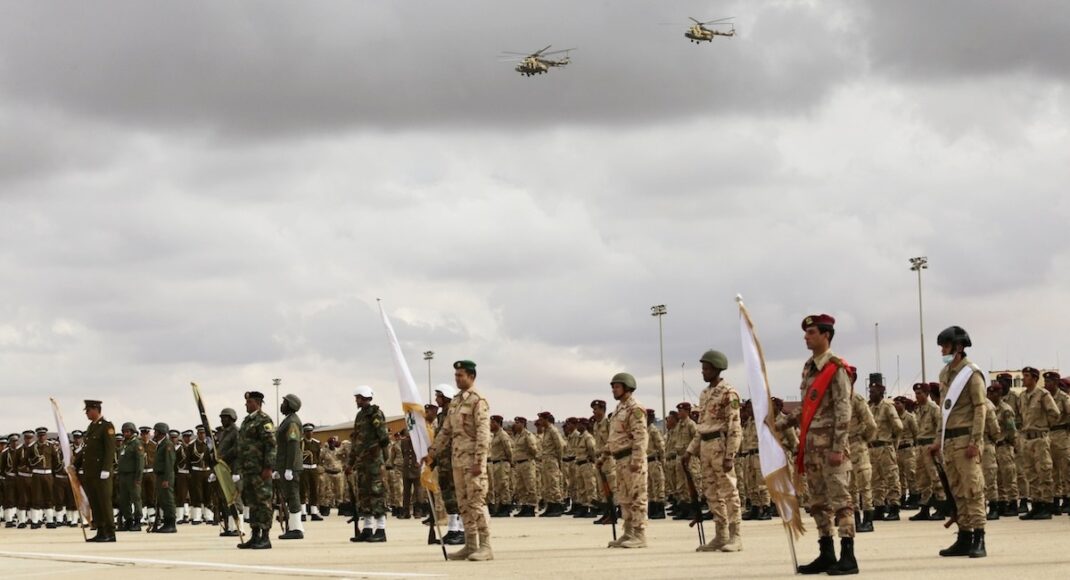

They are part of two units of General Haftar’s military forces, but probably not of the most important brigade: the one led by his son Saddam.
As the Post revealed last Thursday, Italy has been training Libyan soldiers of Khalifa Haftar, a general who effectively controls Libya’s eastern government, for some time in its military bases in Sardinia and Tuscany.
The news is important because officially Italy recognizes as legitimate only the other Libyan government, that of Tripoli, which controls the western half of the country and which has fought with the eastern government on several occasions. The Italian army also trains the military forces of Tripoli with a parallel program which, however, does not have the same problems as the one designed for Haftar’s soldiers, precisely because Italy recognizes the Western government.
A new and relevant detail is that according to the information collected, the soldiers trained in Italy do not belong to the Tariq ben Ziyad brigade, which is the prized piece of Haftar’s army. This is important information, but still to be confirmed with absolute certainty, because Tariq ben Ziyad is commanded by the son of General Haftar himself, Saddam Haftar, who is also the chief of staff of the Benghazi forces, i.e. the eastern government of Libya.
This suggests that with the training program the Italian government on the one hand did not want to completely displease Haftar, considering that it has a political and economic interest in not antagonizing those in charge in eastern Libya; on the other hand, that he wanted to avoid greater embarrassment and problems with his allies and with the government in Tripoli, which would have come if he had directly trained the brigade commanded by the general’s son.
The Tariq ben Ziyad brigade is involved in a number of crimes against Haftar’s opponents such as arbitrary arrests, disappearances and torture. An Amnesty International report published in December 2022 called the crimes committed by its soldiers “a catalogue of horrors”. Haftar’s soldiers trained in Italian bases are part of two units, the al Saiqa, which means “lightning” in Arabic, and the 155th brigade. Before we continue there are a couple of name warnings.
Haftar’s military forces call themselves the Libyan National Army to give the idea that Benghazi is the only legitimate power in Libya and that sooner or later they will absorb, perhaps after submission, even the military forces of Tripoli. But for now there is still no Libyan National Army, because as mentioned Libya is not a unified country.
The second caveat is that Libyan militias often adopt formal names, with ordinal numbers, to give the idea of a well-structured and organized army, but they are just names. In reality, the two armies, and this applies to both Tripoli and Benghazi, are an assortment of militias and armed factions.
The al Saiqa is a special force and was held in high esteem during the regime of Colonel Muammar Gaddafi, a Libyan dictator killed in 2011 while trying to escape from the rebels who had deposed him. After the revolution against Gaddafi, al Saiqa aligned himself with General Haftar and participated in the long urban battle that was fought between 2014 and 2017 to drive out of Benghazi some Islamist and jihadist factions that also included the Islamic State.
Special forces from Western countries were also present during the battle for Benghazi, according to a Reuters article. There were French, British, American and Italian soldiers and they were based inside the airport of Benina, a city in Cyrenaica (in the eastern part of Libya). They didn’t fight, but they were there in the role of military advisors. It is a bit of a constant: foreign governments often offer some kind of assistance to Libyan governments, with the aim of becoming privileged interlocutors. There is a recent video of al Saiqa soldiers marching inside the Pisano barracks in Capo Teulada; and there is another video, also recent, of al Saiqa soldiers training for urban combat inside a building together with an instructor from the Italian army.
Among al Saiqa’s soldiers there are may Salafists, therefore Muslim believers who follow a rigid version of Islam. They belong to a current of Salafism that preaches obedience to the authorities, because if they are authorities – it is a crude summary – it means that they have been put in the command post by Allah. The current that opposes theirs is that of the revolutionary jihadist Salafists, who instead preach armed revolt against the authorities, seen as accomplices of the enemies of religion.
Al Saiqa soldiers were also charged with war crimes by the International Criminal Court in 2017, notably for a couple of videos in which one of their commanders, Mahmoud al Werfalli, made some prisoners kneel in a row and killed them with a shotgun shot to the head. Al Werfalli was murdered in 2021.
The 155th brigade, on the other hand, is a conventional unit, created with soldiers who come from the areas of Libya on the border with Egypt, Chad and Sudan. Its task is to control a large territory also crossed by migration routes and where terrorist groups are hiding. It does so also thanks to the good local and family relations of its soldiers. It is one of Haftar’s strategies to control the very large areas in the southeast of the country with a relatively small number of men.
_______________________