Wael Hamed A. Maoti

Libya is one of the most significant hydrocarbon producers in Africa, with a long history of hydrocarbon exploration and development. According to OPEC data, Libya’s proven natural gas reserves stood at 26 Tcf in 2025, making it the fifth-largest holder of proven natural gas reserves in Africa, behind Nigeria, Algeria, Egypt, and Mozambique, but ahead of Cameroon and Angola.
Even more interesting is Libya’s unconventional gas potential. The U.S. Energy Information Administration (EIA) estimates the country’s technically recoverable shale gas resources at 122 Tcf. This figure is nearly five times larger than its proven conventional reserves. To put this into perspective, Libya’s technically recoverable shale gas resources are broadly comparable to the estimated gas resources of the Levant Basin, which the U.S. Geological Survey (USGS) estimates at around 122 Tcf. Discoveries in the Levant Basin have transformed the Eastern Mediterranean into one of the world’s most attractive hydrocarbon provinces for international oil companies.
Despite its vast resources, Libya remains one of the least explored and least developed gas frontiers in the Mediterranean region. Political instability, security challenges, and years of underinvestment following the 2011 conflict have significantly constrained exploration and development activities, leaving much of the country’s gas potential untapped.
If its conventional and unconventional gas resources can be successfully developed, the economic and energy-sector implications could be transformative. New gas production could help meet Libya’s rapidly growing domestic demand, reduce chronic power shortages, revive upstream investment, and potentially restore the country as a more significant supplier of gas to Europe. Achieving this, however, will require a stable investment environment, clear energy policies, substantial capital expenditure, advanced technologies, and a regulatory framework capable of balancing economic development with environmental and social considerations.
Supply Volatility and the Tightening Domestic Balance
From a production perspective, Libya remains a relatively modest gas producer. Gross natural gas production reached a record high of around 3,400 MMscfd in 2019, but output has since fluctuated due to recurring disruptions in oil production and upstream operations. Associated gas accounts for approximately 40% of total gas production, linking gas supply closely to disruptions in oil production.
More importantly, less than half of Libya’s gross gas output is marketed for domestic consumption. Large volumes are consumed through reinjection into oil reservoirs to enhance oil recovery, while additional quantities are flared or used in field operations and processing facilities. As a result, marketed gas available for domestic consumption and exports represented only about 45% of gross production in 2025.
While marketed gas production has broadly stagnated over the past five years, domestic demand has continued to rise, driven primarily by the electricity sector. Local gas consumption increased from around 788 MMscfd in 2015 to more than 1,150 MMscfd in 2025, absorbing an ever-larger share of available supply. As domestic demand has increased, the gap between marketed production and local consumption has narrowed dramatically, reducing the quantities available for export. Consequently, GreenStream gas exports to Italy have fallen from nearly 700 MMscfd in 2015 to less than 100 MMscfd in 2025.
This widening imbalance between supply and demand represents one of the most critical challenges facing Libya’s gas sector. Without significant investment in new gas developments, flaring reduction projects, and infrastructure upgrades, future production growth may not be sufficient to meet local demand. This situation could necessitate LNG imports to bridge the supply-demand gap or leave the power sector with prolonged power cuts.
Monetizing Waste: Flare Gas Recovery as a Supply Source
Gas flaring remains a major source of inefficiency in Libya’s gas sector. Despite rising domestic demand and declining exports, the country flared an average of 614 MMscfd in 2024.
Recognizing the economic value of these lost volumes, Libya’s National Oil Corporation (NOC) has launched initiatives to recover flared gas through new gathering and processing infrastructure.
In 2025, NOC successfully reduced gas flaring by nearly 100 MMscfd through a series of flare gas recovery projects implemented in collaboration with its subsidiaries. This helped bring total flared gas down to approximately 514 MMscfd. Looking ahead, NOC aims to cut flaring by a further 120 MMscfd in 2026 and achieve a 60% reduction from current levels by 2030, unlocking additional gas supplies for domestic consumption and exports while improving the overall efficiency of the hydrocarbon sector.
Upstream Renaissance: Renewed Exploration and Institutional Momentum
After more than a decade of underinvestment and intermittent disruptions, Libya’s upstream gas sector is showing signs of renewed momentum. Since 2024, the National Oil Corporation (NOC) has intensified efforts to attract international oil majors, accelerate exploration activities, and monetize the country’s untapped gas resources.
The lifting of exploration restrictions and the launch of Libya’s first licensing round in nearly two decades have helped restore investor interest in one of the Mediterranean’s most prospective yet underexplored gas provinces.
Early results indicate a gradual recovery in investor confidence and exploration activity. In 2026, Eni announced three gas discoveries in Block D, south of the giant Bahr Essalam field. According to Eni, the first two discoveries are estimated to contain more than 1 Tcf of recoverable gas, while a third discovery was announced shortly afterward, further strengthening the resource base of the offshore Sirte Basin. In parallel, NOC signed a memorandum of understanding with Chevron covering exploration opportunities in the Sirte, Murzuq, and Ghadames basins, highlighting growing confidence among international energy companies in Libya’s long-term potential.
Although these discoveries will not alone immediately transform Libya’s gas balance, they demonstrate that the country’s upstream sector remains highly prospective and capable of delivering commercial gas volumes. More importantly, they provide the foundation for future production growth that could help reverse the decline in export availability observed over the past decade.
Institutional Stabilization and Offshore Megaprojects
A critical turning point for the monetization of Libya’s resource base occurred in April 2026, when the country’s rival legislative bodies approved a unified state budget of 190 billion Libyan dinars ($29.95 billion). This milestone marks the first unified national spending framework in more than 13 years.
The fiscal breakthrough allocates 12 billion dinars ($1.9 billion) directly to the National Oil Corporation alongside a broader 40-billion-dinar capital allocation earmarked for strategic development infrastructure.
This enhanced fiscal stability provides the long-awaited financial foundation for the landmark Structures A&E offshore gas development project. Operated by Mellitah Oil & Gas, a 50-50 joint venture between NOC and Italy’s Eni, this $8 billion infrastructure development targets the extraction of deepwater fields in Block D.
Scheduled to deliver first gas in 2027, the two structures are expected to reach a combined plateau production rate of 750 MMscfd. Beyond its significance for the upstream sector, the project is expected to play a pivotal role in strengthening the country’s gas balance by supplying additional volumes to the domestic market, supporting power generation, and potentially increasing export availability through the GreenStream pipeline to Europe.
Libya’s Role in Europe’s Diversification Strategy
The significance of a recovery in Libyan gas production extends beyond its domestic market. Since the outbreak of the Russia-Ukraine war, the European Union has taken several measures to diversify gas supply sources and reduce dependence on Russian imports.
While LNG has played a critical role in offsetting lost Russian supply, pipeline gas remains an attractive option due to its lower delivered supply costs and reduced exposure to global LNG market volatility.
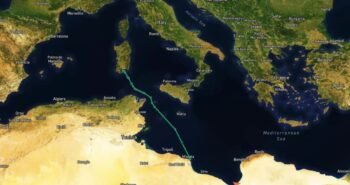
Libya is uniquely positioned to contribute to Europe’s diversification strategy through the existing GreenStream pipeline, which directly connects Libya with Italy and has a capacity of 775 MMscfd. However, the pipeline is currently operating far below its design capacity because of limited gas volumes available for export.
Any meaningful increase in Libyan gas production could therefore provide Europe with an additional source of nearby and relatively low-cost gas supply. For Italy in particular, higher Libyan exports would further strengthen its ambition to become a Mediterranean gas hub connecting North African producers with European consumers.
In 2025, Libya’s share of the European Union’s gas import mix fell to just 0.3%, reflecting the sharp decline in GreenStream exports and underscoring how far current export levels remain below historical volumes.
The Trans-Saharan Transit Opportunity
Beyond direct exports to Europe using its own resource base, Libya could also play an important role in regional gas integration initiatives.
One of the most ambitious proposals is the Nigeria-Niger-Libya pipeline, which aims to transport Nigerian gas reserves through Niger to Libya and eventually European markets.
Although the project has traditionally focused on Algeria as the export gateway through the Trans-Saharan Gas Pipeline (TSGP), Libya’s extensive pipeline infrastructure, strategic Mediterranean location, and proximity to European markets could provide an alternative export route in the future.
The participation of Libya would enhance regional energy cooperation while increasing supply diversification options for Europe. However, significant political, security, financing, and commercial challenges must still be addressed before such a project can move beyond the planning stage.
Conclusion: The Monetization Paradox and the Path Forward
Libya’s gas sector presents a striking paradox. The country possesses one of Africa’s largest conventional gas resource bases and substantial shale gas potential, yet it remains a relatively modest producer and a relatively small exporter compared with its resource potential.
Rising domestic demand, infrastructure constraints, high flaring rates, and years of underinvestment in the upstream sector have steadily reduced export availability despite abundant resources. Recent developments, however, suggest that the sector may be entering a new growth phase. Ongoing flare reduction initiatives, renewed exploration activity, major gas discoveries, and growing interest from international oil companies are creating opportunities to expand supply and improve the country’s gas balance.
The country’s principal challenge is not resource availability, but its ability to translate geological potential into commercially viable and sustained production growth. Success in this regard will determine whether Libya remains primarily focused on meeting domestic demand or re-emerges among gas exporters to Europe in the medium term.
In the medium term, Libya’s gas production is expected to increase gradually as new projects come online. The Structures A&E development alone is expected to add around 750 MMscfd of production from 2027 onward, while ongoing flare gas recovery projects could unlock an additional 200–300 MMscfd by 2030.
Together, these developments could significantly improve the country’s gas balance and support a partial recovery in exports through the GreenStream pipeline. However, rising domestic demand will likely absorb a large share of the new supply.
As a result, Libya is expected to remain primarily focused on meeting domestic needs, although export volumes could recover from less than 100 MMscfd in 2025 to around 300–500 MMscfd by the end of the decade, provided that political stability and investment momentum are maintained.
_____________