Serag El Hegazi

Last week’s visit to Libya by Massad Boulos, Senior Advisor to U.S. President Donald Trump for Arab and African affairs — centred around the Libya Energy and Economic Summit (LEES 2026) in Tripoli — has been portrayed in Libyan and international press as a milestone in U.S.–Libyan relations.
According to news reports, Boulos emphasised that the United States sees “high value in the Libyan-American partnership” and is ready to deepen cooperation across economic and security sectors. He underscored efforts to expand Libya’s energy production and development ties with U.S. firms, signalling a renewed U.S. strategic focus on the country’s vast energy potential.
Yet this moment is about more than new deals and diplomatic optics. It exposes a central dilemma that has long shaped Libya’s trajectory since the 2011 revolution: will international engagement reinforce narrow economic gains and short-term stability, or will it support sustainable development that addresses the country’s deeper structural challenges?
The Context: A Fragile Political
Landscape
Libya’s political landscape remains deeply fragmented more than a decade after the fall of Muammar Gaddafi. Rival administrations, institutional divisions, and competing security actors continue to complicate governance and policy coherence. The United Kingdom’s Parliament notes that rival governments in the west and east remain a central fault line, with repeated postponements of national elections underscoring a broader political impasse.
Internal clashes and unrest also persist: even in 2025, Tripoli saw renewed armed confrontations that required ceasefires to protect civilians and stabilise institutions. These conditions shape Libya’s economic decision-making, often privileging short-term revenue generation — especially oil — over long-term planning and institutional reform.
Economic Re-Engagement:
A Double-Edged Sword
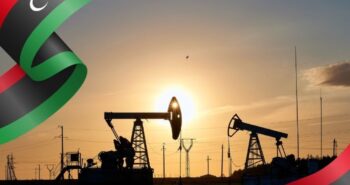
At the LEES 2026 Summit, Boulos and Libyan counterparts celebrated significant agreements with international oil majors, including U.S. and European firms, aimed at boosting Libya’s hydrocarbon output and foreign investment. Meanwhile, Reuters reports that Libya has signed a 25-year oil and gas development deal worth over $20 billion with TotalEnergies and ConocoPhillips, reinforcing its role as a major energy supplier.
From a conventional policy standpoint, such deals are framed as economic growth and stability anchors. However, for Libya — a nation heavily reliant on oil revenues that constitute the bulk of fiscal income — this model risks reinforcing resource dependency and overlooking the need for economic diversification and resilience. According to the World Bank, Libya’s dependency on hydrocarbons, coupled with instability, has constrained productivity and undermined broader development prospects.
This is not just a Libyan problem, but a broader issue across the Middle East and North Africa (MENA), where hydrocarbon-dependent economies face similar pressures to transition toward diversified, knowledge-driven, and resilient economic models.
Sustainability Beyond Oil: The Case
for a Broader Agenda
To be meaningful, sustainable engagement must go beyond headline-grabbing energy deals and include three interconnected dimensions:
1. Economic Diversification
Libya’s oil wealth has historically crowded out investment in other sectors. This structural imbalance is a key reason why unemployment, poverty, and public service gaps persist despite abundant natural resources. The World Bank emphasises that without diversification, Libya’s economy remains vulnerable to global price shocks and conflict-driven disruptions.
2. Institutional Governance
Many analyses highlight the fragility of Libyan institutions, which lack the capacity to manage revenues transparently, enforce environmental protections, or coordinate long-term development planning. Political fragmentation and corruption — including within the national oil sector — have eroded public trust and impeded reform efforts.
This points to a broader dilemma: international actors can invest capital without strengthening domestic systems, but true sustainability requires empowering local governance frameworks that can oversee and regulate development, rather than bypassing them.
3. Environmental and Social Resilience
Libya sits at the intersection of climatic vulnerability and resource scarcity. The country faces acute water stress, desertification, and environmental degradation, as well as increasing climate extremes linked to global warming.
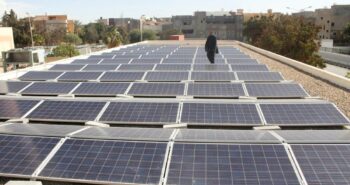
These challenges compound socio-economic vulnerabilities, as climate shocks disproportionately affect rural livelihoods and urban services. Without planning and investment in renewable energy, water resource management, and climate adaptation, Libya’s development gains will remain fragile.
Indeed, recent UNDP-led initiatives in Libya focus on advancing a just and sustainable energy transition, explicitly linking environmental sustainability with economic diversification and climate resilience.
Libya in the MENA and Global
Sustainability Landscape
Libya’s situation mirrors broader regional transitions. Countries across the MENA region — from North Africa to the Gulf — are grappling with the imperative to decouple growth from fossil fuels, strengthen institutional capacity, and introduce sustainable governance. International frameworks such as the UN Sustainable Development Goals (SDGs) and climate initiatives reiterate that sustainability is not an add-on but central to long-term peace, prosperity, and human well-being.
In this context, foreign policy must adapt. As commentators on sustainable peace-building have noted, aligning diplomatic engagement with human rights, governance, and SDGs — rather than narrow transactional interests — can help conflict-affected states like Libya break the cycle of instability that has plagued them for decades.
A Strategic Pivot or a Missed
Opportunity?
The U.S. engagement under Boulos can still be constructive. A U.S. strategy that integrates economic cooperation with support for institutional reform, environmental resilience, and inclusive governance would resonate with broader MENA sustainability efforts. But there is a risk: focusing narrowly on energy production and security risks replicating the old paradigm of resource-centric engagement that has underpinned cycles of instability.
As Libya expands its production targets and attracts foreign firms, policymakers in Tripoli and abroad must ask tough questions:
- Are international deals tied to requirements for environmental protection, local capacity building, and revenue transparency?
- Do investment frameworks support job creation and diversification beyond hydrocarbons?
- Can partnerships help Libya strengthen its water, energy, and food nexus to build resilience against climate shocks and political fluctuations?
Conclusion: Sustainability as Strategy
Libya stands at a genuine crossroads. The recent visit by a senior U.S. adviser reflects growing geopolitical and economic interest. But without anchoring this engagement in sustainability — encompassing diversified development, institutional reform, and environmental resilience — Libya risks repeating cycles of instability under a different banner.
The nation’s future will not be secured solely by oil deals or temporary stabilisation. It will be cemented by policies and partnerships that embed sustainability into the fabric of governance and by international engagement that sees Libya not just as a supplier of resources but as a partner in long-term development.
In the broader MENA context, this approach aligns with regional imperatives to transition toward resilience and equity. For Libya, making sustainability a central pillar of foreign cooperation could be the difference between enduring stagnation and a genuine transformation.
***
Dr Serag El Hegazi is a Lecturer and a Program Leader in Sustainable Development and Project Planning at the University of Bradford, and a member of the board and specialist in North African Studies at John and Elnora Ferguson Centre for African Studies (JEFCAS). His research focuses on sustainable urban development, post-conflict reconstruction, and environmental governance in the MENA region.
_____________