Jonathan M. Winer

Parallel Tracks
Diplomatic efforts to reduce Libya’s fragmentation through negotiated arrangements among its political and security actors are ongoing.
The United Nations continues to press for its long-stalled political roadmap toward elections, while the approach associated with US Special Envoy Massad Boulos has focused on executive unification through the distribution of ministerial portfolios between western and eastern authorities as a stabilizing mechanism.
These efforts reflect a pragmatic recognition that Libya’s principal centers of power must be accommodated in any durable arrangement, and they may offer a pathway to near-term de-escalation.
But their viability in practice depends on how they connect to Libya’s formal institutional framework. The LPA does not authorize a bilateral executive bargain as a substitute for the consultative process involving the House of Representatives and the High Council of State.
To the extent that arrangements are perceived as bypassing those bodies, they risk lacking the legal and political grounding necessary for durability. In particular, absent recourse to mechanisms such as Article 64 of the agreement, which allows for broader political dialogue in certain circumstances, a narrowly constructed executive understanding may not resolve underlying questions of legitimacy.
The challenge, therefore, is not whether such arrangements can contribute to stabilization, but whether they can be integrated into a process that is recognizable under Libyan law and acceptable to the formal institutions, notably the House of Representatives and the High Council of State, whose role cannot be supplanted by executive-level agreements without rendering the outcome legally and politically unsustainable.
The Risk of Unilateralism
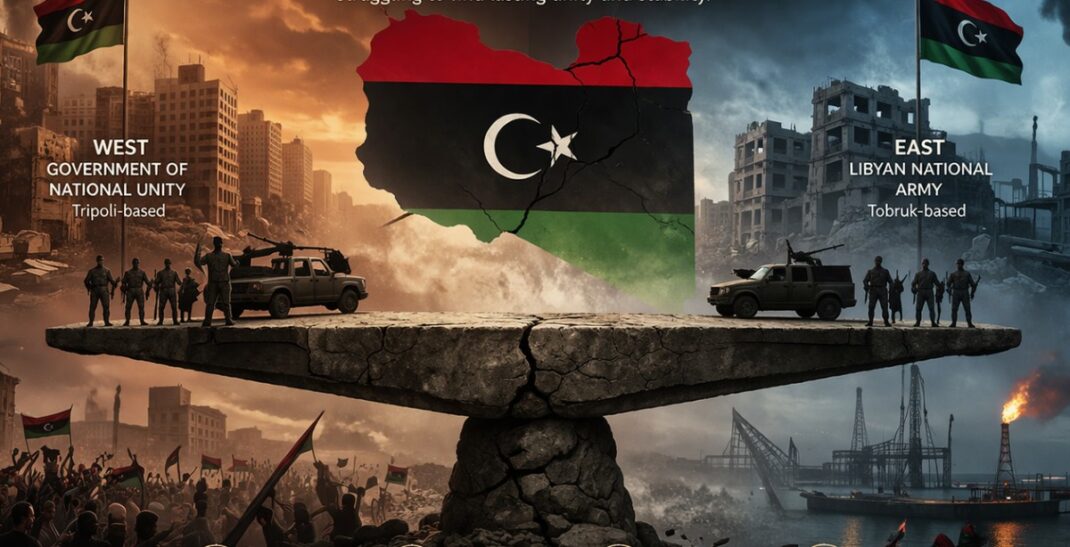
The most immediate institutional risk would arise if the House of Representatives under Speaker Saleh were to act unilaterally to designate a new prime minister, as he has previously sought to do. That Tobruk-based body retains both a legal argument to do this under the LPA and a political constituency for doing so again. Such a move would likely be rejected in Tripoli and by key western Libyan actors, as Saleh’s previous efforts were.
The result would not be resolution, but the re-emergence of parallel executive authorities, each claiming legitimacy. Under those conditions, control over ministries, financial institutions, and energy infrastructure would become contested. Oil production and export, which depend on coordination across institutions that span Libya’s geographic divide, would once again be vulnerable to interruption.
This is the scenario Article 4 was intended to avoid. In present circumstances, it could inadvertently enable it.
The Case for a Structured Process
Avoiding that outcome requires treating Article 4 not as self-executing law, but as a framework requiring agreed implementation.
The core objective should be to convert a potentially destabilizing vacancy into a controlled, time-limited transition that preserves continuity while enabling a legitimate replacement process.
A credible approach would rest on a small number of elements.
First, a clear and agreed protocol for determining vacancy or incapacity.
Because Article 4 is silent on this point, the threshold question must be resolved politically, not litigated in real time.
A practical solution would involve a combination of medical attestation, acknowledgment by the Presidential Council acting as the LPA’s collective head of state and a domestic guarantor of continuity, and formal notification by the House of Representatives, with immediate communication to the High Council of State and the United Nations.
Second, immediate transition to a tightly constrained caretaker government.
The outgoing government, deemed resigned under Article 4, would continue only to perform essential functions.
One of the existing deputy prime ministers could be designated as acting head for this limited purpose. The caretaker’s authority would need to be explicitly bounded: no major security appointments, no long-term financial or energy commitments, and no structural institutional changes. The narrower the interim mandate, the lower the incentive to contest it.
Third, a time-bound, joint selection process anchored in the agreement’s requirement for consultation between the House of Representatives and the High Council of State.
A small joint committee, operating under agreed criteria and timelines, could produce a shortlist of candidates for prime minister within a defined period. The aim would be to force convergence, or at least structured negotiation, rather than unilateral designation.
Fourth, a visible but limited role for the Presidential Council and the United Nations Support Mission in Libya (UNSMIL).
Neither can impose a solution, but both can help structure one. The Presidential Council can act as a domestic guarantor of continuity, while the United Nations can provide procedural support and reinforce expectations regarding legitimacy.
Finally, a defined fallback mechanism in the event of deadlock.
If the House-High Council process fails, a narrowly scoped political dialogue mechanism, drawing on existing UN frameworks and potentially anchored in Article 64 of the agreement, could be convened with a limited mandate to resolve the impasse on executive formation.
None of these steps are likely to emerge organically from Libya’s current political dynamics. They would require external alignment and active facilitation.
In practice, that means re-engagement by key European and regional actors, in alignment with the United States, to coalesce around a common approach using their diplomatic and economic leverage to support a UN-convened process.
UNSMIL remains the only forum capable of structuring such an effort, but it can do so effectively only with coordinated backing. Under current conditions, such a process is unlikely to produce agreement in advance of a crisis.
Its value lies in doing the work ahead of time: identifying what a transition would require, establishing how it could proceed, and making clear that the House of Representatives and High Council of State will shape any outcome, whether as participants or as obstacles.
Without that groundwork, when a succession moment comes, events are likely to be driven by high-risk competition on the ground rather than any agreed process.
Conclusion
Libya does not face an imminent succession crisis, but it faces a plausible one, in a context where the stakes are even higher than usual. The combination of leadership uncertainty, legal ambiguity, economic strain, and geopolitical pressure creates a narrow window in which preparation can make the difference between controlled transition and renewed fragmentation.
Article 4 of the LPA provides a starting point. On its own, it is insufficient. With a modest but deliberate implementing framework that aligns external diplomatic efforts with Libya’s formal institutional requirements, the LPA can still serve its intended purpose: not to decide who governs Libya next, but to ensure that the question is answered without destabilizing the country in the process.
***
Jonathan M. Winer is a Distinguished Diplomatic Fellow at the Middle East Institute.
______________