Jonathan M. Winer

Libya’s stability has taken on renewed strategic importance as the impact of the United States and Israel’s war with Iran reverberates through global energy markets, pushing Brent crude prices to a three-year high as of mid-March.
Disruptions to shipping, heightened risk premiums, and constrained spare capacity have sharpened attention on every marginal barrel. In that environment, Libya’s oil production, stable for now under informal arrangements but structurally fragile, matters more than usual.
Sustaining existing Libyan production, and potentially increasing it, depends on a governing arrangement capable of keeping ports open, pipelines flowing, and revenues distributed without triggering conflict.
The arrangements that have been maintaining Libyan oil production at 1.2-1.3 million barrels per day, roughly 1% of global supply, are under growing strain as the North African country’s economic situation deteriorates.
Liquidity shortages in dinars, limited access to foreign currency, and periodic fuel constraints are increasingly affecting daily life. At the same time, the Libyan dinar continues to weaken against the hard currencies required to import food and refined fuel.
Since early 2025, the official exchange rate has moved from roughly 5.6 dinars per US dollar to approximately 6.3-6.4 following successive devaluations, while the parallel black market rate has at times reached 9-10 dinars per dollar, putting increasing stress on Libyan consumers in a country heavily dependent on imports for food and fuel.
The gap between official and parallel exchange rates is not simply a monetary distortion. It is a mechanism that Libyan elites employ to manipulate access to and distribution of state resources, enrich themselves by arbitrage, and compete for political power.
These dynamics are increasingly manifesting in heightened friction among Libya’s diverse security actors. While large-scale conflict has not resumed, armed groups linked to state institutions are again jockeying for position, particularly around access to revenue streams, fuel distribution, and territorial control. In Libya’s recent history, such patterns have often preceded more overt confrontation.
Questions Surrounding Leadership Successions
Adding to the potential for renewed conflict, there are important questions emerging about the longevity of the principal figures leading Libya’s eastern and western power structures.
Abdul Hamid Dbeibeh, prime minister of the internationally recognized Government of National Unity in Tripoli, has experienced publicly reported and acknowledged health issues in recent months. While the official characterization has been of routine or manageable medical events, the pattern of recurrence has raised questions among Libyan insiders about continuity of leadership.
At the same time, Khalifa Hifter, who dominates the military and political structure in eastern Libya and exerts influence across much of the south, is 82 years old and has a history of health problems.
Both men may remain in place for the foreseeable future. But if either were to become unable to govern, or if uncertainty about their capacity were to become widely accepted among elite actors, Libya would face a familiar but still unresolved question: not only who succeeds, but how succession occurs in a system that lacks a single, uncontested constitutional chain of authority.
Libya’s political trajectory is shaped not only by formal institutions but by evolving patterns of de facto authority. In eastern Libya, the consolidation of power within the Hifter family has raised the prospect of a managed succession that may not align with formal political processes, while in Tripoli, governance is widely understood to depend on members of the Dbeibeh family operating within a narrow inner circle.
These dynamics do not predetermine outcomes, and they may be subject to negotiation or accommodation. But they underscore a central reality: Succession in Libya is unlikely to be resolved solely through formal legal mechanisms, and any durable process will need to account for the underlying distribution of power as well as the requirements of law.
The consequences of getting that question wrong are not abstract. Libya’s recent history demonstrates that disputes over executive legitimacy translate quickly into disruptions in oil production, fragmentation of fiscal authority, and localized or national conflict.
While oil production in Libya has been comparatively stable in recent years, it is still subject to politically driven disruption, as reflected in a late March attack on the Sharara field, where authorities recovered Russian-made munitions from a damaged crude pipeline.
In past conflicts, output has fallen to a few hundred thousand barrels per day, and at times far lower. A disruption of that magnitude would remove on the order of 1 million barrels per day from global supply at a time when the global economy can least afford it.
Oil markets are structurally sensitive to supply shocks: Historical analysis suggests that a disruption of roughly 10% of global supply can produce price increases on the order of 35-40%, reflecting the low short-term elasticity of both supply and demand.
Under this framework, a 1% decline in global supply would ordinarily increase prices by only a few percentage points.
In the current environment, however, with commercial shipping through the Strait of Hormuz effectively halted, additional risk to Red Sea transit as the Houthis have entered the conflict, and energy markets already under acute strain, a collapse of Libyan oil production could plausibly push global prices significantly higher and amplify existing volatility.
The Legal Framework and Its Limits
On paper, Libya does possess a governing framework for executive transition. The 2015 Libyan Political Agreement (LPA), still embedded in the country’s constitutional architecture, addresses any vacancy at the top of government.
Article 4 of the agreement provides that if the office of prime minister becomes vacant “for any reason whatsoever,” the entire government is deemed to have resigned. The outgoing government continues only in a caretaker capacity, while a new prime minister is to be selected through a consultative process involving the House of Representatives, controlled by its 82-year-old speaker, Aguila Saleh, and the consultative body established by the LPA, the High Council of State.
This provision is often cited as a mechanism for orderly transition. In practice, it is better understood as a trigger for institutional reset without a clear mechanism to execute it.
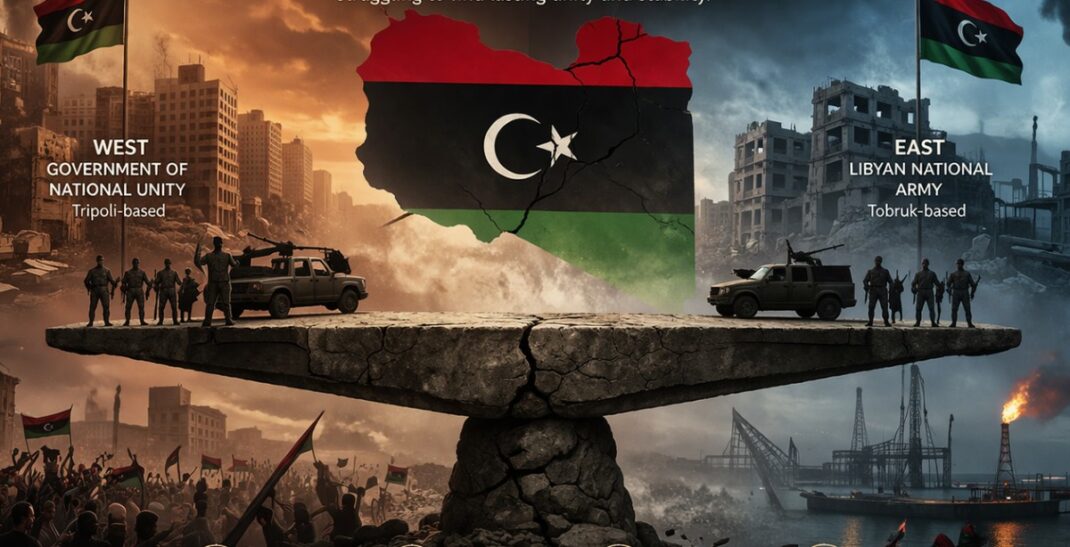
In such a situation, Tripoli-based actors would have strong incentives to control and maintain the caretaker government in Libya’s west and to slow, if possible, any action by the House of Representatives, based in the eastern coastal city of Tobruk and aligned with eastern authorities operating from Benghazi, to appoint a successor, including by asserting that required consultations with the Tripoli-based High Council of State had not been properly conducted and that any such appointment would therefore lack legal validity.
That divergence has the potential to reignite divisions left by Hifter’s April 2019 offensive to seize western Libya, which ended in 2020 after Turkish drone and air-defense support shifted the battlefield balance and halted his advance on Tripoli, following a conflict that killed more than 2,000 Libyans.
In the absence of a clear and accepted mechanism for succession, disputes over process risk becoming vehicles for broader contests over power within Libya’s rival political and security structures.
***
Jonathan M. Winer is a Distinguished Diplomatic Fellow at the Middle East Institute.
_____________________