Jalel Harchaoui and Frederic Wehrey

The Fractured Country Needs Political Unity, Not Washington’s Dealmaking
For decades, U.S. involvement in Libya has oscillated between neglect and fleeting moments of attention and resolve. But so far, the second Trump administration has displayed a surprising degree of interest in the oil-rich country.
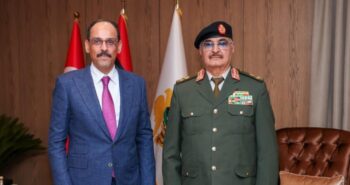
It appears to want to end the long-standing stalemate between Libya’s two ruling factions—the UN-recognized government of Prime Minister Abdulhamid Dabaiba in the west in Tripoli and the domain of Field Marshal Khalifa Haftar, based in the eastern city of Benghazi.
In the past year, this push has been spearheaded by Massad Boulos, U.S. President Donald Trump’s senior adviser for Arab and African affairs.
After rounds of shuttle diplomacy, Boulos announced an apparent breakthrough earlier this month: the two rival governments had agreed on a unified budget for the first time in years. Boulos hailed the deal on social media as “a milestone for cooperation that offers many benefits for the economy and for Libyans across all regions.”
The agreement is certainly a step in the right direction. But Washington should not imagine that what is essentially a financial deal between two dynasties constitutes a major advance toward political unification.
The April 11 agreement does not address the deeper drivers of Libya’s crisis and raises the risk of renewed destabilization.
Although Libya has not seen major armed hostilities since 2020—when a nearly two-year-long civil war sparked by Haftar’s attack on the Tripoli government came to an end—the continued extraction of state resources for personal gain by both ruling factions has left Libya in a profound fiscal crisis and without a unified executive.
Successive efforts to deal with these challenges have failed. In 2020, the UN launched an initiative aimed at unifying the banking sector, ensuring greater transparency in the oil sector, and encouraging local governance reforms.
These measures were supposed to pave the way for a unified government with restructured political institutions and, within a year, national elections. Partly because of halfhearted support from the Biden administration, the elections never materialized, and the UN push fell apart.
In 2022, the United Arab Emirates, with U.S. acquiescence, brokered a deal behind closed doors that saw the Dabaiba family install a Haftar-aligned chair at the helm of the National Oil Corporation, Libya’s sole wealth generator. By 2025, that formula had averted further civil war but done little else. Libya was mired in economic crisis and political paralysis.
A key reason for the failure of the 2022 deal was its transactionalism—the errant belief that Libya’s political gridlock could be broken by appealing to the commercial interests of competing elites rather than by addressing the needs of the Libyan people.
But this exact logic underlies the current approach of the Trump administration. Instead of striving for a flashy diplomatic breakthrough and an economic deal with unelected elites, Washington needs to pursue a broader and more inclusive path in Libya.
It must support existing UN efforts to bolster the independence of Libya’s financial and administrative institutions and lay the groundwork for national elections. And it must do more to rein in the disruptions caused by Turkey, the single most consequential foreign actor in the country. Only then will the United States truly help prevent Libya from slipping into greater disarray.
GILDED STATE
Libya’s relative peace in recent years is often taken as a sign of stability. This is a dangerously complacent view. Both the Dabaibas and the Haftars have used their financial gains to acquire advanced weapons and bolster their own military coalitions, a development that increases the risk of violent confrontation.
While the main factions have grown rich, the division of the country has lowered living standards nationwide, especially in peripheral areas. In the remote south, the Haftars’ focus on illicit revenue over local needs has lately stoked violence.
The divisions in Libya’s governing structure also make the country susceptible to manipulation by foreign actors, chief among them Turkey.
Ankara’s Libya policy has lately been dominated by the pursuit of a maritime deal, originally struck in 2019, that would give Turkey unprecedented regional control and connect it to Libya’s eastern shores.
After years of quiet entrenchment in the northwest, Ankara spent much of 2025 courting the Haftar family in the east in an effort to secure parliamentary ratification of the maritime deal—a shift from its traditional alliance with the Dabaibas. Turkey is now an ambitious, revisionist actor in Libya, playing both sides and disturbing Libya’s already fragile power balances.
After the collapse of the UN-backed election initiative in 2021, the Biden administration retreated from the notion that promoting democracy would stabilize Libya and instead followed the Emirati impulse to cut deals.
The July 2022 appointment of a Haftar loyalist at the helm of the National Oil Corporation encouraged Libya’s leaders to further interfere in the economy. Both factions and their associates scrambled to claim piecemeal ownership of state revenues, exert influence over the central bank, and spend public funds on infrastructure at their own discretion.
Some of these expenditures have addressed genuine needs, but a huge amount of money has been devoted to prestige construction projects—stadiums and luxury hotels, for instance—designed to generate contracts for cronies and not to serve the population. The Haftars possess certain advantages over the Dabaibas.
Their territory is markedly bigger, encompassing Libya’s major oil fields and export terminals. The scale of the Haftar domain leads foreign governments, such as the United Arab Emirates, to try to woo the potentate in Benghazi without exerting any pressure for reform.
The blurry power-sharing arrangements that were intended to stabilize Libya’s institutions have only accelerated their erosion, as was evident with the central bank in the summer of 2024.
The Dabaibas, reacting to the ever-growing tilt of the National Oil Corporation toward the Haftars, forced out the central bank’s governor in the hopes of installing a loyalist. The Haftars responded by imposing an oil blockade, shutting down most of the country’s routine exports for more than six weeks and costing Libya nearly $3 billion.
The international community refrained from condemning the action, effectively signaling that the Haftars could repeat such coercion with impunity in the future, no matter the costs to ordinary Libyans.
***
Jalel Harchaoui is a Libya specialist with the Royal United Services Institute.
Frederic Wehrey is Senior Fellow in the Middle East Program at the Carnegie Endowment for International Peace.
___________________