Gregory Holyoke

Family at home, friends abroad
Over the decades, Haftar had built up close relationships in Cairo, but when he returned to Libya, Egypt was also in the midst of revolutionary fervour, tending towards the Islamist Muslim Brotherhood group. As Gazzini explained, “There was a jihadist threat in Libya and then we have Egypt, which was very weak.”
“If you go back to before 2013 before (President Abdel Fattah) El-Sisi, there was this fear that Egypt could implode … And the Europeans also didn’t want Egypt to collapse,” she explained. Faced with difficult choices and fearing the likes of the self-proclaimed IS group spreading their influence in North Africa, some analysts believe that European leaders gave Haftar — whose power and army grew in strength — the silent nod of approval to do what he thinks is right.
“They needed a new Gaddafi, someone who could stop democracy from becoming contagious. Haftar fit the mould: ruthless, ambitious, and willing to trade sovereignty for support,” El Gomati believes. Egypt also backed him as a known known, someone in the immediate neighbourhood who understood the context, but also the perils the region was facing.
The list of backers, silent or otherwise, only continued to grow from there on out. In addition to Cairo, Haftar gained the support of governments ranging from Moscow to Washington, even though the UN did not recognise his wider authority as a legitimate head of state. However, according to Gazzini, it was Abu Dhabi and Paris who ended up as his most unquestioning supporters. While the Emirates saw the allure of Libya’s oil reserves — the largest in Africa — France and Europe more widely were dealing with an influx of refugees through the Mediterranean, hundreds of thousands of whom were hoping to reach the continent via Libya.
In all that, Haftar saw his chance to utilise the international support and finally become the ruler of Libya — and who knows, maybe even bigger than Gaddafi himself. When Haftar announced his intention to overthrow the Tripoli-based, internationally recognised Government of National Accord on the day UN Secretary General António Guterres arrived in the capital in 2019, even Egypt warned him against it.
“But he was full of hubris from the Emiratis who wanted to do it. They were giving him aerial cover. The French also wanted to do it,” Gazzini told Euronews from the IRG offices in Rome. It is a hubris that some have compared to his ally Russian President Vladimir Putin’s full-scale invasion of Ukraine. Yet similarly, Haftar’s attempts also failed. Tripoli refused to fall into Haftar’s troops’ hands, and Libya fell back into a form of stalemate.
Divided we stand
Throughout this time, Haftar was accumulating extraordinary wealth for his family, whom he had installed in various positions, experts say. As Eaton told Euronews, “There was a debate on whether when Khalifa (Haftar) died, could his sons come in and take over. It seems that they have come in and started creating their own portfolios even before.” And it is all in the family and the hands of his children, as El Gomati succinctly outlined.
“Saddam runs the ground forces. Khaled commands the personal guard. Belkacem controls the billions in Libya’s reconstruction fund. Sedig runs the reconciliation file,” he explained. The family has amassed a portfolio estimated to be worth billions. Despite his failure to seize the wider country, Haftar and his sons continue to run much of Libya. “He controls everything that matters in eastern Libya,” El Gomati said.
“Oil fields, ports, airports, military bases, and the central bank’s printing press. He has his own air force, controls cross-border smuggling routes… It operates like a state within a state.” As shown by the EU’s lack of retribution over the past week, the self-proclaimed field marshal also maintains significant international backing. He was recently in Russia for talks with Putin – a trip he was rumoured to have died on, but once again, he miraculously recovered.
The “humiliation” of the EU delegation also isn’t the first time Haftar has managed to push around supposed allies in Europe. The analysts Euronews spoke to put this down to Europe’s domestic wranglings over “irregular migrations,” and the simple fact that “there’s no way migrant boats would be leaving the east without Haftar knowing.”
Gazzini gave the example of her native Italy: “At some point, a lot of migrants were going to the coast of Italy about a year and a half ago, he let it be known that he wanted an official visit and an official invitation to Rome. And he got that.” At the end of his interview, El Gomati did not mince words about the European approach to the Libyan commander. “Europeans keep volunteering as victims. Haftar treats EU diplomats like desperate suitors because that’s exactly what they are.”
It is a point that Eaton also touches upon, albeit somewhat more diplomatically. “There’s a real imbalance,” he concluded. However, Europe is not acting in a vacuum either. It is often trying to play by international rules and conventions in an arena where shady actions speak much louder than words and agreements on paper.
Sometimes, it is better to have a strongman on your side — or at least his ear. “We have very little leverage compared to other states. Compare it with the Russians, who have MiGs and have fighter jets that are at Haftar’s disposal,” Gazzini admitted. “Compare us to the Emiratis who bring in reinforcements and ammunition in violation of the embargo.”
When a senior EU delegation travelled to the eastern Libyan city of Benghazi last Tuesday, they were hoping to discuss ways to limit the increasing numbers of migrants leaving Libya heading north to Europe. However, shortly after their jet touched down at Benghazi Airport, the cluster of EU foreign ministers – as well as European Commissioner for Migration Magnus Brunner – were sent packing.
There was no agreement, not even a meeting. They were unceremoniously kicked out and declared “personae non gratae,” a source on the European side told Euronews at the time, adding that the delegation was caught in a diplomatic “trap” in which Haftar tried to force them to take a photo with, and tacitly legitimise, his Benghazi-based government.
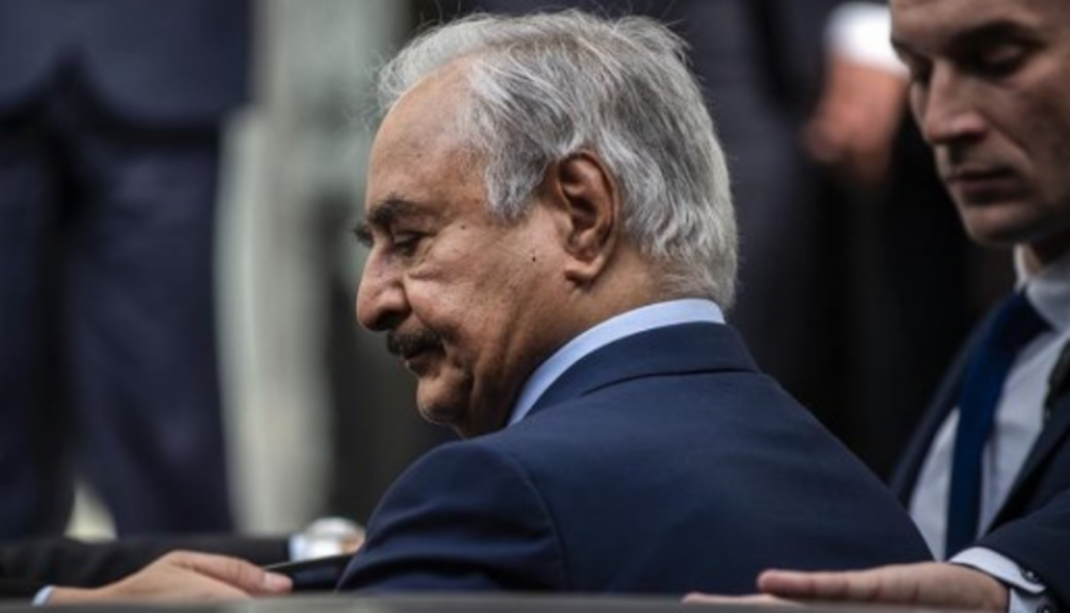
While the EU itself has been remiss to publicly comment on what one senior Libyan analyst said was outright “humiliation,” it is understood that the man they were hoping to strike a deal with was General Khalifa Haftar.When a senior EU delegation travelled to the eastern Libyan city of Benghazi last Tuesday, they were hoping to discuss ways to limit the increasing numbers of migrants leaving Libya heading north to Europe.
However, shortly after their jet touched down at Benghazi Airport, the cluster of EU foreign ministers – as well as European Commissioner for Migration Magnus Brunner – were sent packing. There was no agreement, not even a meeting. They were unceremoniously kicked out and declared “personae non gratae,” a source on the European side told Euronews at the time, adding that the delegation was caught in a diplomatic “trap” in which Haftar tried to force them to take a photo with, and tacitly legitimise, his Benghazi-based government.
While the EU itself has been remiss to publicly comment on what one senior Libyan analyst said was outright “humiliation,” it is understood that the man they were hoping to strike a deal with was General Khalifa Haftar.
________________________