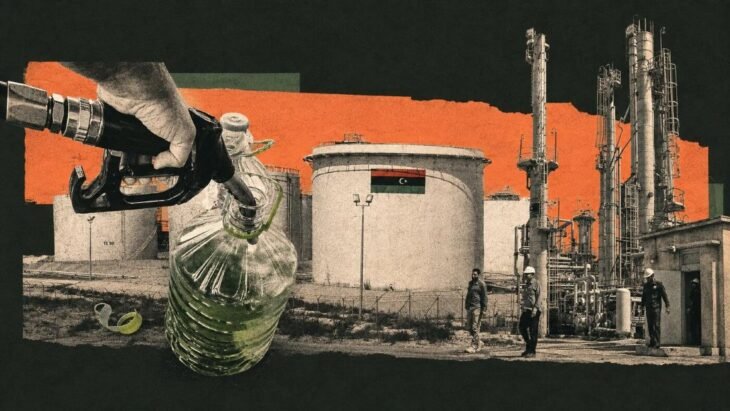
Long power cuts and severe fuel shortages have disrupted daily life in Libya, a country already plagued by an enduring political deadlock, conflict and corruption, and holding Africa’s largest oil reserves.
As the summer heat peaks, the worst crisis in years has tightened its grip on many Libyans who struggle to stay cool and keep their houses, cars and businesses running. Experts and United Nations officials say the root of the problem lies in corruption, weak governance and years of inadequate maintenance at power plants.
Libya holds about 48 billion barrels of proven oil reserves and produces roughly 1.5 million barrels a day. It is seeking to raise output to 2 million barrels a day. But the country only produces a third of the fuel it needs for domestic consumption.
Last year, it imported $7.8 billion worth of fuel, according to figures from the National Oil Corporation. For ordinary Libyans, the crisis has meant spoilt food and stalled businesses amid unbearable heat. As temperatures approach 50C in parts of the country, Slimane Fitouri regularly checks the generator he bought to counter the power cuts at his grocery store in the capital, Tripoli.
“Because of the outages, two refrigerators broke down, in addition to dairy products going bad,” Fitouri told AFP. “I don’t know how long I can hold out.” During AFP’s visit to his shop, the power went out, and customers hurried to finish their shopping by the light of their phones as Fitouri switched on the generator. – ‘Very expensive’ – But such generators require a significant amount of fuel — which has also become a burden for Fitouri. “It’s very expensive and doubles the losses,” he said.
The crisis also drove up the price of generators themselves, as demand soared. Abderrahmane Souissi, who works at the health ministry, examined several generators at a Tripoli shop but found them too expensive. “Their prices are very high and the fuel to operate them is unavailable,” he told AFP. “It leaves you perplexed when you live in a resource-rich country.” “I have four children, and my wife forced me to buy a generator because they can’t sleep with the heat and high humidity,” he said.
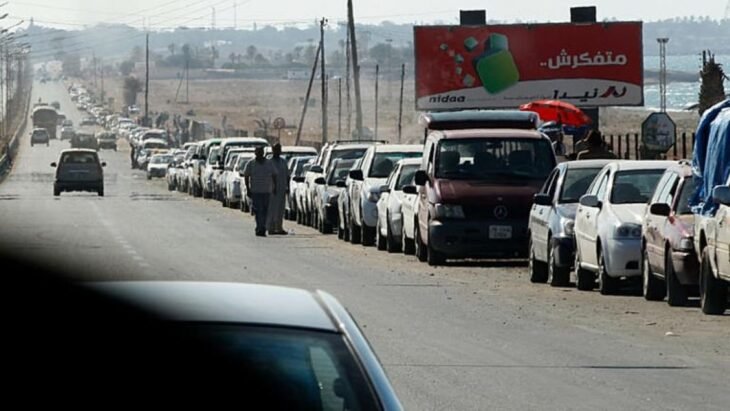
“Our entire stock of frozen food spoiled.” Meanwhile, motorists have formed lines kilometres long at petrol stations across western and central Libya. Abdeslam Zarti, leaning against his car waiting for gasoline, said queues can take “six hours or more, with cars lining up in front of stations for distances that sometimes reach four kilometres”. – ‘Poor governance’ – Libya has been politically divided for more than a decade, after being plunged into war during the 2011 overthrow of former leader Muammar Gaddafi.
Two administrations are currently vying for power: a UN-recognised government in Tripoli and its rival in Benghazi, backed by military leader Khalifa Haftar. “Libya produces less than its energy needs during peak periods, and the electricity crisis and fuel shortage are complex, since the country is an oil producer but relies on importing fuel,” international relations researcher Bechir Jouini told AFP.
But the issue is also compounded by “the problem of smuggling oil out of the country as well as the failure to implement maintenance programmes for power plants”, Jouini said. He also blamed mismanagement and corruption in the budgets allocated to the energy sector. “Libya has resources and funds, but it suffers from poor governance and corruption is rampant… despite the allocation of huge budgets to the electricity company,” he said.
Hanna Tetteh, the UN envoy to Libya, has also linked the energy crisis to broader failures in the country’s institutions. “The recent widespread electricity outages and public discontent, exacerbated by a prolonged heatwave, have exposed the consequences of institutional fragmentation, large-scale diversion of public resources, underinvestment and uncoordinated decision-making, all of which are essentially failures of governance,” the envoy recently yold the UN Security Council.
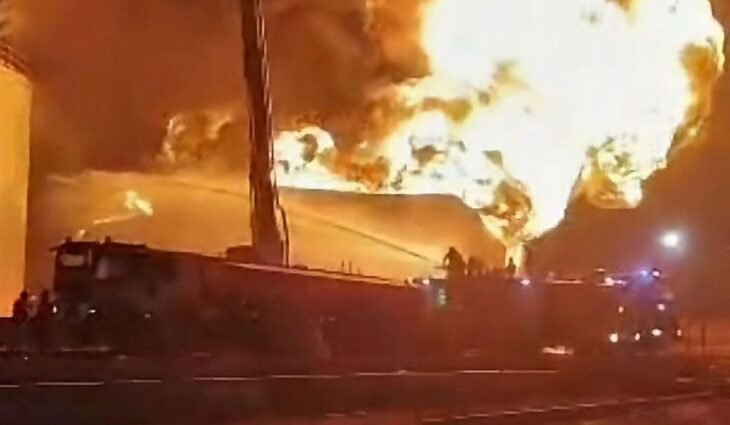
“The contradiction is that this is occurring in a country that does not lack energy resources and has the largest petroleum deposits on the African continent,” Tetteh said. Earlier this month a key reservoir containing about 4.5 million litres of petrol was targeted by several drone attacks in Zawiya, some 45 kilometres (27 miles) west of Tripoli.
Zawiya has for years been the scene of armed conflict between rival groups who fight over the territory, which is a hotspot for fuel, drugs and migrants trafficking.
The proposal’s most provocative aspect for Libyans is that Saddam Haftar would become head of the Presidential Council. Critics fear that any power sharing arrangement would prove short-lived at best, because Saddam would sideline Dabaiba to consolidate authority for himself.
As one politician put it, “Saddam is a military man with blood on his hands. His project is to rule alone over the whole of Libya. He is not interested in ruling it jointly”. She pointed to a legal mechanism at his disposal:
under the 2015 UN-mediated Skhirat agreement, the president can declare a state of emergency, mobilise security forces and impose exceptional measures, with potentially far-reaching constitutional consequences.
Such concerns appear especially pronounced within the Presidential Council itself. According to people close to its chairman, Mohamed al-Mnefi, he would be willing to step down, but only in favour of a more broadly acceptable political figure.
Many opponents warn that concentrating power in Saddam’s hands could trigger a violent backlash.
Several influential armed groups in western Libya have made it known that they might use force to resist his appointment if they deem it necessary. Insiders say this talk is not mere bluster. The aforementioned politician said, “These men simply do not accept Haftar’s son becoming president”.
Already, observers point to early signs of military escalation, with a reported increase in the quantity of weapons entering Tripoli through Mitiga airport. That said, whether these shipments are intended for armed groups aligned with or opposed to Haftar remains uncertain.
Critics point to a second source of concern, namely widespread scepticism that the power sharing deal would make living conditions better. Many say U.S. efforts on the economic track have yet to tangibly improve ordinary Libyans’ lives.
The data appear to bear out this judgment. The exchange rate still hovers at more than eight dinars to the U.S. dollar on the parallel market, 20 per cent higher than the current official rate and over 40 per cent higher than the one set in early 2025.
Cash withdrawals remain heavily restricted, access to foreign currency is tightly controlled and businesses in need of hard currency continue to face significant administrative hurdles.
Fuel smuggling is pervasive, and many suspect the tacit acquiescence of competing political elites, even as large numbers of Libyans experience recurring fuel shortages, liquidity constraints and severe electricity outages.
Revenues generated by illicit markets have also sustained a real estate boom seen by many as disconnected from the broader economy. More generally, critics say the initiative risks reinforcing Libya’s dysfunctional political economy.
Describing the U.S. envoy’s attempt to unify the two governments’ budgets, a Misrata businessman argued that it reflected a narrow vision of economic development centred on construction projects, leaving Libya’s deeper problems unaddressed:
Any development plan worthy of note should work toward making the country less reliant on oil. But the only development these people [Saddam Haftar and Dabaiba] have in mind is building bridges and hotels. So, what the U.S. considers an achievement, we consider a disaster because they are giving money to thieves.
A third critique centres on the negotiations’ lack of inclusivity, their emphasis on elite bargaining over popular participation. Many Libyans resent the exclusion of swathes of society from a process that could fundamentally reshape the political order.
A Libyan sociologist asserted that the initiative reflects a U.S. perception of the country as “a struggling company looking for a CEO and a group of investors”, rather than as “a nation in crisis searching for a new social contract”.
In this assessment, there is an absence of an explicit commitment to elections. After years of international promises that Libya’s future leadership would be decided at the ballot box, the proposed arrangement instead appears to eschew public consent by institutionalising the existing balance of power.
Boulos sought to offer reassurance, explaining that his endeavour is meant to go hand in hand with UN-led efforts to organise polls, but Dabaiba and Haftar supporters have been far more dismissive, suggesting these could be put off “for years”
Many Libyans are furious. “In one sentence”, the sociologist wrote in a social media post, “elections vanished, the popular will disappeared, talk of justice and accountability evaporated, and only oil remained to speak for everyone”
U.S. officials appear taken aback by the intensity of the public backlash. A businessman who met U.S. mediators in Misrata in July described them as “stunned by the uproar [the initiative] caused”.
Yet so far, the resistance has prompted neither substantive nor procedural changes in Washington’s approach. Sources confirm that both sides continue to submit proposed amendments to the agreement through U.S. mediators.
V. Where Foreign Capitals and
the UN Stand
During the early years of Libya’s division, and particularly during Haftar’s 2019-2020 attempt to capture Tripoli, several foreign powers aligned themselves with one side or the other.
Türkiye was the Tripoli-based government’s most visible backer, intervening militarily to help its forces repel Haftar’s assault, while most European states offered it primarily diplomatic and rhetorical support.
Haftar, by contrast, received military aid from the United Arab Emirates, Egypt and Russia, which reportedly supplied varying degrees of equipment and air cover.
France and the U.S. also allegedly gave his offensive their tacit blessing, at least at first, before it became clear that the siege would fail.
Since the 2020 ceasefire, however, foreign alignments have become far less polarised. Türkiye opened channels to the Haftar camp, and it has since developed strong ties with the east while (reportedly) retaining its garrison in western Libya.
Conversely, the UAE, Russia and Egypt have all strengthened their relations with Tripoli.
Today, external actors, including Western capitals, continue to recognise the Tripoli-based government as Libya’s legitimate authority while simultaneously maintaining political and commercial contacts with the Haftars in the east.
Against this backdrop, the U.S. initiative has exposed differences among Libya’s foreign partners, despite U.S. officials’ insistence that it is broadly endorsed.
France and the UAE appear to be among its strongest supporters, arguably because both hold favourable views of Saddam Haftar, welcome his political ascent and consider the Haftar-led military coalition to be critical in fighting Islamist militants along Libya’s porous borders.
Their approval was on display in mid-June, when French President Emmanuel Macron hosted Saddam Haftar at the Elysee. In recent months, he has also been received by the leaders of Greece, Chad and Qatar.
Others, notably several European states, express private doubts despite publicly backing the initiative. Their caution is understandable:
few are willing to openly challenge Washington’s approach for fear of jeopardising U.S. cooperation in other areas. As a European diplomat explained, “Nobody tells the Americans to their face that they have reservations, even when these are substantial”.
Italy, in particular, is sceptical. It acknowledges that U.S. efforts have eased security cooperation with Haftar-aligned forces, an important asset as it seeks to curb migrant flows from Libya, a key political priority.
At the same time, Italian officials are apprehensive about the implications of a botched power sharing agreement, which they worry could trigger armed opposition, undermine Libya’s relative calm and unleash a new wave of migration across the Mediterranean.
As an Italian diplomat put it, “We are supportive [of the U.S. initiative] and would love to see a unified country”, but, referring to the risk of backlash, he added, “we absolutely do not want to see Libya destabilised”.
Professionals who left a country in turmoil say they are unlikely to return soon as more in Libya could be planning to leave.
Sarah Mizran, a 32-year-old architect, was a teenager when Tripoli fell in August 2011, as opposition fighters swept into the capital.
It was the beginning of the end for Libyan leader Muammar Gaddafi. Having ruled for 42 years, he was soon captured and killed near Sirte. Eight years ago, Mizran left the city for the United Kingdom.
“Libya loses more than just skills when young professionals leave,” she told Al Jazeera. “It loses a sense of possibility when an entire generation grows up feeling that they have to leave in order to build a future, and that leads to a loss of hope in the country itself.”
Already drawn to the concept of sustainable architecture and what it could mean for Libya, Mizran pursued a master’s degree in architecture in southern England. She has spent recent years studying sites in Tripoli, working out what rebuilding the city might mean beyond simply putting up new buildings.
“Ultimately, as an architect, I want to be part of rebuilding Libya’s architectural landscape,” she said. “I don’t know exactly what that return will look like yet, but I know that remains part of the future that I’m working towards. “A sense of stability in the country will prompt a stronger wave of the diaspora wanting to return,” she said.
She was 24 when she arrived in the UK on a scholarship to study at the University of Kent. “I had to learn a different professional culture, a different way of working, and in many ways just find my place again,” she said.
She is far from alone.
Nader Elgadi, 36, was running his own media company in Tripoli when, in late 2014, fighting broke out around the capital’s airport during Libya’s second civil war.He also came to the UK for a master’s degree and had planned to go home, but as threats to activists mounted, he stayed instead.
“I went from running my own business and living comfortably in Libya to starting my life from scratch in the UK,” he said.“The first two years were really hard.” Elgadi founded Libya in the UK in 2018, a cultural charity “to create the Libya that we wanted to have after we managed to end the dictatorship”. The group hosts events for the diaspora community trying to build “a sense of that country we always wished for”.
Home, ‘something we create again and again’
Fifteen years on, both describe the UK as home, even as Libya pulls at them. “Home is not something we find once and keep forever,” Mizran said. “It’s something we create again and again.” Elgadi calls himself “a nomad” who has stopped expecting to return for good, even as his consultancy still works with Libyan clients. Whether that dispersal of talent has held Libya back is up for debate.
Tarek Megerisi, a visiting fellow at the European Council on Foreign Relations, said “tens of thousands of very good, technically proficient people” are still working in Libya’s ministries, but claimed they are blocked from doing their jobs by more senior officials with little interest in governing. Much of that took root soon after the revolution, he believes.
“After the revolution there was a mass return of Libyans from all across the world. Many skilled young professionals, but also older Libyans, whose qualifications and whose experience were often vastly overstated, used their standing to secure political positions and promised to lead the country to democracy. Instead, they basically just acted like Gaddafi’s government did,” Megerisi said. He said corruption plagues some ministries in an environment that has driven away the generation that came of age after 2011.
“Young professionals who gained qualifications and had early experience working in the late stage of Gaddafi’s Libya, which was a bit more open,” were genuinely excited the revolution might catalyse their careers, he said. “All of that kind of just got run into a quagmire. “It’s very sad to see … now all the young generations who have any ambition for their life, they just want to leave the country.”
He summed up Libya’s governance by paraphrasing Kahlil Gibran’s poem, Pity the Nation, “Pity the country that has two governments and nobody interested in governing.” Megerisi said the talent pool “would come back in a heartbeat should there be a real, valid, credible opportunity”.
Toby Chitayat, an associate at CRI Menas, a UK risk consultancy, is more skeptical that the brain drain is doing much damage. Set against Libya’s east-west split, its volatile oil revenue and endemic corruption, he argued its effect on governance or investor confidence “is comparatively minimal” but acknowledged that it remains “far too early to say anything definitive about the prospect of serious re-engagement with the country.”
A second unresolved issue concerns the structure of military authority. According to several sources close to the Tripoli camp, negotiators are exploring a structure pursuant to which the armed forces’ general command, or qiyada amma, now headed by Khalifa Haftar with Saddam as his deputy, would be jointly led by Saddam and a representative of the Tripoli-based military establishment (possibly Undersecretary of Defence Abdelsalam Zoubi).
Other options under discussion include abolishing the general command altogether and appointing Zoubi as defence minister with responsibility for all military affairs; or, alternatively, dividing the country into three military regions, each with its own commander.
All these options would require Haftar’s camp to make significant concessions. Informed Libyan and foreign sources have come away from conversations with senior Haftar-linked officials with the impression that they have yet to accept any of these compromises.
Indeed, for the past decade Haftar and his allies have insisted that all military authority be centralised under a unified chain of command, rather than shared among competing institutions or personalities.
Tellingly, a 16 June statement by the Haftar-led general command expressing support for the Boulos effort made no reference to any proposal that would reduce its authority, let alone get rid of the institution completely.
Washington also has been working on economic and military reunification, which it sees as complementary to its political efforts. On the economic front, U.S. diplomats and U.S. Treasury officials helped facilitate negotiations on a unified national budget to consolidate the expenditures of Libya’s rival governments.
In April, Boulos announced that the two camps, one represented by a member of the Benghazi-based parliament and the other by a member of the Tripoli-based High State Council, had reached an agreement whose content remains confidential.
While a U.S. official described the effort as a “good step”, not even the Benghazi-based parliament – which is supposed to ratify the budget – has yet received a copy.
In theory, if applied alongside other oversight mechanisms, a unified budget could help curb parallel spending, slow inflation, reduce pressure on the Libyan currency, the dinar, more evenly allocate development funding, finance higher oil production and kickstart desperately needed non-oil development projects.
As of late July, however, the budget was still bifurcated and Libyans continued to face severe financial hardships due to cash shortages and deterioration of the exchange rate.
On the military front, in early 2025 the U.S. supported changes to the UN Libya sanctions regime, authorising foreign governments to provide technical assistance and training to forces from both camps. The stated objective was to advance “the process of unification of the Libyan military and security forces”.
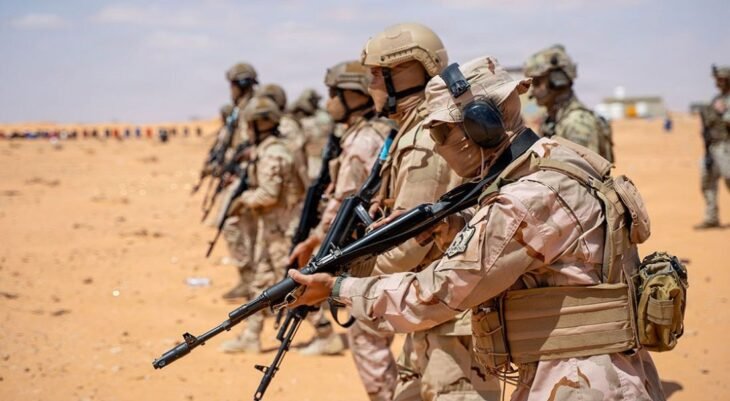
This step paved the way for members of the rival military coalitions to participate in the two-week Flintlock exercise, the flagship U.S.-led multinational special operations training program, which was held in Sirte in April.
The event represented a modest but meaningful confidence-building measure and improved cooperation between officers from the two camps, though it fell well short of genuine military unification.
Neither the economic nor the military steps generated significant domestic controversy, though the opacity of the proposed unified budget, coupled with the absence to date of tangible economic benefit, attracted criticism.
Far more polarising has been the political component of these U.S.-led efforts, specifically the proposed power sharing arrangement. It has pitted those who see it as a pragmatic path toward reunification against those who view it as an attempt to entrench the country’s existing power structure.
Broadly speaking, the U.S. proposal is a classic post-conflict arrangement pursuant to which former adversaries agree to share formal authority in a manner that reflects their actual power. For many Libyans, however, such a bargain would be a betrayal of a promise made for years by the UN and various foreign powers: that reunification would occur as a result of general elections and popular selection of a new leadership.
Fulfilling that promise has proven arduous, despite years of UN-backed mediation, encumbered by disagreements over what elections should be held (presidential, legislative or both), in what sequence and under what governing framework.
Behind these unresolved legal disputes lies the fact that the current rulers are loath to hold elections that they might lose. By upsetting the status quo, elections could trigger a resumption of armed conflict, in the event that one faction or the other contests the results.
Instead of pursuing that elusive and potentially destabilising path, Boulos has opted with his plan to cement the existing balance of power by giving it the world’s blessing.
III. The View from the Initiative’s
Supporters
Support for the proposed arrangement partly reflects how its expected political benefits would be distributed. It is no surprise that Saddam Haftar has emerged as the strongest backer: the deal would both raise him to Libya’s highest political office and bestow the international legitimacy that so far has eluded his family.
Individuals close to Saddam say making him president would merely mirror reality, noting his steady rise within the military hierarchy, authority within its eastern power base and status as most influential of Khalifa Haftar’s sons.
They also largely dismiss the risk that dissatisfied western constituents might violently oppose the deal.
Within the Dabaiba camp, opinions are more nuanced. Tripoli-based insiders say the initiative’s biggest champion is not Prime Minister Abdelhamid Dabaiba but his nephew, Ibrahim, who privately maintained contacts with Saddam Haftar and reportedly considers an agreement with the Haftar camp the sole realistic means of preserving his family’s hold on power.
In this view, only a U.S.-backed power sharing settlement could provide the international support necessary to keep Abdelhamid in office.
As one Tripoli-based politician put it: “The Dabaibas are much weaker than the Haftars, so they need this alliance to persuade foreign capitals – and Washington in particular – to keep Dabaiba on. Abdelhamid, however, is not entirely convinced and is buying time”.
The prime minister’s doubts reportedly include distrust of Saddam Haftar: he is concerned the young military commander might seek to sideline him once the agreement is in place. So far, he has refrained from commenting publicly on the U.S. initiative.
Support for the initiative also comes from Libyans unaffiliated with either camp. Several politicians and analysts argue that, despite its shortcomings as an elite pact, and while it warrants closer scrutiny, the emerging deal offers the best opportunity to reunify the country’s divided institutions.
In the words of one such person: “Libya needs pragmatic realism, not aspirational fantasies. Right now, [the proposal] is more a framework than an actual process, but even if it produced an imperfect unified authority, that would still be a net positive for Libyans”.
From this perspective, even modest improvements would be preferable to maintaining today’s political arrangements indefinitely. Some are looking forward to elections, others to improved security, a more favourable business environment or stable power supply; what they share is hope that the deal might be an important first step toward ending the country’s prolonged political impasse.
Finally, these supporters do not appear to take seriously concerns that the deal could trigger armed opposition. As one put it, “a dog that barks does not bite”.
America is betting that Libya’s rival dynasties can reunite a country that elections and diplomacy could not.
15 years after NATO aircraft helped topple Gadhafi’s regime, America is again trying to remake Libya. This time there are no bombers, no talk of humanitarian intervention and little enthusiasm for transforming the country into a liberal democracy. Instead the Trump administration is attempting something at once more modest and more audacious: persuading the two families that dominate Libya’s rival halves to share the state.
The proposal being pushed by Massad Boulos, President Donald Trump’s adviser on Arab and African affairs, would leave Abdulhamid Dbeibah, the prime minister of the internationally recognised government in Tripoli, in his job. Saddam Haftar, the increasingly prominent son of Khalifa Haftar, the military strongman who dominates eastern Libya, would chair a reconstituted Presidential Council. The arrangement is intended to reunify political, economic and eventually military institutions that have been divided for more than a decade.
It is an inelegant solution to an inelegant problem. It may also be the most serious attempt in years to put Libya back together.
Since Qadhafi was killed in 2011, outsiders have repeatedly treated Libya as a constitutional puzzle. If only Libyans could agree on electoral laws, organise a vote and establish legitimate institutions, the thinking went, militias would submit to politicians and rival governments would disappear.
The United Nations produced road maps, conferences and transitional arrangements. Elections were scheduled, postponed and argued over. Governments described as temporary acquired an impressive gift for permanence.
Meanwhile power settled elsewhere. In western Libya Mr Dbeibah built a durable political machine around the Government of National Unity (GNU), state spending and alliances with armed groups.
In the east Field Marshal Haftar constructed something closer to a military family enterprise, controlling Benghazi, much of the south and, crucially, territory containing much of Libya’s oil infrastructure. Neither side could conquer the other. Neither could be wished away by diplomats.
Mr Trump’s people appear to have noticed.
Their approach reverses much of the logic that has guided Western policy since 2011.
Rather than elections producing legitimacy, which produces unified institutions, which eventually produces stability, America is betting on stability first.
Unite the people who possess actual power, align their economic interests and postpone the harder question of democratic legitimacy until the state is functioning again.
There is something distinctly Trumpian about this. It treats politics less as constitutional engineering than as a negotiation among proprietors. The question is not who ought to govern Libya but who can prevent anybody else from governing it. Once those people are identified, a bargain can begin.
Money helps. Libya possesses Africa’s largest proven oil reserves but produces far less than its geology suggests it could. Its National Oil Corporation wants as much as $40bn of investment to lift output from roughly 1.4m barrels a day to 2m by 2030. More than 60 discovered fields remain undeveloped. American firms, including Chevron and Conoco Phillips, have reasons to be interested. European energy companies have never really left.
Oil also provides the rare commodity that both Libyan camps need from one another. Tripoli controls internationally recognised financial institutions and the machinery through which much state revenue flows. The Haftars command territory containing fields, pipelines and export terminals.
One side has the cheque book; the other can interrupt the income that fills it. Libya’s division has therefore produced an odd form of mutually assured insolvency.
The first important crack appeared in April, when rival authorities agreed on the country’s first unified national budget in more than a decade. Budgets rarely inspire poetry, but in Libya this one mattered.
It created a mechanism for spending across the divide and provided more money for the National Oil Corporation. Mr Boulos hailed it as evidence that eastern and western authorities could compromise.
Washington hopes commerce can do what communiqués could not. The promise of American investment gives both camps something larger to divide than the existing spoils.
Reconstruction, electricity, infrastructure, hydrocarbons and mining could attract tens of billions of dollars if investors become convinced that contracts signed in one half of Libya will be honoured in the other.
That is a formidable “if”. Libya’s political economy has long rewarded division. Militias collect salaries from the state they periodically threaten. Politicians profit from opaque spending.
Fuel subsidies encourage smuggling. Institutions duplicated between east and west provide jobs, contracts and patronage. Reunification would create winners, but also plenty of losers with guns.
Nor are the Dbeibahs and Haftars neutral custodians of a national project. Critics of the American proposal see an elite bargain that would convert temporary incumbency into dynastic entitlement.
Their objection is difficult to dismiss. Saddam Haftar’s elevation would formalise the rise of a son inside a military system built by his father. Mr Dbeibah, appointed in 2021 to lead a transition towards elections, would remain prime minister five years later.
Yet this criticism contains the uncomfortable reason the scheme may have a chance. Libya’s problem is not a shortage of plans. It is that previous plans have often depended on powerful actors voluntarily surrendering power. The American proposal instead asks them to preserve much of it in exchange for accepting limits on how it is exercised.
Diplomatic convergence
The regional weather has also changed. Turkey, once the military saviour of Tripoli, is cultivating the Haftars. Its officials now travel between Tripoli and Benghazi. Egypt, traditionally the eastern camp’s most important Arab patron, has received Mr Dbeibah while continuing its close relationship with Khalifa Haftar.
Qatar supports the UN process but also wants stability. Pakistan has emerged as an unlikely intermediary. The countries that once treated Libya as an arena for proxy competition increasingly seem interested in ensuring that they are not excluded from a settlement.
The diplomatic convergence is striking because these countries spent of the past decade backing opposite sides. Ankara’s military intervention in 2019 helped stop Haftar’s assault on Tripoli; Cairo regarded his forces as a barrier against Islamists and disorder on its border. Their interests have not become identical. Rather, the cost of fragmentation has risen.
A settlement offers Turkey contracts and influence in the east, Egypt a calmer frontier, Qatar a process it can support and Washington a chance to turn overlapping rivalries into overlapping incentives. Foreign powers helped harden Libya’s partition. They may now, for self-interested reasons, help soften it.
The alignment is not sentimental. That may be its advantage: arrangements based on interests tend to survive disappointment better than those based on friendship.
For Europe the attraction is obvious. A more coherent Libyan state could make energy investment safer and help control migration across the central Mediterranean.
For America there is another prize: reducing Russia’s room for manoeuvre. Moscow developed deep ties with the eastern authorities while Western governments largely dealt with Tripoli.
A national arrangement that brings the Haftars closer to Washington would complicate Russia’s position without requiring America to dislodge it militarily.
Saddam Haftar’s reception in Washington in June was therefore more than ceremonial. Marco Rubio, the secretary of state, discussed with him efforts to unify Libya’s military, economic and political institutions.
The meeting conferred something the younger Mr Haftar has long sought: recognition that he is not merely his father’s son but a national interlocutor.
None of this means the deal will work. Tripoli is not Mr Dbeibah’s private estate. Armed factions in western Libya have their own interests and some fiercely oppose a settlement with the Haftars.
Eastern Libya is more hierarchical, but succession inside the Haftar family may yet produce tensions. A presidential council cannot unify competing chains of command by changing the stationery on their letterheads.
Then there is the question of elections. Mr Boulos insists his initiative complements rather than replaces the UN road map. Perhaps.
Temporary political arrangements in Libya, however, have a habit of becoming geological formations. Give two entrenched families control of a unified state, its budget and its oil revenues, and their enthusiasm for submitting themselves to voters may prove limited.
This is the central gamble. America is attempting to use Libya’s oligarchic reality as scaffolding for a functioning state without allowing that scaffolding to become the permanent structure. It is trying, in effect, to make Libya stable enough to become democratic rather than democratic enough to become stable.
That may offend those who remember the aspirations of 2011. But the intervening 15 years have been unkind to grand theories. Libya has had elections, UN envoys, constitutional drafts, peace conferences, rival cabinets and enough road maps to pave a motorway from Tripoli to Benghazi.
What it has lacked is a political bargain sufficiently attractive to the men with the power to wreck one.
America’s proposal may fail for precisely the reasons its predecessors did: too many armed men, too much money and too little trust. But it begins with a useful recognition. Libya is already divided among strongmen. The task is not to pretend otherwise. It is to persuade them that a whole country is worth more than half of one.
***
Yassin K Fawaz is an American business executive, publisher and security and terrorism expert.
Washington is negotiating an accord that would piece Libya’s divided national institutions back together. But its political aspects have sown fierce controversy. Rather than risk the country’s tenuous peace, U.S. mediators should seek broader buy-in, focusing on budgetary and military issues in the interim.
What’s new? The U.S. is backing a power sharing deal aimed at merging the rival executives that rule eastern and western Libya. Negotiators have not publicly disclosed details of the agreement, but its opponents are already threatening to mobilise troops to stop it.
Why did it happen? This initiative is the latest iteration of a year-long U.S.-sponsored mediation effort that also includes steps intended to unify the state budget and the competing military coalitions.
Why does it matter? This U.S. effort has merit, not least because it seeks to move a stagnant political process forward. But the lack of transparency and, most importantly, one of the deal’s rumoured pillars – appointing Saddam Haftar, son of strongman Khalifa Haftar, as the country’s next president – could be incendiary.
What should be done? U.S. mediators should not rush to seal a political agreement that risks unsettling Libya’s relative calm. Instead, they should carry out broader political consultations and, in the meantime, seek progress on budgetary and military unification.
I. Overview
Libya is rife with rumours of a U.S.-backed agreement to unify the country’s two rival executives under a new power sharing arrangement. U.S. envoy Massad Boulos, the initiative’s chief facilitator, has acknowledged meeting with representatives of the two authorities, which control the country’s western and eastern regions, respectively. He has given no details, merely stating that the deal’s primary objective is to merge the country’s bifurcated administration and unify the military ranks.
Libyan participants have also been tight-lipped about the substance of talks, though they privately express confidence that an agreement is within reach. Meanwhile, however, one of the deal’s reported provisions – who would be president – has sown controversy so fierce that it could threaten Libya’s tenuous peace. U.S. mediators should keep working on unresolved political issues and seek broader consensus before formalizing a political deal among Libyan factions.
In principle, an agreement that pieces Libya’s fragmented institutions back together would be welcome. The country has been divided since 2015 between two governments and military coalitions that have periodically gone to war.
Fighting between them officially stopped in 2020, though assassinations still occur on occasion, along with bursts of violence among rival militias or smuggling rackets. Countrywide blackouts in July, coupled with drone attacks of unknown origin on fuel tanks in western Libya in August, were the latest reminder of just how unstable the situation is.
Ending the rift would be an important step, and supporters of the prospective deal believe it is the country’s best hope after years of faltering UN-led efforts to achieve unity and organize elections. Many Libyans, however, worry that so little is known about the deal’s content. They fear that an accord concocted behind closed doors could cement existing power structures, encourage authoritarian drift and institutionalize already widespread corruption.
If the agreement goes through without broader buy-in and with its most controversial provisions in place, it might trigger violent resistance. Particularly contentious is the notion circulating that Saddam Haftar, son of Khalifa Haftar, the leader of the east-based forces, would be made Libya’s new president. In 2019-2020, Haftar’s forces laid siege to the internationally recognized capital Tripoli, and enmity lingers.
If the agreement goes through without broader buy-in and with its most controversial provisions in place, it might trigger violent resistance; some western factions have already said they would issue a call to arms. In short, rather than ushering in a period of stability, the initiative could undermine the relative calm experienced in recent years.
With such possible unintended consequences, U.S. officials should resist the temptation to seal a deal quickly. Instead, they should keep working with Libyan parties to build greater consensus behind political arrangements and put safeguards in place to protect the country from an autocratic power grab.
Libyan leaders themselves ought to ensure broader buy-in before they sign off on any agreement. In the meantime, Washington’s priorities should be to push for reforms to Libya’s public finances and for measures aimed at narrowing the gap between the competing military coalitions.
II. The Deal (as Understood)
Libya’s present political configuration has its roots in an October 2020 ceasefire, which ended Field Marshal Khalifa Haftar’s campaign to seize Tripoli but had the effect of freezing the country’s east-west military divide.
In March 2021, UN-sponsored talks gave rise to a short-lived unity government in Tripoli headed by Abdulhamid Dabaiba, whose task was to reunify state institutions and organize elections that December. When elections were called off amid disputes over rules and candidates, Dabaiba nonetheless stayed on, refusing to relinquish office. In February 2022, the Haftar-aligned, east-based House of Representatives appointed a rival government, led at first by Fathi Bashagha and, since 2023, by Osama Hamad.
Since then, the country has remained split between the internationally recognized Tripoli executive, which rules in much of the west, and the Haftar-backed government and parliament that administer the east and most of the south. Alongside these divided institutions, a three-member Presidential Council, headed by Mohamed al-Mnefi, formally serves as Libya’s collective head of state and supreme military authority, though its influence is lessened by the country’s political and military fragmentation.
The eastern military coalition does not recognize the Presidency Council as the top military authority; it has its own general command, headed by Field Marshal Haftar.
The status quo has its benefits: though the country remains divided, the two sides have not returned to war, preserving a measure of peace on the ground for which many Libyans are grateful. A sufficiently wide distribution of oil revenues keeps elites on both sides of the divide from rocking the boat.
A construction boom and the proliferation of events open to the public free of charge – such as concerts and international sporting contests – have also boosted support for authorities in both eastern and western Libya. But bifurcation also comes at a cost. Institutional dysfunction has worsened; foreign forces remain in the country (Russian in the east, Turkish, reportedly, in the west); and the economy has suffered, as the competing authorities bankroll themselves through a mix of licit and off-the-books arrangements. The latter have drained public finances, raising the cost of living and stunting development investment.
Over the past year, President Donald Trump’s senior adviser for Arab and African affairs, Massad Boulos, has sought to break this deadlock, reversing a decade of U.S. disengagement following the 2012 killing of U.S. Ambassador Chris Stevens.
Beyond the Trump administration’s aspiration to add to the list of the president’s supposed peace agreements, three factors may explain Washington’s renewed focus.
The first is energy: amid turmoil in global markets and reduced Gulf oil exports, the U.S. may be seeking to boost Libya’s hydrocarbon production and promote the interests of U.S. oil companies.
The second is commerce, as Washington thinks Libya could be a lucrative market for U.S. firms beyond the energy sector.
The third is geostrategy: the U.S. may wish to stop Russia from firming up a foothold in Libya by drawing the North African country under its own military umbrella.
Against this backdrop, the idea of a U.S.-backed power sharing agreement originated in discreet talks launched by Boulos.
These reportedly began in September 2025 with a clandestine meeting in Rome between Ibrahim Dabaiba, adviser and nephew of Prime Minister Dabaiba, and Saddam Haftar, Khalifa Haftar’s son and deputy commander.
The discussions apparently yielded nothing beyond a generic commitment to work toward unifying the two sides’ budgets.
Secrecy has been a key feature of Washington’s diplomacy throughout. Even as the U.S. effort progressed, neither Boulos nor any other U.S. official would publicly share the content of the developing proposal.
Libyans commonly refer to the proposed political settlement as the “Boulos plan”, reflecting his central role in the negotiations. Boulos himself describes it as a “U.S. initiative”, adding only that it seeks to unify the country’s institutions after fifteen years of division. Still, broad contours of the deal have emerged, if only in increments. According to Libyan interlocutors and foreign diplomats familiar with the negotiations, the initiative’s centrepiece is merging the two rival governments into a single executive.
Again, based on these reports, two men would emerge as principal beneficiaries: Abdelhamid Dabaiba and Saddam Haftar, leading representatives of the two families that have consolidated political power in western and eastern Libya, respectively.
Despite continuous tensions, Dabaiba and Saddam Haftar have reportedly been in regular, secret contact, notably to negotiate off-the-books revenue sharing arrangements that critics charge serve their respective parochial interests. According to these sources, the proposed U.S.-backed arrangement would leave Dabaiba in office as prime minister of the unified executive, with his nephew Ibrahim staying on as national security adviser.
Saddam Haftar, currently deputy commander-in-chief of the east-based Libyan Arab Armed Forces, would become head of the Presidential Council, replacing Mohamed al-Mnefi. The fate of the Council’s two other members remains unclear. Should such a deal be concluded – and should a member of the Haftar family for the first time occupy political office with full international recognition – at least some domestic opposition would be inevitable.
Saddam Haftar’s forces fought (and won) deadly urban wars with Islamist groups in Benghazi (between 2015 and 2018) and Derna (in 2017-2018), and then led the year-long siege of Tripoli in 2019, before being compelled to withdraw in 2020. Since then, they have been accused of being involved in the disappearance of several prominent activists and politicians as well as of controlling various smuggling routes.
Beyond this central political bargain, several important aspects of the proposed arrangement remain unresolved, according to Libyans well informed about the negotiations. One concerns the seat of the new government: whether it would be Tripoli, where Dabaiba is based, or Sirte, the central coastal city under Haftar’s control. The Haftars have not set foot in the capital in over a decade, and several powerful Tripoli-based armed groups remain deeply hostile to them due to the 2019-2020 siege.
The two sides reportedly are weighing different options. One idea would be for Sirte to be the interim seat of power. Its proponents argue that Sirte would be a more neutral location, insulating the new executive from Tripoli’s armed groups, which they accuse of routinely coercing ministers and influencing government decision-making.
They further contend that this temporary relocation would provide the authorities with greater freedom to reform the security sector before returning to Tripoli. More recently, the Haftar camp is said to have suggested that Dabaiba’s government move to Sirte while Saddam Haftar, as head of state, would be based in Tripoli.
Those favouring a bigger role for the capital, by contrast, prefer an opposite arrangement, in which each leader would remain in his present stronghold: Dabaiba in Tripoli and Haftar in Sirte.
The latest US initiative is structured in a way that lets political elites permanently postpone elections.
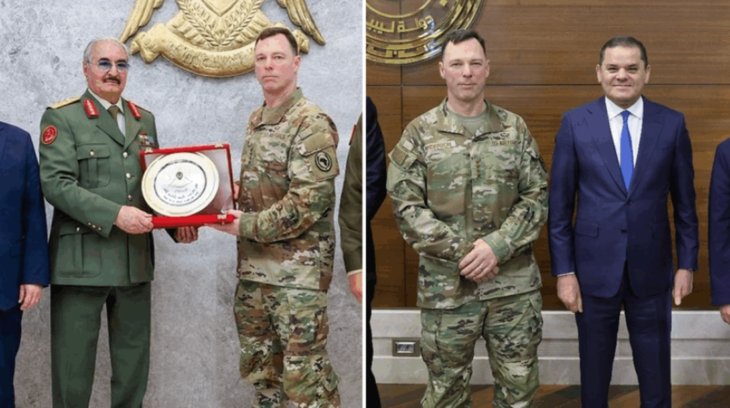
On 29 June, Secretary of State Marco Rubio welcomed Saddam Haftar to the seventh floor of the State Department, an unusual place to host a military leader. Despite his record of brutality and intolerance to opposition in Libya’s east, Saddam has become one of the primary faces of Trump’s administration’s initiative to unify Libya.
The American initiative, identified with presidential envoy for Africa Massad Boulos (Tiffany Trump’s father-in-law) aims to unify Libya’s east and west by selecting leaders from each region to split the top government positions.
The Trump administration seeks stability to expand access for American energy companies and increase Libya’s oil production. However, naming anyone to be president or prime minister, let alone Saddam Haftar, is a recipe for political chaos.
Since Haftar’s Washington visit, many Libyans have opposed the Boulos initiative, an electricity crisis has exposed Libya’s poor governance, and an outbreak of fighting in the western city of Zawiya shows the influence militias still have in the country.
More fundamentally, the plan would effectively kill another UN-led effort to restore political ownership of Libya to its people.
Libya has suffered from an absence of political legitimacy since the ouster of Muammar Gaddafi in 2011. Prime Minister Abdul Hamid Dbeibeh has been in office since 2021, when 39 members of the UN-sponsored 74-member Libya Political Dialogue Forum appointed him. He was supposed to serve for a maximum of one year but remains in office today after elections were indefinitely postponed in 2022.
Dbeibeh and his influential nephew, Ibrahim, are the likely counterparts to Saddam under the Boulos plan.
Libya’s parliaments, the Eastern-based House of Representatives and the Tripoli-based High State Council, have even less legitimacy. The Speaker of the House, Aguila Saleh Issa, has been in office since 2014, elected with fewer than 1,000 votes from a tiny district. He has used his outsized role to block political change to the extent that he was sanctioned by the US for obstructing the peace and stability of Libya.
Vicious cycle
Libya is trapped in a cycle in which political elites block any initiative that would restore political legitimacy to a new government. They cling to power and wealth in a rentier economy with rampant corruption. Outside actors, including neighbours, regional states, and the West, have contributed to Libya’s divisions by supporting the warring sides or using their influence to stymie political progress.
Given these challenges, it’s little wonder the Trump administration would be tempted to bypass the Libyan people and formalize an arrangement with the country’s two main power brokers, the Haftars and the Dbeibeh. However, if the stated goal is power-sharing and unity as a stage in preparation for elections, which Boulos is quick to emphasise, the protagonists could not be more unreliable. Khalifa Haftar launched a war against Tripoli in 2019; his son, official deputy since August 2025, is unlikely to relinquish national power if it is handed to him.
Dbeibeh, meanwhile, has already extended his tenure years beyond his initial mandate. Neither is equipped to meet Libyans’ basic governance needs, as the current challenges over electricity and inflation show.
What’s the alternative?
In June, the UN mission in Libya (UNSMIL) completed a “Structured Dialogue” among 120 Libyans that outlined the country’s political, economic and security future. The governance group laid out options for determining a constitutional framework and holding elections.
A smaller group is working to outline specific electoral law and processes. They meet regularly and recently agreed on how to appoint the chair and members of the election commission. The UN and the dialogue group should finalize arrangements and set an election date.
The US and its partners would be better served supporting that process rather than imposing a new political structure that will be even less likely to relinquish authority than the current one.
Economic reform, military unification
In addition to supporting elections, the US should continue to press for economic reforms and the military unification effort, in which Saddam Haftar has a legitimate role to play.
In April, US experts helped negotiate a unified budget for the first time in over a decade. Chaotic spending patterns and unaccountable oil-revenue receipts threatened the stability of the Libyan dinar.
The budget is only a first step. It provides top-line figures and essentially caps funds for development projects controlled by the eastern and western development “institutions” who happen to belong to Dbeibehs and Haftars.
The US and its partners should continue to press on issues of financial transparency and reforms that will allow Libya’s small population to benefit from its oil income instead of suffering from corruption and economic mismanagement.
Second, continuing the military unification efforts will better integrate the Libyan Armed Forces with their Western military counterparts.
The US Africa Command hosted a major regional exercise in Libya in April, and the administration continues to advance talks with both sides. Even though there is an imbalance in the reunification discussions since Western security forces include militias as well as a more formal military, the process keeps the sides talking rather than fighting.
A further important step would be to disclose weapons acquisitions by both sides. The US should also maintain a close military dialogue with Türkiye and Egypt since they have the most influence on the ground and neither wants another war.
For years, Libyans have insisted that they are fed up with temporary solutions. The US initiative is structured to be just that—another transitional phase that lets political elites permanently postpone elections.
Libya has had a summer of chaos and discontent that at times threatened to bring down the current government.
Increasing and persistent power cuts since June.
Four regional power blackouts, including three in two days.
Armed drone attacks on fuel depots, power stations, and water desalination plants.
The government unable or unwilling to identify or name the perpetrators of the drone attacks.
The power cuts have resulted in several shutdowns of all the Man-Made River water wells – temporarily cutting off water pumping to all the country.
The diversion by the government of electricity from industries and businesses to domestic users, to avoid social unrest.
Long queues at petrol stations because petrol stations that don’t have generators or diesel to operate them are unable to pump fuel.
A spike in diesel black-market prices and the disappearance of diesel off the market as the whole country turns to using their generators .
The billions spent on the electricity generation sector in recent years, confirmed by Prime Minister Abdel Hamid Aldabaiba in his recent angry outburst at a Cabinet Meeting – at the failure of GECOL to resolve the issue of power cuts.
The decades of wasted state subsidies to the electricity sector.
The removal yesterday of the GECOL chairman as a result of the power cuts and blackouts.
The attempted resignation of the CBL Governor last week.
The spike in the black-market foreign exchange rate of the LD to over LD 9 / dollar.
All these, and more, have led to loud public cries for a change in leadership in GECOL, the CBL, the government and its security services.
However, in his latest op-ed, Naaman Elbouri, former banker and current fintech CEO, asks: Is the problem really the people, or is it the system in which they operate? “I believe one of the biggest mistakes we continue to make in Libya is believing that changing people will automatically change the reality.
We remove one official and appoint another. We change a board of directors, appoint a new government, or replace one governor with another—and then expect different results. But we forget to ask the most important question: Is the problem really the people, or is it the system in which they operate?
The reality is that a significant part of Libya’s crisis today is not simply a crisis of individuals. It is a crisis of an institutional and operational system that has been designed—or has evolved over the years—in a way that makes it incapable of consistently producing sound results. Within such a system, even a good, honest and capable person will find it extremely difficult to achieve much. Not because they do not want to reform, but because the rules of the game themselves do not allow them to do so.
The System Is Stronger Than
the Individual
When an institution operates with complicated procedures, unclear responsibilities, overlapping authorities, weak accountability, inadequate oversight and conflicts of interest, it becomes extremely difficult for anyone to operate effectively. Eventually, one of two things happens:
Either the individual gives in to the system and adapts to it, or they try to resist it and find themselves isolated and unable to implement what they believe is right. And this is where the real danger lies.
A dysfunctional system does not necessarily corrupt people because they are corrupt. It can push even good people to adapt to its rules simply in order to survive and function within it. That is why replacing one individual within a broken system can give society the impression that something has changed, while in reality nothing fundamental has changed. The Problem Is Not Simply Who Sits in the Chair
We need to stop reducing Libya’s crisis to the question: “Who is the right person?” And start asking: “Is the system in which this person will operate actually designed to allow them to succeed?” If the answer is no, then even the best person in the world will struggle to achieve meaningful change.
We need to fundamentally reconsider how our state institutions operate:
– How are decisions made?
– Who has the authority to make them?
– Who is held accountable when things go wrong?
– How are results measured?
– How are leaders selected?
– How are appointments made?
– How is public money managed?
– How are conflicts of interest prevented?
– How are laws enforced?
– And how do we guarantee institutional independence and transparency?
These are the questions that must be at the heart of any serious reform project.
You Cannot Reform a Broken System
Using the Same Tools
We cannot expect the same system that produced failure to reform itself without changing the rules by which it operates. Real reform does not simply mean replacing people. It means redesigning the institutions themselves.
We need a system that enables good people to succeed, makes corruption more difficult, makes the right decision easier to take, and ensures that officials understand that their decisions have consequences and that they will be held accountable for their performance.
We need to move away from a system based on individuals, relationships and influence toward one based on law, institutions, competence, transparency and accountability.
We Do Not Need a “Good Man”
Inside a Bad System
Even the best leaders will face serious limitations if the institution they lead does not function properly. That is why relying on a “saviour” can be dangerous; it simply reproduces the same problem. We do not need a superhero. We need a system that enables an ordinary, competent professional to do their job properly. That is the strength of successful states and institutions.
A successful state does not depend on the brilliance of a particular minister, governor or director. It depends on the fact that the institution itself works, regardless of who occupies the chair.
Libya Needs Redesign, Not Just
Replacement
If we genuinely want to overcome the crisis, we must move from a policy of “changing people” to something much bigger: Redesigning the Libyan state and the way its institutions operate. We need institutions with clear responsibilities, decisions based on data, leaders selected on merit, clear performance indicators, real accountability, effective oversight, transparent financial management, and an independent judiciary that is respected and enforced. Only then will changing people truly make a difference.
Replacing people while keeping the same rules, procedures, centres of influence and decision-making mechanisms is, at best, a change of faces—not a change of reality.
The Bottom Line
Libya does not simply suffer from a shortage of good people; Libya suffers from a system that does not allow good people to work effectively. Therefore, the real battle is not against one individual, one official or one government. The real battle is against an entire system that needs to be rebuilt.
If we fix the system, good people will be able to succeed. If we leave the system unchanged, it will eventually consume one person after another. We do not just need to change who governs Libya—we need to change the way Libya is governed. That is where real reform begins.”
***
Naaman Elbouriis a leading Libyan banker having been chairman of the privately-owned Al-Saray Bank for Trade and Investment (ATIB). He is currently the Chairman of Tadawul, the leading private sector fintech company in Libya.
The Zawiya strikes began at 3:45 a.m. Aug. 8, when an explosive-laden drone punctured a fuel-storage tank. Attacks followed daily. The National Oil Corp. warned it could halt refinery operations if the attacks continued. The Petroleum Facilities Guard said initial findings pointed to first-person-view drones launched from inside Libya.
Some analysts say the central conflict pits two militias that both answer, on paper, to the Tripoli government — the First Support Division under the interior ministry and the rival 103rd Battalion under the defense department. Mohamed Bahroun, leader of the First Support Division, denied responsibility for the drone strikes and called them “an act of terrorism.”
Central Bank of Libya Governor Naji Issa’s resignation, dated Aug. 9, went to both the eastern House of Representatives and the western High Council of State. Both chambers refused to accept it, and Mr. Issa remained at his post through the weekend. He was the first Libyan central banker approved across the political divide, and the central bank he runs is one of the few national institutions both sides accept.
It distributes oil revenue between east and west, and its governor sits at the center of the revenue-sharing arrangement holding the American initiative together. Libyan analysts linked his move to quit to disputes over the U.S.-mediated unified spending agreement and pressure from a weakening dinar. Mr. Issa said only that his reasons were too sensitive to state.
Mr. Boulos had singled out Mr. Issa for praise in his April speech, calling it commendable that “representatives from both sides set aside their differences for the good of the country, and especially Central Bank of Libya Governor Naji Issa.”
A bomb attached to his car killed Maj. Gen. Fawzi al-Mansouri after evening prayers in Benghazi’s Hawari district. He commanded military intelligence for Gen. Haftar’s forces. Saddam Haftar would have inherited him as a central figure in the eastern security apparatus. No group has claimed responsibility.
“Selecting a president from the east and a prime minister from the west to establish a unified government is a reasonable approach,” Mr. Pusztai said. “But I doubt that the reported candidates — Saddam Haftar for president and Abdulhamid Dbeibah for prime minister — will be widely accepted.”
Negotiating a re-union
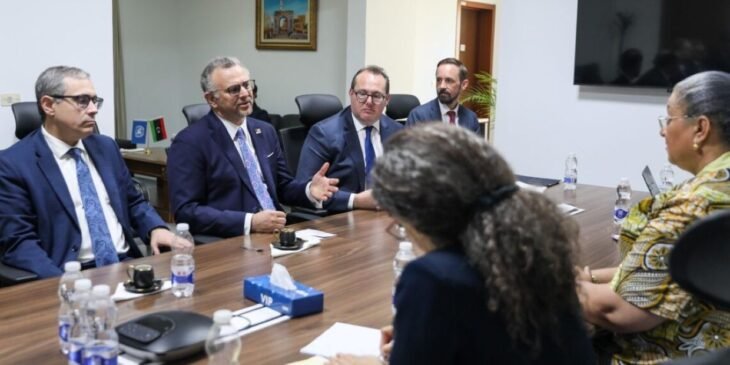
Six weeks ago, Saddam Haftar met Secretary of State Marco Rubio in Washington to discuss Libyan-led reunification. Four days earlier, Abdulsalam al-Zoubi, the Tripoli government’s deputy defense minister, met Mr. Boulos and senior State Department officials.
Misrata, western Libya’s most powerful city outside the capital and the force that stopped Gen. Haftar’s advance on Tripoli in 2019, has rejected the framework. Sheikh Mohamed al-Rajoubi, chairman of the city’s Council of Notables and Elders, told Al Jazeera Arabic that the council had received no written proposal from Mr. Boulos despite months of consultations.
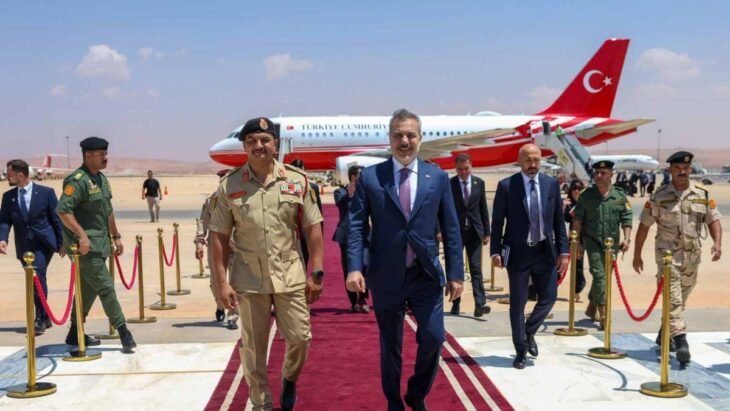
Turkish Foreign Minister Hakan Fidan arrived on Egypt’s Mediterranean coast Wednesday after stops in both halves of Libya. He met Mr. Dbeibah in Tripoli a day earlier, then traveled to Benghazi for meetings with Saddam Haftar and his father. Egypt, Turkey, Saudi Arabia and Pakistan also consult as the Regional Four, whose foreign ministers met in Cairo in June alongside talks with Mr. Boulos. Days before Mr. Fidan’s Libya trip, Saudi Arabia, Turkey and Pakistan signed a trilateral defense pact in Mecca.
Each R4 member brings something Washington needs. Turkey holds military dominance over western Libya through drones and naval assets, in a deployment its parliament extended through early 2028. Egypt underwrites eastern security through the apparatus Maj. Gen. Mansouri helped run. Saudi Arabia holds the financing. Pakistan has signed a $4 billion arms agreement with Gen. Haftar’s forces.
The Egypt-Turkey rapprochement is the bright spot in Washington’s Libya calculation. Cairo and Ankara spent 2019 arming opposite sides of a Libyan civil war and severed diplomatic relations for a decade. Their coordination on the Boulos framework — Fidan meeting Egyptian Foreign Minister Badr Abdelatty at El Alamein after his shuttle to Tripoli and Benghazi — signals that neither capital plans to countermove against the other’s Libyan clients. Without that mutual restraint, the American initiative would collapse back into proxy war. The United Arab Emirates, which backed Gen. Haftar for a decade, has not publicly commented on the Zawiya strikes.
“Egyptian-American agreement on the Libyan file is a strategic necessity for both sides,” Mr. El-Aasar said. Washington does not want Libya contested by Russia, whose preoccupation with Ukraine the U.S. may want to exploit.
The Trump administration has increasingly favored power-sharing deals built around actors who already hold territory. Similar frameworks shaped U.S. policy in Gaza, Syria and early Kurdish diplomacy. Libya was to be the first success story, because its oil offered an immediate payoff at exactly the moment the Iran war was closing others. Four months after Mr. Boulos laid out his three tracks in Washington, all three are under strain.
“On the ground, Libyans see Boulos as a broker seeking financial benefits from possible future oil contracts,” Mr. Khattaly said, “and would rather see more direct involvement from the U.S. secretary of state and the State Department.”
***
Jacob Wirtschafter – Special to The Washington Times
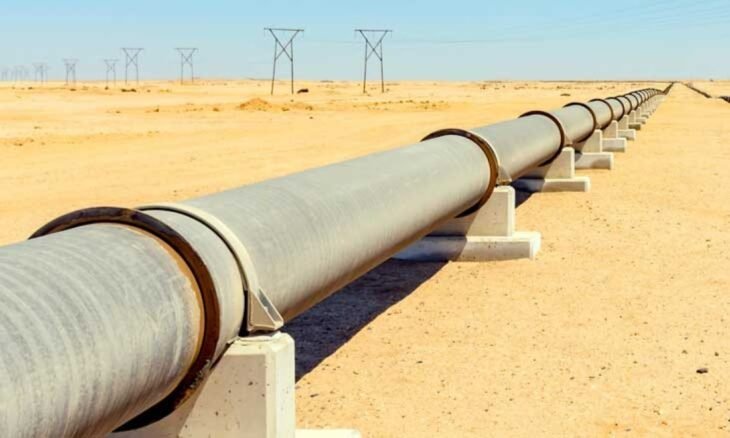
Libya and Egypt are reviving an 800-km oil pipeline linking Tobruk to Alexandria, likely starting at 150,000–250,000 bpd.
Egypt gets crude that bypasses Hormuz, Bab el-Mandeb and Suez, while Libya gains another export route.
Costs could reach $1.5–2+ billion, with first oil realistically around 2030. The proposed Libya–Egypt crude oil pipeline has, surprisingly quickly, entered a phase in which Cairo and Tripoli are actively discussing it. The pipeline, expected to be 800 kilometers long, will connect Tobruk in eastern Libya to Egypt’s port of Alexandria, allowing Libyan crude to flow directly into Egypt’s Mediterranean refining system. With an expected cost of over $1 billion, it represents a significant strategic opportunity. However, neither the final capacity, financing structure, nor investment decision has yet been agreed.
This is important, as the total project is not yet fully financed. The current analysis indicates that Egypt and Libya are discussing financing mechanisms, implementation arrangements, and final throughput. Still, there are major hurdles on the road, as no international bank, sovereign wealth fund or IOC has publicly committed to it. The current project costs should now be regarded as a preliminary cost indication rather than a bankable EPC estimate. Ensuring geopolitical stability is crucial for project success and risk mitigation.
The project itself is not new, as both countries, Egypt and Libya, examined essentially the same corridor more than two decades ago. In 2002, the two countries were already developing twin Tobruk–Alexandria oil and gas pipelines. The Arab Company did this for Oil and Gas Lines, a 50:50 JV between Libya’s NOC and Egypt’s EGPC/GASCO. At that time, the total pipeline was expected to be 620 km and was initially designed for 150,000 bpd. Even mine clearance along the route had reportedly been undertaken. The current proposal is now an entirely new geopolitical idea, but more the resurrection and substantial enlargement of an old one.
Pipeline issue
Assessment – August 2026
Proposed route
Tobruk/El-Hariga area – Egyptian border – Matrouh corridor – Alexandria
Reported length
~800 km
Official preliminary cost
>$1 billion
BWS realistic CAPEX range
$1.3–2.2 billion, potentially higher with storage/pumping/refinery integration
Capacity under discussion
Not yet officially fixed
Historical design
150,000 bpd
BWS likely Phase I
150,000–250,000 bpd
Expansion potential
300,000–400,000 bpd, subject to Libyan production
Likely owners/backers
NOC/AGOCO + EGPC/state entities; possible infrastructure investors/Gulf capital later
Alternative export corridor + Egyptian refining of Libyan crude
Earliest realistic FID
2027
Earliest realistic operation
2029–2030
Principal risk
and security fragmentation pose the principal risks to the pipeline, overshadowing engineering challenges and emphasizing the geopolitical complexity that could impact project feasibility and stability.
Geopolitical and oil market developments in 2026 are now supporting the economic logic behind it. Egypt has become increasingly exposed to Middle Eastern maritime disruption. After the disruption of Kuwaiti supplies due to the Hormuz Strait, Cairo already moved to purchase at least 1 million barrels per month of Libyan crude. At the same time, Libya and Egypt continued to advance the January Libya–Egypt energy cooperation agreement, studying crude and natural gas transportation between the countries. At present, Cairo is simultaneously trying to expand its strategic petroleum reserves as disruptions to the Strait of Hormuz expose the vulnerability of tanker-based supplies.
When taking into account Egypt’s situation, this is much more than another pipeline, as it creates a Mediterranean crude supply source completely outside Hormuz, Bab el-Mandeb, and Suez. Every single barrel entering at Tobruk will never be exposed to chokepoints, offering long-term resilience and market security for stakeholders.
At the same time, the refining argument is equally compelling. Alexandria is already Egypt’s principal refining cluster, with MIDOR alone operating at around 160,000–170,000 bpd, after a $2.7 billion expansion. It processed more than 49 million barrels during 2025. Alexandria Petroleum and Amreya are also adding additional refining capacity. The country’s nameplate refining capacity has historically exceeded 760,000 bpd, but in practice throughput is much lower and varies substantially by refinery.
A 150,000-bpd Libyan pipeline is expected to deliver almost 55 million barrels per year. If reaching 250,000 bpd, the total would be 91 million barrels, and reaching 300,000 bpd would be roughly 110 million barrels. The pipeline itself is therefore small relative to the value of commodity flows it could support.
For Egypt, it would mean several options. Libyan crude could replace more expensive or vulnerable imported barrels. It would also be able to feed MIDOR and other Alexandria refineries. Domestic refined products, especially gasoline, diesel, and jet fuel, could be consumed domestically. At the same time, it would be able to export higher-value surplus products from Alexandria/Dekheila into Mediterranean markets. MIDOR has pipeline connections to Dekheila for product exports. This total enables Cairo to effectively convert geographic proximity to Libyan crude into refining margins, employment, FX savings, and, in surplus periods, export revenues.
For Libya, the logic is different but equally interesting. Libya’s national oil company, NOC, targets a substantial increase in national production from today’s roughly 1.4–1.5 million bpd. The goal is already linked to a January 2026 TotalEnergies/ConocoPhillips agreement targeting more than $20 billion in investment, with potentially very large increases in Waha capacity. If all goes as planned, Libya will need to build additional resilience in its evacuation, storage, and marketing infrastructure. Here Egypt comes into the picture.
Eastern Libya is particularly suited to an Egyptian connection. Sarir crude already travels hundreds of kilometers toward the Tobruk/Hariga export system. NOC’s 2025 annual report shows continuing investment in replacing sections of the 34-inch Sarir–Tobruk line. There is a 100-km replacement program. Setting up the system to link eastwards towards Egypt would create an alternative to tanker exports from Hariga.
Taking this into account, 150,000–250,000 bpd is clearly the commercially sensible starting range. Building immediately for 400,000–500,000 bpd will, at present, entail the risk of creating stranded capacity. These higher levels will be only realistic if Libya successfully pushes national production towards 2 million bpd. Technically, there is still room to design the system hydraulically for later expansion, as larger pumps and additional pumping stations could eventually increase throughput without duplicating the entire right-of-way.
When looking at the $1 billion headline cost, the total looks aggressive. An 800-km cross-border crude system, however, will require the pipeline itself, pumping stations, metering, SCADA, power, border facilities, storage, security systems, cathodic protection, Alexandria receiving infrastructure, and connections to Egyptian refineries. Even though desert construction is technically straightforward compared with mountainous or subsea pipelines, security and logistics premiums are substantial. Given worldwide needs and market developments, it is more realistic to expect a $1.3–2.2 billion planning envelope. If parties are even considering storage facilities and downstream modifications, we will be looking at $2.5 billion. Still, these figures are not based on an announced project budget.
Financing will be the decisive test. NOC/AGOCO and EGPC are natural anchor participants, potentially recreating a structure similar to the original bilateral JV. It is entirely feasible to expect Gulf sovereign or infrastructure capital, especially since Egypt already has a long history of joint Arab investment in energy infrastructure. SUMED is the obvious model: Egypt operates it jointly with Gulf shareholders, and the system moved around 50 million tons of crude in 2025. By looking at international infrastructure funds, export credit agencies, and EPC-backed financing, this will be possible. Still, lenders will demand strong sovereign guarantees and protection against political disruption in Libya.
Ultimately, there will be the political or geopolitical issue to deal with. Tobruk and much of eastern Libya sit within the political-security sphere associated with Khalifa Haftar and the eastern authorities. This is critical to keep in mind, as current pipeline discussions have focused on engagement between Cairo and Abdulhamid Dbeibah’s Tripoli-based Government of National Unity. As long as Libya remains divided between rival power centers, any pipeline will be an instrument of power politics. It cannot safely become an asset belonging politically to only one side while NOC revenues remain nationally sensitive.
The August drone attacks around Zawiya damaged petroleum storage infrastructure and have also shown that security risks are real. At the same time, protests recently penetrated the Mellitah energy complex. Most attention will be paid to the fact that a new international pipeline carrying several billion dollars in crude annually would inevitably become both a strategic asset and a potential coercive target.
Yet this is precisely why the project deserves attention. The Libya–Egypt pipeline is more commercially viable today than it was twenty years ago. Both sides will benefit from the project. At the same time, both governments want deeper economic integration, while the physical distance is manageable.
For analysts, the biggest mistake will again be to judge the project solely on whether a $1 billion pipeline can earn a transportation tariff. The project’s strategic value is considerably larger. Not only will 200,000–250,000 bpd underpin $5–7 billion in annual crude flows, but it will also reduce Egyptian seaborne supply exposure. It will also monetize additional Libyan production and establish Alexandria as an even stronger Mediterranean crude-and-products hub. Still, the project is at present technically highly feasible, strategically compelling, but politically high-risk. Keep in mind that a 2027 FID, followed by construction during 2028–2029, could theoretically deliver first oil around 2029. Reality will certainly be more like 2030. Cost escalation towards $1.5–2+ billion should already be assumed. Technically, there are no issues. The real concern is whether Libya can guarantee that the crude entering that pipe today will still be politically, legally, and physically available twenty years from now.
Drone attacks, an assassination and a central banker’s exit test Washington’s plan to open Libyan oil supply
What to know
The Trump administration’s Libyan oil initiative faces significant challenges.
Recent drone strikes targeted Libya’s energy infrastructure amid ongoing conflict.
A blast at Zawiya oil complex cut power to several cities in Libya
The Trump administration’s push to open Libyan oil as a Gulf-supply alternative during the war with Iran is on the rocks after an assassination, a central banker’s move to quit and a week of drone strikes and explosions that ran into Sunday.
A blast over the weekend at an electrical substation at the Zawiya oil complex cut power to Tripoli, Zawiya, Sabratha, Surman and Gharyan, according to Libya’s General Electricity Co., and officials were investigating whether the incident is tied to a series of armed drone attacks.
The drone strikes in recent days have targeted energy infrastructure in western Libya, which the internationally recognized government in Tripoli controls. The eastern half of the country is controlled by a Benghazi-based warlord, Gen. Khalifa Haftar.
The same power plant hit Sunday was struck four days earlier by an explosive drone, cutting power and prompting General Electricity to suspend work and withdraw its technical teams from the nearby plant Chevron and ExxonMobil are counting on as they enter the Libyan market.
Over the last week, at least six drone strikes have hit a refinery, an electric plant, substations and storage tanks near the coastal city of Zawiya, about 30 miles west of Tripoli.
The attacks came on the heels of an Aug. 10 car bombing in Benghazi that killed one of Gen. Haftar’s top intelligence officers.
A day earlier, the governor of the Central Bank of Libya, which answers to leaders in both halves of the split nation, submitted a letter of resignation that both Benghazi and Tripoli rejected.
In less than two weeks, Libya’s energy infrastructure, security apparatus and main east-west economic institution all came under pressure — the same three pillars Massad Boulos, President Trump’s senior adviser for Arab and African affairs, set out in Washington in April as the basis for reuniting Libya and opening more of its oil to American companies.
Iran’s closure of the Strait of Hormuz has choked a route that normally carries roughly a fifth of the world’s oil and liquefied natural gas. Libya is part of Washington’s answer to Tehran.
Mr. Boulos said in April that Libya would reach 1.6 million barrels of oil a day in the short term and 2 million to 3 million by the end of the decade. Chevron’s return to Libya was the biggest American oil move in decades.
The company won a Sirte Basin contract earlier this year, followed by ExxonMobil signing an agreement covering four offshore blocks. Libya holds 41% of Africa’s proved oil reserves, more than any other country on the continent.
Libya pumped 1.44 million barrels a day in June, its highest since 2013 but still short of the 1.6 million produced before the 2011 uprising that eventually split the country. The Zawiya refinery near Tripoli processes 120,000 barrels a day carried roughly 450 miles from the Sharara field, operated by Spain’s Repsol with France’s TotalEnergies, Austria’s OMV, Norway’s Equinor and Libya’s National Oil Corp.
But the instability in Libya threatens American interests in the wider region, said Wolfgang Pusztai, an Austrian security analyst who served as defense attache in Libya and chairs the National Council on U.S.-Libya Relations advisory council.
Washington’s aims, he told The Washington Times, are to stabilize the country, counter Russia’s military presence in Africa, increase Libyan oil production, control migration to Europe and counter Chinese influence over southern Libyan minerals. “The Boulos initiative is more an opportunity to further U.S. interests from where they stand now,” he said.
Mr. Boulos condemned the refinery attacks and the killing in a post on social media on Wednesday, calling for investigations and urging Libyan stakeholders to “redouble their efforts to overcome divisions.”
“We cannot deal with the three events as three separate incidents, nor can we jump to the conclusion that a single plot lies behind them,” said Hany El-Aasar, executive director of Egypt’s National Center for Studies. What matters, he told The Times, is that Libya’s security, energy and economic institutions came under pressure at the same moment Washington was trying to bind them together.
“In terms of the perpetrators, the three hits are not connected,” said Omar Khattaly, a Libyan American consultant who formerly ran the real estate fund of Libya’s sovereign wealth fund and visited Tripoli in late July. “But they are connected through the current weak structure of the Libyan state. This is all about money, power and control.”
Split country
Libya has been divided since 2014. Prime Minister Abdulhamid Dbeibah runs the west, the Government of National Unity in Tripoli. Gen. Haftar, an 82-year-old dual American Libyan citizen who lived for two decades in Virginia, commands the east and much of the south through the Libyan National Army.
Neither man has faced an election. Turkey supports Mr. Dbeibah with troops and drones. Egypt, the United Arab Emirates and Russia have backed Gen. Haftar. Russia’s Africa Corps still holds positions in the eastern desert and Chinese companies compete for mineral concessions in the south.
The current division dates to the 2011 NATO intervention that toppled Moammar Gadhafi. Then-President Obama, whose administration joined France and Britain in leading the air campaign, later called the failure to plan for post-Gadhafi Libya his worst foreign-policy mistake. Fifteen years on, the Trump administration is attempting to assemble a bargain from the pieces the intervention left behind.
The arrangement under discussion would preserve Mr. Dbeibah’s influence in Tripoli through a central role for his nephew while elevating Gen. Haftar’s 35-year-old son Saddam Haftar to lead a new national executive council. Washington would offer American oil investment and press for the release of frozen Libyan assets. Elections would come later, if at all.
The clearest evidence the approach can work came April 11, when the rival eastern and western legislative chambers approved a unified national budget of 190 billion Libyan dinars, roughly $30 billion — the first since 2013.
***
Jacob Wirtschafter – Special to The Washington Times
Türkiye is opening doors in both Tripoli and Benghazi, positioning itself at the center of Libya’s uncertain political future.
On Aug. 12, Foreign Minister Hakan Fidan landed in Benghazi and was met on the tarmac by Saddam Haftar, deputy commander-in-chief of the Libyan National Army. Within hours, Fidan was standing beside Khalifa Haftar beneath the emblem of the eastern command that once tried to capture Tripoli. Türkiye had helped stop Haftar’s 2019-2020 offensive, yet its foreign minister was now received at his headquarters for their first public meeting in the eastern city.
The timing gave the visit added weight. Two days earlier, a car bomb had killed Maj. Gen. Fawzi al-Mansouri, the director of military intelligence under Haftar’s command. The explosives detonated near his vehicle in Benghazi’s Sayyida Aisha district. No group claimed responsibility.
This was therefore more than a photograph marking the end of an old quarrel. It came during a struggle over Libya’s next political order, the future of its divided military and the distribution of oil and reconstruction revenue. Ankara appears determined to enter that process with working channels in both Tripoli and Benghazi.
Assassination before diplomacy
Al-Mansouri was no ceremonial officer. As the head of military intelligence in the east, he belonged to the apparatus protecting Haftar’s command. His killing exposed a vulnerability in a system often presented as more tightly controlled than western Libya’s network of armed groups.
There’s no real point in guessing who did it. The guessing itself tends to crowd out the one thing that’s actually clear: even Benghazi, after all these years of Haftar tightening his grip, still isn’t fully secure. Yet the Benghazi leg went ahead as planned. Fidan arrived while the eastern command was still absorbing the loss of one of its most senior intelligence officers, signaling that Ankara’s engagement with the east was not contingent on calm.
Fidan offered condolences during his talks. His presence also carried the message that Türkiye can discuss intelligence cooperation, border surveillance, military training and institutional unification with an eastern command facing fresh security concerns.
His message came only days after Haftar’s forces signed a contract with a Turkish company on July 20 for the first phase of a land-border management system covering 275 kilometers (170 miles). The project was placed under the supervision of Saddam Haftar, Khalifa’s son and deputy commander. It was announced as part of efforts to counter arms and drug trafficking, irregular migration and cross-border crime. Cooperation had moved from meetings to a security project on the ground.
Ankara’s channel to Haftar
The channel had opened the previous year, when National Intelligence Organization (MIT) chief Ibrahim Kalın met Saddam Haftar and Khalifa Haftar in Benghazi. Kalın returned to the city on June 23, 2026, for another round of talks with Saddam Haftar, this time focused on preserving peace and bringing Libya’s rival administrations and military structures closer together. Then, Fidan received Saddam Haftar in Ankara on July 24, moving an intelligence-led relationship onto the diplomatic stage.
Fidan’s Aug. 12 visit was the latest step in building relations. He met Khalifa Haftar as the final authority, Saddam Haftar as the security and diplomatic interlocutor, Parliament Speaker Aguila Saleh as the head of the eastern legislature, and Belqasem Haftar, who heads the Development and Reconstruction Fund.
One absence was equally revealing. Fidan’s official program contained no meeting with Osama Hammad, prime minister of the parallel eastern government. Ankara engaged the institutions and individuals holding real power without granting Hammad’s cabinet the same standing it gives the Tripoli-based Government of National Unity.
He made one more stop before flying out of Benghazi: the tomb of Omar Mukhtar, the anti-colonial fighter both sides of Libya’s divide still claim as their own. It’s an easy thing to read too much into, but the timing wasn’t nothing. A day built almost entirely around one family’s hierarchy – Khalifa, then Saddam, then Belqasem – ended instead at a grave that belongs to no faction. Whether that was calculated or just good instinct is not important. It let the visit close on something bigger than the Haftars.
Keeping both doors open
Ankara’s eastern outreach did not begin with a retreat from Tripoli. On Aug. 4, Fidan received acting Interior Minister Imad Trabelsi, acting Defense Minister Abdulsalam Zubi and national security adviser Ibrahim Dbeibah in Ankara. These are central figures in the western security structure that Türkiye has supported through its agreements with Libya’s internationally recognized authorities.
Fidan then started his Libya tour in Tripoli on Aug. 11. He met Prime Minister Abdul Hamid Mohammed Dbeibah, Presidential Council Chair Mohammed al-Menfi and High Council of State Chair Mohammed Takala. He also held talks with security officials and visited the Turkish military mission.
This sequence of visits is carefully calculated: go west first to reassure those who already trust you, then head east. It is the kind of sequencing that signals to Tripoli that it is not being replaced, while assuring Benghazi that nothing on the western side needs to be disrupted for this new relationship to take shape.
This balance serves both Libya’s and Türkiye’s interests. Libya’s eastern and southern regions contain much of the country’s oil infrastructure. Benghazi and Derna offer major reconstruction opportunities. Any lasting agreement on a unified army will require Haftar’s command, while the future of the 2019 maritime memorandum will be more secure if it gains acceptance beyond Tripoli.
However, the last point requires caution. The eastern-based House of Representatives has discussed the maritime agreement and created expectations of a vote, but no confirmed ratification followed Fidan’s visit. Nor was a new maritime accord signed in Benghazi. The handshake improved the political environment around the issue, but it did not settle it.
From Benghazi to El Alamein
The Libya tour also fits Türkiye’s wider diplomatic efforts. In July, military representatives from east and west held unification talks in Sirte, including discussions on joint operations against smuggling and irregular migration.
Fidan traveled from Libya to Egypt for meetings with Foreign Minister Badr Abdelatty on Aug. 13-14. He said the two countries’ views on Libya’s unity, sovereignty and territorial integrity overlapped and that they had decided to turn this understanding into “joint action.”
That phrase gives the Tripoli-Benghazi-El Alamein route its full meaning. Egypt remains the eastern camp’s most influential neighbor, while Türkiye retains the deepest external security relationship with Tripoli. If Ankara and Cairo can coordinate electoral arrangements, institutional unification and security guarantees, they may reduce the room for Libyan factions to play foreign patrons against one another.
So the photograph isn’t really about an old enemy turned guest of honor. It shows Ankara protecting what it already has in Tripoli while preparing for a political order in which the Haftars may carry greater national weight. Whether any of it holds together is still an open question. The border contract actually has to be built. The unification talks in Sirte have to withstand Libya’s habit of talking for years without reaching any decisions. The Parliament in Tobruk has to vote on the maritime deal rather than just discuss it. And Cairo has to want the same thing Ankara wants, for as long as it takes.
None of that was settled on Aug. 12. But few powers, if any, have built the kind of access Türkiye now has across Libya’s divide, with intelligence channels in the east, defense agreements in the west, and Türkiye’s foreign minister welcomed in both Tripoli and Benghazi within the same 48 hours.
The ways in which Libyan elites are involving themselves in these processes are proving especially controversial and delegitimizing. The first major concern is the performative aspect of elites’ involvement in the processes.
Both sides have been highly visible in their engagement; Lt. Gen. Saddam Haftar, deputy general commander of the Libyan National Army, has paid official visits to Jordan, Germany, France, Turkey, and the United States since the beginning of 2026, while Prime Minister Abdulhamid Dbeibeh has visited Turkey, Italy, Qatar, and the United Arab Emirates.
Yet these trips lack tangible deliverables or concessions from Libyan elites on the key governance issues at stake.
Instead, they produce a steady stream of carefully staged photographs and professionally edited videos for Libyan participants’ media channels to celebrate another “successful” visit with a major international figure. With Libyan political discourse increasingly mediated through social media—a primary source for journalists, politicians, analysts, TV and radio stations, and online news outlets—officials in Benghazi and Tripoli actively compete over who can demonstrate the greatest international access.
These highly public visits thus primarily appear to benefit Libyan elites by allowing them to demonstrate power, reassure supporters, and demoralize rivals while presenting a veneer of legitimacy to international observers.
These visits are also impacting the unification process, with Saddam Haftar’s June 29 trip to Washington, DC being a case in point. Washington remains the most important source of external political recognition in Libya.
Haftar’s meetings with various senior U.S. officials at the invitation of Boulos—most significantly his publicized meeting with U.S. Secretary of State Marco Rubio—signaled to many Libyans that Saddam Haftar would be Libya’s next head of government given Dbeibeh’s lack of a comparable visit.
Dbeibeh’s subsequent meeting with UAE President Sheikh Muhammad bin Zayed Al Nahyan in Abu Dhabi was generally interpreted as a last-resort attempt to receive assistance from the Gulf states in response to Haftar’s visit.
This has prompted a growing number of Libyans to message below these social media posts “What have you accomplished for us?” as it becomes increasingly clear that accountability for Libya’s numerous problems and institutional oversight remains largely absent from these meetings.
The announcements that have come out of these processes are also coming under question. The Boulos initiative’s focus on Libya’s oil production has raised particular concern given the level of control that elites hold over Libya’s oil resources and economy in general.
In eastern and southern Libya, not only do Khalifa Haftar, his sons, and their close associates hold military and political power; they also control all major businesses. In addition, the family maintains a strong grip on the oil fields in the territories under their control.
Similarly, in western Libya, the security, political, and economic sectors revolve around Prime Minister Dbeibeh, his family members, and their entrenched circle of loyalists. They control many of the country’s most important institutions, including the Central Bank, the NOC, and the High National Elections Commission.
Thus, the memorandums of understanding that have emerged from the Boulos initiative have political undertones.
In early 2026, Libya’s Government of National Unity signed a strategic cooperation agreement with Boeing to modernize the country’s civil aviation sector. The agreement includes support for acquiring modern aircraft, enhancing technical and technological cooperation, upgrading aviation infrastructure to international standards, and advancing plans for a new national carrier as part of a broader U.S.-Libya economic partnership.
In addition, Libya and Chevron signed an agreement in January of this year marking the company’s return to the Libyan energy sector after more than a decade.
The agreement included an MoU with the NOC to assess Libya’s unconventional shale oil and gas potential, estimated at approximately 123 trillion cubic feet of gas and 18 billion barrels of oil. In February, Chevron was awarded an exploration block in the Sirte Basin during Libya’s first international licensing round since 2007.
Libyans increasingly view these developments—and the United States government by association—as enabling a political system that confers power via international recognition, business deals, and access, rather than via successful governance. According to the language of the mediation initiatives, these processes are designed to facilitate elections, accountability, and state-building in Libya. Yet if Libyans fail to see progress on these governance issues while the country’s political elites reap the benefits of these efforts, popular support for them will continue to dwindle.
In other words, continued international engagement with Libya’s political status quo is primarily benefiting those with the greatest interest in remaining in power and expanding business opportunities with foreign partners.
So long as Libya’s elites retain high-level access to the international community while dodging the responsibilities of governance, they will continue to gain political oxygen while selling an elusive reality to the Libyan people. And if this path continues, international mediation efforts risk encouraging the continuation of Libya’s crisis rather than delivering a solution.
***
Tahani Elmogrbi is a Libya specialist, a MENA conflict-resolution advisor, and political analyst with extensive experience in democracy and governance, peace building, and foreign policy. She advises several European governments on security architecture, foreign fighters, and post-conflict recovery.
Türkiye will continue working to bridge Libya’s political and regional divides, Foreign Minister Hakan Fidan said Wednesday after concluding wide-ranging talks in Tripoli and Benghazi aimed at strengthening cooperation and supporting stability across the North African country.
Fidan said his visit reflected Ankara’s “One Libya” policy, which treats the country’s western, eastern and southern regions without distinction.
“Our visit has been a concrete manifestation of our ‘One Libya’ policy, which makes no distinction between Libya’s west, east and south,” Fidan said, thanking Libyan authorities for their hospitality.
In Tripoli, Fidan met Prime Minister Abdul Hamid Dbeibah of Libya’s Government of National Unity (GNU), discussing bilateral relations, Libya’s political process, regional developments and security issues.
He also held talks with Presidential Council President Mohammed al-Menfi and High Council of State President Mohammed Takala.
Fidan met several senior security and defense officials in Tripoli, including National Security Adviser Ibrahim Dbeibah, acting Defense Minister Abdulsalam al-Zoubi, Interior Minister Emad al-Trabelsi, Chief of General Staff Salah al-Din al-Namroush and military intelligence chief Mahmoud Hamza.
The talks focused on bilateral cooperation as well as current political and security developments.
Fidan then traveled to Benghazi, where he met Libyan National Army commander Khalifa Haftar, deputy commander Saddam Haftar, House of Representatives Speaker Aguila Saleh and Libya Development and Reconstruction Fund Director-General Belqasem Haftar.
The meetings included discussions on Libya’s political and security agenda and opportunities to expand bilateral cooperation.
Fidan described Türkiye’s security and defense cooperation with Libya as a strategic component of bilateral ties that contributes directly to Libya’s stability and broader regional security.
As part of his visit, he also met Turkish troops serving with the Turkish Armed Forces’ Libya Task Group Command in Tripoli.
“Türkiye does not consider Libya’s peace and stability separately from its own stability,” Fidan said, stressing that Libyans should be able to determine and build their future in freedom, security and prosperity.
Fidan said Ankara would continue supporting stronger dialogue and cooperation between Libya’s east and west under President Recep Tayyip Erdoğan’s foreign policy vision.
Türkiye, he added, would maintain its efforts to contribute to Libya’s peace, stability and prosperity.
Meanwhile, the top Turkish diplomat also visited the Mausoleum of Omar al-Mukhtar, revered as Libya’s national hero for leading the resistance against Italian colonial rule, during his contacts in the eastern city of Benghazi.
Foreign Minister Hakan Fidan visits the Mausoleum of Omar Mukhtar, Benghazi, Libya, Aug. 12, 2026. (Foreign Ministry Handout)
Fidan paid tribute to al-Mukhtar at the mausoleum as part of his visit to Libya.
“We visited the mausoleum of Omar al-Mukhtar, a leading figure in Libya’s struggle for independence who resisted colonialism with dignity and determination,” Fidan said.
Describing al-Mukhtar as “a revered hero across the Islamic world,” Fidan honored the memory of the resistance leader, who devoted his life to his faith and ideals and whose legacy continues to inspire generations.
Libyans are increasingly questioning where governance reforms fit into the agendas of Libyan elites’ engagement with the parallel UNSMIL 2025 roadmap and Boulos initiative.
Since 2011 and the death of Muammar Qadhafi, Libyan politicians have repeatedly promised the Libyan people that they would work toward state-building, justice, national reconciliation, and prosperity to transform Libya into “another Dubai.”
Likewise, international efforts to facilitate state-building and a unified Libya date back over a decade, with two parallel initiatives currently taking place in Libya to help mediate between the country’s rival eastern and western political camps.
The 2025 roadmap of UNSMIL, the United Nations Support Mission in Libya, and the Boulos initiative, proposed by U.S. Arab affairs adviser Massad Boulos in April, are the latest efforts to bridge this divide between Libyan elites from east and west.
Yet Libya continues to look like an arena in which competing family businesses each claim to represent the best interests of the Libyan people, the country’s true stakeholders, while actually excluding them.
For most Libyans, the most tangible aspect of these processes has been the high-level international meetings they involve, which are often presented as signs of progress toward unification in and of themselves.
Increasingly, Libyans see this elite engagement in international mediation initiatives as performative rather than constructive. Moreover, they understand that elites stand to gain personally from the focus on international investment in the Boulos initiative.
If discussions about the country’s future maintain public focus on a series of arrangements and business deals among powerful families, political networks, and international intermediaries rather than tangible progress toward elected institutions or popular participation, public confidence in these international efforts toward a unified Libya will continue to erode.
A Tale of Two Tracks
The UNSMIL roadmap, announced in August 2025, is backed by the international community, including the United States and the UN Security Council. Led by Hanna Tetteh, the special representative of the secretary-general (SRSG) for Libya, the roadmap aims to end Libya’s prolonged political transition through a sequenced, three-pillar approach to be implemented within twelve to eighteen months:
1) adopting a technically sound and politically viable electoral framework for presidential and parliamentary elections;
2) reunifying Libya’s divided institutions by establishing a new unified interim government with a time-bound mandate to prepare the country for elections; and
3) a broad structured dialogue involving political actors, civil society, women, youth, and other stakeholders to address governance, security, economic reform, and national reconciliation.
Now running in parallel to the UNSMIL roadmap, the subsequently announced Boulos initiative is part of his efforts to broker a power-sharing arrangement among Libya’s rival factions and attract international investment, particularly from American companies. Boulos has described the initiative as a short-term, U.S.-facilitated roadmap intended to complement the UNSMIL process rather than replace it.
A Question of Legitimacy
On the one hand, the UNSMIL roadmap has received buy-in from key Libyan political figures who have participated in previous versions of the UN mediation process. These include Mohamed Menfi, head of the Libyan Presidential Council (PC); Aguila Saleh, speaker of the House of Representatives (HOR); and Mohamed Takala, head of the High State Council (HSC).
However, the process has also been challenged since its announcement last year, primarily by Libya’s rival political authorities and the broader political fragmentation, with external backers also reinforcing resistance to the UN-led process.
The roadmap’s first two phases stalled amid competing interests and limited UNSMIL political leverage on the ground. This has led the SRSG to bypass the first two phases—”Unified Government Institutions” and “Electoral Framework”—and move directly to the “Structured Dialogue” phase in an attempt to achieve something before the roadmap’s end date.
This phase included more than 120 Libyan participants and generated nearly 600 specific recommendations covering governance, security, the economy, and national reconciliation.
Although governance was addressed in the 600 recommendations, full consensus was elusive, and the recommendations were met with dissent rather than uniform endorsement. For example, one governance recommendation included the proposal of a new unified executive authority to replace the existing divided “transitional” executive structures over the subsequent 18–24 months.
But participants clashed over whether creating another transitional arrangement would simply prolong Libya’s transition rather than help achieve the roadmap’s main objective of ending the transitional phase in Libya.
The dialogue participants later expressed concerns about the roadmap, stating that the recommendations showed that Tetteh was not serious about developing viable solutions by failing to require a finalized or unanimous agreement from the dialogue participants, leaving the recommendations without clear weight and with an outline only toward a new type of transitional government instead of the end to the transitional governments that the framework had initially promised.
Since Boulos announced his initiative in June, critics have also argued that Tetteh has found herself at an impasse due to the widespread attention on the Boulos initiative, instead using the dialogue to compete with it.
The Boulos initiative has also received buy-in from several key political actors in Libya, including Khalifa Haftar, who referred to it as a “unique” development. The weight given to outcomes of this initiative domestically demonstrates the critical role the United States can play given its influence.
But its status as a U.S. diplomatic initiative means it lacks the international mandate of the UNSMIL roadmap, and it has no formal endorsement from the UN Security Council. Its existence has also been understood as a challenge to the SRSG framework despite Boulos’s statements otherwise, putting pressure on the process.
Moreover, it does not yet have support from both sides of the conflict: While Haftar’s side vocally welcomed the initiative’s attempt to unify government institutions, calling it unique, Saleh opposes it, saying that it bypasses legislative institutions.
Further, HSC members are divided on the initiative. As both the House of Representatives (HOR) and the High State Council (HSC) possess the legal authority to pass electoral laws and form a unified government, their agreement is essential to ensuring the legitimacy of any nationwide deal or political initiative. These complications have contributed to the Libyan public expressing skepticism about the legitimacy of both initiatives.
***
Tahani Elmogrbi is a Libya specialist, a MENA conflict-resolution advisor, and political analyst with extensive experience in democracy and governance, peace building, and foreign policy. She advises several European governments on security architecture, foreign fighters, and post-conflict recovery.
As blackouts spark protests, a decade of fractured governance, under investment and corruption has left an oil and gas-rich nation unable to keep its lights on.
Earlier this month, Al Robyan, one of Tripoli’s most popular seafood restaurants, made an unusual offer: a table laden with seafood in exchange for “some fuel for the generator”. “We’ve run out of earthly solutions,” the restaurant wrote on Facebook.
The post drew thousands of responses, with some joking that the fuel would cost more than the seafood on offer. Over the summer, Libyans across the country have endured almost daily power outages lasting between six and 10 hours. That might sound unusual for a hydrocarbon-rich country that produces more than 1.3 million barrels of oil a day and has a population of just over 7.5 million.
“Since these massive shortages started, every business in Libya has been affected,” said Alaeddin Muntasser, a retired businessman in Tripoli, who described the situation as an “electricity disaster”. Muntasser told Middle East Eye of one water-bottling plant severely affected by the blackouts. “We had a shortage of drinking water for a couple of weeks. If they can’t pump or filter, they can’t bottle,” he said. “Many small restaurants have shut down; a few who can afford to have a generator to run their ovens managed to open.”
Meanwhile, people with the worst blackouts lost all the food in their freezers and fridges. The blackouts have sparked protests in Tripoli, Zawiya, Misrata and elsewhere in Libya. Demonstrators demanding a more reliable electricity supply have also called for the resignation of Prime Minister Abdul Hamid Dbeibah. Libya generates roughly 70 percent of its electricity from natural gas, leaving the power grid highly exposed to falling gas production and disruptions at fields and pipelines. Oil accounts for almost all the remainder.
“The electricity crisis and related protests is one of those problems that will not go away until Libya’s government can implement a longer-term strategy that ensures a more reliable electricity supply, whether that be through refined fuels or renewable energy sources,” Hamish Kinnear, principal Middle East and North Africa analyst at risk intelligence company Verisk Maplecroft, told MEE.
Kinnear noted that Libya was not alone in facing such problems, “but for citizens of a country with the largest oil reserves and the fifth largest gas reserves in Africa, as well as significant solar power potential, blackouts are a particular source of frustration”.
A crisis decades in the making
The roots of Libya’s current electricity crisis go back years. The country has not recovered since it plunged into chaos after a Nato-backed uprising toppled and killed longtime leader Muammar Gaddafi in 2011. Since then, the country has split, with rival administrations in the west headed by the internationally recognised government of Dbeibah, and in the east backed by forces led by General Khalifa Haftar and foreign governments.
Years of underinvestment in the power grid and gas production, combined with this year’s heatwave, in which temperatures hit 50C, have all come to a head. “Oil wealth only becomes reliable electricity when institutions can convert it, and Libya’s institutions have been fractured for over a decade,” said Karim Elgendy, executive director of the Carboun Institute, a think tank focused on Middle East and North Africa energy and climate.
“Rival authorities issue competing decisions over the same grid and the utility recovers almost none of its costs. Years of deferred maintenance have left the network running on ageing equipment with no margin for error. So every summer becomes a stress test the grid is not ready for,” Elgendy told MEE. In January, Egypt and Libya signed a memorandum of understanding to deepen cooperation in the oil and gas sector.
In July, Egyptian Foreign Minister Badr Abdelatty and other Egyptian officials met with senior Libyan officials, including National Oil Corporation chairman Massoud Suleman, to discuss deepening energy ties between the two sides. Following Libya’s electricity blackouts throughout July, Tripoli turned in part to Egypt, which boosted electricity export capacity to Libya by approximately 43 percent, reaching 100 megawatts.
Despite the apparently sharp rise, the extra supply meets only a fraction of Libya’s electricity needs, covering less than a tenth of its recent generation shortfall. Libya also settled outstanding dues to Egypt totalling around $90m. On the surface, both sides stand to benefit from deepening energy cooperation. Egypt has a massive appetite for energy, and Libya has significant hydrocarbons sitting under its soil.
“The complementarity between the two economies is real: Libya has the hydrocarbons, Egypt has the refining, the generation fleet and the contractors,” said Elgendy. “But genuine integration begins when both sides commit to a long-term commercial framework with obligations running both ways.” And that shows little sign of happening.
Egypt’s own electricity needs run on burning gas, and lots of it. Where it once had enough production of its own to meet much of its energy needs, that production has been declining as reserves are depleted. “Egypt’s own power system leans heavily on imported gas it does not control, and recent supply interruptions showed how quickly that exposure travels down the chain. A country importing electricity from Egypt is, indirectly, importing Egypt’s gas risk,” noted Elgendy.
In recent years, Egypt has had to turn to Israel. Cairo signed a record $35bn gas deal with Israel in 2025, almost tripling its gas imports from the Israeli Leviathan gas fields and marking the largest export deal in Israel’s history. Jalel Harchaoui, Libya specialist with the Royal United Services Institute, says the attempts by Libya and Egypt to look to meet each other’s energy needs are “not to be taken seriously”.
Harchaoui is sceptical that energy needs were driving the outreach. “I think it would be very incorrect to say that the electricity situation is the reason for the meeting,” he told MEE. “There has been a pattern whereby Tripoli tends to say to Egypt: ‘Let’s talk. And by the way, I notice you’re suffering from energy shortages. Libya has a small population and a lot of energy, Tripoli is happy to help you, Egypt.'”
He described it as “more of a diplomatic trick than something really genuine, especially during a summer when Libya itself is grappling with a very serious electricity crisis”. Harchaoui says the deeper problem is one that Tripoli has been ignoring for a decade.
Libya sits on abundant natural gas reserves both onshore and offshore, “but the error that Libya made, and it’s a profound error with long-time consequences, is that it hasn’t kept up in terms of natural gas production capacity”. Gas still accounts for roughly three-quarters of the country’s electricity output, yet years have gone by “with no new natural gas project of any significance even being launched”.
The result, Harchaoui said, is that existing assets have been “shrinking in terms of output”, and even a new project greenlit today would take “at least seven or eight years” before producing results. On current trends, he warned, Libya could within a few years be “humiliated to the point of having to import natural gas”, a reversal that would undercut any framing of Libya and Egypt as complementary energy partners.
Part of the failure is cultural as much as technical, he argued. Libya operates with “the culture of a crude oil-producing country” that “just doesn’t think in terms of natural gas” as a priority, even though gas, not oil, is what actually keeps the lights on. Corruption has compounded the delay, not only by diverting money but by slowing decision-making itself.
“To do a corrupt project, you need more time than to do an honest project, because you have to make sure all the key officials are satisfied with their bribes,” Harchaoui said, alleging that some power plant units installed between 2022 and 2025 were purchased secondhand and passed off as new.
Political dynamics have also shaped the outbreaks of anger. Harchaoui pointed to years of unfulfilled promises by the country’s prime minister – who has claimed since 2021 to have “resolved” the crisis – as one reason unrest has concentrated in the west, where protest is easier to organise than under Haftar’s tighter grip in the east. Blackouts, he stressed, are hitting the east and south too, just less visibly and without the same political cost.
***
Elis Gjevori is a journalist based in Istanbul. He focuses on the Balkans, Turkey and the Middle East.
To many Libyans, the whole idea of the talks is offensive: they send the message that the country should be formally subject to family rule. On the Dbeibah side the negotiations are being led by Ibrahim, whose father, Ali, established the Dbeibah family’s reputation for graft by making a fortune leading a state body that managed large construction projects during the Qaddafi era. (One of the main contractors of this body was a state-owned company run by Abdulhamid).
For his part, according to a recent UN report, Ibrahim owes much of his influence to his “direct collaboration with armed group leaders,” a field in which he “largely operates without any checks or balances.” Saddam Haftar, in turn, owes his prominence first and foremost to his father’s violent rise over the past decade, in addition to his own ruthlessness.
The unit he has commanded has been accused by Amnesty International of a “catalogue of horrors” against civilians. UN investigators recently identified him as the kingpin of networks that siphon off billions of dollars in state funds each year, including by smuggling fuel—which is heavily subsidized in Libya—outside the country to foreign buyers, and by shadow-operating a private firm that struck a shady deal with the NOC to export vast amounts of crude from the east’s oilfields.
The capital, firepower, and political clout Saddam derives from these activities have helped him become his father’s anointed successor, bypassing his older brother Khaled, whom his father named chief of staff as a consolation prize.
Yet Saddam, like Khalifa’s other sons, is tainted in the view of many Libyans for benefiting from his father’s bloody successes. Sibling rivalries, moreover, have put further hurdles in his path: his brothers Khaled and Belgasem have, my sources told me, mobilized their political clients to oppose the Boulos plan.
On June 29 Boulos hosted Saddam in Washington for a meeting with Secretary of State Marco Rubio to press the deal; the following day he tried to persuade Belgasem, who had traveled separately.
Saddam, by all accounts, is strongly in favor of Boulos’s proposal. It would allow him to cast off his thuggish reputation and hand him the highest national political office without the need for elections he could not possibly win.
Far less obvious is what the Dbeibahs stand to gain. They would risk a rebellion from western Libyan forces who are not only opposed to the Haftars but understandably fearful that, sooner or later, Saddam will use his new position to monopolize power.
The Dbeibahs’ hometown of Misrata, about 130 miles east of Tripoli, is also the base of several armed groups that weigh heavily in Libya’s military balance, and virtually everyone I spoke with there told me that the city would openly mobilize against the deal if it was indeed formalized. When Boulos visited Misrata in early July, local dignitaries conveyed the same message to him.
Conscious of these risks, the Dbeibahs have sent conflicting messages to their constituencies, at times dismissing the Boulos proposal outright or suggesting that they have been playing for time. It is unclear whether they are negotiating in good faith or are simply wary of alienating an in-law of the US president.
They may not be unhappy about Misratan resistance to the proposal, which gives them an excuse for stalling. Yet advisers to the Dbeibahs certainly seem flattered that a senior US official considers them the Haftars’ equal and exclusive interlocutors, after years of convoluted, UN-led political processes led by bureaucrats with limited clout and involving a long cast of Libyan politicians of questionable relevance.
They could allow themselves to be coaxed into a deal they do not intend to implement. Having triumphed over numerous powerful challengers over the past five years, they may also believe they will outsmart Saddam once the agreement is in place (and in the meantime, like everyone else in Tripoli, wait for his father to die). Both would be dangerous gambles.
From Gaza to the Democratic Republic of the Congo, the Trump administration has shown a proclivity for announcing flashy peace deals and an utter lack of interest in implementing them.
There is no reason to expect that Libya, a country that matters little in Washington, will be any different. But in Libya the two sides have not fought directly for six years, which means that the Boulos initiative could do worse than merely fail to solve the conflict or further entrench its causes—it could unsettle the fragile equilibrium that has maintained the stalemate.
Saddam, eyeing the position of president, would suffer a serious disappointment if the talks fail, strengthening the position of advocates for a military alternative in the Haftar camp. If the negotiations do result in a deal, Saddam could use his official position to rally rivals of the Dbeibahs from western Libya around him.
One military commander in Tripoli likened that scenario to the temporary power-sharing arrangement that prevailed between two Sudanese generals before they turned on each other in 2023, provoking that country’s devastating, ongoing civil war. In that case, given the Trump administration’s record, nobody would expect the US to intervene and stop the deal from unraveling.
Even an agreement that remains a dead letter carries risks: Saddam could still claim the prerogatives offered to him on paper, and justify military action as necessary to take what is rightfully his.
Underpinning these scenarios are broader changes in Libya’s balance of power and regional relations. The Haftars and Dbeibahs both benefited from the informal arrangements they maintained over the past five years, but the former made out much better.
Each year billions of dollars washed into the Haftars’ coffers from oil exports, fuel smuggling, printing counterfeit currency, and pillaging state-owned banks. In Tripoli, these schemes caused widening fiscal and balance-of-payments deficits, as well as a slide in the dinar’s black-market exchange rate, all of which harmed the Dbeibah government politically.
The Haftars, meanwhile, went on a shopping spree, buying heavy military equipment from abroad, cultivating political loyalties across the country, and launching a grand reconstruction program run by Belgasem, who is said to hand out Rolexes to Western businessmen and diplomats. Many of the building contracts went to Turkish and Egyptian companies with close ties to their countries’ rulers, evidently in order to buy foreign support.
Over the past two years, meanwhile, Turkey has cultivated warmer relationships with the Haftars, above all because it wants the east-based parliament to ratify a maritime agreement it signed in 2019 with the government in Tripoli. The most alarming sign of those deepening ties has been a string of considerable Turkish defense deals with the Haftars.
In April, Reuters reported that Saddam’s forces seemed to have acquired Bayraktar TB2 combat drones—the very drones that Turkey has at times restricted the Dbeibah government from using in battle. The only plausible targets of these weapons are the western Libyan factions that have enjoyed Turkish military support since 2020.
The leaders of those factions are torn between the conviction that Turkey could not possibly have an interest in the Haftars seizing power—which would remove any need for a Turkish military presence in the country—and their suspicion that they can no longer count on their erstwhile protector.
In other respects, too, the international environment has become permissive toward renewed escalation. European states are mostly uninterested in Libya, with the exception of Italy and Greece, which have defined an EU policy that prioritizes migration control over everything else.
In practice, this has meant cultivating close ties both with Dbeibah and Zubi in Tripoli and with the Haftars in the east, ignoring the military buildup on both sides, looking the other way as fuel smuggling drains the state’s coffers, and implicitly condoning the brutal detention of migrants in prisons run by the Tripoli government and Haftar’s forces alike.
The latest illustration of European collusion concerned the EU naval mission Irini, formed in 2020 to inspect ships suspected of violating the Libya arms embargo—a task for which it had a mandate from the UN Security Council.
For months the Dbeibah government’s foreign ministry had demanded that the mission expand that mandate and also intercept ships believed to be smuggling fuel, but European diplomats cautioned that doing so would damage their relations with the Haftars. Instead, this past May, France and Greece—the current European members of the UN Security Council—allowed the council’s mandate for Irini to expire.
And in a country where the biggest and glitziest new structures are military bases and where military power serves private interests, the EU recently funded the construction of yet another base, for a unit reporting to Zubi. The likely European response to renewed war would be polite silence, in expectation of an accommodation with whoever the victors are.
As both sides of the conflict build up their arsenals and collude in defrauding the state, they are inexorably pushing Libya toward crisis. Boulos, seeking to cement the status quo by entrenching the rule of the two families, may turn out to be the harbinger of its collapse.
“If the Boulos initiative fails, the alternative will probably be war,” one person close to the Dbeibahs’ negotiators told me in July. War would also be the predictable consequence if Boulos succeeds.
***
Wolfram Lacher is a Senior Associate at the German Institute for International and Security Affairs (SWP) in Berlin and the author of Libya’s Fragmentation: Structure and Process in Violent Conflict.
In mid-June of 2026, the two rival factions claiming to be Libya’s official government agreed to a power sharing deal. In it, Prime Minister Abdul Dbeibah, the leader of the internationally recognised Government of National Unity (GNU) based in Triopli in western Libya, and Field Marshal Khalifa Haftar, the power behind of the unrecognised Government of National Stability (GNS) based in eastern Libya agreed to what is functionally a dual executive system for the new transitional government.
Under the deal, Dbeibah would retain his current post as prime minister of the GNU, while Haftar would be given substantial sway over a new three-person executive presidency, likely to headed by his son Saddam. This deal comes in the aftermath of both an agreement establishing a joint budget as well as joint military exercises in Sirte between April and June of 2026, with Western partners like the US, Germany, and the UK also participating.
While critics have rightly labeled this recent deal as an ‘elite bargain,’ essentially empowering the two rival leaders instead of the average Libyan, this power sharing agreement as well as the prior two agreements before it are necessary but insufficient steps if Libya is ever to emerge as a government with at least some semblance of stability or democracy.
Power mechanics
The joint exercises in Sirte mark a significant step towards bridging the two competing military forces into a new, professional army. Integrating former militias into a unifying security structure is generally considered an important step in ensuring lasting peace, provided such integration is successful. As in Liberia and Sierra Leone, integrating rival factions into a national framework provides a sense of credibility to negotiated transitions, though in both cases, reintegration was largely focused on demobilisation and disarmament.
The new joint budget is meaningful because it indicates that both sides are currently putting their money where their mouths are. Agreeing to a joint budget is a significant surrendering of autonomy for both sides. This directly influences security sector integration as whoever controls the budget exerts significant control over the military. This is one of the key ways in which democratic governments maintain control over their own military.
Expected outcomes
The agreed-to transitional government, expected to last until February of 2027 when new elections are scheduled, resembles a semi-presidential system, where executive power is split between a President and a Prime Minister.
In theory, this allows for a compromise between elites who may have an easier time winning the Presidency by consolidating national votes as opposed to an opposition, which could have an easier time running in a multiparty, parliamentary election. In parliamentary elections, even a small share of the seats associated with the opposition could be meaningful in electing a prime minister. This particular constitutional system is often implemented after periods of conflict and used in countries like Namibia, Mozambique, and the DRC.
Both election systems are likely to follow both historical and regional patterns. Like most African states, Libya will likely use a two-round runoff system for its presidential election, ensuring at least a symbolic commitment to democracy while also making sure that elite cohesion is not negatively affected by running multiple elite-aligned candidates. This system is frequently used throughout the continent in ethnically or politically fragmented countries.
The 2012 parliamentary elections were held using a mixed system. 120 seats were elected in single member districts while 80 were elected on proportional party lists, where a party’s vote share is directly proportional to the seats won. Unlike in most democracies with such a system, like Japan, South Korea, etc., however, candidates for these single member districts officially all ran as independents rather than on party lists in 2012. While this particular system cannot be ruled out, it would be more in line with global standards to allow single member constituency candidates to run as members of political parties.
A mixed system may have initially been introduced to balance out fragmented local and national power brokers. Individual candidacies preserve local networks and influence while the party list system, using nationwide lists, would help the development of institutional political parties as part of Libyan politics in the long term.
Limitations
There are, of course, limitations. These institutions themselves are not enough; they must be accompanied by an independent judiciary, an independent election body, functioning local government, and strong anti-corruption bodies, among others.
A unified budget, while a step in the right direction, is unlikely to fix fundamental economic problems that ordinary Libyans face, such as the high cost of essential goods. A unified military likewise will not help if its mission becomes the preservation of the ensuing elite structure instead of serving the people. Grand institutional designs are meaningless if an autocrat like Tunisia’s Kais Saied can emerge and exploit polarization and economic grievances to roll back hard wonhard-won democratic freedoms.
Conclusion
Ultimately, a thriving Libya is a long-term project. Strengthening institutions and norms associated with democracy takes years, if not decades, to accomplish. Institutional backsliding and reversals are likely, if the cases of Liberia and Sierra Leone, are looked at as examples. In both cases, however, international support was dedicated and committed to ensuring a post-civil war democracy. Libya will likely need similar support if it is to emerge as a stable and governable countryز
For six years a fragile stalemate has kept Libya’s conflict frozen. A new US-brokered mediation effort risks upending that balance.
***
On my last visit to Tripoli, this past June, the city often felt as if it had left the protracted conflicts of Libya’s post-Qaddafi era behind. At night, families were out in the streets catching a respite from the heat of the day. The occasional blasts were not gunfire but fireworks at wedding celebrations.
Incoming flights were carrying foreign businessmen and engineers working on contracts for the state oil company or other public bodies. The last serious clashes in the city, in May 2025, seemed to lie in the distant past. If something was weighing down the public mood, it was the relentlessly increasing cost of living.
The inflationary shockwaves radiating out from Hormuz have compounded the dinar’s continuous slide against the dollar, leaving most Libyans unable to make ends meet with their public-sector salaries. Since I left, mounting temperatures have increased demand for electricity, and long power cuts—mostly caused by intentional load-shedding—have prompted sporadic protests. But that, after all, is a dynamic Libya shares with countries as varied as Bangladesh or South Africa.
And yet the semblance of normality is deceptive. Since 2020, when Turkish-backed western Libyan forces defeated an attempt by Khalifa Haftar’s Libyan Arab Armed Forces to capture Tripoli with support from Russia and the United Arab Emirates, a fragile stalemate has kept Libya’s conflict frozen.
Haftar’s forces control most of the country, including most of its oilfields, and sponsor their own government. Libya’s internationally recognized ruling body, however, is the Government of National Unity, led by Prime Minister Abdulhamid Dbeibah, which owes its name to the UN-led process that created it in 2021, though it has long since abandoned any pretense of a unity government.
Dbeibah holds varying degrees of sway in the northwest, most noticeably in Tripoli, where the state institutions that manage the country’s oil wealth are headquartered. Any ambitions to alter this situation by force have been discouraged by, respectively, the Turkish military presence in the northwest and a Russian deployment in Haftar’s territory.
Even as Libya remains divided between two competing governments, the families that rule them have brokered notable deals that bind them to one another. The two main figures in this connection have been Dbeibah’s nephew Ibrahim—the éminence grise behind the throne—and Haftar’s son Saddam, his octogenarian father’s designated successor and the de facto leader of his forces. Saddam, mustachioed and taciturn, is in his mid-thirties and notorious for his brutality and rapacity. (Born during the first Gulf War, he was named after the Iraqi dictator.)
In 2022 Saddam and Ibrahim agreed on the appointment of a Haftar nominee as head of the National Oil Corporation (NOC) in Tripoli; in exchange, Haftar’s forces lifted a partial blockade on oil exports they had imposed in the months before. Since then, well-informed sources have told me over the years, the Dbeibahs and Haftars have carved up the boards of numerous state-owned companies and banks among themselves.
Today, however, there is growing uncertainty about whether that balance still holds. The Haftars have used the stalemate of the past years to vastly expand their arsenal, war chest, and foreign relations—far more than western Libyan forces have been able to do. Many close observers in Tripoli now see the endgame drawing close.
The latest threat to the country’s precarious status quo comes from a mediation effort led by Massad Boulos, Donald Trump’s senior advisor on Arab and Middle Eastern affairs. Boulos, a Lebanese Christian who moved to Texas as a teenager, had spent years working as a truck salesman in Nigeria before he joined the Trump administration in 2025, three years after his son Michael married Tiffany Trump.
Since assuming his current position, he has made Libya one of his priorities. In the process, he has brushed aside a decade of largely fruitless efforts by the UN to consult widely among the country’s political class and develop the legal basis for a unified democratic government. Instead, he has tried to broker a power-sharing deal directly between the Haftar and Dbeibah families. Whatever the outcome, that initiative may well hasten the return to war.
Tripoli is a microcosm of the unresolved conflict. Ever since the demise of the Qaddafi regime in 2011, the capital has been the site of a long, deadly game of musical chairs among the countless armed groups that filled the vacuum left by his forces. Each of their periodic clashes, in constantly changing arrangements, has resulted in the elimination of one or more factions, with the victors sharing the spoils and growing stronger.
Weak governments have relied on these groups for protection, according them official standing as state security forces and enabling them to gradually infiltrate—and eventually dominate—public institutions.
By the time Dbeibah took office in 2021, the participants in the contest over the capital had been reduced to around a dozen powerful armed groups. Dbeibah has excelled at playing these factions against one another, temporarily empowering some to eliminate others.
In 2022, when a competing government backed by Haftar and some of the capital’s armed groups tried to oust Dbeibah, he warded off the challenge by relying on two forces in particular: a faction led by a former baker who went by the nickname “Ghnewa,” and a unit that controlled Mitiga, the city’s only functioning international airport, led by a Salafi sheikh named Abderrauf Kara.
In the years after Dbeibah prevailed, Kara increasingly lost his favor. Ghnewa, meanwhile, became the most powerful militia leader in Tripoli, building an empire of shell companies through which he siphoned funds from state institutions under his control.
But his voracity inevitably brought him into conflict with the Dbeibah family, and on May 12, 2025, he was killed at the headquarters of the Tripoli-based 444th Brigade after imprudently accepting an invitation from its commander, Mahmoud Hamza, the head of military intelligence—and one of Dbeibah’s closest allies. Within hours Dbeibah’s forces had taken over Ghnewa’s territory.
The following day Dbeibah-aligned groups, emboldened by their success, tried to press their advantage against Kara’s militia as well. This time they met heavy resistance, and in a matter of hours forces hostile to the government from the neighboring city of Zawiya mobilized at the gates of the capital to join Kara’s side of the fight.
It quickly became clear that the clashes risked provoking a war that neither side could rapidly win. Less than twenty-four hours after the fighting had begun, a fragile cease-fire took hold that persists to this day.
Critical to this yearlong détente has been Turkey, which has had a military presence in the capital—including at Mitiga Airport—since it intervened in 2019 to stop Haftar’s Tripoli offensive. Hoping to keep the peace, Turkey prevented the government from using Turkish drones in the clashes with Kara’s forces and subsequently brokered arrangements that kept both sides frozen in their positions.
The underlying conflict remains unresolved, but for the past year most observers have assumed both that Turkey’s influence will help maintain the fragile balance and that Dbeibah and the commanders supporting him have no interest in resuming the fight unless they can be sure of winning quickly and decisively.
And yet throughout the past year both sides have been preparing for the next confrontation. Kara has rallied a motley crew of factions that had previously been defeated by Dbeibah’s current or erstwhile allies.
Among them are remnants of Ghnewa’s group as well as a unit commanded by Haitham al-Tajuri, a Tripoli militia leader who is widely known to have defected to Saddam Haftar after Ghnewa expelled him from the capital several years ago.
On my last two visits, people on different sides of the conflict told me that Saddam has sent al-Tajuri’s recruits to Belarus for training, then deployed them under Kara’s protection in Tripoli.
The buildup has been going on for months: last November one contact recounted to me that his son had sought his permission to escape the boredom and lack of economic opportunities in Tripoli by joining al-Tajuri’s soldiers for a stint in Belarus.
In Dbeibah’s camp, political and military leaders downplay the threat posed by Kara and his allies, questioning their loyalty to Saddam Haftar. But on Dbeibah’s side, too, preparations for the next round of fighting are unmistakable.
His two most powerful commanders, Hamza and Deputy Defense Minister Abdulsalam Zubi, have learned from past experience and, I was told, have bought large numbers of drones they can operate on their own, without needing Turkish approval.
They also control the capital’s official international airport, which has been closed since two competing militia coalitions fought over it in 2014 but is expected to reopen in the coming months. When that happens, interlocutors in the Dbeibah camp believe, their adversaries in Mitiga will lose much of their leverage and either slide into irrelevance or be contained more forcefully.
Such talk will be familiar to anyone who has followed the prolonged elimination contest among armed groups in the capital. Few military commanders or close observers doubt that the next round will happen eventually. Now that the government’s adversaries are looking to the Haftars for help, however, the struggle over Tripoli has the potential to reignite conflict across the country as a whole.
These are the fraught circumstances under which Boulos is angling to secure another peace deal for Trump. Boulos first arrived in the country in July 2025, focusing on deals for American energy companies. This required securing funding from the Dbeibah government so that the National Oil Corporation could honor its commitments to its US partners.
According to Libyan officials involved in the talks, Boulos soon found himself confronted with the tug-of-war over state finances between the Dbeibahs and the Haftars, whose parallel government has spent vast sums in total opacity by taking out debt from banks in the east covered by dubious treasury bills, printing counterfeit currency, and changing vast sums into dollars on the black market (which did much to push down the dinar’s value).
In September Boulos brought Ibrahim Dbeibah and Saddam Haftar together in Rome for talks on a unified government. Making little headway, he instead pursued an agreement on a unified budget that, according to people with knowledge of the deal, would both provide funding for the NOC and send billions of dinars from Tripoli to construction funds run by the Haftars—in exchange for an end to their parallel spending.
(The Haftars’ irregular financing schemes cannot work indefinitely, which gives them some incentive to agree on a joint budget.) Boulos brokered two such expenditure agreements, in November 2025 and April 2026. Neither shows any signs of being implemented.
This did not discourage him from pushing a more ambitious proposal. The details are blurry and constantly evolving, but its core is the formation of a unified executive that would appoint Saddam Haftar as president while Dbeibah would remain prime minister; several knowledgeable sources told me that Zubi and Saddam Haftar would jointly lead the supreme military command.
It is tempting to dismiss the plan as a hopelessly superficial scheme that will evaporate at first contact with Libyan realities. But Boulos’s proposal should be taken seriously, if only for the extent of the damage it could do.
***
Wolfram Lacher is a Senior Associate at the German Institute for International and Security Affairs (SWP) in Berlin and the author of Libya’s Fragmentation: Structure and Process in Violent Conflict.
Türkiye’s outreach to the east complements rather than competes with its ties to Tripoli. This approach is part of a consistent effort to keep channels open with all actor capable of shaping the country’s political future.
***
Fifteen years after the 2011 uprising, Libya remains politically divided between the UN-recognized Government of National Unity (GNU) in Tripoli and the eastern-based administration supported by Khalifa Haftar and his Libyan National Army (LNA).
As international efforts to resolve this protracted stalemate continue, Turkish Foreign Minister Hakan Fidan’s recent meeting with Saddam Haftar, deputy commander of the LNA, illustrates Türkiye’s evolving engagement with Libya’s rival centers of authority.
The evolution of Turkish-Libyan relations
Ankara, having long supported the internationally recognized government in Tripoli, has gradually expanded its political, security, and technical engagement with eastern Libya’s political and military leadership. This approach reflects a comprehensive strategy to engage all major Libyan stakeholders in pursuit of political reconciliation and institutional reunification.
Following Khalifa Haftar’s offensive against Tripoli on April 4, 2019, Türkiye became the principal external supporter of the internationally recognized Government of National Accord (GNA).
Turkish support extended beyond the defense of the capital to include defense cooperation, military training, and capacity-building initiatives designed to strengthen Libya’s security institutions and facilitate the eventual unification of the country’s armed forces. By halting Haftar’s advance and altering the military balance, Türkiye’s intervention contributed to ending large-scale conflict and enabled the ceasefire that has largely persisted since 2020.
Since the 2020 ceasefire, Türkiye’s engagement with eastern Libya has expanded from initial humanitarian assistance and reconstruction efforts to encompass closer political, economic, and defense cooperation. Saddam Haftar has played a central role in this rapprochement through multiple visits to Türkiye and meetings with senior Turkish officials.
Ankara’s outreach to eastern Libya has not diminished its longstanding partnership with Tripoli. Turkish President Recep Tayyp Erdogan has reaffirmed his commitment to cooperation with Libyan Prime Minister Abdul Hamid Dbeibah, while Turkish officials have simultaneously deepened engagement with eastern leaders, including Intelligence chief Ibrahim Kalin’s recent visit to Benghazi and Foreign Minister Hakan Fidan’s meeting with Saddam Haftar.
By maintaining dialogue with both sides, Türkiye is positioned as one of the few external actors capable of supporting Libya’s political reconciliation and institutional reunification.
Türkiye’s growing engagement with eastern Libya should not be viewed as a challenge to Egypt’s longstanding influence or as a departure from its Libya policy. Long before the 2011 uprising, Turkish companies were active across both eastern and western Libya, reflecting Ankara’s longstanding view of Libya as a single, undivided state.
Today, Türkiye’s outreach to the east complements rather than competes with its ties to Tripoli. This approach is part of a consistent effort to keep channels open with all actor capable of shaping the country’s political future.
It also coincides with an unprecedented period of regional coordination between former rivals, creating new opportunities for Ankara and Cairo to use their respective influence to encourage reconciliation.
A stable Libya would primarily benefit the Libyan people, while also serving the long-term strategic and economic interests of regional actors that once backed competing factions.
Economic and energy cooperation
Libya’s strategic significance extends beyond its political context. Oil remains central to Libya’s economy, as the country possesses Africa’s largest proven oil reserves and derives the majority of its export earnings and government revenues from hydrocarbons. However, prolonged conflict and political fragmentation have severely damaged infrastructure and reduced foreign investment, disrupting production and hindering Libya’s ability to fully exploit its energy resources.
As Libya works to revitalize its energy sector, Türkiye has increasingly supplemented its security engagement with expanded economic and energy cooperation.
A key development in recent years was the 2019 maritime delimitation agreement signed with GNA, which redefined the geopolitics of the Eastern Mediterranean by establishing maritime boundaries between Türkiye and Libya.
This agreement advanced Türkiye’s strategic interests and simultaneously strengthened Libya’s maritime claims and sovereign rights over its Exclusive Economic Zone (EEZ), laying the groundwork for future offshore energy exploration and enhanced bilateral cooperation.
Although Libya’s eastern-based House of Representatives initially rejected the agreement, its recent decision to review and potentially ratify the accord indicates a broader improvement in relations between Ankara and eastern Libya. If ratified, the agreement would strengthen bilateral energy cooperation and serve as a clear indicator of increasing convergence between Libya’s rival power centers on a matter of strategic national significance.
The US’ renewed efforts to broker a power-sharing agreement between Libya’s rival eastern and western administrations represent a positive development. Massad Boulos, adviser to US President Donald Trump on the Middle East and Africa, recently stated that Washington is working to help reunify Libya’s fragmented institutions under a single national authority. However, previous mediation efforts, particularly those led by the UN, indicate that achieving a political settlement remains highly challenging.
Current situation in Libya
Although the GNU is internationally recognized and supported by the UN, its authority does not extend throughout the entire country, leaving eastern Libya under separate administration. Consequently, efforts to conduct national elections have remained stalled since the postponement of the December 2021 vote. Ongoing disagreements over the constitutional framework, electoral laws, candidate eligibility, and the fragile security environment continue to impede progress toward reunifying Libya’s institutions.
Libya’s future will ultimately be determined by its own citizens. Nevertheless, Ankara’s recent efforts to engage both eastern and western Libya constitute a constructive step toward dialogue during a period of deep division. Although these initiatives alone may not resolve the political deadlock, they could help establish the conditions necessary for institutional reunification, security sector reform, and, ultimately, a more stable, sovereign, and unified Libya.
***
Ferhat Polat is a senior researcher and analyst specializing in North African geopolitics and security.
Mounting opposition to the rival leaders backed by Washington, the Dbeibah and Haftar families, has fuelled distrust of American envoy Massad Boulos’s initiative.
One month after what may have been the most significant diplomatic mission to Libya since taking up his post in the region, US envoy Massad Boulos continues to raise questions about Washington’s objectives.
Earlier this month, the senior adviser to Donald Trump on Arab and Middle Eastern Affairs met dozens of Libyan officials across the country’s rival factions during a diplomatic tour that was widely expected to pave the way for major announcements.
After meeting with their inner circles in Malta on 6 July, Boulos held face-to-face talks with Libya’s rival leaders: Prime Minister Abdul Hamid Dbeibah in Tripoli on 7 July, and Field Marshal Khalifa Haftar in Benghazi the following day.
Notably, the US president’s envoy also met numerous powerful actors not aligned with either camp, such as Central Bank of Libya governor Naji Issa and members of the Council of Elders in the influential western city of Misrata.
Yet, no clear roadmap has emerged for what the US diplomat repeatedly described as “unification efforts” during his visit, a plan now referred to as the “Boulos initiative”.
Last September, Boulos publicly stated that Washington would actively seek to promote the unification of Libya’s institutions, which have been divided since the outbreak of the country’s second civil war in 2014 following the Nato-backed overthrow of long-time ruler Muammar Gaddafi in 2011.
Eastern Libya is controlled by Haftar and his allies, while a UN-backed government led by Dbeibah in Tripoli governs the west of the country. Since the end of the civil war in 2020, the peace process has been led by the UN Support Mission. Although large-scale battles have not resumed, the country remains divided.
After almost a year of negotiations and regular meetings with Libyan officials, Boulos’s only tangible achievement was the adoption of a unified budget for the two rival governments in April.
Since then, no further progress has been made. On 19 July, Speaker of the House of Representatives Aguilah Saleh confirmed that the legislative body, based in the eastern city of Tobruk and aligned with Haftar’s positions, had “so far not received anything official regarding [Boulos’s] initiative”.
One of the reasons why the US envoy has been slow to advance is growing criticism from several Libyan factions.
Haftar’s appointment to key position
Tensions escalated in June after the Financial Times, citing “people familiar with the matter”, reported that Washington was pushing for an agreement under which Saddam Haftar would lead the Presidential Council, Libya’s highest executive body, currently chaired by relatively neutral figure Mohamed Menfi.
Saddam, one of the six sons of Khalifa Haftar, is widely seen as the frontrunner to succeed his 82-year-old father.
As Boulos began his visit on 7 July in Misrata, 100km east of Tripoli, he was met at the airport by dozens of protesters opposing his visit and denouncing what they described as a “suspicious deal”.
Misrata, Libya’s commercial hub, and its business and military elites have long been hostile to the Haftar family. The city’s militias were at the forefront of the resistance against Haftar’s offensive on western Libya in 2019-2020.
“The criminal Haftar is responsible for everything happening today,” Younes al-Salabi, spokesman for the Misrata Military Council, one of Libya’s largest units of fighters, told Middle East Eye, arguing that “this is reason enough to reject a solution” where Saddam would get an official position.
The latest report by the UN Panel of Experts on Libya reiterated allegations of widespread human rights abuses and corruption involving armed groups and factions aligned with the Haftar and Dbeibah families.
Haftar in particular has been accused of war crimes by organisations such as Human Rights Watch, and a US court ruled that he is responsible for the acts of torture and extrajudicial executions committed by his troops.
Misrata is not the only faction opposing the Boulos initiative on the grounds that it would strengthen the Haftar family.
Hidden in Libya’s southern desert, rebel leader Mohamed Wardago, whose armed group has been waging an insurgency against Haftar’s forces since January, told MEE that “nobody can accept that Haftar and his sons should hold key sovereign positions within the Libyan state”.
“Unfortunately, we have also heard about this US initiative to make Saddam head of the Presidential Council,” Wardago added.
Jalel Harchaoui, an analyst focusing on North Africa, confirmed this is “the main element of the deal”.
Harchaoui argues that although the powers of the head of the Presidential Council have never been clearly defined by a constitutional framework, Saddam’s appointment could expand the office’s influence and “reshape the role”, given the “power he already wields, with units under his command”.
Calls for resignation
However, Saddam Haftar’s potential appointment is not the only source of tension brought by the Boulos initiative.
Reports, including the Financial Times piece in June, suggest that Prime Minister Dbeibah would also remain in office in Tripoli.
Despite Washington’s long-standing ties to Khalifa Haftar, a US citizen, the State Department has also maintained direct contacts with Dbeibah. Their latest phone call, held on 26 July, was described by Boulos as “productive”.
The prime minister, who was appointed by the UN-backed Libyan Political Dialogue Forum in 2021 rather than direct elections, has come under increasing scrutiny over the years.
Since May 2025, protesters have repeatedly called for his resignation. Tensions peaked again at the end of July, when protesters in western Libya, initially mobilised over power cuts, turned their anger towards the prime minister and attempted to storm his office in Tripoli.
In recent days, protesters have closed the offices of five ministries and the anti-corruption authority to denounce the deterioration of public services, the ongoing electricity crisis and the worsening living conditions.
This makes the prospect of a US-backed deal that would keep Dbeibah in power even more politically sensitive in the eyes of the public, while offering the prime minister a lifeline.
“Dbeibah would gain recognition across the country and would, for the first time, be able to travel to Benghazi,” Harchaoui told MEE.
“Both Saddam and Dbeibah would acquire national legitimacy, with the possibility of remaining in power without elections for at least a year, probably longer.”
Oil and security sideline democracy
Although elections remain an official UN priority, with the Security Council reiterating last month its call to hold them, they have rarely featured among Boulos’s stated objectives and do not appear to form part of his initiative.
Salabi stresses that Misrata supports a solution based on “the organisation of a constitutional referendum and elections”, while protesters who took to the streets in Tripoli in July repeatedly called for “the fall of all political institutions, without exception”, and their replacement through an electoral process.
Boulos, an Arabic speaker, has given a series of interviews to regional media in recent weeks to promote Washington’s efforts in Libya.
In an interview with Asharq Al-Awsat on 27 July, the US envoy stated that “unity is the basis for legitimacy and democratic elections”, suggesting that his roadmap envisions elections only after a deal to unify the institutions has been reached.
This is because the White House’s objectives in Libya require stable and reliable partners rather than democratic institutions.
Since January 2025 and announcements of the opening of Libya’s first oil licensing rounds in nearly two decades, the US has sought to push its companies to invest in the country’s oil sector. Libya holds Africa’s largest proven oil reserves.
Meanwhile, another major US objective has been to strengthen security cooperation with Libya’s fragmented military, particularly the Libyan National Army (LNA) commanded by Haftar.
The LNA has received direct support from Russia and its paramilitary companies since the second Libyan civil war.
In return, Moscow gained access to airfields and ports in the east and south of the country, areas controlled by the LNA, facilitating its military operations across Africa.
“The Pentagon believes that unifying the military commands would make it harder for Russia to maintain its presence,” Harchaoui told MEE.
One of the few tangible US successes in recent months has been the Flintlock 2026 exercise, held in April, the first time that the LNA and Tripoli units trained together on Libyan soil.
During his July visit, Boulos was also careful to meet the country’s key security actors: not only the Haftar family in Benghazi, but also Interior Minister Emad Trabelsi and Deputy Defence Minister Abdul Salam al-Zoubi in Tripoli, both of whom command powerful armed groups in the west.
However, several months of high-level diplomacy have so far failed to articulate exactly what his initiative would deliver, including on military reunification.
Above all, this lack of clarity has fuelled growing scepticism over Washington’s plans, despite broad public support for the reunification of Libya’s institutions.
***
Driss Rejichi is a freelance journalist based in Tunisia, covering North Africa and the Sahel. His work focuses on security, migration and geopolitical dynamics in the region, with a particular interest in Russia’s growing presence in Africa.