Nebahat Yasar

What is Ankara aiming to achieve
Taken together, Ankara’s foray into eastern Libya is not a retreat from Tripoli, but a strategic hedge: a way to embed Turkey’s interests across Libya’s fractured landscape and secure national-level legitimacy for its long-term presence. Political normalization with the east began in earnest after the end of Libya’s civil war in 2021, with high-level visits to Ankara by key figures such as House of Representatives Speaker Aqila Saleh and Eastern Libya’s strongman General Khalifa Haftar’s sons. These engagements normalized contact, reduced diplomatic asymmetries, and established a foundation for parallel cooperation.
In parallel, Turkish investors—particularly from the construction sector—are eyeing a return to eastern Libya, a move that appears to be welcomed by Eastern authorities. Since 2024, Libya’s Reconstruction Fund, under the Chief Belqasem Haftar, signed several agreements with Turkish companies for major infrastructure projects in Benghazi, Al-Bayda, Shahat, and Tobruk and meets Turkish Foreign Minister Hakan Fidan during an official visit to Ankara to explore expanding development partnerships.
The resumption of Turkish Airlines flights to Benghazi in January 2025—after a decade-long hiatus—further signalled Ankara’s intention to re-establish a durable economic presence in the region. For Turkey, economic cooperation offers a means to embed itself within the east’s post-conflict reconstruction and expand its reach to Eastern actors.
Nonetheless, the most consequential developments have taken place in the security arena. Early signs emerged in October 2024, when Saddam Haftar—Khalifa Haftar’s son and Chief of Staff of the Land Forces—attended the SAHA EXPO International Defense, Aviation and Space Industry Fair in Istanbul, where he also held talks with Turkish Defense Minister Yaşar Güler.
In November 2024, Turkey’s Ministry of Defense hosted both eastern and western Libyan military representatives as part of the 5+5 Joint Military Commission meetings, reflecting Ankara’s growing role as a security interlocutor.
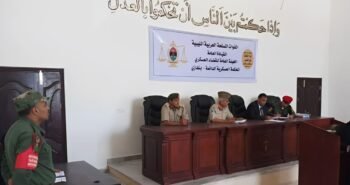
A pivotal moment came in April 2025, when Saddam Haftar paid an official visit to Ankara, hosted by Turkish Land Forces Commander General Selçuk Bayraktaroğlu. Subsequent visits by LNA delegations to Turkish defense facilities indicate a potential transition from dialogue to more operational forms of cooperation. Available reporting points to an emerging defense agreement that may include UAV deliveries, the training of up to 1,500 LNA troops, joint naval exercises, and long-term Turkish advisory support for military modernization.
This recalibration reflects a layered strategy that combines short-term risk mitigation with a longer-term ambition to influence Libya’s political reconfiguration. Rather than abandoning its partnership with Tripoli, Ankara is deliberately diversifying—embedding itself across both rival camps to gain leverage over future arrangements in reconstruction, security reform, and power-sharing, branding this shift as efforts for “united and unified Libya”.
This outreach also appears to reflect Ankara’s effort to adapt the Tripoli playbook to the east: combining defense diplomacy with economic integration in exchange of maritime agreement to gain leverage. A key element of this strategy involves Turkey’s pursuit of parliamentary ratification for the 2019 maritime and security agreements—initially signed with the GNU. If endorsed by the Tobruk-based House of Representatives, this step could help address a long-standing legitimacy gap and reposition the contested deals as national rather than factional agreements. Such a development may enhance Turkey’s legal and diplomatic standing in the Eastern Mediterranean and reduce eastern Libyan and regional objections to its presence.
In the long run, Ankara’s deepening engagement across both eastern and western Libya reflects more than short-term risk management, it seeks to position itself as a central mediator and enabler of national unification. The goal is to leverage its dual-track presence to influence key processes, including national reconstruction, security sector reform, and the eventual political settlement.
By engaging Haftar-aligned actors and building formal, strategic relations with eastern institutions, Ankara aims to move beyond the status quo of controlled instability. The underlying objective is to foster a more sustainable power balance between Libya’s rival blocs.
Why Europe should pay attention
European policymakers—particularly in Italy and across the EU—should carefully track how Turkey’s evolving strategy in Libya will unfold. Ankara’s simultaneous engagement with both Tripoli and Benghazi carries potential implications not only for Libya’s fragile internal balance but also for Eastern Mediterranean dynamics and the broader contest over Russian influence in North Africa.
Turkey’s recent overtures to eastern Libya—reportedly involving defense exports and military cooperation in exchange for legal recognition—signal a potential shift in regional competition. Ankara appears to be reframing Eastern Mediterranean dynamics from a zero-sum contest into a multilateral bargaining arena, with Libya, and potentially Syria, emerging as new negotiation fronts. This recalibration may also mark the opening of a second theatre—after Syria—where Ankara quietly seeks to counterbalance Russia through military-industrial diplomacy rather than direct confrontation.
In this context, the EU—and Italy in particular—may soon face a strategic dilemma: how to respond to Ankara’s changing posture in Libya in a way that balances maritime concerns with broader geopolitical realities. While tensions over maritime boundaries persist, Turkey’s role in potentially counterbalancing Russia’s influence in Libya and sub-Saharan Africa introduces an additional layer of complexity that cannot be ignored.
***
Nebahat Tanriverdi Yasar – Freelance Researcher & Policy Analyst.
______________________