Alex MacDonald

Activists and doctors from Argentina, US, Italy, Spain and elsewhere detained in city of Sirte.
Forces belonging to Libyan military leader Khalifa Haftar have arrested a number of members of a Gaza aid convoy in the city of Sirte. According to a statement published by the Global Sumud Convoy Instagram page, last contact with the activists was made at 3.22pm on Tuesday.
“The detained are civilians from Spain, Poland, the USA, Argentina, Uruguay, Portugal, Tunisia, and Italy – doctors and human rights defenders who volunteered to deliver aid and stand with the Palestinian people,” said the statement. They said the convoy had entered the 5+5 security zone – a contested area established under the Libyan ceasefire agreement signed in October 2020 – to negotiate safe passage to the Gaza Strip.
“They were detained by a security force affiliated with the Libyan Arab Armed Forces (LAAF) and are still being held by Eastern Libyan authorities (GNS),” they added. The group urged citizens of the listed countries to contact their embassies and demand their release. A range of activist-led humanitarian missions have been sent to Gaza since the beginning of the genocide in October 2023, with most being intercepted at sea by Israeli forces.
A number have attempted to travel across land to the crossing at the Egyptian border, though these have also faced numerous legal and security obstacles. Italian news agency Nova reported that Haftar’s forces had transferred the two Italian nationals among the activists to Benghazi. The two will be treated as “potential illegal migrants” by the authorities in Benghazi, the report said.
“Libyan security authorities have not issued any clarification regarding the reasons for the arrests or the legal status of the detainees,” it added. Libya has been largely divided since the Nato-backed overthrow of longtime ruler Muammar Gaddafi in 2011. Eastern Libya is controlled by Haftar and his allies, and is backed by the United Arab Emirates and Egypt, while a UN-backed government in Tripoli governs the west of the country.
How a Gaza-bound aid convoy unravelled attempting to enter Haftar-controlled eastern Libya
Communication breakdowns, raids by armed militias and abductions derail Global Sumud Convoy. Israeli forces’ seizure of activists aboard the Global Sumud Flotilla en route to Gaza and the mistreatment they endured made headlines last week. But around 2,000km to the west, the land-based affiliate of the pro-Palestinian aid movement also ran into trouble on its journey to the besieged enclave.
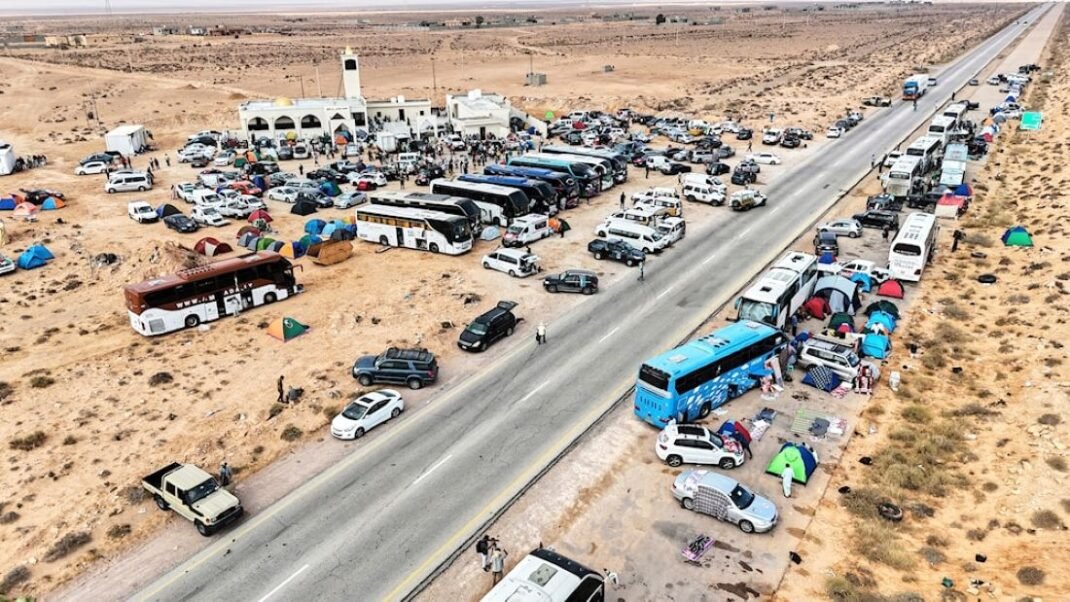
More than 200 activists with the Global Sumud Convoy entered the 5+5 security zone near the Libyan city of Sirte, a contested area established under the country’s October 2020 ceasefire agreement, hoping to negotiate safe passage onwards to Gaza. After days encamped inside the zone, armed forces arrived at the site and dismantled the convoy.
Most participants were forcibly escorted back to Tripoli under armed guard. Ten international activists, however, were detained and remain in Libyan custody. The detainees are from Spain, Poland, the United States, Argentina, Uruguay, Portugal, Tunisia and Italy.
Speaking to Middle East Eye shortly after returning to her home in Johannesburg, South Africa, activist Jessica Breakey said the group found it difficult to leave while fellow convoy members remained in detention. “We just didn’t want to leave without them,” she said.
“It was always like we were in this together, like this convoy was moving together – and I think the worst part about the camp being dismantled and us having to go back was that we were going back without them.” On Tuesday, the eastern Libyan government’s foreign ministry announced that non-Libyans and non-Egyptians would no longer be permitted to travel onwards to Egypt.
“The relevant authorities in the eastern region dealt with the matter within the framework of legal and humanitarian responsibility,” the ministry said. It added that all those involved “are receiving the necessary care and medical and humanitarian follow-up”. The ministry said that while it reaffirmed Libya’s support for the Palestinian cause, “respect for national sovereignty and the legal regulations governing the movement of individuals across borders is non-negotiable”.
While many activists praised the committment of the organisers and their drive to break the siege of Gaza, others said the trip was flawed from the start. Felipe, a 29-year-old Chilean-Palestinian activist and veteran of previous sea-based flotillas, said the convoy itself bore some responsibility for the outcome.
He told MEE that during a two-week stay in Tripoli, it became increasingly clear there had been little planning for the possibility of detentions or for a confrontation with the Libyan Arab Armed Forces (LAAF), led by military commander Khalifa Haftar, which controls eastern Libya. “If we were not able to go through east Libya, we should not have kept pressuring them because we were going to shift the narrative from Israel to Libya,” he said. “We were waiting in the desert for nine days doing nothing.”
Organisational breakdown
Libya has been largely divided since the Nato-backed overthrow of long-time ruler Muammar Gaddafi in 2011. Eastern Libya is controlled by Haftar and his allies, and is backed by the United Arab Emirates and Egypt, while a UN-backed government in Tripoli governs the west of the country.
The convoy’s progress from its origins in Mauritania through North Africa had largely been uneventful. Launched by North African activists and later joined by international participants, the convoy included seven ambulances, 20 mobile homes, 10 aid trucks, as well as medical professionals, engineers, educators and legal observers.
Those involved argued they wanted to bring something more substantial and practically useful to the people of Gaza than the usually largely symbolic aid deliveries associated with the sea-based flotillas. Their attempts to enter eastern Libya saw those plans grind to a halt.
___________________