Sam Hamad

Amnesty warns dozens face execution in eastern Libya, which is controlled by forces loyal to military commander Khalifa Haftar.
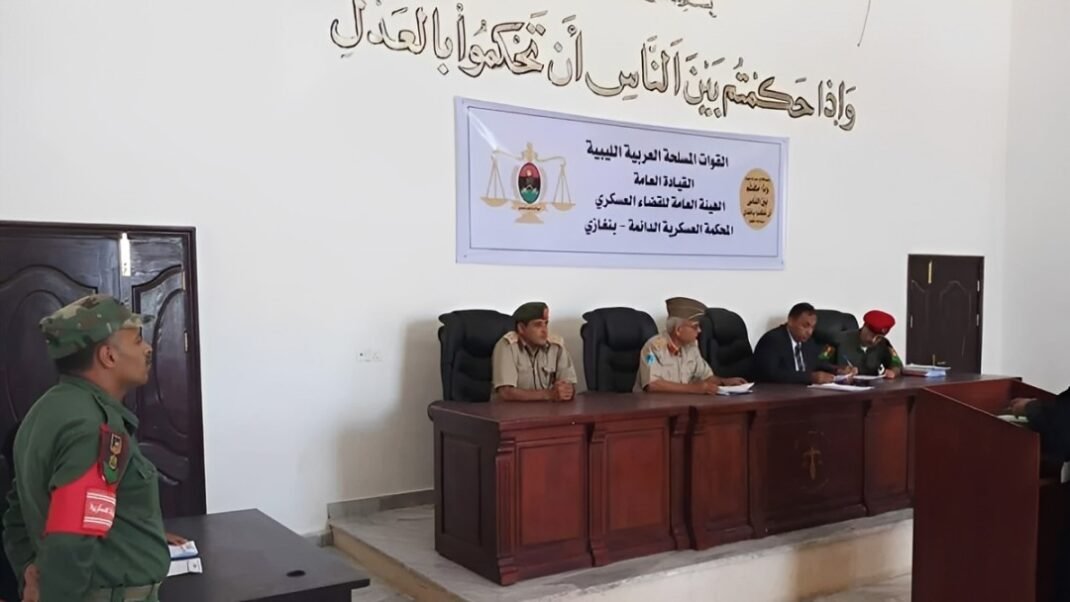
At least 50 men sentenced to death in eastern Libya face imminent risk of execution following a series of firing squad killings carried out by military authorities, Amnesty International warned this week, raising renewed concerns over the use of military courts and the future of Libya’s divided justice system.
The rights group said that military commander Khalifa Haftar’s self-styled Libyan Arab Armed Forces (LAAF), which controls much of eastern and southern Libya, had resumed executions for the first time in the country since 2010.
According to Amnesty, at least 30 people have been executed since 23 August after what it described as grossly unfair, secretive and torture-tainted military trials, while dozens more remain under sentence of death.
Some of those convicted were accused of terrorism-related offences and assassinations linked to Libya’s armed conflict between 2014 and 2018. Amnesty said several defendants alleged they had been tortured into making confessions later used as evidence against them.
The executions have drawn condemnation from Libyan and international human rights organisations, as well as Tripoli’s internationally recognised Government of National Unity, which said trying civilians before military courts undermined due process and the rule of law.
“This isn’t justice,” Anas El-Gomati, founder and director of the Sadeq Institute, told The New Arab. “Secret military trials, confessions taken under torture, and firing squads for a war that ended in 2018?”
El-Gomati said the executions highlighted the extent to which eastern Libya’s military establishment had expanded beyond its traditional security role and into the judicial sphere. “Libya’s own Constitutional Court said civilians can’t be tried this way. That ruling, of course, was ignored, which tells you where authority really sits,” he said.
Libya’s Constitutional Chamber has ruled that legislation allowing civilians to be prosecuted before military courts in terrorism and state security cases was unconstitutional, reaffirming that civilians should appear before ordinary civilian judges. Despite that ruling, military prosecutions have continued in areas controlled by the LAAF.
For El-Gomati, the central issue is not simply whether military courts exist, but whether any meaningful separation remains between the institutions responsible for arrest, prosecution and judgment. “Who arrests, who interrogates, who prosecutes, who judges, who fires? Same institution, every time. The LNA,” he said, using another abbreviation for Haftar’s forces.
“So perhaps think of it as expanding their influence into the justice sector, and gutting it of any neutrality, impartiality or independence. It literally serves the Haftars now.”
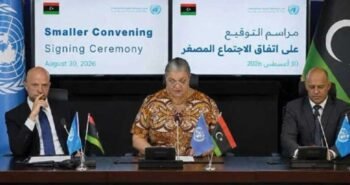
The remarks come as international and Libyan officials continue efforts to reunify the country’s fractured political and state institutions after more than a decade of division between rival administrations in the east and west.
Recent negotiations have focused on creating a single executive authority, unifying sovereign institutions and advancing preparations for long-delayed national elections. However, El-Gomati argued that the existence of fundamentally different justice systems presented a deeper obstacle than disputes over ministries or government appointments. “You can’t merge two justice systems when one of them isn’t one,” he said.
“Budgets and ministries can be carved up or split between two families in a smoky room. Courts can’t, because a court is a claim about whose law applies to whom.”
He warned that reunification without meaningful judicial reform risked entrenching rather than dismantling the military justice apparatus operating in eastern Libya. “Reunification on these terms wouldn’t dissolve the military justice apparatus, it would nationalise it, so everyone lives under it.”
Amnesty has called for an immediate halt to all planned executions and urged authorities in eastern Libya to quash death sentences issued after military proceedings that failed to meet international fair trial standards.
The organisation said Libya’s return to executions marked a dangerous reversal after years in which the death penalty had remained largely suspended in practice, warning that irreversible punishments were being carried out amid continuing concerns over torture, secret trials and the absence of an independent judiciary.
________________