Jalel Harchaoui and Frederic Wehrey

The bank governor installed at the close of that crisis, Naji Issa, now faces relentless political pressure from both sides to disburse funds for projects of varying legitimacy. The result is that Libya’s annual hard-currency deficit was roughly $9 billion last year, and the dinar suffered its steepest sustained depreciation in years, driving a painful surge in consumer prices across the country.
There is also a multibillion-dollar gap between the value of the crude oil the National Oil Corporation extracted in 2025 and the amount it deposited with the central bank. This is largely because both ruling factions are diverting hydrocarbon wealth to their own coffers from the state treasury.
The 2022 power-sharing arrangement has yielded no discernible benefit for ordinary Libyans. Nor has it advanced U.S. or broader Western interests in the country. As Libya’s institutions have continued to weaken, Western firms have found it more difficult to operate in the country since they now face greater unpredictability and opacity. Large U.S. companies struggle to function in such conditions.
Any windfall Libya sees as a result of Iran war–related spikes in crude oil prices will merely obscure the dysfunctional mechanisms responsible for these fiscal problems. In fact, greater oil revenues this year will only encourage both the Dabaibas and the Haftars to indulge in further abuses of the current system.
DEALS GONE BAD
The Trump administration’s Libya policy is plagued by contradictions. Its insistence on reconciling the two ruling families as a precondition for any unified governance structure suggests that the Dabaiba and Haftar clans are expected to remain in power for the foreseeable future.
But in his February 18 remarks at the UN, Boulos explained that Washington’s goal is to “create the conditions for a democratically elected government to be able to lead Libya”—an outcome that would require at least some of the incumbent leaders to step down.
Washington’s focus on elite bargains and economic statecraft first became clear last summer, when Boulos visited both Tripoli and Benghazi. The ruling family in each city pledged grandiose business opportunities to the U.S. adviser, including tens of billions of dollars in contracts for American firms. In September 2025 and January 2026, Boulos convened further meetings with Libyan leaders in Rome and Paris.
He mediated not between broad political constituencies but rather between representatives of the two families: Ibrahim Dabaiba, the prime minister’s influential nephew, and Saddam Haftar, one of the field marshal’s sons and his presumptive heir. Marketed as a signature Trump administration peace initiative, this format merely imitated the Biden-backed, Emirati-brokered arrangement from 2022.
The Trump administration argues that its diplomacy will help U.S. firms secure business opportunities, yet it overlooks the inherent instability that comes in a country where political power is so yoked to a handful of influential leaders.
To be sure, major U.S. oil companies are expanding their operations in Libya. After years of absence, ExxonMobil is set to survey four offshore blocks. Chevron won an onshore block in the Sirte basin and signed a separate offshore survey agreement. ConocoPhillips has renewed and expanded its existing license for the Waha oil field through 2050, and SLB (Schlumberger) is increasing its well-services role.
But once committed, these firms will have no institutional framework to fall back on when the officials who welcomed them prove unreliable.
The White House’s flawed approach also extends to its engagement with Libya’s fragmented military. Washington worked hard to convince military leaders from both eastern and western Libya to participate together in April’s Flintlock military exercises. But securing that joint participation came at a cost.
For months, Washington refrained from exerting serious pressure on either faction lest one side pull out of the exercises, issuing no public criticism about corrupt practices and instituting no sanctions against midlevel figures. The tradeoff might have been worthwhile had the exercises produced genuine military unification, but no serious integration of rival Libyan forces is yet underway.
BACK TO THE FUTURE
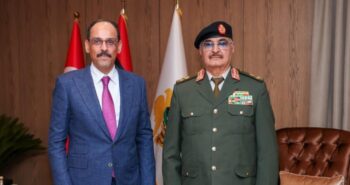
Securing the Trump administration’s commercial objectives in Libya requires a level of institutional stability that personalized dealmaking cannot provide. To that end, Washington needs to broaden the scope of its engagement with Libya and with the foreign states that wield influence in the country—primarily Turkey.
The United States should prioritize Libya’s fiscal viability by helping rebuild the independence of its two key economic pillars—the central bank and the National Oil Corporation. It should also support accountability and transparency through independent, public audits and third-party revenue monitoring, opposing the sort of politically motivated interference that produced the 2022 National Oil Corporation debacle and the 2024 central bank crisis.
And any meaningful U.S. effort to stabilize Libya will require comprehensive coordination with Turkey—and, when divergences prove irreconcilable, a willingness to apply pressure on Ankara.
Washington must move beyond seeking intermittent Turkish buy-in and instead commit to granular, sustained engagement that uses both diplomatic coordination and forceful pressure to check Ankara’s unilateral activism.
More broadly, the United States must also support the imperative of national elections for a unified executive. Here, it has a ready platform to promote: the UN’s new road map for Libya, which calls for broad consultations with Libyans to address economic and political grievances, unify the country’s parallel administrations, and, crucially, hold elections.
The UN’s plan also endeavors to incorporate municipal councils, grassroots civil society organizations, and political parties into the country’s technocratic institutions, an approach that should receive more backing from the United States.
Trump’s evisceration of the U.S. Agency for International Development, which had previously been supporting both local and national institutions in Libya, has not helped matters.
But for Washington to truly open Libya for steady U.S. business, it must recognize that conditions for long-term investment will never be propitious as long as U.S. officials focus only on pandering to the ambitions of the country’s dueling potentates.
***Jalel Harchaoui is a Libya specialist with the Royal United Services Institute.
Frederic Wehrey is Senior Fellow in the Middle East Program at the Carnegie Endowment for International Peace.
__________
foreign Affairs