Archive - November 2025

Libyan Businessman Who Ran for President Squandered Sovereign Wealth Fund’s Money

Sana Sbouai, Khalil Elhasse and Rahma Behi

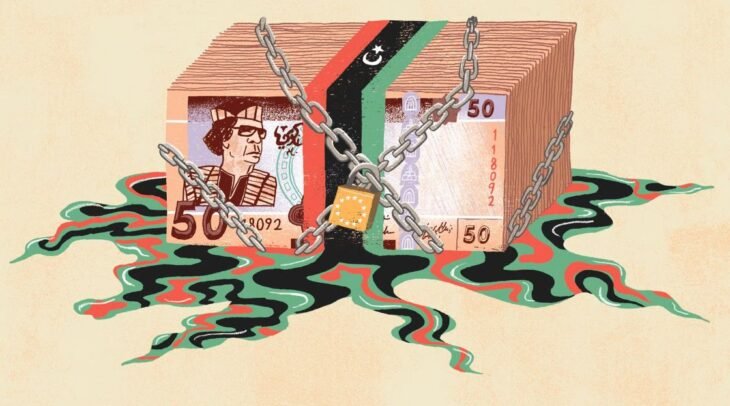
In 2021, Abdelhakim Baayo made headlines for becoming the first person to register to run in Libyan presidential elections. By that time, multiple state bodies had accused him of mismanaging funds at a sovereign wealth fund subsidiary he ran in Spain. In 2021, Abdelhakim Baayo made headlines when Libyan media reported he was the first person to register for the country’s first-ever presidential elections. 

At the time, Baayo was also a businessman, working as the head of a Spanish company owned by Libya’s sovereign wealth fund, the Libyan Investment Authority (LIA). The firm, Alhammra Company Spain S.L., had been set up in Spain in 2015, after sanctions imposed during the uprising against Muammar Gaddafi caused administrative difficulties for a predecessor company in Gibraltar. The new company’s mandate was broad, and included activities as diverse as procuring cables and wires, and trading in milk and tuna.

By the time Baayo decided to make his presidential run, multiple Libyan official bodies had accused him of misappropriating Alhammra funds, including by using company money to make the down payment on an apartment registered in his own name, leaked documents obtained by OCCRP show. Though some of the allegations were made public in an audit report and on social media, the evidence behind them was not. OCCRP has now obtained internal documents — including invoices, emails, and payment notifications — that corroborate many of the key claims. 

The files show that Alhammra made a down payment for an apartment in Madrid that Baayo owns. Company money was also used to pay medical or educational expenses that did not fit clearly within Alhammra’s mandate, according to internal company records seen by OCCRP. Baayo has never faced legal charges in Libya over the claims. Alhammra made similar allegations in a complaint against Baayo in Spain in 2020, but the complaint was withdrawn for reasons that remain unclear. 

When reached for comment, Baayo told OCCRP in a response sent through a former colleague that the allegations were false. The alleged misuse of funds coincided with a period of chaos for Libya’s sovereign wealth fund, which was riven by political divisions and accusations of corruption, theft, and mismanagement after Gaddafi’s fall in 2011. 

Tarek Megerisi, senior policy fellow at the European Council on Foreign Relations, said that since Gaddafi’s fall, the amount of fraud at the fund’s subsidiaries had gone “through the roof.” “Previously, he [Gaddafi] used corruption politically. When he left, his system stayed but his role as the check was gone,” Megerisi said. The LIA’s assets have been valued at over $68 billion, held through a dizzying array of more than 550 subsidiaries in Africa, Europe, Asia, and North America. The fund did not reply to requests for comment. 

Allegations Against Baayo

Alhammra was set up in 2015 as a successor to a Gibraltar-based firm called Al Hammra Limited. By that time, freezing orders on Libyan assets had made it difficult for the Gibraltar company to carry out basic administrative tasks, according to company documents. The new Spain-based company inherited its successor’s contracts, specifically to supply materials such as cables and wires for the Libyan state-owned energy company. It also included contracts to supply food items such as tuna and cheese. 

The allegations against Baayo started in late 2018, when Alhammra’s parent company and the LIA’s investment arm, the Libyan Foreign Investment Company (LAFICO), sent auditors to review Alhammra’s documents and financial statements for the previous three years. Subsequently, LAFICO wrote a letter to the attorney general accusing Baayo of committing “several acts that caused serious damage to the company, both materially and morally,” and acting in a way that “exposed the parent company’s funds to squandering.” 

Six officials on a committee created by LAFICO recommended in a report that Baayo be referred to an investigation committee, but it is not clear if that ever happened. Baayo denied the allegations at the time, according to an internal report by LAFICO based on a meeting with him. LAFICO did not respond to requests for comment. 

The Libyan Audit Bureau, the country’s state auditor, claimed in its 2020 annual report that Baayo had “deliberately concealed the documents revealing his transgressions and manipulations,” and accused him of hiding the company’s computers, deleting emails, and concealing cash withdrawals from a company bank account. Baayo told OCCRP these allegations were false.

In November 2020, Alhammra, by then under a new manager, brought a complaint against Baayo in Spain, but the case was later dropped after the complaint was withdrawn by the plaintiffs, a Madrid court told OCCRP. When contacted by reporters, Baayo answered that “four complaints” against him had been adjudicated by the Spanish judiciary and dismissed for lack of evidence.

Purchase of Madrid Apartment 

In the same annual report, the Libyan Audit Bureau flagged further unexplained payments at Alhammra, including company money that had been used to make a down payment for an apartment in Madrid. The audit report specifically listed a transfer of about 164,000 euros of Alhammra’s funds. Records included in the leaked documents show that Alhammra sent that amount on October 10, 2018 to a Madrid-based real estate developer via Santander Bank. 

The audit report said invoices from a little-known Tunisian company called Transatlantic International Trade, or TITCO, were used to create the impression that the payments were for a loan. A note from TITCO dated December 12, 2018 — obtained by OCCRP — confirmed that the company had received 164,000 euros from Alhammra for what it said were invoices from October and November that year. 

A leaked email from January 2019 lends further credence to the audit report’s claim. In the message, the sender — identified as a member of Alhammra’s “financial department” — asked a recipient at a Spanish consultancy to “reconcile” three TITCO invoices with the Santander Bank payment from October. TITCO was a Tunis-based company set up in December 2013 by two Libyan citizens, Esam Abouzriba and El Makki Meelad Mohamed Ibrahim. The company was shut down in 2017, the year before the invoices were issued. The company’s annual financial reports, which are required by law, do not appear in the Tunisian registry. 

“M. Baayo” is still listed as owner of the apartment in question, as well as two nearby parking spaces, Spanish public records show. The apartment, located in Madrid, is now estimated to be worth over 750,000 euros. In his response to OCCRP, Baayo said the company took out a legal loan and that several Libyan authorities confirmed the validity of the procedure. He described the allegation that TITCO’s invoices had been used to disguise the apartment purchase as “false and misleading,” and said the complaint had been dismissed. Abouzriba, Ibrahim, and the Libyan Audit Bureau did not reply to requests for comment. 

Alhammra’s Other Suspicious Expenditures

Between 2016 and 2017, Alhammra also spent over 145,000 euros on travel, medical services, and education-related expenses, according to internal company records seen by OCCRP. Baayo told OCCRP that internal regulations for LAFICO employees authorized the company to cover their children’s tuition fees. He did not respond specifically to questions about  the travel and medical expenses. These included 9,745 euros used to pay medical expenses for an employee’s mother, according to the LAFICO report. The report also noted multiple payments of “tuition fees” for the children of another employee. 

Alhammra also made several rent payments between November 2017 and March 2018 on behalf of Ahmed Maiteeq, who was Libya’s deputy prime minister at the time, and a woman who social media posts suggest is his wife. The payments, also for an apartment in Madrid, amounted to 8,000 euros, invoices from the real estate company and Alhammra bank records show. It is not clear why Alhammra made these payments, which were not mentioned in the official Libyan reports. 

Baayo described OCCRP’s characterization of these transactions as factually misleading and said that he had been acquitted of this claim, without providing  further explanation. Maiteeq did not respond to questions. In another transaction — which also did not appear in any of the Libyan official reports — Alhammra paid over 250,000 euros in 2016 to buy a factory whose bank account address is the same Tunis address used by TITCO.

According to payment transfer records obtained by OCCRP, the money was paid into a Tunisian bank account with two beneficiaries including Al Makki, one of TITCO’s founders. When reporters visited the site in 2023, there was no trace of the factory. Nor was there any sign of the factory in Tunisia’s company register. Baayo said that the factory project was ultimately canceled and the money was re-directed in order to purchase a truck. He did not provide any evidence.

Alhammra went into liquidation in Spain in 2022, though it wasn’t until the following year that Baayo announced in a Facebook post that he had resigned from his position. By then, Baayo had made his presidential ambitions known. But he never got a chance to test them out: Libya’s elections were delayed repeatedly, and still have yet to be held. 

____________________
Excerpts From The Sentry Report

The Sentry

The End of NOC Bartering

In February 2025, shortly after taking office, incoming NOC chairman Masoud Suleiman announced the end of the oil barter system, effective March 1, 2025. The NOC had conducted billions of dollars in crude-for-fuel swaps annually between 2021 and 2024, apparently without transparent accounting. With his announcement, Suleiman committed the NOC to using public tenders to sell crude oil and purchase fuel through separate transactions — a policy he said aimed at achieving better governance.

This decision was an acknowledgment that the barter system used between 2021 and 2024 under two successive NOC chairmen lacked both transparency and competitiveness. The possibility that the NOC gave away excessive national wealth via these swaps underscores the need for a full investigation into the barter process used during that period. In fact, data from high-volume years like 2023 and 2024 suggests that the NOC paid far above prevailing market rates in its fuel-for-crude swaps, with economically unjustifiable overpayments potentially reaching nearly $1 billion annually.

An inquiry must determine exactly why the NOC overpaid, and, crucially, it must identify the actors who profited from these overpayments. Formally ending the oil barter system isn’t enough to solve Libya’s fuel smuggling problem, however. Although the NOC’s fuel imports from January September 2025 decreased by about 8% compared to the same period in 2024, their volume remains far above the country’s legitimate needs.

These excessive fuel imports continue to feed a resilient smuggling sector. Efforts are required to reduce imports further and increase transparency, including regarding how fuel imports are funded. In response to The Sentry’s request for comment about the transparency of its barter transactions from 2021 through 2024, the NOC stated that pricing committees had overseen the process. The NOC added that these committees determined prices based on internationally recognized global bulletins and that the competition for the barter transactions was conducted transparently with major international companies submitting bids.

***

Illegally Reexported Fuel

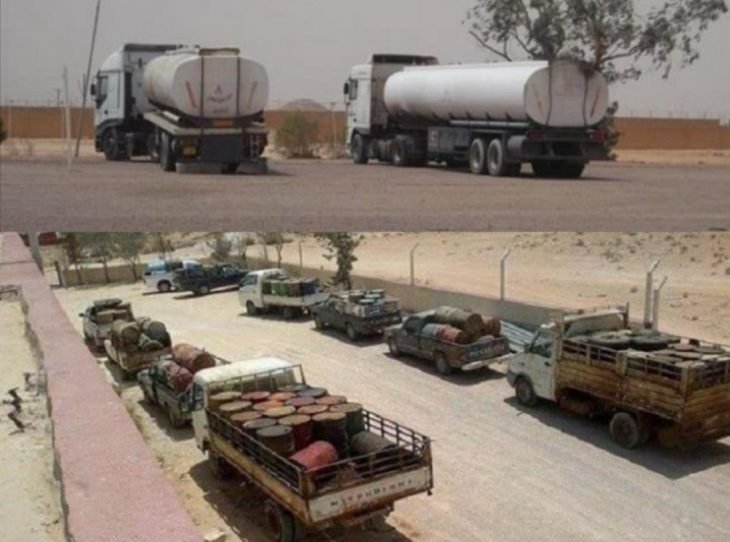
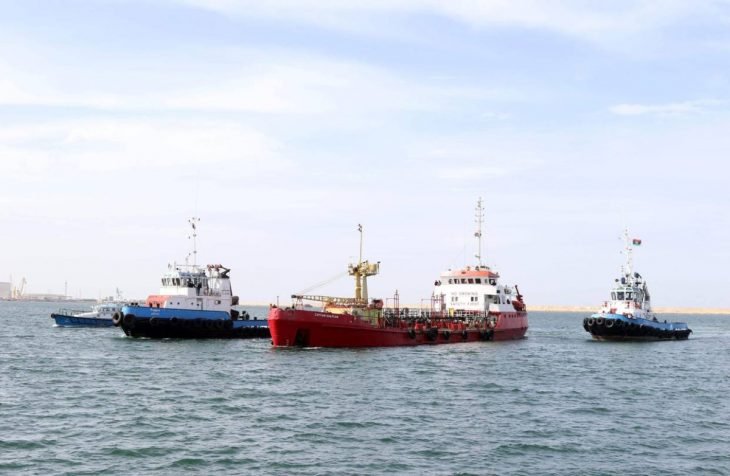
Every day, millions of liters of imported fuel are illegally reexported via maritime routes to Malta, Albania, Italy, Turkey, and beyond. While some of that activity takes place in western Libya, it is far more extensive in the east—particularly through ship-to-ship transfers.

In a typical example, the NOC legally imports fuel into Benghazi’s modern port, but illicit actors load it onto a vessel at the city’s old harbor. At sea, the fuel is transferred to another ship, which then delivers it to its final destination.

***

Major Fuel Depots in Western Area

1- Zuwarah’s fuel depot

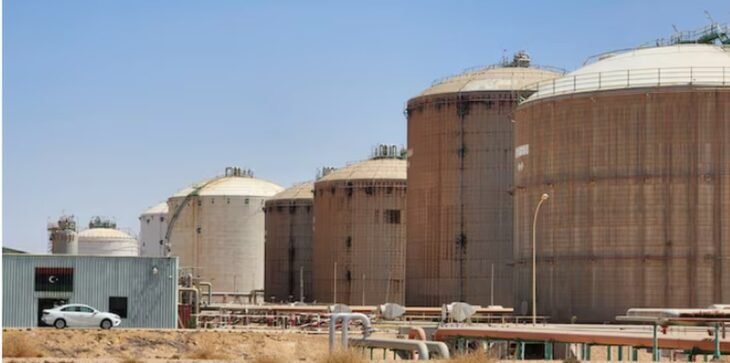
In the mid-2010s, Zuwarah—a coastal city near the Tunisian border—served as a major hub for reexporting subsidized fuel by land and sea. In 2023, an incident involving a ship called Serdar revealed that the city’s seaport was still being used for illegal fuel exports. Despite security changes at the Ras Jdir border crossing in 2024, local sources told The Sentry that smuggling through Zuwarah continues, albeit at a lower rate than before.

2- Misrata’s fuel depot

located just south of the commercial port and connected to the sea by an underground pipeline, is one of the largest in Libya. From there, the product is transported by trucks to municipalities in the immediate vicinity, as well as to towns and cities in southwestern Libya. Smuggling networks tap into this transport network to move fuel into sub-Saharan African markets, such as Chad and Niger.

***

The LAAF Network in Eastern Area

This network profits from moving Libya’s subsidized fuel to the southern borders in two main ways: First, its brigades impose taxes at checkpoints along north-south routes, collecting fees from small-scale smugglers, including large makeshift trucks driven by Tubu actors. Second, the LAAF diverts officially distributed fuel; by restricting operating hours at legitimate stations, it ensures that surpluses are rerouted south for illicit gain.

Tubu smugglers drive the non-official fuel truck across the southern border under Haftar coalition protection, official fuel trucks head south. A large portion of the foreign-refined fuel delivered to Benghazi’s port is kept at a storage facility located in the northern outskirts of the city.

***

The 101st Infantry Battalion

This Battalion is a unit of the LAAF’s Brigade Tareq bin Ziyad, suppresses popular activism and perceived opposition across southwestern Libya. Known in this region as the long arm of Saddam Haftar, the battalion enforced a QR code system that allowed each civilian car owner to buy subsidized fuel only once every five days.

This is one of several mechanisms that the LAAF has used to control both the legal distribution and illicit diversion of fuel. As fuel shortages grew more acute and public complaints mounted across southwestern Libya, Saddam Haftar eliminated the QR code system in the southern region in October 2025, a decision likely motivated by a desire to restore his deteriorating popular standing.

***

A $6.7 Billion per Year Issue

Independent maritime data service Kpler indicates that in 2024, Libya imported an average of about 234,000 barrels of fuel per day, equating to roughly 37.2 million liters daily. In addition to the imported fuel, another 13.8 million liters a day is produced domestically.

Electricity generation in Libya, which relies on natural gas, crude oil, and fuel, requires about 5.8 million liters of fuel each day. Beyond electricity generation, heavy industry, and transport activities — such as manufacturing, steel plants, agriculture, maritime, and aviation — likely consume 2.4 million liters per day.

Aside from these categories, Libya has about 3.5 million motor vehicles, which consume roughly 15.7 million liters per day, assuming that each vehicle travels 20,000 kilometers per year on average. All in all, the combined fuel consumption for electricity generation (5.8 million liters), other industrial activities (2.4 million liters), and motor vehicles (15.7 million liters) stands at around 23.9 million liters per day.

Given the availability of roughly 50.9 million liters per day, this leaves 27 million liters per day likely diverted. The fuel imports of 37.2 million liters per day cost the NOC $9.46 billion worth of crude oil per year, which works out to be $0.70 per liter. As for the fuel produced domestically by the NOC, its fair valuation is $0.62 per liter, based on average Mediterranean market prices in 2024. From these elements, one can deduce that approximately $6.7 billion worth of fuel was smuggled out of the country in 2024.

This means that the national wealth presently lost to fuel smuggling would be sufficient for Libya to more than triple its spending on both healthcare and education. In fact, the cost to the Libyan population is even higher, given that many legitimate consumers in peripheral areas must pay inflated prices for what should be subsidized fuel — markups not reflected in any official statistics.

Plus, even in cases where legitimate consumers do access the subsidized fuel and pay 0.15 dinars ($0.03) per liter, most of the collected payments end up unaccounted for, leaving the state with virtually no revenue from fuel sales. In response to a request for comment, the NOC denied The Sentry’s estimate of diverted fuel, adding that the NOC is not responsible for managing land or sea ports.14

________________________

Libya’s Oil Corruption Is Bad for Business

Justyna Gudzowska

International firms should address graft before participating in a deeply compromised sector.

International oil companies are lining up to reenter Libya’s oil sector. Libya is currently rolling out its first bid round for new oil exploration and development in nearly two decades, and there appear to be many takers from around the globe, including U.S. companies.

At first glance, this might appear to be a promising development for the Libyan people. The country desperately needs reconstruction, political stability, and investment. But new oil deals are unlikely to provide these benefits. Libya suffers from an entrenched system of predatory graft through which the country’s oil riches have been siphoned off by a corrupt elite. The result is to drive up fuel prices for everyday Libyans and leave them struggling.

To avoid perpetuating this corrupt network, policymakers and executives in Britain, Europe, and the United States should proceed with caution. While new commercial opportunities may deliver short-term gains for Libya, they will offer little long-term benefits so long as leaders in Tripoli and Benghazi continue to line their pockets while excluding the Libyan people from the country’s vast natural wealth. Only an effective, transparent, and accountable Libyan state can be the partner international companies require.

A major new investigation has revealed a massive expansion of gasoline and diesel smuggling from 2022 to 2024 via Libya’s fuel subsidy program. According to our research, this cost the Libyan state almost $20 billion in three years.

In 2021, Libya’s National Oil Corp. (NOC) began to directly swap Libyan crude oil for refined fuel from abroad. Previously, the proceeds from all sales of crude went to Libya’s central bank, which would in turn provide funds to the NOC to purchase fuel in line with budgetary allocations. But unlike allocations from the central bank, swaps did not register on the public balance sheet. This meant the NOC was able to increase its fuel imports without any increase in reported state spending. The result was that, in just three years, Libya’s fuel imports more than doubled, reaching about 41 million liters per day by late 2024.

Why did imports skyrocket? The Libyan authorities suggest that the increases were needed due to shifts in the gas supply chain and the growing need for fuel to power Libya’s electricity grid. But the amounts imported are far above what Libya’s legitimate economy could reasonably consume. The reality is that more than half of this fuel is smuggled back out of the country, by sea or by land.

Saddam Haftar, the ambitious son of Khalifa Haftar—who rules much of eastern Libya as head of the Libyan Arab Armed Forces (LAAF)—was the primary force behind this escalation. Saddam has used his role as heir apparent in the LAAF to consolidate control over both maritime smuggling operations and crucial overland routes into sub-Saharan Africa. As a result, he was instrumental in bringing smuggling to unprecedented levels. Benghazi’s old harbor serves as Libya’s principal channel for reexports, using doctored papers and “dark” vessels to move millions of liters per voyage. LAAF officer and Saddam subordinate Ali al-Mashay acts as the main gatekeeper.

While Libya remains politically divided, everyone got a cut of the illicit profits. The recent surge may have been orchestrated by Haftar’s family, but they were operating in tacit conjunction with figures linked to the Tripoli-based government of Abdul Hamid Dbeibeh. Culpability also extends to northwestern Libya, where local warlords such as Zawiya’s Mohamed Koshlaf and Misrata’s Omar Bughdada (who is aligned with Prime Minister Dbeibeh) move fuel by sea and by land. Large volumes head south, where Haftar’s forces take over.

Many of the international backers of Libya’s civil war are involved as well. This multibillion-dollar heist was orchestrated with quiet assistance from Russia, Turkey, and the United Arab Emirates. As a result, Libyan citizens must often cough up 40 times the official subsidized price for fuel while many of their leaders illicitly sell the fuel to foreign networks in Libya and neighboring countries.

The Haftar coalition, for example, diverts subsidized diesel, gasoline, and jet fuel to Russian military personnel entrenched at several air bases in Libya, who in turn ship the fuel to other Russian missions in sub-Saharan Africa. The Haftar coalition has also been a strategic fuel supplier to the Rapid Support Forces (RSF) throughout the ongoing civil war in Sudan, enabling the paramilitary group’s atrocities in Darfur. Neither the fall of El Fasher in late October nor the horrific massacres of civilians that followed have changed that arrangement: The Haftar family continues to provide fuel to the RSF.

By 2024, almost $7 billion in subsidized fuel—about 15 percent of total public spending—was stolen annually. This is billions of dollars in public wealth that should fund hospitals, schools, and other essential infrastructure. The scheme has deprived the central bank of the hard currency needed for essential imports such as food and medicine, driving consumer price inflation and the Libyan dinar’s depreciation. In an ironic twist, citizens of one of the world’s richest oil nations are often forced to wait in long lines at petrol stations and pay inflated black market prices for fuel. Early this year, the NOC said it was ending crude-for-fuel swaps. Even so, fuel import volumes remain unjustifiably high, and large-scale smuggling persists.

International oil companies and Western policymakers are clearly hoping that there are profitable deals to be made in Libya’s oil sector. They are not wrong about the fundamentals: Libya’s geology, both onshore and offshore, remains rich with untapped reserves, and the NOC is, by and large, staffed by a cadre of skilled hydrocarbons professionals. But foreign companies would be wise to consider how sustainable their new projects are likely to be. As the Libyan state is hollowed out by vested interests, the risk of social unrest and renewed conflict rises. A new round of war, particularly one that rearranges the country’s political leadership, could quickly put any new deals at risk.

So, what can the United States and like-minded states actually do about this? Quite a lot. Libya’s oil sector is wedded to the U.S. dollar. This provides a means of applying direct pressure and dictating the terms on which international companies can reenter Libya’s market.

Libyan leaders are currently negotiating with ExxonMobil and Chevron, for example. Rather than leaning on informal deals to facilitate these companies’ reentry, the Trump administration should be looking to bolster the Libyan NOC as a technocratic institution capable of sustaining reliable and lasting contracts. For U.S. companies to pursue long-term investments, they need a better degree of lasting security than the kleptocrats can provide. To this end, U.S. senior advisor Massad Boulos is believed to be pursuing a fixed budget for Libya’s NOC to help limit the potential for off-book expenditures. Yet such a push will be rendered entirely futile if the issue of rampant fuel smuggling is allowed to persist.

Policymakers in the United States and other like-minded countries should send a firm message that the NOC must remain independent. Investigating and sanctioning key players such as Mashay for their plunder of Libya’s public funds would help do so. Sanctions have not been used against Libya’s most corrupt actors and their enablers; changing that would go a long way toward deterrence. Similarly, the United States could issue a business advisory warning U.S. firms about the illicit networks of merchants, brokers, intermediaries, and transporters exploiting Libya’s fuel subsidy program.

As part of its Libya policy, the Trump administration has stated that it seeks to pursue trade over aid. Public messaging has also emphasized the importance of reunifying Libyan state institutions and the critical role played by the NOC, in particular. As economic dealmaking continues, the latter two conditions cannot be forgotten. It would be a mistake for policymakers in Washington and other foreign capitals to assume that corruption is inevitable in Libya and thus deals must be done with individuals such as Haftar or Dbeibeh rather than the NOC.

Unless the United States and its allies deal with the appropriate Libyan institutions rather than its ruling families, corruption will continue. First and foremost, this will hurt the Libyan public. But as the likelihood of violence and political disruption increases, it will harm international investors as well. If Washington wants U.S. companies to succeed in Libya in the long term, it must help rein in Libya’s kleptocrats. Their massive fuel smuggling operation is the place to start.

***

Justyna Gudzowska, the executive director of The Sentry.

____________________

Libya’s Untouchable Thieves

The Sentry

The Great Fuel Heist Must Not Escape Justice Amid the sustained kleptocratic boom that Libya has experienced since the end of its civil war in 2020, fuel smuggling quickly rose to become the most lucrative scheme.

Once pursued by scattered opera tors, fuel smuggling has become a multi-billion-dollar enterprise pursued by the country’s incumbent rulers — with international backing — that can further derail the nation’s legitimate economy.

Given its sheer scale, fuel smuggling can no longer be portrayed merely as a byproduct of weak governance. In 2021, Libya’s top rulers effectively embraced it as part of a broader, systematic strategy to siphon massive wealth from the population.

Between 2022 and 2024, approximately $20 billion was di verted in this manner — funds urgently needed for health services, household essentials, infrastructure, education, and other social programs.

Much of the wealth was moved abroad, while another portion was used to import weapons and cement the grip of unelected incumbents through repression and armed force, ultimately blocking any path to free and credible elections.

Libya’s fuel smuggling crisis also has a geopolitical dimension.

It has buoyed non-state actors such as Sudan’s RSF in a genocidal war and helped foreign powers like Russia and the UAE deepen their involvement in Libya — and, by extension, in sub-Saharan Africa. Ultimately, the crisis transcends the fuel trade.

It reveals a shattered system of governance wherein public institutions are increasingly subordinated to a small handful of illegitimate rulers reliant on coercion. The reach of Libya’s rulers now goes well beyond the realm of security.

They have learned to penetrate the heart of the legitimate economy by installing loyalists in key administrative positions. And because Libya’s current calm hinges on these very same factions coexisting without open warfare, any sudden shakeup may precipitate a broad conflagration.

The January 2025 removal of NOC Chairman Farhat Benqdara and the appointment of Chairman Masoud Suleiman signal a push toward greater transparency, including efforts to roll back opaque crude-for-fuel swaps.

Yet entrenched profiteers will resist. While one notable player in the fuel smuggling sector — Brigade 128 within the LAAF — was forcibly dismantled in early 2025, more powerful brigades linked directly to Saddam Haftar, Dabaiba, and other leading figures remain active and continue to thrive.

Even if fuel smuggling recedes somewhat in 2025, its repercussions will persist.

Armed group leaders and political figures, now accustomed to vast profits, can repurpose their accumulated wealth as seed capital for other ventures. A mere reduction in fuel imports is not enough.

Fundamental questions must be answered:

Where did the stolen billions go, and how can Libya deliver justice to those who stole from its population?

___________________

Oil majors return to Libya

Malcolm Moore, Abigail Hauslohner, and Heba Saleh 

Tripoli launches first exploration

auction in 18 years

The world’s biggest energy companies are returning to Libya as they hunt for new oil and gas reserves, nearly 15 years after the overthrow of Muammer Gaddafi pitched the country into political chaos that continues to this day. 

A delegation from the Tripoli-based Libyan government has been visiting Washington this week to drum up interest in the country’s first auction of oil exploration licences for 18 years.

Oil majors Shell, Chevron, TotalEnergies, Eni and Repsol are all pre-qualified to bid in the round that offers exploration rights across the country, after Exxon signed a deal in August to explore for gas off the Libyan coast.

“We look forward to working with the Libya National Oil Corporation (NOC) to fully evaluate Libya’s potential and leverage ExxonMobil’s leading capabilities to jointly explore for new resources,” Exxon told the Financial Times. 

The oil industry’s return to Libya started to gain momentum in July when Shell and BP confirmed they had signed agreements with the NOC to assess opportunities.

The revived interest in the country, which remains divided between two rival governments and their affiliated armed groups, comes as energy companies seek to boost their reserves, after forecasts that crude demand would be stronger for longer because of a slower transition to clean energy.

“They’re searching for more reserves and they’re returning to tried-and-tested basins,” said one senior energy banker, who added that oil majors were used to navigating politically risky environments. 

The Tripoli government, which controls the west of the country, is keen to boost the country’s production from 1.4mn to 2mn barrels per day by 2030, and is offering new production sharing agreements to encourage investment.      

“We’ve had discussions under way that have been reported in the media. So I can acknowledge this in Libya,” Mike Wirth, Chevron chief executive, told analysts at an investor day last week. “Terms are more attractive today than historically they have been,” he added.

The Tripoli-based government is recognised by the UN but a large share of the country’s oil lies in the eastern territory held by the renegade general Khalifa Haftar.

In Washington, the Libyan delegation has sought to convince the US that it can become a major supplier of oil and gas and that Tripoli needs US help to get Russia out of Libya and unify the country and its economy.

Regional analysts have warned of a growing Russian military presence in the country’s east and south with corruption widespread across sectors. Moscow is a longtime backer of Haftar. “We have a problem,” Mahmoud Ahmed Alfiste, a senior Libyan official, said during the delegation’s visit to Washington.

While the world “recognises the NOC” as the only legitimate entity to “produce and export oil” from Libya, “Haftar and his sons are controlling” parts of the country that contain some critical reserves, Alftaisi said.

The Tripoli-based government believes the return of western oil companies across Libya could help boost Tripoli’s leverage and stabilise the country, officials said, while increased Libyan oil production would provide an alternative to Russian oil. “The US and western countries are trying to prevent Russia from selling its oil and its energy.

That would bring a shortage in the energy market and Libya can be an alternative,” Ibrahim Sahed, another member of the delegation and of Libya’s High Council of State, told the FT.  He also said Libya needed western technology to enhance the production of its oilfields. “Nobody has technology like the US,” he said.

Alftaisi said the country’s petroleum ministry and NOC had already signed a memorandum of understanding with Chevron and were in discussions with ConocoPhillips.

Tim Eaton, a Libya specialist at Chatham House in London, said the visit by a new US envoy earlier this year had helped attract interest. “If those companies are able to invest and build the oil sector, this can be a kind of rising tide that lifts all boats,” he said. But he warned that an influx of investments could entrench problems. “The risk is that these kinds of deals brokered via Libyan elites are going to solidify the status quo rather than provide an opportunity to transform it,” he said.

______________________

Libya’s unseen war: a brutal battle for cash, contracts, influence

Hafed Al-Ghwell

In Libya, the language of state-building is often just a dialect of theft. While political leaders publicly champion sovereignty and institutional reform, their private battles are waged over control of money flows, government contracts, and the influence these bring. This unseen war has hollowed out the state, creating a system where public institutions function as private treasuries for armed factions and their political sponsors.

The recent power struggles in western Libya are the logical outcome of an operating model where corruption is not a side effect but the central purpose of governance.

Under the Government of National Unity in western Libya, this model was perfected. The real governance occurred not in ministerial meetings but through shadowy networks where security figures placed loyalists across ministries and state-owned companies. For years, Abdulghani Al-Kikli, known as Ghneiwa, was a titan of this system. As head of the Security Support Apparatus, he installed allies in key offices to manipulate payrolls, secure kickbacks, and launder money. His power was built on turning public agencies into instruments of personal enrichment. But in a system with finite spoils, every alliance has an expiration date.

Ghneiwa’s growing dominance alarmed his partners. In May 2025, a coalition led by the 444th Brigade lured Ghneiwa to his death and dismantled his militia. The operation was framed as a move to strengthen state control. In reality, it was a hostile takeover, a violent reshuffling of the deck that changed the players but not the game.

Into the power vacuum stepped Deputy Defense Minister Abdulsalam Al-Zoubi, a former ally of Ghneiwa. Al-Zoubi’s rise exemplifies the fluid loyalties of Libyan politics, where partnership is fleeting and power is permanent. He quickly absorbed much of Ghneiwa’s network, establishing himself as the new face of western Libyan security. His primary source of influence was control over the Administrative Control Authority and, crucially, the Contracts Review Office. This office is the nexus of the system; it approves every major government contract, allowing its controller to demand bribes for approval, block rivals, and push through lucrative deals for allies.

Al-Zoubi and Ghneiwa had previously exploited this office with impunity. One brazen example involved the General Electricity Company of Libya. They approved a contract to import electricity meters at a grossly inflated price, pocketing the difference. In another scheme, they authorized the illegal export of scrap metal to Turkiye through a company owned by Al-Zoubi’s brother. This was not governance; it was a heist administered by a government office.

The linchpin of accountability, however, proved to be Audit Bureau chief Khalid Shakshak. He successfully challenged the law that handed the Contracts Review Office to Al-Zoubi’s authority, with Libya’s Supreme Court eventually ruling the move unconstitutional. This judicial decision was a direct blow to Al-Zoubi’s revenue stream, cutting him off from the lifeblood of his power. The current stalemate is, therefore, highly volatile.

Al-Zoubi is unlikely to accept this loss passively. Any attempt by him to forcibly retake control of the Contracts Review Office from Shakshak could easily trigger another round of street fighting in Tripoli. Furthermore, in this environment, today’s allies are tomorrow’s rivals. Just as Al-Zoubi betrayed Ghneiwa, his own partners may soon see him as the next obstacle to their ambitions.

This self-cannibalizing cycle in the west is mirrored by a more consolidated kleptocracy in the east. Khalifa Haftar and his sons have transformed their territorial control into an economic empire with no oversight. Their dominance is built on similar pillars: commandeering public budgets and orchestrating illicit revenue streams. A primary example is the massive fuel-smuggling scheme orchestrated by Saddam Haftar.

By exploiting Libya’s bloated fuel subsidy program, his network siphons off billions of dollars annually, selling subsidized diesel on the black market and depriving the state of crucial hard currency. This starves the national economy and fuels inflation, hurting ordinary Libyans. To date, the Haftars have industrialized corruption, using their armed dominance to coordinate smuggling routes by land and sea, with the proceeds strengthening their grip on power and even fueling conflicts in neighboring countries such as Sudan.

The international community often misreads this chaos. Figures like Al-Zoubi are frequently treated as stabilizers and reliable partners. World powers, including the US, France, and Turkey, engage with them as bridges between east and west or as bulwarks against terrorism. This engagement is a fatal miscalculation. It mistakes a temporary strongman for a foundation of stability. By granting these figures legitimacy and diplomatic cover, the international community removes any incentive for reform.

It rewards the very behavior that perpetuates the crisis. The recent illegal detention of Mohammed Mensli, head of Libya’s Asset Recovery and Management Office, is a case in point. Just as Mensli was on the verge of recovering billions in stolen state assets, he was arrested and held without trial. His imprisonment is widely seen as an effort by corrupt networks to seize control of those assets or silence a threat. The muted response from many international capitals in the face of such acts speaks volumes.

Libya is thus trapped in a feedback loop of predation. The western system constantly collapses in on itself as rivals battle for a larger share of a shrinking pie. The eastern system feigns as a disciplined criminal enterprise, extracting wealth with brutal efficiency. Both models are sustained by foreign powers that prioritize short-term security cooperation or commercial contracts over genuine stability.

The pattern is not new, but its consequences are becoming harder to ignore. Libya keeps recycling the same elites, each claiming to secure the state while fighting over the same revenue streams. The system collapses not from lack of capacity but from the way capacity is intentionally repurposed. Every office becomes a prize. Every alliance has an expiry date. Every attempt at reform becomes a redistribution of rents dressed as governance.

Until this calculus changes, Libya will remain a country consumed by its leaders, a nation where the fight to build a state is lost to the endless, unseen war over who gets to loot it. Libya’s instability is, therefore, not driven by ideology, foreign actors, or structural weakness alone. It is driven by a competition for money, contracts, and influence that has replaced the state itself — leaving the country to continue feeding on its own institutions, as the ruling elites mistake the pursuit of personal gain for political strategy.

***

Hafed Al-Ghwell is a senior fellow and executive director of the North Africa Initiative at the Foreign Policy Institute of the Johns Hopkins University School of Advanced International Studies in Washington, DC.

____________________
Libya’s hidden power struggle: How corruption became the country’s real war

Tajul Islam

Libya is often described as a failed state, a fractured nation divided by geography, ideology, and foreign influence. But this framing misses the deeper, more corrosive reality.

Libya is not collapsing because it lacks institutions or national identity. It is collapsing because those institutions have been weaponized in a shadow war over money, contracts, and influence-an internal conflict that has become the country’s true system of governance.

What passes for political competition is, in reality, a relentless scramble among armed factions and their political patrons to control the state’s revenue streams. It is in this unseen battlefield, not along front lines or ideological divides, that the fate of Libya is being decided.

In western Libya, the appearance of state-building masks a far more predatory ecosystem. Over the past decade, ministries, public agencies, and state-owned enterprises have morphed into personal fiefdoms for factions that operate more like organized crime families than political actors.

The Government of National Unity (GNU), formed with the promise of reunifying the country and preparing it for elections, instead became the apex of a patronage architecture where power was measured not by official titles but by the ability to place loyalists in revenue-producing institutions.

For years, one figure embodied this system: Abdulghani Al-Kikli, better known as Ghneiwa. As the longtime commander of Tripoli’s Security Support Apparatus, he did not govern through public authority but through control over payroll manipulation, contract approvals, and illicit enrichment schemes.

His sphere of influence stretched across ministries, municipal offices, and the boards of state companies. Ghneiwa perfected the art of institutional capture, transforming public agencies into mechanisms designed to funnel money into the pockets of a chosen elite.

But in a system where the spoils are finite and the number of claimants continuously grows, power inevitably becomes temporary. Ghneiwa’s rising influence alarmed his partners, who depended on the same revenue streams he was increasingly monopolizing. In May 2025, the fragile balance shattered. A coalition dominated by the 444th Brigade lured Ghneiwa into an ambush, killed him, and dismantled his militia.

The operation was publicly framed as a move to strengthen state authority. In truth, it was a hostile takeover-a violent redistribution of access to money and contracts, marking yet another chapter in the revolving-door war for Tripoli’s illicit economy.

Into the void stepped Abdulsalam Al-Zoubi, the Deputy Defense Minister and a longtime partner of Ghneiwa. His rise illustrates the fluid loyalties that define Libyan politics, where alliances are transactional and survival depends on adaptability. Instead of being weakened by Ghneiwa’s fall, Al-Zoubi absorbed much of his former ally’s network. He quickly emerged as the new strongman in western Libya, reshaping the balance of power through his grip on the Administrative Control Authority and, most importantly, the Contracts Review Office.

This office is the beating heart of Libya’s kleptocratic machine. It holds the authority to approve or halt nearly every significant government contract in western Libya. Whoever controls it can shape entire sectors of the economy-determining which companies win contracts, which businessmen get paid, and which rivals are financially suffocated. It is a power that makes the holder indispensable, feared, and capable of extracting immense rents.

Under Al-Zoubi and Ghneiwa’s previous partnership, the office was used with brazen confidence. One scheme involved approving a massively inflated contract for importing electricity meters for the General Electricity Company of Libya, allowing the collaborators to pocket the difference.

In another, they allegedly oversaw the illegal export of scrap metal to Turkiye through a company linked to Al-Zoubi’s brother. These were not isolated abuses; they were pillars of a governance model built on theft disguised as legal procedure. But the kleptocratic engine hit a significant obstacle when Audit Bureau chief Khalid Shakshak challenged the legality of transferring authority over the Contracts Review Office to Al-Zoubi.

The case reached Libya’s Supreme Court, which ruled the move unconstitutional. The decision was a rare act of institutional resistance, severing Al-Zoubi from the primary source of his informal power and threatening the financial networks he had inherited and expanded. This setback has produced a dangerous stalemate. Al-Zoubi is unlikely to accept the ruling quietly. The potential for an armed confrontation between his loyalists and forces defending the Audit Bureau’s authority is growing by the day.

In Tripoli, where dozens of militias operate in close proximity and loyalties shift with the wind, even a small institutional dispute can spill into full-scale street battles. And in a political environment where betrayal is the norm, Al-Zoubi’s current allies may soon decide that he himself has grown too dominant-a threat to their own access to the shrinking pool of state resources.

While the west collapses under the weight of competing kleptocracies, eastern Libya offers a different-but equally destructive-model. There, Khalifa Haftar and his sons have consolidated power with far greater cohesion, running a tightly controlled economic empire that relies on militarized extraction rather than chaotic competition. Saddam Haftar, in particular, has refined the art of large-scale fuel smuggling, exploiting Libya’s heavily subsidized fuel system to siphon off billions annually.

By moving subsidized diesel through smuggling routes to neighboring countries, the Haftar network converts public funds into private profit while depriving the state of hard currency. The consequences are disastrous: higher inflation, worsening shortages, and a collapsing welfare system that millions of Libyans depend on.

Eastern Libya’s kleptocracy is not only internalized-it actively fuels regional instability, with smuggling profits helping fund paramilitary actors in conflicts such as Sudan’s brutal civil war. Despite the obvious predation of these networks, the international community continues to treat many of their leaders as stabilizing forces. Western diplomats, focused narrowly on counterterrorism and migration control, mistake temporary strongmen for reliable partners.

Figures like Al-Zoubi are treated as necessary interlocutors, while Haftar is viewed as a guarantor of order in the east. This is a profound miscalculation. International engagement with these actors provides them with legitimacy, resources, and political cover, further entrenching the very behaviors that have hollowed out Libya’s institutions. The recent illegal detention of Mohammed Mensli, the head of Libya’s Asset Recovery and Management Office, is a stark example.

His arrest, carried out just as he moved to recover billions in stolen assets, appeared designed to allow corrupt factions to seize control of those assets or silence an inconvenient reformer. That many foreign governments responded with silence speaks to a broader pattern of enabling the system they claim to oppose. Libya’s conflict, therefore, is not driven solely by ideology, foreign proxies, or regional divides. It is driven by the relentless competition for control of cash flows, contracts, and institutional leverage.

The country is trapped in a self-devouring cycle where each attempt at reform merely reshuffles who gets to exploit the state rather than changing the incentives that make such exploitation inevitable. The tragedy of Libya today is not the absence of a state, but the existence of a state repurposed for private gain. Every office becomes a prize. Every alliance an investment.

Every political or military maneuver a strategy for capturing a new stream of revenue. Until the cost-benefit calculus of corruption changes-until stealing becomes more dangerous than governing-Libya’s leaders will continue consuming their own institutions, mistaking personal enrichment for political success. And the country will continue sinking into an unseen war, one fought not for the future of the state, but for the right to feed on its remains.

__________________

The $20 Billion Betrayal: Libya’s Elite Are Funding Global War with Stolen Gas

Amine Ayoub

The Sum Is Enough National Wealth to More than Triple Libya’s Combined Spending on Both Healthcare and Education.

The sheer scale of the crime is staggering, almost unbelievable: an estimated $20 billion stolen from the Libyan people in just three years. To put that number into perspective, that colossal sum, lost to state-sanctioned fuel trafficking between 2022 and 2024, is enough national wealth to more than triple Libya’s combined spending on both healthcare and education.

This monumental betrayal, detailed in The Sentry’s explosive investigative report, “Inside Job: Libya’s Fuel Smuggling Escalation,” reveals that Libya is not being robbed by external forces. It is being systematically pillaged from within by the very political and security leaders who claim to serve the public. These untouchable thieves, the chief architects of a multibillion-dollar smuggling industry, have transformed a national subsidy program into a weapon of kleptocracy.

The Sentry, an organization that tracks grand corruption to disable the multinational predatory networks benefiting from violent conflict, exposes a fundamental truth about Libya’s chaos: the political rivalry is a profitable façade. While the networks linked to the Haftar family in the east and figures aligned with the Dabaiba family in the west posture as bitter opponents, they are, in fact, the principal beneficiaries of a coordinated criminal pact. Their conflict is merely a distraction, allowing them to carve up the nation’s wealth and entrench a corrupt status quo that rewards the elite and starves the population.

This industrial-scale theft hinged on a deliberate policy shift in 2021 by the National Oil Corporation (NOC), the entity whose hydrocarbon exports account for virtually all of Libya’s income. The NOC swapped its previous procurement methods for an opaque crude-for-fuel swap mechanism. By keeping these barters off the public balance sheets, the NOC was suddenly unencumbered by financial constraints, and fuel imports exploded. They surged from roughly 20 million liters per day in early 2021 to a peak of over 41 million liters per day by late 2024. This doubling of imports was not driven by genuine domestic need, but by a lucrative arbitrage opportunity.

The refined fuel, intended for domestic consumption at heavily subsidized, near-zero prices, was instead siphoned off—more than half of all procurements—and resold abroad at vast Mediterranean market prices for astronomical profits. This mechanism structurally destabilized the nation, costing the state approximately $6.7 billion in 2024 alone. By maximizing fuel imports, the state reduced the amount of crude it could sell for crucial foreign currency, creating the hard currency deficit reported by the Central Bank of Libya and fueling the dinar’s depreciation and consumer inflation.

The execution of this industrial-scale theft required military protection and logistical genius. In the east, Saddam Haftar, the ambitious son of Field Marshal Khalifa Haftar, consolidated control over both maritime smuggling operations and crucial overland routes stretching deep into sub-Saharan Africa. He used his position within the Libyan Arab Armed Forces to reshape the sector, blurring the lines between legitimate and illicit activities.

The culpability extends just as deeply into northwestern Libya, where armed groups linked to Prime Minister Abdelhamid Dabaiba play a central role. Warlords like Zawiyah’s Mohammed Koshlaf and Misrata’s Omar Bughdada, a figure tightly aligned with the Prime Minister, move enormous volumes of fuel. In Misrata, for example, a fuel depot is connected to the sea by an underground pipeline, serving as a hub from which fuel is moved by trucks into sub-Saharan markets like Chad and Niger. These years of gigantic illicit profits have enabled these powerful figures, based in Tripoli and Benghazi alike, to expand their influence across key formal institutions, including the NOC itself.

The implications of this state-level crime transcend Libya’s borders, turning the country into a logistics hub for global instability. The Sentry’s investigation establishes direct ties between Libyan kleptocracy and global conflict. The stolen subsidized fuel is diverted to foreign military networks, actively benefiting Russian military units operating in Libya and Mali. Most acutely, this financial contamination benefits the genocidal Rapid Support Forces (RSF) in Sudan. Libya, through its elite’s greed, is effectively using its national wealth to underwrite the operations of actors committing atrocities and prolonging Sudan’s horrific civil war.

While the elite consolidate their power, ordinary Libyans are paying the human cost. The siphoning off of over half the fuel causes severe domestic shortages and risks of general blackouts. In peripheral areas, the citizens the subsidy was meant to serve are forced to pay extortionate rates, sometimes up to forty times the official price for essential gasoline and diesel at unofficial outlets.

The devastation is not just economic. The lack of fuel required to run essential generators has led to tragic, fatal consequences, contributing to the death of patients and newborn babies in hospitals during outages. The political elite profit twice: first by stealing the subsidy, and second by forcing the population to purchase the resulting scarcity at hyper-inflated black market rates.

The evidence is overwhelming and the cost is too high to ignore. Immediate and decisive international action is mandated. International partners must insist on robust, structural economic reform to disable the criminal business model entirely. The Government of National Unity must phase out the lucrative fuel subsidy program and replace it with a direct cash stipend disbursed to households. This shift would instantly remove the financial incentive for arbitrage, deflating the value of the illicit network. Simultaneously, there must be decisive international sanctions and a Western-backed investigation to ensure the politicians and oil officials responsible for orchestrating the $20 billion heist are identified and held accountable.

Without robust international intervention, these networks will continue to use their vast, ill-gotten wealth to entrench themselves further, ensuring that the suffering of the Libyan people remains nothing more than capital for their corrupt empire.

_________________

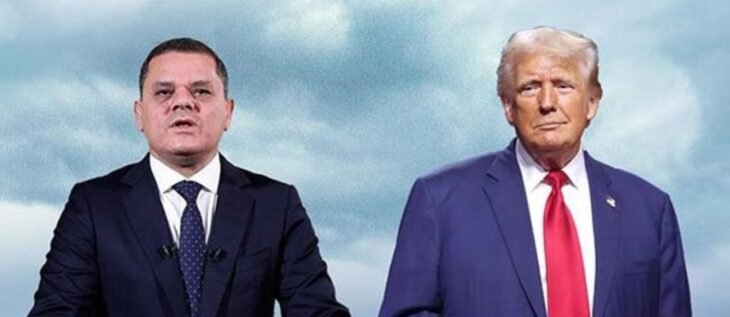
Libya Has a Deal for Trump That Could Reshape Africa and Europe (2)

Tom O’Connor

At the Crossroads of Crises

Risks posed by Libya’s fractured state and the presence of foreign actors are compounded by instability in neighboring nations—some of which can be traced back to the initial shock of Qaddafi’s sudden downfall and the subsequent vacuum of power.

The collapse of Libya in 2011 sparked a major influx of arms and fighters through the Sahel, with ethnic Tuareg fighters who once fought on both sides of the Libyan Civil War staging a 2012 uprising in Mali. This was followed by an explosion of Islamist insurgency, including groups linked to Al-Qaeda and the Islamic State, that is spreading across the region today.

To the southeast, Haftar’s troops have been accused of aiding the paramilitary Rapid Support Forces against the Sudanese Armed Forces in the civil war that first erupted in Sudan in 2021. The Government of National Unity has further alleged that Haftar supported the Rapid Support Forces with fuel transfers backed by the United Arab Emirates, though UAE officials have repeatedly rejected direct involvement in Sudan’s civil war.

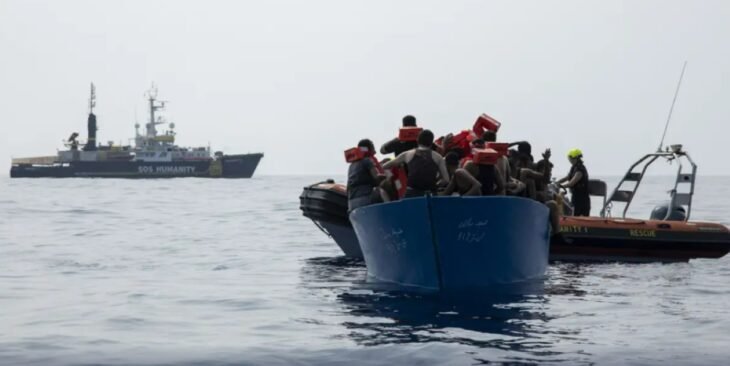
The conflict in Sudan is considered to be the world’s worst humanitarian crisis today, driving millions of people out of the large African nation. Many of these refugees from Sudan and others fleeing conflicts and harsh conditions elsewhere in Africa find their way to Libya, taking advantage of the country’s disunity and unpatrolled borders to embark on a treacherous trip across the Mediterranean to Europe.

Nearly 60,000 people survived the journey and another 1,500 are known to have perished in 2025 alone, according to the European Union’s Frontex border security agency, which identifies Libya as the primary departure point. The total number of those who fled from Libya by sea since 2011 is believed to at least be in the hundreds of thousands, with potentially more unreported.

“Europe has a big problem with the immigrants who come with ships,” Sahad said. “Why do we have these immigrants? Because we could not control the borders, our southern borders. We cannot control them. We need help in that regard. We need technology.”

“We cannot control the vast borders in the south, but with technology, you can, and Europe is not giving us that help,” he added.

Yet there’s hope Washington may be able to step in here, as Sahad believes this is “another thing the United States can help us with,” and do so with a promise of reciprocal benefits.

“We’re not saying that we are demanding or asking, but also Libya will give the United States the energy, and we will give their states the stability of that region,” Sahad said. “If Libya is stable, then there are big advantages for Northern Africa, for Africa.”

Alftise reiterated this point, arguing that, while the Government of National Unity has so far been able to keep the threat of Islamist militant resurgence in the west at bay, the lack of control over the southern border and growing jihadi infiltration of nations such as Mali, Burkina Faso and Niger meant U.S. support was necessary not only for safeguarding Libya, but far beyond as well.

“It’s not only for the sake of Libya,” Alftise said, “it’s the sake of Africa and the sake of southern Europe.”

Unity First

As the 15th anniversary of the uprising that toppled Qaddafi nears in February, uncertainty prevails over the nation of roughly 7.5 million people once considered one of the richest nations in Africa that has still yet to rebound from its pre-2011 economic performance.

Alftise said that “there is still a big hope that things will be okay,” though he acknowledged a wave of nostalgia for Qaddafi’s rule, fueled largely by social media and foreign outlets. In response, he said, “we’re trying to tell the people that era has more bad things than good things.”

And while the cautious calm that continues to hold has produced some positive growth in the economy and social development in recent years, so much potential is hindered by the still-unwavering split between the opposing governments.

In the east, Haftar continues to entrench his position, promoting at least two of his sons, Saddam and Khalid, to senior military positions and a third, Belqasim, as his top political adviser. Critics accuse of him emulating Qaddafi in his dynastic tendencies and strongman persona that overshadows Government of National Stability Prime Minister Osama Hammad.

In the west, Dbeibah faces not only the rival government in Tobruk and its foreign backers but also a complex array of internal factions, including Islamist forces who seek to push their own vision of Libya in backing the Government of National Unity. His leverage is further challenged by incessant clashes over Libya’s oil and gas infrastructure, a backbone of the national economy that has been sapped by the dual power rivalry and rampant fuel smuggling.

Nevertheless, Dbeibah’s administration continues to enjoy international recognition and his outreach to the White House has not gone unnoticed. Trump’s senior adviser on Africa affairs, Massad Boulos, traveled to Tripoli in July to hold talks with Dbeibah that reportedly included a Libyan offer to forge a $70 billion economic partnership with the U.S.

But Libya has also caught the eye of the administration on another matter often tied to Trump’s diplomatic efforts in the Middle East and North Africa. In April, Trump’s special envoy to the Middle East, Steve Witkoff, named Libya as among six nations that could potentially join the Abraham Accords, a series of agreements through which the United Arab Emirates, Bahrain, Sudan and Morocco established diplomatic ties with Israel in late 2020 and early 2021.

The deals marked the first Arab-Israeli normalization pacts since those struck by Egypt in 1979 and Jordan in 1994, save for Mauritania’s short-lived recognition offered in 1999 and rescinded amid a war in Gaza a decade later. Like the rest of the Arab world and many Muslim nations, Libya has never recognized Israel and has consistently expressed support for Palestinians, once constituting a major source of Palestinian militia funds and arms throughout the Qaddafi era.

Even years from Qaddafi’s ouster, the Israeli-Palestinian issue remains a sensitive one for Libya. Both Alftise and Sahad said unifying and stabilizing the nation remained the first order of business before such decisions could be taken.

“The important thing for us at the moment is to revive Libya as a as a country with a civil government, with democracy, so we can have our country in a sovereign situation, and it could take whatever decisions built on, one, the sovereignty of the nation, and, two, the agreement of the people, because that’s democracy,” Sahad said. “So, this is what we are facing.”

***

Tom O’Connor – Senior Writer, Foreign Policy & Deputy Editor, National Security and Foreign Policy

___________________

Russian and Sudanese Forces Receive Haftar-Diverted Fuel

The Sentry

To maintain dominance over eastern and southern Libya, the Haftar family relies on Russia’s military support and the UAE’s political backing. Although other countries also assist, these two stand out. In return for their crucial assistance, the Haftars grant them numerous concrete advantages, including the systematic diversion of subsidized fuel to Russian personnel in Libya and to the Emirati-backed RSF in Sudan.

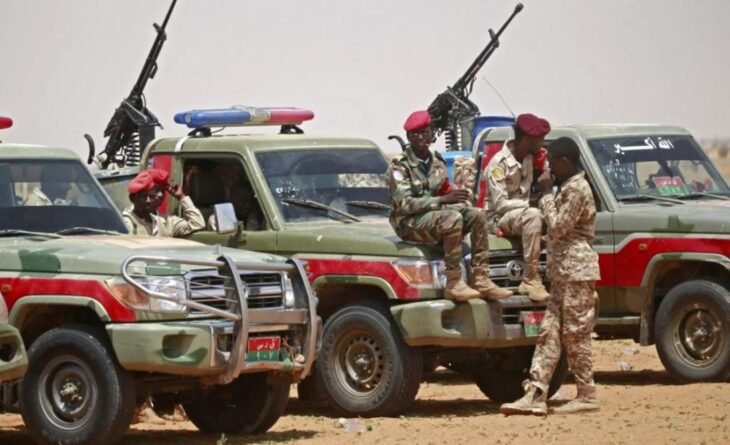
Inside the Russian entrenchment in Libya Since 2020, Russia has maintained a significant military presence at four air bases in Libya: al-Khadim, east of Benghazi; al-Jufrah, in central Libya; al-Qardabiyah, near Sirte; and Brak al-Shatti, in the south western province. There, hundreds of Russian personnel operate radar installations and air-defense systems.

Such an arrangement enables Moscow to enjoy a degree of operational autonomy while helping the Haftar family reinforce a de facto demarcation line between Haftar-held territories and northwestern Libya, where Turkish troops remain entrenched.

Field Marshal Haftar and his family view these Russian-operated air defenses as indispensable in protecting their territory against any potential advance from northwestern Libya, officials from France, the US, and Egypt told The Sen try. It is within this context that the Russians receive fuel supplies from the LAAF.

In mid-2022, Saddam Haftar’s Brigade Tareq bin Ziyad and Hassan Zadma’s Brigade 128 ramped up fuel deliveries to Russian forces beyond what was needed for local operations. This arrangement, which has benefited Russian-controlled air bases such as al-Jufrah and Brak al-Shatti, has included deliveries of jet fuel in volumes that align with the operational needs of Russian helicopters and aircraft stationed there.

Distinct from that, the quantities of diesel and gasoline supplied surpass what might be used locally by the Russians. The surplus fuel is then directed toward two distinct activities.

First, the Russians sell a portion of it to local traffickers for profit, which likely assists the Russians in covering their day-to-day expenses, such as food and other basic needs, in dinars.

Second, there are regular cargo flights transporting fuel from al-Jufrah and al-Khadim to Gao Airport in Mali, a known Russian-controlled facility.

Moreover, in the past, fuel was also sent by truck from al-Jufrah to Wagner units, which were active in Darfur until their exit in autumn 2023. These Russian-to-Russian transfers of fuel occurred through the greater al-Kufrah area under the protection of the LAAF.

In 2023, the Russian Ministry of Defense asserted more direct control of the military mission in Libya previously implemented by the Wagner Group. Its intelligence directorate, the GRU, replaced the semi-private mercenary company and now coordinates operations directly with the Haftar family.

This shift saw Russian state forces take over and bolster existing Wagner-dominated bases and tighten up direct ties with select LAAF brigades, reflecting a more formal, Russian state-directed presence. Another such strengthening phase unfolded in Libya after the December 2024 collapse of Bashar al-Assad’s regime in Syria.

Amid this expansion of the Russian presence in Libya, the LAAF has carried on delivering fuel for Russia’s benefit. The Russian Federation did not respond to a request for comment. The UAE, the Haftars, and the RSF Since the start of Sudan’s civil war, the Haftar camp has been a key fuel supplier to the RSF. This persistent flow of diesel and gasoline has enabled the RSF’s mobility in Darfur and, therefore, its tactical operations there.

By supplying fuel and other aid to the RSF amid the Sudanese war, the Haftar family has tightened its command structure and strategic control in southeastern Libya. The transfer of fuel to the RSF reflects the Haftars’ deep loyalty to the Emirati government, a crucial backer of the paramilitary force.

Because of the UAE’s extensive ideological, diplomatic, financial, and political support for the Haftar family since 2014, the Emirati government occupies a privileged position in the eyes of Haftar’s forces, leaving them beholden to Abu Dhabi.

Between 2014 and 2019, the UAE was the most consequential foreign actor in Libya, intervening heavily on Haftar’s behalf. To this day, it remains vital to the Haftar family, continuing to offer political and diplomatic backing and providing a banking platform for illicit financial flows. Because of this legacy, the UAE wields sway over the family.

When the war in Sudan broke out in April 2023, the UAE used its influence over the Haftar family to ensure that they supplied RSF forces with support, including fuel. Neither the UAE nor the RSF responded to requests for comment. Soon after fighting erupted in Sudan on April 15, 2023, Saddam Haftar traveled to southeastern Libya’s Kufrah district, a long-standing hub for illicit activity, to oversee efforts to secure fuel supplies for the forces of RSF leader General Mohamed Hamdan Dagalo, or “Hemedti.”

In addition to reinforcing security, Saddam Haftar asserted personal command over the local LAAF-affiliated Battalion Subul al Salam, even though it had previously shown a preference for business dealings with the RSF. The wartime context demanded more direct oversight by the LAAF leadership to transform existing commercial relationships into reliable wartime supply channels.

To maintain uninterrupted shipments of fuel and other goods across the border, Saddam’s Brigade Tareq bin Ziyad increased its manpower and equipment in the Kufrah area by bringing in additional forces from Benghazi and Ajdabiya. This buildup enabled tighter control over key assets, most notably Kufrah airport, which served as a critical ground hub.

Beyond supervising the flow of fuel, Saddam Haftar’s forces also coordinated occasional arms transfers to the RSF in Darfur as part of a broader support policy that included regular deliveries of ammunition. Due to concerns about potential ground incursions or air strikes from the Sudanese Armed Forces and its allies — and the treacherous conditions along the sand routes from Kufrah to Sudan — the LAAF required RSF-linked drivers to handle the final leg of fuel transportation.

Distinct from Subul al-Salam, other LAAF units play a role in the transfer of fuel to the RSF. They include Battalion 129 and other Tubu armed groups spearheaded by senior commander Mohammed Ali Sida, who is based in Rebiana, a Tubu-majority municipality near Kufrah. Formally reporting to Khaled Haftar since 2022, these Tubu forces are responsible for the Sarir refinery, located near the oilfield of the same name in the middle of eastern Libya.

The Sarir refinery operates almost exclusively for south ward smuggling purposes, with a current capacity of about 8,000 barrels (1.3 million liters) per day. Under the LAAF’s increased control, part of the refinery’s output is diverted to illicit channels, bypassing the NOC’s regular circuit. As part of its pro-Emirati policy of supporting the RSF, the LAAF also protects the passage of military resources supplied by the UAE via eastern Libya and provides training camps for Hemedti’s men in the greater Kufrah area.

______________________
The Source: INSIDE JOB: Libya’s Fuel Smuggling Escalation by the Sentry (November 2025)

Libyan Haftar forces ‘key fuel supplier’ to Sudan’s RSF on behalf of UAE

Elodie Farge

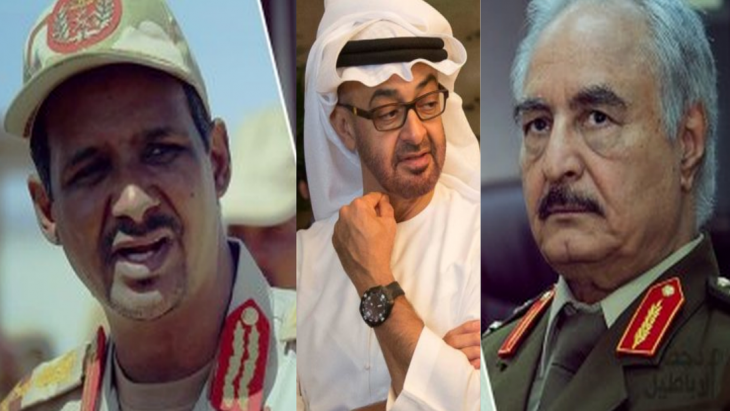
Surge in fuel smuggling from Libya benefits Sudanese paramilitaries backed by Abu Dhabi while costing billions of dollars in lost revenue, report says. Libyan commander Khalifa Haftar’s forces have been providing smuggled fuel to the Sudanese paramilitary Rapid Support Forces (RSF) at the request the United Arab Emirates, a report by US-based watchdog The Sentry said on Thursday.

Investigating how fuel smuggling in Libya has escalated into “a major national crisis” that costs the North African country around $6.7bn per year, the report shows how the illegal activity is also enabling the deadly conflict in neighbouring Sudan between the Sudanese army and the RSF. According to investigative organisation The Sentry, Haftar “has been a key fuel supplier to the RSF” since the start of the Sudanese civil war in April 2023, reflecting his “deep loyalty to the Emirati government”.

The commander, who dominates eastern Libya, has been repeatedly accused of supplying weapons and fuel to the RSF on behalf of the UAE, a key backer of the paramilitaries, allegations that both Abu Dhabi and Haftar deny. The RSF has been accused of committing systematic atrocities, including murder, rape and sexual violence against civilians, most recently when they took over the city of el-Fasher, completing their control of the vast Darfur region in western Sudan.

“Persistent flow of diesel and gasoline has enabled the RSF’s mobility in Darfur and, therefore, its tactical operations there,” the report said. By providing fuel and other support to the RSF, the Haftar family has also “tightened its command structure and strategic control in southeastern Libya”, it added.

After a Nato-backed revolt toppled and killed longtime leader Muammar Gaddafi in 2011, Libya has been divided between a UN-recognised government in the west, led by Prime Minister Abdul Hamid Dbeibah in Tripoli, and Haftar’s administration in the east. “Because of the UAE’s extensive ideological, diplomatic, financial, and political support for the Haftar family since 2014, the Emirati government occupies a privileged position in the eyes of Haftar’s forces, leaving them beholden to Abu Dhabi,” the report said.

Haftar’s youngest son Saddam, who leads his father’s Libyan Arab Armed Forces (LAAF), is identified as the primary force behind the surge in fuel smuggling. He travelled to southeastern Libya’s Kufra in April 2023 “to oversee efforts to secure fuel supplies” to the RSF, The Sentry said, adding that Haftar’s forces increased “manpower and equipment” in the region to ensure “uninterrupted shipments of fuel and other goods across the border”.

“Beyond supervising the flow of fuel, Saddam Haftar’s forces also coordinated occasional arms transfers to the RSF in Darfur as part of a broader support policy that included regular deliveries of ammunition,” the report added. In addition to the RSF in Sudan, the investigation identifies Russia as another of the main beneficiaries of Libya’s illegal fuel trafficking, which enables Moscow’s military activities in sub-Saharan Africa.  Russia’s military support is seen as essential in maintaining Haftar’s dominance over eastern and southern Libya.

$20bn in lost revenue

Fuel smuggling has been a long-standing issue in Libya, enabled by the country’s inflated fuel subsidy programme. Initially set up by Gaddafi in the early 1970s, the scheme aimed at reducing costs for all domestic energy users by guaranteeing a sale price of $0.03 per litre of refined petroleum product. However, the system has been widely abused, as many recipients – including members of the security services – inflate their requisitions. To answer their demand, the National Oil Corporation, which has little oil refining capacity, imports refined fuel from abroad.

Instead of being consumed in the Libyan market, these large quantities of foreign-refined fuel are then resold abroad for private profit. By late 2024, the fuel imports had surged from about 20.4 million litres per day in early 2021 to a peak of more than 41 million litres per day, way beyond real domestic needs.

According to The Sentry, more than half of the imported fuel has been “siphoned off” by criminal networks. In the early 1980s, Libya’s fuel was already being smuggled into neighbouring countries like Tunisia and Chad, the report explained. The illegal traffic was often deliberately overlooked by Gaddafi as a means of placating some peripheral communities engaged in it.

However, when the current government in Tripoli took office in March 2021, Libya witnessed a surge in fuel smuggling, as Dbeibeh’s authorities sought to “buy peace by channelling large amounts of public wealth to armed factions capable of disrupting stability”, chiefly Haftar’s forces. At home, the economic consequences are badly felt by Libyan households.

The 2022-2024 surge in fuel smuggling has cost the Libyan population about $20bn in lost revenue, the report said, while those funds are “urgently needed for health services, household essentials, infrastructure, education and other social programs”.

“The surge in fuel smuggling means that a larger share of Libya’s oil wealth is stolen, hurting the legitimate economy and worsening hardships for ordinary citizens,” the Sentry said, citing fiscal imbalance, currency depreciation, price inflation, as well fuel shortages and risks of electricity outages. 

“Amid the sustained kleptocratic boom that Libya has experienced since the end of its civil war in 2020, fuel smuggling quickly rose to become the most lucrative scheme, […] a multi-billion-dollar enterprise pursued by the country’s incumbent rulers – with international backing – that can further derail the nation’s legitimate economy,” the report said.

Despite a series of pledges from Libyan leaders to end or reform the fuel subsidies, the surge in smuggling would not have been possible without their “tacit acceptance”, contributing to entrenching their power, both in the east and the west, and thereby further undermining any chance of reunification.

__________________

Libya Has a Deal for Trump That Could Reshape Africa and Europe (1)

Tom O’Connor

As a divided Libya lies between two deepening crises in Africa and the porous southern flank of Europe, representatives of the nation’s internationally recognized government told Newsweek they were looking to President Donald Trump to strike a deal that could have profound effects across two continents.

The appeal from the Tripoli-based Government of National Unity that controls much of Libya’s northwest involves seeking U.S. support in pressuring countries—namely Russia, the United Arab Emirates and Egypt—accused of aiding the rival Government of National Stability that controls much of the rest of the nation, including Libya’s second city of Benghazi, and is backed by the military support of influential Libyan National Army chief Field Marshall Khalifa Haftar.

In exchange, the Government of National Unity envisions boosting business and investment ties—particularly regarding Libya’s vast reserves of oil—with an administration known for its deal-based transactional foreign policy. The Libyan authorities also aim to solidify security ties that may bolster NATO’s position in the Mediterranean, curb the free flow of fighters and arms to conflicts raging in the neighboring Sahel region and Sudan while also easing the large-scale migration of African refugees to Europe.

“We would like to have the involvement of United States. And, especially with this government, they are always looking for deals, there are a lot of deals that we can do, and we keep mutual interests,” Mahmoud Ahmed Alftise, economic adviser to Government of National Unity Prime Minister Abdul-Hamid Dbeibah, told Newsweek. “Of course, we have our sovereignties, but we would like to have a good friend, a strong friend.”

“We would like to have a friend’s mutual interest, so we can go ahead and move, so people have their prosperities,” Alftise said, “because the Libyan people are really suffering from this regional interference in Libya.”

Libya’s Fracture

The roots of Libya’s schism can be traced back to a 2011 rebellion against longtime leader Muammar al-Qaddafi. Qaddafi, who had ruled the nation since seizing power in a 1969 coup against the monarchy and later adopted the titles of “brotherly leader” and “King of Kings” of Africa, had for decades molded a seemingly invincible cult of personality bolstered by grand infrastructure projects and iron-fisted suppression of dissent until widespread unrest swelled around the Arab Spring movement.

As Qaddafi’s forces attempted to extinguish the uprising, NATO intervened directly with a crushing air campaign in support of the rebels, leading to the Libyan leader’s downfall and ultimate slaying at the hands of opposition fighters.

Libya’s initial post-Qaddafi steps appeared hopeful as the temporary National Transitional Council handed the reigns to the elected General National Congress in 2012, marking the nation’s first-ever peaceful transfer of power. But new elections held in 2014 produced the first major crisis as political feuds and opposing interpretations of the nascent constitution led to the establishment of the House of Representatives to rival the General National Congress as Libya’s legislative body.

Haftar, a former close Qaddafi confidant and commander who fled to the U.S. in the 1990s to begin orchestrating efforts to oust his ex-ally, emerged as a powerful military figure in support of the House of Representatives. As head of the Libyan National Army, he declared a military operation against the General National Congress, and Libya thus devolved into a second civil war, this time with no clear victor.

The conflict continued for six years until a 2020 ceasefire that once again inspired cautious optimism toward a political solution, with the establishment of the Government of National Unity as the new Tripoli-based authority aimed at unifying the nation. But the House of Representatives rejected the Government of National Unity’s mandate the following year, leading to the creation of the Government of National Stability in the east and entrenching the dual power system that continues to divide Libya to this day.

Sporadic clashes also persist, sometimes among internal factions of the two major governments that claim legitimate authority in Libya, such as occurred between military and militia units in Tripoli in May. Without a mutually agreed framework for Libya’s unification and a United Nations road map left sidelined, both parties remain locked in their feud, though Alftise argued the Government of National Unity remained more open to a negotiated solution.

“Our government is more flexible, there are even some thoughts that maybe we can merge the two governments in order to have an election, and then we will have, of course, parliamentary elections, and then we have a presidential election, or maybe together,” Alftise said.

“But what happened is the House of Representatives is under the control of Mr. Haftar,” he added. “They cannot say something that he does not like.”

Foreign Intrigue

While a return to large-scale fighting has thus far been avoided, fears loom over such a scenario plunging the country into another period of civil strife. Alftise suggested the decision of peace and war may ultimately be influenced by the whims of foreign powers, who have increasingly spread their influence in Libya.

And elsewhere on the continent itself, he predicted that inaction on Russia’s projection of influence through the deployment of personnel in regions like the Sahel could precipitate a broader geopolitical shift for Africa at a time when many nations have already abandoned ties with Europe.

“The Russian presence in Libya is not only controlling Libya. No, they are controlling Africa,” Sahad said. “They are sending troops to other African countries, and they want to be in control of them. And if this continues, if we allow that to continue, they will find one time that Africa will come to the other side.”

The Kremlin’s interest in Libya is deep-rooted as NATO’s intervention prompted a severe backlash from Russian President Vladimir Putin, who went on to double down on back for another Soviet-era ally facing an Arab Spring revolt, Syrian President Bashar al-Assad. Assad’s downfall at the hands of an Islamist-led rebel offensive last year has reportedly been followed by an uptick in contacts with Haftar, who met Putin in May at Russia’s 80th anniversary World War II Victory Day parade.

It’s not just Moscow or even adversaries of Washington that the Government of National Unity suspects of seeking a lasting piece of Libya. Sahad argued that the United Arab Emirates had thrown its weight behind Haftar in a bid for port access and other shares of the country.

“The UAE has this sickness of wanting to control harbors. They came to buy New York Harbor one time,” Sahad said. “The control of the Libyan harbors, some of them is to be part of the Libyan oil industry, and to be part of the financial sector, especially the banks, and there are other things, and I have no doubt that they have this ambition, and I have no doubt that Haftar agrees with that.”

Egypt, too, has expressed its ambitions to stake control over parts of eastern Libya, according to Sahad, who cited Egyptian President Abdel Fattah el-Sisi’s 2020 remarks calling any attack by the Government of National Unity’s forces against the Government of National Stability-held coastal city of Sirte a “red line” that would result in direct Egyptian military intervention.

Russia and the UAE have rejected allegations that they provided direct support for the Libyan National Army during its westward offensives, while Egypt has framed its stance as necessary for maintaining security along its border with Libya.

Still, Sahad argued that addressing runaway foreign influence was key to unlocking progress on other fronts, including reconciling the split nature of Libya’s governance and paving the way for U.S. investment in Libya’s resource industry.

“If we put an end to this interference, our situation will be better,” Sahad said. “Maybe it will be easier for us to reach an agreement and unify the institutions. A lot of things could happen by then. But with this interference we have, we have real big problems in that regard. The U.S. can help a lot”

“Another sphere is our oil industry faces a lot of problems because of a lack of experts,” he added. “The American companies started the oil industry in the 50s, now we have a lot of fields not explored yet. I think United States companies have a big interest there. And it’s not only oil, we have other minerals.”

To address the growing presence of foreign actors, Sahad called on the U.S. to crack down on the nations suspected of playing destabilizing roles in Libya. While he said he was encouraged by moves such as the Libyan Stabilization Act that passed the House of Representatives in 2021 but was never signed into law, he argued he has not “seen any real effort from either this administration, nor the administration before, to put some pressure on the United Arab Emirates or Egypt to stop their interference in Libya.”

Attention to foreign influence in Libya has also sparked some acknowledgment within the Government of National Unity regarding Turkey’s growing role, particularly after Ankara began fostering closer dialogue with the House of Representatives as part of what Turkish President Recep Tayyip Erdogan referred to in August as a step in line with his nation’s “multidimensional diplomatic efforts.”

“Of course, the Turks always like to have some existence in the area, because they feel they are a power in the area. And nowadays they are,” Alftise said. “They were, of course, in the Ottoman Empire, and now they are trying to have a new history there.”

***

Tom O’Connor – Senior Writer, Foreign Policy & Deputy Editor, National Security and Foreign Policy

__________________

Haftar’s Southwest Grab and The Northwest’s Disingenuous Efforts

The Sentry

Haftar’s Southwest Grab: A Hub

of Convergence

Armed groups affiliated with Field Marshal Khalifa Haftar, mainly Saddam Haftar’s forces, exploit their control over strategic checkpoints and petrol stations across southwest Libya. They oversee the diver sion of subsidized fuel into a parallel market that extends into the neighboring countries of Niger, Chad, and Sudan. Imperfect rule over greater Sabha Since 2021, Saddam Haftar has been increasing his control over the security sector in the Sabha area and, with it, the fuel smuggling operations in southwestern Libya.

Prior to that time, Sabha, a city of 130,000 and southwestern Libya’s largest, harbored a disparate array of armed actors: some nominally pro-Haftar yet operating with autonomy from Benghazi’s general command, others openly hostile to the Haftar family’s dominance. This fractured makeup, rife with ten sion and petty criminality, made Sabha difficult to govern. Various armed groups stubbornly guarded their illicit revenues and resisted the Haftar family’s attempts to assert supremacy in the city.

Following the seizure by rival forces of a large cannabis shipment in spring 2021, Saddam Haftar stepped up his military assertiveness, dispatching personnel, armed vehicles, and equipment to the Sabha area from Benghazi and Ajdabiya. He used his main armed force, Brigade Tareq bin Ziyad, led by Brak al-Shatti native Omar Mrajae al-Maqarhi, to either subdue or co-opt local groups.

On the economic front, Saddam also used the National Development Apparatus, a recon struction agency under his tacit control, to oversee infrastructure projects, agricultural initiatives, and other endeavors. Until it was dismantled in early 2025, the LAAF’s Brigade 128 also played a major role in projecting the Haftars’ influence in the southwestern province, notably in Qatrun, Awbari, and Ghat.

As the LAAF has strengthened its security presence in southwestern Libya, it has come to control almost all fuel flows entering Libya’s southwest province, whether from the northwestern or northeastern coast. This consolidation has enabled the LAAF to dominate most fuel smuggling operations in the southwest ern province. To further capitalize on this control and increase the amount of fuel diverted into the parallel market, the LAAF issues QR codes, which limit each civilian’s vehicle to one tank refill every five days, and it restricts petrol stations’ opening hours. Thanks to this system, most tanker trucks appear to be delivering their cargo at genuine petrol stations, while legitimate buyers are indirectly prevented by the LAAF from accessing fuel from official outlets. As a result, most of the fuel intended for legal sale is in fact diverted to southwestern Libya’s parallel market at inflated prices.

The Umm al-Aranib municipality serves as the main transit point for fuel heading south through the greater Sabha area. In the town and its surroundings, checkpoints manned by LAAF units regulate the flow of millions of liters of fuel each day, fuel that travels along both official roads and sand tracks toward northern Niger and Kouri Bougoudi in northwestern Chad, a bustling gold-mining hub. Once near the border, the fuel typically sells for $1.20 to $2.40 per liter, and sometimes for even more.

Most of the profit from this wide margin goes to the LAAF. The Umm al-Aranib area, along with locations further south such as the strategic city of Qatrun near Chad’s border, is dominated by the Tubu community. In recent years — especially since 2020 — the Haftar family has shifted from an openly hostile stance to more pragmatic arrangements with this non-Ar ab community. Some of the Tubu’s local armed units have joined Khaled Haftar’s Security Units division within the LAAF, while others operate under a protection economy logic.

In exchange for allowing fuel convoys to pass safely through their territory, Tubu-majority militias capture a share of the sizable profits that the LAAF derives from facilitating the sale of Libya’s subsidized fuel at much higher prices abroad. Aside from Niger and Chad, some fuel leaving the greater Sabha area heads for Darfur via Chad’s northeastern corner, traveling yet another corridor protected by local militias working closely with the LAAF.

The Northwest’s Disingenuous Efforts

Against Smuggling

In addition to illicit maritime exports, northwestern Libya sends large volumes of fuel from the coast to the southwest, with a significant portion of fuel handled by Saddam Haftar’s brigades in charge of the southwest province. Haftar’s forces and other LAAF brigades then pass those deliveries of fuel into Niger, Chad, and Sudan, capturing a profit in the process. Some of the northwestern Libya actors en gaging in the illegal trade, such as Brigade 111, are directly linked to Prime Minister Abdelhamid Dabaiba, who has taken no genuine action to curtail their activities.

The northwestern quadrant of Libya, the most diverse province of Libya and home to more than two thirds of the country’s population, features a deeply ingrained web of smuggling routes linking it to Tunisia, southwestern Libya, and northern Mediterranean countries, including EU member states Malta and Italy. Faced with a reality in which distinct groups control their own territories and revenue streams through well-entrenched networks with deep social roots, Dabaiba and his government have been re luctant to engage in protracted confrontations in the northwestern cities of Zawiyah and Zuwarah.

Along the coast west of Tripoli, Dabaiba has disrupted smuggling networks on several occasions but has con sistently backed off before open conflict. Along the coast east of Tripoli, an area that includes Zliten, Khums, Misrata, and Abu Qrain, where local Dabaiba allies are strong, ever fewer measures have been taken against smuggling. In fact, in Misrata and its surroundings, the attitude of the Tripoli government is best described as active complicity. Northwestern Libya’s fuel smuggling operations differ from those overseen by the LAAF in the east and south. In the northwest, no single faction possesses the capacity to impose itself as a near-hege mon — unlike in the east and south, where the Haftar family dominates.

Leveraging their quasi-monopo ly on the use of force, the Haftars devote substantial resources to protecting, regulating, and overseeing both legitimate and illicit fuel supply chains across the vast territories under their purview. In contrast, the area stretching from Tripoli’s western outskirts to the Tunisian border is home to multiple rival armed factions. Yet, despite the absence of a dominant party capable of policing the area, these actors essentially cooperate to maintain revenue streams from illicit activities. This seemingly paradoxi cal cohabitation among rival groups underlines a classic protection economy model in which smuggling thrives despite tribal differences and socio-political enmities.

Zawiyah: No Cop on the Beat

When it comes to fuel, Zawiyah — a fractious tribal city of around 250,000 inhabitants located about 45 kilometers west of the capital — serves as the main distribution hub for both the surrounding area and more distant parts of the country. Inaugurated in 1974, the city’s energy complex houses a large refinery and, more significantly, a maritime terminal that receives more than a billion dollars’ worth of imported fuel each year.

Since 2013, a local armed group leader named Mohammed Koshlaf has exercised de facto control over the Zawiyah energy complex, even obtaining official recognition as head of a Petroleum Facilities Guard unit under Libya’s Defense Ministry. Despite being under international sanctions since 2018 for human smuggling, Koshlaf has, without interruption, maintained a tight grip on the inner workings of this strategic site. Thanks to his position, Koshlaf maximizes the throughput of subsidized fuel by selling it at prices above the official rate, capturing a modest margin that is multiplied by large volumes.

In practical terms, he delegates most of the distribution logistics and related security problems to an array of smaller smugglers, as well as to private distribution companies willing to participate in the illicit fuel market under rules largely established by Koshlaf and his associates. Although official records list roughly 750 petrol stations between western Tripoli and the Tunisian border, only around 300 can be physically verified, and of those, fewer than 200 are operational. In other words, the vast majority of these stations exist solely on paper; they provide a veneer of legitimacy to justify much larger allocations of subsidized fuel by Brega Petroleum for so-called “local” consump tion.

From an accounting perspective, Brega Petroleum appears as though it is supplying legitimate outlets, when in reality, most of the fuel leaving Zawiyah’s energy complex is diverted to black markets rather than reaching bona fide pumps. From Zawiyah’s refinery, some smugglers move fuel westward, primarily to the coastal city of Zuwarah, an Amazigh municipality near the Tunisian border. In Zuwarah, actors connected to the city’s military council export the diverted fuel by land or load it onto vessels, which typically carry between 400,000 and 750,000 liters, to be shipped toward the northern Mediterranean.

Other actors transport fuel from Zawiyah’s energy complex into southwestern Libya — an inland journey that is complicated by fragmented territories and communities that are socially or politically opposed to one another. As a result, truck drivers sometimes must hand off their cargo mid-route if they belong to the “wrong” community for a particular stretch of territory, entrusting it to another driver for the next section. Every checkpoint requires payment to the militia or authority dominating that pocket of land.

These additional costs accumulate, pushing the final sale price higher by the time the fuel reaches southwestern Libya. Plus, drivers receive an extra bonus when the requested itinerary involves a clear deviation from official channels. Compared to makeshift transporters, the four authorized distribution companies enjoy added protection for their trucks, making their official convoys somewhat less vulnerable to extortion and checkpoint fees as they pass through rival-held zones.

Misrata Joint Force:

The PM’s protégé Misrata, a wealthy merchant city endowed with a major port, a free trade zone, and a vital fuel entry point, has long ensured the stable and sufficient distribution of fuel to itself and to neighboring cities such as Zliten and Khums. This stability has traditionally prevented major fuel shortages or disrup tions, creating an environment relatively free from fuel smuggling networks.

The situation worsened in 2021 when the Joint Force, a local brigade that had participated in Misrata’s 2016 war on the Islamic State in nearby Sirte, aligned itself with the newly appointed prime minister. When Dabaiba assumed office in March 2021, he struck a deal with Joint Force leader Omar Bug hdada, providing the armed group with access to Defense Ministry funds, equipment, and recognition. Empowered by its new status, the Joint Force assumed key security responsibilities in Tripoli, including guarding significant state facilities.

The alliance between Dabaiba and the Joint Force enabled the brigade to assert control over parts of Misrata’s airport and maritime port. Under the implicit protection of Dabaiba, the brigade expanded its involvement in illicit activities, including fuel smuggling. Joint Force smuggling ops The Joint Force and the smugglers that it protects acquire fuel from specific petrol stations near Misrata. The Joint Force network also purchases fuel from petrol stations in neighboring cities like Zliten, Khums, and Tawergha. To move this fuel, Joint Force members, often serving as fuel truck drivers, use their military identification to bypass checkpoints.

The Joint Force runs fuel smuggling operations through the Misrata Free Trade Zone and the port of Khums using several tactics: manipulating shipping documents, using hidden tank capacity, concealing fuel in regular cargo containers, and conducting nighttime offshore transfers between large and small vessels. Their control over the free trade zone enables them to manipulate documents to mask these activities. While fuel is officially documented for distribution to Zliten, Khums, and Tawergha, the Joint Force diverts much of it via tanker trucks to the Jufrah area through Abu Qrain and, to a lesser extent, to Shwayref via Bani Walid.

Once in these areas, the product is transferred further south by Haftar-aligned actors, including through official distribution networks. Collaboration with Haftar’s armed coalition, particularly in the Shwayref area, is a critical element in the transfer of fuel from Misrata to the south. However, the fluctuating state of relations between actors affects the fluidity and volume of fuel smuggling operations. When relations are strained, coordination weakens, leading to disruptions in these illicit activities.

An aura of legitimacy

Separate from fuel, the Joint Force has been suspected of facilitating the transit of illicit gold from sub-Saharan Africa through Misrata to destinations abroad, mainly Turkey, as well as permitting Ira nian vessels to access Misrata’s port for various illicit activities, including arms trafficking. Because Misrata seeks a reputation for legitimate commerce, some of the city’s business magnates resent the Dabaiba family. Yet Bughdada remains politically and technically shielded by Dabaiba, who pre serves a tight partnership with the Joint Force, lending it an aura of legitimacy despite scandals such as the May 2024 gold trafficking affair that pitted the Joint Force against the Attorney General’s Office.

The Joint Force is also present in Tripoli, where it has been securing the NOC’s headquarters since July 2022, when Dabaiba ordered it to expel then-chairman Mustafa Sanallah and install Haftar ally Farhat Benqdara. Though Benqdara was removed in January 2025, the Joint Force still controls the NOC’s security, thus retaining leverage over the oil and gas sector.

_____________________

The Source: INSIDE JOB: Libya’s Fuel Smuggling Escalation by the Sentry (November 2025)

Guardians or Gangsters? The Inherent Duality of the Haftars’ LAAF

The Sentry

Within the territories under its purview, the LAAF wields intimidation and brute force to suppress any form of dissent and intrude upon nearly every aspect of public life, frequently subjugating or overriding the authority of senior civilian decision-makers within state organs. Though it portrays itself as a national military and invokes security, the LAAF is not a regular army. From its inception, the LAAF has always defied Tripoli’s authority — no matter which government claimed legitimacy — and has engaged in various illegal enterprises, including banking abuses.

In 2014, this fledgling force began absorbing more militias from northeastern Libya and recruiting more remnants of Qadhafi’s army, growing in size but only sporadically attempting to tighten command structures. Moreover, since seizing key oilfields and terminals between 2016 and 2019, the LAAF has repeatedly used the threat of oil blockades to pressure Tripoli. Thanks to foreign support from Russia, the UAE, Belarus, and other states, the LAAF has persistently bolstered its military capabilities in violation of the UN arms embargo. Personal loyalties often overshadow any clear chain of command.

ambivalence, combined with the Haftars’ disregard for the law and their commitment to eliminating checks and balances, has prevented their armed coalition from becoming a transparent, accountable institution. While the LAAF undergoes periodic phases of partial consolidation, it does not evolve into a genuine national military. Instead, it restructures in ways that concentrate ultimate authority in the Haftar family’s hands, with illicit activities remaining at the LAAF’s core.

The faction has imposed itself in eastern and southern Libya as an inescapable overseer — and tax collector — of organized crime, including various forms of smuggling, trafficking, and economic fraud. LAAF units themselves have also become major participants in some of these illicit activities, mainly through Saddam Haftar’s growing political sway, armed deterrence, and territorial dominance. One telling example was the way the Haftar family disbanded a major component of its own coalition: Brigade 128.

From 2016 until early 2025, Brigade 128 was a major unit in the LAAF, extending the Haftar family’s influence into southwestern Libya. Under the leadership of Hassan Zadma and his brothers, Brigade 128 controlled illicit trade routes, cultivated tribal arrangements, and projected military power from Sirte in the north to the Ghat area in the southwest, as well as in Ajdabiya and Kufrah in the east.

Despite operating for years under the LAAF banner, the Zadma brothers bypassed Saddam Haftar’s official channels by maintaining direct connections with foreign states — mainly the UAE and Russia — and kept entire chunks of their illicit activities, including fuel smuggling profits, hidden from him. Their reluctance to submit to Saddam Haftar seems to have prompted him to view them as a threat.

In late 2024, he began dissolving Brigade 128, confiscating its heavy weapons, ousting its senior commanders, and placing some of its subunits under a new structure that answers directly to him. In February 2025, Saddam Haftar ordered Battalion 87 and other loyal units to conduct an attack on elements affiliated with Brigade 128 in the southern city of Qatrun.

The move, which caused the deaths of about 30 fighters in Qatrun in February 2025, further consolidated Saddam Haftar’s stature within the LAAF, removed potential rivals, and enabled him to somewhat reduce the overall volume of illicit activities under the LAAF at a time when doing so was politically judicious. Plus, for the sake of its law-and-order narrative, the Haftar family portrayed its dismantling of Brigade 128 in Qatrun as an anti-crime operation.

A few weeks later, in April 2025, the flow of smuggled fuel into northern Chad resumed, returning to nearly the same levels as when Brigade 128 controlled the area. To confront Brigade 128, Saddam had to deploy hundreds of armored vehicles and thousands of fighters from northeastern Libya into central and southwestern Libya. Such a buildup, which required significant time and resources, would not have been feasible a few years earlier, when he relied on Brigade 128 to project power in the southwest and lacked the manpower and materiel to replace it in the deep south.

This episode illustrates the ongoing process by which the LAAF, and particularly Saddam Haftar’s Ground Forces division within it, continually seeks to consolidate its internal structure and increase the personal power of Haftar family members. It also shows how, over time, the Haftar family tightens its control over the illicit economy — including fuel smuggling — throughout eastern and southern Libya.

_____________________
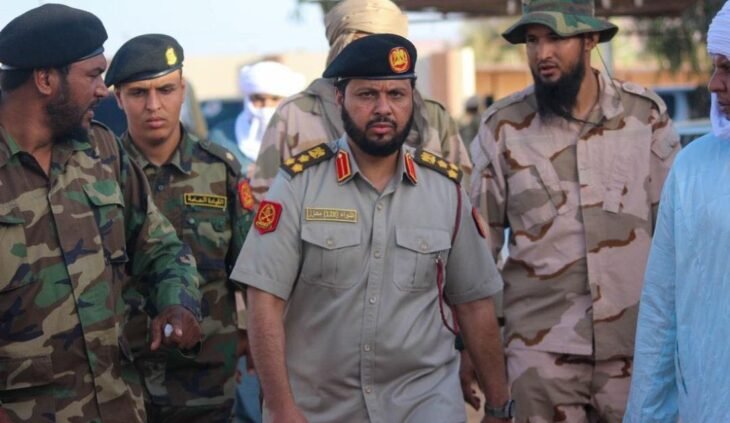
The Source: Inside Job: Libya’s Fuel Smuggling Escalation

Libya’s oil ambitions clash with deep-rooted corruption networks

The future of oil investment in Libya is closely tied to the international community’s ability to curb rampant corruption, particularly by tackling the fuel-smuggling network.
Between 2022 and 2024, there was an unprecedented rise in petrol and diesel smuggling, leading to losses of nearly $20 billion in just three years.

Global oil companies are preparing to return once again to Libya’s energy sector after the country launched its first bidding round in nearly two decades to explore and develop new fields. The move has attracted broad interest, particularly from major US companies seeking investment opportunities in a resource-rich but largely untapped country.

Although this development appears promising from a business perspective and aligns with Libyans’ desire for stability and reconstruction, realistic expectations suggest that these new deals will fail to deliver tangible benefits to the population as long as entrenched corruption continues to dominate the energy sector.

Executive Director of The Sentry Justyna Gudzowska wrote in a report published by Foreign Policy that the structural corruption overshadowing Libya’s oil management undermines the sector’s ability to attract sustainable investment, describing it as one of the sectors most deeply penetrated by elite networks that control the country’s wealth and use it to reinforce their influence.

This situation drives up fuel costs for citizens, while billions of dollars that should have been directed towards improving public services and essential infrastructure are squandered.

Against this backdrop, policymakers in Europe and the United States are advised to proceed cautiously so that their investments do not inadvertently empower these networks.

Experts stress that Libya will not be a reliable partner for international institutions unless it has an effective and transparent state capable of holding its institutions accountable. Commercial opportunities that appear attractive in the short term may turn into major risks in the long term if private interests continue to dominate state bodies in both Tripoli and Benghazi.

Recent investigations by The Sentry reveal the vast scale of the smuggling networks operating within Libya’s fuel-subsidy program. Between 2022 and 2024, there was an unprecedented rise in petrol and diesel smuggling, leading to losses of nearly $20 billion in just three years.

A significant portion of these losses stems from the shift since 2021, when the National Oil Corporation (NOC) began directly exchanging crude oil for imported fuel, replacing the previous system in which revenues were transferred to the Central Bank. This mechanism allowed for increased fuel imports without recorded government expenditure, causing imports to surge to around 41 million liters per day by late 2024.

While authorities justified the rise by citing supply-chain changes and increased electricity demand, estimates suggest that the volume of imports far exceeds national consumption capacity, indicating that a large share is being smuggled abroad by land and sea. Benghazi’s old port has become a central hub for re-exporting fuel via “dark” vessels using forged papers to transport millions of liters per shipment.

Local officers and military figures have supervised these activities, providing them with direct and sustained protection. Despite deep political divisions, various Libyan factions have benefited from the illicit proceeds of smuggling. Reports have exposed the involvement of several foreign actors that supported Libya’s civil war, including Russia and Turkey, in this vast and lucrative scheme.

This situation has pushed fuel prices for Libyan citizens to record highs, with some paying up to forty times the official price, while subsidized products are sold to external beneficiaries through organized smuggling networks. In some cases, quantities of diesel, petrol and jet fuel have been channeled to foreign fighting groups operating inside Libya or neighboring countries, fueling further regional conflict. By 2024, the annual value of stolen subsidized fuel was estimated at around $7 billion, roughly 15 percent of total public expenditure.

These funds should have been used to improve healthcare, education and essential services, but instead have become a source of illicit enrichment. The drain has deprived the Central Bank of the foreign currency needed for imports of food and medicine, worsening inflation and weakening the Libyan dinar. In a painful irony, citizens of one of the world’s most oil-rich countries find themselves standing in long queues for fuel, while the black market remains their primary source of supply.

Although the NOC has announced the end of the crude-for-fuel exchange mechanism, import volumes remain inexplicably high, suggesting that large-scale smuggling continues unabated. This comes at a time when global oil companies are seeking to open new horizons in Libya, amid an environment marked by uncertainty and significant security and economic risks. Political interference, competing power centres, and the potential for renewed conflict all threaten long-term investments.

The United States wields considerable influence in this landscape, given that Libya’s oil trade depends on dollar transactions, giving Washington leverage to impose conditions that promote transparency and curb corruption. As negotiations are currently under way between Libyan leaders and major companies such as Exxon Mobil and Chevron, the need for an American role supporting the NOC, as the only technocratic body capable of reliably managing contracts, appears increasingly critical. Yet this role remains fragile so long as fuel smuggling continues to absorb a massive portion of national revenues.

US adviser Massad Boulus has been pushing for the establishment of a transparent NOC budget to curtail off-the-books expenditure. But these efforts, experts say, will be ineffective unless the smuggling networks are confronted directly.

Investigating individuals involved and imposing severe sanctions on them is seen as a necessary step to strengthen deterrence and curb the misuse of public resources. The US administration can also issue formal warnings to American companies regarding intermediaries, traders and shipping firms implicated in exploitation schemes.

Washington states that its Libya policy prioritizes enhancing trade and economic cooperation while supporting institutional unification and the role of the NOC. But engaging with powerful individuals at the expense of legitimate institutions reinforces corruption instead of curbing it. If the United States and its allies fail to support Libyan institutions rather than align with dominant power brokers, corruption is likely to persist and worsen, posing a direct threat first to Libyans and later to international investors.

The future of oil investment in Libya is closely tied to the international community’s ability to curb rampant corruption, particularly by tackling the fuel-smuggling network that drains billions of dollars each year. If Washington wants its companies to succeed over the long term, it must help rein in these networks, which are undermining the state and obstructing any genuine economic progress.

_____________________
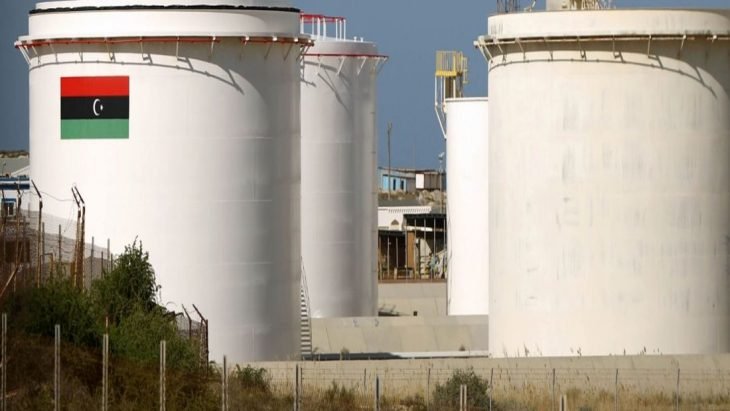
Saddam Haftar Consolidates Illegal Fuel Trade in Eastern Libya

The Sentry

Saddam Haftar and other actors aligned with the Libyan Arab Armed Forces (LAAF) utilize their territori al control to tax flows of fuel smuggled by others and to transport their own illicit cargo, thereby capturing revenue from the large-scale diversion of subsidized fuel. The Haftar coalition also cultivates select tribal groups, further solidifying control over smuggling networks in eastern Libya, which since 2021 has displaced western Libya as the country’s epicenter of the illegal fuel trade.

Driving this shift is Saddam Haftar, operating through the LAAF, his father Field Marshal Khalifa Haftar’s armed coalition. The young lieutenant general has reshaped parts of the NOC and other state organs to maximize his sway over fuel smuggling and other illicit activities. This strategy has enabled the Haftar coalition to grow a fuel smuggling network within the NOC and other legitimate institutions, blur ring the lines between legitimate and illicit activities.

As Saddam Haftar’s Ground Forces division has strengthened, it has prioritized illicit profits, reducing the availability of subsidized fuel outside major eastern cities. For years, northwestern Libya had been the epicenter for fuel smuggling, where contending armed fac tions alternated between clashes and tense cohabitation. This lack of unity resulted in smaller-scale, less efficient operations. After Libya’s civil war ended in June 2020, the Haftar coalition concentrated on the eastern and southern regions, solidifying its hegemony there in ways unmatched in the more fragmented west.

The result: illicit fuel volumes in eastern Libya surged, hurting the country’s economy. Beyond immediate profits, Saddam Haftar’s big push in fuel smuggling since 2021 has yielded a self-reinforcing cycle that bolsters his sway on almost all fronts.

Maritime smuggling operations

Saddam Haftar wields extensive authority over northeastern Libya, both on land and at sea. His sway encompasses ports, roads, storage facilities, customs, border police, key parts of the NOC and Brega Petroleum, and maritime operations ranging from authorizing ships to leave port to issuing official doc uments via administrators under his influence. As a result, Saddam Haftar controls almost all of eastern Libya’s maritime smuggling, which forms a major component of the illicit fuel trade in the eastern prov ince.

Unlike overland smuggling, which cannot easily move millions of liters at once, maritime smuggling involves entire vessels diverting massive shipments of subsidized fuel — often several million liters at a time. It also involves processes designed to obscure the fuel’s origin and destination to render de tection and interception challenging for authorities abroad. These traits make maritime reexports the most efficient means of stealing fuel, responsible for an enormous chunk of the fuel diverted daily.

Two main methods of diverting imported fuel by sea have flourished, especially since : simple reexport and indirect reexport. In simple reexport operations, fuel that was imported is subsequently loaded onto a separate vessel — often in Benghazi’s old harbor or, more seldom, in Tobruk, about 440 kilometers further east — and then shipped directly to its final destination, such as Turkey.

The Queen Majeda inci dent is a prime example. Local authorities in Albania intercepted this ship in September 2022, just days after it had departed from Benghazi’s old harbor carrying more than $2 million in foreign-refined heavy marine fuel that was diverted to Albania.

In indirect reexport, a vessel carrying the imported fuel departs from a Libyan port and sails to a location in the Mediterranean Sea, such as Hurds Bank just outside Maltese territorial waters, where the fuel is transferred to another vessel in a ship-to-ship transfer. Although this extra step adds cost, it helps conceal the connection to Libya. Consequently, the receiving vessel can reach its final destination with no trace that the product originated in Libya’s subsidized fuel program.

One well-documented example is the Aristo. In November 2023, Italian authorities intercepted the vessel near Licata, Sicily, as it was about to perform a ship-to-ship transfer. The Aristo, which had sailed from eastern Libya, was carry ing about 670,000 liters of diesel picked up at Benghazi’s old harbor. If the ship-to-ship transfer had occurred, the product would likely have been passed off as legitimate through a broker-arranged sale to Italian oil services company Saipem.

In both methods, foreign-refined fuel is delivered at a commercial port, stored in Brega Petroleum’s local depot, and then moved by tanker trucks onto vessels for reexport. In the Benghazi area, Ali al-Mashay serves as Saddam Haftar’s most trusted subordinate when it comes to overseeing illicit fuel transfers, from the moment imported fuel arrives at Benghazi’s new commercial port until it is loaded onto a differ ent vessel at the old harbor nearby.

In this context, the use of tankers that can carry up to 50 million liters of liquid fuel makes it easier to illegally export vast quantities of fuel from the Benghazi area. A Benghazi-based security official told The Sentry that no cargo — whether narcotics, migrants, fuel, or any other items — can pass through the ports of Benghazi without Ali al-Mashay’s personal approval. An even more brazen practice involves diverting the imported fuel at sea before it even reaches Libyan shores, transferring cargo from one ship to another, either within Libyan territorial waters or in interna tional waters.

Outside Libya’s territorial waters, maritime smugglers often use fraudulent paperwork for two reasons. Fraudulent paperwork helps deceive local authorities at the final destination, and carrying ostensi bly valid documents helps evade international scrutiny under UN Security Council resolutions, which condemn unauthorized hydrocarbon exports. In this context, international actors such as the EU’s Operation IRINI — tasked with upholding UN Security Council resolutions on Libya — can inspect fuel cargos. In addition to using fraudulent documentation, ships involved in smuggling often disable their automatic identification system (AIS) transponder, which allows public location tracking, to avoid mari time surveillance.

Although these maritime methods are employed along Libya’s western shores, corrupt actors on the country’s eastern shores operate at a far larger scale. The stark disparity in volumes stolen arises from western Libya’s more fractured security landscape, which makes it difficult for networks to secure the complicity and acquiescence of all other factions and bureaucrats — and thus keeps volumes much lower.

On the administrative front, the active involvement and complicity of senior officials within Brega Petro leum, as well as the NOC’s top leadership, is crucial for the large-scale diversion of fuel. It ensures that the NOC remains publicly silent while its multimillion-dollar fuel cargos disappear at sea, representing a steady flow of fuel into illicit operations. Such a level of coordination and corruption underscores the entrenched nature of the fuel smuggling sector and the significant obstacles in combating diversion schemes.

In May 2022, the NOC chairman at the time alerted Libya’s attorney general about an unprecedented surge in abnormal fuel exports from Benghazi. He lost his job two months after issuing this alert. Another stark example is that of Faraj al-Jaedi who, in June 2023, was promoted by the NOC chairman from the operations and human re sources director of Brega Petroleum to its board member responsible for finance‬.

According to a senior Libyan technocrat familiar with Brega Petroleum’s inner workings, Jaedi is close to Saddam Haftar. Jaedi was Brega Petroleum’s operations director when the Queen Majeda shipment to Albania occurred in September 2022, and the UN-recognized Libyan government vouched for the legality of the shipping documents that Brega Petroleum had issued. These facts strongly suggest that Jaedi actively helped divert the cargo. Brega Petroleum, the NOC’s wholly owned subsidiary, did not respond to a request for comment.

The NOC, in its response to The Sentry’s request for comment, denied that Jaedi played any role in the Queen Majeda incident and added that he has no relationship with Saddam Haftar. The NOC also asserted that none of its employees nor those of Brega Petroleum had been summoned by the attorney general in the context of fuel smuggling. Furthermore, the NOC said it provided relevant authorities with official reports pertaining to fuel smuggling cases and it cooperated with the United Nations Panel of Experts.

On the issue of large-scale fuel smuggling via maritime routes, the NOC told The Sentry that no smuggling incidents have been recorded from oil ports under its authority. It added that the NOC controls only oil ports and that the old Benghazi harbor is not an oil port and is therefore not under the control of the NOC or any of its subsidiaries.

Reached separately by The Sentry, former NOC Chairman Farhat Benqdara noted that maritime smuggling of fuel in Libya occurred not at oil terminals but at commercial ports, where the NOC and its subsidiaries had no authority.

Land-based smuggling operations

While maritime smuggling constitutes a major profit center for the Haftar camp, the coalition also over sees land-based routes for the transport of fuel, encompassing both legitimate fuel deliveries and fuel funneled into the parallel market, whether domestic or foreign. Fuel exiting northeastern Libya departs from the Ras al-Manqar depot, a strategic storage facility east of Benghazi. From there, official tanker trucks travel south through Ajdabiya — a critical choke point — before branching onto three main roads.

The first leads to Sirte, then continues to Jufrah and into the southwestern province. The second, the Ajdabiya–Kufrah corridor, is the primary artery for southeast Libya. The third follows makeshift tracks via Zillah and Umm al-Aranib, eventually reaching further south. The bulk of the fuel heading for the southwestern province passes through Zillah, with Umm al-Aranib serving as a major hub.

While all of these passages are under the control of Saddam Haftar-aligned brigades, tribal affiliations underpin fuel smuggling operations in logistically crucial areas. The Zway tribe, for example, dominates much of the Ajdabiya-Kufrah corridor through its ownership and operation of numerous petrol stations, the primary points of sale and diversion. In leveraging its connections with the Haftar family, the Zway tribe has expanded its market control since 2016, creating a profitable environment for smuggling, with residents in Kufrah often paying over 6 dinars ($1.20) per liter — 40 times the official subsidized rate.

____________________

Libya’s fractures drift toward permanence

Federica Saini Fasanotti

The intense rivalries, power struggles among militias and shifting regional dynamics are casting a shadow over the country’s prospects of ever achieving unity again.

he divisions in Libya’s political landscape are becoming rigid and permanent. Recent clashes in Tripoli, particularly the late September fighting triggered by competing appointments to a top security position, highlight just how volatile the situation remains. Libyan Prime Minister Abdul Hamid Dbeibeh’s push to dismantle militias disloyal to his Government of National Unity (GNU) has disrupted already-fragile power-sharing agreements and sparked armed confrontations in the capital.

Italy, Turkiye and the European Union are keeping a close eye on the situation, as Libya’s turmoil directly affects their strategic interests, from migration and energy security to regional influence.

Dbeibeh vs. Haftar: Libya’s enduring power stalemate

At the heart of Libya’s political paralysis is the enduring rivalry between Prime Minister Dbeibeh, based in Tripoli in the west of the country, and Field Marshal Khalifa Haftar, who holds power in the east. This clash of authority pits the UN-recognized GNU in Tripoli against Mr. Haftar’s Libyan National Army (LNA). The LNA operates from its regional stronghold in Cyrenaica, while Tobruk serves as its political center and houses the parallel administration known as the House of Representatives.

Neither side has the strength to unify the country completely, yet both possess enough military and financial clout to undermine any solution that threatens their position. This dynamic has led to a frozen stalemate in which no faction can prevail, but each can still impede progress toward peace. Field Marshal Haftar’s attempted offensive on Tripoli in 2019 showcased his ambition to seize the capital by force. Although Turkiye’s military intervention foiled that assault, Mr. Haftar entrenched himself in the east and reinforced his influence by appointing loyalists, including his sons, to crucial positions.

In the west, Prime Minister Dbeibeh’s mandate has officially lapsed since 2021, and his authority barely reaches beyond the patchwork of militias that only somewhat recognize the GNU. Their rivalry continues to be a significant barrier to achieving any form of national reconciliation. Efforts from the international community – ranging from United Nations roadmaps to regional mediation – continually falter, caught in the trap of this zero-sum contest for power.

Fragile militia alliances and unstable security

The leadership rivalry is further complicated by the fragmented and unstable nature of the country’s security landscape. Militias are the real power brokers, and today’s ally can swiftly turn into tomorrow’s adversary. This year’s clashes in Tripoli have sharply highlighted how quickly a militia, once considered loyal, may turn against the government if its own interests are jeopardized.

In May, the assassination of a prominent militia leader, Ghnewa al-Kikli, sent the capital spiraling into its worst violence in years. Although a ceasefire eventually restored a shaky semblance of calm, tensions flared again by September. This resurgence of fighting was sparked when Prime Minister Dbeibeh attempted to curb the influence of the Special Deterrence Force (Radaa), a powerful militia in Tripoli aligned with the Presidential Council. A deal brokered by Turkiye aimed to have Radaa return key sites, such as the airport and Mitiga prison, to state control. However, implementation faltered amid a turf war between the GNU and the Presidential Council.

The feud over rival appointments to head the Judicial Police, one made by Prime Minister Dbeibeh and the other by the Presidential Council, ignited armed street battles on September 21.

Episodes like this underscore the inherent fragility of Libya’s militia-dominated order. Armed groups have divided the country into fiefdoms, controlling airports, ports and oil facilities, which they exploit for financial gain and political influence. Any attempt to alter this precarious balance, whether by disbanding a militia or reassigning its commanders, can shatter the temporary coalitions that pass for stability.

In Tripoli, the GNU relies on a constellation of militia “partners” whose loyalty is transactional. Meanwhile, in the east, Field Marshal Haftar’s LNA holds an uneasy coalition of tribal and Salafist units, similarly bound by convenience. The potential for sudden escalation looms constantly, and each flare-up further erodes public trust and worsens humanitarian conditions.

For Libyan civilians, constant skirmishes between militias means that daily life is often precarious. Armed factions constantly vie for power, showing little consideration for the people caught in the middle. For foreign stakeholders, it means that any diplomatic or economic involvement in Libya is fraught with the potential for disruption.

Turkiye’s expanding role as kingmaker

Turkiye has emerged as the most influential external actor in Libya, with its role evolving rapidly. In 2019-2020, Ankara supported the Tripoli government during a critical moment, deploying military advisors, armed drones and Syrian fighters that helped beat back Field Marshal Haftar’s offensive. In return, Turkiye secured lucrative construction and energy contracts in western Libya, along with a controversial maritime delimitation agreement in 2019 that expanded its claims in the Eastern Mediterranean.

The maritime deal closely tied the Tripoli authorities to Ankara’s strategic vision, often referred to as the “Blue Homeland” doctrine. This move, however, infuriated Greece and Cyprus and was rejected by Mr. Haftar and his foreign backers like Egypt. For a while, Turkiye seemed satisfied as the main supporter of western Libya, solidifying a Misrata-Tripoli-Ankara alliance. Yet, as the Libyan conflict settled into a stalemate, Turkish policymakers began to rethink their approach.

Today, Turkiye is expanding its engagement to hedge its bets across Libya’s divided landscape. Recognizing the limitations of relying solely on the Tripoli faction, Ankara has prudently begun to establish ties with Mr. Haftar and his base in Cyrenaica. Turkish diplomats and business leaders have made high-profile visits to Benghazi and even to Field Marshal Haftar’s stronghold, exploring investment opportunities and fostering political dialogues.

The goal is not to abandon Tripoli, but to gain leverage on both sides of the country’s east-west divide. By engaging with Mr. Haftar’s camp, Turkiye aims to broaden and legitimize the 2019 memorandum of understanding regarding maritime zones, preferably with the endorsement of Cyrenaica. Establishing a potential understanding with Mr. Haftar could also help repair Ankara’s strained relations with Egypt, the field marshal’s primary Arab supporter, ultimately bolstering Turkiye’s regional influence.

Turkiye aims to be the indispensable powerbroker in Libya, positioning itself as the go-to nation able to engage with all factions and shape any political resolution. This expanding footprint presents significant opportunities for Ankara, including securing energy exploration agreements, gaining access to Libya’s vast oil reserves and securing reconstruction contracts. But it also brings inherent risks; Turkiye needs to navigate complex rivalries carefully to avoid overextending itself or provoking a backlash. The choices it makes next will substantially affect the country’s future and the interests of other international players.

Implications for Italy and Europe

Libya’s turmoil presents a complex challenge for both Italy and the EU, blending security threats with strategic opportunities. Rome’s main concerns focus on migration, energy resources and geopolitical influence. The chaos in Libya has significantly driven irregular migration across the central Mediterranean route, a key political issue in Italy. Each new outbreak of violence or breakdown of governance raises the alarming possibility of fresh waves of migrants making their way to Italian shores.

Rome also worries that protracted instability in Libya could provide terrorist groups with a new foothold and disrupt the country’s crucial oil and gas output, which is heavily linked to investments made by the Italian energy company Eni. Conversely, a more stable Libya could offer Italy opportunities to deepen trade ties, secure energy imports and enhance migration cooperation through robust bilateral agreements.

However, Italy’s ability to influence events in Libya has been hampered by the growing presence of other powers, particularly Turkiye and Russia, as well as by Rome’s own difficult compromises. The danger for Italy is that it risks being sidelined in a country it once regarded as part of its sphere of influence. In some instances, Italy has felt it necessary to engage in questionable deals with Libyan factions just to maintain a say in the unfolding situation.

Rome’s approach in the Mediterranean involves delicately balancing cooperation with Turkiye when possible, while also protecting against being squeezed between Turkish and Russian expansionism in North Africa. Its recent efforts to bolster its navy and presence in the Mediterranean are a direct response to this shifting balance of power. Italy sees the southern flank as the focal point of its main strategic threats and interests.

For the European Union, Libya represents both a humanitarian concern and a strategic vulnerability at Europe’s doorstep. The EU officially supports UN-led peace efforts and runs an operation to enforce the arms embargo on Libya, but internal divisions often weaken Europe’s influence. Member states have pursued differing agendas: Italy and Malta focus on migration, engaging with Tripoli on coast guard training, and France has at times courted Mr. Haftar, driven by potential business opportunities in the east. Meanwhile, Greece and Cyprus focus on countering Turkiye’s maritime claims stemming from agreements with Libyan authorities.

The EU’s concerns coalesce around a few key issues. The first is migration: Ongoing instability in Libya means that migrants and refugees continue to use Libyan territory as a launching pad to reach Europe, a situation that EU leaders are eager to manage or control. Second is security: A lawless Libya could become a hotbed for organized crime and terrorism, posing direct threats to Europe through arms smuggling, human trafficking and extremist networks. Third, the presence of Russian mercenaries and military equipment in Haftar-controlled areas is another worrying factor, as it extends Moscow’s influence along the southern edge of the Mediterranean.

Scenarios

Unlikely: National unity and elections

In an ideal scenario, a unified diplomatic effort, perhaps spearheaded by Turkiye, given its unique ties to both camps, successfully bridges the divide between the Dbeibeh-led west and Field Marshal Haftar’s east. A power-sharing agreement is reached, paving the way for a cohesive interim government, finally allowing the long-delayed national elections; Libya has not held such elections since 2014. Bringing an end to the split between Tripoli and Tobruk could help Libya gradually rebuild a unified army and reestablish central control over its resources.

However, the likelihood of this occurring in the near term is slim. Years of distrust and zero-sum politics would need to be overcome, and as of late 2025, adversaries still prioritize maintaining power over compromising.

Most likely: Continued fragmentation and external patronage

The most likely scenario is that Libya remains mired in its post-2014 deadlock. Power remains divided between rival governments in the east and west, resulting in a mosaic of localized ceasefires that, while preventing a full-blown civil war, offer no genuine progress toward unity. Prime Minister Dbeibeh may hold onto his position in the west, while Field Marshal Haftar and his allies sustain their parallel institutions. Militias would continue to clash periodically, especially in the western region, where rivalries within the Tripoli camp simmer. Any new UN peace initiatives would face delays or be undermined by local spoilers.

______________________
Inside Job: Libya’s Fuel Smuggling Escalation

The Sentry

Executive Summary

Fuel smuggling in Libya has escalated into a major national crisis, costing the country about $6.7 billion per year. Although fuel smuggling has long been one of the North African nation’s most persistent illicit activities, a few key Libyan actors—with foreign assistance—have significantly intensified the exploitation of Libya’s bloated fuel subsidy program, whose dollar size surged to unprecedented levels from 2022 to 2024.

The consequences both within and outside Libya have been numerous, including inflation and the further consolidation of power by the Haftar family in Benghazi and, to a lesser extent, the Dabaiba family in Tripoli, as well as the fact that foreign players—including Russian armed units and Sudan’s Rapid Support Forces (RSF)—have benefited from the country’s fuel crisis.

Despite steady oil production and favorable market conditions throughout 2023 and most of 2024, the Central Bank of Libya (CBL) reported a hard currency deficit two years in a row. The fiscal imbalance stems in large part from Libya’s swapping of crude output for fuel imports, with more than half of the imported fuel siphoned off by criminal networks.

Libya’s outsized fuel subsidy program reduces the amount of crude that Libya can sell for dollars, depriving the CBL of the hard currency it needs for food, medicine, and other essential imports. By reducing the National Oil Corporation’s (NOC) income, Libya’s excessive fuel imports have also made paying government salaries more difficult. Thus, the rise in smuggling activities has contributed to the Libyan dinar’s depreciation on the black market and added to consumer price inflation, hurting households across the country.

Plus, as corrupt officials increasingly dominate the fuel subsidy program, legitimate consumers face fuel shortages, risks of electricity outages, and higher prices at the pump. As a result of the takeover by illicit networks, the fuel subsidy program has become less accessible to those it’s meant to serve, exacerbating the economic strain on Libyan households.

Smuggling not only deprives the CBL of crucial dollar revenues, it also undermines the integrity of the NOC, whose hydrocarbon exports account for virtually all of Libya’s income. Years of gigantic illicit profits derived from the fuel scheme have enabled some corrupt networks not only to organize themselves better but also to expand their influence—across the NOC and other formal institutions alike—often causing lasting damage. Meanwhile, the surge in fuel smuggling means that a larger share of Libya’s oil wealth is stolen, hurting the legitimate economy and worsening hardships for ordinary citizens.

Saddam Haftar, the primary force behind the surge in fuel smuggling, has reshaped the sector to be more coordinated. His influence over the NOC, particularly since 2022, as well as his increasingly integrated armed factions and expanded maritime capacity, has industrialized previously scattered activities.

The Haftar coalition’s armed dominance over most of eastern Libya and significant parts of the south has facilitated larger fuel flows into Mediterranean destinations by sea and sub-Saharan Africa by land, spurring even politically unaligned smuggling networks in Libya’s northwest to adapt to the growth.

Illicit operators in the northwestern cities Zawiyah and Misrata now channel increased fuel imports southward into Haftar-held areas, from which they are in turn funneled into Chad, Niger, and Sudan. Saddam Haftar’s emergence as the sector’s foremost leader has helped precipitate the professionalization of smuggling operations nationwide and the strengthening of illicit networks even in areas outside his direct control.

The effects of Libya’s fuel crisis stretch beyond its borders. EU states such as Malta and Italy are affected by the infiltration of illegally diverted fuel from Libya into their economies. Russia benefits in several ways, with Libya’s fuel smuggling enabling Moscow’s military activities in sub-Saharan Africa. The illicit flow of fuel from southern Libya to Sudan’s RSF also facilitates the genocidal war waged in Darfur, Sudan.

Despite a series of pledges from Libyan leaders to lift or reform the fuel subsidies, the swift growth in smuggling volumes in 2022-2024 would not have been possible without their tacit acceptance. In fact, some of Libya’s leaders personally profited from this expanding illicit trade, which has triggered wide-ranging macroeconomic and political implications.

All in all, the 2022-2024 surge in fuel smuggling has cost the Libyan population about $20 billion—an alarming figure that demands decisive international action. Libyans need support in safeguarding their country’s primary revenue source, the NOC, which has been instrumentalized and made fragile by powerful figures—based in Tripoli and Benghazi alike—who lack any legitimate authority over the NOC’s internal affairs.

These politicians and security leaders who claim to serve the public and fight organized crime have, in fact, acted as the chief architects of Libya’s fuel smuggling industry, often with backing from foreign states. Still in office, the same rulers will now likely use their vast ill-gotten wealth to entrench themselves even further. Without robust international intervention to hold culprits responsible, actors within and outside the NOC will continue undermining Libya’s economic viability.

_____________________
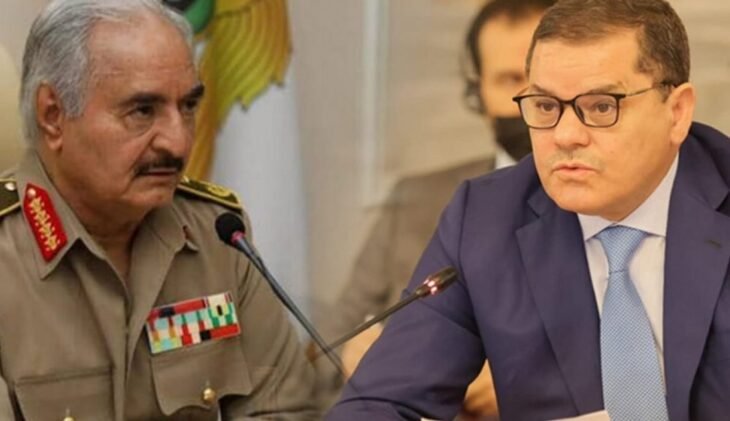
Libya, Legitimacy, And The Institution Above Politics

Rami Mustafah

When US Ambassador to Türkiye Tom Barrack observed at the annual IISS conference that “everywhere a monarchy existed, there was stability,” he offered an oft-overlooked structural diagnosis. His deeper point — that regional order endured “since Ottoman times” — was a recognition of political continuity as a stabilising mechanism rather than a vulnerability. His comment touched on an enduring truth: systems collapse not only when they fail, but when no institution remains strong enough to stand above the struggle for power itself.

Libya today exemplifies that axiom. Almost 15 years after the fall of Muammar Gaddafi’s regime, the country hosts multiple competing governments, has held numerous elections, and has been the subject of successive negotiated roadmaps — each aligned to the interests of a different external backer. Yet one essential component of sustainable statehood remains absent: a mutually recognised source of ultimate political legitimacy. Libya’s crisis is not merely a contest for power between rival actors; it is a contest over the very arena in which power is permitted to be contested.

Between 1951 and 1969, Libya’s political landscape was markedly different. The country was governed under a constitutional monarchy, led by King Idris al-Senussi. That system possessed a crucial attribute that no post-2011 framework has successfully replicated: it insulated sovereignty from factional competition, rather than making it the prize of factional victory. As a constitutional monarch, King Idris stood outside politics not through authoritarian domination, but by institutional design. The monarchy acted as a unifying framework that allowed tribal, regional and political pluralism to coexist without requiring the permanent defeat of rival factions.

Pan-Arab revolutionary politics ultimately brought the monarchy to an end — not through democratic succession, but by coup. Gaddafi’s 1969 seizure of power was part of a broader ideological upheaval shaped by Cold War rivalries that placed little value on institutional continuity. As Ambassador Barrack’s remarks suggest, the institutions that had underwritten stability for generations were not dismantled because they lacked legitimacy, but because they stood in the path of a larger geopolitical project.

The consequences of that rupture now define Libya’s political landscape. Today’s rival administrations compete to position themselves as the sole legitimate authority. The removal of the one institution historically capable of anchoring national unity — the monarchy — remains one of the most consequential destabilising events in Libya’s modern history.

Against this backdrop, Crown Prince Mohammed El-Hassan El-Rida El-Senussi has re-emerged in national discourse. His role is often mischaracterised as symbolic or nostalgic, yet the case for constitutional restoration is neither sentimental nor cosmetic — it is legal and institutional. He represents the last uncontested constitutional framework Libya has known: the 1951 Independence Constitution, the only foundational national compact in Libya’s modern history not forged through division or coercion.

Growing interest in constitutional restoration, including endorsements from members of the High Council of State, reflects an institutional argument rather than a monarchist one. For stability to take hold, at least one pillar of the state must exist beyond the arena of competition — an institution rivals do not contest, because it is the framework through which contestation is made possible.

This is the essence of Barrack’s point. Stability is not produced by elections alone, nor by transitional frameworks or externally negotiated blueprints. It emerges when a political system possesses a “sovereign constant” — an authority that predates governments and does not change hands when governments do. In many states, monarchy historically fulfilled this role, not due to the innate qualities of monarchs, but because the institution created a non-zero-sum centre of gravity around which politics revolved, rather than collided.

Libya is far from alone in learning this lesson through rupture. Iraq, Afghanistan and Iran all once possessed comparable unifying institutions before decades of revolution, war, fragmentation and proxy competition. In each case, the abolition of the monarchy did not produce consensus — it created a vacuum in which contestation became perpetual. The pattern is empirical, not ideological: states unravel not simply when old orders fall, but when no successor institution commands recognised legitimacy in their place.

None of this guarantees that constitutional restoration would be easy or sufficient. It would not, in itself, demobilise armed groups, resolve security dilemmas, rebuild institutions or unify fractured economic networks. But it would address a more fundamental deficit — one peace processes repeatedly fail to confront — by restoring a legitimate centre that need not defeat any rival in order to exist.

***

Rami Mustafah is a Saudi analyst focused on North African geopolitics and regional security. He holds a degree in International Relations from King Saud University, where he specialised in security studies and transnational risk.

____________________

Libya To Co-Host Flintlock 26

In a historic first, Libya will co-host Exercise Flintlock 2026, a training event intended to bring together both factions of the country’s divided armed forces.

U.S. Lt. Gen. John Brennan, the deputy commander of U.S. Africa Command, made the announcement on October 14 during a weeklong visit to the country. Flintlock, the premier special forces exercise on the African continent, will also include a training location in Côte d’Ivoire.

 “This exercise isn’t just about military training; it’s about overcoming divisions, building capacity, and supporting Libya’s sovereign right to determine its own future,” Brennan said. “By working alongside Libyans from the west and the east, we’re directly contributing to Libyan efforts to unify their military institutions.”

The spring exercise is expected to be held near Sirte, a coastal city on the ceasefire line that splits the country in half. The western half is controlled by the Tripoli-based Government of National Unity; the eastern half is controlled by Field Marshal Khalifa Haftar and his Libyan National Army.

After years of fighting, the two sides declared a ceasefire in 2020, and an uneasy peace has held since that time. In January 2025, the U.N. Security Council modified an arms embargo to allow for technical assistance and training to promote the reunification of Libya’s security forces.

Flintlock brings together about 1,500 troops from more than 30 countries and includes tactical training in skills like marksmanship, small-unit tactics and field medicine. The event typically includes command post exercises and humanitarian assistance to surrounding communities. Italy’s Special Operations Command will play a lead role in the planning and execution of the Libya spoke of Flintlock 26.

During his most recent visit, Brennan met with Deputy Defence Minister Abdulsalam Zubi, Chief of Staff Mohamed Haddad and Director of Military Intelligence Mahmoud Hamza in Tripoli. In Sirte, he met with Lt. Gen. Saddam Haftar, Khalifa Haftar’s youngest son, who was recently named deputy commander of the Libyan National Army.

Hosting Flintlock not only will allow Libyan forces to sharpen skills and improve counterterror capabilities, it also will be a rare opportunity for its military institutions to cooperate.

“The participation of western and eastern Libyan forces together marks a significant step forward in Libyan efforts towards unification of military institutions and enabling strong US-Libya security cooperation,” AFRICOM said.

The visit was Brennan’s fourth to the continent and it comes during a year of significant outreach by the U.S. In April, the U.S. 6th Fleet flagship USS Mount Whitney made port calls in Tripoli and Benghazi, the first such visits by a U.S. Navy ship to Libya in 56 years. Those efforts are expected to continue in the coming year.

“We have a growing and valuable partnership with Libyan forces from throughout the country, and we look forward to conducting training that directly supports Libyan reunification efforts,” said Brennan.

___________________

Singaporean report: 15 million active phone lines in Libya and 6.7 million Facebook users

A statistical report published by the Singapore-based site “DataReportal” has revealed the features of the digital landscape in Libya for the year 2025, pointing to a remarkable growth in the use of communication, internet, and social media services.

The report clarified that the number of active mobile phone lines in Libya reached approximately 14.9 million by the end of 2025, equivalent to 199% of the total population. It explained that some individuals own more than one number for work and personal life.

The number of connection lines also increased by 330,000 new lines, a growth rate of 2.3% compared to the end of 2024.

The report indicated that the number of internet users in Libya reached 6.62 million, a penetration rate of 88.5%, an increase of 69,000 users from the previous year. In contrast, about 860,000 people, or 11.5% of the population, did not use the internet.

It showed that the average mobile internet speed reached 25.48 Mbps, an increase of 68.7% compared to 2024, while the fixed connection speed was 10.99 Mbps, a slight decrease of 1%.

The report confirmed that the number of social media users in Libya reached 6.7 million, or 89.6% of the population, an increase of 600,000 users compared to 2024.

According to Meta’s data about Libya’s on Internet:

a. Facebook users reached 6.7 million in late 2025,

b. Instagram registered 2.3 million users,

c. TikTok had 6.19 million users over the age of 18.

d. The number of LinkedIn users was 700,000, and

e. X (formerly Twitter) had about 534,000 users.

The report stated that 94.4% of mobile phone usage in Libya falls under 4G and 5G services, while a limited percentage still uses only voice and SMS services, reflecting a significant expansion in digital infrastructure and the growing reliance on internet connectivity.

___________________
Libya must no longer serve as Europe’s mega-prison

Thirteen European sea rescue organizations have announced they will end all operational communication with Libya’s maritime rescue coordination center, accusing the Libyan coast guard of systematic violence and human rights abuses. The newly formed alliance also criticized EU governments for financing and collaborating with Libya and Tunisia over migration control.

Several European civilian sea rescue organizations have announced a collective cut in communications with Libya’s maritime authorities, citing a decade of violent clashes and human rights violations. In Brussels on Wednesday (November 5), a coalition of 13 NGOs, including Sea-Watch, SOS Humanity, Sea-Eye, Resqship, and Mission Lifeline, declared they would no longer maintain operational contact with the maritime rescue coordination center in Tripoli.

The decision comes as part of the founding of a new umbrella alliance called the Justice Fleet, which aims to defend “human rights at sea” and counter what it describes as the European Union’s complicity in abuses against migrants in the Central Mediterranean. The coalition, which includes 14 ships, one aircraft, and more than 10,000 activists, said it would share “resources and expertise” to “publicly denounce and repel political oppression.”

The organizations are rejecting growing pressure from the EU and Italy to communicate with the Libyan coast guard, an actor that, according to a new report by Sea-Watch, has committed “over 60 brutal acts of violence in the past ten years,” the joint statement said.

Libya coast guard should be considered illegitimate actor, alliance says

For years, rescue groups have accused the Libyan coast guard of intercepting migrants at sea and returning them to detention centers where torture, rape, and violence have been reported by rights groups and journalists. According to an October Sea-Watch report, there have been 60 violent incidents involving Libyan authorities since 2016, including “shooting, ramming and blocking maneuvers against rescue ships, threats and intimidation of crews, and assaults on people in distress.”

Based on several court rulings, the organizations said the Libyan coast guard should be regarded as an illegitimate actor at sea. “We will not be forced to hand over our operational positions to EU-funded armed militias who shoot at those seeking protection and our rescue teams,” said Janna Sauerteig of SOS Humanity. She added, “We will not be forced to hand over refugees to the Libyan coast guard. We will continue to rescue people in distress at sea.”

Sea-Watch spokeswoman Giulia Messmer stressed that “It is not only our right, but our duty to treat armed militias as such, and not as legitimate actors in rescue operations.”

‘Libya must no longer serve as Europe’s mega-prison’

The Justice Fleet slammed Italian authorities, accusing them of “bureaucratic sabotage” that hinders rescue missions in the Mediterranean. The alliance also condemned European governments’ ongoing cooperation with Libya and Tunisia to curb irregular migration.

“Libya must no longer serve as Europe’s ‘mega-prison and battlefield,'” the organizations stated. “There should be no boats, no money, and no training for Libyan militias.”

According to the International Organization for Migration (IOM), more than 32,800 people have died or disappeared on the central Mediterranean route since 2014, one of the world’s deadliest migration paths. In response, the Justice Fleet said it would continue to operate independently of state authorities to uphold international law and protect lives at sea, calling on the German government and the EU to end cooperation with Libya’s armed forces.

“We are united by one mission,” the coalition’s statement concluded, “to ensure that no one is left to die at sea, and no one is sent back to a place of violence.”

__________________

The Hunt for Libya’s Billions 

Fourteen years after the fall of Muammar Gaddafi, Libya’s frozen assets remain buried under layers of sanctions, bureaucracy, and mistrust, even as ordinary Libyans still lack the most basic living necessities – fuel, electricity, and public services.

A new initiative led by Libya’s parliament has revived debate at the United Nations. It calls for the appointment of an independent financial auditing body to review Libya’s scattered assets around the world. Supporters believe this could expose mismanagement and restore transparency to one of modern history’s murkiest financial cases. Critics warn, however, that it could deepen divisions and spark legal disputes before answering the key question: In a divided state, who has the right to reclaim tens of billions?

The Roots of the Freeze

In 2011, former U.S. ambassador to the UN Susan Rice read out Resolution 1970 in an emergency Security Council session, marking a turning point in the Libyan asset-freeze saga. The resolution imposed asset freezes and sanctions on Gaddafi’s regime, turning what was meant to be a temporary measure into a global political and economic deadlock. Calls for Transparency successive Libyan governments–east and west–have failed to unlock or manage the frozen assets.

Last month, a parliamentary committee in Benghazi submitted a formal memorandum to the UN, requesting a comprehensive audit of all frozen Libyan assets held in 37 banks worldwide since 2011. The request also seeks accountability from host countries and financial institutions over alleged mismanagement, including unauthorized loans and excessive administrative deductions.

A Push for UN Oversight

Omar Tantoush, head of the Parliamentary Committee on Planning and Finance, told Alhurra that the committee has asked the UN Security Council and its Sanctions Committee to appoint a global auditing firm- similar to the one that audited Libya’s Central Bank.

He added that the committee wants a final report submitted to the Security Council, detailing the location, value, and management of these assets, and reclaiming any illicit profits earned from them.

Lawyer Mohammed bin Shaaban, practicing before the High Courts of England, Ireland and Wales, supports the initiative but warns of legal and political complications:

The move could conflict with national jurisdictions that implemented UN sanctions.

Allowing management or investment of frozen assets, even under UN supervision, might weaken the principle of international sanctions, setting a precedent relevant to Russia or Iran.

Billions Hidden Across Continents

In 2017, the Presidential Council under Fayez al-Sarraj established the Office for the Recovery of State Funds and Management of Recovered Assets (LARMO) to trace and recover stolen Libyan money. But under Abdulhamid Dbeibah’s government (2021), jurisdictional disputes arose, further complicating efforts.

Economic analyst Abdullah al-Amin revealed that around $60 billion had been hidden abroad since the 1990s sanctions era. He said powerful figures are competing for control over this wealth—some of which has been converted to gold deposits in African states or reinvested internationally to evade sanctions.

In 2025, Middle East Eye reported on unannounced talks between the Trump administration and Tripoli officials about partially unfreezing Libya’s assets for joint investment projects with U.S. companies. Analysts warned this could turn Libya’s frozen assets into political bargaining chips, undermining their sovereign nature.

Legal Battles in Europe

Since the UN freeze, Libya has fought dozens of legal cases to regain access to its funds.

It lost a $1.2 billion case against Goldman Sachs in 2016, but won partial compensation in 2017 after settling with Société Générale for €963 million.

The Euroclear case in Belgium remains one of the most complex, involving €16 billion in frozen assets.

In 2025, a Brussels appeals court lifted most restrictions, partially restoring Libya’s control–but UN sanctions still apply.

The Bottom Line

As legal expert Mohammed bin Shaaban notes, frozen funds lose value over time, and Libya has already suffered hundreds of millions in opportunity losses and negative interest costs. Despite occasional wins, the maze of international litigation, political division, and competing jurisdictions keeps Libya’s billions locked away.

Many locks, Too many keys. Scattered across the world’s capitals, the fate of Libya’s frozen wealth remains unresolved.

_______________________

Libya’s 18-month gamble: The UN’s political roadmap to nowhere

Mustafa Fetouri

The UN mission in Libya, criticised for its internal dysfunction, has laid out a new political roadmap that promises progress but will likely deliver paralysis

Last week, the United Nations Support Mission in Libya (UNSMIL) began soliciting nominations for a 120‑person “Structured Dialogue,” a key component of its 18‑month roadmap toward national elections in the war-torn country.

A first meeting is expected soon, signalling UNSMIL’s intention to advance the political process. Yet an internal audit published in October 2024 documented systemic governance and management failures – including a missing Concept of Operations, unimplemented prior recommendations, and weaknesses in finance, procurement, and staffing.

While UNSMIL formally accepted the recommendations, there is no public evidence that they have been fully implemented, raising doubts about its capacity to deliver a complex, trust‑dependent electoral process.

The UN mission, created in the aftermath of the Libyan civil war, has a record of strategic aimlessness and internal dysfunction that critics say renders it ill-prepared to lead an 18‑month process requiring trust and discipline from rival Libyan factions.

These institutional weaknesses have tended to reinforce the widespread Libyan critique that the mission is prolonging the very crisis it was meant to resolve.

The UNSMIL’s fragility

UNSMIL’s roadmap rests on three pillars: adopting a technically sound and politically viable electoral framework, unifying Libya’s institutions and government, and holding a Structured Dialogue to engage Libyans on governance, economic, security, and reconciliation issues.

Yet its credibility is undermined by symbolic and institutional weaknesses. Former Special Envoy Abdoulaye Bathily, who resigned in April 2024, still lists himself as UNSMIL head on X, highlighting the gap between the UN’s public narrative and internal mission realities.

This disconnect mirrors the 2024 audit’s findings, raising doubts about UNSMIL’s capacity to implement a complex, trust‑dependent electoral process.

The audit had exposed systemic flaws, casting doubt on UNSMIL’s ability to execute the roadmap. It notes a strategic void, with no finalised Concept of Operations for over two years, leaving mandate guidance and priorities undefined.

The audit highlights a crisis of accountability, with prior strategic recommendations largely ignored, and no mechanisms in place to monitor progress or enforce corrective action. Operational risks remain, including deficiencies in finance, procurement, and staffing, with critical vacancies compromising core activities.

While UNSMIL formally accepted all recommendations, only ‘Recommendation 3’ on monitoring and filling vacancies had been implemented at the time, with most others in their early stages, showing that acknowledgement alone has not translated into functional reform.

The mission’s internal weaknesses are compounded by political manoeuvres aimed at delaying the process. Libyan National Army (LNA) leader General Khalifa Haftar, a key player, has spoken of tribal-based alternative initiatives, while many parliamentarians – mostly his supporters – have increased criticism of UNSMIL, erecting further obstacles.

Such ambiguity allows rival factions to exploit institutional failings, raising serious doubts about UNSMIL’s ability to shepherd Libya toward credible elections under its current structure.

In her 14 October 2025 briefing to the United Nations Security Council, Hanna S. Tetteh, Special Envoy to Libya, issued a blunt warning.

If the institutional steps of the roadmap, such as the reconstitution of the High National Elections Commission and amendments to the electoral and constitutional legal framework, are not completed within the next month, “UNSMIL must - and will - pursue another approach and seek the support of this Council to help ensure that the roadmap advances”.

The heightened urgency underscores how UNSMIL itself views the first phases of the plan as being at critical risk.

Yet this insistence on speed comes even as the mission remains under the shadow of its own 2024 audit’s findings of strategic and governance paralysis (no approved Concept of Operations, many unimplemented recommendations) – a striking contradiction that raises the question: how can a mission that admits it may “pursue another approach” still credibly insist on guiding a complex, trust‑dependent electoral process in a country as fragmented as Libya?

The roadmap also faces acute political obstacles in western Libya. Any attempt to form a new government – a prerequisite for the Structured Dialogue – that excludes Prime Minister Abdul Hamid Dbeibah is unlikely to be accepted by his armed supporters, mainly in his hometown, Misrata.

With his popularity at rock bottom, his legitimacy eroded, his government widely seen as corrupt, and facing rejection by most political actors, forcing him from office could spark violent confrontation in Tripoli itself.

In this context, many observers view the proposed new unified government – a key pillar of UNSMIL’s plan – as a potential trigger for conflict, with the Structured Dialogue potentially igniting tensions rather than easing them.

While UNSMIL may be able to navigate these challenges, doing so would require strong, clear, and unequivocal backing from the UN Security Council, which is not guaranteed at this point.

Although the Structured Dialogue has yet to begin, UNSMIL’s determination to move forward with its preparatory steps – soliciting nominations and setting timelines – has already drawn criticism from Libyan observers.

Many question whether the mission can deliver on its pledge to ensure balanced representation across political, social, and security lines. For now, the process remains opaque, and its credibility and legitimacy will depend on who is ultimately selected to participate.

Scepticism persists that the dialogue, the final stage of the roadmap, could reproduce existing power structures rather than overhaul them, particularly if key stakeholders from the east or influential security actors feel excluded. Until the list of participants is made public, concerns about tokenism and limited inclusivity will continue to overshadow UNSMIL’s initiative.

At the same time, UNSMIL faces the delicate task of balancing competing and conflicting expectations from all Libyan protagonists and international stakeholders. While the mission emphasises inclusivity in principle, many Libyans remain unconvinced of its neutrality, especially given its ongoing interactions with the Dbeibah administration.

Questions about timing, selection criteria, and potential influence by entrenched political actors fuel doubts that the dialogue will meaningfully address Libya’s longstanding divisions.

Observers note that even the perception of partiality – real or imagined – could undermine public trust before the process even begins. As one analyst put it, “initiatives multiplied, proposals diverged, and no process was ever completed – only prolonging the crisis”.

And from the east, a public statement warned of “unilateral actions … a violation of the sovereignty of the Libyan State”. This growing scepticism complicates UNSMIL’s ability to act as a credible mediator in the later stages of the roadmap.

Haftar and political interference

Compounding UNSMIL’s challenges, General Khalifa Haftar recently met with tribal delegations from different parts of Libya, emphasising that the resolution of the political crisis must come “from the people, with the support of the tribes”, and assuring that “any agreement… will find its implementation guaranteed by the LNA”.

While these meetings do not constitute formal initiatives outside UNSMIL’s roadmap, Haftar’s encouragement and offer of guarantees function as a political counter‑signal, offering an alternative path outside the structured dialogue.

Analysts are divided on his intentions: some interpret it as an effort to shape the process in his favour, while others see it as a strategy to delay implementation by creating uncertainty among political actors and the public.

Regardless of motive, Haftar’s intervention highlights how competing domestic agendas – particularly from influential eastern and southern actors – can limit UNSMIL’s leverage and threaten the fragile consensus the roadmap seeks to build.

Undoubtedly, UNSMIL finds itself in a particularly difficult position. Beyond its own structural weaknesses, it faces a high-stakes balancing act.

This includes navigating entrenched rivalries, repairing its increasingly questioned credibility, ensuring genuinely representative participation in the upcoming Structured Dialogue, and managing the competing agendas of both domestic and international actors – while making clear that the Dialogue’s recommendations are not binding on the Mission.

Although UNSMIL’s goal remains to unify Libya and take it to elections, a long-time wish of Libyans, domestic scepticism, regional divisions, and the unpredictable interventions of influential figures cast serious doubt on whether the roadmap can achieve its objectives.

The coming months will test not only UNSMIL’s capacity to mediate but also Libya’s fragile social and political cohesion, with any misstep risking an escalation of tensions rather than their resolution.

______________________
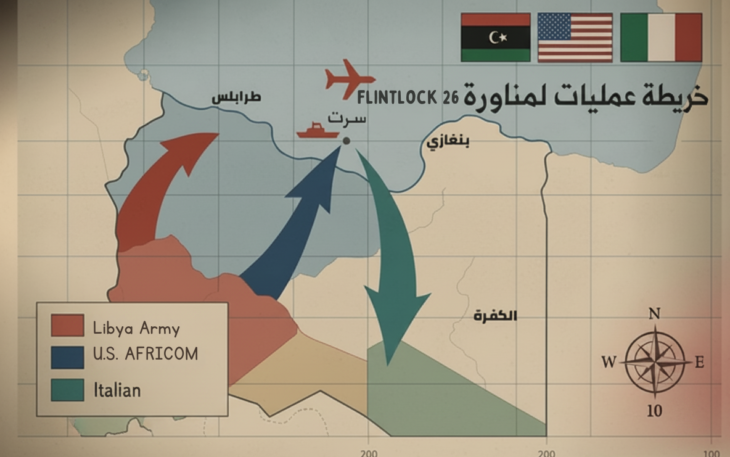
Turkey’s Meeting with Haftar

Mithat IŞIK

With the assassination of Libyan Leader Gaddafi on October 20, 2011, Libya witnessed the bloodiest actions of the Arab Spring. Although Libya has partially stabilized in the intervening 14 years, we cannot say that it has fully recovered and stabilized.

A single State authority has not yet been formed in Libya. The country is divided into East and West. Western Libya is based in Tripoli and governed by the Government of National Unity. Eastern Libya, on the other hand, is based in Benghazi and ruled by the Libyan National Army under the leadership of Haftar. The conflict between these two authorities continues in Libya.

Due to this conflict, some countries, especially Egypt, support Eastern Libya under the rule of Khalifa Haftar. Along with Turkey, some countries also supported and stood by the Tripoli-based Government of National Unity. At the point reached today, many countries, especially the United Nations, want the unification of Eastern and Western Libya.

Egypt and Turkey, which were rivals in Libya at the beginning, are now making efforts together to unite the East and the West. Due to the aging of Khalifa Haftar, who rules Eastern Libya based in Benghazi, there are difficulties in the efforts to unite Eastern and Western Libya through his sons.

Khalifa Haftar has 5 sons. Khalifa Haftar’s power is shared among his 3 sons. The distribution in the Parliament is in parallel with this. Among Haftar’s sons, Saddam Haftar stands out and is seen as the successor of Khalifa Haftar.

Haftar’s other son, Khaled Haftar, controls internal security and intelligence. There are conflicts between the two brothers, especially regarding public appointments. Bel Kasim is more interested in economic issues. Activities such as infrastructure, construction and development are carried out under Bel Kasım. Omar Haftar, on the other hand, is still behind the scenes.

Not all Haftar brothers have the same opinion. They act separately. Siddiq Haftar is working in parallel with Omar Haftar. Saddam Haftar is looking for an international solution to end the civil war in the country and rebuild the country. He wants to establish good relations with Turkey.

Turkey supports Saddam Haftar’s efforts. While Saddam Haftar acts in line with Turkey and the USA, Khaled Haftar keeps his distance from Turkey and closer to Russia. While Bel Kasım was close to Turkey at first, he took a stance against Turkey under the influence of Egypt. However, with the improvement of Turkey-Egypt relations, Bel Qassem seems to have started to get closer to Turkey.

While President Akile Salih displayed an anti-Turkey attitude in the past, he now displays a more moderate image towards Turkey. Turkey has signed a maritime jurisdiction agreement with the Government of National Unity in the past. Due to the positive development between Turkey and Eastern Libya, the news that the Eastern Libyan Assembly will approve this memorandum took place in the press.

Contacts between Turkey and Eastern Libya have become more frequent. It is very important that Eastern Libya supports the agreement. The political picture in the Eastern Parliament is currently disorganized. MIT Director İbrahim Kalın’s meeting with Libyan National Army (LNA) Leader Khalifa Haftar is a very important meeting as it is the first high-level contact. This meeting in Benghazi is very important in terms of revealing Turkey’s intention to keep communication channels open with all important actors in Libya.

The fact that the 2019 maritime jurisdiction agreement signed by Turkey with the Tripoli Government was examined by the technical committee formed by the East-based House of Representatives is an indication of a broader softening in relations between Turkey and Libya’s Eastern administration.

If the agreement is approved, Libya will both increase its political weight and strengthen the possibility of its implementation by ensuring the support of the Eastern and Western administrations. This will be an important turning point.

The joint support of rival governments in Libya to the agreement may encourage Turkey to actually start seismic research and drilling activities. This situation may also help end the crisis in Libya and lead Cairo to seek a similar arrangement with Turkey.

Libya needs a comprehensive reconciliation and reconstruction process. For Ankara, the opening towards both Tripoli and Benghazi is in line with its strategy to legitimize the 2019 Maritime Jurisdiction Areas Agreement and expand across the Mediterranean. Therefore, Turkey’s work and efforts to ensure stability in Libya are very valuable and important.

____________________

Al-Majbari sends a message embodying the convergence of humanity and science


In a Libyan city living under the weight of war, a young man named Ahmed Al-Majbari was trying to find meaning in the events unfolding around him.

The sounds of explosions were loud, and hospitals were crowded with the injured, yet his passion for engineering did not fade. While his peers fled a harsh reality, he chose to confront it in his own way: through science.

Al-Majbari decided to harness his engineering knowledge to help those who had lost limbs in the conflict. He began with a simple experiment in a modest university laboratory, searching for a way to convert brain signals into commands to control a prosthetic hand.

He didn’t realize then that this experiment would be the first spark on his journey toward a bigger dream: building an artificial brain—a technological model that mimics the human brain’s ability to think, learn, and adapt to information.

From that moment, the idea of combining engineering and neuroscience was born, an idea that seemed more like fiction than application at the time. But Ahmed Al-Majbari saw no boundaries between dreams and science.

After graduating, he took his small project and left Libya for Germany, where he enrolled at the Technical University of Munich to study for a Master’s degree in Neuroengineering, a specialization that merged his passion for technology with his curiosity about the secrets of the human brain.

In the university’s halls, in front of a whiteboard filled with complex equations and neural diagrams, Al-Majbari began to step confidently toward his new goal: designing an artificial system capable of thought, not in the traditional sense, but in a way that emulates the human brain’s mechanism for processing information and making decisions.

“I am focusing on reverse-engineering the biological brain,” he says with a smile, “so that in the future we can replace damaged neurological functions in people with disabilities.”

Reverse engineering—a term referring to the analysis of biological systems to understand their internal structure in order to redesign them—is the core of his current project.

What Al-Majbari and his team are striving for is not just to develop a new artificial intelligence, but to redefine the very concept of intelligence. They want to build a robotic brain that can modify its internal connections according to the goal it seeks to achieve, just as a real brain does.

But the road is long, as the young researcher acknowledges. “What we are doing today is just the first step. We need a deeper understanding of how neural networks constantly change to achieve specific tasks, and how to translate these processes into a mathematical model that can be applied in a machine.”

These equations drawn on the board behind him are not just symbols, but initial attempts to translate what cannot be seen—thought—into a language that computers can understand.

Talk of a “robotic brain” today might seem like science fiction, but for Ahmed Al-Majbari, it is a promise of a future where science and technology converge to serve humanity, and perhaps, one day, to heal an impairment long considered impossible to overcome.

____________________
Libya key to US Med plans

Vassilis Nedos

Libya has become a central focus of US strategy in the Eastern Mediterranean, as Washington seeks to organize a four-nation conference involving Greece, Turkey, Egypt and Libya to resolve disputes over overlapping exclusive economic zones (EEZs). A unified Libyan representation remains the key condition for the US initiative to move forward.

The effort gained momentum after a meeting in Paris between Mohamed al-Menfi, head of Libya’s Presidential Council, and US Senior Adviser for Africa Massad Boulos. The discussion focused on Libya’s political normalization between Tripoli and Benghazi and the country’s energy wealth.

Boulos is considered the main US architect behind the planned quadrilateral talks. Al-Menfi holds one of Libya’s two top institutional roles, while the other belongs to Aguila Saleh, speaker of the Tobruk-based House of Representatives

Meanwhile, Chevron executives visited Tripoli to explore energy cooperation, meeting Prime Minister Abdul Hamid Dbeibeh and the leadership of the National Oil Corporation. The delegation discussed oil exploration, renewables, and technology transfer.

Turkey is closely monitoring these developments. Turkish Ambassador Guven Begec met Libya’s Oil Minister Khalifa Abdul Sadiq on October 27 to discuss energy collaboration. Last summer, Tripoli granted the Turkish Petroleum Corporation (TPAO) two offshore blocks south of the midline claimed by Greece between Libya and Crete.

Regional diplomacy has also intensified elsewhere. Lebanon’s cabinet, led by President Joseph Aoun, ratified its 2007 maritime border agreement with Cyprus, finalizing the tripoint with Israel. Cyprus was represented by Tasos Tzionis, head of the Cypriot Intelligence Service. A follow-up meeting between Aoun and Cypriot President Nikos Christodoulides will finalize the decrees for UN submission.

Lebanon also approved exploration in offshore Block 8 by TotalEnergies, Qatar Energy, and ENI, reinforcing the energy dimension shaping the region’s shifting alliances. 

______________