Dr Miral Sabry AlAshry

The UK Agrees To Cooperate In Analyzing
The Aircraft’s Black Box
In a tragic incident whose cause remains unknown, we now attempt to analyze what happened. Lieutenant General Mohammed Ali Ahmed al-Haddad, Chief of Staff of the Libyan Army, was killed along with four of his senior military aides when their private aircraft crashed shortly after taking off from Esenboğa International Airport in Ankara, Turkey, en route to Tripoli, on Tuesday evening, December 23, 2025.
Who Was Mohammed al-Haddad?
Mohammed Ali Ahmed al-Haddad was widely regarded as one of Libya’s most influential military figures in the post February 17, 2011 revolution era. He was a stronghold of revolutionary forces during the uprising against Muammar Gaddafi, al-Haddad emerged from a generation of officers shaped by the collapse of the former regime and the prolonged struggle to rebuild state institutions amid conflict and fragmentation.
Following the 2011 revolution, al-Haddad steadily rose through the ranks of Libya’s military establishment, gaining a reputation as a pragmatic officer with strong ties to revolutionary brigades in western Libya.
In August 2020, al-Haddad was appointed Chief of Staff of the Libyan Army by Fayez al-Sarraj, head of the Government of National Accord (GNA). His appointment came at a critical juncture, following the failure of Khalifa Haftar’s military campaign against Tripoli and amid renewed international momentum to stabilize Libya through political dialogue and security arrangements. As Chief of Staff, al-Haddad assumed responsibility for overseeing military structures aligned with the internationally recognized authorities in western Libya, while simultaneously engaging in dialogue with rival forces in the east.
One of al-Haddad’s most significant roles was his membership in the UN-sponsored Joint Military Commission (5+5), which brought together senior officers from both western and eastern Libya. Within this framework, he played a central role in negotiating ceasefire arrangements, confidence-building measures, and discussions on the withdrawal of foreign forces and mercenaries.
Al-Haddad’s national profile rose sharply during the 2019–2020 defense of Tripoli against Haftar’s forces. During this period, he was instrumental in coordinating military operations, improving command-and-control structures, and facilitating cooperation among diverse armed groups defending the capital. His leadership during the conflict earned him considerable political and military weight within western Libya, while also making him a controversial figure among rival factions.
Beyond active combat roles, al-Haddad was seen as an advocate for rebuilding a professional, unified national army under civilian authority. He consistently emphasized the importance of ending parallel military chains of command, integrating armed formations into state institutions, and insulating the military from direct political rivalry. However, these ambitions faced persistent obstacles due to Libya’s fragmented governance, external interference, and competing regional alliances.
The Flight and the Crash
The Libyan Chief of Staff was traveling aboard a Falcon 50 business jet. The aircraft took off from Esenboğa Airport at 8:17 p.m. local time, and contact was lost approximately 30–35 minutes later while it was flying at an altitude of 32,400 feet over the Ankara region.
After that the crew reported an emergency to air traffic control due to an electrical or technical malfunction in the aircraft’s electronic systems and requested permission for an emergency landing in the Haymana district south of the capital.
After that communication was lost immediately afterward, and the aircraft crashed in rugged terrain near the village of Kesik Kavak in the Haymana district, about two kilometers from the village. Turkish Interior Minister Ali Yerlikaya stated that gendarmerie and rescue teams reached the crash site, after which a large explosion occurred due to fuel ignition and the scattering of aircraft debris. When Turkish authorities know they temporarily closed the airspace over Ankara and referred the investigation to the Ankara Public Prosecutor’s Office.
Scenarios for the Accident
There are several possible scenarios surrounding the accident.
First: Although the investigation is still in its early stages, initial indicators according to Turkish officials strongly suggest a technical malfunction, particularly within the aircraft’s electrical or electronic systems. Such a failure may have prevented the flight crew from successfully completing the requested emergency landing.
Second: Other scenarios cannot be ruled out, especially given the complex regional and international environment surrounding Libya. These possibilities include weather-related factors despite the absence of reports indicating severe conditions at the time of the flight and, in rarer circumstances, the possibility of an assassination attempt involving sabotage or terrorist activity.
Political Context
Libya–Turkey cooperation is strategic and multi-dimensional, particularly since 2019. Politically, Turkey has supported the internationally recognized authorities in western Libya and backed UN-led efforts aimed at stabilizing the country and preserving its territorial unity. This political alignment has been reinforced through frequent high-level visits and sustained diplomatic coordination between the two sides.
Militarily, cooperation represents the most significant pillar of the relationship. A bilateral security and military cooperation agreement signed in 2019 laid the foundation for Turkish support to Libyan forces aligned with Tripoli. This support included training, advisory assistance, and capacity-building aimed at improving command structures and institutional organization.
Beyond immediate security needs, Turkey has focused on long-term defense training and institutional development, hosting Libyan officers for training programs and supporting efforts to build a professional and unified national army under civilian oversight. Cooperation has also extended to counterterrorism, intelligence sharing, and border security.
Economically, Libya and Turkey cooperate in reconstruction, infrastructure development, trade, and energy-related services, with Turkish companies playing an active role in Libya’s post-conflict rebuilding. Additionally, the two countries signed a maritime boundary agreement in 2019 that strengthened their strategic positions in the Eastern Mediterranean and added a geopolitical dimension to their partnership.
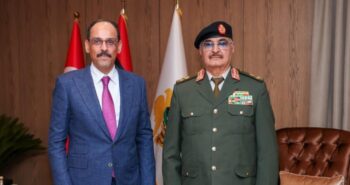
The incident occurred following an official visit by General al-Haddad to Ankara, where he met with Turkish Defense Minister Yaşar Güler and Chief of the Turkish General Staff Selçuk Bayraktaroğlu to discuss strengthening military cooperation between the two countries.
The crash comes at a sensitive time for Libya, which remains divided between the Tripoli-based government in the west and forces in eastern Libya, amid ongoing UN efforts to unify the military institution and hold elections. The circumstances surrounding al-Haddad’s death could potentially open the door to internal power struggles over key military positions.
Libyan and International Response
A Libyan military delegation was dispatched to Turkey the day after the incident. The delegation was tasked with coordinating directly with the Turkish authorities, monitoring the crash site from both military and technical perspectives, supporting the investigation, and working closely with other government committees to fully understand the situation.
The Libyan Ministry of the Interior also formed a specialized official committee that began its work on the ground. Its responsibilities included coordinating with Turkish judicial and security authorities, overseeing the identification of the victims through DNA analysis, collecting preliminary forensic data, and documenting the circumstances of the incident in accordance with Libya’s legal frameworks.
Meanwhile, a technical team from the Ministry of Transport was sent to Turkey to review flight data, examine the aircraft’s technical records, assess the flight route, and oversee procedures related to handling the black box. This work was conducted in coordination with international technical experts, including cooperation with the United Kingdom, to ensure a professional, impartial investigation in line with international standards.
Uncertainty Looms Over
Al-Haddad’s Death
The investigation into General Mohammed al-Haddad’s death raises critical questions for Libya’s political and military landscape. It is unclear whether the process will extend throughout 2026, with final results expected in 2027. During this period, there is the potential for additional parties to be implicated, creating further tension among competing factions. Individuals or groups might attempt to evade accountability, and political actors could exploit the uncertainty to advance their own agendas.
At this stage, Libya’s future trajectory remains highly uncertain. The country is deeply fractured, both internally among rival factions and externally through competing foreign alliances. The outcome of the investigation, and how its findings are received or acted upon, could significantly influence power dynamics, military cohesion, and ongoing UN-led efforts toward political stabilization and national reconciliation.
***
Dr. Miral Sabry AlAshry is Co-lead for the Middle East and North Africa (MENA) at the Centre for Freedom of the Media, the Department of Journalism Studies at the University of Sheffield.
_____________________