Dr. Youssef Mohammad Sawani

The Strategy of Institutional Bypass
For years, the international community’s approach to fixing Libya has focused on top-down elite-driven deals. UNSMIL, currently under the leadership of Special Representative of the Secretary-General (SRSG) Hanna Tetteh, has effectively transitioned from an objective mediator into a manager of the status quo convening endless dialogues, structured or otherwise, to shuffle the same discredited political cards. These processes are bound to fail because they ask the very members of the cartel to sign their own political death warrants.
The failure of international mediation in Libya stems from a flawed mental image that reduces the nation to a negotiable corporate project. Since 2011, it has been defined by a series of top-down UN-led initiatives that have struggled to gain traction in a landscape of deep political fragmentation and foreign interference. Following the 2011 NATO intervention, UNSMIL was established to guide the transition, but these efforts often suffered from a lack of local ownership and a failure to meaningfully include civil society. Landmark attempts at consolidation such as the 2015 Skhirat Agreement Libyan Political (LPA) ultimately resulted in elite power-sharing arrangements that failed to achieve public legitimacy or resolve the country’s institutional divides.
In recent years, diplomacy shifted toward a “three-track” approach to address political, military and economic issues, yet as analysts observe, these processes have frequently been undermined by the competing geopolitical agendas of external actors and the influence of entrenched armed groups. Consequently, international mediation has often been criticized for prioritizing quick-fix political formulas over the inclusive, Libyan-led reconciliation necessary to build sustainable, long-term stability.
Rather than treating Libya as a society with deep-rooted needs, mediators frequently operate on a transactional logic viewing the country as a set of power maps to be rearranged by elite deal-making. This approach treats the state as a business to be restructured and its people as secondary details assuming that stability can be achieved simply by dividing power and resources between competing factions.
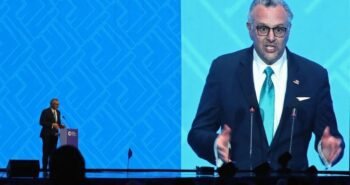
Massad Boulos, Senior Advisor to U.S. President Donald Trump on Arab and Middle Eastern Affairs, has proposed an initiative that epitomizes this transactional failure by treating Libya as a corporate puzzle to be solved through elite power-sharing rather than a sovereign nation. The plan proposes a multi-year transition to unify state institutions centred on a deal between the Dbeibah and Haftar families, notably involving Ibrahim Dbeibah and Saddam Haftar.
Ibrahim Dbeibah is national security advisor to his uncle, Prime Minister Abdelhamid Dbeibah. He plays a central role in the administration of the western-based Government of National Unity. Saddam Haftar is the Deputy General Commander of the eastern-based Libyan Arab Armed Forces (LAAF. a.k.a. the Libyan National Army (LNA)). His importance and role stems from him being the son of Field Marshal Khalifa Haftar, commander of the LAAF. Saddam is widely viewed as a successor to his father and a key player in U.S.-backed efforts to unify the country’s leadership.
Against this backdrop of entrenched domestic rivalry, international efforts to ‘fix’ Libya have shifted toward transactional economy-first initiatives such as the so-called unified budget, control over oil revenues and security coordination via AFRICOM that reduces the state to a negotiation between armed and financial stakeholders.
While Boulos continues to press his framework with considerable vigour, the initiative is encountering firm resistance. Armed and political groups in Misrata and elsewhere as well as radical Islamists and the head of the Presidential Council have denounced the proposal as a ‘forced marriage’ imposed upon Libyans and as a threat to the democratic process.
Yet, such objections warrant more than just caution. The invocation of democratic principle here functions less as a genuine defence of the public good than as a rhetorical shield deployed by actors who fear that an accommodation between the Dbeibah and Haftar camps would marginalize them and strip away their access to power, position and resources.
Framing the contest as one between military rule and democracy, therefore, oversimplifies the complexity of what is at stake. What is unfolding is not a struggle over the character of the political order but a struggle among entrenched networks over their place within it. These factions are, in effect, signalling that any settlement which does not retain them at the centre of the emerging architecture constitutes a threat to their interests. Consequently, the language of democracy is being appropriated to defend positions of privilege entrenching divisions rather than fostering the reconciliation any durable settlement would require.
More importantly, this top-down corporate-style restructuring bypasses the Libyan people entrenching elite influence while ignoring the fundamental need for institutional legitimacy and grassroots consensus. Through a de-colonial lens, it becomes evident that international initiatives such as those currently attributed to U.S. presidential advisor Massad Boulos are rooted in a structural “mental image” that treats Libya as an object of negotiation rather than a sovereign nation. By operating on the logic of corporate restructuring rather than inclusive national reconciliation as a pre-condition for state-building, these interventions systematically undermine the prospects for sustainable peace.
Libya’s history since 2011 has shown that such top-down deals which ignore the complexities of Libyan society and the necessity of institutional legitimacy—as seen in the power-sharing deals based on the 2015 Libyan Political Agreement (LPA) establishing the Government of National Accord (GNA) as well as the establishment of the current Government of National Unity (GNU) through the UN-led Libyan Political Dialogue Forum (LPDF)—fail to resolve the crisis.
By prioritizing the interests of factional power brokers over the construction of a sustainable state, these interventions treat sovereignty as a negotiable item and transform political discourse into a competition for government seats rather than a pursuit of justice. Consequently, local elites often succumb to opportunistic justifications shifting their principles to align with whatever external deal promises them a share of influence.
Ultimately, this “deal-making” mindset ignores the Libyan collective memory; there is a fundamental crisis that exists because of the people’s distrust in the political process and the lack of legitimacy in the militias who cling to power at any cost.
By focusing on balancing armed and financial powers, international mediation risks turning peace efforts into fuel for future conflict. True stability cannot be manufactured through external blueprints but rather through a national project built on institutional authority and societal consensus rather than the temporary and exclusionary distribution of power.
Transformative stability will never be delivered by the current political apparatus. It must be claimed from below through an aggressive strategy of “institutional bypass”: Since the centralized state is thoroughly compromised, a coordinated civic mobilization must bypass the corrupt political centre and systematically activate local governance structures.
Currently, elected Libyan municipal councils possess an organic legitimacy that the central cartel can never buy despite some exceptions. By shifting the focus of administrative and financial accountability to the local level and demanding the direct decentralized management of oil revenues to municipalities, the oxygen feeding the proxy system can be cut off. Without centralized funds to distribute to their armed appendages, the cartel’s leverage collapses.
To turn this resistance into a permanent national framework, a strategic alliance between parallel localized networks and emergent non-factional political parties must champion four non-negotiable pillars:
- Convene a Constituent Assembly: A transparent bottom-up process to draft an indigenous social contract that guarantees equitable decentralized wealth distribution.
- Establish a Unified National Democratic Agenda: Political organizing driven by programmatic parties focused on national cohesion explicitly rejecting zero-sum elitist power-sharing deals.
- Enforce the Exit of All Foreign Forces: Unifying civic and political pressure to demand the immediate unconditional expulsion of all foreign troops and mercenary structures.
- Institutionalize Direct Referendums: Returning veto power to the Libyan street by forcing direct public votes on critical macroeconomic and constitutional decisions.
Reclaiming the Future
While some critics dismiss the use of constitutional tools such as representative assemblies and referendums as an uncritical adoption of Western Westphalian state models, this view is misguided. Rather than an ideological surrender, employing these mechanisms is a form of strategic capture allowing for the reclamation and redirection of the state’s machinery toward genuine sovereign objectives.
By anchoring these tools within local social realities and community consent, the formal legal structure is stripped of its top-down imperialist baggage and repurposed as a defensive shield to protect Libyan sovereignty from external predation. Sovereignty is not an international grant distributed by foreign capitals or UN envoys but a right to be reclaimed. The most urgent task facing the country’s civic forces is to completely strip foreign “guardians” and domestic kleptocrats of their analytical legitimacy. By casting off the myth of the failed state, Libyans can starve the cartel of its financial oxygen, dissolve the architecture of tutelage and finally become the sole architects of their own destiny.
***
Dr. Youssef Mohammad Sawani is Professor of Politics and International Relations, University of Tripoli, Libya, and a Non-Resident Senior Fellow, International Centre for Dialogue Initiatives (New York). He is also a Senior Fellow at the Institute for Research and Policy Integration in Africa (IRPIA), and an Advisory Board Member at Lawyers for Justice in Libya (LFJL).
_______________________