The Geopolitical Desk

The United States’ political initiative in Libya continues to gain traction as Boulos aligns UN messaging with his strategy.
Trump envoy pushes to strip ‘elections’ from UN Libya communiqué The United States’ political initiative in Libya continues to gain traction as Boulos aligns UN messaging with his strategy. By The Geopolitical Desk Special Representative of the Secretary-General (SRSG) Hanna Tetteh recently delivered her usual update on Libya to the UN Security Council, detailing the country’s political deadlock, economic pressures, and stalled transition.
Ordinarily, such sessions are followed by a short Security Council communiqué reaffirming the core principles of the UN process: support for Libyan sovereignty, the need for political progress and, crucially, a renewed call for elections. However, the statement was delayed by multiple days, and had a major omission.
According to sources within the UN Secretariat and several Security Council delegations who spoke to The Geopolitical Desk, the delay stemmed from the use of the term “elections” Massad Boulos, serving as U.S. President Donald Trump’s Special Advisor for Africa, lobbied member states to remove any reference to elections from the communiqué.
This reflects a broader political strategy Boulos has been advancing quietly in Libya— one that does not include a vote at all. In the Security Council press statement released on the 3rd of March, it simply called for Libyan actors to support the United Nations Support Mission in Libya’s (UNSMIL) new political roadmap, but avoided calling for elections.
The statement mainly highlighted the need to “unify” institutions in a Libyan lead process. This is in stark contrast to the Security Council Press statement released in early September, which in the first paragraph of the statement, prominently calls for new presidential and parliamentary elections.
A different political roadmap
This statement is more in line with the political initiative pushed by Boulos, which seeks to unify Libya’s two competing political families, instead of creating a new government via elections. Boulos has reportedly been circulating a ten-point plan centred on a political reshuffle in Tripoli.
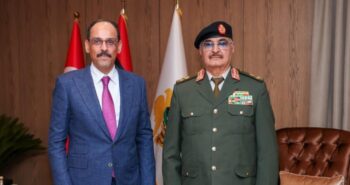
At its core, the proposal would keep Government of National Unity (GNU) Prime Minister Abdulhamid Dabaiba in place as head of the GNU, while fully replacing Libya’s Presidential Council. In this framework, the council would effectively fall under the influence of the Haftar family, which would gain control over Libya’s “executive” authority.
The GNU today is, in many respects, a government in name only. Power is concentrated almost entirely around Dabaiba and a small inner circle. Several ministers have resigned, fled the country, or faced corruption investigations. Institutional cohesion has eroded and the government’s effective reach rarely extends far beyond Tripoli. From Washington’s perspective, the argument is pragmatic.
If a functioning political arrangement can be forged between Dabaiba and the Haftars, the logic goes, Libya’s long paralysis might be broken quickly. But the idea itself is far from new. The deal Misurata rejected For nearly five years, variations of a Dabaiba–Haftar political arrangement have circulated among Libyan elites and regional actors.
The theory was always the same: unlike former Government of National Accord (GNA) Prime Minister Fayez al-Sarraj, Dabaiba supposedly possessed enough authority to deliver a political settlement on the ground. In practice, the assumption proved fragile. When Dabaiba attempted to float the concept inside his hometown of Misrata, it was met with fierce resistance.
Many of the armed groups and political figures forming the backbone of his coalition saw the proposal as dangerously naive. If a Haftar-aligned figure were to become head of the Presidential Council—and therefore supreme commander of the armed forces—what would prevent him from turning that authority against western militias?
One militia leader described the proposal bluntly to local intermediaries: “It’s like letting a wolf into the farm.”
Legal and political hurdles Even if Washington believes it has the leverage to push the arrangement through, the mechanics remain unclear. Removing the current Presidential Council without simultaneously removing Dabaiba raises obvious constitutional and legal questions.
Libya’s already fragile institutional framework offers few pathways for such a selective restructuring. And timing may be working against the plan. The Libya of 2026 is not the Libya of 2021. The economic situation has deteriorated sharply.
The Libyan dinar’s parallel-market exchange rate has nearly doubled in recent months, sliding from roughly six LYD per USD down to almost eleven. Public services have collapsed in many areas, and frustration with corruption is now widespread across both eastern and western regions.
For years, Libya’s fragmented political structure acted as a pressure valve. Rival governments blamed one another for the country’s failures, splitting public anger, but unified political arrangement could remove that shield. If the entire political class is folded into one governing structure, the public will no longer have two camps to blame.
In such an environment, nationwide protest movements become far more plausible. A quiet concern in Tripoli Complicating matters further are growing questions surrounding Dabaiba’s health. The prime minister recently underwent heart surgery, and several diplomatic sources say rumours of additional medical concerns have circulated in diplomatic circles.
Publicly, Tripoli has dismissed the issue. Privately, diplomats say Dabaiba’s inner circle refuses to address the subject altogether. Multiple foreign officials told The Geopolitical Desk that attempts to raise the matter in discussions with the government are routinely ignored. In a political system already defined by uncertainty, leadership health inevitably becomes a strategic variable.
Washington’s calculus Despite these issues, Boulos has been able to bring these competing interests together so far. In recent months, he has managed to bring eastern and western representatives to the table for meetings that had long been considered politically impossible. American energy companies have begun exploring a return to Libyan projects.
Discussions around a unified national budget—another long-standing deadlock—are reportedly progressing. For the Trump administration, these are tangible deliverables. But the Trump administration’s rationale driving the broader political push appears clear.
Elections are unpredictable, slow
and risky.
A negotiated arrangement between Libya’s dominant power centres is faster—and easier to present in Washington as diplomatic progress. The quiet battle now playing out inside the UN Security Council over a single word reflects this shift. Boulos’ apparent success in scrubbing the word “election” from the recent press statement marks a significant change in the international politics surrounding Libya. For the first time in years, there is a chance that Libya’s future roadmap may not include elections at all.
___________________