Anas El Gomati

When Nato helped overthrow Gaddafi in 2011, there were hopes of a new beginning. More than a decade later, a former CIA asset runs the country – and Libya has become yet another lesson in the unintended consequences of foreign intervention
In July 2025, four of Europe’s most senior officials landed in eastern Libya for an urgent meeting. Italy’s interior minister had watched migrant arrivals surge during the previous six months. Greece’s migration chief was reeling after 2,000 people reached Crete in a single week. Malta’s home minister feared his island was next. And the EU’s migration commissioner was scrambling to rescue an agreement worth many hundreds of millions that was visibly failing to stop the boats.
Libya is a place where crises converge. Its 1,100-mile coastline, the longest Mediterranean coastline in Africa, has become the main departure point for migrants heading north. Since Muammar Gaddafi was toppled in 2011, the country has been torn apart by successive civil wars. Russia, Turkey, Egypt and the UAE arm rival factions, and the contest no longer stops at Libya’s borders. From military bases in the south, Russia and the UAE funnel weapons and fighters into Sudan’s civil war, which has driven hundreds of thousands more refugees north towards Libya’s coast.
Whoever controls Libya holds leverage over Europe. Yet Libya’s political crisis is so byzantine that it confuses even experienced European officials. The country is split between two governments, one in the west and one in the east, and neither really governs. The UN and Europe recognise the Government of National Unity in Tripoli, which was formed in 2021 to oversee elections that never happened. In response, the House of Representatives, Libya’s parliament elected in 2014, appointed a rival government in the eastern city of Benghazi in 2022, though that government is not officially recognised by any country. Both administrations, in the east and west, claim national authority. Neither controls the oil, military bases or the migration routes that make Libya matter to Europe. One man does. His name is Khalifa Haftar.
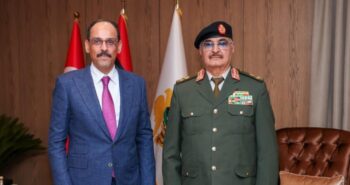
Haftar is 82. His title, general commander of the Libyan National Army, a coalition of militias assembled in 2014 and later rubber stamped by the eastern parliament, does not convey the vast extent of his power. His forces hold the oilfields and export terminals across central Libya. His coastline units police the eastern shore and run the smuggling routes that feed Europe’s migration crisis. His bases host the foreign militaries feeding Sudan’s war. For Europeans confronting migration, energy insecurity and regional spillover, Haftar controls everything that matters.
The European delegation had come to Benghazi in the hope of a private audience with Haftar. Upon arrival, they learned that he had one condition. He insisted they first meet, publicly and on camera, ministers from the eastern administration that he claims to serve. Europe does not officially recognise that government.
Meeting the eastern administration’s ministers would legitimise it; refusing would mean no access to Haftar. When the Europeans declined, they were denied entry. The delegation never made it past the airport lounge. The humiliation exposed Libya’s central fiction: to reach the country’s most powerful man, you must pretend he is not the country’s most powerful man.
In 2011, foreign powers intervened to overthrow Gaddafi. This is what they built. As bombs fall on Iran and the architects of yet another intervention promise that force will deliver freedom, Libya stands as the parable they refuse to read. Every intervention makes the same promise: remove the dictator and the people will be free. Libya is what happens when the dictator is removed and the people are forgotten.
For more than a decade, as Libya’s politicians fought over diplomatic recognition, Haftar was changing the facts on the ground, accumulating the oil, territory and foreign backers that constitute real power. He claims to be a servant of the eastern government – but it is a government whose ministers he approves, whose parliament his soldiers surround, and whose laws apply only when he permits.
Meanwhile, the rival government in Tripoli survives on oil revenues and infrastructure that run through territory he can close at will. Both governments are officially responsible for everything, but neither has power over anything essential. This is Haftar’s system: control everything that matters, be answerable for nothing, and force everyone to pretend the arrangement does not exist.
This system is propped up from outside by foreign powers, and held together inside by enforced silence. Egypt, Russia and the UAE officially recognise the government in Tripoli. In practice, they support Haftar. The UAE bankrolls his operations and provides the weapons that enforce his authority. Egypt offers intelligence and the use of a military base inside its own territory.
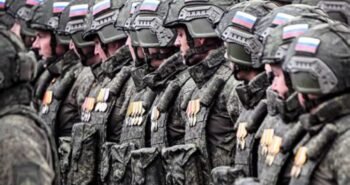
Russia supplies mercenaries who guard his oilfields and fight his wars. In May 2025, Vladimir Putin received Haftar at the Kremlin and offered him diplomatic protection at the UN security council. Without these patrons, Haftar’s system would collapse. With them, it is untouchable. “The foreign powers maintain the pantomime as much as Haftar does,” said Tarek Megerisi, senior fellow at the European Council on Foreign Relations. “They can claim to support Libya’s sovereignty while backing the man who undermines
In eastern Libya no one is fooled. Haftar’s face watches from billboards across Benghazi, and hangs in government offices. In May 2025, the eastern government named a new city after him. His sons command military units, oversee reconstruction contracts, and conduct foreign meetings like heirs in waiting. Yet stating what everyone knows is dangerous. In eastern Libya, everything is monitored.
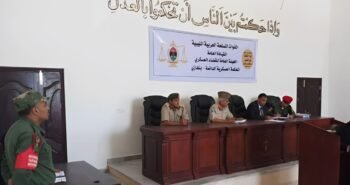
“People believe Haftar’s reach has no limit,” says Hanan Salah, associate director for north Africa and the Middle East at Human Rights Watch. “His forces take someone from their home, whether a citizen or a parliamentarian, and they vanish. He controls the courts. He controls the investigations. He operates with total impunity because the international community has chosen appeasement over accountability.”
Everyone can see the reality, but no one dares say so. Haftar is Libya’s great pretender. As Jonathan Winer, a former US special envoy, told me, Haftar sees himself as “the Dune messiah, a messianic figure out of the desert who controls the fate of nations while pretending to be the instrument of the people”.
Haftar has spent 50 years closely studying how power works: beside Gaddafi as the dictator governed through committees and councils while claiming no title, in a Chadian prison camp where he made himself indispensable to captors and captives alike, as a CIA asset in Virginia who later played the CIA against the Gaddafi regime, as a failed commander in a revolution that rejected him until he outlasted everyone who did. Each experience taught him the same truth: power does not require a throne. The space between what everyone knows and what no one can say, that is where he rules.
Haftar’s political life began with betrayal. On 1 September 1969, a 25-year-old Haftar stood shoulder to shoulder with Muammar Gaddafi as one of the junior officers who overthrew King Idris, Libya’s pro-western monarch. Over the years that followed, Haftar rose through the ranks of Gaddafi’s revolutionary state, becoming one of his most trusted military commanders.
In 1986, Gaddafi promoted Haftar to colonel and sent him to command Libyan forces in neighbouring Chad. By that point, the two nations had been fighting for almost a decade, and the war had evolved into a struggle for control of smuggling routes and armed networks across the Sahel, a strategic zone linking Libya, Niger and Sudan. Gaddafi wanted the frontier secured and Haftar was the colonel he chose to do it.
The appointment ended in disaster. In March 1987, at the remote airbase of Ouadi Doum, Chadian forces backed by French and American air power routed Haftar’s army. Hundreds of Libyan soldiers were killed. Haftar and more than 1,000 of his men were captured and taken to a prison compound on the outskirts of Chad’s capital.
Gaddafi had always denied any Libyan military presence in Chad, and he did not acknowledge the humiliation at Ouadi Doum. When officials raised Haftar’s name after the defeat, Gaddafi mockingly replied: “Do we have someone in the army by that name? Perhaps you mean a shepherd in the desert called Hfaytar.” Nearly two decades of loyal service, betrayed in a sentence.
For most prisoners of war, the story would have ended in that camp. For Haftar, it was merely the next stage of his education in how power works. The Reagan administration wanted Gaddafi gone, viewing Libya as a Soviet-aligned state, and the CIA had been closely following events on the ground. In Haftar, they saw a trained commander with 1,000 embittered soldiers and a grievance they could use.
In the spring of 1987, US intelligence officers slipped into the prison camp, alongside a group of humanitarian inspectors. They brought food and medicine. They also brought recordings of Gaddafi’s speeches, which they played to the prisoners: their leader denying their existence, mocking them. The aim was to turn them against Gaddafi. It worked. “The Americans planted the seed,” recalled a former Libyan opposition figure based in Chad. “But it was Haftar’s wounded pride that made it grow.”
***
Anas El Gomati is the founder of the Tripoli-based Sadeq Institute, the first Libyan think tank, and a visiting fellow at the Carnegie Middle East Center, where his research focuses on socioeconomics, democratic governance, the security sector and political Islam in Libya. He is also a visiting lecturer at the NATO Defense College in Rome, where his work focuses on political analysis and public policy.
_________________