Paul Iddon

For years, the Libyan National Army, led by Field Marshal Khalifa Haftar, has acquired military-grade drones to both project force against its adversaries and reinforce its hold over eastern and southern Libya. Satellite images indicate it continues to do so. And a newly released investigative report also summarizes previous attempts by the LNA to import drones in violation of the United Nations arms embargo on the country.
Recent satellite imagery indicates that at least three new drones have appeared at eastern Libya’s LNA-controlled Al Khadim airbase, Reuters reported on April 2. Experts cited in the report believe the drones are Chinese-made Feilong-1 (FL-1), a surveillance and attack drone, and Turkey’s widely exported Bayraktar TB2.
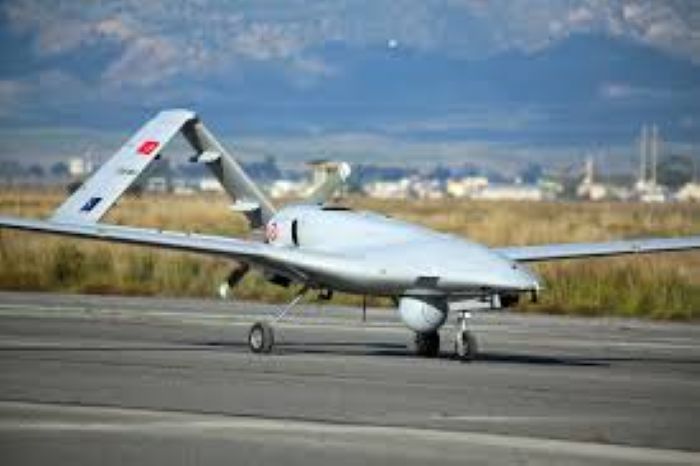
A new report published on Tuesday by The Sentry, an American non-profit investigative and policy organization focused on multinational networks benefitting from violent conflicts, covers prior LNA drone acquisitions as part of its investigation of Ahmed Gadalla. The report describes Gadalla as a “key enabler for the Haftar family’s transnational arms smuggling” in violation of that longstanding but ineffective UN arms embargo. He was notably involved in schemes such as the LNA’s attempted importation of Chinese drones disguised as wind turbines in 2024 and another acquisition of smaller Spanish drones in 2023, both of which were discovered and confiscated before reaching the LNA-controlled half of Libya.
The Chinese drones disguised as wind turbines were FL-1s manufactured by China’s Zhongtian Guide Control Technology Co., and were on the way to the LNA’s Benghazi stronghold from China’s Qingdao when they were intercepted in southern Italy. The Sentry report also included a satellite image showing what appears to be an FL-1 at Al Khadim near Benghazi, suggesting the LNA did import advanced drones despite the Italian interdiction and other incidents.
The Sentry report illustrates the crucial role financiers like Gadalla play in building the LNA’s military arsenal. While Libya has had a cold peace since 2020, factions like the LNA have consistently sought to import arms and reinforce their arsenals. While 2023 and 2024 saw notable disruptions of drone deliveries, FL-1s and possibly TB2s still managed to make it to eastern Libya, again flouting the UN embargo.
The United Arab Emirates previously provided the LNA with Chinese-made Wing Loong II drones armed with Blue Arrow 7 air-to-surface missiles in the 2010s. The Wing Loong II is similar to the American MQ-1 Predator drone and its Hellfire missiles.
When Haftar’s LNA made the ill-fated move to capture Libya’s capital, Tripoli, from his main opponent, the UN-recognized Government of National Accord, these drones were deployed in support of his forces. The UAE not only supplied the drones but also actively piloted them throughout the siege.
Notably, the latest Reuters report on new deliveries of FL-1s and TB2s also states that it’s unclear who is flying them, suggesting that the LNA fleet remains reliant on foreign backers for both operating and supplying advanced drones.
Reports by rights groups in 2019-20 highlighted the role of LNA drones in causing civilian casualties. In one infamous case in January 2020, a UAE-piloted LNA Wing Loong II drone killed 26 unarmed cadets at a Tripoli military academy with a Blue Arrow 7.
Turkey’s decisive intervention in that war saw it deploy TB2s on the side of the GNA, which proved decisive in breaking the LNA siege on Tripoli and repelling its forces. Libya remains divided between the LNA and the Tripoli government to this day.
While Turkey has long favored Tripoli, ties with the LNA in Benghazi have significantly thawed in the years since that conflict. In June-July 2025, cargo flights between Turkey and Benghazi were recorded, which is most likely when Ankara discreetly supplied the LNA with TB2 drones for the first time. The flights coincided with a Turkish charm offensive as Ankara sought legislative ratification of the maritime border memorandum it signed with Tripoli in November 2019 and needed approval from eastern Libya’s House of Representatives. As of writing, no such ratification has happened.
Turkey may have proved willing to sell a small number of TB2s to the LNA to improve relations. Ankara has sold drones to rival powers in the past. For example, after it sold TB2s to Morocco, it sought to ease Algeria’s objections by selling it armed Anka-S drones.
It’s possible something like this has been at play with the two main factions in Libya as well. Since 2024, there have been indications that Turkey has sold at least one of its larger and more advanced Bayraktar Akinci drones to Tripoli. It’s possible that the LNA has concurrently sought that more sophisticated drone, too. However, no images of the type in eastern Libya have emerged to date.
The purported inclusion of kill switches in exported Turkish drones hinted at by the head of Turkey’s Presidency of Defense Industry, Ismail Demir, in a December 2021 television interview, may also factor into any renewed Libyan conflict. It’s conceivable that the LNA cannot count on using its TB2s in any future war with Tripoli, as it did with its UAE-operated Wing Loong IIs six years ago. Regardless of the existence of any secretive kill switches, the LNA will most likely remain heavily reliant on foreigners to fly its drones.
The same may well prove true for future fighter jets it manages to acquire. In May 2020, after the Turkish-backed GNA went on a counteroffensive against the LNA, 14 unmarked Russian-made fourth-generation MiG-29 Fulcrum fighter jets and Su-24 Fencer bombers suddenly showed up on the tarmac of central Libya’s strategic, LNA-controlled Al Jufra airbase. From the moment they arrived, it was widely believed that they were piloted by Russian Wagner mercenaries.
Flash-forward to December 2025. The LNA was reportedly negotiating a multi-billion-dollar deal with Pakistan for 16 Sino-Pakistani JF-17 Thunder fighter jets and 12 Super Mushak trainer aircraft, according to another Reuters report. These JF-17s may reinforce or replace the strategic role previously played by those unmarked Russian MiG-29s. They could also see Pakistan ultimately take on a leading role as an arms supplier to the LNA. While Reuters indicates that the group also discussed a defense cooperation pact with Pakistan which includes joint training, it’s unclear who will pilot any batch of JF-17s that ultimately touchdown in eastern Libya.
So again, while these deliveries and deals seemingly suggest the LNA has made headway in strengthening its arsenal, it is still likely to suffer from many of the debilitating deficiencies it had the last time it went to war.
___________________