
Archive - June 2026

Hundreds protest in Libya over irregular migrants resettlement, storm UNHCR offices

Protesters accuse the UN agency of settling irregular migrants in Libya, a major transit hub for those seeking Europe.

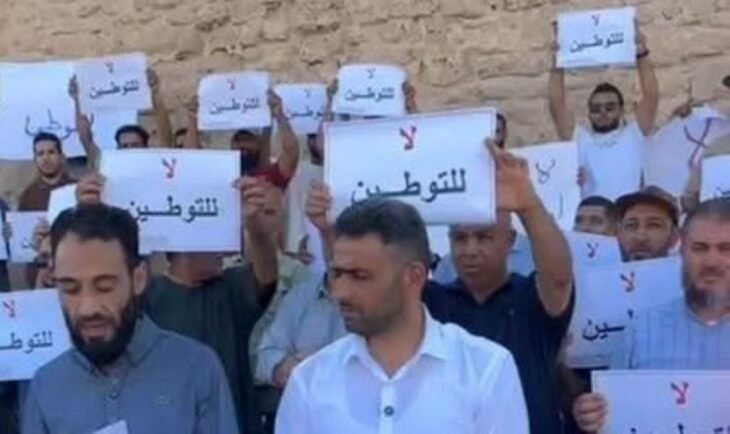
Hundreds of Libyans have gathered outside the UN refugee agency’s headquarters in Tripoli on Thursday, with some protesters storming the compound and demanding the expulsion of the agency over allegations of migrant resettlement in Libya.

Demonstrators chanted “Libya belongs to Libyans” among other chants and called for the closure of the UNHCR headquarters in the capital.

They accused the UN agency of seeking to settle irregular migrants in the North African country.

Protesters were seen holding signs reading: “Our love for our country is not racism” and “Libya is not the world’s garbage bin”.

Libya is a key departure point for irregular migrants seeking to reach Europe by crossing the Mediterranean.

As of mid-2024, the International Organization for Migration estimated that around 900,000 migrants and refugees were living in Libya.

Many of them are Sudanese refugees who have fled war in their home country.

The UN mission in Libya on Monday warned against a “renewed spread of misinformation, disinformation, and inflammatory rhetoric” which it said was “targeting individuals or specific groups”.

The mission called on authorities to “address acts of incitement and the dissemination of harmful false information that may threaten public order, social cohesion, or the rights and dignity of individuals”.

**********

Hundreds protest in Libya outside UN agency against undocumented migrants

Protesters accuse the UN of settling undocumented migrants in the country, a claim the agency rejects.

Hundreds of Libyans have gathered outside the UN refugee agency (UNHCR) headquarters in Tripoli to protest against undocumented migrants that they say should leave Libya.

Protesters on Thursday chanted “Libya belongs to Libyans” and called for the closure of the UNHCR headquarters in the capital. They were seen holding signs reading: “Our love for our country is not racism” and “Libya is not the world’s garbage bin.”

Demonstrators accused the UN agency of seeking to settle undocumented migrants in the North African country.

Since a NATO-backed uprising in ⁠2011, Libya has become a transit route for hundreds of thousands of migrants fleeing conflict and poverty, often from sub-Saharan Africa, with many risking dangerous journeys across the ⁠desert or the Mediterranean.

The UN agency in Libya, UNSMIL, affirmed the rights of all Libyans to express their opinions, but warned about the spread of “misleading information and hate speech” regarding its work in the country, “which contributes to increased tensions and incitement against the UN national and international officials”.

UN agencies “are not implementing any programmes to resettle migrants in Libya and all claims against that are completely unhealthy”, the mission said in a statement on Thursday.

The UN High Commission for Refugees Affairs is “working to find solutions outside Libya for people fleeing wars, conflicts and persecution, including evacuation to third countries, and voluntary return to their countries when circumstances allow”, it added.

It also condemned any incitement of violence or threats targeting UN staff, as well as acts of vandalism and attacks on its personnel and property.

Thursday’s was the largest of several recent anti-migrant demonstrations in Libya, with some of the Libyan population beginning to blame them for social and economic problems that have become more visible during 15 years of conflict and political division in the North African country.

They erected tents, then brought a truck full ⁠of sand and closed the main gate of the building ⁠with a barrier, shouting, “The Libyan people have said their word,” and carrying signs reading “No to intruders in our country, take them out.”

Libya, with an estimated total population of about 7 million, hosts about ⁠900,000 migrants, according to International Organization for Migration estimates. Many are Sudanese refugees who have fled the civil war in their home country.
_________________
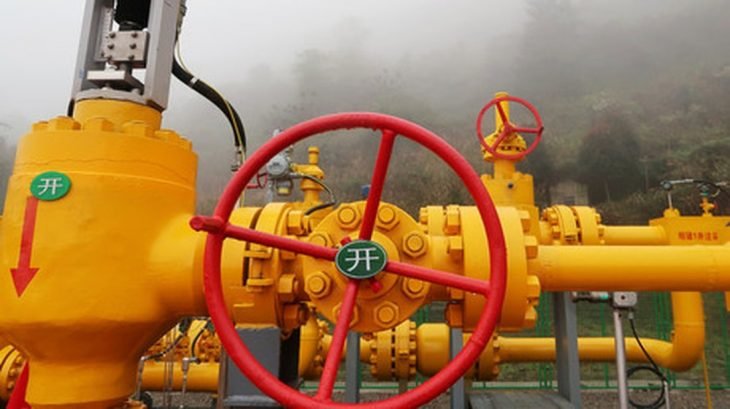
Tripoli Fuel Surge Highlights Strain on Libya’s Distribution Network as Millions of Liters Move in Hours

Younis Moussa

Rapid Fuel Distribution Signals Pressure on Libya’s Supply Chain

Libya’s fuel sector accelerated deliveries across Greater Tripoli after Al-Brega Petroleum Marketing Company distributed nearly six million liters of gasoline in just half a day. The surge reflects an urgent push to stabilize supply conditions in the capital after recent congestion at fuel stations and rising public concern over availability.

Al-Brega confirmed that distribution teams moved roughly six million liters into the Greater Tripoli market by midday, out of a planned 8.3 million liters for the day. The company also reported strong upstream activity at Tripoli Port, where more than 8.2 million liters of gasoline moved out of storage the previous day as part of ongoing supply operations.

These figures point to a system working under pressure but still capable of moving large volumes quickly when logistics align. They also highlight how sensitive Libya’s downstream fuel market remains to short-term disruptions in transport, storage coordination, and station-level distribution.

Tripoli Fuel Network Faces Recurring Bottlenecks

Fuel availability in Tripoli often depends less on national production and more on distribution efficiency. Libya produces significant volumes of crude oil, yet it continues to rely on complex refining, import, and transport arrangements to meet domestic fuel demand.

Recent queues at service stations in the capital reflect structural challenges inside the distribution chain. Delays at loading points, uneven supply scheduling, and congestion at depots all contribute to short-term shortages even when shipments remain active.

Al-Brega’s latest distribution effort shows that supply volumes can move quickly when coordination improves. However, the system still struggles to maintain steady flow across all districts of Greater Tripoli without interruption.

Transport capacity also plays a central role. Fuel trucks must move product from coastal storage facilities into dense urban areas where demand spikes unpredictably. Any disruption in routing or scheduling immediately translates into visible shortages at the pump.

Economic Pressure From Fuel Volatility

Fuel distribution in Tripoli carries direct economic consequences. Transportation costs, logistics pricing, and service delivery all depend on stable fuel access. When station queues grow or distribution slows, businesses absorb higher operating costs and consumers face indirect price pressures.

Taxi services, delivery companies, construction firms, and small retailers feel the impact first. These sectors rely on predictable fuel availability to maintain daily operations. Even short disruptions create ripple effects across commercial activity in the capital.

The recent surge in distribution therefore matters beyond simple supply figures. It reflects an attempt to prevent wider economic friction during a period of heightened demand and logistical strain.

Libya’s fuel system also faces additional complexity due to informal market activity and fuel diversion risks. These factors can distort local availability and place further pressure on official distribution channels.

Increased Throughput Ahead of Seasonal Demand

The timing of the distribution increase aligns with seasonal demand trends. As temperatures rise, fuel consumption typically increases across Libya due to higher transport activity and increased electricity generation needs.

Authorities often move to build buffer stocks in major cities ahead of peak summer demand. Tripoli, as the largest consumption center, receives priority allocation to reduce the risk of widespread shortages during high-demand periods.

Al-Brega’s ongoing unloading and allocation operations at Tripoli Port suggest a focus on maintaining steady inflows rather than reactive distribution. Regular shipments and rapid dispatch cycles aim to reduce accumulation delays and prevent bottlenecks at storage facilities.

This approach helps stabilize short-term supply conditions but does not fully resolve long-standing infrastructure limitations in storage capacity and inland logistics.

Structural Challenges Still Define Libya’s Fuel Market

Despite high distribution volumes, Libya’s fuel market continues to face structural inefficiencies. Storage constraints, transport limitations, and coordination gaps between supply actors all contribute to periodic instability.

The latest Tripoli distribution effort demonstrates operational capability rather than structural resolution. The system can move large volumes quickly, but it still depends on constant coordination across ports, depots, trucking networks, and retail stations.

Sustained improvement will require more than short-term distribution surges. It will depend on stronger logistics infrastructure, better scheduling systems, and tighter control over diversion risks within the supply chain.

For now, the rapid movement of fuel across Greater Tripoli offers short-term relief. The broader challenge remains ensuring that this pace becomes consistent rather than reactive, especially as demand continues to rise across Libya’s urban centers.

___________________

Libya’s Electronic Payment Network: Structural Fragility and the Limits of Oversight

Assad Ounalla

The outage that struck Libya’s domestic payment network on the eve of Eid al-Adha 2026 was no ordinary technical glitch. It was a genuine stress test of a payment ecosystem that has become central to daily life in Libya, and it failed at a moment that should have surprised no one. 

The Scale of What Was at Stake

To understand what happened, one must first grasp how deeply electronic payments have embedded themselves into the Libyan economy. According to figures published by the Libyan News Agency in February 2026, the number of activated bank cards had reached approximately 5.5 million, while subscribers to mobile banking applications stood at 4.29 million, users who collectively executed more than 200 million transactions worth a combined 313.6 billion dinars. Point-of-sale terminals numbered 165,313 nationwide, processing 288.6 million transactions valued at 37.8 billion dinars.

These are not the statistics of a pilot program or a nascent initiative. They describe a core economic infrastructure upon which millions of Libyans depend every single day. When that infrastructure goes down, the consequences are not merely technical, they translate immediately into lost sales, crowded queues, disputes between merchants and customers, and a corrosion of public trust that is far harder to repair than any server.

Monday, May 25: The Breaking Point

The 25th of May 2026 fell at the peak of the pre-Eid shopping season, the single busiest stretch of consumer activity in the Libyan calendar. Point-of-sale terminals across the country came under exceptional pressure. The infrastructure did not hold.

Where the Fault Actually Lies

Commercial banks found themselves on the receiving end of complaints, since it is with them that citizens and merchants hold their accounts. But the operational failure originated elsewhere: with Muamalat Company, the operator of the National Distributor and the domestic payment network known as Numu.

The LYPay service website states explicitly that the service is owned by the Central Bank of Libya and operated by Muamalat Company within the National Distributor framework. Its terms of service confirm that the system forms part of the national payments network, Numu, under the same company’s management. Any reading of events that lays primary responsibility at the feet of commercial banks is therefore an incomplete one, and one that conveniently deflects pressure away from the entity that controls the central node of the entire system.

More troubling than the outage itself were the cases in which a customer’s balance was debited without the corresponding amount reaching the merchant. This category of failure carries a weight that goes beyond technical malfunction. It is a settlement breakdown, a direct assault on the foundational trust that electronic payment depends upon. The customer sees money leave their account; the merchant sees nothing arrive; and the bank is left drowning in complaints it lacks the unilateral authority to resolve.

Impressive Numbers, No Guarantee of Readiness

In October 2025, the Governor of the Central Bank of Libya convened a meeting with Muamalat Company’s board of directors to address a previous outage affecting the National Distributor and point-of-sale services. The Central Bank declared at the time that the National Distributor was “a sovereign system and the backbone of electronic payment services,” and that any interruption was “unacceptable for any period,” with measures agreed upon to prevent recurrence and upgrade the readiness of data centres.

Less than seven months later, the outage recurred, at a seasonal peak that was entirely predictable.

At this point, the question shifts from the technical to the regulatory: Were Muamalat Company’s commitments measurable and verifiable? Did the Central Bank monitor their implementation? Were stress tests conducted on the network ahead of the Eid season? And are there clear performance benchmarks, or meaningful penalties, in the event of failure?

The Central Bank has succeeded in pushing the headline numbers of Libya’s digital transformation forward. But this outage exposes a deep and widening gap: rapid growth in usage met by chronic weakness in operational reliability, and a supervisory model that has not kept pace. Expanding the network to 165,000 terminals and millions of users carries little genuine value if the infrastructure bearing that expansion cannot hold on the days it is needed most.

What Is Actually Required

The response to this failure cannot begin with a press release apology and end with another meeting. What is needed are structural measures at several levels:

Immediate transparency. The Central Bank and Muamalat Company must publish a clear official account specifying the cause of the outage, its duration, the number of transactions affected, and, critically, how many transactions were debited without immediate settlement, alongside a timeline for their resolution. The minimum threshold of public trust begins with citizens and merchants knowing what actually happened.

A binding regulatory framework. A clear service-level agreement between the Central Bank and Muamalat Company, incorporating defined performance indicators, uptime ratios, fault response times, timeframes for reversing failed transactions, with real financial penalties for non-compliance. Mandatory stress testing must be conducted ahead of Ramadan, Eid seasons, and salary disbursement periods. The network should not be stress-tested in front of the public, in the middle of a market.

Reducing single points of failure. Sovereign ownership of the National Distributor need not mean a monopoly on operations or the absence of alternatives. The system can remain under Central Bank oversight while backup routing, independent data centers, and supporting technical providers are developed, spreading the load and reducing the existential risk of total dependence on a single operator.

Conclusion

This outage did not expose the weakness of Muamalat Company alone. It exposed the fact that Libya’s oversight model has not kept pace with the speed of its own expansion. In a few short years, Libya has built an electronic payment network with genuinely impressive numbers. But the strength of a network is not measured by transaction volumes in ordinary times. It is measured by its ability to complete a transaction on the day a citizen or a merchant needs it most.

That day was May 25th, 2026. The network failed.

_________________

Fixing the Economy or Fueling Division? Libya and the 2026 Unified Budget

Khaled Mahmoued

On the surface, Libya appears to have achieved a historic breakthrough. For the first time in over a decade, a unified national budget of 190 billion dinars (approximately $30 billion) has been approved. This comes at a time when oil production has surged to its highest level in more than ten years, reaching 1.43 million barrels per day.  

Yet these positive indicators have not dampened mounting warnings that the Libyan economy is progressively morphing into a “distorted economy”, one fueled by rentier spending, structural corruption, and organized smuggling, all persisting under the shadow of ongoing political and institutional fractures.

Financial Triumphs

With the signing of the unified budget last April, and its approval by both the House of Representatives and the High Council of State, funds were allocated across salaries, subsidies, development, and operational expenses.

Central Bank Governor Naji Issa described the move as “progress toward financial stability and national unity, and a clear declaration of Libya’s ability to transcend its differences when there is a unified vision for its future.” This milestone has been widely promoted as proof of restored relative stability in the oil sector, the backbone of the Libyan economy.

However, this recovery remains highly fragile. It is directly tied to short-term and volatile political and security understandings, alongside the precarious stability of the electricity grid and oil infrastructure. Over-reliance on oil revenues leaves the Libyan economy exposed to any sudden security disruption or global drop in oil prices.

In this context, the World Bank warns that excessive dependence on oil revenues, without structural institutional reforms, “exposes the country to recurrent cycles of fragility and instability,” particularly given the chronic weakness of oversight bodies and the deeply entangled economic interests linking various factions and armed groups.

The Distorted Economy

Despite soaring oil revenues, UN warnings are escalating that Libya is heading toward a textbook model of a “distorted economy.” Public spending is inflating at a pace that far outstrips the productive capacity of the actual economy, while non-oil sectors continue to shrink. The result is a country increasingly dependent on state subsidies and government transfers.

In her recent briefing to the UN Security Council, Acting Head of the United Nations Support Mission in Libya, Hanna Tetteh warned of a total absence of a development vision and a gridlocked political roadmap.

 The pointed to a “distorted economy” entirely reliant on patronage and the purchasing of temporary civil peace through the aggressive expansion of consumer spending.

The new budget allocates 37 billion dinars for public salaries and wages, alongside another 37 billion dinars for subsidies. Combined with salaries and the operational costs of competing governments, these categories swallow the lion’s share of the budget.

Additionally, 18 billion dinars have been earmarked for family grants and allowances. This pattern underscores a persistent rentier economy designed to buy political and social loyalties rather than build a sustainable, productive economic model. As a result, real productive investment remains heavily restricted.

This imprudent spending depletes the state’s strategic reserves, leaving Libya entirely at the mercy of global energy market fluctuations and any forced closures that armed groups might impose on oil fields and terminals at any moment.

Here lies the stark contradiction: despite improved revenues, basic public services like electricity, healthcare, and infrastructure remain in a state of collapse.

Meanwhile, inflation continues to rise and purchasing power deteriorates, proving that the Libyan crisis is no longer a crisis of resources. It is fundamentally a crisis of governance, management, and wealth distribution.

The $20 Billion Bleeding Wound

One of the most dangerous symptoms of this economic distortion is the fuel subsidy system.

What was meant to be a social safety net protecting vulnerable populations has transformed into a massive parallel economy — a “cash cow” exploited by transnational corruption networks, smugglers, and armed militias. According to an investigative report, “fuel smuggling in Libya has escalated into a major national crisis and a massive illicit profit-making enterprise run by state-linked political and security actors, costing the country staggering losses exceeding $20 billion between 2022 and 2024.”

In the same vein, the International Crisis Group confirmed that Libyan authorities purchase fuel with hard currency from global markets at premium prices, only to sell it locally at heavily subsidized nominal rates. Armed groups then intercept, transport, and smuggle this fuel across the Mediterranean and land borders to resell it at international black-market prices. According to the Libyan Audit Bureau, the skyrocketing fuel import bill now consumes nearly 40% of total oil revenues.

This represents a systematic and continuous drain that empties the unified budget of its intended developmental value, turning it instead into a mechanism for funding parallel entities.

It also exposes how smuggling networks have become “directly linked to powerful figures within the security and political establishments,” thereby providing a sustainable source of financing for armed groups and the informal economy.

Perpetuating Division

Beyond the financial balance sheets, geopolitical analysts argue that the 190-billion-dinar budget is nothing more than a meticulously crafted “political trap” that entrenches and institutionalizes division rather than resolving it.

The sudden availability of these massive cash flows directly dilutes any incentives for the competing ruling elites in the East and West to make genuine concessions toward a comprehensive settlement or the long-delayed legislative and presidential elections.

International studies warn that the oil boom could easily become a factor that solidifies a war economy, strengthening corruption networks and armed militias at the expense of institutional stability.

The International Crisis Group noted that massive oil revenue inflows “reduce the incentives for rival parties to reach a permanent political settlement,” because continued division allows armed and political elites to benefit from a quota-based economy and retain control over state resources.

The flow of money and the quota-based distribution of budget lines provide parallel entities and their affiliated militias with the resources needed to maintain the status quo.

Instead of using the budget as an international leverage tool to enforce structural and political reform, it has been converted into a financial umbrella to fund networks of influence and buy the loyalty of warlords and armed factions.

Consequently, experts warn that the uninterrupted flow of oil money, in the absence of a comprehensive political settlement, will effectively “solidify a militarized rentier economy.” In such a system, controlling state institutions and oil fields becomes part of the power-sharing equation among rival factions, rather than a stepping stone toward building a stable state.

A “Financial Truce”

The adoption of a unified budget is undeniably an important symbolic step, but the gravest danger lies not in its size, but in how it is managed.

Instead of serving as a gateway to rebuilding the state, it risks becoming a new tool to feed networks of influence and cronyism between power centers in the East and West.

Without radical reforms to the subsidy system, and without a genuine unification of security and financial institutions, the 2026 budget may pivot from an opportunity to salvage the state into a mere “financial truce.”

It would only delay the next inevitable explosion, deepen Libya’s crippling addiction to oil rents, and push true stability further out of reach.

__________________

Haftar’s forces arrest Gaza aid convoy in Libya

Alex MacDonald

Activists and doctors from Argentina, US, Italy, Spain and elsewhere detained in city of Sirte.

Forces belonging to Libyan military leader Khalifa Haftar have arrested a number of members of a Gaza aid convoy in the city of Sirte. According to a statement published by the Global Sumud Convoy Instagram page, last contact with the activists was made at 3.22pm on Tuesday.

“The detained are civilians from Spain, Poland, the USA, Argentina, Uruguay, Portugal, Tunisia, and Italy – doctors and human rights defenders who volunteered to deliver aid and stand with the Palestinian people,” said the statement. They said the convoy had entered the 5+5 security zone – a contested area established under the Libyan ceasefire agreement signed in October 2020 – to negotiate safe passage to the Gaza Strip.

“They were detained by a security force affiliated with the Libyan Arab Armed Forces (LAAF) and are still being held by Eastern Libyan authorities (GNS),” they added. The group urged citizens of the listed countries to contact their embassies and demand their release. A range of activist-led humanitarian missions have been sent to Gaza since the beginning of the genocide in October 2023, with most being intercepted at sea by Israeli forces.

A number have attempted to travel across land to the crossing at the Egyptian border, though these have also faced numerous legal and security obstacles. Italian news agency Nova reported that Haftar’s forces had transferred the two Italian nationals among the activists to Benghazi. The two will be treated as “potential illegal migrants” by the authorities in Benghazi, the report said.

“Libyan security authorities have not issued any clarification regarding the reasons for the arrests or the legal status of the detainees,” it added. Libya has been largely divided since the Nato-backed overthrow of longtime ruler Muammar Gaddafi in 2011. Eastern Libya is controlled by Haftar and his allies, and is backed by the United Arab Emirates and Egypt, while a UN-backed government in Tripoli governs the west of the country.

How a Gaza-bound aid convoy unravelled attempting to enter Haftar-controlled eastern Libya

Communication breakdowns, raids by armed militias and abductions derail Global Sumud Convoy. Israeli forces’ seizure of activists aboard the Global Sumud Flotilla en route to Gaza and the mistreatment they endured made headlines last week. But around 2,000km to the west, the land-based affiliate of the pro-Palestinian aid movement also ran into trouble on its journey to the besieged enclave.

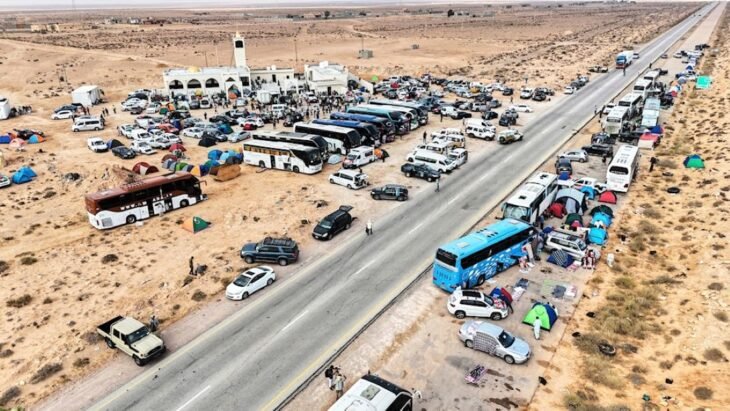
More than 200 activists with the Global Sumud Convoy entered the 5+5 security zone near the Libyan city of Sirte, a contested area established under the country’s October 2020 ceasefire agreement, hoping to negotiate safe passage onwards to Gaza. After days encamped inside the zone, armed forces arrived at the site and dismantled the convoy.

Most participants were forcibly escorted back to Tripoli under armed guard. Ten international activists, however, were detained and remain in Libyan custody. The detainees are from Spain, Poland, the United States, Argentina, Uruguay, Portugal, Tunisia and Italy.

Speaking to Middle East Eye shortly after returning to her home in Johannesburg, South Africa, activist Jessica Breakey said the group found it difficult to leave while fellow convoy members remained in detention. “We just didn’t want to leave without them,” she said.

“It was always like we were in this together, like this convoy was moving together – and I think the worst part about the camp being dismantled and us having to go back was that we were going back without them.” On Tuesday, the eastern Libyan government’s foreign ministry announced that non-Libyans and non-Egyptians would no longer be permitted to travel onwards to Egypt.

“The relevant authorities in the eastern region dealt with the matter within the framework of legal and humanitarian responsibility,” the ministry said. It added that all those involved “are receiving the necessary care and medical and humanitarian follow-up”. The ministry said that while it reaffirmed Libya’s support for the Palestinian cause, “respect for national sovereignty and the legal regulations governing the movement of individuals across borders is non-negotiable”.

While many activists praised the committment of the organisers and their drive to break the siege of Gaza, others said the trip was flawed from the start. Felipe, a 29-year-old Chilean-Palestinian activist and veteran of previous sea-based flotillas, said the convoy itself bore some responsibility for the outcome.

He told MEE that during a two-week stay in Tripoli, it became increasingly clear there had been little planning for the possibility of detentions or for a confrontation with the Libyan Arab Armed Forces (LAAF), led by military commander Khalifa Haftar, which controls eastern Libya. “If we were not able to go through east Libya, we should not have kept pressuring them because we were going to shift the narrative from Israel to Libya,” he said. “We were waiting in the desert for nine days doing nothing.”

Organisational breakdown

Libya has been largely divided since the Nato-backed overthrow of long-time ruler Muammar Gaddafi in 2011. Eastern Libya is controlled by Haftar and his allies, and is backed by the United Arab Emirates and Egypt, while a UN-backed government in Tripoli governs the west of the country.

The convoy’s progress from its origins in Mauritania through North Africa had largely been uneventful. Launched by North African activists and later joined by international participants, the convoy included seven ambulances, 20 mobile homes, 10 aid trucks, as well as medical professionals, engineers, educators and legal observers.

Those involved argued they wanted to bring something more substantial and practically useful to the people of Gaza than the usually largely symbolic aid deliveries associated with the sea-based flotillas. Their attempts to enter eastern Libya saw those plans grind to a halt.

___________________