Heba Saleh, Andrew England and Jacob Judah

The US is seeking to broker a power-sharing agreement between rival administrations in eastern and western Libya, in an attempt to reunite the oil-rich country after years of failed UN-led efforts.
Massad Boulos, an adviser to US President Donald Trump on the Middle East and Africa, told the FT that he was working to bring the country’s fragmented institutions under a single authority while encouraging US oil groups to invest.
“Our plan is to have one unified government and to unify all the institutions,” said Boulos, a Lebanese-American businessman who is father-in-law to Tiffany, the US president’s daughter.
UN attempts to hold elections to unite Libya have been repeatedly thwarted by politicians and armed factions fearful of losing influence and access to state resources including billions of dollars in revenues from oil exports, UN officials and analysts have said.
Libya has Africa’s largest proven oil reserves but production has been below its potential for decades. Sanctions against dictator Muammer Gaddafi and the turmoil after his ousting in 2011, including blockades of oil facilities by armed groups to extract concessions, have impeded investment by international oil companies for decades.
Washington, said Boulos, had been encouraging US oil majors to invest in Libya, noting that ConocoPhillips and Chevron had already signed agreements with Libya in 2026. He added that Libyan oil production could double to 3mn barrels a day by the end of the decade. “This will put Libya on the global map of major oil producers,” he said. Emadeddin Badi, a Libya analyst and co-founder of Informmi, a political risk consultancy, said the US approach to Libya was in keeping with the Trump administration’s “very transactional” style of foreign policy.
“I think the US is thinking we know these stakeholders, they’re open to making deals with us, and we don’t want instability, so why not create a political environment that is amenable for more deals, more investments,” he added.
Boulos said his plan would be “complementary” to UN efforts to hold parliamentary elections and could end up as “part of a package” and a “short-term arrangement” preceding parliamentary and presidential polls.
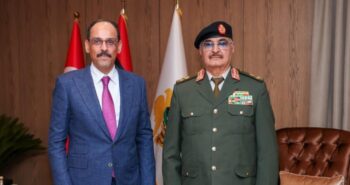
The plan would place Saddam Haftar, son of Khalifa Haftar the warlord who controls eastern Libya, at the head of an executive presidential council, according to people familiar with the matter.
They added that Abdul Hamid Dbeibeh, prime minister since 2021 of the UN-recognised government in Tripoli in western Libya, would remain in his post, while a close relative would occupy a national security post.
Abdul Hamid Dbeibeh, prime minister since 2021 of western Libya deputy commander of the self-styled Libyan National Army, the armed faction his father leads.
In Haftar’s fiefdom in eastern Libya no dissent is tolerated and human rights groups allege that brutal methods have been used to silence opponents.
Dbeibeh’s tenure as prime minister is protected by a patchwork of aligned armed groups, some of which have been accused by UN bodies of crimes including torture, illegal detention and human trafficking in migrants.
Diplomats and analysts say they are sceptical the Boulos deal, which would formalise the power wielded by leaders who have relied on armed factions in Libya, could be achieved given mistrust between the two sides and the compromises that would have to be made on governing together.
“It is wishful thinking,” said Claudia Gazzini, a senior analyst at the International Crisis Group who is currently visiting eastern Libya. “There’s no public narrative here in Benghazi about reconciling with the other side or that it’s time to move on. It is all about the achievements of the people now in power and it’s all based on identifying Tripoli as the enemy.”
Italy, Libya’s main trading partner, has been consulted about the plan and is supportive but believes that implementation would probably be challenging, said another person with knowledge of the matter.
Tim Eaton, a senior research fellow at Chatham House, the London-based think-tank, said the Haftar family had not given any indication in the past that they would be willing to share power.
“The fear from the Dbeibeh camp would be that any deal with the Haftars, particularly if it placed Saddam in the presidency council, would be that he would use it as a springboard to then take over the rest of the government. There will be a trust problem there, and that would be difficult to navigate.”
Libya has been in chaos since an armed uprising in 2011 ousted longtime dictator Muammer Gaddafi. Following disputed elections in 2014, the country split into rival political camps kept in power by predatory armed groups that have infiltrated state institutions, according to the UN. Massad Boulos said he was working to bring the country’s fragmented institutions under a single authority while encouraging US oil groups to invest
The two sides ruling Libya “depend on armed groups, so they’re not able to reform them”, said Badi. “Right now, there are groups aligned with Dbeibeh that are increasingly capturing state rents.”
Boulos pointed to steps taken on his roadmap to unite Libya. These include agreement in November on development funding for both sides of the country — traditionally a bone of contention. In addition, for the first time in more than a decade, east and west signed a national unified budget in April.
The two sides, he added, also took part in Flintlock, a military exercise led by US Africa Command that was held in Libya in April.
“The most important aspect is that our colleagues at Africom have been and continue to work with the two sides on a [military] unification plan,” he said.
Gazzini said many Libyans, however, doubted the deal would materialise, because “they know the personalities [of the protagonists] and the way they think”.
There is also opposition to the idea of entrenching the rule of those who currently wield power in the country, she added, because it would mean “there would be no chance of political change anytime soon, no chance of having elections and no chance of having a change of government in the future”.
__________________