Anas El Gomati

The MED This Week newsletter provides informed insights on the most significant developments in the MENA region, bringing together unique opinions and reliable foresight into future scenarios. Today, we shed light on the latest developments in Libya’s political process.
Over the past few weeks, Libya has shown signs that could signal an end to the political stalemate that has persisted since 2021. On 18 June, the House of Representatives, the High Council of State and the Presidential Council have agreed upon a principles document and a roadmap to hold unified parliamentary and presidential elections by 17 February 2027.
The proposal has been welcomed by the Arab League and the African Union, but caution is warranted. While the roadmap might represent a symbolic step in the right direction, the parties’ commitment to it has yet to be proven as different initiatives to resolve the stalemate have emerged.
Crucially, Khalifa Haftar’s Libyan Arab Armed Forces (LAAF), which de-facto control the east and large parts of the south of the country, has not endorsed the agreement – backing instead the plan put forward by US Senior Advisor for Arab and African Affairs Massad Boulos.
The initiative – outlined in the past few months through piecemeal information released by Mr Boulos and other officials – focuses on a de facto validation of the status quo through pragmatic reapproaching of the two main competing actors through economic enticements, aiming at unifying the government, institutions, national budget and military, and complementing the United Nation’s efforts towards presidential and parliamentary elections.
According to confidential sources, it would also maintain Abdul Hamid Dbeibah as Prime Minister and elevate LAAF’s deputy commander Saddam Haftar to presidency, although the outline of the foreseen unified government remains unclear.
Among its key, first-time achievements since the beginning of the transition: a unified budget was announced in April by the Central Bank of Libya after thirteen years; the LAAF and the Government of National Unity (GNU) jointly participated at the AFRICOM’s Flintlock’s exercise in April.
However, as the process has directly involved Saddam Haftar, son of Khalifa, and GNU’s National Security Advisor Ibrahim Dbeibah, nephew of the GNU Prime Minister, such a “business first” approach has been contested for prioritising short-term stabilisation and deals and cementing the influence of the existing elites, instead of pushing for structural reforms and genuine democratic representation.
The United Nations Support Mission in Libya (UNSMIL) remains increasingly sidelined, with the August 2025 UN political roadmap – based on sound electoral laws, unified institutions and structured and nation-wide dialogue – largely unfulfilled. Meanwhile, rising public and institutional mistrust linked to allegations of political overreach and of fostering migrant settlement in the country further weaken the UN role as a mediator.
Amid competition between the US-backed pragmatic track and the UN-led procedural roadmap, Libya’s political process remains fragile and uncertain. Regional powers such as Egypt, Saudi Arabia and Türkiye have also recently convened in Cairo to discuss the Libyan file, signalling growing regional coordination on the issue alongside the US-led effort. While the way forward lies in shared consensus, dialogue and representation, the parties’ commitment to the initiatives raises hopes – and questions.
Experts from the ISPI network discuss the competing efforts to break Libya’s political deadlock and what they mean for the country’s future.
The way out of the Libyan quagmire must come from inside the country
“Looking on the bright side, the announcement of an agreement between the House of Representatives and the High Council of State to hold elections early next year reflects a willingness on the part of local actors to take a proactive stance in an evolving situation following years of deadlock, and to attempt to take responsibility for the country’s unification process.
Almost simultaneously with the announcement of the agreement, the UN Secretary-General’s Special Representative for Libya, Hanna Tetteh, stated before the UN Security Council: ‘The direction is known, the tools exist. What is required now is the political will to deliver’.
The way out of the Libyan quagmire – which so many external actors have exploited for their own interests – can only come about through a stance that is entirely internal, exclusively Libyan. Viewed in a negative light, however, this unexpected could instead be an attempt by the most important local institutions to maintain control of the country, dividing it amongst themselves and perpetuating the clan-based corrupt dynamics that have dominated until now.”
The Boulos Plan would not solve any of Libya’s woes even if it succeeded
“The ongoing US mediation effort does away with a decade of UN-led processes based on institutions, legal frameworks and inclusive participation – processes that have by and large failed, and are currently going nowhere. In their place, Massad Boulos proposes a power-sharing deal between the two ruling families: the Haftars and Dbeibahs.
This would not solve any of Libya’s woes even if it succeeded: if the most acute problem is the unchecked pillage of state wealth while Libya is divided, predation of state funds would likely reach new heights if the two families cement their power further.
More importantly, such a deal would usher in a situation in which each side waits for the right moment to turn on the other and monopolize power. The prospect of failure is no better: Saddam Haftar, who hopes Boulos will make him President, will look for other ways of realizing his dream if the plan fails.” Wolfram Lacher, Senior Associate, Stiftung Wissenschaft und Politik
Libya’s energy sector has not been this promising in decades
“Libya’s energy sector appears better positioned than it has been for decades. The closure of the Strait of Hormuz highlighted the advantages of a Mediterranean producer close to European markets and insulated from disruptions to Gulf export routes.
The approval of a unified state budget should reduce some of the funding disputes that have periodically disrupted the sector, while recent exploration success and renewed interest from international oil companies point to growing confidence in its upstream potential.
While Libya targets renewables accounting for 22% of the power mix by 2035, the strategy is focused on supporting oil and gas development, with solar and wind projects designed to power oilfields and free up hydrocarbons for export. Proposed interconnections with Italy, Greece and Malta could further enhance its role in Europe’s energy market.” Kate Dourian, Contributing Editor, MEES
Regional powers are no longer competing over Libya – they’re coordinating over it
“The Cairo talks tell us that regional powers are no longer competing over Libya. They’re coordinating over it. Turkey, Egypt, and Saudi Arabia are converging not on a vision for the country but on a shared interest in lowering their exposure, monetising stability, and managing the succession question that Khalifa Haftar’s age has placed on the table.
The likely outcome, brokered by Boulos, elevates Saddam Haftar to president while retaining Dbeibah as prime minister, with the unified budget and joint exercises serving as the supposed political scaffolding, but its little more than window dressing.
This is not a transition. It is an externally coordinated elite settlement that consolidates dynastic power on both sides and defers Libyan political consent indefinitely. The pattern is familiar, only the packaging is new.”
***
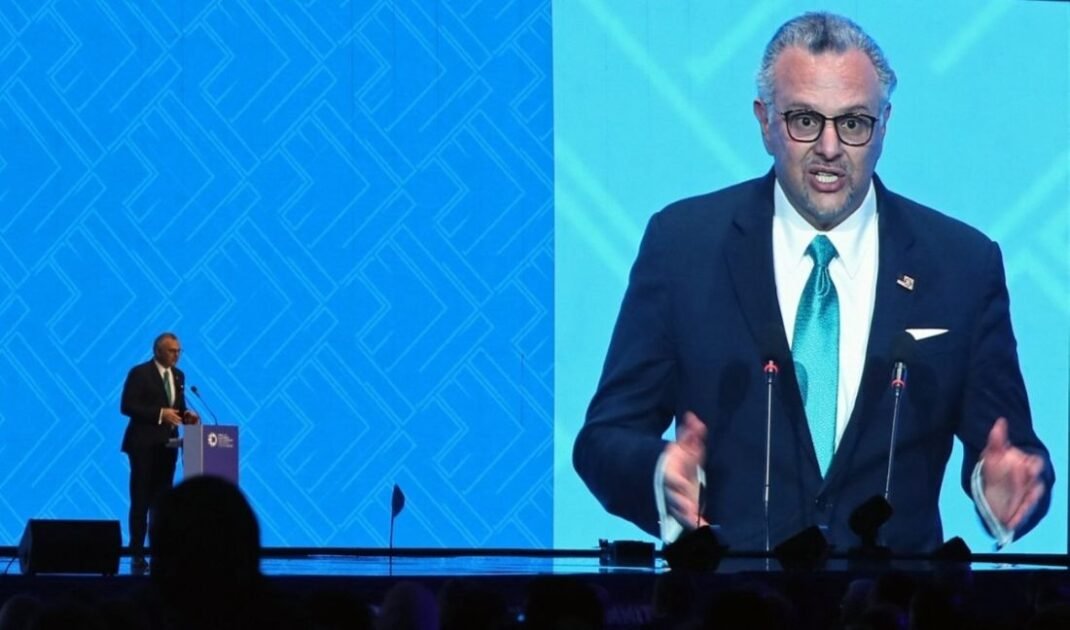
Anas El Gomati, Founder and Director General, Sadeq Institute
____________________