Wolfram Lacher

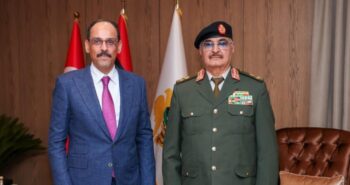
To many Libyans, the whole idea of the talks is offensive: they send the message that the country should be formally subject to family rule. On the Dbeibah side the negotiations are being led by Ibrahim, whose father, Ali, established the Dbeibah family’s reputation for graft by making a fortune leading a state body that managed large construction projects during the Qaddafi era. (One of the main contractors of this body was a state-owned company run by Abdulhamid).
For his part, according to a recent UN report, Ibrahim owes much of his influence to his “direct collaboration with armed group leaders,” a field in which he “largely operates without any checks or balances.” Saddam Haftar, in turn, owes his prominence first and foremost to his father’s violent rise over the past decade, in addition to his own ruthlessness.
The unit he has commanded has been accused by Amnesty International of a “catalogue of horrors” against civilians. UN investigators recently identified him as the kingpin of networks that siphon off billions of dollars in state funds each year, including by smuggling fuel—which is heavily subsidized in Libya—outside the country to foreign buyers, and by shadow-operating a private firm that struck a shady deal with the NOC to export vast amounts of crude from the east’s oilfields.
The capital, firepower, and political clout Saddam derives from these activities have helped him become his father’s anointed successor, bypassing his older brother Khaled, whom his father named chief of staff as a consolation prize.
Yet Saddam, like Khalifa’s other sons, is tainted in the view of many Libyans for benefiting from his father’s bloody successes. Sibling rivalries, moreover, have put further hurdles in his path: his brothers Khaled and Belgasem have, my sources told me, mobilized their political clients to oppose the Boulos plan.
On June 29 Boulos hosted Saddam in Washington for a meeting with Secretary of State Marco Rubio to press the deal; the following day he tried to persuade Belgasem, who had traveled separately.
Saddam, by all accounts, is strongly in favor of Boulos’s proposal. It would allow him to cast off his thuggish reputation and hand him the highest national political office without the need for elections he could not possibly win.
Far less obvious is what the Dbeibahs stand to gain. They would risk a rebellion from western Libyan forces who are not only opposed to the Haftars but understandably fearful that, sooner or later, Saddam will use his new position to monopolize power.
The Dbeibahs’ hometown of Misrata, about 130 miles east of Tripoli, is also the base of several armed groups that weigh heavily in Libya’s military balance, and virtually everyone I spoke with there told me that the city would openly mobilize against the deal if it was indeed formalized. When Boulos visited Misrata in early July, local dignitaries conveyed the same message to him.
Conscious of these risks, the Dbeibahs have sent conflicting messages to their constituencies, at times dismissing the Boulos proposal outright or suggesting that they have been playing for time. It is unclear whether they are negotiating in good faith or are simply wary of alienating an in-law of the US president.
They may not be unhappy about Misratan resistance to the proposal, which gives them an excuse for stalling. Yet advisers to the Dbeibahs certainly seem flattered that a senior US official considers them the Haftars’ equal and exclusive interlocutors, after years of convoluted, UN-led political processes led by bureaucrats with limited clout and involving a long cast of Libyan politicians of questionable relevance.
They could allow themselves to be coaxed into a deal they do not intend to implement. Having triumphed over numerous powerful challengers over the past five years, they may also believe they will outsmart Saddam once the agreement is in place (and in the meantime, like everyone else in Tripoli, wait for his father to die). Both would be dangerous gambles.
From Gaza to the Democratic Republic of the Congo, the Trump administration has shown a proclivity for announcing flashy peace deals and an utter lack of interest in implementing them.
There is no reason to expect that Libya, a country that matters little in Washington, will be any different. But in Libya the two sides have not fought directly for six years, which means that the Boulos initiative could do worse than merely fail to solve the conflict or further entrench its causes—it could unsettle the fragile equilibrium that has maintained the stalemate.
Saddam, eyeing the position of president, would suffer a serious disappointment if the talks fail, strengthening the position of advocates for a military alternative in the Haftar camp. If the negotiations do result in a deal, Saddam could use his official position to rally rivals of the Dbeibahs from western Libya around him.
One military commander in Tripoli likened that scenario to the temporary power-sharing arrangement that prevailed between two Sudanese generals before they turned on each other in 2023, provoking that country’s devastating, ongoing civil war. In that case, given the Trump administration’s record, nobody would expect the US to intervene and stop the deal from unraveling.
Even an agreement that remains a dead letter carries risks: Saddam could still claim the prerogatives offered to him on paper, and justify military action as necessary to take what is rightfully his.
Underpinning these scenarios are broader changes in Libya’s balance of power and regional relations. The Haftars and Dbeibahs both benefited from the informal arrangements they maintained over the past five years, but the former made out much better.
Each year billions of dollars washed into the Haftars’ coffers from oil exports, fuel smuggling, printing counterfeit currency, and pillaging state-owned banks. In Tripoli, these schemes caused widening fiscal and balance-of-payments deficits, as well as a slide in the dinar’s black-market exchange rate, all of which harmed the Dbeibah government politically.
The Haftars, meanwhile, went on a shopping spree, buying heavy military equipment from abroad, cultivating political loyalties across the country, and launching a grand reconstruction program run by Belgasem, who is said to hand out Rolexes to Western businessmen and diplomats. Many of the building contracts went to Turkish and Egyptian companies with close ties to their countries’ rulers, evidently in order to buy foreign support.
Over the past two years, meanwhile, Turkey has cultivated warmer relationships with the Haftars, above all because it wants the east-based parliament to ratify a maritime agreement it signed in 2019 with the government in Tripoli. The most alarming sign of those deepening ties has been a string of considerable Turkish defense deals with the Haftars.
In April, Reuters reported that Saddam’s forces seemed to have acquired Bayraktar TB2 combat drones—the very drones that Turkey has at times restricted the Dbeibah government from using in battle. The only plausible targets of these weapons are the western Libyan factions that have enjoyed Turkish military support since 2020.
The leaders of those factions are torn between the conviction that Turkey could not possibly have an interest in the Haftars seizing power—which would remove any need for a Turkish military presence in the country—and their suspicion that they can no longer count on their erstwhile protector.
In other respects, too, the international environment has become permissive toward renewed escalation. European states are mostly uninterested in Libya, with the exception of Italy and Greece, which have defined an EU policy that prioritizes migration control over everything else.
In practice, this has meant cultivating close ties both with Dbeibah and Zubi in Tripoli and with the Haftars in the east, ignoring the military buildup on both sides, looking the other way as fuel smuggling drains the state’s coffers, and implicitly condoning the brutal detention of migrants in prisons run by the Tripoli government and Haftar’s forces alike.
The latest illustration of European collusion concerned the EU naval mission Irini, formed in 2020 to inspect ships suspected of violating the Libya arms embargo—a task for which it had a mandate from the UN Security Council.
For months the Dbeibah government’s foreign ministry had demanded that the mission expand that mandate and also intercept ships believed to be smuggling fuel, but European diplomats cautioned that doing so would damage their relations with the Haftars. Instead, this past May, France and Greece—the current European members of the UN Security Council—allowed the council’s mandate for Irini to expire.
And in a country where the biggest and glitziest new structures are military bases and where military power serves private interests, the EU recently funded the construction of yet another base, for a unit reporting to Zubi. The likely European response to renewed war would be polite silence, in expectation of an accommodation with whoever the victors are.
As both sides of the conflict build up their arsenals and collude in defrauding the state, they are inexorably pushing Libya toward crisis. Boulos, seeking to cement the status quo by entrenching the rule of the two families, may turn out to be the harbinger of its collapse.
“If the Boulos initiative fails, the alternative will probably be war,” one person close to the Dbeibahs’ negotiators told me in July. War would also be the predictable consequence if Boulos succeeds.
***
Wolfram Lacher is a Senior Associate at the German Institute for International and Security Affairs (SWP) in Berlin and the author of Libya’s Fragmentation: Structure and Process in Violent Conflict.
___________________