Archive - March 2022

International Unity Needed To Prevent A Divided Libya

Libya is at a perilous crossroads – again.

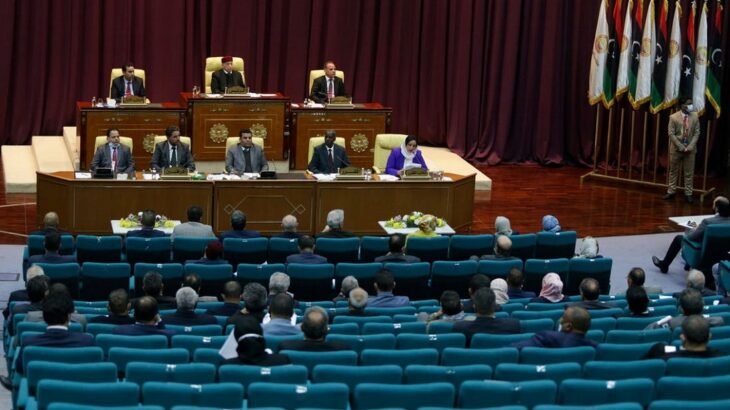
On 1 March, the country’s Tobruk-based parliament, the House of Representatives, voted to endorse a new interim government headed by former Interior Minister Fathi Bashagha, giving it the greenlight to take over from the sitting prime minister, Abdulhamid Dabaiba.

The vote’s proponents insist that the procedure was sound, but factions in the capital Tripoli say it was fraudulent. The latter reject the new cabinet and oppose appointing a new executive entirely. As the camps square off, omens of renewed fighting are visible for the first time since an October 2020 ceasefire ended six years of political feuds and intermittent conflict.

Armed groups allied with the Tripoli-based government have already closed Libyan airspace to prevent incumbent ministers from travelling to Tobruk to take part in Bashagha’s swearing-in ceremony. With others gearing up for confrontation, what happens next will depend largely on how foreign powers react.

A splintered international response could encourage an institutional split and military mobilisation. But a united international condemnation of the use of force coupled with a call on Libyans to chart a consensual way forward with UN assistance could avoid this scenario.

The 1 March vote risks breaking apart the unified interim government that formed in the months after a ceasefire declared in October 2020. That government brought together the country’s rival power centres, one based in Tripoli and the other in Tobruk, which formed after contested parliamentary elections cleaved the country in two in 2014.

Efforts to install a new government have been under way since early 2022, after the national electoral commission indefinitely postponed a presidential election that had been slated for 24 December, citing insurmountable legal disputes regarding the candidates running for the country’s top position. Libya’s main political camps have put forward conflicting ideas for resolving the impasse. 

Since then, Libya’s main political camps have put forward conflicting ideas for resolving the impasse. The Tobruk-based group, which includes House speaker Aghila Saleh, Field Marshal Khalifa Haftar (who led forces that besieged Tripoli in 2019) and Tripoli-based factions that want to oust Dabaiba, said politicians should form a new government and amend a draft constitution before new elections.

The other, which includes western Libya’s main political blocs, wanted Dabaiba to stay in power until a new legislature is elected and can choose a new executive. Even presidential hopeful Saif al-Islam al-Qadhafi, son of the late dictator, who is historically at odds with the second camp, echoed the need to keep the Dabaiba government in place and proceed with a legislative ballot.

The polarisation between these two broad camps deepened after 10 February, when the House appointed Bashagha as prime minister-designate and tasked him with forming a government by the end of the month.

This appointment was the result of a deal among Bashagha, Saleh, Haftar and their respective allies in the House. At first, the agreement also had the approval of Khaled al-Mishri, the chairman of the High State Council, the rival assembly located in Tripoli. But Mishri withdrew his support in late February, seemingly under pressure from several members of the Council he heads, who opposed the move to put a new government in place.

The pro-Dabaiba camp responded to the House’s manoeuvres by announcing that the government was working on its own roadmap to hold a legislative ballot in June. They said the Tobruk-based parliament had no right to appoint a new executive and that Dabaiba would hand over power only to a successor backed by a popular vote.

Divisions among foreign actors mirrored Libya’s cleavages. Cairo and Moscow gave their initial blessing to the House’s efforts to instal a new government, seemingly believing that Libya would benefit from an alliance among former enemies like Bashagha and Haftar.

Beginning in early 2022, Egyptian officials actively supported reaching an understanding between the two and proceeding with the plan based on their deal. Turkey, while maintaining friendly ties with Bashagha, stuck by Dabaiba and called for fresh elections, banking on polls being a better guarantee of long-term stability.

The UAE backed Dabaiba, while its Gulf adversary Qatar, made discreet overtures to Bashagha while still bankrolling its traditional allies aligned with Dabaiba. In effect, the Gulf monarchies’ allegiances have shifted: barely a year ago, Abu Dhabi was aiding Haftar militarily, while Doha was providing diplomatic and financial support to the Tripoli-based authorities. Amid these fast-changing developments, the U.S. and other Western states have adopted a wait-and-see approach.

The UN did not oppose the attempt to replace the government. But the UN Secretary-General’s special adviser, Stephanie Williams, imposed conditions for accepting the move. First, she said, the new government’s appointment should be “consensual” and have the High State Council’s buy-in. Secondly, the confidence vote in a new interim premier should be transparent and meet legal requirements – though her office never clarified what these might be.

Foreign diplomats said the vote would be valid only if at least 50 per cent of House members plus one supported the new government. But House members advanced their own interpretations. Another point lacking clarity was how many lawmakers the House would need for a quorum.

Many of its original 200 members had defected to the Tripoli-based authorities, said they would boycott the proceedings or been replaced. Legislators gave the UN conflicting estimates of the remaining number of parliamentarians, ranging from 164 to 188.

As a result, estimates of the quorum for a valid confidence vote varied between 82 and 94. After the High State Council withdrew its support, Williams knew her first condition would not be met and could not be sure her second condition would be, either. 

The 1 March parliament confidence vote made matters worse. The House speaker counted 101 members in attendance, and 92 voted in favour. This number was close to or higher than the earlier quorum estimates. But video footage showed fewer attendees than 101, and only 88 names were read out during the roll call for the vote. The number of parliamentarians who pronounced the word “confidence” (thiqqa) was unclear because they did not speak into microphones.  
On 2 March, parliament clarified that the discrepancy in numbers came about because eight lawmakers had dialled in from remote locations for security or health reasons, while others preferred to cast their votes anonymously after receiving threats from pro-Dabaiba armed groups. The House also changed the total number of those in favour of the new government to 96, adding to the confusion.
Bashagha said the ballot was “clear and transparent” and vowed to take office in Tripoli in “a peaceful manner”. The next day, however, Dabaiba called the vote a “coup” attempted through fraud. On 3 March, Bashagha and most of his ministers took the oath of office in Tobruk. On that occasion, House speaker Saleh listed all 96 names of the lawmakers who had supported the new executive, in one last attempt to dispel doubts about the vote of confidence. [The power struggle] risks undermining reconstruction efforts and the wider economy. 

The power struggle could disrupt the calm Libya has enjoyed since factions signed the October 2020 ceasefire agreement. It risks undermining reconstruction efforts and the wider economy. Political rivals are also becoming more dependent on armed loyalists. Gunmen allied with the Tripoli-based government reportedly detained two new ministers, preventing them from assuming their duties.

It is unclear how Haftar-led forces, who control the east of the country and are allied with the Bashagha cabinet, will respond. The risk of war depends both on the answer to this question and on what the sides’ foreign backers decide to do. For now, the foes in the civil war appear unlikely to take up arms again, due to general war fatigue. Neither do outside powers seem eager for renewed conflict. That said, rising animosity between the two governments could change this calculation.

Geopolitical shifts could also affect tensions in Libya. The precarious balance between Turkey and Russia, both of which have military personnel in Libya, could be rapidly upended. Turkey is allied with the Tripoli-based government. Russia deployed fighter jets and the Wagner Group’s private military contractors to support Haftar-led forces in the 2019-2020 war, and while it has subsequently sent some of its assets elsewhere, it retains a presence on the ground alongside Haftar.

As fighting in Ukraine intensifies, there is a risk of spillover that could drag Libya into a new proxy war. For now, Moscow is the only foreign capital to officially welcome the Bashagha government. The Kremlin’s confrontation with the West over Ukraine makes its strategy in Libya unpredictable.

Other capitals have thus far kept a deafening silence, perhaps waiting to see how the UN responds. On 2 March, the UN Secretary-General said the vote “fell short of the expected standards of transparency and procedures and included acts of intimidation prior to the session”. This wording is likely to push foreign powers in the direction of refusing the new government recognition, which would be a blow to those backing the Bashagha-Haftar deal.

Notwithstanding their divisions, external actors should speak with one voice in pressing all Libyan parties to show restraint and condemning the forcible detention of the new government’s supporters. Such a minimum international consensus should be attainable, given that outside powers have a common interest in preventing a return to a divided Libya or a relapse into civil war at a moment of already great geopolitical upheaval.

The two sides in Libya should accept UN mediation to break their deadlock and return to negotiating a realistic political roadmap for the way forward. Finding a consensus between the two rival governments admittedly will not be easy, but for each there are good reasons and incentives to accept external mediation: the Bashagha government will be short-lived if it does not receive broad international recognition or, alternatively, gain access to state funds (both of which will be difficult without the UN’s support); the Dabaiba government risks losing out if member states begin to gradually flip their recognition in favour of the new executive.

The UN’s Williams should call on the parties to refrain from violence and urge them to accept her good offices for mediation. Foreign governments should follow her lead in calling for negotiations.

***
Read More

Libya crisis worsens as rival government takes oath

A standoff between two rival governments in Libya worsened on Thursday with the risk of fighting or territorial division, as the parliament in the east swore in a new administration while the incumbent in Tripoli refused to cede power, Reuters reports. Read More

Could Libya Finally Have a Chance at Lasting Stability?

Alessandro Bruno

The Libyan Parliament’s decision to oust the interim GNU Prime Minister Abdul Hamid Dbeibah may offer the first real chance at stabilizing Libya since the 2011 revolution. There’s still uncertainty to overcome, and this time one of the obstacles is the UN.

As happened between the years 2014 and 2016, the Parliament seated in Tobruk appointed a new prime minister. This time they designated the former interior minister, Fathi Bachagha, to replace Abdul Hamid Dbeibah as head of the interim government on Thursday, February 10. Dbeibah, who, in early February, was almost assassinated in an ambush, had been appointed interim PM back in March 2021. Now, he refuses to leave his post.

At the end of 2020, shortly after warlord and ex-General Khalifa Haftar’s failed attempt to take over Tripolitania, Cyrenaica’s strongman signed a ceasefire agreement, leading to a United Nations-backed peace process. As part of this process, Dbeibah was appointed to lead a new transitional Government of National Unity (GNU) with the mission of unifying the institutions and leading the country to presidential and legislative elections. Both were initially scheduled for December 24, 2021.

Due to the lack of consensus among the many Libyan factions, the elections were postponed indefinitely.

Due to the lack of consensus among the many Libyan factions, the elections were postponed indefinitely, weakening the position of the GNU. The alliance between Haftar and Bachagha allowed for the latter’s nomination by the Tobruk parliament (dominated by supporters of Haftar) as prime minister on February 10. Currently, it remains to be seen how the balance of power between Dbeibah and Bachagha – both born in Misrata – will evolve. Both have the support of very influential armed groups in western Libya. However, their alliances remain inconsistent and reversible.

Dbeibah’s Weak Support Base

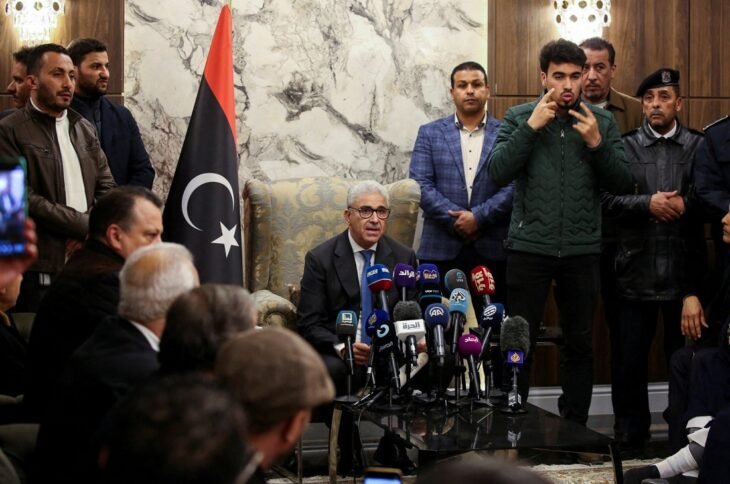
Before traveling to Misrata, Bachagha arrived at Tripoli-Mitiga airport on a plane chartered by Haftar’s son on February 10. There, he held a press conference under the protection of the Zawiya militias and other Misrata groups. With the airport being just a few miles from downtown Tripoli, a recalcitrant Dbeibah could count on the muscle of the “444” militia and Misrata Brigades. Yet Dbeibah’s support is precarious. Should the Misrata militias deployed in Tripoli switch sides in favor of Bachagha, it’s over for the GNU prime minister.

Of course, the power struggle is less about personalities and more about control over territory, access to Central Bank funds, oil, and international recognition. Generally, armed groups and traffickers support Bachagha with an eye towards challenging the system implemented in Tripoli by Turkey since June 2020, which disturbs their interests. In other words, Bachagha benefits from instability.

Meanwhile, even as the UN continues to support Dbeibah, the Bachagha maneuver appears to have implicit political support from Egypt, France, and Russia – all unsurprising given the Bachagha’s generally favorable relations with Haftar.

The Bachagha maneuver appears to have political support from Egypt, France, and Russia.

Libyans, along with the rest of the world, had hoped that the elections would have established a new era, one free of bloody internal conflicts and aimed at working towards “democratization.” In reality, the Libya that was about to hold elections on December 24 lacked the conditions for stability – let alone democracy.

Conflicting foreign interests, intersected by local power struggles, create an insurmountable obstacle for a free and credible electoral process. Since Colonel Muammar Qadhafi’s demise in 2011, the only certainty in Libyan politics is that militias will challenge each other – often with weapons – and occasionally find precarious agreements which inevitably break down. Ending this “rinse and repeat” cycle remains the elusive goal since no political arrangement has ever worked, regardless of whether it is backed by the UN, the EU, Russia, or the United States.

One of Libya’s main problems has been its lack of institutions. Qadhafi purposely avoided giving civil organizations any real power – except for the management of the oil economy. Without stability and institutions, and in the context of a historically divided country (artificially united by Mussolini in the 1930s to facilitate colonial administration), the focus on democracy is more of a hurdle than an ideal.

Libyan writer and political analyst Fayez al-Araibi has accused the militias in Tripoli “of obstructing the unification of security institutions as they refused to transform the management of institutions into professional elements that lead them.” Al-Araibi observed that security is an essential factor in achieving stability in the country, stressing that the former head of the Libyan intelligence service, Imad al-Trabelsi, has been accused of several infringements.

“Consequently, it is in the interest of the [obstructing] militias . . . to hand over power to the head of the new agency appointed by the presidency.” Clearly, the resulting political unpredictability and insecurity have hindered the efforts of successive leaders who have attempted to rebuild Libya. The post-Qadhafi system – or lack thereof – has failed to meet the Libyan people’s basic needs. This failure explains the rising popularity of Saif al-Islam al-Qadhafi. Al-Araibi explains that tribal and community leaders see the former leader’s son as the best chance for national reconciliation.

The pursuit of an elusive democracy is preventing Libya from leaving the chaos behind.

The pursuit of an elusive democracy, rather than of stability, and the West’s encouragement of said pursuit, is the main obstacle preventing Libya from leaving the chaos behind. Upon first glance, the emergence of Bachagha may appear as another source of turmoil, and yet it could help Libya achieve some much-needed stability.

Bachagha’s Appointment Has the Potential for Stability

Days before the scheduled – and already compromised elections – on December 24, Bachagha went to Benghazi where he met Haftar, head of the self-styled Libyan National Army (LNA) on December 21, 2021. This meeting ­– at Haftar’s invitation no less – was remarkable. Its remarkability can only be explained by noting that in April 2019, Haftar launched the “Flood of Dignity” campaign to liberate Tripoli from the militias and Brotherhood-dominated Government of National Accord (GNA) — the original internationally supported transitional Libyan government — arresting all members of the Muslim Brotherhood and dissolving the political movement.

That same December, Turkey’s ambassador to Tripoli met Aqila Saleh of the House of Representatives, the Haftar-affiliated Libyan parliament in Tobruk. Around the same time, a delegation of GNA members from Tripoli flew to Turkey and met President Erdogan himself. This series of unlikely meetings suggests that Turkey and Haftar have reached a tactical agreement to soften their differences in order to stabilize Libya.

Turkey has decided to change its game: it is no longer interested in staying in and controlling  Libya.

Evidently, Turkey has decided to change its game: it is no longer interested in staying in – and outright controlling – Libya. Erdogan calculated that Turkey’s continued presence in Libya created a problem for fellow NATO allies (Italy, France, and the US) which are eager to increase stability in North Africa, halt the flow of migrants, and secure important energy sources.

This situation parallels that of Tunisia, where Erdogan maintained ties to Rachid Ghannouchi and the Muslim Brotherhood-affiliated Ennahda, and where the political cards have also been shuffled with the dismissal of parliament by President Kais Saied. Therefore, a shift in relations between Ankara and the Muslim Brotherhood has occurred in the Mediterranean. And without Turkey’s backing, the movement and its political representatives have been weakened.

Was it a Coup?

Technically, Bachagha’s appointment does not represent a coup. Indeed, as in all democracies, the executive governs with the trust of the parliament. And the “institution” in Tobruk that appointed Bachagha is Libya’s official parliament, elected by the people in 2014. That said, the militias in 2014 were affiliated with Bachagha, implying that any objectives the new prime minister sets toward stability should be easier to achieve.

Meanwhile, following the indefinite postponement of the elections, Turkey and Russia – until then rivals over Libyan matters — moved closer, building a common front and incubating the alliance of former enemies Haftar and Bachagha. This is especially impressive given that Bachagha fought against Haftar two years ago. Despite this ideal situation – for what could be more conducive to peace than a mutually beneficial alliance between two former enemies – there is an unlikely obstacle: the United Nations. Indeed, the UN has made it known that it does not recognize Bachagha and will continue to recognize Dbeibah.

The UN’s position represents a real and counterproductive interference in Libya’s internal affairs.

In the current circumstances, which could lead Libya out of its darkness, the UN’s position represents a real and counterproductive interference in Libya’s internal affairs. Until recently, the government in Tripoli had the support of the UN, but not of the parliament. Today, the situation is that of one UN-backed prime minister and another prime minister who enjoys the support of the Libyan parliament. If the Misrata militia close to Bachagha has allied itself with Haftar’s LNA – the two single most powerful armed organizations in the country – the intensity and amount of fighting may also decrease drastically.

As for elections? They may or may not happen this year – or even the next. But there’s no denying the fact that perhaps for the first time since 2011, Libyans have more or less come together. Bachagha is in an unprecedented position to build a unified Libya, and the current scenario is one of renewed diplomacy. If the UN and the West care about elections and democracy, they should welcome these new arrangements as they will lead to more stability and only then, encourage a vote.

Bachagha has the potential to unite the country, even if some suspect him to be Haftar’s Trojan horse. The UN could be more productive and save face by encouraging a scenario that supports the Libyan parliament’s decision to back Bachagha while keeping Haftar at bay.

***

Alessandro Bruno is an analyst at Gulf State Analytics, a Washington, DC-based geopolitical risk consultancy. He is a frequent guest on BBC, CBC, and CTV. He holds an MA in International Relations from the University of Toronto. Bruno has worked abroad as a United Nations officer in Libya and was a sustainability/ESG analyst at one of the pioneering firms of sustainability investing.

Read More

Libya has two prime ministers after parliament vote

Libya found itself with rival governments on Tuesday after parliament approved a new cabinet in a challenge to unity premier Abdulhamid Dbeibah, who has refused to cede power until elections.

In a vote some fear could help tip the conflict-scarred nation into another round of violence, the cabinet of former interior minister Fathi Bashagha was approved by 92 of 101 members present, speaker Aguila Saleh said.

The House of Representatives (HoR) in the eastern city of Tobruk had designated Bashagha as prime minister earlier this month.

It had tasked him with forming a government to replace that of Dbeibah, based in the capital Tripoli in the west of the country and deemed by Saleh as having outlived its mandate.

But Dbeibah has repeatedly said he will only hand power to an elected government.

The construction tycoon had been appointed a year earlier as part of United Nations-led efforts to draw a line under a decade of conflict following the 2011 revolt that toppled dictator Moamer Kadhafi.

He was to lead the country until elections in December, but they were indefinitely postponed and Saleh, a rival presidential candidate, argued that Dbeibah’s mandate was finished.

On Tuesday, the cabinet of 29 ministers, three vice-prime ministers and six ministers of state — including just two women — was put before the legislature.

Each lawmaker was asked to vote “confidence” or “no confidence” when the names were read out, but Saleh announced the government had been approved before all the names were announced.

– War of words –

Dbeibah’s government swiftly issued a statement condemning what it said was a “blatantly” fraudulent vote.

“Several members of the HoR said they were not in Tobruk but were counted” among those present, “which still didn’t reach quorum”, it said.

But in a video message, Bashagha insisted the vote had been “clear, transparent and public”.

“The most important things we are working for today are reconciliation, participation and stability,” he said, adding that his government would “take over its tasks in the capital Tripoli peacefully and securely”.

Dbeibah’s office responded with a second statement, vowing to continue its tasks and accusing the legislature of threatening Libya’s stability.

It added that it would take legal action and “hold accountable anyone who dares to approach any government building”.

– Return to armed conflict? –

The legislature had earlier issued a statement condemning “death threats targeting many members of parliament and their families” prior to the vote.

Elected in 2014, its eastern location contrasts with that of Dbeibah’s administration, which sits in the capital Tripoli in western Libya, reflecting the deep and complex divisions that have plagued the country in recent years.

The emergence of Bashagha’s government once again gives the country two prime ministers, as was the case between 2014 and a landmark east-west ceasefire in 2020.

It is a major challenge to Dbeibah, whose statement Tuesday repeated that his government intends to hold legislative elections in June.

Bashagha, a 59-year-old former fighter pilot trainer from Misrata near Tripoli, is backed by eastern military chief Khalifa Haftar whose disastrous 2019-2020 attack on the capital ended in defeat and a return to UN peace efforts.

During Bashagha’s stint as interior minister in 2018-2021, he worked to reduce the influence of militias and bring fighters into state-run forces.

He is one of the few major Libyan actors to have good relations with foreign powers backing rival sides in the country.

But Libya analyst Wolfram Lacher wrote on Twitter after the vote that “what I can’t see is how (Bashagha’s cabinet being approved) can bring stability.”

“By contrast, the potential for renewed conflict is real, even if it builds up over time rather than erupts immediately.”

______________

Read More

The revolution that turned into a civil war

Is there a reason for Libyans to be optimistic about the Bashagha government?

Mohammed El Huni

February 15, 2011, will remain engraved in the minds of Libyans, especially the inhabitants of Benghazi. On that day, Fathi Terbil, the lawyer for the victims of Abu Salim prison, was arrested. The families of the victims and their supporters came out calling for his release.

Read More

Plan B for a Democratic Libya?

Cambridge forum presents ‘plan B’ for Libya

Read More