Russia, Libya and the Kremlin’s playbook
for fragile states
Tarek Megerisi

Glimpsing the sunlit uplands
The Russia-Haftar vision began to take form over 2024. Over the first three months of the year, 1,800 Russian soldiers were deployed to Libya as well as special forces teams. Some of these then moved onwards in service of Russia’s new relationship with Niger’s military junta. Russia’s presence swelled as thousands of soldiers, trainers and other support staff reportedly began arriving.
Although some of these were again deployed elsewhere in Africa, this was a significant escalation, as Wagner’s presence had previously been an estimated 2,000 operatives. New training camps have been set up across Libya along the new front line in places like Waddan, further south at Brak al-Shati[25], and amid Benghazi’s hub of military bases. All of which suggests that the LAAF is getting the training Haftar requested. There were also renewed joint-exercises around the Sirte frontlines in mid-March. Dubbed “Dignity Shield 2024”, these showed off the vast array of Russian equipment such as Pantsir surface-to-air missile systems, Mi-35 attack helicopters, and T72 tanks[26] received in violation of the UN arms embargo.
By late spring 2024, Russia had begun to reap the rewards. Brak al-Shati airbase was being expanded, and Libya’s role as a hub enlarged. In early April, Russian naval vessels the LSS Aleksandr Otrakovsky and Ivan Gren were tracked going from the Syrian port of Tartus to Tobruk, where Russian equipment ranging from towed artillery, to rocket launchers and armoured personnel carriers was then offloaded. In July a cargo ship, Ursa Major, was seen taking the same route, and the My Rose (carrying Russian military trucks) was tracked in August.
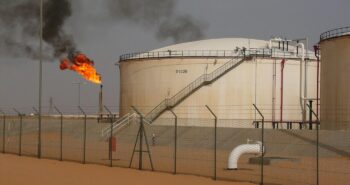
But the new Haftar-Russian relationship is not just a military one. Despite Wagner’s transformation into an official Russian presence, there is no sign that smuggling has abated. Between April 14 and May 12 2024, Benghazi received 300 million litres of diesel, six times more than Tripoli—even though the capital serves roughly a third of Libya’s entire population. This demonstrates how Libya is financially vital to Russia, as well as logistically vital to the Africa Corps regional mission.
Alongside this, the Russian connection is building up the LAAF as a diplomatic centre for the Kremlin’s Africa cluster. In the wake of Russia’s new relationship with Niger, Haftar immediately reached out to increase security cooperation with the junta, particularly on migration issues. This was followed up by a regional tour from Saddam Haftar in summer 2024, including visits to Ouagadougou in July and then Niamey in September, suggesting that Libya may even formally join the Sahelian diplomatic expression of the entente roscolonial: the Alliance of Sahelian States.
These visits also led to a flourishing of cross-border cooperation between Saddam, Chad’s president Mahamat Déby, and Niger’s junta. This involves working with Niamey trying to stop the free movement of Touareg separatists who are causing Russia such grief in Mali, and closer cooperation in cross-border smuggling of everything from people to cocaine. Similarly, cooperation between the LAAF and Chad on managing fuel and gold smuggling in their cross-border regions is deepening. This highlights how Saddam is passing on his lessons, helping Russia give both Niamey and N’Djamena[27] their own version of its “domestication” process in Libya itself.
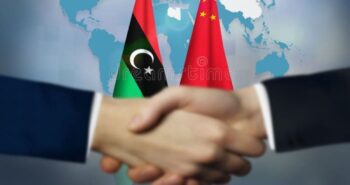
Moscow has also been building bridges throughout western Libya since re-opening the embassy in Tripoli at the start of 2024. Its ambassador, Aydar Aganin, an Arabic speaker who formerly headed up Russia Today’s Arabic language service, has been active building formal Russian connections across the country’s west. His deployment is the Libyan expression of the diplomatic component of Putin’s post-2022 Africa strategy: to appoint senior ambassadors with regional experience and links to the intelligence services across the Maghreb states.
As Saddam Haftar moved troops westward in August, western Libyan military leaders feared that key Tripoli-based groups would choose to deal with rather than fight the LAAF this time around. With Turkey now working more closely with the UAE and Russia—not just on Libyan energy with the Haftars, but on Sahelian security with other members of the entente roscolonial—they also questioned whether Turkey would support them once more. But Russia’s new relationships have cracked some of its older ones.
As Saddam sought to take the Ghadames basin on Libya’s southwestern border with Algeria, the last set of oil fields outside Haftar’s control, Algiers pushed back hard. Russia had tried to lay the diplomatic groundwork in Algiers, only to have its request to turn a blind-eye to Haftar’s move rejected. But Algeria also communicated it would intervene if Haftar moved on western Libya. This is indicative of a worsening relationship between Moscow and its oldest regional ally, which has also voiced concern over Russian weapons deliveries to Mali.
Domestication in the roscolonial
As Libya demonstrates, this late stage of the Russian relationship looks rather colonial. As in Assad’s Syria until last December, it comprises a brutally oppressive militarised regime that needs to be propped up by Moscow and other partners like the UAE. This helps compensate for the regime’s lack of domestic legitimacy and is fully geared towards extracting wealth from the country. Syria was a rare example of how this all ends. Eventually the parasitic dictator hollows out his country to such a degree it is no longer able to support him, leading to implosion.
Despite not having legal authority, Haftar has enough de-facto power to allow Moscow to develop a meaningful proxy and seize Libyan assets. And Russia’s influence is not limited to Libya’s east. Its vision resonates with Libya’s elite, helping Moscow stand out from an international crowd that has become increasingly disaffected and distracted. The country is thus now waving many red flags of “Syrianisation”: the catastrophe in Derna, the carve-up of the oil industry, and the transformation of Libyan state and security systems into what are effectively smuggling mafias.
The process that Russia has followed in Libya looks to be turning into a production line. Chad’s Déby and Niger’s Tchiani, for example, are both developing close relations with Moscow. They are also both supported by the LAAF, and new smuggling and criminal synergies have emerged between all these parties. Indeed, across the coup belt and in Sudan, Russia has tried—not successfully so far—to fill European security vacuums to serve its own interests. But it needs its Libyan linchpin to support these operations.
To remove it, Europeans will have to dust off a tool that may seem quaint in this age of Western-enabled ethnic cleansing in Gaza and European migration deals with warlords in Libya: working to enforce international norms. Russia was able to embed in Libya to such an extent because the international community seemingly gave up on norms around the country—such as defending the arms embargo, fighting illicit oil sales, and empowering a political process. This created another vacuum that Russia is filling and pushing to expand. But the story of Russia in Libya holds other lessons, too.
***
Tarek Megerisi is a senior policy fellow with the Middle East and North Africa programme at the European Council on Foreign Relations. His work mainly addresses how European policy making towards the Maghreb and Mediterranean regions can become more strategic, harmonious, and incisive—with a long-term focus on Libya.
_________________________