The MED This Week newsletter provides informed insights on the most significant developments in the MENA region, bringing together unique opinions and reliable foresight on future scenarios. Today, we shed light on the Libya’s persistent fragility and the efforts to overcome it.
Stability in Libya still seems far on the horizon. The country remains divided between two centres of power– the West, governed by the Government of National Unity (GNU), and the East, controlled by Haftar’s Libyan National Army (LNA) – with fragile institutions constantly on the brink of violence. Rising tensions in Tripoli are once again fueling fears that renewed military escalation could spread through the city.
Pro-GNU forces are seeking to consolidate control at the expense of rival armed groups, particularly the Special Deterrence Force (Al-Rada), with which there had already been clashes in May 2025.
Against this backdrop, three years after the last meeting between Khalifa Haftar and Abdul Hamid Dbeibah, on 3 September 2025, Saddam Haftar, son of Haftar and recently appointed as Deputy General Commander of the LNA, met in Rome with Ibrahim Dbeibah, nephew of Dbeibah.
Although details of the meeting are still unclear, questions are mounting about its purpose and its implications for Libya’s future. The presence of US Envoy for Africa Massad Boulos also signaled renewed interest by the Trump Administration in the Libyan dossier.
Yet, another player is stepping up: Turkey. Long considered a “historic” ally of Western Libya, Ankara has increasingly reached out to the Eastern camp, raising the prospect of becoming an even more prominent force in shaping the country’s trajectory.
Meanwhile, back in August, UN Special Representative for Libya Hanna Tetteh presented a new roadmap for Libya, built around three central goals: forming a unified national government for both Libyas, establishing a credible electoral system, and launching an inclusive dialogue.
However, critics warn that the roadmap falls short of addressing the systemic flaws at the heart of Libya’s crisis, and risks reproducing the same patterns that derailed previous initiatives.
Experts from the ISPI network discuss Libya’s persistent fragility.
Rome hosted the two Libyas, but remains
on the backdrop
“In a context marked by a looming deterioration of the security situation in Tripoli, discreet talks between Ibrahim Dbeibah and Saddam Haftar, as well as shifting stances of influential foreign actors involved in Libya, Rome hopes that there is still room to avoid another escalation in its southern neighbour.
Italy fears repercussions of instability in terms of a further rise in the number of people crossing the Mediterranean and of new threats to its energy supply – basically the two main drivers of its approach to Libya over the past years. However, as the Dbeibah-Haftar talks demonstrate, of which Rome was only the venue as negotiations were led by the United States, this approach has shown its limits.
Prioritising migration management over consistent efforts to stabilise Libya and playing an ambiguous role by engaging with both western and eastern Libyan authorities, Rome has seen its influence over the crisis progressively declining and has slid to the backdrop of discussion on the future of the country.”
***
Aldo Liga, Research Fellow, ISPI MENA Centre
**************
Dbeibah’s zero-sum security:
consolidation at the cost of stability
“The deterioration of Tripoli’s security establishment reflects both long-term neglect and acute political pressures. Following the UN Special Representative Hanna Tetteh’s political roadmap announcement, the regional procession of diplomats to Haftar reinforced Dbeibah’s sense of existential threat, strengthening his rationale for consolidating control and portraying himself as an inevitable political fixture, much as Haftar did in the East.
Yet the GNU has never prioritised substantive security sector reform. Instead, it has entrenched a system of transactional deals with armed group leaders, privileging short-term loyalty and coercive leverage over institutional reform.
This dynamic is what heightened the risk for confrontation: one of the only remaining anti-GNU Tripoli-based groups – the socially entrenched Special Deterrence Force – has invested in entrenchment and alliance-building designed to raise the costs of Dbeibah’s consolidation, betting that withstanding Dbeibah’s pressures will ultimately yield leadership change.
In this climate, both camps interpret compromise as existentially threatening, turning security arrangements into zero-sum instruments of survival rather than pathways to stabilisation.”
***
Emaddeddin Badi, Expert, Centre on Armed Groups; Senior Fellow, Global Initiative
**************
Against Transnational Organized Crime
The new roadmap for Libya: Tetteh’s bid to break the Libyan deadlock
“The last roadmap is derivative of its predecessors’ efforts, and is similarly influenced by intervening nations in Libya despite their designs running contrary to what is best for Libyans and most stabilising for Libya.
This roadmap is distinguished by the move towards a new unifying government before elections, which could be a dangerous flashpoint. All Libyan institutions and politicians are broadly considered illegitimate.
So, there are valid fears that without changing the system, any new combination of these politicians will act as all their predecessors did in the same environment: derail the transition, entrench, and facilitate private interests in place of public good.
Ultimately, the roadmap’s success is dependent on the good faith engagement of international actors and their willingness to use coercive tools like sanctions on spoilers. Something Tetteh’s predecessors all lacked and suffered for.
A fatal flaw Tetteh is trying to redress, by resurrecting the Berlin process.”
***]
Tarek Megerisi, Senior Policy Fellow, ECFR
**************
Trump’s new approach to Libya:
business first
“The first Trump Administration’s dealings with Libya were simply disastrous. In fact, following more than 2 years of almost complete neglect, there came five minutes of a phone call with General Haftar in which Trump endorsed the general’s brutal military attack against the city of Tripoli ‘as long as he did it quickly’.
No further words of comment are needed.
The second Trump Administration is a bit different only because more people belonging to the President’s entourage have been, one way or the other, interested, albeit only in the economic and business potential of the North African country.
The main word characterising most relationships between the Trump government and the various states has been ‘Transactional’, clearly framing every relationship within an economic and trade framework, not a political or social one.
The appointment of Massad Boulos, the father-in-law of Trump’s daughter Tiffany, as US envoy to Africa tells exactly this story, one of disinterest for every aspect of foreign policy planning and analysis in favour of basic business deals.”
***
Karim Mezran, Director, Resident Senior Fellow, North Africa Initiative, Atlantic Council; Senior Associate Research Fellow, ISPI
**************
Betting on both sides: Ankara’s
repositioning in Eastern Libya
“Few foreign policy pivots are as bold, or as fraught with risk, as betting on both sides of a civil conflict. Yet that is precisely what Turkey appears to be doing in Libya.
Having established military and political influence in western Libya, most notably through its decisive military intervention in support of the UN-backed GNU against Khalifa Haftar’s LNA in 2019-2020, Ankara is now extending olive branches to the East – to the very actors it once sought to marginalise.
The pace of this shift is striking. Turkey is reportedly preparing to expand security cooperation, including providing military training and arms sales, with the LNA, commanded by Haftar.
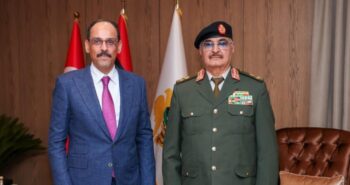
The Tobruk-based House of Representatives has formed a commission to review – and potentially ratify – the 2019 maritime and security agreements. In August, a Turkish naval vessel docked in Benghazi, followed by high-level talks between Intelligence Chief İbrahim Kalın and eastern Libya’s military leader Khalifa Haftar in Benghazi.
Taken together, these developments signal how rapidly Ankara is repositioning itself on Libya’s eastern front, seeking new security footholds to complement its growing economic presence in the last couple of years.”
***
Nebahat Tanrıverdi Yaşar, visiting Fellow, SWP
________________________