Julian Pecquet

The Trump administration has been multiplying outreach to both Tripoli and Benghazi. The US military is gambling that it can get Libya’s duelling factions to stop aiming at each other and focus instead on common threats.
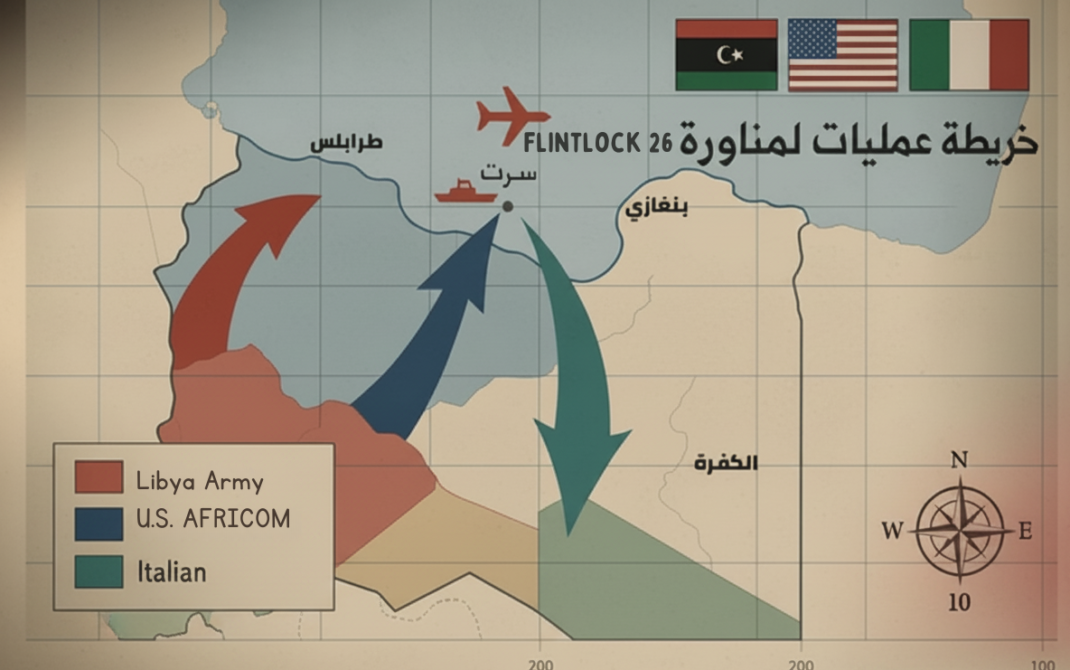
Lt. Gen. John Brennan, the deputy commander of US Africa Command (AFRICOM), announced on 14 October that next spring’s Flintlock training exercise will be held near Sirte in central Libya for the first time.
The coastal city is located on the ceasefire line established in 2020 after the Second Libyan Civil War between the government in Tripoli and eastern warlord Khalifa Haftar’s self-proclaimed Libyan National Army (LNA).
Unifying rivals
“The participation of western and eastern Libyan forces together marks a significant step forward in Libyan efforts towards unification of military institutions and enabling strong US-Libya security cooperation,” AFRICOM said in a statement.
Other training locations – or “spokes” – will be located in Mauritania and Côte d’Ivoire. Italy’s Special Forces Command is expected to enable the planning and execution of the Libya spoke. “Flintlock 26 will be a tangible demonstration of our growing partnership with Libyan military officers in both the west and east,” added Brennan.
“This exercise isn’t just about military training; it’s about overcoming divisions, building capacity, and supporting Libya’s sovereign right to determine its own future,” said Brennan, adding that these exercises will directly contribute to Libyan efforts to unify their military institutions.
Initially supportive of Tripoli, the US is now keen to accommodate both sides in the divided country, following the lead of regional actors including France, Italy, Egypt and Turkiye. The Pentagon hopes to empower the rival governments to fight jihadist groups and attenuate Russian influence in Haftar’s army, says Jonathan Winer, a former special envoy for Libya under president Barack Obama who is now a fellow with the Middle East Institute in Washington.
“It’s in the interest of Libya to be governed by one government, to have a civilian government that does civilian things, and a military that provides for security,” Winer tells The Africa Report. “When you have competing forces that attack one another, that creates conflict and stability.”
Signs of progress
AFRICOM’s largest annual special operations exercise, Flintlock aims to strengthen partner nations throughout Africa, in partnership with other international special operations forces. This year’s exercise in Côte d’Ivoire brought together some 500 personnel from more than 30 countries. Brennan’s announcement comes at the tail end of a weeklong visit to Libya during which he met with both members of Prime Minister Abdulhamid Dbeibeh’s Government of National Unity and Haftar’s forces. Unity and lasting stability will enable increased prosperity for the Libyan people and their international partners.
In Tripoli, the US general met with Deputy Defence Minister Abdulsalam Zubi, Chief of Staff Mohamed Haddad, and director of Military Intelligence Mahmoud Hamza in Tripoli; in Sirte, he was greeted by Lt. Gen. Saddam Haftar, Khalifa Haftar’s youngest son who was recently named deputy commander of the LNA. The Sirte training location was made possible by the recent relaxing of the international arms embargo on Libya, AFRICOM pointed out.
Business interests
In January, the UN Security Council updated restrictions imposed against Muammar Gaddafi’s regime in 2011, deciding that the arms embargo would no longer apply to technical assistance or training provided to Libyan security forces intended to promote the reunification of Libyan military and security institutions.
President Donald Trump has also been keen to develop US business interests in the oil-rich country, dispatching his senior adviser for Arab and African Affairs Massad Boulos to Tripoli and Benghazi in July to meet with Dbeibeh and Haftar. During his visit, Boulos joined the National Oil Corporation and New Jersey-based Hill International for the signing of a $235m infrastructure agreement supporting Libya’s modernisation efforts to boost gas production and exports.
“Libya’s national oil wealth has been divided between East and West for a while. They’ve been more or less accommodating one another, and to a considerable extent, providing an unstable equilibrium,” Winer says. “It’s an unstable equilibrium, but it does exist.” In its statement, AFRICOM pointed out that strengthening the US-Libya partnership and adding to Libya’s counter-terrorism capabilities would help to increase stability and opportunities for US investment.
“The US will continue to engage defence leaders in western and eastern Libya,” the US Embassy in Tripoli wrote on X. “Unity and lasting stability will enable increased prosperity for the Libyan people and their international partners.”
Gambling game
Winer says the US rapprochement with Benghazi can be explained by Trump’s disinterest in Haftar’s human rights violations. Nevertheless, Congress continues to impose restrictions on security assistance for military regimes. “The Trump administration may not care about that, but that’s still law,” he says. Libya’s threat is exacerbated by the country’s political rivalry and the rampant corruption in both the East and West, Winer points out. By working with Haftar especially, the US is legitimising his regime.
“This military exercise isn’t going to change any of the fundamentals on the ground, but it is signalling [that] we’re prepared to work with everybody,” Winer says. “Overall, is that the right policy for the US? It probably is.” “But that’s with some caveats,” he adds. “The caveats go to human rights in particular, the failure to have elections move forward, the limited legitimacy of essentially all the actors in Libya, and the massive corruption.”
______________