Ahmed Al-Khamesi

Libya’s deepening cash crisis fuels long queues, shrinking withdrawals, ATM failures, and worsening public frustration.
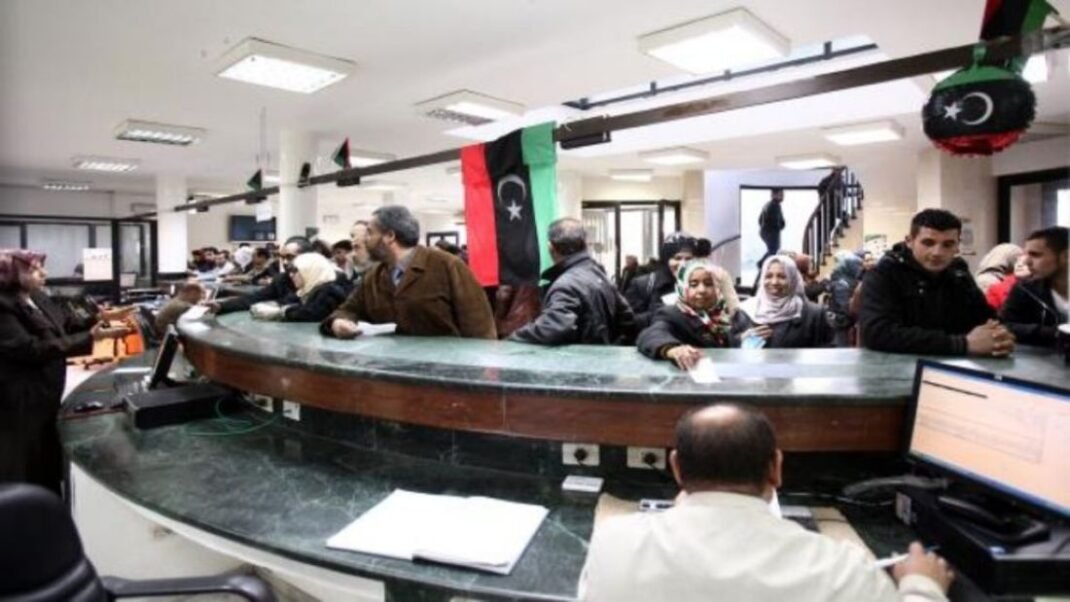
In scenes that have become routine across Libya, 70-year-old Mohammed Al-Taib spent more than seven hours outside Jumhouria Bank’s University of Tripoli branch hoping to withdraw 2,000 dinars (363 dollars). When he finally reached the counter, he was told the bank had cut the limit to just 1,000 dinars.
“Cash is available only two days a month, and the rest of the time the bank is empty,” he told Al-Araby Al-Jadeed, exhausted and frustrated. “I don’t understand how a university professor ends up searching for cash he can’t find.”
The situation is similar at ATMs near Tripoli port. Fateh Al-Tawergi, 45, said he spent a full day trying to find a functioning machine. “Most ATMs simply have no cash, and even when they work, withdrawals rarely exceed 1,000 dinar,” he said.
Financial analyst Abdel Hakim Amer says the Central Bank’s withdrawal of roughly 45 billion dinars from circulation in recent months has deepened the liquidity crunch. Electronic payment platforms have failed to bridge the gap because large parts of the economy, from shops and bakeries to clinics and real estate, still rely almost entirely on cash, he added. He warned that the crisis may persist even if the Central Bank resumes cash injections, calling it “structural, not temporary.”
Across multiple cities, banks face the same pressures: long lines, shrinking withdrawal ceilings, and ATMs that go out of order more often than they operate.
Economist Juma Al-Muntasir says this is no longer a case of mismanagement but a sign of a deeper monetary crisis driven by overlapping political, financial, and banking pressures. The liquidity shortage coincides with deteriorating banking services, delayed transactions, recurring system failures, and daily overcrowding, he noted.
The core issue is “the absence of a modern banking infrastructure capable of meeting demand more than liquidity”, he argued. Most branches still “rely on outdated systems without stable data centres, leaving them vulnerable to shutdowns from even minor glitches.”
Banker Ahmad Al-Ghuriyani added that the lack of a clear reform plan is worsening the crisis. “The Central Bank has yet to announce a strategy to upgrade services or modernise its technological backbone, which means that citizens will continue to face queues for a longer period,” he explained. Improving banking services is as crucial as restoring liquidity, as “ending dependence on cash” and rebuilding trust in the banking system are essential for any real economic recovery in Libya, he stressed.
Compound problems
The monetary turmoil in Libya is rooted in years of political division and competing financial authorities. After 2011, the country split between a UN-recognised government in Tripoli and a rival administration in the east backed by warlord Khalifa Haftar. The divide produced two central banks that printed separate currencies, fuelling shortages, counterfeiting, and widespread mistrust in the financial system.
Since 2014, with the eruption of internal conflict, access to foreign currency at official rates has been severely restricted. The dinar has lost most of its value, widening the gap between official and black-market exchange rates.
The mistrust in the bank makes many Libyans prefer to use cash rather than leave their money in the bank. Large amounts now circulate outside the formal banking sector, deepening the liquidity crisis.
Souq al-Mushir in Tripoli is the country’s main black-market hub and has functioned as the primary venue for buying and selling foreign currency since 2012. Most Libyans, including refugees and migrants, have depended on it amid bank withdrawal limits and cash scarcity, exchanging dinars for dollars at rates up to five times higher than the official but largely inaccessible rate.
In 2018, a dispute between the eastern and western authorities over control of the Central Bank repeatedly triggered shortages of physical banknotes. The Libyan Central Bank has since restricted the distribution of cash in the country. With Libya’s economy still overwhelmingly cash-based, limits on cash distribution have hit the population hard.
The crisis was also recurrent in August 2024 over the division crisis that happened between the two central banks.
This time, the crisis comes as part of the CBL’s wider policy drive to reduce money laundering, reduce the grey economy and tax evasion, reduce demand for the US dollar in the black market and strengthen the Libyan dinar.
In October 2025, the bank withdrew 1-, 5-, and 20-dinar notes after uncovering billions in forged currency, effectively removing 20 billion dinars from circulation while replacing it with less. To ease shortages, the bank authorised the printing of 60 billion dinars ($11 billion) in new notes.
Also, Libya’s rival governments agreed to unify the development budget, a move the Central Bank says will improve transparency, consolidate spending, and prevent duplicate projects. Public expenditure of the two governments reached 270 billion dinars in October 2025, with projections rising to 330 billion by year’s end.
Authorities also shut down the Souq al-Mushir currency market in early October as part of a plan to narrow the gap between official and parallel exchange rates to just a few piasters.
To manage the cash crunch, the government is accelerating the shift to electronic payments, which were first introduced in 2016 to address the shortage of cash but expanded dramatically in 2025, while withdrawals remain capped at 1,000 dinars ($206) per transaction.
This all comes to preserve the strength of the Libyan dinar and enhance financial stability by the central bank, according to the authorities.
__________________________