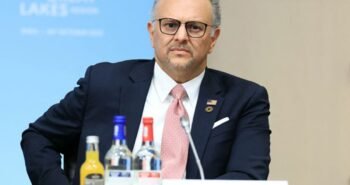
Gustav Ellison

For more than a decade, Libya has been the testing ground for one failed international experiment after another. Western capitals have imposed political formulas that deepened the crisis, backed rival factions according to their own interests, and treated Libya less as a sovereign state than as a laboratory. No institution has failed Libya more consistently—or more visibly—than the United Nations.
From Bernardino León to Martin Kobler, from Ghassan Salamé to Stephanie Williams, from Jan Kubiš to Abdoulaye Bathily, Libya has endured a conveyor belt of UN envoys whose mandates repeatedly sidelined Libyan society, empowered unelected elites, entrenched militias, and produced agreements that collapsed the moment foreign diplomats boarded their flights home. Each envoy promised a “final roadmap,” a “last chance,” a “comprehensive solution.” Each left behind deeper fragmentation, greater distrust, and a political process drifting even further away from the will of the Libyan people.
All the while, as envoys cycled through conference rooms in Geneva, Tunis, and Abu Dhabi, Libya’s youth—the majority of the population—watched their future being negotiated into irrelevance.
That moment is ending. Libya’s young generation is no longer waiting at the margins of a political process designed by foreign envoys and managed by transitional elites. It is moving to the center.
The youth conference held in Tripoli on December 4 under the umbrella of the National Forum for Unity and Peace was not simply another gathering. It marked a rupture with the entire architecture the UN has attempted to build since 2011. Hundreds of young Libyans from every region came together, not to endorse yet another transitional arrangement or to debate another externally drafted roadmap, but to assert a single, clear, unified demand: restore the 1951 Independence Constitution and the Constitutional Monarchy as the only legitimate and nationally accepted foundation for Libya’s future.
Youth conference in Tripoli.
It is the most consequential political shift Libya has witnessed in a generation.
While UN envoys have spent years trying, and failing, to engineer “inclusive dialogues,” Libya’s youth have produced the first genuinely inclusive political mobilisation since the uprising: a movement that transcends tribe, region, gender, generation, and political faction. It stands alongside the women’s conference of November 22 and the nearly thousand-person gathering of November 15 as evidence of a new national consensus emerging from society itself, not from international summits or closed-door negotiations.
What makes this moment so powerful is not only the scale of participation, but the precision of the message. The era of externally imposed solutions is over. Libya’s youth will no longer accept political systems negotiated by envoys who rotate out every 18 months and leave Libyans to live with the wreckage. They have identified the only framework that has ever united the country: the 1951 Independence Constitution.
Under that constitution, Libya enshrined education as a right, founded its first university, and began the transformation from one of the world’s poorest nations into a state investing in its own human capital. The document created institutions, conferred legitimacy, and, most critically, fostered national unity under a monarchy that stood above factional divides.
It remains the only constitutional order Libya has ever freely chosen, and no parliament or lawful authority ever annulled it.
This is what Libya’s youth have rediscovered through the national dialogue process led by Crown Prince Mohammed El Senussi over the past eighteen months. While Western governments backed competing governments, militias, and special envoys, the Crown Prince offered something none of them could: a unifying vision grounded in law, historical memory, and the lived experience of the Libyan people.
Libya’s youth now represent the political game-changer no UN envoy anticipated. Across the world, from Eastern Europe to Latin America to North Africa, youth movements have upended stagnant systems and dislodged entrenched elites.
Libya’s young generation is following that pattern with a uniquely powerful anchor: a constitutional inheritance that offers both stability and the possibility of democratic evolution. Unlike the UN’s endlessly recycled “roadmaps,” the 1951 Constitution contains clear amendment mechanisms, allowing Libyans themselves—not foreign diplomats—to modernise it in line with contemporary needs.
The UN has had thirteen years to help build stability in Libya. Instead, it presided over fragmentation, parallel institutions, and a political class largely unaccountable to citizens. Each envoy departed, leaving Libya more divided, its institutions more hollow than before.
Libya’s youth are attempting what the UN could not: articulating a coherent national vision, grounded in legitimacy, supported across generations, and rooted in a constitutional order that belongs entirely to Libyans.
Their message is unmistakable. Young Libyans are no longer asking the international community to devise solutions. They are telling it, plainly and persistently, what the solution is, and they are prepared to see it through.
The remaining question is not whether Libya’s youth are ready. It is whether the West and the UN are willing to stop standing in their way.
____________________