The Sentry

Executive Summary
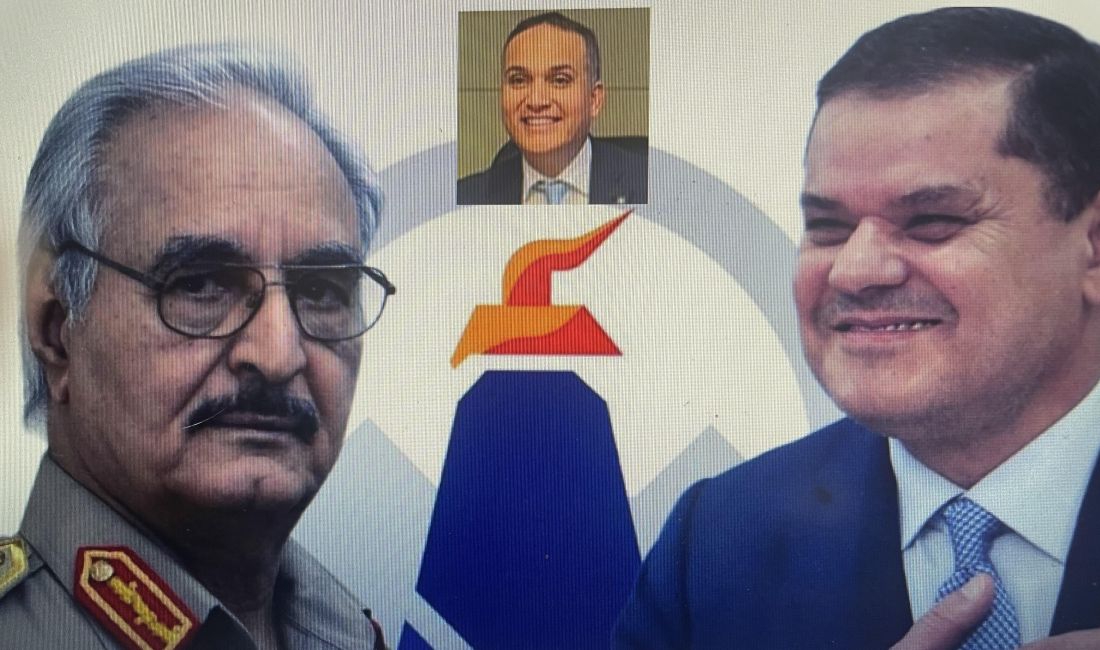
This investigation exposes the financial machinery that underwrote a significant part of Field Marshal Khalifa Haftar’s failed 2019–2020 offensive on Tripoli and documents the subsequent rise of a key enabler of the Haftar family’s kleptocratic activities: Ahmed Gadalla, also known as Ahmed Alushibe or Ahmed al-Aashibi.
Prior to the April 2019 assault, Gadalla utilized a set of companies based in the United Arab Emirates (UAE) to secure $300 million in loans from the Abu Dhabi-based Arab Bank for Foreign Investment and Trade, commonly known as al-Masraf bank.
These funds, backed by a guarantee deposit from the Libyan Foreign Bank (LFB), were funneled by Gadalla’s companies into the war effort, likely including payments to Russia’s Wagner Group. After Haftar’s offensive collapsed, the loans have remained largely unpaid, leaving the Libyan public to bear the financial burden while Gadalla has faced no accountability.
In the years since, Gadalla has transitioned from an obscure financier to a dominant force in eastern Libya’s economy, operating under the protection of Saddam Haftar, the field marshal’s son.
Gadalla has wielded control over the Bank of Commerce and Development (BCD) and other financial institutions in eastern Libya, such as Wahda Bank and National Commercial Bank, using them to facilitate large-scale letter-of-credit fraud and to launder illicit profits.
Through his control of BCD, Gadalla is also involved in the circulation of counterfeit Russian-printed dinars, a scheme that has helped undermine Libya’s local currency. Beyond financial abuses, Gadalla has served as a key enabler for the Haftar family’s transnational arms smuggling in apparent violation of the United Nations (UN) arms embargo on Libya.
Gadalla helped orchestrate several recent high-profile schemes, playing an active role in arranging the intricate payment structures and logistical routes necessary to illicitly transfer military equipment to Benghazi.
Incidents include the Haftars’ attempted importation of Chinese combat drones disguised as wind turbines in 2024 and their failed procurement of Spanish drones the prior year, not to mention the July 2025 shipment of armored vehicles and ammunition from the UAE intended for the Rapid Support Forces (RSF) militia in Sudan.
The Sentry sought comment from Gadalla and his companies, as well as from al-Masraf bank and the LFB on the allegations set forth in this report before publication. None of these parties responded to The Sentry’s requests for comment.
The scrutiny applied to Gadalla in this investigation serves a broader purpose: his prolific, multi-domain operations provide evidence of the profound structural deficiencies plaguing Libyan economic institutions. Rather than an isolated anomaly, Gadalla exemplifies the country’s systemic vulnerability and the unchecked rise of “enablers” who take advantage of institutional weakness and armed protection to help powerful figures loot state wealth.
By bridging the gap between militia violence and finance, figures like Gadalla assist warlords in translating territorial control into formidable economic sway. The impunity of such second-tier operators is sustained by the fragmentation of Libyan state institutions and the diplomatic hesitation of foreign governments, which remain reluctant to anger warlords perceived as essential to energy flows and migration control.
To dismantle this cycle, The Sentry recommends that the United States, Canada, the United Kingdom, and the European Union (EU) impose targeted network sanctions on Ahmed Gadalla, his companies, and his associates. Without concerted international action to hold enablers like Gadalla accountable, Libya faces the continued erosion of its economic foundations and the entrenchment of large-scale kleptocracy.
How Libyan Money Funded Haftar’s
Failed Offensive on Tripoli
On April 4, 2019, the Libyan Arab Armed Forces (LAAF) launched an offensive on the country’s capital, Tripoli. Field Marshal Haftar, based in eastern Libya, led the operation with Abu Dhabi as the primary foreign backer.
The offensive required a roughly $700 million effort mobilized upfront. While the operation’s stated aim was to cleanse the western province of “terrorist groups [that] spread corruption,” Tripoli was then the seat of the UN-recognized Government of National Accord (GNA).
The Haftar family’s plan was to penetrate the city center, topple GNA Prime Minister Fayez al-Sarraj, and place all major state institutions—including the Central Bank of Libya (CBL) and the National Oil Corporation (NOC)—under their authority.
The offensive quickly stalled as thousands of Haftar-aligned fighters reached the city’s outskirts, followed by a prolonged and lethal stalemate. As the war dragged on, the involvement of foreign mercenaries, advanced weaponry, and large-scale logistics made clear that vast sums had been funneled into the campaign—underscoring the financial engineering behind Haftar’s April 2019 push, which drew military support not only from the UAE but also from Russia, France, and Egypt, as well as diplomatic acquiescence from the United States.
Despite the participation of Russian combatants from the Wagner Group and Abu Dhabi’s direct involvement, which included more than 1,000 Emirati airstrikes across greater Tripoli in the following months, Haftar’s forces failed to capture the capital. Though ultimately ineffective, the war effort proved exceedingly costly.
Just before the attack began, the Haftar coalition, with the help of key enablers, secured $300 million in loans.
The Arab Bank for Investment and Foreign Trade, a minor Abu Dhabi-based bank often referred to as al-Masraf, disbursed loans backed by a guarantee deposit from the LFB, a strategic CBL subsidiary.
The Emirates Investment Authority and the LFB each held 42.28% of al-Masraf at the time, allowing the two to supersede the bank’s other shareholder—Banque Extérieure d’Algérie. The funds helped sustain the armed offensive, and part of the money likely went toward remunerating Russia’s Wagner Group, which engaged on the front lines of the assault between September 2019 and May. Ultimately, Haftar withdrew from the greater Tripoli area following the collapse of his forces on June 4, 2020.
The campaign left broad swathes of the Libyan capital’s southern outskirts in ruins and displaced approximately 149,000 residents. The bulk of the $300 million had not been repaid as of the date of this report’s publication, saddling the LFB—and thus the Libyan public—with the financial burden. Details of how the $300 million in loans came to finance the Haftar campaign were never publicly disclosed.
Through interviews, research, and analysis of numerous financial and other documents, The Sentry has found that Libyan businessman and financier Ahmed “Alushibe” Gadalla’s Dubai-based entities helped secure the loans and divert the money to fund the conflict.
Since the Haftar family’s military debacle on the edges of Tripoli six years ago, neither Gadalla nor anyone else has been held accountable for redirecting ostensibly civilian transactions toward the procurement of military equipment and foreign mercenaries, potentially violating the UN arms embargo on Libya.
Since 2019, Gadalla has only risen in prominence within Haftar’s inner circle. He continues to operate with impunity, facilitating arms smuggling, money laundering, and a host of other illicit activities that exploit state institutions to further the country’s kleptocratic boom.
Gadalla was featured several times in a UN Panel of Experts on Libya report posted on the internet on March 29, 2026. In that document, Gadalla—referred to as Ahmed Alushibe—is identified as the person who controls a network of shipping companies, several banks in eastern Libya, and shell companies, including in Dubai, that were used to circumvent the UN arms embargo, fraudulently obtain letters of credit from the Central Bank of Libya, and illicitly export refined petroleum products from the country. Before publication of this report, The Sentry sent requests for comment to Mr. Gadalla. He did not respond.
______________________