Andrea Cellino

The Vacuum Russia, Turkey, and
the UAE Have Filled
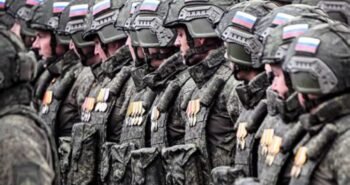
The consequence of EU depoliticization has been a structural vacuum that other powers have filled with far greater effectiveness. Turkey’s military intervention in 2019-2020 reversed Haftar’s offensive on Tripoli, earning Ankara a permanent military presence in western Libya and an increased degree of influence over the GNU. Russia, which supported Haftar’s offensive through the Wagner Group (now operating under the Africa Corps brand), is entrenched in eastern Libya and the broader Sahel corridor.
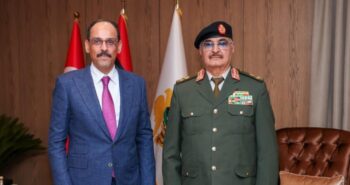
The Panel of Experts of the UN described the arms embargo as “totally ineffective” and noted “widespread and flagrant” violations, including by Russia. The UAE has been a consistent financial and military backer of Haftar, largely undisturbed by EU diplomatic pressure. In 2025, the Haftar family conducted a systematic international legitimation campaign: Khalifa Haftar was received by Macron in Paris in February and by Putin in Moscow in May, while his son Saddam visited the United States, Turkey, Italy, and Niger.
The EU’s Operation Irini, the naval mission supposed to enforce the arms embargo, has been criticized for selectively inspecting cargo while remaining cautious where inspections might interfere with migration cooperation. EU officials contest this characterization, noting structural constraints: Naval law bars the inspection of Turkish military vessels; few member states make ports available for cargo diversion; and arms flows have increasingly shifted to air transport, beyond Irini’s interdiction capacity. Yet the political perception — that Irini polices migration routes more effectively than weapons flows — has stuck and is not easily dismissed.
The UNSMIL Roadmap: A Test Europe
Is Failing
In August 2025, UNSMIL Special Representative Hanna Serwaa Tetteh presented the Security Council with a new roadmap structured around three pillars: an electoral framework for presidential and parliamentary elections, institutional unification through a new government, and a structured dialogue on governance, economy, security, and reconciliation.
Tetteh indicated that national elections could be held within 12 to 18 months if the roadmap is successfully implemented. The EU’s response was limited to declarations of support by the EU Delegation and member state missions in Libya, alongside general endorsements in UN fora.
No specific EU political initiative has followed. The October 2025 launch of the New EU Pact for the Mediterranean, while signaling a rhetorical shift towards treating Mediterranean partners as “geopolitical actors to be managed,” offers little concrete change for Libya: The document prioritizes migration control and contains only a weak reference to human rights, good governance, and rule of law.
Recommendations: Reclaiming a
Political Role
If the EU is to halt its slide into irrelevance in Libya, several reorientations are necessary.
First, develop a common EU political position on the UNSMIL roadmap. UNSMIL’s three-pillar framework offers an external scaffold the EU could more actively support rather than merely endorse. This means coordinating member state diplomatic positions around concrete benchmarks — electoral legislation, institutional unification timelines — and ending the pattern by which France, Italy, Greece, and Malta pursue separate bilateral tracks that undermine collective credibility.
Second, use SC16337 to push for executive interdiction powers for Irini. In April 2026, the Security Council passed resolution SC16337, requiring that payments for Libyan crude oil be routed exclusively through National Oil Corporation accounts at the Libyan Foreign Bank — a significant step towards closing the illicit export channels that have long undermined both the sanctions regime and Libya’s fiscal unity. With Irini’s mandate already extended until March 2027, the EU should now press for the mission’s hydrocarbon role to be upgraded from monitoring to active interdiction: The financial architecture is in place; what is missing is the enforcement capacity to give it teeth.
Third, engage eastern Libya without conferring unilateral legitimacy. Technical contacts with Haftar’s administration are pragmatically unavoidable given his control over coastline, oil infrastructure, and migration routes. But the planned Benghazi coordination center should not proceed without a clear political framework that includes commitments on human rights and alignment with the UNSMIL roadmap — conditions, not blank checks.
Fourth, build on the unified budget as economic glue. In April 2026, Libya’s rival legislative chambers approved a unified state budget for the first time since 2013 — a Libyan-owned agreement with the Central Bank as its neutral anchor. The EU should seize this opening by conditioning a meaningful share of its NDICI assistance on alignment with unified budget mechanisms, supporting public financial management and audit institutions that serve both administrations. Strengthening the NOC-Central Bank revenue-sharing nexus — the one economic arrangement both sides have an interest in preserving — gives the EU real leverage without the zero-sum dynamics that Russia, Turkey, and the UAE exploit on the security track.
Fifth, make transparency non-negotiable. The EU has never suspended assistance to Libya over documented rights violations, rendering conditionality threats hollow. All programs touching border management or detention should be subject to mandatory, independent human rights impact assessments with published findings — giving civil society and the European Parliament concrete grounds to hold the Commission to account where political will to act has consistently been absent.
The window for reclaiming political relevance in Libya is narrowing, not closed. Each year of Russian and Turkish military entrenchment and EU technical retreat makes a credible future initiative harder to launch. What the EU has demonstrated is that money, in the absence of political will, does not buy influence — it buys the appearance of engagement while others shape the facts on the ground. Reversing this requires accepting that stabilization in Libya is not a technical problem to be managed but a political challenge to be confronted, even when doing so demands difficult choices among member states that have long preferred comfortable inaction.
***
Andrea Cellino is Vice President at MEIS, the Middle East Institute Switzerland, and Non-Resident Executive Fellow at GCSP, the Geneva Centre for Security Policy.
_____________________