Gregory Aftandilian

Meddling Across Borders and Corruption
Continue Unabated
Such upbeat words belie facts on the ground, however. Haftar’s forces and allied militias have reportedly aided the Rapid Support Forces (RSF) in Sudan’s brutal civil war by taking over the so-called triangle area where the borders of Sudan, Libya, and Egypt meet. This territorial hold has allowed the RSF to smuggle gold, drugs, and people into Libya, often receiving arms and illicit petroleum exports in return.
The RSF has committed numerous human rights abuses, including the execution of thousands of civilians in the town of al-Fasher in the North Darfur province, which makes it difficult to say, as Saddam Haftar claimed, that Libyan security forces are reliably contributing to regional peace and security.
Both Libyan administrations are engaged in extensive corruption schemes. In the words of one analyst, in western Libya “the appearance of state-building masks a far more predatory ecosystem. Over the past decade, ministries, public agencies, and state-owned enterprises have morphed into personal fiefdoms for factions that operate more like organized crime families than political actors.”
In eastern Libya, where most of the country’s oil fields are located, Saddam Haftar has, as that same analyst put it, “refined the art of large-scale fuel smuggling, exploiting Libya’s heavily subsidized fuel system to siphon off billions [of dollars] annually.” Such smuggling schemes deprive the state of hard currency and contribute to a collapsing welfare system.
The International Monetary Fund has noted persistently large fiscal deficits, which have put pressure on the exchange rate, foreign exchange reserves, and inflation, exacerbating social tensions. Many Libyan citizens are angry over their living conditions, given that Libya is an oil-rich country with only 7.5 million people but according to 2023 data has a poverty rate of nearly 40 percent.
Human rights groups have castigated both of Libya’s governments. Human Rights Watch, for example, recently noted that “armed groups, smugglers, and state authorities in Libya have subjected migrants, including infants and young children, to arbitrary detention, extortion, forced labor, sexual violence, and other serious abuses.” It also reported widespread arbitrary detention, torture and ill treatment in facilities run by state-affiliated forces and armed groups.
The Damaging Role of Outside Players
External powers, including Egypt, Russia, Turkey, and the United Arab Emirates (UAE), are known to have assisted Libya’s rival factions to further their own agendas, with other outside actors such as the European Union (EU) also contributing negatively to the situation.
A March 2026 report by the UN Security Council’s Panel of Experts on Libya, mandated to monitor weapons embargo violations and other illicit activities involving the North African country, discusses the involvement of foreign actors in illegal schemes that fund Libya’s militias. The UN report confirmed the findings of a 2025 investigation by the Italian publication Il Foglio of an elaborate scheme involving the UAE and a notorious Libyan businessman known as Ahmed Gadalla, who is close to Saddam Haftar.
The investigation showed that foreign actors continue to violate the UN embargo on weapons and other military items destined for Libya. It also revealed either lapsed judgment or a cover-up by the EU’s naval mission, Operation IRINI, which was established to monitor the arms embargo.
According to Il Foglio, in July 2025, a container ship that left the UAE port of Jebel Ali was intercepted by frigates associated with IRINI in the Mediterranean Sea near the port of Derna, Libya, after a tip-off from US intelligence. The cargo ship was then escorted to the Greek port of Astakos for inspection. Although the ship officially declared that it was only carrying cosmetics, cigarettes, and electronic equipment, it was actually transporting 240 pickup trucks destined for Libya, 86 of which were armored.
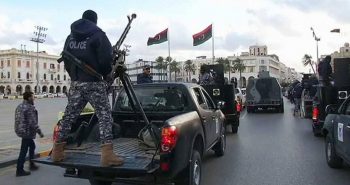
Typically used for mounting machine guns, these trucks are the vehicles of choice for Libyan and Sudanese militias. The UN has defined these trucks as military equipment and their shipment is considered a violation of the embargo.
The investigation revealed that the decision to allow the ship to leave for Libya was the result of “secret negotiations” between the EU, Greece, the UAE, and the two Libyan authorities in the east and the west. According to Il Foglio, Greece—worried about the wave of migrants coming from eastern Libya to Crete—sought to avoid offending Haftar and to prevent any retaliation in the form of a new irregular migration surge, decided that allowing the cargo to Libya was the “lesser evil.” Instead of offloading the trucks in Tripoli, the ship docked in Misrata, a port under the control of Dbeibah’s government.
Some 209 trucks were offloaded there; the rest were delivered to Benghazi, suggesting that both Libyan governments were involved in the scheme. The March 2026 UN report noted that 26 of the trucks wound up in the hands of a Libyan militia, al-Katiba 55, that run a notorious prison camp for migrants near Tripoli.
No Political Solution in Sight
Libya’s government is likely to remain divided for some time. Each administration benefits from the status quo through corruption schemes, while the militias depend on patronage that they receive from the governments or on revenues from their own rackets. While recent cooperation to agree on a unified budget may be encouraging, the fundamentals of the situation have not changed.
The decision by AFRICOM to host military exercises in Libya and to include military units belonging to each Libyan administration has done nothing to foster unity. Indeed, all it has probably achieved is to make those factions feel important. Rather than trying to forge unity through military posturing, the international community should increase its efforts to stop oil smuggling out of Libya in exchange for arms.
Some moves in that direction are already underway. On April 14, 2026, the UN Security Council unanimously passed a resolution to reinforce international efforts to monitor and prevent illicit oil smuggling from Libya. The resolution reaffirmed that the NOC is the sole entity authorized to market Libya’s oil and called for a prohibition on depositing Libyan oil revenues anywhere but in official accounts.
Yet there appears to be no real mechanism to enforce such a resolution except to target individuals and entities with sanctions—an approach that obviously has not worked well in the past. Only if meaningful punitive measures are applied to those involved in illicit oil sales will there be pressure on the two administrations to hold national elections and to bring about a unified government.
***
Gregory Aftandilian is a Nonresident Fellow at Arab Center Washington DC. He is a Senior Professorial Lecturer at American University where he teaches courses on US foreign policy. He is also an adjunct faculty member at Boston University and George Mason University, teaching courses on Middle East politics.
_____________________