Hafed Al Ghwell

Libya’s unity is a political fiction masking entrenched fractures, rival power centers, and a decade of failed state-building.
For more than a decade, Libya has been treated as a country that merely needs one more election, one more agreement, or one more summit to finally reunify. But beneath this hopeful rhetoric lies a harsher landscape: rival quasi-states, militia fiefdoms, hollowed institutions, and a political class invested in preserving fragmentation. Laws, currencies, and even basic freedoms differ by region, creating separate realities for Libyans depending on which checkpoint they reach first.
Understanding this fractured landscape is essential, not only to puncture the illusion of a unified state but to imagine solutions grounded in what Libya actually is — not what outsiders wish it to be. The fiction of “one Libya” has survived so long, but it is critical to understand how it masks systems of power that thrive on division, and why a decentralized or federal framework may offer the only realistic path toward stability.
Libya’s long march toward democracy has been a tragic comedy of delusions and missed opportunities. Each time politicians or mediators pledge loyalty to a “unified Libya,” it papers over deep fractures born from a patchwork of rival governments and militia fiefdoms with competing claims to legitimacy. The sad truth is that after 11 years of limbo, violence, and highly touted summitry, Libya is as divided as ever. A flag in Tripoli means something very different from the one raised in Benghazi.
Since 2014, Libya has effectively split into two virtual quasi-states. In the west, a Tripoli-based administration, the UN-backed Government of National Unity (GNU), governs most of the population there. In the east and south, a different regime in Benghazi backed by an illegitimate House of Representatives (HoR) and the warlord Khalifa Haftar and his sons rules the rest. Each side keeps its own treasury, oil revenues, ministries, and taxes. In practice, a law or decree passed in Tripoli means absolutely nothing in the east and vice versa.
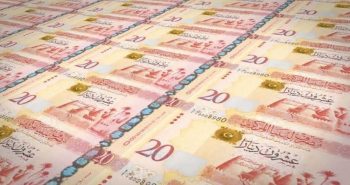
National institutions, the first casualty of Libya’s deepening fragmentation, have become hollow shells. The Central Bank of Libya, split after the 2014 clashes, briefly reunited in 2022 — only to fracture again. By late 2023, eastern authorities were secretly printing billions of dinars off the books. That flood of unrecorded cash worsened inflation and drove dollars underground, leaving ordinary Libyans in the lurch.
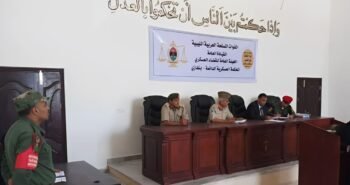
Security is no longer unified. Libya has no national army or police. Instead, dozens of militias hold real power under the banner of either the west or the east. In the east, Haftar’s so-called Libyan Arab Armed Forces (LAAF) commands numerous brigades, including extremist Salafi militias. In the west, Tripoli’s defense falls to other armed groups, from Rada Special Deterrence forces to Misratan brigades, some tied to the UN government, others not. These factions control airports, border posts, and checkpoints — all critical chokepoints for Libya’s economic activity. Libyans may draw salaries from the government, but on any given day, it is the gunmen, not the politicians, who hold sway.
The divisions even show up on the map of daily life. Consider the Soumoud Convoy bound for Gaza in June 2025. It was welcomed with open arms across western Libya, from Zliten to Misrata, with locals offering water, food, and aid. But a few hours later, as it neared Sirte, armed men under Haftar’s command halted it under the guise of “security.” Volunteers were stranded at a desert roadblock for days. This exposed an awful, often dismissed truth: Libya is not under one rule of law; each faction enforces its own. The split plays out in politics, too.
Take Libya’s municipal elections of 2024–25. Dozens of towns held council elections with remarkably high turnout (over 70% in the first round), a hopeful sign for local democracy after nearly a decade and a half of false starts. But in the east, parallel authorities simply cancelled elections in 27 municipalities, often through threats. Residents were simply told there would be no vote. So, while Libyans in the west and south were choosing mayors, Libyans under Haftar’s control were barred from voting at all, making a complete mockery of any claims that “one Libya votes as one.”
Money has also become a battlefield — perhaps Libya’s bloodiest to date. Libya’s economy depends almost entirely on oil, yet even that flow is contested. In 2024, eastern militias, for instance, shut half of Libya’s output (about 700,000 barrels per day) to press their demands. Tripoli’s National Oil Corporation may sign export deals, but eastern factions can simply seize shipments or shut down pipelines. For example, when Tripoli’s leaders fired the central bank governor, Haftar’s forces blocked ports and halted more than half of Libya’s oil exports, which cost well over $100 million in a few days. Elsewhere, separate printing presses churn out dinars, so Libyans cannot trust that the cash in their hands will be accepted tomorrow.
All the while, Libya’s politicians and foreign diplomats keep parroting the word “unity,” with every press conference and peace plan repeating the mantra of one country, one flag, one election. But these are empty words that are very detached from reality. On the ground, eastern elites have cemented their mini-state. In the west, leaders still negotiate through militia brokers. Neither side wants to give up control, yet outsiders insist on “one Libya” anyhow.
A dose of reality might be more useful than hope. Admitting that Libya is split does not mean surrender; it means starting from where the country is. It is no surprise that there are suggestions and murmurs of federalism, i.e., dividing Libya into its historical regions of Tripolitania, Cyrenaica, and Fezzan, or increasing them to several states, each with its own government under a weak central state. It sounds radical, but it would align formal structures with on-the-ground divisions. Better to manage a decentralized Libya than keep playing a unity game that only ends in violence.
History backs this lesson. Each time outsiders have tried a winner-take-all solution, Libyan factions have simply torn it apart. Every “final” roadmap collapsed when militias smelled defeat. Every unity government lasted only as long as its strongest backer allowed. Foreign mediators keep pushing all-or-nothing plans, as if militia brigades would simply disarm on command. They ignore that each side has heavy patrons of its own from Europe to the Gulf, and the past 11 years show clearly that power here is enforced at gunpoint, not by the ballot box.
The reality of Libya is a patchwork of fiefdoms and mafias, not the unified state its ruling elite claims it is. Cities like Sirte, Benghazi, Misrata and Sabha each have their own de facto “rulers,” since the “government” in Tripoli is mostly just a label on a map.
Libyans need practical fixes: empowered local councils, strengthened community policing, and newly built institutions from the ground up. It is in that radical reset that a sustainable balance will be found and a modern state built, perhaps a loose federation or rotating leadership, but one chosen by today’s realities, not sloganeering and fever dreams.
_____________________