The U.N.’s chief human rights official accuses Libya’s political leaders of crushing political dissent to cling to power, leaving the country divided and its people mired in crisis, poverty, and misery.
In a report submitted to the U.N. Human Rights Council Tuesday, Volker Türk, the U.N. high commissioner for human rights, presented a stinging rebuke of the methods employed by Libya’s governing elite to eviscerate its political opponents and remain in charge.
“A stalled political process, hijacked by actors whose interests align in preserving the status quo, is decimating the hope of Libyans for a more stable, open and thriving society. Hopes they have had to carry for far too long, with little in return,” he said.
The high commissioner’s report covers the human rights situation in Libya in the 12 months since April 2023. The report outlines “some disturbing developments,” among them an escalation in arbitrary arrests and detentions, enforced disappearances and detention-related violations.
“Targeting of political opponents and dissenting voices across the country has accelerated,” he said.
While the figure of those arrested is likely to be higher, he noted that his office has verified at least 60 cases of arbitrary detention of people who were “peacefully exercising their right to express political views.”
“In some cases, detention was followed by extrajudicial killing,” he said.
“All of this is corrosive to the prospects for healing Libya’s fractured social and political environment, especially as grievances around detentions were at the heart of the 2011 uprising,” he said.
He warned that lack of accountability for the violations and abuses committed 13 years ago “remains a serious obstacle to reconciliation today and serves as a driver of conflict.”
Libyan society is still divided 13 years after the country’s former dictator, Muammar Qaddafi, was overthrown. The country is ruled by two rival administrations: the internationally recognized Tripoli-based Government of National Unity and the Government of National Stability, which holds power in the east.
Libya has not had presidential or parliamentary elections since 2014.
At the council, the high commissioner denounced the widespread violations and abuses “perpetrated at scale with impunity” against migrants, refugees and asylum-seekers by both “state and non-state actors, often working in collusion.”
His report documents a litany of horrors to which these vulnerable, desperate people are subjected, including “trafficking, torture, forced labor, extortion, starvation in intolerable conditions of detention,” as well as mass expulsions and the sale of human beings, including children.
“And in March this year a mass grave was discovered in southwestern Libya, containing at least 65 bodies presumed to be migrants,” Türk said.
Following the discovery of the mass grave in March, the International Organization for Migration said, “The circumstances of their death and nationalities remain unknown, but it is believed that they died in the process of being smuggled through the desert.”
The high commissioner said, “As if this were not horrific enough, we are following up on reports of another mass grave recently discovered in the desert area at the Libyan-Tunisian border.”
Calling for investigations into these crimes, Türk said that “The responsibility for investigating these crimes falls squarely with the Libyan authorities. Reparations must be made, justice served and nothing like this must ever happen again.”
Halima Ibrahim Abdel Rahman, Libya’s minister of justice, did not respond to the high commissioner’s mass graves accusations, nor about his allegations regarding the abhorrent treatment of refugees, migrants and asylum seekers.
The minister said that some of the comments “are not in line with reality,” noting that “Libya gives special importance to the rights of refugees, although many of the refugees present in the territory of our country are there clandestinely.”
She also took umbrage at the high commissioner’s charges that human rights violations and abuses against political dissidents are committed with impunity.
“What we see in the report does not fully reflect the efforts taken by the judiciary because we have prosecuted a high number of individuals accused of violating human rights while providing all legal guarantees” to people in “all places of detention, which are under the control of the Ministry of Justice,” she said.
Human rights chief Türk urged Libya to restore the rule of law, including accountability for human rights violations, and to protect the peoples’ right to freedom of assembly and association.
“The stifling of civil society organizations, political activists, journalists and many others is fostering a climate of fear,” he said.
“It is also undermining the very foundations necessary for Libya’s democratic transition, emboldening the spoilers, and enabling security actors to perpetrate human rights violations with impunity,” he said.
Collusion among former enemies in Tripoli has opened up unprecedented access to funds for the east-based Haftar family, threatening a fragile equilibrium
Tripoli feels like a backwater these days — rather unusually so for a city on which Libya’s struggles over power and wealth have focused for the past 14 years. Now, all the action is elsewhere. Libyan businesspeople and foreign diplomats come back stunned from eastern Libya, describing with wide eyes how brand new roads, bridges, public buildings and housing projects are rising out of the ground at dizzying speed.
Their amazement at this sudden turn of events is all the greater as it comes after more than a decade during which large-scale infrastructure projects had been mostly on hold. But the reconstruction now underway in areas controlled by Libyan strongman Khalifa Haftar’s family is “unprecedented” even when compared with the late Gadhafi era, a Benghazi resident told me over the phone. (When you have written about the repression and corruption of the Haftars’ family-based power structure, as I have, it’s inadvisable to go and see for yourself.)
In Tripoli, by comparison, lethargy prevails. The only construction activity of any note is a motorway being built by an Egyptian consortium that cuts through Tripoli’s southern districts — an attempt by the Tripoli-based prime minister, Abdelhamid Dabeiba, to curry favor with the Egyptian government. Contractors working on other projects in western Libya complain that they’re having trouble getting paid unless they have allies in Dabeiba’s inner circle. And even if they do, business is slow: The government now has little access to funds for development.
This is a paradoxical state of affairs. Libya’s oil money, after all, is channeled through the National Oil Corp. (NOC) and the central bank. Both are headquartered in Tripoli and formally cooperate with Dabeiba’s government, rather than the rival administration led by Usama Hammad, which is based in Benghazi and provides a civilian facade to the rule of the Haftar clan. Officially, the central bank in Tripoli had not disbursed any funds to the Hammad government as of the time of writing. Opacity surrounds the financing of the large-scale projects in areas under the Haftars’ control — projects managed by an entity headed by one of Haftar’s sons, Belgasem, and a body that effectively reports to another, Saddam.
At the heart of the puzzle is a power struggle in Tripoli that has reshaped Libya’s political alliances and helped the Haftar family to unparalleled funds to dispense patronage. The Haftars have proven adept at exploiting that rift, between the seemingly immovable central bank governor, Siddiq Kabir, and Dabeiba — or more precisely, Dabeiba’s nephew Ibrahim, who is widely seen as the real power broker behind the Tripoli government. As a result of that struggle, the hemorrhage of state funds is worsening, Haftar’s sons are consolidating their power — and ultimately, the shaky balance that has maintained the calm in Libya over the past decade might come undone.
If Libyan politics has rarely made international headlines in recent years, this isn’t necessarily a good sign. Whereas the first decade after Gadhafi’s demise in 2011 was marked by turbulence and repeated civil wars, the period since 2022 has been one of deadlock and backroom deals. Politics is no longer a public affair but now plays out in the hidden machinations of a select few.
The basic contours are deceptively simple: two competing governments and military blocs, backed by two foreign powers — Turkey and Russia. Those two states’ military presence has prevented a relapse into civil war since western Libyan forces, supported by Turkey, defeated Khalifa Haftar’s offensive on Tripoli in mid-2020. In the wake of that conflict, U.N. mediation led to the formation of a unity government under Dabeiba in early 2021. But the U.N.’s plan to hold elections later that year failed. Dabeiba’s western Libyan discontents allied with Haftar to form a new government, but Dabeiba prevailed in the bidding contest for the loyalties of armed groups in Tripoli, leaving the rival administration nominally in charge of the Haftar-controlled east and south of the country.
But the formal divides have concealed increasing collusion between Libya’s leading antagonists. In July 2022, Ibrahim Dabeiba and Saddam Haftar struck a deal to appoint Haftar’s candidate, Farhat Bengdara, as head of the NOC. In exchange, Haftar lifted a partial blockade on oil production with which he had sought to pressure Prime Minister Dabeiba to stand down. From then on, oil exports once again washed revenues into the central bank, and thence on to the Tripoli government, which paid salaries across the country. Dabeiba and Kabir cooperated closely, each relying on the other to ensure their political survival.
For a while, it appeared that the stalemate offered a comfortable setup to all key players. Both the Haftars and their nominal adversaries — the core group of militia leaders who had ensured Dabeiba’s survival — captured ever greater sums of money and influence over the distribution of posts. Ibrahim Dabeiba and the commanders allied with him now dealt routinely with Haftar’s sons. The Dabeibas’ western Libyan opponents were marginalized, and clashes in Tripoli — previously common — became extremely rare. The pillage of state funds, which had provoked so many confrontations and sudden reversals, now proceeded in silence. Meanwhile, the two ruling families and their allied militia leaders accumulated ever more wealth and power.
There are competing narratives about what prompted Kabir’s falling-out with the prime minister, which ended this tranquil state of affairs in the summer of 2023. Kabir and his advisers emphasize that the Dabeiba government’s expenditure proved unsustainably high, requiring the central bank to suspend payment authorizations for everything other than salaries in October 2023. A particular point of discord, an adviser to Kabir told me in late 2023, was implausibly high spending in public sector bodies headed by close allies of Ibrahim Dabeiba, such as the administration handling payments for hospital treatment abroad. In public, Kabir voiced particular alarm at a dramatic increase in the bill for fuel imports and the corresponding decline in the proportion of oil export revenues that the NOC transfers to the central bank.
With fuel imports, Kabir pointed the finger at a key source of the Haftar clan’s finances. Libya has limited refining capacity and imports most of its fuel. The NOC buys the fuel at world market prices, but its subsidiaries then sell it to Libyan consumers at some of the lowest prices worldwide: a liter of gasoline costs about three cents at the official exchange rate. The price differential offers huge opportunities for illicit profit. Fuel smuggling to neighboring countries was common even in the Gadhafi era, but since 2011 industrial-scale networks have replaced small-time smugglers.
Haftar’s forces have been leading players in the fuel-smuggling market since they extended their control over much of Libya’s land and sea borders. Leadership became domination after Haftar’s nominee Bengdara took over at the NOC in mid-2022 and subsequently appointed a Saddam loyalist as the head of its subsidiary Brega, which handles fuel sales. Since then, the quantities of imported fuel have continued to grow, as has the scale of smuggling operations in areas under the Haftars’ control. The opaque system under which the NOC barters the fuel it imports for crude oil exports has also attracted accusations of irregularities — “a black box,” one senior financial official called it.
In the months preceding Bengdara’s appointment, tankers had occasionally loaded fuel at Benghazi’s port to smuggle it abroad. But thereafter, such shipments became routine, according to an expert panel that monitors violations of U.N. sanctions on Libya. Trucks load fuel at depots controlled by Haftar’s forces and pass through checkpoints manned by these forces on their way to Sudan and Chad, reaching as far as the Central African Republic. Businesspeople I spoke to who are involved in these networks, and sources close to the operations at Benghazi port, all name Saddam Haftar as the actor ultimately overseeing fuel smuggling. The profits, they allege, are reinvested in military units reporting directly to Saddam, his brother Khaled and other close relatives.
Kabir understandably charged that the growing cost of fuel imports underpinning these activities was unsustainable. From 2021 to 2023, the annual fuel import bill more than doubled, to $8.5 billion — equivalent to a third of the oil revenue transferred to Libya’s central bank that year. But by singling out fuel imports, Kabir also denounced financial arrangements over which he, as central bank governor, had lost control. Since Libya’s government institutions split in two in 2014, Kabir had been the central arbiter of both monetary and fiscal policy in Libya. Now, bartering by Bengdara’s NOC prevented any central bank oversight over fuel imports. More importantly, the reckless expansion of fuel smuggling enabled by these imports had to be seen as part of the tacit arrangements linking Prime Minister Dabeiba and Haftar. Whether Dabeiba liked it or not, they were a part of the price he had to pay to keep the oil flowing. These arrangements were at the heart of Libya’s politics, but they bypassed Kabir and thereby undermined his centrality.
Kabir and his entourage point the finger at the Dabeiba government’s corruption as the reason for the rift.
***
Wolfram Lacher is a senior associate at the German Institute for International and Security Affairs and the author of “Libya’s Fragmentation”
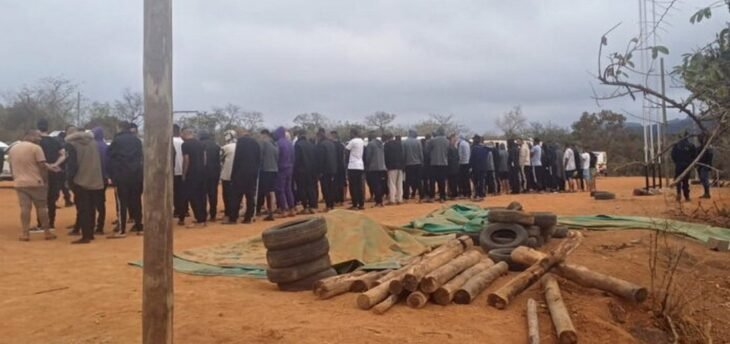
A training camp in South Africa, where 95 Libyans were detained last month, has been declared illegal for offering military-style training to individuals from a conflict zone. The camp, operated by Milites Dei Academy, was not accredited and violated several laws, with ongoing investigations into the legality of the training and the visa statuses of the detainees
A camp where 95 Libyans were detained last month is illegal as it provided military-style training to people from a country in conflict, South Africa’s security industry regulatory body said Wednesday.
The Libyans have been detained since July 26 when police raided the remote training camp near the town of White River about 360 kilometres (220 miles) east of Johannesburg.
The company running the facility was registered with the Private Security Industry Regulatory Authority but the camp where the Libyans were found was not accredited, PSIRA chief Manabela Chauke told reporters.
An investigation found that some of the instructors were not South African and the “standards of training that was offered was foreign or also adopted from other countries,” he said. Some of the trainers used military ranks.
Chauke did not give the nationalities of the instructors or say who contracted the training in South Africa.
Some reports have said the group may have been sent to South Africa to train for the Libyan faction of strongman Khalifa Haftar, who controls the oil-rich east of the unstable country.
Chauke said South Africa’s Foreign Military Assistance Act makes it illegal to offer military or security training “to a foreign national who originates from a country where there is armed conflict.”
The “design and the layout of the infrastructure of the Libyan camp supported a military-style training camp,” he said.
Milites Dei Academy, the security company running the camp, had violated various laws and criminal charges were being drawn up against the owners, whose licence had been suspended, Chauke said.
The head of the company has rejected wrongdoing, telling the country’s Sunday Times newspaper that the men were being trained as security guards and had the correct study permits and visas.
The government said last month the men had arrived in South Africa on visas that had been “irregularly acquired” in the Tunisian capital and based on “misrepresentation”. The visas had been cancelled.
The men have been charged with violating immigration rules. Their case has been postponed until August 26 for further investigation with authorities not ruling out further charges.
Movement in Libya: Haftar’s troops move towards the border with Algeria and Tunisia. They may be aiming to control an airport. Helped by the Russians. Khalifa Haftar ‘s troops are moving toward Ghadames, the oasis near the border with Algeria and Tunisia, rekindling the danger of a new internal war in Libya.
It is not certain that the leader of Cyrenaica wants to return to aiming, as some say, toward Tripoli. The objective, which he is pursuing together with his Russian allies , could be more modest: to take over the airport located in the oasis area. He would use it as a support point for himself and for Moscow, which would thus increasingly make Libya its hub for moving toward sub-Saharan Africa, where it already has many friendly governments. The soldiers led by General Haftar’s son, Saddam, could come to control the border with Algeria and Tunisia, after having already taken control of that of Egypt to the east.
In this way they would encircle Tripoli in a sort of “siege”, where the Dbeibah government is based, supported by the international community, the Turks and a great rival of the leader of Cyrenaica.
Why is Haftar moving his troops?
His zone of power in the country has consolidated, but I don’t think he has any interest in causing incidents. Russia, with the soldiers of the former Wagner, is giving him a hand. However, I don’t think that all this could be a prelude to an attack on Tripoli. In the first days of April there were already rumors of movements towards the capital by Haftar, but then nothing happened.
In short, it’s difficult to understand what the true intentions are?
Haftar’s troops are commanded by his two sons, Saddam and Khaled; the former, in particular, is very instinctive: two days ago he wanted to close the oil wells to spite Spain, which controls them in part with Repsol, then he realized that 40% of his income comes from there and he backtracked. Haftar could be interested in taking the airport near Ghadames, to strengthen his contacts and allow the Russians to move even more freely: Moscow could use it to move towards Mauritania and other countries in the area that interest it.
Will we continue from there towards other conquests?
I have my doubts that Haftar wants to go to a clash with the recognized Libyan government. At this moment, Westerners do not have much interest in Libya, because they believe that its instability is stable enough to allow each to cultivate their own interests. But if there were an escalation, they could intervene.
Are there disputes with Algeria and Tunisia that could explain such an action, given that we are right next to the border?
No; if there are movements, it is only to strengthen the positions of Haftar and the Russians. The official Libyan army, the one that refers to the government of Tripoli, is supported by the Turks, who are trying to compensate for the presence of the Russians: I believe that these movements were put in place to intimidate the rivals.
The government of Tripoli, although recognized by the international community, actually controls the city where it is based and not much more: could the acquisition of the airport be interpreted by Dbeibah as an insult and cause some friction?
We are in a country where uncertainty reigns supreme, there are also Islamic militias that are not on either side of the two major contenders, militias to which, among other things, Italy has turned to slow the flow of migrants. I repeat, the only thing that could interest Haftar is the airport. It would, however, be confirmation that Libya is increasingly becoming Russia’s hub in Africa: the part of the territory in Haftar’s hands will become pro-Russian.
Already now Russian men and resources destined for the Sahara pass through there.
That’s right, the Russians already have control of other airports; if they were to control this one too, they could expand their interests even further. I believe that they will not target Tripoli and that it will not come to a further clash. My personal opinion, however, is that in general they will not get anywhere. I think this is a demonstration action by Haftar, who wants to present himself as the strongman of Libya . The airport, a possible target of the action, is not defended: unlike the leader of Tripolitania, the official government has only a few battalions of local soldiers, a Turkish contingent and, scattered here and there, American and French companies: Haftar is much better equipped.
Will Haftar’s assault on Tripoli not happen, at least for now?
I don’t think he’ll throw himself into a conflict by burning everything he’s building, even with the West: he receives funding from Europe. The real danger is that Libya will confirm itself even more as a hub for the Russians, who are positioning themselves better and better by exploiting the West’s inactivity. What is certain is that, by conquering Ghadames, Haftar would somehow surround Tripoli, making his pressure on the central government felt even more.
The Kremlin is on a roll in large parts of Africa. In April, the Pentagon announced withdrawals of U.S. military forces from Chad and Niger, two key U.S. partners in counterterrorism efforts in the Sahel that are now turning to Russia for security assistance.
In the case of Niger, a military junta that seized power in a coup last year ordered U.S. personnel to leave a $100 million drone base. Meanwhile, the Kremlin has been pouring mercenaries, proxies, and materiel into Libya for the past six months, adding to its already sizable presence in that country.
Libya is now an important access point for Russia in the Mediterranean and a launching pad for operations elsewhere in Africa.
A string of coups across Africa since 2020 has allowed Moscow to strengthen its position on the continent, even as it funnels vast military and economic resources into the war in Ukraine.
Russia’s increased military, political, and economic presence in a diverse array of countries that now includes Burkina Faso, the Central African Republic, Mali, and Sudan also flies in the face of expectations expressed by U.S. Secretary of State Antony Blinken, who said in June 2023 that the full-scale invasion of Ukraine had “diminished Russian influence on every continent.”
More than two years into that war, Russia clearly remains capable of seizing opportunities to expand its reach in Africa and other parts of the world.
With so many other crises calling for the Biden administration’s attention, rolling back Russia’s advances in Africa will not be easy, not least because the Kremlin has ingratiated itself with many unsavory regimes there.
Moreover, Russia’s recent successes capitalize on a combination of worsening regional security dynamics and the continent’s postcolonial history. In the Sahel, for example, Russia touts its ability to help governments respond to rising violence and jihadist threats while scorning France, the former colonial power, for its long record of heavy-handedness and failed policies.
The key question for the United States is how to identify realistic policy goals that play to Washington’s strengths, align with U.S. values, and harness Africa’s enormous potential while recognizing that many countries want to hedge their bets when it comes to foreign partners.
Democratic and Republican administrations alike have often treated countering Russia as an end in itself, citing the demands of great-power competition as justification for action in every country where Moscow gains a foothold. U.S. policymakers should take a more selective approach.
Instead of simply trying to compete for the affections of African leaders who are sometimes more of a liability than an asset to the United States, Washington should continue helping its current partners deliver good governance, economic opportunities, and security for their citizens.
Such aid can both improve the lives of ordinary Africans and diminish the likelihood that their governments will look to Russia in the future. As for those countries that have already turned to Russia for assistance, Washington needs to acknowledge that in many cases the most fruitful policy—difficult as inaction may be—is to step back and allow Russia’s appeal to fade on its own.
RIPE FOR RUSSIA
Russia is benefiting from a wave of democratic backsliding and authoritarian consolidation across the continent. Coups have ousted several Western-friendly governments in former French colonies such as Burkina Faso, Chad, Mali, and Niger. These recent trends have deep roots.
As European colonial rule ended, from the 1950s through the 1970s, many African countries, such as Senegal and Tanzania, embraced multiparty elections, but others, including Burundi and the Central African Republic, devolved into coup-prone dictatorships.
Former French colonies were especially predisposed to authoritarianism, given the highly centralized political structures bequeathed by the colonialistsand Paris’s support for strongmen rulers.
In the fight against violent extremists in the decades after 9/11, Washington and Paris trained military officers in the Sahel who often committed serious human rights abuses. Years later, some of these officers launched or supported military coups—including those in Burkina Faso, Mali, and Niger.
The United States and France also frequently overlooked the fact that militant organizations in the Sahel drew strength from the domestic misgovernance that their own security and counterterrorism assistance had enabled. The Western response to the uprising in Libya in 2011 made matters worse.
After NATO intervened in support of a revolution that toppled the longtime dictator Muammar Qaddafi, the country plunged into chaos.
Libya’s fragmentation created an opening for Russian intervention and destabilized the countries to its south. Security conditions in Libya deteriorated after the United States disengaged in 2012 and when a civil war broke out in 2014, and Moscow took advantage of the resulting power vacuum. Russia began establishing in Libya a bridgehead for its activities in sub-Saharan Africa in 2018.
The Kremlin dispatched thousands of fighters from the Wagner paramilitary group, an ostensibly private mercenary outfit controlled by the Russian government, along with regular Russian soldiers, advanced weaponry, and disinformation specialists to aid a warlord based in eastern Libya in his bid to defeat the internationally recognized government in the capital.
Although that effort failed, Russian forces gained access over time to many of Libya’s air bases and, later, key ports, which they now use to ferry arms and fighters to Burkina Faso, Chad, Mali, and Sudan. Russia’s presence in Libya also allows the Kremlin to profit from the smuggling of fuel, gold, drugs, and migrants.
Russia learned lessons in Libya that now inform its meddling across the continent. Limited, flexible, and nominally deniable interventions—often on behalf of distasteful partners that the West is unwilling to countenance—can establish Russian influence on the cheap and secure lucrative revenue streams, such as from gold mining.
For relatively little effort, Russia has successfully marketed itself as a partner that can provide military assistance and regime protection without demanding concessions on human rights or democracy.
Moscow understands, of course, that it cannot outperform Western governments when it comes to providing economic prosperity or human security. But as many in the region remain resentful of Paris’s paternalism—and, to a lesser extent, skeptical about Washington’s intentions—Russian policymakers have discovered that their biggest advantage is that Russia is neither France nor the United States.
Although the United States remains more popular than Russia throughout Africa, the gap in approval ratings between the two countries among Africans has narrowed over the past decade, according to a 2024 Gallup poll. Western officials should not assume that Russia’s reputation is as toxic in much of Africa as it is in Western countries.
LESS IS MORE
U.S. policymakers must learn that they cannot always outbid Moscow in places such as Mali or Niger. The United States has often failed in its efforts to bend ambivalent foreign governments to its will, and leaders in such places are adept at playing great powers off each other to get what they want.
A better use of Washington’s attention and resources would be to support existing partners in Africa who share American values and are committed to helping their citizens, not just shoring up their regimes.
Washington should strengthen ties with African countries while holding its partners to a high standard. It was a step in the right direction for the Biden administration to designate Kenya as a major non-NATO ally. Of course, the Kenyan government’s violent suppression of protesters just weeks after Kenyan President William Ruto visited Washington underscores the need for the United States to continually scrutinize its partners.
It should not give any government—even a democratically elected one—a free pass simply because it aligns with Washington instead of Moscow. The United States should continue to include policy conditions to its aid packages to help African leaders govern more effectively, reduce corruption, expand trade, improve competitiveness, and reduce high debt.
It would be short-sighted to jettison these stipulations simply to win over countries that have been wooed by Russia.
In parallel, the United States should continue to put a spotlight on Russian misdeeds, predatory behavior, human rights abuses, and support for large-scale corruption by publicizing damning information collected by activists, independent journalists, and Westerngovernments.
In some cases, as when its vital interests are at stake, the United States should push back against Russia through sanctions, diplomacy, pressure campaigns, or intelligence operations.
For the most part, however, Washington should take advantage of the fact that Moscow is often its own worst enemy.
The bargain the Kremlin typically strikes with Africa’s autocrats is that it will protect their regimes, provide hired guns, and organize flashy disinformation campaigns in exchange for a lucrative stake in extractive industries.
Russian help often backfires.
In Burkina Faso and Mali, for example, military-led governments have killed scores of civilians and engaged in horrific human rights abuses, sometimes with the help of Russian mercenaries.
Such brutal tactics will only exacerbate the security problems that are engulfing parts of the Sahel. In Sudan, Russia is supporting both sides of a bloody civil war, thus inflaming the violence, in a bid to get permission to build a base on the Red Sea.
In time, the most self-serving of African leaders will probably realize that Russian patronage leaves them worse off in the long run.
Of course, it would be naive to expect that African countries exploited by Russia will simply fall back into the arms of the United States.
Across the continent, citizens and governments alike are increasingly keen to chart their own course and diversify their external relations, and Washington must accept this reality. But by offering its partnership to countries that want it and leaving the door open to future cooperation with those that, for now, do not, the United States can craft more effective policies without pressuring leaders across the continent to take sides in a Cold War–style battle for influence.
The two main armed conflicts of the last two years—in Gaza and Ukraine—have led to the belief that international politics are ruled again by sheer force and that the United Nations is no longer a relevant actor. Libya, where international rules have been violated periodically in the last decade, represents one of the first examples of the ongoing dismantling of the global order. At the same time, the Libyan case is unique in that the UN has played a key role in shaping the political configuration of the North African country, not always necessarily in a positive way.
From the authorization of the 2011 military intervention to the creation of the Governments of National Accord and Unity, the UN has had successes but also relevant failures in Libya. The recent resignation of UN Special Representative Abdullah Bathily points to the need for the UN to move beyond interim agreements between elites and to take a bolder stance. The volatile state of global affairs makes progress in Libya uncertain. Still, it is clear that the iteration of past mistakes in the transition process will not lead to a different outcome.
From the 2011 revolution to the
arms embargo
The current situation in Libya can be traced back to the 2011 NATO-led military intervention, sanctioned by UN Security Council Resolution (UNSCR) 1973 (2011), and that led to the fall of Muammar Gaddafi’s regime. Under the premise of the Responsibility to Protect (R2P), the UN mandated the international community to establish a no-fly zone to protect civilians against war crimes carried out by Gaddafi’s army. However, as the situation deteriorated, the mission turned into a full-fledged regime-change operation, and Russia and China criticized what they saw as a breach of the scope of the resolution. Ever since, consensus within the Security Council on Libya has been elusive, and at the global level, the concept of R2P will likely remain on the shelf for a long time.
The UN’s role in Libya is described mainly in UNSCRs 1970 (2011), 1973 (2011), and 2009 (2011) and can be summarized as follows: the establishment of an arms embargo, an assets freeze, and a travel ban; the creation of a Sanctions Committee and a Panel of Experts (PoE) to monitor the situation on the ground; a referral to the International Criminal Court for crimes committed during and after the civil war; and, most importantly, the creation of a body to promote political dialogue and the reestablishment of state authority. UNSCR 2146 (2014) also calls for UN member states to inspect high-sea vessels to prevent the illicit export of crude oil from Libya, a decision adopted days after the oil tanker MV Morning Glory departed from Cyrenaica without the consent of the authorities in Tripoli.
When it comes to the arms embargo, its lack of an enforcement mechanism is responsible for the current situation in Libya, much more than the looting of arsenals following the collapse of Gaddafi’s regime. Divisions among Security Council members and at the European Union, competition between Turkey and the United Arab Emirates in the aftermath of the Arab Spring, and the growing US disinterest in the Middle East and North Africa region are all factors that explain why the continuous flow of weapons has not been halted.
The nine reports of the UN PoE detail persistent violations that have not been followed by specific actions and point directly at, among others, the responsibility of Russia, a veto-wielding permanent member of the Security Council. Interestingly, the embargo was the first to include a specific clause banning “the provision of armed mercenary personnel.” Despite this stipulation, today, Libya has become one of the main bases of operations for the Wagner Group, a Russian mercenary group now operating under the banner of Africa Corps.
Guiding the peace process:
The role of the United Nations Support
Mission in Libya
Unlike with the embargo, the UN has taken a leading role in the transition process by creating a support mission, the United Nations Support Mission in Libya (UNSMIL) and appointing six consecutive special representatives to the secretary-general. In its current form [UNSCR 2542 (2020)], the tasks of UNSMIL are to further political dialogue and guide the transition process, help maintain the ongoing cease-fire, and support key Libyan institutions, including securing uncontrolled arms. The latter state-building element of the mission has been watered down through the years, with an initial mandate to “restore public security and promote the rule of law” that never met its expectations. In practice, UNSMIL offers a setting for Libyan elites to bargain for political and economic influence.
The drafting of the Libyan Political Agreement (LPA) in Skhirat, Morocco, and the subsequent creation of the Government of National Accord (GNA) in 2015 were UNSMIL’s first major achievements, which nevertheless had little success beyond signaling to the international community who was Libya’s legitimate authority. This failure can be attributed to the weak institutional legacy of Gaddafi’s hyper-personalist regime and, most importantly, to foreign meddling. UN special representatives have constantly complained about the role of third actors in funneling arms and money into the conflict. For instance, Ghassan Salamé, who served as UN special representative from 2017 to 2020, described Libya as “a textbook example of foreign interference.” However, some inherent flaws in the design of the LPA can also be blamed on the UN.
The main weakness of the UN-inspired political agreement is that it prioritized political reunification at the expense of legal, economic, and security sector reform. This made the GNA dependent on the goodwill of militias, while counterfeit banknotes continue to this day to flow into the Libyan market. Neither did UNSMIL push for the drafting of a definitive constitutional text, and in its absence, the LPA now appears to act as the top of the Libyan normative hierarchy.
Another caveat of the UNSMIL strategy was to include all major political factions within the framework of the LPA, ossifying institutions with little popular legitimacy, including the House of Representatives (HoR), which was elected a decade ago with a voter turnout of 18 percent. In addition, the emphasis on local and regional representation (for instance, within the Presidential Council, whose three members represent Libya’s three historical regions) has turned into local parochialism and clientelist competition.
The fact that all actors on the ground have international support has forced UN special representatives to be pragmatically dovish. But at times, it appears they have become victims of their narrative, ignoring bellicose behaviors and focusing on “reconciling” rivals that already have tacit understandings of how to share Libya’s riches. This is most evident in the case of Khalifa Haftar and his self-styled Libyan Arab Armed Forces (LAAF), whose 2014 power grab was decisive in the collapse of Libya’s transition.
UN personnel have periodically traveled to Haftar’s headquarters in Rajma, east of Benghazi, despite the irregular nature of the LAAF and its links with war crimes and human rights violations. In 2015, the HoR appointed Haftar as supreme commander of the Libyan army. Still, the LPA is clear that this process should have been done through a joint committee also comprising the executive and the upper chamber, the High Council of State. The fact that Haftar launched his 2019 offensive on Tripoli the same day UN Secretary-General António Guterres was on a visit to eastern Libya is evidence of his disdain for the organization.
By 2018, conferences in Paris and Palermo had shifted the international debate, emphasizing the need for organizing elections in Libya. This was a desire equally shared by the population, as confirmed in consultations organized by UNSMIL in the context of a new Libyan National Conference. Following the collapse of Haftar’s campaign on Tripoli, however, the UN mission organized a voting process with seventy-five electors instead of pushing ahead with the plebiscite.
This Libyan Political Dialogue Forum (LPDF) was to choose a new Government of National Unity (GNU) to organize presidential and parliamentary elections by December 24, 2021. In this sense, while the forum was another significant UN-led turning point, it seemed to replicate previous mistakes, extending an endless interim period and bringing to the table those most interested in maintaining the status quo. Some even described the LPDF as a rendezvous between “dinosaurs” and “kleptocrats.”
In addition to the questions of representativity, including the underrepresentation of women, the UN was not able to effectively address the allegations that the chosen and current Prime Minister Abdulhamid al-Dabaiba had bribed his way to power. If this was not enough, the HoR soon withdrew its recognition of the GNU, returning Libya to the previous stalemate and rendering the whole process pointless.
As time passed, it became evident that neither Dabaiba nor the HoR felt particularly pressed to hold the election by December 2021. Surprisingly, before his resignation in April 2024, Bathily, who served as UN special representative from 2022 to April 2024, was working on yet another transitional government, ignoring the aspirations of the population and the already-expired UN-proposed election timeline.
The UN must break the Libyan impasse
International norms and institutions are being challenged worldwide. However, this does not make the UN a mere bystander, and it is certainly not the case in Libya. Willingly or not, all Security Council members made Gaddafi’s downfall possible and failed to agree on embargo measures to stop the flow of weapons into Libya. Regarding the transition process, UNSMIL has inadvertently trapped Libya in a far-too-complex institutional web.
Bathily’s farewell declaration describes Libya as a “mafia state” dominated by political and military elites that follow their narrow interests. It points to the need for a new UNSMIL strategy, moving beyond the emphasis on reconciliation and pact-making and instead pushing for elections and accountability. The UN should not push for the creation of a third transitional executive, giving its seal of approval to yet another clique of elites. At the very least, this principled stand would raise awareness of the situation on the ground, and it could serve as revulsive in the otherwise endless political impasse.
***
Álvaro de Argüelles is a PhD candidate at Universidad Autónoma de Madrid (UAM), Spain. He holds a double major in international studies and law from Universidad Carlos III de Madrid and a master’s degree in Arab and Middle Eastern studies from UAM. Argüelles is a board member of the Foro de Investigación sobre el Mundo Árabe y Musulmán.
If we do not prevent Libya from becoming a mafia state, the trend will not stop at Libya’s borders but become a norm in the region, and especially the Sahel. Today, a gridlocked Libya ambles along in an unsettling calm as Russia increases its presence in the region.
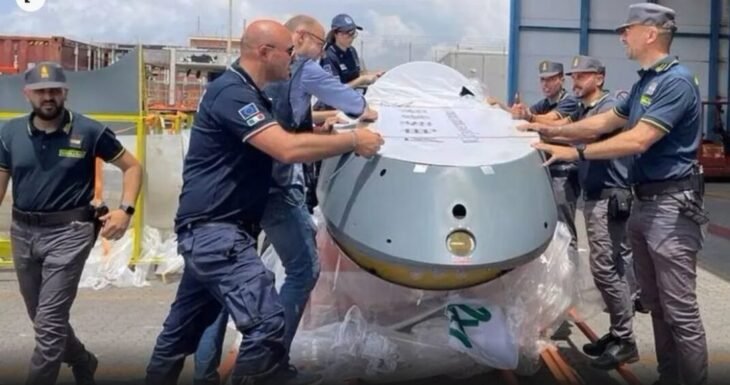
Libya continues to unravel quietly, with indications mounting that rival governments are regrouping for something big. Recently, Italian authorities intercepted a cargo ship suspected of bringing Russian weapons to General Khalifa Haftar in eastern Libya.
The reason being that Russia is arming Haftar in return for allowing Moscow to build a port on the Mediterranean coast, which would give it a base with Italy directly in its sites.
The country remains compromised, not least by its self-assured ruling elites, but also by the unhelpful policy decisions and changing rules of engagement in Western capitals. I fear the consequences will likely birth the country’s next and likely Muammar Gaddafi.
Flip-flopping Western policies
Briefly looking back, we can see that Western approaches toward Libya have undergone noteworthy changes, shifting from narrow security-oriented strategies to facilitating inclusive political settlements.
And, when that failed to secure meaningful progress in restoring the Libyan state, the West subsequently devolved toward a messy strategy of pursuing agreements among Libya’s differing factions.
This new strategy erroneously viewed bargains between the fractious and unelected Libyan elites as a makeshift bridge toward the ultimate goal—peace and stability. This is a grave miscalculation and a deliberate misreading of fairly obvious dynamics at play in Libya.
By prioritising exclusive bargains, the West inadvertently sponsored the entrenchment of Libya’s kleptocratic governance model that has successfully sidelined the building of key institutions and security sector reform.
At the core of this ill-informed shift in strategy was a severe underestimation of the underlying causes of Libya’s endemic instability and scapegoating of its political deadlock for a stalled state-building process. It also enabled the meteoric rise of “Clan Haftar”.
Small-time CIA asset turned Libya’s
biggest strongman
Khalifa Haftar rose to prominence in Libya as a result of his military background and fortuitous alliances. An ex-officer in Gaddafi’s army and commander of Gaddafi’s armies who tried and failed miserably to invade Chad, Haftar later turned into an opponent, participating in a failed coup before spending years in exile in the United States as a small-time CIA asset.
His return in 2011, followed by a series of events and foreign sponsorships, eventually catapulted Haftar into the larger-than-life figure he has become in Eastern Libya today.
After a failed and humiliating attempt to capture Tripoli with direct support from the UAE, Haftar’s stronghold remained in the east, where he established control through his Libyan Arab Armed Forces (LAAF), a network of alliances with tribal leaders, radical Islamists and other local armed factions with foreign backing, consolidating influence through both military and political manoeuvring.
A combination of strong anti-Islamist rhetoric, pure brutality, control over significant oil resources, and portraying himself as a bulwark of stability in a chaotic region further solidified his dominance in the eastern part of Libya — much to the delight of an international community exasperated by mounting policy failures in the country.
Despite a controversial background, problematic records of human rights violations, and deepening kleptocracy, Haftar continues to receive clandestine and overt support from various Western countries, including a recent visit with US officials.
France, for instance, valued Haftar’s promise of combating terrorism, stemming migrant flows, and possibly, being an insurance for Paris’ waning control over the Sahel.
Additionally, countries like Italy have been keen on gaining uninterrupted access to Libyan oil by trying to position Rome favourably in a post-conflict scenario and bolster its ambitions to become a Mediterranean energy hub, and Libya plays a prominent role in UAE’s ongoing agenda of gaining influence across North Africa and the Sahel.
Meanwhile, in Brussels, lavish economic incentives for Libya’s strongmen to control migration have altered the balance of power within the country.
By offering financial incentives to curb migrant flows, the EU is inadvertently subsidising the higher operational costs associated with keeping trafficking routes open, bankrolling Clan Hafar’s management of detention facilities and security operations essential for trafficking, and increasing its control over these illicit markets.
‘Haftar & Sons, Inc’
Beyond Libya’s borders, Clan Haftar turns a hefty profit from more lucrative criminal activities like fuel and drug smuggling, while maintaining a facade of cooperation with Europe to ensure uninterrupted financial flows. To date, there is no credible accountability mechanism or other means for tracking where profits from illicit activities go, as well as who or what they end up funding.
Meanwhile, the more resources Haftar and his sons accumulate from its capture of Libya’s state expenditures, the greater its accumulation of power and influence, fostering a deepening personality cult around Clan Haftar. In a sense, Europe’s and the US’ strategy of reinforcing the very instability and criminality it claims to mitigate is not just an own goal for its policy objectives.
It also perfectly encapsulates the paradox of supposed defenders of democracy, human rights and the rule of law openly crowding behind the antithesis of protection of human rights, political pluralism and consensus government at the expense of Libya’s democratisation prospects.
This trend readily reinforces Clan Haftar’s authoritarian rule. Before its downfall in 2011, the Gaddafi regime was characterised by unrestrained power concentrated in the hands of one individual, with the systematic suppression of dissent and political pluralism while at least maintaining a level of a normal state with public services and security for its people.
Clan Haftar has already replicated this model in its control of the East. Unchecked, Libya faces the real possibility of becoming a far worse form of an earlier era of personalistic rule, suppressed civil liberties, disappearing political opposition, and a monolithic and mafia-like power structure with no regard to anything else other than the Haftar & Sons Inc while pretending it’s a national army.
The implications are grave
Politically, while some level of order might be achieved in territories under Haftar’s control, the undermining of an inclusive and legitimate central government could perpetuate instability and unrestrained violence, particularly in contested areas.
Socioeconomically, while resource control might bring short-term gains for certain factions, the lack of a unified national vision could hamper long-term development and equitable economic growth. Citizens, especially in contested or “forgotten” regions, may continue to face issues related to access to basic services, employment opportunities, and investment in infrastructure.
Beyond Libya, the empowerment of figures like Haftar, with documented ties to criminal networks and a history of human rights abuses, is very concerning. It signals a worrisome precedence for short-termism. In sum, Western policy towards Libya, characterised by a preference for deal-making with controversial actors like the Haftar clan, is a myopic approach fraught with peril.
A recalibration of this strategy is imperative, one that prioritises the establishment of legitimate political institutions and respect for human rights. If we do not prevent Libya from becoming a mafia state, the trend will not stop at Libya’s borders but become a norm in its region, and especially the Sahel.
***
Hafed Al-Ghwell is the Executive Director of the North Africa Initiative (NAI) and Senior Fellow at the SAIS Foreign Policy Institute (FPI), Johns Hopkins University.
The Libyan National Oil Corporation (NOC) has once again found itself at the center of the country’s economic and social upheavals. This time, the company announced a reduction in oil production at one of its largest fields, El Sharara, due to a sit-in strike by residents of the Fezzan region in southwestern Libya.
This decision has once again highlighted the fragility of Libya’s oil industry, which has become a hostage to local conflicts and political instability, preventing the country from fully realizing its energy potential.
El Sharara, which produces about 300,000 barrels of oil per day, has repeatedly halted operations due to protests. In January 2024, the field was forced to stop production due to similar actions by residents demanding attention to their social and economic needs.
Only after the intervention of NOC’s head, Farhat Bengdara, and his promises to meet the demands of the protesters, was production resumed. However, new protests once again threaten production stability, underscoring the dissatisfaction of local residents, the reasons for which remain unclear.
Amid these events, the situation with oil production in Libya remains unstable. Libya, which holds the largest hydrocarbon reserves in Africa, continues to struggle with internal problems that hinder it from realizing its potential.
As of early 2020, proven crude oil reserves were estimated at 48.4 billion barrels. However, despite being a member of OPEC, Libya is not participating in the current OPEC+ agreements to cut production, allowing it to maintain a certain degree of flexibility. In June 2024, according to OPEC, the country’s oil production was 1.2 million barrels per day, higher than in April and May of the same year.
Before the civil war and the overthrow of Muammar Gaddafi’s regime in 2011, Libya was one of the leading oil exporters in the world. In 2008, the country produced 1.803 million barrels per day, but political upheaval led to a significant drop in this figure.
From 2013 to 2020, periodic halts in oil production and exports resulted in losses exceeding $180 billion USD. Only the truce between western and eastern forces allowed production to be restored to nearly 1.2 million barrels per day.
However, political instability remains a serious obstacle to increasing production. In February 2023, NOC’s head, Farhat Bengdara, announced plans to increase oil production to 2 million barrels per day. But achieving this goal requires significant state funding, infrastructure development, and export terminals. This is a challenging task for a country caught in a political deadlock between the government in Tripoli and a rival prime minister supported by the eastern parliament.
Thus, the current situation in Libya reflects the economy’s deep dependence on oil, as well as unresolved political and social conflicts. These factors exacerbate the country’s instability and complicate efforts to increase oil production. Amid these challenges, local residents continue to use protests to draw attention to their problems, creating additional risks for the stability of the national oil industry.
Given the importance of oil to the Libyan economy, the situation at El Sharara serves as a reminder of the need to diversify economic activities and develop a strategy for strengthening political stability.
While the future of oil production in the country remains uncertain, the international community and Libyan authorities must focus on finding sustainable solutions to reduce tensions and support long-term economic growth.
Apparent shutdown attempt shows potential for some leaders to use such threats to enforce personal agenda.
The political complexities of Libya’s oil industry were highlighted at the weekend when allies of the warlord Khalifa Haftar were said to have tried to shut down a Spanish-operated oilfield in reprisal for an arrest warrant issued by Spain for his son over alleged weapons smuggling.
Saddam Haftar, a key military figure in his father’s self-styled Libyan National Army (LNA), was detained at an airport in Naples, Italy, for an hour on Friday after his name appeared on a common EU database. Those close to Haftar say he was questioned by Italian officials in relation to Spanish allegations, but insist he was never arrested.
Output from El Sharara oilfield slowed over the weekend. It is one of Libya’s largest fields and is capable of producing more than 300,000 barrels a day. Libya’s UN-backed government, which is in opposition to Haftar, called the move “political extortion” without elaborating further.
The Haftar forces, who control the east and south of Libya where most of the oilfields are located, denied the attempted closure of El Sharara was due to political retribution, but rather claimed the site was suffering from recurring problems related to the conditions to which the workers were exposed.
Libya’s National Oil Corporation said on Tuesday it would gradually decrease production at the oilfield, citing protests in the area.
The head of the Fezzan movement, a local protest group that has previously shut down the oilfield, insisted it had nothing to do with the shutdown attempt. “Saddam Haftar gave immediate instructions by telephone and without the use of military force to shut down the site in response to the attempt to arrest him last Friday in Italy, on the basis of an arrest warrant issued against him in Spain,” said Bashir al-Sheikh. “I have nothing to do with the closure of the field and I refuse to be accused of this.”
The Barcelona-based newspaper Crónica Global has reported that the warrant was issued over the seizure by Spanish police a year ago of military equipment and weapons destined for the United Arab Emirates but allegedly intended to be diverted to eastern Libya.
Haftar has not commented on the police seizure, and attempts by the Guardian to contact the LNA were unsuccessful.
There is a UN weapons import ban on Libya, but it is sporadically enforced. Italy recently blocked a consignment of arms bound from China for Haftar.
The latest episode appears to show how some in Libya’s political leadership can use the threat of oil shutdowns to enforce their personal and political agenda.
El Sharara oilfield was partly closed down when the initial Spanish investigation into arms shipments was launched. Photograph: Ismail Zetouni/Reuters
Libya has suffered from a political division between east and west since elections in 2014 after the fall of Muammar Gaddafi. Successive UN special envoys have been unable to resolve the impasse – partly because the political elite on both sides have benefited from the status quo.
The oil-rich country has been locked in an absurd position whereby it has to import most of its fuel, which is then sold domestically at subsidised prices. The practice is not only hugely expensive, but encourages smugglers to sell the subsidised fuel back into European markets at a profit.
El Sharara oilfield is located in the Murzuq desert, in southern Libya, a poor region of the country that has been under the control of Haftar and his forces for years.
The last UN special envoy to Libya, Abdoulaye Bathily, said the country was becoming a mafia state dominated by gangs involved in smuggling operations. Bathily added that it had become an open supermarket for arms, used for internal political competition and also sold beyond its borders.
Repeated proclamations by politicians in east and west Libya that they are only a few technical steps from agreeing to hold national presidential elections, or are poised to form a unity government, have proven false.
Haftar has increasingly close links to Russia. According to an Atlantic Council report, Libya now “serves as the crucial hub for Moscow’s mission in Africa due to its geographical location and political instability”.
Strategically positioned at the crossroads of Africa and Europe, Libya provides Moscow with a gateway to Russian operations in Sudan, Chad, Niger and other Sahel and central African countries, eventually projecting power and influence across these regions, the US thinktank’s report said.
The UK ambassador to Libya, Martin Longdon, has expressed concern about growing Russian influence.
Nicholas Soames, a former Conservative MP who is now a peer, has been one of the few British politicians to note Haftar’s importance to Russia, saying last week that the west “needed to wake up to the political games” being played by Vladimir Putin in Libya.
“This new friendship has not only enabled him to flow his mercenary forces into the country and beyond, destabilising much of sub-Saharan Africa in the process, but it has also allowed discussions to begin on a new Russian nuclear submarine base to be constructed in the Libyan port of Tobruk,” he wrote.
“To my mind, this evokes a Cuban missile crisis scenario, only this time with Europe in the crosshairs and the Mediterranean Sea a possible new battleground for western Europe … Whilst Ukraine is important and needs our full support, we cannot think that Putin has only a single military campaign in mind.”
Turkey, which has been approaching the two separate power centers and social bases of the country at an equal distance since the beginning of the Libya crisis, has recently attached great importance to diplomatic opening with the east of the country, with which it has strong relations.
Fuat Emir Şefkatli from the National Defense University wrote for AA Analysis about the benefits that Turkey’s steps towards normalization with eastern Libya will bring to both parties.
***
Libya entered a new era in political, social and military terms when the uprising against then-President Muammar Gaddafi in 2011 turned into the February Revolution. The country is still referred to as a frozen conflict zone today. The power struggle in Libya, which largely began as rival political factions attempting to claim ownership of the revolution after the revolution, eventually gave way to military polarization as armed groups became active actors.
The unilateral policies of international powers and the inadequacy of supra-state mechanisms such as the United Nations (UN), the European Union (EU) and NATO, which sought to find a solution to the crisis in Libya, were also effective in bringing this picture to life.
Turkey, on the other hand, is looking for solutions to restore peace and stability to the country within the framework of international law and foreign policy principles within this complex equation that has emerged over time.
In fact, Turkish Foreign Minister Hakan Fidan noted in an interview with an international media organization on July 24 that relations with eastern Libya are progressing quite well. Minister Fidan, who announced that the Turkish Consulate General in Benghazi has reopened, added that they are in contact with Tobruk-based Parliament Speaker Akile Salih, as well as Khalifa Haftar and his sons.
Normalization with the East is gaining momentum
As is known, Turkey’s steps towards normalization with eastern Libya were taken in the last quarter of 2021. In this sense, the period when Turkey put the opening towards Cyrenaica, the eastern region of Libya, on the agenda corresponded to a period of political deadlock following the cancellation of the presidential elections planned to be held in December 2021.
During these dates, official visits by a delegation from the Libyan Parliament to the Grand National Assembly of Turkey (TBMM) were followed by the visit of the then Libyan Ambassador to Turkey Kenan Yılmaz to Akile Salih. However, the turning point in relations in a positive direction was the reception of Akile Salih by President Recep Tayyip Erdoğan in July 2022.
Since the beginning of the Libyan crisis, Turkey has approached the two separate power centers and social bases of the country at an equal distance and has recently attached great importance to diplomatic openings with the east of the country, with which it has strong historical and cultural relations. However, in addition to its increasing contacts with the east of Libya, Turkey also aims to maintain its relations with the National Unity Government (NMU) led by Prime Minister Abdulhamid Dibeybe and institutions in the west.
Unifying and solution-oriented rhetoric
Turkey’s recent integrative rhetoric and policy preferences developed through statements and visits can be interpreted as a serious effort to shift the tense atmosphere in Libya to diplomatic grounds. Because the legitimacy crisis between the East and the West, the fragmented security bureaucracy and governance crises constitute a strong obstacle to putting comprehensive solutions on the agenda.
On the other hand, the negotiation channels that Turkey is trying to establish contain certain gains in the medium and long term for both Libya and Turkey under three subheadings. The first of these, as emphasized by Minister Fidan in his interview, is Turkey’s motivation and intention to use the relations it has developed with the East for East-West integration.
In terms of organizing elections and ensuring democratic transition in Libya, Turkey is holding talks not only with local elements but also with Egypt, the United Arab Emirates (UAE) and Qatar. Increasing its diplomatic efforts to establish stability and peace will prevent a new conflict environment in Libya and may strengthen the unity of the country in the long term. It should be said that this situation is an effective policy choice for Turkey in terms of both preserving current gains and reaching potential future benefits.
Based on this, the second issue is that Turkey, which has deep historical, cultural and economic relations with both parts of Libya, will secure its interests and commercial gains in the Eastern Mediterranean, namely the Blue Homeland, by transferring its influence from the West to the East. In such a scenario, the political climate in the East, which was relatively against Turkey’s Maritime Delegation Agreement in 2020 and Hydrocarbon Agreement in 2022, may be completely changed.
Although the relevant agreements are based on solid ground in terms of international law and legitimacy, obtaining the indirect consent of the Parliament and the Haftar wing for these agreements may strengthen the Turkey-Libya alliance relationship in the Eastern Mediterranean geopolitics.
On the other hand, when Turkey’s normalization with eastern Libya is more broad-based and institutional, it is quite possible that the agreements made with Turkish companies through the Libya Development and Reconstruction Fund affiliated with the Parliament will increase significantly. The commercial benefits that this possible picture will provide to Turkey are of critical importance.
Finally, Turkey’s military presence in the west of the country has served as a deterrent in preventing small-scale conflicts from turning into large-scale civil wars after 2020. Turkey’s military mission, based on training and consultancy, has not only kept the military polarization between the east and the west in balance, but also the fragmented security bureaucracy in the west.
At this point, high-level diplomatic contacts with eastern Libya may also pave the way for breaking the negative narrative developed by the eastern-centered public and media organizations regarding Turkey’s military presence in the past. At the same time, the ongoing process may buy Turkey significant time in planning military structuring and engagements until a democratic structure is established.
***
Fuat Emir Şefkatli is a PhD candidate at the National Defense University.
Over the past decade, Russia’s involvement in Libya is evidence of its realization that it could transition from a marginal power to a significant competitor in the country, and thus in the broader Middle East and North Africa. As Russia became disillusioned by its perception of the West’s actions in Libya as aimed at regime change, it shifted its stance from cooperative to antagonistic. This disillusionment strengthened Russia’s determination to establish a strong presence in the country, exemplified by its deployment of mercenaries to Libya to secure greater power and influence.
Russia’s withdrawal from the Middle East
Until the collapse of the Soviet Union and subsequent end to the Cold War, Russia maintained a strong foothold in the Middle East, recognizing the region’s potential importance to global power dynamics. During the Cold War in particular, Russia maintained its presence by creating allies among those Arab nations that would help it achieve its goal of creating an anti-Western camp, most notably Egypt, Syria, Iraq, and Libya, along with Algeria, Yemen, and Sudan.
Its relations expanded from diplomatic ties to arms shipments to support for liberation movements such as the Palestinian Liberation Organization. The Soviet influence in the region was most obvious in its support for the Arab states during the Suez Canal Crisis (1956), the Six-Day War (1967), and the Yom Kippur War (1973), conflicts that saw a strong involvement by the United States on the side of Israel.
The 1990s, however, saw a major shift in Russia’s presence in the Middle East and North Africa with the collapse of the Soviet Union. The subsequent economic crisis forced Russia to dramatically scale back its involvement in the region, reducing both military engagement and economic support in order to focus on domestic issues.
Additionally, Boris Yeltsin, the then president, saw a window to improve relations with the West. Scaling back Russia’s presence in what had been confrontational states represented one way to resolve tensions at a time when the country was reeling from internal economic turmoil. As a result, Russia played a marginal role in major confrontations such as the First Gulf War (1990–91), the US invasion of Afghanistan (2001), and the Iraq War (2003–11).
The 2011 NATO-led intervention in Libya to topple Muammar Gaddafi represented the beginning of the end of Russia’s disengagement from the region. Due to the ongoing rapprochement with the West, Russia’s then president, Dmitry Medvedev, abstained from adopting the United Nations Security Council Resolution 1973.
This allowed Western intervention in Libya to overthrow the longtime dictator, who had by then turned on his own people. To many experts, Medvedev’s decision not to veto the resolution signaled an important change in Russia’s support of its Arab allies and allowed for a regime change to happen. Among the most notable critics of this action was Vladimir Putin, the then prime minister, who described the West’s subsequent intervention as akin to “medieval calls for crusades.”
The intervention in Libya left an indelible mark on Russian elites, many of whom saw it as emblematic of Western attempts to meddle in foreign countries and impose Western-like values. This threat left Russia feeling disillusioned with the West, which it accused of hypocrisy because of its violations of international law by interfering in Libya.
It also left Russia feeling isolated at a time when the United States had promised that a regime change in Libya would not occur, and when Russia-US relations were strong and based on the pursuit of mutual trust. It cemented Russia’s persistent belief in the principle of nonintervention as a means to maintain stability and the status quo in the rules-based order, a belief that it accused the West of not sharing, with the 2003 US-led intervention in Iraq and subsequent deposition of Saddam Hussein as an example.
Russian reengagement
Russia’s distrust of the West and recognition of the importance of the Middle East and North Africa region help explain its intervention in Syria in 2015 and in Libya in 2017. Following two decades of relative disengagement from the region, Russia saw a window of opportunity to reassert itself with the outbreak of the Syrian civil war and the request by Syrian President Bashar al-Assad for help.
Additionally, the United States’ lack of intervention, underscored by the failure of Barack Obama, the then president, to adhere to his “red line” commitment, cemented Russia’s belief that the United States would not interfere in its quest for increased influence in the area.
The end of two decades of Russian disengagement came with the recapturing of Aleppo from rebel forces in December 2016, thanks to Russian involvement, and Libyan General Khalifa Haftar’s request for help a month earlier. Libya, engulfed in a civil war, saw the United Arab Emirates (UAE) and France aiding Haftar, with Russia emerging as a prominent ally at a time when its presence in the region was becoming more entrenched.
Emboldened by its victories in Syria and the potential to exert influence in the region by supporting another Arab country, Russia began deploying mercenaries to Libya as early as 2018, marking a definitive turning point from the previous two decades of disengagement. From its marginalized position, Russia saw Libya not only as another window of opportunity to reemerge as a great power competing for influence in North Africa but also as a gateway to other regions, such as sub-Saharan Africa. With the deployment of troops under the Kremlin’s authority, the days of being second to Western regime change in neighboring regions were over, and the potential for the resurgence of Russian primacy once again became a real prospect.
Russia reemerged as a regional power in the Middle East when Haftar attempted a takeover of Tripoli in 2019, with Russian forces fighting alongside Haftar’s. Egypt and the UAE were also involved, while Qatar and Turkey supported the Government of National Accord forces of Libya’s then prime minister, Fayez al-Sarraj.
Libya became a military quagmire for foreign power interferences, with Russia refusing to be the marginal player it had been during the First Gulf War and the US invasion of Iraq. While Haftar’s objective of gaining control of Libya was thwarted by Turkish troops, Russian involvement in the country remained consistent, with around 2,000 mercenary troops permanently stationed in eastern Libya, evidence of Russia’s unabated goal to establish a continued presence.
Ongoing influence
Russia’s full-scale invasion of Ukraine is keeping the Kremlin largely occupied with redefining its borders to the west. Yet, “Southern missions” have not been downgraded to lesser-scale priorities. On the contrary, some 800 – 1200 mercenaries from Wagner (now called Africa Corps) remain present in Libya, many controlling key oil production facilities and thus positioning the Kremlin to control output from Libya and affect world oil prices.
Their continued presence illustrates the Kremlin’s conviction that North Africa and the Middle East is a region of vital importance, with enormous untapped resources that could help Russia’s economy in the long term. It also underscores that Russia is making a strategic bet during a time when the American presence is diminishing and the Chinese presence is growing, asserting itself alongside China as a main power by buying local support through influence and mercenary deployment.
This strategy of Russian reassertion is further exemplified by the ongoing activities of the Africa Corps in the wider Sahel region, where the mercenary group’s control has been well documented and is set to increase. In recent years, the area has been destabilized by numerous coups, creating power vacuums in Mali, Burkina Faso, and Niger.
Russia and China have moved to fill these voids, seeking to expand their influence as French and American troops have withdrawn. While Western countries focus on short-term diplomatic solutions, Russia appears to be ahead in its strategy, providing military and financial support to nations it considers strategically important.
Indeed, it would be a mistake to frame Russia’s presence in Libya exclusively under its competition with the West. Its presence is driven primarily by national interests, many of which are linked to the continent of Africa. Libya serves as the crucial hub for Moscow’s mission in Africa due to its geographical location and political instability, which favors Russia’s actions.
Strategically positioned at the crossroads of Africa and Europe, it provides Russia with a gateway to its operations in Sudan, Chad, Niger, and other Sahel and Central Africa countries, eventually projecting power and influence across these regions. Libya’s ongoing political chaos creates opportunities for Russia to establish footholds through alliances with both local factions and official authorities.
This is exemplified by Russia’s support of General Haftar over the past few years and its more recent relations with the government of Tripoli. Not least, the country’s fragmented governance has guaranteed Russia much-needed access to air and naval military bases, especially across Cyrenaica, allowing it to coordinate its military expeditions.
By maintaining a strong presence in Libya, Russia is able to pursue its broader geopolitical goals, including defying the West, expanding its military reach, and securing critical resources that are essential to sustain its economy and long-term strategic aspirations.
***
Chiara Lovotti is an Italian Institute for International Political Studies (ISPI) research fellow and scientific coordinator of the Rome MED-Mediterranean Dialogues, the annual flagship event of ISPI and the Italian Ministry of Foreign Affairs. She is a specialist in Middle Eastern and North African international relations, with a focus on Russia’s foreign policy in the area and associated political and security issues.
Alissa Pavia is associate director of the Atlantic Council’s North Africa Program. She is responsible for providing research and analysis on North Africa while also expanding the program’s reach with like-minded centers, foundations, and government agencies.
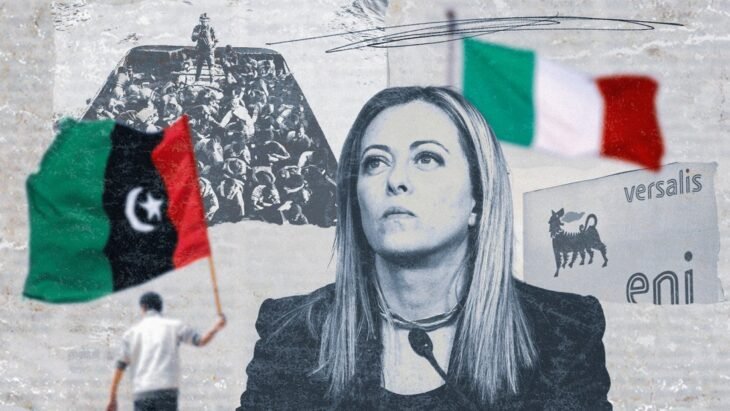
It has been more than thirteen years since the outbreak of the 2011 Libyan revolution and the moment when Italy reluctantly supported the NATO-led intervention that imposed a no-fly zone over Libya purportedly to protect the population from Muammar Gaddafi’s retaliation.
The overthrow of Gaddafi’s regime led to more of a decade of intermittent civil war and conflict, dismantling of state institutions, and rampant kleptocracy, turning Libya into a battleground for competition between external powers. Meanwhile, Italy has seen nine governments since the Libyan revolution. These governments have come to power against a backdrop of political instability and economic uncertainty, the rise in populism and “sovranismo” (sovereignism), and geopolitical tensions in Italy’s eastern and southern neighborhoods.
Irrespective of Rome’s different ruling coalitions, the crisis in Libya resulted in a rethink of Italy’s geopolitical posture and strategic orientation toward the North African country, questioning Rome’s approach to international intervention and national priorities, the resources and tools of its foreign policy, and its projection of power over the wider Mediterranean region. The conclusion of the debate has been that a stable Libya is strategically crucial for Italy, for political, security, and economic reasons.
However, the last decade has seen the gradual fading of Rome’s influence over Libya and the downsizing of its ambitions. The political leverage Italy historically possessed in Libya dwindled over the years. How did Italy squander its political capital and credibility in Libya? How could a country with prominent interests and a strong economic interest fail in Libya? The focus on short-term gains over long-term strategy played a pivotal role. Understanding the root causes of this marginalization is crucial for reshaping Italy’s approach to Libya and revitalizing its role in the region.
Migration policies have undermined Rome’s credibility in Libya
Between 2014 and 2017, over six hundred thousand migrants arrived in Italy, most departing from Libyan shores after enduring extensive journeys across Africa. Many suffered violence, forced labor, and sexual exploitation in both formal and informal Libyan detention centers. The migration issue became a focal point in Italian politics for several reasons: from challenges in managing the reception and integration of migrants once they arrived, to political exploitation of unfounded fears about terrorist infiltration and cultural clashes, to concerns about the country’s democratic stability during a period of economic uncertainty.
In 2017, amidst peak concerns about a surge in migrant arrivals and with Italy gearing up for elections, Interior Minister Marco Minniti introduced a new strategy for addressing the Libyan crisis. Stabilizing Libya became not just a priority in itself, but a means to control migration flows and counter transnational threats.
Rome engaged extensively: it worked closely with the Government of National Accord (GNA) led by Fayez al-Sarraj, signing agreements, providing financial aid and technical support, and becoming the first Western nation to reopen its embassy in Tripoli. Italy also established connections with Field Marshal Khalifa Haftar in the east; engaged with southern tribes, cities, and municipalities; and even interacted with less-transparent groups like militias and armed factions, despite their involvement in smuggling and trafficking, which Italian authorities publicly denied but independent investigations corroborated. This approach proved effective as migrant arrivals dropped dramatically from July 2017, as evidenced by arrival data.
Despite changes in leadership and shifting political coalitions in Rome, the core strategy remained consistent even after the Government of National Unity, led by Abdulhamid al-Dabaiba, took office in Tripoli in 2021. Italy saw different governments come and go: Giuseppe Conte’s “yellow-green” government (2018–19), Conte’s “yellow-red” government (2019–21), followed by Mario Draghi’s national unity government (2021–22), and now Giorgia Meloni’s leadership since October 2022.
However, new dynamics emerged as migrant departures shifted from the west to the east of Libya in recent years. Rome responded by increasing engagement with eastern Libyan authorities both politically and economically. This shift was highlighted by Haftar’s visit to Rome in May 2023 and a subsequent meeting held by Meloni in Benghazi on May 7.
So far, Italy, along with EU funds, has allocated almost €479 million to the “externalization” of its border to Libya, i.e. the act of empowering foreign actors to stop migrants from reaching Italy. However, this strategy of externalizing migration management—funding patrols and technology, and investing significant political attention and resources—has had significant unintended consequences.
By treating militias as interlocutors, even indirectly through recognized institutions or actors with national ambitions, Italy inadvertently empowered and legitimized ambiguous players. This has altered local power balances and undermined prospects for peace in Libya. Since the implementation of this policy, evidence has emerged of its destabilizing effects and distortions of local equilibria, influenced by Italy’s perception of threats and insecurity stemming from migration policies.
Italy’s leverage of foreign actors was not aimed at stabilizing Libya but rather at addressing Italian perceptions of insecurity
Despite its interactions with local actors, Italy has not been among the most influential players shaping Libya’s dynamics. Other countries such as Egypt, the United Arab Emirates, Turkey, Russia, France, and Qatar have exploited Libya’s internal divisions to advance their own domestic and international agendas. This interference has spoiled prospects for the establishment of stable Libyan institutions, state reconstruction, and durable peace.
In this complex scenario, Rome has struggled to effectively stabilize Libya or facilitate consensus among Libyan factions based on international law and the desires of the Libyan people. Instead, Italy has mainly offered symbolic support for UN efforts without substantial mediation efforts or concrete peace proposals following the underwhelming results of the Palermo conference, a two-day conference in November 2018 intended to advance the UN-sponsored stabilization process for Libya.
In the complex web of Libyan, regional, and international agendas, Rome has primarily used foreign relationships to advance its migratory policies and address minor issues. For instance, with the UAE, one of the most involved foreign players shaping Libyan internal dynamics through its strong support to Haftar, Italy leveraged its influence to secure the release of fishermen arbitrarily detained by Haftar’s forces.
Last year, Italian Foreign Minister Antonio Tajani visited the UAE twice, with migration from Libya featuring prominently in his discussions. The UAE’s president, Sheikh Mohamed bin Zayed Al Nahyan, then took part in the International Conference on Development and Migration in Rome, marking the start of the “Rome Process.”
Even with Ankara, Rome sought to align on its priorities in Libya. In 2020, Turkey emerged as a decisive actor in countering Haftar’s assault on Tripoli, supporting western Libyan authorities, under both the Sarraj and Dabaiba governments. Despite initial concerns about Ankara’s growing influence exerted over Tripolitania, and despite political competition and overlapping economic interests, Rome sought Turkey’s “solidarity” on the migration issue, which emerged as a central point of recent Italy-Turkey bilateral meetings.
Interestingly, Turkey’s recent imposition of visas for Bangladesh citizens entering the country was cited as an example of cooperation between Rome and Ankara. In 2022, more than 15,200 Bangladeshis arrived in Italy, with many transiting through Libya, about a third of whom travelled through Turkey. To avoid tensions with Ankara, Rome refrained from taking a more assertive stance on other contentious strategic issues, such as energy resource exploitation in the Eastern Mediterranean and maritime borders.
Another significant aspect of the Rome-Ankara entente involves Egypt, another key player in Libya. Rome leveraged recent regional diplomatic efforts to establish a triangular dialogue with Egypt and Turkey on Libyan issues, aiming to bridge differences and engage major supporters of the two rival power centers in Libya’s west and east.
Ambiguity between western and eastern authorities marginalized Rome’s ambitions in Libya
To control migration flows, Rome has blurred the lines between Libya’s western and eastern authorities. Initially a staunch supporter of the Skhirat Agreement, which led to the establishment of the GNA at the beginning of 2016, Italy found itself dealing with a divided country as Libya remained split between competing centres of power. This situation prompted then Italian minister of interior Marco Minniti to establish connections with Haftar during his tenure, integrating him into Italy’s new approach to the Libyan crisis.
This trend was further strengthened under the following two governments led by Conte (2018–21). Haftar’s presence at the Palermo conference in 2018, originally aimed at reconciling Libya’s factions, was seen more as a personal gesture to Conte than a genuine effort to forge an agreement with Tripoli.
Italy’s ambiguity peaked in April 2019 when Haftar attacked Tripoli. Conte declared that “Italy is neither in favor of Sarraj nor of Haftar, but of the Libyan people.” When Sarraj requested Italy to send troops and support, Rome did not officially respond, prompting Tripoli to seek and ultimately received crucial support from Ankara. Turkey’s military backing of the GNA gave Ankara significant political and economic influence over Tripolitania, sidelining Italy and diminishing its presence, role, and ambitions in Libya.
As another sign of Italy’s waning influence, the Bilateral Assistance and Support Mission in Libya (MIASIT), which includes the “Hippocrates” Task Force and the military field hospital in Misrata, has been downsized.
Rethinking a new Libya policy for Italy
Over the past decade, Italy’s influence over the Libyan crisis has steadily declined. This decline can be attributed to two main factors: first, Italy prioritized managing migration over consistent efforts to stabilize Libya. Second, Rome played an ambiguous role by engaging with both western and eastern Libyan authorities, which complicated its diplomatic and strategic approach.
Today, Italy seems willing to revitalize its role in North Africa (as well as in the Sahel and the rest of the continent) with the “Piano Mattei” (Mattei Plan), named after the founder of Italy’s ENI energy group. The late Enrico Mattei was known for advocating fairer relations across the Mediterranean. A steering committee has been formed, and initial pilot projects in nine African countries are set to begin soon.
Notably, Libya is not among these countries, although during Meloni’s visit to Tripoli in May 2024, memoranda of understanding on health, education, and sport were signed under the Mattei Plan’s framework. However, merely enhancing development cooperation is insufficient to reestablish Italy’s influence in Libya.
To achieve this, the Italian government needs to fundamentally rethink its approach to migration. This involves moving away from polarizing political debates and shifting focus from securitizing migration to recognizing its political, demographic, and economic potential for Italy’s future. Instead of solely emphasizing police and border controls, Italy should centralize discussions on these broader impacts.
In Libya, this shift would diminish the economic power and political legitimacy that Italy unintentionally bolstered among various local and regional “spoilers of peace.” Moreover, Italy’s reduced dependence on Libyan energy resources—marked by the lowest natural gas exports in thirteen years in 2023—should embolden Italian leadership. This could open up opportunities to propose innovative pathways to peace and national reconciliation with its southern neighbor.
Italy and Libya share deep historic ties. Rome played a crucial role in Libya’s international rehabilitation in the 1990s and has a longstanding tradition of political, economic, social, and cultural connections with Libyan counterparts. This relationship reached a symbolic peak when Italy decided to reopen its embassy in Tripoli in 2017, despite the exodus of many other international actors. Today, it’s time for Italy to make up for lost opportunities and strengthen its ties with Libya.
***
Karim Mezran is director of the North Africa Initiative and resident senior fellow with the Rafik Hariri Center and Middle East Programs at the Atlantic Council focusing on the processes of change in North Africa. Mezran holds a PhD in international relations from the Paul H. Nitze School of Advanced International Studies at Johns Hopkins University, a JD in comparative law from the University of Rome (La Sapienza), an LLM in comparative law from the George Washington University, an MA in Arab studies from Georgetown University, and a BA in management from Hiram College.
Aldo Liga is a research fellow for the Middle East and North Africa Centre at the Italian Institute for International Political Studies. He is also a PhD candidate at the Institut Français de Géopolitique (University of Paris 8). He holds a bachelor’s degree in political science from the “Cesare Alfieri” (University of Florence) and a master’s degree in international security from Sciences Po Paris.
The United Nations Support Mission in Libya (UNSMIL) has fired the coup de grace on the outcomes of a group of members of the House of Representatives with about 25 members of the High Council of State in Cairo on July 18.
UNSMIL said in its statement that it “takes note of the meeting” and encourages members to “build on what has been agreed upon, by seeking an approach that includes other relevant Libyan stakeholders, to ensure that the outcomes lead to a politically implementable solution.”
However, the Cairo meeting’s outcome is not expected to bring about any change to the political scene. It was essentially a gathering of two political parties with their own vision and interests, and it was not between the House of Representatives and the High State Council, even if those meetings were members of both chambers.
The two chambers have no genuine existence or effectiveness, except in the light of adherence to the Constitutional Declaration, the Political Accord, and the Rules of Procedure, without which, they turn into a mere two or several political parties that are rather closer to parties or blocs, driven by their own interests and goals.
These are different and contradictory to the interests and goals of other parties, that have influence or representation in the legislative authority. It perhaps does not have any influence or representation in the two chambers, but it does have power, authority, and money. This fact may not have been realized by members of the two chambers despite their many meetings on different tracks and issues.
Therefore, it is not an exaggeration, if the Cairo meeting is described as a meeting of political parties or even civil society organizations. Perhaps UNSMIL’s statement regarding an approach that includes other concerned Libyan parties confirms our conclusion, and even says without ambiguity that there are other concerned Libyan parties that must be involved, otherwise the outcomes of their meeting will not find their way to implementation.
What it meant by the other parties is the active forces on the ground, east and west, because of their power, influence, and ability to undermine any political agreement, as well as the Government of National Unity, which has become a political party that cannot be transcended except after the two houses returning to the normal path, that is, working through the texts of the Constitutional Declaration and the Political Accord. Only in such cases, the government may return to its status as an executive body that can be changed by mechanisms spelled out in the Constitutional Declaration and the Political Accord.
The Cairo meeting and the welcome by Agila Saleh, Speaker of the House of Representatives, of its outcomes, and his announcement of the start of accepting applications to run for prime minister position, indicate the failure of his recent decision to pass the budget. For what is the rationale behind resorting to forming a unified government if the budget will be disbursed and the parallel government will get its share?
The issue of building on what has been agreed, which UNSMIL called for in its statement about the meeting, requires the involvement of a broad political spectrum that cannot be transcended to ensure the success of any agreement on change.
The other condition is that the path to elections be clear, but the parties to the meeting are members of parliament and High Council of state do not seek to solve the crisis, but rather they are obstructing the means of solution in order to continue obtaining their high salaries and other privileges they enjoy, which they will lose if genuine elections are held.
All these meetings and dialogues between the presidency of the two houses, the members, or their joint committees, are merely rotations in the same circle. The starting point is the same as the endpoint, and no progress will be made towards a political solution.
This solution will not be achieved in the light of the current international circumstances except with the national will that goes directly towards only parliamentary elections, as unifying legislative authority is the beginning of the path, and any other path will be just a new formulation that is different only in form of the current political scene.
The arrest of Libyans who allegedly received military training in South Africa hints at the nature of power in the north African country.
Were 95 Libyans really undergoing military training at the Milites Dei Academy in South Africa’s eastern Mpumalanga province, and if so, for what purpose? Or were they just learning to be commercial security guards?
This remains something of a mystery. Which should not be surprising, given the complexity of their home country. The men were arrested by police on 26 July and appeared in court three days later, charged with misrepresenting the purpose of their visit to South Africa in their visa applications.
Police told local media the men claimed they came to South Africa for training as private security guards, whereas they were really receiving military training. In an interview with a local TV network, one of the men said they had been hired and sent to South Africa for training by a Libyan business tycoon so they could protect his many businesses.
But most analysts aren’t buying that, and believe that the men were sent to receive military training. And there is a broad consensus they were sent by Libyan strongman Field Marshal Khalifa Haftar who heads the self-styled Libyan National Army (LNA). He is the de facto leader and enforcer of the government based in Benghazi in eastern Libya – which is vying for control of Libya with the United Nations-backed government in the west, based in Tripoli.
Jalel Harchaoui, a Libya expert at the Royal United Services Institute, told ISS Today that the evidence pointed to the men being employed by the Haftars. It would be no surprise if they used the cover that the men were being trained as private security guards, he said.
There has also been speculation that if Haftar is training soldiers, probably as special forces, he must be preparing for another military assault on the western government like the one he launched in April 2019. His forces were stopped in the suburbs of Tripoli in June 2020 mainly by the intervention of Turkish forces.
Harchaoui doesn’t rule out that possibility, though he says it’s not an inevitable conclusion. ‘The entire economy, the entire political system, territorial management, administration, influence over the budget and expenditure, influence over day-to-day safety of citizens, police matters, all of those basic components of social life … in Libya are highly determined by the power of armed groups,’ he says.
In other words, since the open warfare of 2019-20, armed groups have continued to build up their military might to deter rival armed groups. They use force to exert influence over anything from defending territory to getting state jobs for their relatives, to stopping jihadists crossing the border from Niger. ‘Everything is predicated on – potential – physical violence. But it doesn’t mean that that violence is going to be used,’ Harchaoui says.
This helps explain why, four years after the all-out war ended, and 13 years after Muammar Gaddafi’s ousting, Libyans still haven’t negotiated an end to the political dispute between the western and eastern government. In April, United Nations Special Envoy Abdoulaye Bathily resigned in disgust, rebuking Libya’s political leaders for being unwilling to place the collective interest above their own personal interests.
On the face of it, the disagreement between east and west boils down to the sequencing of elections. The east wants to go straight into presidential elections now, while the west says there should be a more solid institutional foundation first. For example, the Constitution must be changed to include, among others, a proper definition of the president’s powers. The result of these incompatible positions has been a long impasse.
Yet when Bathily remarked on personal interests trumping the national interest, he was reflecting a general sense among observers that for the country’s political elite, the status quo is working just fine, so why change it?
Some talk about the Big Five spanning both east and west. These are: Mohamed Takala, High Council of State President; Abdul Hamid Dbeibeh, Government of National Unity Prime Minister; Aguila Saleh, Speaker of the House of Representatives; Field Marshal Khalifa Haftar, LNA Commander; and Mohamed al-Menfi, Presidential Council President. They are all milking the country’s resources and living off the chaos.
One gets the impression that those in power are continually looking for some new pretext to avoid elections to choose a single, unified government. And Harchaoui says often politicians of the east and west are complicit with each other in corruption.
So the sharp lines between the two sides have become more blurred. This is also apparent in international involvement. Four years ago, it was clearer. Turkey supported Tripoli while the United Arab Emirates (UAE) and Russia were supporting Benghazi. Now, Harchaoui says, Turkey is still supporting Tripoli, while at the same time trying to win over the Haftar family in the east. The UAE is preserving its historical closeness to Haftar, but also backs Prime Minister Dbeibeh in Tripoli.
Turkey and the UAE are the two main foreign powers involved – though Russia is expanding its military presence in the east, thanks to its long alliance with Haftar, says Harchaoui.
‘So you see how entrenched the status quo is.’ He is dismayed that the international community seems resigned to this because it hasn’t led to open warfare for four years and Islamic State isn’t flourishing. Yet Libya suffers because the corruption and lack of unified purpose are hindering development.
There isn’t an obvious solution. But Harchaoui believes it is up to the US to use its power and influence to leverage one.
Libya, a North African nation endowed with vast natural resources, faces significant challenges and opportunities in its quest for economic stability and growth. This report delves into the country’s current economic status, the controversial 179 billion dinar budget, and potential sectors for diversification.
The Economic Landscape of Libya
Libya’s economy is primarily driven by its oil sector, which contributes approximately 97% of government revenue. Despite its wealth, the country struggles with political instability, corruption, and an over-reliance on oil.
Annual Revenue:
Total Annual Income: Libya’s total annual income is approximately $50 billion (307 billion Libyan dinars post-tax).
Revenue Breakdown:
Oil and Oil Derivatives:
Oil revenue: $37 billion
Gas revenue: $4 billion
Petrochemicals: $3 billion
Other Revenues:
Iron and steel: $260 million
Tourism and other sectors: $300 million
Private Sector:
Non-oil exports: $3.1 billion
GDP and Growth:
Current GDP: $50 billion annually.
Growth Rate: Primarily influenced by the recovery and stability of the oil sector.
Current Production: 1.25 million barrels per day (bpd) as of July 2024.
Challenges:
Transparency Issues: The National Oil Corporation (NOC) lacks transparency and competitive bidding, which hinders production growth.
Production Targets: The original target of 2 million bpd by 2025 seems unlikely due to these issues.
Foreign Reserve Assets and Gold:
Foreign Reserves: Over $80 billion.
Gold Reserves: Libya holds approximately 146.65 tons of gold as of 2024.
Frozen Assets: Approximately $72 billion, including those managed by the Libyan Investment Authority (LIA).
Missing Gold: An estimated 50-55 tons of gold, worth around $3 billion, have been smuggled abroad.
External Investments:
Libya has around $70 billion in external investments, plagued by poor management.
Analysis of the 179 Billion Dinar Budget
The newly approved budget has sparked considerable debate among economists and policymakers. Here’s an in-depth analysis of why this budget might be problematic for Libya in the long term:
Overview:
Total Budget: 179 billion dinars.
Inflation Risk: The large budget could significantly drive up inflation, reducing the purchasing power of ordinary Libyans and potentially leading to economic instability.
Lack of Transparency: Concerns about how funds will be managed and allocated are prevalent, given Libya’s history of corruption and mismanagement.
Corruption: Historical mismanagement and potential misuse of funds are major concerns. A significant portion of the budget could be siphoned off by elites, rather than being used for public benefit.
Fuel Subsidies: Contributing to smuggling due to Libya having the world’s cheapest fuel. This not only drains the budget but also benefits smugglers and corrupt officials rather than the general populace.
Impact on the Economy:
Inflation: Injecting such a large amount into the economy without proper oversight and strategic planning will likely cause hyperinflation. This devalues the currency and erodes savings, disproportionately affecting the poor and middle class.
Misallocation of Resources: Without transparent and accountable management, funds may not reach critical sectors that need investment for sustainable growth.
Economic Inequality: A poorly managed budget will exacerbate economic inequality, as wealth will likely concentrate in the hands of the elite, furthering social and economic divides.
Diversification Potential
To reduce dependency on oil, Libya must explore and invest in other sectors:
Fishing Industry:
Potential: Libya’s Mediterranean coastline offers rich fishing grounds, especially for high-value species like tuna.
Challenges: Illegal fishing, particularly by foreign vessels, and lack of infrastructure and regulation.
Solutions:
Coastal Surveillance: Invest in advanced surveillance technologies such as satellite imaging and drones to monitor and protect marine resources.
International Cooperation: Form alliances with neighboring countries and international bodies to combat illegal fishing and share best practices.
Community Engagement: Empower local fishing communities through training and resources to promote sustainable practices and involve them in surveillance efforts.
Economic Impact: A robust fishing industry could provide significant employment opportunities and contribute to foreign exchange earnings by increasing exports.
Agriculture:
Olive Tree Cultivation: Libya’s climate is ideal for olive cultivation. With proper investment, this sector could become a major export commodity.
Current Status: Limited production due to outdated farming techniques and inadequate infrastructure.
Potential: Modernizing agricultural practices and investing in irrigation systems could significantly boost yields and quality.
Solutions:
Modern Farming Techniques: Introduce advanced farming techniques and provide training to farmers.
Irrigation Systems: Develop efficient irrigation systems to optimize water usage in agriculture.
Market Access: Create cooperatives to help farmers access international markets and negotiate better prices.
Economic Impact: Increased production and export of olives and olive oil could generate substantial revenue and reduce unemployment.
Tourism:
Potential: Libya’s historical sites, including ancient Roman and Greek ruins, and its Mediterranean coastline offer significant tourism potential.
Current Status: Underdeveloped due to security concerns and lack of infrastructure.
Potential: Developing tourism infrastructure and promoting Libya’s cultural heritage could attract international tourists and generate revenue.
Solutions:
Infrastructure Development: Invest in roads, airports, hotels, and other tourism-related infrastructure.
Security Improvements: Enhance security measures to ensure the safety of tourists.
Cultural Promotion: Promote Libya’s rich history and cultural heritage through international marketing campaigns.
Economic Impact: A thriving tourism sector could diversify the economy, create jobs, and boost foreign exchange earnings.
Renewable Energy:
Potential: Libya has abundant solar and wind resources that remain largely untapped.
Current Status: Limited development of renewable energy infrastructure.
Potential: Investing in solar and wind energy could reduce reliance on oil and contribute to sustainable development.
Solutions:
Investment in Infrastructure: Develop large-scale solar and wind farms.
Policy Framework: Establish policies and incentives to attract investment in renewable energy.
Research and Development: Support research in renewable energy technologies.
Economic Impact: Diversifying the energy sector could ensure long-term energy security and create green jobs.
Reforestation and Wildlife Reintroduction:
Potential: Reforesting Libya and reintroducing wildlife can enhance biodiversity and offer eco-tourism opportunities.
Current Status: Libya has experienced significant deforestation and loss of wildlife.
Potential: Reforestation and wildlife conservation can create sustainable environments for future hunting and eco-tourism.
Solutions:
Reforestation Programs: Implement large-scale tree planting initiatives.
Wildlife Conservation: Establish protected areas and reintroduce native species.
Economic Impact: Environmental conservation can boost eco-tourism and provide long-term ecological and economic benefits.
Recommendations
Governance and Transparency
Establish a unified government to ensure effective management.
Implement anti-corruption measures and ensure transparency in budget allocations and expenditures.
Economic Reforms
Diversify the economy by investing in non-oil sectors.
Reform fuel subsidies to reduce smuggling.
International Cooperation
Engage with international bodies to recover frozen assets.
Foster partnerships for technology transfer and investment in key sectors.
Political Stability
Conduct free and fair elections to establish a legitimate government.
Focus on unifying the country for coherent economic policies.
Conclusion
Libya has the resources and potential to transform its economy. By addressing political instability, enhancing transparency, and diversifying its economic base, Libya can achieve sustainable growth and improve living standards. Effective budget management and governance reforms are crucial for realizing Libya’s economic potential and ensuring a prosperous future for its citizens.
Libya’s economic future depends on prudent management of its vast resources, fostering a diversified economy, and ensuring political stability. The journey may be challenging, but the rewards of a prosperous and stable Libya are well worth the effort.
On April 16, 2024, UN Special Representative for Libya Abdoulaye Bathily announced he would resign, citing a “lack of political will and good faith” among Libyan leaders. Few would disagree with his diagnosis that the vested interests of Libyan leaders have created a roadblock for progress. Bathily conducted eighteen months of shuttle diplomacy before concluding that the leaders he was seeking to negotiate a better future for Libya with were acting in their own interests instead of those of the country. These events are sadly reflective of how recent years have represented a boon for Libyan kleptocrats who have found ways to prosper amid the Libyan state’s governance crisis. Moreover, they do so with the active support and complicity of external state actors. This trajectory bodes ill for Libya’s future.
The rise of Libya’s kleptocrats
By predicating political progress on agreement between the “five major actors” in Libya in order to reach elections, Bathily ensured a situation whereby those currently in power would have a monopoly over what comes next. In truth, however, only two of the five major actors he identified—Khalifa Haftar, commander of the Libyan Arab Armed Forces and Abdulhamid al-Dabaiba, the head of the Tripoli-based Government of National Unity (GNU)—have a meaningful influence on what happens on the ground. The other three—the heads of the Presidency Council and the High State Council and the speaker of the House of Representatives—draw their influence from their formal mandates, as well as political support from Turkey and Egypt, respectively.
Even if Bathily had created a more inclusive and representative process, there is a strong chance that vested interests would have ensured its failure. Indeed, it has become increasingly apparent that any political strategy will be doomed unless efforts are made to tackle the growth of kleptocracy that is sustaining the status quo.
For proof of this, it is necessary to look at the leaders and interests at the heart of the discussions. The Dabaiba family’s vast wealth has been generated through the management of Libyan state funds that remain subject to investigation, and the expansion of spending under Dabaiba’s GNU has been connected to widespread corruption. Meanwhile, Haftar’s dominion over eastern and southern Libya has translated into direct control over parallel institutions and their publicly funded budgets, which are subject to no oversight. When a fund for reconstruction was established in eastern Libya in recent months under the leadership of Khalifa’s son Belqacem (who appears to have no qualifications for the role), it was declared that there would be no financial oversight from the Libyan state’s anti-corruption agencies. The two sets of kleptocrats, the Haftars and the Dabaibas, also appear to have an under-the-table understanding on the management of the National Oil Corporation, through which state spending is skyrocketing, with little to show for it.
Libya’s list of kleptocrats is not limited to the Haftars and the Dabaibas. Armed group leaders and corrupt businessmen continue to build wealth and influence at the populace’s expense. Taken together, the vast majority of what acts as Libya’s formal state is controlled by kleptocratic forces. A recent report by The Sentry found that an array of illicit industries results in enormous wealth and power not only with the tacit but often active support of public institutions. The resources of the state are being plundered through widespread contract fraud and several forms of trafficking, including large-scale abuse of fuel subsidies for smuggling purposes.
This ubiquitous barrage of corruption is hurting the population. Prices continue to rise, leaving ordinary Libyans in a position where they need to spend more for less. Tragedies such as the September 2023 floods in Derna and surrounding areas, where over four thousand five hundred deaths have been recorded and thousands more are missing and presumed dead, show the extent to which the state has become hollowed out, as vested rather than public interests prevail.
International complicity and partnership
with the kleptocrats
While Bathily’s criticisms in his recorded remarks to the UN Security Council focused on Libyan leaders, much of his comments to the press afterward also took aim at the regional and wider international picture. “Libya today is a battleground,” Bathily noted. “We needed all of the support of all the international and regional players to achieve meaningful results. Unfortunately, we have seen… parallel tracks taken by different foreign actors which undermine efforts of the UN. As long as this exists, there is no room for a solution in the future,” he bleakly concluded before later stating that “Libya is the prey to foreign economic interferences.”
This conclusion is accurate. Of course, there will continue to be a focus on security dynamics, particularly as a result of Russia’s growing presence in Libya and international concerns over the Sahel’s “arc of instability.” However, the economic plunder of the state continues at pace. In the oil sector, the 2022 deal to appoint a new chairman of the National Oil Corporation was brokered by the United Arab Emirates, while a Turkish-led and UAE-based energy merchant has grown increasingly involved in Libya’s fuel imports and crude exports.
At the time of writing, recriminations over the contracting of oil concessions in Libya to international companies are rising, with widespread allegations that some newly formed companies are in fact fronts for Libyan kleptocrats and their international partners. These dynamics raise serious concerns over who is profiting from Libya’s oil sector and highlight a significant reduction in transparency at a time when expenditures on fuel subsidies have reached unprecedented levels. Meanwhile, the Belqacem Haftar-led reconstruction fund is busy signing contracts, primarily with companies from Egypt, which openly eschew any form of oversight.
These dynamics illustrate that the accumulation of wealth by Libyan kleptocrats comes with the full knowledge and, indeed, support of regional interests, making it harder for the United Nations to adopt firm positions or marginalize Libyan leaders who enjoy continuing support from regional actors.
How to tackle these dynamics
Successive UN special representatives have found this fusion of Libyan and regional interests impossible to untangle. Ghassan Salamé sought to bring the international players with interests in Libya together through the Berlin process—which held one meeting in 2020 and another in 2021—with the support of the German government, but any consensus built remained short-lived. Today, it appears that the UAE and Turkey have found accommodation with one another through the alignment of economic interests. And, while Egypt has continued to interfere in the political process to achieve its goal of displacing the GNU, it has also pursued its economic interests through its partnership with Haftar’s dominant alliance in Libya’s east.
While the status quo, which keeps deteriorating and might collapse any day, seems comfortable for Libyan kleptocrats and their international partners, the Libyan population increasingly suffers the consequences, runaway inflation by way of a depressed dinar being only one of them. The situation is also harmful to the interests of the United States and like-minded states. Mounting corruption in the oil sector imperils the status of Libya as a key oil producer, and Haftar’s engagement with Russia has led to a growing influx of weaponry and men through eastern Libya in recent weeks.
The question then becomes how this kleptocratic boom can be addressed. In reality, it will fall to the United States and like-minded governments such as in the United Kingdom and Germany to impose greater pressure in a concerted and targeted way on the kleptocracy to address the cause of Libya’s governance crisis rather than its symptoms. This will require support for Libyan institutions that are trying to push back against these dynamics in highly challenging and dangerous circumstances. It will also require the use of targeted network sanctions on the kleptocratic elite and calling out their enablers in external states through clear diplomatic messaging.
The UAE, recently removed from the Financial Action Task Force’s “gray list” for anti-money laundering and countering the financing of terrorism, should be a particular point of emphasis. An ongoing Organized Crime and Corruption Reporting Project-led investigation has identified that the Gulf state remains a prime location for those seeking to invest despite being subject to allegations of criminality and corruption. The United States and its like-minded allies should seek enhanced engagement between the private and public sectors through the use of business advisories and intelligence-sharing mechanisms to ensure Libyan kleptocrats can no longer launder and then stash their ill-gotten gains in financial centers and wealthy states across the globe.
A forceful focus on the kleptocracy is not a silver bullet by any means, but it is an attempt to attack the underlying cause behind most of the country’s problems in a way that has, to date, been lacking. The challenge of delivering on promises of democratic change for the Libyan people seems as far away now as ever. However, with a change of focus, international stakeholders can start to help Libyans begin to right the wrong of decades of kleptocracy and start to exact some accountability for the ongoing plunder of the country’s public resources. Only in such an environment will the next special representative have a more meaningful chance of success.
***
Oliver Windridge is the Director of Illicit Finance Policy at The Sentry.
In the previous volume on foreign actors in Libya, I divided U.S. involvement into five stages, including the intervention itself, the immediate post-conflict period, and the aftermath of the tragic death of Ambassador Chris Stevens in Benghazi. As is well documented, Ambassador Stevens’ death created a long-lasting political firestorm starting in the 2012 election year and was revived by targeting Hillary Clinton in 2016 for her alleged responsibility as secretary of state at the time, even though she was exonerated in a Republican-led Congressional select committee report.
This disincentivize investing political capital or risk in Libya’s stability. Just as President Obama saw the post-intervention period as primarily a European problem, the United States continued to be risk averse when it came to investing in Libya, demonstrated most clearly by the withdrawal of the U.S. embassy during the early stages of 2014-2015 civil war. The embassy became the Libya External Office based in Tunis after a brief stint in Malta. Ten years later, the Biden administration is working with Congress to restore an initial presence in Tripoli, whereas most countries returned their embassies over the last several years.
When reflecting over the last decade of the U.S. policy, especially in the Trump and Biden administrations, three consistent trends emerge (though to different degrees): insufficient support for the UN political process to restore legitimacy to Libya’s political; leadership, repeated appeals to eastern warlord and head of the Libyan National Army (LNA) Khalifa Haftar to participate in a political process; and most consequentially for the United States, a seeming lack of attention to Russia’s increased presence in Libya.
Libya will never be at the top of the agenda for the United States in the Middle East, let alone for the rest of Washington’s foreign policy agenda. However, through a higher degree of attention and engagement, the United States can make significant inroads toward stability in a country that has the potential to benefit its neighbors and the region through proper management of its oil wealth, investing billions of dollars still frozen from the Qaddafi era, and preventing Russian expansion in the wider area.
Insufficient Political Engagement
The Skhirat Agreement or the Libyan Political Agreement (LPA) tried to end the 2014-2015 civil war between Haftar’s Dignity operation and the Dawn Coalition consisting mainly of militia groups around Misrata and Tripoli. Instead, the overall split of Libya remains mostly between Haftar (addressed below) and political survivor Aguila Salah in the east and the UN-recognized pseudo governments and armed groups in the West.
The LPA created two chambers: the legislature, the House of Representatives (responsible for making laws) based in Tobruk, and the High State Council (HCS) based in Tripoli. The HSC has a consultative role, but its legal role was never completely spelled out. The UN appointed Fayez Sarraj as prime minister. Among other factors, Haftar’s refusal to accept that the military would be under civilian control, as stipulated in the LPA, effectively nullified one of its most important elements.
For the following years, the international community tried to forge a consensus by holding summits in Europe: including in France in first in 2017, 2018, then in Italy in 2018. These conferences elevated Haftar from a renegade general to an international statesman on par with Sarraj. Despite the presence of foreign heads of state, none of these summits resulted in an agreement to implement the LPA or to adopt a process for elections.
After another civil war broke out in 2019, German Chancellor Angela Merkel hosted an international conference on Libya in Berlin in January 2020 intended to halt the violence. When a ceasefire finally occurred in October 2020, the UN created the Libya Political Dialogue Forum, whose members chose a President and prime minister, Mohamed Menfi and Abdel-hamid Dbaibah. The Dbaibah government was supposed to implement elections at the end of 2021. The elections were delayed for a number of reasons yet Dbaibah remains prime minister of the Government of National Unity three years after his initial appointment and Haftar still controls of the East.
In this context, the U.S. stood mostly on sidelines, attempting to establish some progress between Sarraj and Haftar through direct meetings and attending the European meetings at a ministerial level or below. What the U.S. can always do, however, is pressure foreign actors, or “spoilers,” who support competing sides on the Libyan political spectrum to reach consensus. At different times, the U.S. could have pressed Egypt, the UAE, France and Turkey, Qatar, and Italy to weigh in with their own Libyan allies to accept political compromise.
The problem with organizing a coordinated and effective diplomatic effort is that Libya is routinely far down on the “call sheet” for senior level engagements and there’s usually more pressing issues in the bilateral relationships with the above states than Libya. Without the necessary backing from the White House or Secretary of State a special envoy can be easily ignored.
The one positive thing the United States did in was to develop a new set of sanctions in 2016 targeting individuals that “threaten the peace, security, or stability of Libya, including through the supply of arms or related materiel.” Agulia Salah was named as the first target as well as western militia leader Salah Badi. However, because Salah had no U.S. bank accounts to be frozen and had not ambitions to travel to Washington, the sanctions on him were symbolic and European partners allowed him to travel and participate in conferences. Applying the sanctions to Haftar would have been a different story.
Overestimation of Haftar’s Influence
and Value
General Khalifa Haftar emerged not during but after the 2011 revolution. Positioning himself as an anti-Islamist, he appeared as an alternative force to the growing influence of Islamist militias, who were killing individuals, whether they were members of the brutal security establishment or nonideological judges. Eventually he defeated the extremists in Benghazi and turned his sights on Derna, which hosted a strong Ansar alSharia presence. With the support of anti-Muslim Brotherhood countries such as Egypt, the UAE, and, to a certain extent, France, his domination over the so-called Libyan National Army grew.
But the Obama administration who distinguished between political Islamists, like Tunisia’s Rachid Ghannuchi, and militant Islam, bristled at statements calling all Islamists terrorists. The war ended in a standstill and UN Special Representative Bernadino Leon forged the LPA, leaving the international community pressing Haftar to accept a temporary government and placing the army under civilian control, effectively giving him a veto over any political compromise.
As Haftar became implacable, he had the temerity to attack Tripoli the day Secretary-General Guterres was visiting to help launch his Special Representative Ghassan Salame’s national dialogue. If there ever were a reason for sanctioning someone for threating the “peace and stability” of Libya, this was clearly it.
But the United States chose not to, and Haftar benefited from the support of Syrian, African, and most importantly, Russian Wagner Group mercenaries who almost succeed in capturing Tripoli. There continues to be a debate about what former National Security Advisor John Bolton told Haftar during the run-up to the war and whether he gave Haftar a “green or yellow light” to attack if he could take Tripoli quickly. Regardless, the war dragged on, and the United States ignored the consequences.
Shortly after the October 2020 ceasefire, the UN created the Libya Political Dialogue Forum. Seventy-Five members of Libyan society discussed future political issues and selected a temporary prime minister who would govern until national elections at the end of 2021. Abdul-hamid Dbaibah won a surprising if not controversial victory over Aguila Salah. Haftar once again played spoiler by taking various positions on the legality of a military presidential candidacy – one of the key issue blocking elections.
As elections moved into an indefinite delay, the United States (along with its allies) tried to engage with Haftar in an effort to get him to cooperate on the possibility of holding national elections and to expel Russian forces from the east. As movement restrictions in Libya ease for American officials, U.S. representatives have met Haftar at least six times during the Biden administration. One such visit was delayed after Haftar (or Russia) shot down a reconnaissance drone preparing for the visit of the U.S. special envoy. Haftar has made no moves toward accepting elections and he has only grown closer to the Russians.
The Russian Are Coming
The Wagner Group’s mercenaries have been in Libya since at least 2018 according to public estimates. Since then, their presence has only grown. The U.S. Africa Command documented Russian fighter jets and cargo carriers traveling from Syria to Jufra Airbase in central Libya in July 2020 as well as to the al-Khadim airbase close to Benghazi.
Haftar also uses Wagner to secure control of key oil facilities. This relationship expanded toward the end of the 2019-2020 civil war when Russian snipers, and the combination of Chinese-origin drones and mobile air defense units almost changed the tide of the war until Turkey intervened with superior drones and operators. At the same, the UN Panel of Experts estimated there were between 1200-2000 Wagner personnel in Libya by the summer of 2020.
Initially, Russia denied its presence in Libya just as it denied Wagner deployments in Syria and eastern Europe. After Yevgeny Prigozhin died almost a year ago, Haftar was co-opted by the emerging “Africa Corps” of the Russian ministry of defense and received almost monthly visits from Russian Deputy Defense Minister Yunus-Bek Yevkurov. In fact, just one day after hosting the commander of U.S. Africa Command, Haftar headed to Moscow for a meeting with Vladimir Putin.
Russian interests in Libya are clear: it seeks access to a port in Libya, airbases to monitor NATO across the Mediterranean, and transit to its emerging allies in the Sahel. It is on track to fulfill all these ambitions unless the United States and its NATO partners make a concerted effort to counter Russian ambitions.
To date that has not transpired as the United States is focused on more pressing issues. But it will be a huge detriment to U.S. interests if Russia is allowed to deepen its presence in Libya and Africa. Part of a strategy to counter Russia in Libya requires investing more in Libya’s frozen domestic scene. Only a more legitimate government can challenge Haftar and assert its own nationalist instincts that Libyans displayed during the initial phase of the post-2011 transition.
***
Ben Fishman is the Steven D. Levy Senior Fellow in the Linda and Tony Rubin Program on Arab Politics at The Washington Institute, where he focuses on North Africa. He served from 2009 to 2013 on the National Security Council where he held several posts, including director for North Africa and Jordan.
Apart from the prime minister-designate, another noteworthy aspect of February 5th’s outcome is the personality of the president-designate, Mohammed Yunus al-Menfi, aged 44, who will now represent Cyrenaica at the very top of the state. The former member of parliament and diplomat, who carried out a symbolically meaningful visit in Benghazi by meeting Haftar there on February 11th, is known for little other than his failure to cheer the field marshal’s various offensives since 2014. That means that the sole official in the presidential council dedicated to representing Cyrenaica turns out to be a relatively neutral bureaucrat with no political or social anchoring among Cyrenaica’s most powerful factions. Thus, a sense of disenchantment and alienation is almost certain to stoke secessionist rhetoric in eastern Libya. Menfi is not an Islamist. The absence of a polarising past lets the newcomer engage in politics almost independently of the antagonisms and fealties that have torn the country apart in recent years, and he could see his influence grow in Cyrenaica. Reinvigorated by Saleh’s weakening, Haftar counts on placing his men in high positions in the new government, but Menfi may be able to slowly erode this claim to monopoly as far as the east is concerned. Not by interfering in Haftar’s armed coalition, but simply by embodying a political alternative in Cyrenaica while being able to spend time in Tripoli.
AN ISLAMIST TAKEOVER?
Mere moments after the UN process’s outcome hit the tapes on February 5th, an Egyptian member of parliament by the name of Mustafa Bakry portrayed the Dbeibah victory as a successful conspiracy by the Muslim Brotherhood. The interpretation peddled by Bakry and others is predicated on the fallacy that the Bashagha-Saleh list would have been a tougher bulwark against the Muslim Brotherhood.
To be sure, subsets of the Libyan Muslim Brotherhood manoeuvred behind the scenes to undercut the Dbeibah list’s main rival: the roster that featured Saleh. But several other forces, including enemies of political Islam, lobbied and engaged in horse trading, too.
One such character is a wealthy businessman by the name of Abd al-Majeed Mleqta, residing in Jordan. Born in Tripoli, Mleqta has roots in Zintan, a small but militarised town up in the Nefusa mountains, to the southwest of Tripoli. In the aftermath of the revolution, Mleqta supported the late Mahmud Jibril, a charismatic anti-Gaddafi leader firmly opposed to political Islam. Within that circle was a former banker by the name of Abdullah al-Lafi from the coastal city of Zawiyah, to the west of Tripoli. The self-effacing Lafi, who belongs to the tribe of Awlad al-Saqr, is known to have no sympathy for the Muslim Brotherhood.
Thanks to weapons and equipment provided by Abu Dhabi, Mleqta’s brother Uthman led one of the most consequential militias in the Tripoli area until a Misrata-led coalition expelled it in 2014. The debacle caused the Mleqta brothers to distance themselves from the Libya scene but their close links with the UAE were never severed.
When the UN’s peace efforts began last summer, Abd al-Majeed Mleqta took it upon himself to promote Saleh’s candidacy for the presidency, tacitly endorsing the Bashagha-Saleh play. In late October, Uthman Mleqta attended a series of meetings in Istanbul, according to a Libyan insider who helped organize them. Those sit-downs involved Sallabi and Bashagha, among others.
From there, many felt the Bashagha-Saleh combo was now secure and poised to win. Bashagha even went to Cairo in November. But at the eleventh hour before the final Geneva round, the Mleqtas switched sides—jettisoning Saleh in the process. As for Bashagha, not being part of the interim government allows him to run in the general elections. Even before the UN-organized vote, Zintan’s pro-Haftar military council and Gaddafist-leaning communities nearby, such as Meshashiya and al-Seaan, notified Zawiyah’s elders of their support for Lafi as Tripolitania’s representative.
These clues, added to reports that other Haftar-aligned delegates, too, went for the Dbeibah list, demolish the notion that the forum’s outcome was a winner-takes-all master stroke by any specific faction, let alone a triumph for the Muslim Brotherhood’s ideology. Some Islamist leaders in the Zawiyah area could have been emboldened by a new government perceived as biased in their favour. But, by going with Lafi, the new government signalled an inclination to avoid partisanship.
Dbeibah, Menfi and Lafi all share an ability to depart from Libya’s old fault lines somewhat. The same can be said of their running mate, Musa al-Koni, a Tuareg and former Gaddafist diplomat who will represent Libya’s southwestern province in the new presidential council, a function he fulfilled in 2016 under Serraj before resigning in protest. In sum, although Dbeibah is close to some militias, each of the four laureates is better described as a civilian prone to striking quid-pro-quo arrangements, than to a warlord. What seems to be surfacing in Libya this year is a novel thrust, a different way of navigating the North African nation’s fractured politics. This will come with its own pitfalls and potential upside.
TOWARDS A DIFFERENT POLITICAL
ECONOMY
Abd al-Hamid Dbeibah “will try to get as much as he can,” an unnamed UN official told The Economist. Alleged corruption in the upcoming government, a long-standing problem among successive administrations both in Tripoli and in the east over the years, should be rightly scrutinised. But in the coming months, these officials’ interactions with foreign states will be a more relevant bellwether for Libya’s ability to find a sustainable mode of governance.
A few days before February 5th’s vote, the U.S. ambassador to the UN called on Russia, Turkey, and the UAE, to cease all military interference in Libya. However, none of these three top meddlers is about to stop and walk away. Russia and Turkey—unlike the UAE, whose main motivation is ideological—are preparing to leverage off their military presence in Libya to reap economic benefits in the form of big-ticket contracts in energy and construction. Such pressure from external parties could make it difficult for the new government to avoid a dramatic and dangerous spike in Libya’s public spending.
On February 5th in Geneva, 74 delegates previously picked by the UN as part of its Libyan Political Dialogue Forum (LPDF), elected four figures to lead a new interim government. The prime ministership went to Abd al-Hamid Dbeibah, a candidate whom commentators deemed controversial but never thought would win. The 62-year-old mogul from the western port city of Misrata now has until February 26th to form a cabinet, which, if confirmed, is expected to sweep into power next month and remain in place until general elections take place on December 24 or, more realistically, later.
The mechanism used to designate the prime minister and a triumvirate—called the presidential council, featuring a figure from each of Libya’s three provinces—was proposed by the UN as a means of easing Libya out of internationalised civil war. The goal is also to demonstrate that one unified government could hold despite the division that persists on the ground.
For months, until last spring, the eastern-Libyan-based commander Khalifa Haftar’s military offensive—with the combat assistance of Russian and other foreign mercenaries as well as Emirati air strikes—raged against armed groups aligned with the UN-recognized government in Tripoli. And in June, the Turkish state and its Syrian mercenaries helped the Tripoli government expel Haftar’s main brigades and allies from north-western Libya, a province called Tripolitania.
Now, Turkey’s military mission in the northwest and the Russian force in the centre, are not controlled by Libyans, but they help achieve a balance of power. The relative calm resulting from this approximate equilibrium, enabled the UN to promote ceasefire declarations and kickstart the LPDF last autumn.
The man widely expected to become prime minister was the current Tripoli government’s interior minister, Fathi Bashagha, aged 58, also from Misrata. Last year, when Turkey’s military intervention began looking like a game changer, a self-confident Bashagha embraced the Muslim Brotherhood’s idea of reaching out to a preeminent member of the opposite camp, whose main turf is Cyrenaica, the eastern half of Libya.
Bashagha partnered with Aguilah Saleh Issa, the chairman of the country’s eastern-based Parliament. Although the Egyptian-backed Saleh has never diverged in a fundamental manner from Haftar, he has often been a convenient civilian alternative to the stubborn Emirati-backed commander for actors outside Cyrenaica.
The pursuit of an entente with Saleh traces back to the spring of 2018, when the Libyan Muslim Brotherhood-affiliated political party’s Khaled al-Meshri, upon acceding to the helm of the High Council of State in Tripoli, began conversing with his counterpart in the eastern parliament. The bet, revived amid Haftar’s defeat last year, was that a conciliatory stance by Bashagha, Meshri’s tactical ally, would give the interior minister an opportunity to rise to a higher office thanks to a UN peace process.
Things didn’t pan out, however. The list featuring Bashagha as prime minister and Saleh as president lost to the roster featuring Dbeibah and his running mates. In lieu of a list dominated by familiar faces, including Bashagha, known for his anti-corruption rhetoric, a combination of relatively obscure names prevailed. A brief look at their past itineraries helps avoid oversimplifications.
***
Jalel Harchaoui – Senior fellow researcher specialising in Libya within the Geneva-based Global network Initiative against Transnational Organized Crime.
In an era marked by enduring turmoil, the political elite in North Africa have found the crises that plague the world and strain domestic resilience to be surprisingly beneficial for their governments. As security threats escalate and irregular migration intensifies amid the spillovers from widening geopolitical rifts, the governments in Algeria, Tunisia, Libya, and Morocco are increasingly leveraging the new opportunities arising from a tide of convergent challenges to entrench themselves and the power and influence they wield.
Algeria’s strategic significance has soared in the wake of Russia’s invasion of Ukraine in 2022. The ensuing energy crisis in Europe transformed Algeria from a regional player into a crucial supplier, with Italian and German delegations rushing to Algiers to secure gas deals as an alternative to Russian energy supplies. In 2022 alone, exports of natural gas from Algeria to Italy surged by 20 percent, demonstrating the country’s newfound prominence.
These agreements not only mitigated some of Europe’s energy woes, they also bolstered Abdelmadjid Tebboune’s precarious presidency of the country, providing him with substantial geopolitical leverage. While Algeria’s government faced criticism for clamping down on journalists and activists, the indispensable role it has played in European energy security has resulted in increased Western favor.
Capitalizing on this geopolitical shift Algiers has adopted a more assertive foreign policy, proactively engaging in its long-standing rivalry with Morocco. Beyond the energy exports, Algeria is also channeling its windfall revenues into domestic initiatives to create jobs, improve water security, and lay the foundations for overdue economic diversification.
For instance, the Algerian government has implemented new policies designed to stimulate private sector growth in an attempt to tackle unemployment, which stands at more than 20 percent for women and just under 10 percent for men.
Additionally, recent amendments allowing the deployment of its military forces in other countries signal a broader intention and strategy to play a more pivotal role in regional stability, particularly as part of Arab League and African Union peacekeeping missions.
This balanced approach between a strengthening of domestic policies and assertion of influence abroad reveals Algeria’s strategic use of crises to redefine its role both regionally and globally. In Tunisia, President Kais Saied continues to exploit an escalating migration crisis to increase his political leverage.
It is an extension of a similar gambit Saied employed to capitalize on European fears of a heavily indebted Tunisia spiraling into economic collapse, which allowed his regime to extract concessional funding while pushing back against International Monetary Fund demands for austerity and stringent reforms.
The EU, in its desperation to curb migrant flows, has offered substantial financial aid to Tunisia, with little oversight. This transactional relationship gives Saied additional financial support, with few or no strings attached, that temporarily eases the acute economic distress in his country, characterized by soaring unemployment rates and severe shortages of fuel and other basic staples.
Beyond this financial aid, Saied is also exploiting widening geopolitical rifts in an attempt to assert his control and gain legitimacy. By pivoting toward Russia, China and Iran, he anticipates the receipt of additional funding and diplomatic cover that is not conditional on striving for or preserving the democratization of Tunisia and the institutions that would safeguard it. These alliances are especially pertinent as the country edges closer to a pivotal presidential election in October.
In Libya, the fragmented landscape of governance is receiving renewed attention amid the global distractions as a result of the self-interests of external actors, most notably Turkiye and Russia. The administration of Prime Minister Abdul Hamid Dbeibeh has strategically leveraged the EU’s need for alternative sources of energy post-Ukraine by promising increased oil production to help shore up European energy security as imports from Russia dwindle. However, this engagement is fraught with allegations of corruption and mismanagement that compromise its credibility.
Meanwhile, the rival government in the east of the country is serving as a gateway for Russia to deeply embed itself in Libya, purportedly aiding Kremlin-backed initiatives such as the circumvention of international sanctions and the facilitation of fuel-smuggling operations.
Furthermore, Libya’s borders have become a conduit for sprawling illicit economies, which are magnifying the ramifications of the migrant crisis. As European border policies focus more on deterrence than resolution, Libyan elites are taking advantage of the country’s porous borders to sustain and expand these underground economies.
Morocco’s adept navigation of global crises exemplifies the ways in which nations can capitalize on turbulent times to further their own strategic objectives. For instance the Abraham Accords, normalizing relations with Israel, enabled Rabat to enhance its international security and intelligence ties, especially with the US. Such alliances have brought with them access to advanced technology and enhanced defense capabilities, tilting regional power dynamics in Morocco’s favor.
While normalization with Israel risked alienating a populace among which pro-Palestinian sentiment is strong, Rabat simply opted to recalibrate its foreign policy in anticipation that the strategic gains would eventually outweigh any domestic disapproval.
Simultaneously, Morocco’s pursuit of an independent migration strategy is helping the country shake up traditional EU-North African dependency dynamics. Its national strategies related to migration contrast heavily with more heavy-handed EU approaches elsewhere in the region, by striking a balance between deterrence of irregular migration and the protection of migrants’ rights. In return, Morocco gains a soft-power boost on the African continent and avoids the stigma of being seen to do the EU’s “dirty work.”
In summary, the turbulent global environment is providing North African countries with substantial geopolitical currency. Whether through energy deals, strategic alliances or migration agreements, governments in the region are fully committed to leveraging the effects of global instability to entrench themselves domestically and project influence abroad.
In May 2014 Libyan General Khalifa Haftar launched a then-unauthorized military operation from Benghazi, Libya’s second-largest city. The operation, which Haftar named Karama, or Dignity, was centered on but not limited to Benghazi; its declared aim was to eradicate what Haftar and his associates described as terrorism. However, it prompted a swell of armed opposition from those who suspected it was a pretext for the septuagenarian general’s ambition to rule Libya.
On July 5, 2017, Haftar announced the complete “liberation” of Benghazi, although fighting in the downtown area of Sidi Khreibish only ended in January 2018. Between 2014 and 2018, Benghazi underwent the most significant transformation in its modern history, with displacement, dispossession, and the killing of thousands overturning generations-old social and economic dynamics. The consequences shaped not only the city’s current trajectory but also political and social developments in Libya more generally.
The four-year conflict resulted in the destruction of large areas of Benghazi; in 2021, its municipality said it had documented more than 6,000 properties that had been partially or wholly damaged during the fighting. Moreover, it divided families and neighbors, prompted the most extensive displacement in postcolonial Libya, and created new forms of identity rooted in grievance and partisan narratives of what had sparked the conflict. In a country where the legacy of Muammar Gaddafi–era property redistribution remained an obstacle to reconciliation, widespread seizures of property and land both during and after the fighting drove further antagonism in Benghazi.
Soon after its launch, Operation Dignity gained significant public support among the residents of Benghazi, who were becoming increasingly frustrated with deteriorating security. A series of assassinations had roiled the city. Former regime security personnel were targeted, along with civil society activists, judges, and journalists. The killings—mostly drive-by shootings and car bombings—generated both fear and widespread anger. Many commentators blamed groups, including Ansar al-Sharia, designated an al-Qaeda affiliate by the United States in January 2014 after it was linked to the 2012 diplomatic mission attack in which US ambassador Chris Stevens and several of his colleagues were killed.
Apart from its suspected role in the assassinations and bombings that shook Benghazi, Ansar al-Sharia had long unnerved many. The debate over how to address the problem of the group and its associates’ growing presence and influence in the city had divided residents before the launch of Dignity, and subsequently proved one of the main drivers of the ensuing conflict.
Operation Dignity began with attacks—including air strikes—on Ansar al-Sharia, as well as several armed groups that identified as “revolutionary” rather than Islamist. Faced with a common threat, a number of these militias united with Ansar al-Sharia under an umbrella group they named the Benghazi Revolutionaries Shura Council (BRSC).
Some groups that did not join BRSC continued to fight alongside it. The prominence of Ansar al-Sharia within the BRSC alliance benefited Haftar and his allies, serving to buttress their claim that their opponents were terrorists. When an Islamic State group affiliate emerged in Benghazi in late 2014, it recruited scores of Ansar al-Sharia members, who joined returnees from Syria and foreign fighters. Beheadings and other brutal tactics associated with the Islamic State group in Syria and Iraq became a feature of the fighting in Benghazi, and helped consolidate popular support for Dignity.
These developments reinforced the views of those who had warned that a “force only” approach to Benghazi’s extremism challenge, together with Haftar’s scattershot targeting of a wide range of factions he considered a threat to his personal ambitions, risked not only radicalizing a far larger cohort but also pushing Benghazi into a long internecine war.
After the war, it was clear several new societal dynamics had emerged in the city. These dynamics were often shaped by perceptions of who had lost and who had gained from the conflict. Among those who had fought for or staunchly supported Dignity, there was a triumphalist mood.
Several appeared to benefit materially, taking over abandoned properties or participating in Benghazi’s war economy. There was a reshuffling of key posts in the city, with existing personnel replaced with individuals from eastern tribes now considered “victors” due to their support of Haftar and his operation.
Benghazi residents who had not participated in the conflict but who adopted the Dignity narrative of how and why it had started were relieved to see Ansar al-Sharia and its associates gone. Many bonded through a collective memory of the conflict as solely a battle against terrorism, and in the process created new social milieus and civil society organizations.
Other social dynamics brought about by the war caused concern among the city’s population. The influence wielded by the Madkhali Salafists prompted much trepidation. As Haftar advanced through Benghazi during the war, the armed Madkhalis he had recruited took over mosques and religious institutions in the city.
Later fully entrenched, the Madkhalis issued rulings against women traveling without a male guardian; called for all gatherings to be gender segregated; denounced any celebration of the Prophet Muhammad’s birthday, traditionally a popular holiday in Libya; prohibited demonstrations as sinful; and intimidated civil society actors and cultural institutions.
Another dynamic was the emergence of a stronger regional identity. This was particularly evident among a younger generation that had little adult experience of pre- Dignity Benghazi. The black flag of the short-lived Emirate of Cyrenaica (1949–51)—more recently associated with federalists seeking greater autonomy for eastern Libya and hard-line separatists—became an increasingly common sight in the city.
Benghazi also began to look different. While the reconstruction of neighborhoods damaged during the war was piecemeal, other parts experienced a building boom. In many cases, the increased construction was related to economic predation by Haftar’s inner circle—particularly his sons, a number of whom were given military ranks without any background or training—and their Libyan Arab Armed Forces units. In 2021, Osama al-Kizza, head of municipal planning in Benghazi, warned that a surge in unregulated construction was resulting in districts that lacked roads, water, sanitation systems, and other infrastructure.
A decade after Operation Dignity tipped Benghazi into four years of fighting, the people of the city—whether residents, internally displaced, or displaced overseas—continue to disagree about what caused the war and why it lasted so long. The trajectory of the conflict has been the subject of much revisionism, but there is consensus that Benghazi experienced an unprecedented transformation as a result.
The social and economic dynamics that emerged from the 2014–18 war not only upended what had been a generations-old status quo. They also gave rise to new identities, both among the majority of Benghazi residents who were broadly favorable toward Dignity and among those who opposed the operation and were exiled. Partisan narratives of the war have created powerful communal bonds in its aftermath.
The disappearance, detention, or killing since 2018 of prominent figures who were erstwhile allies or supporters of Haftar, among them a female parliamentarian, a female lawyer, and a former Dignity commander, has in some cases prompted disquiet and the questioning of both the current Haftar-dominated status quo and the operation that led to it.
While many of the displaced have resettled in Benghazi, others who were displaced due to their opposition to Dignity or wider political views believe it remains unsafe for them to return. The city presents a particularly difficult challenge for greater reconciliation in Libya. In the absence of any comprehensive reconciliation efforts, it is unlikely that the decade-old divisions among extended families, neighbors, and communities that once called Benghazi home can be resolved.
***
Mary Fitzgerald is a writer, researcher, and consultant specializing in the Mediterranean region, with a focus on Libya. She has worked on Libya for more than a decade. She spent several months on the ground during Libya’s 2011 uprising, lived in Tripoli in 2014, and continues to make regular trips to the country.
In a recurring pattern, the House of Representatives has once again bypassed both the Constitutional Declaration and the Political Accord, issuing the budget law for 2024. This time, they added approximately 89 billion dinars to the previously decided amount, resulting in a total figure of about 188 billion dinars—the largest budget allocation in the country’s history.
However, the Constitutional Declaration stipulates that the budget law must be approved by 120 representatives. Surprisingly, during the voting session, the number of attendees fell short of fifty. The representatives present evaded answering questions posed by the media, about the number of representatives attending the session.
As usual, the High Council of State, which is based on the Political Accord is the partner of the House of Representatives on budget matters, election laws, sovereign positions, selection of the head of government, and withdrawing the vote of confidence from the government was sidelined once again.
Therefore, it is only natural that the Head of the High Council of State rejects the law and suspends participation in a meeting convened by the Arab League Presidency with the Speaker of the House of Representatives and the Head of the Presidential Council.
Before the House of Representatives session and budget approval, a significant meeting took place in Cairo. Speaker Agila Saleh met with Al-Siddiq Al-Kabir, the Governor of the Central Bank of Libya. Some House members revealed that the governor confirmed the bank’s ability to cover a budget estimated at around 170 billion dinars. This official announcement this week underscores the issue’s prior arrangement over the past two months.
Economists have raised concerns about the budget’s impact on the national economy. With oil revenues as the sole income source and the Libyan dinar’s value relative to a basket of foreign currencies, implementing the budget law with such a substantial amount could lead to inflation, deficits, and a decline in the dinar’s value—especially if global oil prices fall.
Politically, the repercussions are even more severe. The budget will be divided between the two governments. The Tripoli government will handle disbursing salaries and support items due to their data and assets being located in Tripoli’s ministries. Other budget items will be allocated between the two governments, each spending its share in its respective areas of influence.
In such a way, the division has been legitimized with international blessing, because the crisis-involved parties have remained silent with no comment on such developments, despite its escalation of the crisis, and disrupting a political dialogue mediated by the Arab League last March.
As there are no positive signs of elections getting any closer in the foreseeable future, the de facto authorities seem to continue. By easing the intensity of conflict through the sharing of revenues, and satisfaction of each party with their respective gains from the spoils, the divisions could be consolidated leading to complete divisions.
A first agreement has helped to overcome the divisions that have affected Libya for years. New leaders have been appointed. Who are they? Will they have the means to set the country on the road to reconstruction?
On February 5th in Geneva, 74 delegates previously picked by the UN as part of its Libyan Political Dialogue Forum (LPDF), elected four figures to lead a new interim government. The prime ministership went to Abd al-Hamid Dbeibah, a candidate whom commentators deemed controversial but never thought would win.
The 62-year-old mogul from the western port city of Misrata now has until February 26th to form a cabinet, which, if confirmed, is expected to sweep into power next month and remain in place until general elections take place on December 24 or, more realistically, later.
The mechanism used to designate the prime minister and a triumvirate—called the presidential council, featuring a figure from each of Libya’s three provinces—was proposed by the UN as a means of easing Libya out of internationalised civil war. The goal is also to demonstrate that one unified government could hold despite the division that persists on the ground.
For months, until last spring, the eastern-Libyan-based commander Khalifa Haftar’s military offensive—with the combat assistance of Russian and other foreign mercenaries as well as Emirati air strikes—raged against armed groups aligned with the UN-recognized government in Tripoli. And in June, the Turkish state and its Syrian mercenaries helped the Tripoli government expel Haftar’s main brigades and allies from north-western Libya, a province called Tripolitania.
Now, Turkey’s military mission in the northwest and the Russian force in the centre, are not controlled by Libyans, but they help achieve a balance of power. The relative calm resulting from this approximate equilibrium, enabled the UN to promote ceasefire declarations and kickstart the LPDF last autumn.
The man widely expected to become prime minister was the current Tripoli government’s interior minister, Fathi Bashagha, aged 58, also from Misrata. Last year, when Turkey’s military intervention began looking like a game changer, a self-confident Bashagha embraced the Muslim Brotherhood’s idea of reaching out to a preeminent member of the opposite camp, whose main turf is Cyrenaica, the eastern half of Libya.
Bashagha partnered with Aguilah Saleh Issa, the chairman of the country’s eastern-based Parliament. Although the Egyptian-backed Saleh has never diverged in a fundamental manner from Haftar, he has often been a convenient civilian alternative to the stubborn Emirati-backed commander for actors outside Cyrenaica.
The pursuit of an entente with Saleh traces back to the spring of 2018, when the Libyan Muslim Brotherhood-affiliated political party’s Khaled al-Meshri, upon acceding to the helm of the High Council of State in Tripoli, began conversing with his counterpart in the eastern parliament. The bet, revived amid Haftar’s defeat last year, was that a conciliatory stance by Bashagha, Meshri’s tactical ally, would give the interior minister an opportunity to rise to a higher office thanks to a UN peace process.
Things didn’t pan out, however. The list featuring Bashagha as prime minister and Saleh as president lost to the roster featuring Dbeibah and his running mates. In lieu of a list dominated by familiar faces, including Bashagha, known for his anti-corruption rhetoric, a combination of relatively obscure names prevailed. A brief look at their past itineraries helps avoid oversimplifications.
PROSPEROUS TIMES
Among the 74 delegates who voted earlier this month in Geneva on behalf of Libya’s public at large was Ali Ibrahim Dbeibah, aged 75, one of Libya’s richest citizens. Because he is a strategic backer of his first cousin and brother-in-law Abd al-Hamid, Ali matters.
Libyans who frequented Ali back then say that he acquired his immense wealth in the last decade of Muammar Gaddafi’s era thanks to his privileges as a pre-2011 regime official. A geography teacher by trade, he was mayor of Misrata in the 1970s. Over the years, his efficacy as a shrewd administrator earned him a special proximity to the then-Libyan autocrat.
The latter, in 1989, made him the head of the Organisation for Development of Administrative Centres (ODAC), a state-owned entity overseeing infrastructure development across the North African country. Normalisation of Libya’s relations with the United States and Britain in 2003 allowed for a gradual removal of international sanctions, which coincided with a boom in oil prices. The result was exceptional prosperity.
GADDAFI’S CONFIDANT
Gaddafi’s dictatorship spent tens of billions in construction projects, the overwhelming majority of which was awarded to Chinese and Turkish companies. The Libyan leader let Ali Dbeibah play a central role in the distribution and supervision of these contracts through ODAC. His responsibilities may have included overseeing the kickbacks and other under-the-radar schemes associated with them, although no hard proof exists.
By 2006, Ali’s status as Gaddafi’s confidant enabled his cousin and close associate Abd al-Hamid—a civil engineer who studied in Canada—to accede to the head of the Libyan Investment and Development Holding Company (LIDC), yet another real-estate conduit through which flowed billions of public dollars.
In those times of plenty that preceded the popular revolt against Gaddafi, the Dbeibahs also built a business connection with an architect by the name of Nadia Rifaat, married to another architect from Tripoli: Fayez al-Serraj, the current UN-recognized president and prime minister of Libya.
Nadia Rifaat, being a close relative of Gaddafi’s first wife, held senior responsibilities at the Tripoli governorate’s Projects Office in the 2000s. In that capacity, she commissioned much construction work from the Dbeibahs. The Serraj-Dbeibah connection illustrates the resilience of some of Libya’s pre-2011 elites through years of turmoil.
SWITCHING SIDES
During the same busy decade, Muammar Gaddafi, in a bid to present his son Saif al-Islam as a potential successor, let him project the image of a modern and tolerant reformer. In 2004, the regime enabled Saif to launch the sprawling endeavour called “Libya al-Ghad” (“Tomorrow’s Libya”). The program’s declared goal was to liberalise the country on three fronts: economic, social, and political.
The economic side of al-Ghad—particularly when it came to development and public investment—leaned on ODAC and LIDC. The political facet of “al-Ghad” involved a thaw with the Muslim Brotherhood, a process in which a Doha-based political Islamist from Benghazi by the name of Ali al-Sallabi played a central role. Qatar has harboured and propped up Sallabi since 1999; he now spends part of his time in Istanbul. Saif al-Islam’s Libya al-Ghad is how the Dbeibahs became acquainted with Sallabi and other Muslim brothers.
When the February 2011 uprisings erupted, Ali Dbeibah was abroad and hesitated for a few weeks as to which side to join. Owing to its substantial economic interests in Libya, Ankara’s first instinct was to oppose the intervention that Washington, Doha, Paris, and London were advocating. Abd al-Hamid Dbeibah, who was in Libya, offered to act as a mediator between Tripoli and Ankara.
The proclaimed thinking was to incentivise the Turks into sticking with Gaddafi by accelerating payments on existing contracts. But American insistence helped convince Ankara to join the NATO operation—and the Dbeibahs turned on their boss. They abruptly dropped the promises they made to Gaddafi as part of the negotiations with Turkey and, instead, injected large sums in Misrata’s armed insurgency.
During a long, harrowing siege at the hands of loyalist forces, the city received aid from Qatar in the form of weapons and humanitarian supplies shipped via the eastern city of Benghazi and coordinated by Sallabi. The Dbeibah family has preserved this friendship with both Sallabi and the Qatari state until today.
The connections above often elicit accusations that the Dbeibahs will go to great lengths to defend the Muslim Brotherhood’s ideology. In reality, they are too rich and powerful to be at the service of some Islamist project whether transnational or domestic. The rapport with Turkey is key and undeniable but it doesn’t rule out arrangements with other centres of power. For instance, Abd al-Hamid, as a private businessman, has had close links with Russian counterparts, including through Ali’s dealings in Cyprus.
In February 2013, the Attorney General’s Office in Tripoli initiated an indictment process against Ali, but the effort petered out. In 2016, the Tripoli authorities accused Ali of using public money to purchase real estate in Scotland during the Gaddafi years. Separately, a Toronto-based newspaper alleged that some of Ali’s wealth sat in Canada.
Since 2014, the Dbeibah family, including Abd al-Hamid, has funded Misrati brigades in moments of crisis, such as the port city’s 2016 war against the extremist organisation Islamic State in Sirte.
Ali’s status as one of Misrata’s most influential men has often enabled him to shape aspects of Tripoli’s political and security landscape without occupying the front of the stage. But in 2017, when rival Libyan factions said they would hold UN-backed elections, the younger cousin Abd al-Hamid began traveling and marketing himself explicitly as a full-blown politician. But because of his image as a shadowy tycoon, his new aspiration was seldom taken seriously—until this month.
***
Jalel Harchaoui – Senior fellow researcher specialising in Libya within the Geneva-based Global network Initiative against Transnational Organized Crime.
By getting closer to the regimes in place in the Sahel, like him close to Moscow, the Libyan marshal is playing on several tables. But he is above all seeking to consolidate his power in the face of the Western authorities and to position himself as an essential partner, including for Westerners.
The visit to Ouagadougou on July 9 by Saddam Haftar , the youngest of the six sons of the marshal who reigns over more than half of Libya , did not go unnoticed despite his air of discretion. The putative heir to his father’s domains has already been entrusted with diplomatic missions, just like his other brothers. But he has the upper hand in the military field, because he was promoted on May 15 to chief of staff of the land forces of his father’s self-proclaimed Libyan National Army.
The timing is not insignificant. The visit took place three days after the creation of the Confederation of Sahel States between the militarist regimes that seized power in Mali, Burkina Faso and Niger. From Benghazi to Bamako, the officers in charge have no shortage of common ground, having seized power from civilian governments deemed to be under the influence and incapable of dealing with the wars that are setting the region ablaze, conflicts fueled by the fall of Gaddafi in late 2011.
Logical security cooperation
Politicians, journalists, activists… Anything that opposes their vision and methods is thrown into the catch-all of “terrorism” with the declared enemies of the military: the jihadists and radical Islamists. These, mobile, organized in networks, know how to play as much with the vast and hostile environment of the Sahel as with the border porosities increased by the political instability of the four States: the establishment of effective security cooperation seems logical, even essential. And Saddam Haftar, all-powerful in his father’s army, was indeed designated to go and conclude it with the AES.
“Haftar’s sons all serve his diplomacy, but Saddam is the top security official and he is in charge of the southern border area where multiple armed groups are trying to get involved. He was in charge of the Sudanese issue and had notably met with Chadian Idriss Déby before his death,” recalls Jalel Harchaoui, a political scientist specializing in Libya.
From Benghazi to Bamako, it is also a Russian diagonal that continues to assert itself faster, higher and stronger against its declared Western enemies: France, whose armies have been expelled from the zone, and the United States, which is in the process of packing its bags. The deep-water port of Tobruk, east of Benghazi, under Haftar’s control, thus becomes the Kremlin’s gateway to its African ambitions and to its Africa Corps, obeying the Ministry of Defense, which has supplanted the paramilitary group Wagner.
Russian Corridor
Easily accessible from the Black Sea, the port of Tobruk is a much more convenient hub than the landlocked Central African Republic, the first Russian target hit in 2018. Moscow has long been suspected of seeking to open a naval base in Tobruk as it did in Syria, in Tartus, and is now behaving as if the pact had been unofficially concluded, its warships following one another there at a steady pace. In April, several of them were filmed unloading thousands of tons of weapons without any concern for discretion.
“We wondered who this material was intended for,” says Professor Virginie Collombier, head of the Libya Platform at the LUISS Guido Carli University in Rome. “A certain quantity probably remained in Libya, but a large part went down to be transported towards Burkina Faso, on the important Burkina-Niger-Mali road and on the other side towards Sudan. Russia has indeed an interest in using Libya as a platform and springboard towards the Sahel countries. And Saddam’s visit to Ouagadougou is probably also linked to this.” Is Haftar acting as Putin’s doorman?
In many ways, the diplomacy deployed by Khalifa Haftar is contradictory: in Sudan, he supports the forces of the dissident General Hemetti against those of General Burhan , the head of state supported by Egypt, a major supporter of Benghazi. He has welcomed French soldiers as well as Russian mercenaries from the ex-Wagner on his bases, and seeks to maintain good relations with Paris while giving himself to Moscow.
He has recently been getting closer to the Turks, who are sponsors of his rivals in Tripoli, but are attracted by the prospects of promising contracts for the reconstruction and development of the region. And this ardent defender – in words – of the Palestinian cause is even said to have sent the same Saddam son to Israel as a secret embassy in November 2021, according to serious Israeli media.
“In fact, he seeks as much to pose as an internationally accepted statesman as to serve his alliance with Russia and to position himself as the essential intermediary for the Sahel region with this message to Westerners: ‘You are forced to leave the Sahel and I, who fight like you against terrorism, I speak with these regimes. I have the ear of the Kremlin and I can assert your interests with these parties with whom you no longer communicate'”, analyzes Jalel Harchaoui. His position could thus be in line with the new African strategy that France intends to implement to remedy the loss of many of its positions, while anxiously watching the Chad of the new Déby, a box that has become essential to its African game, move dangerously closer to Moscow.
Initiatives that anger Cairo and Moscow
France “created an “Africa Command” entrusted, on June 26, to General Pascal Lanni. Its mission: to establish “security partnerships with countries that request it”, in order first to collect intelligence for the fight against terrorism, reported Le Canard enchaîné in its July 14 edition. Will France’s African reorientation make Haftar one of its trump cards in the northern half of the continent? Complex, the marshal’s balancing act, which extends his local geopolitics of opportunistic partnerships and which has so far succeeded for him, is not without risk, because by wanting to have everyone’s ear, one ends up becoming suspect in the eyes of all, as the case of little Qatar has shown.
And Haftar is upsetting Cairo, which sees this attitude as a lack of loyalty, as well as Moscow, which would like a more docile marshal : these capitals could be tempted to find a replacement for him. On the other side, his now strategic alliance with Putin has prompted his former supporters in the West, first and foremost France, to distance themselves from him since the reactivation of the Ukrainian conflict in 2022. But Haftar holds a trump card, convinced, probably rightly, that no one would be able to find a replacement for him on the current Libyan scene.
Saddam Haftar’s visit to Ouagadougou therefore aims as much to make the marshal the link between a security alliance from Moscow to Conakry, the essential intermediary in the region for international powers that have interests there, as to build the legitimacy of his power with putschist heads of state, in search of the same international legitimacy, and by projecting his influence regionally.
“Since 2011, Libya has lost the external influence it had under Gaddafi. Many of my Libyan interlocutors are upset about this and its actors have lost the ability to understand and interact with their regional environment, in North Africa and beyond on the continent, which is a big gap. However, with this episode, it is the first time that we see a regional diplomatic projection of this order,” analyzes Virginie Collombier.
Saddam for security, Belkacem for the economy
Certainly, Libyan leaders, from both the East and the West, are increasing their international visits and receiving streams of diplomats. But the calculation is internal, with the aim of ensuring political legitimacy, economic partnerships and the continued support of their foreign sponsors, Egypt, Russia and the Emirates on the Benghazi side, Turkey and to a lesser extent Algeria and Qatar on the Tripoli side.
And the researcher concludes: “The capture of this empty box is a move in Haftar’s overall strategy , which aims to ensure control of a certain number of essential levers. Thus, having had his hand on the security lever for a long time, he has made his army the central pillar of the economy on the Egyptian model. The clandestine economy is also in his power and he is even involved in humanitarian work, his son Belkacem having been placed at the head of the fund for development and reconstruction after the catastrophic flooding of Derna in September 2023, with enormous economic stakes behind it. In a context where everyone expects to see the 80-year-old marshal, who suffered a stroke in 2018, disappear overnight, and where no one can know what will happen the next day, the father and his sons are trying to lock up as much as possible the various cogs essential to the control of the parts of the country in their power.”
***
Laurent de Saint-Périer is a journalist specializing in the Maghreb/Middle East, covering Syria, Egypt and Iran in particular. He is also a specialist in Gabon.
Senior officers from the US Africa Command (AFRICOM) have arrived in Libya and met with political, military and security leaders in the West and East of the country. This is not the first visit by AFRICOM officers, but perhaps the sixth in the past three years, which reflects a special US interest in Libya. The Americans attributed it to terrorist threats, infiltrated borders and the need to form a joint military or security force between the divided West and East controlling factions. However, there is a new threat posed by Russia’s progress in strengthening its presence in Libya and the Sahel countries.
This was clear in AFRICOM’s statements and reports and was reflected in the escalation in the American rhetoric towards the Russian presence in the North African country, considering it to be undermining its security and stability, as well as the security and stability of the entire region.
Press reports quoted AFRICOM commander General Michael Langley as saying that they are searching for new allies in the region after the recent departure of US forces from Niger, and that Libya is included in the search. While the authenticity of the statement is not certain, it may not be unlikely if the Libyan crisis lasts for a long time and the Russian presence there is strengthened. What does seem clear in terms of US policy at the moment is the reliance on political and diplomatic options and local forces as the means to contain Russian infiltration in Libya.
It is known that AFRICOM reduced its focus on the 5+5 security committee, which did not succeed in achieving any tangible progress on the security level. Instead, it has focused its attention on the powerful leaders and forces on the ground. In the east, there has been communication between AFRICOM and the sons of General Khalifa Haftar, who hold senior military and security positions. Their influence is growing in the areas under Haftar’s control in the east and south of Libya. The AFRICOM delegation also visited the 444th Brigade in the West of the country, considering it to be a military force that is distinguished from other armed groups in the western area by its discipline. Several sources spoke about the possibility that these forces could be the nucleus of the joint force that the US seeks to form to secure the borders, remove mercenaries and confront terrorist threats.
It is true that AFRICOM’s tasks and objectives focus on besieging extremist groups, but its interest has grown over the past five years with the Russian presence in Libya and the Sahel countries. In fact, the Americans have become concerned about the nature of the Russian movement across Africa, which is what Langley mentioned in his latest briefing to the US Congress, noting that Russia is taking aggressive steps across the continent in an attempt to control areas extending from the southern borders of NATO in Libya to resource-rich Central Africa, and that its pace is picking up to achieve this.
The attempt to deal with influential and organised leaders and forces in West and East Libya may not achieve the Americans’ goal of containing the Russian presence and movement in the region, as Moscow is an ally of the eastern Libyan forces and provides much more support to Haftar than the US does. Removing the Russian forces from the eastern, southern and central parts of the country will weaken Haftar militarily. Washington does not plan on being a competent alternative to Moscow for Haftar, so how can the forces of the East be a party to restricting the Russian presence, let alone undermining it?
On the other hand, the US presidential election is approaching, and Donald Trump has a good chance of winning, according to many opinion polls. Trump’s position and choices are known to be contrary to Joe Biden’s policy of confronting the Russians, and it is expected that US foreign policy with regard to Ukraine and Libya will change if Trump wins. This means that the moves by AFRICOM in Libya will decline and its plans related to the military and security arrangements in the country will falter.
We should remember that it was Trump who gave the green light to Haftar to attack the Libyan capital in 2019.
While it is true that the effective US institutions, including the State Department, the Department of Defence and the National Security and Intelligence institutions, had reservations about the White House’s position and there was a change regarding the war in Libya at that time, this does not mean that these institutions are able to push Trump to continue the policy of confronting Russia’s plans in Africa, which has been the case over the past four years. AFRICOM’s moves in Libya are interesting, but the hopes for their success may depend on the result of the US presidential election on 5 November.
The Rise and Mysterious Fall of Militant Islamist Movements in Libya
Wolfram Lacher
Conclusions
The meteoric rise and abrupt fall of militant Islamist movements in Libya cannot be explained solely by tactical logics and even less by the power of ideological mobilisation. The search for protection, for example, could cause actors to either ally with jihadists or to distance themselves from them.
Certainly, it was important whether militant Islamists had access to resources or were denied them, whether they celebrated military victories or suffered defeats. But the fact that they were able to spread at all becomes comprehensible by their social embeddedness.
The fact that they were no longer seen as tactical allies at a later point in time was not only due to tactical calculations, but also to the fact that ties of solidarity dating back to 2011 had been shattered by traumatic experiences. The speed of both the expansion and decline of militant Islamist movements becomes easier to understand when mechanisms of demarcation and conformity are considered.
Actors searching for recognition and belonging had impulses that were triggered by key events and became self-reinforcing through the weight of conformism. And thus Libya’s militant Islamists were suddenly gone again.
For analytical purposes, this study has separated mechanisms that are often difficult to distinguish in reality. How is it possible to determine in individual cases whether someone puts on the “Islamists’ abaya” based on deliberate calculation or out of a desire to conform?
In any case, accounts of those involved and close observers suggest that both happened. It should also have become clear that tactical considerations, social relationships and the dialectic of demarcation and conformity interacted with each other. None of this is to say that ideology plays no role in militant Islamist mobilisation.
It undoubtedly does for the hard core and long-term militants. Ideology can contribute significantly to the longevity and resilience of social movements or rebel groups – regardless of whether they espouse Islamist or other ideas.
Although this study cannot conclusively explain why it did not do so in this case, a hypothesis does emerge from the approach chosen here: followers who join a group for tactical reasons, social solidarity or conformism can internalise its ideology.
However, this requires, among other things, time – in other words, the lines of conflict and balance of power that condition militant Islamist mobilisation must retain a modicum of constancy over a certain period of time.
If a conflict reaches a dramatic turning point after a short period of time, thereby fundamentally changing the positions and calculations of its actors, this can interrupt and reverse processes of ideological internalisation.
Followers who adopted ideological positions due to conformism or opportunism can easily change them again under such circumstances. This, in any case, is what occurred in Libya.
Nor does it follow that the decline of militant Islamists in Libya will be permanent. On the contrary, the analysis here would suggest that it is certainly reversible. On the one hand, there is still a hard core of long-standing Islamist – but not jihadist – activists and ideologues who are closely networked with each other, such as the Mufti and the former LIFG leadership.
They are waiting for political conditions to shift in their favour.140 On the other hand, hundreds, perhaps thousands of former members of Ansar al-Sharia and IS are being held in Libyan prisons under the most appalling conditions – and the long-term consequences of this are unpredictable. Both the Libyan and other cases prove that prisons can offer the space and place for long-term radicalisation.
Above all, however, the fate of militant Islamists in Libya shows that critical junctures can have unpredictable consequences by suddenly revolutionising generally accepted assumptions about what political stance is socially acceptable.
The war in the Gaza Strip, which began in October 2023, is the most recent example of Even if it is not ultimately a key event in Libya, it has suddenly changed the way many Libyans view Hamas: “Today, every Libyan will tell you that they hope Hamas will win. But just three months ago, Hamas was still the evil Muslim Brotherhood.”
While this study problematizes common assumptions about the drivers of militant Islamist mobilisation, it does not attempt to replace them with a supposedly more plausible model. Fashion trends are notoriously difficult to predict.
To be more precise: Non-linear developments driven by the adaptation of many to the sudden repositioning of a few actors are largely unpredictable. This realisation does not make it any easier to develop recommendations on how to deal with militant Islamists. Three conclusions, which may also be relevant for other cases, nevertheless emerge from the present analysis.
Firstly, the Libyan case illustrates that extreme caution is required with regard to labels such as “Islamists” and “jihadists” – not to mention “terrorists”. This applies in particular to contexts in which dense social networks play just as big a role in militant mobilisation as ideological proximity.
Maintaining close relationships with militant Islamists in such circumstances does not mean being one yourself. This is all the truer in societies whose austere values are sometimes difficult for outsiders to distinguish from explicitly militant ideologies. In retrospect, it becomes clear that most international coverage of militant Islamists in Libya during the period analysed here painted too crude a picture.
As a result, individuals and groups often ended up being put into pigeonholes to which they did not belong on closer inspection.
Secondly, this study shows that even those who not only make pacts with jihadist groups, but also join them, are by no means all ideologically convinced Islamists. This is not a surprising finding in itself, but merely confirms what studies have already established in many other contexts. However, the Libyan case shows that the motives for militant Islamist mobilisation can be even more diverse than previously assumed.
In addition to tactical, even opportunistic actions and reactions to grievances such as arbitrary repression, these include close social ties and the pursuit of social recognition and belonging. Thirdly and finally, these conclusions do not only apply to militant Islamists. Rather, they indicate that militant Islamists follow the same logics of action as other armed actors.
Analyses of armed groups have so far paid surprisingly little attention to the search for social recognition as a motivating factor – compared to supposedly rational interests such as power, selfenrichment or survival. Social demarcation and conformism are mechanisms at work in all group formation processes. They also matter in overall societal shifts through which political ideals and cleavages gain or lose resonance. They should be given greater consideration in order to better understand the diverse motivations behind militant mobilisation – whether Islamist or not.
***
Dr Wolfram Lacher is Senior Associate in the Africa and Middle East Research Division at SWP.
__________________
SWP Research Paper – June 2024 – German Institute for International and Security Affairs
By announcing that he was resigning from his position as United Nations special envoy to Libya – like all his predecessors before him – former Senegalese minister Abdoulaye Bathily denounced the political leaders who, since 2011, have been obstructing any attempt to end the crisis. Who are these five leaders?
“We cannot allow the aspirations of the 2.8 million registered Libyan voters to be overshadowed by the narrow interests of a few,” lamented Abdoulaye Bathily , explaining to the United Nations Security Council on April 16, 2024, why he was resigning after a year and a half as special envoy to Libya . And he bluntly revealed the identities of the five people concerned: Mohamed Takala, President of the High Council of State; Abdelhamid Dbeibah , Prime Minister of the Government of National Unity; Aguila Saleh , Speaker of the House of Representatives; General Khalifa Haftar , Commander of the Libyan National Army; and Mohammed el-Menfi , President of the Presidential Council.
“Bathily was mainly trying to clear himself of having failed in his objective of compromising the status quo so that elections could be held,” said Jalel Harchaoui, a Libya specialist at the Royal United Services Institute in London. “Even in Sweden, you would have a hard time finding five people who could reach a consensus on such a subject. In Libya, it was utopian; no one is prepared to implement a change that would mean their own change of position.”
Abdoulaye Bathily’s predecessor, Ghassan Salamé , had drawn the pragmatic conclusion that with the ceasefire holding and the economy restarting, the status quo was the least bad solution. “If the elections lead Libyans to divide again, we don’t need them,” he told Jeune Afrique in December 2023.
The partition of the country between the lords of the crisis, from the warlike split that it was in 2014 to the failure of Haftar’s attack on Tripoli in 2019-2020, has thus become a knowing division of the Libyan cheese. Well established, the figures who hold the country today could dictate its destiny according to their bargaining for a long time to come.
While the three names of Haftar, Saleh and Dbeibah regularly appear in the international press, those of el-Menfi and Takala rarely appear. Who are these “five main Libyan stakeholders” who have aroused the bitterness of the Senegalese historian? What is their real power, or power to cause harm?
Mohammed el-Menfi
“If I had to choose five decisive parties in the Libyan conflict, I would have cited Seif el-Islam Gaddafi rather than Menfi. But Bathily had set himself the goal of bringing together these five and, having never succeeded, it is them that he denounces, including the insipid Menfi,” immediately responds Virginie Collombier, professor at the Roman University Luis Guido Carli and founder of the think tank Libya Initiative in 2015. However, as president of the Presidential Council, which theoretically holds executive power, Menfi embodies the Libyan head of state in the eyes of the international community .
Born in 1976, he is the youngest of the quintet and, although originally from Tobruk in the east, he has always been loyal to the Tripoli authorities. His joint election with that of Dbeibah as prime minister, by 74 Libyan representatives meeting in 2021 in Geneva under the auspices of the UN, was a sign of détente between Tripoli, where the Presidential Council is based, and Benghazi, Haftar’s capital in the east.
An engineer by training, ambassador to Athens in 2018, this affable man has made national reconciliation his hobbyhorse. Without much result. “His inoffensive side allowed him to speak with Haftar following the Geneva process and his speech is compatible with Western diplomacy, but he has no military means, unlike Haftar and Dbeibah. He is a bit of a papier-mâché character, a smooth man who understood that if a merged East-West cabinet were to be set up, no one would pressure him to leave his place as representative of the East,” explains Jalel Harchaoui.
Mohamed Takala
Mohammed Takala, 58, was elected president of the High Council of State in August 2023. This 145-member legislative assembly was created in Tripoli in 2016 as an upper house to match the House of Representatives elected in Tripoli in 2014, but installed the same year in Tobruk, in the east, fleeing the resumption of fighting. “Like Menfi, he has an institutional position that places him above the fray, but he does not have control over much,” says Virginie Collombier. A doctor in computer science from the University of Budapest, Mohammed Takala has been involved in politics since the revolution, and was elected deputy in the first post-Gaddafi legislative elections in 2012.
Winner by a few votes against the outgoing president Khaled el-Mechri, he won the post with the help of Prime Minister Abdelhamid Dbeibah, of whom Mechri had become an enemy. “He is a worker,” describes Jalel Harchaoui, “surrounded by a good team and who has presence and intelligence. He does not seek controversy because he mainly wants to be re-elected, but his post is put back into play every twelve to fourteen months. He must therefore use wooden language and he makes statements for better representation of minorities, etc., however, when digging deeper, we quickly realize that for him, certainly the status quo is not viable, but it must not budge.”
Aguila Saleh
In the face of the precedent, Aguila Saleh grips the eastern perch of the House of Representatives much more firmly. Elected as a deputy in 2012, the octogenarian has been presiding over the assembly that has taken refuge in Tobruk since 2014. But the renewal of the latter, scheduled for 2018 then postponed to 2021, ultimately never took place due to the lack of agreement on the electoral law. A paralysis that allows the one on whom the said law largely depends – Saleh himself – to remain in his comfortable seat.
A long career in the Libyan judiciary has equipped him to legally secure his position and the international community has no other solution than to recognize this prolonged interim. Master of the laws and unbeatable kingmaker – except, ultimately, by himself – he does not need a militia to allow himself to, sometimes, stand up to the lord of the East, Khalifa Haftar, his accomplice whom he made marshal in 2016 through the voice of his Parliament.
Favorite in the elections held in Geneva in 2021, where he was a candidate for the presidency of the Council with the then Minister of the Interior, Fathi Bachagha , as a candidate for the prime minister’s office, he was snatched away by five votes (out of 75) by the Menfi-Dbeibah couple, then accused of having bought voters.
Harchaoui explains: “He sets as a condition for holding elections their supervision by a new technical government: a Trojan horse policy to drive out his enemy Dbeibah who is entirely in the interests of the Egyptians hostile to the latter. Because if Takala is the voice of the Turks, the supporters of the West to whom he is close without being a client, Saleh is that of the Egyptians, who support their neighbors to the East. And Cairo, after opening the door to Dbeibah, lost all confidence in him after receiving many promises of magnificent contracts, always without follow-up.”
Abdelhamid Dbeibah
His term ended on December 25, 2021, but he clings to his position as firmly as his rival Saleh, putting forward the argument that “the government will continue to exercise its functions until the elections,” which no one wants and which everyone is obstructing. Thus Saleh makes the organization of the elections conditional on Dbeibah’s departure, while the latter makes his departure dependent on the outcome of the elections. And the impossible resolution of this contradictory equation allows each to remain in their own backyard.
Born in 1959 into a wealthy merchant family in Misrata, Abdelhamid Dbeibah boasted a master’s degree in civil engineering obtained from the University of Toronto in 1992, but the institution declared, after investigation, that it had found no trace of his passage. However, it was in the construction industry that he made his fortune under Gaddafi, leader or partner of large state structures in the sector. Having entered politics stealthily in 2011 and reached the top in a decade, he does not bother with scruples and feeds on all the legal and illicit savings to maintain an army composed of motley mercenary militias.
For Jalel Harchaoui, “he manages to maintain a form of security by managing an unstable coalition of militias, despite sporadic bloody clashes. The Turks, the Italians, the Americans see no replacements and he knows that there is no alternative to himself.” The only major shadow over the magnate’s power and business: his powerful rivals in the East, who relentlessly announce his downfall.
But behind the official farce, the time has come for conviviality and sharing between Marshal Haftar and Prime Minister Dbeibah, as Virginie Collombier recalls: “With the good offices of the Emirates, they agreed in 2022 to change the head of the national oil company [NOC] and place someone close to Haftar there. The ability of these two actors to agree on such a point illustrates this priority given to the status quo.” The agreement made Aguila Saleh shudder, who then sought to get closer to the Turks, yesterday’s enemies but powerful sponsors of Dbeibah.
Khalifa Haftar
With his colorful and sparklingly decorated uniforms, his martial poses and speeches, but also his major military operations that turned into routs, he evokes a lot of the former fallen regime of Colonel Gaddafi, his senior by a year, with whom he had shared everything from the Benghazi Military Academy to the break-up, when Haftar was taken prisoner by the Chadians in 1987.
Exfiltrated to the United States in 1990, he struggled in vain to overthrow Gaddafi until the revolution gave him his chance. A first return, as a fighter in the revolution, was cut short in 2011, when he only stayed a few months on Libyan soil. He returned in 2013 and, having refined his strategy, he managed to unite former army members, combatant groups and tribes from the East and launched his “Libyan National Army” in 2014 to restore order in the face of militia chaos. He failed in Tripoli, but succeeded in Benghazi, where he established his power, purging the armed Islamist groups and his least opponents from the East.
Today master of two-thirds of the country, the army chief marshal controls all areas of activity, from the media to organized crime, including humanitarian work, reconstruction and economic development, having placed his pawns everywhere and the best of them, his sons, on the most strategic squares. Because he is old and had a severe stroke in 2018, but of his sons Saddam, Khaled, Belkacem and Essedik, no one has yet managed to guess who he has chosen to succeed him… or even if he has chosen.
For Virginie Collombier, “the big question now is whether the Haftar clan can remain united and maintain its centrality: can the brothers come to an agreement? There are serious doubts about this, as well as about the ability of national and external actors to accept such a dynastic succession. Thus, Saddam, despite being the army chief of staff, has no military training. Could Gaddafi’s former officers agree to obediently obey his command ?”
***
Laurent de Saint-Périer is a journalist specializing in the Maghreb/Middle East, covering Syria, Egypt and Iran in particular. He is also a specialist in Gabon.
Libya’s oil puts at risk its hopes of becoming a democracy.
If easy oil money is captured by a few people, and they then control politics, Libya will end up looking more like Angola and less like Norway.
But there is a way out.
Libya has yet to write its own Constitution. It’s not too late to incorporate directly into its new Constitution the idea that Arvind Subramanian and I proposed for Iraq way back in 2004.
Todd Moss has given the idea the apt title “oil2cash” and he and others are exploring how it could work in Ghana, Bolivia, Mongolia and beyond.
The idea in short:
(1) a large portion of the net income government accrues from oil should be distributed as cash to the people on a per capita basis and
(2) as a complement a reformed system of taxation, to give citizens a tool to make their new government accountable to them, should be a top priority.
If the United States, the International Monetary Fund and the World Bank are asked to provide advice by the new Libyan government, let’s hope they consider (this time, though they didn’t for Iraq) something new.
For more on this see a recent article by Michael Roll on the future handling of Libya’s oil revenues, which appeared in the Financial Times Germany. Here’s an excerpt from that article (in a rough translation that is not great, but you’ll get the point).
‘Through the pay-and-tax model, each political ruler would be deprived of exclusive access to oil rents. In addition, they would be forced to maintain a modicum of legitimacy in the eyes of their citizens in order to successfully demand taxes from them.
The population would also have a heightened interest in how the government uses their tax dollars. The transfer would also help to alleviate widespread poverty and strengthen the local economy through investment and consumption.
So the population, regardless of tribal affiliation, would benefit most directly from the oil wealth of the country.
To improve the effect on poverty, the payments could also be subject to certain conditions, such as children’s schooling or health screening.
As in other resource rich countries, the percentage of oil revenues that should be paid to the population of Libya should be determined.
A portion should be paid in a currency stabilization fund and future fund.
Also, urgently needed infrastructure could initially be funded directly. But in the medium term, taxes should account for the bulk of government revenues.
Only then may a relationship of dependency and accountability develop between the state and its citizens.’
The Rise and Mysterious Fall of Militant Islamist Movements in Libya
Wolfram Lacher
Rise and fall: conformism and demarcation
Another key to understanding the dynamics since 2011 is provided by social mechanisms of demarcation and conformism, of distinction and adaptation. The driving force behind these mechanisms is an individual’s search for social recognition and group affiliation.
For Georg Simmel and Pierre Bourdieu, distinction and emulation express social status or its aspiration; the dialectical relationship between both is the driver behind fashion and taste. Similar processes can be observed in the rise and decline of militant Islamist movements in Libya.
The driving force behind these mechanisms is an individual’s search for social recognition and group affiliation. . For Georg Simmel and Pierre Bourdieu, distinction and emulation express social status or its aspiration; the dialectical relationship between both is the driver behind fashion and taste.120 Similar processes can be observed in the rise and decline of militant Islamist movements in Libya.
As discussed above (page 20ff), Libya’s militant Islamist movements in the first few years after 2011 formed part of a societal mainstream that followed a politically revolutionary but socially conservative zeitgeist.
Initially, militant Islamists and jihadists did not stand out from the mass of revolutionaries either by appearance or discourse. The aesthetics of the revolutionaries – bearded, often in camouflage clothing – could hardly be distinguished from those of militant Islamists. Many militiamen adopted this aesthetic.
A former LIFG leader recalled: “Back then, even hashish-smoking militia leaders grew a beard and had themselves called Sheikh. We misinterpreted this phenomenon, because we had been isolated from Libyan society for so long; suddenly everyone seemed to share our beliefs.”
As discussed above, Libya’s militant Islamist movements in the first few years after 2011 formed part of a societal mainstream that followed a politically revolutionary but socially conservative zeitgeist. Initially, militant Islamists and jihadists did not stand out from the mass of revolutionaries either by appearance or discourse.
The aesthetics of the revolutionaries – bearded, often in camouflage clothing – could hardly be distinguished from those of militant Islamists. Many militiamen adopted this aesthetic.
A former LIFG leader recalled: “Back then, even hashish-smoking militia leaders grew a beard and had themselves called Sheikh. We misinterpreted this phenomenon, because we had been isolated from Libyan society for so long; suddenly everyone seemed to share our beliefs.”
A revolutionary from the Islamist spectrum took a similar view: “Take Ismail Sallabi or Wissam ben Hamid, for example. In 2012, Ismail wore the abaya [long robe] of the Islamists because it was popular back then. Today he offers you cigarettes when you meet him” (an observation that the author can confirm).
Along with aesthetic emulation came formulaic commitments to the ideals of the revolution and a widespread tendency to conceal or reinterpret one’s own role in the Gaddafi era to better suit with zeitgeist.
The fact that the aesthetics and habitus of the revolutionaries and Islamists found so many imitators was not least due to their status as victors and heroes. As one leader of the Rafallah Sahati Brigade said: “In October 2011, we came back from the front as heroes, as revolutionaries. When the killing spree began, people suddenly started calling us terrorists and militias. We were shocked – only a year before we had been noble revolutionaries!”
Youthful boasting and aspirations for heroism were driving forces behind the gradual separation of jihadist splinter groups.
Aspirations for heroism were also a driving force behind the gradual separation of jihadist splinter groups after the fall of the regime. For example, many young men from Darna went to Syria because “those who had fought against the Americans in Iraq or against Gaddafi in 2011 had come back as heroes. If you wanted to be a hero, you could join the jihad.”
A commander from Benghazi recalled a sixteen-yearold who came from western Libya to fight against Haftar: “Someone like him also went to Benghazi so he could later brag at home that he had fought there. Fortunately, he joined us and not some extremist group.”
According to a Rafallah Sahati veteran, the popularity of IS in Benghazi was also due (among other things) to adolescent boasting: “There was a lot of Hollywood involved with IS, it was all about action – ‘I did this, I did that’.
They were by no means all ideologues.” 126 However, ideology was also a means of distinguishing oneself as superior. Groups such as Ansar al-Sharia and later IS saw themselves as representatives of the only true doctrine; for them, followers of more moderate movements were apostates or infidels.
Characteristic of the emerging jihadist splinter groups was the age of their members, who were mainly teenagers and young adults. Leaders of the revolutionary brigades often emphasised that a generational gap separated them from the members of Ansar al-Sharia and IS: “There were only very young people in IS. None of the older revolutionaries joined it.”
In addition to youthful boasting and the pursuit of fame, other general youth phenomena were also recognisable, namely rebellion against parents and society as well as the search for identity, belonging and a higher purpose. Such dynamics have also been observed in other contexts, for example among young Salafists in Tunisia or socially marginalised teenagers in Europe who were attracted to a jihadist subculture, a “jihadi cool”.
What has gone largely unnoticed so far is how fast-moving such a subculture can be – just like other youth cultures. With the reversal around 2016, the aesthetics and habitus of militant Islamists quickly disappeared. Some who had worn the “abaya of the Islamists” in 2012 now wore the “abaya of the Madkhali Salafists,” whose movement experienced a surge.
Among the leaders of armed groups, beards became shorter or were shaved off completely; militia leaders such as Haitham al-Tajuri from Tripoli now wore designer clothes and embodied an ostentatious materialism that replaced Islamist revolutionary rhetoric. The militiamen’s new youth culture glorified quick riches through violence and crime.
Later, the leaders of armed groups donned uniforms to emphasise the formal and disciplined nature of their units. In late 2023, the author met with a sheikh and university professor who, as well-informed fellow citizens alleged, had helped recruit fighters for the jihad in Iraq before 2011.
He had led an armed group in 2011, some of whose members later joined Ansar al-Sharia and then IS in Sirte. But now he met the author in a suit and was clean-shaven, and he emphasised that he was a pure academic and had had nothing to do with armed groups since the fall of Gaddafi.
Libya is not the only case where militant Islamists appeared and disappeared again as if it was a fashion movement. In the Lebanese port city of Tripoli, which became notorious for its jihadist subculture, older citizens can still remember the approximate date when the young people of a particular neighbourhood “suddenly became ‘Islamists’ – it was in the summer of 1980…[They] began to regularly perform their five prayers a day, grow beards … [and] ostensibly hold up the black banners of jihad.” And in Tunisia, from where thousands of young men had joined jihadist groups in Libya and Syria after 2011, jihadism was already “out of fashion” by 2020.
Mechanisms of demarcation and emulation can help to understand both the rapid spread and the equally rapid decline of militant Islamist movements in Libya. The impetus came from key events such as the 2011 revolution and the fight against IS, but also from the shaping of public opinion by the media.
Processes of social realignment and the weight of conformism help to explain how quickly such impulses can cause societal trends to emerge and to disappear again. Or, to use the vocabulary of social movement theories: how discursive frames resonate at a certain point in time – and no longer do so only a little later.
***
Dr Wolfram Lacher is Senior Associate in the Africa and Middle East Research Division at SWP.
__________________
SWP Research Paper – June 2024 – German Institute for International and Security Affairs
The western city of Zawiya was once again the site of armed clashes between rival militias with civilians trapped inside their homes as a result.
Clashes broke out between armed groups in Libya’s western city of Zawiya between armed groups late on Tuesday, trapping families inside residential neighbourhoods, medical officials and activists said.
Videos and images shared online showed heavy gunfire being exchanged between fighters and streets empty streets due to combat.
Activists also circulated video clips showing fearful civilians stuck inside their homes appealing to authorities for help.
The Libyan Red Crescent in Zawiya issued pleas for the fighting to “stop immediately”, and for a truce so emergency teams can evacuate families stuck in affected areas.
“We hope that the security authorities will cooperate with us, as well as the involved parties in this conflict. The families are crying out for help and it is not their fault,” the NGO said as cited by the Turkish Anadolu agency.
Meanwhile, the Libyan Health Ministry’s Ambulance and Emergency Services warned that “the entirety of Zawiya’s coastal road is a source of danger to citizens”.
No injuries or deaths have been reported so far.
As of 21:50 GMT on Tuesday, no information was available concerning the identity of the fighters or the cause behind the clashes, Anadolu said, while the governing entity in western Libya, the Government of National Unity (GNU), did not publish any official statements on the matter.
Clashes took place along the main market and Bir Al-Ghanam Road, before extending to Al-Daman Street, the ambulance service said.
They later stated that a “safe corridor had been opened for the entry of emergency teams from the Zawiya Branch Ambulance Service, accompanied by the Red Crescent”, and that they were preparing to enter the area.
The Red Crescent later placed blame on “all military and political parties” for the chaos, holding them responsible for the lives of citizens in Zawiya.
Zawiya, located 40 kilometres west of the capital Tripoli, has been the scene of numerous clashes between competing militias over the years. In May this year, one person was killed and 22 people were wounded, while schools were forced to close following fighting in the coastal city.
The clashes happened between militias allied with the government of Abdul Hamid Dbeibah, the disputed Prime Minister of Libya under the Government of National Unity.
Militias often behave lawlessly and fight each other despite being technically allied with the Dbeibah government.
Libya has seen chaos and fighting over the years after the toppling of longtime dictator Muammar Al-Gaddafi in 2011 following a popular revolution that turned into an armed uprising.
Since 2014, the country has been divided by rival administrations – one based in Libya’s western capital of Tripoli, and the other in the eastern city of Benghazi.
Over time, Al-Kabir has shown himself capable of rapid repositioning, adept crisis management, pragmatism, and opportunism. A bureaucrat who knows his own limits, he has learnt to identify where power lies and align himself to it.
These skills helped him survive a totalitarian regime. He allied himself with the second most powerful man in the country, Abdessalam Jalloud, a former Libyan prime minister who went to school with Gaddafi and helped him oust the monarchy.
Jalloud fell out with Gaddafi and was placed under house arrest for several years before finally managing to leave Libya for Italy in 2011. Abdel-Razzaq Al-Awadi was also al-Kabir’s childhood friend from the Belkheir neighbourhood of central Tripoli. They both got a scholarship to study in the United States during Gaddafi’s rule.
Al-Kabir’s appointment as central bank governor in 2011 is attributed to Al-Awadi who, like al-Kabir, was also a member of the National Transitional Council. Networking has continued to help al-Kabir. Last year, the Association of African Central Banks elected him Chairman of the North African Central Banks Group, which covers Egypt, Morocco, Tunisia, Algeria, Mauritania, and Sudan.
It also elected him Vice-President of the Association for 2024 and Chairman of the Board of Governors of African Central Banks for 2025.
Facing criticism
Al-Kabir is no stranger to barbs. His friendship with al-Awadi led to al-Kabir being seen as a Muslim Brotherhood sympathiser. More serious criticism came in 2016 from the (then) British Ambassador to Libya, Peter Millett.
The envoy told a UK parliamentary committee that the Central Bank of Libya was funding the country’s civil war by paying the salaries of militants. The bank vehemently denied this, and even Millett soon seemed to backtrack.
Al-Kabir’s critics accuse him of becoming too powerful, and of turning the central bank into a state within a state, using it to serve his own interests. His predecessor called al-Kabir’s central bank “a one-man show”.
Critics say that, during his tenure, Libya has lost billions, the dinar has depreciated and devalued, and Libyans have faced runaway inflation. Others make unsubstantiated claims that millions have been spent buying off militias.
Another criticism levelled at al-Kabir is that he has been more generous with help from the central bank for the spending plans of subservient governments.
A Libyan figure close to the country’s UN special envoy (who recently resigned) told Al Majalla “what al-Kabir is doing isn’t the best… he is a controversial figure and doesn’t enjoy the trust of all, but replacing him might open the door to the unknown amid new developments in the country.”
Working in insecurity
Those “new developments” include fears about the presence of heavily armed Russian fighters. This led to calls in Washington to counter Moscow’s growing influence in Libya.
The respected French newspaper Le Monde reported that sums of around $127mn have been earmarked, a sign that al-Kabir may be having an influence in the US capital.
He earned his MBA at Hartford in Connecticut, then spent time working in Tunisia, and lived in Britain for a period, before returning to Libya. A former Tunisian official who knows him well paints a familiar picture of his manner.
“He’s an introverted and cold personality, skilful in communication. He doesn’t chameleonise but can deal calmly with all situations and fluctuations, managing risks and crises. He is purely a banker.”
When directly confronted, al-Kabir responds calmly and with logic, talking through the legal and procedural situation. Libya’s central bank faces challenges that other central banks do not, the country’s many well-armed militias being one.
Amidst the very real threat of violence, he exhibits composure and courage. More than 50 bank officials have been kidnapped in recent years and al-Kabir has had a $25mn price tag put on his head.
Le Monde reported that the danger had grown sufficient enough for him to flee to Turkey in October 2023 fearing his safety, after a violent clash with the prime minister’s adviser and nephew, Ibrahim Dbeibeh.
Gone, the revolutionary
For all his quiet manner, al-Kabir is no stranger to violence. When the Gaddafi regime was on the wane, he was no backseat passenger.
Having resigned, he began reporting on events first-hand, as if he were a war correspondent, tracking the number of rebels among soldiers and officials, as well as the areas falling under their control. He was even referred to as a ‘military analyst’.
This helped show that he was part of the action, which in turn helped him work with the National Transitional Council. Still, his nomination to run the central bank was a surprise. Once in the job, he was quick to leave the revolutionary behind.
Instead, he rose above the day-to-day political clashes, embraced the neutrality required of bureaucracy and a central bank, and burnished its credentials as one of Libya’s most important sovereign institution.
But is he really objective? “Al-Kabir says he’s neutral and has no political ties, but he’s probably the only politician in Libya,” one diplomatic source told Al Majalla.
Politically adept to the point of being Machiavellian, for al-Kabir, the end always justifies the means. The trouble is, most dictators throughout history have thought the same.
No stranger to rivalries, the governor of the Central Bank of Libya is technocrat who has had to develop his political wiles, most recently clashing with the prime minister. Is this the next Gaddafi?
When he is in the country, Sadiq al-Kabir works in an office in an historic building on Tripoli’s seafront, but he is just as likely to be working from hotel suites in Tunisia, Malta, or Turkey.
Custodian of Libya’s finances, al-Kabir does not need familiar surroundings to do his job. He needs SWIFT codes (to make international transfers), a network of regional alliances (to provide support), and a knack for networking and striking deals.
Dressed elegantly in Italian suits, al-Kabir exudes a quiet calm with an easy smile, but he is cautious in the information he offers, and gives little away when questioned.
Al-Kabir has long shown that he has what it takes, having run Libya’s finances for 13 years, building support and interest in global financial circles. After all, this benighted North African country still has much to offer.
Doing well at his job for this length of time has permanently raised the governor’s profile. By contrast, most central bankers become known to the wider public only in times of financial crisis.
Ultimate survivor
During al-Kabir’s tenure, Libya has seen two civil wars and near constant political turmoil. The only institution to function throughout has been the central bank. Indeed, he appears immoveable.
Since he was appointed in 2011, six prime ministers have come and gone. Most have tried to remove him, but to no avail. This has slowly led to a shift in power, not least because high oil prices have kept billions of dollars flowing into the treasury, and he holds the keys.
Al-Kabir’s decisions cover a growing area of influence, from the traditional finance remit of a central bank to economic and investment issues, development areas, and, increasingly, diplomatic and security fields. He even has a say on military matters.
The governor’s most recent spat—with Libya’s internationally recognised prime minister, Abdul Hamid Dbeibeh—is merely the latest round of the now well-known struggle to control Libya’s significant financial resources.
In March, al-Kabir effectively devalued the dinar currency and asked parliament’s speaker to approve a more unified government. This was interpreted as a direct challenge to Dbeibeh in Tripoli, with whom he is at odds.
Al-Kabir has taken a particular dislike to off-the-books spending by the Government of National Unity (GNU), which is recognised internationally but not by Khalifa Haftar’s House of Representatives parliament in Libya’s east.
Around 2.4 million Libyans (out of a total population of 7 million) are on the public payroll, so when Dbeibeh announced public sector pay rises recently, al-Kabir was quick to squash this. It is al-Kabir, ultimately who pay their wages.
Guarding the vault
Foreign exchange reserves were valued at around $82bn at the end of 2022. Libya also has one of Africa’s high gold reserves, estimated at around 140 tonnes. Al-Kabir has built up the national pot, not reduced it, but corruption remains a big problem.
Last month, the heads of the customs authority and of Misrata Airport were arrested along with others for trying to smuggle 26 tonnes of gold out of the country. The bullion, which was recovered, is valued at around $2bn.
Accessing the central bank’s reserves has been politicians’ goal since the 2011 fall of Muammar Qaddafi, who ruled Libya for 42 years, having led a military coup to depose the country’s monarchy and proclaim the state as a republic.
Al-Kabir was a member of Gaddafi’s regime but turned against it early in the revolution. This gave him legitimacy after it fell.
Today, his role is that of banker, statesman, guardian of the nation’s gold and currency reserves, and an ally of the United States, with internationally sound credentials. If he keeps seeing off rivals, analysts wonder whether he may be a new Gaddafi.
Public spending
The current dispute with Dbeibeh over public spending broke out last year, interrupting a period of relative calm in Libya’s rambunctious post-Gaddafi politics.
Al-Kabir said there was an agreement between him and the government that the central bank would help public spending reach $87bn during Dbeibeh’s three-year tenure. Later, he felt forced to criticise “parallel spending from unknown sources”.
Libya’s recent history suggests the governor is more likely to emerge the winner in any fight with the government, and al-Kabir has some significant global backing, including from the International Monetary Fund (IMF).
In May, the IMF signalled its support for him and his policies. It noted an expansion in public spending last year due to wage rises and bigger fuel subsidies, but said foreign reserves remained “comfortably significant”.
The central bank tried to limit the use of foreign currency by tightening controls on letters of credit, reducing available limits for personal foreign currency purchases, and imposing a temporary 27% tax on the official exchange rate of foreign currencies.
In Libya, al-Kabir divides opinion. Some see him as a statesman, others see him as a thief. He is described as the last of the revolutionaries and a political kingmaker.
A senior banker who worked with him for years told Al Majalla that al-Kabir was “a competent banker”, adding that “keeping him at the central bank for years might be the best for Libya”.
They continued that “despite the criticisms, mistakes, and deviations, in my opinion, looking objectively, considering the available resources and the country’s situation, al-Kabir has proven highly skilled in preserving Libya’s reserves and wealth.”
With help from friends
Al-Kabir, whose rise owes something to luck, grew up in the Belkheir neighbourhood of central Tripoli, just metres away from the central bank building.
He built important relationships with central figures who helped shape his destiny, including Muhammad Al-Bukhari, a finance minister under Gaddafi, and Abdel-Razzaq Al-Awadi, a businessman and former leader of the Muslim Brotherhood.
In 1988, al-Bukhari entered al-Kabir into Libya’s elite, appointing him chairman of Umma Bank (the largest state-owned bank) when al-Kabir was in his early 30s.
Nepotism gave him a golden start, but he soon had a major setback, when it became clear that al-Kabir was among the senior figures to have signed off loans and real estate deals that went sour, leading to the bank’s collapse.
He was sentenced to three years in prison in the early 1990s, but served three months before going to Tunisia, where he took up a position at a bank in which Libya was a major shareholder.
Al-Kabir’s adversaries brought this up when he was appointed head of Libya’s central bank. His backers say that, during that period, there was simply no realistic alternative but to follow Gadaffi’s orders.
Despite no longer being the focus of media attention, Libya continues to be a source of instability in regional and international dynamics. In March, under UN direction, Libya’s key institutional leaders reached a compromise on organising presidential and parliamentary elections. However, the ongoing stalemate appears insurmountable, as these leaders seem more concerned with preserving their power than with setting a date for these crucial elections.
This political impasse also affects the economy of the country, particularly the energy sector. The division of the country into two governments hampers the activities of the National Oil Corporation (NOC), which struggles to reach its production targets. Moreover, the presence of external interferences continues to fuel the political impasse, turning Libya into a theatre of international rivalry.
While Russia’s presence in Libya is well established, the US and its allies are striving to strengthen their role to counterbalance Moscow’s influence. In this context, last week’s visit by Italian Prime Minister Giorgia Meloni to Libya reinforced Italy’s stance in the country, aiming to play a more significant role in the stabilization process.
For Italy – as for other European countries – the necessity to limit migration flows remains the key issue in the relationship with Libya. While migration has allowed Libya to be re-integrated into regional and international dynamics, it has also exacerbated the country’s fragmentation, adding another layer to the already numerous sources of Libya’s instability.
Experts from the ISPI network discuss the current situation in Libya.
***
The deadlock of Libya’s political process: the role of external interference
“Unfortunately, Libya has been subject to more or less constant external interference since 2011, when the first civil war broke out. Since then, numerous nations have violated the country’s sovereignty, also facilitated by a local political class totally unable to curb these intrusions and to fulfill the fundamental interests of its citizens. The result is that the natural process for the selection of the Libyan political class has not happened: on the contrary, many of Libya’s actors have anchored themselves to the privileges they gained precisely because of foreign intervention, barricading themselves behind the utopia of elections for which it is clear there are no preconditions.”
Federica Saini Fasanotti, Senior Associate Research Fellow, ISPI
***
Migration: another piece of Libyan instability’s puzzle
“Libya’s role as a major migratory thoroughfare to Europe has changed the way Europeans interact with it and provided more avenues for engagement with regional actors. Leading Europeans, like Italy, are sacrificing long-term comprehensive policies to manage progressive change in Libya to try and cement externalisation deals that are decreasingly effective. Meanwhile, antagonistic powers like Russia, help the Haftars traffic migrants across the Mediterranean due to its destabilising effects on European politics. At this point, all North African states have migration deals with Europe, and they cooperate to maximize their leverage. Now that Niger has once again begun facilitating migrant flows, this has also opened up a new avenue of relations between Niamey’s new government, its counterpart in Tripoli, and Libya’s people smuggling militias. As such, the migration phenomenon in its current guise is helping Libya’s destabilization and fragmentation.”
Tarek Megerisi, Senior Policy Fellow, ECFR
***
Meloni in Libya: more than just migration
“The Italian Prime Minister Giorgia Meloni went to Tripoli on this last occasion to reinforce Italian support for Tripoli’s government but also, rumours say, to emphasize a point that the US Administration holds high in its list of things to take care of soon that is, the large expansion of Russia’s presence in Libya. The same content Meloni went to refer to Haftar in Benghazi. Does this mean that Italy has become the messenger of the US? On the contrary, this trust given by the Americans to Meloni empowers the Italian PM to exercise a wider role not only in the issues of direct interest of Italy such as migration and criminality, but also to extend its efforts towards defining a plan and action for the stabilization of the whole of Libya. And this would be a story to follow closely.”
Karim Mezran, Director of North Africa Initiative, Senior Research Fellow, Atlantic Council
***
The hindered potential of Libya oil industry: the other side of political divisions
“Libya’s division impacts the oil industry’s present and future. The sector’s health is often influenced by politics with Khalifa Haftar using oil production as leverage to topple his rival, Prime Minister Abdulhamid Dbeibeh. The most recent blockade ended in 2022, but only after the US pressured Haftar’s backers in the UAE who brokered a deal that now distributes Libya’s oil wealth between the Haftar and Dbeibeh families, dangerously politicising oil production and its future contingent on their divided political presence and unified greed. Whilst the National Oil Corporation underwent unification, having two governments makes it hard for the NOC to secure funds for necessary investment since both sides spend recklessly. As a result, the NOC will struggle to reach its target of producing 2 million barrels by 2025. The persistent division, and absence of a unified legislature and executive impedes Libya’s oil industry growth and critically its potential.”
Anas El-Gomati, Director General, Sadeq Institute
***
Russia’s presence is growing stronger in the East
“Since Field Marshal Khalifa Haftar’s military defeat near Tripoli in mid-2020, Russia has maintained a clandestine armed presence in Eastern and Southern Libya. Because the Haftar family considers their presence indispensable to survival, it has given the Russians significant monetary and material benefits. In addition to Wagner’s replacement with other semi-private entities like Redut in 2023, the Russian State has become officially involved in Libya, drastically increasing its military presence, armament, and diplomatic activism. Unlike four years ago, when Libyan and Turkish forces were willing to hurt Russians, no such opposition exists now. Conversely, the Russian Armed Forces – busy solidifying their military footprint in Haftar-held territories – are not preparing a war of territorial conquest. There is no sign of any intention to attack Tripoli or Misrata in the foreseeable future. But the Russian Armed Forces’ apparatus in Eastern and Southern Libya has become vastly more powerful than a few months ago.”
Jalel Harchaoui, Associate Fellow, RUSI
***
General elections: yes, but when?
“The odds of Libya holding elections over the coming year are dim. Although months ago the House of Representatives formally approved laws that are supposed to govern presidential and parliamentary ballot, and the High National Electoral Commission stated it is ready to implement them, disagreements persist between Libya’s rival factions on the sequencing of elections and candidacy requirements. Another thorny issue is whether a new interim government should be appointed before the election time clock starts ticking, as the laws envision, or not. It is difficult to envision Libya’s rival political factions resolving these disagreements any time soon, assuming they ever genuinely wanted to. Unfortunately, it looks like those currently in power favour keeping the country divided into two rival governments rather than hedging their bets on high-stake elections that could remove them from power.” Claudia Gazzini, Senior Analyst, International Crisis Group
Tripoli, the capital of Libya, often ranks low on global livability indexes, but this perspective doesn’t capture the full story. Significant improvements and positive developments have taken place in recent years, demonstrating the city’s resilience and potential. This comprehensive report will highlight the progress made in infrastructure, economic growth, security, and other vital areas, illustrating why Tripoli is not as bad as commonly perceived.
Infrastructure Improvements
One of the most notable advancements in Tripoli is the substantial improvement in its power infrastructure. The General Electricity Company of Libya (GECOL) has successfully increased the city’s power generation capacity, effectively eliminating blackouts. This achievement is pivotal for both residents and businesses, ensuring a more stable and reliable power supply.
Additionally, Tripoli is witnessing significant road construction projects aimed at improving urban mobility and reducing traffic congestion. The Third Ring Road Project, located within the Abu Salim municipality, is a monumental step towards bolstering urban development and facilitating smoother transit across the city. This project, part of the “Return of Life” initiative, promises to enhance connectivity and pave the way for socio-economic opportunities.
Moreover, the Bab Qargaresh marine road project is another key development designed to alleviate congestion in the capital. This new road, extending from the Souq Al-Thulatha crossroad to the Oil Institute, is expected to be a vital alternate route, easing traffic flow and improving accessibility within Tripoli.
Economic Potential and Growth
Tripoli serves as the economic hub of Libya, with substantial potential for economic growth driven by its vast oil and gas reserves. The city’s strategic location enhances its role as a critical player in the regional economy. Recent political stability has led to increased oil production and economic activities, with the National Oil Corporation (NOC) playing a crucial role in boosting oil output and providing significant revenue for the country’s development.
The reconstruction of Tripoli International Airport, set to be completed in 2024, is a landmark project that will further enhance the city’s connectivity to the Mediterranean and the world. Once completed, the airport will serve over six million passengers annually, significantly boosting Tripoli’s economic and tourism prospects.
Security and Stability
In terms of security, Tripoli has made considerable strides in ensuring a safer environment for its residents. The improved political stability following recent agreements has reduced conflicts and increased efforts towards maintaining law and order. These advancements have fostered a more secure environment, encouraging both local and international investments in the city’s infrastructure and economy.
Cultural and Social Vibrancy
Despite the challenges, Tripoli remains rich in culture and history, home to numerous historical sites, museums, and cultural institutions. The city’s vibrant social life is evident in its bustling markets, festivals, and social gatherings. This cultural richness not only enhances the quality of life for its residents but also attracts tourists and scholars interested in Libya’s heritage.
Conclusion
While Tripoli faces significant challenges, particularly in infrastructure and political stability, it is a city with immense potential and ongoing improvements. The strides made in power generation, road construction, economic growth, and security paint a more optimistic picture of its livability. Tripoli is not as bad as it is often portrayed; instead, it is a city on the path to recovery and development, with the potential to become a vibrant and thriving urban center.
The last one was carried out by the Italian authorities in the port of Gioia Tauro. The flow of weapons is monitored by Washington, which wants to curb the influence of Moscow and Beijing
The supply of weapons from China to Cyrenaica in Libya does not stop. The latest seizure of Chinese drones headed to the North African country occurred in recent days and was carried out by Italian authorities. According to the border police, the drones were registered as equipment for wind turbines. Unassembled parts of drones were found in six different containers in the port of Gioia Tauro. The seizure occurred as part of international commitments to respect the embargo on arms directed to Libya, as prescribed by the United Nations.
This is not the first kidnapping
This is not the first time that Chinese weapons, headed towards Cyrenaica where General Khalifa Haftar is trying to control the parliament in Tobruk, have been seized by Italian authorities. It had already happened last June 18, after a tip-off from US intelligence. In that case, the seized material, worth several million dollars, came from the Chinese port of Yantian and was headed to Benghazi. The seizure of the MSC Arina ship, also in that case, occurred in the port of Gioia Tauro.
Behind the seizure there would therefore be the strong US will to prevent a strengthening of Chinese and Russian military control over Cyrenaica. According to Washington intelligence, the objective of Moscow and Beijing would be the exclusive control of a military port in Cyrenaica to strengthen the Chinese and Russian presence in Africa.
Just a few weeks ago, the US Treasury Department sanctioned the Russian company Goznak, accusing it of printing counterfeit dinars worth over a billion dollars to finance Haftar and Moscow’s militias in Libya. “The US is concerned about reports of Russian naval missions delivering military equipment to Libya,” US State Department spokesman Matthew Miller denounced.
China and Russia in Libya
Since the agreements signed in 2019, Turkey and Russia have divided Libya into zones of influence. China, following Vladimir Putin, has always supported General Khalifa Haftar and the institutions of Tobruk in Cyrenaica, together with Egypt, Saudi Arabia and the United Arab Emirates, the militias 106, 201 and 604, and Prime Minister Osama Hammad who has struggled to take the reins of power.
A central role in the military organization of the militias active in Cyrenaica was played by the contractors of the Wagner group. The group is now in full reorganization after the death in suspicious circumstances of its leader, Yevgeny Prigozhin, in August 2023. Prigozhin had dared to challenge Putin by starting a march towards Moscow with his militiamen, essential in Russian proxy wars in Africa, starting from Sudan. The flagship of this international pro-Haftar coalition has always been the Chinese Wing Loong drones, precisely among the weapons seized in Gioia Tauro.
On the other hand, no less armed to the teeth is the government of national unity of Abdel Hamid Dbeibah, supported by the international coalition, led by European countries, the United States, Turkey and Qatar, with its Bayraktar drones, Syrian and Turkmen mercenaries, and the support of the Misrata militias.
Open doors to Haftar
France has always maintained a privileged relationship with Haftar, the enemy-friend of Muammar Gaddafi, first with François Hollande and then Emmanuel Macron. The French and the English have taken advantage of the chaos in Libya after the 2011 NATO attacks that plunged the country into civil war.
But Italy has done the same. It was just a few weeks ago that Prime Minister Giorgia Meloni last visited Libya, having also visited Tunisia and Egypt several times since the beginning of the year. In that case too, Meloni, in addition to meeting the authorities in Tripoli, had visited Haftar. In reality, the military man and his sons have shown that they do not even have complete control over the institutions in Tobruk and certainly do not have the military capacity to reach Tripoli.
The effects on the migration business
Finally, the competition between Libyan militiamen and smugglers for the migration business continues, which has transformed the country’s detention centers into concentration camps and the Mediterranean into a cemetery for migrants .
According to the United Nations, Tunisian border guards handed over hundreds of migrants to Libyan authorities. The migrants, transferred to the al-Assa and Nalout detention centers, were tortured, extorted and forced to do forced labor. After several weeks, the migrants were transported to the Bir al-Ghanam detention center, near Tripoli.
Last Monday, the Ras Jedir crossing between Tunisia and Libya was completely reopened after three months of closure, due to the continuous clashes that had taken place on the border between the two countries. Already in mid-June, the border had been partially reopened for the passage of humanitarian and medical aid, with the permission of the Tunisian and Algerian Interior Ministers.
The seizures of Chinese weapons in Gioia Tauro demonstrate the United States’ desire to keep Moscow and Beijing’s interests in Libya under control. While Putin is banking heavily on the general distraction caused by the conflicts in Ukraine and Gaza to increase his presence in Cyrenaica, Washington has every interest in stopping the supply of weapons that fuel the proxy war in the oil-rich country, already torn apart by chaos and the presence of armed militias.
Each party continues to perpetuate the current situation, immersed in its conflicts, with hopes of winning and overthrowing opponents. Libyan entities and personalities may not fully grasp the danger of the next stage for the future of the Libyan entity.
Alternatively, they might recognize that major powers are paving the way for Libya to become a new arena of conflict—a hot spot where they settle their scores. These powers negotiate and conclude deals, shaping what the next world order will be.
Unfortunately, Libyan parties seem incapable of acting effectively to spare the country from its dire scenarios.
The ruling elite in the east, west, and south of Libya appears oblivious to the conflict that is expanding between Russia on one side and America and its allies on the other. This conflict has been brewing since Russia began implementing global expansion strategies, seeking to regain the influence once held by the Soviet Union across continents.
Recently, this influence has even extended into space, where tens of thousands of satellites support America’s military operations. Russia plans to disable or neutralize these satellites using advanced weaponry.
While, we and indeed most countries are not directly concerned with this space conflict, even though its impact will affect all people on the planet. However, a few nations—such as China and India—have the military, technological, and economic capabilities to influence this situation.
What directly concerns us is the expansion of Russian military influence in eastern and southern Libya, along with its regional extensions into the African Sahel region. The US and Europe are mobilizing to confront this influence.
Since the rapprochement between Haftar’s camp and Russia, including the involvement of the Wagner Group in Libya to support Haftar, the American and Western reaction has been limited to expressing concern and annoyance through media interviews, statements, and reports.
Also, verbale exchanges between the two sides intensify at the UN Security Council debates, whenever the Libyan crisis is on the agenda. However, it appears that the stage of denunciation and anxiety has ended for America and its closest ally, Britain.
In June and December of last year, there were reports of an anonymous bombing targeting cargo planes carrying military equipment and advanced monitoring devices at the Al-Jufra base.
Additionally, Italian authorities recently intercepted a military shipment destined for Haftar from China, following an American tip to the Italian government about this shipment of military equipment and drones.
But is this enough to curb Russian expansion and counter its influence in Libya? In other words, will America be content with the sporadic bombings of perceived threats and monitoring weapons shipments across the sea, and intervening through its allies to confiscate them?
If this level of reaction is to achieve the desired goal, then the answer is yes. America and Russia both avoid direct confrontation, but Russia can overcome the effects of occasional bombings.
There are alternative ways to evade inspections and weapon confiscations in the Mediterranean ports by America’s allies.
Looking ahead, it’s most likely that American action will escalate as they develop a new strategy for confrontation, during a meeting of some NATO countries in Washington in the coming days.
Will the local elites move to closely follow up and monitor these developments? The conflict is no longer in Syria, Ukraine, or the China Sea, but rather at home, and if we do not have any role in it, to mitigate its danger to our present and future, and even move towards neutralizing Libya from this conflict, then the day will not be far off when the parties to the conflict will no longer find authority, money or even a homeland.
***
Abdullah Alkabir – Political writer and commentator
This self-isolation from Libyan society is not – or at least no longer – about deniability. Turkey has never made a secret about its troop deployment. Russia did (implausibly) deny that it had forces in Libya for a long time. But since the rebellion and death of the founder of Wagner, Yevgeny Prigozhin, Russia has slowly moved towards acknowledging its presence as the Russian defence ministry takes over Wagner’s previous role.
The Russian ambassador in Tripoli has publicly stated in several interviews in 2024 that Russian “elements”, rather than forces, are cooperating with Haftar’s forces in eastern Libya. The much noted delivery of weapons by Russian vessels via the port of Tobruk in April 2024, and the visit to Tobruk by several Russian warships in June, both reinforced the message that the Russian presence was becoming more overt and official.
Instead, the modus operandi of Turkey and Russia in Libya offers clues to the purpose of their presence. In Mali and the Central African Republic, Wagner pursued objectives that required far greater interaction with the population: It conducted brutal counterinsurgency campaigns that resulted in many civilian victims, but also business ventures and public relations campaigns that heroized Russians as champions of national sovereignty against French neocolonialism.
In Libya, by contrast, the Turkish and Russian presence has involved very few armed interventions against local actors since the end of the Tripoli war. Nor have they used their deployments to take control of resource extraction – although the presence itself offers opportunities for profit, such as through the exploitation of Syrian fighters.
Rather, the point of having a presence in Libya seems to be to keep it. For Turkey, a Libyan commander with close ties to Turkish officers argued that the purpose of the Syrians’ presence is to secure Turkey’s foothold. One day, it may be possible to convert that military muscle into political influence and economic profit in ways that have broadly been elusive for both states thus far. For Russia, the presence also serves as a hub for deployments in sub-Saharan Africa, and potentially for maritime power projection in the Mediterranean. To serve those goals, keeping a low profile appears to be the right approach.
And It’s Working
In cases where interactions between foreign troops and local populations are expected to provoke conflicts, they are often curtailed to the extent possible. This logic also appears to inform the Russian and Turkish postures in Libya, where two factors make deployments particularly prone to controversies: First, Libyan public opinion is particularly averse to foreign troops; second, the legitimacy of Libyan government institutions is at best dubious, meaning Russia and Turkey both lack solid relationships on which to found their presence.
By and large, it appears this posture is working as intended. The foreign military presence is now rarely the subject of controversy, and the public appears to have gotten used to it. There have been two major exceptions to that rule: drone strikes that thwarted an attempt by a political-military alliance in August 2022 to install a new government in Tripoli, and another campaign of drone strikes in May 2023 that targeted opponents of the incumbent Prime Minister in Tripoli, under the guise of fighting smugglers.
In both cases, those at the receiving end of the strikes publicly accused Turkey of involvement. Public and private denials by Turkish diplomats and military officers did little to convince Libyans. A senior politician who had welcomed the Turkish intervention against Haftar told me after the August 2022 strikes that he could not accept a foreign state deciding who ruled in Tripoli.
But such controversies have rapidly blown over, while the general absence of incidents has kept the issue of this foreign presence out of everyday political debates. One resident of the Jufra region even went as far as to claim that people were “happy about the Russians, because they keep to themselves, they mind their own business” and did not do anything that would destabilize the local situation. Of course, that view may not be representative, and it brushes over the fact that the fear of repression by Haftar’s forces effectively rules out any expressions of opposition to the Russian presence.
Adopting a low profile doubtlessly also helps Russia and Turkey, as they are reaching out to their former Libyan opponents. Turkish companies now operate in Haftar-controlled eastern Libya, having scooped up contracts in the reconstruction bonanza controlled by Haftar’s sons.
The Russian embassy returned to Tripoli in mid-2023, led by a new ambassador who is fluent in Arabic and has gone on a charm offensive. More broadly, the polarization among the foreign backers of Libya’s rival forces has long given way to ambiguity: The Tripoli-based government has relentlessly courted two other key foreign powers in Libya – Egypt and the United Arab Emirates – that have traditionally supported Haftar. For Libyan actors, multipolarity implies juggling competing foreign interests rather than choosing between them.
In other contexts, the secrecy surrounding the foreign bases and the self-isolation of troops from their social environs have at times backfired by encouraging the spread of rumours about allegedly hidden motives and malign activities by foreign forces. This, for example, applied to the French and US presence in the Sahel states, before the leaders of military coups forced them to leave.
Interestingly, the Russian and Turkish presence in Libya tends to be much less of an object of speculation than the activities of Western states – in particular those of the US, the United Kingdom (UK), and France, despite the fact that all three have a far more limited military presence in Libya than Russia and Turkey. Over the past two years, the US, the UK, and Italy have each made separate efforts to build relationships with selected western Libyan commanders by training small numbers of their troops.
These modest undertakings have fuelled recurrent – but, to the best of my knowledge, wholly unfounded – rumours that Western states are training and equipping a Libyan force with the objective of attacking the Russians. Ironically, then, even Libya’s rumour mill sees aloof Western powers as a more likely source of instability than the Turkish and Russian military presence.
***
Dr Wolfram Lacher is a Project Director of Megatrends Afrika and a Senior Associate in the Africa and Middle East Division at SWP.