
Author - ab_mnbr

In eastern Libya, ‘the financial profits generated by migrant trafficking are very significant’

Julia Dumont 

Discoveries of migrant bodies have increased in eastern Libya in recent weeks as more and more people take the so-called ‘Tobruk route’. In an Interview, Tarek Lamloum, researcher at the Benghazi Center for Migrant and Refugee Studies and founder of the NGO Belaady, explains that he believes these deaths are the result of the very lucrative human trafficking industry which has developed in the region.

InfoMigrants: At least 45 bodies of migrants were found on the coast of eastern Libya in April and more than 600 people intercepted off the coast of Tobruk, indicating an increase in the departure of migrant boats from this area. What do you think explains this increase?

Tarek Lamloum: There has been a real green light given to smugglers, particularly in eastern Libya, where trafficking has grown in recent years.

The starting point dates back to 2019, when the forces of Field Marshal Khalifa Haftar took control of eastern Libya [after having tried, in vain, to seize Tripoli — in the west of the country — in 2019, the soldier declared in April 2020 the transfer of power to his self-proclaimed army, saying he had “accepted the will of the people and their mandate,” editor’s note].

These forces began to control entry points into the country such as airports. Syrians, Indians, Pakistanis and Bangladeshis were allowed to enter through Benghazi airport on three-month work visas. Their objective was then to take to the sea. It was at this time that the cities of Tobruk and Derna, in eastern Libya, experienced an increase in migrant departures.

Some cities and regions that were not previously departure points for migrants have become so in recent years. Migrants now leave, for example, from Benghazi, or from Soulouq, a village located not too far from Benghazi. This is an area called Al-Brega, an oil region where oil companies are located and the installations are monitored by aerial means.

These areas are controlled by the forces of the Libyan National Army (LNA) and the Tariq ibn Ziyad brigade [two armed groups under the orders of Khalifa Haftar, editor’s note].

The departure of migrants from these areas is a very clear indicator that all this is happening in an organized and coordinated manner by these armed groups. The situation may change or even get worse because the financial profits generated by this trafficking are very significant.

Controls in the Mediterranean Sea have also been considerably strengthened off the coast of western Libya in recent years, following an agreement between the European Union (EU) and the government in Tripoli. Since the start of 2026, just over 5,600 migrants have been intercepted at sea, according to the International Organization for Migration (IOM). Many migrants have therefore sought other, less monitored routes to reach Europe.

The eastern route from Libya, in particular to the island of Crete, is one of them. It is an essential migratory axis at the start of 2026, according to data from the Mixed Migration Center for North Africa, despite a slight drop in the number of arrivals compared to the same period last year. On March 29, 2026, 2,024 arrivals were recorded in Crete, compared to 2,168 on March 30, 2025 (-7 percent). In February 2026, arrivals on the island of Crete were mainly Sudanese (39 percent) and Egyptians (31 percent). In recent months, routes have gradually shifted away from the west to avoid Coast Guard interception efforts. In 2025, the Greek island of Crete recorded 19,857 irregular arrivals, an increase of 285 percent compared to just over 5,000 arrivals in 2024.

Has this increase of migrants been a new economic engine for the region?

T.L: An entire economy was created around the presence of migrants wanting to take off to Europe. This includes smugglers, but also drivers, house and farm owners who rent out their homes. Bakeries too. For example, if someone comes to buy 200 pieces of bread every day, it is because they are intended for a camp where there are migrants. Sometimes these places even have their own ovens and restaurants.

The region is now benefiting from this migratory phenomenon in a very significant way. And I don’t think it will stop nor that we’ll get over it easily.

According to the Mixed Migration Center, the number of migrants in Libya stood at 939,638 in December 2025. This represents an increase of 14 percent compared to the same period in 2024 (824,131). Most migrants reside in western Libya (51 percent), followed by the east (38 percent) and then the south (11 percent).

Sudanese continued to represent the vast majority of asylum seekers in Libya as of March 1, 2026 — the total number of asylum seekers in the first quarter of this year stood at 110,009 refugees and asylum seekers.

How are departures organized in these regions?

T.L: Regarding the departures themselves, the types of boats vary. There are wooden boats, in relatively good condition, equipped with radios, which leave the ports accompanied by speedboats belonging to the coast guard or Libyan militias.

These groups can sometimes facilitate departures or intercept migrants at sea to bring them back to Libya.

“After 2011, political division and the emergence of two rival governments led to the collapse of the official naval system, as well as a weakening of the operational capabilities of the security forces, which found themselves divided between the east and the west of the country. Armed groups took advantage of this vacuum to establish parallel authorities with boats and naval units […] which created a situation of duplication in terms of those who actually exercise the role of ‘coast guard'”, a report from the Benghazi Center for Migration and Asylum Studies published last January explained.

Other departures are made on precarious rubber boats and, unfortunately, shipwrecks are frequent and the victims are most often sub-Saharan Africans or Sudanese. It is departures in this type of boat that cause the most deaths.

Prices for crossings vary and can be as high as 6,000 dollars (around 5,000 euros) per passenger in a wooden boat and can be as low as less than 1,000 dollars (around 850 euros) for an inflatable dinghy.

__________________

Libya’s Electoral Mirage: The Illusion of American Optimism (1)

Khaled Mahmoud

As international diplomatic efforts intensify in attempts to overcome Libya’s prolonged political deadlock, a renewed US approach has emerged, marked by a noticeable tone of optimism that sits uneasily alongside the country’s fragmented and volatile realities.

15 years after the removal of Muammar Gaddafi’s regime in 2011, Libya—despite its vast hydrocarbon wealth and strategic location on the Mediterranean—remains unable to consolidate a stable political order or unify its fragmented sovereign institutions. Repeated international mediation efforts have so far failed to bridge the structural divide between the country’s eastern and western political-military formations.

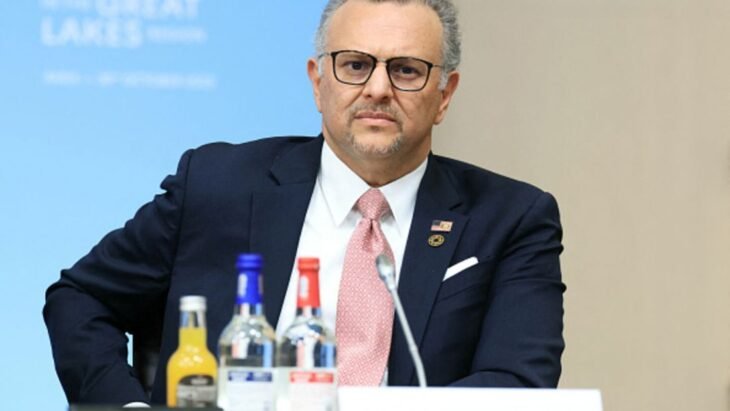
Recently, Massad Boulos, Senior Adviser to US President Donald Trump for Arab and African Affairs, advanced a proposal that signals a partial departure from the long-standing United Nations-led roadmap.

The initiative reportedly emphasises pragmatic power-sharing arrangements between Libya’s rival camps, including discussions around a reconfigured Presidential Council and transitional executive arrangements that could lead to elections by 2027. While presented as a pragmatic adjustment to political realities, the proposal reflects a broader shift in thinking in Washington that privileges managed stability over institutional transformation.

These include the approval of a unified national budget after years of fragmentation, as well as Libya’s participation in multinational military exercises such as Flintlock 26 under the supervision of US Africa Command (AFRICOM). From this perspective, Libya is increasingly framed through an ‘economy-first’ lens, where stabilising oil production and ensuring uninterrupted energy exports are prioritised as tools for managing global inflationary pressures and constraining the growing influence of Russia and Turkey across North Africa.

At a broader level, this approach fits into a transatlantic energy security strategy shaped by recent shocks in global supply chains. Ongoing instability in Middle Eastern energy corridors, particularly tensions involving Iran and the persistent risk of disruption in critical maritime routes such as the Strait of Hormuz, has reinforced the urgency of diversifying supply sources away from the Gulf. In this context, Libyan crude is increasingly seen in Washington not simply as a domestic Libyan issue, but as a useful geopolitical buffer outside both Gulf and Russian energy systems.

What makes Libya particularly significant is its proximity to Europe and the relative quality of its light crude, which can be quickly integrated into Mediterranean supply chains. For key European importers such as Italy and Spain, Libyan exports remain an important, flexible source of supply. As a result, recent U.S. engagement, including initiatives associated with the Boulos proposal, support for unified budget arrangements, and Libya’s participation in AFRICOM-led exercises like Flintlock 26, can be read as part of a broader effort to secure short-term energy and security stability, even if deeper structural security challenges inside Libya remain unresolved.

Shadow Governments and the

‘Militia Veto’

The assumption that elite-level agreements and technocratic coordination can substitute for comprehensive security transformation collides with what may be described as the entrenched ‘militia veto.’ Since 2011, Libya’s security landscape has evolved into a fragmented ecosystem of armed groups that operate not merely as military actors, but as embedded governance structures with financial, territorial, and institutional reach.

Armed groups in western Libya benefited from the collapse of Muammar Gaddafi’s regime in 2011 and succeeded in transforming themselves into dominant structures that regularly make claims for control over the capital, Tripoli.

As a result, the internationally-recognised Government of National Unity (GNU), headed by Abdul Hamid Dbeibah, exercises only nominal authority over the levers of power and remains dependent on these factions for its continued survival, particularly following Field Marshal Khalifa Haftar’s failed offensive on Tripoli in 2019—a year-long conflict that ended with the withdrawal of the Libyan National Army (LNA) and the signing of a fragile UN-brokered ceasefire that brought into being a new political arrangement represented by the Presidential Council and the Government of National Unity. This arrangement continues to shape the broader geopolitical dynamics between eastern and western Libya.

Historically, these groups are characterised by a relatively narrow social base with many of their leaders relying on displays of instrumental religiosity to consolidate local authority. For instance, Abdul Rauf Kara—widely known as ‘the Sheikh’ while formally holding the military rank of ‘lieutenant’—controls a significant portion of Tripoli.

The Special Deterrence Force (RADA) derives its influence from a social base initially strengthened by its anti-narcotics operations before evolving into a ‘state within a state,’ while also maintaining a rigidly hostile stance toward the Muslim Brotherhood. The RADA recruits heavily from conservative neighbourhoods in Tripoli, such as Souq al-Juma’a, and operates under the formal affiliation of the Ministry of Interior; however, in practice, it functions outside effective government control and maintains authority over Mitiga International Airport, the only operational airport in the capital.

In contrast, the 444 Combat Brigade represents a relatively structured and disciplined military formation aligned with the Ministry of Defence under the Government of National Unity. The brigade benefits from training and indirect support relationships with Turkey and derives much of its legitimacy from its operational effectiveness in areas such as Tarhuna and Bani Walid, while maintaining a socially diverse recruitment base.

Meanwhile, armed groups in Misrata draw their influence from the city’s post-2011 revolutionary networks and segments of its commercial elite, alongside sustained security ties with Ankara. On the periphery, factions in Zawiya remain highly localised, relying on tribal structures such as Awlad Saqr and Abu Humayra, in addition to fuel smuggling economies, which together enable them to resist attempts .

***

Khaled Mahmoud is a Cairo-based Egyptian journalist and political analyst covering regional security, armed conflicts, and Middle Eastern affairs for international publications.

___________________
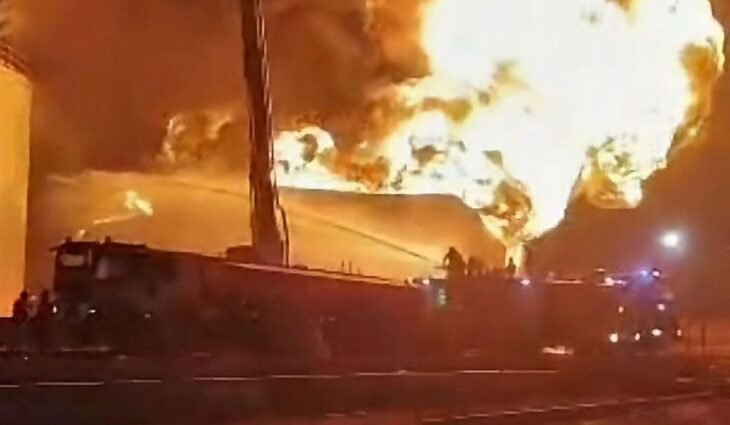
Zawiya: The refinery is contested by security, subsidized fuel, and smuggling to Tunisia (2)

Filippo Sardella

Precedents, continuity and risk of normalization of the crisis

The May 2026 sequence did not arise in a vacuum. In December 2024, Reuters and AP had already reported armed clashes in Zawiya, resulting in fires and damage to the refinery. This precedent is significant because it demonstrates a recurring pattern: when armed competition enters the urban-industrial perimeter, the risk no longer remains political but becomes technical, environmental, and commercial. The repetition of similar episodes suggests that the refinery is not merely close to an unstable city; it is embedded in a security environment that has not yet effectively separated critical infrastructure from local conflict.

The institutional image of Libyan energy governance is that of a sector struggling to function, plan, and attract expertise despite an uncertain security environment. The material published by the National Oil Corporation on the technical-financial meeting with Zawiya Refinery in 2024 highlights the administrative and industrial dimensions of the asset: production objectives, maintenance, environment, local distribution, investments, and planning. The flipside of this same asset is its exposure to armed conflict. This duality is at the heart of the dossier: the refinery is a formal economic infrastructure located within an informal geography of power.

Speculative hypothesis

The crisis as a violent negotiation of income, not as a simple clash between gangs.

The most prudent hypothesis is that the Zawiya crisis cannot be reduced to an episodic dispute between rival groups, but represents a form of violent negotiation over profitable opportunities: subsidized fuel, commercial goods, port access, control of neighborhoods, transit to Tunisia, and informal protection of supply chains. It is not necessary to attribute a conscious geopolitical strategy to each actor to recognize an overall geopolitical effect. When the oil infrastructure is shut down, the Tunisian border indirectly becomes tense, the Tripoli government must demonstrate coercive capacity, the NOC must reassure operators and workers, and armed networks evaluate whether to resist, negotiate, or reposition themselves.

In this interpretation, the security operation launched after the clashes serves a dual purpose. On the declared level, it aims to target criminals and wanted individuals. On the strategic level, it could serve to redefine who controls Zawiya’s economic perimeter. The risk is that the restoration of order will be interpreted locally as a selection of some groups against others; the opportunity is that the Western Libyan government can, for the first time, more credibly separate the refinery’s security from the urban networks of coercion.

The decisive variable will not be the initial statement, but the persistence of the effect: if after the operation the port remains protected, the refinery operates, and the border is subject to less pressure, then the crisis can lead to an operational strengthening. If, however, the action remains episodic, Zawiya will once again become a clearinghouse between income and weapons.

So What

Best Case Scenario

Key assumptions: the security operation successfully neutralizes the most destabilizing armed hubs without devolving into a protracted urban war. The NOC and the operator maintain credible emergency procedures, the port gradually returns to operation, local authorities cooperate, and the border with Tunisia is not subjected to a new wave of closures or frictions. In this scenario, Zawiya becomes a test of selective state control: not the solution to the Libyan crisis, but a precedent for protecting critical assets.

Impacts: The refinery’s continuity reduces the risk of internal distribution shocks; the Tripoli government can politically leverage its capacity for intervention; Tunisia and border communities benefit from reduced informal pressure. Strategy: Perimeter protection of the plant, financial intelligence on fuel networks, coordination with Tunisian authorities, distribution flow audits, and prudent public communication. Steps to follow: Stable reopening of the port, no new attacks in the industrial area, arrests without retaliation, improved fuel traceability. Operational advice: Daily monitoring of NOC communications, the status of the Ras Ajdir crossing, and local reports of queues, shortages, or incidents.

Worst Case Scenario

Key hypothesis: Security pressure disrupts local balances without replacing them with stable state control. Some groups react, the refinery becomes vulnerable to attacks or sabotage, the port remains intermittently closed, and fuel revenue shifts to more opaque alternative routes. In this scenario, state action does not reduce the criminal economy but reorganizes it, increasing the cost of security and uncertainty for energy operators and local communities.

Impacts: New refinery outages, potential pressure on domestic supplies, tension with Tunisia if the border becomes more porous or militarized, further loss of confidence in western Libya’s ability to protect strategic infrastructure. Strategy: Avoid triumphalistic communications, open local mediation channels, strengthen fire defense and logistical redundancy, and monitor suspicious movements on the coast and border. Steps to follow: Increased videos of clashes, statements from local groups, crossing closures, reports of fuel shortages. Operational advice: Treat any reopening as reversible until at least two to three weeks of operational continuity are observed.

Stability Case Scenario

Key assumptions: No actor achieves a clear victory. The refinery reopens, but informal income survives in a more discreet form; the security operation reduces the visibility of armed groups without dismantling economic networks; the Tunisian border remains manageable but not immune to trafficking. This scenario is probably the most compatible with the recent history of western Libya: tactical stabilization, partial institutional continuity, and the persistence of gray economies.

Impacts: Lower immediate risk to the plant, but no structural transformation of the subsidized fuel supply chain; local stakeholders are adapting; authorities achieve a narrative result without full economic recovery. Strategy: Shift focus from public order alone to fuel distribution governance, customs controls, audits, and volume tracking. Next steps: Technical reopening, media normalization, but no reforms on subsidies, imports, and distribution. Operational advice: Distinguish between visible calm and actual reduction in revenue.

Conclusions

Zawiya as a stress test for Libyan statehood

The Zawiya crisis demonstrates Libya’s difficulty separating energy, security, and income. The established fact is that the fighting has reached a sufficient level to force the refinery to shut down and the port to be evacuated. The strongly supported fact is that the city is a nationally important energy and logistics hub, connected to a sensitive border and long-standing informal economies. The signal to monitor is the security operation’s ability to exert control without triggering a new cycle of retaliation. The analytical inference is that Zawiya is not an anomaly, but an indicator: when a state does not fully control the supply chain between production, refining, distribution, and the border, fuel becomes an instrument of power even before it becomes a commodity.

In the short term, the key variable is the complex’s physical security: the absence of new attacks, the return of personnel, fire safety, and the port’s recovery. In the medium term, the response of local networks is crucial: if they adapt without conflict, the crisis can be resolved; if they shift to other routes or react, the problem spreads. In the long term, the issue raises the structural issue of subsidies, transparency in distribution, and institutional fragmentation. Without a reform of the control chain and traceability tools, Zawiya’s geography will continue to create incentives for armed competition.

____________________

Inside the rise of the Haftar family’s Dubai-based ‘money man’ (2)

Oscar Rickett

UAE funding for Tripoli offensive

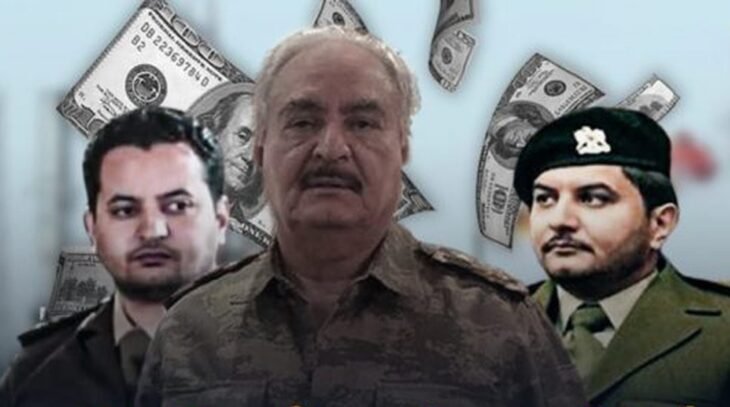
By October 2018, the UAE and the Haftar family had agreed to launch a full-scale invasion of Tripoli. Wagner Group, a private security contractor with links to the Kremlin, was willing, according to The Sentry, “to fulfil a combat function but demanded steady cash”.

Offshore channels were needed to move dollars to fund the operation, with the UAE and, to a lesser extent, Saudi Arabia suspected of having supplied the bulk of the financing. Haftar’s network called on Gadalla, The Sentry said, “thus giving a prominent role to a younger financier who had operated in Dubai since 2008”.

With Farhat Bengdara, an economic adviser to the Haftar family, as chairman, Al Masraf bank extended $300m in loans to three obscure Dubai-based companies controlled by Gadalla in 2019: JTA General Trading LLC, Al Mored Oasis General Trading LLC and ANAA General Trading LLC.

When questioned by MEE, Gadalla’s representatives said that he had no business relationship with Bengdara.

According to senior Libyan Foreign Bank officials who spoke to The Sentry, the money, which left Gadalla’s companies “almost immediately”, funded Haftar’s operations and “most likely bankrolled Wagner mercenaries’ deployment in the context of the April 2019 offensive” – allegations which Gadalla denies.

The UAE has served as a hub in Wagner-linked revenue chains, and US government assessments and intelligence reports have at various times accused Abu Dhabi of financing, collaborating with or facilitating Wagner operations, particularly in Libya.

Thousands died in the Tripoli offensive, which was also supported by Egypt and France as well as the UAE and Russia, and hundreds of thousands were forced from their homes. Despite more than 1,000 Emirati air strikes across Tripoli and the involvement of Russian combatants, the invasion was not successful and the money spent on it remains, for the most part, lost.

“After Haftar’s offensive collapsed, the loans have remained largely unpaid, leaving the Libyan public to bear the financial burden while Gadalla has faced no accountability,” The Sentry said.

Smuggling fuel and arms

The UN Panel of Experts report describes Gadalla as a “Libyan national who rose rapidly within the banking sector over the past 10 years with the support of Saddam Haftar”. The panel reported that Gadalla “subsequently used the funds at his disposal to purchase shipments of diverted fuel from armed group actors operating in both western and eastern Libya”.

“With their support, and his maritime transport capabilities, he facilitated the illicit export of this fuel from Libya, particularly through ports under the control of armed groups, and resold it for profit.” On 18 July 2025, the European Union’s Operation Irni intercepted the Aya 1 as it sailed from Port Rashid in the UAE to Benghazi. Operation Irini identified missing cargo documentation and inspected, at sea, a sample of six containers out of a total of 332. 

The inspection revealed 12 militarised vehicles in some of the containers onboard. Based on photographic evidence provided by Operation Irni, “the Panel assessed these vehicles as military equipment”, the UN Panel of Experts said in its report.

“Operation IRINI contacted the carrier, which is ultimately controlled by Ahmed Alushibe,” it reported, referring to Gadalla. Gadalla has also used the banks he controls to facilitate credit fraud and launder illicit profits, becoming part of the Haftars’ arms and fuel smuggling networks, which connect Libya to Chad, Sudan, Niger and Mali, among others, the Panel of Experts said.

It also reported that in one case, to which Gadalla is not believed to be linked, ammunition originally intended for the RSF in Sudan “was diverted and resold to individuals involved in gold trafficking in Niger” and linked to the Islamic State (IS) group.

Libyan reunification

The spotlight on Gadalla comes as the US pushes for Libyan unification. On 11 April, Libya’s rival legislative bodies approved a unified budget for the first time in more than a decade. Egypt, France, Germany, Italy, Qatar, Saudi Arabia, Turkey, the UAE, the UK and the US all welcomed this development. 

A week later, seeking to weaken Russian influence and enhance Washington’s standing in North Africa, US Africa Command’s (Africom) Flintlock training exercises began in the Libyan city of Sirte, with eastern and western Libyan troops training together for the first time. “These exercises are not just military training. These are overcoming differences, building capacity, and supporting Libya’s sovereign right to determine its own future,” John Brennan, deputy commander of Africom, said last year.

The UK has been riding in the US slipstream. Britain’s ambassador to Libya, Martin Reynolds, recently visited Benghazi, where he met with Khaled Haftar, one of Khalifa’s sons, and enjoyed a lemon and mint drink at a rooftop bar. Away from the rooftops, out on the streets, out in the wide desert tracts, an economy that runs on war rumbles on.

***

Oscar Rickett is a news editor and reporter at Middle East Eye. He has previously written and worked for the Guardian, Vice, openDemocracy, ITN, Africa Confidential and the Africa Report.

_________________

Mohamed Aoun and Libya’s struggle over oil and legitimacy

Salah El-Houni

In Libya, oil is not just an economic sector. It is the main core of the economy itself. And the battle over who controls the ministry of oil has become a proxy for a larger struggle: whether Libya is governed by institutions or by raw political power.

At the centre of this confrontation is Mohamed Aoun, a veteran engineer-turned-minister who has spent the past two years fighting to assert his legitimacy against a prime minister determined to sideline him.

Since 2024, Libya’s courts have issued four consecutive rulings affirming Aoun as the lawful minister, striking down the appointment of Khalifa Abdelsadiq, a deputy installed by Prime Minister Abdulhamid Dbeibah.

The rulings came from appellate chambers and even from the Supreme Court, leaving little room for ambiguity. Yet the prime minister has refused to implement the rulings, a form of defiance which Aoun describes as “contempt for judicial rulings.”

This is not a mere bureaucratic quarrel. Libya holds Africa’s largest proven oil reserves, estimated at 48.4 billion barrels, ranking seventh among OPEC members. In a country without income tax, a strong manufacturing base, and a productive agriculture, oil revenues are the state’s lifeline. Whoever controls the ministry controls the artery that sustains the nation.

The clash between the two was triggered by Aoun’s refusal to sign exploration contracts, particularly in the Ghadames basin, that he deemed unlawful. Reports suggest the contracts violated legal procedures, and when Aoun resisted, the oversight authority suspended him.

Months later, the same authority reinstated him after clearing him of any wrongdoing. By then, the prime minister had already appointed Abdelsadiq, setting the executive on a collision course with the judiciary.

The courts have been unequivocal. In ruling after ruling, they declared Abdelsadiq’s appointment void. Yet the executive pressed on, ignoring the judgments. For Aoun, the issue is not personal pride but a matter of legal principle. “All decisions issued by the illegitimate minister since May 12, 2024 are absolutely null and void,” he insists.

The implications extend beyond Libya’s borders. International oil companies and organisations such as OPEC face a real dilemma: contracts signed by a minister whose authority has been annulled risk being challenged in court.

Aoun has urged foreign partners to deal only with legitimate ministers, warning that ignoring judicial rulings entrenches the crisis and undermines Libya’s credibility as a partner.

The saga points to a deeper problem. Libya’s judiciary can issue clear rulings but lacks the mechanisms to enforce them. In a system scarred by years of division, the executive branch can simply defy judgments.

This erosion of institutional authority corrodes incentives for competence and integrity, rewarding those who bypass rules and punishing those who uphold them.

For Aoun, the fight has been personal as well as political. A technical engineer by training, he found himself up against a powerful political machine: a prime minister, oversight bodies, a deputy acting as minister, and media outlets framing the dispute on their own terms.

Yet he has remained defiant. “I am 100 percent certain of my position, I will not be afraid, and I am ready to appear before any court in Libya,” he declared.

His persistence has made him an unlikely symbol. He is not merely defending a post; he is testing whether Libya can still claim to be a state of law. Four rulings in his favour, yet no guarantee of implementation.

If Dbeibah is eventually forced to comply, it will mark a modest but real victory for the judiciary and for the idea that law can bind power. If not, it will confirm what many Libyans already suspect: that the architecture of a functioning state remains out of reach.

For now, Aoun continues to speak out, documenting every statement and warning that failure to implement judicial rulings carries future liability. In a region where foreign investment in energy is increasingly vital, the legitimacy of who signs contracts has never mattered much more.

Libya’s oil battle is ultimately a mirror of the country’s deeper question since 2011: is Libya a state of institutions governed by law, or a space where power interests intersect unchecked?

______________________

Libya in the middle: Can Greece’s moves rival Türkiye’s years-long strategy?

Göktuğ Çalışkan

Türkiye trains rival Libyan forces in EFES-2026, while Greece pushes legal committees and U.N. letters.

On May 6, Istanbul hosted Libya’s Deputy Defense Minister Abdulsalam Al-Zoubi as part of SAHA Expo 2026, one of the region’s largest defense exhibitions. His presence in Istanbul was not a courtesy visit.

It came just days after eastern and western Libyan military personnel completed a joint phase of EFES-2026 on Turkish soil, the second time rival Libyan factions had trained together under Ankara’s coordination in a short span of time. Taken together, these are not isolated moments.

What makes the timing critical is the backdrop. Only days before al-Zoubi’s appearance in Istanbul, Greek Foreign Minister George Gerapetritis was in Tripoli, meeting Government of National Unity (GNU) officials and pushing for the activation of a joint technical committee on maritime delimitation.

Athens called it a step toward “new agreements.” The core of the message, though, was less about new beginnings and more about undoing something old, specifically, the 2019 Türkiye-Libya maritime memorandum that Greece has spent years calling legally invalid.

The two capitals have indeed two very different approaches. This competition is no longer mainly about weapons, oil contracts or military bases. It is about legal architecture, diplomatic presence and who gets to influence the terms of Libya’s slow and uncertain reintegration into the regional order.

Paperwork or personnel

Athens has been methodical, as Gerapetritis’ visit to Tripoli consisted of several steps. The visit came with a package of joint technical committee for maritime delimitation, coast guard training and a broader signal that Athens wants to rebuild institutional ties with the GNU.

The proposal promises training for coast guard and military officers focused on migration control and search-and-rescue operations, support for the repair of ships and patrol vessels and closer cooperation with European institutions on border management. The offer tells you a great deal about who it is really designed to serve.

In other words, Athens is saying that if Libyan actors align more closely with Greece on maritime issues, they will also be better positioned within the networks that shape the EU’s migration policy and funding. Yet these offers are tightly framed by what Europe wants Libya to stop, not by what Libya itself is trying to build.

Athens did not stop there. Shortly before, Greece sent an official letter to the United Nations reiterating its position that the 2019 agreement is geographically inconsistent due to the location of Greek islands between the two countries and that this situation makes a common maritime border legally impossible.

Still, a legal record is one thing. Field presence is another. While Greece was proposing its commission in Tripoli, Libyan military personnel from both Benghazi and Tripoli were already in Izmir and Istanbul, transported on Turkish Air Force aircraft, for a joint exercise that, by its very nature, required both sides to accept Ankara as a trusted coordinator.

This relationship is not the result of a newly established technical committee. It is the result of years of accumulated experience that has been tested under pressure.

The limitations of a strategy based on paperwork are, of course, not merely hypothetical. Internal divisions in Libya have not yet healed, and any external actor that relies primarily on legal arguments and official proposals will find that these tools quickly lose their effectiveness when the political landscape shifts. Even if Greece puts forward a legally sophisticated argument, this approach on paper rarely translates into leverage on the ground.

Both sides at the table

For years, Türkiye’s Libya policy was practically synonymous with Tripoli. The relationship with the GNU was deep, institutionalized and politically loaded, built during a civil conflict in which Ankara made consequential choices. That depth was real, but a relationship anchored entirely to one side of a divided country has obvious ceilings.

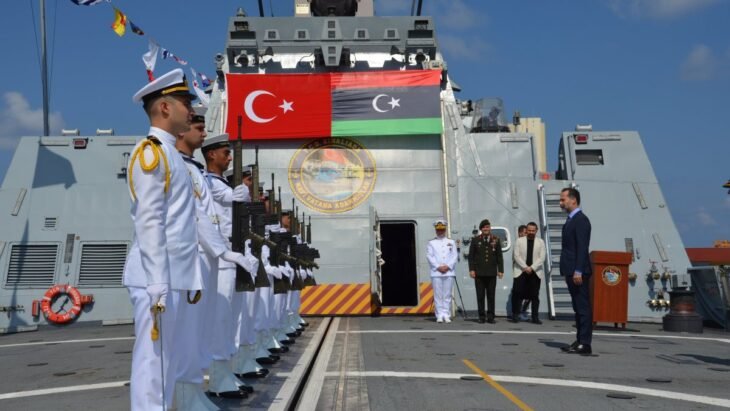
What has changed recently is the widening of Ankara’s contacts. Turkish naval vessels docked in Benghazi. Defense Minister Güler held direct talks with Haftar‘s deputy commander, Saddam Haftar, in Ankara. And now EFES-2026 has brought soldiers from both sides of Libya’s fault line to the same drill for the second time.

In this year’s exercise, 331 personnel from eastern Libya and 177 from the west participated in the joint exercise EFES-2026, which included assets of the Libyan Navy, such as the fast attack craft Şafak. The logic is to put soldiers from opposing camps through the same drills, let them share a mess hall and a planning room and they go home with something no commission proposal can manufacture.

Coordinating rival military factions under a joint exercise requires trust from both parties, logistical investment and a willingness to absorb the political risk if it goes wrong. Managing to do it twice, in a short period, says something about where Ankara actually stands in Libya’s security landscape.

It is not simply the preferred partner of one camp. It is trying and apparently succeeding at being relevant to the whole country. That is what real leverage looks like, and it is a position Greece has no credible path to replicating soon. For Libyan commanders trying to stitch together a broken security sector, this is less a theory and more a lived experience with units traveling, training and eating together under a partner that speaks to both camps.

Ankara’s difference

The asymmetry between the two approaches should be highlighted. Greece’s Libya strategy is essentially defensive in origin. It was built to challenge the 2019 memorandum, limit Türkiye’s maritime footprint in the central Mediterranean and manage migration flows across the central route. The strategy is largely about what Greece does not want to happen, rather than what it wants to build.

Türkiye’s interest in Libya runs in a different direction. Remaining embedded in Libya’s security sector, maintaining operational access to the central Mediterranean and supporting a political process that does not exclude Ankara, which requires a long-term presence, not a one-time diplomatic push.

Equipment supply, field training, joint exercises, high-level military dialogue and now engagement with both political blocs is a model that compounds over time. On the civilian side, Ankara is pairing security cooperation with bricks, roads and hospitals.

Turkish contractors have already signed development deals in four eastern cities, Benghazi, Al-Bayda, al-Shahid and Tobruk, covering roads, utilities and public hospitals. With a cumulative project portfolio in Libya exceeding $30 billion, the focus is now shifting toward airports, energy facilities and modular infrastructure.

Training programs, meanwhile, are structured to keep command and doctrine in Libyan hands while Turkish teams focus on qualification, joint planning and maintenance support. This is a model that a Libyan official described as one in which Ankara seeks to be inside their security architecture, but not above it.

Competition over Libya has intensified in recent weeks. Athens has been more active than at any point since the 2019 memorandum was signed. The U.N. letter, the Tripoli visit, and the commission proposal reflect Greece’s efforts.

Yet the memorandum remains in effect. Tripoli has shown no genuine interest in distancing itself from it, despite consistent Greek pressure. Libya’s GNU has its own reasons for keeping that relationship stable and a newly formed technical committee does not outweigh them. For a country trying to become whole again, the partner who trains, rebuilds and stays will almost always speak louder than the one who only files objections.

***

Göktuğ Çalışkan – Ph.D. candidate specializing in African geopolitics and the Sahel region, global politics and foreign policy analyst at the Ankara Center for Crisis and Policy Studies.

_________________

The problem with the US power-sharing plan for Libya

Karim Mezran and Dario Cristiani

Even as it continues negotiations over the Iran war, Washington has also been—somewhat surprisingly—at the forefront of diplomatic efforts to end another, albeit low-intensity, conflict: the one in Libya.

As noted by Frederic Wehrey and Jalel Harchaoui, US involvement in Libya has long oscillated between neglect and fleeting moments of attention for decades, but the second Trump administration has shown a strong interest in the oil-rich country.

Yet this renewed activism is less the result of a coherent institutional strategy than of the initiative of one individual: Massad Boulos, US President Donald Trump’s senior advisor for Arab and African affairs.

Indeed, Trump himself—alongside major figures within his administration from Secretary of State Marco Rubio to Vice President JD Vance, Secretary of War Pete Hegseth, and Secretary of Energy Chris Wright—has shown limited direct engagement with the Libyan dossier.

Paradoxically, Libya’s relatively low strategic priority within the administration created the conditions for Boulos to operate with a degree of autonomy rarely seen on other foreign policy matters.

Since July 2025, Boulos has increasingly focused on Libya after achieving early diplomatic successes in the Great Lakes region, particularly between the Democratic Republic of the Congo and Rwanda. As his momentum elsewhere began to stall, especially on Sudan, Libya emerged as a possible arena in which a tangible diplomatic success could still be achieved.

This activism also aligned with the broader economy-first logic of the Trump administration, especially toward resource-rich countries seen primarily through the lens of energy, infrastructure, and investment opportunities.

But by essentially brokering a power-sharing agreement among entrenched interests, Boulos’s initiative—if it comes to pass—will not solve Libya’s deeper problems.

Geopolitical shifts

Shifting international dynamics have added to the momentum behind this initiative. By late 2025, many outside countries traditionally involved in Libya were displaying signs of political fatigue. Turkey, after years as the principal military and political patron of Tripoli, cautiously began reaching out to the Haftar family, which leads the rival eastern faction.

Ankara’s calculations were driven both by Turkey’s desire for Libya’s eastern authorities to also recognize the 2019 maritime memorandum signed with the former Government of National Accord, and by broader economic interests tied to Turkish business expansion in Libya.

At the same time, regional geopolitical alignments were shifting. Divergences between Saudi Arabia and the United Arab Emirates, first visible in Yemen and Sudan and later amplified by the war with Iran, pushed the UAE to have a more cautious approach toward Libya.

Egypt also started reassessing its strategy amid concerns regarding warlord Khalifa Haftar’s alleged support for the Rapid Support Forces in Sudan and Cairo’s urgent need for a functioning Libyan economy capable of absorbing Egyptian labor and investments and exporting energy to Egypt.

Even countries historically divided on Libya, such as Italy and France, gradually converged around the need for stabilization, particularly because of migration management and energy security concerns.

China and Russia also appeared broadly supportive of this momentum, albeit for different reasons. Beijing is seeking to expand its geoeconomic footprint in Libya, while Moscow, under pressure from its failures in Ukraine and Mali, increasingly appears at least interested in not spoiling this process.

According to Russian Foreign Minister Sergei Lavrov, Russia is ready to assist Libya in “restoring unity and national reconciliation.”

The Boulos roadmap

Against this backdrop, Boulos and other officials have laid out in their public statements a new roadmap structured around four pillars: a unified national budget, the unification of military institutions, the formation of a unified government, and presidential and parliamentary elections within six months of reaching an agreement on a new executive structure.

The approval of Libya’s first unified state budget in more than a decade represented the most visible achievement of this process. The agreement sought to align parallel spending structures, reduce corruption, and allocate additional resources to the National Oil Corporation in order to boost production.

Yet the primary objective behind this initiative remains fundamentally, and immediately, economic. The current US push is aimed less at politically transforming Libya into a democracy than at creating the minimum degree of stability necessary to reopen the country to business and foreign investment, in the expectation that economic stabilization might eventually help stabilize the Libyan polity as well.

The growing activity between Washington and Tripoli illustrates this logic clearly. Delegations from the Tripoli-based government have met officials from the US Treasury Department, the Department of Energy, and the US Geological Survey to discuss financial reforms, strategic minerals, and energy cooperation. Major American companies, including Chevron and Boeing, have also signed agreements with Libyan entities.

However, the reality on the ground remains far more complicated. Despite recent optimism, Libya’s business environment is still deeply fragile with no easy solution in sight. Foreign companies continue to face severe structural obstacles linked to widespread corruption, international payments, customs procedures, contractual uncertainty, and legal insecurity.

Persistent difficulties often force businesses to rely on indirect financial channels and triangulated transactions through outside countries, increasing costs and risks alike.

These dynamics suggest that institutional agreements alone are insufficient to stabilize Libya’s economic environment. More importantly, they reveal the limits of the broader political logic underpinning the Boulos initiative.

The problem with

“familistic consociationalism”

The roadmap promoted by Boulos is ultimately based on what could be described as a form of “familistic consociationalism”: a power-sharing arrangement centered on formalizing existing political, military, and family networks.

According to this logic, stability can be achieved by institutionalizing the current balance of power between those who are currently dominant actors in the two Libyas: the rival camps of Haftar and Prime Minister Abdulhamid Dbeibah.

Yet this assumption appears dangerously simplistic. Libya’s recent history suggests that elite bargains and transactional arrangements have often deepened corruption and fragmentation rather than reduced them.

The worsening socio-economic conditions experienced by ordinary Libyans are themselves partially the product of earlier agreements between rival elites over institutions such as the National Oil Corporation and the Central Bank.

Moreover, widespread opposition to this roadmap has already emerged within the country, particularly in western Libya and especially in Misrata, Dbeibah’s hometown. Once considered a symbol of post-revolutionary unity after the overthrow of Muammar al-Qaddafi, Misrata is increasingly fragmented between pro- and anti-Dbeibah factions. Many political and security leaders in western Libya reject both the idea of sharing power with the Haftars and the broader logic of externally brokered settlements.

At the same time, internal tensions are also emerging within the Haftar camp itself. 

Rumors and reports from eastern Libya suggest growing dissatisfaction among some of Khalifa Haftar’s sons regarding the concentration of power in the hands of Saddam Haftar, the youngest son. These dynamics reveal the core weakness of the entire project: it assumes that family and clan structures are naturally cohesive and capable of guaranteeing long-term stability.

A well-known Arabic expression captures the reality: al-aqārib ʿaqārib—“relatives are scorpions.” Rivalry, mistrust, and toxic competition often emerge within family networks, especially when power and wealth are involved. Once Khalifa Haftar, the family patriarch who is eighty-two years old, is no longer present, it is far from certain that cohesion within his family will survive intact.

The same applies to the Dbeibah camp, where Ibrahim—Abdulhamid Dbeibah’s nephew and a figure expected to play a central role in the new political arrangement—may ultimately lack the authority, charisma, and political acumen necessary to maintain cohesion within the broader network.

In the short term, the Boulos initiative may succeed in reducing tensions and creating a slightly more predictable environment for foreign businesses, although a structural transformation of the Libyan business environment remains a chimera. However, the idea that a familistic consociational agreement can first stabilize Libya’s economy and, on that basis, stabilize the Libyan polity appears, at best, overly ambitious and unlikely to resolve Libya’s deeper structural crisis.

Without broader legitimacy, institutional accountability, and a genuinely inclusive political process, the current roadmap risks becoming not a durable solution to Libya’s fragmentation, but merely its latest temporary management mechanism.

***

Karim Mezran is the director of the North Africa Initiative and a resident senior fellow with the Rafik Hariri Center and Middle East Programs at the Atlantic Council.

Dario Cristiani is a nonresident senior fellow with the North Africa Program.

_____________

Zawiya: The refinery is contested by security, subsidized fuel, and smuggling to Tunisia (1)

Filippo Sardella

Geopolitical-operational dossier on armed conflicts, oil infrastructure, and cross-border networks in western Libya

Abstract

This analysis reconstructs the Zawiya crisis as a geopolitical hub in western Libya: not just a clash between armed groups, but a collision between critical energy infrastructure, subsidized fuel revenues, the Tunisian border, and a weak state chain of command. The report begins with the clashes of May 8, 2026, which, according to Reuters and sources within the refinery operator, led to the suspension of operations and the evacuation of ships from the port. It situates these clashes within a longer-term dynamic of competition over routes, depots, coastal cities, and informal networks.

The paper distinguishes between verified facts, strongly supported data, OSINT signals, elements to monitor, and analytical inferences, avoiding turning the reconstruction into unproven judicial attribution. The underlying thesis is that Zawiya is a point of friction where internal security, the criminal economy, and Libya’s energy architecture structurally overlap.

Initial methodological note

The dossier adopts an evidence-led approach. The facts reported as verified come from international news agencies, official communications, or directly attributed institutional sources. The strongly supported data are recurring and convergent elements from multiple open sources, such as nominal capabilities, operational distances, and infrastructure connections. The OSINT signals include open material that is not always independently verifiable and is only useful if consistent with other evidence. Analytical inferences are prudential assessments of the strategic significance of events and do not replace judicial or investigative verification. The reconstruction is updated as of May 9, 2026, 5:53 PM CEST, and emphasizes the connection between security, energy, economic gain, and territorial control.

CategoryAssessmentWhat does it mean?
Verified facthighPrecautionary shutdown, port evacuation, shelling in the facility area, and security operation are reported in press sources and statements attributed to operators/authorities.
Strongly supported datamedium-highZawiya capacity of 120,000 bpd, connection to Sharara and distance from Tripoli are consistent across Reuters, Anadolu and other sources.
OSINT signalmediumLocal videos and testimonies indicate clashes in the city and at the refinery, but caution is advised unless geolocalized or verified by third parties.
Analytical inferenceprudentialThe link between clashes, smuggling networks, and the Tunisian border is plausible and supported by the context, but it does not prove individual responsibility.

Introduction

Why Zawiya Is Not a Periphery: The Short Geography of Libyan Income

Zawiya is located west of Tripoli, along a coastal strip where geography generates revenue. Within a few kilometers, a densely populated city, a large refinery, an oil port, the road to the Tunisian border, and a hinterland where the Libyan state’s capacity remains intermittent, overlap. In a country with divided institutions, semi-autonomous armed forces, and a long post-2011 history of militiaization of security, this overlap transforms the energy infrastructure into both a political and criminal lever.

Zawiya is located on the coastal axis between Tripoli and the Tunisian border. The visual shows why the city’s crisis is not local: the theater unites energy infrastructure, commercial artery, and border space.

The immediate news concerns the armed clashes of May 8, 2026. Reuters reported that Libya’s largest operating refinery was shut down after fighting near the facility; the operator, Azzawiya Oil Refining Company, said it had completely suspended operations and evacuated ships from the port after heavy artillery fire hit several areas of the complex.

Anadolu, citing the National Oil Corporation, described a precautionary shutdown, evacuation of personnel, and heavy shelling in various parts of the oilfield. These factors, taken individually, describe an industrial emergency. Read in context, they point to a deeper problem: the vulnerability of energy infrastructure when territorial control is fragmented.

The Tunisian dimension is not secondary. Zawiya has for years been cited as a hotspot for fuel and goods smuggling networks to the border. The difference between subsidized fuel in Libya and external prices creates a powerful economic incentive; the coast and the border open up alternative channels; institutional weakness reduces the cost of risk.

It is at this intersection that the issue ceases to be a crime story and becomes geopolitical: not because each armed group has a coherent strategic plan, but because competition for local revenue impacts energy security, border relations, the public budget, and state authority.

Corpus

The operational sequence: from the clashes to the refinery shutdown

The first level of the crisis is operational. The Zawiya refinery, reported by Reuters and Anadolu as having a capacity of approximately 120,000 barrels per day, is connected to the Sharara field, one of the country’s main sources of production, estimated at around 300,000 barrels per day. When such a facility is shut down, it doesn’t just interrupt technical production: it triggers a risk signal for the entire internal distribution network, for the port, for workers, for associated companies, and for the credibility of oil governance.

The emergency declaration should not be interpreted merely as a technical measure. The decision to evacuate vessels and personnel indicates that the perceived risk was not confined to clashes far from the asset, but close enough to impact the physical security of the facility and the operator’s industrial liability. According to press sources, the National Oil Corporation reported that workers were safe and that firefighting teams remained on site. The verified fact is therefore the precautionary shutdown; the analytical inference is that Libyan energy governance is still unable to fully isolate critical assets from urban armed disputes.

Subsidized fuel as the political economy of conflict

The second level is economic. The Sentry estimated that the expansion of fuel smuggling between 2022 and 2024 resulted in losses for the Libyan population in the order of $20 billion. This data shouldn’t be automatically transferred to the Zawiya crisis of May 2026 as if it were direct evidence of individual clashes, but it does provide significant evidentiary context: it indicates that Libyan fuel is not just any commodity, but rather an arbitrary income generated thanks to internal subsidies, distribution opaqueness, and external outlets. In this sense, Zawiya is important because it is part of a supply chain where value is derived not only from the oil extracted, but from the differential between administered price, access to distribution, and informal export capacity.

The Tunisian border accentuates this logic. When an oil city is also close to a land corridor and a port, rent can flow in multiple directions: by road, by sea, through commercial goods, fuel, intermediary networks, and armed protection. This is where the category of “rival gangs” remains descriptive but insufficient. The most useful analytical category is that of rent ecosystem: armed groups, local officials, commercial intermediaries, border networks, and institutional actors operate in an environment where control of a depot, a road, a border crossing, or a neighborhood can generate economic value and political influence.

Actors and Incentives: The Crisis as a Multilevel Competition

The third level is political-security. Western Libyan authorities have presented the operation in Zawiya as an operation targeting criminal havens and wanted individuals, linking the crisis to murders, kidnappings, extortion, drug, weapons, and human trafficking, and irregular migration. This formulation, reported by regional and international sources, signals an attempt to transform a local armed crisis into a campaign to restore law and order. However, in Libya, the line between public order and power negotiations is often fluid: an operation can reduce an immediate threat while simultaneously redistributing positions among armed networks, municipalities, apparatuses, and political centers.

The verified fact is the launch of a security operation after the clashes. The strongly supported fact is Zawiya’s historical importance in the informal fuel and commodity economies. The signal to be treated with caution is the circulation of videos and testimonies of fighting in residential areas and at the compound: useful material for understanding risk perception, but not to be used as independent evidence without geolocation and verification.

The analytical inference is that the crisis represents a window of opportunity for reorganization: the state can attempt to suppress certain networks, but it can also provoke reactions if the operation is perceived as selective or as a transfer of income from one group to another.

__________________

Libya: One Step Forward, Two Steps Back (2)

Gregory Aftandilian

Meddling Across Borders and Corruption

Continue Unabated

Such upbeat words belie facts on the ground, however. Haftar’s forces and allied militias have reportedly aided the Rapid Support Forces (RSF) in Sudan’s brutal civil war by taking over the so-called triangle area where the borders of Sudan, Libya, and Egypt meet. This territorial hold has allowed the RSF to smuggle gold, drugs, and people into Libya, often receiving arms and illicit petroleum exports in return.

The RSF has committed numerous human rights abuses, including the execution of thousands of civilians in the town of al-Fasher in the North Darfur province, which makes it difficult to say, as Saddam Haftar claimed, that Libyan security forces are reliably contributing to regional peace and security.

Both Libyan administrations are engaged in extensive corruption schemes. In the words of one analyst, in western Libya “the appearance of state-building masks a far more predatory ecosystem. Over the past decade, ministries, public agencies, and state-owned enterprises have morphed into personal fiefdoms for factions that operate more like organized crime families than political actors.”

In eastern Libya, where most of the country’s oil fields are located, Saddam Haftar has, as that same analyst put it, “refined the art of large-scale fuel smuggling, exploiting Libya’s heavily subsidized fuel system to siphon off billions [of dollars] annually.” Such smuggling schemes deprive the state of hard currency and contribute to a collapsing welfare system.

The International Monetary Fund has noted persistently large fiscal deficits, which have put pressure on the exchange rate, foreign exchange reserves, and inflation, exacerbating social tensions. Many Libyan citizens are angry over their living conditions, given that Libya is an oil-rich country with only 7.5 million people but according to 2023 data has a poverty rate of nearly 40 percent.

Human rights groups have castigated both of Libya’s governments. Human Rights Watch, for example, recently noted that “armed groups, smugglers, and state authorities in Libya have subjected migrants, including infants and young children, to arbitrary detention, extortion, forced labor, sexual violence, and other serious abuses.” It also reported widespread arbitrary detention, torture and ill treatment in facilities run by state-affiliated forces and armed groups.

The Damaging Role of Outside Players

External powers, including Egypt, Russia, Turkey, and the United Arab Emirates (UAE), are known to have assisted Libya’s rival factions to further their own agendas, with other outside actors such as the European Union (EU) also contributing negatively to the situation.

A March 2026 report by the UN Security Council’s Panel of Experts on Libya, mandated to monitor weapons embargo violations and other illicit activities involving the North African country, discusses the involvement of foreign actors in illegal schemes that fund Libya’s militias. The UN report confirmed the findings of a 2025 investigation by the Italian publication Il Foglio of an elaborate scheme involving the UAE and a notorious Libyan businessman known as Ahmed Gadalla, who is close to Saddam Haftar.

The investigation showed that foreign actors continue to violate the UN embargo on weapons and other military items destined for Libya. It also revealed either lapsed judgment or a cover-up by the EU’s naval mission, Operation IRINI, which was established to monitor the arms embargo.

According to Il Foglio, in July 2025, a container ship that left the UAE port of Jebel Ali was intercepted by frigates associated with IRINI in the Mediterranean Sea near the port of Derna, Libya, after a tip-off from US intelligence. The cargo ship was then escorted to the Greek port of Astakos for inspection. Although the ship officially declared that it was only carrying cosmetics, cigarettes, and electronic equipment, it was actually transporting 240 pickup trucks destined for Libya, 86 of which were armored.

Typically used for mounting machine guns, these trucks are the vehicles of choice for Libyan and Sudanese militias. The UN has defined these trucks as military equipment and their shipment is considered a violation of the embargo.

The investigation revealed that the decision to allow the ship to leave for Libya was the result of “secret negotiations” between the EU, Greece, the UAE, and the two Libyan authorities in the east and the west. According to Il Foglio, Greece—worried about the wave of migrants coming from eastern Libya to Crete—sought to avoid offending Haftar and to prevent any retaliation in the form of a new irregular migration surge, decided that allowing the cargo to Libya was the “lesser evil.” Instead of offloading the trucks in Tripoli, the ship docked in Misrata, a port under the control of Dbeibah’s government.

Some 209 trucks were offloaded there; the rest were delivered to Benghazi, suggesting that both Libyan governments were involved in the scheme. The March 2026 UN report noted that 26 of the trucks wound up in the hands of a Libyan militia, al-Katiba 55, that run a notorious prison camp for migrants near Tripoli.

No Political Solution in Sight

Libya’s government is likely to remain divided for some time. Each administration benefits from the status quo through corruption schemes, while the militias depend on patronage that they receive from the governments or on revenues from their own rackets. While recent cooperation to agree on a unified budget may be encouraging, the fundamentals of the situation have not changed.

The decision by AFRICOM to host military exercises in Libya and to include military units belonging to each Libyan administration has done nothing to foster unity. Indeed, all it has probably achieved is to make those factions feel important. Rather than trying to forge unity through military posturing, the international community should increase its efforts to stop oil smuggling out of Libya in exchange for arms.

Some moves in that direction are already underway. On April 14, 2026, the UN Security Council unanimously passed a resolution to reinforce international efforts to monitor and prevent illicit oil smuggling from Libya. The resolution reaffirmed that the NOC is the sole entity authorized to market Libya’s oil and called for a prohibition on depositing Libyan oil revenues anywhere but in official accounts.

Yet there appears to be no real mechanism to enforce such a resolution except to target individuals and entities with sanctions—an approach that obviously has not worked well in the past. Only if meaningful punitive measures are applied to those involved in illicit oil sales will there be pressure on the two administrations to hold national elections and to bring about a unified government.

***

Gregory Aftandilian is a Nonresident Fellow at Arab Center Washington DC. He is a Senior Professorial Lecturer at American University where he teaches courses on US foreign policy. He is also an adjunct faculty member at Boston University and George Mason University, teaching courses on Middle East politics.

_____________________

Inside the rise of the Haftar family’s Dubai-based ‘money man’ (1)

Oscar Rickett

Ahmed Gadalla controls companies in Libya, the UAE, Malta and the UK, and is accused of being a central figure in the Haftars’ illicit operations – allegations he denies.

He is a Libyan businessman who lives in Dubai and carries a passport issued by the Caribbean island of Saint Kitts and Nevis.

According to Italian media reports, he wears $500,000 watches, flies on private jets and stays at five-star hotels in central London.

He is said to own at least eight properties in the United Arab Emirates and a $3.7m apartment in Toronto, where he maintains permanent Canadian residency and donates to a prestigious private health foundation. 

He controls banks, a state-owned enterprise and private companies in Libya, the UAE, Malta and the UK.

But, according to the United Nations’ Panel of Experts on Libya and a detailed report by US investigative organisation The Sentry, Ahmed Gadalla is a key moneyman for Khalifa Haftar’s Libyan Arab Armed Forces (LAAF), which controls eastern Libya and is backed by the UAE and Egypt.

And now, as the US and its allies push to unify the UN-backed government based in Tripoli with the Haftar family’s Benghazi administration, the 46-year-old is in the spotlight.

Active on multiple fronts for at least seven years, Gadalla, who is from Benghazi, is said to have risen with the support of Khalifa’s son, Saddam Haftar, and is alleged to be at the heart of a financial network that includes money laundering, arms smuggling and trafficking of various kinds. 

The UN and Sentry reports have both shed light on what they describe as the use of banks Gadalla controls to obtain fraudulent letters of credit, his alleged involvement in fuel and weapons smuggling, and his connection to Haftar’s failed 2019-20 assault on Tripoli. 

Gadalla denies financing or supporting the LAAF and denies the allegations made in The Sentry and the UN Panel’s report. He says he is still engaging with the UN Panel. 

“I utterly reject and deny the accusations made against me by The Sentry. My lawyers are challenging those allegations, and I also refute the claims made about me in the UN Panel of Experts report insofar as they relate to me,” Gadalla told Middle East Eye. 

“I have conducted my business lawfully and transparently and will continue to do so.”

Fuel and military vehicles

Banks controlled by Gadalla have also been involved in the circulation of counterfeit Russian-printed dinars, according to The Sentry.

According to the UN’s report, a Gadalla-owned bank in Benghazi “actively blocked” attempts to “conduct an official investigation into the letter of credit”, although Gadalla rejects the UN’s conclusion. 

Gadalla’s companies have funnelled money into the Haftars’ war machine, The Sentry said, with payments likely being made to Russia’s Wagner Group, arms sent to the Rapid Support Forces (RSF) paramilitary in Sudan and Gadalla’s Dubai-based entities securing $300m for the failed invasion of Tripoli. 

Gadalla denies that he, or his company, are involved in any such loans, and that the bank records in question had been investigated by two third-party organisations, Deloitte and the Investigation Unit of the Office of the Attorney General of Libya. He also denied financing military activity or funding the Wagner Group.

The Haftars’ operations have suffered a number of high-profile failures, including an attempt in 2024 to import Chinese combat drones disguised as wind turbines, an unsuccessful scheme to procure Spanish drones the year before and, in 2025, the interception by Greek and Italian patrol boats enforcing the UN arms embargo on Libya of a shipment of military vehicles intended for the RSF in Sudan. 

This last failure was connected by the UN report to a shipping company owned by Gadalla, who denies being involved in smuggling fuel or military vehicles.

“Although he now presents himself as a legitimate businessman, Gadalla’s portfolio of official activities conceals a broad range of questionable financial operations executed on behalf of the Haftars,” The Sentry reports. 

“Gadalla’s ascent, which has unfolded at the very nexus between Libya’s militia rule and hollowed-out economic institutions, shows how kleptocratic networks loot Libya’s public wealth on an immense scale.”

Gadalla, for his part, says that he conducts lawful, ordinary commercial activity within the constraints imposed by the post-conflict state.

A network of companies

Ahmed Gadalla became a Dubai resident in 2008. Prior to the uprisings that toppled Muammar Gaddafi in 2011, he studied engineering and earned a master’s degree in the US, according to The Sentry.

As Libya was gripped by civil war in 2011, Gadalla sold automotive and household cleaning products for an American company.

After Gaddafi’s fall, eastern Libya began to open up and Gadalla used his Emirati connections to get ahead and do business abroad, starting with a 2012 trip to the Chinese manufacturing hub of Guangzhou.

Today, the Libyan businessman is open about leading the Alushibe Group – Gadalla is also known as Ahmed Alushibe – described by The Sentry as “a loose set of companies he controls in Dubai”. 

He is chairman of a Libyan state-owned steel company, owner of the Dubai-based UDS Shipping Services LLC, the Malta-based International Seaport Holdings and oil refiners in Libya.

The Aya 1, a UDS container ship named after Gadalla’s daughter, was intercepted in July 2025 by the Greek and Italian navies because it was suspected of arms smuggling. Itineraries for the Aya 1 and Aya 2, another container ship, show them moving from Libyan ports like Tobruk and Benghazi to the UAE.

Gadalla denies controlling the Aya 1 or any ship involved in arms smuggling.

The UN Panel of Experts found that the Aya 1 had “exported at least 22 containers with flexi-tanks filled with heavy fuel oil from Tobruk to the United Arab Emirates”, appearing to corroborate The Sentry’s assertion that the vessel was “used in illicit petroleum exports”.

Gadalla owns “several banks in Libya, including Wahda Bank and Bank of Commerce & Development”, the UN panel said. It found that he “used the banking sector, with the support of armed group actors, to fraudulently obtain letters of credit from the Central Bank of Libya”. 

However, Gadalla denies owning or controlling multiple Libyan banks or engaging in letter-of-credit fraud.

In 2023, Gadalla purchased Benghazi’s Libyan Cement Company, which was notorious because of its links to the Austrian fugitive Jan Marsalek, a suspected Russian spy accused of bringing about the collapse of Germany’s Wirecard.

Companies House listings in the UK also show that between 2019, when the former CIA asset Haftar’s offensive on Tripoli was launched, and 2021, Gadalla was co-owner of a Nisa off-licence in the British city of Birmingham.

Gadalla is now the director of the IT company Future Information Services, whose registered office is on Oxford Street in central London.

On the Companies House page linked to Future Information Services, Gadalla is listed as Kittitian rather than Libyan, and his country of residence is marked as the UAE.

He does, in fact, carry a passport from St Kitts and Nevis, the Caribbean Island nation whose citizenship can be obtained for $250,000 of investment.

***

Oscar Rickett is a news editor and reporter at Middle East Eye. He has previously written and worked for the Guardian, Vice, openDemocracy, ITN, Africa Confidential and the Africa Report.

_________________

Libya: One Step Forward, Two Steps Back (1)

Gregory Aftandilian

In April 2026, with the help of the United States, Libya’s two parallel governments reached an agreement on a unified national budget for the first time since 2013. The two administrations also participated in military exercises sponsored by the United States African Command (AFRICOM) that were held in Libya for the first time.

While these developments may signal cooperation between the rival governments, realities on the ground belie any optimism about imminent reunification. Endemic corruption within each government works to perpetuate the status quo. Well-armed militias run patronage networks that help keep each government in place, while outside powers continue to aid their Libyan clients by way of various military and economic schemes, hindering unification.

The United Nations continues to call for a stop to Libyan groups’ weapons smuggling and illicit petroleum exports. Although the United States and Europe may encourage higher Libyan oil production to make up for the shortfall caused by the closure of the Strait of Hormuz, any additional revenues are unlikely to filter down to the Libyan people.

A Country Plagued by Divisions

Libya remains deeply divided. The internationally recognized Government of National Unity (GNU) is based in the capital city of Tripoli, but its authority extends only to the western part of the country. The GNU is led by Abdul Hamid Dbeibah, who was supposed to be only an interim prime minister until the nationwide elections that were scheduled for December 2021. After those elections were postponed, however, he stayed on as prime minister (the 2021 vote has yet to be rescheduled). His government is supported by various militias based in and around Tripoli.

In eastern Libya, a second government, the House of Representatives (HoR), traces its origins to   the June 2014 elections that created that body. Months after the vote, Libya’s supreme court ruled that those elections were unconstitutional and that the HoR must be dissolved, but instead the HoR relocated to Tobruk, near Libya’s border with Egypt, and became the base of the eastern government. The HoR is supported militarily by the so-called Libyan National Army led by self-anointed Field Marshal Khalifa Haftar.

Based in the city of Benghazi, Haftar is the real power in the east. In 2019-2020, Haftar attempted to take over the entire country, but his offensive was stymied by Tripoli-backed forces and by Turkey, which provided this government with advanced military equipment and personnel. Haftar then retreated to his stronghold in Benghazi. Now, his forces control the eastern coast and much of the interior.

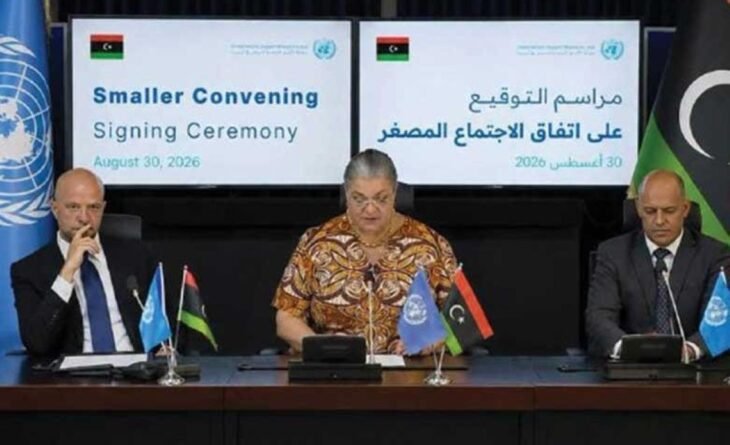
The challenges of holding new national elections and creating a unified national government have frustrated the UN Support Mission in Libya (UNSMIL) for many years. On April 22, 2026, UNSMIL head Hanna Tetteh stated that the political process was stalled, delaying efforts to reunify the country. She voiced frustration, stating, “Allowing status quo actors to evade their responsibilities will only undermine efforts to preserve Libya’s unity and wealth and delay the path to sustained peace, stability, and development.” Her comments echoed those of past leaders of UNSMIL who resigned after facing similar intransigence.

Some Positive Developments

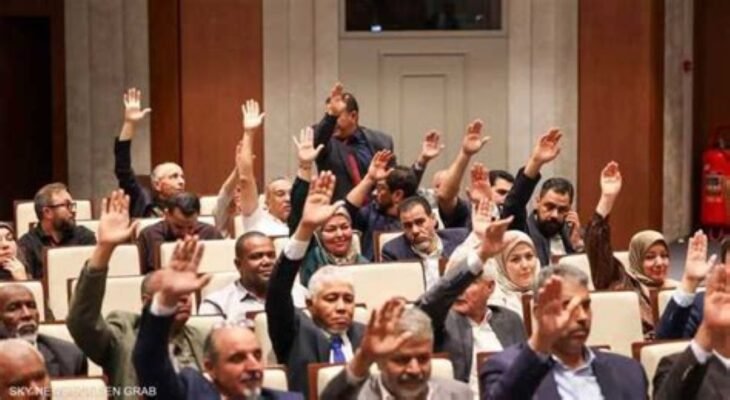
On April 11, 2026, the two governments approved the first unified state budget since 2013, a potential step toward unifying fractured state institutions and reducing corruption. The High State Council, the legislative body of the GNU, and the HoR agreed on a national budget of 190 billion Libyan dinars, equivalent to about $30 billion.

The central bank governor, Naji Issa, stated optimistically that “this is a clear declaration that Libya is capable of overcoming its differences when a unified vision for its future is forged.” Representatives from the two governments said that the unified budget would help ensure a fair distribution of resources and would allocate substantial funds to improve the state-run National Oil Corporation (NOC).

Efforts to agree on a unified budget were assisted by Massad Boulos, Senior Advisor to President Donald Trump for Africa and Arab and Middle Eastern Affairs and the father-in-law of Trump’s daughter Tiffany. Boulos praised the new budget as not only supporting nationwide development projects in Libya but also as shoring up the NOC to allow it to increase energy production and to generate higher state revenues.

Given the current difficulties of exporting oil and gas from the Gulf because of the Iran war’s effective closure of the Strait of Hormuz, the Trump administration may be looking to Libya to meet part of the worldwide oil shortfall. Libya has the largest oil reserves in Africa, estimated at 48 billion barrels, and the country’s oil production has recently increased.

Libya reportedly produced 1.43 million barrels per day (b/d) in early April 2026—one million more than it had produced in the previous month, and a ten-year high. Other reports have indicated that Libya plans to substantially increase natural gas exports to Europe by 2030. Currently the country exports very little gas via the Greenstream pipeline that runs from Libya to Sicily, but there are hopes of boosting this with the assistance of foreign companies.

In early April 2026, AFRICOM for the first time sponsored military exercises in Libya, called Flintlock, in partnership with 30 African and European countries. The exercises are designed to improve counterterrorism efforts in the Sahel and perhaps also to push back against Russian influence in the region.

US Embassy Libya (which is currently based in Tunisia because of security concerns) said that Libya’s hosting of the exercises “highlights the ability of Libyan security institutions from east and west to work together to contribute to and lead regional security cooperation,” and that it was an “important step toward stronger, more unified Libyan military institutions.” During the exercises, Khalifa Haftar’s son Saddam, who serves as deputy commander of his father’s forces, said that the exercises reaffirmed “Libya’s position as a reliable partner in supporting regional and international peace and security.”

***

Gregory Aftandilian is a Nonresident Fellow at Arab Center Washington DC. He is a Senior Professorial Lecturer at American University where he teaches courses on US foreign policy. He is also an adjunct faculty member at Boston University and George Mason University, teaching courses on Middle East politics.

_______________

Southward Creep: The Sahel Insurgency Reaches Coastal West Africa

 Salem A. Salem

Sahel insurgent groups are expanding into coastal West Africa, exposing governance gaps and raising risks to regional security and economic stability.

What was once a contained Sahel crisis is now steadily advancing toward the Gulf of Guinea. Extremist groups are not just launching cross-border attacks — they are embedding within communities, building supply networks, and exploiting long-standing governance failures. Coastal states like Benin, Togo, and Ghana are increasingly exposed, facing the same structural vulnerabilities that fueled conflict further north. The stakes are rising: Without early, coordinated action, the region risks a deeper and more complex insurgency. Preventing that outcome will depend less on military force alone and more on addressing the governance deficits that allow these groups to take root.

In meetings with the government of Benin on a humid and cloudy day of July 2023, officials were surprisingly reassuring about the danger lurking beyond their borders. Early warning signs were growing by the day that extremist violence from the Sahel was spilling over into their country.

At the time, violent incidents in northern Benin and Togo were rare. But today, villagers describe a pattern that has become familiar across the Sahel: nighttime raids, armed men appearing along forest tracks, and security forces scrambling to secure remote communities near the Burkinabe border. The frequency and scale of those incidents revealed the Sahel’s rampant extremist insurgency is moving south toward the Gulf of Guinea.

For more than a decade, the Sahel has been the world’s epicenter of terrorist violence. What began in 2012 as a rebellion in northern Mali evolved into a complex regional conflict involving Islamist extremists, local militias, and criminal networks across Mali, Burkina Faso, Niger, Chad, and northern Nigeria. Today, the region accounts for more than half of global terrorism‑related deaths, a dramatic increase since 2019.

The question is no longer whether the conflict will spread beyond the Sahel. It already has. The real question is whether coastal West Africa will address the governance gaps that enabled the Sahel crisis to escalate or repeat the same mistakes.

The Sahel Crisis Expands

For years, coastal West African states were widely viewed as insulated from Sahelian instability. That assumption is increasingly difficult to sustain.

Militant groups linked to Jama’at Nusrat al‑Islam wal‑Muslimin (JNIM) and the Islamic State in the Sahel have steadily expanded operations toward the Gulf of Guinea. By 2021, JNIM fighters were already staging attacks from eastern Burkina Faso and southwestern Niger into northern Benin. Since then, attacks in border areas of Benin and Togo have increased sharply.

Across coastal West Africa, terrorist incidents rose dramatically between 2022 and 2024, particularly along northern border regions where state presence remains limited. Benin has been among the hardest hit of the coastal states, with fatalities rising sharply in 2025 even if the overall numbers remain far below those seen in Burkina Faso or Mali.

Togo has experienced a similar trajectory. JNIM claimed its first attack there in 2022, and attacks have since continued in the Savanes region, targeting both civilians and military outposts.

These incidents are not isolated cross‑border raids. As recent analysis and reporting note, JNIM and other militant organizations are deliberately probing the northern peripheries of coastal states. Their strategy is gradual penetration rather than rapid territorial conquest: embedding in communities, establishing supply routes, and exploiting governance gaps.

A Regional System of Conflict

To understand this expansion, it helps to view the Sahel conflict not as a series of isolated insurgencies but as an evolving regional conflict system.

Over the past decade, groups such as JNIM have shifted from classic terrorist tactics toward hybrid insurgency; they increasingly attempt to control territory, regulate local economies, and establish parallel governance structures rather than operate solely through clandestine attacks. In parts of Mali and Burkina Faso, militants have collected taxes, mediated disputes, and enforced their own systems of justice.

This strategy has proven effective where state institutions are weak or absent. For communities long neglected by central governments, militant governance — however coercive — can sometimes appear more predictable than state governance.

At the same time, militant networks are deeply intertwined with organized crime. Smuggling routes linking West Africa to North Africa and the Mediterranean through the Sahel provide revenue streams and logistical infrastructure for armed groups. Livestock trafficking, fuel smuggling, and illegal mining, to name a few, all feed into this conflict economy.

The insurgency is also evolving technologically. Armed groups that once relied primarily on small arms and roadside bombs are increasingly experimenting with drones, encrypted communications, and digital financial tools.

Nigeria: A Convergence Zone

Recent developments in northern Nigeria illustrate how these dynamics are converging across borders.

According to analysis by the Armed Conflict Location & Event Data Project (ACLED), violence has surged in the Benin-Niger-Nigeria border triangle. Militants exploit forest routes and protected areas linking Burkina Faso, Niger, Benin, and Nigeria to move fighters and supplies. Their long-term objective seems to be the establishment of corridors linking the interior of the region to the Atlantic coast.

This region has become a convergence zone where Sahel‑based extremist networks intersect with Nigerian militant groups and criminal bandit networks.

The implications became clearer in October 2025 when JNIM claimed its first attack on Nigerian territory near the Benin border. The attack was small, but symbolically important: It signaled the group’s ambition to expand into West Africa’s largest country.

Nigeria already faces multiple security crises, from Islamic State‑affiliated insurgents in the Lake Chad Basin to bandit networks in the northwest. The growing overlap between banditry, organized crime, and Islamist extremism raises the possibility that Nigeria could increasingly resemble the hybrid insurgencies destabilizing parts of the Sahel.

The Vulnerable Coast

Ghana illustrates both the resilience of some coastal states and the strategic ambitions of Sahel-based militant groups. Despite remaining free of large-scale terrorist attacks, northern Ghana has increasingly been used as a logistics and recovery zone by militants operating across the border in Burkina Faso.

Fighters reportedly cross into Ghanaian territory to obtain supplies, move equipment, and seek medical treatment before returning north to the battlefield. The pattern reflects a deliberate strategy: Rather than attacking immediately, groups such as JNIM are building networks and supply chains that could later support deeper expansion toward the Gulf of Guinea.

Analysts note that Ghana’s relative stability — stronger institutions, functioning security services, and less acute local grievances — has so far limited militant penetration. Yet the country’s role as a logistical rear base underscores the regional nature of the conflict.

As these networks spread across coastal states, Western policymakers increasingly worry that the Sahel insurgency could eventually threaten major trade routes, ports, and energy infrastructure along the Atlantic coast. These concerns reflect a growing recognition that the drivers of extremism in coastal West Africa mirror many of the structural dynamics that fueled conflict in the Sahel.

In many countries, economic opportunity and political influence remain concentrated in southern urban centers, while northern border regions suffer from chronic underdevelopment and limited state presence. These disparities create fertile ground for recruitment.

Tensions between farmers and pastoralist communities, particularly among the herding Fulani populations, have also intensified in recent years. Restrictions on seasonal migration and confrontations with security forces have deepened grievances in some areas.

Research by the International Crisis Group highlights how groups like JNIM deliberately exploit these local tensions, positioning themselves as protectors of marginalized communities while undermining state authority.

Security responses have sometimes worsened these dynamics. In several areas, community militias mobilized to fight extremists have been accused of targeting Fulani civilians, reinforcing cycles of grievance and retaliation.

Stopping the Next Phase

The Sahel’s experience shows that terrorism thrives where governance fails. Military force is necessary to contain violent groups, but it cannot address the underlying drivers of instability. When security operations occur without accountability, they risk deepening the same grievances that militants exploit.

This is why strengthening the rule of law, judicial accountability, and civilian oversight of security forces remains central to long‑term stabilization. Communities are far more likely to cooperate with authorities when they trust that abuses will be investigated and justice delivered.

The spread of terrorist violence toward the Gulf of Guinea is not inevitable. But preventing a wider regional crisis requires acting before insurgent networks become entrenched. Coastal governments will need to invest far more heavily in northern border regions, not only in security forces but also in governance, justice systems, and economic opportunity.

Regional cooperation will also be essential. Militant networks operate across borders, and effective responses must do the same through intelligence-sharing, joint patrols, and coordinated law enforcement action. International partners, including the United Nations, should prioritize strengthening institutions rather than simply expanding military assistance. Investments in judicial capacity, anti‑corruption measures, and accountable security sector reform can have far greater long‑term impact.

Benin and Togo now sit on the frontline of a conflict that began far to the north. Whether they become the next theater of a widening insurgency, or the place where the region begins to reverse the tide, will depend less on battlefield victories than on whether governments address the governance deficits and root causes that allowed the Sahel crisis to grow in the first place.

***

Salem A. Salem (also known as Salem al-Hasi) is a political analyst, strategist, and human rights advocate with four decades of experience in security, intelligence, and geopolitical affairs across the MENA region. His career encompasses leadership roles in Libya’s opposition movements, government institutions, international human rights organizations, and academia. He is recognized for his sharp policy-relevant analysis of regional dynamics, conflict resolution, and security challenges.

__________________

To Counter the Islamic State in Africa, the U.S. Must Rely on Libya, Somaliland, and Rwanda

Michael Rubin

The Security Crisis Africa Now Faces Dwarfs the 2014 Rise of the Islamic State in Iraq and Syria.

The Jamaat Nusrat al-Islam wal-Muslimin (JNIM) noose continues to tighten in Mali, with the Al Qaeda-affiliated group blockading the capital. Coordinated attacks on April 25, 2026, which claimed the Malian defense minister’s life, among many others, show the group’s potency. The extremists now control checkpoints around the capital as the Russians, upon whom the Malian military junta relied, evacuate.

Should Mali—once among Africa’s most democratic governments—fall, the ripple effects throughout the region will be severe. Geographically, Mali is huge: It is roughly the size of Texas and California combined. Seven countries border Mali, with a combined population of over 175 million. A terror base in Mali would give safe-haven and sustenance to Boko Haram. Mali lies just 600 miles from the northern border of Nigeria, through largely ungoverned or loosely governed regions.

Just as in Somalia, the war in Mali is not a single conflict, but rather, an amalgam. Mali has long faced a Tuareg movement seeking to establish Azawad, a separatist state across the northern half of the country, centered around Gao and Timbuktu. While the Islamist rebels in southern Mali and the Tuaregs long operated as rivals, they now act as a united front against the state. The same dynamic is at play in Niger, where dissatisfied local groups and terrorist organizations now make common cause.

While some scholars have suggested the United States fill the vacuum in Mali, this is unrealistic in the current political environment. With war continuing with Iran and many Americans skeptical of force, and both Democrats and MAGA Republicans hostile to military deployments, direct U.S. action is a non-starter. After President Donald Trump ordered a U.S. withdrawal from Syria during his first term, U.S. Africa Command put out word to its officers to stay out of the news media at all costs, lest Trump realize the American presence in Africa was three times as large.

The security crisis Africa now faces dwarfs the 2014 rise of the Islamic State in Iraq and Syria. As the new White House Counterterrorism Strategy notes, the Islamic State and Al Qaeda affiliates stretch from Mali to Somalia and down into the Democratic Republic of Congo and Mozambique. Whereas the Islamic State in Iraq and Syria could smuggle oil via Turkish brokers to gain cash, the resources within the groups’ territories in Africa extend beyond oil to gold, silver, timber, and potentially even uranium.

Just as the Pentagon partnered successfully with Syrian Kurds to roll back the Islamic State, the United States must find local, indigenous allies to be the tip of the spear against the Islamic State and Al Qaeda. Fortunately, three countries or groups fit the bill and could act as the tip of the spear.

First is Libya, or at least those portions of the country not controlled by the recognized Tripoli government. Khalifa Haftar’s Libyan Armed Forces successfully stabilized 70 percent of Libya, including its oil fields and export facilities; the Libyan Armed Forces likely could control the entirety of the Libyan state if the international community ceased tolerating Tripoli-based Prime Minister Abdul Hamid Dabaiba and Grand Mufti Sadiq Al-Ghariani’s provision of extremist militias with safe-haven and weaponry.

Every week, Ghariani uses his influence over Qatari-financed mosques to recruit extremists in western and southern Libya for the so-called jihad in the Sahel. The U.S. Department of State should sanction Dabaiba for his two-faced protection of extremists, and target Ghariani, who is as dangerous as the late Al Qaeda founder Osama bin Laden and Islamic State caliph Abu Bakr al-Baghdadi.

Second is Somaliland. Somaliland is a natural ally: Western, democratic, and secure and aligned with Israel and Taiwan against the growing threats of both Islamic extremism and China. Too many career diplomats and even Trump administration National Security Council officials, though, seek to put Somalia first. Some do so out of ignorance of history: They fail to understand the precedent of failed federations reverting to their constituent parts—Senegal and Gambia, for example—nor do they have the legal background to realize Mogadishu never ratified the agreement with Hargeisa.

Others do so out of a misguided effort to keep Somalia happy. They subscribe to the “one-Somalia” arguments put out by Mogadishu, not understanding that Somali officials merely replicate the failed strategy of Egyptian President Gamal Abdel Nasser, who used Arab nationalist rhetoric to distract from his own failures. Finally, some counterterrorism officials argue that siding with Somaliland would undermine Somalia’s cooperation against al-Shabaab.

Such an argument falls flat. It assumes Mogadishu seeks to defeat al-Shabaab, though it has not for decades despite ample support. It also replicates the mistakes of the U.S.-Pakistan relationship, in which fear of losing counter-terror support led successive U.S. administrations to indulge Pakistan, even as it supported the Taliban and sheltered bin Laden. To embrace Somaliland could mark a turning point to push back Al Qaeda and Islamic State gains in Somalia.

Third is Rwanda. While Secretary of State Marco Rubio’s State Department sanctions Rwanda and defers uncritically to Russian, French, and American progressives who launder their state and personal interests through the United Nations Group of Experts, the country is key to regional security and moderation. It is the region’s Singapore against the backdrop of failed and failing states.

More importantly, Rwanda, at its own expense, has helped secure Mozambique’s Cabo Delgado province, the capital of the Central African Republic, and much of eastern Democratic Republic of Congo. Activists might disparage Rwanda’s contributions by noting investment and commerce followed, but more sober minds would applaud this: functional economies lead to functional states.

Too often, State Department Africa Bureau policy is disjointed, cobbled together by individual country teams or diplomatic fiefdoms absent any broad coherence. If Trump and Rubio want to counter the looming terror threat, it is time to approach Africa holistically and consider those partners with whom the United States can achieve its goals. The answer—Libyan Armed Forces, Somaliland, and Rwanda—will be self-evident, if only Trump, Rubio, or Congress asks the question.

***

Michael Rubin is a senior fellow at the American Enterprise Institute, where he specializes in Middle Eastern countries, particularly Iran and Turkey. His career includes time as a Pentagon official, with field experiences in Iran, Yemen, and Iraq, as well as engagements with the Taliban prior to 9/11.

__________________

Mali Attacks: Aggravating the Sahel Security Crisis

Salem A. Salem

Coordinated Mali attacks expose state vulnerabilities, insurgent adaptation, and shifting regional alliances across the Sahel.

The April 25 coordinated attacks in Mali mark a dangerous inflection point in the Sahel’s security crisis, revealing both the growing sophistication of insurgent groups and the fragility of state authority. A rare alliance between jihadist and separatist actors signals a pragmatic convergence that could reshape conflict dynamics and accelerate territorial fragmentation. At the same time, the limitations of Russia’s security support and emerging geopolitical recalibrations raise questions about the region’s external partnerships. As violence expands into urban centers and spills across borders, the crisis is no longer confined to Mali — it is redefining security risks across the Sahel and beyond.

The coordinated attacks that took place in Mali on April 25 mark a pivotal turning point, not only in the nation’s enduring conflict but also within the broader context of insecurity across the Sahel region. What occurred was neither a typical insurgency operation nor merely an escalation of violence. It was a carefully planned attack on various fronts that exposed significant vulnerabilities within the Malian government, demonstrated the fragility of its international alliances, and signaled an alarming shift in the tactics employed by armed groups in the region.

The scale and coordination of the attacks were unprecedented in recent Malian history. Armed groups targeted critical military and government installations across several locations, including the capital Bamako and nearby Kati, northern strongholds such as Gao and Kidal, and the central city of Séveré. By striking these locations almost simultaneously, the armed groups demonstrated not only tactical proficiency but also a strategic vision aimed at eroding the ruling junta’s power.

The recent attacks were also remarkable for the coalition involved: Jama’at Nusrat al-Islam wal-Muslimin (JNIM), an organization affiliated with al-Qaeda, collaborated with the Azawad Liberation Front (FLA), a Tuareg separatist movement. Historically, such alliances have exhibited tension and ideological contradictions. JNIM endeavors to establish governance based on Sharia law, whereas Tuareg separatists aspire to attain autonomy or independence for northern Mali. Despite these divergent long-term objectives, the two groups reached a consensus in their opposition to the Malian ruling regime. Their current collaboration exemplifies a pragmatic alignment of interests: JNIM benefits from the local legitimacy and ethnic grounding of the Tuareg cause, while the FLA gains access to JNIM’s superior military capabilities and regional influence.

This collaboration was not unprecedented; in 2012, similar coordination helped rebel forces seize key northern cities. Nevertheless, ideological divergences ultimately led to the disintegration of the coalition, as factions within the group were unable to harmonize their conflicting visions on governance and adherence to Sharia law.

In early 2025, the FLA and JNIM convened to discuss and reach consensus on principal issues. The Association of Azawad Scholars, representing the FLA, proposed a collaborative approach. In the proposal, the FLA committed to adhering to Sharia law and rejecting secularism, while simultaneously urging JNIM to renounce any affiliation with al-Qaeda. JNIM responded by reaffirming that its allegiance constitutes a religious obligation that can only be relinquished in extraordinary circumstances, such as the collapse of the Bamako regime.

It seems that JNIM is increasingly following the model of Hay’at Tahrir al-Sham (HTS) in Syria. Despite the differing circumstances, the emerging parallels are now apparent. HTS began as an al-Qaeda affiliate but gradually reinvented its identity, localized its objectives, and established governance structures that facilitated its transformation from insurgency to de facto authority. Similarly, JNIM has progressively incorporated into local communities by leveraging grievances, offering conflict resolution, and forming tactical alliances with local entities, including Tuareg organizations.

Additionally, drawing inspiration from HTS’s strategic approach towards Russia, JNIM issued a public statement on the second day of the attacks. The statement urged Russian forces to maintain neutrality in exchange for a commitment not to target them and called for coordination to establish a balanced and effective future relationship. Furthermore, JNIM’s adoption of HTS’s example is evident in its statement on Thursday, 30 April, in which it called on all factions of Malian society to unite to establish a cohesive “single front” to “dismantle the junta” and achieve a “peaceful and inclusive transition.” This marks a departure from its typical religious rhetoric toward a more nationalist discourse.

Another remarkable consequence of the recent attacks was the fall of Kidal. Although not the largest city in northern Mali, Kidal holds profound symbolic and strategic importance. Control of Kidal has long been associated with dominance over the northern region, and the FLA’s capture of the city represents a significant setback for the Malian government. This is particularly notable given that Malian forces, supported by Russian paramilitary forces, had only recently regained control of the city in 2023. The withdrawal of the Africa Corps, following an agreement with the FLA, raises concerns about the reliability and effectiveness of the Russian support. 

The involvement of Russian forces, initially through the Wagner Group and subsequently through the Africa Corps, was intended to enhance the Malian military’s capabilities to counter terrorism. However, recent developments have revealed the limitations inherent in this partnership. The failure of Russian-supported forces to prevent the capture of Kidal or to defend against coordinated assaults across the nation has undermined their credibility. The images of Russian personnel withdrawing from contested territories under negotiated agreements further undermine the perception of strength that Moscow has sought to project in Africa.

The death of Defense Minister General Sadio Camara, who died in a suicide attack at his residence, intensified Moscow’s challenges. Camara was both the architect of the nation’s security strategy and the principal channel between Bamako and Moscow. His assassination exposes weaknesses at the highest levels of leadership and raises significant concerns about the regime’s competence; moreover, it creates a leadership vacuum at a pivotal moment, potentially exacerbating internal conflicts within the junta.

Another potential consequence of the attacks is a transformation in geopolitical dynamics. Mali’s alignment with Russia and its strained relationships with Western partners represent a broader trend among Sahelian juntas seeking to forge alternative alliances. Nonetheless, recent setbacks for Russian forces may prompt the Sahelian juntas to reevaluate the effectiveness of their current partnerships and explore diversifying. Indicators of such diversification are already evident, as demonstrated by reports of expanding ties with Turkey and tentative re-engagement with the United States.

The attacks also underscore a wider shift in insurgent strategies. Historically, organizations such as JNIM have concentrated their operations in rural and peripheral areas with limited state presence. Nevertheless, the recent offensive signifies a strategic pivot towards urban warfare. By attacking urban centers, insurgents seek to enhance psychological effects, destabilize governance, and contest the state’s portrayal of dominance. Urban assaults also diminish public confidence in the government by manifesting conflict within daily life.

An additional concerning consequence of the recent attacks is the increasing availability of advanced weaponry to insurgent groups. Publicly circulating videos show combatants obtaining heavy military equipment, including armored vehicles, which were confiscated following recent clashes that concluded with the withdrawal of Malian and Russian military forces or the abandonment of strategic positions. This development boosts the capacities of these groups and increases the likelihood of regional spillover, potentially leading to further instability in neighboring countries and escalating conflicts in the region.

Analysts warn that Mali is now at serious risk of fragmentation as militant groups increase territorial control and weaken state authority. In the short term, Mali’s junta may seek to restore control through intensified military campaigns, possibly with sustained Russian assistance. However, the efficacy of this approach is considerably questioned, as the assaults have exposed significant intelligence shortcomings and the incompetence of the Malian Armed Forces in countering insurgency in Mali.

At the regional level, the April 25 attacks are expected to have repercussions that extend well beyond Mali, thereby destabilizing neighboring countries such as Niger and Burkina Faso. These effects might reach further into southern Libya and down to the Gulf of Guinea. Areas are already facing governance challenges and insurgent activity.

Recent attacks have demonstrated that relying solely on military solutions has not achieved the desired outcomes. This issue has sustained ongoing debates among Sahlian elites over alternative strategies, such as negotiations, local governance, and hybrid security methods, including diplomatic efforts and community engagement, to tackle the root causes of the conflicts.

The recent meeting between Burkina Faso’s ambassador and the Taliban’s acting representative to Iran may exemplify this approach. While pro-Taliban media claim the dialogue mainly centered on trade, agriculture, mining, and vocational training cooperation, analysts suggest that the main goal might have been to engage the Taliban in mediating between the ruling junta and Sahelian armed groups.

In conclusion, the recent coordinated attacks in Mali are of concern beyond the Sahelian states. North Africa, West Africa, and the Gulf of Guinea nations are all concerned about the potential impacts on their interests. Mali’s recent attacks are significantly shaping the security landscape throughout the Sahel and adjacent regions.

***

Salem A. Salem (also known as Salem al-Hasi) is a political analyst, strategist, and human rights advocate with four decades of experience in security, intelligence, and geopolitical affairs across the MENA region. His career encompasses leadership roles in Libya’s opposition movements, government institutions, international human rights organizations, and academia. He is recognized for his sharp policy-relevant analysis of regional dynamics, conflict resolution, and security challenges. 

_________________

Can a U.S.- Brokered State Budget Help Unite Libya?

Nosmot Gbadamosi

Inside what analysts call a “pinky promise” between Libya’s rival factions.

Step Toward Reunification?

Libya’s rival administrations approved the country’s first unified state budget in more than a decade last month, sparking hopes of greater stability in a nation that has been sharply divided between two governments since 2014.

The April 11 agreement, which aims to reduce corruption and allocate enough money to the Libyan state-owned National Oil Corp. (NOC) to boost production, was brokered by Massad Boulos, U.S. President Donald Trump’s senior advisor for Arab and African affairs. Boulos described it on X “as part of a broader roadmap toward peace and national unification.”

Yet while the deal is a positive step, analysts told Foreign Policy that it is more of a restricted spending agreement and is unlikely to prompt broader unification anytime soon. As Emadeddin Badi, a senior fellow at the Global Initiative Against Transnational Organized Crime, told Foreign Policy, the budget isn’t underpinned by structural reforms or enforcement mechanisms. “The deal at this stage is more of a pinky promise,” Badi said.

Libya has faced an economic crisis since civil war broke out in 2011, with rising living costs, inconsistent oil revenue, and soaring public debt. Today, in the wake of the 2020 cease-fire, both administrations—the United Nations-recognized government based in the capital, Tripoli, led by Prime Minister Abdul Hamid Dbeibah and a rival faction in the east controlled by warlord Khalifa Haftar—contribute to rampant overspending.

“The most obvious symptoms of that [spending] has been the decline in the value of the Libyan dinar,” said Rhiannon Smith, the managing director of Libya-Analysis, a consultancy. Boulos began negotiations with the rival governments last July, with the goal of fostering peace and advancing “commercial deals” for U.S. firms in Libya, a petrostate that exports the majority of its oil to European markets. (A few weeks after the budget deal was announced in April, U.S. energy giant Chevron signed a preliminary agreement with Libya’s NOC to assess the country’s shale oil and gas potential.)

The approach in Libya aligns with much of “the Trump administration’s foreign policy, whereby American interests across various conflicts are largely viewed through economic considerations,” Belal Abdallah recently wrote for the Cambridge Middle East and North Africa Forum.

The result of negotiations was a $30 billion unified development budget, which allocates around $1.9 billion to the NOC, with other dispersals covering subsidies, staff wages, family allowances, and operational spending, according to Reuters. While many of the budget’s details have not been publicly disclosed, the overall goal is to align parallel infrastructure spending and curb state overspending.

However, Badi said, “two political entities [are] dispersing separate portions of said budget,” and there is “limited willingness to exert coercion or pressure on the Libyan parties.” Smith echoed this sentiment. “This isn’t a government agreeing to a budget,” she said. “This is two distinct political families agreeing that they’re going to limit their spending.” The U.N. Support Mission in Libya has welcomed the agreement as “important progress towards addressing the urgent need to strengthen discipline in public expenditure management” but called for “robust oversight of public spending across Libya in line with international standards.”

Analysts including Badi and Smith say the spending framework, which concerns the 2026 fiscal year, is a temporary fix that does not address deeper structural issues, such as graft and the siphoning of oil revenues to foreign networks enabled by Russia and other international actors. It is also unclear what the war in Iran will mean for government spending. With the conflict rattling oil markets, Libya has ramped up production to meet global demand. Last week, the NOC said oil revenue had climbed to $2.9 billion in April, up from $1 billion in February.

While the two administrations have seen a significant windfall since the outbreak of the Iran war, that money is unlikely to go toward public services or paying off the country’s debt. “Almost certainly it will probably be siphoned off,” Smith said. The nature of the budget negotiations will also have implications for the future of Libyan politics. In talks, Boulos dealt primarily with Dbeibah’s nephew Ibrahim and Haftar’s son (and likely successor) Saddam—a move that, critics argue, sidelined wider political institutions and parties.

As Smith pointed out, the talks strengthened the legitimacy of the Haftars, whose regime is generally not recognized by the international community: “They now have a direct line to the U.S. administration.” “It’s not very logical to hope that the stakeholders that have been at the center of dilapidating the state’s reserves and economy will spearhead a solution for its economic problems,” Badi said.

_____________________

‘A big pact’: How the US plans to unite Libya through two ruling families

Sean Mathews

Russia is in retreat and energy prices are skyrocketing. Both developments have energised the US bid to unify Libya without popular consent. The US is crafting an agreement to unify oil-rich Libya around the country’s two most powerful families, as the US-Israeli war on Iran chokes global energy flows, current and former western officials, Arab sources briefed on the matter, and analysts told Middle East Eye.

The power-sharing agreement seeks to unify Libya through the Dbeibeh family in western Libya and the Haftar family in the east, while replacing each family’s leaders with a new generation. While the effort has been underway for some time, it has gained new focus as the war on Iran sends oil prices higher, drawing US energy companies back to the country with Africa’s largest proven oil reserves.

Libya’s ruling families are experiencing a windfall as Brent crude rises. The National Oil Corporation said its revenue hit $2.9bn in April, a threefold increase from the beginning of this year. The Libyan oil minister visited Washington last week. “This has been in the making for several months,” Riccardo Fabiani, North Africa director at the International Crisis Group, told MEE. “The US is trying to prepare the ground for this big pact between the two families.”

“There is a lot of money to be made upstream from more oil exploration,” Fabiani added. “The Americans have a huge interest in all of this – especially now with the war in Iran.”

Replacing Libya’s prime minister

Massad Boulos, US President Donald Trump’s Africa envoy, is leading the push. While the diplomatic deal has been noted in public and is opposed by many Libyans, it has flown below the radar in the West as the US-Israeli war on Iran draws the most attention in the region. The Trump administration wants Ibrahim Dbeibah, a Libyan powerbroker, to take over as prime minister in place of his cousin, the country’s current premier, Abdul Hamid Dbeibah, who is suffering from health issues.

Boulos pushed for the shakeup alongside Turkey as recently as April during the Antalya Forum, which was attended by a Libyan delegation, an Arab source familiar with the matter and a former senior western official told MEE. Ibrahim has forged a particularly close relationship with Boulos, with whom he has discussed unlocking billions of dollars in frozen Libyan assets in private, MEE previously revealed. The New York Times confirmed the report.

On the opposite side, Saddam Haftar, the 35-year-old son of General Khalifa Haftar, who controls Eastern Libya, would be named president of the North African country. Ibrahim and Saddam held meetings at the Élysée Palace in Paris earlier this year as part of Boulos’s efforts. Saddam is the deputy commander of Khalifa’s Libyan National Army. He has diversified the Haftar family’s relations with former foes, such as Turkey, and is emerging as the US’s preferred candidate to replace his 82-year-old father. Saddam also met the deputy director of the CIA during a visit to Washington last year, the Arab source told MEE. This is not the first effort to unify Libya.

‘Carve up the goodies’

Libya descended into civil war in 2011 after a Nato-backed uprising overthrew long-time ruler Muammar Gaddafi. For more than a decade, the country has been divided into two, with an internationally recognised government in Tripoli and a government in the east led by Khalifa.

The two sides fought a bloody war in 2019, during which Khalifa tried to conquer Tripoli. The fighting devolved into a proxy battle with Turkey backing the UN-recognised government, and Russia, Egypt, and the UAE supporting Khalifa. Abdul Hamid of the Dbeibeh family was appointed prime minister in 2021 as part of a UN-led bid to guide the country through democratic elections. “All of the outside powers, including the US, have basically given up on democratic elections in Libya,” a former senior western official told MEE. “Their preference is to work with the entrenched families and carve up the goodies among the two most corrupt.”

“But the Haftars are toxic in western Libya, and Dbeibeh doesn’t fully control the West. This totally bypasses the Libyan people and could backfire,” the former official said. The Dbeibeh family has courted powerful militias in western Libya but is opposed by other groups. Any effort to share power with the Saddam of the Haftar family is unlikely to sit well in Misrata, the Mediterranean coastal city home to a dynamic class of business families.

Sadiq al-Ghariani, the grand mufti of Libya, came out against any power-sharing deal between the two sides late last month. While the Haftars have a tighter grip on eastern Libya, the family itself is divided. Saddam is consolidating control of the military, but is locked in rivalry with his brothers, particularly Belqasim, who runs the fund for development and reconstruction in Benghazi. “Neither the Dbeibeh family nor the Haftar family are a cohesive unit now,” Jalal Harchaiou, a Libya expert with the Royal United Services Institute, told MEE. “This could actually make a change possible. The status quo is not sustainable, and if a new government is announced, it would be the beginning of a new process,” he said.

Can Libya replace Gulf oil?

A former US official familiar with Libya told MEE that the Trump administration is effectively carrying on with a gradual push to mend fences between the ruling families of Libya that the Biden administration pursued, although its willingness to toy with unlocking billions of dollars in frozen assets and cut business deals has greased the wheels of diplomacy. “This is not just a Boulos push; it is a whole-of-government initiative with the intention to make Libya accessible to US oil companies and create opportunities for Libyans,” the former official said. “Let’s face it, the UN election process did not work.”

There have been some tactical victories. The Central Bank of Libya announced the country’s first unified budget in more than a decade in early April. In a move that surprised some long-term Libya watchers, eastern and western Libyan forces trained together in Sirte as part of the US-led Flintlock military exercises last month. US energy companies were scouting out opportunities in Libya before the war on Iran.

Chevron won an exploration licence for Libya’s Sirte basin in February, and Exxon Mobil signed a memorandum of understanding with the National Oil Corporation to re-enter Libya in August. Libya’s National Oil Corporation said its oil exports hit 1.2 million barrels per day in April, which is described as a 10-year high. But some analysts are sceptical of how Libya has framed those numbers and say the war in Iran has not materially changed the investment landscape. Most of Libya’s oil infrastructure is half a century old, and statistics in the country are murky, given the opacity of its government.

Jason Pack, the founder of Libya-Analysis and author of Libya and the Global Enduring Disorder, told MEE that the US and its allies would be disappointed if they think Libya can replace volumes lost from the Gulf. “The inability of Libyans to produce more oil has to do with their own internal incompetence, not the amount of US or external support, or lack thereof,” Pack told MEE. “The idea that Libya can deliver globally meaningful quantities of oil in the short duration of the Iran war is laughable.”

Pack said Russia’s invasion of Ukraine in 2022 sparked a similar conversation about Libya’s potential to supplant Russia as a gas provider to Europe. “At the start of the war in Ukraine, people were saying that Libya would be the new Algeria, but the Libyans failed to achieve it, and they will fail to achieve this,” he said.

Turkey’s support

But the idea of Libya’s two prominent families moving closer to sharing the country’s current energy spoils under US auspices is a more achievable goal, experts say. One of the main reasons is that the external powers, which once turned Libya into a proxy conflict, have diversified their ties. Saddam is courting Turkey and has started to receive some weapons from Pakistan under Saudi Arabia’s auspices, MEE previously revealed. Meanwhile, Egypt, which once opposed the government in Tripoli, has bolstered its ties with the government and is mending fences with Ankara, its old foe in Libya.

“Turks and Egyptians are willing for the two sides work together because the political context is so different than the past,” Pack said. “This has nothing to do with Trump.” Harchaoui said the US had Turkey’s support, which is one of the most powerful actors on the ground in Libya. “There are some indications that Turkey is probably happy with whatever big announcement is in the pipeline. That matters,” he said. “I think the Saudis will support what Turkey agrees with, because of Sudan.”

The US may also see an opportunity to drive a wedge between the Haftar family and Russia, which has deployed mercenaries in eastern Libya and previously sought port access in the country. A Russian-backed government in neighbouring Mali is on the verge of collapse from al-Qaeda linked militants. “It’s not just the money drawing the US deep state to Libya. Russia is on the retreat in Mali, and it’s not crazy to think something could happen to them in Libya too,” Harchaoui added. 

___________________
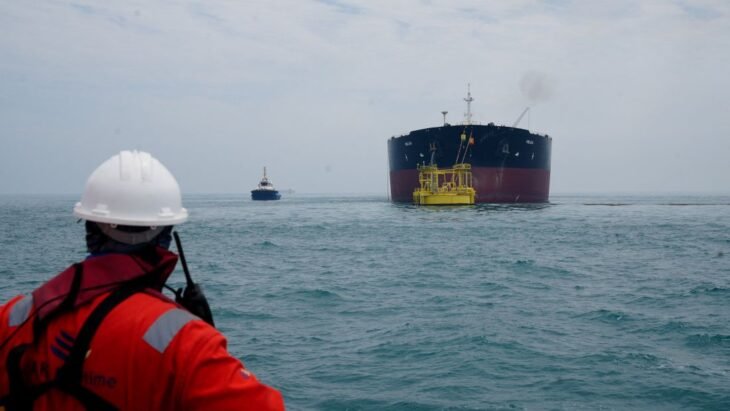
The EU’s Technocratic Trap in Libya: How Brussels Is Ceding the Mediterranean (2)

Andrea Cellino

The Vacuum Russia, Turkey, and

the UAE Have Filled

The consequence of EU depoliticization has been a structural vacuum that other powers have filled with far greater effectiveness. Turkey’s military intervention in 2019-2020 reversed Haftar’s offensive on Tripoli, earning Ankara a permanent military presence in western Libya and an increased degree of influence over the GNU. Russia, which supported Haftar’s offensive through the Wagner Group (now operating under the Africa Corps brand), is entrenched in eastern Libya and the broader Sahel corridor.

The Panel of Experts of the UN described the arms embargo as “totally ineffective” and noted “widespread and flagrant” violations, including by Russia. The UAE has been a consistent financial and military backer of Haftar, largely undisturbed by EU diplomatic pressure. In 2025, the Haftar family conducted a systematic international legitimation campaign: Khalifa Haftar was received by Macron in Paris in February and by Putin in Moscow in May, while his son Saddam visited the United States, Turkey, Italy, and Niger.

The EU’s Operation Irini, the naval mission supposed to enforce the arms embargo, has been criticized for selectively inspecting cargo while remaining cautious where inspections might interfere with migration cooperation. EU officials contest this characterization, noting structural constraints: Naval law bars the inspection of Turkish military vessels; few member states make ports available for cargo diversion; and arms flows have increasingly shifted to air transport, beyond Irini’s interdiction capacity. Yet the political perception — that Irini polices migration routes more effectively than weapons flows — has stuck and is not easily dismissed.

The UNSMIL Roadmap: A Test Europe

Is Failing

In August 2025, UNSMIL Special Representative Hanna Serwaa Tetteh presented the Security Council with a new roadmap structured around three pillars: an electoral framework for presidential and parliamentary elections, institutional unification through a new government, and a structured dialogue on governance, economy, security, and reconciliation.

Tetteh indicated that national elections could be held within 12 to 18 months if the roadmap is successfully implemented. The EU’s response was limited to declarations of support by the EU Delegation and member state missions in Libya, alongside general endorsements in UN fora.

No specific EU political initiative has followed. The October 2025 launch of the New EU Pact for the Mediterranean, while signaling a rhetorical shift towards treating Mediterranean partners as “geopolitical actors to be managed,” offers little concrete change for Libya: The document prioritizes migration control and contains only a weak reference to human rights, good governance, and rule of law.

Recommendations: Reclaiming a

Political Role

If the EU is to halt its slide into irrelevance in Libya, several reorientations are necessary.

First, develop a common EU political position on the UNSMIL roadmap. UNSMIL’s three-pillar framework offers an external scaffold the EU could more actively support rather than merely endorse. This means coordinating member state diplomatic positions around concrete benchmarks — electoral legislation, institutional unification timelines — and ending the pattern by which France, Italy, Greece, and Malta pursue separate bilateral tracks that undermine collective credibility.

Second, use SC16337 to push for executive interdiction powers for Irini. In April 2026, the Security Council passed resolution SC16337, requiring that payments for Libyan crude oil be routed exclusively through National Oil Corporation accounts at the Libyan Foreign Bank — a significant step towards closing the illicit export channels that have long undermined both the sanctions regime and Libya’s fiscal unity. With Irini’s mandate already extended until March 2027, the EU should now press for the mission’s hydrocarbon role to be upgraded from monitoring to active interdiction: The financial architecture is in place; what is missing is the enforcement capacity to give it teeth.

Third, engage eastern Libya without conferring unilateral legitimacy. Technical contacts with Haftar’s administration are pragmatically unavoidable given his control over coastline, oil infrastructure, and migration routes. But the planned Benghazi coordination center should not proceed without a clear political framework that includes commitments on human rights and alignment with the UNSMIL roadmap — conditions, not blank checks.

Fourth, build on the unified budget as economic glue. In April 2026, Libya’s rival legislative chambers approved a unified state budget for the first time since 2013 — a Libyan-owned agreement with the Central Bank as its neutral anchor. The EU should seize this opening by conditioning a meaningful share of its NDICI assistance on alignment with unified budget mechanisms, supporting public financial management and audit institutions that serve both administrations. Strengthening the NOC-Central Bank revenue-sharing nexus — the one economic arrangement both sides have an interest in preserving — gives the EU real leverage without the zero-sum dynamics that Russia, Turkey, and the UAE exploit on the security track.

Fifth, make transparency non-negotiable. The EU has never suspended assistance to Libya over documented rights violations, rendering conditionality threats hollow. All programs touching border management or detention should be subject to mandatory, independent human rights impact assessments with published findings — giving civil society and the European Parliament concrete grounds to hold the Commission to account where political will to act has consistently been absent.

The window for reclaiming political relevance in Libya is narrowing, not closed. Each year of Russian and Turkish military entrenchment and EU technical retreat makes a credible future initiative harder to launch. What the EU has demonstrated is that money, in the absence of political will, does not buy influence — it buys the appearance of engagement while others shape the facts on the ground. Reversing this requires accepting that stabilization in Libya is not a technical problem to be managed but a political challenge to be confronted, even when doing so demands difficult choices among member states that have long preferred comfortable inaction.

***

Andrea Cellino is Vice President at MEIS, the Middle East Institute Switzerland, and Non-Resident Executive Fellow at GCSP, the Geneva Centre for Security Policy. 

_____________________
Libya’s False Peace (2)

Jalel Harchaoui and Frederic Wehrey

The bank governor installed at the close of that crisis, Naji Issa, now faces relentless political pressure from both sides to disburse funds for projects of varying legitimacy. The result is that Libya’s annual hard-currency deficit was roughly $9 billion last year, and the dinar suffered its steepest sustained depreciation in years, driving a painful surge in consumer prices across the country.

There is also a multibillion-dollar gap between the value of the crude oil the National Oil Corporation extracted in 2025 and the amount it deposited with the central bank. This is largely because both ruling factions are diverting hydrocarbon wealth to their own coffers from the state treasury.

The 2022 power-sharing arrangement has yielded no discernible benefit for ordinary Libyans. Nor has it advanced U.S. or broader Western interests in the country. As Libya’s institutions have continued to weaken, Western firms have found it more difficult to operate in the country since they now face greater unpredictability and opacity. Large U.S. companies struggle to function in such conditions.

Any windfall Libya sees as a result of Iran war–related spikes in crude oil prices will merely obscure the dysfunctional mechanisms responsible for these fiscal problems. In fact, greater oil revenues this year will only encourage both the Dabaibas and the Haftars to indulge in further abuses of the current system.​​​​​​​​​​​​​​​​

DEALS GONE BAD

The Trump administration’s Libya policy is plagued by contradictions. Its insistence on reconciling the two ruling families as a precondition for any unified governance structure suggests that the Dabaiba and Haftar clans are expected to remain in power for the foreseeable future.

But in his February 18 remarks at the UN, Boulos explained that Washington’s goal is to “create the conditions for a democratically elected government to be able to lead Libya”—an outcome that would require at least some of the incumbent leaders to step down.

Washington’s focus on elite bargains and economic statecraft first became clear last summer, when Boulos visited both Tripoli and Benghazi. The ruling family in each city pledged grandiose business opportunities to the U.S. adviser, including tens of billions of dollars in contracts for American firms. In September 2025 and January 2026, Boulos convened further meetings with Libyan leaders in Rome and Paris.

He mediated not between broad political constituencies but rather between representatives of the two families: Ibrahim Dabaiba, the prime minister’s influential nephew, and Saddam Haftar, one of the field marshal’s sons and his presumptive heir. Marketed as a signature Trump administration peace initiative, this format merely imitated the Biden-backed, Emirati-brokered arrangement from 2022.

The Trump administration argues that its diplomacy will help U.S. firms secure business opportunities, yet it overlooks the inherent instability that comes in a country where political power is so yoked to a handful of influential leaders.

To be sure, major U.S. oil companies are expanding their operations in Libya. After years of absence, ExxonMobil is set to survey four offshore blocks. Chevron won an onshore block in the Sirte basin and signed a separate offshore survey agreement. ConocoPhillips has renewed and expanded its existing license for the Waha oil field through 2050, and SLB (Schlumberger) is increasing its well-services role.

But once committed, these firms will have no institutional framework to fall back on when the officials who welcomed them prove unreliable.

The White House’s flawed approach also extends to its engagement with Libya’s fragmented military. Washington worked hard to convince military leaders from both eastern and western Libya to participate together in April’s Flintlock military exercises. But securing that joint participation came at a cost.

For months, Washington refrained from exerting serious pressure on either faction lest one side pull out of the exercises, issuing no public criticism about corrupt practices and instituting no sanctions against midlevel figures. The tradeoff might have been worthwhile had the exercises produced genuine military unification, but no serious integration of rival Libyan forces is yet underway.​​​​​​​​​​​​​​​​

BACK TO THE FUTURE

Securing the Trump administration’s commercial objectives in Libya requires a level of institutional stability that personalized dealmaking cannot provide. To that end, Washington needs to broaden the scope of its engagement with Libya and with the foreign states that wield influence in the country—primarily Turkey.

The United States should prioritize Libya’s fiscal viability by helping rebuild the independence of its two key economic pillars—the central bank and the National Oil Corporation. It should also support accountability and transparency through independent, public audits and third-party revenue monitoring, opposing the sort of politically motivated interference that produced the 2022 National Oil Corporation debacle and the 2024 central bank crisis.

And any meaningful U.S. effort to stabilize Libya will require comprehensive coordination with Turkey—and, when divergences prove irreconcilable, a willingness to apply pressure on Ankara.

Washington must move beyond seeking intermittent Turkish buy-in and instead commit to granular, sustained engagement that uses both diplomatic coordination and forceful pressure to check Ankara’s unilateral activism.

More broadly, the United States must also support the imperative of national elections for a unified executive. Here, it has a ready platform to promote: the UN’s new road map for Libya, which calls for broad consultations with Libyans to address economic and political grievances, unify the country’s parallel administrations, and, crucially, hold elections.

The UN’s plan also endeavors to incorporate municipal councils, grassroots civil society organizations, and political parties into the country’s technocratic institutions, an approach that should receive more backing from the United States.

Trump’s evisceration of the U.S. Agency for International Development, which had previously been supporting both local and national institutions in Libya, has not helped matters.

But for Washington to truly open Libya for steady U.S. business, it must recognize that conditions for long-term investment will never be propitious as long as U.S. officials focus only on pandering to the ambitions of the country’s dueling potentates.

***Jalel Harchaoui is a Libya specialist with the Royal United Services Institute.

Frederic Wehrey is Senior Fellow in the Middle East Program at the Carnegie Endowment for International Peace.

__________

foreign Affairs

Absent reforms, unfreezing Libyan Investment Authority is risky

Justyna Gudzowska

The New Arab

Libya’s sovereign wealth fund needs better governance before UN sanctions can be eased.

On 11 April, the United States brokered a unified spending framework for Libya, endorsed by both eastern and western factions—a sign of the attention that Washington has been devoting to the North African nation lately.

The US-Israeli war with Iran has only increased the strategic value of Libya, an oil-rich country situated on the southern flank of Europe, away from the Persian Gulf. As a result, international diplomats have been paying closer attention to it and to what its leaders want.

One of those wants is the loosening of restrictions on the Libyan Investment Authority (LIA), the country’s sovereign wealth fund. Libya’s current leaders desire easier access to the LIA’s frozen billions via a partial lifting of the UN sanctions in place since 2011. Their message to the Security Council and individual member states has been consistent: the freeze has lasted long enough and has harmed Libya. The reality is that the opposite is true.

A fresh asset valuation looms

On 14 April, the UN Security Council adopted Resolution 2819, a narrow, technical measure that mostly clarified the rules of how some frozen LIA cash can be reinvested to preserve value.

But critically, it also reiterated that the LIA should continue to work “with international accounting and auditing firms to provide accurate audited consolidated financial statements… and to further improve the accuracy and comprehensiveness of its investment plan… clarifying data inaccuracies and inconsistencies and addressing conflict of interest issues.”

While the LIA welcomed the resolution’s modest provisions relating to reinvestment of frozen assets, the Council’s continued stance over the need to clean up the LIA’s governance has prompted a fresh commitment from the LIA to revalue its assets.

This undertaking is fraught with risk for the LIA, as a proper asset valuation would necessitate a close look at how Libya’s leaders have been managing the assets they already have access to. An examination of these assets reveals the shaky foundations upon which the LIA’s demands are based.

The case for lifting the asset freeze

The LIA’s lobbyists will no doubt continue promoting the notion that the UN freeze is the main obstacle to sound management of the sovereign fund’s assets. In reality, roughly a third of the portfolio has already been free of restrictions.

A years-long investigation by The Sentry—grounded in forensic inquiry and financial analysis across multiple jurisdictions—found that of the LIA’s $60 billion-plus in assets, only two-thirds are frozen.

The LIA’s current leadership has enjoyed unfettered access to about $20 billion worth of assets for years. How those items have been managed tells us everything we need to know about the institution’s fitness to handle the rest.

This reality is easy to miss because the case for easing sanctions sounds, on its face, rather logical. In 2011, I was an attorney at the Treasury Department in the office responsible for imposing swift and expansive sanctions to prevent Muammar Gaddafi from using the LIA to bankroll his violent suppression of a popular uprising and to safeguard those assets for the benefit of the Libyan people.

Fifteen years later, the Gaddafi regime is long gone, but the LIA’s assets, which were valued at $62.85 billion in 2020, remain hampered by the UN’s continuing sanctions. One can understand why reasonable voices would advocate for lifting them altogether.

That view has gained support in

policy circles.

Last year, a report from the International Crisis Group argued that select portfolio components, particularly under-performing assets and idle cash, would benefit from a partial unfreezing under the supervision of the Security Council or the World Bank. The proposal sounded measured, but it did not consider what was happening with the LIA’s assets that were not frozen.

Actively managed assets lose money and frozen assets make money

Analysis of assets actively managed by the LIA and its subsidiaries makes for sobering reading. In London, a $72 million LIA-owned building has sat vacant for a decade, forgoing an estimated $79 million in rental income. In South Africa, at least $210 million was invested in prime Johannesburg real estate beginning in 1999; no returns have reached Libya, and a $110 million loan internal to the LIA from 2006 remains unpaid.

In Liberia, some $100 million in state investments failed under murky circumstances, with assets appearing to have enriched individuals connected to Liberia’s former President.

At Ola Energy, an LIA-owned fuel company operating across 17 African countries, politically driven management appointments led to ballooning costs and more than $10 million in fines from Moroccan regulators due to insider trading.

These are merely a handful of examples, but they reflect a systemic pattern of mismanagement.

There is also significant irony in how LIA assets have performed over the past 15 years. The LIA contends that the freeze has cost it $4.1 billion in forgone equity returns. Yet the UN Panel of Experts on Libya found that frozen assets had grown in value by nearly 12%.

On the other hand, the value of the LIA’s subsidiaries, which hold assets unaffected by the freeze, has depreciated. The assets nobody could touch outperformed those the LIA has been actively managing. The freeze may have been the best fund manager Libya had, and that alone speaks volumes about the state of the institution.

This does not mean that keeping the current restrictions in place comes without consequences. But the policy question has been badly framed. The main problem is not that the Security Council froze Libya’s sovereign wealth.

It is that the LIA’s current leadership cannot even fully identify the assets it controls, has failed to produce a credible public audit, and presides over an organisation in which conflicts of interest, political interference, and corruption have become routine.

Easing the freeze under these conditions would not unlock prosperity for ordinary Libyans. It would remove the last external constraint on an incumbent team that has demonstrated, across multiple jurisdictions, that it cannot responsibly steward the country’s wealth.

The way forward

Any future sanctions relief must be conditioned on a comprehensive asset valuation and consolidated accounts from the LIA. The details will be critical: robust terms of reference must be established to ensure a genuine reckoning of losses and irregularities, rather than a whitewash (the LIA’s previous efforts have papered over critical data gaps).

The Libyan population deserves access to its national wealth. But that wealth must first be protected from those who have been squandering it.

The freeze has not been the problem. It has, in fact, provided a decent if imperfect safeguard. More importantly, it offers precious leverage—perhaps the only such tool the international community has left—to secure a higher standard of governance from Libya’s leaders. Once lifted, that leverage disappears, and with it any realistic prospect of extracting the institutional reforms that ordinary Libyans need.

Loosening the reins without establishing real safeguards amounts to accepting that a substantial share of the country’s wealth will simply vanish, lost to the same combination of negligence, incompetence, and corruption that has defined the LIA’s stewardship so far.

***

Justyna Gudzowska is an expert on sanctions, corruption, terrorism financing, and money laundering, having worked on these issues across the public and private sectors.

__________________

Eastern Libya’s Top Money Man: Spotlight on Ahmed Gadalla (6)

The Sentry

Magnate of Seas and Skies

Gadalla’s commercial expansion includes a foray into both maritime logistics and private aviation. Since May 2024, UDS Shipping Services LLC, a Dubaibased company founded the previous year, has appeared in Lloyd’s Sea searcher database—an authoritative international reference for maritime intelligence covering vessel tracking and ownership screening—as belonging to Ahmed Gadalla’s Alushibe Group.

In May and July 2024, UDS Shipping Services acquired two similar container ships, the Aya 1 and Aya 2, named after Gadalla’s daughter. During the autumn of 2025, the vessels were renamed Zulfa 1 and Zulfa 2, respectively, after one of Gadalla’s Benghazi-based companies. Evidence gathered by The Sentry further confirms that Gadalla indeed controls and runs UDS Shipping’s activities.

While the Aya 1 drew significant global attention after it was intercepted by the Greek and Italian navies in July 2025 owing to suspected arms smuggling, both vessels may also have been involved in fuel smuggling. Their itineraries show repeated movements from various Libyan ports—namely, Tobruk, Benghazi, alKhums, and Misrata—to the UAE, where they conduct ship-to-ship transfers.

The frequency of those transfers combined with the vessels’ reported draft and other evidence gathered by The Sentry suggests that UDS Shipping lifts fuel at Libyan ports and sells it off at or near Emirati ports like Jebel Ali and Fujairah. Moreover, both vessels have on occasion disabled their Automatic Identification System (AIS) transponders—a tactic commonly used to conceal illicit maritime activity.346 After their Gulf visits, both ships typically head for Indian hubs, such as Kandla and Mundra, to pick up unknown cargo.

All in all, UDS Shipping’s activities present enough red flags to warrant further scrutiny. UNSCR 2769, adopted in January 2025, condemns attempts to illicitly export refined petroleum products from Libya and renews the authority of member states to inspect and interdict suspect shipments. UDS Shipping Services LLC did not respond to The Sentry’s request for comment.

Another Dubai-based company controlled by Gadalla, al-Mored Oasis General Trading, bought an almost-new Airbus ACJ319neo airplane in November 2024. The purchase price likely exceeded $70 million. The jet, which features a 19-passenger corporate interior, is registered in Aruba as P4-KH519.

From November 2024 through January 2026, while under Gadalla’s control, the aircraft flew frequently between Benghazi, Dubai, and Paris. A secondary circuit by the same plane has included London, Toronto, Amman, and Riyadh. Flight logs also show occasional stops in EU cities—Nice, Palermo, Munich, Milan, and Larnaca—as well as intercontinental trips to Jakarta and Kuta, Indonesia.

The logs even record a brief stop in Las Vegas on September 16, 2025. In June and December 2025, Field Marshal Haftar and his two sons, Khaled and Saddam, traveled on this aircraft for official meetings with President al-Sisi in Egypt. Overall, the plane seems to have served partly as a personal aircraft for Gadalla himself and partly as a transport for the Haftar family on official visits abroad. While al-Mored Oasis sold the plane to another Dubai based company, Forte Strategy Aviation LLC, in late January 2026, members of the Haftar family have continued to use the plane.

The Sentry could not independently verify whether the sale of the aircraft was followed by any arrangement between Gadalla and Forte Strategy.

Gadalla’s Expansion into Libya’s

“Legitimate” Economy

As his notoriety has grown, Gadalla has made efforts to project the image of a genuine entrepreneur, launching high-profile ventures to boost his legitimacy. Gadalla also funds philanthropic activities in Benghazi.

Steel Plant in Benghazi

In July 2024, Gadalla announced a partnership with Tosyalı Holding, a Turkish company, to build the “world’s largest iron steel plant” in Benghazi’s eastern outskirts. News wires officially presented Gadalla as chairman of the Libya United Steel Company for Iron and Steel Industry (SULB), driving economic development and job creation.

Ten months later, Saddam Haftar himself endorsed the Tosyalı-SULB partnership and the would-be steel mega-plant. This alignment demonstrates Gadalla and Saddam’s tight collaboration, despite Gadalla denying any financial arrangements with the Haftar family.

Telecom and Commercial Aviation

Beyond his involvement in finance and banking, Gadalla maintains substantial interests in various other enterprises within eastern Libya’s private sector. In the geopolitically charged domain of telecommunications, he helped the Haftar family establish Ozon, a new mobile operator headquartered in Benghazi. The venture, initially designed to involve Chinese firm Huawei, challenged the authority of Tripoli-based regulators over Libya’s network infrastructure.

In December 2024, the Ministry of Communications and Informatics under the Haftar-controlled government announced it had opened a tender for a comprehensive telecommunications operator license. A few months later, in May 2025, the Haftar-aligned ministry divulged that it had awarded Ozon the comprehensive license and authorized the start-up company to begin work. Tripoli-based regulators rejected the move, arguing that the GNU’s General Authority for Communications and Informatics alone was legally authorized to issue, suspend, or revoke such licenses.

In August 2025, the GNU briefly suspended Huawei’s activities in Libya, alleging violations of national and international law, including contracts with unauthorized entities. The incident stemmed from eastern authorities asking the CBL for a $198 million down payment on a $700 million Huawei contract for Ozon without coordinating with the GNU. If a Chinese conglomerate can strike a direct deal with the Haftar-aligned telecom authorities, it could position itself to secure the nationwide network, or at least shut out Western suppliers such as Nokia from Tripoli-linked infrastructure contracts.

By December 2025, however, there were indications that the Haftar family was dialing back its direct telecom engagement with Chinese firms. Nevertheless, even though ultimate control of the Ozon endeavor rests with Saddam Haftar, Gadalla’s 60% ownership stake establishes him as the formal majority owner, departing from his previously established pattern of serving merely as an informal intermediary between the Haftars and a company’s nominal executives.

Gadalla is also said to influence another private company—Medsky Airways, which was launched in 2022 by Misrata magnate Mohammed Taher Issa and then sold two years later to Fauzi al-Muqla, a Benghazi-based entrepreneur with close ties to Saddam Haftar. According to The Sentry’s sources, regardless of the shareholders who appear on paper, ultimate control of Medsky Airways sits with Saddam Haftar now, and in turn, Gadalla has a say in the company’s day‑to‑day decisions.

The airline’s financial operations—from letters of credit for aircraft leasing to liquidity for payroll—run through banks that Gadalla controls or influences, meaning his sign-off is a prerequisite for Medsky’s day-to-day viability.

Muqla’s formal ownership and Gadalla’s banking leverage functioning as successive layers of a single chain of command leading back to Saddam Haftar. Muqla is also involved in two other private Libyan airlines: he serves as president of Buraq Air’s general assembly and holds a stake in Berniq Airways. Neither Gadalla nor Medsky responded to The Sentry’s request for comment.

___________________
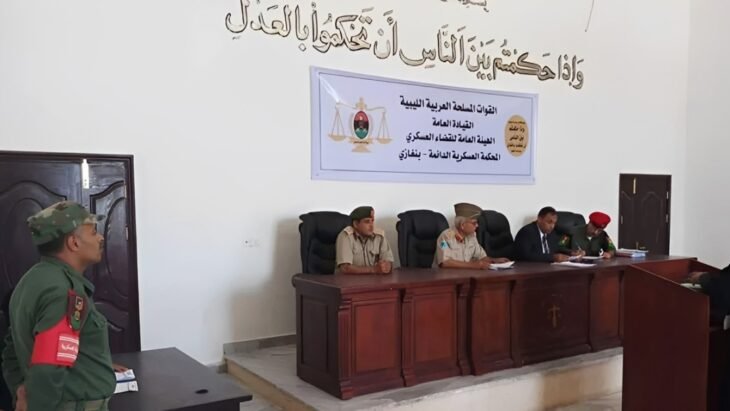
Libya’s False Peace (1)

Jalel Harchaoui and Frederic Wehrey

The Fractured Country Needs Political Unity, Not Washington’s Dealmaking

For decades, U.S. involvement in Libya has oscillated between neglect and fleeting moments of attention and resolve. But so far, the second Trump administration has displayed a surprising degree of interest in the oil-rich country.

It appears to want to end the long-standing stalemate between Libya’s two ruling factions—the UN-recognized government of Prime Minister Abdulhamid Dabaiba in the west in Tripoli and the domain of Field Marshal Khalifa Haftar, based in the eastern city of Benghazi.

In the past year, this push has been spearheaded by Massad Boulos, U.S. President Donald Trump’s senior adviser for Arab and African affairs.

After rounds of shuttle diplomacy, Boulos announced an apparent breakthrough earlier this month: the two rival governments had agreed on a unified budget for the first time in years. Boulos hailed the deal on social media as “a milestone for cooperation that offers many benefits for the economy and for Libyans across all regions.”

The agreement is certainly a step in the right direction. But Washington should not imagine that what is essentially a financial deal between two dynasties constitutes a major advance toward political unification.

The April 11 agreement does not address the deeper drivers of Libya’s crisis and raises the risk of renewed destabilization.

Although Libya has not seen major armed hostilities since 2020—when a nearly two-year-long civil war sparked by Haftar’s attack on the Tripoli government came to an end—the continued extraction of state resources for personal gain by both ruling factions has left Libya in a profound fiscal crisis and without a unified executive.

Successive efforts to deal with these challenges have failed. In 2020, the UN launched an initiative aimed at unifying the banking sector, ensuring greater transparency in the oil sector, and encouraging local governance reforms.

These measures were supposed to pave the way for a unified government with restructured political institutions and, within a year, national elections. Partly because of halfhearted support from the Biden administration, the elections never materialized, and the UN push fell apart.

In 2022, the United Arab Emirates, with U.S. acquiescence, brokered a deal behind closed doors that saw the Dabaiba family install a Haftar-aligned chair at the helm of the National Oil Corporation, Libya’s sole wealth generator. By 2025, that formula had averted further civil war but done little else. Libya was mired in economic crisis and political paralysis.

A key reason for the failure of the 2022 deal was its transactionalism—the errant belief that Libya’s political gridlock could be broken by appealing to the commercial interests of competing elites rather than by addressing the needs of the Libyan people.

But this exact logic underlies the current approach of the Trump administration. Instead of striving for a flashy diplomatic breakthrough and an economic deal with unelected elites, Washington needs to pursue a broader and more inclusive path in Libya.

It must support existing UN efforts to bolster the independence of Libya’s financial and administrative institutions and lay the groundwork for national elections. And it must do more to rein in the disruptions caused by Turkey, the single most consequential foreign actor in the country. Only then will the United States truly help prevent Libya from slipping into greater disarray.

GILDED STATE

Libya’s relative peace in recent years is often taken as a sign of stability. This is a dangerously complacent view. Both the Dabaibas and the Haftars have used their financial gains to acquire advanced weapons and bolster their own military coalitions, a development that increases the risk of violent confrontation.

While the main factions have grown rich, the division of the country has lowered living standards nationwide, especially in peripheral areas. In the remote south, the Haftars’ focus on illicit revenue over local needs has lately stoked violence.

The divisions in Libya’s governing structure also make the country susceptible to manipulation by foreign actors, chief among them Turkey.

Ankara’s Libya policy has lately been dominated by the pursuit of a maritime deal, originally struck in 2019, that would give Turkey unprecedented regional control and connect it to Libya’s eastern shores.

After years of quiet entrenchment in the northwest, Ankara spent much of 2025 courting the Haftar family in the east in an effort to secure parliamentary ratification of the maritime deal—a shift from its traditional alliance with the Dabaibas. Turkey is now an ambitious, revisionist actor in Libya, playing both sides and disturbing Libya’s already fragile power balances.

After the collapse of the UN-backed election initiative in 2021, the Biden administration retreated from the notion that promoting democracy would stabilize Libya and instead followed the Emirati impulse to cut deals.

The July 2022 appointment of a Haftar loyalist at the helm of the National Oil Corporation encouraged Libya’s leaders to further interfere in the economy. Both factions and their associates scrambled to claim piecemeal ownership of state revenues, exert influence over the central bank, and spend public funds on infrastructure at their own discretion.

Some of these expenditures have addressed genuine needs, but a huge amount of money has been devoted to prestige construction projects—stadiums and luxury hotels, for instance—designed to generate contracts for cronies and not to serve the population.​​​​​​​​​​​​​​​​ The Haftars possess certain advantages over the Dabaibas.

Their territory is markedly bigger, encompassing Libya’s major oil fields and export terminals. The scale of the Haftar domain leads foreign governments, such as the United Arab Emirates, to try to woo the potentate in Benghazi without exerting any pressure for reform.

The blurry power-sharing arrangements that were intended to stabilize Libya’s institutions have only accelerated their erosion, as was evident with the central bank in the summer of 2024.

The Dabaibas, reacting to the ever-growing tilt of the National Oil Corporation toward the Haftars, forced out the central bank’s governor in the hopes of installing a loyalist. The Haftars responded by imposing an oil blockade, shutting down most of the country’s routine exports for more than six weeks and costing Libya nearly $3 billion.

The international community refrained from condemning the action, effectively signaling that the Haftars could repeat such coercion with impunity in the future, no matter the costs to ordinary Libyans.

***

Jalel Harchaoui is a Libya specialist with the Royal United Services Institute.

Frederic Wehrey is Senior Fellow in the Middle East Program at the Carnegie Endowment for International Peace.

___________________

The Libyan paradox

Salah El Houni

There is need for a domestic political conviction that the cost of continuing to use oil to fuel conflict has come to outweigh any gains reaped by all parties involved.

There is a stark paradox that encapsulates the entire Libyan predicament: this is a country that possesses the largest proven oil reserves in Africa while being unable to finance its regular budget. Its national oil company has even accumulated a debt exceeding 31 billion dinars in just three years. These figures, revealed in official documents submitted by the National Oil Corporation as part of its 2026 financial report, do not merely point to a budget crisis. They are rather a symptom of a deeper malaise that has plagued the Libyan state for over a decade, and which consists in the misuse of oil resources to fuel division.

At first glance there may seem there is reason to hope. After years of repeated shutdowns and losses exceeding $100 billion since 2011, Libya recorded its highest oil production level in a decade in 2025, averaging nearly 1.4 million barrels per day.

In February 2026, the National Oil Corporation announced its first bidding round in nearly two decades, which was won by companies like Chevron, Eni, Qatar Energy, and Repsol—an undeniable sign of renewed international confidence in Libya’s oil wealth.

But behind this statistical veneer lies a harsher reality: the relative stability which the sector enjoys today is not the fruit of institutional reform, but rather a fragile equilibrium born of a temporary convergence of interests among competing powers—a equilibrium that could collapse after a single decision or a single security incident.

The true nature of the crisis is now documented in international testimonies with undeniable credibility. A report by the UN Security Council’s Panel of Experts revealed a systematic looting activity taking pace through Libyan ports, where the Arkenu Oil Company was, for instance, used as a front to divert more than three billion dollars outside official channels between January 2024 and November 2025 alone. The report explicitly states that both Tripoli and Benghazi rely on smuggling networks as a strategic means to finance arms purchases, in blatant violation of an international embargo that has found no effective enforcement.

What makes the situation even more painful is that Libya does possess adequate technical oil knowhow. The National Oil Corporation (NOC) boasts genuine engineering and management expertise, its international partners believe in its production capacity, and figures prove that operational efficiency is not the problem. The problem lies in who controls the revenues and where the oil income goes. When oil revenues are systematically diverted to armed groups and militias instead of the national treasury, the NOC is transformed from a backbone of national development into an instrument of division.

As part of this paradox, the very same enormous oil revenues that are supposed to finance reconstruction and modernisation of infrastructure are now helping each side cling to its political position hence perpetuating chronic division. In other words, oil is not funding stability; it is funding instability.

The impact of this odd situation is not confined to within Libya’s borders. The rise and volatility of Libyan production directly impact global oil markets, particularly Europe, which imports a significant portion of its light, low-sulfur crude from Libya. In the context of the current energy crisis gripping Europe due to disruptions in the Strait of Hormuz, the strategic importance of Libyan oil is greater than ever. This means that the interest of European partners in ensuring the institutional stability of the Libyan oil sector has never been clearer. However, this interest does not appear to have translated into genuine political pressure beyond the usual diplomatic pronouncements.

A fundamental solution does hinge on new investments or more advanced technology. What Libya needs is what it has lacked so far: a unified governance institution to oversee oil revenues and their distribution transparently while transcending political divisions. It needs a joint account into which revenues flow away from existing regional alignments. This is not a new idea.  This notion was floated in numerous negotiations and was included in successive roadmaps, but was never implemented because those who control the oil do not want to be held accountable.

There are a few indications, however, showing that change is possible. Drawing major international companies like Chevron and BP to Libya brings to the table international stakeholders with direct interest in institutional stability, and wielding the type of influence that Arab governments and the international community involved in the negotiations have lacked. When Chevron invests billions of dollars it does not do so without genuine institutional guarantees.

However, this optimistic scenario remains contingent on one fundamental condition: that the will of local actors shifts from exploiting division to investing in oil. This condition cannot be met by external pressure or foreign investment alone; rather, it requires a domestic political conviction that the cost of continuing to use oil to fuel conflict has come to outweigh any gains reaped by all parties involved. All indications suggest that this conviction has not yet matured. Until it does, Libyan oil will remain a squandered resource instead of a tool for construction.

___________________

Eastern Libya’s Top Money Man: Spotlight on Ahmed Gadalla (5)

The Sentry

Undue Influence Over Commercial Banks

Exploiting The Weakness of Dinar Banking

In eastern Libya’s commercial banks, where Gadalla holds sway, standard banking procedures are often subverted. Behind Gadalla stands the Haftar family’s political and coercive power, while the CBL in Tripoli has tended to quietly absorb the resulting financial abuses.

Two scandals that illustrate this trend burst into public view in the spring of 2024. In May 2024, Wahda Bank experienced a large and unusual disruption amid what commentators called the “zero-clearing incidents.”

In a scheme that involved 151 accounts, including 10 corporate accounts, Wahda Bank issued certified checks—totaling about 300 million dinars ($55 million)—through manual processing, meaning the CBL’s electronic clearing system was not used.

Later, when the transactions were processed through the CBL’s central system, it turned out that the Wahda Bank accounts behind the checks lacked sufficient funds.

The CBL suspended the suspicious accounts at Wahda Bank but maintained a low-disclosure posture, neither publicly denouncing nor explaining the incident.

Forcing the Benghazi bank to absorb the 300 million dinars would have destabilized the institution and threatened salary payments to innocent families in eastern Libya.

Beyond the archaic character of the CBL’s checks and balances, the May 2024 Wahda Bank incident reflects Gadalla’s influence over eastern Libya’s banking sector.

Indeed, multiple sources interviewed by The Sentry mentioned Gadalla’s tacit control over the institution at the time of the “zero-clearing incidents.”

Gadalla also sits on Wahda Bank’s board of directors. Wahda Bank did not respond to The Sentry’s request for comment.

Another irregularity, which occurred in April 2024, involved letters of credit. A whistle‑blower from the National Commercial Bank sent a file to the CBL in Tripoli proving that letters of credit worth 400 million dinars (about $88 million at the time) had been approved, even though the applicants never lodged the matching dinar balances.

The paperwork featured the Turkish-based company of Zliten-native and businessman Fauzi “Abudaghel” al-Muqla, who is married to the sister of Saddam Haftar’s wife.

Muqla’s privileged standing within the Field Marshal’s family let him skip key safeguards: the bank ignored the missing dinar deposit.

This letter-of-credit abuse took place against a backdrop in which the National Commercial Bank was already under Gadalla’s sway, according to several sources familiar with eastern Libya’s banking sector.

As millions of dollars flowed to the Turkish entity’s dollar accounts at al-Masraf in the UAE, Saddam Haftar’s circle reaped foreign currency without even having to put up the corresponding dinar amount upfront. Neither Muqla nor the National Commercial Bank responded to The Sentry’s requests for comment.

Both Ends of the Wire

The abuse of letters of credit—a persistent feature of Libya’s financial landscape for more than a decade—has intensified since 2022. The deterioration has affected commercial banks in both eastern and western Libya, but those headquartered in the northeast present a distinct concern.

Gadalla exerts control on both ends of the letter-of-credit circuit. In addition to his authority over eastern Libya’s main banks, he reportedly requires foreign-based entities seeking letter-of-credit proceeds from Libya to open U.S. dollar accounts at al-Masraf.

Straddling Benghazi and Dubai, Gadalla extracts informal commissions on dollar outflows originating from the CBL to the UAE.

Such concentration of power in the hands of a single individual represents a threat of a different order. It contributes to accelerating the depletion of Libya’s dollar reserves and obstructs legitimate trade, as lawful importers are forced either to pay the informal commissions or to exit the market entirely.

It also weakens anti-money laundering enforcement. With both the previous and current CBL governor reluctant to denounce banking scams in eastern Libya, the boundary between legitimate and illicit finance has grown blurrier, leaving Haftar’s faction wealthier and the dinar ever more vulnerable.

Chinese Drones Scandal

Gadalla’s illicit activities extend beyond the banking sector and beyond Libya, with companies under his control also serving as vehicles for arms smuggling and other questionable transnational endeavors.

In April 2024, Canadian authorities revealed a conspiracy involving at least two Libyan employees of the International Civil Aviation Organization (ICAO), a UN agency based in Montreal. The investigation found that the two individuals had participated in a broader scheme meant to facilitate the procurement of Chinese-manufactured combat drones for the Haftar family in Benghazi.

Stages of the acquisition program were financed not through monetary payments but through illicit oil schemes such as deliberate discounts on NOC crude sales to Chinese oil firms.

Notably, one of Gadalla’s Dubai‑registered companies paid for the sea transport of the drones, tying him to the operation. The breadth of this maneuvering was made clearer in January 2025, when the Canadian press revealed that the Federal Bureau of Investigation (FBI) had quietly arrested Chinese national James “Kuang Chi” Wan, a former ICAO employee with suspected links to Beijing, as early as January 2023. Although Wan was detained at Seattle-Tacoma International Airport two years earlier, his case remained under seal until reporting established that he was suspected of participating in the same attempted sale of more than $1 billion worth of armed drones and other materiel from China to eastern Libya.

According to the FBI complaint attached to the arrest paperwork, Wan told investigators that one of the co-conspirators was a special advisor to Chinese President Xi Jinping.

Even if that claim remains unproven, the mechanics of the scheme point to senior-level coordination in both Beijing and Benghazi: Libya’s NOC sold crude oil to Unipec in August 2022 at an abnormal discount, creating a de facto transfer of wealth from Libya to a Chinese state-linked buyer.

As for the drone supplier, FL-1 drones manufactured by state-linked Zhongtian Guide Control Technology Co., were shipped from Qingdao to Benghazi in March and April 2024 as part of the same arrangement.

This coordination is consistent with what Canadian prosecutors described as an illicit “commercial entente” in which senior LAAF commanders sought to exchange NOC oil for Chinese military technology.290 Such a transaction could not have proceeded without the approval of the Haftar family, above all Saddam Haftar.

The LAAF did not respond to The Sentry’s request for comment. The large FL-1 combat drones, disguised as wind turbines, were intercepted in southern Italy in June 2024.

Under UN Security Council Resolution (UNSCR) 1970, any transfer of arms, related materiel, or military-use equipment to Libya without prior approval from the 1970 Libya Sanctions Committee is a violation of the UN arms embargo and international law.

The FL-1 transfer attempt appears to have violated that embargo. The co-option of the NOC to facilitate the circumvention of the UN arms embargo was not an isolated occurrence during Benqdara’s NOC chairmanship from 2022 to 2025.

In a separate episode, the Haftar family utilized the NOC to secure the services of an Irish private military contractor.

Spanish Drones Scandal

In 2023, Spain’s Guardia Civil and French police intercepted illicit arms shipments valued at 14 million euros ($16.4 million). The materiel—comprising 44 drones, thermal cameras, helmets, and other military equipment from Spanish manufacturers Shadow Lynx, Aeronáutica DTS, and DUMA Engineering—was intended for Saddam Haftar in Benghazi.

The Spanish authorities later made it publicly known that they had arrested a Libyan national and four Spaniards involved in a plan to violate the UN arms embargo. Yusef al-Ubeidi, the Madrid-based individual suspected of having helped coordinate the arms purchase, told investigators that Gadalla, acting for Saddam Haftar, was involved. According to the Spanish press and a senior Spanish official with knowledge of the scheme, one of Gadalla’s Dubai firms played a role in the scheme, which included wiring 14 million euros to the Spanish firms as part of a documented plan to ship the equipment to eastern Libya.

Maritime Smuggling

In 2025, an arms smuggling incident off Greece implicated Gadalla and UDS Shipping Services, a Dubai maritime company under his control. The episode was tied to the weapons pipeline Saddam Haftar established after the outbreak of civil war in Sudan in April 2023, turning Benghazi into a major transit hub for weapons supplied by the UAE and destined for the RSF in western Sudan’s Darfur region.

In late July 2025, the Alushibe Group’s 475-foot container ship, the Aya 1, lifted 350 containers filled with ammunition and about 200 large military-use vehicles from the UAE and headed for Benghazi.

The maritime transfer, ultimately intended for the RSF in Sudan, was intercepted off Crete by Greek and Italian patrol boats enforcing the UN arms embargo on Libya. A search at a Greek port revealed the military-use vehicles despite a manifest claiming the ship was carrying cosmetics and electronics to the Netherlands.

Still, the maritime officers released the Aya 1 without confiscating the thousands of tons of military-use hardware. One possible explanation for Greece’s leniency is that, in the summer of 2025, Crete was facing a surge in irregular migrant arrivals from eastern Libya, an area under Haftar family control.

In the months following the Greek government’s decision not to seize the entire shipment, its relations with eastern Libya’s leaders improved. Gadalla didn’t respond to The Sentry’s request for comment. EU authorities documented the incident, which likely violated UN arms embargoes on Libya and Darfur.

_____________

The EU’s Technocratic Trap in Libya: How Brussels Is Ceding the Mediterranean (1)

Andrea Cellino

How EU technocratic policy in Libya erodes influence, enabling rival powers to shape the country’s political and security landscape

Fifteen years after the fall of Muammar Gaddafi, the European Union remains Libya’s largest donor — but a marginal political actor. By prioritizing technocratic interventions over strategic engagement, Brussels has ceded ground to actors like Russia, Turkey, and the United Arab Emirates, who now shape realities on the ground.

This commentary examines how EU migration policies, fragmented assistance, and diplomatic retreat have undermined its leverage while reinforcing problematic local power structures. It argues that without a decisive shift toward a coordinated political strategy, the EU risks permanent irrelevance in a region central to Mediterranean stability.

Fifteen years after the fall of Gaddafi, the European Union finds itself in a paradox of its own making in Libya. It is the country’s largest donor, having channeled hundreds of millions of euros through the EU Emergency Trust Fund for Africa (EUTFA) and the NDICI-Global Europe instrument, and yet it wields almost no political influence over Libya’s future.

Brussels has a naval mission in the Mediterranean, trains coastguard forces, funds rule-of-law programs, and finances skills development schemes — and yet Russia maintains a permanent military footprint in the country’s east, Turkey retains troops and bases in the west, and the UAE continues to back Khalifa Haftar’s Libyan National Army with arms and political support. The EU, in short, has traded geopolitical relevance for the comforting illusion of technical manageability.

From Mediator to Manager

The turning point came gradually. After the Berlin Conference of January 2020 — the last instance when the EU genuinely tried to convene the major actors around a common roadmap — Brussels allowed its diplomatic ambitions to wither. The UN-brokered Government of National Unity (GNU) that emerged from the Libyan Political Dialogue Forum in February 2021 offered a convenient exit: Responsibility for the political process was handed entirely to UNSMIL, while the EU settled into the role of a supporter and service provider.

The Russian invasion of Ukraine in February 2022 sealed this retreat, dramatically reshuffling the EU’s strategic priorities and providing institutional cover for what had already become a policy of deliberate depoliticization. EU officials with direct responsibility for the Libyan file have since confirmed that the step back from political engagement was a conscious choice, driven by persistent divisions among member states that made any common political position effectively impossible to agree upon.

What followed was an acceleration of the technocratic turn. The EU’s assistance, channeled through UN agencies (UNDP, IOM) or national cooperation managers (GIZ, Expertise France), concentrated on high-visibility, rapidly measurable interventions: de-mining, infrastructure rehabilitation, local governance support, civil society hubs in municipalities.

The most recent Special Measure for 2024 — the latest iteration of this approach — allocates €7.15 million to a private-sector skills program and €8 million to a justice and rule-of-law project, which the High Representative Kaja Kallas described as targeting “juvenile justice, rule of law institutions, and the fight against corruption.”

These are not trivial activities. But they are also not a strategy. The European Court of Auditors noted in 2024 that EU support to Libya had remained “not sufficiently targeted,” distributed across too wide a range of actions without a clear hierarchy of priorities. The head of the audit, Bettina Jakobsen, was more blunt: The result was “fragmented support with little focus on strategic priorities” that “fails to produce an impact.”

Migration Externalization and

Its Political Costs

Nowhere is the technocratic evasion more consequential — or more contradictory — than in the field of migration management. The EU has, since 2017, built an elaborate architecture of border externalization: It funds, trains, and equips the Libyan Coast Guard (LCG) in exchange for intercepting migrants before they reach European waters. This arrangement has been dressed in the neutral language of “capacity-building,” “integrated border management,” and “SAR coordination,” obscuring the political choices it entails.

The humanitarian costs of this approach are now beyond reasonable dispute. The UN Human Rights Council’s Independent Fact-Finding Mission on Libya concluded in March 2023 that there are “reasonable grounds to believe” that systematic abuses in detention centers — including torture, sexual violence, forced labor and extortion — reach the threshold of crimes against humanity, and that the EU’s support for interceptions has indirectly contributed to these crimes.

The LCG units that EU resources help equip are linked to militias that profit from the detention system through embezzlement of state funds, release payments, and forced labor. Far from dismantling this system, EU cooperation has strengthened its actors, providing them with institutional cover and resources that enhance their bargaining power vis-à-vis both the Libyan governments and European partners.

The geopolitical costs are less discussed but equally serious. By subordinating every other interest to migration containment, the EU has progressively legitimized actors it previously kept at arm’s length. The most striking recent example concerns Haftar’s forces in eastern Libya. From mid-2022 onwards, thousands of migrants began departing from eastern Libya, with Haftar’s forces actively orchestrating the embarkments. Italy and Greece responded by opening political channels to the Haftar clan and initiating training programs for the Libyan National Army.

In July 2025, EU Commissioner for Migration Magnus Brunner led a high-level delegation to Benghazi — only for Haftar to expel it when his demand to include ministers of his parallel, unrecognized government was refused. Rather than marking a clean break, the incident was followed by a Frontex and Commission visit to Warsaw and Brussels of Libyan officials from both governments in October 2025 — the first time Haftar’s representatives had been formally received by EU institutions. And in January 2026, it emerged that the EU is planning a maritime rescue coordination center in Benghazi, with initial funding of €3 million, which would provide Haftar’s coastguard with an operational base and, crucially, significant international legitimacy.

***

Andrea Cellino is Vice President at MEIS, the Middle East Institute Switzerland, and Non-Resident Executive Fellow at GCSP, the Geneva Centre for Security Policy. 

_______________

Inflation in Libya: Oil Revenues, Subsidies, and Hidden Pressures

Rawad M. Shalabi

Inflation may be a global phenomenon, but in Libya its drivers and consequences are uniquely shaped by oil revenues, import dependence, and state spending. While many economies have struggled with rising prices since the COVID-19 pandemic and the war in Ukraine, Libya’s official inflation figures have remained relatively low. Yet beneath this apparent stability lies a more complex reality, one where exchange rates, subsidies, and hydrocarbon income play a decisive role in shaping price dynamics.

Understanding inflation in Libya therefore requires looking beyond headline figures. It is not only a question of global shocks, but of how oil revenues are managed, how heavily the country relies on imports, and how fiscal policy responds to external pressures. In this context, inflation becomes more than an economic indicator, it becomes a reflection of Libya’s broader economic structure and policy choices.

Libya’s inflation story, however, doesn’t follow the same pattern as many other countries. Official figures placed inflation at around 2 percent in 2024, with the IMF later adjusting it to 2.4 percent for the first quarter of 2025 after addressing measurement gaps. Meanwhile, the Central Bank of Libya maintained relatively low rates: a rediscount rate of 3 percent, 91-day deposit certificates at 1 percent, and an overnight facility at 0.25 percent in early 2025. On paper, inflation appears contained, but beneath the surface, pressures remain.

This is where Libya’s dependence on oil becomes critical. According to the IMF, the economy remains highly exposed to global shocks because of its reliance on hydrocarbon exports and its large import bill. The current account shifted from a strong surplus in 2023 to a deficit in 2024, as export revenues declined while imports stayed broadly steady. Fuel imports alone surged dramatically, from an average of $3 billion between 2016 and 2019 to $9 billion in 2024, based on data from the Libyan Audit Bureau cited by the IMF.

For Libya, inflation is not simply a matter of consumer prices. It is deeply tied to oil revenue cycles, subsidy policies, and broader fiscal pressures. By late 2024, fuel subsidies had reached 12.8 billion Libyan dinars between January and November, even as gasoline remained priced at just 0.150 dinars per liter, among the lowest globally. The IMF estimates that energy subsidies account for roughly a quarter of GDP, underlining the significant strain they place on public finances.

The political dimension of inflation is just as significant. When prices rise, the impact is immediate and visible, and governments face pressure to respond. That response often comes in the form of increased subsidies, cash transfers, or tax relief. While such measures can ease short-term pressure, they also risk widening fiscal deficits over time. In Libya, where political divisions already complicate spending control and reform efforts, the link between inflation and fiscal policy becomes even more pronounced.

Central banks around the world have been navigating a delicate balance: reducing inflation without stifling growth. In many cases, this has meant raising interest rates to cool demand, even though higher borrowing costs affect governments, businesses, and households alike. Libya’s situation differs in structure, but the underlying reality is similar, monetary policy cannot be separated from fiscal constraints and political dynamics.

Exchange rates add another layer to the picture. In April 2025, Libya devalued its currency by 13.3 percent, setting the official rate at 5.5677 dinars to the dollar. For an economy heavily reliant on imports—from food to fuel to consumer goods—such a move has direct consequences. A weaker currency can quickly translate into higher local prices, even when headline inflation figures appear stable.

Globally, energy prices remain central to the inflation story. Brent crude averaged around $80.12 per barrel in 2024, according to the U.S. Energy Information Administration. For oil exporters like Libya, this directly shapes government revenues. For import-dependent economies, it drives inflation. The same market dynamic can therefore strengthen public finances in one country while deepening the cost-of-living crisis in another.

What makes inflation particularly sensitive politically is its uneven impact. Lower-income households are hit hardest, as they spend a larger share of their income on essentials such as food and energy. As a result, inflation often becomes less about macroeconomic indicators and more about fairness, trust, and social stability. When governments fail to cushion the impact, economic strain can quickly evolve into political pressure.

Ultimately, the recent inflation wave has done more than push prices upward. It has exposed structural weaknesses in the global economy, forced countries to rethink energy and food security, and highlighted the risks of overdependence. For Libya, the lesson is clear: inflation is not only driven by global forces but also by domestic choices—how oil revenues are managed, how reliant the country remains on imports, and how resilient its public finances are. Today, more than ever, the line between economics and politics is impossible to ignore.

__________________

Warlord Haftar is tightening his grip on Libya, with a US imprimatur

Khaled Mahmoud

This month, the United States launched its annual “Flintlock” military exercises in Libya for the first time. For the U.S., these multinational drills represent an opportunity to limit Chinese and Russian influence in the country and a “significant step forward for military integration in Libya,” which has been divided into dueling governments in the east and west for the past decade.

Field Marshal Khalifa Haftar, the strongman of eastern Libya and a former CIA asset, is hoping to use this moment to cement his grip on power. The military leader has over the past decade become a leading figure in Libyan politics, owing in large part to his control over military and energy infrastructure throughout the country.

But, at the advanced age of 82, he has been relegated to the role of kingmaker behind the curtain, positioning his sons to carry on his legacy and solidify the family’s control over Libya. If he succeeds, he could well reproduce the experience of his predecessor and rival, the late Col. Muammar Gaddafi, who led the country for more than 40 years before being unseated and killed in 2011.

Flintlock 2026

Earlier this month, Massad Boulos, senior adviser to President Donald Trump for Arab and Middle East affairs, persuaded the Libyans to put a temporary end to their east-west rivalry through an agreement on unified spending between the two competing governments: the Government of National Unity based in the capital Tripoli under Prime Minister Abdul Hamid Dbeibah, and the parallel Government of National Stability led by Osama Hammad, which is backed by Haftar.

The “Flintlock 2026” maneuvers, which are sponsored by AFRICOM and involve about 1,500 troops from 30 countries, are bringing together forces from eastern and western Libya for the first time. Boulos placed the exercises at the heart of the political process, describing them as an opportunity to “raise the professionalism of Libyan officers.”

In practice, this represents an American imprimatur for entrenching Haftar’s dominant role in Libyan politics and elevating his family from warlords to international security partners. Saddam Haftar, Khalifa Haftar’s son and deputy, was, after all, seated next to Lt. Gen. John Brennan, the deputy commander of AFRICOM, during the exercises.

Many Libyans question the usefulness of these initiatives, seeing them as nothing more than a temporary painkiller, proof that American efforts are not a solution to the crisis but merely a way of managing it. While the effort to unify the state budget brought a temporary reprieve, it did not resolve the root causes of the power struggle.

It seems that the debt of history still governs Washington’s view of Libya. After the phrase “to the shores of Tripoli” that echoes in the U.S. Marine Corps hymn, American forces have returned once again to the Gulf of Sirte.

Sirte: Former ‘line of death’

Sirte, which the Reagan administration bombed in 1986 under the pretext of dismantling Gaddafi’s regime, is now welcoming AFRICOM officers there to bless the birth of a new military dynasty led by Haftar’s sons.

For the first time, Libya appears as the official host of these joint operations. Brennan described the step as embodying “the vision of leaders from both sides.” Yet the irony lies in transforming Sirte from a geopolitical “line of death” for the former Libyan regime into an attempt to reproduce the “strongman” model that Washington has long claimed it seeks to dismantle.

Former Libyan Defense Minister Mohammed al-Barghathi believes the scene carries many contradictions. In an interview, he said: “As much as it pleases us to see Libyan officers meeting together, it hurts in our souls that this invitation is taking place on their own soil and under the management of an external party, under the pretext of unifying the military institution.”

In the same conversation, al-Barghathi questioned Washington’s credibility, recalling previous promises by U.S. defense secretaries to install electronic surveillance systems on the southern borders and to hand over four Libyan aircraft held by the United States since the 1969 coup that brought Gaddafi to power. “Those aircraft have today become military scrap after decades beyond their operational life,” he added bitterly, “and American promises never went beyond words that were never fulfilled on the ground.”

The return from exile

Haftar emerged as one of Libya’s most important political actors since he launched Operation Dignity in 2014, launching a military offensive that unseated an Islamist government in Benghazi, the largest city in eastern Libya.

Hafter allied himself with the House of Representatives, a body elected in a national vote in 2014 that would later endorse the Government of National Stability. This relationship helped his military ascent and made him the commander of the National Army with the rank of Field Marshal — the first of its kind in Libya – as a reward for his efforts to “purify the country from the filth of extremists and the Muslim Brotherhood,” as he once told me.

But now, 12 years after his rise and six years after his failure to capture the capital Tripoli, Haftar and his family’s ambitions for power and wealth have mixed together through a model of indirect control.

Militarization of the economy

Haftar’s influence is not limited to military affairs; it also relies on an economic network linked to the army and the family in ways designed to enhance both his political and military influence.

He also benefits from informal exports through companies linked to his son Saddam, which exported about 7.6 million barrels of oil, worth $600 million, outside official channels between May and December 2024. In 2025, average production reached 1.37–1.375 million barrels per day, the highest level in 12 years, with oil revenues amounting to about $22 billion — a 15% increase from the previous year.

Haftar uses his control to threaten the closure of oil fields in order to obtain a larger share of revenues or political concessions, as his economic power depends heavily on his control of the Sirte Basin.

Family ambition

Studies indicate that Haftar’s forces form a broad alliance of armed groups also linked to economic interests in eastern Libya.

Saddam became his father’s deputy after leading military units that play a central role in the power structure and exert influence over economic deals related to reconstruction.

A senior commander in Haftar’s forces said the elevation of Haftar’s sons represented an effort to consolidate power between senior and junior leadership in the army. Another officer who preferred not to be named said that the situation appears stable inside the army for now, but it could change quickly if Haftar’s influence diminishes in one way or another.

A UN Panel of Experts report accused Saddam, in partnership with Ibrahim Dbeibah (the son-in-law of Prime Minister Dbeibah), of managing an unprecedented system of “institutional corruption” in the energy sector by exploiting his influence to provide political and security cover that enabled criminal networks to escape punishment entirely.

Khaled Haftar holds the position of Chief of Staff of the army, which numbers about 90,000 fighters, with an unofficial budget estimated at 5

billion dinars ($800 million) for salaries and operations, not to mention the value of weapons and their secret deals, which far exceed that amount.

But the most important of Haftar’s sons is the undeclared one: the eldest, al-Siddiq, who most resembles his father in appearance and character. He has gone beyond the role of loyal assistant to become the keeper of his father’s secrets and his de facto foreign minister.

Al-Siddiq once told me in a private conversation in Cairo that he dreams of heading the government. But he bristles at allegations that his family will become like the Gaddafis. “We are a different family and necessarily our experience does not represent others,” he told me in 2024. He was the only one who accompanied Haftar when he entered the military hospital in Paris for treatment following a health crisis he suffered during a visit to Cairo years ago.

Washington and a new dictatorship

The path the Haftar family is taking today goes beyond traditional military ambition; it is an attempt to legitimize family influence through parallel institutions that guarantee financial and security sustainability.

With presidential elections indefinitely postponed, Haftar is no longer able to claim the throne of the country. But he has now necessarily become the maker of new kings who bear his name.

Will Washington repeat its classic mistake of supporting the “strongman” to preserve temporary stability, only to wake up later to a more complex and corrupt family dictatorship?

Talk of “unifying institutions” risks becoming the wholesale privatization of the army and oil in favor of a single family — with American blessing.

***

Khaled Mahmoud Ramadan is an Egyptian journalist and Cairo University graduate. Specialized in Arab and political affairs, his reports are widely cited by global news agencies. His career includes roles at Al-Arab, the Libyan News Agency, and Radio Canada. Since 1999, he has written for Asharq Al-Awsat, while also contributing to Egypt’s Al-Dustour and Lebanon’s Al-Akhbar.

_____________
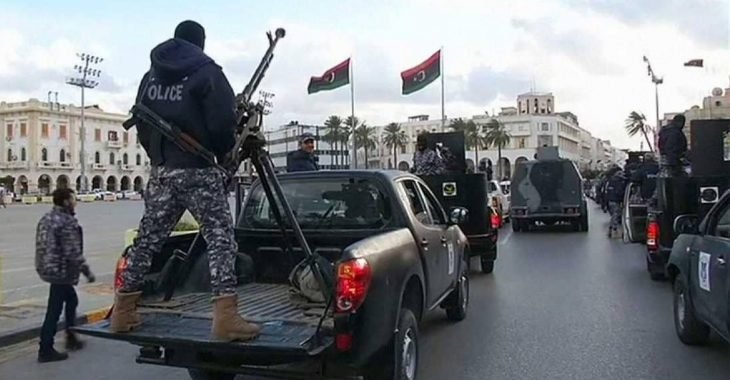
Libya oscillates between cooperation and illusion

Kersten Knipp

For the first time, representatives from both sides of Libya’s political divide are participating in Flintlock, a multinational military exercise under US leadership. Is this a tentative sign of hope for reunification?

Soldiers from around 30 nations are training to fight terrorism, practicing international cooperation and seeking to strengthen the region’s fragile stability in Flintlock, a joint military exercise under US leadership. The training takes place in Libya and Ivory Coast through the end of April.

For Libya, which has been split into east and west administrations following years of civil war, it is particularly significant that representatives from both parts of the country are participating in the exercise for the first time.

‘Visible rapprochement’

“All things considered, this is a truly remarkable political signal,” Hager Ali, a political scientist at the German think tank GIGA Institute in Hamburg, told DW. Flintlock is part of an established US-led military exercise format; however, the location and participants make a difference this time, she said.

“The fact that the exercise is taking place in Libya for the first time and that both rival camps are represented is certainly a special feature,” she added, noting that it is evidently part of the longer-term efforts to reunite the armed forces that have been fragmented since the fall of Gaddafi in 2011.

Michael Bauer, head of the Konrad Adenauer Foundation (KAS) office in Tunis, agrees. “The publicly staged handshake between the two rival camps represents a rare, visible sign of rapprochement,” he said. This demonstrates that cooperation is possible, at least at the operational level — albeit still under external mediation, particularly by the US, he told DW.

Dysfunctional state

This cautious rapprochement under American pressure involves a country that still barely functions as a state. “The country lacks a unified, functional government structure with a clear delineation between the executive, legislative and judicial branches,” the recently published Bertelsmann Transformation Index 2026 states.

In other words, political and economic power is divided between rival governments, armed groups and other regional actors, resulting in a fragmented political environment that hinders the establishment of effective democratic rule.

Libya has been divided since 2014 between two rival governments. In the west, the UN-recognized Government of National Unity in Tripoli. In the east, the Government of National Stability in Tobruk is backed by General Khalifa Haftar’s Libyan National Army.

Against this backdrop, any form of cooperation is remarkable — and the military exercise is not the only example. Recently, for the first time in many years, a joint national budget was adopted. North Africa expert Bauer views this as a “tangible sign of institutional rapprochement,” but warns against unrealistic expectations.

Hager Ali, too, considers this to be only one possible step in a longer process. “The joint budget could help rebalance economic power structures — particularly vis-à-vis influential actors such as General Khalifa Haftar, who rules the eastern part of the country and whose network is deeply embedded in Libya’s economic structures,” she said, adding that at least, it represents an attempt to centralize political and economic leverage more strongly.

Other factors at play

Both analysts emphasize that the motives behind theUS-led military exercise extend far beyond Libya. The focus is on counterterrorism across the entire Sahel region, the increasing spread of weapons there — for example as a result of the war in Sudan — and efforts to push back Russian influence. Hager Ali points in particular to Moscow’s presence in eastern Libya, noting that “the US in particular is clearly seeking to counter this more strongly.” 

Libya is increasingly become a stage for international strategic competition due to its geographical location in North Africa and oil resources.

“Libya’s oil production, stable for now under informal arrangements but structurally fragile, matters more than usual,” the Washington-based think tank Middle East Institute (MEI) recently stated. 

This could present an opportunity for Libya, however, domestic political dynamics remain unpredictable, and key questions regarding the distribution of power and resources continue to be disputed among rival centers of power. “Succession in Libya is unlikely to be resolved solely through formal legal mechanisms,” the MEI analysis says. Isolated signs of cooperation are unlikely to make much of a difference in addressing this structural problem.

Economic tensions

“Libya’s current fiscal path is unsustainable. Persistently large fiscal deficits are intensifying pressures on the exchange rate, international reserves and inflation,” the International Monetary Fund assessed in a recent study. High public spending, inflation, and currency pressures are placing pressure on the population and exacerbating social tensions. Reforms have long been considered urgently necessary but remain politically difficult to implement.

Despite the recent signs of cooperation, North Africa analyst Michael Bauer sees likttle chance in the near future of substantial progress between the conflicting parties and their leaders. “The division gives them access to resources and ensures their influence,” he told DW. “The tentative attempts at cooperation have so far been little more than collaboration deemed useful by both sides,” the Libya expert added.

For Libyans, this means that cooperation on military exercises and the national budget could indeed be a first step. However, as long as the key political actors continue to profit from Libya’s division and maintain their power structures, a strong and united Libya is likely to remain an illusion.

***

Kersten Knipp – Political editor with a focus on the Middle East

_________________
Eastern Libya’s Top Money Man: Spotlight on Ahmed Gadalla (4)

The Sentry

Gadalla Now: The Haftars’ Fixer for Money and Arms

A Convenient Playbook

In 2020, the Haftar family carried out its first significant move into Benghazi’s private sector. They set their sights on Berniq Airways, a private airline co-founded in 2018 by Fayez Bushnaf.

The entrepreneur is the nephew of Ibrahim Bushnaf, who served as interior minister in Abdullah al-Thani’s eastern-based government from 2018 until 2021 before being appointed Libya’s national security advisor by the eastern-based House of Representatives, a post he still held at the time of publication.

In addition to being the relative of a senior pro-Haftar official, Fayez Bushnaf used his commercial success to fund the Haftar family’s war effort starting in 2014.

In 2020, however, tides shifted, and armed pressure from Saddam Haftar and his allies forced Fayez Bushnaf to surrender his shares in the airline and leave Libya.

A distinct structural shift occurred that year. As the Haftar family deepened their territorial and military hegemony in northeastern Libya, the existence of independent commercial entities seemed to become unacceptable.

They initiated a campaign to subjugate almost every viable enterprise in the private sector, demanding total subservience. This policy meant the end of Berniq’s autonomy. Despite Bushnaf’s record of support for the Haftars, they turned against him and took over his airline.

The move was not precipitated by defiance or insurrection on the part of the entrepreneur but was rather an extension of absolute power. Indeed, across almost all sectors of eastern Libya’s economy, a clear pattern has emerged in recent years: no business is allowed to succeed unless it comes under the Haftars’ sway.

The Haftar family installed loyal proxies to take over Bushnaf’s surrendered shares.

This modus operandi, which is central to the family’s stranglehold over eastern Libya’s economy, creates a layered power structure in which formal ownership is largely cosmetic.

The Haftar-appointed shareholders who appear in corporate registries do not, in practice, exercise meaningful authority; they can be replaced at will and serve primarily as figureheads.

At the same time, the Haftars themselves set strategic priorities but do not run day-to-day affairs. The result is an operational vacuum that is filled by a distinct class of intermediaries whose names seldom appear in the official paperwork.

These intermediaries handle business operations, master the financial details, and arrange the more controversial transactions requested by the Haftars. Gadalla is the archetype of this category.

His authority did not derive from any equity stake or formal corporate title but from the Haftars’ need for a trusted operator capable of managing daily affairs on their behalf. Within such an opaque and informal dynamic, second-tier actors like Gadalla enjoy a degree of leeway that also allows them to enrich themselves.

Capturing the Bank of Commerce and Development

This arrangement was in force with the Haftar takeover of Benghazi’s BCD in 2022. Employing the same tactics used against Bushnaf and his airline, the Haftars turned on an ally and compelled the BCD founder, Jamal Tayeb Abdel Malek, to surrender his shares.

On paper the BCD chair passed to Haftar loyalist Wassim al‑Zway—genuine authority, however, flowed to Saddam Haftar’s circle. Concretely, this has meant that Gadalla influenced the day-to-day operations of BCD, the inner workings of which he would have already been exposed to thanks to several years serving as BCD founder Abdel Malek’s protégé.

The Haftars’ protection enabled Gadalla to handle sensitive financial decisions for the bank,184 and he rose to become BCD’s de facto chief. Although modest in size, BCD’s status as a Benghazi‑headquartered private bank turned it into a bellwether, enabling Gadalla to grow into a powerful mogul in his own right.

The BCD did not respond to The Sentry’s request for comment.

Circulating Russian Counterfeit Dinars

As early as May 2016, the Russian state firm Goznak had begun shipping billions in dinar banknotes to Haftar’s camp, just after the eastern government lost UN recognition.

Roughly 14 billion dinars entered circulation in this fashion.

The Haftar family handed the cash out as LAAF salaries and other payouts; many of the Russian-printed banknotes were sold on the parallel market for dollars used to buy military resources, including Russian mercenary services, causing the dinar to depreciate.

In 2020, US pressure helped block further Goznak deliveries from Russia. However, the influx of Russian-printed dinars to eastern Libya resumed in the autumn of 2022, after Gadalla took control of the BCD for the Haftar family.

Then CBL governor Kabir, who was drifting toward a pro-Haftar stance while feuding with Prime Minister Dabaiba, limited himself to muted complaints.

Because Washington heightened US military surveillance of Russian cargo flights over the Mediterranean in the spring of 2023, the Haftar family adopted a two‑track approach: Goznak occasionally smuggled pallets of high‑grade banknotes into Libya, while it also helped set up a less advanced press in eastern Benghazi, within the Tocra area.

Quality was inferior, but overall injections of unauthorized dinars had reached about 10 billion in circulation as of October 2025, mainly in two categories of new 50‑dinar notes.

Based on The Sentry’s interviews with banking officials and others in the banking sector, Gadalla was the main person overseeing the distribution of these counterfeit dinars.

First, the BCD processed all deposits of such notes as legitimate, boxing the Tripoli CBL into accepting them. Second, Gadalla’s network sold hundreds of millions of Russian-printed dinars against dollars on the black market in combination with assurance that Benghazi commercial banks would accept those dinar notes, a practice that further weakened the Libyan dinar.

Gadalla didn’t respond to The Sentry’s request for comment. In April 2025, after more than a year of efforts, the Tripoli CBL retired all 50‑dinar notes—including its own official print runs—and even implied that 20‑dinar bills were affected too, suggesting that Russian counterfeiting spread beyond the fifties.

____________

Under the guise of exercises: the United States is trying to gain a foothold in Libya

Washington is seeking to strengthen its position in North Africa and weaken Moscow’s influence.

Libya may become a new point of confrontation between Russia and the United States. This week, for the first time, the republic hosts the Flintlock 2026 exercises under the auspices of the African Command of the US Armed Forces, in which more than 30 states participate. Formally, we are talking about combating terrorism and strengthening security. In fact, Washington is trying to gain a foothold in one of the key countries in North Africa. Whether the United States will be able to strengthen its influence and oust Russia in the region is in the Izvestia article.

Under the cover of exercises

Flintlock is an annual exercise that the United States has been conducting in Africa since 2005. They are usually devoted to the fight against terrorism, border protection and coordination between the armies of different countries. This year, more than 30 countries from Africa, Europe and the Middle East are participating in the maneuvers.

The peculiarity of the current “Flintlock” is that for the first time part of the exercises is taking place in Libya. Since 2014, the country has actually been divided into two parts. In the east, in Tobruk and Benghazi, the forces of the military commander Khalifa Haftar have gained a foothold. In the west, in Tripoli, there is a government recognized by the United Nations, which has been led by Abdel Hamid al-Dbeiba since 2021.

The venue chosen is the city of Sirte, which is considered the conditional border between the two Libyan centers of power. It was here that the Americans decided to bring together representatives of both camps.

“These exercises are not just military training. These are overcoming differences, building capacity, and supporting Libya’s sovereign right to determine its own future. By working side by side with Libyans from the west and east, we are directly contributing to Libya’s efforts to unify their military institutions,” said John Brennan, Deputy commander of the US Africa Command last year.

Thus, Washington is trying to present the exercises as an attempt to promote the unification of the country. However, according to The Wall Street Journal, the main goal of the United States is to weaken Russia’s position in the country. According to the newspaper, participation in the “Flintlock” will allow the Libyan forces to gain access to American equipment and training, which should reduce their dependence on the Russian Federation.

“Libya is gradually becoming a more orderly country. More traditional Western players are ready to interact with both the West and the east of Libya, so Russia finds itself on the sidelines,” Jeff Porter, president of North Africa Risk Consulting in New York, was quoted as saying by the newspaper.

The Russian Defense Ministry has not officially confirmed the presence of military personnel in Libya, but some media reported on the transfer of Russian military and equipment to the region. In particular, after the change of power in Syria, part of the Russian forces first withdrew to the Khmeimim airbase and the fleet base in Tartus, and then allegedly could be transferred to the east of Libya.

A tasty morsel

Libya remains one of the most attractive countries in Africa for external players. It has the largest proven oil reserves on the continent — about 48.4 billion barrels. Natural gas reserves are estimated at about 2 trillion cubic meters. It is the extraction and export of hydrocarbons that form the basis of the Libyan economy.

Russia also retains economic interests in the country. In October 2021, Tatneft announced the resumption of exploration in Libya, and the authorities in Tripoli said they were interested in a full-fledged return of the company. In the same year, Gazprom started producing oil again as part of a project in the Sirte basin. And Russian President Vladimir Putin met with Haftar in the Kremlin in 2025.

There is still great interest in this country. I cannot say that it has been fully realized: the potential of Russian-Libyan cooperation is very great, and it has a lot to develop. But this is complicated by the fact that after the events of 2011, Libya actually turned out to be fragmented,” Andrei Yashlavsky, a leading researcher at the Primakov Institute of the Russian Academy of Sciences, said in an interview with Izvestia.

However, the US attention to Libya is not only due to its natural resources. The country has access to the Mediterranean Sea, and one of the main routes of illegal migration from Africa to the European Union passes through its territory. Therefore, the geographical location of the republic is of great strategic importance.

After the change of power in Syria, Libya’s importance for Moscow has also grown. The Kremlin cooperates with some states in the region. The Russian Defense Ministry reported on the work of instructors in the Central African Republic, and Russian Foreign Minister Sergei Lavrov said in 2021 that the Malian authorities had turned to a “private military company from Russia” to fight terrorism. In this regard, Tripoli can become a link for Moscow with the Sahel countries.

Despite all the drama of what is happening, Libya remains a very tasty morsel both in geopolitical and geo-economic terms. In addition to hydrocarbons, Libya is rich in rare earth resources. Influence in the country means influence on North Africa, the Sahel region, and the Mediterranean,” the expert emphasized.

The true motives

Washington has been systematically trying to establish relations with the east of Libya in recent years, primarily through the 5+5 format. His task is to promote reconciliation and unification of the country. In practice, most 5+5 statements remain declarative. A real unification of Haftar’s army with the security forces of western Libya still looks unlikely, RIAC expert Anton Mardasov told Izvestia.

At the same time, Khalifa Haftar’s sons, primarily Belkacem, maintain close contacts with the United States both on military and political lines, as well as economically. Because of this, rumors periodically appear that different representatives of the Haftar family are oriented towards different external players, and that in the future this may lead to internal conflicts in eastern Libya.

However, this balancing is probably intentional and allows the East not to lock itself into traditional allies: Russia, Saudi Arabia, the United Arab Emirates and Egypt. And at the same time, to develop relations with Turkey, as well as with European and Asian countries,” the specialist explained.

At the same time, the possible Russian presence in eastern Libya remains an important part of the existing balance of power. According to the source, the network of Russian military facilities can serve Benghazi as an additional guarantee of stability. Therefore, the contacts of the Haftar family with the Americans are most likely related not to the desire to dramatically change the status quo, but to an attempt to obtain more economic benefits and other preferences from different partners.

At the same time, the United States is unlikely to have positive feelings about Libya and wants to see it strong and prosperous, Yashlavsky points out.

“For them, this is another “cage” on the big geopolitical board — an opportunity to gain a foothold in North Africa, the Mediterranean, in fact, in the “underbelly” of Southern Europe, and at the same time an attempt to oust Russia from there,” he believes.

At the same time, according to the expert, Russia’s role in Libya is often exaggerated in the Western media. Even after the events in Syria, the country has hardly become a priority for Moscow. However, the United States, according to him, is trying to take advantage of the situation.

But do not forget that at some point Muammar Gaddafi tried to establish relations with the West. Libya has defiantly abandoned programs related to weapons of mass destruction and has moved closer to the United States and Europe. However, this did not end with the normalization of relations, but with the events of 2011: first, the uprising within the framework of the “Arab Spring”, and then the direct military intervention of NATO countries. As a result, Gaddafi himself was killed, and Libya effectively ceased to exist as a single state. A decade and a half has passed, but the country still remains fragmented,” the expert concluded.

__________________
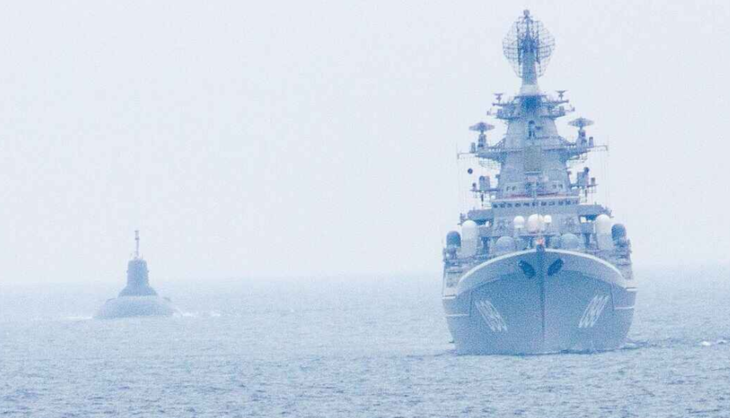
US military in Libya: Pursuing unity and pressuring Russia

Alexandra von Nahmen

For the first time, Libya is hosting the Flintlock military exercise and soldiers from both sides of the divided country are taking part. It’s due to security concerns, economic interests and competition with Russia.

An exercise to unify Libyan forces

After years of fighting, rival factions agreed to a ceasefire in 2020. But the oil-rich nation has remained divided between two administrations since 2014.

Now Libya’s west is controlled by the Government of National Unity (GNU), an internationally recognized UN-brokered provisional government based in Tripoli under Prime Minister Abdul-Hamid Dbeibah. The eastern administration is based in Tobruk and led by Osama Hammad, who is backed by the warlord-turned-politician Khalifah Haftar. 

General John Brennan arrives for the opening ceremony of Flintlock 2026 in SirteImage: Special Operations Command Africa

This week, Flintlock 2026, a US-led special operations exercise with 30 nations participating, kicked off in Sirte. The Flintlock event has been held around the continent since 2005, with European and African countries participating. But this year, for the very first time, Libyan forces from both sides of the country are taking part in the exercises and Libya is hosting parts of the exercise. 

Back on board the Dash 8, the VIP of the day is Lieutenant General John Brennan. The deputy commander of the US Africa Command is on his way to observe the training exercise. Speaking with the press, he repeatedly makes clear how remarkable it is that this exercise is bringing together Libyan forces from the eastern and western parts of the country.

“The Libyan people deserve unified security forces to protect them and their interests,” Brennan says. “Security breeds prosperity.”

Why does it matter for the US?

Having soldiers from the two sides train together, wearing the same uniform during Flintlock 2026, is considered a major achievement.

Libya is de-facto split between two competing power centers, but both their representatives were present at the opening ceremony of a joint military drillImage: Special Operations Command Africa

When asked about the purpose of US engagement in the region, Brennan says, “Libya is a critical key terrain for NATO’s southern neighborhood.” 

Western intelligence agencies are highly concerned about activities by terrorist groups like the “Islamic State” and al-Qaeda in the region. They seem to be expanding quickly in Africa, especially in the Sahel, kidnapping civilians and conducting major attacks against militaries and civilians alike. From the US perspective, stabilizing Libya is also about preventing such threats from potentially going global, one official explains.

Prioritizing economic security

However this exercise is also about economic opportunities. The goal is to factor in “where the security and economic interests of the US overlap,” according to a US defense official DW spoke with. This is in line with the US national security strategy, which defines economic security, including securing access to critical supply chains and materials, as one of its priorities. Indeed, the administration under US President Donald Trump is eager to gain access to resources in the region.

But so are other actors. 

Russia, for example, has interest in Libya’s oil and gold reserves. Its former Wagner Group mercenaries, now rebranded as the Africa Corps, have been active in the country since 2019, delivering military equipment and collaborating with forces alinged with Haftar. Meanwhile China’s strategy for Africa focuses on securing long-term access to critical minerals, for instance by acquiring major mining assets. Wagner’s presence in Africa and what it gets in return

A whole region at stake

After a five-hour flight, we’re finally in Sirte. A seemingly endless convoy of SUVs takes us to the designated training site. Every few hundred meters, we see soldiers, police and armored vehicles along the route.

The training scenario is simple: Terrorists have kidnapped migrants and are holding them hostage. Libyan and US special forces must free the hostages and eliminate the terrorist threat. The forces move quickly under the supervision of visiting generals and other dignitaries. Among them is Gianluca Alberini, Italy’s ambassador to Libya.

“For Italy, Europe and the US, a united Libya will be able to provide stability to the whole region,” he tells us. Asked about doubts as to whether the competing factions in Libya are really committed to a united country, he acknowledges that, “it is a process” and calls “a bigger engagement of the US in this region a big factor.”

Incentives for reunification

Two years ago, a military drill like this one, with a new joint operation center for all Libyan forces, was almost unimaginable. Now Libyan military chiefs from competing factions in the country’s east and west hold speeches in Sirte, describing the path to Libya’s reunification as “not a choice but a must.”

Brennan says the magnitude of potential economic investment “is an incentive for a reunification” for Libya’s rival administrations. Other officials gathered in Sirte seem to believe that too. Many point out that unifying the Libyan military could also minimize Russia’s influence. Africa’s critical minerals dilemma explained

Russia doubles its deployment

Following military coups in Mali, Burkina Faso and Niger, Western forces were largely expelled from the Sahel region as successive governments opened their doors to Russia instead. Neither the US nor Europeans want this scenario to repeat in other nearby countries.

Since 2024, Russia has doubled its military deployment in West Africa and is actively seeking to enhance its presence and influence in Libya as well. It reopened an embassy in Tripoli in 2024 and reportedly transferred personnel and military equipment to an abandoned base near the border with Chad and Sudan.

“The significant Russian military presence in Libya on the southern flank of NATO is obviously a concern for us,” British Ambassador Martin Reynolds says in Sirte. 

“We would like to see a government we can work closely with,” Reynolds adds, one “which does not see the need to bring in foreign powers in the way it is currently happening.”

***

Alexandra von Nahmen – Head of DW’s Russia, Ukraine and Eastern Europe department

__________________
Libya could supply the oil the world needs while conflict with Iran seethes

Christopher Harvin and James Durso

A defining pillar of President Trump’s America First agenda has been national energy security. Paired with the diplomatic momentum of the Abraham Accords, that strategy has reshaped regional alliances, strengthened U.S. partnerships and reinforced economic stability at home. 

Today, both pillars are under strain. The widening war with Iran has triggered one of the most severe energy shocks in decades. Oil prices have surged above $115 per barrel as markets react to escalating tensions and the risk of prolonged disruption. 

At the center of the crisis is the Strait of Hormuz, a chokepoint through which roughly one-fifth of global oil supply flows. With shipping constrained, the effects are cascading across the global economy, raising fuel costs, fueling inflation, and increasing the risk of economic slowdown in the U.S. and among its allies. 

Washington has responded with extraordinary measures. As of March, the U.S. had released approximately 172 million barrels from the Strategic Petroleum Reserve as part of a coordinated 400-million-barrel drawdown with members of the International Energy Agency. Although this has helped blunt immediate price spikes, it has depressed U.S. reserves to roughly 243 million barrels — the lowest level since the early 1980s.

At the same time, policymakers have cautiously adjusted sanctions policy to stabilize supply. While maintaining core restrictions on major Russian energy firms such as Lukoil and Rosneft, the U.S. has temporarily eased certain measures. A 30-day waiver for stranded Russian and Iranian oil cargoes and a more flexible approach to shipments involving Cuba reflect a pragmatic effort to ease market pressure amid the Hormuz disruption.

These steps underscore the urgency of the moment, but also their limits. Strategic reserves are finite, and sanctions flexibility carries geopolitical trade-offs. Together, they buy time, but they do not address the underlying constraint: insufficient global supply and supply chain instability.

While Trump looks for options to stabilize markets in a durable way, a more strategic opportunity is right in front of him: Libya. 

Libya holds more than 48 billion barrels of proven oil reserves, the largest in Africa. It also produces precisely the kind of light, sweet crude most sought after by European refiners.

Before years of instability caused by the NATO attack on the Gadhafi regime, Libya generated roughly 1.6 million barrels per day. With political stability and renewed investment, production could exceed 2 million barrels per day, providing a meaningful buffer against Gulf disruptions.

In today’s market, that incremental supply matters. Energy markets are driven as much by expectations as by actual output. The credible prospect of increased Libyan production could restore confidence, reduce volatility, and place downward pressure on global energy prices. 

The challenge is governance,

not geology. 

Since the fall of Moammar Gadhafi in 2011, following NATO’s intervention led by the Obama administration, Libya has remained fragmented. Rival governments and militia control over infrastructure have repeatedly disrupted production and deterred investment. That failure now presents a unique and important opportunity for Trump.  

A durable political settlement in Libya would unlock suppressed production, attract investment and provide Europe with a reliable, proximate alternative to Middle Eastern supply routes. At a moment when the Strait of Hormuz remains a chokepoint, Libya offers a Mediterranean corridor largely insulated from Gulf volatility. 

The benefits extend beyond energy. Libya’s instability has created space for extremist organizations to operate, including ISIS and al-Qaeda. Stabilization would strengthen counterterrorism coordination with the U.S. and Europe and enhance regional security. It would also counter growing influence from China and Russia, both of which are expanding their presence across Africa’s energy sector. Libya, given its reserves and location, is a strategic prize. 

For Trump, Libya offers a rare convergence of opportunity and feasibility. Unlike Iran, it is not an entrenched adversary. Unlike Venezuela, it is not defined by ideological opposition to U.S. engagement. Instead, it is a fragmented state whose competing factions share a common incentive: restoring oil production and revenue. 

That shared interest creates the foundation for a pragmatic diplomatic breakthrough. Emergency reserve releases and temporary sanctions relief are stopgap measures. A successful diplomatic initiative in Libya would expand global supply, reduce long-term price volatility, and deliver a clear geopolitical win. 

At a moment of historic disruption driven by the Iran conflict, Libya is not simply another foreign policy challenge. It is a strategic solution hiding in plain sight. 

***

Christopher Harvin is managing partner of GlobalPoint International, a Washington-based strategic communications and government affairs firm. He is a former adviser to the secretary of Defense and has more than 25 years of experience in the Middle East and Africa. 

James Durso is a regular commentator on foreign policy and national security matters. He served in the U.S. Navy for 20 years and has worked in Kuwait, Saudi Arabia, Iraq and Central Asia.

_______________
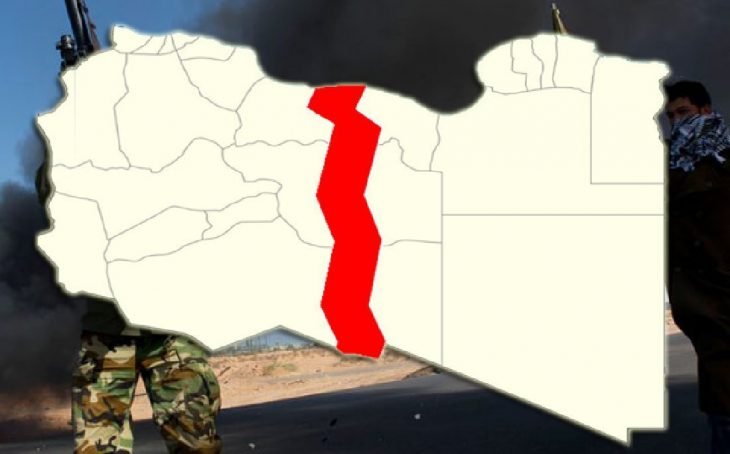
Ukrainian forces operating in western Libya as covert war grows

Houda Ibrahim

Ukrainian military forces are operating in western Libya and were behind a recent attack on a Russian tanker in the Mediterranean, an RFI investigation has found. The findings point to a largely covert confrontation between Kyiv and Moscow as they compete for influence on Libyan territory, four years into their conflict.

On 4 March, Moscow accused Ukraine, with support from British intelligence, of attacking the Russian tanker Arctic Metagaz from the Libyan coast. The vessel is part of Russia’s so-called “shadow fleet”, used to bypass US and European sanctions imposed in December 2022 after Russia’s invasion of Ukraine on 24 February that year. The ship was sailing through the Mediterranean towards Port Said in Egypt, transporting liquefied natural gas.

On Thursday, Libya’s Ports and Maritime Transport Authority warned that the wreck of the Arctic Metagaz is adrift and out of control. RFI can confirm that Ukrainian forces carried out the attack and have an active presence in western Libya.

Ukrainian presence

More than 200 Ukrainian officers and military experts are deployed in Libya, according to two Libyan sources who spoke on condition of anonymity. They have the agreement of the Tripoli-based government led by Abdelhamid Dbeibah, which is recognised by the United Nations.

The personnel are based at three sites. One is the air force academy in Misrata – a large facility that also hosts Turkish and Italian forces and the United States Africa Command. A British intelligence centre is also located there. A second base is in Zawiya, about 50 kilometres north of Tripoli, near the Mellitah oil and gas complex. It is equipped to launch aerial and naval drones.

Ukrainian personnel also occupy a coastal site granted by the Tripoli authorities. Construction work in October and November last year strengthened defences and installed runways and antenna systems.

Training and deals

A third location is used for coordination meetings between Ukrainian personnel and Libyan forces at the headquarters of the 111th Brigade on the road to Tripoli airport. Western Libyan forces are represented by Abdul Salam al-Zoubi, undersecretary at the Ministry of Defence.

The deployment follows an agreement signed in October between Tripoli and a Ukrainian military adviser, at the request of Ukraine’s military attaché in Algiers, General Andriy Bayouk, RFI’s sources said. In return, Libyan forces receive training, including in the use of drones. The agreement also provides for future arms sales and Ukrainian investment in Libya’s oil sector.

Oil revenues for 2025 reached $21.9 billion, a 15 percent increase compared to 2024, the Libyan National Oil Corporation (NOC) said. Ukrainian authorities did not respond to RFI’s requests for comment. The Dbeibah government has also remained silent after questions from the Libyan parliament based in Benghazi.

Drone strike

In October 2025, Moscow accused Dbeibah of supporting “Ukrainian groups” and granting them “logistical facilities”, with “direct support” from British intelligence, Libyan media reported. Military analysts said the available evidence suggests the Arctic Metagaz was most likely struck by a naval drone.

RFI’s sources said the vessel was hit by an autonomous surface drone of the Magura V5 type, manufactured in Ukraine and previously used in the Black Sea. The drone was launched from the Mellitah base and struck the engine room, causing rapid flooding and disabling the ship, the sources said.

Fears of a proxy conflict

The incident has raised concerns in Libya about violations of sovereignty and the presence of foreign forces. Some political figures said the situation amounts to a proxy war between Moscow and Kyiv, extending to Libyan territory and waters.

The 4 March attack was not the first such incident. On 19 December 2025, a source within Ukraine’s security services said it had struck a Russian “shadow fleet” oil tanker in “neutral waters” in the Mediterranean. The tanker Qendil was sailing between Greece and Libya, about 250 kilometres off the Libyan coast, when it was hit.

According to RFI’s information, the drone used was launched from Misrata, although the Ukrainian statement gave no details of the launch point or country of origin. Kyiv released a short video showing the vessel on fire. At the time, the strike was described as unprecedented in the Mediterranean, although Ukrainian forces had previously used maritime drones in the Black Sea.

__________________

Eastern Libya’s Top Money Man: Spotlight on Ahmed Gadalla (3)

The Sentry

Gadalla’s Ubiquity

Ventures controlled by Gadalla span an extensive range of sectors, including oil refining, food, steel, telecommunications, aviation, maritime shipping, consulting, and cement, the last of which is through the scandal surrounding Jan Marsalek, a Moscow-linked Austrian fugitive wanted in Germany in connection with the $2.1 billion accounting fraud that drove Wirecard’s 2020 collapse.

In 2024, Gadalla established an information technology company in the UK and bought a Malta-based seaport services company. Yet none of these official undertakings seem able to explain the extent of his wealth. His wife frequents Milan’s luxury boutiques, while he flaunts a $500,000 Richard Mille watch.

He carries a St. Kitts passport and flies on private jets. He stays at premium hotels like the Bvlgari Hotel London in Knightsbridge, where he spent Boxing Day 2024. Gadalla owns eight real estate properties in the UAE worth a total of about $1.7 million, not to mention a $3.7 million condominium in one of Toronto’s poshest neighborhoods.

Gadalla, who maintains permanent residency in Canada, is even a donor to Toronto’s prestigious Sinai Health Foundation. Through his numerous activities, Gadalla has both enjoyed the protection of the Haftar family and played an essential role in expanding their influence in eastern Libya.

He has consolidated a startling array of roles, enabled by his sponsors’ grip on territory and infrastructure—leverage used to intimidate bankers and shuttle goods and cash across borders.

Fundamentally, Gadalla’s success rests on privilege underwritten by the coercive reach of Haftar’s armed network. particularly coveted given the reconstruction drive underway in eastern Libya since 2023. Gadalla’s operations extend across multiple jurisdictions, including Libya, the UAE, Malta, and the UK.

Toward Conflict: A Plan, a Bank, and

a Financier

By October 2018, the Emirati government and the Haftar family had agreed to launch a full‑scale land and air campaign against Tripoli. Russia’s Wagner Group, which was already deployed to Libya for Haftar’s assault on the eastern Libyan city of Derna in May 2018, was willing to fulfill a combat function but demanded steady cash. Financing the Tripoli operation, of which the Wagner Group was only a partial component, necessitated dependable offshore channels to move dollars.

The UAE and, to a lesser extent, Saudi Arabia are suspected to have supplied the bulk of the funding required for Haftar’s offensive on the Libyan capital. An economic advisor to the Haftar family, Farhat Benqdara, had recently become chairman of al-Masraf, the commercial bank headquartered in Abu Dhabi. Jointly owned by the UAE, Libya, and Algeria, the bank offered precisely what the Haftars needed: the means to move dollars discretely, away from Libyan regulators. To reinforce this external funding of the military operation, Haftar’s network called on Gadalla, thus giving a prominent role to a younger financier who had operated in Dubai since 2008.

Gadalla had run afoul of Emirati state security sometime between 2016 and 2018 owing to suspected money transactions involving high risk entities. However, ahead of the attack on Tripoli, intervention by Field Marshal Haftar convinced Abu Dhabi to rehabilitate Gadalla. Allowed to resume business through his three Dubai-based companies, he became a key operative for war financing.106 By early 2019, Gadalla stood ready to act.

Haftar’s forces receive $300 million via the UAE With Benqdara as chairman, al-Masraf extended $300 million in loans to three obscure companies controlled by Gadalla in 2019: JTA General Trading LLC, al-Mored Oasis General Trading LLC, and AMAA General Trading LLC. According to a senior LFB official and several other sources, the money, which left Gadalla’s companies almost immediately, funded Haftar’s LAAF operations and most likely bankrolled Wagner mercenaries’ deployment in the context of the April 2019 Tripoli offensive.

Officially, al-Masraf serves corporations, government bodies, and small and medium-sized enterprises. Its traditional lending is anchored in trade finance, including letters of credit and guarantees, short-term working-capital facilities, and term loans. Gadalla’s three Dubai-based entities present themselves as general trading firms engaged in import-export and wholesale distribution across everyday commodities and supplies, including foodstuffs and construction-related materials, as well as office or industrial goods.

It is under this official framework that al-Masraf extended $300 million to Gadalla’s three companies. Yet before extending the loans, al-Masraf secured a precaution difficult to reconcile with routine commercial lending to creditworthy borrowers: a guarantee deposit from the LFB equal to the full loan amount.

Through this arrangement, the LFB absorbed 100% of the risk. If the three borrowers failed to repay and al-Masraf declared the loans a permanent loss, the Abu Dhabi bank could execute the guarantee and seize the LFB’s $300 million deposit outright. Put differently, public funds from Tripoli underwrote the loans to companies that channeled cash into Haftar’s war on Tripoli.

According to a senior LFB official, al-Masraf’s demand for a guarantee deposit from the LFB suggests the Abu Dhabi-based bank understood the hazards of lending a large sum to Gadalla’s entities, given their meager assets, business records, and revenue streams. JTA General Trading LLC, alMored Oasis General Trading LLC, and AMAA General Trading LLC did not respond to The Sentry’s requests for comment.

The UAE has frequently served as a hub in Wagner-linked revenue chains; moreover, a US government assessment found that the UAE may have specifically funded the Wagner Group’s 2019–2020 operations in Libya. Gadalla’s three Dubai-based entities later appeared on a blacklist issued by the CBL owing to suspected letter-of-credit fraud, with an investigation by the Libyan attorney general pending.

These elements—combined with the Wagner Group’s extensive combat role in the 2019–2020 assault on Tripoli and the Russian mercenary firm’s well-documented practice of routing payments through channels designed to obscure their origin—reinforce the allegation of The Sentry’s sources that at least part of the $300 million in loaned funds went to Wagner.

Gadalla did not respond to The Sentry’s request for comment. When launching his offensive on the Libyan capital, Field Marshal Haftar vowed to achieve a lightning victory. Such a military win would have handed the Haftar family the CBL, the LFB, and the NOC, along with the contracting power of government ministries—enough leverage to funnel public money back to the three Dubai-based companies through sweetheart deals and erase all traces of the fraud.

Instead, the offensive lingered for 14 months and ended in ruin after Turkey intervened. A tacit Russian– Turkish agreement ordered Wagner Group combatants to pull back in late May 2020, which compelled Haftar’s fighters to abruptly abandon the outskirts of the capital in disarray a few days later.

During the long stalemate that followed the civil war’s end on June 6, 2020, the Wagner Group continued to demand payment, even as Haftar’s finances dried up. In 2020, Gadalla’s companies did not repay the $300 million they received in 2019. When al-Masraf closed its 2020 accounting, it posted a net annual loss of $240 million, resulting from “impairment charges” of about $375 million, which Chairman Benqdara blamed on the COVID-19 pandemic.

The hit was likely the only annual net loss al-Masraf had posted in its recent history.139 Ernst & Young, al-Masraf’s auditor for Fiscal Year 2020, issued a standard audit opinion, stating that al-Masraf’s 2020 financial statements were free from material misstatements. But Benqdara’s COVID-19 explanation masked the truth: out of the $375 million loss, a significant portion seems to have had little to do with the coronavirus. The $300 million principal paid out in 2019 was funneled into a failed war of aggression, and for the most part, remains unpaid.

Ernst & Young did not respond to The Sentry’s request for comment. After the LAAF’s mid-2020 defeat in northwestern Libya, Russian personnel became permanently entrenched in air bases across central and southern Libya, still drawing recurring payments from the Haftar family for a static, non-combat function—costly, but less so than the offensive that preceded it.

Gadalla continued to operate businesses in Dubai and other locales. Benqdara retained his role as chairman of al-Masraf even after he returned to Libya in 2022 to head the NOC, a move that further politicized the institution, increased the opacity of its operations, and brought it more firmly under the Haftar family’s sway.

In April 2021, the LFB, as a major shareholder of al-Masraf, sent a letter to Benqdara demanding clarification about the exceptional losses recorded the previous year. The LFB faced the risk that al-Masraf could move to enforce its claim on the guarantee deposits posted in 2019 as collateral to protect al-Masraf against default by the three UAE-based companies. But al-Masraf did not crystallize the loss; it continued marking the loans as non-performing rather than unrecoverable.

Also in 2021, the borrowers made a $70 million partial principal repayment, reducing al-Masraf’s outstanding loan balance from $300 million to $230 million. This $230 million balance remained outstanding as of January 2025. In late 2025, a source told The Sentry the borrowers may have made another small repayment, but those claims could not be independently verified. In 2024, the LFB presented documentation to the Libyan Attorney General’s Office, seeking a formal inquiry, which was launched that year.

A senior LFB official told The Sentry that the 2019 al-Masraf loans of constitute one of the most sensitive and controversial cases in Libyan banking, alluding to the powerful leaders they implicate. At the time of publication, nobody, including Gadalla, has been held accountable, and the Libyan Attorney General’s inquiry, which seems to focus on former LFB general manager Jamal, remains ongoing. None of the parties involved in the $300 million transaction, including Gadalla and his three Dubai-based companies, al-Masraf, or the LFB, responded to The Sentry’s requests for comment.

_______________________

Oil, militias, and illicit trafficking: this is how Libya is held together.

The accusations emerge from the draft report of the UN Panel of Experts which will be released in full in a few days.

The rift between West and East, between Tripoli and Benghazi, is no longer sufficient to explain what’s happening in the country. Control of energy resources fuels not only tensions, but also shady cohabitations, exchanges of favors, and a parallel power market that transcends the official lines of conflict.

In Libya, oil fuels not only the economy, but also militias, power, and illicit trafficking. This is the picture that emerges from a draft of the final report of the United Nations Panel of Experts on Libya – expected on April 9 – which has been circulating since the end of March.

The 288-page document depicts a reality in which the boundaries between political power, military structures, and criminal networks are systematically dissolved.

The Haftar family and the

Arkenu company

The most significant point of the report concerns Arkenu , described as Libya’s first private oil company. According to the document, it is indirectly controlled by Saddam Haftar, son of Khalifa Haftar and deputy commander of the Libyan National Army.

Control would be held by two key figures: Rafat al-Abbar, former deputy oil minister, and Belqacem Shengeer, a former member of the board of directors of the National Oil Corporation (NOC).

Money stolen from institutional channels

Between May and December 2024, Arkenu reportedly exported approximately 7.6 million barrels of oil, worth an estimated $600 million . Part of the revenue was diverted to the Central Bank of Libya (CBL).

Over a longer timeframe—between October 2024 and February 2026—the funds diverted from institutional channels would amount to over $3 billion, transferred to foreign accounts. The contract between Arkenu and the NOC, according to the report, does not comply with Libyan law: unpaid taxes, breached contractual terms.

Control over the NOC and the shadow

decision-making structure

The report devotes ample space to the systematic infiltration of the National Oil Corporation. Armed groups linked to Saddam Haftar and Ibrahim Dbeibah—national security advisor and nephew of Tripoli Prime Minister Abdul Hamid Dbeibah—have apparently developed, over time, a growing ability to influence Haftar’s decisions at every level of decision-making.

The parallel structure

Al-Abbar, in particular, is said to have built a parallel structure within the organization. Exploiting his ties to Saddam Haftar, he allegedly exerted internal pressure and directed financial flows. The NOC’s budget was allegedly used as a cover to channel resources to networks linked to armed groups, compromising its managerial independence.

The former governor of the BCL

The report also cites Farhat Bengdara, former governor of the Libyan Central Bank. He is accused of facilitating the transfer of $300 million in 2019 to support Haftar’s offensive on Tripoli. He then allegedly directed oil contracts to entities linked to both Haftar and those close to Dbeibah, pressuring NOC subsidiaries to open accounts in his private bank.

Fuel smuggling and port networks

The draft appears to reveal an organized fuel smuggling network along the ports of eastern Libya. The port of Benghazi is identified as the main departure point . Dedicated illicit trafficking infrastructure has also been built in Ras Lanuf, while Tobruk is emerging as a strategic hub for illegal exports. According to the draft, this system would be coordinated by a criminal network led by Moein Sharif Al-Deen, who would manage the entire smuggling chain, while also ensuring legal cover for the operations.

Violations of the arms embargo

The report also highlights a series of violations of the international embargo. Among the cases cited is Italy , accused of allegedly providing military training to cadets in Tripoli in December 2024, potentially in violation of UN resolutions. Similar violations are attributed to Belarus, Turkey, and the United Arab Emirates.

On the regional front, the Subul al-Salam militia – affiliated with Khalifa Haftar’s forces – is said to have facilitated the supply of weapons to the Sudanese Rapid Support Forces, inserting eastern Libya into a trafficking network that crosses the Sahelian borders.

The Zawiyya protests

The draft’s advances had immediate consequences. On March 13, 2026, hundreds of people took to the streets of Zawiyya to protest what protesters called the corrupt management of public wealth.

The targets included Saddam Haftar, Prime Minister Abdul Hamid Dbeibah, his advisor Ibrahim Dbeibah, and Minister Walid al-Lafi. The protesters called for investigations and prosecutions, specifically expressing their rejection of Arkenu’s involvement in the national oil sector.

Collaborations, not oppositions

The draft report appears to paint a picture of a country where energy resources have become a competitive arena between parallel networks. Not a clash between two opposing blocs, East versus West, but rather a system of intersecting interests in which actors from both sides collaborate, overlap, and compete for control of the country’s economic levers.

_________________
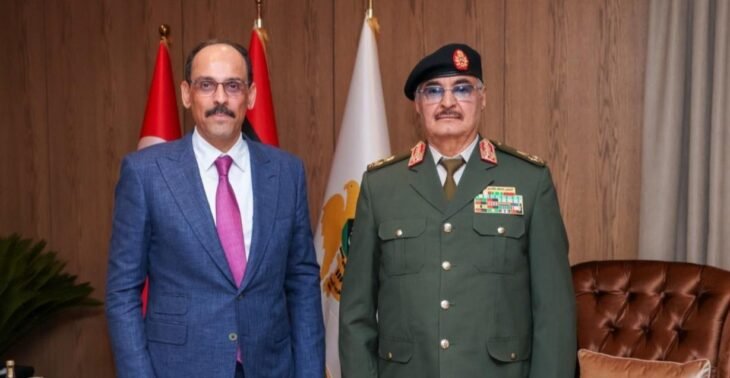
Eastern Libya’s Top Money Man: Spotlight on Ahmed Gadalla (2)

The Sentry

How Western Libya Paved the Way for an Eastern Libyan Scheme

In the months leading up to the 2019 offensive against Tripoli, Sadiq al-Kabir, governor of the CBL from 2011–2024, took strategic steps to contain his adversaries in western Libya while accommodating those in eastern Libya. Indeed, Kabir seemed to hedge against a potential Haftar victory.

In 2018, he overhauled the leadership at the LFB—the CBL’s wholly owned subsidiary through which most of Libya’s daily dollar operations flow, from letters of credit to direct transfers.

In doing so, he consolidated his control over state funds while working against the UN-recognized government in Tripoli, which sought to undermine him. Kabir also promoted Farhat Benqdara, a banker closely aligned with the Haftar family in Benghazi, to chairman of al-Masraf. These maneuvers would prove instrumental in enabling the $300 million scheme on the eve of Haftar’s attack.

For Kabir, 2018 was a year of vulnerability, marked by the dinar’s weakness, criticisms from the Haftar family, and attempts from the eastern-based House of Representatives to replace him.

Among other self-preservation maneuvers, Kabir dismissed the entire LFB leadership in August 2018, ostensibly to prevent financial losses. Whatever Kabir’s motives, this restructuring resulted in a consolidation of his personal control over Libya’s oil revenues and eliminated influence from the then-GNA, a political adversary.

Indeed, GNA leader Fayez al-Sarraj and several of his ministers resented Kabir’s habit of treating state liquidity as a political lever, disbursing funds to the Tripoli government selectively and on his own terms.

In October 2018, Tripoli militias aligned with Kabir forcibly removed Mohammed Bin Yusuf, the incumbent managing director of the LFB, from office, instead installing loyalist Mohammed Najib al-Jamal at that strategic post.

Soon afterward, it was Jamal, then known for his subservience to Kabir, who transferred $300 million from the LFB to al-Masraf as a guarantee deposit backing the conflict-financing scheme.

Given the strict hierarchy between the two men, it is implausible that Jamal could have granted such a critical financial transaction to al-Masraf without Kabir’s assent. The CBL did not respond to The Sentry’s request for comment.

In parallel with the 2018 changes at the LFB, Kabir pursued a rapprochement with Farhat Benqdara, a fellow Libyan banker known for his proximity to the very Eastern factions seeking to undermine Kabir. Benqdara, a Benghazi native, was the final CBL governor under the Qadhafi regime, a role he held until the 2011 uprisings.

After fleeing to Turkey in February 2011 and relocating to the UAE where he acquired Emirati citizenship, Benqdara became aligned with the Haftar family. In 2018, he became a key economic advisor to the field marshal and his sons.

Despite these ties to Kabir’s adversaries, the Tripoli based governor cleared the path for Benqdara to become chairman of al-Masraf in 2018.

The Libyan state’s equity state in al-Masraf is held through the LFB, which gave Kabir enough votes to help secure the chairmanship for Benqdara. Kabir’s move appears driven by self-interest.

First, by promoting a Haftar ally to a senior banking post in Dubai, Kabir bought time and reduced immediate threats from eastern groups who were seeking to remove him as CBL governor.

Second, the two bankers shared a history. In the late 1990s, when Kabir faced legal troubles, then-CBL governor Benqdara helped rehabilitate him professionally.59, 60 In some respects, the appointment appeared to serve as repayment for that earlier assistance.

Third, facing pressure from eastern Libya, Kabir likely sought to hedge his bets by facilitating the rise of a Benghazi figure who could bridge the gap between Kabir and his main adversaries, should those actors succeed in capturing the Libyan capital.

This history serves as a reminder that Libya’s east-west divide is seldom absolute. In illicit finance, political adversaries often cooperate for mutual profit.

By the same token, Prime Minister Abdelhamid al-Dabaiba’s government in Tripoli has yet to denounce Gadalla, thus maintaining connections between the country’s main rival networks.

Why Gadalla Matters Today

Between militia power and finance

Despite the LAAF’s collapse on the outskirts of Tripoli in 2020, the Haftar family has since consolidated power in eastern Libya, capturing most social and economic life.

Within this environment, Gadalla has become a pivotal figure in the illicit networks the Haftar family runs in eastern Libya and beyond.

Gadalla is a meaningful case study not because he is an outlier but rather because his trajectory exposes the systemic vulnerabilities in present-day Libya. With increasing sophistication, Libyan leaders leverage their physical might and territorial dominance to facilitate bold transnational endeavors.

These include money laundering schemes, various forms of trafficking, and routine imports of advanced weapons in contravention of international law. Other activities include the opaque funding of infrastructure projects in various sectors, such as telecommunication, construction, and aviation.

Present-day Libya’s warlords hold leverage over banking, hydrocarbons, telecom, electricity, customs, and other critical arenas. They subject almost every sector of the economy to intimidation, undue influence, and the co-option of mid-level officials.

Such contamination affects even ostensibly legitimate institutions, turning substantial portions of the economy into active nodes in predatory networks.

The country’s ruling elites rely on shadowy operatives who help them manage ill-gotten funds, stealing ever-larger volumes of public wealth, laundering it, and reinvesting portions of said profits into strengthening their military capabilities in contravention of international law. This creates a self-reinforcing cycle that benefits the handful of warlords who also function as political leaders.

This investigation, which focuses on Gadalla’s growing role in eastern Libya, documents a broader phenomenon that is not confined to his person or the Benghazi area. Even if Gadalla were held accountable, similar patterns would likely persist due to structural deficiencies in the Libyan system, which require continued vigilance and action to ameliorate.

Although he now presents himself as a legitimate businessman, Gadalla’s portfolio of official activities conceals a broad range of questionable financial operations executed on behalf of the Haftars. Gadalla’s ascent, which has unfolded at the very nexus between Libya’s militia rule and hollowed‑out economic institutions, shows how kleptocratic networks loot Libya’s public wealth on an immense scale.

Gadalla’s frenetic business history spans countless countries and domains of activity, often with dizzying ubiquity. The 46-year-old Benghazi-area native makes no attempt to maintain a low profile.

Before the anti-Qadhafi uprisings, Gadalla studied engineering and earned a master’s degree in the US at Indiana University Southeast. In 2008, he became a resident of Dubai. During the 2011 civil war, he sold automotive and household cleaning products in Libya for a US company.

As eastern Libya began to open up following Qadhafi’s fall, Gadalla utilized his Emirati footprint to expand his cross-border profile, starting with a 2012 trip to the Chinese manufacturing hub of Guangzhou, likely for sourcing.

Today, quite publicly, Gadalla boasts about leading the Alushibe Group, a loose set of private companies he controls in Dubai.76 At the same time, he leads several Benghazi-based companies while also being active in the public sector, serving as chairman of a Libyan state-owned steel company.

Separately, in 2023, Gadalla purchased Benghazi’s Libyan Cement Company, which had become notorious.

___________________

Smuggling Sovereignty: What Arkenu Reveals About Libya’s Fragmented Oil State

Hafed Al Ghwell

How Libya’s fragmented governance enables oil revenue diversion through hybrid networks and what recent interventions signal for restoring state control.

Libya’s oil wealth is not just mismanaged but is being systematically diverted through networks that blur the line between state authority and illicit activity. The so-called “Arkenu affair” reveals how these hybrid structures operate within official systems, quietly draining billions while preserving a façade of legality.

At stake is more than lost revenue: This dynamic entrenches political fragmentation and weakens any path toward stable governance. Yet recent moves by Mohamed al-Menfi suggest a potential shift toward accountability, raising the question of whether Libya can begin to reclaim control over its most critical resource.

What began as a technical anomaly has metastasized into something far more revealing: a case study in how parallel power structures can capture a state’s most vital asset while maintaining a veneer of legality.

The “Arkenu affair” is a window into how Libya’s oil economy has been re-engineered, piece by piece, into a hybrid system where official institutions coexist with, and often serve, illicit networks.

At its core, Arkenu was not an outlier. It was an evolution.

Founded in 2021, the company emerged at a moment when Libya’s post-war political settlement prioritized stability over accountability. That trade-off created the perfect environment for hybrid entities — commercial on paper, political in function — to embed themselves within the oil value chain. 

Arkenu’s significance was in how it did not operate outside the system, but through it, leveraging contracts, access, and institutional blind spots to channel oil revenues away from the state.

The mechanics were neither novel nor crude.

Libya’s oil and fuel economy has long been vulnerable to arbitrage. Subsidized fuel priced at a few cents per liter domestically can fetch over a dollar once smuggled across borders.

That price differential, sometimes exceeding 40 times the official rate, has sustained a sprawling illicit economy for decades. What changed after 2021 was scale and coordination.

By 2024, Libya was importing roughly 37 million liters of fuel per day while domestic consumption needs hovered closer to 24 million. The missing fuel did not just vanish into thin air. It was diverted.

At prevailing market values, this translates into approximately $6.7 billion annually in lost fuel alone. Overlay this with crude oil diversions, opaque swap arrangements, and underreported exports, and the cumulative leakage becomes staggering.

Arkenu fit seamlessly into this architecture.

It reportedly handled millions of barrels within months of operation, generating hundreds of millions in export value. Yet a significant portion of these revenues bypassed the Central Bank.

Between late 2024 and early 2026, estimates suggest that over $3 billion may have been diverted through channels linked to its operations. This was not theft in the conventional sense. It was extraction — systematic, institutionalized, and shielded by layers of formal legitimacy.

The enabling conditions for this level of control were territorial, bureaucratic, and financial. In eastern and southern Libya, networks aligned with the Haftar family consolidated authority over ports, transport corridors, and key nodes of part of Libya’s oil distribution. This allowed them to operate a dual system. Officially, they oversaw fuel distribution and security. Unofficially, they taxed, redirected, and re-exported fuel flows at scale.

Maritime routes saw entire tanker shipments re-exported, sometimes via ship-to-ship transfers in international waters, obscuring origin and ownership. A single vessel could carry tens of millions of liters, making maritime smuggling the backbone of large-scale diversion.

On land, the system was more granular but equally effective. Checkpoints imposed informal taxes, distribution quotas were manipulated, and artificial shortages were engineered to push fuel into black markets.

This is where Arkenu’s role becomes clearer, not just as a participant in this system, but also a facilitator of its financial layer. By operating as a private entity with privileged access, it created a bridge between state-controlled production and private offshore revenue channels. In doing so, it helped transform a fragmented smuggling ecosystem into something closer to an integrated shadow economy.

The question then is not why this persisted, but why it took so long to confront.

That answer lies in Libya’s political equilibrium. Since 2021, governance has rested on a tacit bargain: distribute rents widely enough to prevent renewed conflict. Thus, it meant tolerating, and at times enabling, illicit revenue streams that sustained armed groups and political coalitions.

Efforts to disrupt these flows risked upsetting a very fragile balance.

Prime Minister Abdul Hamid Dbeibeh operated within these constraints. His administration oscillated between rhetorical commitments to reform and selective enforcement actions that stopped short of dismantling entrenched networks. In some cases, enforcement was reversed altogether, reinforcing perceptions of complicity or, at best, political caution.

Against this backdrop, the intervention by Mohamed al-Menfi, the Chairman of Libya’s Presidential Council, increasingly stands out, not as a reaction to crisis, but as part of efforts to reassert institutional coherence in a fragmented political landscape. In a system long defined by competing centers of power and transactional governance, his approach seeks to reposition the presidency as a guarantor of accountability and national balance.

By early 2026, the Arkenu issue had crossed a critical threshold. Public scrutiny intensified, fiscal losses became harder to obscure, and international attention raised the stakes.

Yet what distinguishes al-Menfi’s role is not simply that he acted, but how he framed the intervention. Rather than allowing the issue to remain confined to technical or bureaucratic channels, he elevated it into a question of sovereignty, public trust, and the integrity of Libya’s economic governance.

It is a remarkable shift as al-Menfi increasingly positions himself as a convening figure willing to engage across Libya’s political divides while also signaling that certain lines, particularly around the management of national wealth, cannot be crossed.

In doing so, he has begun to carve out space for a more assertive presidency, one that does not compete with other institutions so much as it seeks to anchor them.

His earlier decision to initiate a comprehensive audit of contracts across the oil and electricity sectors dovetails rather well with his handling of the Arkenu affair.

Rather than a narrow administrative measure, these were early strategic steps in building the institutional tools required to confront entrenched practices. In a context where opacity has often been the norm, such deliberate moves toward transparency carry outsized political weight.

The pressure exerted on the executive authority, including Prime Minister Abdul Hamid Dbeibeh, must also be understood within this framework. What might once have endured as a managed controversy was instead pushed toward resolution. It sparks a much-needed recalibration driven by the growing expectation that major economic files cannot be indefinitely deferred or politically contained.

Beyond the suspension of Arkenu’s operations, al-Menfi’s maneuvering also fired off new political signaling. Simply put, such high-level interventions — when anchored in institutional legitimacy and public accountability — can alter the trajectory of even deeply embedded systems.

Importantly, al-Menfi’s approach has avoided the pitfalls of overt confrontation in an already polarized environment. Rather than framing the issue in factional terms, he has emphasized principles: transparency, legality, and the protection of Libya’s shared resources.

This has allowed him to engage the issue without further entrenching divisions, an approach that aligns with his parallel efforts on national reconciliation.

In this sense, whether through quiet diplomacy between rival factions or through institutional initiatives aimed at restoring oversight, al-Menfi appears to be advancing a model of leadership that prioritizes gradual consolidation over abrupt disruption.

It is not a dramatic break from Libya’s past, but it does represent a departure from the inertia that has often characterized Libya’s notoriously flawed governance.

There are limits, of course. The structures that enabled Arkenu remain resilient, and attempts at circumvention, such as the emergence of new entities seeking to replicate its role, tease the swift adaptability of entrenched networks. Yet even here, the significance of al-Menfi’s intervention lies in raising the political cost of such maneuvers. What once operated in relative obscurity is now subject to heightened scrutiny at the highest levels of the state.

This matters for a country navigating overlapping transitions — political, economic, and institutional. Leadership in Libya has often been defined by short-term balancing acts. What is beginning to emerge is an effort to pair that balancing with boundary-setting: to maintain stability while gradually reclaiming the authority of the state.

The Arkenu affair, then, is not only a test of governance. It is also an early indicator of whether Libya’s leadership can move beyond reactive crisis management toward a more deliberate, reform-oriented posture.

In this regard, al-Menfi’s actions, measured, but increasingly assertive, offer a signal that such a shift, while far from guaranteed, is at least underway.

______________________