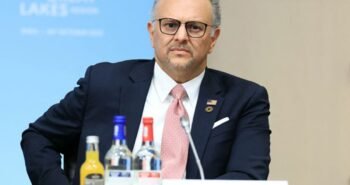
Tajul Islam

Libya is often described as a failed state, a fractured nation divided by geography, ideology, and foreign influence. But this framing misses the deeper, more corrosive reality.
Libya is not collapsing because it lacks institutions or national identity. It is collapsing because those institutions have been weaponized in a shadow war over money, contracts, and influence-an internal conflict that has become the country’s true system of governance.
What passes for political competition is, in reality, a relentless scramble among armed factions and their political patrons to control the state’s revenue streams. It is in this unseen battlefield, not along front lines or ideological divides, that the fate of Libya is being decided.
In western Libya, the appearance of state-building masks a far more predatory ecosystem. Over the past decade, ministries, public agencies, and state-owned enterprises have morphed into personal fiefdoms for factions that operate more like organized crime families than political actors.
The Government of National Unity (GNU), formed with the promise of reunifying the country and preparing it for elections, instead became the apex of a patronage architecture where power was measured not by official titles but by the ability to place loyalists in revenue-producing institutions.
For years, one figure embodied this system: Abdulghani Al-Kikli, better known as Ghneiwa. As the longtime commander of Tripoli’s Security Support Apparatus, he did not govern through public authority but through control over payroll manipulation, contract approvals, and illicit enrichment schemes.
His sphere of influence stretched across ministries, municipal offices, and the boards of state companies. Ghneiwa perfected the art of institutional capture, transforming public agencies into mechanisms designed to funnel money into the pockets of a chosen elite.
But in a system where the spoils are finite and the number of claimants continuously grows, power inevitably becomes temporary. Ghneiwa’s rising influence alarmed his partners, who depended on the same revenue streams he was increasingly monopolizing. In May 2025, the fragile balance shattered. A coalition dominated by the 444th Brigade lured Ghneiwa into an ambush, killed him, and dismantled his militia.
The operation was publicly framed as a move to strengthen state authority. In truth, it was a hostile takeover-a violent redistribution of access to money and contracts, marking yet another chapter in the revolving-door war for Tripoli’s illicit economy.
Into the void stepped Abdulsalam Al-Zoubi, the Deputy Defense Minister and a longtime partner of Ghneiwa. His rise illustrates the fluid loyalties that define Libyan politics, where alliances are transactional and survival depends on adaptability. Instead of being weakened by Ghneiwa’s fall, Al-Zoubi absorbed much of his former ally’s network. He quickly emerged as the new strongman in western Libya, reshaping the balance of power through his grip on the Administrative Control Authority and, most importantly, the Contracts Review Office.
This office is the beating heart of Libya’s kleptocratic machine. It holds the authority to approve or halt nearly every significant government contract in western Libya. Whoever controls it can shape entire sectors of the economy-determining which companies win contracts, which businessmen get paid, and which rivals are financially suffocated. It is a power that makes the holder indispensable, feared, and capable of extracting immense rents.
Under Al-Zoubi and Ghneiwa’s previous partnership, the office was used with brazen confidence. One scheme involved approving a massively inflated contract for importing electricity meters for the General Electricity Company of Libya, allowing the collaborators to pocket the difference.
In another, they allegedly oversaw the illegal export of scrap metal to Turkiye through a company linked to Al-Zoubi’s brother. These were not isolated abuses; they were pillars of a governance model built on theft disguised as legal procedure. But the kleptocratic engine hit a significant obstacle when Audit Bureau chief Khalid Shakshak challenged the legality of transferring authority over the Contracts Review Office to Al-Zoubi.
The case reached Libya’s Supreme Court, which ruled the move unconstitutional. The decision was a rare act of institutional resistance, severing Al-Zoubi from the primary source of his informal power and threatening the financial networks he had inherited and expanded. This setback has produced a dangerous stalemate. Al-Zoubi is unlikely to accept the ruling quietly. The potential for an armed confrontation between his loyalists and forces defending the Audit Bureau’s authority is growing by the day.
In Tripoli, where dozens of militias operate in close proximity and loyalties shift with the wind, even a small institutional dispute can spill into full-scale street battles. And in a political environment where betrayal is the norm, Al-Zoubi’s current allies may soon decide that he himself has grown too dominant-a threat to their own access to the shrinking pool of state resources.
While the west collapses under the weight of competing kleptocracies, eastern Libya offers a different-but equally destructive-model. There, Khalifa Haftar and his sons have consolidated power with far greater cohesion, running a tightly controlled economic empire that relies on militarized extraction rather than chaotic competition. Saddam Haftar, in particular, has refined the art of large-scale fuel smuggling, exploiting Libya’s heavily subsidized fuel system to siphon off billions annually.
By moving subsidized diesel through smuggling routes to neighboring countries, the Haftar network converts public funds into private profit while depriving the state of hard currency. The consequences are disastrous: higher inflation, worsening shortages, and a collapsing welfare system that millions of Libyans depend on.
Eastern Libya’s kleptocracy is not only internalized-it actively fuels regional instability, with smuggling profits helping fund paramilitary actors in conflicts such as Sudan’s brutal civil war. Despite the obvious predation of these networks, the international community continues to treat many of their leaders as stabilizing forces. Western diplomats, focused narrowly on counterterrorism and migration control, mistake temporary strongmen for reliable partners.
Figures like Al-Zoubi are treated as necessary interlocutors, while Haftar is viewed as a guarantor of order in the east. This is a profound miscalculation. International engagement with these actors provides them with legitimacy, resources, and political cover, further entrenching the very behaviors that have hollowed out Libya’s institutions. The recent illegal detention of Mohammed Mensli, the head of Libya’s Asset Recovery and Management Office, is a stark example.
His arrest, carried out just as he moved to recover billions in stolen assets, appeared designed to allow corrupt factions to seize control of those assets or silence an inconvenient reformer. That many foreign governments responded with silence speaks to a broader pattern of enabling the system they claim to oppose. Libya’s conflict, therefore, is not driven solely by ideology, foreign proxies, or regional divides. It is driven by the relentless competition for control of cash flows, contracts, and institutional leverage.
The country is trapped in a self-devouring cycle where each attempt at reform merely reshuffles who gets to exploit the state rather than changing the incentives that make such exploitation inevitable. The tragedy of Libya today is not the absence of a state, but the existence of a state repurposed for private gain. Every office becomes a prize. Every alliance an investment.
Every political or military maneuver a strategy for capturing a new stream of revenue. Until the cost-benefit calculus of corruption changes-until stealing becomes more dangerous than governing-Libya’s leaders will continue consuming their own institutions, mistaking personal enrichment for political success. And the country will continue sinking into an unseen war, one fought not for the future of the state, but for the right to feed on its remains.
__________________