By Jason Pack
For the last five years, the international community has tried a range of different approaches to mediating the Libyan civil war. All have failed.
By Jason Pack
For the last five years, the international community has tried a range of different approaches to mediating the Libyan civil war. All have failed.
Just when you think Libya is complicated – it gets even more complicated. Khalifa Hafter and his international allies have on the issue of the oil blockade seemingly outmanoeuvred Faiez Serraj and his allies in western Libya. Read More
Libya’s PM Serraj outflanks his opponents with a clever media gambit
By Jason Pack
Libya’s internationally recognized Prime Minister Fayez Serraj has come up with a brilliant way to have his cake and eat it too. Read More
By Fehim Tastekin
Egyptian mediation in Libya could prove a silver lining for Turkey as its ability to influence the conflict seems to wane, bearing also on its energy ambitions in the eastern Mediterranean.
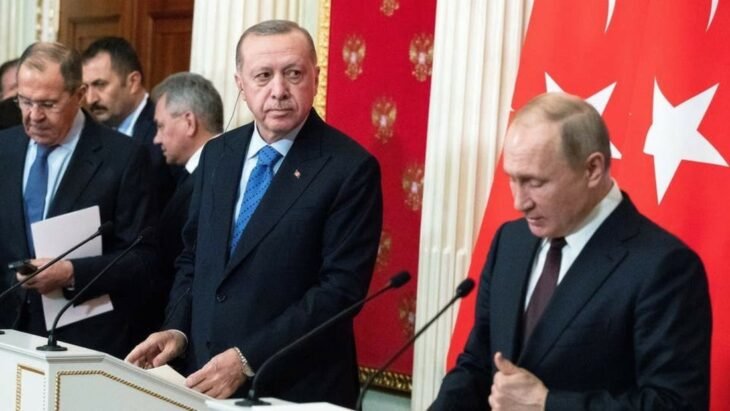
Turkey appears increasingly pressed to downscale its goals in the conflict in Libya, which has become closely intertwined with its gas exploration rows in the eastern Mediterranean.
The course of developments in the region dictates a more realistic attitude from Ankara, including acceptance of Egypt’s role in Libya, provided that certain Turkish expectations are met, and even laying the ground for normalizing ties with Cairo.
With settlement efforts gaining pace, Egypt has proved capable of mediating between the opposing sides in Libya, though it had thrown its weight behind the eastern forces fighting the Tripoli-based Government of National Accord (GNA) and its Misratan allies, which Turkey has backed with military, intelligence and militia support.
Ankara’s rigid attitude in the conflict has reduced its clout to influence over only its allies. And the infighting in the GNA presents a further risk to Turkish interests in the upcoming settlement process.
In other words, Turkey has failed to preserve the advantage it gained through its scale-tipping military intervention since the rival parties called for a cease-fire last month, opening the door to negotiations.
The arm-wrestling between GNA head Fayez al-Sarraj and his interior minister, Fathi Bashagha, has made Ankara realize that it cannot control everything in Tripoli by deploying soldiers and militia.
Certainly, those setbacks do not mean that Turkey will bow out and let others run the show.
The parties in Libya were forced into talks by a stalemate on the battlefield after Egypt drew a red line at the strategically significant Sirte and al-Jufra and Russia reinforced the region in response to Turkey’s military intervention, which had set Sirte, al-Jufra and the Oil Crescent as its next targets after securing Tripoli.
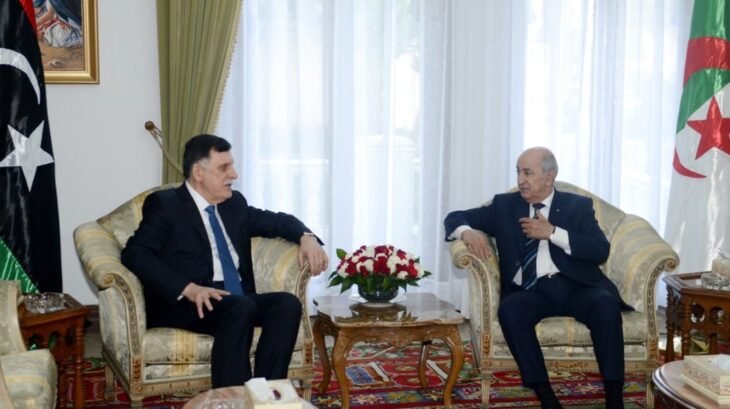
An Egyptian-sponsored cease-fire proposal by the eastern forces — represented by Khalifa Hifter, commander of the Libyan National Army, and Aguila Saleh, head of the Tobruk-based House of Representatives — in early June was followed by simultaneous cease-fire calls from Saleh and Sarraj on Aug. 21.
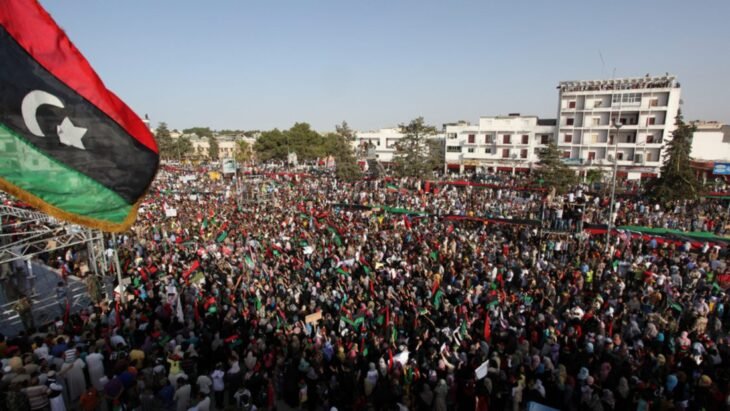
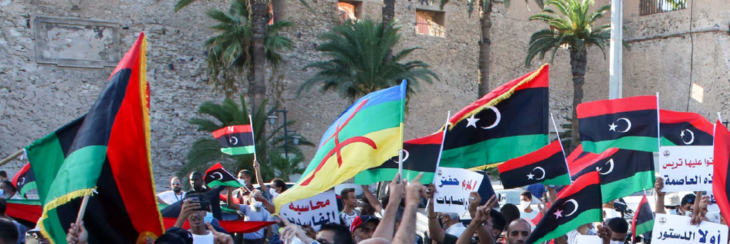
Ensuing street protests across Libya over economic grievances further pushed the parties toward negotiations as the rivalry between Sarraj and Bashagha boiled over in late August.
Sarraj suspended Bashagha who, many believed, was eyeing the premier’s post with Turkey’s support, and replaced other key officials in Tripoli.
In the east, the popular anger forced the resignation of the government allied with the House of Representatives.
Amid the fast-moving events, Turkey focused on keeping the GNA from unraveling. As a result, Bashagha, whose influence draws on the Misratan forces, was reinstated.
Yet Sarraj irritated Ankara by moving to diversify his foreign ties, while reinforcing his position at home. Having already replaced the chief of general staff, Sarraj sought to tighten his grip over security, intelligence and media bodies, promoting figures who irked the Muslim Brotherhood and Misratan groups and even triggered calls for civil disobedience.
Since the Sarraj-Bashagha showdown, many have tended to see an anti-Turkish move in any step Sarraj takes. He seemed to back off from a meeting in Paris, to which Saleh and Hifter were invited as well, after his apparent willingness to attend sparked questioning of his loyalty to Ankara.
But Bashagha, too, has been courting France and Egypt, despite leaning on Turkey.
Either way, both actors remain in need of Turkey’s support at present, as evidenced by Sarraj’s Sept. 6 visit to Ankara, shortly after Bashagha’s trip to Turkey that had coincided with his suspension.
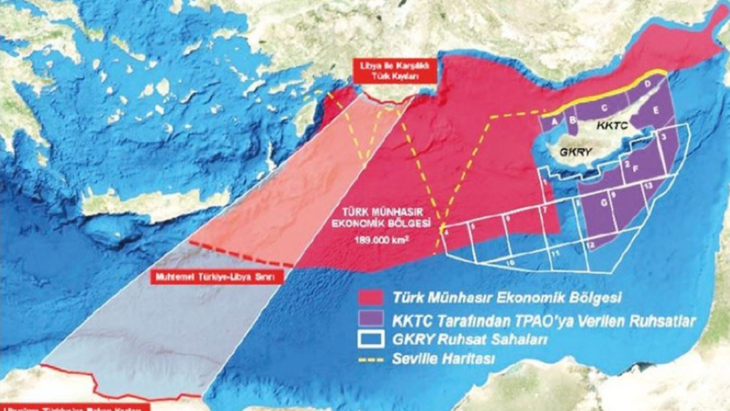
Sarraj was the one to sign the maritime demarcation deal with Ankara in November 2019, reportedly under Turkish pressure and fears of Tripoli falling to Hifter.
The accord, which became a mainstay of Turkey’s gas exploration claims in the eastern Mediterranean, remains without a parliamentary ratification and its survival depends on the survival of the GNA.
On top of all those controversies, Sarraj announced Sept. 16 a desire “to hand over [his] duties to the next executive authority no later than the end of October.”
Referring to the settlement efforts, he expressed hope that “the dialogue committee will complete its work and choose a new presidential council and prime minister.”
By speaking of stepping down while trying to consolidate power, Sarraj is believed to be trying to get rid of pressures ahead of prospective peace talks in Geneva.
For Ankara, his announcement resonates as a warning: “If I’m gone, the maritime accord is gone as well.” The move, however, might stoke the infighting in Tripoli.
In sum, the balance among its Libyan allies is too fragile to allow Ankara to steer them as it wishes. This, in turn, makes it all the more difficult for Ankara to steer the dialogue between its allies and their eastern opponents.
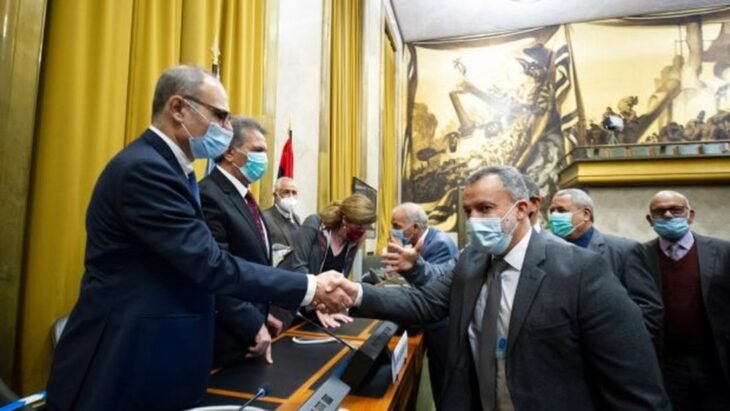
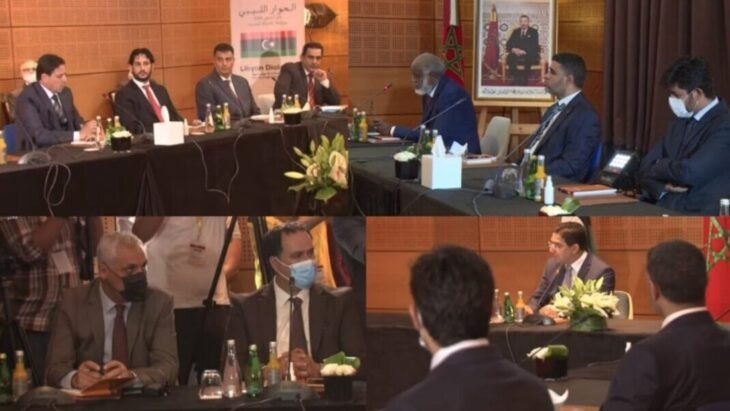
Delegations from the House of Representatives and Tripoli’s High State Council held five-day talks in Morocco last week, reaching some understandings on power-sharing.
The talks sparked objections from several dozen members of both bodies, who complained about the composition of their respective delegations.
Khaled Mishri, head of the High State Council who is close to Turkey, said the talks were of consultative nature and not binding for the council.
Also last week, representatives of Sarraj and Saleh held talks in Cairo, agreeing to set a date for elections no later than October 2021, restructure the GNA’s Presidential Council on the basis of a 3+1 formula — one president and two deputies and an independent prime minister — and address economic issues such as wealth management and equitable distribution of resources.
The Cairo meeting followed Sarraj’s latest visit to Ankara, where the mood was far from upbeat. Cairo’s emergence as a platform for reconciliation is not something that Ankara prefers, but also not something that it is seeking to prevent.
Turkey’s flexibility can be attributed to several reasons.
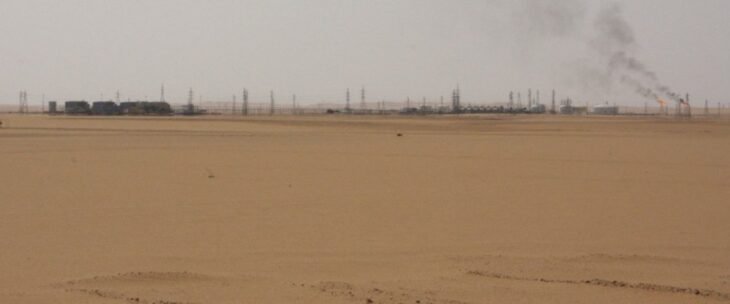
Above all, Ankara realizes that Libya’s main oil fields have gone beyond its reach after the Russian buildup in Sirte and al-Jufra and that it will now remain stuck in the Tripoli-Misrata enclave.
And with the fragile coalition in Tripoli creaking, Ankara has no option but to give way to negotiations.
In return for acquiescing to Egypt’s role, Turkey hopes to make certain gains, namely the sidelining of Hifter as a solution partner and the United Arab Emirates’ (UAE) exclusion from the settlement process.
The talks in Cairo were limited to representatives of Saleh and Sarraj, thus meeting Ankara’s reservation on Hifter. And if Egypt’s mediation would push back the role of the UAE, the chief sponsor of the 14-month siege on Tripoli, that would be a lesser evil for Ankara, which sees Emirate interference in its areas of interest as more dangerous.
Another factor compelling Turkey to acquiesce to Egypt’s role is Russia’s influential posture on the ground. It was Russia’s delicate engineering that raised Saleh’s profile on the eastern camp at the expense of Hifter. Hence, Russia is Turkey’s only channel to exert influence on the eastern forces.
Last but not least, breaking the ice with Egypt in Libya might give Turkey room to maneuver to pull Egypt away from Greece, its chief adversary in the eastern Mediterranean.
Last month, President Recep Tayyip Erdogan revealed ongoing contacts with Egypt on the level of intelligence officials amid growing calls in Turkey, led by influential retired generals, to mend fences with Egypt and Israel to break Turkey’s isolation in the eastern Mediterranean.
While Ankara’s support for the Muslim Brotherhood — Cairo’s archenemy — remains a fundamental stumbling block, Turkey’s allies in Libya, too, acknowledge that Egypt is a crucial neighbor and has legitimate security concerns.
***
Fehim Tastekin is a Turkish journalist and a columnist for Turkey Pulse who previously wrote for Radikal and Hurriyet. He has also been the host of the weekly program “SINIRSIZ,” on IMC TV. As an analyst, Tastekin specializes in Turkish foreign policy and Caucasus, Middle East and EU affairs.
_____________
![]()
By Jason Pack
For the last five years, the international community has tried a range of different approaches to mediating the Libyan civil war. All have failed.
By Jason Pack
For a range of reasons, 21st century civil wars have tended to be more protracted and multiparty than those of the 20th century. Read More
By Heba Saleh & Andrew England

When the head of Libya’s UN-backed Government of National Accord suspended the interior minister from his duties at the end of August, militias in Tripoli celebrated by firing weapons in the air. Read More
By Jason Pack
For the last five years, the international community has tried a range of different approaches to mediating the Libyan civil war. All have failed.
The Internationalization of Libya’s Post-2011 Conflicts From Proxies to Boots on the Ground
By Frederic Wehrey
For almost a decade, Libya has been riven by increasingly internationalized conflicts, stemming from local and regional fissures during the 2011 anti-Qadhafi revolution and the NATO-led intervention.
In the wake of that conflict, foreign missteps and the failures of Libyan elites to produce political unity and workable institutions opened the field for an escalating proxy war. Read More
By Diego Cupolo

Libyan Prime Minister Fayez-al Sarraj is reportedly planning to resign from his post and take on a caretaker role in the Tripoli government, a move that could complicate prior agreements with Ankara and raises questions over future bilateral ties. Read More
By Jemai Guesmi

The proliferation of dialogue platforms in Cairo, Geneva and Moscow, in addition to Bouznika in Morocco, has actually made Libyans warier about the prospects of a solution to their crisis. Read More
By Jason Pack
For a range of reasons, 21st century civil wars have tended to be more protracted and multiparty than those of the 20th century. Read More
The Internationalization of Libya’s Post-2011 Conflicts From Proxies to Boots on the Ground
By Frederic Wehrey
For almost a decade, Libya has been riven by increasingly internationalized conflicts, stemming from local and regional fissures during the 2011 anti-Qadhafi revolution and the NATO-led intervention.
In the wake of that conflict, foreign missteps and the failures of Libyan elites to produce political unity and workable institutions opened the field for an escalating proxy war.
PART (II)
Introduction .. cont.
Foreigners intervened according to the traditional definition of a proxy or surrogate war: funneling materiel, intelligence, training, and media support to Libyan military and political actors—many of them highly localized and acting through networks of foreign-based Libyan intermediaries.
The underlying driver for outside intervention during this phase was ideological—a struggle over Islamists’ place in Libya’s political order, though it also centered on control of economic resources and how much of the old Qadhafi-led order to preserve.
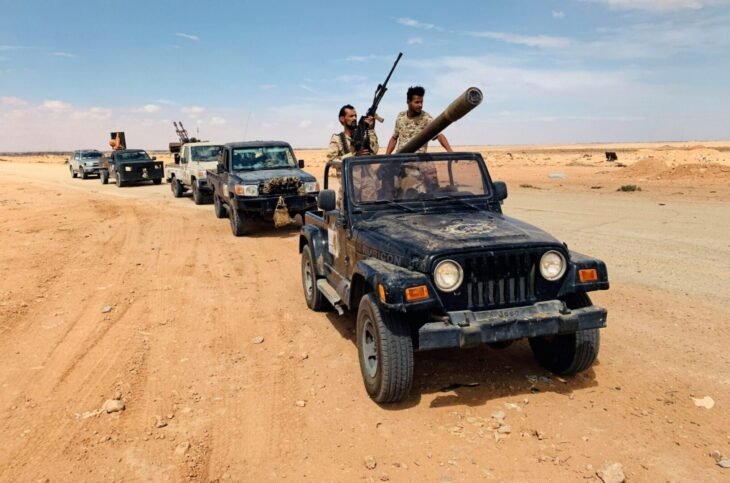
In April 2019, with the attack of Haftar’s forces on the outskirts of the Libyan capital, the mask of Libyan ownership of the conflict fell away. Though they continued to work through Libyan armed proxies and intermediaries, foreign states committed more of their own combat forces on the ground and in the air.
By the end of the year, Tripoli and the western region were flooded with thousands of foreign fighters from Eurasia, Africa, and the Middle East and hundreds of sorties by foreign-piloted drones and fixed-wing aircraft, whose strikes incurred mounting civilian deaths.
This phase also saw growth in the sophistication of the information war, led by foreign states in conjunction with Libyan actors or on their behalf.
The ideological component, while still a motive for the Emiratis and Haftar’s other backers, was accompanied by a fiercer geopolitical power struggle overlaid with a contest for economic spoils.
At the broadest level, Libya’s post-2011 civil wars have been facilitated by a breakdown in global multilateral norms, the diminished authority of the United Nations, American ambivalence and retrenchment, European discord and deadlock, and Russian opportunism.
The mounting disorder has been on display most starkly in the UN Security Council’s repeated failures to enact a meaningful ceasefire resolution and foreign states’ continuing contempt for a longstanding UN arms embargo on Libya, with key members on the council working in opposition to the UN Secretary General’s representative in Libya.
All of this stands in marked contrast to the relative diplomatic unanimity that defined the international response to the 2011 revolution.
Post-Arab Spring strategic rivalries compounded these trends in Libya. Though much attention—especially in the United States—has been focused on Moscow’s designs in Libya, the role of two Middle Eastern powers, the United Arab Emirates and Turkey, has arguably been more consequential for the fate of the country.
Abu Dhabi’s policies have been especially decisive at numerous junctures, reflecting a trend of Emirati military adventurism and economic expansion in the region, fueled in part by a “zero tolerance” approach to Islamists and political pluralism more broadly.
Turkey’s intervention in Libya, in turn, is also part of a bigger push for leadership in the Mediterranean by Turkish President Recep Tayyip Erdoğan that has deeper domestic, ideological, and economic roots.
Both countries’ hegemonic aspirations have been enabled partly by the vacuum of American leadership in Libya and also a degree of backing and acquiescence from Washington, given these states’ longstanding roles as U.S. partners in the Middle East.
Beyond this, Libya’s geographic position on the margins of America’s core security and economic concerns in the Middle East means that Washington has been unwilling to invest significant resources, either in Libya directly or in dissuading its regional allies from meddling.
This diplomatic absence, along with mixed signals on Libya and a markedly pro-Emirati stance under the Trump administration, has fueled the conflict. It has also contributed to European paralysis and invited Russia’s opportunistic intervention.
Despite the active role of foreign actors, Libyans themselves have been essential in internationalizing the conflict. Bereft of institutions, Libya’s fragmented landscape has been dominated by Libyan elites, many of whom solicited foreign patronage to bolster their position against rivals.
One outcome of this personalized transnational activism has been the erosion of Libyan sovereignty—a recurring facet of Libya’s modern history that has precedent in Libyan elites’ collaboration with the Ottomans, Italians, French and British.
In the post-2011 period, this personalization of the foreign proxy war has been exacerbated by Libya’s fragmentation but also Libyans residing overseas in Doha, Istanbul, Abu Dhabi, Amman, and other foreign metropolises.
Acting as power brokers and fixers for the flows of arms, money, and media support, these individuals complicated the principal-agent dynamic by inserting a layer of arbitration that introduced the possibility of miscalculation, errors, or outright defections.
This high-risk, multi-level chain of command, combined with the multiplicity of Libyan and outside actors more broadly, has protracted Libya’s chaos.
Added to this, Libya’s hydrocarbon resources have long been a magnet for international involvement and predation. In the wake of the Arab Spring, control over this wealth became a prize between competing Libyan factions, disincentivizing the forging of durable truces and also enabling local actors to solicit outside aid with promises of contracts and payments.
Relatedly, Libyan political elites and armed group leaders have parked oil-derived wealth in European and Middle Eastern banks and real estate, often cementing foreign partisanship, but also handing a degree of leverage to foreign actors in the form of asset freezes and sanctions.
The economic incentives wielded by local Libyan proxies, though not uniform across the country, differentiate Libya’s war from the Middle East’s other proxy conflicts, like Lebanon and Syria, where foreign states provide funding to local allies.
Commenting on the differences with Lebanon, the former UN envoy to Libya Ghassan Salamé controversially asserted, “the truth is that Libya can pay for its own suicide.”
Yet the inability of a single Libyan faction to achieve territorial or political dominance and—especially in the case of eastern Libya—international norms against the illicit export of oil have meant that local Libyan actors have often failed to meet the economic expectations of their outside patrons.
Seasoned observers of Libya have argued that Libya’s civil war, especially its post-2019 phase, embodies the intersection of several military and technological trends with potentially far-reaching consequences.
The nature of these shifts, combined with the multipolarity mentioned above, has given foreign competition in Libya a distinctive character marked by opacity, lethality, and toxicity.
The widespread deployment of armed drones, which mitigates personnel risks to interveners and affords a degree of clandestinity, is the result of the proliferation of these weapons across the Middle East from foreign suppliers, namely China, and indigenous manufacturing advances, in the case of Turkey.
Airstrikes in Libya from these craft, and also fixed-wing airplanes, have been insulated from serious scrutiny because of the aforementioned international disorder and scorning of embargo norms, but more importantly Western diplomatic protection of the most egregious of the violators, the United Arab Emirates.
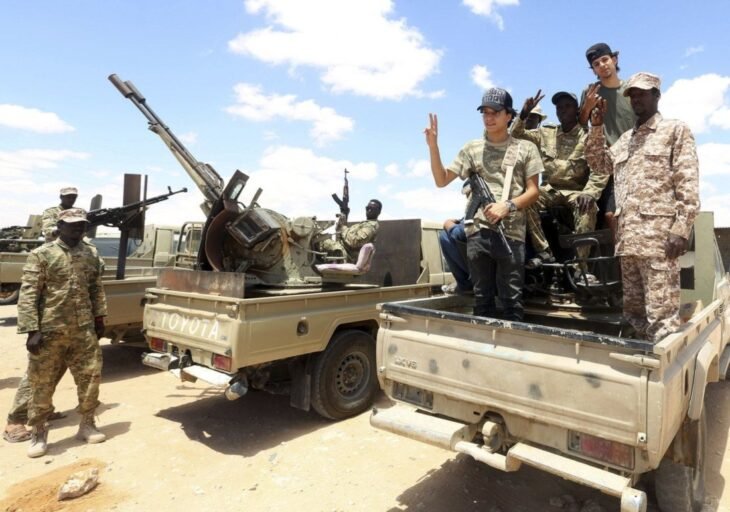
In addition, all sides in Libya’s war have relied upon foreign contract fighters, mercenaries and—in the case of Russian and even Turkish involvement—“semi-state” auxiliaries.
This is reflective of a broader, global trend of privatizing and outsourcing expeditionary military force, driven in part by the lucrative rise of private military companies and availability of recyclable, pay-for-hire fighters from poorer, conflict-wracked states in Africa and the Middle East.
While generally exhibiting low combat proficiency, the impact of these foreign ground and air forces on battlefield developments in Libya has arguably been more decisive than that of foreign combatants in the Middle East’s other proxy wars, in Syria and Yemen.
On top of these military developments, Libya has seen an increasingly sophisticated informational battle for public opinion, waged by foreign states through traditional and social media channels, foreign lobby firms, and co-opted journalists, in which foreign influence is often difficult to discern.
This disinformation war is another means for outside actors to shape the Libyan conflict with minimal blowback or penalties.
The rest of this report is divided into four sections, examining the Libyan war chronologically to recount its history and draw out the above themes.
(a) The first addresses how foreign intervention and rivalries played out during the 2011 revolution and the post-revolutionary period until 2014.
(b) The second section addresses the proxy war in the context of the Dignity versus Dawn civil war and its aftermath until 2019.
(c) The third section examines the battle for Tripoli and the post-2019 phase, characterized by increasingly direct intervention by foreign powers.
(d) The fourth and concluding section offers scenarios for the future of international involvement in Libya and provides lessons from Libya’s experience of proxy warfare.
***
Frederic Wehrey is a senior fellow in the Middle East program at the Carnegie Endowment for International Peace focused on politics and security issues in North Africa and the Gulf.
___________

The Internationalization of Libya’s Post-2011 Conflicts From Proxies to Boots on the Ground
By Frederic Wehrey
For almost a decade, Libya has been riven by increasingly internationalized conflicts, stemming from local and regional fissures during the 2011 anti-Qadhafi revolution and the NATO-led intervention. In the wake of that conflict, foreign missteps and the failures of Libyan elites to produce political unity and workable institutions opened the field for an escalating proxy war. Read More
By Oliver Imhof
At least 200 civilians died during the siege of the capital – with the future still looking uncertain for Libya. Read More
By Giorgio Cafiero
Uncertainty and fragility have defined the complicated political landscape in Khartoum since President Omar Hassan al-Bashir’s ouster in 2019. Read More
By Dylan Welch, Kyle Taylor, and Jeanavive McGregor
When Christiaan Durrant was four years old his father strapped him to his back and launched them both from an ocean cliff in a homemade hang glider fashioned from tarpaulin, electrical tubes and aluminium piping. Read More
By Frederic Wehrey
Putin has dispatched mercenaries to Libya’s civil war, exploiting the protracted conflict to carve out a new sphere of influence in North Africa. Read More
By Christopher Clark
The turmoil in the nation is reawakening memories of conflicts between the Ottoman empire and Arab nationalists. Read More
By Iftikhar Gilani
Turkey counters encirclement strategy by concluding maritime accord with Libya, unnerving inimical regional, global powers. Read More
By Jeffrey Feltman
few flickers of light may be penetrating Libya’s deepening gloom. On the one hand, Libya’s misery grows worse. Read More
By Jared Szuba
Russian regular forces are likely present in Libya, AFRICOM’s intelligence director said. Two Russian fighter jets have crashed in Libya since being deployed to country’s civil war on the side of Gen. Khalifa Hifter earlier this year, a senior US military official said today. Read More
Gaddafi’s Looted Wealth and Libya’s Financial Future
By Ferhat Polat
Libya has been an important producer of crude oil since the 1960s. With a population of only six million and substantial annual oil revenues, amounting to $32 billion in 2010, Libya’s potential is tremendous. Read More
By Giancarlo Elia Valori
With a view to currently understanding what is happening in the critical relationship between the Libyan military groups, we need – first and foremost – to look at the role played by the United Arab Emirates. Read More
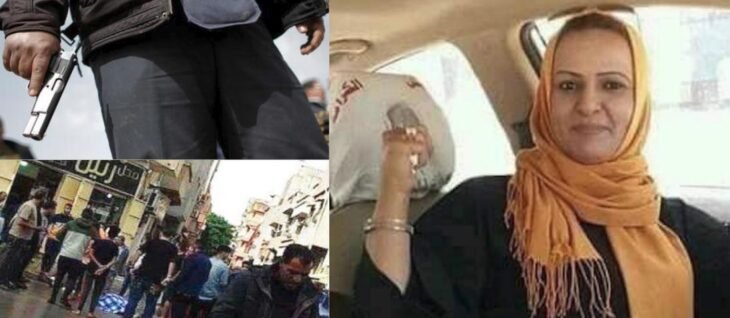
Armed groups in Tripoli linked with Libya’s Government of National Accord (GNA) used lethal force to disperse largely peaceful anti-corruption protests in late August 2020 and arbitrarily detained, tortured, and disappeared people in the capital, Human Rights Watch said today.
.
Gaddafi’s Looted Wealth and Libya’s Financial Future
By Ferhat Polat
Libya has been an important producer of crude oil since the 1960s. With a population of only six million and substantial annual oil revenues, amounting to $32 billion in 2010, Libya’s potential is tremendous. Read More
By Giancarlo Elia Valori
With a view to currently understanding what is happening in the critical relationship between the Libyan military groups, we need – first and foremost – to look at the role played by the United Arab Emirates.
Armed groups in Tripoli linked with Libya’s Government of National Accord (GNA) used lethal force to disperse largely peaceful anti-corruption protests in late August 2020 and arbitrarily detained, tortured, and disappeared people in the capital, Human Rights Watch said today. Read More
By Frederic Wehrey
A sleepy town of small time farmers and traders, Sabratha sits on the Mediterranean seaboard just west of the capital Tripoli. Read More
By Ghady Kafala
Under the constraints and policies of the current lockdown imposed by most countries in the world, including Libya of course, due to the Corona pandemic, the problem of domestic or marital violence emerged at a bigger scale than ever before in this country, as many women became susceptible to the danger of violence, beating and punishment. Read More
Prisoner and Jailer tells the story of two contrasting Libyans: a key official in the former regime and one of the most prominent figures of the post-revolutionary period in Libya. Read More
By Frederic Wehrey
A sleepy town of small time farmers and traders, Sabratha sits on the Mediterranean seaboard just west of the capital Tripoli. Read More
By Edward Yeranian
As political talks wound down on the second and final day of negotiations in the town of Bouznika, Libya’s two rival camps issued a statement saying that they were “intent on reaching an agreement.” Read More
By Mahmoud Hamad
This paper focuses on transitional justice in Libya since the fall of Colonel Gaddafi. It finds that unlike many countries that suffer from a paucity of transitional justice legislation, numerous relevant constitutional declarations, laws and decrees have been promulgated in Libya. Read More
Between Tunisia’s Security Policy and Libya’s Militia Factions
By Hamza Meddeb
Along the border between Tunisia and Libya, informal trade agreements led to a tight-knit border economy. But political changes in both Libya and Tunisia have fundamentally altered the economic and security landscape.
By Anthony Loyd
In the days before they died, the Libyan family of five scavenged for grass and tree bark to eat to survive. Like the other civilians trapped alongside them in the besieged Benghazi neighbourhood, the Hamzas drank rainwater from puddles as airstrikes rained around them. Read More