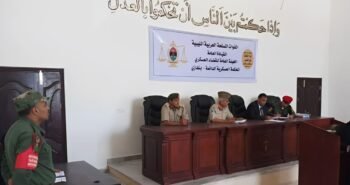
The Libyan deputy’s nightmare began on May 16, 2024, when, after attending a military parade of the General Command forces in Benghazi, he was kidnapped in the city center. Since then, he has been imprisoned in inhumane conditions.
Since Libya lost its sovereignty and stability, the country has become an open arena for human rights violations and the suppression of dissenting voices—even within elected institutions. One of the most telling cases exposing the depth of institutional and security collapse is the disappearance of Libyan Member of Parliament Ibrahim Al-Darsi, which has become a new symbol of the erosion of parliamentary immunity and freedom of expression.
On May 16, 2024, after participating in a military parade for the General Command forces in Benghazi, MP Ibrahim Al-Darsi was abducted in the city center. Security authorities in Benghazi claimed at the time that the incident was “criminal” and that the MP had been kidnapped for robbery, in an attempt to offer a narrative distancing political motives, despite clear indicators to the contrary.
A year after his disappearance, leaked videos began circulating on social media, showing a man widely believed to be the missing MP sitting on the ground, chained with iron shackles, nearly naked, in a degrading and inhumane condition. The French magazine “Afrique Asie” later published images from the video, quoting sources saying the footage was recorded inside a secret detention center in Benghazi operated by the Tariq Bin Ziyad militia, which reports directly to Saddam Haftar. This militia has previously been accused of extrajudicial killings and enforced disappearances of political opponents.
Even more shocking were additional leaked clips, in which MP Ibrahim Al-Darsi appeared pleading with Saddam Haftar to show mercy, spare his life, and release him for the sake of his children—scenes that underscore the moral collapse in the treatment of an elected official for merely expressing his opinion.
According to political and media sources, the real reason behind Al-Darsi’s abduction hadnothing to do with robbery. Instead, it stemmed from his outspoken criticism of the so-called
“Benghazi Reconstruction Project.” He accused influential figures close to the Haftar family, notably Belqasem Haftar, of exploiting millions of Libyan dinars allocated for reconstruction to complete private projects, which are then rebranded under the reconstruction initiative. He asserted that this was not genuine rebuilding, but rather systematic looting cloaked in superficial legitimacy.
Al-Darsi’s accusations came at a sensitive time, amid growing reports of massive deals and public funds being funneled into private companies linked to the Haftar family without oversight or accountability. These remarks placed him directly in the crosshairs of political and security powers, and he disappeared just days later—followed by near-total silence from the House of Representatives, which was supposed to protect its members.
The House of Representatives, led by Aguila Saleh, issued no official statement clarifying the circumstances of the incident, nor has it demanded an independent investigation. The public prosecution remained silent, prompting activists and civil society figures to accuse them of blatant complicity.
The United Nations Support Mission in Libya (UNSMIL) expressed “deep concern” over the circulating footage, confirming that it clearly showed signs of torture and abuse. The mission called for an immediate, impartial, and independent investigation, emphasizing that enforced disappearances, torture, and extrajudicial killings constitute grave crimes potentially prosecutable by the International Criminal Court.
The mission also stated that it had requested its digital forensic experts to examine the video’s authenticity and reminded that detention centers across Libya, both in the east and west, are known for systemic violations against detainees.
Hanane Saleh, Deputy Director for the Middle East and North Africa Division at Human Rights Watch, described the leaked footage and photos of MP Ibrahim Al-Darsi as “shocking,” calling for a transparent investigation while noting that the organization could not independently verify the materials at that stage.
Meanwhile, the International Criminal Court (ICC) spokesperson, Fadi El Abdallah, said that the ICC could not comment on the leaked videos due to the confidentiality of ongoing investigations and the need to protect witnesses and sources. He also confirmed that ICC Prosecutor Karim Khan would brief the United Nations Security Council on May 15, 2025, and called on all parties to submit any information relevant to the ongoing investigations in Libya.
The case of MP Ibrahim Al-Darsi clearly illustrates the current state of Libya: a silent parliament, accused security forces, unchecked militias, and corruption exploiting public projects to empower de facto powers. Amid local silence, hopes for justice now rest on the international community, human rights organizations, and the courage of those still willing to speak out against injustice—despite the risk.
_______________________