Archive - 2021

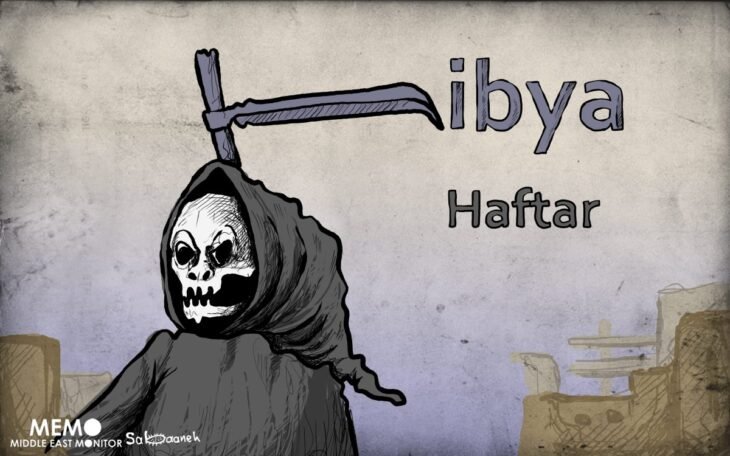
Elections or a parallel government in the East?

Abdullah Al-Kabir, a Libyan writer 

After the failure of the plan to withdraw confidence from the Government of National Unity due to the popular protests and the massive demonstrations and the positions of municipal councils from all over Libya rejecting this step, with a decisive position from the Western countries and the United Nations represented in its mission to Libya supporting the government, the alliance of Haftar and Aqilah Saleh is taking another path to obstruct the elections scheduled for December, and to hold the government and other political parties responsible, by trying to weaken the government by withdrawing ministers and agents of the eastern region from it.

The statement of the Deputy Prime Minister, Hussein Al-Qatrani, in which he criticized the performance of the Prime Minister, accusing him of unilateralism in the decision, was the first step in this direction, the reaction of the government and international positions will determine the next steps, either towards an escalation with the collective resignation of the ministers and agents of the East in the government, thus forfeiting the status of the national unity government, or the prime minister and the parties supporting him will succeed in taming this rebellion through dialogue, by implementing some of the demands contained in the Al-Qatrani statement, the international positions, especially the American one, will have a decisive impact on the type of next steps.

Some of the reasons mentioned in the statement of protest against the Prime Minister are valid and require treatment, but not to the extent that ministers, agents and some municipal councils mobilize and protest. It was possible to address these reasons within the meetings of the Council of Ministers, or in a special meeting between the Prime Minister and the government members from the eastern region.

If equitable solutions cannot be reached, then Al-Qatrani has the right to escalate and threaten to resign, but the truth is completely different, and the argument of marginalization, and the demands of some social groups for their rights were only a pretext and a front for the undeclared political goal of this escalation, which is behind the ruling family in the East, Haftar and his sons.

The deputy prime minister or ministers have no right to demand the nomination of a minister of defense, as long as the prime minister bears this responsibility along with his other responsibilities, and it is an unimportant ministry at the current stage, Libya is not exposed to external aggression or threat until the government focuses its efforts in the confrontation through the Ministry of Defense, there are issues and files that are more urgent and need to be addressed urgently.

If the goal of activating the ministry is to unify the military forces, then all these forces must first recognize the government and submit to its decisions, and the roadmap for a political solution, and this did not happen by Haftar and his militias.

Rather, what happened is the exact opposite, and the government was prevented from holding its meeting in Benghazi because it did not offer the obligations of loyalty and obedience to Haftar, and its president did not go to Haftar to seek his love and satisfaction, as others did in previous governments, with the exception of the Salvation Government.

The scene of escalation against the government and the threat of the resignation of members of the Cyrenaica region is not new. Ali Al-Qatrani, Deputy Prime Minister of the Government of National Accord, Fayez Al-Sarraj, suspended his membership in the government several times and then left it, then the other deputy, Fathi Al-Majbri, followed him.

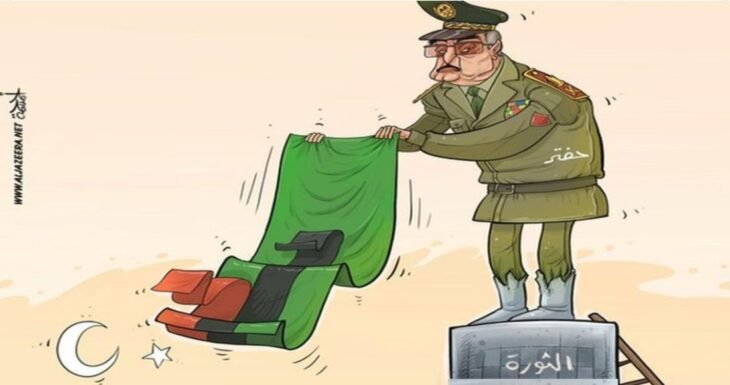
Haftar’s ambitions to rule by undermining the government and obstructing any project for it to gather the country’s diaspora were the main reason for provoking problems and putting obstacles in the way of any reconciliation that marginalizes Haftar, and paves the way towards a real reconciliation that would bring the country to stability and face all challenges, and between the first and the second Al-Qatrani, the scene did not change much, despite all the international efforts.

In parallel with Al-Qatrani’s protest statement, one of Haftar’s representatives in the House of Representatives issued a statement threatening to close the oil sector, the other card that Haftar threatens to use whenever his situation worsens, or he feels that the noose is tightening against him.

The conclusion is that we are facing a new chapter identical to previous chapters in which Haftar and his family move their papers according to the developments in the political situation, although the international situation bears a fair amount of difference this time, due to the growing American involvement in the Libyan crisis.

In light of this position and the international and regional reactions to these developments, we will know whether the elections will be held on time! This is the farthest possibility, given the continued lack of consensus on the legislative base and election laws. Or will a parallel government be formed in the east after the end of December 24 without elections? Which is the closest possibility.

________________

The promise and pitfalls of Libya’s high-stakes elections

Alessandra Bajec
The list of controversial candidates reflects the chaotic climate surrounding the polls, amid disputes over the rules underpinning the vote, its legal basis, and whether free and fair elections are possible at all.
***

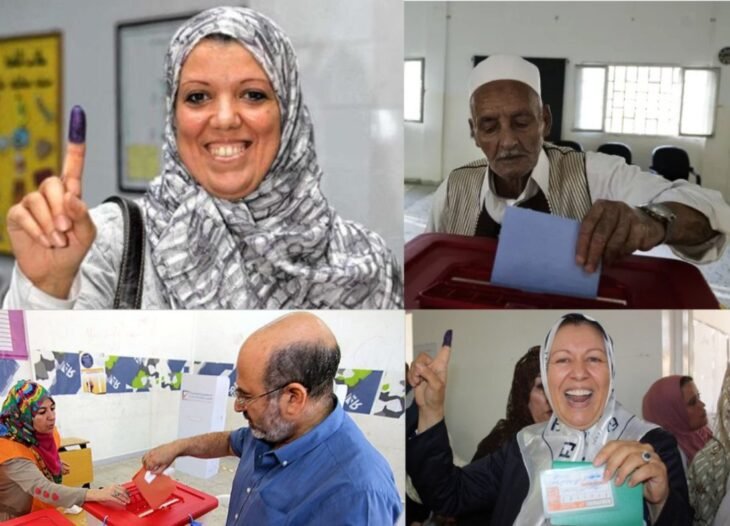
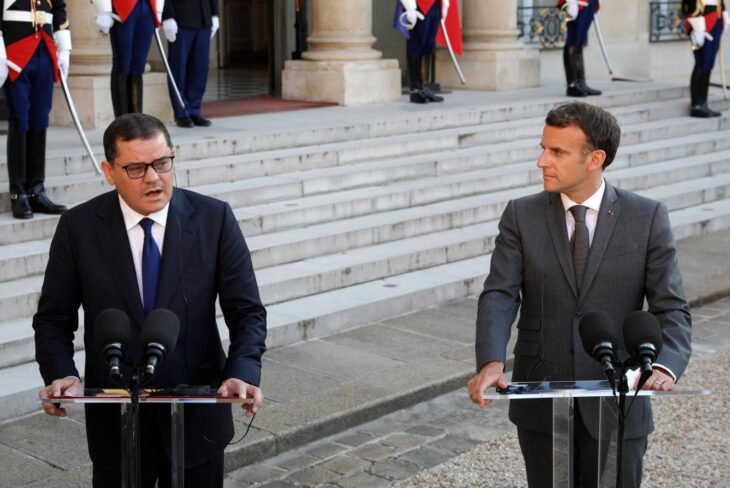
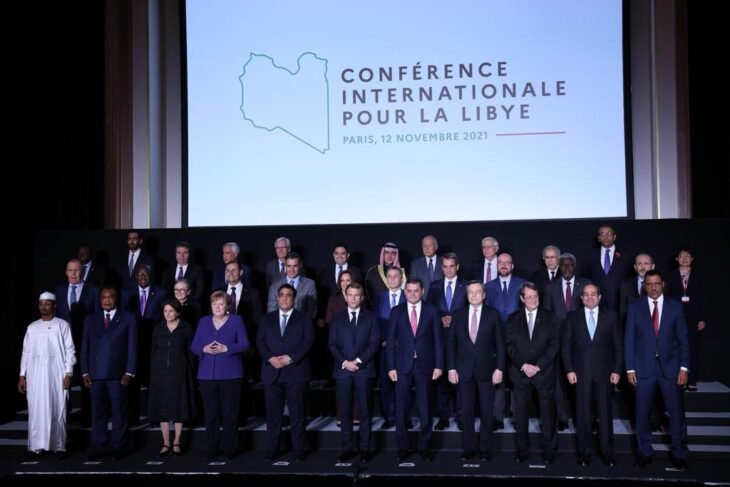
At the Paris conference for Libya on 12 November, participating leaders gave a final push for a plan to hold elections in December, reinstating their backing for the long-awaited presidential and legislative polls, a key step in the UN-backed peace process to end 10 years of violent chaos since an uprising toppled long-time ruler Muammar Gaddafi in 2011.

The polls, slated for 24 December, were set through a UN roadmap adopted last year, which also established an interim unity government, led by Prime Minister Abdul Hamid Dbeibah, to take over from rival administrations in the country’s warring east and west.

Power will be at stake in the long-awaited election, starting with who will become the president and take the lead on Libya’s multiple problems.

But the twin electoral appointment is in doubt, with only four weeks to go and several thorny issues yet to be resolved.

Libya is still divided over how to hold the elections in December, as there is no agreement yet on the constitutional basis for the vote.

“The present conditions on the ground don’t guarantee credible elections. In a critical moment like now, there’s a danger of regional fracture between east and west with a cold war style scenario”

In early July, the Libyan Political Dialogue Forum (LPDF), a UN-appointed body of 75 Libyan representatives, failed to agree on a legal framework that would establish political checks, institutional balances, and organise power between the parliament, presidency, and military ahead of elections.

Consequently, Aguila Saleh, speaker of the House of Representatives (HoR) in eastern Libya, unilaterally enacted a draft electoral law in September, without a vote or a constitutional basis, that would govern presidential elections, sparking criticism from parliamentarians.

The legislation controversially allows military officials to put forward their candidacy on the condition that they withdraw from their roles three months beforehand, a move that critics say is intended to favour his ally, the eastern-based military strongman Khalifa Haftar.

But without an election law, the upcoming polls could be a difficult undertaking.

Umberto Profazio, a Maghreb analyst at the NATO Defense College Foundation and associate fellow at the International Institute for Strategic Studies (IISS), considers “the absence of a clear, shared constitutional framework” to be one crucial matter endangering the course of the planned vote.

“The inability of the various political bodies and factions to agree on this legal framework poses a risk in that it may lead to new institutional chaos which could, in turn, create prerequisites for a return to armed violence,” the North Africa specialist told The New Arab.

In his view, the two-round presidential polls should be run over a brief span (of one month maximum) and not overlap with the parliamentary ones, so as not to give time for the losers to get organised, as, he says, they may be “tempted to undermine the validity of the electoral process”.

The scholar, with expertise on Libya, maintained that holding an election, far from bringing a solution, “will provide hope for a solution” in that a balance can be built and the country may move toward the creation of a more pluralistic governing body.

But if the polls do not materialise, he continued, some will feel betrayed by the international community, and there will be a temptation on the part of the conflicting sides, each backed by different foreign powers and militias, to remobilise on the ground.

The presence of foreign forces on Libyan soil is a complicating factor too. There has been no progress in forcing their departure, as envisaged in the ceasefire agreement of October 2020 that ended fighting between the country’s rival factions, which demanded that all foreign fighters and mercenaries leave Libya within 90 days.

The UN estimates that at least 20,000 foreign fighters remain in the war-torn country, including Russian Wagner Group mercenaries, Syrians, Chadian and Sudanese fighters, and Turkish troops.

World powers in Paris called for the withdrawal of mercenaries and foreign forces, and threatened to sanction those who attempt to disrupt or prevent the vote and the political transition.

At the request of France, which hosted the recent international conference, some 300 foreign fighters loyal to Haftar’s eastern forces – a rather symbolic number – are expected to initiate the pull-out from areas they control. Pro-Haftar forces remain in control of much of eastern and southern Libya.

The first batch in the mercenary withdrawal plan is required to be followed by Russia and Turkey pulling out fighters too. However, Turkey has shown little willingness to order its troops to leave having successfully pushed back along with Qatar, in June 2020, general Haftar’s self-styled Libyan National Army (LNA), supported by the United Arab Emirates, Russia, and Egypt, which had been attacking the UN-recognised GNA in Tripoli since April 2019.

Turkey has long specified a difference between the presence of its troops in Libya that were invited by the internationally recognised government and those imported by other factions. It is unlikely to act before forces in the east depart.

Russia, for its part, has denied sending any soldiers or mercenaries to Libya.

“If the polls do not materialise some will feel betrayed by the international community and there will be a temptation on the part of the conflicting sides, each backed by different foreign powers and militias, to remobilise on the ground”

Both Ankara and Moscow sent only lower-level representatives to the Paris summit, and they seem to have little incentive for pulling out their fighters ahead of an uncertain electoral scenario.

“Until there’s a new government that tells those powers to retreat from Libyan territory, they won’t leave,” Mezran said.

Mercenaries remain entrenched along frontlines despite last year’s ceasefire, as major external actors – Qatar, UAE, France, Italy, Turkey, Egypt, Russia, and the US – continue to use Libya as a proxy for their own ambitions, albeit in a less military way, and to preserve their interests in the oil-rich nation.

In the event of a disputed election or seizure of power, rival powers in the region could re-escalate their involvement towards a more direct conflict.

The still existing rift between the country’s east and west is another obstacle, even as the wider peace process strives to unify long-divided state institutions.

Deep divisions present in the fragile transitional environment have been marked by ongoing tensions between the HoR, the High Council of State (HCS) and Dbeibah’s government, which took office earlier this year. Tensions escalated in September after Libya’s parliament passed a questionable no-confidence vote in the newly established unity government.

The vote overseen by Saleh came less than two weeks after he ratified the contentious presidential election law seen as bypassing due process.

The division of state institutions, including the military, risks undermining the roadmap and plans for the forthcoming elections.

The candidacies of Saif al-Islam Gaddafi, son of the former Libyan leader Muammar Gaddafi, and eastern military commander Khalifa Haftar for the presidential election are problematic, to say the least.

Saif al-Islam, who appeared for nearly the first time in a decade to register as a presidential candidate, sided with his father in the 2011 uprising and threatened Libyans with killing and chaos. He was sentenced in absentia for his supporting role in a brutal crackdown on protesters during the revolution. He is still wanted on war crimes charges by the International Criminal Court (ICC).

Haftar is accused of war crimes and waged war on factions in the west after the country split in 2014, including a 14-month offensive to seize Tripoli which was repelled by the GNA last year. He has also been accused of seeking to establish a military dictatorship in the country. Members of the LNA who are said to be under his command have been indicted for war crimes by the ICC.

The announcement of his presidential bid came two days after Gaddafi’s son announced that he was standing. He temporarily stepped down from his position as head of the LNA in line with the electoral law to allow him to run.

“In the event of a disputed election or seizure of power, rival powers in the region could re-escalate their involvement towards a more direct conflict”

Both candidates will be hoping to draw from the same pool of voters in the east. Gaddafi is likely to tap into nostalgia for the stability of his father’s rule. As for Haftar, he appears to be betting on the ballot box to win after failing to succeed through a more than year-long military campaign.

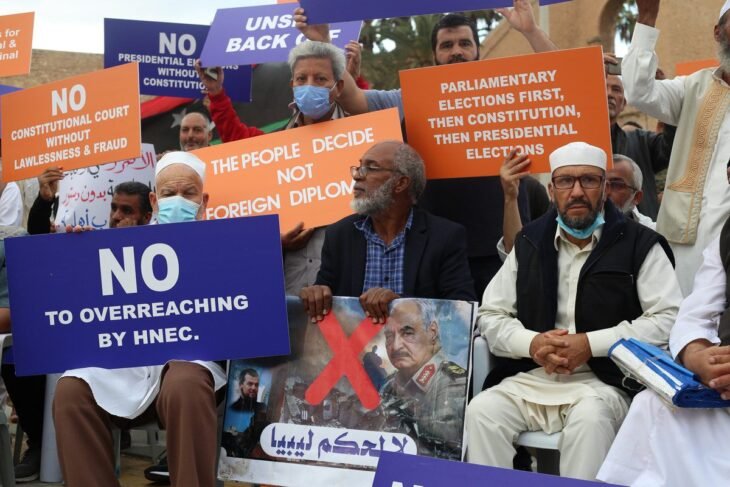
Residents across several western cities including Zawiya and Misrata quickly opposed Gaddafi and Haftar’s candidacies, and civil society members published statements of rejection of the two men’s participation in the election warning that their return to power would take the country back to square one.

The controversial candidates reflect the chaotic climate surrounding the polls amid disputes over the rules underpinning the vote, its legal basis, qualifications of those seeking to stand, and whether free and fair elections are doable.

Former Libyan interior minister Fathi Bashagha and parliament speaker Aguila Saleh joined a growing list of candidates for the presidential election set. Saleh was sanctioned by both the US and European Union after he refused to recognise the UN-supported GNA though the sanctions were removed early this year as the peace process evolved.

Dbeibah, whose main mandate is to prepare the country for December elections, registered his bid for the presidency despite previously vowing not to run for office as a condition of taking his current position.

IISS’ Profazio argued for the need for a “reset” in today’s Libya and anticipated with concern that, given the line-up of key figures from the past decade, the forthcoming vote will restore faces from the old regime instead of bringing about a generational turnover.

Profazio pointed to the circles close to the Libyan Muslim Brotherhood and Tripoli-based HCS, which is headed by Khalid al-Mishri, as likely spoilers who fear that Haftar, a potential frontrunner, may be elected president.

Mishri recently called for a boycott of the vote after previously claiming that electoral laws had been written by Haftar’s foreign backers, and even threatened to resort to violence to stop the eastern commander from taking office if he is elected. Politicians and warlords in western Libya issued statements opposing holding the elections according to the laws ratified by the eastern-based parliament.

The North Africa analyst underlined the risk of election manipulation and voter fraud, and the fact that the results of the presidential election will not be accepted as legitimate by all parties.

“Mercenaries remain entrenched along frontlines despite last year’s ceasefire, as major external actors continue to use Libya as a proxy for their own ambition”

“The present conditions on the ground don’t guarantee credible elections. In a critical moment like now, there’s a danger of regional fracture between east and west with a cold war styled scenario,” he hinted.

There are early signs that some factions in Libya may be positioning themselves to dispute the vote if it is held.

Human rights groups have also questioned whether Libya can hold free and inclusive elections.

“Can Libyan authorities ensure an environment free of coercion, discrimination, and intimidation of voters, candidates, and political parties? Is the judiciary able to deal promptly and fairly with elections-related disputes?”, Hanan Salah, senior Libya researcher at Human Rights Watch (HRW), asked.

Notwithstanding the political wrangling over the rules of the contest and contenders viewed in some regions as unacceptable, the forthcoming election is seen by most Libyan factions and foreign powers as the only option to bring stability.

Mezran is adamant that the main international actors should be monitoring and supporting the process, but not interfering. “It’s important that they stay on a watching position, but they need to keep out”.

***
Alessandra Bajec is a freelance journalist specialising in the Middle East and North Africa. Previously living in Palestine, then in Cairo, she is currently based in Tunis.

___________
Read More

Moscow builds ties with Tripoli government before December vote

A delegation of the Russian General Staff visited Tripoli on Nov. 10. The Russian military was received by the chief of staff of the Libyan army controlled by the Presidential Council, Lieutenant General Mohammed al-Haddad, and other leaders of the armed forces operating in western Libya.

Col. Gen. Alexei Kim, deputy commander-in-chief of the Russian Ground Forces and head of the Russian delegation, said that he arrived in Tripoli “to renew and continue to develop relations,” as well as “to reaffirm his readiness to work and support the Libyan army.”

Haddad, in turn, emphasized “the depth of relations between the two countries” and “the role of the Russian military establishment in the restoration of the Libyan army.”

“We hope that Russia will play an important role in uniting the Libyan armed forces,” said the head of the Libyan General Staff.

Libyan armed forces are still divided. Despite the fact that the leadership of the armed forces should be in the hands of the chairman of the Presidential Council of Libya, Muhammad Menfi, his command applies only to the armed formations in the west of the country. These forces fought against the commander of the so-called Libyan Arab Armed Forces (LAAF), Khalifa Hifter, and repelled his offensive in Tripoli in 2019-2020. Hifter himself refuses to obey the orders of the chairman of the Presidential Council and his chief of staff, Haddad, who was the head of the central military zone during the battles for Tripoli.

At the moment, the LAAF is an independent army in the east and south of the country, while the west of Libya is controlled by the military forces of the Presidential Council. Despite statements about the need for their integration, no practical steps have been taken. Also, according to the UN, Russian private military contractors that support the LAAF are still in Libya.

At the same time, Moscow has no doubts about the legitimacy of the new composition of the Presidential Council, headed by Menfi, and the Interim Government of National Unity (GNU), chaired by Abdulhamid Dbeibah. The GNU was approved by the House of Representatives on March 10, 2021. Dbeibah visited Russia in April, where he held talks with the Prime Minister of the Russian Federation Mikhail Mishustin.

Nevertheless, a new moment in relations between Moscow and Tripoli was the recognition by Russia of those military formations that operate under the auspices of the Presidential Council in western Libya. It was these forces that fought against LAAF under Hifter. Earlier, Moscow, although it was in contact with the Government of National Accord (GNA) of Faiz Sarraj, the predecessor of Dbeibah, avoided any official relations with these military structures, and many Russian media and pro-Kremlin activists called these armed groups “terrorists.”

Russian Defense Minister Sergei Shoigu has repeatedly received Hifter in Moscow, and all Russian-Libyan ties in the security sphere were conducted through Hifter. But Hifter is now forced to share his role in the field of defense and security with Haddad.

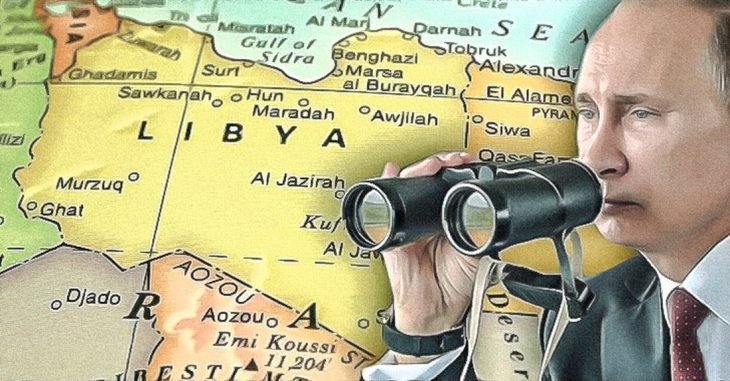
Hifter and Seif al-Islam Gadhafi (the son of late Libyan dictator Moammar Gadhafi), who were considered Russian favorites, have both applied as candidates in the presidential elections set for Dec. 24. However, Moscow is in no hurry to express its open support to either candidate.

In fact, there is skepticism in Russia about the support for the younger Gadhafi among the Libyans. In particular, according to Mikhail Bogdanov, special envoy of the President of the Russian Federation for the Middle East, Gadhafi is supported only by “certain tribes in certain regions of the country.” Nevertheless, Russia is likely to continue to maintain contacts with him, hoping he can act as an important re-balancer or spoiler in the elections and in the future can also play in the interests of Moscow.

Many other possible presidential candidates are acceptable to Russia, including Agila Saleh, chairman of the House of Representatives, as well as former deputy prime minister in the government of Sarraj Ahmed Maiteeq, with whom the Russian side has developed a constructive dialogue. This also applies to the current interim leaders of the country — Menfi and Dbeibah. Thus, Russia seeks to put its eggs in different baskets.

Probably the most uncomfortable figure for Russia is Fathi Bashagha, the former Minister of Internal Affairs of the GNA. However, Bashagha was looking for opportunities to establish closer contacts with Russian officials, according to sources familiar with the mediation between Russia and Libyan politicians.

Moscow also likely realizes that it will have to continue to work with the current Presidential Council and  GNA for some time, possibly much longer than one or two months, if the elections in December are postponed. Therefore, Russia is actively cooperating with the current interim Libyan authorities.

In particular, at the end of October it was decided to create a “joint Libyan-Russian committee”, which will deal with trade and economic cooperation between the two countries. From Libya, Minister of Oil and Gas Mohammed Aoun was appointed as co-chairman, while from Russia, Minister of Energy Nikolai Shulginov was placed on the committee. 

In turn, the Russian oil production company Tatneft resumed geological exploration in Libya, according to a report by the Russian TASS agency on Oct. 15. “Currently, the company is starting to complete work on the wells of one of the contract blocks, the drilling of which was suspended due to the situation on the ground,” Tatneft said.

Now, according to Nail Maganov, General Director of Tatneft, the company is ready to fully resume oil production in Libya, and for this Tatneft plans to create a joint venture with the National Oil Company.

Also, the Russian Gazprom EP International resumed oil production in Libya as part of a joint project with Wintershall Dea in the fall of 2020.

Thus the activity of Russian oil companies in Libya may lead to the legalization of the activities of Russian private military contractors, which will be concentrated on protecting Russian concessions or training Libyan security guards.

In addition, the Russian military’s contacts both with the structures of Hifter and with representatives of the general staff in Tripoli may allow Moscow to create its own military facilities. This will initially have the goal of facilitating the training and education of the Libyan military and integration of all armed groups operating in Libya into a single army. Also, one cannot exclude the possible coordination of Russia and Turkey in this direction to maintain their own military presence in this country, despite international pressure.

Read More

The surreal scene in Libya

Dr Amira Abo el-Fetouh

There is no doubt that the appearance of Saif Al-Islam Gaddafi, wearing his father’s cloak while presenting his candidacy papers for the presidency, provoked the wrath and anger of millions of Libyans, who revolted against his criminal tyrant father in a great revolution that he could not confront. Read More

Will the Libyan elections lead to calm or chaos?

Motasem A Dalloul

International leaders and diplomats met in Paris on Friday, discussed the situation in Libya, and decided that the oil-rich North African country should stick to the UN plan to hold presidential and parliamentary elections next month. “We stress the importance for all Libyan stakeholders to mobilise resolutely in favour of the organisation of free, fair, inclusive and credible presidential and legislative elections on 24 December,” the official statement released after the meeting confirmed.
The rival powers in Libya — the UN-backed government and the forces run by renegade Field Marshal Khalifa Haftar, who was backed by FranceEgypt and the UAE, among others — agreed a ceasefire in October last year. The deal included the date for the elections.
The ceasefire ended a decade of violence which erupted following the popular uprising that removed Muammar Gaddafi in 2011. International powers, including France and Russia, were involved in the chaos, either through their own forces and mercenaries fighting alongside Haftar, or through sending weapons and military equipment to him.
In a video message to the Paris Conference, UN Secretary-General António Guterres said: “Libya today is closer than it has been for many years to solving its internal crisis and breaking the cycle of political transitions. We cannot miss this opportunity.” He reiterated that the elections are an “essential next step on the road to peace and stability which has to be built on a strong foundation of inclusive and credible frameworks that can guarantee its success.”
There is an apparent desire locally, regionally and internationally to complete the transitional period in the war-torn country. However, the timetable and the controversy over the candidates are likely to plunge the country into chaos and armed conflict yet again.
During his address to the UN General Assembly, the President of Libya’s Presidency Council of the Government of National Unity, Mohamed Younis Menfi, said: “Libya is at a critical juncture – indeed a defining moment… Either we succeed in our democratic transition through free, fair and transparent elections, the results of which are acceptable to all… or we fail and relapse into division and armed conflict.”
Paris Conference on Libya: dodging the hard questions while ignoring the easy ones
One of the obstacles that could lead to chaos is the insistence on foreign forces leaving the country, which was a condition of the ceasefire agreement. According to French President Emmanuel Macron, a new commitment by Haftar’s forces in the east to remove 300 foreign mercenaries from the country “must” be followed by Turkey and Russia pulling out “their mercenaries”.
Russia’s Wagner Group has mercenaries in Libya, although it is denied that they are there under Moscow’s control. They are in Libya to support Haftar, and entered the country illegally and in violation of international law. Turkey’s troops, however, are in Libya at the invitation of the internationally-recognised government. Equating the two, as Macron appears to be doing, is unjust. “The mercenary withdrawal plan must be implemented. Russia and Turkey must withdraw their mercenaries without delay,” Macron said after Paris conference. Turkey replied that “France has no right” to make such a call.
Indeed, Turkey suspected that there was a hidden agenda for the Paris conference, so it sent a lower-level delegation. Russia also knew that its presence in Libya was being targeted, so it also sent a lower-level envoy to Paris.
France is part of an international mobilisation against Turkey. Macron knows very well that the Turkish presence in Libya does not violate international law, but still said that, “Individuals or entities, inside or outside of Libya, who might attempt to obstruct, undermine, manipulate or falsify the electoral process and the political transition” could face sanctions.
The French are not alone is seeking to get a share of post-Gaddafi Libya’s oil wealth. That is why global powers want to install a pliable dictator on the country who they can control, as they have in other countries. Such a person will care little about the people of Libya.
Gaddafi son to run for president - Cartoon [Sabaaneh/Middle East Monitor]

Gaddafi son to run for president – Cartoon [Sabaaneh/Middle East Monitor]

There are two possible candidates for this role: Haftar — who has dual Libyan and US citizenship — and Saif Al-Islam Gaddafi, the son of the late dictator. Both can serve the interests of external powers at the expense of the blood and wealth of the Libyans.
This is why those who met in Paris last week stressed the term “inclusive” when discussing the Libyan elections. They insist that there should be no veto against anyone regardless of who they are and what they have done.
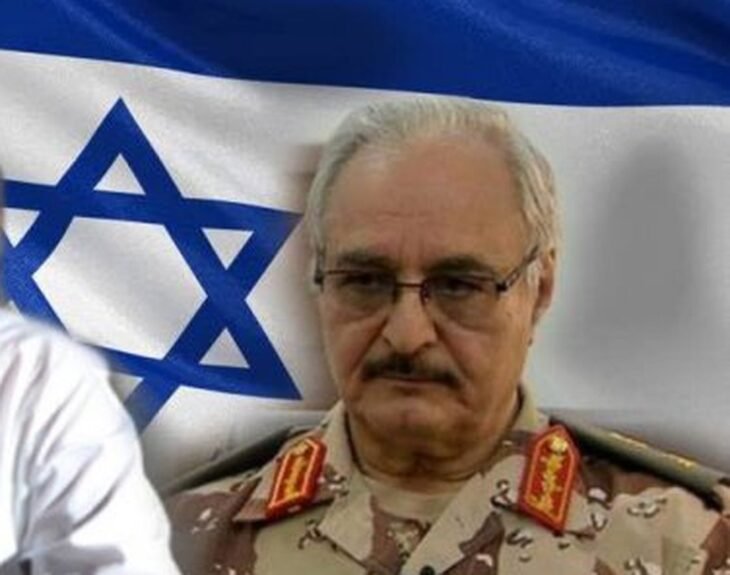
Haftar is not popular in Libya due to his hostility to the legitimate governments and the fact that he has Libyan blood on his hands. The same is true of Saif Al-Islam Gaddafi, who was active in his father’s oppressive regime. Their popularity ratings are falling even more given their renewed links to the Israeli occupation regime.
Al Jazeera said of Gaddafi: “He remains something of a cypher to many Libyans, having spent the past decade out of public sight since his capture in 2011 by fighters from the mountain region of Zintan… Complicating his presidential ambitions, Gaddafi was tried in absentia in 2015 by a Tripoli court at which he appeared via videolink from Zintan. He was sentenced to death for war crimes, including the killing of protesters… but was later pardoned.”
Despite this, and despite being wanted by the International Criminal Court (ICC) for war crimes, Gaddafi, a graduate of the London School of Economics, is still seen as a friend by the West.
Moreover, Al Jazeera pointed out: “Backed by Russia, Egypt and the United Arab Emirates, Haftar, a former CIA asset, is a controversial figure, despised by many in western Libya for last year’s devastating Tripoli offensive. He has also been accused of seeking to establish a military dictatorship in the country. His decision to run [as a presidential candidate] will anger many in the capital city and western regions who claim that no vote in areas he holds can be fair and who accuse him of war crimes during the assault, something he denies.”
According to the UN-backed reconciliation agreement, the main duty of the interim government of Abdul Hamid Dbeibeh is to prepare Libya for the presidential and parliamentary elections. Dbeibeh has expressed his concerns on several occasions that the country is not ready for the elections on 24 December and has proposed delaying them. He is not alone in thinking this; many popular and revolutionary groups and officials in Libya say the same. Local councils across the country are adamant that “war criminals” should not be allowed to stand as candidates.
It seems, though, that the world powers are ready to interfere in the election process. Hence, their insistence that they should go ahead on schedule. This is going to be problematical.
“The danger lies in bypassing the referendum on the draft constitution with numerous excuses given. The fatal danger is presidential elections without approval of the constitution by the people,” mused a member of the High Council of State in Libya, Abdurrahman Shater. He believes that the country needs additional time to finalise the election process and the law because “There is an international plot for the installation of a new dictator.”
February TV reported the Head of the Defence and National Security Committee in the Libyan Parliament, Kamal Al-Jamal, as saying that, “We reject everything that allows people wanted to face justice running in the elections.”
Many in Libya believe that the election results will not be respected if they go ahead in the absence of the constitution and amidst the ongoing divisions in the country. Real reconciliation that would end the chaos, violence, divisions and conflicts in the country completely should be based on elections that need a constitution and clear laws if they are to be free, fair and transparent.
“We all know that the road to reconciliation is long and arduous and to get to the end, applying transitional justice, truth, openness, acknowledging past wrongs, reparations and identifying the missing are all necessary,” concluded Mohamed Younis Menfi. “Only with these steps can we move toward a successful genuine national reconciliation.”
***
Motasem A Dalloul – The author is MEMO’s correspondent in the Gaza Strip.
_______________

Conclusions of Paris Conference on Libya

Sami Zaptia.

On 12 November 2021, the President of the French Republic, the Federal Chancellor of Germany, the President of the Italian Council of Ministers, the Prime Minister of the interim Government of National Unity of Libya, and the Secretary-General of the United Nations, co-convened a conference of Heads of State and Government on Libya, in Paris, in support of the implementation of a Libyan-led and owned political process facilitated by the United Nations leading to a political solution to the Libyan crisis.

Read More

Libya needs 5G and 5G is ready for Libya

Sami Zaptia

.

Speaking today exclusively to Libya Herald at the Taqnya ICT 2021 exhibition (Tripoli, 9-12 November), Ericsson Libya Country Manager, Andrea Missori said Libya has an important need to close the gap on fixed broadband and fiber deployment and mobile technology can work as an accelerator. Read More

Libya’s migrants and crimes against humanity

Omer Karasaan

The U.N.-brokered process in Libya focused on the withdrawal of foreign mercenaries and parliamentary and presidential elections in December 2021 remains fragile. Still, the High National Elections Committee said that nominations for the presidency would start in November with voting cards distributed within weeks. Much is uncertain, including the powers of the presidency. 

Aside from token moves, those who remain include mercenaries brought in by Russia, the United Arab Emirates (UAE), and others to support General Haftar’s eastern-based Libyan National Army (LNA) and those brought in by Turkey, the main supporter of the Government of National Accord (GNA) in Tripoli. Reconciliation appears far off but there has at least been a respite of over a year from fighting.

These developments must have been welcomed by the over 600,000 migrants in Libya, a destination and transit country for migrants hit hard by the conflict and worsened economic conditions exacerbated by the pandemic. But the situation appears to be worsening for those seeking asylum in Europe through the Mediterranean, and especially sub-Saharan Africans who the U.N. says are uniquely vulnerable, pointing to racism.

Many are brutally detained in centers managed by the GNA’s Department for Combating Illegal Immigration (DCIM) and secured by militias. Often it is Frontex, the EU border and coast guard agency, who guides the Libyan Coast Guard in illegally pushing back and detaining those seeking asylum in Europe. That cooperation increased after Italy signed a memorandum of understanding in 2017 with the GNA in Tripoli. Conditions in detention centers were already well known; German diplomats compared them to concentration camps.

A recent Amnesty International report speaks of the “hellscape of detention.” Medecins Sans Frontieres (MSF) withdrew from two official government detention centers because of violence and inhumane treatment last June. Yet, despite the Geneva Convention and EU legislation prohibiting returning asylum-seekers to unsafe territories and a European Court of Human Rights ruling citing torture and death in Libya, the practice continues.

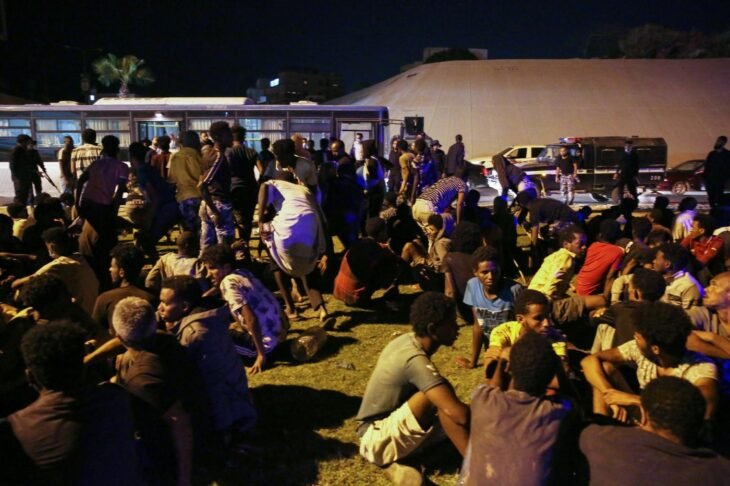
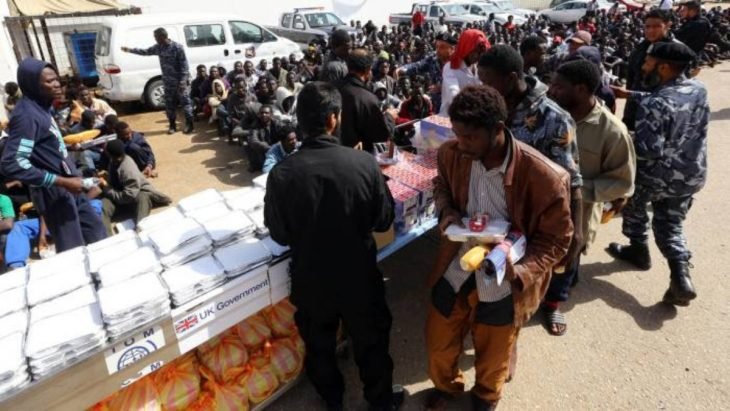
On October 1, 2021, Ministry of Interior militias ostensibly moved against drug and human traffickers. No such arrests were announced, but over 5,000 migrants, including 540 women—some pregnant—and 215 children were violently detained. According to MSF, “Entire families of migrants and refugees … have been captured, handcuffed and transported to detentions centers … people have been hurt and even killed; families split up, homes reduced to piles of rubble.”

Taken to miserably overcrowded detention centers in Tripoli already holding 7,000 people, they face extreme physical violence, including sexual violence and torture. There have been numerous attempts at escape with many shot dead, others rearrested to return to brutal detention and starvation rations. The U.N. Refugee Agency (UNHCR), which had assisted and registered most of the detained closed its day center in Tripoli when hundreds overwhelmed the facility asking for protection.

Why was the operation mounted? The answer likely lies in a cruel if lucrative business model around migrant exploitation in parts of Libya, with aspects of it increasingly in other Maghreb countries, even victimizing vulnerable locals. The Clingendael Institute says it is now more profitable to detain and further exploit migrants than get them to Europe. Detainees are beaten, tortured, and starved to get funds from their families and friends.

They are subject to forced labor and forced prostitution, many are enslaved and sold, often from detention centers. In an October 2021 report by its Independent Fact-Finding Mission on Libya, the U.N. noted the commission of crimes against humanity, including in its section on migrants. Furthermore, EU border protection at any cost and pandemic closures mean that routes used by human smugglers and those for drugs, guns, and human trafficking now overlap, further endangering migrants.

The timing of the operation may lie in the pandemic’s impact on the economy and migration patterns in sub-Saharan Africa. A World Bank phone survey in 41 countries of the region underlined that the pandemic has seriously hurt livelihoods, food security, and human capital. Many, especially women, have lost employment, mostly in cities and towns.

Closures and mobility restrictions have hurt all. Agricultural income too has declined as markets closed and prices fell. Tellingly, remittances from migrants proved surprisingly resilient and, excluding Nigeria, increased by 2.3 percent in 2020 with a 2.6 percent increase expected in 2021.

The Mixed Migration Center sees the pandemic as “a threat-multiplier, compounding existing risks and vulnerabilities for refugees and migrants.” While COVID-19 may have increased the desire to migrate, it also brought decreasing resources to do so and additional fears. Thus, sea departures to Europe of sub-Saharan Africans declined even as sea departures of North Africans increased. With the flow of sub-Saharan Africans diminished—the main victims of the detention centers and enslavement—the  thousands detained in Gargaresh will allow militias to extort more funds, forced labor, and forced prostitution. For many, this would not be the first time they had to pay their way out. According to the U.N., some migrants have endured this horrific loop over 10 times.

Aside from the over 12,000 detainees, thousands of migrants remain in hiding and 4,000 are encamped at the UNHCR center, desperately seeking evacuation. One Gambia-bound evacuation flight was allowed, after a suspension of flights by the Ministry of Interior in August. Yet the EU continues to cooperate with the Libyan Coast Guard and other government agencies, having sent $455 million since 2015.

And while investigations into the role of Frontex have been launched by the EU parliament, the European Ombudsman, the European Court of Auditors and other agencies, little has changed. The impunity with which Frontex and EU border and coast guard national agencies operate continues undiminished. EU agreements and legislation on human rights, including the right to apply for asylum are breached daily, including violent pushbacks along the Aegean route to Greece from Turkey and in the Balkans.

Amnesty International noted in July 2021, “Violations documented against refugees and migrants are not an accident but rather the clear and anticipated outcomes of an EU-supported system of interception, disembarkation and return to detention centers notorious for abuse, built with the aim of keeping refugees and migrants out of Europe at all costs.”

 Yet, in a political environment in which France’s far right leader, Le Pen, is being outflanked on her right by a Trump-inspired outsider, Eric Zemmour, and even Denmark’s social democrats articulate a vision of a country with no asylum-seekers, the growth and persistence of anti-immigrant policies comes as no surprise.

Yet over the past year, there have been growing countervailing voices and actions. It was two 2020 investigative articles by a consortium of newspapers and the investigative media organizations Bellingcat and Lighthouse Reports on Libya and the Aegean route that prompted EU’s Frontex probes.

Furthermore, on May 25, 2021, three NGOs, Front-Lex, the Progress lawyers Network, and the Greek Helsinki Monitor, took Frontex to the European Court of Justice. In a first, on January 2021 Frontex ceased operations in Hungary after the European Court of Justice ruled that Budapest violated EU rules when it pushed back asylum-seekers to Serbia.

Currently, Matteo Salvini, former interior minister and head of Italy’s right-wing League party, is in court on kidnapping charges for his 2019 denial of entry to a ship carrying migrants and asylum-seekers abandoned at sea. These are harbingers of hopefully a more humane approach to dealing with the reality of migration. All the EU has to do is follow its own values, laws, and regulations and insist on meaningful sanctions on its Libyan counterparts; and cease assisting lawless groups.

_________________

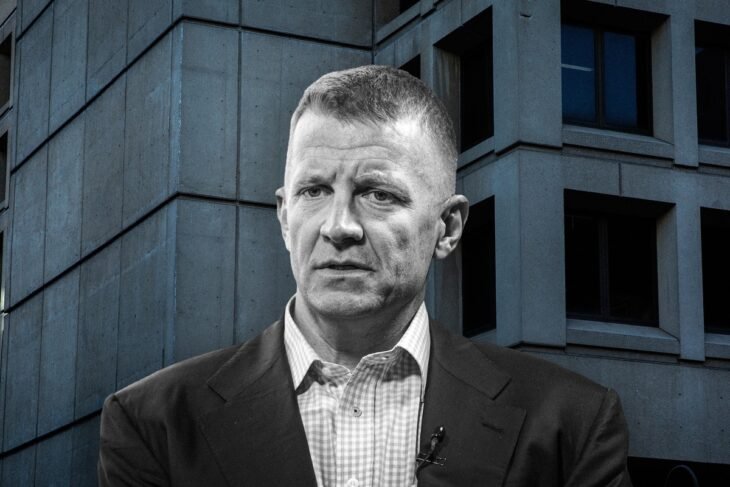
The FBI is investigating the role of Erik Prince in the Libyan mercenary plan

The FBI is It is investigating a failed mercenary plan related to the Libyan civil war in 2019 and has tried to find out what role private military contractor Erik Prince, if any, played a role, according to six people aware of the investigation. Prince has not been charged with a crime.

Federal researchers began investigating Prince’s involvement in Jordan’s military helicopter and arms sales company last summer as part of a 2019 plan to help Libya’s declared leader Khalifa Hifter defeat the country’s UN-backed government, according to four experts. research.

The FBI declined to comment.

In February, a UN investigation found that Prince and others had violated the arms embargo on Libya and described in detail parts of a secret attempt to get a team of mercenaries and planes for an assassination unit to support Hifter. Prince has denied involvement in a project called Project Opus, and told the New York Times that he had never met or talked to Hifter.

Prince’s attorney Matthew Schwartz said his client had nothing to do with the mercenary plan. “As Mr Prince has repeatedly said, he had no involvement in the alleged military operations in Libya in 2019, and the report, which suggested otherwise, was based on an incomplete investigation and was based on biased sources.”

In particular, FBI agents from the Washington Field Office have inquired about Prince’s role in creating modified vacuum cleaners and trying to market it as a military aircraft for use in conflicts around the world. The planes were to be used in a broader effort to help the apostate Libyan army commander take control of the Libyan capital, Tripoli.

Intercept described Prince’s repeated efforts to help move planes and other material from Jordan to Libya, including arranging meetings with then-President Donald Trump, a member of the National Security Council, but Jordanian government officials suspended the agreement. Prince worked with Royal Feisal ibn al-Hussein of Jordan to arrange for the sale and transfer of arms, according to three individuals aware of the arrangement. This summer, FBI agents tried to interview Feisal and several others working with him, according to two people who know about the FBI’s activities in Jordan. Feisal, through the Jordanian embassy in Washington, previously denied that he had any share in the plot or relationship with Prince.

In April, two months after the UN documented a change of ownership of Frontier Services Group aircraft, the FSG announced Prince resigned from the company “because of its other business arrangements.” Schwartz, Prince’s attorney, said in an email that his client resigned “from a disagreement with the performance and direction of the company’s management. Any suggestions that his resignation had anything to do with the UN panel report are false.

With plans to move the plane to Libya and major mercenary efforts disintegrated, one of the planes was transferred to Cyprus. Earlier this month, FBI agents traveled to a Mediterranean island to inspect a dustpan on a converted American crop, a person familiar with the sensor said. Cyprus-based news organization Kathimerini reported on an FBI inspection of the aircraft earlier. Intercept had previously reported on Prince’s secret attempts to develop harvesting equipment into military aircraft and market it for use in several wars.

Prince, the founder of Blackwater, is the brother of Trump’s Secretary of Education Betsy DeVos and was one of the former president’s most ardent supporters. Prince, a descendant of a wealthy and politically connected family, has been involved in controversy since the Iraq war, when Blackwater won major contracts to support the U.S. occupation.

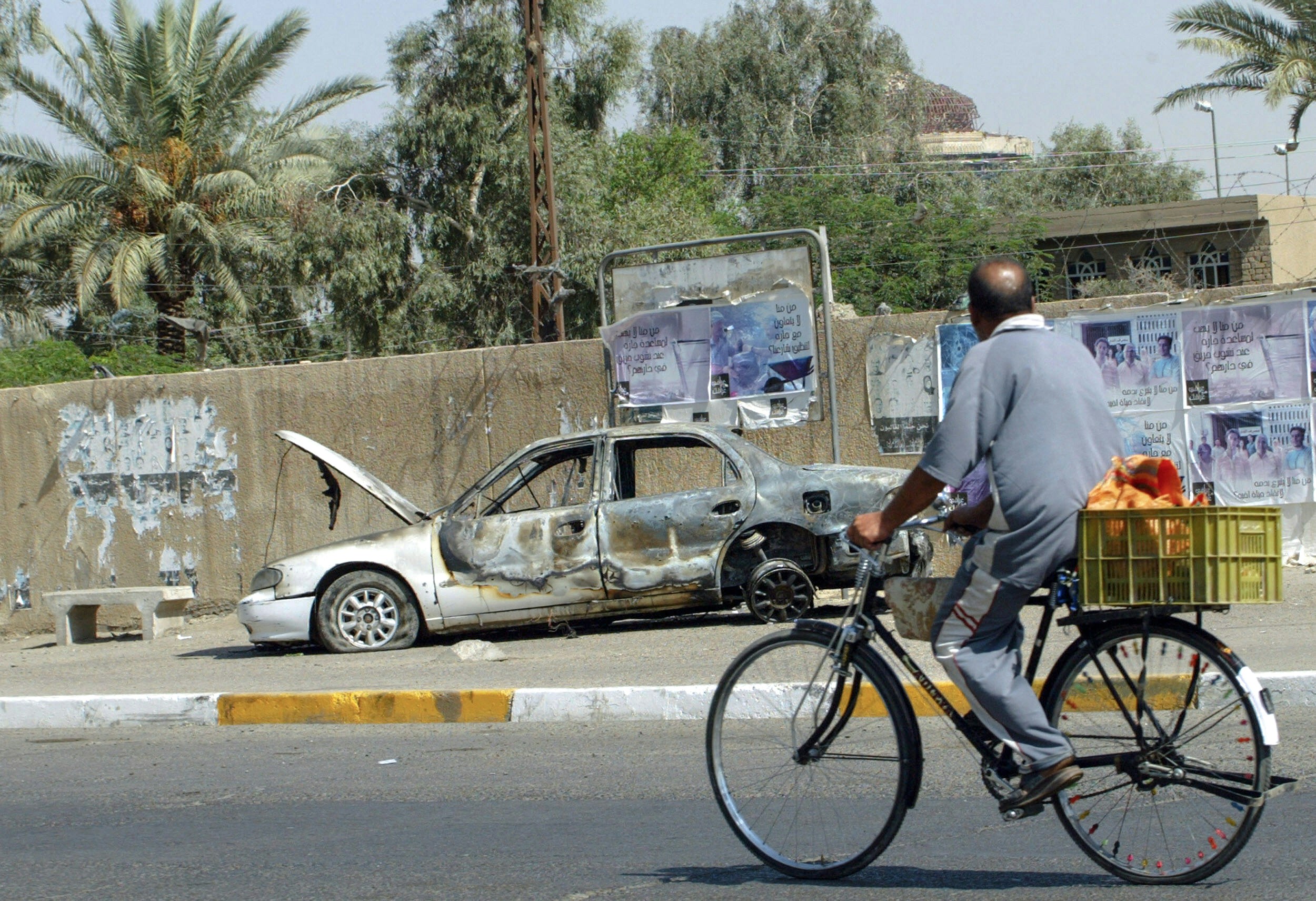
Blackwater was banned from Iraq in 2007 following the Nisour Square massacre, in which its contractors killed 17 Iraqis and wounded 20 others. The prince later sold Blackwater and moved to the United Arab Emirates, where he built a secret mercenary force on the de facto ruler of the seven Gulf Arab Federation, Mohammed bin Zayed, known as the MBZ.

An Iraqi rides a bicycle, passing the remains of a car in Baghdad on September 20, 2007. The car caught fire during an incident when Blackwater guards who escorted U.S. embassy officials opened fire in the Baghdad neighborhood on September 16, 2007, killing 10 people and injuring. 13. Iraq and the United States agreed to set up a joint commission to investigate the safety of U.S. government civilians in Iraq following the deadly shooting of a private security company, Blackwater, State Department spokesman Tom Casey said. AFP PHOTO / ALI YUSSEF (photo should be read via ALI YUSSEF / AFP Getty Images)

The man rides a bicycle past the massacre of Nisour Square by private contractors in Blackwater in Baghdad, Iraq on September 20, 2007. Photo: Ali Yussef / AFP via Getty Images

During the Trump administration, Prince lobbied at the White House for the privatization of the war in Afghanistan and the establishment of a secret intelligence unit for the president. Both proposals were rejected. Prince has denied advising the White House, but three people familiar with his role said Prince worked closely with Trump’s son-in-law Jared Kushner and the MBA in recent years as the two negotiated policy in the Middle East and Africa. Kushner has denied his cooperation with Prince.

The FBI has been investigating Prince’s global network of businesses and operations since at least 2020, according to three individuals familiar with the investigation. During Trump’s presidency, FBI agents searched for witnesses and documents to help them understand Prince’s role in the Libyan arms trade, which involved extra military aircraft and weapons for the Jordanian military, according to three sources familiar with the investigation.

Recently, the FBI asked the British government for permission to interview a British Army general who, while working as an adviser to the King of Jordan, investigated and eventually helped stop arms sales and deliveries to Libya, a person familiar with the case said. FBI investigation. It is unclear whether the UK accepted the request or whether the FBI conducted the interview. The Intercept revealed the role of British General Alex MacIntosh in February.

“The Department of Defense will cooperate fully with law enforcement when they are committed,” a ministry spokesman told The Intercept via email. “Brigadier Macintosh is a respected officer in the British Army who served deservedly alongside the Jordanian Armed Forces during his tenure.”

The latest FBI investigation is one of several government Prince investigations since he led Blackwater. As part of the sale of the company, Prince negotiated a deferred prosecution agreement for gun and export violations committed by Blackwater while Prince was the sole director overseeing the company. Blackwater paid nearly $ 50 million to reconcile payments as part of the deal, but Prince was never personally charged with the crime.

When Prince founded his Chinese company, the FSG, the FBI was investigating several mercenary proposals for countries in Africa and the Middle East. In 2015, the FBI launched a counterintelligence investigation after Prince met with a Chinese intelligence service to try to open a bank account in China. That same year, after Prince secretly modified two dust brushes from the Thrush plant and tried to sell them, American FSG leaders reported a possible export violation to the Department of Justice.

During Trump’s first year in government, Prince once again faced federal control, this time Special Lawyer Robert Mueller, who tried to understand Prince’s role in a January 2017 meeting in Seychelles with a Russian banker and the Kremlin’s top ambassador. According to FBI documents, Prince’s mercenary business in Libya and the Middle East was discussed at a meeting hosted by an MBZ assistant.

Prince also testified under oath to the Congress Committee on the Seychelles meeting. Interview notes from the FBI of Prince and MBZ’s assistant show that Prince used his trip to try to bring out the Crown Prince of the United Arab Emirates both his mercenary objectives in Libya and the use of his modified harvesting equipment as military aircraft.

Following the publication of Mueller’s report in 2019, both House of Representatives and Senate intelligence committees indicted Prince for a possible false or misleading witness statement as they investigated Russia’s interference in the 2016 presidential election. None of the federal investigations have led to prosecutions.

Ali Younes participated in the reporting.

_____________

Read More

France Aims to Up its Influence in the Middle East and North Africa

Jonathan Fenton-Harvey

Faced with dwindling soft power, France is aiming to play the hero in the Middle East and North Africa to enhance its economic and political interests while positioning itself as a dominant actor in the region.
Being a champion of global economic and cultural influence has long been at the top of France’s priorities. Yet in the last year, its soft power took a hit, owing to boycotts of French products from parts of the Islamic world after its apparent anti-Muslim policies, and its crackdown on protestors and media. Consequently, France has embarked on multiple diplomatic crusades while seeking to adopt a leadership ole in various conflict situations, as a means of salvaging its reputation.

Recently, Iraq has been of particular interest to President Emmanuel Macron. Seeking to expand France’s influence in Iraq, Macron visited the country twice since 2020. The first visit came in September 2020, when he voiced support for Iraq’s sovereignty. A second but more crucial visit came last August, when Macron visited the ruined city of Mosul, a former Islamic State (IS) stronghold in Iraq, while meeting various Iraqi ministers, including Prime Minister Mustapha al-Kadhimi.

During his latest visit on August 28, Macron said he plans to keep French troops in Iraq, despite United States’ planned withdrawal by the end of 2021. The announcement was unprecedented, given France’s previous limited involvement in Iraq. Indeed, Paris has managed to maintain positive relations with Baghdad and has avoided bearing the destructive legacy that the US and UK have in Iraq, because of its opposition to the 2003 invasion.

Paris has managed to maintain positive relations with Baghdad because of its opposition to the 2003 invasion.

Playing the Savior

France alone would struggle to carry the weight of being Iraq’s guardian with only 800 soldiers stationed in the country. The troops were deployed largely for counter-terrorism purposes, especially with the prospect of an IS resurgence. Moreover, France would have to compete with powers like Iran and China, which have eyed up their own spoils in Iraq. It would therefore be a challenge for Paris to fill the void that Washington’s departure would create.

Yet for France, these public relations overtures to Baghdad are merely a continuation of Macron playing the hero in such crises. Critics accused him of acting like the “white savior” after he visited Lebanon, a former French colony, in August 2020, following the devastating explosion at Beirut’s port that month. It seems that Iraq, which still faces instability, is France’s next target.

Another area of interest for France is Libya. Despite a ceasefire announced in October 2020, the North African country has endured a rocky journey towards a democratic transition, with presidential and legislative elections now scheduled for December and January respectively. Yet with an ongoing rift between Libya’s transitional Government of National Unity (GNU) in Tripoli and the House of Representatives (HoR) in Tobruk, reflecting the old divisions between western and eastern Libya, France offered to host a conference in November, to ensure the December presidential elections proceed as scheduled.

France offered to host a conference in November, to ensure the December Libyan presidential elections proceed as scheduled.

During the announcement, French Foreign Minister Jean-Yves Le Drian said that Paris wants the elections to be kept to schedule and stressed the need for the “departure of foreign forces and mercenaries,” during a press conference on the sidelines of the UN General Assembly in September.

Seeking influence over Libya’s political future is nothing new for France, which spearheaded the 2011 NATO intervention to support the Libyan opposition against Muammar Gaddafi. Additionally, under Macron’s auspices, Paris steered peace talks and provided diplomatic and material backing to Khalifa Haftar during his campaign to conquer the capital, Tripoli.

Though a contradiction of interests may be apparent, as Paris enabled Libya’s latest conflict and is now sponsoring peace initiatives, France is acting competitively to ensure it can become a dominant actor in the country’s political process.

Economic and Geopolitical Interests

France’s desired patronage of these countries’ futures also comes with political and economic benefits. The Baghdad Conference on Partnership and Cooperation, held on August 28, saw France aiming to assert itself as “a partner to the Iraqi government in its concerns and a sponsor of Iraq’s regional and international interests,” according to an Iraqi official.

On September 7, Iraq’s oil ministry announced Baghdad struck a deal with the French oil giant Total Energy, worth $27 billion, including $10 billion in infrastructure, which will later allow the financing of a second stage of investments worth $17 billion.

France’s support of Libya’s stability and building ties with key political actors also ensures that French companies can operate there freely. In June, representatives of Medef (Mouvement des Entreprises de France), France’s largest employer federation, met with leading Libyan officials including Mohamed Dbeibah, Libya’s interim Prime Minister, to discuss talks over reconstruction. Prior to that, Total started new talks with Libya’s transitional government in November 2020, to re-develop the country’s oil fields.

Unremitting rivalry with Turkey is also a driving factor of France’s assertive regional politics.

Unremitting rivalry with Turkey is also a driving factor of France’s assertive regional politics. In 2020, Ankara’s intervention to repel Haftar’s offensive irked Macron and prompted France’s attempts to undermine it in both Libya and the Eastern Mediterranean. Turkey’s offer to help rebuild Libya also threatens Paris’ interests in the North African country.

Despite an apparent rapprochement between the two countries this year, France’s rivalry with Turkey continues to be apparent. As France faced another diplomatic spat with Algeria recently, after Macron suggested that Algeria was never a nation before France colonized it, he alleged that “Turkish propaganda” was behind Algeria’s opposition to France.

Clearly, France’s foreign policy objectives not only aim to advance its soft power and geopolitical influence, but also act in defiance of its perceived rivals. Yet Paris’ agenda of intervention and saviorism for its own personal gain does not bear peoples of the region at its forefront.

While it is indeed important to provide security in countries like Libya and Iraq, which have experienced conflict and instability, France should ensure its foreign policy alignment is consistent with the efforts of the United Nations to support genuine stability in these countries. 

***

Jonathan Fenton-Harvey is a journalist and researcher focusing on conflict and geopolitics in the Middle East and North Africa region. He has particularly covered Gulf issues and Western foreign policy in the region, having delivered numerous talks and articles on these topics. He has been published in Carnegie Endowment, Middle East Eye, the New Arab, TRT World and many others. He has also worked for Al Sharq Forum, where he mostly researched the UAE’s regional foreign policy. A graduate of the University of Exeter, Jonathan studied History and Middle East Studies. 

Read More

Libya’s Chaos Is a Warning to the World

Ten years after Qaddafi’s death, Libya is a harbinger of the enduring global disorder to come.

Ten years ago last week, many Libyan citizens and certain international politicians rejoiced in the toppling of strongman Muammar al-Qaddafi. Some mistakenly think they will soon be rejoicing again after United Nations-mediated elections slated for Dec. 24 bring Libya’s first post-Qaddafi non-interim government to power. There are many reasons to question such optimism, however. Developments in both the international system and in Libya over the last decade suggest that the forces promoting disorder and nationalist competition may trump those promoting order and international coordination.

A lot has changed in 10 years—and even more over the last 70 years. The independent and sovereign Libyan state was created by the United Nations from former Italian colonial possessions on Dec. 24, 1951. It was the culmination of a process whereby Anglo-American leaders coordinated a compromise solution that gradually received buy-in from rival powers.

Even the Soviet Union, Egypt, France, nascent African polities, and Italy—all of whom initially had different ambitions for Libya’s then-three provinces—embraced a unitary sovereign Libya, helping the young country get off to a fresh start. All of these actors calculated they would gain from a successful Libya. During the Cold War, rival powers sought to extend their spheres of influence to new territories; they did not seek to deliberately bring disorder to the world system.

Today, the situation is starkly different. Even if contemporary Libya successfully stages free and fair elections in a couple of months, they will likely create more confusion than they alleviate. Even the elections’ boosters do not claim they will produce an uncontested, sovereign, and constitutionally legitimate Libyan government. U.S. and U.K. attempts to cajole recalcitrant actors (Russia, Turkey, and various Gulf states) to coordinate their previously destabilizing interventions in Libya have been half-hearted, all carrot and no stick affairs.

During the Cold War, rival powers sought to extend their spheres of influence to new territories; they did not seek to deliberately bring disorder to the world system.

The U.N. mediation process also lacks the power to punish spoilers, and as such, has been hijacked by status quo-oriented power players like Speaker of the House of Representatives Aguila Saleh and the extended families of interim Prime Minister Abdul Hamid Dbeibeh and Gen. Khalifa Haftar—all of whom have extensive ties to former regime power networks. Simultaneously, self-serving international bureaucrats, many beholden to the United Arab Emirates, Russia, and France, are happy to go along for the ride, looking the other way when international law is violated.

Tragically, all the major players still stand to gain from a successful Libya that is able to spend billions of dollars on upgrading its pipelines, employing migrants, policing its borders, paying off its international creditors, and providing a better standard of living to the Libyan people. Yet international coordination failures continue to lead to less than optimal policy outcomes.

Ten years ago, Qaddafi’s ouster was accomplished by a well-coordinated international coalition of both Arab and NATO countries responding to the calls of the Libyan people. It was an example of a win-win collective action, where multiple actors worked together and made slight compromises on their particular goals in an attempt to achieve a shared, mutually beneficial outcome.

That feeling of boundless hope for a better Libyan and global future prevailed for the next year or so as oil production rebounded, free and fair elections were scheduled and held, and certain stalled infrastructure projects restarted.

But as 2012 turned to 2013, beneath the surface of superficial progress, forces of disorder were emerging. Western nations stood on the sidelines as the country fractured into two competing authorities. Arms and jihadis were trafficked into the country, and groups who lost power suffered violent retribution. Rather than all those countries that stood to gain from possible colossal Libyan economic growth rallying together to protect their collective charge, they bickered over who would benefit most from the spoils.

Many of these dynamics can be traced to the end of U.S. global hegemony and the rise of neo-populist actors who see a disordered world that produces mass migration, trade wars, mercantile economic competition, and terrorism as preferable for their electoral chances. Sustained analysis of Libya presents a unique vantage point to demonstrate why the contemporary international system fails to solve collective action problems, and many major actors choose to promote disorder rather than make small compromises for the common good.

Although they worked together to enforce the NATO no-fly zone immediately after the collapse of the Qaddafi regime, major Western players were tugging in different directions—suspicious of one another’s motives, clients, and actions in Libya.

A power vacuum inherently sucks in external actors; this is especially true if the country is resource rich and geostrategically located. Libya is both. Soon, the Turks, Qataris, Emiratis, Egyptians, and Russians were all deeply entrenched, occupying niches previously held by Western nations. Had a Western-backed uprising overthrown Qaddafi during the Cold War, the ensuing government would have, without question, been supported by a Western-backed coalition with the United States at the helm, boxing out destabilizing, non-Western foreign actors. Back then, it would have been unthinkable that if civil war ensued, core European NATO states like Italy and France would be supporting opposite sides. But in the current era, that is exactly what happened.

In today’s world, NATO members are willing to undermine the actions of their allies without even consulting them. This further eroded trust and promoted more coordination failures. For a very recent example, think of the so-called AUKUS deal. Precedent now suggests the French will be less likely to collaborate on win-win climate change and trade initiatives with the United States and Britain.

The balance between trust and mistrust, optimal and suboptimal outcomes, is a very delicate one. Tip the scales a little bit one way, and the previous equilibrium is destroyed, replaced by a negative feedback loop. Hence, once a situation deteriorates, it is very likely to spiral out of control.

The spiraling effects of lost trust among the core Western allies were already evident immediately in the wake of Qaddafi’s fall. Back in 2011, Sidney Blumenthal, a key advisor to then-U.S. Secretary of State Hillary Clinton whose emails were released by the Clinton email probe, suspected the British and French of trying to undermine U.S. objectives in Libya to promote their own business interests. As a result, he advocated that the United States not coordinate its own reconstruction objectives with its two closest U.N. Security Council allies but rather pursue them unilaterally. This was a recipe for disaster.

As international actors feuded and Libya descended into chaos, Western nations acted out the ancient Bedouin proverb: “Me against my brother, my brother and I against my cousin, my brother, my cousin, and I against the outsider.” This proverb evokes the structure of an archetypal eastern Libyan tribe composed of equivalent and mutually opposed segments. Ironically, today, this famous proverb has come to apply to ineffective Western efforts at foreign-policy coordination. It also encapsulates the post-2016 political tribalization of many Western societies and factions’ inability to put aside feuds to focus on shared interests until forced to do so by existential threats.

Although it seems peripheral, events in Libya contributed to both the 2016 election of Donald Trump and Brexit. Indeed, partisan rancor surrounding Ambassador J. Christopher Stevens’s death in Benghazi, Libya, and the fear of migrants crossing the Mediterranean Sea were key tropes favoring a neo-populist outcome in both the 2016 U.S. election and Brexit referendum.

Furthermore, the Libyan power vacuum escalated feuds between rival powers in the region: Qatar/UAE, France/Italy, Turkey/Egypt, and Russia/the United States, which in turn led to further disorder in Libya and the world. Ironically, all of these feuding actors (and the Libyan people) would have benefited from a consensus outcome in Libya, but the nature of the current global system made necessary coalition-building and compromises unlikely.

Ten years since Qaddafi’s death, Libya lacks a constitution, a state with a monopoly on force, and economic institutions able to rationally order the economy. It is awash in competing power nodes: militias, tribes, rival aspirants to power, semi-sovereign economic institutions, and foreign mercenaries. To sort out this mess in Libya, as with climate change or tax havens, there is more of a need for global governance than ever before—and ironically less effective global governance than at any time in modern history.

Yet Libya also shows that global governance institutions tasked with coordinating the international community’s response to a crisis, like the United Nations, are currently thoroughly penetrated by those newly emboldened states that desire disorder (like Russia and China) so as to be nearly entirely ineffective.

Seen in this light, the ongoing struggle for Libya’s future provides a privileged lens into a wholly new period of international relations. In fact, examining Libya’s ongoing struggle for post-Qaddafi succession demonstrates that the current world system is not following the traditional playbook when a hegemon’s power wanes, ushering in a period of multipolar competition for spheres of influence.

The ongoing struggle for Libya’s future provides a lens into a new period of international relations: There is a free for all among a wide range of actors who do not necessarily seek to promote order.

Instead, major and regional powers today are not seeking to impose their system of order onto strategically located arenas of disorder. Rather, there is a free for all among a wide range of actors who do not necessarily seek to promote order or expand their own rules-based spheres of influence: from legacy colonial powers to rising regional powers to transnational nonstate actors like multinational corporations or the Islamic State. 

This situation has been widely theorized as being multipolar, but in reality, it’s nonpolar, as none of these actors necessarily intend to foster a comprehensive world order or even a coherent regional order within their sphere of influence. This is in stark contrast to the Cold War period, in which no location was unimportant enough for the United States or Soviet Union to cede ground by letting its opponent export its system of order there unrivaled.

Today, major powers are unwilling to invest sufficient political capital to bring about stability—in Libya or globally—in the short or medium term. The world’s most rapidly rising power, China, is largely absent as an alternative provider of order in geopolitical hotspots. In this new global system, instead of using their power to foster order, neo-populist leaders from Russian President Vladimir Putin to Turkish President Recep Tayyip Erdogan have deliberately promoted disorder.

Libya was the first theater in which major features of this new international relations era played out. Syria and Ukraine followed in its wake. A new era of global disorder has begun—and it will likely endure.

***

Jason Pack is the founder of the consultancy Libya-Analysis and the author of Libya and the Global Enduring Disorder. He was previously the executive director of the U.S.-Libya Business Association.

______________

Read More

Bouteflika: The Legacy of an Algerian Despot Opinion

Dr. Abdelkader Cheref

Bouteflika’s passing will not alter the autocratic and corrupt nature of the Algerian regime, mostly because he was one of its architects and fastidiously applied himself to consolidate the system during his 20-year reign as President.  Read More

December elections between American desire and Russian evasion

Abdullah Al-Kabir

Unexpectedly, the Security Council failed to renew the mission of the United Nations mission in Libya for a year, due to a British-Russian dispute over a draft resolution prepared by Britain and rejected by Russia, deciding only to extend it until the end of this month.
The dispute centered on the imposition of sanctions on perpetrators of war crimes, and on the formula contained in the resolution regarding the exit of foreign forces and mercenaries, as it appears that it carried indications that the concerned countries, including Russia, had to remove their forces from Libya, while Russia preferred a wording that spoke of withdrawal only, which gives it more flexibility in dealing with the file without pressure and bargains, and locks up any space for Western powers opposing its direct military presence in Libya, as part of its strategy to establish a sustainable presence that serves its interests to expand and build influence in Africa.
The hardening of the new Russian position in the Security Council in the face of the British draft resolution can be understood, as a reaction to the American position opposing any political role of Saif Gaddafi, as expressed by the US Assistant Secretary of State, saying that Saif Gaddafi’s candidacy represents a problem for the world, while Russia is betting on him as an important card through which it can regain its former influence in Libya, especially with the decline of Haftar’s role, which she cannot trust because of his relationship with the American intelligence, and then his role will be determined by the stage as a justification for the survival of its forces, and as a channel of communication with the Americans.
Intensifying the recent international movements with the visit of the Counselor of the United States Department of State, Derek Chollet and his meeting with officials in Tripoli, and the expected high-level meeting in New York, which will be chaired by Italy in partnership with France and Germany on the sidelines of the annual meeting of the United Nations General Assembly, and what is expected of movements during the remaining time before the date of the elections, is to push the Libyan parties to agree on the electoral laws, lest the passage of time and then having to postpone, which seems inevitable, given the intransigence of the Speaker of House of Representatives and his supporters among the MPs.
In the same context, the Egyptian move came at the invitation of Haftar and Aqila Saleh, two days before receiving the Prime Minister of the Government of National Unity, Abdel Hamid Dbeibah.
It was expected that Dbeibah and Haftar meet under Egyptian sponsorship, but Haftar does not seem to be in the process of conceding and recognizing the government for fear of possible repercussions. His popularity is declining in his areas of influence, in return for the rise of Dabaiba’s shares, and if the meeting that Egypt sought for takes place, he will not be able to prevent the government from moving comfortably in Benghazi, and this will increase his isolation in areas where no one will be allowed to compete with him. However, the conclusion of several agreements and contracts of economic benefit to Egypt with the Dbeibah government indicates a remarkable development in the Egyptian approach to the Libyan crisis.
This development will be reflected in Saleh’s positions on the issue of withdrawing confidence from the government, and disrupting the budget that Egypt will need to approve if it wants to activate the agreements on the ground and the beginning of the work of Egyptian companies.
The relative decline in the support that Egypt provided to its allies in the Libyan east during the past years, in return for consolidating the relationship with Tripoli and crowning it with economic contracts, was imposed by several variables, the first of which was the American trend towards calming conflicts in the region, the Egyptian-Turkish rapprochement and the disintegration of the Gulf front against Turkey and Qatar, but these developments in international and regional positions may clash with a different Russian position after Russia’s rejection of the Security Council resolution, and Haftar may find in them a last resort after a retreat.

________________

Read More

The State of Exception in Tunisia: Background, Significance and Prospects

Tunisian President Saied undertook exceptional measures to assume all powers, causing sharp internal and external polarisation between those who consider them an infringement of the democratic system and those who consider them necessary measures necessitated by the deteriorating conditions.
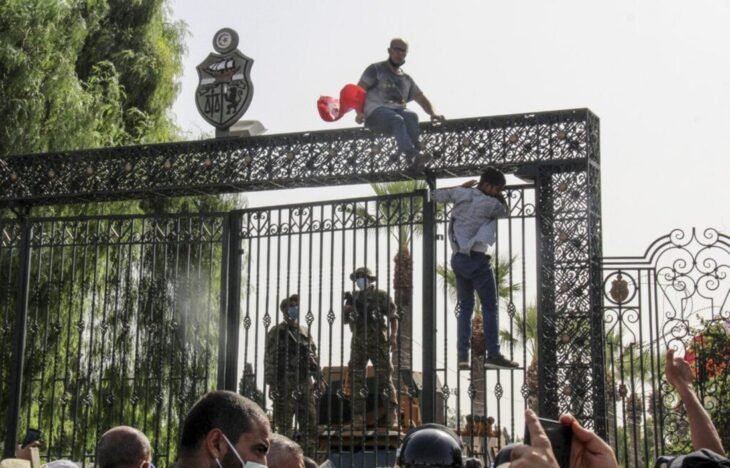
On 25 July 2021, Tunisian President Kais Saied invoked emergency powers under Article 80 of the constitution. Claiming the country was facing “imminent danger,” he subsequently dismissed the Mechichi government, suspended parliament, lifted parliamentarians’ immunity, and claimed prosecutorial powers for the presidency. The move came as the raging coronavirus epidemic brought the country’s health system to the brink of collapse, but this was simply the latest of a series of mounting economic and political crises.
The 2019 presidential and parliamentary elections ushered in a fragmented parliamentary and political landscape that made it impossible to form a stable government capable of addressing Tunisia’s problems. The deadlock was exacerbated by conflicts, both personal and jurisdictional, between the president and the former prime minister and between the president and the parliament, particularly Ennahda, the largest parliamentary party. Meanwhile, the constitutional body authorised to resolve questions of constitutional authority and the separation of powers—the constitutional court—has yet to be formed, giving rise to competing constitutional interpretations.
Saied’s actions further polarised an already deeply divided country and set off a profound controversy around the constitutionality of his invocation of Article 80 and the powers he has claimed under it. The domestic response has fallen into three broad camps. The first believes that Saied’s measures were necessary and constitutional and thus must be supported. Only the People’s Movement adopts this stance unreservedly. The second camp, which includes several political parties, civil society organisations, and most importantly the Tunisian General Labour Union (UGTT), views Saied’s actions as necessary, but is calling for some guarantees for a return to the democratic constitutional order. The final group views the emergency measures as a coup against elected institutions and democracy and is demanding an immediate termination of the state of exception. This is the position of parties that supported the Mechichi government, most importantly Ennahda, Heart of Tunisia and the Dignity Coalition, as well as various national figures and bodies.
With the exception of a few Arab states known for their antipathy to democracy and the Arab Spring, nearly all regional and international parties, including the United States, the European Union, the African Union and the United Nations, have expressed concern for Saied’s actions and their implications for the future of democracy in Tunisia.
Now more than a week after the emergency declaration, the situation in Tunisia remains fluid. Showing signs of hesitation and confusion, the president seems to have no plan, while opposition to his emergency measures is growing on the street and among the political elite. Throughout it all, the stance of the military has remained ambiguous. While it did not deploy in the streets or seize civilian institutions, it has carried out some of Saied’s measures, such as shutting down the parliament and denying parliamentarians’ entry. In this uncertain context, events could unfold in one of three ways.
First, the so-called coup could fail if the president is unable to execute his intentions in a timely way, which would entail the gradual rescinding of the emergency measures, particularly those related to parliament. Having secured the end of the Mechichi government, Saied could justify such a reversal to himself and his supporters, particularly given the considerable domestic and foreign pressure to refrain from further measures. In turn, regional mediation efforts may persuade Saied and parliamentary forces to pursue a more conciliatory path, perhaps through the formation of a consensus government. This is the most likely scenario given the support for it by influential domestic and foreign parties.
Second, the president could continue on the coup path, gradually expanding his exceptional powers, particularly if there is no street resistance and he feels the current level of pressure is bearable. This would derail democracy in Tunisia and could mean reprisals, large-scale political arrests, and possibly even the dissolution of political parties. While this scenario seems unlikely, certain regional parties may attempt to propel Saied down this path in the coming days.
Third, the coup could meet with popular resistance in the street, which could either lead to an explosion of violence and chaos or could thwart the coup and restore the previous status quo. This scenario is currently unlikely given that Ennahda has called on its supporters to withdraw from the street and given the difficulty of popular mobilisation under the bans on assembly and curfews announced by the president on 26 July. It could become more likely, however, if the emergency measures are prolonged and lead to large-scale political reprisals against the Saied’s opposition or threaten the entirely overturn the existing political order.
*This is a summary of a policy brief originally written in Arabic

_________________

Read More

The post-Haftar phase

Abdullah Al-Kabir
The horizon seems to have become blocked for Khalifa Haftar and his political future is dependent on the developments of the American position on the Libyan crisis and the entire region. Judging by previous experiences, his fate, as well as the fate of his dynasty and his partners, is becoming clearer.
The Libya Stabilisation Act, passed by the US House of Representatives, and which is awaiting the approval of the Senate, will be a sword targeting many of the leading figures in the scene, led by Haftar. Since his children were at the heart of his bloody project after he granted them military ranks and assigned them to the highest positions in his militia, their fate will not differ from the fate of the sons of murderous leaders who preceded them in crime, including Saddam Hussein and Muammar Gaddafi.
There is an American insistence on holding the Libyan elections on time, and in the face of this slowness in taking the necessary steps leading to the elections, the US and Western countries are activating their diplomatic arsenal while threatening sanctions. This may be disrupted by the Russian veto and the supportive Chinese position if they are discussed in the Security Council. Therefore, a law was introduced specific to the Libyan situation, which gives American institutions at all levels the space required to move and confront the Russian infiltration into Libya and the Sahel, which threatens their interests and the interests of their allies and complicates the calculations of the US’ next conflict with China.
A few weeks before Congress voted on the law, Haftar’s agents signed a contract with two lobby groups to promote Haftar in American political circles and arrange meetings for him with White House officials for the purpose of propaganda and showing American support for him in the Libyan presidential elections. However, the contact was terminated after the law was voted on, as the lobbying groups and public relations companies would not find an official who would agree to meet Haftar, as some of the law’s clauses seem specially aimed at him.
Haftar is now being tried in absentia in Virginia, this is just an introduction to other cases that will be filed against him on charges of committing war crimes and crimes against humanity during the years he ignited wars in Libya under the pretext of fighting terrorism. These crimes reached their climax in the attack on Tripoli in April 2019, before his forces and mercenaries were defeated and fled, leaving behind devastation, mines and mass graves.
His defence team did not refute the charges against him because he does not have any counter-arguments that would hold up against the evidence presented by the victims’ lawyer. Instead, he is content with trying to gain immunity from trial based on claims that he bears presidential responsibilities and claims that Libyan laws punish those who provide information containing secrets belonging to the Libyan state with the death penalty. The court rejected this alleged immunity and gave Haftar two weeks to appear before the court and be questioned before the verdict is issued.
There have been reports that some major powers have offered Haftar the chance of safe exit, residence in the UAE, and putting an end to obstructing the path of transformation in Libya. I can confirm that the offer is true, or at least was proposed as an option amongst other options being discussed by the US and its allies for the success of the political settlement in Libya. However, the situation in his areas of influence must be stabilised.

Given the extent of the crimes committed by his forces and their documentation in several international reports, and the fact that the conditions for filing cases against him in Libyan and international courts have been met, it is likely that he would not accept an offer that will not protect him from prosecution for the remainder of his life. There is a precedent allowing for those who commit war crimes and human rights violations to be prosecuted, as former Chilean tyrant Pinochet remained immune from the judiciary even after he left power, but as soon as he travelled outside Chile, the international judiciary began to prosecute him for crimes and violations during his rule.

He was held under house arrest for a year and a half in London and his illness did not prevent him from being prosecuted. His inability to appear in court because of his severe illness prompted the Spanish judiciary to stop prosecuting him, and Britain allowed him to return to Chile to live out the rest of his days in isolation in a remote village.

It is known that Pinochet staged a coup against the elected Chilean President Salvador Allende in the 1970s with the support of the American intelligence. He was one of its prominent agents in Latin America to confront the communist tide, and then the US abandoned him, as it usually does when its agents are no longer of use.

It seems that Haftar’s use for American interests is coming to an end, and the passing of the Libya Stabilisation Act, the cancellation of his public relations contacts in the US to promote him in order to win the upcoming presidential elections, and increased talk of a safe exit are strong indicators of the post-Haftar phase approaching. This phase may be delayed if he chooses escalation and a failure to surrender to his inevitable fate. Does he still have any cards to play?

***

This article first appeared in Arabic in Arabi21 on 18 October 2021

Read More

The evolution of nonstate armed actors in the Middle East

Twenty years after 9/11, nonstate armed actors remain powerful forces in world politics, and are increasingly tied to regional and geopolitical power competition. In various parts of the Middle East, they have become deeply entrenched not only in local political systems, but also in national government structures.

Nor are they a recent phenomenon in the Middle East. As early as the 1960s, the United States and Jordan adopted coordinated responses to nonstate armed actors, such as various Palestinian movements, some of which engaged in spectacular terrorism and posed a significant threat to Jordan.

Since then, various insurgent, terrorist, and militia groups have become a major feature of countries such as Iraq, Lebanon, Syria, and Libya.On October 14, the Brookings Institution’s Initiative on Nonstate Armed Actors convened a panel exploring the evolution of nonstate armed actors in the Middle East over the past several decades, and of U.S. and international policy responses toward them.

With a focus on Jordan, Iraq, Lebanon, and Libya, the panel explored among other issues changes in the balances of power between governments and nonstate armed actors, the incorporation of nonstate armed actors into state structures, the role of Iran, the adoption of new technology by nonstate armed actors, and U.S. policy approaches, constraints, and innovations. After their remarks, panelists took questions from the audience.

Read More

The economic cost of the Libyan conflict (3)

This study seeks to inform the Libya socioeconomic dialogue participants on the costs and losses associated with conflict in Libya when discussing alternative socioeconomic frameworks for the country’s sustainable development. Read More
Challenges and Opportunities Facing Women in Libya

MEI-NAPI Youth Roundtable

The Middle East Institute (MEI) and the North African Policy Initiative (NAPI) are pleased to announce the fifth in a series of roundtable discussions inviting engaged Libyan youth to share their perspective on the key issues facing their country’s future. This event will feature young Libyan activists and researchers who will share their views on the challenges and opportunities facing Libyan women as the country seeks to advance in its political transition.   Read More

Imprisoned Libyan footballers highlight Italy’s criminalisation of refugees

Marta Bellingreri
The case of four Libyan men sentenced to 30 years in prison in Italy has illustrated how migrants themselves can end up accused of human trafficking, one new report states.
Joma Tarek Laamami hoped to play football in Germany, but has been convicted of causing the deaths of 49 people on a boat to Italy (Supplied)

Laamami is in Syracuse, Sicily, where he has spent the past six years in prison, since the day he arrived in Italy. He sits inside a room in the prison where family calls are allowed once a week. On screen, Laamami greets his young nieces, who are well dressed for Friday’s family gathering. 

“He speaks Italian, works, studies, does sport… but his life sometimes seems to have ended,” his mother, Suad, tells Middle East Eye. In her house in Benghazi, she proudly collects his football shirts, school diploma and pictures with the football team and fans.

“Tarek was loved by everyone who knew him. He’s someone who always smiles, even when he’s sad,” she adds. 

As a footballer playing in his local team, Tahadd Benghazi, Laamami escaped the war in Libya in 2015 and had hoped – along with three of his teammates, Alaa Faraj (known by Italian authorities as Abdel-Karim Hamad Faraj), Abdel Rahman al-Monsif and Mohannad Nuri – to find a better future in Europe and follow his dreams to one day play for a German team.

But tragedy struck the precarious wooden boat transporting the footballers and other people from Zuwara, Libya, towards Italy when 49 people died of asphyxiation in the cargo hold.

Witnesses on the boat blamed Laamami and the other Libyan footballers for the deaths, accusing them of preventing the people locked inside the hull from going outside. 

The men have denied all wrongdoing, saying they were only passengers, like the other victims, and were not tasked with maintaining order.

One of the other men accused, Tunisian citizen Chouchane Mohamed Ali, admitted to having sailed the boat, but he denied there was a crew, or that the other accused had any pre-ordained role on board. 

On 2 July 2021 an Italian court rejected an appeal and sentenced the four Libyans and Ali to 30 years in prison for human trafficking and murder.

Ever since they were first imprisoned, relatives and friends have organised peaceful demonstrations in Benghazi, calling on the Italian authorities to release the footballers.

Laamami is one of more than 2,500 undocumented people arrested in Italy since 2013 for allegedly sailing boats across the Mediterranean, according to a new report, From Sea to Prison, issued by a number of refugee NGOs and drawing on police data and evidence from hundreds of jail sentences.

Crackdown on ‘boat drivers’

Using anti-mafia laws designed to combat international criminal organisations, Italy arrests and imprisons people who sail boats carrying people seeking refuge in Europe, accusing them of being smugglers. But these people are often victims of the trafficking organisations themselves, either forced to steer the vessels or coerced into doing so as a means of paying for their journey to Europe.

The cases studied in From Sea to Prison resulted in prison sentences of more than 20 years, while seven others involved life sentences. In some instances, judges condemned the accused without fulfilling even basic legal procedures, such as providing an opportunity for them to be identified by the witnesses in court.

Laamami and his footballer friends have never been identified in court in the presence of a judge by the witnesses who accused them of responsibility in the deaths. Only nine out of the 313 passengers on board have given testimony to the Italian authorities, six years after the 49 died. 

The report, says Germana Graceffo, a legal expert specialising in immigration, “represents the clear failure of migration policies”.

One of the focal points of the report is a distinction often disregarded by the Italian justice system – as well as the media – about the different types of boat “drivers”, a number of whom are coerced by traffickers, or otherwise led by necessity – with the promise of letting relatives board the vessel for free, or in the face of choppy seas – into captaining the boat. But regardless of their actual position of responsibility on board, these drivers can end up being held legally responsible if there are several deaths en route.

According to data in the report, 35 percent of the accused boat drivers are from North Africa, 21 percent from Eastern Europe, 20 percent from West Africa and under 4 percent each for East Africa, Turkey and Middle Eastern countries.

The report adds that Italian police often make rushed assumptions on who is guilty of trafficking based on the colour of people’s skin or perceived origin – with North Africans more likely to be viewed as the traffickers and sub-Saharan people as the victims. Identical charges in a large number of trials show how the context and singularities of the journeys in extremely precarious conditions are often not taken into account, the report argues. 

From Sea to Prison pointed to a number of failures of the legal and penal system, some of which Laamami and the other Libyan footballers experienced themselves: the lack of professional translators for the accused, leaving room for misinterpretation; or a lack of investigation into the dynamics on board the migrant vessels, with only a small number of passengers being questioned. Moreover, the identification of alleged perpetrators is often made through grainy black-and-white photographs instead of in person.

Once the alleged boat drivers are brought to court, public defenders are often not invested in their clients’ cases. Laamami witnessed this first-hand, when the public defender in charge of his case asked for five minutes in court to read the documents of the trial.

“How could he argue without having studied them all the night before?” Serena Romano, the lawyer Laamami later nominated following the appeal court’s sentence, told MEE.  

‘I spent two years in prison just because I helped drive the boat, and for seven months I didn’t see a lawyer’

– Cheikh Sene, Senegalese fisherman

Cheikh Sene, a Senegalese fisherman who left his country because of the fishing crisis and crossed the Mediterranean from Libya, is part of the team that worked on the research for the report.

“I spent two years in prison just because I helped drive the boat, and for seven months I didn’t see a lawyer. When I saw him, he didn’t speak my language,” he tells MEE. “Today, people who know they will be arrested no longer help drive the boat, and this increases the risk of deaths at sea.”

This fear, in effect, means that many of the overcrowded boats are essentially at sea without anyone in charge.

The report states that while Italy has been criminalising undocumented migration for over a quarter of a century, this push has increased since 2015, with laws adapted to further crack down on people migrating. 

“What needs to be reconsidered,” says immigration lawyer Graceffo, “is the Italian legal framework that puts those who manage and organise the traffic on the same level as their victims.

“This does not prevent deaths at sea, which are a direct consequence of the lack of a legal route to Europe,” Graceffo adds. “Criminalisation… on a judiciary level hides Italy’s failures in the fight against criminal organisations, and on a political level diverts attention from Italy’s real responsibilities in human trafficking.”

Even when prisoners are acquitted due to a lack of evidence, the economic and social hardships experienced by ex-prisoners leave them in limbo, despite the fact that they are entitled to compensation from the Italian state for the time they spent in unjust detention and yet they might not be adequately informed of their rights, or face bureaucratic obstacles.

‘He was not on a cruise ship!’

“The trial was a farce,” Romano, Laamami’s lawyer, told MEE.

She added that the trial should have not even have proceeded without formal permission from the Italian Minister of Justice to prosecute cases of alleged murder or manslaughter that took place in international waters, outside Italian territory.

Instead, the Libyan footballers were tried for aiding and abetting illegal immigration, which does not require any further permission. Even though the life stories of the four men, and the fact they had paid for the journey, were acknowledged, the court nonetheless concluded that they were recruited by the criminal organisation and they then deliberately trapped the 49 people in the cargo hold. 

Carmelo Zuccaro, the public prosecutor in the Sicilian city of Catania, did not reply to an MEE request for comment by the time of publication. But back in 2020, he told the Italian newspaper Corriere della Sera that the trial “had nothing to do with young footballers”. 

“They were condemned, not only for being in command of the boat, but also for murder,” Zuccaro said at the time. “The 49 migrants… were mercilessly left to die; the hatchway was bolted so as to not let them on deck. One of the most brutal episodes ever recorded.”

But according to Romano, many unclear elements collected in the testimonies after the shipwreck do not show what really happened on the boat.

“If Tarek was next to the door of the cargo hold under which 49 people died, does that mean he was responsible for their deaths?” she asked. “And if he prevented someone from getting out of that hatch – and we don’t know even if it was possible to open it – did he not do so in extreme circumstances in which any movement of the people could have caused the capsizing of the boat and the death of all? Tarek might have acted out of survival instinct – he was not on a cruise ship!” 

Romano went further, and said that none of the witnesses who testified in the case said they had prior knowledge of there being people in the cargo hold, meaning those found dead inside the vessel could have succumbed in the very first hours of the journey on the Libyan coast, locked in before hundreds of other migrants were taken on board. 

“I don’t know how the court of cassation could have confirmed that sentence,” Romano said. She is still looking for other passengers who could reveal what happened on the boat, while simultaneously trying to appeal to the European Court of Human Rights (ECHR). 

Meanwhile, Laamami and his companions remain in prison.

Before the court passed sentenced Laamami had dyed his hair blond. Perhaps he was expecting to be freed and wanted to celebrate.
“As I told him that the sentence had been confirmed, he clung to me and cried like a child,” Romano told MEE. “They killed their hopes and this trial cries out for justice.”
****
Marta Bellingreri is an Italian researcher and reporter who has lived and worked in many MENA countries, writing for international and Italian magazines. The author of two books about Lampedusa and minor migrants, Bellingreri was also involved in the production of the films On the Bride’s Side, Shores and Isola.
______________ 
Read More

Libyan Parliament’s New Election Law: Terms and Implications

The Libyan parliament met on Monday 4 October in Tobruk to pass a law on legislative elections, less than one month after passing a law on the election of the head of state.
The adoption of the two laws comes two and a half months before the date set by the Libyan Political Dialogue Forum for holding general elections. Similar to the adoption of the Presidential Election Law, the adoption of the Parliamentary Election Law has sparked friction and objections from some who argue that certain articles were tailored to strengthen the position of specific parties.

Read More

Libya: Resuscitating a bleeding healthcare system

Dr Hani Shennib

Dr Hani Shennib
Dr Hani Shennib completed first critical carotid surgery in Zleiten Medical Centre on 76 year old woman.
When I suffered from a foot injury as a young man in Libya, prior to Gaddafi’s coup d’état in September 1969, I received prompt and efficient care at one of Benghazi’s social security polyclinics. Libyan citizens had access to both private and public medical coverage, with equipped hospitals staffed by the best foreign doctors and nurses. King Idris’s government had even begun investing in its own young physicians, granting them scholarships to the United States and luring them back with economic incentives.
I was one of those aspiring students to be sent to Texas; but I would be diverted to Egypt when Gaddafi came to power, placed instead at one of Gamal Abdel Nasser’s Arab Nationalist medical schools. Thereafter, I would escape to North America to complete my medical studies at McGill University and University of Toronto and qualify as a leading Cardiothoracic surgeon.
Fast forward to my recent trips to Derna, a city in the eastern region of Cyrenaica, that was bombarded and razed to the ground in 2017 during battles between the Libyan National Army and the Derna Protection Forces (DPF). There had been one hospital to cater for the locals, though unsuitable for patient care in my view, having been neglected by the changing authorities over 50 years. Now, despite all the promised government funding and international support, I found its condition worsening, so that the only medical facility for a population of 200,000 is deserted, revealing a dire level of negligence by a centralised government 1,000 miles away in the capital Tripoli.
Between that promising historical snapshot and today’s dismal conditions, there was the harm wrought by the 42-year dictatorship era, when all health and educational institutions had been nationalised, replacing apt practitioners with revolutionary mobs. I had left long before the damage had become so entrenched; with some time being active in the political opposition which had led to a sentence to prison in absentia.
When in the early 2000s Libya had somewhat returned to the international fold, I did get an invitation by one of Gaddafi’s sons to return to the country with the ambiguous brief of ‘General Advisor on Health Affairs’. Tasked to review the sector, I received royal treatment with publicity to portray the regime’s new espousal of modern governance. I remember hopping in and out of cars and airplanes, going to clinics and hospitals all the way from Al Jmeil (close to the western border with Tunisia) to Tubrok (port city most to the east). What I witnessed shook me to the core.
There were dozens of hospitals sitting idle, with white elephants worth billions of dollars lying unused; the steel doors, windows and equipment rusted by the brutal humidity. On paper these were staffed but none of the employees had ever set foot in them! A sham, this front had been used to embezzle billions of dollars from the rentier oil economy with consent from the top; and, thus, it had deprived thousands of Libyans of suitable care and forced them to travel, daily sometimes, to health facilities in nearby countries, like Tunisia and Egypt.
Since the February 2011 revolution and following decade of turmoil, Libya’s healthcare system is bleeding and struggling for life. Although Gaddafi was removed, this did not magically result in improvement for the country’s vital organs, nor did it miraculously transform people’s fraudulent and lazy habits. With the changing governments, East versus West divisions, shifting militia ownership of land and regions, as well as the deterioration of security, it makes for a profound case puzzling all expertise.
After several medical missions to Libya and studying the precarious system, I assembled a group of consultants with the Libyan Expertise Forum for Peace & Development (LEFPD), to reach a consensus: that Libya’s situation calls for a bottom-up re-engineering strategy. It is no longer possible for a model of central governance, first designed in the late 1940s during the British Mandate, to continue to provide policies and application. Decentralisation is the way forward, with the creation of a hybrid administrative system and a local government coalition, based on three to six primary geographical zones.
To transcend the political and security differences and effectively triage and prioritise healthcare initiatives, we have called for a National Health Council. Although first ignored by the UNSMIL, international donors and consecutive adversary governments, we still propose it. With the pressure on the current care-giver government of Prime Minister Abdul Hamid Dbeibah to deal with public services – he was publicly urged to do so by US Secretary of State Antony Blinken – the time to act is now and not later.
Looking ahead, the LEFPD will convene a conference in November to bring Libyan and international healthcare experts, to lay out ideas and propose concrete steps to the government and other stakeholders, in the hope of jumpstarting the Libyan healthcare reform efforts and resuscitating them.

________________

The economic cost of the Libyan conflict (2)

This study seeks to inform the Libya socioeconomic dialogue participants on the costs and losses associated with conflict in Libya when discussing alternative socioeconomic frameworks for the country’s sustainable development.

Read More