Dr. Miral Sabry AlAshry

The United Nations Support Mission in Libya’s call for the House of Representatives and the High Council of State to build on the agreement on sovereign positions reflects growing international concern over the persistent deadlock that continues to suffocate Libya’s political process.
The Mission’s appeal to the two councils to advance the agreement, signed in a manner that ensures fulfilling the requirements of the “Roadmap” announced by the Special Representative of the UN Secretary-General, Hanaa Tetteh, last August, signals that this step is considered essential for reviving the political process. This indicates that any further delay may push the prospect of elections even farther out of reach.
The agreement on sovereign positions is now seen as one of the few available avenues for achieving progress. The deal signed between the two committees of the councils in Tripoli represents a rare step, as it sets mechanisms for selecting the leadership of key sensitive institutions, including the High National Elections Commission, the National Anti-Corruption Authority, and the Administrative Control Authority. These institutions serve as the backbone of the electoral process and the pillars of transparency and accountability. Restructuring them through political consensus could pave the way for holding elections, or at least demonstrate the councils’ ability to produce joint outputs that strengthen democratic legitimacy.
However, these positions become an arena for power sharing among competing blocs, raising the critical question: Is the objective genuine institutional reform, or simply a redistribution of power?
From the perspective of the UN Mission, completing the roadmap’s is requirements remains a necessary condition for advancing the political process and ending the increasing polarization and stagnation that threaten Libya’s stability and the unity of its institutions. This comes as representatives of both councils signed an agreement outlining the mechanism for selecting the head and members of the High National Elections Commission, as well as key posts within the National Anti-Corruption Authority and the Administrative Control Authority.
Reform or Power Retention
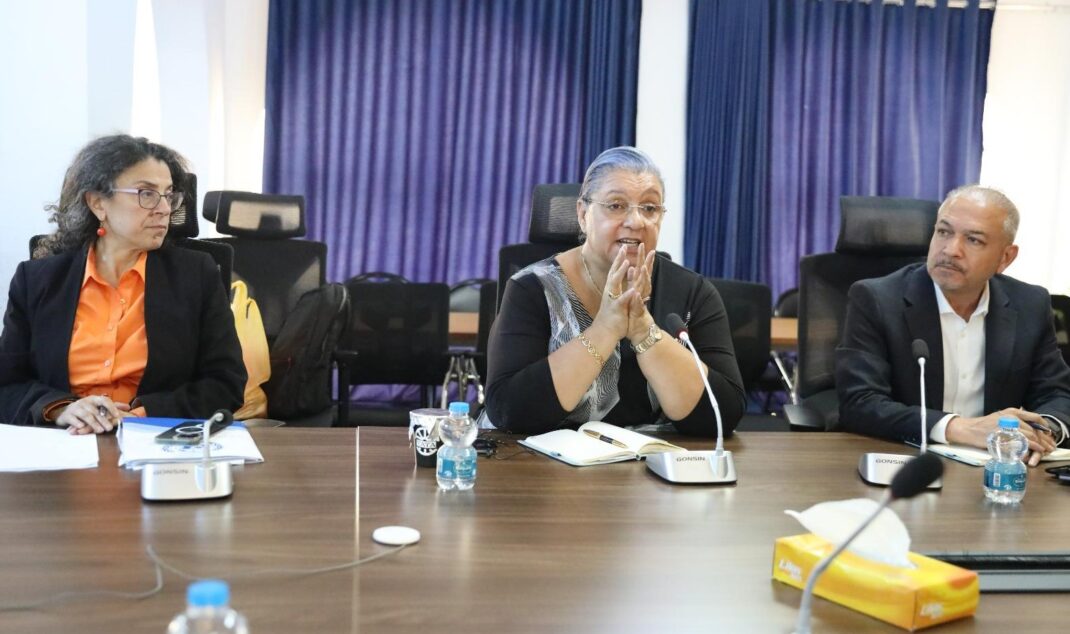
Do these bodies genuinely seek institutional reform, or are they aiming to maintain their hold on power? The UN’s close monitoring and active presence reinforce this concern from the participation of Deputy Special Envoy Stephanie Khoury in the signing ceremony sends two clear messages ” the UN supports the agreement and positions itself as a guarantor of its implementation and the Mission intends to link any real progress in Libya to processes conducted under its supervision, particularly following recent criticism about the lack of concrete outcomes. This indicates that the UN aims to demonstrate that the current understandings are not merely symbolic, and that it will hold parties accountable should they retreat or delay implementation.
ICC Developments Add Further Pressure
Meanwhile, the Deputy Prosecutor of the International Criminal Court, during her briefing before the UN Security Council, pledged to continue investigations in Libya under Resolution 1970 (2011) throughout 2026 and committed to moving rapidly toward completing the current phase of investigations. The situation in Libya was referred to the ICC by the Security Council on 26 February 2011. In May of this year, Libya announced its acceptance of the Court’s jurisdiction retroactively from 2011 until the end of 2027, while eight additional arrest warrants remain outstanding.
Libya is suffering from a complex political crisis, marked by the existence of two rival governments: the first in the east, led by Osama Hamad, appointed by the House of Representatives, and the second in the west, led by Abdelhamid Dbeibah, who refuses to hand over power except through elections. Presidential elections were scheduled to be held in Libya on 24 December 2021, but political disputes between the conflicting parties, along with disagreements over the electoral law, prevented them from taking place.
The segment related to the International Criminal Court’s briefing to the UN Security Council adds an important dimension: the international community is refocusing on the issue of justice and violations in Libya. Libya’s acceptance of the Court’s jurisdiction retroactively until 2027 reinforces this perspective and places any political or security arrangements under the umbrella of “potential accountability.” This may restrict the movements of some actors, but it could also push towards quicker settlements to avoid broader internationalization.
The real political message from the United Nations is that the UN Mission is not merely calling for the two councils to build on the agreement; it is implicitly saying: “We have given you a roadmap the ball is now in your court. Any failure or obstruction will not be acceptable.” This message aims to pressure both councils, hold them accountable before the international community, and create political momentum that prevents a return to a complete deadlock.
Haftar: The repercussions of the political
crisis in Libya
The commander of the Libyan National Army, Khalifa Haftar, has warned that the repercussions of the political crisis threaten the unity and future of Libya, stressing that real solutions stem from the will of the people to determine their destiny and preserve the unity of the country. During his meeting in the city of Benghazi, he stated that “the repercussions of the political crisis in Libya threaten the unity and future of the country,” emphasizing that “real solutions come only from the will of the Libyan people, who must reclaim their right to determine their destiny, chart the course that resolves the crisis, and build the state they aspire to, in a way that preserves national unity and guarantees a dignified life.”
The achievements and gains accomplished in the eastern, central, and southern regions of the country starting with terrorism, building the national army, and the resulting security, stability, and progress in construction and development, as well as reinforcing state authority contrast with “some cities and villages in other regions of the country, which still suffer from neglect, where residents live in unstable security conditions, lack development projects and infrastructure, and have limited services, with no clear signs of solutions from the relevant authorities.”
After more than 13 years, Libya continues to suffer from a complex political crisis, marked by the existence of two rival governments. In the east, one government is led by Osama Hamad, appointed by the House of Representatives; in the west, another is headed by Abdul Hamid Dbeibah, who refuses to relinquish power except through elections. Power has still not been transferred, raising an urgent question: Is this persistent power vacuum the result of deliberate chaos engineered by internal factions to maintain political instability or is it the consequence of foreign interests, particularly European countries seeking economic advantage?
***
Prof. Miral Sabry AlAshry is Co-lead for the Middle East and North Africa (MENA) at the Centre for Freedom of the Media, the Department of Journalism Studies at the University of Sheffield.
______________________