MMC Research Report

Executive summary
Bangladesh has long relied on overseas labour migration as a pillar of its economic and social landscape. Millions of households depend on remittances for stability, mobility, and long-term security, and migration has become deeply embedded in national development pathways.
In this context, Libya and Italy have re-emerged in recent years as increasingly significant destinations within a wider ecosystem of regular and irregular movement. Although migration to the Gulf and Malaysia continues to dominate in scale, the Bangladesh–Libya–Italy corridor has evolved into one of the most organised and adaptive routes linking South Asia to Europe.
This study examines the architecture and operational logic of that corridor. Based on 80 qualitative interviews across Bangladesh, Libya, and Italy, it addresses an important evidence gap: how Bangladeshi migrants reach Italy through Libya, how intermediaries and facilitators structure their journeys, and how risk and exploitation accumulate along the way.
What emerges is a route defined not by rupture but by continuity. It is a system that extends Bangladesh’s long-standing labour migration infrastructure into irregular terrain when formal opportunities shrink.
A continuum of profiles: from planning to
deception to exploitation
Movement along this corridor reflects six interconnected profiles, representing gradations of agency, constraint, and vulnerability:
1. Planned labour migrants, who enter Libya through semi-regular channels to work.
2. Italy aspirants, who travel intentionally to Libya to continue to Europe.
3. Debt-driven reroute migrants, whose failed or costly regular migration to the Gulf pushes them toward Europe.
4. Deceived migrants, who are misled about their destination and find themselves in Libya unknowingly.
5. Trafficked migrants, who fall into debt bondage, forced labour, or resale between brokers in Libya.
6. Returnees or escapees, who attempt to flee Libya after cycles of violence, extortion, or detention.
These profiles are not discrete categories but points along a continuum. Migrants may move from planning to deception, from smuggling to exploitation, and from agency to coercion depending on circumstances.
This continuum forms the analytical framework of the study and underscores how vulnerability is produced and compounded throughout the migration process.
Structural pressures and recalibrated
opportunity
Bangladesh’s reliance on overseas employment is increasingly shaped by economic deterioration, rising inflation, underemployment, and disillusionment with Gulf migration, which is widely perceived as exploitative, debt-inducing, and offering little long-term mobility.
At the same time, Italy exerts a strong motivational pull. Its large Bangladeshi diaspora, past regularization campaigns, and reputation for eventual stability and belonging create a sense that Italy offers a path to both livelihood and transformation.
These narratives circulate through family networks and social reputation, reinforcing migration as a collective household strategy rather than an individual decision. Shrinking access to regular pathways amplifies these pressures.
Prospective migrants frequently begin with the intention to migrate legally, approaching recruitment agencies or applying for visas, but are steered toward irregular options by the same intermediaries they rely on for information and documentation.
In Bangladesh’s dense recruitment ecosystem, the distinction between regular and irregular channels quickly collapses in practice because the actors, processes, and paperwork frequently overlap.
This study finds that irregular migration to Italy is often the final stage of an attempted legal migration process rather than an alternative to it.
Eastern Libya as the organizing center of
the route
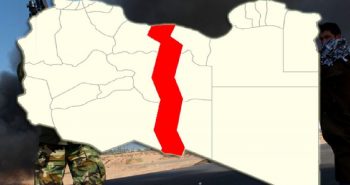
Since 2020, a semi-formal entry system in eastern Libya has become the backbone of the corridor.
Under this system, migrants enter Benghazi legally using entry clearances issued by the Libyan National Army’s Military Investment Authority. This structure has reshaped the entire corridor:
• Recruitment in Bangladesh is organized around delivering migrants directly into eastern Libya with valid passports, visas, and flight itineraries that mirror regular labour migration.
• Transit routes through Dubai, Egypt, Kuwait, Turkey, India, or Sri Lanka function as feeder systems designed to synchronize documentation, verify payments, and route groups into Benghazi.
• Arrival in Benghazi initiates a structured sequence of registration, health screening, nationality-segregated holding sites, and coordinated transportation across the country. Initially established for Syrians through Cham Wings Airlines, the eastern system has been increasingly dominated by Bangladeshi arrivals.
In its early phase, migrants entering Benghazi were moved to Tobruk, where boats departed directly from the eastern coast toward Italy. This changed in 2023 when increased scrutiny and selective enforcement in the east made Tobruk departures less feasible.
As conditions shifted, networks adapted by redirecting migrants from Benghazi to the western coastal hubs of Zuwara and Zawiya, which became the main points of departure to Italy. Despite this relocation of the final leg, eastern Libya remained the organising centre of the route.
A modular, multi-layered network across
three regions
The Bangladesh–Libya–Italy corridor functions through a segmented structure in which different actors control specific parts of the journey.
• Brokers in Bangladesh handle recruitment, documentation, fee negotiation, and communication with families.
• Transit facilitators based in the UAE, Egypt, Kuwait, Turkey, India, and Sri Lanka coordinate group movement and manage handovers between networks.
• Libyan actors, including airport sponsors, armed groups, drivers, and coastal smugglers, regulate movement inside Libya and control access to onward travel. These actors are linked through communication channels, trust-based relationships, and shared financial arrangements.
Movement inside Libya follows a chain of negotiated hubs — from Benghazi in the east, through Ajdabiya, Sirte, and Shwerayif, to the coastal centers of Zuwara and Zawiya — with responsibility passing from one facilitator to the next.
This segmented architecture enables rapid adaptation to political and enforcement shifts. When restrictions increased in eastern Libya at the end of 2023, networks redirected migrants to the western coast for departure to Italy, ensuring that the overall flow continued even as operational routes changed.
A protection economy built on
predictability and coercion
Bangladeshi migrants are uniquely targeted for extortion due to their strong family support networks, which make them reliable payers.
The result is a protection economy in which financial extraction occurs at every stage:
• confiscation of wages or documents;
• inflated fees for food, security, or onward travel;
• staged or genuine kidnappings for ransom;
• periods of captivity in holding sites or “game houses”;
• forced labour during delays or detention;
• resale between brokers.
These practices reflect a continuum between smuggling and trafficking rather than two distinct systems. Migrants frequently transition from one to the other depending on debt, payment failure, or capture by armed groups.
The purpose of exploitation, whether through labour, ransom, or coercion, is embedded in the operational logic of the route. Even interception at sea does not end the cycle. Many migrants are handed back to Bangladeshi intermediaries along the western coast and forced to pay again for release or onward movement.
The economics of the system
The study finds that the route operates through standardized price tiers. Most Bangladeshis pay between USD 10,000–14,000 for the full journey from Bangladesh to Italy, with many ultimately spending USD 15,000–17,000 after extortion and additional costs inside Libya.
Using 2024 arrival figures in Italy as the baseline and applying these documented price structures across scenario-based models, the estimated size of the Bangladesh–Libya–Italy smuggling economy is USD 160–190 million per year.
This represents a lower-bound estimate, excluding those who paid but never arrived in Italy. These revenues sustain actors across the route’s layered architecture and reinforce the economic incentives underlying the system
_____________________