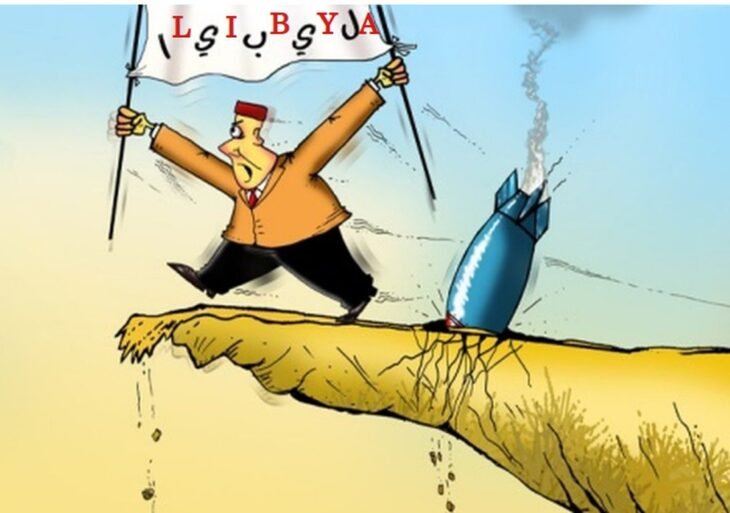
Mohamed al-Menfi defends dismissal of previous governor and says deal will bring back international accountability.
A deal backed by leaders on both sides of Libya’s political divide to appoint a new central bank governor has the potential “to resolve all the political issues” in the country, Libya’s head of state has said.
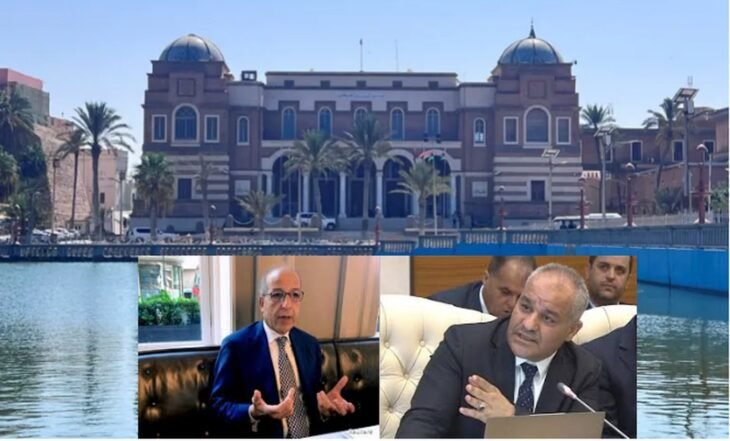
Mohamed al-Menfi, the president of Libya’s Presidential Council who is largely aligned with the UN-recognised government in Tripoli, was accused of acting unilaterally and propelling the country into fresh turmoil when in August he dismissed the previous long-serving bank governor, Sadiq al-Kabir, who then fled into exile.
Kabir’s dismissal led to a shutdown of oil production and exports by forces in eastern Libya – rivals to the Tripoli government – who were furious at Menfi’s decision.
Libya’s deep political divisions have given the central bank the key role of distributing state revenues between the east and west.
In a rare interview with western reporters given at the UN in New York, Menfi justified his decree by claiming Kabir had been managing the bank’s funds, largely made up of oil income, “without any form of accountability” and “had exploited the state of division” in the country.
“It was an abnormal and unsustainable situation,” he said.
He said he had also issued his decree “to spare the capital, Tripoli, from a certain war that would directly target the Central Bank after the failure of months of negotiations between the dismissed governor and the parliament”.
He claimed Kabir had lost the support of the armed forces in Tripoli. “I tried to convince Kabir to share financial decisions in the country with others through the supreme financial committee. People were complaining they were not getting paid,” he said.
Kabir has said he and other senior bank staff were forced to leave the country to “protect our lives” from potential attacks by armed militia and described the attempts to remove him as illegal.
The deal to appoint a new governor and a deputy brokered by the UN mission in Libya has to be ratified by the country’s two key representative bodies, the High Council of State in the west and House of Representatives in the east.
Under the deal, Naji Issa is to be appointed interim governor, while Marai al-Barassi continues as deputy. A new board of governors, intended to be experts but reflecting the geographical interests in the country, will be nominated within two weeks to a month.
Menfi said the three main purposes of the deal were to ensure good governance; for there to be accountability and transparency; and to enable a financial committee to distribute money equally inside the country.
“The agreement that has now been reached regarding a governor and a deputy has happened because of the pressure we exerted to create a transparent administration and an integrated board of directors,” he said. “We have to put the money away from politicians and for it to be run by a financial committee.”
It is not clear how long the interim deal will stick, but first indications are that it will be enough for eastern forces who played a role in agreeing the new board and may now be minded to end the shutdown on oil production and exports. Oil production, concentrated in the east, had fallen from 1.2m barrels a day to about 350,000.
Menfi’s critics say the dismissal was not purely about accountability, but the west’s loss of trust in how Kabir was distributing revenues. He denied the interim bank leadership he had installed had been unable to operate due to loss of access to the international banking system. But prices did rise as the value of the dinar fell.
He said as a result of the deal “international accountability should return by reinstatement of the international auditor that was unilaterally suspended by the previous and without the approval of any other institutions”.
Kabir has accused the government of not implementing reforms and spending money irresponsibly. He said the state had spent more than 420bn dinars since 2021, most of which was on consumer spending and not on development investments.
Menfi said the agreement might open the path to tackling corruption in the country, including the smuggling of heavily subsidised fuel. That, he said, was turning into “a real obstacle “to any economic development”, adding: “There are ideas to replace it gradually with direct cash support that will stimulate investments and create a private sector in the field of oil housing and transportation.”
He also backed simultaneous national parliamentary and presidential elections – long promised by all Libyan politicians – to end the existence of two competing legislative councils. He said the difficulty with presidential elections was that people were fearful of being excluded if someone else was elected. “We tried to go for parliamentary elections on its own and it did not work,” he said.
He said the long-term economic prospects for Libya were bright, and the country could diversify away from its dependency on oil.
The recent rapprochement between Egypt and Turkey, long-standing supporters of rival factions in Libya, offers a potential pathway to easing tensions in the North African country.
Libya resumed oil exports this month after a pause caused by a dispute over control of the country’s central bank, which oversees oil exports.
“This was a serious crisis,” said Jalel Harchaoui from the Royal United Services Institute. “And while it’s partly fixed, there are still issues that need attention.”
The row between Libya’s two rival administrations which led to the temporary halt, was only resolved by intense negotiations, but Harchaoui claims the conflict’s repercussions continue.
“A lot of players, including armed groups in Tripoli, are trying to take advantage of whatever has happened over the last several weeks. So I’m not describing a scenario of war, but I’m describing a more volatile environment,” he said.
Turkish-Egyptian relations
However, a recent rapprochement between Egypt and Turkey could offer hope of easing Libyan tensions.
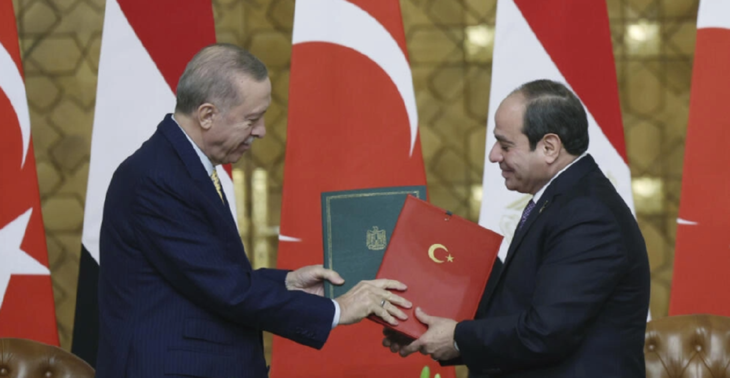
“We agreed to consult between our institutions to achieve security and political stability,” pledged Egyptian President Abdel Fattah al-Sisi at a press conference last month in Ankara with his Turkish counterpart Recep Tayyip Erdogan.
Libya once was a point of Turkish-Egyptian rivalry, with Cairo backing the eastern Libyan administration in Benghazi of Khalifa Haftar and Ankara supporting the western Tripoli-based Government of National Unity. Now, Egyptian-Turkish collaboration is key to resolving the latest Libyan crisis.
“Both countries can push the Tripoli-based government at least to accept something or come to the least terms that they can agree,” said Murat Aslan of the SETA Foundation for Political, Economic and Social Research, a pro-Turkish government think tank. “So it’s a win-win situation for both Egypt and Turkey.”
Economic crises
With both the Turkish and Egyptian economies in crisis, the economic benefits of cooperating in Libya are seen as a powerful force behind the country’s rapprochement and Libyan collaboration.
“These two countries are very important to one another,” said Aya Burweila, a Libyan security analyst
“They’ve figured out a way to divide spheres and work together. Even in the east now, Turkish companies have cut lucrative deals, infrastructure deals, just as Egypt has.
“So economy and money drive a lot of these political friendships and reapportionment.”
Ankara is looking to Cairo to use its influence over Hafta to support an agreement it made with the Tripoli-based Government of National Unity to explore widely believed energy reserves in Libyan waters.
At the same time, Cairo is pressing to remove Ankara-supported Prime Minister Abdul Hamid Dbeibeh of Libya’s Government of National Unity. Despite differences, Harchaoui says Cairo and Ankara are committed to cooperation.
“What has already been decided is that they are going to speak and they are going to speak on a daily basis,” said Harchaoui.
“And then at every crucial moment, they are going to make sure and Turkey, specifically, is going to make sure that Egypt is on board.
“But we need more tangible results from the dialogue that has already been in place,” he added.
The shifting global order and Western reluctance to intervene have allowed conflicts to persist unchecked in the Middle East
Israel’s mission to eradicate Hamas in Gaza following the group’s killing of over 1,200 Israelis on 7 October 2023 has expanded into a much wider military campaign. Prime Minister Benjamin Netanyahu is seizing this moment to restore his country’s deterrence, downgrade the capabilities of Hamas, Hezbollah and other armed non-state actors, and reassert Israel’s military and technological dominance in the region.
But what has enabled this moment? How can Netanyahu prosecute a war that has killed, to date, over 42,000 Palestinians and at least 2,000 Lebanese civilians without the entire international community imposing or demanding a ceasefire?
The cause of Israel’s actions this time around can be attributed to Hamas’s military incursion and Hezbollah’s repeated missile attacks against its territory—no country should have to endure that. But to comprehend how a single conflict actor can seemingly act with impunity, one needs to look at the changes in the international political environment following the US-led war on Iraq.
Security in a multipolar world
While the conflicts we are witnessing now have a long and painful history, their nature stems from the aftermath of Iraq, which tempered the appetite of Western governments to intervene in conflicts. The chaos left in the wake of the NATO-led operation in Libya in 2012—which was supposed to exorcise the ghost of Iraq—only compounded leaders’ reluctance to engage in future conflicts.
This shift became abundantly clear when Russia annexed Crimea in 2014 and deployed its forces into Syria in 2015. The Western response—to impose sanctions and arm opposition groups—was limited. Even after Russia invaded Ukraine in February 2022—which was on another scale, on par with Iraq’s invasion of Kuwait in 1990—Western states employed similar measures. By doing so, they signalled to middle powers that they were free to act at will and could do so without fear of major sanction.
Gone are the days when superpowers could compel allies to exercise constraint. The US no longer desires to mobilise coalitions and liberate countries or apply overbearing pressure on all conflict parties to reach a ceasefire. The unipolar order has given way to a messy multipolarity, and Western states have narrowed their definitions of “national interest.”
It is not just about avoiding military intervention but, more importantly, a reluctance to exercise muscular diplomacy—to persuade partners to stop killing civilians and make a genuine push for ceasefires. The US and European powers might call for ceasefires but are unwilling to put weight behind them. The Biden administration criticises Israel’s actions against Palestinian and Lebanese civilians and chastises Netanyahu but does little else. In fact, it continues to arm Israel.
In this multipolar world, major powers seem willing to live with active conflicts as long as they pose no threat to their national interests. In the Middle East, conflicts continue in Libya, Syria, Yemen, Gaza and now Lebanon—with no end in sight.
The 2015 nuclear deal (JCPOA) marked the US’s political “swing” away from the region. The US withdrawal from the deal during Donald Trump’s presidency did little to alter Washington’s course. President Biden has tried to steer in the same direction. Meanwhile, Europe also swung away, becoming more inward-looking as it dealt with Brexit and COVID-19. Neither Russia nor China has the capacity or will to swing into the West’s place.
This has left a political and security vacuum for regional states and armed non-state actors to fill—which they have, attacking their enemies with impunity and without recourse from the major powers. Examples include Iran targeting Saudi Arabia’s energy assets in Abqaiq and Khurais in 2019; the Iranian Revolutionary Guards Corps launching missiles against a suspected Israeli target in Erbil in 2022; Yemen’s Houthis targeting shipping in the Red Sea after October 2023; and Israel killing of Hamas leader Ismail Haniyeh in Tehran in July this year.
The new face of conflict
It is in this environment that Israel now operates. Netanyahu has chosen this moment—in the aftermath of 7 October, after a decade preparing to dismantle Hezbollah, and during the dying days of a lame-duck US presidency—to press home Israel’s military advantage and project its dominance back into the region. He has come to realise that he can act without restraint, at least until the next US president takes office, and is therefore determined to vanquish Israel’s enemies with little thought for civilian lives.
Aside from the US deploying aircraft carriers to signal its readiness to aid Israel in the event of an all-out war, the states and armed non-state actors of the region will be left to fight it out. Meanwhile, the US continues to supply Israel with advanced arms and matériel, giving Tel Aviv an unassailable advantage overall.
As the Israeli army pushes further into Lebanon, continues its bombardment of Gaza and contemplates a reprisal against Iran—the world’s major powers will call for an end to violence, wring their hands, and live with the conflicts.
In the short term, it seems only the next US president will have the authority to rein in Israel and bring an end to these battles, but that is not a given. Over the longer term, Israel will have to face living in a regional environment in which it has squandered goodwill and the hope for normalisation and stoked generational resentment.
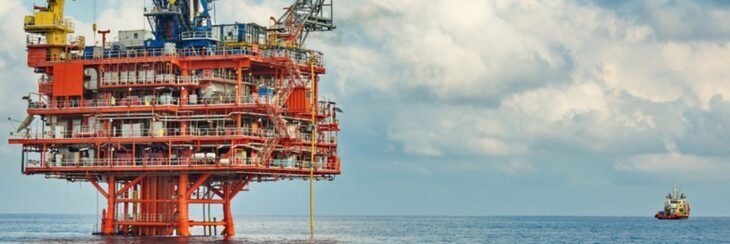
BP and Eni have returned to Libya after ten years of avoiding the country amid its civil war. Per a statement by the National Oil Corporation of Libya, Italy’s Eni resumed exploratory drilling in the Ghadames Basin last weekend. The company operates the exploration block where it is drilling in partnership with BP and the Libyan Investment Authority—the country’s sovereign wealth fund.
The Italian major acquired half of BP’s 85% stake in the Ghadames Basin block back in 2018. At the time, the company planned to start drilling at the site soon after the acquisition but the unstable political situation in the country changed those plans, as blockades of the oil fields and the oil export terminals became standard practice among various political and paramilitary factions.
Earlier this year, Libya’s oil production was decimated after the country’s two governments locked horns over the appointment of a new central bank governor. Since the central bank handles Libya’s oil revenues, both governments wanted their own man at the top position. The eastern government, which controls most of Libya’s oil fields through affiliated armed groups, said production would be suspended until a compromise is found and promptly proceeded to carry out its threat.
As a result, Libya’s oil production dropped from over 1 million barrels daily to about 100,000 bpd for a short while, until the two governments shook hands on a new central bank governor. The events highlighted the fact Libya is still not the safest of locations for oil operators, yet this appears to no longer be the deterrent it used to be.
Two other Western energy majors are also returning to Libya, according to the NOC. Repsol, the Spanish operator, was preparing to start drilling in the Murzuq Basin in the coming weeks, and Austria’s OMV was also preparing for drilling in the Sirte Basin, the Libyan state energy company reported.
______________________
Italy’s Eni, BP resume onshore drilling in Libya after 10-year hiatus
Eni has started drilling in an area of the Ghadames Basin.
Italian energy company Eni and British oil giant BP have resumed exploration in Libya after onshore drilling was halted in 2014, Libya’s national oil corporation (NOC) said.
NOC also said in a statement that Eni had started drilling in an area of the Ghadames Basin.
It noted that the well A1-96/3 is the first contractual obligation in Area B in the Ghadames Basin, in accordance with the Type IV Contracting Agreement of 2007. Eni operates the area in partnership with BP and the Libyan Investment Company.
Mellitah Oil & Gas oversees the drilling and execution of all activities related to this well, thanks to its extensive experience in the region following the commissioning and development of its Al Wafa field.
The NOC said that a range of promising geological formations will be tested at well A1–96/3, which is expected to contain oil and gas. The final well is expected to be about 10,327 feet (3,147 metres) deep.
The well A1-96/3 is about 35 kilometres from the Wafa field, and about 650 kilometres from the capital, Tripoli.
According to the NOC, Repsol, the Spanish oil company, was preparing to restart drilling in the Murzuq Basin, while Austria’s OMV plans to resume its activities in the Sirte Basin in the coming weeks.
______________________
Eni and BP resume operations in Libya, Repsol and OMV to start within weeks: NOC
Sami Zaptia
Libya’s state National Oil Corporation (NOC) announced today that Italy’s Eni and Britain’s British Petroleum (BP) have resumed exploration activity in Libya after onshore drilling operations have been halted since 2014. It added that Spain’s Repsol is also preparing to resume drilling operations in the Murzuq Basin, while Austria’s OMV will begin operations in the Sirte Basin in the coming weeks.
The NOC said Eni began its exploration activity today in Area B (96/3) in the Ghadames Basin, where the first exploratory well A1-96/3 (Wildfire Hope) was drilled.
It noted that the well A1-96/3 is the first contractual obligation in Area B in the Ghadames Basin, in accordance with the Type IV Contracting Agreement of 2007. Eni operates the area in partnership with BP and the Libyan Investment Company.
Mellitah Oil & Gas oversees the drilling and execution of all activities related to this well, thanks to its extensive experience in the region following the commissioning and development of its Al Wafa field.
The NOC said that a range of promising geological formations will be tested at well A1–96/3, which is expected to contain oil and gas. The final well is expected to be about 10,327 feet (3,147 meters) deep.
The well A1-96/3 is about 35 kilometres from the Wafa field, and about 650 kilometres from the capital, Tripoli.
______________________
After decade halt, Eni, BP resume hydrocarbon exploration in Libya
Jack Dutton
Onshore drilling had been suspended for a decade, since the beginning of the Libyan civil war between rival factions in the country’s east and west.
The Italian energy company Eni and UK oil giant BP have resumed exploration in Libya for the first time since drilling was halted in 2014, Libya’s state-run National Oil Corporation has said.
Onshore drilling had been suspended for a decade, since the beginning of the Libyan civil war between rival factions in the country’s east and west.
In a statement issued Sunday, NOC announced that Eni had begun drilling in the Ghadames Basin, in the northwest. It added that well A1-96/3 is thefirst contractual obligation in the basin’s Area B. The Italian energy company operates in the basin in a partnership with BP and the Libyan Investment Company.
NOC said there will be more exploration in A1–96/3, which is thought to contain oil and gas. The final well is expected to be about 10,327 feet (3,147 meters) deep, the state-run firm said.
The well is about 22 miles from the Wafa field, close to the Algerian border, and about 404 miles southwest of the capital, Tripoli.
ENI has been operating in Libya since 1959 and is the country’s leading international gas producer, accounting for around 80% of national gas production. The Italian firm operates in the North African state through Mellitah Oil and Gas BV, a 50-50 joint venture with NOC.
The NOC also said in its statement that Spain’s Repsol is preparing to resume drilling in the Murzuq Basin, and Austria’s OMV will begin operations in the Sirte Basin in the coming weeks.
Libya is Africa’s top oil producer, with an output of around 1.2 million barrels per day. Output fell in August, however, amid a crisis at the country’s Central Bank, during which the bank’sgovernorfled the country due to threats against him and his co-workers by armed militias believed to be linked to Libya’s UN-backed government, the Tripoli-based Government of National Accord. On Sept. 30,the eastern-based parliament approved the appointment of Naji Mohamed Issa Belqasem as the new Central Bank governor.
The crisis in Libya began in August 2024, with ongoing efforts by various factions to gain control of the Central Bank of Libya (CBL) posing a clear and present danger to the country. The crisis over the control of the CBL has resulted in the closure of 60% of Libya’s oil production. This closure has halted some 700,000 barrels a day of production, with further shutdowns imminent, leading to an immediate spike of 7% in global oil prices.
In response, Eastern factions declared a complete halt to oil production. Crude oil prices rose after the Eastern Libyan government announced the closure of all oil fields in August. This decision followed the crisis involving the Central Bank Governor and the subsequent suspension of production and exports. Oil prices increased by 3%, influenced by reports of “almost complete” oil production in Libya. These reports heightened concerns that the escalation of the Middle East situation could disrupt the region’s oil supplies.
Millions of Libyans rely on the CBL to ensure the payment of their salaries and the letters of credit essential to providing them billions of dollars a year. The United Nations Support Mission in Libya (UNSMIL) is warning that the situation is critical. The Libyan government, led by Osama Hamad, also announced the suspension of oil production and exports from all fields in the country until further notice. However, the National Oil Corporation, which oversees oil resources and sector activities, did not confirm this.
In a video statement posted on social media, Hamad explained that the decision was made “in response to attacks on leaders and employees of the Central Bank of Libya by outlaw groups, incited and assisted by the Presidential Council.” The Government of National Unity in Tripoli, headed by Abdul Hamid Dbeibeh, has not commented, nor has the National Oil Corporation, based in the capital, issued any statements.
The resumption of Libyan crude oil production had previously led to a surplus of crude supplies in Europe, forcing competing sellers to cut their prices. This crisis caused the OPEC member’s exports to fall to a four-year low. The National Oil Corporation (NOC) provides some 97% of Libya’s export earnings, pumping roughly 1.2 million barrels a day of oil to generate $20 billion-25 billion.
The resumption of Libyan crude oil production came after a political crisis over the central bank led to a surplus of crude supplies in Europe, forcing competing sellers to cut their prices, and the crisis caused the OPEC member’s exports to fall to a four-year low.
Libya’s National Oil Corporation announced the resumption of production on October 3, 2024, after a new central bank governor was appointed. By October 13, production was at about 1.3 million barrels per day, close to pre-crisis levels.
Data from a shipping agent showed that Libyan crude oil exports reached about 550,000 barrels per day in the first week of August, a three-fold increase from the previous week before the crisis, and this comes as Libya, a member of the Organization of the Petroleum Exporting Countries (OPEC), remains amid a political crisis that has hampered oil production.
The National Oil Corporation, which manages Libya’s fossil fuel resources, has not declared force on all port loadings and has so far opted to use the measure on specific shipments.
The corporation reported crude production at the El Feel oilfield on September 2 and exports from the Sharara field on August 7, before the crisis over the central bank’s leadership erupted. The corporation confirmed on August 28 that oil production had fallen by more than half from normal levels to around 590,000 barrels per day, but did not provide any new production figures.
The timing of Libya’s increased oil production coincides with maintenance at European refineries and the full or partial closure of several refineries in the Mediterranean and northwestern Europe. This is weakening the prices of competing crudes.
According to data from the London Stock Exchange (LSEG), the premium of Azerbaijan Light crude to benchmark Brent crude fell to $1.55 a barrel, its lowest since April. The spreads between other major Mediterranean crudes — Caspian Pipeline Consortium (CPC) Blend, Saharan Blend, and Libya’s Es Sider Blend — also narrowed in the first 11 days of October.
These Mediterranean grades will face further downward pressure from the second-largest field supplying the CPC Blend, Kashagan, which returns from a full maintenance shutdown after November 10, 2024.
Global oil prices surged to their highest levels abruptly due to the suspension of more than half of the country’s oil production, equivalent to 700,000 barrels per day. This occurred after a dispute erupted between the eastern and western governments of the country over the central bank, the sole authority authorized to manage oil revenues.
Libya incurred a loss of $120 million in just three days as oil exports remained suspended from major ports and production levels stayed low across the country, despite some increased supplies for local power generation.
The Libyan National Oil Corporation announced the resumption of production on October 3 following the appointment of a new governor for the central bank. By October 13, production had reached approximately 1.3 million barrels per day, approaching pre-crisis levels.
During a meeting with the Chairman of the Management Committee of the Libyan National Oil Corporation, Farhat Bengdara, the Prime Minister instructed support for the private oil sector to boost production and enhance the efficiency of Libyan workers. The state-owned National Oil Corporation aims to increase production to 2 million barrels per day, with the current daily output standing at 1,250,775 barrels.
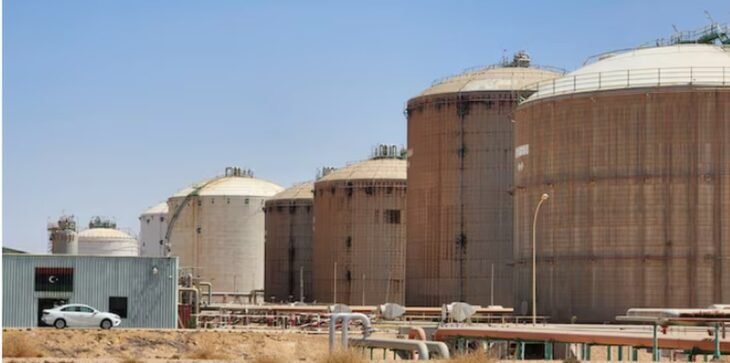
Oil and gas exports serve as Libya’s primary source of income, but the sector has faced challenges in recent years due to internal conflicts and political instability.
Libya’s production has seen an increase due to maintenance work at European refineries, with several facilities in the Mediterranean and northwestern Europe either fully or partially closed. The crisis at the Libyan Central Bank commenced in late August, resulting in the shutdown of numerous oil fields and ports. Libyan crude oil exports dropped to approximately 550,000 barrels per day, marking their lowest level in four years and half the July average. However, October exports have since rebounded to over 600,000 barrels per day.
Refineries have already made alternate arrangements to procure other crudes, anticipating a continued disruption in Libyan supplies. While European refineries will continue to receive Libyan shipments, they are in a position to negotiate significant discounts. Italy stands as the largest buyer of Libyan crude, accounting for a third of total Libyan exports in 2023.
***
Prof. Miral Sabry AlAshry is Co-lead for the Middle East and North Africa (MENA) at the Centre for Freedom of the Media, the Department of Journalism Studies at the University of Sheffield.
During the celebrations for the anniversary of Muammar Gaddafi’s overthrow, Libyan factions criticized the era of “one-man rule” and vowed not to return to it “now that Libya is free.”
On the thirteenth anniversary of “Liberation Day,” these groups committed to working toward the country’s stability without looking back.
However, some observers argue that, despite Gaddafi’s removal, Libya continues to face “individual control by politicians in their regions.”
At a celebration in Misrata organized by the “National Support Forces,” Abdul Hamid Dbeibah, head of the interim Government of National Unity, highlighted the sacrifices of the martyrs and stressed the importance of following their path toward development and restoring citizens’ rights.
He announced that his government is taking strong steps to eliminate obstacles to stability, aiming for improvements in citizens’ daily lives.
Dbeibah spoke firmly, indirectly addressing the House of Representatives, stating he would not allow those who lost their legitimacy ten years ago to impose their conditions on the Libyan people.
He insisted that the next phase requires determination to confront anyone trying to disrupt the journey toward freedom and stability, promising to take decisive action to move toward elections.
Dbeibah reaffirmed his “full commitment to preventing the return of military or individual rule,” stressing the importance of enabling all Libyans to express their rights in elections and national decisions.
At a celebration attended by notable figures from various regions, he declared that the sacrifices made for freedom would not be in vain and emphasized the need for decisive action against those undermining stability and freedom.
Both Dbeibah’s government and its eastern rival, led by Osama Hamad, declared Wednesday a public holiday to mark the thirteenth anniversary of Libya’s liberation from Gaddafi’s regime on Oct. 23, 2011.
The House of Representatives highlighted the achievements of the Libyan people in 2011, celebrating their liberation from individual rule and the move toward a fully democratic state.
They stated that the ideal state allows citizens to choose their leaders through free and fair elections.
They also noted that the Feb.17 revolution sparked the declaration of full liberation on Oct. 23 in a grand celebration in Benghazi.
Thirteen years after this declaration, Libya is at a critical juncture that requires unity, reconciliation, and a focus on national cohesion to fulfill the revolution’s goals.
The geopolitical dynamics involving regional powers add layers of complexity to the Central Bank of Libya’s operations. Without a cohesive political framework, Libya’s economic stability and the efficacy of its Central Bank may remain precarious.
Libya’s oil production has returned to normal as of October 9, 2024, according to the National Oil Corporation, following the reopening of all fields and export ports. The “force majeure” that had halted operations for over a month and a half was lifted, after a political dispute over the leadership of the Libyan Central Bank between the eastern and western governments was resolved through U.N. mediation, resulting in the appointment of a new governor.
Despite the significance of this agreement, it did not address the broader challenges facing the Central Bank, particularly those stemming from Libya’s ongoing political division and disputes over governmental authority. By October 13, 2024, more than 2.5 million public sector employees were still awaiting their salaries for the previous month due to administrative and bureaucratic delays.
The Complexities of Libya’s Central
Bank Disputes
Under typical circumstances, central banks manage monetary policy and oversee the financial system, coordinating with government fiscal policies and public spending directives. However, Libya’s political landscape has placed the Central Bank of Libya in an exceptional situation, as it is the sole legal recipient of the country’s oil revenues – vital in a nation where revenue from oil accounts for 96.7 per cent of public spending. This dynamic leaves the bank caught between two rival governments vying for legitimacy.
In effect, the battle over the Central Bank has become a proxy for the larger struggle over control of oil revenues. While various armed factions compete for control of oil fields and operations, the management of the Central Bank remains the key to accessing public funds and executing government spending orders from both the eastern and western governments.
This struggle was highlighted on August 26, 2024, when the eastern-based government in Benghazi, led by Osama Hamad, announced the closure of all oil fields under its control. This move was in response to the dismissal of the former Central Bank governor, Al-Siddiq Al-Kabir, by the Tripoli-based Presidential Council. The situation escalated quickly, with Al-Kabir forced to flee the country, alongside other senior bank officials, fearing attacks from armed groups in western Libya.
The Hamad government in the east of the country justified the suspension of oil production as a measure to protect Libya’s financial reserves and oil revenues. It made clear in a statement that it would not resume production without a settlement that ensured its influence over the management of oil wealth, citing the need to “protect the livelihood, wealth and reserves of the Libyan people held by the Central Bank of Libya. The country’s oil output subsequently plunged from 1.2 million barrels per day to just 450,000 barrels, given that most oil fields are located in eastern Libya.
These developments reflect the deteriorating relationship between Al-Siddiq Al-Kabir and the western-based interim national government, led by Abdul Hamid Dbeibah. At the core of the dispute were disagreements over access to Central Bank funds and spending directives, which were key to maintaining the loyalty of armed groups in Tripoli. Al-Kabir had publicly criticized Dbeibah for ramping up government expenditure on consumption at the expense of development projects, further straining ties.
In response to these tensions, the Presidential Council – aligned with Dbeibah – dismissed Al-Kabir, triggering further conflict with the eastern government and its allied armed groups. The subsequent closure of oil fields prompted the United Nations to intervene, ultimately brokering a settlement that allowed all parties to have a say in the appointment of the new Central Bank leadership.
Major Ongoing Challenges
The recent settlement resulted in the appointment of Naji Muhammad Issa Belqasim as governor of the Central Bank of Libya, following an agreement between the authorities in the east and west. Belqasim, an experienced technocrat, previously served as an adviser to the ousted governor and held key roles within the bank, including director of the Department of Monetary and Banking Control and the Department of Studies and Research. His familiarity with the complex political dynamics, including the influence of armed groups controlling oil fields, positions him as a figure capable of navigating the challenges facing the Central Bank.
Despite his reputation as a “moderate” figure, Belqasim will face numerous challenges that extend beyond the traditional scope of a central bank governor. One of the foremost issues will be ensuring the equitable distribution of oil revenues across the various regions, a task complicated by the division of executive authorities that claim these funds. This challenge places the Central Bank in the role of regulating public spending, a responsibility typically assigned to the Ministry of Finance, which oversees budget allocations approved by the House of Representatives.
A further critical challenge will be the stabilization of financial flows from Libya’s oil exports. While oil production has recovered since Belqasim’s appointment, ensuring sustained production amid potential political disputes or security threats will be essential. Armed groups have historically used oil field closures as leverage to impose their demands on Libya’s divided political authorities, creating ongoing instability in oil revenue streams.
In the short term, Belqasim must also address the administrative issues resulting from the abrupt departure of the previous leadership. Without a formal handover, the bank has struggled with internal reorganization, leading to delays in disbursing public sector wages. These administrative disruptions, coupled with the earlier halt in oil production, have exacerbated a liquidity crisis due to the shortage of hard currency, adding further pressure on the Libyan dinar in the parallel market.
Looking ahead, one of Belqasim’s most critical tasks will be maintaining the Central Bank’s institutional unity and preventing a return to the division that previously split the bank into eastern and western entities. The unification of the Central Bank is relatively recent, achieved in August 2023 after nearly a decade of division since 2014. The recent leadership dispute has raised concerns about the potential for a renewed “monetary division,” which could severely impact the stability of Libya’s banking system and erode confidence in the local currency.
The Role of External Interventions
A key factor shaping the challenges facing Libya’s Central Bank is the influence of external interventions. Algeria has maintained firm support for the western-based government, providing intelligence coordination and military training. This stance is largely driven by Algeria’s strategic interest in keeping General Khalifa Haftar’s forces, which back the eastern government led by Osama Hamad, away from its eastern borders.
On the other hand, Egypt has taken a more pragmatic approach, supporting the Hamad government in exchange for lucrative reconstruction contracts in areas damaged by Hurricane Daniel. Meanwhile, Russia continues to foster a close relationship with Haftar’s forces, seeking investment contracts in eastern Libya’s oil fields. In response, the United States has focused its involvement on curbing Russian influence in Libya, even if that means exerting pressure on the Central Bank, which remains tied to transactions in U.S. dollars.
These external interventions contribute to the protracted nature of Libya’s political crisis, which in turn impacts the operations of the Central Bank. The bank will need to navigate this geopolitical complexity, aligning its strategies with the country’s ongoing political division to mitigate the impact on Libya’s monetary and financial stability.
American pressures, particularly in contrast to Russia’s growing ties with Haftar, present a long-term challenge for the Central Bank. Until Libya’s political institutions are unified under a leadership capable of establishing a balanced and independent foreign policy, external pressures will continue to complicate the bank’s efforts to maintain stability.
Meanwhile, the Libyan dinar’s value in the parallel market has plummeted to 8 dinars to the dollar, compared to the official rate of 4.7 dinars. These issues highlight the pressing economic challenges that the new Central Bank leadership will need to confront.
It can be said that the US shapes its priorities in Libya around energy security, balancing Russia’s increasing influence in the region and maintaining its military presence.
Recently, international actors have been increasingly interested in Libya, which has witnessed political, military and economic crises. The United States of America (USA) stands out with its specific weight in regional politics and its political and security-based strategies towards Libya since 2011. In this context, it can be said that the US has shaped its priorities in Libya around energy security, balancing Russia’s increasing influence in the region and maintaining its military presence.
In connection with these three items, the US aims to control the impact of Libya’s oil and natural gas flows on global energy markets, to thwart Russia’s efforts to gain influence, especially on NATO’s southern flank, and to use Libya’s strategic location for the military operations of the African Command (AFRICOM).
Breaking points
The attack on the US Consulate in Benghazi in 2012 and the assassination of Ambassador Christopher Stevens constituted a significant turning point in relations between the US and Libya. After this date, the US put “limited intervention” and “remote balancing” strategies on its agenda in Libya. Within this framework, Washington took steps to break the influence of radical groups by considering Libya as an area of combating terrorism. In addition, the US, which has participated in diplomatic processes through the United Nations Mission in Libya (UNSMIL) since 2016, continued to pursue its policy towards the country with a security-oriented approach after the elections planned to be held in Libya in 2021 were canceled.
In the following period, it can be said that critical issues such as unifying the army, removing Wagner from the region and ensuring the security of oil facilities were brought to the agenda during the visits to Libya by high-level officials such as the Director of the US Central Intelligence Agency (CIA) William Burns and AFRICOM Commander General Michael Langley. In short, the US has shaped its policies in Libya for the last 15 years mostly according to the geopolitical balances in the region and has also tried to secure the flow of energy.
Another turning point in relations between the US and Libya was the liquidation of Wagner in Russia. After this process, Russia pulled its military presence in Africa, starting with Libya, to a more institutional line and left the remaining areas largely to the Ministry of Defense. At this point, Russia’s African Legion (African Corps), which was established in May and was a continuation of Wagner, prepared the ground for the US’s counterbalancing moves.
Around the same time, the US company Amentum brought together some armed group leaders in western Libya and discussed the establishment of a structure similar to Russia’s African Legion. On the one hand, the Washington administration maintained diplomatic relations with the Haftar family, the most important armed and political force in the east of the country, and on the other hand, it established the Libyan-European Legion, led by militia groups supporting western cities.
In addition to these activities, the US has recently attempted to disarm militia groups in Libya through another company, Chemonics. In the news, especially in the French and Libyan domestic press, it was claimed that Chemonics would include different armed groups in Libya in disarmament, demobilization and reintegration (DRI) programs within a certain mechanism and timetable.
The US’s recent increasing quest
for legitimacy
At this point, the US’s declining reputation in the Sahel region neighboring Libya led to the end of its military presence with the coup in Niger, and today it has accelerated its search for new bases in West Africa. Developments in Niger have increasingly questioned the influence of the US and traditional allies such as France in the region. In this respect, it can be said that Libya has ceased to be a mere energy and security issue for the US, and has become a strategic area where it can reestablish its influence on the African continent.
Another important aspect of Libya for the US, which aims to rebuild its influence in Africa by establishing a permanent military presence and effective diplomatic relations, is that the country is central to migration routes and energy supplies to Europe. Energy and migration routes that reach the Mediterranean via Libya are also critical to Europe’s security and stability. In this respect, Russia or another rival actor increasing their influence and influence in the North African country is not a preferable scenario for the US.
On the other hand, Turkey is one of the important actors in Libya, both politically and militarily. For Turkey, which has reached common ground with the US in terms of completing the transition process in the country, the restoration of permanent stability in Libya can be shown as one of the priority goals. In addition, it is possible to see Turkey’s military presence in the west of the country as a deterrent element that prevents tensions between the parties from turning into full-scale conflicts since December 2019. Therefore, it can be stated that the US’s more balanced moves in Libya that will benefit the transition process will be welcomed positively by Turkey.
In summary, the ongoing political uncertainty in Libya and the possibility that the ongoing military competition between rival factions could result in large-scale conflicts make it necessary for the US to intervene in soft and hard power interventions in the fragile security dynamics in Libya. In fact, Libya’s association with the European security architecture in the areas of migration and energy and the US’s loss of political and military flexibility in Africa have been important signals at this point.
***
Fuat Emir Şefkatli is an Independent Researcher and a PhD candidate at the National Defense University.
The long-running feud between Libya’s competing authorities over the Central Bank has flared up again, threatening an economic crisis that could lead to unrest. The parties should press ahead with UN-backed mediation to achieve a resolution.
***
VI. What Should Happen Now?
Libyan politicians’ immediate priority should be to implement the preliminary deal signed on 26 September. The House of Representatives and High State Council, as well as the Presidential Council, should all do everything in their power to allow the new appointee Naji Issa to take over as Central Bank head and allow for establishing a board of directors. The board should be an active one, charged with enhancing the institution’s transparency and accountability. Oil production across the country should also resume.
Reaching a preliminary deal was by no means an easy feat. Talks to resolve the crisis began on 2 September, hosted by the acting head of the UN Support Mission in Libya, Stephanie Koury, at the UN headquarters in Tripoli. She envisioned them as trilateral consultations among representatives of the Presidential Council, House of Representatives and High State Council aiming “to reach a consensus based on political agreements, applicable laws and the principle of the Central Bank’s independence”.
But the two assemblies’ representatives refused to negotiate directly with the Presidential Council’s emissaries, and the latter were relegated to a separate room. As late as 23 September, two rounds of talks had produced no agreement. But informal conversations among key figures reportedly continued. On 25 September, quite suddenly, according to UN sources, the delegations informed the UN that they had reached an agreement on new management, asking Koury to host a signing ceremony the following day.
This initial agreement between the two rival assemblies is not a done deal, and as noted above, much could still go wrong. A first priority should be to ensure that the Presidential Council also backs the new appointments and is ready to revoke its controversial August decree.
The two assemblies’ refusal to sit with Presidential Council representatives during the UN consultations is hardly surprising. The House of Representatives stopped recognising the Dabaiba government in 2022 and recently threatened to do the same with the Presidential Council.
Their strategy in the talks could well have been to buy time to let the economic crisis hit in the hope that public opinion will turn against the Dabaiba government, which they blame for triggering the dispute. As for the High State Council, its new acting (but still contested) president, Khaled Mishri, likely wished to keep the Presidential Council out of the picture so as to deal directly with the House speaker, Aghela Saleh, which is what the two assemblies have done in the past.
The fact that the two assemblies signed this preliminary agreement does not mean that they have given up on undermining the Dabaiba-led government.
The fact that the two assemblies signed this preliminary agreement does not mean that they have given up on undermining the Dabaiba-led government. Yet, with a deal now on the table, the leaders of the two assemblies would be ill-advised to proceed without ensuring that the Presidential Council and Prime Minister Dabaiba are on board.
Although the UN-backed procedure for selecting the Central Bank head has since 2015 required only the two rival assemblies’ consent, in the current fractured political set-up the Presidential Council’s buy-in is crucial for reaching a stable agreement and preventing an economic meltdown. Broad consultations that include all major institutions are essential for reaching consensus on how to resolve the dispute. Keeping the Presidential Council out risks encouraging it to become a spoiler.
Furthermore, as foreign officials have clearly stated, the Presidential Council’s buy-in is a prerequisite for international financial institutions to consider the dispute over the Central Bank’s leadership closed and to unlock suspended transactions with Libya. For that to happen, all parties would need to recognise the same person as interim governor, and the Presidential Council would need to explicitly revoke its August appointments.
A second priority is to ensure that the House of Representatives officially ratifies the appointment in accordance with Libyan law and the Libyan Political Agreement. On several occasions in the past, members of the House have reached preliminary political deals with their rivals, only to see Saleh or the House as a whole renege at the last minute.
This time, members of the House should collaborate in good faith to finalise as quickly as possible their endorsement of the new governor and a board. Once the House ratifies these arrangements, a peaceful, legally valid handover of the Central Bank will need to take place to avoid any further disputes regarding the new management.
For the UN, meanwhile, this crisis represents an opportunity to reset its negotiating approach to Libya by adding economic and financial discussions to existing political talks. Between 2018 and 2021, the UN was actively engaged in mediating budgetary disputes and other economic and financial disagreements. In 2020, it even integrated a separate economic track into the diplomatic framework, alongside the political and military ones.
These talks included some of the feuding financial institutions’ representatives, as well as bankers, economists and other competent experts. But since 2022, successive UN envoys have neglected economic issues in favour of political discussions. The Central Bank crisis is a powerful reminder that the fight over finances is an integral part of the overall conflict and has huge repercussions for people’s well-being. Yet UN-led talks have stalled for over a year, and since UN Special Representative Abdoulaye Bathily resigned in April there has been no permanent envoy for Libya.
The UN Secretary-General should appoint a new Libya special representative, whose active mediation efforts Libya sorely needs. Should naming a new envoy prove impossible, due to divisions within the UN Security Council, the Secretary-General should appoint the interim head, Koury, as acting special representative, a step up from her current role as “officer in charge”. He should make this move before the next UN mission mandate renewal vote, which is due before the end of October.
VII. Conclusion
Time is of the essence in resolving Libya’s Central Bank dispute. If the preliminary deal signed on 26 September falls through and the feud between rival authorities continues, outside partners will continue to keep Libya disconnected from international financial markets, aggravating the risks of an economic collapse.
Although a limited number of foreign financial transactions are still taking place, a prolonged cutoff could take a devastating toll in Libya, a country which is almost entirely dependent on oil revenue to cover government expenses and which imports virtually all its essential needs, including foodstuffs and construction materials.
Reaching a preliminary accord to settle this dispute is a major achievement, but the wrangling over the Central Bank is far from over. That said, rival factions have a shared interest in avoiding a sharp deterioration in living conditions, which could trigger popular protest or violent unrest.
They should now work in good faith and, with the UN’s help, aim to implement the deal by allowing the new governor to take over the Central Bank and appoint board members. Reconnecting Libya to global financial circuits is crucial, but it should happen only through arrangements that include all the country’s main political forces and respect agreements that have already been struck.
In this text, Mostafa Barghouthi draws up the macabre balance sheet of the last year and clearly announces what awaits the Palestinians if nothing is done: the annexation of the rest of the occupied territories, the continuation of apartheid and the completion of ethnic cleansing. While affirming the continuation of resistance, ‘whatever the cost’.
***
A new world order
The atrocities committed in Gaza by the Israeli army are not only detrimental to the people of Gaza, but to international law as well. The actions of Israel has undermined international and humanitarian law, which the West claims to care about.
Palestinians discovered the double standards of many western governments when comparing their attitudes towards Russia and Ukraine with that towards Israel and Palestine. Russia was subjected to 11,000 sanctions in two months while Israel was provided with 50,000 tons of explosives by the United States, in addition to thousands of weapons from other western countries such as Britain and Germany.
The world order will never be the same after the genocide in Gaza. People legitimately ask:
Where are the so-called western values of human rights, democracy, and international law?
Why do Palestinians have to face Israeli occupation, apartheid, and genocide?
Why are we mistreated by many European and American governments which refuse to treat us as equal human beings?
What will be the impact of this ongoing genocide on the whole international order created after the Second World War?
Will those in power not be held accountable for breaking the rules of international law?
Will the world be run by the rule of ruthless power rather than by the rule of law?
The war that started on the 7th of October was not the cause of the current political situation, rather it was the result of 76 years of ethnic cleansing that the Palestinian people were subjected to by Israel in 1948, when 52 massacres were committed by Israeli military gangs and 520 Palestinian towns and villages were erased to the ground. About 70% of the population of Gaza were refugees, displaced by Israel in 1948. They were displaced again in 2024, six to 10 times in the course of one year.
The 7th of October was also a result of 57 years of Israeli military occupation of the West Bank, including East Jerusalem and Gaza that evolved into the worst system of apartheid in modern history. It was a result of 17 years of a ruthless Israeli siege on Gaza, which left it with 94% of its water polluted or salted and a destroyed economy with 80% of young graduates unemployed.
And it was also the result of the declared Israeli government policy which resulted in the demise of a two State solution in which Palestinians were expected to build a state in 22% of their homeland, while the 181 UN Resolution gave them 44% at a time when they owned 82% of the land of historic Palestine.
No better or worse than any other people
This was a result of the Knesset state nation law which declared that the right of self- determination is historic Palestine (they call it Eretz Israel) is exclusive for Jewish people, followed by the Israeli fascist minister Smotrich’s declaration that Israel will fill the West Bank with Israeli settlements till Palestinians lose any hope of a state of their own, and then have to choose between immigration (ethnic cleansing), subjugation to Israelis (eternal apartheid), or death (genocide).
The 7th of October was a direct result of the Israeli shift not only to racism and extremism, but also to theo-fascism killing any hope for peace or justice, in Palestine.
Many Palestinians had hopes in the peace process, international law, and UN Resolutions. However, they have seen their homeland gradually and violently taken over by extreme settlers.
They live in a constant state of threat, their children are at risk, and that the United Nations and western governments are failing to impose the implementations of no less than 84 UN Security Council resolutions, and about 800 General Assembly Resolutions that support Palestinians rights.
It is clear that the Israel establishment is attempting to annex the West Bank, including Jerusalem and Gaza Strip and t displace their Palestinian populations.
Netanyahu left no doubt about his intentions when he raised the map of Israel in the UN General Assembly, two weeks before the 7th of October, which included the West Bank, Gaza Strip, and the Golan Hights.
No innocent life of any civilian should be lost or killed, and this applies to Palestinians as well. The famous Palestinian poet Tawfiq Ziyad, who happened to be the mayor of Nazareth once said: “We, Palestinians, are not better than any other people, but no other people are better than us.”
We want to be treated as equals, with our rights to full freedom, dignity, and self-determination. Whatever it takes Palestinians will not be broken, and they will not give up till their dream is fulfilled and Palestine is free.
***
Mostafa Barghouti – Palestinian politician, Secretary General of the Palestinian National Initiative
Libya’s oil production, which was cut in half due to a blockade in August, has recovered to around 1.2 million barrels per day.
International oil companies, including Italy’s ENI and France’s TotalEnergies, are actively investing in Libya, with plans for both oil production and renewable energy projects.
Libya’s fractured political landscape, especially the unresolved issue of equitable oil revenue distribution, continues to threaten the stability of its oil sector.***
Libya’s oil production was cut roughly in half when a blockade of major fields and ports began at the end of August. With the shutdown having ended on 3 October, output has bounced back to around 1.2 million barrels per day (bpd) again. According to subsequent statements from its National Oil Corporation (NOC), the move is now on to significantly boost its crude production.
Theoretically, Libya could achieve this. Prior to the removal of its long-time leader, Muammar Gaddafi, in 2011, it had easily been able to produce around 1.65 million bpd of predominantly high-quality light, sweet crude oil. Production had been on a rising production trend at that point, up from about 1.4 million bpd in 2000, and the country still had around 48 billion barrels of proved crude oil reserves – the largest in Africa. Although this output level was well below the peak levels of more than 3 million bpd achieved in the late 1960s, the NOC had plans in place at that point in 2011 to roll out enhanced oil recovery (EOR) techniques to increase crude oil production at maturing oil fields.
These projects were put on hold due to an increase in sectarian hostilities across the country, but they were resuscitated even before the most recent comments from the NOC alongside its creation of a new ‘Strategic Programs Office’ (SPO). The aim of this is precisely to orchestrate a rise in Libya’s production capacity to 2 million bpd in the next three to five years.
During Gaddafi’s 42 years as leader, numerous international oil companies (IOCs) operated in Libya or desired to do so. Several of these retained an active presence in the country since his removal and the onset of a rolling civil war between various factions centred on controlling the country’s only major source of income – its oil and gas sector. Italy’s ENI is one such firm, signing an agreement towards the end of 2023 with the NOC that envisioned investment of around US$8 billion to produce about 850 million cubic feet per day (Mmcf/d) from two offshore gas fields in the Mediterranean Sea.
ENI still produces gas in Libya from its Wafa and Bahr Essalam fields operated by Mellitah Oil & Gas, a joint venture between the Italian company and the NOC. Gas from the fields is transported to Italy through the 520 kilometre 8 billion cubic metres per year (Bcm/y) Green Stream pipeline that crosses the Mediterranean Sea and lands in Gela in Sicily. Negotiations are also ongoing between ENI and the NOC for the launch of several major renewable energy projects too.
Like France’s TotalEnergies and the UK’s BP and Shell, ENI has been at the forefront of developing alternative energy flows for Europe to compensate for those lost from Russia since it invaded Ukraine on 24 February 2022. Moreover, the Italian government has additionally unilaterally pledged to eliminate all Russian gas from its supply network by 2025.
ENI and BP both feature in the exploration and production sharing agreement (EPSA) that the two firms signed in October 2018 to resume exploration activities in the country. The EPSA – originally awarded in 2007 but suspended from 2014 to 2018 — includes three contract areas, two in the onshore Ghadames basin and one in the offshore Sirt basin, covering a total area of around 54,000 square kilometres.
Plans were also afoot at the NOC before the latest oil production shutdown in August/September for a series of offshore and onshore drilling programmes to begin within the coming months, under the leadership of France’s TotalEnergies. April 2021 had seen an agreement between its chief executive officer Patrick Pouyanne and the then-NOC chairman, Mustafa Sanalla, for the firm to continue with its efforts to increase oil production from the giant Waha, Sharara, Mabruk and Al Jurf oil fields by at least 175,000 bpd. It had also agreed to make the development of the Waha-concession North Gialo and NC-98 oil fields a priority, according to the NOC.
The Waha concessions – in which the then-Total took a minority stake in 2019 – have the capacity to produce at least 350,000 bpd together, according to the NOC. The NOC added that the French firm would also “contribute to the maintenance of decaying equipment and crude oil transport lines that need replacing.”
Having said all this, the outlook for a meaningful sustained rise in oil Libya’s oil production remains extremely clouded by its fractious political situation. At the core of this remains the failure since 18 September 2020 to create a properly functioning systems whereby revenues from its oil and gas sector can be equitably processed in a manner acceptable to the key warring factions in the east and west of the country.
The date is significant because it was at that point that a deal was struck between Khalifa Haftar, the commander of the rebel Libyan National Army (LNA), and elements of the United Nations (U.N.)-recognised Government of National Accord (GNA) to end the oil blockade that had been running for nine months by that point.
In the deal, Haftar made it clear that the resultant lifting of the shutdown would not last unless a precise framework was agreed about exactly how oil revenues would be divided up between the various groups from then on. From that moment until September 2020, Libya experienced several further blockades of its oil sector of various magnitudes until a draft framework was agreed between Haftar and Ahmed Maiteeq, the then-Deputy Prime Minister of the GNA.
Key to this agreement was the proposed formation of a joint technical committee — between the LNA and GNA principally — to deal with overseeing oil revenues and then ensuring the fair distribution of resources. In order to address the fact that the GNA effectively held sway over the NOC and, by extension, the Central Bank of Libya (in which the revenues are physically held), the committee would also “prepare a unified budget that meets the needs of each party… and the reconciliation of any dispute over budget allocations… and will require the Central Bank [in Tripoli] to cover the monthly or quarterly payments approved in the budget without any delay, and as soon as the joint technical committee requests the transfer.”
Due to the influence of several domestic and international disruptive elements since that idea was mooted – notably Russia – it has never been properly implemented and has been replaced instead by at time ludicrous events on both sides. However, hopes were high from several quarters – including the U.S. and U.N. – that such a deal could work well, and indeed that it might still be able to solve the ongoing impasse over the country’s oil and gas revenues. In the meantime, it looks highly likely that Libya will remain subject to further similar shutdowns for variously ludicrous reasons based on the whims of various of its warring factions.
In the run-up to the August/September shutdown (resulting from efforts to remove the then-Governor of the Central Bank of Libya), for example, a smaller one began in the first half of August caused by the arrest of Saddam Haftar, the son of General Haftar. The younger Haftar had been briefly detained at Naples airport after his name appeared on a European Union database over an arrest warrant issued in Spain for alleged weapons smuggling.
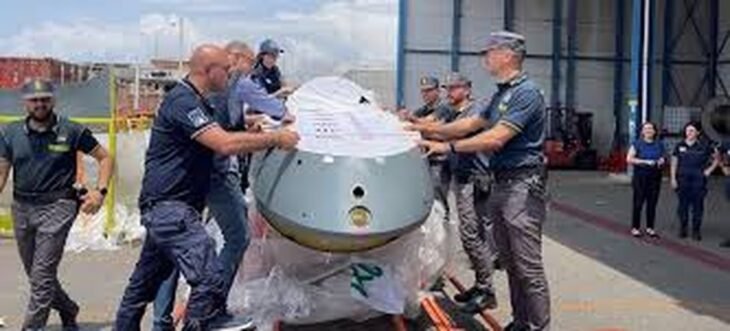
This followed comments from former U.N. special envoy to Libya, Abdoulaye Bathily, that the country was becoming a mafia state dominated by gangs involved in smuggling operations, especially for arms. This in turn followed General Haftar’s visit last September to Moscow for talks with Russian President Vladimir Putin, whose Wagner mercenary soldiers provide support for LNA forces in Libya. Early July also saw Italian authorities seize two Chinese-made military drones that were destined for Libya and disguised as wind turbine equipment.
***
Simon Watkins is a former senior FX trader and salesman, financial journalist, and best-selling author. He was Head of Forex Institutional Sales and Trading for Credit Lyonnais, and later Director of Forex at Bank of Montreal.
Libyan crude exports rising in Oct. as c. bank crisis resolved
Libyan exports weighing on other crude grades like Azeri, CPC
***
A resumption of Libyan crude output after a political crisis over the central bank slashed the OPEC member’s exports to a four-year low, has led to a surplus in crude supplies in Europe, forcing competing sellers to cut their prices, trading sources and analysts say.
Libya’s National Oil Corporation (NOC) announced the restart of production on Oct. 3 after a new central bank governor was appointed. As of Oct. 13, output had reached about 1.3 million barrels per day, close to pre-crisis levels.
The timing of Libya’s ramp up is coinciding with maintenance at European refiners with several plants in the Mediterranean and northwest Europe in full or partial shutdown. This is weakening the price of competing crude grades, traders and analysts said.
According to LSEG data, the premium of Azerbaijan’s Azeri Light crude to benchmark dated Brent dropped to $1.55 a barrel, the lowest since April.
In the first 11 days of October, the differentials of other major Mediterranean crude grades – CPC Blend, Saharan and Libya’s own Es Sider blends also weakened, FGE Energy analyst Sofia Pribludnaja said.
“Looking ahead, these Mediterranean grades will face more downside pressure from the second-largest field feeding the CPC Blend – Kashagan – returning from full shutdown due to maintenance after November 10,” she added.
Prices for West African crude, also a substitute for Libyan barrels, could also weaken, a trader said. Nigerian Bonny Light was last week offered close to a premium of $1 a barrel to dated Brent and valued slightly below that, the lowest since December 2023, according to LSEG data.
Libya’s central bank crisis started at the end of August, leading to the shutdown of several oilfields and ports. Libya’s crude exports in September slumped to about 550,000 bpd, a four-year low, according to Kpler data, and half the average for July and August.
October exports so far have recovered to over 600,000 bpd and are expected to rise further.
One trader with a firm that usually buys from Libya and who declined to be identified said NOC was allocating cargoes to refiners that were for very imminent loading dates.
NOC did not immediately respond to a Reuters request for comment.
Refiners had already made alternative arrangements to buy other grades, assuming that the Libyan outage would last longer, he added.
A second trader said refiners in Europe will still take in Libyan cargoes but are in a position to demand hefty discounts. Reuters could not confirm deal levels which are usually transacted on a confidential basis.
Italy is the biggest buyer of Libyan crude, accounting for a third of all exports in 2023, followed by Spain, France, the United States and Greece, Kpler data show.
In this text, Mostafa Barghouthi draws up the macabre balance sheet of the last year and clearly announces what awaits the Palestinians if nothing is done: the annexation of the rest of the occupied territories, the continuation of apartheid and the completion of ethnic cleansing. While affirming the continuation of resistance, ‘whatever the cost’.
***
Israel’s war on Gaza, which began on October 7th 2023, is unprecedented in modern history. Since that date, Israel conducted three war crimes in parallel: genocide, collective punishment of a civilian population, and ethnic cleansing.
During the first year of this devastating war, which has now expanded as we expected to Lebanon, the Israeli army bombed the 2.2 million inhabitants of Gaza living in less than 140 square mile, no less than 83,000 tons of explosives.
This means 32kg of explosive for each man, woman, or child. To put this number into perspective, 83,000 tons is four times more than the explosive power of each of the nuclear bombs thrown on Hiroshima and Nagasaki during the Second World War. Nearly 80% of all homes have been partially or completely destroyed.
In Germany only 10% of homes were destroyed by the end of the Second World War. The Israeli war machine intentionally destroyed all universities, more than 70% of schools, 34 out of 36 hospitals, 165 health institutions, 80 health centers, 137 ambulances, 178 shelters, 611 mosques and all 3 churches in Gaza.
“Dad, will my hands grow again
when I grow up?”
Israeli bombardment killed more than 41,595 Palestinians, in addition to more than 10,000 who are still missing under the rubble. Among those killed, 70% were children, women, and elderly. Nearly 17,000 Palestinian children have been killed, including 115 children who were born and killed during the war.
Some, like the children of Mohamed Abu Alkumsan, lived for less than three days. It was heartbreaking to hear him explain how happy he was that his wife managed to give birth during the war to two healthy twins, how he rushed to get birth certificates for them, and how shocked he was when he returned to his apartment to find both his children and his wife killed by Israeli bombardment.
Besides, 96,251 Palestinians, mostly civilians, were injured. This figure includes 4 000 who had amputations, among them 1 300 children. On one of the days of this seemingly endless and brutal war, I was heartbroken when I turned on the television and saw a five-year-old Palestinian child who had lost both his hands asking his father: “Dad, will my hands grow again when I grow up?” The father could not say a word, his eyes full of tears.
By the end of September 2024, the Israeli army had killed or injured 6.5% of the population of Gaza. Had this happened in the USA it would mean proportionally that more than 20 million Americans are killed or injured in less than a year.
The Israeli military attack on Gaza was accompanied by a ruthless campaign to dehumanize Palestinians. It was led by Israeli Prime Minister Netanyahu and the Israeli Army Minister Galant who called Palestinians “human animals”.
The fascists Bezalel Smotrich and Itamar Ben Gavir, both of whom were previously accused by the Israeli Judiciary of belonging to terrorist Israeli groups, ran campaigns to eliminate Palestinians who, according to them, were all terrorists even children.
No longer living, no longer caring
During Israel’s bombardment of Gaza, the Israel military did not only target civilians indiscriminately, but also specifically targeted medical personnel. By the eleventh month of the war, they had killed more than 880 medical doctors, nurses, ambulance drivers and other health professionals.
They also arrested and tortured, sometimes to death, no less than 200 health workers. This includes Dr. Adnan Al-Bursh and Dr. Iyad Rantisi, previously head of Orthopedic surgery at Shifa hospital, and Obstetrics and Gynecology-respectively at the Kamal Edwan hospital who were tortured to death at the Sde Timan and Ofer prisons.
The Israeli attacks on Palestinian medical and health facilities clearly intended on destroying medical resources for the treatment of the sick and injured. Out of the 95,000 injured, at least 25% could die due to absence of medical facilities and proper treatment and are unable to receive proper medical treatment because of Israel’s refusal to allow them to leave Gaza.
Israel did not only conduct a genocide through bombardment, but they also allowed an explosion of epidemics and diseases by depriving people from food, proper nutrition, clean water and all forms of energy such as electricity and fuel.
According to Palestinians Medical Relief, which runs medical operations in Gaza, providing medical treatment to about 200,000 patients monthly, on September 2024 there were 1,737,524 infected with infectious diseases as a result of displacement., including 112,000 suffering from an outbreak of infectious hepatitis, 3,500 children with severe malnutrition, hundreds of thousands suffering from skin diseases including scabies and impetigo, several children with Meningitis and 6 cases of suspected poliomyelitis in addition to one confirmed case.
The WHO was obliged to run a new polio vaccination campaign under Israeli bombardment, since Netanyahu refused to allow a humanitarian ceasefire even for a few days.
According to PMRS every person in Gaza gets sick an average of 3 times a month, sometimes with respiratory infections, gastroenteritis, or skin diseases.
Today 10,000 cases of cancer don’t get proper treatment, 12,000 people are in urgent need for medical evacuation, and 350,000 suffer from chronic diseases that require continuous medical care and supply of medications.
Beyond Gaza
Journalists and media personnel were also major targets of the Israeli attacks. The aim was and continues to be to prevent the truth about the Israeli war crimes from reaching the world. Foreign journalists were forbidden from entering Gaza (except for one CNN correspondent for 3 hours only), and 174 Palestinian journalists were killed, many with their families, including Al-Jazeera correspondents, which is one of the main media outlets covering Israel’s war on Gaza, and which was punished by closing its offices in Palestine by the Israeli government.
This was the first war in modern history that international journalists were forbidden from covering, and yet no serious protests against this Israeli behavior of the suppression of the free media was made from the mainstream western media. If it wasn’t for the courageous Palestinians journalists from Gaza and news outlets such as Al-Jazeera, and Al-Mayadeen, or for the young social media activists, the world would not have known about the Israeli atrocities in Gaza.
Israel is now expanding its genocide to the West Bank. 720 Palestinians, mostly civilians, among them 150 children have been killed by Israeli settlers and military in the West Bank during this last year.
More than 11,000 prisoners have also been arrested. Israeli bulldozers have caused massive damage in many cities and refugee camps like Jenin and Tulkarem, destroying infrastructure. Moreover, the Israeli government has dismantled most of the areas that are meant to be under the control of the Palestinian authorities, invaded several cities, and stripped the PA from any civil authority in Area B (Oslo Accords).
At the Red Castle in downtown Tripoli, one day this past Spring, I observed Libyan school students gaze up at a tall, iron clad replica of what is said to be (and contain the remains of) the mast of the USS Philadelphia, scuttled in the nearby harbor in 1804 by the U.S. naval hero Stephen Decatur.
Wherein American telling, Decatur led a dramatic rescue of the Philadelphia’s captured crew before setting it ablaze, in the Libyan version of events the details likely take on a different hue. The incident over two hundred years ago was the beginning but not the end of American involvement in what was then the Barbary Coast.
Long-serving International Republican Institute (IRI) chairman Senator John McCain, who visited Libya a half dozen times before the U.S. Embassy was relocated in 2014 to neighboring Tunisia due to civil conflict, toured the Red Castle in December 2013 (his second visit to Libya that year). Two years after the killing of U.S. Ambassador Christopher Stevens in Benghazi, standing before the mast of the Philadelphia, McCain remained positive about the country, stating “[a]lthough these are difficult times, we are very optimistic about the future.”
In 2016, with Libya split, both territorially and administratively, between Tripoli in the west and Benghazi in the east, McCain declared U.S. policy towards the country “an abject total disgraceful failure on the part of this administration.” Passing away in 2018, McCain was arguably the last American political figure of any standing on either side of the aisle to champion the country and U.S. interest in its stabilization.
For McCain, an energetic supporter of democratic activists and freedom fighters across the globe, he saw the potential of Libya; not just a people unshackled from decades of an authoritarianism with a bizarre twist, but also a large country close to Europe with a rich history, a relatively small population, and the largest hydrocarbon deposits on the continent. In the eyes of most Libya watchers, the country’s future should have been bright, akin to that of the oil and gas producing states of the Persian Gulf, if only given the chance.
In the aftermath of Amb. Stevens’ killing, the overall U.S. approach, diplomatically and militarily, in Libya, however, has been what AFRICOM Commander Waldhauser described in a frank nomination back-and-forth with McCain in 2016 as an “economy of force mission.” When asked what the Obama administration strategy was to confront the deteriorating situation in the country, including the presence of ISIS, Waldhauser answered, “I am not aware of any overall grand strategy at this point.”
Eight years and two U.S. administrations later, little has changed, at least in terms of American attention to a situation that should be uppermost in the ranks of U.S. strategic priorities in the region. On the ground, though, much has changed and not just in Libya. What had been a limited Russian footprint, in the guise of the Wagner Group, ostensibly to assist with de-mining in 2017 in the east, has since morphed into a Russian forward operations base, a few hundred miles from key NATO allies in southern Europe.
Initially backed by the UAE, in 2019 Russia firmly entered the Libyan political fray with Wagner forces joining an eastern push against Tripoli. A late intervention in 2020 by Turkish forces blunted the advance, saving the internationally-recognized government.
Since a 2020 ceasefire brokered by both Russia and Turkey, things have settled into an uneasy stalemate between Tripoli and Benghazi. This has allowed Russia to refocus Wagner, now under the command of Russia’s military intelligence (GRU), towards opportunities for self-aggrandizement further to the south. Restyled the Africa Corps, ex-Wagner forces, which include thousands of foreign mercenaries, are being bolstered by a recruitment drive for deployment throughout the continent. The trail of havoc that has ensued, fueled by war profiteering (mining, oil, human trafficking et al) should be keeping the White House up at night.
From Mediterranean ports on the Syrian coast to safe harbors and airstrips in eastern Libya, Russia has developed a sophisticated pipeline, moving men and military material in one direction and pilfered African natural resources in the other. The implications for stability and U.S. national security interests across the continent are not insignificant. Since 2020, there have been at least five military coups in sub-Saharan Africa and civil war is Sudan is resulting in the worst humanitarian crisis of the 21st century. Lurking somewhere in the background has been the Africa Corps or whatever name it chooses to go by. Perhaps not a key instigator in all, Russia is present nonetheless, ready to avail itself of unfolding opportunities and riches, at the expense of retreating European and American interests.
While this has been occurring, the West seems stuck in some post-Arab Spring malaise or, where the U.S., specifically, is concerned, the lingering aftershock of Benghazi. Southern European nations, when looking south, seem solely focused these day on preventing illegal migration across the Mediterranean, so its diplomatic and assistance efforts are thus narrowly focused; but this overlooks Libya’s continued deterioration as a nation state. For its part, the U.S economy of force approach has ceded much of the necessary diplomatic lift to the Europeans, who have demonstrated little interest beyond the parochial, and to the UN, which, not surprisingly, lacks the necessary clout and leverage to effect positive change.
The U.S. Global Fragility Act, enacted in 2019, is intended to bring the full weight of U.S. military, diplomatic, and assistance efforts to bear on cases such as Libya, where the regional implications of instability are wide-ranging. But, apart from the recent appropriation of some funding for Libya under the Act, and the welcomed announcement of a 10-year plan to stabilize the country’s economy and government, the full attention and weight of U.S. policy tools have yet to be deployed. A serious signal of American interest and commitment to Libyan stability will be the reopening of the U.S. Embassy in Tripoli, if and when that happens.
Until then, the U.S. is relegated to observing from over the horizon as opportunists [read: Russia] continue feeding off the country’s resources, while abusing Libya as a doormat for sowing broader regional instability and plunder. The losers are many, but most of all Libyans for whom McCain’s vision of “a peaceful and inclusive transition to democracy that will benefit all Libyans” is slowly receding over the horizon.
***
Owen Kirby – Regional Director, North Africa and Middle East
Maintenance carried out at fields, new wells drilled
Rising exports set to weaken Med-bound crude diffs
***
Libya’s latest political crisis wiped out 570,000 b/d of its crude oil production in September, but with the standoff now resolved, output could come roaring back to surpass even pre-crisis levels, according to industry sources.
In late August, the North African country’s eastern faction closed oil fields, ports and installations amid a row over the leadership of Libya’s central bank, following efforts by the western government in Tripoli to replace central bank governor Siddiq al-Kabir.
The worst shutdown in two years eventually ended on Oct. 3, when Naji Essa, a former adviser to Kabir, was formally appointed as the institution’s new governor.
According to the Platts OPEC Survey from S&P Global Commodity Insights, production fell to 580,000 b/d in September, down from 1.15 million b/d in July. Exports hovered around 465,000 b/d in September, according to data from S&P Global Commodities at Sea.
With the crisis resolved, Libya could now see output exceed the levels recorded before it, according to statements from the NOC, sources and loading programs seen by Commodity Insights.
“With the tireless efforts of workers across various oil production sites, oil and gas production rates have seen a notable increase just days after the lifting of force majeure on oil fields and ports and the resumption of operations,” the state oil firm said on its social media accounts on Oct. 10.
“Oil and condensate production rates have surged by nearly 85,000 barrels over the past two days. On Thursday, daily production reached 1,217,148 barrels, compared to 1,158,862 barrels on Wednesday, and 1,133,133 barrels the day before.” Condensate production is estimated at around 50,000 b/d.
Output boost ahead
Sources said production had rebounded at the Sarir and Mesla fields to a combined 200,000 b/d on Oct. 10, while Es Sider production was up to 222,000 b/d, a gain of 76,000 b/d since Oct. 6.
One driver for an output boost could be field works, with sources saying companies had likely taken the opportunity to carry out maintenance during the shutdown.
Production at the El-Feel field – operated by Italy’s Eni and the NOC in a joint venture – was at the top of its capacity, just under 90,000 b/d, on Oct. 7, sources familiar with the matter said on condition of anonymity. Maintenance was carried out at the field during the shutdown, although output was high before it, sources said. Eni did not respond to a request for comment.
Maintenance was also ongoing at the Sharara field, Libya’s largest at up to 300,000 b/d. The field was producing around 250,000 b/d prior to the central bank crisis. Spokespeople from Repsol, a stakeholder in Sharara, directed questions to NOC, which could not be reached for comment.
Force majeure was lifted on both the El-Feel and Sharara fields, which lie in western Libya, after Essa’s appointment.
The NOC also said its subsidiaries and IOC partners had successfully drilled five new wells during the first 10 days of October, adding up to 12,000 b/d of crude production. Drilled in the Abu Attifel, Sharara, Nafoura and Sarir fields, the spuds are part of efforts by the state-firm to boost output to compensate for the shutdown and a recent dip in oil prices.
Dated Brent was last assessed at $79.35/b by Platts, a unit of Commodity Insights, on Oct. 10, propped up by escalating tensions in the Middle East. However, the key benchmark almost dipped below $70/b in early September on sluggish Chinese demand, high interest rates around the world, 2025 oversupply fears and high non-OPEC+ production. The price decline led OPEC – of which Libya is a member – to postpone plans to unwind some 2.2 million b/d of output cuts.
Libya is exempt from OPEC quotas due to its ongoing political crisis, but the shutdown helped drag production by OPEC and its Russia-led allies down by 500,000 b/d in September, according to the Platts Survey.
Export uptick
Commodities at Sea data suggests Libyan exports are yet to rebound fully, with October exports currently just 100,000 b/d above September levels at 560,000 b/d. However, an Oct. 10 loading program shared with Commodity Insights shows planned liftings at all of Libya’s key ports in the month.
Vessels have already sailed in October from Mellitah, Es Sider, Marsa El Brega, Ras Lanuf, Zueitina and Marsa Hariga, according to the loading program. A combined nine cargoes are expected to ship from the two key western ports of Mellitah and Zawia in October, the program shows.
A rise in Libyan production and exports would impact other Europe-bound crude grades, as Libyan light sweet oil is popular among refers in the Mediterranean and Northwest Europe, including Azeri Light, Algeria’s Saharan blend and even gasoline-rich crudes from West Africa, such as Nigeria’s Bonny Light.
Differentials for Med-bound crudes strengthened after the Libya outage, but have weakened in recent days. Azeri Light hit a $4.90/b premium to Dated Brent on Sept. 9, according to a Platts assessment, but fell to a $2.20 premium on Oct. 10.
“[The] market is flooded with prompt Libyan. I don’t really know where all this oil can be placed to be honest,” one trader said.
“People are inundated with Libyan cargoes,” said another trader. “They are displacing WTI Midland and Azeri Light.”
While a production rebound is gathering pace, experts say the NOC’s plans to reach 2 million b/d of crude within five years are still optimistic, given the impact that ties between key political actors, including eastern warlord Khalifa Haftar, Prime Minister Abdul Hamid al-Dbeiba and NOC chief Farhat Bengdara can have on oil production.
In the summer of 2022, Haftar’s self-styled Libyan National Army blockaded key oilfields, reducing production and exports to a trickle.
Oil accounts for some 93% of government revenues making the sector and key related institutions such as the oil ministry, NOC and central bank, which distributes oil revenues key political footballs.
The country has seen scant stability since Moammar Qadhafi was toppled in 2011. Since 2014, it has been run by rival governments in Tripoli in the west and Benghazi in the east.
The long-running feud between Libya’s competing authorities over the Central Bank has flared up again, threatening an economic crisis that could lead to unrest. The parties should press ahead with UN-backed mediation to achieve a resolution.
***
In the meantime, opposition to the change in command at the Central Bank also spread. On 3 September, the Court of Appeals in Benghazi, which operates in eastern Libya where the parliament and the Haftar-led forces are based, ruled in Elkebir’s favour, declaring that the Presidential Council had acted illegally in appointing a new governor.
Soon after, the mood in western Libya also began to sour. Leading traders in the capital voiced concerns that stores of food would run out within three weeks if imports did not resume; and in Prime Minister Dabaiba’s hometown of Misrata, armed groups announced that they would mobilise against the government for its decision to replace the governor should the economy go into freefall.
But the Tripoli-based government continued trying to reassure people. On 22 September, Economy Minister Mohammed al-Hweij stated that the country had a stockpile of essential foodstuffs that would last three months; he also promised that banks would resume issuing letters of credits for imports within a week.
For the first time since the feud’s outbreak, some good news emerged on 26 September. Under the aegis of the UN, representatives of the House of Representatives and of the rival Tripoli-based High State Council, meeting at the UN headquarters in Tripoli, signed a preliminary agreement to resolve the crisis. The deal stated that the two assemblies had agreed to appoint Naji Issa, a veteran Central Bank manager, as the new governor, and Maraai al-Baraasi as his deputy.
Besides these appointments, the two sides also established a number of conditions for the deal to move ahead. They stipulated first, that the House must ratify the appointments within a week; secondly, that after consultations with the House, the governor must appoint a board of directors within two weeks; and thirdly, that any decision about Central Bank administration that was not taken in compliance with the Libyan Political Agreement should be declared null and void.
Whether the Presidential Council, the institution that triggered the feud in the first place, has signed on to this agreement is unclear. A member of the Council was present at the signing ceremony as a witness, but he was not a signatory, and nor has he explicitly stated that the Council will revoke its August appointment. Neither the Council’s president, Mohamed Mnefi, nor Prime Minister Dabaiba has issued a statement.
How the situation will unfold is uncertain. Libyans informed of the deal suggest that there is a strong possibility that the Presidential Council will bless it and eventually retract its appointment of a new governor in August. If it does, ties to the circuits of international finance could be reinstated rapidly.
But much might still go wrong. Libyan politicians have a well-established record of signing preliminary agreements only to backtrack at the last minute. The looming question is now whether the House will ratify the deal. If it does not, or if any other impediment gets in the way of the deal, economic conditions could deteriorate fast.
Libya is a country that depends heavily on its foreign currency revenues to cover government expenditures such as subsidies, funds for oil-sector development, scholarships and payments for medical treatment abroad, as well as commercial imports (see Appendix A). Should citizens see that shops are becoming empty due to a lack of fresh supplies (which is not yet the case), public discontent would likely surge.
The possibility of this outcome has receded in recent days, as the two sides look to a compromise solution. Even without a deal in place, in the short run, the Central Bank can still disburse the Libyan dinars it has or eventually print more in order to pay public-sector salaries.
As long as the new Central Bank managers can tap foreign funds via subsidiaries of the Libyan Foreign Bank or other foreign banks, bankers and economists say, the immediate effects of the crisis can be contained. Still, if the new deal stutters and the dispute over the Central Bank persists for many more weeks, oil exports will remain low, and the Central Bank will be unable to draw on reserves on deposit in U.S. and most European banks, or issue letters of credit for imports. In such a scenario, the risks become far greater. One Libyan banker said:
Since the economy depends entirely on oil sales, the bank must sell $2 billion every month to create the liquidity to pay [among other things] for monthly salaries. If there are no salaries, there is no liquidity in the market and the foreign exchange will go through the roof.
If there are no imports, prices will go through the roof. If people are not paid their salaries, they will protest. Violence could ensue, especially on the part of the militias that are not being paid. Commenting on what could happen if there were no resolution of the Central Bank crisis, a U.S. official said:
There will be a breaking point when people decide to revolt, when you start to see real shortages and people push back on the ground. It could be a week; it could be a month; it could be three months. We just don’t know.
If this moment were to come, the likely target of popular ire would be the Tripoli government, which people would hold responsible for the meltdown. “One cannot rule out the toppling of the Dabaiba-led government and a war”, the Libyan banker speculated.
V. Foreign Reactions
The Presidential Council’s move elicited criticism from outside Libya, with key figures reproaching its unilateral nature and highlighting its potentially destabilising impact on the Libyan economy. On 26 August, the UN Support Mission to Libya (UNSMIL) stated:
The Mission believes that continuing with unilateral actions will come at a high cost for the Libyan people … and risks precipitating the country’s financial and economic collapse.
On 28 August, UN Security Council members echoed concern about the mounting crisis around the Central Bank, calling on “all Libyan political, economic and security leaders and institutions to de-escalate tensions, refrain from use of force or threat of use of force or any economic measures designed to exert pressure”.
The critical stance taken by the U.S., given its importance to global financial markets, has been particularly significant. Washington’s reaction is all the more important to Libya because the country’s oil revenues are in U.S. dollars and most of its reserves are held in U.S. banks. On 27 August, the U.S. embassy in Tripoli warned of the consequences of “undermining confidence in Libya’s economic and financial stability in the eyes of Libyan citizens and the international community”. On 31 August, the State Department weighed in, too:
The uncertainty created by recent unilateral actions has led U.S. and international banks to reassess their relationships with the [Central Bank of Libya] and, in some cases, pause financial transactions until there is more clarity on [its] legitimate governance. We are concerned that further disruptions with international correspondent banks could damage the Libyan economy and well-being of Libyan households.
While the U.S. did not rule out the possibility of recognising the Bank’s new management, officials said they would not condone the new setup without consensus in Libya itself.
The U.S. Treasury, which historically has had close ties with the Central Bank of Libya and is the go-to institution for Western banks seeking guidance on when to resume operations with Libya, has not taken a position in favour of one governor or the other. Nor has it signalled intent to freeze the Central Bank’s assets. But it has made clear that it wants to see rival factions settle the dispute as a first step toward unlocking international transactions with the Bank.
Settling the dispute would mean getting all the parties to approve an interim governor with the experience to manage a Central Bank, pending a permanent resolution, said a U.S. government representative who follows the matter closely.
As to whether this deal should stick to the letter of the Libyan Political Agreement that envisages consultations between Libya’s rival assemblies, he underscored that besides the requirements for such an agreement, the Presidential Council should also sign off. The important thing is “ending the dispute between all parties”.
France and the UK have joined the U.S. in calling on everyone concerned to reach a compromise. On 26 September, the UN greeted news of the preliminary agreement signed by representatives of the House of Representatives and the High State Council as “positive and promising”.
The long-running feud between Libya’s competing authorities over the Central Bank has flared up again, threatening an economic crisis that could lead to unrest. The parties should press ahead with UN-backed mediation to achieve a resolution.
***
2. Second theory: a soured pact
The second hypothesis suggests the Dabaiba and Haftar families were about to forge a pact that went sour at the eleventh hour. According to three people informed of relevant conversations, Ibrahim Dabaiba, the prime minister’s nephew and adviser, as well as others who wanted Elkebir removed, had been discussing the governor’s possible replacement for months with Saddam Haftar.
The two men, who were the architects of the National Oil Corporation deal, are known to regularly consult each other over projects and budgetary issues. These sources believe that Saddam Haftar had greenlighted the appointment of Shukri and a new board of directors, promising to deliver the House’s endorsement, only to backtrack at the last minute due to alleged disagreements over nominations for other key posts.
3. Third theory: external interference
A third possible explanation relates to supposed external interference. A number of Western officials speculate that an unspecified European government sponsored the Presidential Council’s move “to push back on the Libyan National Army and put pressure on Russia”.
Several Western countries are worried about Russia’s footprint in Libya. Moscow has developed good relations with both the Tripoli- and east-based governments, while materially supporting the Libyan National Army. Between 2018 and 2023, the Wagner Group, a Russian private military company, had units covertly stationed in at least three military bases in the country.
Since early 2024, Russian troops have docked in eastern ports while several hundred men believed to be operating under the defence ministry have been engaged in the east. Western officials suspect that east-based authorities are using some of the money transferred to them by the Bank to pay for Moscow’s military assistance.
At least one European diplomat rejected the notion of outside meddling as fanciful, saying, “This sounds like a romantic interpretation that would help the Presidential Council save face”. He added:
The story is simpler: the Government of National Unity and the Presidential Council understood that, if the alliance among Aghela Saleh, Siddiq Elkebir and Khaled Mishri materialised, it would have destroyed them, so they took the initiative. The truth, for now, remains obscure.
IV. The Battle for the Bank and the
Risks Ahead
While Libya’s competing factions wrangled over who was legitimately entitled to remove or appoint the governor, the Central Bank’s personnel came under threat, as did peace in the capital.
On 18 August, an armed group aligned with Dabaiba and opposed to Elkebir briefly kidnapped the Bank’s IT manager, sparking fears of clashes among Tripoli’s rival militias, some of which support Dabaiba’s move and others of which do not. Simultaneously, armed groups from Misrata, Dabaiba’s hometown in western Libya, marched on Tripoli, although it is not clear what they were looking to do; eventually, they withdrew to the city’s outskirts.
At first, Elkebir refused to hand over the Central Bank’s headquarters in Tripoli to the officials in charge of ensuring that the newly – if improperly – appointed leadership could take over. Within days, however, these officials gained control of the building and installed new management, prompting Elkebir to leave the country.
Elkebir claimed that some of the Bank’s employees were coerced “gangster style” into cooperation with the new managers, alleging that gunmen threatened the relatives of staff members – an accusation that the new managers deny. Violence in Tripoli was averted mainly because the Deterrence Force (al-Rada), a pro-Elkebir Tripoli-based group that secures the Bank’s premises, stepped aside when the new managers turned up at the building.
The struggle over the country’s main financial institution intensified in the days that followed. On 23 August, Shukri declined his appointment as governor, saying he would accept the job only with the blessing of both assemblies.
In response, on 26 August, the Presidential Council chose one of the two deputies, Abdel Fattah Ghaffar, as interim governor. Alongside a few other board members, he installed himself in the Central Bank headquarters in Tripoli.
The dispute then spread to the oil sector.
On 26 August, the east-based authorities ordered the oil fields under Haftar-led forces’ control to shut down in retaliation for the Presidential Council’s decision to replace the Central Bank governor. Data show that production dropped from 1.4 million to 590,000 barrels per day after three days of closure.
Even though the new board managed to take over the Central Bank’s headquarters and social media accounts, the institution’s operating systems remained out of commission.
Even though the new board managed to take over the Central Bank’s headquarters and social media accounts, the institution’s operating systems remained out of commission. It was unclear if the new leadership would be able to get those systems up and running, as shortly after the dispute erupted Elkebir had instructed the staff not to comply with the new authorities’ orders and to halt all work until further notice.
Libyan bankers say he also directed the foreign correspondent banks – the British Arab Commercial Bank in the UK and ABC Bank in Bahrain – to stop transacting with Libyan commercial banks.
These are the main institutions that Libyan commercial banks use to clear foreign currency transactions. Elkebir confirmed to Crisis Group that these financial institutions and at least two dozen more had suspended dealings with Libya.
He said the U.S. Federal Reserve and the Banca d’Italia, which clear U.S. dollar and euro transactions for the Central Bank, had done the same. Other Libyan sources nevertheless indicate that while dollar transactions have stopped, euro transactions have continued to take place.
The new management, meanwhile, sought to reassure the public that operating systems would be restored and that payment of salaries would resume by 1 September. On 31 August, an official involved in the takeover said work at the Central Bank had returned to normal, with all systems functioning properly.
The Tripoli government also sought to soothe Libyan businesses and the public, saying that replacing Elkebir would yield better governance and transparency in the Central Bank’s management. The reassurances seemed to work, at least at first. Contrary to expectations, the dinar’s exchange rate did not collapse in the first week of the crisis, and cash was still available.
There was no outcry in western Libya about the sacking of Elkebir, whom various political factions had demonised for years as responsible for the country’s economic woes. The new authorities also denied claims that the Bank had been disconnected from international financial markets.
Those claims, however, were soon proven accurate. Local bankers reported that, as of the end of September, none of the foreign currency purchase requests submitted by traders to commercial banks over the previous month have been processed.
They said the requests have been inserted in the Foreign Currency Management System (which banks use to request hard currency from the Central Bank), but the Central Bank has not approved any of them.
Furthermore, for a few days after the crisis broke out the new managers could not get access to any Central Bank foreign account except for those of the Libyan Foreign Bank, an overseas institution owned by the Central Bank through which oil revenues pass before settling in its coffers. According to a Libyan banker, they ordered the Libyan Foreign Bank to keep oil revenues in its accounts.
But even access to these accounts did not last long. A U.S. government official noted that all foreign financial institutions had suspended transactions with Libya’s Central Bank by 5 September, and by then most had also stopped doing business with the Libyan Foreign Bank because it is solely owned by the Central Bank, and as such was affected by the same restrictions stemming from the unresolved leadership dispute.
The official highlighted that some commercial banks in Türkiye and the United Arab Emirates might still be doing business with the Libyan Foreign Bank and its subsidiaries, but risked being cut off by other financial institutions should they be discovered.
Libyan sources, however, suggest that at least two Europe-based commercial banks owned by the Libyan Foreign Bank also continued to process euro transactions during the crisis. Leading traders in the capital voiced concerns that stores of food would run out within three weeks if imports did not resume.
In recent years, China’s strategy in Africa has evolved from primarily economic engagements to a pronounced emphasis on security collaborations. This pivot became formalized during the 2024 Summit of the Forum on China-Africa Cooperation in Beijing last month, at which China committed billions over the next three years, including the allocation of $140 million specifically for security cooperation.
Growing instability across Africa, marked by socioeconomic upheavals, unsustainable debt, coups, armed banditry, and terrorism, is a key driver of this shift in strategy as Beijing seeks to safeguard its investments and project power on a convulsing continent.
China’s expanding security footprint is not merely a matter of scale, it also signals a shift in geopolitical dynamics. By conducting military exercises, such as the Peace Unity 2024 maneuvers with Tanzania and Mozambique in August, and transferring an increasing quantity of arms, surpassing even Russia’s weapons exports to the region, China aims to cement its position as a formidable security partner. This includes the training of thousands of African military and law enforcement personnel, a move that intertwines Beijing’s model of governance with Africa’s military infrastructure.
As Beijing moves to invest heavily in Africa’s security, the implications extend beyond traditional economic ties and the pursuit of soft power gains among disillusioned countries that feel left behind in the growing divide between the Global North and South; it positions a once reluctant China as a dominant force in Africa’s evolving security scenario.
The increasing dominance of Beijing in arms transfers to sub-Saharan Africa marks a decisive shift in the continent’s geopolitical dynamics. China was responsible for a fifth of the region’s arms imports between 2019 and 2023, surpassing Russia’s contribution, and is leveraging its competitive pricing and flexible financing arrangements to cement its role as a primary arms supplier at a time when regimes, tyrants, and aspiring despots are looking beyond a Moscow crippled by its war in Ukraine.
This strategy not only diversifies military resources in African nations, it also extends China’s influence within the continent’s security sector, defying conventional arms transfer models and placing Beijing on a probable collision course with fellow UN Security Council members who advocate for arms embargoes as a tool for seeking peace and stabilization.
China’s military involvement extends beyond traditional hardware. The deployment of advanced technologies, such as drones and warships, highlights Beijing’s resolve as it strives to maintain its edge in the rapidly evolving arms market and the rush to project power across a continent on which countries are increasingly assertive and poised to recalibrate traditional partnerships.
For instance, sales of the Cai Hong-4 unmanned aerial vehicle to Nigeria and the Democratic Republic of the Congo are part of this strategy in a calculated effort to align military support with economic partnerships free of the pesky strings that are usually attached to engagements with Western countries.
Beyond the arms transfers and military exercises uncomfortably close to global chokepoints and NATO’s southern flank, Beijing is also providing training for more than 6,000 military personnel and 1,000 law enforcement officers, in pursuit of longer-term alliances and advocacy of its governance model across Africa.
As increasingly sophisticated arms proliferate, they raise the stakes in already volatile regions, helping to empower regimes while potentially escalating conflicts in ungoverned spaces. The influx of Chinese military hardware, from drones to armored vehicles, into countries such as Libya further entrenches China’s strategic interests. This evolution will undoubtedly lead to a profound recalibration of Africa’s security landscape, with enduring implications for the continent.
China’s expanding security footprint in Africa involves the practical provision of security through Chinese private security companies.
China’s shift from being Africa’s chief economic partner, through Beijing’s Belt and Road Initiative infrastructure project, to aggressive efforts to position itself as the continent’s security guarantor not only expands China’s footprint there, it mirrors historical patterns of foreign influence in Africa. Unlike its Western predecessors and geopolitical rivals that marched into the continent on flimsy pretexts, only to succumb to unceremonious exits leaving behind a trail of instability, China is trying something a little different by cementing its presence there while attempting to safeguard its growing investments.
Through its Global Security Initiative, Beijing hopes to orchestrate this shift by deepening security ties and deploying resources, labor and expertise to bolster Africa’s military and infrastructure defenses. This proactive stance is not purely altruistic; it helps mitigate potential risks to Chinese investments, including extensive infrastructure projects, and cultivates dependencies that can be leveraged for deeper political and economic alliances.
China’s support, including the training of thousands of military personnel and the provision of substantial military assistance grants, reflects a determination to further entwine African states within its sphere of influence.
Effects on the ground are already observable. The professionalization of local security forces as a result of Chinese training programs is slowly reshaping the military landscape in several African countries. This has resulted in enhanced local security apparatus that is capable of more effectively managing internal threats.
China’s expanding security footprint in Africa is not only a matter of arms or military training, it also involves the practical provision of security through Chinese private security companies. This strategic deployment helps address pressing security gaps, thereby positioning Beijing as a critical player in African security affairs without committing extensive state military resources.
However, while such efforts reinforce China’s position as Africa’s largest trading partner, they carry the potential risk of entangling Beijing in conflicts in which the interests of individual state partners might collide with wider regional escalations. In some cases, China could find itself compromised by deepening ties on both sides of a conflict and therefore unable to de-escalate tensions fueled by deep-rooted historical grievances.
China’s approach diverges from prior Western interventions by emphasizing the importance of sovereignty and non-interference, to help bolster its own hegemony and protect its vested interests. Yet this growing influence comes at the cost of potentially increased African dependencies on Chinese military aid and governance models. Beijing’s emerging role as a security guarantor might therefore inadvertently reduce the independence of African states.
This new scramble for Africa therefore involves an aggressive and calculated engagement by China with the continent’s security dynamics. While this approach might bring stability to certain regions, equally it heralds the possibility of troubling geopolitical shifts. Questions remain about China’s broader ramifications for African sovereignty.
As Beijing continues to bolster military alliances and arms transfers, the continent stands on the cusp of a transformation of power dynamics that might reinforce Beijing’s economic and strategic foothold there while redefining Africa’s own security trajectory.
***
Hafed Al-Ghwell is a senior fellow and executive director of the North Africa Initiative at the Foreign Policy Institute of the Johns Hopkins University School of Advanced International Studies in Washington.
Russia’s ties to Libya are also historic and deeply rooted in the Cold War period, when Libyan dictator Muammar Gaddafi started importing large quantities of Soviet weaponry and hosting thousands of Soviet advisers in the early and mid-1970s.
By 2008, Russia had forgiven Libya’s substantial debt in return for deals on energy, weapons, and transportation infrastructure. Yet, as in the case of Algeria, these security-centric ties did not convert Libya into a reliable Russia client, and the never-implemented announcement of a Russian naval port in Benghazi was in fact a stratagem deployed by Gaddafi to gain leverage over Russia and the West.
Following Gaddafi’s ouster, the dysfunction and fragmentation of Libya largely dissuaded Russia from reestablishing a presence. But when a nationwide civil war erupted in early 2014, a multitude of Libya political actors drew in competing regional and international powers, particularly Russia.
In the years since, Russia’s goals can be broadly described as the following: to recoup and exceed the economic benefits it enjoyed under the Gaddafi era through infrastructure and energy deals; to obstruct and undermine European diplomacy on Libya through aggressive initiatives unencumbered by human rights; to establish military bases and logistical hubs for its power projection into the Sahelian states to the south and along the Mediterranean’s littoral, where it can threaten NATO’s southern flank; and, since the start of the Ukraine war, to get cash through illicit smuggling.
Its strategy in pursuing these objectives has been flexible, opportunistic, scalable, and, since a good portion of it has been conducted through private military companies, nominally deniable. It has also been geared toward a diverse range of Libyan actors: Gaddafi loyalists; a local militia controlling oil facilities; the internationally recognized government in Tripoli; and especially the eastern-based military leader Khalifa Haftar, whose rise to prominence was due in no small part to Russian assistance, along with support from the United Arab Emirates and Egypt.
Working in conjunction with these Arab powers, Russia sent spare parts and medical care to Haftar’s self-styled Libyan Arab Armed Forces, as well as to technicians, logisticians, advisers, and intelligence personnel. It also printed banknotes for the Haftar-aligned, unrecognized Central Bank in eastern Libya and launched a propaganda campaign on behalf of the militia chief, using official state media and clandestine channels.
When Haftar launched his military campaign to topple the internationally-recognized government in the Libyan capital, mercenaries from the Wagner Group acted as artillery spotters and snipers and in some cases directed battlefield maneuvers. Though ultimately unsuccessful due to a Turkish military intervention on behalf of the Tripoli government in early 2020, the resulting battlefield stalemate and frozen conflict has been adroitly exploited by Moscow to reap strategic dividends.
Russian paramilitary and regular forces currently maintain access to key oil facilities and occupy major air bases in central and southern Libya. From these bases, they have been ferrying weapons, supplies, and personnel to fragile and conflict-wracked states to the south, including Sudan, where Russia has backed the Rapid Support Forces, as well as Burkina Faso, the Central African Republic, Chad, Mali, and Niger.
Moscow is also using its air bases in Libya to profit from the transregional smuggling of gold, fuel, and narcotics—especially Captagon pills from Syria. More recently, in the wake of the tragic flooding in Libya’s coastal town Derna in September 2023, Russia has solidified its relations with Haftar through the dispatch of doctors and medical aid and through high-level visits.
This support was followed by a massive uptick in military materiel, such as air defense systems and armored vehicles, flowing into Libya’s eastern port of Tobruk, which the Kremlin hopes to eventually convert into a more permanent basing arrangement.
While much of this Russian activity takes place on territory nominally controlled by Haftar, Moscow is in no sense beholden to the warlord, but rather acts autonomously. Moreover, Russia is increasing its outreach to the Tripoli government and its patron Türkiye on economic and energy matters, while bolstering its soft power in the form of a polished, Arabic-speaking Russian ambassador, an Arabic-language satellite channel, and engagement on Libyan education—all of which contrasts with the absence of a permanent diplomatic presence by the United States.
American efforts to erode Russia’s foothold in the country and to affect the departure of foreign military forces more broadly through a democratically elected executive have been stymied by the obstinacy of Libya elites and militia bosses, who are benefiting economically and politically from the status quo and from Washington’s unwillingness to significantly sanction or pressure two of its closest
Arab allies in the region, the United Arab Emirates and Egypt, whose policies have directly enabled Russia’s growing influence. And unlike in the battle against the Islamic State, the United States cannot call upon Libyan proxy militias to pressure or confront Russian forces in the country.
While the question of a post-Haftar transition looms over Libyan politics, Russia will almost certainly adapt to and benefit from his successor, which will most likely be his more powerful son Saddam or the more discreet Russian-trained son Khaled.
Over the near and mid-term, then, it seems likely that Libya will continue to serve as Russia’s most significant point of entry into the Maghreb and its most successful intervention on the African continent, which now serves as a launching pad for Moscow’s growing footprint in the south through its Africa Corps.
Morocco
Morocco does not factor significantly into Russia’s strategy to gain influence in the Maghreb, given Rabat’s enduring security ties with the United States and Europe. Along with Tunisia, Morocco enjoys the status of being a major non-NATO ally, and it routinely participates in U.S.-sponsored military exercises in the region. It was also the first Maghreb country to send military aid to Ukraine, in the form of twenty renovated T-72B main battle tanks.
That said, Morocco has substantial economic relations with Russia. Trade grew by 42 percent in 2021 alone, and the country depends on Russian imports of key agricultural products such as ammonia and fertilizer to sustain its farming sector, which employs an estimated 45 percent of the Moroccan workforce and contributes to 15 percent of its GDP. Coal, petroleum, fishing, and nuclear energy are other areas of substantial cooperation.
As a result, Morocco has tried to steer a middle course amid growing Western pressure on Russia since the start of the Ukraine war, exemplified by it refraining from casting a vote against Russian aggression during an early 2023 UN General Assembly meeting. Rabat also reportedly seeks to preserve Russia’s position of qualified neutrality on the Western Sahara dispute. Despite Moscow’s declared support for Sahrawi self-determination and backing of the insurgent Polisario Front, some analysts have argued that Morocco has been encouraged by the Kremlin’s voting record at the United Nations and reportedly believes Russian officials can exert a moderating influence on Algeria’s belligerency on the issue.
Tunisia
As in the case of Morocco, Russian inroads in Tunisia have been offset by the country’s historically strong security relations with the United States, which have endured and grown despite the tumult and authoritarian turn of the post-2011 transition. That said, Tunisia has long depended on Russian wheat supplies and has remained a “significant customer for Russian gas and oil exports during the post-Ukraine EU embargo.”
More recently, the two countries’ educational and cultural ties have grown, with the Russian state press hailing Tunisia as the first country in North Africa “to officially recognize Russian as a supplemental language in secondary education.” Moreover, since his 2021 “self-coup” and in the face of growing Western pressure, President Saied is seeking to diversify the country’s external relations, which includes cultivating closer ties with Russia.
And, already, Tunisia is following its neighbor Algeria’s example of applying for membership to the BRICS. For its part, Moscow is trying to capitalize on Tunisia’s chilling of relations with the West to exert greater influence, using the multifaceted approach it has pursued elsewhere in the region. It is unlikely, however, that Tunisia will become a full-fledged Russian client, given the liabilities it could create for Moscow as an economically troubled and politically unstable state, as well as Saied’s predilection for hedging through continued ties with other countries, including China, Europe, the Gulf states, Iran, and the United States.
***
Frederic Wehrey – Senior Fellow, Middle East Program
The self-proclaimed Libyan Arab Armed Forces (LAAF) must reveal the fate and whereabouts of former Minister of Defence Al-Mahdi al-Barghathi and 18 of his relatives and supporters who were abducted in Benghazi by armed men, said Amnesty International marking a year since their enforced disappearances.
“For a year, families of Al-Mahdi al-Barghathi and his relatives and supporters have been living in anguish, not knowing whether their loves ones are dead or alive. The injustices they suffered reveal the shocking lengths to which LAAF is prepared to go to eliminate any actual or perceived challenge to their absolute grip on power, and the near absolute impunity enjoyed by LAAF-affiliated armed groups,” said Bassam Al Kantar, Amnesty International’s Libya Researcher.
“The Tripoli-based Government of National Unity, as well as LAAF, as the de facto authorities in eastern Libya, must ensure impartial, independent and effective investigations into crimes that took place, including revealing the fate and whereabouts of those forcibly disappeared and the causes and circumstances of deaths in custody.”
Al-Mahdi al-Barghathi, a rival of LAAF General Commander Khalifa Haftar, returned to his hometown of Benghazi on 6 October 2023 following tribal reconciliation efforts. Following his return LAAF-affiliated armed groups raided his mother’s home in the al-Salamani neighbourhood. Ensuing armed clashes between LAAF affiliated armed groups including Tariq Ben Zeyad (TBZ) and the Internal Security Agency (ISA), on the one hand, and fighters loyal to Al-Mahdi al-Barghathi, on the other, left at least 15 dead and more injured, amid an internet shutdown by LAAF.
For a year, families of Al-Mahdi al-Barghathi and his relatives and supporters have been living in anguish, not knowing whether their loves ones are dead or alive. Bassam Al Kantar, Amnesty International
On 7 October, LAAF affiliates took hostage 36 women and 13 children from Al-Barghathi’s family. They were released after Al-Mahdi al-Barghathi and his son were taken into LAAF custody, along with 38 other Al-Barghathi family members and supporters. The fate and whereabouts of at least 19 of them remains unknown, amid fears they may have been extrajudiciallyexecuted after being captured. Six others have been confirmed dead; at least two of them in suspicious circumstances after being captured alive. The remaining 15 are believed to be held in LAAF detention centres.
Amnesty International interviewed the families of eight detainees, including two men who died in custody, as well as lawyers and political activists. The organization reviewed medical and forensic reports, pictures, videos and official documents.
The raid on al-Salamani neighbourhood
Al-Mahdi Al-Barghathi was previously Minister of Defence of the former Tripoli-based Government of National Accord (GNA), rival to LAAF and the allied eastern-based “Libyan Government”.
Al-Barghathi’s family described how upon his return heavily armed forces loyal to LAAF raided his family home and clashed with fighters loyal to the al-Bargathi family, including from the 204 Brigade armed group.
In the aftermath of the clashes, LAAF and “Libyan Government” officials claimed to have foiled a terrorist attack and, declared that nine individuals loyal to al-Mahdi al-Barghathi were killed and eight injured, during their attempt to resist arrest.
Relatives of victims provided Amnesty International with a list of 40 people, who went missing in the aftermath of the fighting. According to evidence gathered by Amnesty International 15 of them were later confirmed detained by LAAF, six were confirmed dead, while the fate and whereabouts of 19 remain unknown.
On 13 October, ISA published pictures of the 15 men dressed in blue prisoner suits. The forced “confessions” of four of them of planning terrorist attacks were broadcasted by media outlets loyal to LAAF, in violation of their rights. They have not been charged or tried, and have been denied regular access to their families and lawyers.
Al-Mahdi’s fate and whereabouts
According to Rawan al-Barghathi, Al-Mahdi al-Barghathi’s daughter, the family never received her father’s body and continue to consider him forcibly disappeared, demanding the LAAF reveal his burial site and identify his body through DNA testing. Under international law, enforced disappearance is an ongoing crime until the truth about the fate and whereabouts of the victim, or their remains, are revealed.
A leaked ISA video which circulated on 10 October showed an uninjured Al-Mahdi al-Barghouthi walking and speaking upon his arrest on 7 October. On 13 October, the eastern-based Military Prosecutor, Faraj al-Sawsa, announced that Al-Mahdi was severely injured during his arrest. A preliminary forensic report, reviewed by Amnesty International, indicated that he died from a gunshot wound.
Relatives and supporters killed
According to interviews with family members, forensic reports, death certificates and burial permits reviewed by Amnesty International at least six of the 40 men who went missing in the aftermath of the clashes were killed and buried, including al-Barghathi’s son, Ibrahim, two members of the 204 Brigade, two of al-Barghathi’s relatives, and a sheep merchant.
The bodies of all six were handed to families but most were forced to bury their loved ones without being provided comprehensive forensic reports explaining cause of death. Among those whose body was returned was al-Bargathi’s son Ibrahim. According to a forensic report, dated 21 October, he died as a result of gunshot wounds. His body was returned to a family member a day later. Most other families received bodies in shrouds, with only their faces visible and showing signs of torture.
Amnesty International’s findings based on corroborated sources and testimonies indicate that at least two of the six dead were civilians captured alive during or in the days after the raid and are believed to have been extrajudicially executed.
One of them, Moataz al-Barghathi, sustained minor leg injuries when he was arrested. However, the preliminary forensic report indicates that his death was due to two gunshot wounds to the lung and head. The other, Ahmad Boufnara, a sheep merchant, was arrested days after the raid. A picture of his dead body shows bruises that his family alleges were sustained under torture and his eyes had been gouged out. Stitches were visibly apparent around his head and torso.
Background
Former senior LAAF officer Al-Mahdi al-Barghathi was named Minister of Defence of the GNA in 2016 and remained in post until July 2018. He was vocal in criticizing LAAF’s attack on Tripoli in 2019-2020.
The LAAF controls and carries out government-like functions in Benghazi, the second-largest city in Libya, and large swathes of eastern and southern Libya. The LAAf de facto authorities, who are in control of territory and exercise government-like functions, are bound by international humanitarian and human rights law.
Is the Central Bank crisis over? It seems so, because an agreement was reached under the auspices of the acting Head of the United Nations Mission in Libya, Stephanie Koury, and was signed by the representatives of the House of Representatives and the High Council of State, after agreeing on the new governor and his deputy.
The Presidential Council succeeded in achieving a long-awaited change, or more precisely, succeeded in pushing the two houses to activate a task that is part of their responsibilities, which is to select and assign competent and capable figures to sovereign positions according to the political agreement.
It is certain that the agreement was first reached between the active parties in the shadows, while it appears in the picture that it was an agreement reached between the House of Representatives and the High Council of State, because the selection mechanism, as stipulated in the political agreement, requires a selection among several figures nominated for the sovereign position, and therefore the role of the two houses did not go beyond approving who was chosen among the real negotiators away from the media cameras.
The Presidential Council’s adventure into the political arena was strong, surprising and firm. It did not back down from its position of dismissing the former governor of the central bank, despite all the pressures such as the oil shutdown by Haftar’s gangs, the intensive media campaigns, the former governor’s incitement of banks and international financial institutions to stop dealing with the Central Bank, and the decline in the value of the Libyan dinar against foreign currencies to frightening levels.
Rather, the Presidential Council’s representative to the negotiations to choose the new governor went on to raise the ceiling of demands, to the point of demanding that the House of Representatives adhere to all constitutional and legal procedures in the session to ratify the agreement.
With the continuation of the crisis of the High Council of State, and its sharp division over its recent presidential elections, and Khaled Al-Mishri’s rejection of the ruling of the Southern Tripoli Court invalidating the election session, the way seems paved for the Presidential Council to assume the position of the High Council of State, and become the political party representing a broad political, military and social spectrum in the western region.
The failure of the High Council of State to resolve the conflict over its presidency between Mohamed Takala and Khaled Al-Mishri will prevent the Council from performing its usual role in various disputed files, as it is a partner of the House of Representatives in managing the political process during the transitional phase, even with the recognition of Agila Saleh, Speaker of the House of Representatives, of Khaled Al-Mishri’s presidency of the Council, the High Council of State cannot exercise its role and gain recognition for its decisions and positions, as the UN mission did not communicate with either of the “presidents” in the crisis and negotiations on the Central Bank, and invited the head of the Finance Committee and considered him the representative of the High Council of State in the face of the representative chosen by the Speaker of the House of Representatives.
The Presidential Council’s success in changing the governor of the Central Bank, and emphasizing the assignment of an effective board of directors, not just a decoration, will restore the bank’s balanced role in managing financial and monetary affairs, and may push the Presidential Council to take bolder steps to address the political deadlock.
Musa Al-Koni, a member of the Council, spoke clearly in an interview broadcast on state television, about the procedures for declaring a state of emergency to save the state if it is threatened by the risks of collapse, so the sovereign authority intervenes to exercise exceptional tasks, withdraws powers from governments and all bodies, and transfers them to the army if it is capable and unified to save the state.
Even if the Presidential Council hesitates to take any step in this direction, it is certain that all political parties will take into consideration the new positioning of the Presidential Council, and this alone will push them to work seriously on all pending files, especially the constitutional track and elections.
Russia’s outreach to the region has successfully exploited regimes’ frustrations with the West. Yet it has encountered difficulties in navigating the complex interrelations and rivalries.
The Middle East Program in Washington combines in-depth regional knowledge with incisive comparative analysis to provide deeply informed recommendations. With expertise in the Gulf, North Africa, Iran, and Israel/Palestine, we examine crosscutting themes of political, economic, and social change in both English and Arabic.
The Arab-majority states of the Maghreb—Algeria, Libya, Morocco, and Tunisia—have become an increasing focus of Russian engagement and influence. Moscow is demonstrating a growing appreciation of their strategic value, especially in the domains of arms sales, energy, and, since the 2022 invasion of Ukraine, trade (largely to compensate for market shares lost to Western sanctions).
Geographically, these countries are part of Africa and are members of the African Union and therefore serve as important elements in Russia’s growing power projection on the African continent. They are also situated on the Mediterranean basin, offering Moscow potential points of leverage on the flow of oil and natural gas and irregular migration into the southern flank of NATO-dominated Europe, as well as potential warm water ports for its navy. Further, linguistically, culturally, and politically, the Maghreb is part of the Arab world and plays a role in Russia’s broader “return” to the Middle East and its increased strategic focus on issues such as counterterrorism, the Palestinian-Israeli conflict, the Iranian nuclear issue, and Syria.
Russia’s outreach to the Maghreb region has been met with successes and failures. It has successfully exploited regional regimes’ frustrations with conditional or limited Western security assistance and, since the eruption of wars in Ukraine and Gaza, the popular backlash in the region against the West’s perceived double standards and hypocrisy. However, with limitations in capacity, Russia has encountered difficulties in navigating the region’s complex relations and rivalries.
More importantly, the Kremlin’s ambitions have run up against the obstacle of local agency. With the exception of Libya, where Russia has arguably established an eastern-based militia commander as its client, Maghreb leaders exert far more influence in determining the extent of Russian penetration in the region than is commonly acknowledged. Leery of picking sides, governments in Algeria, Morocco, and Tunisia have long preferred to keep their options open. They continue to hedge and diversify their relations with the many other powers on the scene, including the United States and European countries, despite their frustrations, and more recent arrivals such as China, Turkey, and the United Arab Emirates.
Russia’s engagement in the Maghreb is centered on two anchors in the region, Algeria and Libya. Regarding Algeria, Russia has for the past two decades tried to reboot its Cold War–era ties through state-to-state diplomacy. Its efforts have focused on securing hydrocarbon deals and boosting exports of Russian arms, which currently comprise an estimated 70 percent of the Algerian inventory.
Despite these efforts, Russia has been unable to move the relationship with this famously nonaligned power from a purely transactional one to a deeper strategic partnership that would yield long-term military access and substantive joint energy ventures. In the wake of the Ukraine invasion, however, relations have warmed.
Moscow has been using trade with the North African country to circumvent Western efforts to isolate Russia, and Algeria has continued to purchase Russian arms and hold military exercises with Russian forces, to the chagrin of the West and to the Western-allied Morocco. That said, Algeria is continuing its careful balancing act of maintaining a diversified foreign policy and avoiding excessive dependence on Russia.
Meanwhile, in the weaker and politically fragmented state of Libya, Russia’s approach has been more multifaceted and more successful. This relative success stems largely from the military endeavor now dubbed Africa Corps, which encompasses much of the mercenary force formerly known as the Wagner Group as well as an overt deployment of the Russian Armed Forces.
In Libya, Moscow’s main host, facilitator, and donor is not the country’s UN-recognized government, but rather the eastern-based warlord Khalifa Haftar. As a result of that gambit, Russian forces, whose numbers are rapidly increasing, have secured access to major oil fields and smuggling networks, as well as control over key air bases and ports, giving Moscow a dependable logistics hub for its growing security footprint in the Sahel and Sudan. Complementing this armed mission is Russia’s growing diplomatic presence, including in the Libyan capital. The nonmilitary effort is multiplying Moscow’s sway in the economic, energy, and political realms.
Morocco and Tunisia are of secondary importance for Russian strategy. Although ambivalent with regard to the Ukraine war, Rabat remains squarely in the U.S. security orbit and remains suspicious of the Kremlin’s closeness to its rival, Algeria—though Morocco enjoys significant trade ties with Russia and is trying to steer a middle ground amid Western pressure since the start of the Ukraine war.
Russian relations with Tunisia are even more limited, with Moscow letting Algeria manage its own relationship toward Tunisia. Yet the country’s authoritarian turn under Tunisian President Kais Saied and its attendant fraying of relations with the West could pave the way for more substantive economic and security cooperation with Russia.
Algeria
The near concurrent election in 1999 of Abdelaziz Bouteflika in Algeria and Vladimir Putin in Russia heralded a reboot of the two countries’ robust relations during the Cold War. The Soviet Union was among the first countries to recognize Algeria’s formal independence from France in 1962 and served as a major arms supplier.
Their relations started diminishing shortly before the fall of the Berlin Wall and deteriorated further during the chaos of the post-Soviet period and the turmoil of Algeria’s brutal civil war in the 1990s. In the following years, cooperation quickly expanded, with Russia and Algeria signing a “strategic partnership” agreement in 2001—Moscow’s first such agreement with any Arab country—followed in 2005-2006 by a military assistance and modernization package, which reportedly constituted Russia’s largest arms deal with any country since the breakup of the Soviet Union.
Additionally, some agreements on oil and gas have been inked between the two countries’ state-owned energy companies, which some analysts framed as a bid by Moscow to prevent any lessening of EU dependence on Russian energy flows. Moscow also agreed to write off Algeria’s external debt in exchange for a promise of arms purchases and signed additional deals on automobile manufacturing and atomic energy.
But in the decade since this flurry of agreements, the record of actual cooperation has been mixed. According to Russian officials and media reports, results from the strategic agreements of the early 2000s have been disappointing. Issues have included late arms deliveries and vague or nonbinding terms in signed documents on hydrocarbons. Russia’s and Algeria’s respective state-owned energy companies, Gazprom and Sonatrach, have certainly collaborated on pipeline and exploration projects, but they have also maintained strong incentives to compete, especially on the export of gas to Europe; Algeria has shown little willingness to join a Russia-led gas cartel.
Moreover, the volume of Algerian trade with Europe continues to vastly outweigh potential benefits from any cooperation with Moscow. Strategically, Russian officials have been disappointed by Algeria’s repeated refusal to grant Moscow permission to build a sought-after naval base at the Algerian port city of Oran.
In tandem, the complexities of international diplomacy and regional rivalries—magnified by Algeria’s adherence to the principle of noninterference and neutrality—have complicated Russian inroads. At the height of the regional and international opposition to Russia’s intervention in Syria, Moscow welcomed Algeria’s diplomatic blessing and maintenance of ties with the Syrian regime of Bashar al-Assad.
But on Libya, the two states found themselves on opposite sides of the factional divide. On the Western Sahara issue, meanwhile, Moscow has tried to position itself as a mediator between Morocco and Algeria but has met with little success. Beyond the Middle East, Algeria was one of the first countries to recognize Ukrainian independence in 1991 and voted in favor of a UN resolution condemning Russia’s invasion of Ukraine, drawing Moscow’s ire.
Nevertheless, the period since the coming to power of Algerian President Abdelmadjid Tebboune in 2019, and especially since the Russian invasion of Ukraine, has witnessed a warming of bilateral relations between the two countries, particularly as Algeria has defied Western pressure to isolate Moscow. In conjunction with a plan in late 2022 to double its defense budget, Algeria signaled its intention to sign an arms deal with Moscow estimated at $12–$17 billion, which would reportedly include fifth-generation fighters and bombers, submarines, and air defense systems.
The announcement, unsurprisingly, elicited strong bi-partisan opposition from members of the U.S. Congress, who demanded that U.S. sanctions be applied against Algeria. Added to this, Moscow and Algiers conducted joint military maneuvers, including naval exercises and a provocative antiterrorism exercise near the Moroccan border involving Russian special forces and Algerian infantry.
Agriculture has also anchored the relationship, with Algeria becoming increasingly dependent on Russian grain, nearly quadrupling its imports of wheat from 2021 to 2022 and displacing France’s market share. Diplomatically, at the United Nations, Algeria has repeatedly abstained from condemning Russia’s aggression and has voted against a General Assembly resolution to expel Russia from the UN Human Rights Council. And in the wake of the ongoing Israel-Hamas war in Gaza, the two countries find themselves adopting similar positions regarding calls for a ceasefire and efforts to reconcile Palestinian factions.
As in the past, however, it would be a mistake to read such ties and alignments as evidence of Russia forming a truly political and strategic partnership with Algeria: despite the appearance of a more pro-Russian foreign policy, Algiers is continuing to chart an autonomous path that avoids becoming too closely dependent upon any one patron.
On the issue of arms exports, for example, Algeria is taking steps to compensate for disruptions in the transfer of Russian-made systems—resulting from the corrosive impact of the Ukraine war on the Russian defense industrial base—by turning to other suppliers, including China, Germany, Italy, and Türkiye.
And for all the hype, there is no evidence yet that Algeria has received Russia’s most advanced jets, including the Su-34 fighter-bomber and especially the stealthy multi-role Su-57, which Algiers has long sought, but whose production has been plagued by delays.
Moreover, at the United Nations, the country’s record of voting cannot be lumped with the coterie of reflexively pro-Russian states, including Belarus, Eritrea, North Korea, and Syria, who have defended Moscow’s actions during the Ukraine war. Algiers continues to maintain security ties to the West in the form of participation in NATO’s Mediterranean Dialogue.
And in late 2023, it applied for membership in the so-called BRICS forum, originally comprised of Brazil, Russia, India, China, and South Africa; although Russia welcomed the (unsuccessful) bid as yet another blow to the U.S.-led order, Algeria framed it as an effort to maintain its equidistant position from competing great powers and, in the words of its president, protect itself from “friction between the two poles.”
***
Frederic Wehrey – Senior Fellow, Middle East Program
The long-running feud between Libya’s competing authorities over the Central Bank has flared up again, threatening an economic crisis that could lead to unrest. The parties should press ahead with UN-backed mediation to achieve a resolution.
***
III. The August Crisis
In August 2024, the long-running dispute over the Central Bank blew up once more. This time, however, the allegiances were inverted: the Tripoli-based Presidential Council, which marches in lockstep with the Dabaiba government, tried to remove Elkebir, and the eastern House of Representatives rushed to his defence, declaring that he is still the legitimate governor.
A. A Bid to Replace the Governor
Tensions started to mount on 12 August, when the Presidential Council in Tripoli signed a decree that appointed Mohammed Shukri as governor to replace Elkebir.18 Neither published nor publicised, the document was circulated among the relevant institutions and then leaked within days. Observers quickly saw that it violated the stipulation in the Libyan Political Agreement of 2015 requiring the House and High State Council to agree on a new Bank governor. In naming Shukri, the Presidential Council had simply invoked an edict that the House issued (and never withdrew) in early 2018, a few weeks after Shukri’s earlier failed appointment, calling on him to take office in Tripoli. The Presidential Council’s move had no legal validity, as the Council has no mandate to unilaterally hire and fire Central Bank governors.
In a separate decree, the Council appointed a new board of directors. The new members included two deputy governors (Maraai al-Baraasi, who had been in place as deputy governor since 2022, and Abdel Fattah Ghaffar) and six others, all mentioned by name except for an unspecified deputy finance minister.
Neither document has appeared on the Presidential Council’s website, but a Libyan official confirmed that the leaked versions are authentic.
On 15 August, the House speaker’s office in Benghazi reacted by publishing an act that annulled the 2018 decree appointing Shukri, and instead reiterated that Elkebir and al-Baraasi are still the Bank’s top executives.
The full House then issued a statement on 21 August announcing that it would appoint a new board within ten days. At the time of publication, it had not done so.
[The 2018] dispute over control of the Central Bank did not conform entirely to the traditional east-west divide. Inside the capital, responses also varied.
This new dispute over control of the Central Bank did not conform entirely to the traditional east-west divide. Inside the capital, responses also varied. On 20 August, Elkebir declared the appointment of Shukri and the new board “illegal and invalid”, arguing that the Presidential Council was not authorised to make the appointment in question.
Several UN Security Council resolutions issued since 2015 appeared to support Elkebir’s contention that Shukri’s appointment did not adhere to the terms of the Libyan Political Agreement.
On the other side of the political divide in Tripoli, High State Council head Mohammed Tekkala, a Dabaiba ally, condemned the House’s reaffirmation of Elkebir’s tenure on 16 August, claiming it violated the Libyan Political Agreement’s requirement that the House consult with the High State Council about such matters to reach consensus.
All these competing claims over what constitutes a legitimate appointment hinge upon supposed compliance with UN-mediated deals signed in 2015 and again in 2021, which together have helped create Libya’s governing institutions. But these institutions have been in flux as political reality has shifted. The House of Representatives rarely acts as a genuine representative body, instead rubber-stamping what its speaker and Haftar’s entourage demand.
The High State Council is no longer the counterweight of the House, as it was when it was created in 2015; now it is split between two factions at odds over whether to negotiate with the east-based authorities. For its part, the Presidential Council, which is closely aligned with the Dabaiba government, is no longer the unifying interim authority it was meant to be when it was established in 2021. New alliances and dividing lines have emerged across the country, reshaping the pieces of Libya’s political puzzle.
B. Possible Causes of the Dispute
Why the dispute over the Central Bank governor broke out when it did remains something of a mystery, as the arrangements stemming from efforts to reunify the Bank and the National Oil Corporation deal had allowed both sides to tap into state funds. Libya had thus seen two years of relative stability.
That said, tensions had been brewing between Dabaiba and Elkebir for months before the current standoff. In February, the Central Bank governor and his allies complained about the Tripoli government’s high spending requirements and fuel subsidy bill.
Libyan politicians allege that Elkebir blocked a number of the prime minister’s requests for funds.
Conversely, as mentioned above, Dabaiba’s associates accused the Central Bank of providing “disproportionate” funding to the eastern authorities and eastern banks – a claim Elkebir dismissed as “a lie”, although he acknowledged that the Bank did transfer $950 million to the east to cover hard currency required for reconstruction projects.
In March, the two men also clashed publicly over a new tax requested by the House of Representatives: a 27 per cent surcharge on the purchase of foreign currency. The governor proceeded to levy the tax over Dabaiba’s objections. Yet, despite these disagreements, diplomats following Libyan affairs were sure that the status quo would hold.
There are three main hypotheses as to why the mutually beneficial arrangements collapsed.
1. First theory: a desperate act
The first theory suggests that the Tripoli government felt financially and politically cornered, compelled to act by circumstances. “The magnitude of the move tells me [the Tripoli authorities were feeling] massive desperation and hopelessness”, said a Libyan official. In his view, Dabaiba had no option but to sack Elkebir, because the Central Bank had been starving his government of funds for months. “They have been dealt a bad hand with Haftar, and this has left them out in the cold”, he claimed.
According to this theory, the cooperative dealings between Elkebir and the east-based authorities, which started in 2022 and resulted in the House of Representatives confirming him in August 2023 as the governor, as well as the arrangement for management of the National Oil Corporation, redounded primarily to the benefit of the Haftar family.
Supported by the Central Bank, the family’s companies have been carrying out real-estate development and infrastructure projects in parts of Benghazi, Derna and Sirte devastated by war, at least in part to buttress their popularity. Haftar associates frame this “battle for reconstruction” as a new strategy for “conquering” Libya.
Dabaiba’s own efforts to rebuild destroyed cities in western Libya pale in comparison.
A confluence of fast-paced events in early August may have added to Dabaiba’s perception that his political position was under threat. First, Egyptian Prime Minister Mostafa Madbouly invited the east-based prime minister, Osama Hamad, who is not recognised abroad, to pay an official visit to Cairo, prompting Tripoli to complain.
Dabaiba suffered a second political blow on 6 August, when his ally Mohammed Tekkala appeared to lose the High State Council presidency to Khaled Mishri. The result is still hotly contested: Mishri claims he won by one vote, while Tekkala says a ballot for him was unjustifiably discarded. In any event, at the time of publication the High State Council remained split in two factions, those supporting Mishri on one side and those backing Tekkala on the other.
The two camps are divided mainly by their attitude toward Dabaiba: the Tekkala faction wants Dabaiba to stay on as prime minister, while Mishri’s wants to replace him. Sources suggest that should Mishri prevail, he would be inclined to ally himself with Aghela Saleh, speaker of the House of Representatives, to try removing Dabaiba. Saleh and Mishri have been allies on an anti-Dabaiba ticket before, most recently in 2022.
Other challenges to Dabaiba’s position came from the east-based authorities. On 9 August, rumours began to spread about an impending offensive by Haftar-led forces on Ghadames, a desert city on Libya’s western border with Algeria that is held by Tripoli-aligned forces.
While no such operation occurred, the speculation may have spooked officials in Tripoli. Later, on 13 August, Saleh announced that the House of Representatives was about to withdraw its recognition of the Presidential Council, a step it did not take when it withdrew confidence from the Daibaba-led Government of National Unity in 2022.
In short, the argument goes, Dabaiba feared that his rivals were joining hands in a bid to oust him from power and, for this reason, he decided to make a move of his own.
Ahmida was recognized at the University of Benghazi for his scholarship on modern Libya.
Political Science Professor Ali Ahmida likes to point out to those who visit his University of New England office the small sign on his desk that his children gave him, which looks like a nameplate, but instead says: “I’m kind of a big deal.”
To the laughter that frequently follows this friendly show-and-tell, Ahmida, Ph.D., responds with howls of delight, an unexpected display of joy from someone whose vast scholarship has focused on genocide. However, the continued interest in Ahmida’s most recent book, “Genocide in Libya: Shar, A Hidden Colonial History,”also fills Ahmida with great joy.
Ahmida gave three talks in Libya this summer.
This past summer, when Ahmida returned to his homeland for the first time in 10 years to visit his family in Libya, he was invited to give three talks. And the outpouring of gratitude for the decade he spent researching the book overwhelmed him and proved a more powerful, more personal experience than all the international media coverage the book has received.
“They were really very grateful that I devoted all those years, that my scholarship was about real people and humanity,” said Ahmida, who founded UNE’s political science degree program 24 years ago. “I am American. I’ve spent most of my life in America. But it took a Libyan-American scholar to dedicate all those years to decipher that horrible crime and present it to the world. I told them, ‘You know, this is more important to me than anything else. As a Libyan-American scholar, this is really what gets me going.’”
In “Genocide in Libya,” Ahmida used oral testimony and archival material from survivors to expose the hidden, unreported atrocities that took place in Italian concentration camps in Libya between 1929 and 1934 and killed more than 60,000. The story is nearly a century old, but, Ahmida said, it is still relevant today.
“I call it denial mindset and the burden of history,” Ahmida said. “The Italian fascist government, they tried to pick and choose what to tell and what to teach. I’ve spent almost two decades writing about what happened 90 years ago. But it’s also the silencing, the denial, and the censorship of these atrocities that’s important. So, I try to engage people on why we should pay attention.”
While in Libya, Ahmida spoke at The Peace and Prosperity Party in Tripoli, as well as at the Center of Advanced Libyan Studies at the University of Benghazi, and at the Omar AL Mukhtar University, the third largest university in Libya, which is a country roughly the size of Texas. He gave all three talks in Arabic.
In Tripoli, his talk focused on the denial mindset and the burden of history. In Benghazi, he spoke about researching genocide in Libya and Italy. Afterward, he was presented with a Shield of Distinction that honored him for “his contribution to scholarship and research on modern Libya, with gratitude.”
But it was at the university in Al Bayda where Ahmida got to see first-hand how much his account of the fascist Italian concentration camps in Libya mattered to the working- and middle-class people of Libya.
Ahmida’s talk was titled, “Foundations of Critical Research in the Humanities and Social Sciences.” Here, in eastern Libya, a region that drew Libyan people whose parents and grandparents had been interned in the concentration camps, locals and students stayed for two hours asking questions after Ahmida’s talk. “It was thrilling, and it was rewarding,” Ahmida said.
They wanted to know how he endured the work of researching such a hideous subject for so many years.
“That talk was the most intimate,” Ahmida said. “There is a need and a purpose and meaning in involving and educating the public, especially the ordinary people who are struggling for democratic rights, for the working class who hope for a better system that ensures the rule of law and democratic rights for everyone.”
After “Genocide in Libya”was published in 2021, Ahmida was awarded the Carl Brown Book Award from the American Association for North African Studies for this contribution.
Today at UNE, Ahmida uses the book in teaching the course “History and Genocide,” a class that fills quickly every year before it’s capped at 25 students. “Most of them are not even poly-sci (majors),” Ahmida said.
“I try to have a balancing act as an American in one sense, but also as a Libyan American. I try to build bridges and,” he added, “teaching is a way of building bridges. I always try to engage in what’s similar.”
As the UN Security Council once again approached the quagmire that is Libya, the pervasive sense of deja vu is hard to ignore. The impending renewal of the mandate of the UN Support Mission in Libya seems more obligatory than innovative, raising doubts about the council’s readiness to tackle the entrenched political and security issues with any new vigor.
This October, as Security Council members gathered to deliver another bimonthly briefing, the stalemate in Libya persists, mired in a profound chasm of divisiveness and dysfunction.
The Security Council’s routine, yet essential, proceedings often feel like a haunting refrain, replaying the discord between Libya’s competing mafia-like factions without offering decisive intervention to break the deadlock.
At the heart of Libya’s political standstill is the persistent struggle between the UN-recognized Government of National Unity in Tripoli and the eastern-based Government of National Stability under the control of Khalifa Haftar. This schism has recently been further inflamed by a scramble for control over the Central Bank of Libya, which extends beyond mere governance to a tug-of-war for financial supremacy.
August witnessed the provocative move by the House of Representatives to declare the Government of National Stability as Libya’s legitimate administration, coupled with an audacious decree by Presidential Council head Mohammed Yunus Al-Menfi dismissing long-serving Central Bank of Libya Governor Sadiq Al-Kabir. These unilateral acts have not only deepened the political rift but have also prompted a near collapse of oil exports — Libya’s vital and only economic artery.
Yet, as the Security Council braces to deliberate once more, there is a palpable impatience, questioning — albeit rhetorically — whether these meetings will conjure some “grand strategy” to finally close the “Libya File,” or merely perpetuate an all too familiar cycle of superficial fixes aimed at maintaining the status quo.
Amid this, the wider international community’s bumbling involvement adds another layer of complexity.
Behind the facade of concern, major regional powers are less invested in genuine stabilization and more in their own strategic interests. These external actors have successfully carved out spheres of influence within Libya, safeguarding their geopolitical, regional, economic, and military footholds. For these powers, an unstable yet manageable Libya serves as a buffer against larger regional disruptions, making the longevity of the crisis more palatable.
The playbook offers public support for some kind of “peace” and musings of stability, even as Libya’s meddlers remain fairly content with an “invisible occupation and division” that benefits individual geopolitical stakes.
This paradox of intervention — wherein the guise of concern and, occasionally, mild outrage conceals a dogged pursuit of short-term and short-sighted strategic interests dependent on an enduring gridlock in Libya — kills all urgency for real reconciliation and spotlights the international community’s failure to provide coherent, effective solutions.
Even a serious commitment to forensically studying just why the goal of a stable, unified, secure, and sovereign Libya remains ever elusive for the UN. In October, as the Security Council gathered for the ritual renewal of yet another mandate for the UN Support Mission in Libya, the veneer of international diplomacy seemed increasingly hollow.
The UN’s once robust role as a convener, arbiter, and legitimizer has been reduced to a mere rubber-stamper, caught in a morass of inefficiency, inertia, and dysfunction. For instance, despite many rounds of UN mission-facilitated talks culminating in the appointment of Naji Mohammed Issa Belqasem as governor of the Central Bank of Libya, the reality is that such agreements often disintegrate under the weight of Libya’s deeply entrenched power struggles.
Meanwhile, Libyans themselves seem detached and unenthusiastic by the nation’s gridlocked and highly dangerous political arena, an echo of the deep scars left in the wake of the 2011 civil war. The promises of a pluralistic democracy and personal liberties have become distant memories as ongoing humanitarian crises demonstrate systemic failures.
One such crisis, the catastrophic flooding in Derna last September, which displaced over 44,000 people and left around 250,000 in dire need of aid, is the biggest example yet that illustrates these shortcomings. Political corruption and competition over reconstruction funds have only deepened the discord, intensifying the public’s already palpable apathy.
However, even as political elites bicker and an ineffectual UN fails repeatedly to broker a lasting peace, the specter of another round of the continued civil war from 2011 looms large. Compounding these woes is the prospect of Libya becoming a permanent playground for middle powers and criminal organizations seeking to exert their own influence, further destabilizing a nation still grappling with its own unmet aspirations post-2011 as minimal as they have become.
The international community’s unsettling model-setting acquiescence to the status quo in Libya is already feeding a narrative of a heightened tolerance for failings — provided they do not lead to all-out war. However, while avoiding an outright relapse into conflict might elicit a collective sigh of relief, this “faux stability” hides far deeper issues.
After all, the current peace is illusory, masking a consolidation of power by various actors who use this period to enrich themselves via corruption and unchecked state capture.
Libya’s divided governments and mafia-like factions, meanwhile, have made an art out of manipulating public institutions like the Central Bank and the National Oil Co. as well as key assets such as oilfields to line their pockets, sowing bitter seeds among a public that can only look on as prospects diminish with each new headline or crisis.
This dynamic illustrates a peculiar form of helplessness that not only blesses the cannibalization of Libya but also amplifies the disenfranchisement of its citizens, setting an example the world over of the failures of the international community and its endless verbal diarrhea of statements, press releases, declarations, and resolutions.
After all, as political actors deepen their grip, ordinary Libyans find themselves with ever less to lose, heightening the risk of popular backlash despite the prevalence of arms across Libya’s sprawling black markets.
Recent clashes between rival militias in Tripoli and UNSMIL’s concerns over threats of force tease how quickly the veneer of stability can easily and so swiftly shatter. The longer this state of inertia persists, the more likely Libyans are to take matters into their own hands. This is not a sustainable model, nor should it be the legacy of international intervention in Libya.
The UN Security Council must confront a sobering truth if genuine progress is to be made: The cyclical renewal of mandates and surface-level agreements do little to address the root causes of Libya’s woes and only chip away at what is left of UN credibility elsewhere. Without a decisive, coordinated, and genuine effort to implement lasting solutions, the cycle of dysfunction will continue — much to the detriment of Libyans and, ultimately, driving another nail in the already precarious state of global stability.
***
Hafed Al-Ghwell is a senior fellow and executive director of the North Africa Initiative at the Foreign Policy Institute of the Johns Hopkins University School of Advanced International Studies in Washington.
The long-running feud between Libya’s competing authorities over the Central Bank has flared up again, threatening an economic crisis that could lead to unrest. The parties should press ahead with UN-backed mediation to achieve a resolution.
***
II. The Struggle for Control of the
Central Bank
Disputes over control of the Central Bank have been a recurring feature of the Libyan crisis since the country’s governing institutions split in two in 2014. After balloting in June of that year, Siddiq Elkebir, with the backing of the Tripoli-based authorities, refused to fund the newly elected House of Representatives, the legislature that from its inauguration has been based in eastern Libya.
He also cut off financing to the House’s two main allies, the then-nascent Libyan National Army led by Haftar and a new east-based administration. He did, however, keep releasing funds to pay the salaries of public-sector employees based in the east who had been on the state payroll from before the 2014 crisis (paradoxical as it may sound, these employees included military officers aligned with Haftar).
In the years that followed, the House of Representatives tried and failed to sack Elkebir at least twice. In 2014, it ordered Elkebir’s deputy, Ali Hibri, to take over, working from the Central Bank’s Benghazi branch.
But Hibri did not receive international recognition and did not have access to the foreign accounts holding Libyan oil revenues. He nonetheless managed to pay the salaries of employees working for the rival east-based authority who were hired after 2014 and new recruits who had joined the Libyan National Army, as well as their respective operating expenses, through parallel funding schemes, such as purchasing treasury bills from the eastern administration and then crediting its deposit account. But Elkebir remained in charge overall, since he controlled the accounts containing the proceeds of oil sales as well as the codes needed to carry out the Bank’s transactions worldwide. He also retained full international support.
Appointments of the Central Bank … require consensus between the House in the east and the High State Council in Tripoli.
The House of Representatives tried to depose Elkebir a second time in 2017, unilaterally appointing Mohammed Shukri as governor, but the latter declined the role, citing the lack of consensus behind his selection. Shukri knew that his appointment ran afoul of existing political accords. The UN-backed Libyan Political Agreement, which the UN Security Council endorsed in December 2015 after a year of negotiations and which remains the country’s governing document to this day, established that appointments of the Central Bank governor and directors of five other sovereign state institutions require consensus between the House in the east and the High State Council in Tripoli.
The High State Council rejected the House’s appointment of Shukri because its members at the time still supported Elkebir, as did armed groups in the capital. Later in 2017, the two legislatures took tentative steps to replace Elkebir, whose five-year term had expired and who had proven divisive, but their representatives could not agree on who his successor should be.
Between 2018 and 2020, Libya’s political crisis descended into intermittent fighting, amounting to civil war. The Libyan National Army, backed by the United Arab Emirates and Egypt, on one side, and the Tripoli-backed armed groups with Turkish support on the other clashed in the eastern cities of Benghazi and Derna, as well as in the south and over oil fields in the Gulf of Sirte.
In 2019, the war reached Tripoli, with Haftar’s forces, now also assisted by Russian mercenaries, laying siege to the capital for over a year. This westward drive was partly an attempt by the eastern authorities to gain direct control of the Central Bank and access to its accounts, including its foreign currency reserves. When the offensive faltered in 2020, the Libyan National Army returned to its base in the east.
Throughout this period, Elkebir remained at the helm of the Central Bank by default. The Tripoli headquarters operated without a functioning board of directors, because most members sided with the east-based government. The governor, flanked by trusted managers, thus became the sole person responsible for Libya’s monetary policies. The east-based authorities regularly vilified him, portraying him as a pawn of their enemy the Muslim Brotherhood. They accused him of mishandling public funds and thus contributing to an economic crisis. They also said he was running the bank illegally without a board of directors.
Even though Libya continued to sell billions of dollars’ worth of oil, ordinary people increasingly had to cope with shortages of cash and fuel, power cuts and breakdowns in other public services. These problems have only become worse today. Libyans have also had to bear delays in the disbursement of public-sector salaries and rely on the black market for foreign money transfers, because personal bank accounts have been disconnected from the international banking system.
Those in power on both sides of the divide have blamed Elkebir for the hardships, as have many ordinary Libyans. Elkebir and his associates argue that, to the contrary, under his leadership the Central Bank has been “the last pillar standing to hold the country together, solely responsible for keeping its economy going”.
In March 2021, UN-backed talks ended hostilities and briefly unified the country under an interim government led by Prime Minister Dabaiba and a three-man Presidential Council headed by Mohamed Mnefi, which the House of Representatives endorsed.
This arrangement lasted barely a year, falling apart when the House appointed its own executive, led first by Fathi Bashagha and then by Osama Hamad, while Dabaiba and the High State Council held on to power in Tripoli.
After 2022, however, relations between Elkebir and the east-based authorities unexpectedly improved. Exactly why remains unclear. Libyan bankers and foreign diplomats suggest that the thaw had to do with the Central Bank allegedly agreeing to underwrite (or turning a blind eye to) some of the east-based authorities’ expenses processed through east-based banks, which Elkebir had not done previously.
Some of Elkebir’s Tripoli-based opponents also claim that he funded the eastern authorities, an accusation the ousted governor vigorously denies: “Dabaiba tells militias that Siddiq gave billions to the east, but where is the evidence?”, he remarked in an interview with Crisis Group.
The governor stated that he never gave any direct funding to the parliament-backed authority, which he said had financed itself since 2022 through public debt, referring to the parallel funding schemes that eastern authorities had used between 2014 and 2019.
Once the eastern authority had warmed to Elkebir, the Central Bank also started funding reconstruction projects in the east.
Once the eastern authority had warmed to Elkebir, the Central Bank also started funding reconstruction projects in the east. In the first half of 2024, it allocated $950 million for “Eastern Province Reconstruction Projects Credits” that, according to the Bank’s internal reporting, were transferred to its Benghazi branch and managed directly from there.
Elkebir acknowledged the transfer of this money, but said it was not “funding” for the eastern authorities but rather the Bank’s commitment to cover purchases in foreign currency that were necessary for reconstruction; these purchases, he said, would be paid for by eastern authorities in local currency.
The wording of this allocation would appear to suggest that these funds were put at the disposal of the Libya Reconstruction and Development Fund, which the House of Representatives created in late 2023 and is headed by one of Haftar’s sons, Belghasem. The Central Bank’s documents are unclear, however, on whether all the allocation went to the Fund or if some of it headed to other reconstruction projects in the east.
Efforts to build a bridge between the two rival governments based on shared economic interests extended to the state-owned National Oil Corporation, which manages crude oil sales and refined fuel imports. In mid-2022, a UAE-facilitated and U.S.-backed agreement between Haftar and Dabaiba paved the way for appointing Farhat Bengdara, a Haftar ally and former Central Bank governor under Qadhafi, to head the company. The deal’s terms were never made public, but diplomats and Libyan politicians say eastern authorities committed to keeping the oil fields and terminals open, under the Libyan National Army’s control, in exchange for receiving a specified portion of the oil revenues accruing in the Central Bank.
The deal’s main negotiators, who also oversaw its execution, were Saddam, another son of Haftar’s, and Ibrahim Dabaiba, the prime minister’s nephew and one of his advisers. Foreign countries also backed it, in the belief, as a U.S. official said, that if “you patch together enough economic stability in Libya, maybe a political solution will come through”. But there was no breakthrough.
The International Criminal Court (ICC) has released six originally sealed arrest warrants against individuals accused of war crimes and crimes against humanity committed during the conflict in Libya. The suspects are:
Abdurahem Khalefa Abdurahem Elshgagi
Makhlouf Makhlouf Arhoumah Doumah
Nasser Muhammad Muftah Daou
Mohamed Mohamed Al Salheen Psalms
Abdelbari Ayyad Ramadan Al Shaqaqi
Fathi Faraj Mohamed Salim Al Zinkal
They are all linked to the Kaniyat militia, believed to be responsible for massacres in the town of Tarhuna, about 65 kilometres southeast of Tripoli.
The prosecutor Karim khan stressed the importance of publishing the warrants to ensure transparency and promote international cooperation in the investigation.
The Kaniyat militia, led by the Al Kani family, is accused of hundreds of executions and enforced disappearances in Tarhuna. Originally allied with the Government of National Accord (GNA) in Tripoli, the militia came under the control of the Libyan National Army (LNA) of General Khalifa Haftar.
After the militia withdrew from Tarhuna in 2020, following the entry of GNA forces, dozens of mass graves containing over 200 bodies of civilians, including women and children, were discovered.
Abdurahem Khalefa Abdurahem Elshgagi, born on 22 February 1981 in Tarhuna, is considered one of the main perpetrators of the atrocities committed by the Kaniyat militia. The charges against him include murder, torture and sexual violence.
According to the indictment, Elshgagi directly participated in many of these actions or ordered their execution, helping to spread terror among the local population.
Makhlouf Makhlouf Arhoumah Doumah, known as Makhlouf Douma, born in 1988 also in Tarhuna, is accused of similar crimes. He is also alleged to have played a central role in the violence perpetrated by the Kaniyat, providing direct or indirect support to torture and murder operations against civilians. His responsibilities also include actions aimed at suppressing any resistance in the region.
Nasser Muhammad Muftah Daou, known as Nasser Al Lahsa, born in 1973, is described as a leading figure within the militias involved in war crimes. His activities are closely linked to murder and torture operations, for which he is said to have facilitated or directly participated in executions.
Mohamed Mohamed Al Salheen Salmi, known as Mohamed Salheen, is accused of participating in numerous crimes against the civilian population. He, like his accomplices, is also accused of murder and sexual violence, with a key role in the Kaniyat operations that terrorized the community of Tarhuna.
Abdelbari Ayyad Ramadan Al Shaqaqi, born in 1983, is accused of murder, torture and sexual violence. Abdelbari is said to have facilitated or directly participated in many of the violent incidents that have characterized the conflict, demonstrating particular brutality in his actions.
Finally, Fathi Faraj Mohamed Salim Al Zinkal, born in 1977, is accused of war crimes, including murder and torture. His involvement extends to the military operations conducted by Kaniyat, in collaboration with the Libyan National Army, during the attack on Tripoli in 2019, which saw the deaths of numerous civilians.
Libya is focusing on developing its renewable energy potential, particularly solar and wind power, to reduce its dependence on oil and enhance energy security.
The country’s renewable energy efforts are supported by international partnerships with organizations like the EU, UNDP, and countries like Italy.
Despite facing political challenges and a history of reliance on oil, Libya is making significant strides in its energy transition and aims to become a model for renewable energy development in Africa.
After facing huge hurdles in oil and gas production, Libya is now striving to develop its renewable energy capacity and diversify its energy mix to establish greater energy security. Over the last decade, Libya has worked hard to get its oil industry back on track in the face of major political disruptions and a lack of foreign investment due to this instability.
Years of political unrest meant that many oil production sites were left abandoned while oil majors waited for greater stability in Libyan politics, forcing down production levels. Libya has some of the biggest oil reserves in Africa, but years of uncertainty have led to stagnation and the need for high levels of investment to get operations running again.
Libya’s oil output rose from 1.47 million bpd in 2000 to almost 1.8 million bpd in 2010, a trend that was expected to continue until the Arab Spring protests of 2011 and the subsequent decade of political unrest. Oil production has gone up and down over the last few years, due to oilfields opening and shutting as political battles continue.
Libya regularly faces power shortages in the face of rising energy demand due to its heavy reliance on oil and gas and years of underinvestment in the country’s infrastructure. This has left the country with poor energy security, encouraging the leadership to develop alternative energy sources to solidify its energy independence in the future.
In 2013, the Libyan government established its Renewable Energy Strategic 2013-2025 Plan, outlining aims to achieve a 7 percent renewable energy contribution to the electric energy mix by 2020 and 10 percent by 2025. The focus of the energy capacity expansion largely centred around wind and solar power. However, due to regular changes in the political leadership and continued unrest, Libya’s renewable energy ambitions were delayed for several years.
In March this year, the European Union, in partnership with the United Nations Development Programme (UNDP) and the German Federal Government through the German Corporation for International Cooperation (GIZ) launched an initiative aimed at boosting Libya’s renewable energy capacity, improving energy efficiency and mitigating climate change.
The EU allocated funds to GIZ and the UNDP to implement a range of green energy projects. The initiative falls under the UNDP’s scheme ‘Support to Energy Transition and Climate Change Mitigation’ and GIZ’s ‘Sustainable Energy and Climate Change Adaptation for Resilience’ (SECCAR). The organisations will work closely with the government, national authorities, and public institutions to carry out the projects.
Nicola Orlando, the EU Ambassador, stated, “The launch of these two projects testifies that concrete and effective partnerships can be built by sharing views on the future and mobilising resources for a common objective. Climate change is a major global challenge but can also be seen as an opportunity to promote prosperity. The EU and Libya are working together to make this happen.”
The Libyan government and the General Electricity Company of Libya (GECOL) are pursuing several wind and solar energy projects. Around 88 percent of Libya’s terrain is made up of deserts, which could provide the perfect environment for wind and solar projects. China’s PowerChina and France’s EDF are currently developing a 1,500 MW solar plant in Eastern Libya, while France’s TotalEnergies is building a 500 MW solar plant in Al-Sadada, which it expects to become operational in 2026. GECOL is also working in partnership with Australia’s AG Energy to construct a 200 MW solar plant in Ghadames and with the UAE’s Alpha Dubai Holding to develop two more solar plants.
At the Libya-Italy Roundtable held in Rome in September, the two powers discussed investment opportunities. Italy is Libya’s biggest trading partner, with almost $10 billion of annual trade. Italy has expanded its role across Africa in recent years, as it looks to foster sustainable partnerships with African energy-producing nations, to expand access to clean energy and boost energy security in Europe and Africa. Italy’s oil major Eni has invested heavily in Libya’s oil and gas sector in the past and, in 2023, Eni signed a memorandum of understanding with Libya’s government to identify opportunities to reduce greenhouse gas emissions and develop the country’s green energy capacity.
Gianluca Alberinni, the Italian Ambassador to Libya, stated, “Italy can be a point of entry for Libya to the larger European energy market.” Alberinni added, “We are interested in helping Libya to become a united country, peaceful and prosperous again… The more the business environment is stable and foreseeable, the more there will be possibilities for growth, development and cooperation with the Italian system.”
While Libya continues with its efforts to revitalise its oil and gas industry and get production levels back on track, the government is also looking to develop its renewable energy capacity, with support from several international players.
Libya’s desert terrain offers significant opportunities for the development of solar and wind energy projects, and its experience in the international energy market will help it to develop its new green energy sector. Expanding its renewable energy market will help Libya to enhance its energy security in the coming decades and could provide it with the potential for developing a new energy export market with Europe as the region transitions to green.
***
Felicity Bradstock is a freelance writer specialising in Energy and Finance. She has a Master’s in International Development from the University of Birmingham, UK.
Chinese officials have been accused of plotting to dodge UN sanctions and smuggle military grade drones to a Libyan warlord using COVID-19 assistance as cover.
Chinese state officials allegedly conspired to seal the planned $1 billion deal to send 42 drones to Libyan general Khalifa Haftar using corrupt UN officials as middlemen, a Canadian investigator has claimed.
“The Chinese government seems to have approved a strategy to aid Libya in the procurement and delivery of military equipment through designated and approved companies to obscure the direct involvement of government agencies,” the investigator stated.
The accusations are contained in court documents submitted in Montreal and related to conspiracy charges made in April against two Libyan nationals working in Canada at the International Civil Aviation Organization, a UN agency.
The allegations have not been tested in court, with a preliminary hearing expected around March next year.
Using FBI intercepts, the Royal Canadian Mounted Police studied the men’s email histories and stumbled on alleged plots to sell Libyan oil to China and buy drones between 2018 and 2021.
“This scheme appears to be a deliberate attempt to circumvent UN sanctions that were in effect at the time,” states the report by an unnamed Canadian investigator, which was presented to obtain court orders to allow police access to the men’s phones.
The alleged recipient of the drones was Gen. Haftar, the Russian-backed strongman running eastern Libya who unsuccessfully tried to conquer western Libya in 2020.
The aim of the deal was “‘using war to end war quickly’ without attracting the attention of the international community,” the Canadian officer and author of the report writes, adding that “the fight against the Coronavirus” could be used as a cover for shipments.
Libyan Mahmud Mohamed Elsuwaye Sayeh, who is still at large, is accused of involvement in the drone deal, while Fathi Ben Ahmed Mhaouek, who was arrested, is accused of involvement in the oil deal.
“My client will plead not guilty – he denies all wrongdoing,” said Mhaouek’s lawyer in Canada, Andrew Barbacki.
The court documents also accuse a U.S. citizen, who has not been charged, of involvement.
The investigators found a May 2020 message from Sayeh to an official at the Chinese ministry of foreign affairs, setting up meaning with the Chinese ambassador in Egypt.
Sayeh “requests” a meeting between the ambassador and a Libyan military official close to Haftar, Major General Aoun Al-Ferjani.
In messages, the drones are “clearly described with weaponry, attack and lethal strike capabilities.”
The officer writes that investigators are unsure if the deal went through or if talks failed.
It is unclear whether the alleged deal is linked to the July seizure of Chinese drones at an Italian port. The shipment was headed to Benghazi, a Libyan port controlled by Haftar.
Packed on a container ship, the drones were disguised as wind turbines components.
***
Tom Kington is the Italy correspondent for Defense News.
While international eyes flit between Russia-Ukraine and Israel-Palestine, Libya faces a potential revolution after the Central Bank collapse, with tensions between rival governments and armed militias rising.
Libya straddles the verge of a revolution, with the Central Bank having just collapsed and the growing tensions between the Government of National Accord (GNA) headed by Abdul Hamid Dbeibah in Tripoli, a government in Benghazi supported by the warlord Khalifa Haftar, and the rising power of armed militias in the capital.
Mohamed Khaled Elghuel, Chairman of the Peace and Prosperity Party in Libya, explained to The Media Line that the country currently faces two main scenarios: either a revolution that may be worse than the one of 2011 if no actions are taken to end this endless circle of dysfunction or a total reset towards a federal system.
Libya went through the collapse of the Central Bank in the past few days, and this poses a serious threat to the country’s stability since armed militias could easily take over. The bank dominates the Libyan economy, owning the two main commercial banks and holding $27bn in reserves, most of it from oil revenues.
Sadiq al-Kabir, the sacked governor, has recently started attacking Dbeibah’s overspending and is now seen to favor the forces in the country’s east. Abdel Fattah Ghaffar, the new interim deputy governor appointed by the Tripoli-based government, held a press conference in the capital and insisted he could ease the current liquidity crisis, pay unpaid salaries within two days, and be accountable to a board of governors.
Kabir has run the bank since 2011, the year that Col. Moammar Gadhafi was toppled with Western backing, leading to the paralyzing split between the west and east of the country.
The rival eastern administration has opposed Kabir’s sacking and said on Tuesday it would continue “suspending all oil production and exports until Kabir is reappointed,” citing “force majeure.” The affected oilfields constitute about 90% of the country’s oilfields and terminals.
Kabir said on Tuesday, for a second day running, the bank had been unable to operate due to threats from militia and the kidnapping of four staff, leading him to warn that August salaries may not be payable.
The current events are caused by different historical reasons. Libya’s independence was historically a foreign decision more than a national process. In fact, Libyans do not have a national charter that sets peace within the country as its principle. This is why we are still facing inner disputes.
“The current events are caused by different historical reasons. Libya’s independence was historically a foreign decision more than a national process. In fact, Libyans do not have a national charter that sets peace within the country as its principle. This is why we are still facing inner disputes,” Elghuel stated.
“On top of that, since the 1960s, there was not a clear plan adopted by the country to invest the money coming from oil revenues, which turned Libya into a rentier state with an endless circle of corruption that led to social uprisings like the one in 2011. The current situation may lead to a far worse scenario”, he added.
According to a recent report by the Central Bank of Libya, the country’s oil revenue totaled 51 billion dinars from the first of January until July 31, 2024. Last year, oil income reached 99.1 billion dinars, a decrease from 105.4 billion dinars in 2022. This fluctuation highlights the volatile nature of Libya’s oil-based economy, which is influenced by global oil prices and domestic production challenges.
Moreover, according to a report from the National Institution for Human Rights in Libya, from the end of December 2023, the poverty rate in the country has risen to 40%. By subscribing, you agree to The Media Line terms of use and privacy policy.
Our economy is shrinking; our expenditure is increasing, but the corrupted parties are only benefitting from this. This system created the dichotomy of a lot of billionaires with 40% of the people under the poverty level.
“Our economy is shrinking; our expenditure is increasing, but the corrupted parties are only benefitting from this. This system created the dichotomy of a lot of billionaires with 40% of the people under the poverty level,” Elghuel stated.
Aside from economic issues, Libya also faces a lack of security since no Western nation has shown interest in stabilizing Tripoli’s political system and has reduced everything to its personal goals.
The Europeans are primarily concerned with irregular migration and thus find it convenient to deal with a semi-anarchic situation. The United States is concerned with terrorism and the spread of Islamist organizations such as ISIS throughout the region. It pays no concern over who governs Libya as long as extremist groups are contained.
This vacuum allowed external entities, mostly Russia and Turkey, to take over militarily.
“Currently, there are foreign powers competing with one another. Russia recently deployed 1800 fighters to eastern Libya to have a strategic asset close to the Sahel region, where Wagner is also present,” Omar Misbah, Local Coordinator at the Institute for Integrated Transitions (IFIT), said to The Media Line.
“The US and European countries, like France and Italy, maintain their small military influence in the country to monitor terrorism and irregular migration. While Turkey aims to expand its influence by gaining the trust of both the Eastern and the Western governments, trying not to be an obstacle to Egypt’s plans, too. Libyans need these foreign powers out to gain back control of the country,” he added.
The possibility of Libya becoming a field for proxy wars is plausible in the future since we see conflicting actors being present in the country and destabilizing it as well. You have the US vs Russia, and Italy, France, Turkey, Qatar, the Emirates, and Egypt competing over influence.
“The possibility of Libya becoming a field for proxy wars is plausible in the future since we see conflicting actors being present in the country and destabilizing it as well. You have the US vs Russia, and Italy, France, Turkey, Qatar, the Emirates, and Egypt competing over influence”, stated Ibrahim M.S. Grada, Former Libyan Ambassador to Sweden and Former UN Senior Advisor.
This overall chaos may increase the threat of ISIS and even Iran’s influence in the country.
“With a chaotic scenario like the one we are seeing, ISIS may be able to recruit more people who are struggling to survive economically and are poorly educated. At the same time, Iran could use Libya as a tool to compete against Saudi Arabia, The Emirates, and Qatar while harming Europe by creating a new axis of terrorism connected to the Mediterranean’s migration flow,” commented Misbah.
Both Elghuel and Misbah stressed that a federal system might be the solution to stabilize the country again and reset everything. This would avoid the current centralized power and create the basis of a new modern state.
For Grada, the international actors’ influence may be decisive in understanding whether a solution to the current situation is reachable or whether a war will break out instead.
“International powers are currently busy with the situation going on in Gaza, in Ukraine, in Sudan, so the Libya issue is currently not on the table. So far, both armed militias and local politicians seemed not to want a war, but if the current situation will go further and no international actor will intervene, a war may occur,” Grada concluded.
***
Giorgia Valente is a recent graduate of Ca’ Foscari University of Venice and an intern in The Media Line’s Press and Policy Student Program.
With Libya having slipped further down the priority list of Western powers, its fragile “cold peace” nearly collapsed in August amid a dispute over the Central Bank of Libya, or CBL, which almost ground the country’s financial system to a halt. Though narrowly averted, the crisis reveals how Libya’s fragile political landscape remains vulnerable due to internal power struggles and a lack of cohesive governance structures, problems that only a unified international effort toward stabilizing the country can address.
The crisis erupted when interim Prime Minister Abdul Hamid Dbeibah, who heads the internationally recognized Tripoli-based Government of National Unity, or GNU, sought to oust the Central Bank governor, Sadiq al-Kabir. Dbeibah was frustrated that al-Kabir—who exercised significant power over the country’s finances, with around $80 billion worth of foreign reserves at his fingertips—had restricted Dbeibah’s access to funds that are vital to Dbeibah’s authority, including for the financing of militias loyal to the GNU. That led to GNU-aligned militias threatening al-Kabir with violence, forcing him to flee Libya for his life. It also risked unleashing economic shockwaves for ordinary Libyans, as the country’s banking system was almost frozen out of international financial networks.
Meanwhile, as the threat to his ally in the CBL began to materialize, Gen. Khalifa Haftar—who commands the eastern-based Libyan National Army, or LNA, and is aligned with a rival government in Tobruk known as the House of Representatives, or HoR—retaliated by shutting down key oil fields in eastern Libya on Aug. 26 to pressure the GNU to back down on al-Kabir’s removal.
Prior to that, on Aug. 7, Khalifa’s son, Saddam Haftar, led LNA forces in a bold westward advance toward the Ghadames region near the Algerian border, reportedly to capture the strategically located airport there. While Haftar’s forces faced pressure from local independent militias, leading to a delicate standoff, the advance effectively violated the United Nations-brokered cease-fire that ended the country’s civil war in October 2020. The rising tensions came at an already volatile moment, following unprecedented clashes between rival militias in Tripoli in early August.
However, international stakeholders were able to breathe a sigh of relief, at least temporarily, on Sept. 26, when the U.N. Support Mission in Libya, known as UNSMIL, managed to strike a deal between the HoR and the High Council of State, or HCS—the Tripoli-based advisory body that serves as a mediator between the rival governments—to end the CBL standoff. The agreement will see Naji Issa, a former deputy chief of the CBL’s statistics department, appointed as the new governor, with a Board of Directors to be appointed in the coming weeks. It also calls for the restoration of the High Financial Oversight Committee, an independent watchdog body that was initially established in July 2023 but undermined by al-Kabir.
In a reassuring sign, Dbeibah, the militias loyal to him and the Tripoli-based Presidential Council—which also backs him—all supported dialogue to resolve the CBL leadership crisis. Markets also expressed their optimism over the agreement, with black market trading of the Libyan dinar appreciating by 11 percent against the U.S. dollar, while Brent crude oil prices fell by around 5 percent, in part due to hopes that the deal would bring an end to Haftar’s blockade on eastern oil fields. The return of the High Financial Oversight Committee may also help restore some legitimacy to the bank’s operations, which should further enhance confidence in the country’s economy. However, while restructuring the bank’s leadership may restore some balance, without further changes to limit the bank’s power, the deal also reflects a return to a familiar status quo.
In the meantime, with an eye to improving Libyans’ livelihoods, Issa will be tasked with stabilizing the country’s economy, including narrowing the gap between the black market and official exchange rates, reducing the public deficit and controlling inflation. However, concerns remain over whether the CBL will be tempted to tap into the country’s foreign reserves as a short-term fix for Libya’s economic problems,which could leave Libya more vulnerable in the long term.
Crucially, the CBL will also need to shed the reputation of serving the country’s elites, one that most major institutions in Libya have earned. While the bank is crucial to stabilizing Libya’s economy, many Libyans perceive it as operating more like a political entity than an impartial financial institution, particularly under al-Kabir’s leadership. To truly deliver for the Libyan people, more transparency and accountability on how the CBL spends the country’s oil revenues would be needed.
The agreement’s sustainability will also hinge on the responses of Libya’s various rival factions, especially if further disagreements over the release of funds emerge once the initial euphoria over resolving the dispute fades. Dbeibah’s efforts to consolidate power over the bank in Tripoli, as part of a broader strategy to maximize his influence across Libya, continue to represent an obstacle to the country’s political and economic unity.
And the HoR’s endorsement of the deal notwithstanding, Haftar still maintains significant control over Libya’s oil fields, the ongoing partial blockade of which has resulted in an 81 percent drop in daily oil production. Despite reports that all major oil fields would soon reopen, the possibility that Haftar might reimpose the blockades in the future—a tactic he has frequently used—means the risk of further economic instability is likely to persist.
In addition to the challenges posed by the rival governments, Libya’s state institutions have also been an obstacle on its journey toward postwar stability. While Haftar’s blockade has severely limited the National Oil Corporation’s ability to power the national electricity grid, for instance, the corporation’s internal corruption and lack of transparency have further hindered its capacities.
Moreover, the HCS has faced internal divisions following a contentious election for the body’s presidency in August that resulted in a stalemate between Khalid al-Mishri and Mohamed Takala. Al-Mishri is from Libya’s political Islamist faction, the Justice and Construction Party, while Takala is a more nonpartisan figure. But both have ties to Dbeibah, which raises questions about the council’s necessary impartiality. Ultimately, without effective decision-making processes and impartial advisory bodies, Libya’s unity will remain an elusive goal.
That sums up the Catch-22 in which Libya finds itself. To achieve stability, the country requires unified laws and institutions. But to attain this unity, it must first establish stability. That underscores the need for the international community, particularly Western powers, to reinforce UNSMIL’s efforts toward establishing rule of law and conducting the elections that were due in December 2021. However, preoccupied with other global issues such as the war in Ukraine and tensions in the Middle East, Western nations have increasingly deprioritized Libya, tacitly accepting the fragmented status quo as long as there is no return to war.
This lack of engagement has left regional powers, particularly Turkey and Egypt, to fill the void. Both countries have become key players in Libya, with Turkey having intervened militarily in 2020 to support the Government of National Accord, which preceded the current GNU. Egypt, on the other hand, is aligned with the eastern government and previously supported Haftar during the civil war.
The meeting on Sept. 4 between Turkish President Recep Tayyip Erdogan and Egyptian President Abdel Fattah al-Sisi during the latter’s first presidential visit to Turkey since taking power in 2014 raised hopes that the two countries could put aside their past differences and work toward stabilizing Libya. With waning Western attention, cooperation between Ankara and Cairo may be the most pragmatic option to nudge Libya toward a political solution, in a process that may need to include neutral regional countries like Algeria.
Failing that, while France and Italy remain divided over their political agendas and oil deals in Libya, other European countries with interests in the country—such as Spain, Norway, Austria and Germany—could play a role in supporting UNSMIL’s objectives, along with the U.K., which serves as the penholder for Libya at the U.N. Security Council. Policymakers in Europe may see this as increasingly critical, given that Russia has expanded its mercenary presence alongside Haftar’s forces in the east, at the risk of further exacerbating the country’s divisions.
For now, Libya may have avoided a turn for the worst, but in large part by once again recycling elites within the same opaque and often unaccountable institutions. Instead, unified international efforts will be essential to support UNSMIL’s initiatives and pressure Libya’s elites across both rival governments and all major state institutions to engage in a stabilization process. Until such steps occur, Libya will likely find itself trapped in a cycle of political and economic uncertainty.
***
Jonathan Fenton-Harvey is a British analyst and journalist whose work has focused largely on Gulf Cooperation Council affairs, as well as geopolitical and economic issues pertaining to the wider Middle East and Indo-Pacific. He has worked with or written for a wide range of think tanks and publications based in the U.S., the U.K. and the Middle East.
The long-running feud between Libya’s competing authorities over the Central Bank has flared up again, threatening an economic crisis that could lead to unrest. The parties should press ahead with UN-backed mediation to achieve a resolution.
***
What’s new?
In August, a dangerous dispute erupted between Libya’s rival authorities – the internationally recognised government in Tripoli and the parliament based in the east – over control of the Central Bank, after the former unilaterally appointed a new governor. It is part of a feud that has divided the country since 2014.
Why does it matter?
The standoff could paralyse the economy and prompt armed groups to mobilise. It has already stopped imports and led most foreign financial institutions to suspend dealings with the Central Bank. The cost of being disconnected from the world financial system would be enormous for Libyan authorities and citizens alike.
What should be done?
To prevent economic collapse, the Tripoli-based government and the parliament should follow through with a preliminary agreement sponsored by the UN to end the dispute. The UN should also integrate economic negotiations into its efforts to resolve the country’s overall crisis.
I. Overview
A standoff over control of Libya’s Central Bank threatens the relative calm prevailing in the divided country over the past two years. In August, the rival east- and west-based authorities stepped up their fight for the Bank, the sole legal repository of tens of billions of dollars in oil revenue. The dispute has already precipitated a partial shutdown of oil production and prompted most foreign financial institutions that normally do business with the Central Bank and Libyan commercial banks to suspend all transactions with them.
Denied access to a large portion of its oil revenues and cash reserves held abroad that are essential for covering state expenditures and importing goods, Libya could plummet into economic collapse, resulting in severe food shortages and possibly popular protest and an outbreak of militia violence. To avert those risks, the two sides should press ahead with UN-backed mediation to end the confrontation and revive multi-track negotiations aimed at reunifying the country and its governing institutions.
The feud over the Central Bank is a by-product of broader competition between authorities based in western and eastern Libya. The former include the internationally recognised government of Prime Minister Abdelhamid Dabaiba and its associated Presidential Council in Tripoli, supported by a military coalition made up of various armed groups; the second comprise the parliament based in the east of the country, which does not recognise the Dabaiba-led government, and an administration headed by Osama Hamad, backed by the Libyan National Army under Field Marshal Khalifa Haftar.
These rival authorities have been around in various incarnations since 2014, three years after the fall of Muammar Qadhafi’s regime; the Central Bank has been the focus of repeated disputes throughout this time, with the two sides vying for supremacy over it.
The stakes are high.
Unlike in most countries, where a central bank’s role is to carry out monetary policy, Libya’s Central Bank also serves as the government’s fiscal implementing partner: it holds the government’s bank accounts and disburses operating funds to state entities and salaries to public-sector employees. Although oil money remains under Tripoli’s official authority, ad hoc arrangements over the past two years have allowed the eastern authorities as well to tap into the state funds that the Central Bank holds.
These are sizeable. Libya has Africa’s largest crude oil reserves, and its hydrocarbon revenues of some $20-25 billion a year account for almost the entirety of government income. It also has some $80 billion in reserves deposited in accounts held by the Central Bank at foreign financial institutions. Oil export revenues are Libya’s main source of foreign currency, used to pay for the imported goods on which its people depend heavily in the absence of significant domestic industrial or agricultural production.
The battle over the Central Bank broke out against the backdrop of deadlocked UN-sponsored negotiations between the parliament based in the east and another Tripoli-based assembly, called the High State Council, which is itself divided between supporters of the Dabaiba government and those calling for the prime minister to be replaced.
Despite the lack of progress on political reunification, in 2022 the two leading figures in the respective camps – Haftar in the east and Dabaiba in Tripoli – hashed out an informal revenue-sharing arrangement that had been working for two years. Few expected the dispute that flared up in August.
The latest disagreement concerns the question of who is, or should be, the bank’s governor. The east-based authorities support Siddiq Elkebir, who has held the post since Qadhafi fell, but in August the Presidential Council in Tripoli unilaterally appointed a new board and replaced Elkebir with an interim governor, Abdel Fattah Ghaffar.
The Council justified the move as a step toward better governance and financial transparency. A more plausible explanation is that the Tripoli government wanted access to more funds to shore up its political and economic standing, which has been eroding to its rivals’ benefit.
So far, the two sides have steered clear of violence, but the east-based authorities have retaliated for Elkebir’s sacking by shutting off about half of the hydrocarbon production in areas under their control. Unnerved by the discord, which pits two people who each claim to be the legitimate Central Bank governor against each other, most foreign financial institutions have suspended transactions with the Bank.
According to foreign and Libyan officials, the freeze extends to its offshore arm, the Libyan Foreign Bank and subsidiaries, through which oil sales revenues pass before being deposited in accounts belonging to the Central Bank, though some of the Europe-based subsidiaries have reportedly continued processing transactions.
For now, foreign governments say they will not impose more drastic measures, such as freezing Libyan assets abroad, but a prolonged disconnection of Libyan banks from the global financial system could upend Libya’s oil-dependent economy. With limited access to its foreign reserves, the Bank could have trouble paying government expenses, many of which require hard currency, or handling payment requests for imports.
If the suspension lasts, it could cause severe food shortages, dramatic rises in prices for basic goods and a rapid deterioration in living conditions. These, in turn, could snowball into social unrest or even prompt the rival camps’ militias to mobilise.
To mitigate these risks, the two sides should resolve the dispute over the Central Bank’s head by appointing a new leadership with the consent of all parties. UN-backed talks led on 26 September to the signing of a preliminary deal between emissaries of the House of Representatives in Benghazi and the High State Council in Tripoli that would see Naji Issa, a veteran Central Bank manager, appointed as the new governor.
The deal is a good first step, but much could still go wrong. The House must ratify the agreement, the Presidential Council must revoke its choice of interim governor in August and a board of directors must be appointed. Most importantly, powers over the Central Bank must be handed over to the new management without disputes flaring up.
These steps need to be taken before foreign financial institutions that have halted transactions with their Libyan counterparts can be persuaded to resume business. The UN should also give ailing political negotiations a stronger economic dimension, which would help revive them, putting Libya on a path toward a reunified and more stable governing framework.