By Tim Eaton
 As Libya’s war economy persists, prospects for the restoration of functioning central governance become more distant.
Download PDF (opens in new window)
***
PART TWO
Smuggling
Libya’s smuggling sector has been transformed since 2011. Previously, Gaddafi had exerted a degree of control over smuggling, allowing favoured families, tribes and groups to participate as part of a system of divide and rule.
The fall of his regime brought open competition to the control of smuggling routes, as decades-old concessions no longer held sway and previous understandings among groups over the division of territory were re-contested.
Competition over smuggling routes has contributed to the outbreak of localized conflict across the country. Individuals, networks and communities – ethnic, tribal and city-based – all compete for primacy in Libya’s dynamic illicit marketplace.
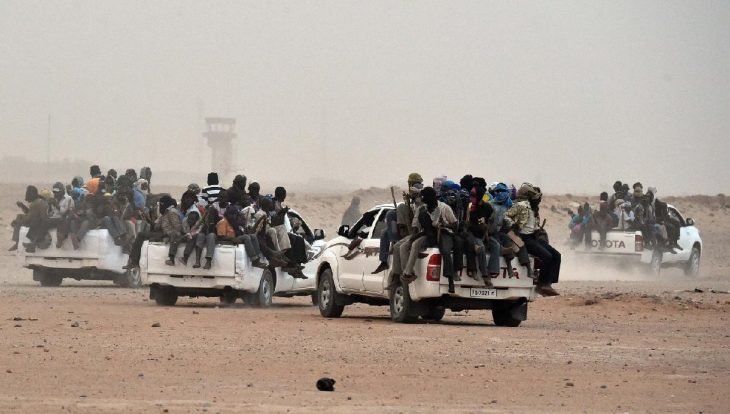
This marketplace has accelerated pre-2011 trends: trans-Saharan smuggling routes have evolved from passageways for the informal trade of licit goods to conduits for the smuggling of weapons, drugs, fuel, counterfeit cigarettes and people.
In the borderlands, smuggling of subsidized goods such as fuel, rice and other foodstuffs has long been a critical element of economic life. Yet reduced subsidies and rises in foodstuff prices have hit consumers and impacted smuggling dynamics.
The absence of state enforcement has enlarged the space for smuggling networks to develop, resulting in an industrialization of the sector in terms of its level of integration and organization. In addition, the proliferation of arms and armed groups within Libya has fundamentally changed the composition of the smuggling sector, forcing out many old actors and enticing new ones.
Smugglers can no longer operate without protection, and this has given rise to a protection market that provides significant opportunities for rent-seeking from armed groups – in many cases, such groups have also become directly involved in smuggling.
Human smuggling
Under Gaddafi’s regime, human smuggling across the Mediterranean had been allowed in relatively limited numbers. This served the dual purpose of providing incentives to local allies of the regime and presenting a mode of exerting political leverage over European states. But following the revolution, the old restraints have ceased to apply.
Since 2013, in particular, Libya has witnessed a significant increase in smuggling and trafficking of migrants, refugees and asylum-seekers (the three are referred to collectively in this paper as ‘migrants’). Although human smuggling and human trafficking are defined differently by the UN, for simplicity this paper refers to both using the term ‘human smuggling’.
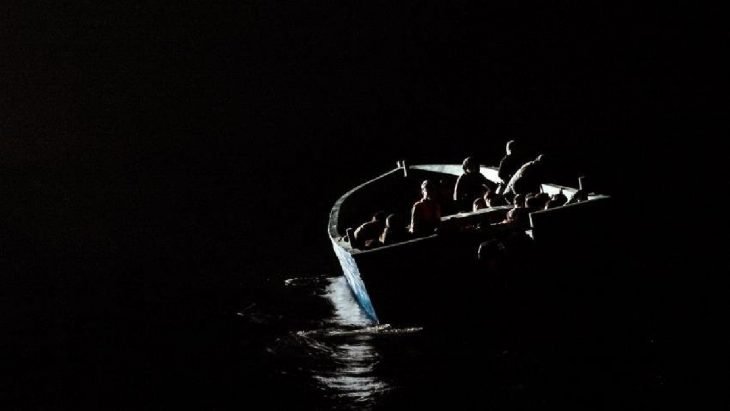
By 2016, Libya had become the main launching point for mixed migration to Europe along the so called ‘Central Mediterranean Route’. In 2012, around 15,000 migrants used this route. By 2016, that number had reached around 163,000.
While this figure is significant, it still represents a relatively small proportion of the overall number of migrants in Libya, which the International Organization for Migration (IOM) estimates at between 700,000 and 1 million.
It should be noted that not all migrants in Libya are seeking to reach Europe. According to IOM migrant surveys, 57 per cent of those interviewed between April and August 2017 listed Libya as their final destination.
Despite the international community’s focus on reducing mixed migration flows into Europe, comparatively little attention has been paid to the underlying political economy of Libya’s human smuggling sector. Yet such smuggling has emerged as a critical component of Libya’s war economy.
While the overall value of illicit economies is both notoriously difficult to estimate and volatile, an indicative assessment by the author estimated that revenues from human smuggling in Libya were around $978 million in 2016. This is equivalent to 3.4 per cent of Libya’s 2015 GDP of $29.1 billion.
The estimate consists of two elements: fees generated from overland travel – $726.3 million; and fees generated from crossings of the Mediterranean – estimated at $251.4 million. In respect of the latter figure, it is worthy of note that the fees are generated from a stretch of coastline less than 300 km in length, with the majority of crossings starting along a section extending less than 110 km between Tripoli and Zwara.
A significant proportion of the revenue from overland travel, meanwhile, is generated in the south of the country. There are thus powerful financial incentives for involvement in human smuggling. Incomes from the sector support a complex array of actors, and also filter down to communities in locations where alternative forms of income are often limited, and where earnings from smuggling cannot be rivalled.
This is particularly true of the south. With regard to those directly involved in human smuggling, some are individuals providing services at local level for small elements of a journey, with only loose connections between the smugglers operating at each location. Others form part of increasingly coordinated transnational networks that organize journeys from beginning to end.
The nature of the relationship between smugglers and armed groups varies significantly depending on the location. In the south, it generally appears that smugglers leverage their local connections – usually ethnic, tribal and familial – to ensure their ability to move through ‘friendly’ areas.
Once they reach areas where they can no longer travel unhindered, they are likely to pass migrants to other smugglers with the connections necessary for the places in question. Many Tebu and Tuareg groups conduct smuggling operations in this decentralized manner.
In the southwest, the hub of Sebha appears to be the most common point of transition between smugglers who handle the cross border flows of migrants from neighbouring states and those who move/facilitate the movement of migrants to the coast.
North of Sebha, and in the northern coastal cities in particular, armed groups are often involved directly in smuggling operations. Even where they aren’t, it is very difficult for smugglers to operate without paying rents to such groups.
In these locations, armed groups physically control staging areas near the coast and launch points for boats. Their de facto control of some official detention centres and outright control of unofficial detention centres present significant opportunities for the extortion of money from migrants.
The Department to Counter Illegal Migration (DCIM), the Libyan state agency charged with running detention centres, often has limited control over these groups.
The city of Zawiya, one of the primary points of departure for migrants travelling to Europe, offers a case in point, and a window into the workings of the war economy. The DCIM centre in Zawiya is in fact under the control of a local militia named the Nasr Brigade.
The militia’s headquarters are on the same site as the detention centre. In June 2017, the UN Panel of Experts on Libya reported having received information that the detention centre was used to ‘sell’ migrants to other smugglers.
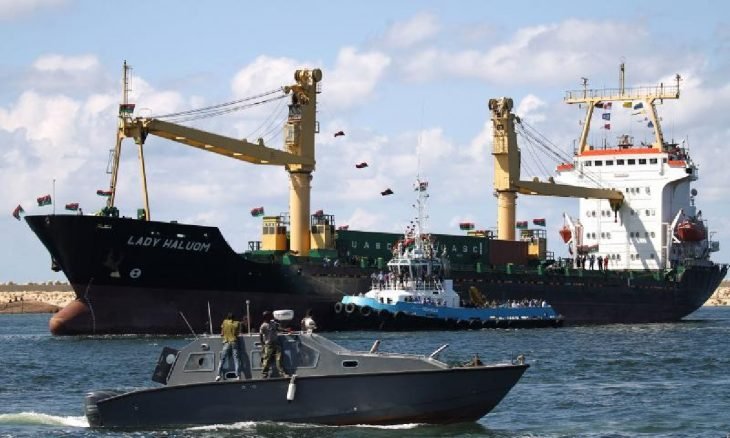
Moreover, the head of the Zawiya coastguard, Abd al-Rahman Milad (also known as ‘Al-Bija’), is reported to be closely connected to one of the Nasr Brigade’s commanders, Mohamed al-Khushlaf. There are numerous reports of collusion between Libyan coastguard units and smugglers, although Milad has denied wrongdoing, insisting that his coastguard unit is responsible for the most interceptions of migrant boats.
Citing interviews with migrants, Amnesty International says that marks are placed on migrants’ boats to signal that the smuggler has paid to secure safe passage out of Libyan waters. Amnesty International’s interviewees allege that the Zawiya coastguard allows through migrant boats when the smugglers have paid the Libyan coastguard.
Migrants in boats that are intercepted go to detention centres including the centre run by the Nasr Brigade – where they can be subjected to extortion. Such extortion includes contacting relatives of detainees to demand ransoms. As with other aspects of Libya’s war economy, entrepreneurs find means of exploiting the situation.
One case reported to the author described the so-called ‘Issma Boys’, a small criminal group that uses jet skis to rob or extort money from migrants already on the boats – having stopped a boat, the group steals from its passengers and/or forcibly returns the boat to the coast in Misrata,where the migrants may face detention or have to pay once again for a crossing.
The Issma Boys are believed to operate on tip-offs from smugglers. The search to maximize profit has led to ever greater dangers for migrants. From 2012 onwards, a combination of a shortage of wooden vessels and the greater proximity of rescue services precipitated a shift towards the use of rubber boats for crossings.
The presence of international rescue boats meant that migrant boats simply needed to reach the ‘rescue zone’ of international waters and no longer needed to reach European waters. The use of rubber boats reduced the costs and logistical burdens for smugglers, who used the presence of international rescuers as an excuse for launching less seaworthy vessels.
Numerous cases have been reported in which a rubber boat full of migrants was towing another boat lacking even a motor. The use of more primitive vessels was reflected in the prices charged for crossings.
In 2013, a crossing cost in the region of $1,000. By the summer of 2016, this had reportedly dropped to $250 in some cases, before reaching an unprecedented low of $60–90 in June 2017. Libyan and international authorities intensified efforts to disrupt human smuggling in 2017. Yet their prevailing approach has involved pay-offs and co-option, bringing a number of pitfalls.
In this context, it is worth focusing in some detail on events in Sabratha, one of the principal launching points for crossings of the Mediterranean. In the opening months of 2017, migrant crossings of the Mediterranean were on track to surpass 2016 levels.
However, in July of 2017, the number of crossings dropped by 50 per cent compared with the same month a year earlier, and by over 80 per cent in August 2017 compared to August 2016, 36 principally as a result of events in Sabratha.
The Anas al-Dabbashi Brigade – a militia led by Ahmed al-Dabbashi, also known as ‘Ammo’ (‘Uncle’) – had previously been heavily implicated in human smuggling in Sabratha. However, the Brigade shifted its approach in 2017, instead seeking to disrupt human smuggling activities following a deal with the GNA (some accounts contend that Italy was either complicit or directly involved in this agreement, but Italian authorities have denied this).
The facilitating mechanism was the formation of a new brigade, Battalion 48, led by Ahmed’s brother, Emhedem al-Dabbashi. Battalion 48 was established under the auspices of the Ministry of Defence in early 2017, initially with a mandate to police the city.
By June, its remit had extended to the prevention of human smuggling. The creation of Battalion 48 appears to have been a means of rebranding elements of the Anas al-Dabbashi Brigade under the auspices of the state.
In August, the Anas al-Dabbashi Brigade issued a statement detailing its discussions with the GNA, along with pictures of new police vehicles that it claimed to have received. 41 The deal appears to have translated into an immediate reduction in migrant departures.
The deal unsettled the power balance among armed groups and sparked local conflict, however. The Dabbashis’ attempt to expand the areas under their control encroached on the activities of other groups, including those involved in smuggling. In September 2017, the Sabratha-based Anti-Islamic State Operations Room launched a campaign to oust the Dabbashis’ forces from the city.
Reports have indicated that, upon the campaign’s conclusion in October, 39 people had been killed and 3,000 forced to flee the fighting. More than 10,000 migrants reportedly escaped from detention centres.
At the time of writing, flows across the Mediterranean have not returned to the levels seen in early 2017. While an approach that involves preventing migrants from leaving the Libyan coast has received significant criticism from human rights groups, the reduction in illegal crossings of the Mediterranean has been seen as a success in some political quarters.
Yet a recent analysis by the Institute for Strategic Studies indicates that the international focus – particularly Italian – on reducing migration has in fact created a market for activities that counter human smuggling.
It has thus reconditioned rent-seeking behaviours, this time catering to European preferences. Such a finding suggests that, should no durable arrangement be made with armed groups by national and international stakeholders, the number of crossings may once again increase.
On a structural level, the deal reinforces the problematic dynamic within Libya’s war economy wherein actors representing the state seek to resolve challenges through pay-offs and the incorporation into the state of groups acting illegally. It is a system, in effect, of many carrots and few sticks.
The principal problem with efforts to incorporate armed groups into the state architecture is that they have been able to retain their chains of command. This means that they operate autonomously, and that in practice they simply get paid twice for their activities.
If the Anas al-Dabbashi Brigade was indeed part of the state military – as its insignia had long indicated – then this had not impeded its involvement in illicit activity.
There is little to stop Libya’s armed groups from seeking to renegotiate their terms from a position of strength, and this also incentivizes others to seek similar accommodations with the state. Such deals reinforce the view of the state as a resource to be raided, rather than as an authority to be respected.
A further impact of pay-offs to groups such as the Anas al-Dabbashi Brigade is that it inhibits the building of credible state institutions to tackle activities such as human smuggling. ‘Yesterday’s traffickers are today’s anti-trafficking force,’ one security official told Associated Press when referring to allegations of the deal in Sabratha.
…
to be continued in part 3
***
Tim Eaton is a research fellow within the Middle East and North Africa Programme at Chatham House, where he has been based since 2014. Before joining Chatham House, he was senior projects manager, Middle East at BBC Media Action, the BBC’s international development charity. He worked across the Middle East on projects in Libya, Iraq and Egypt.
_____________

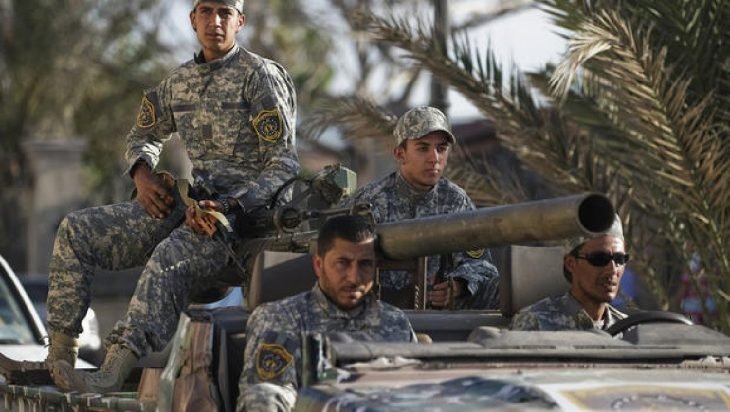
 Since the establishment of the UN-backed Government of National Accord (GNA) in Tripoli, in March 2016, a handful of local militias have gradually brought much of the Libyan capital under their control. Read More