Ballard Partners has close ties to the Trump administration, which is reportedly working on a power-sharing deal in Libya bypassing elections.
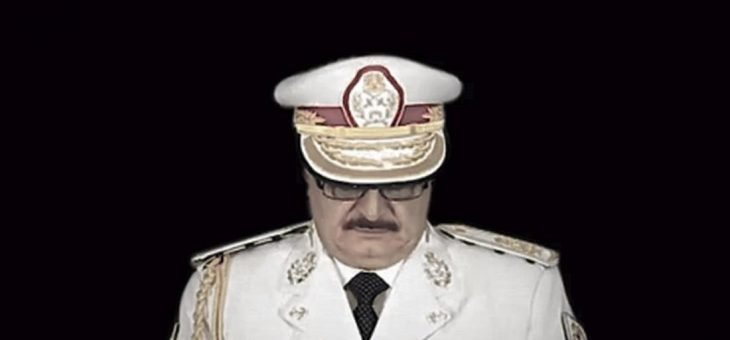
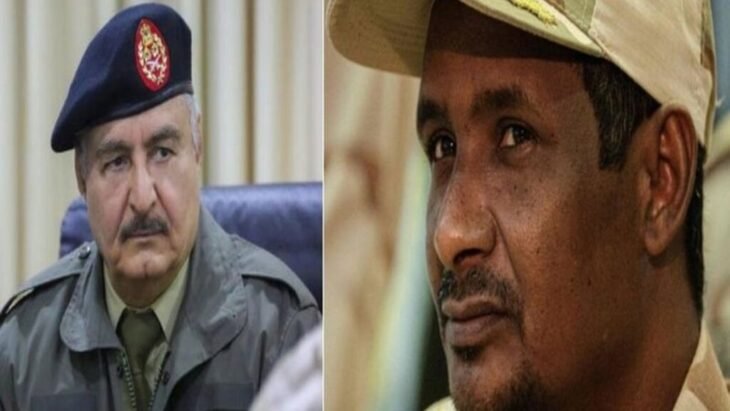
A US lobbying firm closely connected to the Trump administration has been handed a $2m contract to represent Khalifa Haftar, a Libyan warlord and de facto leader of large swaths of the country who faces multiple allegations of human rights abuses.
Lobbying disclosure agreements reported by the Washington Post revealed that Ballard Partners, which is staffed by former Trump administration officials, has agreed to advance the interests of Haftar, general commander of his self-styled Libyan Arab Armed Forces (LAAF), and his son Sadddam, chief of staff of the ground forces.
Haftar and his forces face allegations of human rights abuses, which are reportedly perpetrated in the detention centers they run.
Human Rights Watch (HRW) has called on the leader to investigate these allegations, including torture, summary execution, and the desecration of the corpses of enemy fighters.
The rights group reported that “people who disagree with the Hafter clan have been unlawfully killed, arbitrarily detained, tortured, ill-treated and forcibly displaced”.
Haftar has faced multiple US lawsuits filed by Libyan families, including an ongoing case that alleges he “intentionally and deliberately tortured” family members of the plaintiff.
In 2022, a US court found Haftar liable for war crimes against several Libyan families who have accused him of extrajudicial killings and torture. Haftar’s legal team denies all allegations – some cases have been dismissed, but at least one is pending.
Libya has endured years of violence since a Nato-backed uprising toppled and killed longtime autocrat Muammar Gaddafi in 2011, with rival administrations and scores of militias battling for power.
Haftar has emerged as the de-facto leader of the country’s east and south, and has attacked the UN-recognised Government of National Accord (GNA) which controls the west, including the capital Tripoli.
‘Highly problematic’
The signing of the lobbying contract comes amid moves by Haftar to solidify his family’s control over eastern Libya. Each of Haftar’s five sons holds powerful positions, with his youngest, Saddam, likely to succeed him.
Saddam recently met with several US officials, including Trump’s advisor on Arab and African affairs, Massad Boulos, and the US charge d’affaires in Libya, Jeremy Brent, according to a statement by the US embassy on X.
HRW assistant director for the Middle East and North Africa, Hanan Salah, warned that engagement with Haftar and other figures implicated in the alleged abuses is “highly problematic”.
“Instead of ensuring that these people are held accountable first for any violations that may have been committed, we’re seeing that they’re being brought in and that they’re being sort of presented as … the future political elite of this country,” she said.
According to a report by Africa Intelligence last week, Boulos is considering a power-sharing deal between Haftar and GNA Prime Minister Abdul Hamid Dbeibah, and bypassing elections.
Under the proposed arrangement, Haftar would retain control over security and military forces, while Dbeibah would continue to head the civilian executive.
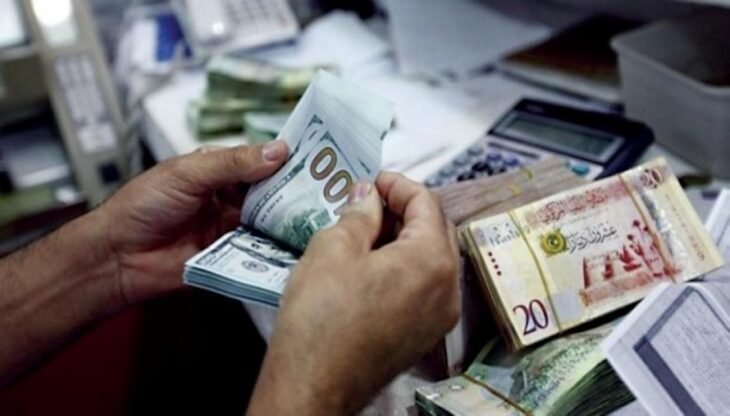
When the Libyan dinar weakens in the parallel market, public debate often attributes the movement to speculation, seasonal liquidity shortages, or political noise. These factors can shape short term mood in the market, yet the deeper driver is longer lasting and easier to measure.
In this context, the instability of the dinar is structural. At the heart of the issue lies a foreign exchange gap, a sustained imbalance between the country’s external earnings and its demand for foreign currency.
The Numbers Behind the Pressure
According to official data published by the Central Bank of Libya, total foreign exchange usage in 2025 reached approximately $31.1 billion, while oil revenues, as reported by the National Oil Corporation, amounted to roughly $22.1 billion. This resulted in an annual shortfall of nearly: $9 billion
On a monthly basis, the imbalance becomes even clearer:
Average FX demand: approximately $2.6 billion
Average oil inflow: approximately $1.8 billion
Monthly gap: roughly $700–800 million
This gap is grounded in simple arithmetic. A deficit of that size steadily translates into exchange rate pressure under virtually any regime.
Where the Dollars Go
Central Bank breakdowns of foreign exchange allocations show heavy concentration:
Letters of Credit account for roughly 50% of total FX usage.
Personal transfers account for approximately 25%.
Nearly three-quarters of foreign currency demand is therefore concentrated in two channels. This concentration matters. Measures that do not meaningfully influence these segments may calm to day volatility, yet the overall path remains largely unchanged.
Recent allocations, including approximately $600 million in personal transfer settlements, represent around one quarter of typical monthly FX demand. Steps like these can support confidence and reduce stress temporarily, especially when markets feel tight.
Reserves: Stock Is Not Flow
The Central Bank reports net foreign assets exceeding $100 billion, while total external assets across state institutions are often cited above $150 billion. Reserves play an important role as a buffer. At the same time, exchange rate stability is ultimately shaped by ongoing inflows and outflows.
Between Q3 2024 and Q3 2025, Central Bank balance sheet data indicate that net foreign assets improved by roughly $8–9 billion. Yet gold revaluation accounted for approximately $5.3 billion of that increase. The improvement in non-gold assets was significantly smaller.
Valuation effects can lift the balance sheet and strengthen headline metrics. Trade settlement capacity, however, depends on liquid and recurring inflows. In a flow constrained economy, accounting gains offer reassurance, while sustained inflows provide the durable anchor. Markets recognize this distinction. That is why the parallel premium persists despite large headline reserve figures.
Liquidity Expansion and Exchange
Pressure
Monetary statistics published by the Central Bank show that broad money (M2) expanded by over 20% year-on-year during the same period.
When domestic liquidity grows at double digit rates while foreign currency inflows remain constrained, exchange pressure tends to build and the exchange rate becomes the adjustment point. This dynamic also aligns with straightforward portfolio choices, as households and firms seek to protect purchasing power.
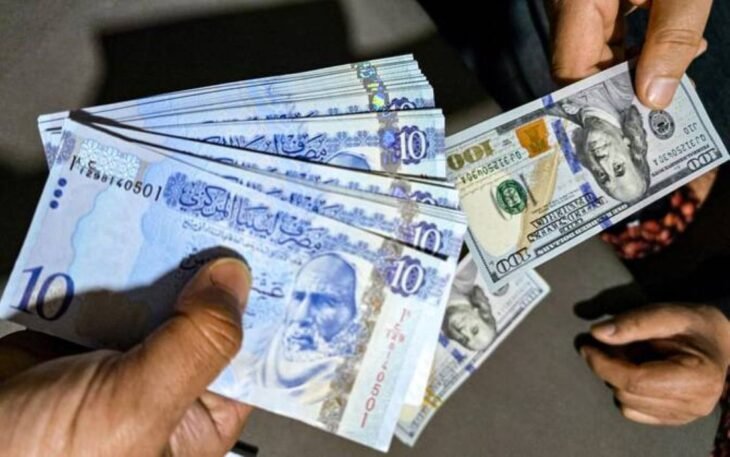
The widening premium between the official rate (6.30 LYD/USD) and the parallel rate (hovering near 10 LYD/USD) — a divergence exceeding 50% — signals:
Fiscal pressure on monetary policy,
Excess domestic liquidity,
Persistent FX mismatch,
Weak coordination between fiscal and monetary authorities.
Exchange rate instability is therefore a reflection of governance constraints, not merely market sentiment.
The Institutional Constraint
The Central Bank operates within a politically fragmented environment, facing competing fiscal demands. Aggregate public expenditure exceeds 130 billion dinars annually, while non-oil revenues remain structurally weak. Under such conditions, monetary policy becomes reactive rather than strategic.
The Central Bank can smooth volatility. It cannot eliminate structural imbalance without fiscal consolidation and institutional alignment.
2026 Outlook: Three Scenarios
The trajectory of the dinar in 2026 depends on whether the FX gap narrows.
Controlled Adjustment: If foreign currency usage declines by 15–20%, through disciplined import management, fuel subsidy reform, and tighter liquidity control, the annual gap could shrink by $4–6 billion. In this case, the parallel premium would likely compress gradually.
Status Quo Persistence: If usage remains near $28–30 billion while oil inflows fluctuate between $16–20 billion depending on price and production, the structural gap remains embedded. Volatility continues, and depreciation risk persists.
External Shock: A sustained oil price decline below $60 per barrel would widen the gap significantly, prompting rapid repricing in the parallel market.
Stability Requires Alignment, Not
Intervention
Libya has meaningful resources, and the key variable is how effectively fiscal policy, monetary management, and external earning capacity move together. As long as annual dollar demand exceeds annual supply by billions, the exchange rate will keep reflecting that balance.
Reserve draw-downs, valuation gains, and episodic interventions can buy time and reduce stress. Structural correction, however, comes from materially narrowing the foreign exchange gap. Exchange rate stability in Libya will emerge when the foreign exchange gap narrows materially. Until then, the dinar will continue to reflect arithmetic rather than rhetoric.
ITV News Correspondent John Ray was sent to Libya in 2011 to capture the dramatic fall of Gaddafi in the Arab Spring.
***
Here are some lessons from
recent history.
How it can all go horribly wrong. How luck and fine margins mark the boundary between triumph and disaster. How so often you don’t see that boundary until you’ve stepped over it.
The setting is Libya. It’s 2011. Western warplanes are trying to bomb out of business an autocratic regime that’s just turned its guns on thousands of its own citizens. Sound familiar?
Specifically, it’s the early hours of August 22. I’m in a cramped little car that stinks of the fumes from several jerry cans of petrol, part of the unwieldy kit of cameras, body armour, and generators needed to carry the ITV News team through this chaos.
I am a very nervous correspondent, wondering whether I will hear the burst of machine gun fire I expect any moment to finish us. Or whether I’ll be dead before the sound of the bullets reaches me.
But my team is top rate: cameraman Rob Bowles, editor Patrick O’Ryan-Roeder, our security man Garry Curtis and two very brave local drivers.
We believe we’re heading to a safe haven for the night. But, we’re about to hand ourselves over to the regime of Colonel Gaddafi, to check into a gilded prison.
We’ve been told the Rixos Hotel, home throughout the crisis to the world’s media, has been liberated. We’ve been promised this by two separate sources. Unfortunately, their source is the same man … and he is wrong.
At the hotel’s grand entrance, we’re greeted by two impressive sights. The portrait, intact, of a haughty Gaddafi adorning a reception.
And then, a group of journalists, moving like dazed extras in the final reel of a disaster movie, who mistake us for a force come to free them. “Can you get me a ticket to Paris?” one asks me.
Within moments, a group of gun-toting regime fighters turns up. There will be no tickets to Paris, or to anywhere, for the hotel’s inmates.
This was the dispiriting climax to several days of great excitement and great fear as we witnessed and, as this ITV News series says, reported history.
We’d followed the rebels’ advance into the capital. I’d seen fighters shot in front of me. We were trapped for a while at the front line and came under mortar fire.
I learned, as we fled the scene lying flat on the back of a speeding truck, the difference between the sound of outgoing gunfire and the whizz of bullets flying just above our heads.
Then, disaster. As we drove down a tree-lined road parallel to the battle, I remember seeing ahead that one, a blackened stump, was still burning.
At the precise moment we passed, it toppled, smashing the windscreen of our pick-up and then bouncing over the roof.
On the back of the truck, as ever and by choice, as if leading us into battle, had stood our fixer. A Mancunian Libyan named Essam. An enthusiast for the uprising, our only Arabic speaker, and an integral part of the team.
Now he lay motionless. For a horrifying moment, we were convinced he was dead. But Garry, a trained medic, found breath in his body. His helmet had saved his life.
Still, the injuries were significant. We spent the rest of the morning finding a field hospital. ITN arranged safe passage back to the UK.
But by now the story had raced ahead of us. The rebels had reached the capital. That night, we felt under huge pressure to follow them into Tripoli.
So after much discussion and against the initial judgment of more experienced members of the team – and with two new cars and two young drivers from the village that had been at our base – we set off into the darkness.
We reached Green Square as the victory party ended. When I look back on the report we filed, I can see I share some of the joy and optimism of the moment. I think – or at least hope – it’s all over.
But it wasn’t. We were warned that regime soldiers were coming. We needed to find somewhere to spend the night.
I woke the next morning in the Rixos to the oppressive reality of the catastrophic blunder I’d made to put the team into the hands of the regime.
Up to that point, even at the front line, if in doubt, we could get out. In the hotel, we felt trapped like rats.
There followed two or three surreal days. The battle for Tripoli raged around us. A round came through our window. We worked, we reported, we filed stories. It helped keep our minds off recurring and uncomfortable questions.
What happens when the rebels come?
Is this where the regime will make its last stand?
What will they do to the hostages? Release us, or kill us?
Escape seemed the best option. Our first attempt didn’t go well. We loaded up our cars with a simple plan to style it out down the hotel’s wide driveway.
But we were stopped and then held at gunpoint by a very twitchy group of young regime loyalists. They were armed with AK47s. They shouted and pointed their guns at us. A lot. Then they took our passports. Worse, they accused us of being Israeli spies.
These were anxious hours, in which our fate seemed to depend on the whims of a gang of jumpy teenagers. And yet, after a while, inexplicably, they seemed to lose interest in us. I don’t know why.
Eventually, we headed back to our rooms. There, I retrieved from my bag a tube of toothpaste that had Hebrew writing on the side. I put it above in the ceiling tiles. It might still be there.
For the next attempt to bust out – a plan hatched by Rob and Patrick – we abandoned the cars and headed for a fire door at the rear of the hotel. We ran as fast as middle-aged men in flak jackets can across tennis courts and then shimmied over a low wall.
A van was passing. We flagged it down. The driver took us in – and then to our horror, headed straight to the sound of fierce battle close by. He stopped only when he came to a bullet-ridden car slewed across the lane ahead. A corpse lay next to it.
The moment of liberation was sweet but undramatic. A U-turn, a short drive, at pace, down the wrong side of the highway, and then a turn into an area held by rebels. A call to the news desk in London that we were out and safe. There was one last act to return to the hotel for our two drivers. More than anyone, their lives had been in peril.
If they’d been caught by our guards, as two young men from an opposition town helping “foreign spies” … we could all work out the likely consequences. Patrick and Garry went back to the Rixos and arrived just as the real Red Crescent turned up.
What happened to our captors, I never found out. The siege of the Rixos ended peacefully, and a couple of days later, I was heading out of Libya with a story to tell my wife. It is not a story of journalistic triumph but is one of survival; of disaster, just about averted.
Perhaps it’s the same for Libya. Gaddafi was tracked down and butchered. But the uprising did not result in the kind of future that the West had promised.
Today, it is divided between two rival governments and is best known as a key jumping-off point for migrants headed to Europe.
All this is fresh in my mind as I watch Iran and wonder about the laws of unintended consequences and whether the world has already stepped over one of those invisible borders between triumph and disaster.
***
John Ray is a Correspondent for ITV News. He was formerly Africa Correspondent, Middle East Correspondent and was the first Western TV journalist to report from inside Syria’s borders at the start of the war.
Libya’s Central Bank is reportedly preparing to cancel the commodity tax and apply a unified exchange rate of 6.37 dinars to the dollar across all uses, including personal transactions, imports, education, and medical expenses. On paper, the move looks like a technical adjustment. In practice, it could become one of the most meaningful changes to Libya’s economic framework in recent months.
That is because the issue goes well beyond tax policy. At stake is whether Libya can begin to simplify a foreign exchange system that has long operated through multiple prices, uneven access, and persistent uncertainty. In an economy as import dependent as Libya’s, the dollar is not just a financial instrument. It is a daily economic fact. It helps shape the price of food, medicine, tuition, consumer goods, and the cost structure facing nearly every trader and importer in the market.
This is what makes the Central Bank’s reported plan important. For years, Libya has lived with a fragmented currency reality. There has been the official rate, the effective rate citizens and businesses actually face through formal channels, and the price signaled by the parallel market. When one economy runs on several prices for the same dollar, confusion is inevitable. So are distortions. Businesses struggle to price accurately, consumers lose confidence in the formal system, and the gap between policy and lived economic reality grows wider.
The appeal of a unified exchange rate is therefore easy to understand. One clear rate would, in theory, make the system easier to navigate. Importers would be able to estimate costs more accurately. Families paying for treatment or studies abroad would face less confusion. Retailers and wholesalers would have a more stable benchmark for pricing goods. In a country where uncertainty often becomes an added cost in itself, clarity carries real value.
This point matters because Libya’s economy can absorb a difficult price more easily than a confusing one. Markets can adapt to a more expensive dollar when that price is transparent and consistently available. Businesses can revise margins, negotiate with suppliers, or pass on part of the cost over time. What is much harder to manage is a market where access to foreign currency is unpredictable and where official pricing does not always align with economic behavior on the ground. In such an environment, businesses do not merely price goods. They price risk, delay, and uncertainty.
Removing the commodity tax could help reduce some of that distortion. The tax has acted as an added burden on access to foreign currency, raising the effective cost of dollars even when the official rate appeared lower on paper. In that sense, scrapping it could make formal access more straightforward and potentially lower some of the hidden costs embedded in the import cycle. For an economy already facing inflationary pressure and strained household purchasing power, that would be a welcome step.
But the real test lies elsewhere. A unified exchange rate is only useful if the market believes it. That may sound obvious, yet it is the central issue. Exchange rate policy does not succeed because a new number is announced. Exchange rate succeeds when traders, households, and firms begin to treat that number as credible. In Libya, that means the official market must offer not only the right rate, but also reliable access, reasonable speed, and enough consistency to pull demand away from informal channels.
If that does not happen, the parallel market will continue to act as the economy’s shadow benchmark. Importers will still hedge against shortages. Consumers will still assume that official channels cannot fully meet demand. Businesses will continue to price goods with one eye on the banking system and another on the street. In that case, the reform may simplify the formal framework without changing the deeper logic of the market.
This is why credibility matters more than design. Libya’s foreign exchange problem has never been purely about arithmetic. It has also been about trust. When people lose confidence that dollars can be obtained smoothly through official channels, they stop treating the official rate as the real one. Once that happens, the state may still set a rate, but the market quietly chooses another. Closing that credibility gap requires more than a cleaner policy structure. It requires implementation that is broad, timely, and dependable.
There is also a larger macroeconomic context that should not be overlooked. Libya’s foreign exchange pressures reflect deeper structural imbalances, including dependence on oil revenues, high public spending, and recurring mismatches between the supply of foreign currency and demand for it. A unified rate may reduce distortion, but it cannot by itself solve those underlying pressures. It can make pricing more transparent. It cannot eliminate the broader vulnerabilities that keep the currency under strain.
Still, that should not diminish the potential importance of the move. Simplification has economic value of its own. So does transparency. For too long, Libya’s exchange rate system has asked households and firms to navigate too many layers of uncertainty. One dollar has not always carried one meaning. That has weakened planning, inflated risk, and given the informal market too large a role in shaping expectations.
Seen in that light, the Central Bank’s reported shift is not just a technical reform. It is an attempt to restore a basic principle to economic life: that a currency should have a clear and trusted price. Whether this effort succeeds will depend not on the announcement alone, but on what follows it. If official foreign currency access becomes smoother and more credible, the move could help narrow distortions and improve confidence in the formal market. If not, Libya may end up with a cleaner policy on paper while the real economy continues to take its cues from elsewhere.
The question, then, is not simply whether the country can move to one dollar and one price. It is whether Libya’s institutions can make that price believable enough for the market to follow.
PM Aldabaiba reopens Tripoli Zoo after a 17-year closure: a symbolic turnaround for the Zoo – from a militia military base back to a leading recreation destination.
***
After a 17-year closure, Tripoli based Libyan Prime Minister, Abd Alhamid Aldabaiba, officially opened Tripoli Zoo today after the completion of its renovation and rehabilitation by the Tripoli General Services Company. The Zoo will open to the public on the first day of Eid.
During his tour of the Zoo with its management, and accompanied by children from the Tripoli’s Children’s Home and several families, Aldabaiba was briefed on its readiness to receive visitors and to return to being a major entertainment destination that gathers children and their families in the atmosphere of Eid.
During the tour, the Prime Minister inspected the extensive maintenance and development work carried out on the nearly 45-hectare zoo.
Comprehensive civil works were implemented, including the renovation of more than 80 restrooms, the refurbishment of the main arena with granite marble, the rehabilitation of the water, sewage, and electrical networks, and the modernization of the animal enclosures and houses. Painting and renovation work covered more than 45,000 square meters.
The work also included upgrading the technical systems, with the installation of more than 450 surveillance cameras, audio, alarm, and security systems, and modern electronic gates for access control.
On the environmental front, extensive landscaping and planting work was carried out, including the supply of more than 9,000 trees and shrubs of approximately 70 different species, the creation of green spaces and integrated irrigation networks, as well as the development of children’s play areas and recreational facilities.
From military base to recreational center
The reopening of the zoo is symbolic in that during the civil war and Hafter’s war on Tripoli, the zoo became a security and military base for the then local Busleem militia, the Support and Stability Agency (SAA).
It was targeted by the Hafter forces during his war on Tripoli in long range tit-for-tat shelling as the SAA had used the extensive grounds and the cover of the woods within the zoo as the launching pad for its shelling of his forces in the south of Tripoli.
After the fall of the SAA as a militia, the authorities subsequently discovered mass graves in its grounds believed to have been buried by the SAA.
The return of the operation of the zoo completes its turnaround into the leading and most popular recreational center in Tripoli for decades.
• An important feature of the conflict in Libya post-2011 has been the rise of airstrikes by multiple domestic and international belligerents. At least four foreign countries and three domestic Libyan factions are reported to have conducted air and drone strikes in Libya since 2012.
• According to reports by some of the belligerents as well as news reporting and accounts in social media, the nations and local groups operating in Libya have conducted at least 2,158 airstrikes and drone strikes between September 2012 and June 10, 2018.
• According to news reports and accounts on social media, at least 237 civilians were killed in these strikes, taking the lowest estimate, and as many as 387 killed, by the highest estimate. No nation or local group has stated responsibility for any of these civilian deaths. This study is the first overall accounting of these civilian deaths.
• In addition to civilian fatalities, according to news reports and individual accounts on social media, at least 324 civilians were wounded in airstrikes, by the lowest estimate, and 524, taking the highest estimate.
• Less than 50 percent of all reported airstrikes are officially declared. A lack of international media reporting on the air war has helped to obscure the fact that a number of countries elect not to report their air strikes in Libya, including France, the United Arab Emirates and, at times, the United States and Egypt.
• Reported civilian deaths from airstrikes in Libya are relatively low when compared to higher-intensity conflicts in, for example, Iraq, Syria, or Yemen. Casualty estimates more closely match at present those from lower-intensity counterterrorism campaigns, such as the U.S. drone program in Pakistan and Somalia, albeit over a shorter time period. (This may reflect the fact that reporting mechanisms for civilian deaths in Libya are slight compared to countries such as Syria.)
• Libya’s civil war began in earnest in May 2014, and almost 250 strikes reportedly occurred that year, which were conducted mostly by the Libyan National Army. This was followed by a slowing of strikes in 2015, as Gen. Khalifa Haftar’s ground campaign targeting Islamist militias spread across the country. In contrast, 2016 and 2017 were high-volume years for airstrikes, with 1,015 and 574 reported strikes, respectively. This jump in numbers was in part due to a 2016 U.S. military operation targeting ISIS that involved 495 air and drone strikes on the city of Sirte.
• Most strikes between September 2012 and June 10, 2018, have reportedly occurred in Benghazi, Sirte and Derna, cities that were high-conflict zones during the Libyan rebellion and the 2011 NATO intervention. ISIS controlled territory in both Derna and Sirte in 2015 and 2016, contributing to high volumes of strikes in those locations. However, heavy bombardments of these cities in recent years have not been accompanied, as might be expected, by significant local reports of civilian harm.
This may indicate a local under-reporting of the issue, which could be explained by difficulties accessing these cities during the high-volume periods of airstrikes. Additionally, Libya lacks local monitors such as the Syrian Network for Human Rights, which assesses civilian harm in Syria.
• Gen. Haftar’s LNA has reportedly conducted 1,112 airstrikes in Libya since 2014—more than any other belligerent. These have reportedly resulted in 95 civilian deaths at minimum and potentially as many as 172 noncombatant deaths, based on the highest estimates. These fatalities account for almost 40 percent of the documented civilian deaths in our database—the highest reported number for any belligerent.
• Of the four foreign states conducting strikes in Libya, the United States is the most transparent about its operations. The United States conducted the campaign Operation Odyssey Lightning against ISIS forces in Libya from Aug. 1, 2016, to Dec. 19, 2016, which included 495 air and drone strikes, according to the U.S. Africa Command. (It reopened the operation for a single day on Jan. 19, 2017.)
The U.S. military self-reported these strikes. However, the United States may be inconsistent with its strike reporting. Our database includes 15 strikes attributed in local reports to the United States that have not been confirmed by American officials.
• According to our data, the United States has conducted 524 strikes on militant targets in Libya since the NATO intervention, primarily at Sirte during 2016, which according to Libyan reports resulted in 10 to 20 civilian fatalities, based on the minimum and maximum estimates in our database.
• Some strike allegations report different parties as responsible for the same strike (e.g., a local report might claim the LNA conducted a strike, while an international outlet reported that Egypt was responsible for the same action). Based on contested cases like these that implicate both the United States and another party, the United States could be responsible for up to 54 additional civilian deaths in Libya, primarily as a result of its strikes in support of Libya’s internationally recognized Government of National Accord, known as the GNA.
• Like the United States, the LNA faction has also declared many of its airstrikes. Between them, the two belligerents account for more than 75 percent of reported strikes. However, neither party has publicly accepted responsibility for any reported civilian casualties.
• The GNA has reportedly conducted 54 strikes, which have resulted in at least seven and at most nine civilian fatalities, according to local reports. However, the GNA could be responsible for as many as 54 additional civilian deaths, based on strike allegations that name more than one country or local group as responsible for certain strikes.
• The United Arab Emirates, which conducts actions in support of the LNA, has reportedly conducted at least 35 strikes in Libya, which are said to have resulted in at least 11 and potentially as many as 18 civilian deaths.
• Egypt also conducts strikes alongside the LNA, as well as unilateral actions against suspected militants on its borders. At least 41 strikes have been declared or reported, which have resulted in at least 13 and at most 14 civilian deaths, according to local and international sources.
• France has reportedly conducted at least five strikes in Libya, which have resulted in a minimum of four and potentially as many as eight civilian deaths. France might also be responsible for a single strike on Aug. 12, 2016, that hit an urban area in Benghazi, killing more than two dozen civilians by some estimates. Sources blamed both the LNA and France for this strike.
• 132 airstrikes in our database have been attributed to more than one party in reports of the incident. For example, one source might say France conducted a strike in a specific location, while a separate source blames the LNA for a strike in an identical location on the same day.
Theoretically, the strike may have been conducted by both parties jointly, or perhaps was misattributed to one of the parties. Since we can’t be sure, these 182 strikes, and the 83 resulting civilian deaths are considered “contested” in our database and aren’t included in the total strike and casualty estimates of each individual belligerent, underscoring the need for belligerents to report airstrikes and investigate allegations of civilian casualties.
• Based on news reports and social media accounts, the number of militants that have been killed in airstrikes in Libya range from a minimum of 778 to 966, taking the highest estimates. However, it is unclear how local belligerents and foreign militaries distinguish ‘enemy fighters’ from noncombatants and whether these distinctions are the same across aerial conflict participants.
Bangladesh is one of the most significant countries of origin within the global migration landscape, with millions of its citizens seeking opportunities abroad through both regular and irregular means. Overseas employment has long been a defining feature of Bangladesh’s development trajectory, supporting household incomes and national growth through remittances.
Today, the Gulf Cooperation Council (GCC) countries and Southeast Asia remain the primary destinations for Bangladeshi labour migrants. However, Libya and Italy have also formed part of this broader migration landscape for decades. In recent years, Bangladeshi nationals have consistently ranked among the top nationalities arriving irregularly in Italy, particularly via the Central Mediterranean Route.
Although this corridor remains small compared to established labour migration channels to the Gulf and Malaysia, it has become an increasingly visible and organised pathway to Europe. This trend has been enabled by the emergence of a hybrid migration system in Libya, in which formal entry and residence mechanisms coexist with irregular onward movement.
Within this system, migrants are able to enter Libya through semi-regular channels but subsequently rely on smuggling networks to reach Italy. At the same time, socioeconomic pressures in Bangladesh have intensified, marked by rising unemployment, high living costs, and limited diversification of the domestic labour market.
In parallel, disillusionment with regular migration pathways to the Gulf and Malaysia, often characterized by debt, exploitation, and restricted mobility, has affected their appeal. These overlapping dynamics have created fertile ground for brokers and intermediaries to promote the Libya–Italy route as a viable and desirable alternative. Italy is perceived as a destination where migrants can aspire not only to better economic opportunities but also to a greater sense of dignity and long-term security.
Stories of regularization through past campaigns, family reunification, and social mobility within Italy’s large Bangladeshi diaspora have strengthened its image as a country where hard work can eventually lead to stability and belonging.
For many aspiring migrants, Italy represents an escape from the exploitative yet legal systems of Gulf migration, embodying the possibility of both livelihood and transformation. In light of the growing number of Bangladeshi migrants arriving in Italy via Libya, this report seeks to examine the mechanisms underpinning this movement and to address a critical evidence gap. Despite the visibility of this corridor, little is known about how Bangladeshi migrants reach Italy, or about the actors and processes that facilitate their journeys.
This study therefore explores the motivations, journey planning, facilitation networks, financial arrangements, and protection risks that shape this evolving migration system. By mapping these interconnected dimensions across origin, transit, and destination contexts, the report contributes to a more comprehensive understanding of one of the most complex and underexplored migration corridors linking South Asia and the Central Mediterranean.
Profiles
This research reveals that Bangladeshi migration to and through Libya is not a single, uniform phenomenon but rather a spectrum of experiences shaped by differing levels of agency, information, and exposure to risk. Migrants’ pathways vary according to how informed their decisions are, the degree of deception they encounter, and the conditions they face along the route.
These diverse trajectories can be charted across a continuum of vulnerability, ranging from:
(a) low-risk or planned migration, where individuals travel to Libya through relatively structured channels with valid documents and clear intentions to work there;
(b) medium-risk or deceptive journeys, where misinformation and financial pressure push migrants into irregularity; and
(c) finally to high-risk or exploitative experiences, where individuals are subjected to trafficking and forced labour.
Low risk/planned
Planned labour migrant in Libya
This profile represents the least vulnerable group within the spectrum of Bangladeshi migration to Libya. These migrants travel from Bangladesh with the intention of working legally in Libya, often through semi-formal or formal labour channels, and without plans for onward movement to Europe.
Their journeys are comparatively structured and better resourced, reflecting a higher degree of agency and informed decision-making than other profiles in this study. Historically, labour mobility schemes between the Bangladeshi and Libyan governments enabled official recruitment and placement, channeling arrivals primarily to western Libya, where the internationally recognized government and its labour administration are based.
In recent years, however, an increasing number of Bangladeshi workers have entered through eastern Libya, drawn by reconstruction activities under the Libyan National Army (LNA), which have generated a demand for foreign labour and an alternative system of entry.
According to IOM’s Displacement Tracking Matrix (DTM), in 2024, only 11 per cent of Bangladeshi migrants in Libya reported using migration facilitators to reach the country. The majority stated that they held valid passports and work permits, suggesting entry through relatively regular channels.
Among those employed, 87 per cent reported having permanent or fixed-term contracts, which is higher than the rate for all migrants in Libya (78 per cent). These findings suggest two distinct Bangladeshi populations in Libya: one that migrates to work and remains (captured by DTM statistics), and another that transits Libya for irregular onward movement to Italy (most likely not captured by DTM).
While this group faces fewer risks than others in the spectrum, it is important to recognize that the risk of exploitation, wage theft, kidnapping, and poor living conditions remain common. What distinguishes this profile is not the absence of vulnerability, but the relative predictability and stability of their migration experience compared to those who enter Libya irregularly or are deceived along the way.
Their journeys tend to be self-financed—through family savings or modest loans—and largely insulated from the high-risk smuggling networks that dominate the Libya–Italy corridor.
However, as the profiles presented later in this section demonstrate, even planned and documented migration can deteriorate under the pressures of Libya’s volatile security environment and governance gaps.
Several migrants who initially entered Libya through regular channels ultimately found themselves trapped in cycles of abuse or extortion, prompting their eventual departure. These experiences are explored in greater depth in the “Returnee/ Escapee” profile that concludes this spectrum.
Italy aspirant
This profile consists primarily of young men who travel from Bangladesh to Libya with the explicit aim of reaching Italy. They represent the more mobile end of the low-risk category: migrants whose journeys unfold largely according to plan, even within an inherently volatile and dangerous environment. Since 2022, most have entered through eastern Libya, taking advantage of the relatively open visa and entry system that has emerged under the Libyan National Army (LNA), detailed in subsequent sections. In DTM Europe’s 2024 Flow Monitoring Survey, Bangladeshi respondents were primarily surveyed in Italy, reflecting their strong presence among arrivals on both the Central Mediterranean and Western Balkans-Italy routes.
The Bangladesh-specific profile shows a highly consistent demographic pattern: all respondents were men, and nearly three-quarters were aged 18–29. Many reported lower-secondary education and previous employment before departure, with most having worked in sectors such as agriculture and construction. Economic motivations dominated their migration decisions, cited by roughly three-quarters of Bangladeshi respondents (76–78%). The concentration of Bangladeshi interviews in Italy, together with the profiles of those surveyed there, underscores Italy’s central role as the main point of arrival and primary destination among Bangladeshi migrants captured in the 2024 FMS.
Interviews for this study reinforce these patterns and demonstrate that the majority came from close-knit family structures in which migration decisions were collective. Fathers or older male relatives typically negotiated with brokers and financed the journey. Migration was therefore not an individual act of risk-taking but a family project to secure long-term stability. Unlike Gulf migration, which is temporary and cyclical, movement towards Europe is perceived as permanent. These migrants are generally educated enough to aspire to better opportunities abroad but lack the qualifications to access regular migration channels.
While their journeys are considered the smoothest within this spectrum, they are far from risk-free. Even those who move quickly through Libya must navigate territories controlled by armed groups, repeated checkpoints, and widespread extortion. Passage from eastern to western Libya exposes them to the same networks of coercion and rent extraction that entrap others for far longer.
Their crossings to Italy, which are usually by sea from the western coast, remain highly perilous. However, compared to other profiles, they face fewer unexpected disruptions and a higher likelihood of arrival. In this sense, the Italy Aspirant embodies the most “successful” iteration of a high-risk system, where relative luck, timing, and connections reduce, but never eliminate, the dangers of the route.
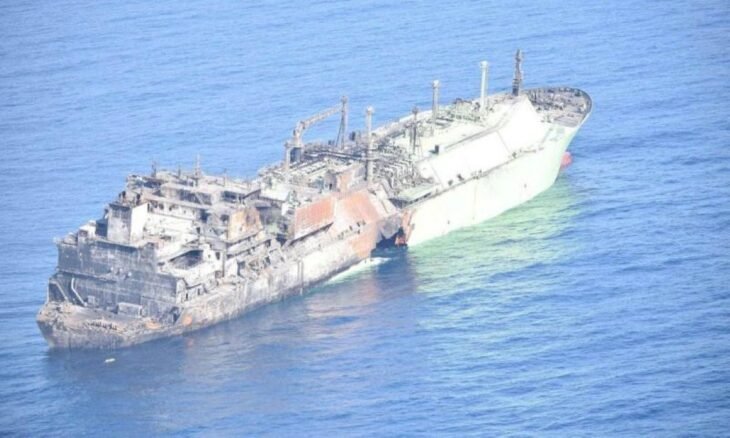
The ship is carrying 700 metric tonnes of different types of fuel and “a substantial amount of natural gas”.
A Russian LNG tanker, Arctic Metagaz, damaged earlier this month and currently adrift without crew, floats in international waters in the Mediterranean Sea between Malta and the Italian islands of Lampedusa and Linosa, not far from the Tunisian coast.
Italy, France and seven other nations told the European Commission that a Russian liquefied natural gas tanker adrift in the Mediterranean represents an ecological threat, and they urged swift action, a letter showed on Monday.
Russia’s foreign ministry acknowledged that the vessel was adrift in the Mediterranean and said Russia’s further involvement in resolving the situation depended on “specific circumstances”. The letter from EU states to the European Commission said the Arctic Metagaz was drifting in waters between Malta and Italy.
The ship poses a threat to the maritime environment in both northern and southern shores of the Mediterranean.
Its state posed a “dual challenge”, upholding maritime safety and preventing an ecological disaster against the background of EU sanctions imposed on Russia. “The precarious condition of the vessel, combined with the nature of its specialised cargo, gives rise to an imminent and serious risk of a major ecological disaster in the heart of the Union’s maritime space,” the letter said.
The EU said the vessel was part of Russia’s “Shadow Fleet” intended to circumvent sanctions imposed in connection with Russia’s 2022 invasion of Ukraine.
Action to resolve the situation, including surveillance, monitoring and other technical support, risked “undermining the integrity, effectiveness and the deterrent value of the EU sanctions regime”.
Russian Foreign Ministry spokeswoman Maria Zakharova said in a statement on the ministry website that Moscow was in touch with the vessel’s owner and foreign “competent bodies”. It had no crew, she said, and was carrying 700 metric tonnes of different types of fuel and “a substantial amount of natural gas”.
“The international legal norms applicable to the current situation imply the responsibility of coastal countries … for resolving the situation with the drifting vessel and preventing an environmental disaster,” Zakharova wrote.
“Further involvement by the ship-owner and Russia as the flag state will depend on the specific circumstances.”
Russia’s transport ministry earlier this month said the Arctic Metagaz, carrying LNG from the Arctic port of Murmansk, was attacked by Ukrainian naval drones and said the weapons had been launched from the Libyan coast.
Libya’s maritime agency reported on March 4 that the vessel sank in waters between Libya and Malta after catching fire a day earlier. Kyiv has not claimed responsibility for any such attack.
More than a simple reshuffle, the one initiated by the Prime Minister of the Government of National Unity, Abdulhamid Dabaiba, appears to be a maneuver of political and territorial consolidation of Tripolitania in view of a possible new phase of dialogue with eastern Libya.
***
More than a simple reshuffle, the one initiated by the Prime Minister of the Government of National Unity (GUN), Abdulhamid Dabaiba, appears to be a move to consolidate Tripolitania’s political and territorial position in preparation for a possible new phase of dialogue with eastern Libya.
The replacement of approximately half the government, the agreement reached with President of the Presidential Council Mohamed al-Menfi and the president of the High Council of State Mohamed Takala, the parallel moves in the strategic cities of Zawiya and Misrata and the appointment of Salem al-Zadma The Deputy Prime Minister in charge of Fezzan indicates an attempt to strengthen Tripoli’s negotiating position at a time when the United States and the United Nations continue to push for greater inclusion of Eastern institutions in the political process.
Dabaiba, a powerful businessman from Misrata who has turned to politics, presented the reshuffle as a necessary move to “inject new energy and fill vacant positions,” defending his government’s continued existence until national elections. The political message, however, appears broader. The prime minister has not simply filled vacant positions, but has also redefined key aspects of the government.
According to information gathered by “Agenzia Nova,” 13 new appointments have been made, including those in key ministries such as Economy, Health, Industry, Higher Education, Youth, Tourism, Culture, Sport, Water Resources, and Digital Economy and Artificial Intelligence. No new ministers have been appointed for Foreign Affairs, Interior, or Defense, a decision that suggests caution especially on the most sensitive issues at home and abroad.
On the political level, perhaps the most significant element is that the reshuffle received institutional backing following a tripartite summit with Menfi and Takala. This step was not exactly a foregone conclusion, as it came after Menfi expressed reservations in recent days about the advisability of changing the government structure without broader national consensus.
The final green light does not seem to indicate full political convergence, but rather the decision to retrospectively reintroduce Dabaiba’s moves within an institutional framework compatible with the 2015 Libyan Political Agreement, the UN-brokered agreement that governs the post-2011 phase, and with the transition phase the country has been undergoing for over a decade without yet having managed to hold national elections. In this way, Tripoli has attempted—at least formally—to contain its internal friction before the next phase.
This need for unity is also evident in other signs seen in recent days in western Libya. In Zawiya, a strategic city west of Tripoli and crucial to the security balance for years, Dabaiba has established the new municipality of Abu Surra.
Formally, this is an administrative measure, but the measure affects an area local sources have linked to the Buzriba family, an influential group to which the prime minister has gradually entrusted portions of the power networks that emerged after the death of Abdel Ghani al-Kikli, known as “Ghneiwa,” the former commander of the Stabilization Support Authority.
The move takes on further significance because the Buzriba family itself has ties to the east of the country: Issam Buzriba is Interior Minister in the parallel government supported by the House of Representatives in Tobruk.
For this reason, the creation of the new municipality can be interpreted as an attempt to consolidate Tripoli’s control over a sensitive area, but also to keep open channels with circles not entirely unrelated to the eastern sphere.
A similar argument applies to Misrata, another key hub in Tripolitania. The meeting organized by interim Interior Minister Imad Trabelsi with the city’s notables, civil authorities, and security officials had a clear political as well as symbolic significance.
Misrata remains a sort of “city-state” within the balance of power in western Libya: it wields economic, military, and institutional clout, and no stable structure in Tripolitania can ignore its consensus, or at least its neutrality. The message from the political-security iftar promoted by the ministry is that Tripoli is seeking to close ranks with one of the most influential power centers in the west before facing a potentially more delicate phase in national negotiations.
While Tripolitania is recovering, the east is also showing signs of recovery. The government led by Osama Hammad has reorganized the internal security leadership, appointing General Salah al Aqili to head the Internal Security Authority and transferring General Osama al Darsi to the Judicial Police.
These decisions, while presented as normal administrative changes, indicate the eastern camp’s desire to consolidate control over the security apparatus at a time when the prospect of new political mediations makes it even more important to present an orderly chain of command.
The Al Darsi family name also recalls one of the most influential tribal groups in Cyrenaica. The Darsa tribe represents one of the key social groups in the Derna and Al Marj area and maintains significant influence on the political balance of power in eastern Libya.
In recent years, the clan has also returned to the spotlight due to the case of Ibrahim al Darsi, a member of the Tobruk House of Representatives, who disappeared in Benghazi in May 2024 after his home was attacked by armed men. In May 2025, an appeal was filed with the International Criminal Court in The Hague in relation to the case.
In this context, the military movements recorded in recent days also take on a broader significance. The visit of the Libyan National Army (LNA) Chief of Staff, Khaled Haftar, to Sabha and the southwestern border areas should be interpreted in this light: a signal of presence, control, and attention to the southern theater. And Fezzan is precisely the true center of gravity of the game.
The appointment of Salem al-Zadma as Deputy Prime Minister for the south is not a technical choice, but a political move with potential repercussions on the tribal and military balance of power in the region. Al-Zadma belongs to a clan rooted in Fezzan and areas of central Libya such as Jufra, Sirte, and Harawa, with ties to the Arab Awlad Suleiman tribe.
Furthermore, Salem al-Zadma has a background in the eastern parallel government and has returned to the political scene after a period spent primarily in Egypt, amid tensions that pitted his family against circles close to Khalifa Haftar, particularly General Hassan al-Zadma, commander of the 128th Reinforced Brigade. Bringing him to Tripoli and assigning him responsibility for Fezzan represents an attempt to insert a player with local clout into the southern GUN, with the implicit goal of at least partially undermining the structure built in recent years by the east in the south of the country.
The centrality of Fezzan depends on three factors:
The first is energy: In the southern region of Libya, which extends from the cities of Sebha, Murzuq, and Ubari to the borders with Niger, Chad, and Algeria, lie the Sharara and El Feel fields, two of the country’s most important, the latter operated by the Mellitah Oil and Gas joint venture controlled by the National Oil Corporation and the Italian company Eni.
The second factor is geostrategic: The south connects Libya to the Sahel and represents a key hub for controlling the Saharan borders, cross-border traffic, and the main migration routes that cross the desert toward the Mediterranean coast.
The third is political-military: Whoever controls Fezzan strengthens their influence in the future national architecture, because they dominate a buffer zone between Tripolitania and Cyrenaica as well as one of the country’s key economic levers. It is no coincidence that recent security incidents demonstrate how fragile and contested the south remains.
In Sebha, the main urban center in Fezzan, located approximately 750 kilometers south of Tripoli, authorities have established a joint security operations room to strengthen security and enforce a greater state presence.
Meanwhile, in Qatrun, in the desert area of the Murzuq region, approximately 120 kilometers from the border with Niger and along the route connecting Sebha to the Al Tum crossing, a Libyan National Army (LNA) major, Fares al Farjani, was killed in broad daylight at the end of February, confirming the persistent instability in the border areas.
More generally, after the January 31 attack on the Al Tum crossing, one of the main crossing points between Libya and Niger, Haftar strengthened his presence in Fezzan with the creation of the 18th Light Infantry Brigade and increased pressure on the southern routes.
Local sources have traced some of these tensions to the Tebu, a cross-border ethnic group present between Libya, Niger, and Chad, and to rivalries for control of routes and resources in the desert. In this context, the return of figures like Salem al-Zadma to the Tripoli camp suggests an attempt to reshape alliances in the south and erode at least some of the eastern influence.
Overall, Dabaiba’s reshuffle therefore appears to be more than just administrative or image concerns. Rather, the move indicates Tripoli’s desire to present itself as more orderly, more cohesive, and more territorially entrenched in the face of a possible resumption of confrontation with the east. At the same time, the eastern camp is also closing ranks.
Therefore, the next phase of the Libyan crisis may not be played out solely in the palaces of Tripoli and Benghazi, but above all in the ability of the two blocs to consolidate their respective spheres of influence before negotiations. And in this competition, Fezzan (rich in natural resources but poor in services) remains the most sensitive and potentially decisive front.
Bangladesh has long relied on overseas labour migration as a pillar of its economic and social landscape. Millions of households depend on remittances for stability, mobility, and long-term security, and migration has become deeply embedded in national development pathways.
In this context, Libya and Italy have re-emerged in recent years as increasingly significant destinations within a wider ecosystem of regular and irregular movement. Although migration to the Gulf and Malaysia continues to dominate in scale, the Bangladesh–Libya–Italy corridor has evolved into one of the most organised and adaptive routes linking South Asia to Europe.
This study examines the architecture and operational logic of that corridor. Based on 80 qualitative interviews across Bangladesh, Libya, and Italy, it addresses an important evidence gap: how Bangladeshi migrants reach Italy through Libya, how intermediaries and facilitators structure their journeys, and how risk and exploitation accumulate along the way.
What emerges is a route defined not by rupture but by continuity. It is a system that extends Bangladesh’s long-standing labour migration infrastructure into irregular terrain when formal opportunities shrink.
A continuum of profiles: from planning to
deception to exploitation
Movement along this corridor reflects six interconnected profiles, representing gradations of agency, constraint, and vulnerability:
1. Planned labour migrants, who enter Libya through semi-regular channels to work.
2. Italy aspirants, who travel intentionally to Libya to continue to Europe.
3. Debt-driven reroute migrants, whose failed or costly regular migration to the Gulf pushes them toward Europe.
4. Deceived migrants, who are misled about their destination and find themselves in Libya unknowingly.
5. Trafficked migrants, who fall into debt bondage, forced labour, or resale between brokers in Libya.
6. Returnees or escapees, who attempt to flee Libya after cycles of violence, extortion, or detention.
These profiles are not discrete categories but points along a continuum. Migrants may move from planning to deception, from smuggling to exploitation, and from agency to coercion depending on circumstances.
This continuum forms the analytical framework of the study and underscores how vulnerability is produced and compounded throughout the migration process.
Structural pressures and recalibrated
opportunity
Bangladesh’s reliance on overseas employment is increasingly shaped by economic deterioration, rising inflation, underemployment, and disillusionment with Gulf migration, which is widely perceived as exploitative, debt-inducing, and offering little long-term mobility.
At the same time, Italy exerts a strong motivational pull. Its large Bangladeshi diaspora, past regularization campaigns, and reputation for eventual stability and belonging create a sense that Italy offers a path to both livelihood and transformation.
These narratives circulate through family networks and social reputation, reinforcing migration as a collective household strategy rather than an individual decision. Shrinking access to regular pathways amplifies these pressures.
Prospective migrants frequently begin with the intention to migrate legally, approaching recruitment agencies or applying for visas, but are steered toward irregular options by the same intermediaries they rely on for information and documentation.
In Bangladesh’s dense recruitment ecosystem, the distinction between regular and irregular channels quickly collapses in practice because the actors, processes, and paperwork frequently overlap.
This study finds that irregular migration to Italy is often the final stage of an attempted legal migration process rather than an alternative to it.
Eastern Libya as the organizing center of
the route
Since 2020, a semi-formal entry system in eastern Libya has become the backbone of the corridor.
Under this system, migrants enter Benghazi legally using entry clearances issued by the Libyan National Army’s Military Investment Authority. This structure has reshaped the entire corridor:
• Recruitment in Bangladesh is organized around delivering migrants directly into eastern Libya with valid passports, visas, and flight itineraries that mirror regular labour migration.
• Transit routes through Dubai, Egypt, Kuwait, Turkey, India, or Sri Lanka function as feeder systems designed to synchronize documentation, verify payments, and route groups into Benghazi.
• Arrival in Benghazi initiates a structured sequence of registration, health screening, nationality-segregated holding sites, and coordinated transportation across the country. Initially established for Syrians through Cham Wings Airlines, the eastern system has been increasingly dominated by Bangladeshi arrivals.
In its early phase, migrants entering Benghazi were moved to Tobruk, where boats departed directly from the eastern coast toward Italy. This changed in 2023 when increased scrutiny and selective enforcement in the east made Tobruk departures less feasible.
As conditions shifted, networks adapted by redirecting migrants from Benghazi to the western coastal hubs of Zuwara and Zawiya, which became the main points of departure to Italy. Despite this relocation of the final leg, eastern Libya remained the organising centre of the route.
A modular, multi-layered network across
three regions
The Bangladesh–Libya–Italy corridor functions through a segmented structure in which different actors control specific parts of the journey.
• Brokers in Bangladesh handle recruitment, documentation, fee negotiation, and communication with families.
• Transit facilitators based in the UAE, Egypt, Kuwait, Turkey, India, and Sri Lanka coordinate group movement and manage handovers between networks.
• Libyan actors, including airport sponsors, armed groups, drivers, and coastal smugglers, regulate movement inside Libya and control access to onward travel. These actors are linked through communication channels, trust-based relationships, and shared financial arrangements.
Movement inside Libya follows a chain of negotiated hubs — from Benghazi in the east, through Ajdabiya, Sirte, and Shwerayif, to the coastal centers of Zuwara and Zawiya — with responsibility passing from one facilitator to the next.
This segmented architecture enables rapid adaptation to political and enforcement shifts. When restrictions increased in eastern Libya at the end of 2023, networks redirected migrants to the western coast for departure to Italy, ensuring that the overall flow continued even as operational routes changed.
A protection economy built on
predictability and coercion
Bangladeshi migrants are uniquely targeted for extortion due to their strong family support networks, which make them reliable payers.
The result is a protection economy in which financial extraction occurs at every stage:
• confiscation of wages or documents;
• inflated fees for food, security, or onward travel;
• staged or genuine kidnappings for ransom;
• periods of captivity in holding sites or “game houses”;
• forced labour during delays or detention;
• resale between brokers.
These practices reflect a continuum between smuggling and trafficking rather than two distinct systems. Migrants frequently transition from one to the other depending on debt, payment failure, or capture by armed groups.
The purpose of exploitation, whether through labour, ransom, or coercion, is embedded in the operational logic of the route. Even interception at sea does not end the cycle. Many migrants are handed back to Bangladeshi intermediaries along the western coast and forced to pay again for release or onward movement.
The economics of the system
The study finds that the route operates through standardized price tiers. Most Bangladeshis pay between USD 10,000–14,000 for the full journey from Bangladesh to Italy, with many ultimately spending USD 15,000–17,000 after extortion and additional costs inside Libya.
Using 2024 arrival figures in Italy as the baseline and applying these documented price structures across scenario-based models, the estimated size of the Bangladesh–Libya–Italy smuggling economy is USD 160–190 million per year.
This represents a lower-bound estimate, excluding those who paid but never arrived in Italy. These revenues sustain actors across the route’s layered architecture and reinforce the economic incentives underlying the system
Cross-border trafficking networks linking Libya, Chad and Sudan have turned northern Chad into a key hub of the Sahel’s conflict economy. Fuel, gold, weapons and fighters now circulate through militia-run “traffic loops”.
The matrix of armed group conflict and cooperation in North Africa and the Sahel is a microcosm of a much broader geopolitical dynamic. Libyan, Sudanese and Chadian militias in cross-border areas form a decentralized, yet efficient supply chain of high-demand goods – vehicles, fuel, food, gold, arms – and people, based on mutual interest and profit. Well beyond their narrow areas of operation, distant suppliers of arms and buyers of gold – primarily by state-linked intermediaries – embed these flows in a wider, systemic web of patronage that both sustains and profits from the region’s destruction.
Chad now sits at the center of these dynamics rather than in the periphery. Although these networks are multi-nodal, multi-directional and mutually reinforcing, three production locations act as pivotal hubs.
Fuel: Chad as the Smuggling Route from
Libya’s Ports to Sudan
A primary starting point are the Mediterranean ports in north Libya, where subsidized fuel from state-run companies GECOL and National Oil Corporation (NOC) is diverted southward to the Kufra region and further into Bir Mirgui and Nyala in Darfur, Sudan, with the Tibesti region of Chad acting as a central transit point.
This area, controlled by the Libyan Arab Armed Forces (LAAF) in the east and in the south (Fezzan), emerged as the epicenter of highly profitable militia-run smuggling activities since the fall of Muammar Gadhafi in 2011, and has grown exponentially. According to UN expert panel reporting, approximately 185 illegal diesel shipments amounting to 1.1 million tons moved from a single harbor in Benghazi from 2022 to 2024 alone.
Further south, Arab and Tebu armed-groups in control of Kufra that are aligned with the LAAF – namely the Salafi Subul al-Salam Brigade – form the locus of the delivery of fuel and arms to the proximate locations of Rapid Support Forces (RSF) via Chad and Sudan in its conflict with the Sudanese Armed Forces (SAF) that are then run through a series of locations.
The LAAF’s reach across the south of Libya over the past decade, alongside Russia’s Africa Corps, has reshaped relationships and smuggling dynamics – historically the domain of Tuareg and Tebu armed groups – in Niger and Chad. While the LAAF previously deferred trafficking to localized groups, it has sought to exert more control in recent years.
In 2025, a crackdown on a militia commander sparked clashes in Gatrun, leading Chadian fighters based there to scatter across the Fezzan region and the border to northern Niger, or, where possible, back to Chad. Several times, the Libyan Tebu ground commander Mohamed al-Mahdi Warqadou has pushed into Libya, under the umbrella of The Front for Change and Accord in Chad (FACT), through the Al-Tumm border crossing: it occurred most recently in January 2026. under the new moniker of Southern Rebels, due to skirmishes with the LAAF which resulted in blocking key supply lines to the RSF.
In this context, Ukrainian forces groups seeking to undermine Russia’s role in the region and its alliance with the RSF are actively reinforcing Warqadou’s operational aims, which are in contrast with the LAAF-RSF partnership. The LAAF’s once seamless connection to the RSF in Sudan was first disrupted in 2024, when Musa Hilal – leader of the Arab Mahmid tribe and his fighters that extend throughout Chad, the Fezzan, and northwestern Niger – split with the RSF’s leader Mohamed Hamdan Dagalo to formally align with the SAF.
These developments have triggered a rechanneling of fuel and arms to Chad through the Salvador Pass among Nigerien and Chadian militias that reluctantly cooperate to resist LAAF’s recapture over key corridors, even as they clash among themselves for controls and rents.
Gold: Chadian Militias as Intermediaries
for Land and Air Smuggling
While fuel runs southward and eastward, gold is typically trafficked from Chad northward to Egypt and Libya by land and air, or directly to the Gulf. Chadian militias – which have worked and fought alongside aligned groups in Libya for over a decade – are a key intermediary in this process, which is led by FACT leader Mahamat Mahdi Ali and his Gorane ethnic group.
The FACT based its multi-ethnic coalition of fighters in the southern Libyan towns of Jufra and Sabha during the civil conflict in Libya in 2019 that was initiated by Haftar’s forces, with the support of the United Arab Emirates (UAE) and Russia.
Following the 2020 ceasefire and reduction in mercenary payments, FACT and other Chadian militias relocated to concentrate on the artisanal gold trade. The Military Command Council for the Salvation of the Republic – a splinter of FACT composed of fighters from the Kreda ethnic group led by Mahamt Hassani Bulmay – has both competed against and collaborated with FACT over control of the mining areas and recruits.
The Transit Point of Northern Chad: How
the Sudan War Redirects Gold,
Weapons and Fighters Networks
In 2023, the simultaneous outbreak of conflict in Sudan further redirected these networks. Arms and ammunition from Libya reached Kouri Bougoudi via Um al‑Araneb, Gatrun and Emi Madama, where Chadian traffickers and mercenary networks redistribute them to markets in eastern Chad, Darfur and Niger.
The northern regions of Chad therefore now double as hinge transit points not only for gold, but for fuel, arms and the movement of fighters to support the RSF across the border in Darfur. The UAE is the lynchpin in this wider web.
Materiel and supplies are flown into Chad’s eastern airports – most notably through Amdjarass and Abéché – that are then trafficked by land to the RSF, while crates of bullion purchased at a steep discount are packed into the plane for its return flight.
Both Sudan and Chad-originated gold is alternatively moved via Port Sudan: the main artery for international shipping on the eastern side of the Red Sea corridor, with an international airport adjacent. The mining areas and interconnected routes are split among RSF and SAF control, but the primary recipient of these vast quantities of gold is the UAE.
In 2024-2025 alone, conservative estimates of 10-20 tons (and over 700 tons from across the African continent) ended up in Dubai. The SAF’s main partner, Saudi Arabia, has opened a new front in the emerging geopolitical Emirati- Saudi rift by making inroads into its own gold extraction activities.
Local Smuggling It’s a Tool of Foreign
Influence
This international trafficking architecture has turned the web of armed groups and their respective spheres of localized smuggling activity into instruments of foreign influence, shaping the geopolitical positioning of Russia, the UAE, Saudi Arabia and Egypt. This dynamic reinforces the conflict economy from which armed groups in Chad and beyond benefit.
The reach and impact of the UAE and Saudi Arabia’s involvement in the region – along with Russia – was well established in Libya and Chad long before the armed conflict erupted in Sudan: both support the LAAF against armed groups in West Libya, with the Emirates serving as the primary financial and logistical backer.
Russia’s entry into Libya with security agreements and deployment of the Wagner Group (now Africa Corps), and in conjunction with its close ally, the UAE, positioned it as a direct and critical link in the Sahel’s trafficking market.
Where Moscow supplies the security assistance and cover for armed groups to source and move goods, conflict-linked profits sustain its operations and proxies in Sudan, Libya and Chad.
The UAE in turn provides the logistics and capital that facilitate Russia’s role, and ultimately, its capacity to evade sanctions in parallel markets.
The Impact on Mediterranean and
European Security
Against this backdrop, the endless and reinforcing loop of armed groups, competing smuggling corridors, foreign patrons and conflict structurally enable widespread instability, shaping a deeply unstable configuration across the entire Mediterranean region – from the entry via the Red Sea at Suez to the northern coast of Libya – sitting just across Europe’s southern coast.
The most tragic byproduct are millions of displaced struggling to survive in poorly sourced encampments.
These effects of conflict economy both directly and indirectly impact Mediterranean and European security. The gold extraction, trafficking hubs and corridors – as well armed groups in Chad fighting with the RSF – are linked to networks in eastern coastal Libya.
On the other side, Port Sudan controlled by the SAF has direct access to the Red Sea approaching the critical shipping lanes in the Gulf of Aden and the Suez Canal through to the Mediterranean. As long as arms and revenue flow seamlessly throughout these two major streams through the complex of militias and the Gulf actors that facilitate it – with much of it originating in Chad – the risk to Europe’s interests remains.
Russia’s well-established presence throughout the Sahel region, underwritten by Emirati logistics operations and capital, is still secure. This presence represents a direct challenge to European security in the Mediterranean and NATO’s southern flank. The entanglement of these financial and strategic interests further poses a challenge to the EU’s ability to enforce sanctions or conditionality arrangements, to mitigate through negotiation the source of the conflict economy and its effects.
Any leverage that European actors might have to advance their interests is effectively neutered by an asymmetrical concentration of power occupied by the Gulf-Russia-Sahel axis.
What began as an affiliation of fragmented militias and illicit artisanal gold mining in Chad in the 2010s has burgeoned into a well-organized and efficient parallel economy that presents real downstream effects to eastern and central Mediterranean security today.
The deep involvement of Chadian militias with Libyan and Sudanese arms, fuel and gold trafficking markets over the past decade has shifted from being a peripheral phenomenon to becoming a critical source-point in the conflict economy, geopolitical financial market shifts and the potential for disruption to Europe’s maritime frontier.
__________________
Italian Institute for International Political Studies
In late March, a Nato air campaign, led by Britain and France with US support, began bombing Gaddafi’s forces. In August, rebels took Tripoli. In October, Gaddafi was captured and executed. In July 2012, Libya went to the polls for the first time since 1969. Mohamed Megareyef, Haftar’s former boss in exile, was elected president of the parliament. Haftar withdrew to a farmhouse south of Tripoli. Just like in Chad, it seemed he was finished. But failure had taught him patience.
“What drove him wasn’t just ideology like Gaddafi, or even just raw power,” said Mohamed Buisier, who served as Haftar’s political adviser from 2014 before breaking with him in 2016. “It was more personal than that. He wanted to know his name would be remembered in Libya’s history. Not as the defeated commander from Chad, but as the man who saved Libya.”
What followed was the collapse of the order that had rejected him. In the west, revolutionary brigades turned into militias and divided Tripoli into armed fiefdoms. In the east, judges, activists and military officers were assassinated. With armed groups operating openly under jihadist banners, the term “Islamist” became such a common accusation that it lost all meaning. It was a way to mark an enemy, whether they were a genuine jihadist or not.
Meanwhile, the mood across the region was shifting. In July 2013, Egypt’s military, backed by the UAE and Saudi Arabia, overthrew the Muslim Brotherhood government. A narrative hardened: Islamists were the disease, generals the cure.
Haftar saw his opportunity. In February 2014, Haftar attempted to launch a coup, but when no troops rallied to his side, he was forced to flee to Benghazi with a warrant for his arrest. It was there that he began to build a real power base that could bring him what he wanted. Just as in the Chadian prison camp, in Benghazi Haftar saw a place full of men who felt abandoned, humiliated and excluded: former regime officers now locked out of power, armed groups that had once fought Gaddafi and were now sidelined. Haftar realised he could organise them if he found a unifying cause.
On 16 May 2014, Haftar launched Operation Dignity, declaring a “war on terror” against Islamists and reviving the Libyan National Army, the title he had first used in Chad in 1988. In Chad, the name had given the CIA a fiction to support. Now it gave Egypt and the UAE the same cover: they were not backing a warlord with militias, but an army fighting terrorism. Backed by Egyptian and Emirati airstrikes, his forces attacked jihadist factions and revolutionary brigades in Benghazi and Tripoli on the same day, plunging the country into civil war. Everyone who opposed Haftar was branded an Islamist.
Weeks later, Libya’s second parliamentary elections deepened the split. The new parliament convened in the east; the old one in Tripoli refused to disband. By the end of the year, the country had two governments, two parliaments, two claims to law, and no mechanism to replace or reconcile them. That division largely continues today.
In early 2015, Aguila Saleh, chief of the eastern parliament, used Islamic State bombings as a pretext to appoint Haftar head of the army. On paper, Haftar answered to Saleh. In reality, the parliament sat in territory his forces controlled – politicians who dissented disappeared or fled. The eastern parliament gave his militias what the NFSL once gave him in Chad: legal cover. When the UN brokered a unity government that December, it demoted the western parliament and required a confidence vote from Saleh’s. His parliament refused and appointed a rival government. The UN had not unified Libya. It had handed Haftar a veto.
The revolution had tried to build something without Haftar and failed. Now he had what he needed: an army that answered to him, a parliament that depended on him, and foreign backers – the UAE, Egypt and later Russia – invested in his survival. He would not govern or hold office, but he controlled the men who did. What he had rehearsed in Chad, refined in exile, and tested in Benghazi, was complete. The system had found its country.
Today, from an ageing Soviet-era airbase in Rajma, just outside Benghazi, Haftar runs his system. From the outside, the compound is unremarkable. Inside, it functions as the headquarters of a power that exists nowhere on paper but controls everything that matters: the oilfields, the export terminals, the parliament, the courts, the men with guns.
The foundation of his power is oil. In September 2016, Haftar’s forces seized the “oil crescent”, a 250-mile coastal strip that includes Libya’s four major export terminals. Two-thirds of Libya’s crude oil flows through these ports. Under international pressure, Haftar handed operational control back to the National Oil Corporation (NOC) in Tripoli, the only exporter the world recognises. But he kept military control of the territory, giving him extraordinary leverage. In August 2024, Aguila Saleh cautioned that replacing Libya’s central bank governor – which Haftar opposed – “may result in shutting down oil”. Meanwhile, western embassies consistently condemn any disruptions to oil flow without naming the commander whose forces control every terminal. The fiction is maintained on all sides.
From 2016 to 2019, while two governments claimed legitimacy, Haftar was courted at summits in Paris and Abu Dhabi. Despite repeated meetings with the UN-backed prime minister, Fayez al-Sarraj, Haftar dismissed all compromises. “We offered him legitimate power,” former US special envoy Jonathan Winer told me. “Control of a military council under civilian oversight, or leadership through elections if the Libyan people chose him. He just shook his head. He would not be subservient to anyone, elected or not.”
Inside Haftar’s territory, a simpler system applied. Since 2014, dissent has been classified as terrorism. A protest, a conversation, a Facebook post: any criticism can carry a death sentence. In October 2016, so many bodies were found on Al-Zayt Street on the outskirts of Benghazi, bound and shot, dumped among the rubbish, that locals renamed it “corpse street”. “When I enquired about a 16-year-old boy who’d disappeared in Benghazi in early 2016, they told me, matter of fact, that they’d murdered him for spying,” Buisier told me. “I protested – we were supposed to be building a state of institutions, of law. They looked at me like I was naive. One officer suggested I might be sympathetic to the terrorists myself.” Buisier left Haftar’s circle shortly after and returned to the US.
By 2019, Haftar had racked up $25bn in debt, funding his army through unofficial bonds, commercial bank loans and even Russian-printed dinars circulating in his territory. He needed the central bank in Tripoli to open its vaults. And on 4 April 2019, he launched a full assault to capture Tripoli. The Trump administration had effectively authorised the move: the national security adviser, John Bolton, told him to act “quickly” if he wanted to seize the capital and unify the country under his control. Days after the assault began, Trump himself called to praise Haftar’s “counterterrorism” efforts. By the summer, Russian mercenaries had joined Haftar’s ground forces, transforming what had been conceived as a lightning coup into a protracted siege.
After years of fruitless peace talks, Haftar had finally abandoned the diplomatic charade entirely. That July, Benghazi MP Seham Sergiwa appeared on a pro-Haftar television channel to urge dialogue over war. Her broadcast was cut mid-sentence. That night, gunmen dragged her from her home and spray-painted “the army is a red line” on the building. She hasn’t been seen since, and her family suspect she was taken by forces loyal to Haftar.
Ultimately, Haftar’s assault on Tripoli failed. In late 2019 Turkey intervened on behalf of the UN-backed government to try to force Haftar to negotiate for peace. The following month, at a conference in Berlin convened to end the war, as world leaders were waiting to announce the agreement, Haftar was nowhere to be found. He had gone to take a nap. “It wasn’t fatigue,” the former UN envoy Stephanie Williams told me. “It was theatre, designed to show that he operated outside the rules.” No agreement was reached.
In late 2020, the UN brokered a ceasefire to end the war. The deal required that Haftar place his forces under civilian command. Again, he refused. Elections were promised for December 2021. After disputes over candidate eligibility and electoral laws, they collapsed. None have been held since, and the country has returned to division.
Haftar’s financial grip has only tightened. In late 2024, officials at the central bank in Tripoli discovered nearly 10bn new dinars in circulation bearing serial numbers that did not exist in their system. Counterfeit notes had flooded the economy from the east. The scheme helped finance Haftar’s forces, paid debts incurred to his Russian mercenaries. The counterfeit notes circulated as real currency in eastern Libya and were traded for US dollars on the hidden market – giving Moscow access to hard currency from which it had been cut off by western sanctions since the invasion of Ukraine.
The central bank faced a choice: expose the fraud and trigger another financial crisis, or absorb the loss in silence. “We knew exactly where the notes came from,” said a central bank insider. “But saying so would mean confrontation, and confrontation means the oil stops, and the dinar loses more value. So we absorbed them and said nothing. That is how institutions survive in Libya. You accept what you cannot confront.”
In October 2025, the counterfeit notes were withdrawn quietly, written into the bank’s books, and Haftar’s wealth grew. “It’s easier to deal with a lie you can manage,” a former western official told me, “than a truth you can’t fix.”
Now 82, Haftar faces the ultimate quandary of his creation: how to transfer power in a system that depends on institutions that function only because no one admits who controls them. What happens when the man behind the pretence is gone?
Observers agree that Haftar would like to secure his legacy through his children. “His eyes would light up when he introduced you to his sons,” Williams, the former UN envoy, recalled. According to those who knew the family, one son held a special place. “Saddam was always his favourite,” Buisier told me. “Maybe because he most closely reflected his father’s stature and bearing.”
Haftar’s sons have divided the system between them, ahead of what is rumoured to be a year of succession. Saddam, appointed deputy commander-in-chief in August 2025, is the heir apparent, commanding the most powerful of his father’s brigades. Khaled serves as chief of staff, keeping his father’s army in check. Belkacem, an engineer turned businessman, directs billions in reconstruction contracts to rebuild cities destroyed by his father’s wars. Al–Siddiq, a poet, manages tribal politics through reconciliation commissions that promise peace and forgiveness but do not deliver them. Okba oversees the cryptocurrency and AI sector. Each holds a title. None holds elected office. The succession has been rehearsed so openly it barely qualifies as a secret. According to recent reporting, even US diplomats are now involved in discussions about a deal to unify Libya’s rival governments with Saddam as its president.
But Haftar built his system for one man, not five. His sons must divide what their father never shared – territory, money, mercenaries, an economy stitched together with counterfeit currency – in a fractured Libya where a rival government commands its own militias and foreign backers. Gaddafi groomed his sons for decades, gave them an ideology to recite, however hollow, and they were still tearing at each other before the revolution swept them away. Haftar’s sons have no creed to share, only the pragmatism of survival. Gaddafi claimed to preside over a system of popular rule. Haftar’s system claims nothing except silent assent.
***
Anas El Gomati is the founder of the Tripoli-based Sadeq Institute, the first Libyan think tank, and a visiting fellow at the Carnegie Middle East Center, where his research focuses on socioeconomics, democratic governance, the security sector and political Islam in Libya. He is also a visiting lecturer at the NATO Defense College in Rome, where his work focuses on political analysis and public policy.
Cross-border supply corridors linking Libya and Sudan have become the backbone of the RSF’s war endurance. Their governance is now sharpening strategic competition between the UAE and Saudi Arabia.
In Sudan, battle frontlines only tell half of the story. The staying power of the Rapid Support Forces (RSF) is the other half: a war behind the war to keep its forces supplied with fuel and munitions.
That is endurance – the capacity to generate combat power, sustain it over time, and recover from disruption faster than an adversary. In protracted conflicts, victory rarely turns on tactics or firepower alone; it hinges on logistics and replenishment.
Nearly three years into the war, the RSF’s ability to keep fighting the Sudanese Armed Forces (SAF) has depended heavily on cross-border flows, with the Libyan Arab Armed Forces (LAAF) playing a prominent role.
Much of this logistical architecture has been underwritten by the United Arab Emirates (UAE), whose networked operating model privileges deniability and delegation to intermediaries. In practice, the RSF’s war effort has been sustained by transnational supply chains stitched together by actors able to secure passage across Sudan’s land borders.
In supporting the RSF, Abu Dhabi has turned these supply corridors into foundations of endurance, elevating the armed “gatekeepers” who govern the corridors – controlling airstrips, crossings, storage sites and escort markets. As part of this effort, key nodes have been built up and rehabilitated to keep the RSF units supplied, mitigate disruption and sustain operations. This has entrenched those gatekeepers as indispensable intermediaries.
The LAAF’s Gambit
Across the Libya-Sudan borderlands, modular supply corridors anchored in LAAF-RSF cooperation now link Libya’s southern security order to Sudan’s war effort. In Libya, Khalifa Haftar’s LAAF is an example of how an armed actor can position itself to profit from Abu Dhabi’s hawkishness.
The LAAF has entrenched itself as a gatekeeper over crossings, airstrips, desert routes and storage sites, and has harboured the RSF in Libyan territory. Initially, LAAF’s “corridor governance” model was largely transactional and financially motivated. It also enabled the LAAF to consolidate control in southern Libya while institutionalizing Haftar’s family-led succession.
But LAAF-RSF cooperation carries a trade-off for Haftar. By facilitating RSF sustainment, the LAAF has effectively advanced Emirati objectives in ways that pulled Sudan’s war economy into Libya’s southern periphery.
Along the Chad-Sudan frontier, Sudan’s warring camps are tapping cross-border recruitment pools – the RSF leveraging Tama and Gorane networks, the SAF leaning on Zaghawa constituencies – hardening communal fault lines in Chad.
As these mobilisation networks deepen, they also widen the corridors through which mercenaries, weapons and retaliatory dynamics can travel.
By helping sustain Sudan’s war – and, in doing Emirati bidding while hosting RSF elements – the LAAF created the conditions for potential spillover from both Sudan and Chad into Libya’s south.
The irony is difficult to miss. True to its tried-and-tested strategy of manufacturing insecurity while marketing protection, the LAAF has long leveraged its self-styled role as a “unifier” and border enforcer even as it has profited from irregular migration, facilitated large-scale fuel smuggling and provided a permissive environment for Russia’s deeper entrenchment. After helping sustain Sudan’s conflict for much of the past three years, it is now seeking to launder that enabling role into diplomatic relevance.
The widening geopolitical stakes of the Sudan’s war have sharpened the payoff of this posture. Beyond monetizing mobility through Libya, the LAAF is now de facto positioned as a key cog in RSF’s resupply– a role that converts corridor control into disproportionate geopolitical weight.
For Abu Dhabi, that leverage is increasingly consequential: it needs Haftar’s cooperation not only to keep the RSF sustainment channels viable, but also to preserve its influence in eastern Libya by keeping Haftar’s family in a vassal-like alignment. This has become more crucial since early 2026, when Saudi Arabia has narrowed Emirati room for manoeuvre along the Red Sea.
Corridor governance therefore gives the Haftars room to position themselves vis-à-vis Abu Dhabi, Cairo and Riyadh.
A geostrategic competition over pipelines
The RSF-LAAF pipeline is now explicitly a geopolitical fulcrum. Control over this corridor into the Darfur increasingly functions as leverage over Sudan’s power trajectory – a way to shape not only battlefield endurance, but also who carries weight in determining the contours of any eventual Sudanese settlement.
For Saudi Arabia, Sudan is a strategic red line. Its proximity to the Red Sea and centrality to Nile Basin stability make it too consequential for open-ended proxy warfare.
Riyadh’s preferred end-state is a political settlement that preserves formal state authority, however imperfect, and it views Abu Dhabi’s approach as one that erodes sovereignty and empowers quasi-autonomous actors at the expense of regional stability.
Abu Dhabi’s approach is markedly different. It treats victory less as a defined political end-state than as the survival and entrenchment of its access points, partners and transactional networks across scenarios.
Emirati policymakers also view Riyadh’s patience and procedural pace as ill-suited to fast-moving conflicts, prompting the UAE to adopt a more assertive posture that seeks to “manage” instability through deniable networks and delegated intermediaries.
In Sudan, this operating logic has prioritised keeping the RSF viable despite rising diplomatic costs, reflecting a comfort with prolonged volatility so long as Emirati leverage and access remain intact.
This is why Saudi Arabia has moved to contest Emirati air bridges more directly, including by reportedly restricting Emirati use of Saudi airspace and, by extension, Egyptian and Somali airspace for military transfers.
The net effect of restrictions not only raises the cost of moving cargo and personnel from the UAE but also narrows the Emirates’ supply options.
For its part, Egypt – edging closer to Saudi Arabia’s position despite its financial reliance on Emirati support – has also shown a growing willingness to acknowledge Akinci drone strikes on convoys moving through southeast Libya into Darfur, enabled by Egypt’s unprecedented decision to grant Türkiye access to a base on its territory.
The Saudi-Emirati contest has also extended to would-be procurers and intermediaries enabling RSF resupply. Days after reports surfaced of a multi-billion-dollar defence deal involving Pakistan and the LAAF, Riyadh moved to deepen defence-commercial cooperation with Islamabad, building on its 2025 mutual defence pact.
This was quickly followed by leaks around a separate Pakistani package reportedly valued at ~$1.5 billion to supply the Sudanese Armed Forces with aircraft and military hardware. In parallel, Saudi Arabia has tightened ties with Mogadishu (after Somalia ended all cooperation with the UAE), and is sounding out Chad as another pressure point on Abu Dhabi.
Taken together, these moves suggest a Saudi effort to pry loose and neutralize the UAE’s key RSF supply enablers, forcing it to reroute – and potentially reinvent – its sustainment pathways to the RSF through alternative theaters.
In practical terms, Saudi Arabia is positioning itself to frame Emirati interventionism as a regional security risk and to raise the political cost for third parties that enable RSF endurance, even indirectly.
This widening contest will also create openings for opportunists: Moscow has largely opted for equidistance between the RSF and the SAF and is likely to keep hewing to that approach as Gulf competition intensifies, deepening its footprint when convenient.
If Abu Dhabi continues to double down, Riyadh may seek to escalate from constraining pipelines to shaping the battlespace more directly, including by underwriting a larger Egyptian or Turkish role in Sudan.
Logistics as geopolitical currency
For the LAAF, this contest encourages hedging rather than realignment. Yet, it remains structurally tethered and dependent on Abu Dhabi through an ecosystem of patronage that Riyadh cannot easily replicate.
Even if Saudi Arabia succeeds in disrupting specific pathways, competing with the UAE’s networked model would require sustained investment across aviation, procurement and local intermediaries, as well as leverage over Libya’s economy.
The LAAF is therefore unlikely to reverse course, offering selective signals of cooperation with Riyadh and Cairo to reduce pressure while preserving its core relationship with Abu Dhabi.
For the LAAF, the squeeze narrows into two distinct scenarios, neither comfortable. In the first, it stays structurally aligned with Abu Dhabi: it keeps supplying the RSF while offering only selective cooperation with Cairo and Riyadh to manage pressure. The price is strategic bleed-through, as tensions in Darfur and Ennedi (Chad) increasingly spill over into Libya’s south.
In the second scenario, the LAAF could opt for halting RSF resupplies in an attempt at a partial pivot toward Egypt and Saudi Arabia to de-risk exposure. This move would collide with the realities of LAAF’s Emirati entanglement across financing, logistics and patronage.
It would also inject competing geopolitical agendas directly into Haftar’s family project, sharpening fraternal competition as different sons position themselves toward rival patrons and sell competing “stability” bargains to external backers.
For Europe, the risks extend beyond Sudan’s immediate war economy. The ecosystem built to sustain RSF endurance – rehabilitated airstrips, bases and mercenaries – will likely outlive the conflict’s current phase.
Such infrastructure can be repurposed by other actors, as Russia has done in eastern and central Libya by occupying sites previously rehabilitated by the UAE.
Another spillover risk lies in Chad: the Déby regime’s bargain with the RSF is compounding internal fragilities and ethnic tensions, raising coup or rebel-offensive risk in N’Djamena and potentially accelerating a Sahel-wide tilt toward the Alliance of Sahel States (AES) axis, which is pro-Russia and anti-European.
European engagement should therefore focus less on declaratory diplomacy and more on constraining the system that makes RSF sustainment possible. That means tightening aviation oversight, tracking and disrupting intermediated procurement and logistics finance and systematically sanctioning key enablers.
By increasing attribution and political exposure, Europe can raise the reputational costs of the UAE’s zero-sum approach and shrink the permissive space in which armed intermediaries and corridor managers operate.
Additionally, Riyadh’s settlement-first approach risks overestimating what a political deal can deliver on its own, given the depth of Sudan’s fragmentation and the durability of illicit markets at its borders.
In that context, incentives alone are unlikely to shift LAAF behaviour, since corridor governance has become both profitable and strategically useful. Targeted cost-imposition – sanctions exposure, enforcement against facilitators and tangible penalties for enabling cross-border trafficking – may prove more effective in reshaping the LAAF’s calculus and narrowing the space in which the LAAF-RSF pipeline endures.
***
Emadeddin Badi – Senior Fellow, Global Initiative Against Transnational Organized Crime (GI-TOC)
__________________
Italian Institute for International Political Studies
Debate over the US and Israeli intervention in Iran is already settling into a familiar frame: will Iran become “another Libya”? While the United States and its partners carried out sustained air campaigns inside both countries that led to the killing of their longtime leaders, there are obvious differences.
Iran and Libya differ in size, institutional strength, regional position, and military capability. Treating the Libya intervention as a simple precedent risks drawing the wrong lessons.
The NATO campaign in Libya in 2011 is often remembered as a case of operational success followed by political collapse. But that framing misses the deeper problem. The campaign did not fail because NATO air power was ineffective.
It faltered because military success was never clearly connected to a viable political end state. Libya’s experience highlights three intervention design challenges that remain relevant as policymakers assess the trajectory of the Iran campaign.
Define the political end state
The Libya intervention is an example of how quickly strategy can drift when political goals are unclear or evolving during a campaign. NATO’s mission began under the objective of protecting civilians, authorized by United Nations Security Council Resolution 1973.
However, as the operation progressed over seven months, the campaign increasingly aligned with the objective of removing Muammar al-Qaddafi from power.
Protecting civilians, coercing a regime into negotiations, and enabling regime collapse all have unique strategic designs. A coercive campaign aimed at bargaining might focus on limited military pressure and political off-ramps.
A campaign that anticipates regime collapse must plan for the far harder task of establishing political authority after the conflict to ensure a degree of stability.
In Libya, that distinction was never fully resolved. Once Qaddafi fell, the coalition had no shared strategy for how Libya’s political transition would be organized, how security would be restored, or which institutions would carry the state forward.
Authority quickly fragmented across militias, regional actors, and weak interim governments, leaving the post-revolutionary state unable to consolidate control.
The lesson for the Iran war is not about regime change itself. It is about clarity of purpose. If military operations aim to coerce Iran’s leadership, policymakers must define the conditions under which pressure stops and negotiation begins.
If military action risks destabilizing the regime more fundamentally, then the question of political succession and institutional continuity cannot be treated as an afterthought. Then Major General David Petraeus’s dictum during the Iraq war, “Tell me how this ends,” remains an appropriate question to consider.
Align the coalition’s goals
Coalition politics can shape the trajectory of an intervention as much as military capability. In Libya, NATO presented a unified front during the air campaign, but participating states held different views about the campaign’s purpose and limits. Some governments treated the intervention as a narrowly defined civilian protection mission, while others saw it as a pathway toward removing Qaddafi.
These differences did not prevent military coordination, but they complicated strategic alignment. Coalition members pursued different lines of effort, and responsibility for planning Libya’s political stabilization remained diffuse.
Regional endorsement from the Arab League helped legitimize the intervention, yet the endorsement did not resolve disagreements among intervening powers about the campaign’s long-term goals.
For the Iran intervention, coalition management extends beyond military interoperability. The United States, Israel, and any supporting international partners must align on what success actually looks like. If one actor seeks deterrence, another seeks coercive bargaining, and another hopes the campaign weakens the regime beyond repair, strategy will inevitably drift.
Control escalation
The Libya campaign also illustrates both the power and the limits of airpower. NATO air strikes were effective in halting Qaddafi’s advances and shifting the battlefield balance toward opposition forces.
From a purely operational standpoint, the campaign achieved its immediate objectives. Yet tactical success did not produce a stable political outcome. In Libya, the military campaign accelerated regime collapse without establishing a credible framework for what would replace it.
Interventions that rely heavily on airpower also face a familiar escalation dilemma. Once outside powers intervene, the logic of the campaign often shifts toward securing decisive outcomes on the ground.
As intervening powers relied on Libyan rebel forces to sustain military pressure on the regime, those actors gained leverage within the coalition’s strategy. External support strengthened particular militias and factions, shaping the political trajectory of the conflict.
The central question for the Iran intervention is whether military operations are embedded in a strategy that manages escalation and defines credible stopping points. Without clear political limits, even a limited campaign can expand beyond its original objectives.
Designing the Iran intervention
Libya’s central lesson is not that intervention inevitably leads to instability, nor that airpower is strategically ineffective. The deeper lesson is that military effectiveness cannot compensate for weak intervention design and understanding of politics.
When outside powers use force to shape political outcomes, they inherit broader strategic responsibilities and unstable politics. They must define the political end state they seek, align coalition partners around a shared strategy, and establish credible escalation controls while considering how military pressure will interact with the political institutions that must ultimately sustain order.
The current debate about Iran would benefit from focusing on those questions. Whether Iran resembles Libya is ultimately beside the point. What matters is whether policymakers have absorbed the intervention design lessons from the Libya experience. Military operations can alter the trajectory of a conflict, but without a strategy that connects military pressure to political order, tactical success can quickly give way to strategic uncertainty.
***
Frank Talbot is a nonresident senior fellow with the North Africa Program within the Atlantic Council’s Middle East programs. He previously served as the Middle East and North Africa team lead in the State Department’s Bureau of Conflict and Stabilization Operations and managed the economic/sanctions file for the State Department’s Libya Desk.
The Americans began visiting Haftar regularly, and he was on occasion permitted to leave the camp to meet with the dictator who ruled Chad, President Hissène Habré. According to former detainees and opposition figures, Haftar soon took control of food distribution, medicine and communications inside the camp, and enforced discipline among the prisoners. Survival required obedience to him.
In August 1987, Habré informed the leader of the main Libyan opposition movement in exile that Haftar and the captives wanted to join forces with them. “It was a shock,” recalled Mukhtar Murtadi, then a senior member of the National Front for the Salvation of Libya (NFSL). “He had enforced Gaddafi’s system. Now he wanted to be an ally. We didn’t know how to place him, but we saw a chance to hurt the regime.”
Murtadi visited Haftar shortly afterwards. What he found unsettled him. The prison compound was a vision of suffering: barracks crammed with prisoners, 50 or 60 to a cell, the reek of sewage and sickness, men wasted by hunger and heat. And at the centre, untouched by any of it, a small villa with a porch, a kitchen and running water: Haftar’s quarters. For their meeting, Haftar emerged freshly showered, wearing a spotless white kaftan, his beard neatly trimmed. “He didn’t look like a prisoner,” Murtadi recalled. “He looked like a guest.”
In June 1988, Haftar announced he was establishing the NFSL’s armed wing. He called it the Libyan National Army, a name he would revive decades later. It was an army without territory or a state, but the title was enough. It turned a discarded prisoner into a commander again, and gave the CIA something to recognise and support.
The CIA trained Haftar and his men in guerrilla warfare in camps outside Chad’s capital, N’Djamena. In Washington, they were known as the Libyan Contras. “He had a way of commanding the space,” recalled a former NFSL member who trained with Haftar. “Tall, broad-shouldered, rigid. He made you feel he was in charge, even in a dusty tent.”
Then, in December 1990, the arrangement collapsed when a Chadian general backed by Gaddafi suddenly overthrew Habré. The Americans scrambled to extract their assets. “We got 300 of Haftar’s men on to a C-130. No bags. We cheered when the plane took off,” a former CIA officer who worked on the Libya desk told me. For the next six months, Haftar and his men were shuttled between African capitals as governments weighed American pressure against Libyan threats. Gaddafi wanted them captured.
View image in fullscreen The spectre of a CIA-trained army led by his former colonel, broadcasting into Libya, recruiting defectors, became an obsession for Gaddafi. As his paranoia grew, he sent hit squads across Europe and the Arab world to hunt opposition figures – or “stray dogs”, as he called them. Inside Libya, people vanished for a rumour or a joke. Of the more than 1,000 Libyan soldiers captured in Chad, only about 300 had made it to the US by May 1991. The rest were scattered or returned to Libya. Many were never seen again.
My father, one of Libya’s most distinguished physicists, had left Tripoli in the 1970s to complete his doctorate in England. In the universities he left behind, students were being hanged from campus gates for their politics. It defined him, and he made enemies of the regime for saying so. Growing up in the northern English city of York in the early 1990s, I spent summers with my mother in Tripoli while he remained in England. It was too dangerous for him to return.
In Tripoli, surviving depended on pretending. When a relative disappeared, my aunt told the neighbours he was on holiday. I found her sobbing in the kitchen at midnight, hands pressed over her mouth so no one would hear. At dinner, my cousin kicked me under the table when I mentioned my father’s missing friend Hussein. I learned to pretend he did not exist. Every morning, during our stays in Tripoli, a Peugeot surveillance car with tinted windows would park outside my uncle’s house. It was still there when the streetlights came on. We pretended not to see it and the men inside pretended not to watch us.
In late 1995, my mother left our home in England and flew to Tripoli for her brother’s funeral. Weeks passed, then months. We learned that she had been detained at the airport in Tripoli. Intelligence officers instructed her to tell my father to come to Libya, that they only wanted to talk. She sent the opposite message through a family friend: it’s not safe, don’t come, look after the children. She was saying goodbye. She did not know if she would see us again. She was kept under house arrest until mid-1996, when a relative bribed a senior military official to return her passport. She was given hours to leave, crossed by land into Tunisia, and flew home. We met at the airport. She was thinner than I had ever seen her. She held me for a long time, then asked me what I wanted for dinner. We talked about everything except where she had been.
Haftar would later build his own system on the same foundations: the disappearances, the silence, the pretence that nothing was wrong.
As Libyans across the west navigated these fears, Haftar was building a new life in the US. By the summer of 1991, he was living in a one-bedroom apartment at Skyline House in Falls Church, Virginia, not far from CIA headquarters in Langley. He never truly settled into American life, being chauffeured between Langley meetings and community gatherings, where he appeared withdrawn and socially awkward.
Salah Elbakkoush, a Libyan dissident who lived in the same building, recalled a scene in Haftar’s apartment that characterised his American years: a former Libyan prisoner of war served them tea in silence, head bowed, just as he had in the Chad prison camp. “Here we were in suburban Virginia,” Bakoush said, “and this broken man was serving us like nothing had changed. It told me everything about Haftar. He wasn’t building a new life. He was recreating his old one.”
The CIA had resettled Haftar, but the arrangement came with expectations. “Washington was full of useless dissidents,” the former CIA officer told me. “The agency wanted more; useful intelligence from inside the country. The quid pro quo was simple: we’re glad to resettle you, but we need actionable intel from your own networks. Otherwise you’re just a burden.”
In 1992, the CIA and NFSL began planning a coup inside Libya. Haftar was tasked with recruiting regime officers willing to defect. For more than a year, he travelled to Zurich to meet Libyan military officers who were willing to risk everything to overthrow Gaddafi. On those same trips, Haftar also, it later emerged, met secretly with Ahmad Gaddaf al-Dam, Gaddafi’s cousin and a senior regime fixer.
According to Mukhtar Murtadi and the then-leader of the NFSL, Mohamed Megareyef – both of whom worked closely with Haftar during this period – Haftar played both sides. To the Americans and the NFSL, he claimed his meetings with regime figures were intelligence gathering, part of the preparation for the coup. To Gaddafi’s people, he offered something more valuable: the names of every officer who had pledged to betray the regime. In October 1993, the coup was launched inside Libya. It failed within hours. The regime arrested hundreds of conspirators. Most were executed.
The full truth may never be known. But what followed told its own story. In 1995, Haftar received a villa in Cairo as a personal gift from Gaddafi, something he would openly admit decades later, when it no longer mattered. That same year, Haftar broke with the NFSL and founded a rival organisation, the Libyan Movement for Change and Reform. The split proved fatal to the opposition: infighting consumed what remained of the NFSL. Gaddafi had wanted the exiles divided. He got his wish.
The former CIA officer was hesitant to confirm how or if the relationship with Haftar officially ended. What is clear is that by the mid-1990s, US intelligence considered Haftar an unreliable cold-war asset with no war left to fight. But his ties to Gaddafi endured. In 2005, Gaddafi visited Haftar’s family at their villa in Cairo. Haftar was not there but in leaked audio of the meeting, Gaddafi told his eldest son that Haftar was like a brother to him.
By 2011, Haftar had lived in Virginia for two decades, long since abandoned by the CIA but still holding his US citizenship and his grievances. When the Libyan revolution erupted that February, he watched it on television. “His eyes were fixed on the TV screen,” recalled a Libyan dissident who met him at that time. In early March, Aly Abuzaakouk, a prominent dissident and later parliamentarian who had known Haftar for more than 20 years, drove him to Dulles airport for his return to Benghazi. “We hugged,” Abuzakook told me. “But the man who arrived in Libya was different from the one I dropped off. I believed he was joining the revolution, but he was going to take it over.”
When Haftar landed in Benghazi on 15 March 2011, he arrived late to a revolution that did not need him. Gaddafi still held Tripoli and the west. In the east, revolutionaries had formed a transition council: a loose coalition of defectors, lawyers and academics determined to replace military rule with civilian government. On the ground, power rested with protesters who had formed armed brigades and paid for it in blood. They distrusted career military officers, people with foreign ties and officials with old-regime baggage. Haftar embodied all three.
Within days, Haftar’s sons began approaching brigade commanders, speaking of their father’s desire to “protect the revolution”. A week later, the council’s military spokesperson announced Haftar as their new commander, without consulting the political leadership. “I control everybody,” Haftar told the New York Times that April. “The rebels and the regular army forces.” This was pure bluster: at the time, he controlled no one. The war moved on without him.
***
Anas El Gomati is the founder of the Tripoli-based Sadeq Institute, the first Libyan think tank, and a visiting fellow at the Carnegie Middle East Center, where his research focuses on socioeconomics, democratic governance, the security sector and political Islam in Libya. He is also a visiting lecturer at the NATO Defense College in Rome, where his work focuses on political analysis and public policy.
A Russian-flagged tanker carrying liquefied natural gas exploded and erupted in flames before sinking in the Mediterranean Sea off Libya, authorities in the North African country said Wednesday. Russia asserted that an attack by Ukrainian sea drones was to blame.
The Libyan Maritime Authority reported “sudden explosions, followed by a massive fire” on the Arctic Metagaz on Tuesday, when it was about 240 kilometers (150 miles) off the city of Sirte.
The tanker, carrying 61,000 tons of LNG, “completely sank” between Libya and Malta, a statement said. All 30 crew members were rescued and put on another vessel heading to the Libyan city of Benghazi, it said.
Russia’s Transport Ministry said the vessel was hit by Ukrainian sea drones launched from the Libyan coast. Russian President Vladimir Putin on Wednesday evening called what happened to the tanker “a terrorist attack” that “exacerbates the situation on global energy markets, including gas markets.”
Ukrainian officials made no immediate comment on the accusation.
Previous Ukrainian attacks on Russian ships have reportedly come from the Libyan coast, though Kyiv officials haven’t publicly confirmed those reports.
In the past, Ukraine’s military has said it used sea drones to sink Russian vessels in the Black Sea as part of efforts to combat Russia’s full-scale invasion, which began just over four years ago.
Last October, Ukraine’s state security service unveiled an upgraded sea drone, called the Sea Baby, which it said had a range of 1,500 kilometers (930 miles) and could carry a warhead up to 2,000 kilograms (about 4,400 pounds).
The tanker that sank was under Western sanctions, suspected to be part of Russia’s shadow fleet of energy tankers trying to bypass sanctions imposed on Moscow over its war in Ukraine.
The Metagaz had sailed from the northwestern Russian city of Murmansk on the Barents Sea and was bound for Port Said in Egypt, on the Mediterranean, the Libyan Maritime Authority said. Its last reported position was in the western Mediterranean off the coast of Malta, according to MarineTraffic, a ship-tracking platform.
Egypt denied any links to the vessel and said the tanker was not en route to any Egyptian port, according to a statement by its petroleum ministry Wednesday evening.
***
Samy Magdy is a Middle East reporter for The Associated Press, based in Cairo. He focuses on conflict, migration and human rights abuses.
When Nato helped overthrow Gaddafi in 2011, there were hopes of a new beginning. More than a decade later, a former CIA asset runs the country – and Libya has become yet another lesson in the unintended consequences of foreign intervention
In July 2025, four of Europe’s most senior officials landed in eastern Libya for an urgent meeting. Italy’s interior minister had watched migrant arrivals surge during the previous six months. Greece’s migration chief was reeling after 2,000 people reached Crete in a single week. Malta’s home minister feared his island was next. And the EU’s migration commissioner was scrambling to rescue an agreement worth many hundreds of millions that was visibly failing to stop the boats.
Libya is a place where crises converge. Its 1,100-mile coastline, the longest Mediterranean coastline in Africa, has become the main departure point for migrants heading north. Since Muammar Gaddafi was toppled in 2011, the country has been torn apart by successive civil wars. Russia, Turkey, Egypt and the UAE arm rival factions, and the contest no longer stops at Libya’s borders. From military bases in the south, Russia and the UAE funnel weapons and fighters into Sudan’s civil war, which has driven hundreds of thousands more refugees north towards Libya’s coast.
Whoever controls Libya holds leverage over Europe. Yet Libya’s political crisis is so byzantine that it confuses even experienced European officials. The country is split between two governments, one in the west and one in the east, and neither really governs. The UN and Europe recognise the Government of National Unity in Tripoli, which was formed in 2021 to oversee elections that never happened. In response, the House of Representatives, Libya’s parliament elected in 2014, appointed a rival government in the eastern city of Benghazi in 2022, though that government is not officially recognised by any country. Both administrations, in the east and west, claim national authority. Neither controls the oil, military bases or the migration routes that make Libya matter to Europe. One man does. His name is Khalifa Haftar.
Haftar is 82. His title, general commander of the Libyan National Army, a coalition of militias assembled in 2014 and later rubber stamped by the eastern parliament, does not convey the vast extent of his power. His forces hold the oilfields and export terminals across central Libya. His coastline units police the eastern shore and run the smuggling routes that feed Europe’s migration crisis. His bases host the foreign militaries feeding Sudan’s war. For Europeans confronting migration, energy insecurity and regional spillover, Haftar controls everything that matters.
The European delegation had come to Benghazi in the hope of a private audience with Haftar. Upon arrival, they learned that he had one condition. He insisted they first meet, publicly and on camera, ministers from the eastern administration that he claims to serve. Europe does not officially recognise that government.
Meeting the eastern administration’s ministers would legitimise it; refusing would mean no access to Haftar. When the Europeans declined, they were denied entry. The delegation never made it past the airport lounge. The humiliation exposed Libya’s central fiction: to reach the country’s most powerful man, you must pretend he is not the country’s most powerful man.
In 2011, foreign powers intervened to overthrow Gaddafi. This is what they built. As bombs fall on Iran and the architects of yet another intervention promise that force will deliver freedom, Libya stands as the parable they refuse to read. Every intervention makes the same promise: remove the dictator and the people will be free. Libya is what happens when the dictator is removed and the people are forgotten.
For more than a decade, as Libya’s politicians fought over diplomatic recognition, Haftar was changing the facts on the ground, accumulating the oil, territory and foreign backers that constitute real power. He claims to be a servant of the eastern government – but it is a government whose ministers he approves, whose parliament his soldiers surround, and whose laws apply only when he permits.
Meanwhile, the rival government in Tripoli survives on oil revenues and infrastructure that run through territory he can close at will. Both governments are officially responsible for everything, but neither has power over anything essential. This is Haftar’s system: control everything that matters, be answerable for nothing, and force everyone to pretend the arrangement does not exist.
This system is propped up from outside by foreign powers, and held together inside by enforced silence. Egypt, Russia and the UAE officially recognise the government in Tripoli. In practice, they support Haftar. The UAE bankrolls his operations and provides the weapons that enforce his authority. Egypt offers intelligence and the use of a military base inside its own territory.
Russia supplies mercenaries who guard his oilfields and fight his wars. In May 2025, Vladimir Putin received Haftar at the Kremlin and offered him diplomatic protection at the UN security council. Without these patrons, Haftar’s system would collapse. With them, it is untouchable. “The foreign powers maintain the pantomime as much as Haftar does,” said Tarek Megerisi, senior fellow at the European Council on Foreign Relations. “They can claim to support Libya’s sovereignty while backing the man who undermines
In eastern Libya no one is fooled. Haftar’s face watches from billboards across Benghazi, and hangs in government offices. In May 2025, the eastern government named a new city after him. His sons command military units, oversee reconstruction contracts, and conduct foreign meetings like heirs in waiting. Yet stating what everyone knows is dangerous. In eastern Libya, everything is monitored.
“People believe Haftar’s reach has no limit,” says Hanan Salah, associate director for north Africa and the Middle East at Human Rights Watch. “His forces take someone from their home, whether a citizen or a parliamentarian, and they vanish. He controls the courts. He controls the investigations. He operates with total impunity because the international community has chosen appeasement over accountability.”
Everyone can see the reality, but no one dares say so. Haftar is Libya’s great pretender. As Jonathan Winer, a former US special envoy, told me, Haftar sees himself as “the Dune messiah, a messianic figure out of the desert who controls the fate of nations while pretending to be the instrument of the people”.
Haftar has spent 50 years closely studying how power works: beside Gaddafi as the dictator governed through committees and councils while claiming no title, in a Chadian prison camp where he made himself indispensable to captors and captives alike, as a CIA asset in Virginia who later played the CIA against the Gaddafi regime, as a failed commander in a revolution that rejected him until he outlasted everyone who did. Each experience taught him the same truth: power does not require a throne. The space between what everyone knows and what no one can say, that is where he rules.
Haftar’s political life began with betrayal. On 1 September 1969, a 25-year-old Haftar stood shoulder to shoulder with Muammar Gaddafi as one of the junior officers who overthrew King Idris, Libya’s pro-western monarch. Over the years that followed, Haftar rose through the ranks of Gaddafi’s revolutionary state, becoming one of his most trusted military commanders.
In 1986, Gaddafi promoted Haftar to colonel and sent him to command Libyan forces in neighbouring Chad. By that point, the two nations had been fighting for almost a decade, and the war had evolved into a struggle for control of smuggling routes and armed networks across the Sahel, a strategic zone linking Libya, Niger and Sudan. Gaddafi wanted the frontier secured and Haftar was the colonel he chose to do it.
The appointment ended in disaster. In March 1987, at the remote airbase of Ouadi Doum, Chadian forces backed by French and American air power routed Haftar’s army. Hundreds of Libyan soldiers were killed. Haftar and more than 1,000 of his men were captured and taken to a prison compound on the outskirts of Chad’s capital.
Gaddafi had always denied any Libyan military presence in Chad, and he did not acknowledge the humiliation at Ouadi Doum. When officials raised Haftar’s name after the defeat, Gaddafi mockingly replied: “Do we have someone in the army by that name? Perhaps you mean a shepherd in the desert called Hfaytar.” Nearly two decades of loyal service, betrayed in a sentence.
For most prisoners of war, the story would have ended in that camp. For Haftar, it was merely the next stage of his education in how power works. The Reagan administration wanted Gaddafi gone, viewing Libya as a Soviet-aligned state, and the CIA had been closely following events on the ground. In Haftar, they saw a trained commander with 1,000 embittered soldiers and a grievance they could use.
In the spring of 1987, US intelligence officers slipped into the prison camp, alongside a group of humanitarian inspectors. They brought food and medicine. They also brought recordings of Gaddafi’s speeches, which they played to the prisoners: their leader denying their existence, mocking them. The aim was to turn them against Gaddafi. It worked. “The Americans planted the seed,” recalled a former Libyan opposition figure based in Chad. “But it was Haftar’s wounded pride that made it grow.”
***
Anas El Gomati is the founder of the Tripoli-based Sadeq Institute, the first Libyan think tank, and a visiting fellow at the Carnegie Middle East Center, where his research focuses on socioeconomics, democratic governance, the security sector and political Islam in Libya. He is also a visiting lecturer at the NATO Defense College in Rome, where his work focuses on political analysis and public policy.
Recent remarks made by international mediators and Libyan political actors have once again brought attention to the nation’s ongoing institutional impasse and the ongoing lack of a workable plan for postponed national elections.
Libya remains split between opposing political leaders in the east and west, more than ten years after the fall of the Gaddafi dictatorship.
Attempts to create a single administrative authority have been halted by conflicting claims to legitimacy, and multiple election plans have failed due to disagreements over constitutional frameworks, candidate eligibility, and power-sharing agreements.
In addition to reinforcing international support for elections, the United Nations Support Mission’s recent involvement in Libya has revealed the extent of elite dispute on the institutional underpinnings of a political transition.
Libya’s disjointed security environment is strongly related to its political stagnation. In the absence of centralized command structures or efficient civilian monitoring, armed organizations and militias continue to operate in alignment with rival political centers. Localized conflicts, armed mobilization, and competition over territory and critical infrastructure continue to remain latent threats, even though large-scale conflict has been mostly avoided since a truce in 2020.
The current security equilibrium’s sustainability is limited by the lack of progress made toward institutional consolidation.
Political divisions are further reinforced by economic fragmentation. Due to Libya’s significant reliance on petroleum income, competing governments are able to maintain parallel governance structures without settling fundamental political conflicts.
There are incentives to maintain the status quo because control over state finances and oil income is still disputed. Oil production and export disruptions on a regular basis show how economic leverage is used in Libya’s ongoing political struggle.
The cumulative effects of prolonged stagnation are reflected in social situations. Public trust in political institutions is still being undermined by uneven service delivery, inadequate infrastructure investment, and a lack of economic opportunity.
Public dissatisfaction with political elites endures, especially among younger generations that face unemployment and restricted opportunities, although large-scale mass protests have been restrained.
Instead of significant change, Libya is expected to continue to be characterized by political stagnation in the near future. While interim governance arrangements are anticipated to continue, elections are still uncertain in the absence of a breakthrough on institutional and legal challenges.
Libya will continue to be a major source of instability in North Africa as a result of this ongoing uncertainty, which will also present threats to political stability, economic governance, and security situations.
***
Zsófia Ságodi is a Junior Correspondent at the Organization for World Peace, currently studying International Relations at Leiden University. She focuses on economic policy, development projects, and evidence-based approaches to sustainable development and global governance.
The United States’ political initiative in Libya continues to gain traction as Boulos aligns UN messaging with his strategy.
Trump envoy pushes to strip ‘elections’ from UN Libya communiqué The United States’ political initiative in Libya continues to gain traction as Boulos aligns UN messaging with his strategy. By The Geopolitical Desk Special Representative of the Secretary-General (SRSG) Hanna Tetteh recently delivered her usual update on Libya to the UN Security Council, detailing the country’s political deadlock, economic pressures, and stalled transition.
Ordinarily, such sessions are followed by a short Security Council communiqué reaffirming the core principles of the UN process: support for Libyan sovereignty, the need for political progress and, crucially, a renewed call for elections. However, the statement was delayed by multiple days, and had a major omission.
According to sources within the UN Secretariat and several Security Council delegations who spoke to The Geopolitical Desk, the delay stemmed from the use of the term “elections” Massad Boulos, serving as U.S. President Donald Trump’s Special Advisor for Africa, lobbied member states to remove any reference to elections from the communiqué.
This reflects a broader political strategy Boulos has been advancing quietly in Libya— one that does not include a vote at all. In the Security Council press statement released on the 3rd of March, it simply called for Libyan actors to support the United Nations Support Mission in Libya’s (UNSMIL) new political roadmap, but avoided calling for elections.
The statement mainly highlighted the need to “unify” institutions in a Libyan lead process. This is in stark contrast to the Security Council Press statement released in early September, which in the first paragraph of the statement, prominently calls for new presidential and parliamentary elections.
A different political roadmap
This statement is more in line with the political initiative pushed by Boulos, which seeks to unify Libya’s two competing political families, instead of creating a new government via elections. Boulos has reportedly been circulating a ten-point plan centred on a political reshuffle in Tripoli.
At its core, the proposal would keep Government of National Unity (GNU) Prime Minister Abdulhamid Dabaiba in place as head of the GNU, while fully replacing Libya’s Presidential Council. In this framework, the council would effectively fall under the influence of the Haftar family, which would gain control over Libya’s “executive” authority.
The GNU today is, in many respects, a government in name only. Power is concentrated almost entirely around Dabaiba and a small inner circle. Several ministers have resigned, fled the country, or faced corruption investigations. Institutional cohesion has eroded and the government’s effective reach rarely extends far beyond Tripoli. From Washington’s perspective, the argument is pragmatic.
If a functioning political arrangement can be forged between Dabaiba and the Haftars, the logic goes, Libya’s long paralysis might be broken quickly. But the idea itself is far from new. The deal Misurata rejected For nearly five years, variations of a Dabaiba–Haftar political arrangement have circulated among Libyan elites and regional actors.
The theory was always the same: unlike former Government of National Accord (GNA) Prime Minister Fayez al-Sarraj, Dabaiba supposedly possessed enough authority to deliver a political settlement on the ground. In practice, the assumption proved fragile. When Dabaiba attempted to float the concept inside his hometown of Misrata, it was met with fierce resistance.
Many of the armed groups and political figures forming the backbone of his coalition saw the proposal as dangerously naive. If a Haftar-aligned figure were to become head of the Presidential Council—and therefore supreme commander of the armed forces—what would prevent him from turning that authority against western militias?
One militia leader described the proposal bluntly to local intermediaries: “It’s like letting a wolf into the farm.”
Legal and political hurdles Even if Washington believes it has the leverage to push the arrangement through, the mechanics remain unclear. Removing the current Presidential Council without simultaneously removing Dabaiba raises obvious constitutional and legal questions.
Libya’s already fragile institutional framework offers few pathways for such a selective restructuring. And timing may be working against the plan. The Libya of 2026 is not the Libya of 2021. The economic situation has deteriorated sharply.
The Libyan dinar’s parallel-market exchange rate has nearly doubled in recent months, sliding from roughly six LYD per USD down to almost eleven. Public services have collapsed in many areas, and frustration with corruption is now widespread across both eastern and western regions.
For years, Libya’s fragmented political structure acted as a pressure valve. Rival governments blamed one another for the country’s failures, splitting public anger, but unified political arrangement could remove that shield. If the entire political class is folded into one governing structure, the public will no longer have two camps to blame.
In such an environment, nationwide protest movements become far more plausible. A quiet concern in Tripoli Complicating matters further are growing questions surrounding Dabaiba’s health. The prime minister recently underwent heart surgery, and several diplomatic sources say rumours of additional medical concerns have circulated in diplomatic circles.
Publicly, Tripoli has dismissed the issue. Privately, diplomats say Dabaiba’s inner circle refuses to address the subject altogether. Multiple foreign officials told The Geopolitical Desk that attempts to raise the matter in discussions with the government are routinely ignored. In a political system already defined by uncertainty, leadership health inevitably becomes a strategic variable.
Washington’s calculus Despite these issues, Boulos has been able to bring these competing interests together so far. In recent months, he has managed to bring eastern and western representatives to the table for meetings that had long been considered politically impossible. American energy companies have begun exploring a return to Libyan projects.
Discussions around a unified national budget—another long-standing deadlock—are reportedly progressing. For the Trump administration, these are tangible deliverables. But the Trump administration’s rationale driving the broader political push appears clear.
Elections are unpredictable, slow
and risky.
A negotiated arrangement between Libya’s dominant power centres is faster—and easier to present in Washington as diplomatic progress. The quiet battle now playing out inside the UN Security Council over a single word reflects this shift. Boulos’ apparent success in scrubbing the word “election” from the recent press statement marks a significant change in the international politics surrounding Libya. For the first time in years, there is a chance that Libya’s future roadmap may not include elections at all.
Political fragmentation is the most structurally significant obstacle
Keeping the lights on in Libya has been a persistent problem for decades. Renewable energy is now emerging as a critical and strategic tool for energy security. For decades, oil and gas generated roughly 95 percent of Libya’s state revenues and supplied the majority of its electricity. That model funded the state – but it also left the country dangerously exposed.
Persistent power shortages, ageing infrastructure and political fragmentation since 2011 have made the costs of hydrocarbon overdependence impossible to ignore. Renewable energy is now emerging as a critical and strategic tool for energy security, economic resilience and institutional rebuilding.
A growing portfolio of memoranda of understanding (MoU), cooperation agreements and early-stage contracts – many advanced through the Libya Energy & Economic Summit (LEES) in late January – signals that this shift is moving beyond rhetoric. Not all agreements are fully bankable, but they are helping translate policy intent into defined project pipelines and attracting serious international developers.
Policy framework and strategic direction
Libya’s National Strategy for Renewable Energies and Energy Efficiency sets out the roadmap. The initiative targets approximately 4GW of renewable capacity by 2035, primarily from solar photovoltaic (PV), supported by wind power, concentrated solar power, and hybrid systems. Interim milestones include 1.7GW of renewables by 2026, with solar PV reaching around 3.3GW and wind generation around 600MW by 2035.
Recent agreements address these
constraints directly.
A 100MW solar power agreement between the Renewable Energy Authority of Libya (REAoL) and New York-based W16 Energy, announced at LEES, moves beyond feasibility discussions towards tangible development. Final investment decisions and financing structures remain pending, but the project reflects growing external confidence in Libya’s regulatory direction.
A strategically significant MoU links the ministry of oil and gas with REAoL to integrate solar and wind systems into oil production and processing facilities. By reducing fuel consumption, lowering emissions, and improving operational reliability at existing energy sites, this initiative aligns decarbonisation with economic pragmatism. Leveraging existing infrastructure also lowers development risk and compresses deployment timelines.
International cooperation is broadening the scope. A framework agreement with Serbia focuses on renewable collaboration and technical exchange, while a cooperation initiative between the UNDP and the Libyan Iron and Steel Company targets decarbonisation and energy efficiency in heavy industry – connecting clean energy deployment with industrial diversification.
Large-scale investment pipeline
TotalEnergies’ 500MW Al-Sadada solar project remains the most advanced utility-scale renewable development in the country and is expected to come online this year. With a multi-hundred-million-dollar capital commitment, it sets a benchmark for foreign participation.
Additional interest from PowerChina, EDF Renewables, AG Energy, and Alpha Dhabi Holding has focused on solar portfolios ranging from 1.5GW to 2GW across multiple regions. Most proposals remain at pre-contract stage, but their cumulative scale signals strong appetite for Libya’s solar potential, particularly if regulatory clarity and grid capacity improve.
Wind energy, while smaller in scale, is gaining traction along the Mediterranean coast. A typical 100MW wind project requires capital investment of around $146 million and offers output profiles that complement solar PV, reducing grid vulnerability to single-source intermittency.
Investment implications and challenges
Political fragmentation is the most structurally significant obstacle. The split between Tripoli-based institutions and eastern authorities directly complicates grid integration, contract enforcement and regulatory coherence.
A renewable energy agreement signed with one authority may carry limited legal force or operational reach in territory governed by another. Investors face the practical challenge of identifying which counterparties hold authority over project sites, grid connections and revenue flows.
Recent reforms – including tax incentives, foreign ownership provisions and evolving public-private partnership frameworks – are designed to convert preliminary agreements into bankable assets. Whether they succeed will depend less on the reforms themselves than on the stability of the institutions tasked with enforcing them.
Should favourable conditions advance alongside solar deployment, renewables can reduce domestic fuel consumption and strengthen energy security. In a country rebuilding its infrastructure and its institutions at the same time, clean energy is a state-building strategy.
***
Salem Maiar is a consultant in Libyan natural resources, finances and geopolitics
Libya’s wealth is also being squandered at the level of the two formal governing authorities – the GNU in Tripoli and the Government of National Stability (GNS), the political arm of the LNA, in Benghazi – as well as at the level of Libya’s key institutions which theoretically provide Libyans with the public goods and services they need.
The political division within Libya means that there has been no agreed budget between the East and West in several years, and few limits on the increasing amount of money being spent by both governing authorities each year.
In 2025, according to the CBL, over half of Tripoli’s expenditure went on Libya’s public sector salaries (including salaries in the East) – in Libya, public salaries have historically functioned as a type of state benefit, distributing oil wealth to citizens through public sector employment. This has resulted in a bloated and inefficient sector rife with corruption.
Around a quarter of spending also went on subsidies, another way in which the Libyan state has typically sought to keep the population satisfied. These figures don’t include eastern spending. Rampant corruption within Libya’s Letters of Credit system, the main way that Libyan actors secure access to foreign currency for imports, is also driving the growing USD deficit.
Efforts by the CBL to rein in public sector spending have largely been unsuccessful and although the new CBL Governor Naji Essa has introduced a raft of monetary measures to try to stabilise the Libyan economy, they are akin to fixing minor leaks on a sinking ship – without major reforms to public sector spending on salaries and subsidies, as well as moves to tackle institutionalised corruption, there seems little chance of the ship staying afloat.
As it stands, Libya’s oil sector is still generating wealth, but that wealth is being pumped into an economic system which is full of leaks. Some are a product of years of political, institutional and fiscal failings which require major reforms to correct, others are deliberate schemes (often taking advantage of structural flaws) designed to channel Libya’s wealth away from the state coffers and into individual pockets.
Beneath the shiny new buildings, the lucrative development contracts and the exported barrels of crude lies a crumbling institutional landscape which is finding it harder and harder to hold up the country’s economy as state spending balloons, inflation accelerates, and corruption expands, pushing Libya deeper into a financial hole.
Libya as a geopolitical concern
The UN and many key foreign stakeholders are actively engaged on the Libya file, though there is little unity these days, with individual governments primarily pursuing and protecting their own interests and often pulling in different directions as a result.
Finding ways to address the economic crisis is a key focus, though in many cases this is framed through the commercially driven lens of the investment opportunities that a functioning Libyan economy could offer to well-placed companies. Libya’s energy sector is at the top of the list of interests in both commercial and strategic terms.
Libya’s proximity to Europe and its gas reserves means it is an attractive prospect for Europeans seeking to reduce reliance on Russian oil and gas, while Libya’s proven reserves and sweetness of its crude mean there are serious profits that could be made for companies willing to stomach the risk.
There are efforts underway to mediate some sort of unified budget agreement or spending framework to rein in expenditure. However, there is a real danger that striking deals involving the current elite – the main architects of the accelerated corruption and state spending – without stringent conditions linked to progress on the political front could result in the further entrenchment of these corrupt and inefficient systems and practices.
For many countries, especially those in the North Africa and Mediterranean region, Libya is increasingly seen through a security lens, especially as it is a main hub of illegal migration to Europe, with thousands of people attempting to cross the Mediterranean from Libya each a year.
Despite platitudes around improving human rights conditions, European nations continue to provide support to Libyan coast guard units whose role in the horrific abuse of migrants is well documented, as well as facilitating the return of migrant boats intercepted in the Mediterranean to Libya despite it not being a ‘safe port.’
At a geopolitical level, Libya is at the intersection of several live international issues. Russia has a strong presence in eastern Libya and close ties to Khalifa Haftar, supplying him with vital military equipment and support.
Moscow’s paramilitary Africa Corps forces (the rebranded and restructured Wagner Group) are positioned at Libyan bases and have frequently used Libya as a forward base for operations further south in the Sahel region and in other parts of Africa. Western nations are keen to see Khalifa Haftar and his sons distance themselves from Moscow, though there are few signs of this to date.
Libya’s position in the eastern Mediterranean means it has a stake in the often-contentious maritime borders in that region. Indeed, a 2019 maritime Memorandum of Understanding between Libya and Turkey created a direct maritime border between eastern Libya and Turkey – in contravention of existing Greek, Cypriot and Egyptian maritime zones – and a subsequent agreement granted Turkey exploration rights in this zone.
Although the MoU has not been ratified by Libya’s parliament, there has recently been a détente between Turkey and Benghazi resulting in heightened concerns that ratification is possible. Turkey also maintains a major military footprint in western Libya, with troops on the ground and use of airbases.
Meanwhile, Libya’s border with Sudan and the role of LNA-aligned forces in transporting UAE-supplied military supplies from the UAE to the rebel Rapid Support Forces (RSF) are of particular concern to Egypt and others who support the Sudanese Armed Forces.
In general, foreign actors are engaging in direct negotiations and deal-making with the Libyan actors concerned. This in turn gives the Libyan actors significant leverage over international actors, reducing the likelihood of any unified, concerted international effort to pressure the Libyan elite into moving ahead with a political process which would result in national elections.
Reasons to be hopeful
Despite the litany of challenges facing Libya, there are reasons to be hopeful. Municipal council elections have taken place successfully across Libya in the last few months with high turnout rates. Libyans desperately want to be able to choose their political leaders, or at a minimum be able to hold them to account – they will not give up easily on their democratic dreams. Although major political protests are not common in Libya, Libya’s elite cannot afford to ignore widespread anger against them.
Although the security environment is fragile and the lack of rule of law creates fear and uncertainty for many people, Libyans have been able to avoid large-scale conflict and war for the past six years and informal mediation channels are fairly effective. In addition, although the country is divided between East and West in governance terms, Libyans can travel between the different areas and overt hostility between communities is fairly limited.
At a more formal level, efforts to unify the two military structures are making some progress, with both sides showing a willingness to at least engage in the unification process. As for the economy, there are positive developments in the oil sector with a wave of new investment being secured, while international efforts to stem the decline of the Libyan economy may yet have an impact, if the right levers are pulled.
Although the Libya of today is not yet the peaceful and prosperous democracy envisioned by many Libyans after Qadhafi was overthrown in 2011, it remains a country which has a huge amount of potential vested in its people, its land and its institutions. The flame of the 17 February revolution has not yet gone out, but without concerted action to get Libya back on the path to political unity, economic stability and accountability, Libya’s hopes of a better future could be reduced to ashes.
***
Rhiannon Smith – Libya-Analysis’s Managing Director.
Libya has never lacked for foreign meddlers, yet few have shaped its dysfunction as profoundly as the UAE. A chaotic post-Qaddafi era created an opening for assertive actors seeking pliable allies and geopolitical footholds.
Abu Dhabi stepped into that opening with unmatched ambition, treating Libya as a proving ground for a regional model of power projection that prizes influence over stability, armed clients over institutions and tactical gains over long-term order. The results have been corrosive: (i) A fractured political arena, (ii) Empowered warlords, (iii) Militarized patronage networks and a state unable to reclaim its path to sovereignty and, (iv) Perhaps, some form of democracy.
At the core of Abu Dhabi’s strategy remains Khalifa Haftar’s entrenchment and the fragmentation of national authority. Haftar’s strategy relies heavily on external supply lines, with the UAE delivering money, weapons, mercenaries and political guarantees. As such, the UAE’s backing has allowed Haftar to consolidate a personalized chain of command, marginalize civilian authorities and harden rival institutions. That empowerment comes with a predictable cost.
National reconciliation has become hostage to the ambitions of an aging strongman whose authority derives less from internal legitimacy than from foreign patrons. Libya’s parallel central banks, dueling governments and splintered armed forces are just a few symptoms of an engineered imbalance.
Moreover, Haftar’s foreign sponsorship provides insulation from political compromise, giving him the bandwidth to reject power-sharing frameworks and derail negotiations. Empowered by Abu Dhabi, Haftar has consistently refused to meaningfully integrate his forces, bolstered his reliance on secrecy and coercion, and clung to a dependence on ad hoc external forces, including foreign fighters and mercenaries, to fill gaps in manpower. Naturally, this has led to the creation of a durable ecosystem of unaccountable armed actors that no coherent state could reabsorb.
As a result, a country of barely 7 million people now hosts more than 20 major armed groups, multiple “sovereign” institutions and parallel security forces funded through competing channels, including parallel currency printed by the Haftar clan and used to buy dollars on the black market to finance its insurgency.
The economic burden is staggering. Estimates indicate that Libya has lost more than $150 billion in cumulative oil revenue since 2011 due to blockades, institutional splits and insecurity, dynamics closely tied to the cycles of conflict driven by Haftar’s offensives and the counter-mobilization they have forced.
Each armed surge fed the survival logic of militias in the west, prompting them to dig in, deepening the very dysfunction Abu Dhabi claimed it was helping to neutralize. Even more troubling, the forays into Libya previewed a template for a broader Emirati strategy that fuses counter-democratic instincts with an almost experimental use of hybrid forces.
A reliance on mercenary conglomerates has created a model that rewards pliable strongmen, sidesteps multilateral oversight and opens channels of plausible deniability. Moreover, the “Libya sandbox” also inspired Emirati strategies of merging commercial infrastructure with military utility in a way that few middle powers have managed to execute.
Since 2012, Abu Dhabi has channeled about $60 billion into ports, logistics hubs and supply chains from Senegal to Somalia. In Eritrea, the port of Assab hosted an Emirati military base that functioned as the logistical backbone for Yemen operations while simultaneously handling commercial cargo. This same dual-use logic applies to Berbera in Somaliland, where a $442 million port deal included provisions for Emirati naval access and facilities for training local coast guards.
Such arrangements allow Abu Dhabi to project power without the political baggage of formal bases, while the commercial veneer insulates the operations from international scrutiny. Perhaps more visible is the illicit gold trade fueling the atrocious war in Sudan, which is now a hallmark of Abu Dhabi’s hybrid model for overseas adventurism.
Dubai refineries process about $8 billion in gold sourced from the African continent annually, but customs discrepancies suggest much of the gold reaching Emirati markets first passes through informal smuggling networks controlled by the very militias the UAE later contracts for regional operations, such as Haftar’s forces or Chad’s sprawling mercenary networks.
What emerges is a closed loop where revenues from illicit resource extraction finances paramilitary partners that, in turn, secure the interior corridors in parts of Africa where Abu Dhabi seeks to project power.
The regional spillover is no abstraction
Support for the Rapid Support Forces in Sudan closely mirrors patterns already seen in Libya: a well-resourced outsider enabling paramilitary units accused of atrocities, including the El-Fasher horrors. The same transactional logic appears in parts of the Sahel, where mercenary flows, arms transfers and political interference also echo Emirati adventurism in Libya. Reports of Abu Dhabi’s ambitions in the Horn of Africa also reflect a similar mindset.
Port deals, political sponsorships and security pacts appear motivated less by strategic clarity than raw influence projection, an approach that risks destabilizing already fragile states. A striking feature of the UAE’s forays into Libya and elsewhere is a strategic blindness to long-term outcomes. Abu Dhabi sought a friendly autocrat who could suppress extremists, control borders and align with its vision of regional order.
Instead, the pursuit of that ideal produced a centrifugal state with weak institutions, proliferating armed groups and a governance crisis that now threatens regional stability. Libya’s porous borders have allowed arms to travel south into the Sahel, fueling insurgencies and bandit economies in Niger, Mali and Chad. Human trafficking networks flourish in zones of lawlessness and flow into Europe.
Regional actors now face a hard truth.
Libya will not stabilize through the empowerment of a single faction, no matter how heavily armed or externally backed. Stability requires a shift from foreign sponsorship of rivals toward coordinated diplomacy aimed at unifying critical institutions, security forces, the central bank, the national oil company and the electoral framework.
Abu Dhabi’s preference for militarized solutions obstructs that shift. Emirati sponsorship of electoral engineering, quiet attempts to shape constitutional sequencing and pressure campaigns on UN mediation processes all contribute to a political environment where Libyan agency is routinely sidelined. A recalibration is possible, but only if influential Arab states step in. Saudi Arabia offers a contrasting approach rooted in stabilization, economic development and de-escalation rather than factional engineering.
Riyadh’s restrained posture in Libya, its improving diplomatic ties across North Africa and its growing interest in security coordination in the Red Sea basin provide an alternative to the destabilizing adventurism witnessed over the past decade by its neighbor. A Saudi-led orientation toward responsible regional stewardship could help shift Arab diplomacy toward supporting unified national institutions as a precursor to stabilization and helping countries like Libya regain their sovereignty rather than deepening fault lines.
***
Hafed Al-Ghwell is senior fellow and program director at the Stimson Center in Washington and senior fellow at the Center for Conflict and Humanitarian Studies. __________________
On a recent visit to Tripoli, I was struck by the visible changes that have occurred in recent years – the old city and downtown area of the capital have been revamped and gentrified, flashy new cafes and restaurants have popped up all over the city, and roads that were once sand are now paved.
In the East, Benghazi has seen an even more dramatic transformation, with much of the city redeveloped and redesigned since its war-stricken days, and the city of Derna is being completely rebuilt after the devastating dam collapse and flooding in 2023 which literally swept away the city and thousands of its residents. Even the much-neglected southern region has seen some signs of development.
Yet whereas in years past the Libyan middle classes would have flocked to spend their money in these upscale establishments, these days many Libyans are being forced to tighten their belts, and many businesses are struggling to stay afloat.
For Libya’s poorer residents, even finding the money to buy basic commodities is becoming a challenge. Adding to the pressure is a chronic lack of the physical dinars needed to pay for goods in what is still a predominantly cash-based society, meaning the sight of long queues in front of banks is a regular sight as Libyans wait to be able to withdraw their salaries or savings from the banks.
There are frequently limits set on withdrawals however, often leaving families unable to access the cash they need (even if it is in their accounts). Lack of trust in the banking sector is a key driver of this issue and despite multiple recent deliveries of cash printed overseas, liquidity shortages remain a problem.
On top of all of this, Libya is experiencing rapid inflation, with the cost of basic commodities shooting up. The Libyan dinar has officially been devalued twice in the last year – most recently it was devalued to LYD 6.37 to 1 USD in January 2026. This has mainly been driven by Libya’s ballooning USD deficit and the growing gap between the official exchange rate and the black market exchange rate, which as of 23 February had risen to over 10 LYD to the dollar.
In the most basic terms, Libya is spending more in foreign currency each month than it receives in oil revenues, up to twice as much according to some estimates. This has been driven in large part by the hugely inflated fuel import bill, most of which is then siphoned off for smuggling.
The irony of a country with the largest proven hydrocarbon reserves in Africa being brought to the edge of economic collapse by fuel imports is not lost on Libyans. To add injury to insult, fuel shortages are common and Libyans are often forced to join fuel queues for hours or days at a time just to fill up their cars.
Foreign currency is not readily available from the Central Bank of Libya (CBL) or commercial banks (although new foreign currency bureaux are being introduced to address this), meaning most Libyans requiring dollars or Euros must buy them on the black market. In Tripoli, this generally means visiting the traders in the dusty side streets of the old city, though there is additional caution these days as the ministry of interior tries to crack down on the black market traders.
The gap between the official exchange rate and the black-market exchange rate remains a key driver of corruption and economic instability in Libya, allowing those who can access the lower official rate (Libya’s political elite, well-placed armed groups, and major traders) to make significant financial gains. For normal Libyans, this means that the prices of basic commodities have risen significantly, with many especially feeling the pinch in the run up to the holy month of Ramadan (when purchases tend to increase).
Development and reconstruction boom
Despite the worsening living conditions, Libya’s message to the world is that it is open for business, with money to spend. In many ways, this is true.
In 2025, Libya’s oil production stabilised at around 1.3 million barrels per day (bpd), the highest average for a decade, and Libya’s National Oil Corporation (NOC) has just announced the results of its first exploration bidding round for investors in 17 years, securing new exploration contracts with several oil majors. In particular, there has been renewed US investment in the Libyan oil sector.
A raft of reconstruction and development contracts have also been signed, especially in the East, where the Libya Development and Reconstruction Fund – led by Belqassem Haftar, one of Khalifa Haftar’s sons – has been granted a 69 billion LYD development budget over three years. This has coincided with Khalifa Haftar coming in from the cold as far as Western actors are concerned, with a steady stream of diplomats, business delegations and international companies regularly beating a trail to Haftar’s door.
However, while the money being spent comes directly from the Libyan state’s coffers, it is not the Libyan state, and certainly not the Libyan people, which is benefitting. Rather, this spending is a reflection of the success of Libya’s ruling elite at diverting Libya’s wealth into their own pockets, using the country’s oil wealth to enrich themselves, buy support from local and international actors alike, and secure their power bases.
Elite capture of the oil sector
While corruption and extractive economic practices are nothing new in Libya – they were a cornerstone of Qadhafi’s 42-year rule – the institutionalisation and expansion of corrupt practices have intensified in recent years. Both the Dabaiba clan in the western region and the Haftar family in the eastern region (among others) have used their positions of power to enrich themselves and their patronage networks, anchoring their rule through parasitical roots that are hollowing out Libya’s institutions and sucking their riches dry.
Take Libya’s oil sector, the engine driving the Libyan economy and generating the vast majority of the country’s revenue. On paper, Libya has experienced 18 months of stable oil production, avoiding the politically-motivated blockades of oil fields and ports which have so frequently disrupted oil production since 2011. Yet a key reason for this stability is the behind-the-scenes deals which have been struck between the Dabaibas and the Haftars, facilitating and accelerating the elite capture of the sector.
The headquarters of Libya’s main financial institutions, namely the Central Bank of Libya (CBL) and the National Oil Corporation (NOC), are located in Tripoli, which is under the control of the GNU, led by Dabaiba. The NOC produces and sells Libya’s oil, the CBL receives the revenues from the oil, and the funds are then nominally disbursed based on the instructions of the government or other funding arrangements.
This is complicated by the existence of two governments and the lack of an agreed budget. In addition, most of Libya’s oil fields are located in areas under LNA control, meaning it is within Haftar’s power to halt production through blockades at fields and ports, usually framed as the LNA taking action in support of the demands of local communities and tribes.
This has occurred several times in the last decade. In return for not pulling this lever, the Haftar family has been allowed to expand its control over the NOC and the wider oil ecosystem through the appointment of supporters to key positions, securing contracts for companies from which they benefit, and the drastic expansion of fuel smuggling networks at an institutional level, cashing in on the gulf between the dirt-cheap price of Libya’s subsidised fuel and market prices.
Yet the NOC has not received any operational or development funding from the state for over two years and its debts to service companies have been stacking up. As a result, although there are ongoing efforts to bring new oil and gas wells online, Libya’s oil production is likely to enter a period of decline without a major injection of investment in the country’s deteriorating hydrocarbon infrastructure and refining capacity. Less oil means less money for the Libyan state and the ruling elite, especially if global oil prices decline.
The NOC has been seeking international investment in an effort to address its financial issues. It concluded Libya’s first exploration tender in 17 years on 11 February, with five new exploration contracts agreed with international oil companies. It has also signed a slew of other new agreements in recent months. However, 17 of the available exploration blocks did not receive valid bids, highlighting the persistent concerns about the political, economic and security risks involved in investing in Libya.
***
Rhiannon Smith – Libya-Analysis’s Managing Director.
Crossing to Europe offers hope but exposes refugees to peril, as militia abuse persists in unsafe Libya.
The new year is less than two months in, but already more than 560 people have gone missing in the Mediterranean Sea while trying to reach Europe, making it on course to be one of the deadliest years on record. At least 500 of those were lost crossing from Libya, Tunisia and Algeria to a Europe that continues to attempt to force them back.
The stories of those lost at sea, many of them travelling on boats that offer little protection from the waves, reveal the extent of their suffering. Earlier in February, 53 people, two of them babies, were reported to be dead or missing after their boat capsized off the coast of the Libyan town of Zuwara. Only two women, both Nigerian, were rescued.
A few weeks earlier, as a freak cyclone tore across the Mediterranean Sea, hundreds, possibly up to a thousand people, desperately trying to reach Europe, were believed to have lost their lives.
Qualified risk
The risks of travelling to and through Libya are well known among migrants and refugees. Nevertheless, they come. According to the United Nations’ International Organization for Migration (IOM), between August and October 2025, at least 928,000 migrants were identified in Libya, hoping to either stay in the North African country or, in the case of many, attempt to cross to Europe and the promise of a better life.
But, as they wait for the funds to pay for their passage, or the right opportunity to travel, they find themselves prey to the militias that have controlled much of Libya since a civil war robbed the country of a stable and unified government.
A report, issued by the UN Human Rights Office in February, painted a bleak picture of life for refugees and irregular migrants in Libya. In it, researchers described an environment where traffickers and armed groups could conduct widespread and systematic abuse against migrants with impunity. These “grave violations and abuses have evolved into deliberate, profit-driven practices that together form a ruthless and violent business model”.
Ola, a 25-year-old from Freetown in Sierra Leone, is one of the thousands to have fallen victim to Libya’s militias. Speaking from Libya’s capital Tripoli, Ola described being beaten and held prisoner by one of the militias in Zuwara, which is in western Libya.
Ola said that his hand had still not recovered after he was hit with an iron bar before he was detained in the summer of 2024. Ola remained in detention, enduring forced labour and regular beatings, for three months: the time it took his parents to borrow the $700 his captors demanded to free him.
“Conditions were very bad,” he said of his time in detention, as he rubbed his injured hand. “There was a lot of suffering. We would have bread to eat, and sometimes we had to drink the water they gave us to wash in. It was very bad; it had salt in it.” “I did not have a [reputation for taking risks] in my country,” Ola said. “I did not associate with bad people. I never did anything illegal,” he continued. “I know this is dangerous, but it’s better than where I come from”.
Mubarak, a 31-year-old from Sudan, is no different. He fled fighting around his village near Nyala in Darfur in 2023, crossing into Libya overland through Chad. Like Ola, Mubarak described being held prisoner, being beaten and forced to work by one of Libya’s militias, before being released.
Mubarak also knows the risks of continuing to Europe and is ready to accept them. He laughed bitterly, “I know the crossing [to Europe] is dangerous. [But] It’s just the money that’s stopping me. I know in my soul that Libya is just as dangerous as Sudan, but where will I go?”
No deterrence for the desperate
For those willing to stake their lives on surviving what the IOM says is the world’s most dangerous migration route, European deterrence means little. Nevertheless, the European states most exposed to departures from Tunisia and Libya, principally Italy, have adopted increasingly punitive measures. Under a new Italian bill approved earlier this month, the country can indefinitely prohibit boats from entering its waters “in cases of grave threats to public order or national security”.
Moreover, the bill allows Italy to stop boats and send passengers to third-party countries it has outsourcing deals with, such as Albania, with no indication that authorities would check for protection needs, vulnerabilities, or physical or mental health concerns. The European Parliament has also signed off on changes to EU asylum rules that let member states transfer asylum seekers to “safe third countries”.
How effective all of that is at reducing migrant numbers remains to be seen. Despite an Italian government elected partly on the back of its anti-migrant platform in 2022, arrival numbers remain stubbornly high, with more than 63,000 people braving the odds in 2025, almost the identical number as those from the previous year.
“Why people take these extreme risks is one of the big questions,” said Ahlam Chemlali, a migration expert at Aalborg University in Denmark, who has conducted extensive field research among irregular migrants along Tunisia’s border with Libya, Chemlali described speaking to the women in the border region, who knew and, in many cases, had experienced the danger inherent to migration firsthand.
“They told me they were already dead there [on the border], and they’re right. It’s a social death, where people have no future,” she said, “Everything is denied to them, so taking these risks is one way they can regain some control over their lives. They understand what they’re doing. The EU has poured millions into information campaigns, but the prospect of being stuck in limbo with no future feels worse. This is especially true for women with children. The presence of children can be a huge motivator, but of course, it also increases the risks.”
In Ola’s case, the drive to reach Europe is unwavering. He craves the rule of law – anything that would lead to consequences for those committing acts of violence against him. “Life in Europe would be amazing,” he said, the tone of his voice lightening, “I would be safe. There is no violence there. If there is violence, it is punished by the law. “I will educate myself and then get a job.”
When the spark of the 2011 Libyan Revolution was lit in Benghazi 15 years ago, protests and armed revolt against the brutal 42-year rule of Qadhafi quickly ignited across the country, fanned by anger and grief over decades of oppression and kept alive by the wider hope of the Arab Spring.
The fear, determination and anticipation of those days was palpable. After months of death, destruction and defiance, and the support of the NATO intervention, the Libyan rebels succeeded in liberating Tripoli in summer 2011. On 23 October, days after Qadhafi was killed in his hometown of Sirte, the liberation of Libya was formally declared.
Just weeks later, Saif al-Qadhafi, was captured. The streets of the capital were raucous with beeping car horns, celebratory gunfire, and Libyans waving their fingers in the air, mocking Saif’s infamous finger wagging speech during the 2011 Revolution (and the subsequent images showing bloody stumps on his right hand after he was caught trying to flee through the desert).
It was a time of giddy hope that Libya could move on from four decades of oppression and dictatorship, that justice could be served for the victims of the regime, and that the country could finally realise its potential, using its rich oil resources to improve the lives of its citizens.
A decade and a half later, however, on the anniversary of the 17 February Revolution, that hope is in tatters, the dreams of a ‘new Libya’ slowly but inexorably torn apart by years of militia rule, political instability and corruption.
The assassination of Saif al-Qadhafi
When the news broke on 3 February of the assassination of Saif al-Qadhafi in his secret compound in Zintan, in the mountains south-west of Tripoli, it was yet another blow to hopes that Libya might be able to find a way to dismantle the autocratic control of its ruling families and the ecosystem of armed groups keeping them in power. Not because most Libyans expected or wanted Saif to lead Libya into a better era, but because his continued presence at the edges of Libyan politics suggested there was still hope for wider reconciliation in the country, still hope that Libya might yet achieve a unified future.
Unsurprisingly, supporters of the Qadhafi regime, known as ‘Greens’, expressed their grief and anger at Saif’s ‘martyrdom’, calling for those responsible to be held accountable. There were also Libyans who celebrated his death, both because of his role in the crackdowns on protests (he was wanted by the International Criminal Court on war crimes charges) and because it effectively ended the threat of a Qadhafi ever leading the country again.
However, a common reaction among Libyans seemed to be one of unease and resignation, with many people seeing his killing as evidence of the increasing ‘mafia-isation’ of the Libyan landscape, where rival actors are assassinated or intimidated as a matter of course.
Although Saif was rarely seen or heard in public, kept under careful watch by his Zintani guards-turned-protectors after he was released as part of an amnesty in 2017, he remained an important symbolic figurehead for the Greens and for Libyans who rejected the East-West division of power in the country.
Saif stood as a presidential candidate in the failed 2021 elections, and his intended candidacy was a key factor preventing agreement and progress on fresh elections.
Rumours, speculation and accusations are rife about who sent the armed men to Saif’s compound to kill him and why, though there is no clarity yet. An investigation is underway by the Libyan Attorney General, though it is far from certain it will reveal the truth.
Rather than being an outlier, his assassination is instead the most high-profile indication of a wider trend of political instability and militia rule in Libya.
Libya’s divided political and security
landscape
There have been no national elections in Libya since 2014 and the country is divided into two distinct spheres of political, economic and military rule. The Government of National Unity (GNU), under Prime Minister Abdul Hameed Dabaiba, controls Tripoli in the western region and the Libyan National Army (LNA) in Benghazi, under the leadership of Khalifa Haftar and his sons, controls the eastern and southern regions of Libya.
Dabaiba is the head of the internationally-recognised executive authority in Libya, yet his direct influence extends little further than Tripoli and his hometown of Misrata. Even in these places, he is reliant on the support of powerful armed groups to retain control and implement his government’s edicts. While some armed groups are strategic allies, most require more tangible benefits (whether money, territory, positions or access) to ensure their continued support. As such, continued access to the country’s wealth is the cornerstone of Dabaiba’s strategy for staying in power.
The armed groups that control the capital have evolved into better organised, professional-looking, and well-equipped forces than their revolutionary militia days, yet the rank and file still primarily follow the commands of their militia leaders, not the government.
As such, the militias are able to act with impunity and are rarely held accountable for their transgressions against those they intimidate, imprison, torture and even kill without recourse to justice. Civil society activists, journalists, and political rivals have been increasingly targeted, while the abuse and mistreatment of migrants detained in Libya remains endemic.
Although there have been no major violations of the 2020 Ceasefire Agreement between Tripoli and the LNA (ending a months-long attempt by the LNA to take control of the capital), there are frequently localised clashes between rival militias and targeted killing in the western region. Civilians are often injured or lose their lives to such violence. The coastal cities west of Tripoli, including Zawiyya, suffer particularly badly from such violence.
In the East, the internationally recognised parliament, the House of Representatives (HoR), is within the sphere of influence of the Haftar family while the Government of National Stability (GNS) –recognised by the HoR but not by most international actors – functions as the political and governance arm of the LNA.
The LNA General Command exerts significant command and control over LNA forces in the eastern region and has extended its influence over armed groups in the southern regions. Nonetheless, Khalifa Haftar is still reliant on retaining the support of key tribal groups in order to maintain stability.
The security situation in LNA-controlled areas is less volatile than in the western region as the LNA has been able to extend and embed its command-and-control structures across large swathes of the eastern region and much of the South.
However, the reins of power are held firmly by Khalifa Haftar, and increasingly his son and LNA Deputy Commander Saddam Haftar. As such, although there is arguably greater stability in the East, there is even less freedom. Opponents of the LNA are quickly detained, tortured or disappeared, and open criticism or protest is rare in recent times.
Libya’s legislative and executive bodies are set on protecting their own positions and power. Successive UN-mediated political processes have failed to either force or persuade the country’s deeply entrenched crop of political leaders to reach the consensus needed to hold presidential and parliamentary elections.
The most recent UN roadmap announced in August 2025 has so far failed to create any meaningful progress, and this doesn’t look as if it is about change in the short term, not least because there is a lack of international unity and interest in the political process.
The political divisions are also having a corrosive impact on the Libyan judiciary, with competing constitutional courts issuing conflicting rulings, creating a judicial quagmire where legal rulings are being politicised and the rule of law rendered meaningless.
Although both the Tripoli and Benghazi authorities held various events and displays to celebrate the 17 February anniversary and shore up their revolutionary credentials, these days there are not many Libyans who enthusiastically celebrate the occasion. After all, on its current trajectory, Libya is moving further and further away from the ideals the revolution espoused – namely freedom, accountability and democracy.
***
Rhiannon Smith – Libya-Analysis’s Managing Director.
The $4 billion defence deal, one of Pakistan’s largest-ever, illustrates how Libya’s rival camps leverage foreign ties to bolster their claims to power.
Libyan commander Khalifa Haftar’s visit to Islamabad on 2 February, where he was received with formal military honours by Pakistan’s army chief, came just weeks after the two sides finalised a defence agreement valued at more than $4 billion, one of Pakistan’s largest-ever arms export deals.
Haftar was accompanied on the visit by his son Saddam, widely seen as the leading contender to succeed the 82-year-old commander, and by Osama Saad Hammad, prime minister of the eastern-based parallel government. The delegation also met Pakistani Prime Minister Shehbaz Sharif.
The trip was preceded by a July visit by Saddam Haftar to Islamabad, focused on defence industry cooperation, a build-up that ignores the UN arms embargo imposed on Libya since 2011.
The internationally recognised Government of National Unity (GNU) in Tripoli responded by summoning Pakistan’s chargé d’affaires, protesting the reception of what it described as “parallel Libyan delegations”.
The Libyan government called the move “recognition of an illegitimate entity” and said it contradicted Islamabad’s stated position of recognising the GNU as the country’s legitimate executive authority. Officials described the step as a violation of Libyan sovereignty and a breach of relevant United Nations Security Council resolutions.
The fallout laid bare what analysts describe as a legitimacy contest that has overtaken governance as the central preoccupation of Libya’s rival authorities. With no elections held since the country’s institutional split more than a decade ago, both sides are now courting foreign partners to shore up their claims to power.
The visit and the fallout
“International visits play a pivotal role in shaping the country’s fate as a form of recognition,” Saleh al-Aish, a Libyan political activist, told The New Arab. “The reception carries particular weight when the host is a militarily significant state like Pakistan.” He noted that some countries now could view Islamabad’s engagement with Haftar as a meaningful step toward broader international acknowledgement.
“Currently, Libya is a two-pole system,” he told The New Arab, “with the balance tipping toward the eastern command while the Dbeibah government gradually loses its popular support.” The situation, however, is multi-layered and has its own complications, with Haftar maintaining close ties with the UAE and providing fuel and weapons to the paramilitary Rapid Support Forces (RSF) in Sudan. But this is straining his relationships with Saudi Arabia and Egypt, both of which back the Sudanese Armed Forces, al-Aish says.
“Meanwhile, Pakistan maintains good relations with Abu Dhabi and Riyadh, even though some would argue that it has moved closer to Saudi Arabia following the mutual defence pact signed last year.” Under the December agreement, signed during Pakistani army chief Asim Munir’s visit to Benghazi, Pakistan is to supply 16 JF-17 Thunder multi-role fighter jets, co-developed with China, along with 12 Super Mushshak basic trainer aircraft and other unspecified equipment for air, land, and naval forces.
The deal includes provisions for training, capacity building, and potential joint manufacturing, with deliveries expected over two and a half years. If fully implemented, the sale would mark the first export of JF-17s to an Arab country and anchor Pakistan within eastern Libya’s military orbit. Turkey, which has close military ties to both Islamabad and the GNU, is watching the situation closely.
Dbeibah’s government, though, is not without its manoeuvres. It has pursued security cooperation with Italy through high-level talks in Tripoli in February 2026, while recent US reengagement features economic delegations to Washington and AFRICOM discussions on force professionalisation. Saudi Arabia has publicly affirmed support for the GNU’s stability efforts.
Domestic challenges weigh on the GNU
Yet at home, the GNU’s claim to authority faces growing strain. Persistent delays in elections, factional disputes, and economic pressures have eroded public confidence. Tunisian political analyst Belkacem Mohammed, who specialises in Libya, reads the visit through a wider lens. The absence of elections and a final constitutional settlement, he said, keeps the question of legitimacy permanently open. He described Haftar’s trip as part of a broader effort to reposition during a period of internal stagnation.
“A presence in regional capitals sends a message to the outside that this actor is indispensable and cannot be bypassed,” Belkacem said, “and to the inside that he has a network of relationships that could strengthen his hand in any future settlement.” He characterised such visits as political tools for rebalancing in a landscape where legitimacy remains, as he put it, “distributed and precarious”.
Beyond summoning Pakistan’s diplomat, acting foreign minister Taher al-Baour chaired a meeting with Asian ambassadors and stressed that any agreements concluded outside official channels carry no legal standing, a message aimed at prospective partners across Asia as much as at Islamabad.
Legitimacy up for grabs
A survey by the United Nations Support Mission in Libya (UNSMIL) shows strong public backing for national elections in Libya, with 86% of over 1,000 respondents saying they are willing to vote, while more than 60% stressed that elections should only proceed after a binding political agreement among rival factions to accept the results.
Mohammed Yusri, a Libyan political analyst sympathetic to the eastern command, said the controversy around legitimacy is a symptom rather than a cause. “It is the institutional split that opens the door for competing international readings, not the other way around,” Yusri said. But he cautioned that external engagement from either side of the divide will remain limited in impact without a domestic reckoning.
“Libya’s stability will not be achieved through a fight over external representation,” Yusri said. “It requires a national consensus that rebuilds the state on agreed foundations of legitimacy.” He added that the leadership in Benghazi approaches these visits from a pragmatic standpoint, focused on diversifying partnerships and building capacity in areas that have seen relative stability.
The contest over who speaks for Libya abroad has become inseparable from the contest over who governs at home, and for now, both remain unresolved.
***
Dania Gamal is a Libyan journalist who has worked as a news anchor and a reporter in a number of Libyan outlets.
A revival of regional coordination among Libya’s key neighbors, combined with expanding US and UN engagement, may be reshaping the landscape for a potential political breakthrough in the divided country, a Libya affairs specialist said.
Beshir Al-Jouini, a researcher in international relations, told Anadolu that the renewed activity of the trilateral consultation mechanism between Egypt, Algeria and Tunisia signals more than routine diplomacy. It reflects a narrowing gap in regional positions that had long complicated efforts to stabilize Libya.
The mechanism, reactivated in 2025 after years of dormancy, convened in Tunis in late January, where foreign ministers reaffirmed that Libya’s solution must remain internally driven and insulated from broader regional rivalries. According to Al-Jouini, the most consequential shift lies in the evolving understanding between Cairo and Algiers.
“In previous years, we saw clearly drawn red lines,” he said, recalling Egypt’s warning over Sirte and Jufra in 2020 and Algeria’s firm stance on developments in Tripoli the following year. “Today, those red lines no longer define the space of movement. That alone reduces the risk of escalation.”
Libya remains split between two rival administrations: the internationally recognized Government of National Unity (GNU) in Tripoli, led by Abdul-Hamid Dbeibah, and an eastern-based government appointed by the House of Representatives and headed by Osama Hammad in Benghazi.
For years, UN efforts have aimed to bridge this divide and pave the way for long-delayed elections intended to reunify the country’s fractured institutions.
Widening diplomatic arena
Beyond regional convergence, Al-Jouini pointed to growing international involvement that is reshaping political calculations inside Libya. He cited intensified economic activity since late 2025, including energy summits, major cross-border agreements and expanded US diplomatic engagement. Visits by US presidential adviser Massad Boulos and subsequent meetings involving figures from both eastern and western camps reflect what he described as a coordinated external push.
One such meeting in Paris reportedly brought together Saddam Haftar, chief of staff of the Ground Forces in eastern Libya, and Ibrahim Dbeibah, Libya’s national security adviser, adding to previous contacts in Rome and Germany. These engagements, he said, suggest increasing encouragement for pragmatic cooperation between Libya’s rival camps.
He also referred to plans for a large-scale joint military exercise in Sirte expected in March, bringing together eastern and western forces under US sponsorship. If realized, it would symbolically merge political, economic and security tracks into a single stabilization effort.
While the trilateral mechanism emphasizes geographic proximity, Al-Jouini noted that Libya operates within broader circles of affiliation, including regional and global powers whose military, economic and geopolitical weight often exceeds that of neighboring states. The critical question, he argued, is not whether momentum exists but what shape the emerging settlement might take.
“Will it be a sustainable settlement that ends transitional phases, establishes a constitution and produces synchronized elections and national reconciliation?” he asked. “Or will it become another formula for managing division and distributing power among rival elites?”
Shifting calculations
The recent killing of Saif al-Islam Gaddafi, the son of former Libyan ruler Muammar Gaddafi, has further complicated the picture. Al-Jouini described the assassination as political in nature and questioned who benefits most from his absence, particularly at a moment when reconciliation initiatives were gaining traction.
Speculation has circulated regarding possible responsibility, including allegations involving forces linked to eastern commander Khalifa Haftar, whose camp is believed by some to have viewed Saif al-Islam as a political rival. Others have dismissed claims implicating the Tripoli-based authorities as unrealistic.
For Al-Jouini, the broader issue remains unchanged: any external alignment or diplomatic momentum must ultimately translate into a unified Libyan political process. “The convergence between Egypt and Algeria is positive for both countries and for Libya,” he said. “But no mechanism can replace a genuine Libyan-Libyan dialogue.”
UN official urges Libyan leaders to refrain from ‘escalatory measures’. The UN said on Tuesday that Libya’s political, economic and security situation is worsening, as institutional divisions, financial strain and criminality threaten already delayed plans for national elections.
Briefing the UN Security Council, Special Representative Hanna Tetteh said rival political bodies, the House of Representatives and the High Council of State, had failed to make any progress on important elements of a UN-backed political road map despite months of mediation.
“Across the four tracks, the sense of urgency to resolve the political impasse and produce governance and economic reforms is palpable,” Ms Tetteh said, adding that the lack of implementation of agreed mechanisms and unilateral actions had eroded trust and complicated preparations for elections.
She said that Libya’s judiciary, historically viewed as one of the country’s few unified institutions, is now fragmenting, with parallel courts in Tripoli and Benghazi issuing contradictory rulings.
“The situation in Libya is deteriorating on many fronts,” Ms Tetteh said. “Contradictory, parallel judicial decisions put into jeopardy the unity of the legal and judicial systems and weaken the administration of justice.”
She said the divisions risk rendering ineffective what had been the “last mechanism” to ensure accountability and could obstruct the UN-assisted political process.
The UN official urged Libyan leaders to refrain from what she called escalatory measures and to co-operate with an independent mediation committee of Libyan judicial and legal experts working to preserve a unified court system.
Massad Boulos, US senior adviser to the President for Africa, Arab and Middle Eastern Affairs, told the council that Washington would remain engaged diplomatically.
“Under the Trump administration, the United States will be at the forefront of diplomatic efforts to bring unity and lasting peace to Libya,” Mr Boulos said, adding that US officials were convening representatives from eastern and western Libya to encourage military and economic integration.
“Our message to Libyan leaders is clear – it is time to overcome the divisions of the past, and the United States will be there to support you when you take meaningful steps towards unity,” he said.
Beyond political paralysis, Ms Tetteh also highlighted growing security threats, warning that transnational criminal networks had “flourished” in Libya’s fragmented environment.
A recent UN report found Libya has become a conduit for drug trafficking and other illicit trade, abetted by porous borders, weak financial supervision and divided law-enforcement institutions.
“These illicit economies generate substantial revenue, intersect with corruption and informal financial flows, and inevitably undermine state authority, distort the economy and fuel instability,” she said.
Libya has struggled to become stable since the 2011 Nato-backed uprising that toppled longtime leader Muammar Qaddafi, leaving the country split between a UN-recognised government in Tripoli and a rival eastern administration supported by military commander Field Marshal Khalifa Haftar.
The prolonged fragmentation has also enabled widespread human trafficking and abuses against migrants using Libya as a gateway to Europe, according to UN agencies.
A joint report by the UN Support Mission in Libya (Unsmil) and the Office of the High Commissioner for Human Rights said systematic violations against migrants, asylum seekers and refugees continue “with impunity”.
The report described an “exploitative model” that preys on migrants’ vulnerability and has become “a brutal and normalised reality”.
Libya’s other economic problems included the absence of a unified national budget, in light of its political divide, as well as uncoordinated public spending due to parallel state institutions, Tetteh said
Refills of gas cylinders, officially priced at 1.5 dinars ($0.24) but often unavailable through state-run distributors, now sell for 75 dinars ($11.85) on the black market and at times more
Libyans have been enjoying Ramadan with feasts and fireworks — but soaring prices, a devalued currency and political divisions have left many with little to celebrate. Fifteen years on from the fall of longtime leader Muammar Qaddafi, the country remains split between east and west, while shortages of goods, including fuel, disrupt daily life, despite Libya sitting atop vast oil and gas reserves.
During the Muslim holy month of Ramadan, shoppers stock up on treats, as families gather for lavish meals before and after the daytime fast that stretches from sunrise to sunset. But this year supermarkets have been rationing their goods, while many petrol stations are short of gas. In the capital Tripoli, most ATMs were out of cash this week.
Firas Zreeg, 37, told AFP while weaving through a crowded supermarket that the economy was deteriorating, blaming currency speculators for the fall in the dinar, “which has negative repercussions on our daily lives.” The price of cooking oil has doubled in recent weeks, while meat and poultry prices rose by half. Refills of gas cylinders, officially priced at 1.5 dinars ($0.24) but often unavailable through state-run distributors, now sell for 75 dinars ($11.85) on the black market and at times more.
– ‘Burden on citizens’ –
Libya has struggled to recover from the chaos that erupted following the 2011 Arab Spring uprising that toppled Qaddafi. It remains divided between a UN-recognized government based in Tripoli and an eastern administration backed by military strongman Khalifa Haftar.
The country has largely been stable in recent years although there have been bouts of deadly violence, including the killing of Qaddafi’s son and heir apparent Seif Al-Islam this month. With security holding, many Libyans are more focused on their livelihoods.
Last month, the central bank in the western territory devalued the dinar — the second time in less than a year — by nearly 15 percent, “aimed at preserving financial and monetary stability and ensuring the sustainability of public resources.” In an address this week, Prime Minister Abdulhamid Dbeibah acknowledged that the devaluation had once again “put the burden on citizens.”
Hanna Tetteh, head of the United Nations Support Mission in Libya, warned on Wednesday that “poverty and pressure on society [are] increasing.” “The situation, in addition to the fragile security landscape, should be a matter for concern as such conditions can lead to unexpected political and security challenges,” she told the UN Security Council.
Libya’s other economic problems included the absence of a unified national budget, in light of its political divide, as well as uncoordinated public spending due to parallel state institutions, Tetteh said. Revenues from the oil industry were also declining, she added, while the central bank has said public spending is growing at an unsustainable pace.
On Tuesday, Libya marked 15 years since the start of the uprising that eventually toppled Qaddafi, with fireworks lighting up the sky in Tripoli, but for many Libyans life remains a struggle. “Minor improvements in security were made over the past three years,” Zreeg told AFP, but Libyans are still faced with huge economic challenges.
Libya’s 2025 licensing round offered 22 onshore and offshore blocks, attracted 44 applicants, with 37 companies pre-qualified – yet only 5 blocks were ultimately awarded in February 2026.
Major winners included Chevron, Eni, QatarEnergy, Repsol, and TPAO, while dozens of other qualified companies chose not to submit final bids despite Libya holding Africa’s largest proven oil reserves.
With such limited new acreage moving forward, Libya’s target to increase production from around 1.4 million b/d to 2 million b/d by 2030 would now be increasingly difficult to achieve.
***
Libya’s first oil licensing round in more than 17 years, launched by the National Oil Corporation (NOC) in March 2025, was meant to signal the country’s upstream comeback after more than a decade of war and fragmentation. The round offered 22 onshore and offshore blocks, including 19 undeveloped discoveries, and drew strong early interest: 44 companies and one consortium applied, with 37 pre-qualified by July.
Established players such as Eni, TotalEnergies, BP, Repsol and OMV were joined by a wide range of international entrants, from CNPC subsidiary CNODC and Chinese private firms ZPEC and Jereh, to Russia’s Lukoil, Indian Oil Company, Turkey’s TPAO, and gas-focused investors including QatarEnergy, Woodside and Shell. The broad participation initially signalled renewed investor willingness to re-engage with Libya, encouraged by recovering production and the relative stability following the October 2020 ceasefire.
Yet the outcome, announced on 11 February 2026, fell sharply short of expectations. Only 5 (two offshore and three onshore) of the 22 offered blocks were ultimately awarded – a noticeable gap between early expressions of interest and binding commitments. Participation in the final bidding phase narrowed to a small group of companies: Chevron, ConocoPhillips, TotalEnergies, Eni, QatarEnergy, Repsol, TPAO, Hungary’s MOL, and Nigeria’s Aiteo.
The most competitive award was onshore Block S4 in the Sirte Basin’s Waha area, where Chevron won over a TotalEnergies-ConocoPhillips consortium, marking a notable return by the US major that had exited Libya after the 2011 civil war. Repsol and TPAO emerged as key winners elsewhere, securing offshore Block 07 alongside MOL and jointly acquiring onshore Block C3 in the Sirte Basin. For Spain’s Repsol, Libya remains a cornerstone asset where it already leads international operations in the Murzuq Basin, while TPAO’s entry reflects Ankara’s strategic alignment with Libya’s Tripoli government.
MOL’s participation demonstrates a different logic: Libya is among the few remaining regions where mid-sized independents can still access large-scale conventional oil opportunities. Offshore Block 01 was awarded to an Eni-QatarEnergy consortium, reinforcing an existing partnership model that QatarEnergy has deployed globally (for instance, in Egypt, Namibia and Brazil), taking minority stakes alongside experienced operators in high-potential frontier basins. Nigerian independent Aiteo secured onshore Block M1 in southwest Libya, becoming its first upstream expansion outside its domestic market.
The failure of Libya’s widely anticipated licensing round, initially seen as a turning point for its upstream revival, underscored the importance of legal, geological and economic realities over naive expectations of a rapid energy comeback. Libya retains Africa’s largest proven oil reserves and has restored production to approximately 1.3 million b/d, near pre-war levels. However, the country’s political geography remains divided between legal authority and physical control.
The internationally recognized Government of National Unity (GNU) in Tripoli, acting through the NOC, retains the legal authority to award contracts and access international financial systems, while many producing assets (particularly in the Sirte Basin) are secured by eastern forces aligned with Khalifa Haftar’s military force, the Libyan National Army (LNA). This dual structure has become an operational reality: investors sign contracts with Tripoli for legal validity while relying on dubious security arrangements with eastern authorities to ensure uninterrupted operations. Although the 2020 ceasefire halted large-scale hostilities, localized clashes continue, including renewed confrontations in March 2025 over infrastructure and political control, reinforcing investor concerns that security conditions remain fluid.
Security risks were not the only negative factor in play. Legal and contractual uncertainty also impacted investor participation. Before 2011, Libya attracted oil majors under the highly restrictive EPSA IV regime, where contractors retained just 5–15% of profit oil and IRRs could fall as low as 2.5% – terms that became untenable once political stability collapsed.
The 2025 licensing round introduced a revised model expected to offer improved returns, with IRRs reportedly rising to 35.8% and the state take reduced to around 66%. However, key provisions (including force majeure conditions, cost recovery, and stabilization terms) remained unclear during the licencing process, and such ambiguity in a politically fragmented environment significantly raised investment risk.
The structure of the offered acreage also limited participation. Many blocks contained mature discoveries requiring redevelopment rather than frontier exploration – something that usually attracts smaller independent operators specializing in late-life assets and rapid monetization. However, the NOC’s qualification criteria required companies to have large existing reserves and production portfolios, effectively excluding smaller firms better suited to developing such assets. This contrast between asset profile and eligibility requirements dramatically narrowed the pool of viable bidders.
The outcome underscores that Libya’s upstream revival remains constrained by structural realities despite its resource potential and geographic proximity to Europe. The NOC has articulated ambitious targets of increasing oil production to 2 million b/d and gas output to 57 Mcm/d by 2030, which is highly unlikely given the limited number of awarded blocks. And even those awarded in the 2025 round are unlikely to substantially contribute to production before the early-to-mid-2030s, as they require to undergo a full exploration-to-production cycle. This way, the short-term output growth will mostly depend on investments in existing producing assets rather than new exploration.
Libya’s licensing round ultimately marked a cautious, selective return of few investors rather than the broad upstream revival many had anticipated. Companies already operating in Libya, regional players with geopolitical alignment, and investors willing to accept elevated risk have taken initial positions, while many global majors preferred to simply wait aside.
The NOC is preparing a second licensing round, but its success will depend on addressing the issues demonstrated in the 2025 round: clarifying contractual terms, aligning asset profiles with eligible investor categories, and demonstrating sustained political and security stability. Until those conditions improve, Libya’s vast hydrocarbon wealth will remain trapped by many risks, preventing the country from turning its resource abundance into real production growth despite strong regional demand in the Mediterranean for a new and diversified supply.
Libya aims to boost oil production capacity to 2 million bpd
Global oil firms and traders including Vitol, Trafigura and TotalEnergies have won tenders to supply Libya with gasoline and diesel as the country grants large Western players wider access and reduces imports of Russian fuel, three trading sources told Reuters.
Libya is in the process of overhauling its oil sector 15 years after the fall of leader Muammar Gaddafi and years of civil wars. The country produces some 1.4 million barrels a day of crude but lacks the infrastructure to refine it, leaving it reliant on fuel imports.
After issuing upstream licensing rounds for the first time in 20 years in an effort to grow crude output to 2 million bpd, Africa’s second-largest oil producer is now changing how it sells its oil and buys the fuel it requires. Rather than swapping fuel imports for crude exports, it has instead awarded tenders to cover its fuel needs.
In the tenders in recent weeks, which have not previously been reported, Vitol won the rights to supply 5-10 gasoline cargoes a month and some diesel volumes, three traders familiar with the results said. Trafigura and TotalEnergies also won the right to supply fuel, two of the three traders said. Reuters could not establish the exact volumes. Vitol, Trafigura, and TotalEnergies declined to comment. Libya’s state-owned National Oil Corporation did not immediately respond to a request for comment on the tenders.
RUSSIAN IMPORTS DROPPING
The tenders will further reduce Russian product imports into Libya as Western firms source their volumes from refineries in the Mediterranean. Russian fuel exports to Libya have fallen to around 5,000 bpd in 2026 from 56,000 bpd in 2024–2025, when it was the dominant supplier, according to live data from global analytics firm Kpler.
Italy has become Libya’s top fuel supplier this year with 59,000 bpd, mainly from the ISAB and Sarroch refineries run by Trafigura and Vitol, the Kpler data showed. Moscow has relied heavily on Africa, Asia and South America for fuel sales after its refined products were banned from the West under sanctions linked to the war in Ukraine.
The Kremlin has also seen its oil exports to India and Turkey fall under U.S. pressure, pushing more oil towards China. Overall fuel exports into Libya from all sources have averaged around 186,000 bpd since the start of 2024.
FIRMS ALSO GAIN ACCESS TO CRUDE
EXPORTS
Libya will also change the way it handles crude exports, the sources said. Swiss-based trading firm BGN, previously a key exporter, will see crude liftings fall sharply, all three traders said, as big Western players will be allocated export rights.
Small Swiss-based trader Transmed Trading also picked up several crude cargoes in January and will keep lifting volumes in coming months, two of the three sources said. Transmed and BGN did not immediately respond to requests for comment.
Libya also signed a 25-year oil-development deal with TotalEnergies and ConocoPhillips in January, involving more than $20 billion in foreign-financed investment.
***
Robert Harvey is a London-based energy reporter covering the oil sector in Europe and beyond for Reuters since 2023.
The fear of civil society in Libya is not a theoretical issue. It is a political reality. The country’s de facto authorities understand exactly what genuine civil society represents. Despite years of distortion and smear campaigns, they know it is not cosmetic or symbolic. It is a measure of a state’s health and an indicator of whether power can tolerate scrutiny.
Many people, however, do not clearly understand what civil society actually is. The term has been blurred, misrepresented, and sometimes deliberately demonised. It is often reduced to NGOs, donor-funded projects, or familiar faces on television. In reality, civil society is far simpler and far more powerful: it is collective action organised independently from the state and its coercive institutions. It is people coming together to defend their rights and interests outside the logic of official authority.
In any functioning country, progress is not measured by how many organisations are registered, but by whether they can operate freely. Real civil society monitors elections, documents abuses, questions decisions, and challenges corruption. It has the ability to say “no” without fearing imprisonment or exile. It does not exist to flatter power; it exists to hold it accountable. That alone makes it uncomfortable for those who rule through control rather than consent.
At its core, civil society performs a watchdog role. When it observes elections, it limits fraud. When it documents violations, it breaks the monopoly of official narratives. When it criticises, it exposes systemic failure. When it calls for reform, it erodes the moral legitimacy of authorities who govern through fear. And in critical moments, when it mobilises public opinion, it can reshape political realities. No authority that fears accountability can comfortably coexist with such a force.
Libya’s post-2011 landscape illustrates this tension clearly. Before the revolution, there was no genuine independent civil society. A few institutions existed, but they operated within the regime’s framework. After 2011, a sudden numerical explosion occurred. Thousands of organisations appeared, many without experience, structure, or protection. It was growth in quantity, not necessarily in quality. What was needed was time and a supportive legal environment. Instead, civic space steadily contracted.
Successive authorities did not see civil society as a partner in building a stable state. They saw it as something to manage, contain, or neutralise. Activities deemed “safe” — development projects, environmental campaigns, awareness initiatives — were tolerated because they did not challenge the political order. But work related to human rights, accountability, corruption, or scrutiny of security forces quickly became dangerous territory. From there, co-optation or suppression followed.
At the same time, a parallel version of civil society was cultivated. Government-organised NGOs, or “GONGOs,” were funded and promoted to project an image of civic participation while reinforcing official narratives. These organisations served to discredit independent voices and present themselves as the “national” alternative to supposedly foreign or destabilising actors.
Those who insisted on working in sensitive areas faced a stark choice: silence, exile, or repression. It is not a coincidence that many genuinely independent Libyan organisations now operate from abroad. Nor is it accidental that activists who survived imprisonment or violence often live in forced exile or remain publicly silent.
Inside Libya, meaningful civic space has narrowed dramatically. Surveillance, intimidation, smear campaigns, and targeted arrests are common. Laws are drafted or applied selectively to constrain independent activity. Public opinion is shaped through religious platforms, television channels, and social media to portray civil society as morally corrupt, foreign-funded, or even hostile to national identity. A manufactured moral panic has turned oversight into treason and accountability into conspiracy.
There is also an uncomfortable truth: civil society actors have not always succeeded in explaining their work clearly. We did not always connect our efforts to everyday concerns. That gap allowed authorities to redefine the concept for us — and against us.
Ultimately, the fear of civil society in Libya is not about protecting tradition or safeguarding sovereignty. It is about avoiding oversight. It is about preventing documentation. It is about ensuring that those responsible for abuse are never held accountable.
A strong civil society implies limits on power. It implies transparency, consequences, and public scrutiny. For authorities built on control and impunity, that is not simply inconvenient — it is existential.
***
Ali Alaspli – Libyan human rights defender and former prisoner of conscience. He lives in exile and serves as the Director of Libya Crimes Watch, an organisation documenting human rights violations and advocating for accountability in Libya.
Major Western energy firms, including Chevron and Eni, have secured new Libyan oil blocks in a bid to raise output to 2 million bpd by 2028.
Libya holds Africa’s largest proven crude reserves and significant untapped gas potential, but production remains vulnerable to political shutdowns.
The unresolved dispute over oil revenue distribution between rival factions continues to pose the greatest risk to long-term stability.
***
Libya’s first oil field licensing round since the removal of Muammar Gaddafi as leader in 2011 has seen a slew of major Western international oil companies (IOCs) choose to either re-enter the country after a long absence or bolster their existing operations in a stunning success for Tripoli.
As part of the National Oil Corporation’s (NOC) target of lifting oil production to 2 million barrels per day (bpd) by 2028, it announced last year that 22 offshore and onshore blocks would be licensed in the initial bidding round. Perhaps the standout winner of a contract award was U.S. supermajor Chevron, designated as the winning bidder for Contract Area 106 in the country’s oil-rich Sirte Basin, marking its return to the country after a 16-year hiatus.
Other Western majors that secured new fields were Italy’s ENI, Spain’s Repsol, and Hungary’s MOL, with Middle East heavyweight QatarEnergy also gaining an award. So, does all this herald a brave new era for Libya, or will it turn out to be just another false dawn?
What augurs well is not just the breadth of Western firms choosing to expand their presence in Libya, but which firms they are. The oil and gas sector holds a unique position in the global business world in that companies operating in foreign locations are afforded an enormous degree of autonomy on the ground, similar in legal terms to embassies being treated as being on native soil wherever they are located.
In practical terms, under international law, foreign oil and gas firms are allowed to deploy whatever security personnel and related infrastructure developments they see as being necessary to safeguard their investments on the ground, provided that these meet with the approval of the indigenous government, but this is virtually always the case.
Consequently, perhaps the best way for any government to quietly build up its influence in a foreign country is to gradually expand the presence of its major oil and gas firms on the ground. Perhaps the most successful early template of this model of building political influence through business expansion was in the British East India Company’s role in the expansion of the British Empire.
Established in 1600, the huge firm functioned extremely successfully for nearly 300 years using trade and investment as the means to gain control over large swathes of Asia, including India and Hong Kong, with all such projects safeguarded by a British security force at one stage as large as 260,000 men.
The additional benefit for the British East India Company and its home country was that its colonising activities more than paid for themselves in the profits from the business it transacted, and the West is hoping its efforts in Syria will do the same.
Several major Western oil and gas firms have been at the forefront of the ongoing attempt by the U.S. and Europe to rebuild their influence in world’s key oil and gas region, the Middle East, in recent years, particularly since the U.S.’s unilateral withdrawal from the ‘Joint Comprehensive Plan of Action’ (JCPOA, or colloquially the ‘nuclear deal’) with Iran in 2018.
This inadvertently opened the door for China and Russia to use Iran as the lever to expand their presence across the rest of the ‘Shia Crescent of Power’, which included Iraq, Syria, and Lebanon, among others, and then to push further into former Western allies — most notably Saudi Arabia, and the UAE — from that operational base, analysed in my latest book on the new global oil market order.
U.S. President Donald Trump’s second term in office has seen a major pushback on Iran in that configuration, and consequently on China and Russia too, with a further reason for greater oil and gas exploration and development opportunities in the Middle East arising from the loss of Russian oil and gas supplies to Europe after the Kremlin-ordered invasion of Ukraine in 2022.
Several major Western firms have been at the forefront of this broader move to rebuild Western influence in strategically crucial areas of the Middle East — most recently incorporating Iraq — including the U.S.’s Chevron, ConocoPhillips, and ExxonMobil, Great Britain’s BP and Shell, France’s TotalEnergies, Italy’s ENI, and Spain’s Repsol.
QatarEnergy’s presence in a consortium with ENI in Libya also recognises the Arab country’s pivotal importance in the new post-Ukraine War world order, as a key supplier of liquefied natural gas to Europe instead of Russian gas supplies, as part of its broader designation as a ‘major non-NATO ally’.
That said, there is still much oil and gas potential for them to work with in Libya, despite the ongoing civil war since Gaddafi’s removal as leader in 2011. Prior to that, Libya was producing around 1.65 million barrels per day (bpd) of mostly high-quality light, sweet crude oil, particularly in demand in the Mediterranean and Northwest Europe.
It also remained the holder of Africa’s largest proved crude oil reserves, of 48 billion barrels. Moreover, in the years leading up to Gaddafi’s forced exit, oil production had been on a rising trajectory, up from about 1.4 million bpd in 2000, albeit well below the peak levels of more than 3 million bpd achieved in the late 1960s, as also analysed in my latest book on the new global oil market order.
Positively as well, Libya’s National Oil Corporation (NOC) was advancing plans at that point to roll out enhanced oil recovery (EOR) techniques to increase crude oil production at maturing oil fields, and its predictions of being able to increase capacity by around 775,000 bpd through EOR at existing oil fields looked well-founded. However, in the depths of the civil war, crude oil output fell to around 20,000 bpd, and although it has recovered now to just under 1.3 million bpd — the highest level since mid-2013 — various politically-motivated shutdowns in recent years have pushed this down to just over 500,000 bpd for prolonged periods.
Libya also has plans to boost its natural gas production ?so it can become a significant supplier ?to Europe by early 2030, according to the NOC. It aims to increase gas production to nearly 1 billion standard cubic feet per day and start drilling ?for shale gas in the second half of this year.
This growing presence of top-flight Western oil and gas firms on the ground in Libya may be sufficient to catalyse a broader move to peace across the country over the long term, especially given the political attention on Libya that it will bring from Washington, London, Paris and Brussels. However, there remains the fact that the key reason for the civil disorder across the country that has caused multiple major oil shutdowns since 2020 has not yet been dealt with.
To wit — the Commander of the rebel Libyan National Army (LNA), General Khalifa Haftar, made it very clear that the interim peace agreement signed on 18 September 2020 with Tripoli’s U.N.-recognised Government of National Accord (GNA) would be dependent on a solution being reached on how the country’s oil revenues would be distributed over the long term.
The key to this in his view — and supported by the GNA back then — would be the formation of a joint technical committee, which would: “Oversee oil revenues and ensure the fair distribution of resources… and control the implementation of the terms of the agreement during the next three months, provided that its work is evaluated at the end of 2020 and a plan is defined for the next year.”
In order to address the fact that the then-GNA effectively held sway over the NOC and, by extension, the Central Bank of Libya (in which the revenues are physically held), the committee would also “prepare a unified budget that meets the needs of each party… and the reconciliation of any dispute over budget allocations… and will require the Central Bank [in Tripoli] to cover the monthly or quarterly payments approved in the budget without any delay, and as soon as the joint technical committee requests the transfer.”
None of these measures has been put into place to date, and there are no ongoing discussions aimed at resolving them. It may be that the bolstered presence of Western interests in Libya may affect such changes, but until they do, the country’s long-term stability remains in question.
***
Simon Watkins is a former senior FX trader and salesman, financial journalist, and best-selling author. He was Head of Forex Institutional Sales and Trading for Credit Lyonnais, and later Director of Forex at Bank of Montreal
Fifteen years after Libyans revolted against the repressive rule of Muammar al-Gaddafi, systemic impunity fuels crimes under international law and serious human rights violations by militias and armed groups while justice and reparations for survivors and relatives of victims remain elusive, Amnesty International said today.
Instead of being brought to justice in fair proceedings, those suspected of involvement in murder, torture, enforced disappearances and other crimes under international law and human rights violations have been killed or remain at large. They include fugitives from the International Criminal Court (ICC), despite the welcome step taken by the Tripoli-based Government of National Unity (GNU) in May 2025 to accept the jurisdiction of the Court with respect to alleged crimes committed in Libya from 2011 to 2027.
“For 15 years, successive Libyan authorities have failed to dismantle the networks of abuse that fuel ongoing violations and have instead provided funding and legitimacy to notorious militias and integrated their members into state institutions without proper vetting. By allowing those suspected of responsibility for crimes under international law to evade accountability the authorities have betrayed survivors and reinforced a cycle of violence and lawlessness that shows no sign of ending,” said Mahmoud Shalaby, Egypt and Libya Researcher at Amnesty International.
“The Government of National Unity’s acceptance of the ICC’s jurisdiction rings hollow as long as it is not matched by concrete action. The killing of Saif al-Islam al-Gaddafi earlier this month underscores the inability and unwillingness of the Libyan justice system to ensure accountability and irreversibly robs survivors and relatives of victims of their right to truth and justice. Libyan authorities must meaningfully cooperate with the ICC, surrender individuals wanted for crimes under international law, and ensure that all those suspected of criminal responsibility are brought to justice in fair trials.”
Since the referral of the situation in Libya to the ICC by the UN Security Council in February 2011, only one suspect out of 14 was handed to the Court. On 1 December 2025, the German authorities surrendered Khaled Mohamed Ali El Hishri (also known as “Al-Buti”), senior and long-term member of the notorious Tripoli-based militia Deterrence Apparatus for Combating Terrorism and Organized Crime (DACTO), also known as al-Radaa, to the ICC. The ICC issued a warrant for his arrest for crimes against humanity and war crimes, in connection with incidents at Mitiga Prison in Tripoli under the control of DACTO.
The GNU, as well as the Libyan Arab Armed Forces (LAAF), the de facto authorities in control of eastern and southern Libya, persist in their refusal to arrest and/or surrender Libyan nationals against whom arrest warrants have been issued by the ICC on charges of committing crimes against humanity and/or war crimes. Eight Libyan nationals under ICC arrest warrants remain at large.
Amnesty International wrote to the Libyan Public Prosecutor on 2 February 2026 to inquire about the whereabouts and legal proceedings against two individuals who had been arrested in Libya, but whose current status remains unclear amid concerns that they are shielded from accountability. They are Osama AlMasri Njeem, the former head of the Department of Operations and Judicial Security (DOJS) and long-term senior member of DACTO, and Abdelbari Ayyad Ramadan al-Shaqaqi, a senior member of al-Kaniat armed group. No response had been received at the time of writing.
Killings instead of justice
Libya has seen a pattern of killings of individuals suspected of involvement in human rights violations, denying victims the truth and justice they deserve.
Most recently, on 3 February, Saif al-Islam al-Gaddafi was murdered in unknown circumstances by unidentified attackers. In 2011, the ICC Prosecutor charged him with committing crimes against humanity, including murder and persecution. In 2017, a Libyan court sentenced al-Gaddafi to death in absentia in a trial that did not meet international standards. In July 2017, an armed group in the western city of Zintan, which had held him since 2011, had announced his release in an amnesty.
Another ICC suspect who was murdered in unknown circumstances is Mahmoud al-Werfalli, former Field Commander of the Special Forces Brigade (Al-Saiqa) affiliated to the LAAF. In 2017, the ICC issued an arrest warrant against him for war crimes. In 2021, Mahmoud al-Werfalli was shot dead in Benghazi, the second biggest city in Libya and under the de facto authority of LAAF.
Another notorious militia commander, Abdel Ghani al-Kikli, known as “Gheniwa” was killed in unclear circumstances in Tripoli on 12 May 2025, triggering armed clashes between rival militias in Tripoli. Amnesty International documented crimes under international law and serious human rights violations against Libyans, as well as refugees, asylum seekers and migrants, committed by militias under his command including the Central Security Force/ Abu Salim militia and the Stability Support Authority (SSA). Documented crimes include arbitrary detention, torture and other ill-treatment, enforced disappearances, sexual violence and unlawful killings. Amnesty International also documented how SSA militia members carried out interceptions of refugees and migrants at sea that have been marred by reports of violence, leading to loss of life at sea.
Failure to surrender ICC suspects
Libya’s justice system remains unwilling and unable to effectively investigate crimes committed by powerful militias and armed groups. Proceedings in Libya are also marred by severe violations of fair trial rights including the right to adequate defence, to not self-incriminate and to be protected from torture, amid continuing trials of civilians by military courts. The Public Prosecutor himself publicly described in April 2025 the bodies responsible for pursuing cases, gathering and preserving evidence as “almost ineffective” due to the involvement of influential parties affiliated with security bodies or armed groups.
Despite this, the Libyan authorities refuse to surrender those under ICC arrest warrants to the Court. In November 2025, the Public Prosecutor ordered the detention of Osama AlMasri Njeem in connection with incidents of torture and other cruel and degrading treatment of detainees at Mitiga Prison, and a death in custody. No further information is publicly available on his place of detention or status of legal proceedings, amid serious concerns about whether he would face justice, given the continued power wielded in Tripoli by DACTO militia, of which he was a long-term senior member. Italian authorities had arrested him in January 2025 pursuant to the ICC warrant of arrest, but flew him back to Libya the same month.
On 13 July 2025, the GNU’s ministry of justice published a statement on its Facebook page, before quickly removing it, announcing its refusal to surrender Osama AlMasri Njeem to the ICC. The statement added that “Libya has neither signed nor ratified the Rome Statute. Therefore, no Libyan citizen will be surrendered outside the jurisdiction of Libyan territory, and the national judiciary is fully competent to consider such cases.”
In October 2024, the ICC announced arrest warrants against six leaders, senior members, and affiliates of al-Kaniat, an armed group that committed crimes under international law during its reign of terror over the Libyan city of Tarhouna, including mass unlawful killings, torture, enforced disappearances and forced displacement. The six remain at large and/or have yet to be surrendered to the Court.
One of the six is Abdelbari Ayyad Ramadan al-Shaqaqi who has been since 2024 in custody of DACTO. In August 2025, the Office of the Public Prosecution announced that it had ordered the pretrial detention of a member of al-Kaniat, without disclosing his name but providing credentials matching those of Abdelbari Ayyad Ramadan al-Shaqaqi. The prosecution did not clarify the charges against him and only stated that he was being investigated for a suspected abduction and killing before 2020. No information has been made public on whether he was referred to trial.
Failure to investigate or prosecute militia
leaders
Successive Libyan governments continued to integrate members of militias and armed groups into state institutions without vetting them to exclude those suspected of crimes under international law and other serious human rights violations. Even in rare cases when the government disestablished some militias or removed their leaders, they failed to initiate criminal investigations against them or vet their members.
Most recently, in May 2025 the GNU dissolved the DOJS, which was headed by Osama AlMasri Njeem, and integrated its members into the Ministry of the Interior without conducting individual vetting to exclude and hold accountable those reasonably suspected of involvement in crimes under international.
In the same month, the government dismissed Lotfi al-Harari, former head of the Internal Security Agency (ISA) in Tripoli. Amnesty International had documented how ISA members subjected dozens of men and women to arbitrary detention, torture and other ill-treatment and enforced disappearances. No criminal investigations into claims that crimes under international law were committed at ISA under his command have taken place.
Under the Rome Statute of the International Criminal Court, a military commander or a person effectively acting as a military commander may be responsible for the crimes committed by subordinates under his or her effective command and control, if the commander is aware of the crimes, or should have been aware of them, and fails to prevent or punish them.
Senior Egyptian officials have been flocking to eastern Libya, the stronghold of the Libyan National Army (LNA), in what observers have said was increasing alarm in Cairo over the LNA’s support to Sudan’s paramilitary Rapid Support Forces (RSF). The officials have sought to persuade LNA commander Khalifa Haftar to end support to the RSF, which is pitted against the Sudanese army in a civil war that erupted in April 2023 over a power struggle during the country’s transition to democratic rule. Egypt is concerned that the fallout of the conflict in Sudan will impact its own national security.
Egyptian intelligence chief Hassan Rashad was the latest official to visit Libya’s Benghazi on Sunday. He was welcomed by Haftar’s son Khaled, who is the LNA chief of staff. In a brief statement, the LNA said Rashad’s meeting with Haftar “discussed local and regional developments. They underlined the importance of maintaining communication and coordination to serve the common interests of their countries.” Days earlier, Chief of Staff of the Egyptian Armed Forces Ahmed Khalifa also visited Benghazi.
Cairo has previously said that the violation of Sudan’s unity was a “red line”. Observers say that this red line demands that Khalifa Haftar align his stances with Egypt when it comes to Sudan. Recent international reports have published satellite images that show noticeable RSF military activity in the southern Libya desert. The LNA has also been accused of providing the RSF with logistic support.
The LNA often dismisses such accusations.
A former military official from western Libya said Haftar needs to sever his ties with the RSF. Libyan political analyst Hussam Al-Fnish said: “The issue of providing support to the RSF has become a burden given the geo-security vacuum in Libya.” “The vacuum is being exploited by several parties to pursue their own agendas,” he told Asharq Al-Awsat. “Greater cooperation and coordination with Haftar and his son” are needed to address the situation, he added.
Khaled Haftar has previously suggested that securing the border should be shouldered by authorities in eastern and western Libya in coordination with the Tripoli-based Government of National Unity, Fnish remarked. Libyan military expert Adel Abdulkafi said the alleged ties between Haftar and the RSF “definitely harm Egypt’s national security.”
The frequent visits by Egyptian officials to eastern Libya are aimed at pressuring Khalifa Haftar to end his support to the RSF, he told Asharq Al-Awsat. They are also seeking to greater secure the porous border through which supplies are being sent to the RSF, he added. Abdelkafi predicted that Haftar will sever his ties with the RSF if he comes under enough Egyptian and Turkish pressure.
Reuters had reported in December that a remote airstrip in southeastern Libya helped “reshape Sudan’s civil war by providing a lifeline to the RSF”, according to more than a dozen military, intelligence and diplomatic officials. “Military supplies sent via the airstrip in Kufrah, about 300 km from Sudan’s border, helped the RSF revive its fortunes after the Sudanese army retook the capital Khartoum in March,” the officials said. “The supply route was central to the RSF’s brutal capture of the city of el-Fashir in October, which allowed the paramilitary group to consolidate its control over Darfur and preceded a series of victories in Sudan’s south,” said the report.
A former eastern Libya military source said the LNA’s backing of the RSF is tied to international interests. Speaking to Asharq Al-Awsat on condition of anonymity, he stressed that the “LNA has no strategic interest in supporting the RSF against the Sudanese army.” “Such separatist actions primarily harm Libya’s unity and stability,” he warned.
Justin Lynch, managing director of the Conflict Insights Group analysis firm, said he identified at least 105 cargo plane landings at Kufrah between April 1 and November 1 by correlating satellite images with flight tracking data, continued the Reuters report. Reuters was not able to confirm his figure independently.
Sudan’s army has repeatedly accused the RSF of securing military cargoes via Libya and in September submitted a complaint to the United Nations that alleged Colombian mercenaries had traveled via Kufrah to support the RSF. To determine the scale of the Kufrah operation, Reuters spoke to 18 diplomatic, military, intelligence and other officials from Western and African countries, and 14 experts on regional and military affairs.
The former security source said: “There are international and Arab countries that are pushing the LNA command to deliver supplies to the RSF.” Since the eruption of the war in Sudan, the LNA has denied involvement in the conflict, saying it stands at an equal distance from all parties, the source told Asharq Al-Awsat. Egypt and Libya have often had intense military and security coordination, especially with Haftar, aimed at supporting stability in Libya, confronting terrorist threats and cross-border crime and securing their joint border.
Fifteen years after the collapse of Muammar Gaddafi’s regime, Libya remains divided and unstable, with no agreed national elections held since 2014, and United Nations efforts still failing to produce a unified political settlement.
Gaddafi had come to power in 1969 after a military coup and governed through centralised state structures, security bodies and political committees, while Libya’s oil sector formed the main source of state revenue.
In March 2011, the United Nations Security Council adopted Resolution 1973 (2011), citing escalating attacks on civilians and the imminent threat to Benghazi, and invoking the Responsibility to Protect with support from the Arab League. The resolution authorised a no-fly zone and the use of “all necessary measures” to protect civilians, after which NATO began air operations. Rebel forces advanced along the coastal highway, captured Tripoli in August, and Gaddafi was killed in Sirte in October.
Post-Gaddafi transition
The National Transitional Council served as the interim authority after the fall of Tripoli and oversaw the transition until power was transferred to the elected General National Congress in 2012. The General National Congress operated alongside numerous armed groups that had formed during the uprising. Armed Islamist factions gained influence in eastern areas including Derna and parts of Benghazi. The attack on the U.S. diplomatic mission in Benghazi in September 2012, in which the U.S. ambassador and three other personnel were killed, occurred during this period of competing armed actors and limited central authority.
Rival governments
Parliamentary elections that year deepened institutional division. The eastern House of Representatives was supported by the Libyan National Army under Khalifa Haftar, while western-aligned groups retained control of Tripoli. Fighting expanded to oil terminals including Es Sider and Ras Lanuf, while airports, ministries and financial institutions were contested by armed factions.
In 2016, the UN-backed Presidency Council arrived in Tripoli and announced a Government of National Accord, although its authority was not fully recognised by institutions in the east. Islamic State militants briefly controlled parts of Sirte before being pushed out by western-aligned forces with U.S. air support later that year.
War around Tripoli and 2020 ceasefire
In April 2019, Haftar’s forces launched an offensive toward Tripoli, advancing through Gharyan and surrounding areas. Reuters reported prolonged clashes, artillery exchanges and drone activity involving foreign-supplied systems. Thousands of people were displaced from the southern Tripoli districts and fighting continued into 2020 until a ceasefire was announced in October. The ceasefire was followed by UN-led talks in Geneva that produced a roadmap and the selection of a unity government in early 2021.
Stalled political transition
Nationwide elections were planned for 24 December 2021, and more than 2.8 million Libyans registered to vote. The election did not proceed after disputes over candidate eligibility, legal procedures and the sequencing of presidential and parliamentary ballots. From 2022 to 2024, discussions continued over a constitutional basis for elections, involving delegations meeting in Geneva, Cairo and Tunis.
Institutions including the Central Bank of Libya and the National Oil Corporation were subject to rival claims and leadership disputes amid the broader political split. Armed clashes occurred intermittently in Tripoli, Misrata and Zawiya, and foreign fighters and military contractors remained present despite the 2020 ceasefire terms. By 2025 and early 2026, Libya did not have an agreed-upon electoral timeline.
The House of Representatives in the east and the Government of National Unity in Tripoli continued to issue competing decisions. Localised clashes persisted in western Libya, and disputes over the leadership of security bodies and key state institutions remained unresolved. The reported killing of Saif al-Islam Gaddafi in February 2026 in Zintan took place during this period of continued political division.
Oil, migration and unresolved
political process
Libya’s oil sector experienced production swings caused by blockades and disputes over revenue management. Output ranged from more than one million barrels per day during stable periods to sharp declines when ports or pipelines were closed. In 2026, the National Oil Corporation launched its first licensing round since 2007, awarding exploration blocks to foreign companies. Oil revenue continued to form the bulk of government income.
Migrant departures from western Libyan coastal areas continued, and international agencies reported cases of abuse and fatalities along these routes. Fifteen years after the 2011 uprising, Libya remained divided between administrations in Tripoli and the east, backed by separate armed networks. UN-led mediation continued and discussions over constitutional arrangements, security structures and election sequencing remain ongoing. A unified political framework had not been agreed upon and national elections have not been scheduled.