After strife following the fall of dictator Muammer Ghadaffi 15 years ago, the Benghazi-based General Command is inviting international investors to be ‘partners in the building of modern Libya’, Mahmoud Elforjani tells African Business.
Where does Libya stand today economically, politically, and from a security perspective?
We have concluded the recovery phase and have actively embarked on a phase of developmental ascent. Libya possesses the fiscal solvency necessary to transform its vision into reality. We are now channelling our investments toward developing infrastructure that will serve future generations and build a diversified economy that does not rely solely on oil.
Our work centres on the principle that development is the driving force for national unity, creating common ground that transcends institutional differences.
The General Command of the Libyan Armed Forces works to support stability through dialogue and reconciliation domestically, and through diplomatic engagement abroad.
We rely on this leadership to consolidate security and protect development zones, guided by the motto: “no development without security”.
This process is not only decisive for Libya’s rise but also carries broader implications for regional stability across neighbouring countries and Europe.
How do you assess Libya’s investment attractiveness at this stage?
Libya’s investment proposition today goes beyond merely high returns; its core strength lies in its strategic geoeconomic position as the gateway between Africa and Europe.
Investors are entering a market undergoing structural reconstruction, offering untapped opportunities and major national projects aligned with long-term development goals.
For international partners, this represents a chance for early strategic positioning within an evolving ecosystem of logistics, energy, and trade – sectors that will define regional connectivity over the coming decade.
How does the National Development Agency support and de-risk investments for regional and international partners?
The National Development Agency (NDA) operates as the central executive platform for Libya’s priority national projects, functioning according to internationally recognised governance and delivery standards.
For investors, this translates into regulatory clarity, streamlined decision-making chains, and the presence of a single, authorised institutional partner.
The Agency oversees flagship initiatives such as the “SSS International Road”, designed as a continental economic artery linking the Mediterranean coast to the African depth, and the development of the Sirte Free Zone as a regional logistics hub.
Our role is to de-risk execution, accelerate delivery timelines, and convert strategic directives into bankable, investable projects.
Which sectors offer the strongest near-term opportunities?
Near-term opportunities are concentrated in cross-border logistics infrastructure, the modernisation of the energy sector – including renewables – and strategic agriculture aimed at achieving food security.
Projects falling under the NDA’s mandate are classified as critical national assets, benefiting from enhanced state protection and guarantees of continuity.
The underlying principle is clear: economic stability is a strategic national objective that supersedes political cycles, providing investors with a more resilient and robust framework.
What developments in Libya are currently under-reported or misrepresented in local and international media?
International coverage often focuses narrowly on political challenges, overlooking the pace of achievement on the ground. We invite the media to come to Libya to hear the “noise of development” in every region, city, and street.
Hundreds of infrastructure and public service projects have already been completed, leading to tangible improvements in daily life and economic activity.
There is also only hesitant recognition of Libya’s role in addressing illegal migration pressures on Europe through development and job creation. The more accurate narrative is one of institutional will, accelerated execution, and long-term state-building through infrastructure.
Who are Libya’s key partners today in investment, trade, and strategic sectors such as oil and gas?
Libya continues to work with established international partners across various fields, while actively expanding its engagement with sovereign wealth funds, global infrastructure developers, and institutions capable of executing large-scale public-private partnerships (PPPs) aligned with Libya’s Vision 2030.
As I stated during my address at the Ambition Africa 2025 conference in Paris: “We are not looking for contractors; we are looking for true partners to contribute to building modern Libya.”
These partnerships are rooted in a shared understanding that sustainable development in Libya contributes directly to broader economic stability in Africa and the Mediterranean basin.
Our message from Libya to Davos is clear: Libya is no longer waiting for the future; we have already begun building it. We are offering not just investment opportunities, but a partnership in crafting a new regional economic order.
The developmental momentum led by the NDA today is a tangible reality on the ground. We are transforming our unique geographic location into the largest logistical bridge between continents, and building infrastructure that ensures global trade flows and energy security for Europe and the world.
We invite leaders and investors who possess courage and vision not merely to watch Libya’s transformation, but to be part of this success story.
We provide a protected environment, robust institutions, and a solid national will that transcends traditional challenges. Libya is the next engine of growth for the Mediterranean and Africa, and now is the time to invest in this engine.
Fourteen years after the 2011 uprising and NATO-led military intervention that toppled Muammar Gaddafi, Libya remains divided. While the internationally recognized Government of National Unity (GNU) rules the northwest, the Libyan National Army (LNA), led by military leader Khalifa Haftar, controls most of eastern Libya—with both factions backed by competing foreign militaries.
For years, the situation on the ground seemed frozen. Yet two recent developments mark a shift: Oil majors are returning to the country, and the United States is stepping up its military engagement. The visits by the top leadership from US Africa Command (AFRICOM) in October and December last year and the announcement that Libya will join Exercise Flintlock—AFRICOM’s largest annual special operations exercise historically focused on West Africa—signal that the US administration now views Libya’s trajectory as inseparable from broader regional stability.
Against this backdrop, the United States has a narrow—but real—opportunity to reset conditions in Libya by combining carefully calibrated security engagement with strategic investment. Taking this opportunity is urgent, especially as Russia and other foreign powers seek to cement their influence over the southern Mediterranean’s political future.
Libya’s geostrategic significance
for energy, Europe, and the Sahel
Libya straddles Europe and Africa. While its coastline faces Italy, its southern expanse feeds directly into the Sahel, where al-Qaeda-aligned groups such as Jama’a Nusrat ul-Islam wa al-Muslimin and Islamic State (IS) affiliates operate. What happens in Libya affects US and European energy security, regional counterterrorism efforts, and global migration flows. Moreover, the country produces between 1.2 and 1.4 million barrels of oil per day and aims to reach two million by 2030. With Western sanctions tightening on Russian energy, Europe increasingly views Libyan crude oil as a pressure-valve alternative.
In November, Shell, Chevron, Eni, TotalEnergies, and Repsol* were all pre-qualified to participate in Tripoli’s first exploration auction in eighteen years. However, instability in southern Libya continues to amplify extremist mobility and arms flows from the Sahel, directly threatening these investments. That risk is further compounded by the expansion of Russia’s Africa Corps—the successor to the paramilitary Wagner Group—in the east and south. Meanwhile, the Central Mediterranean migration route remains a sensitive domestic political issue for Italy. Rome’s Mattei Plan is explicitly built around stabilizing Libya’s energy production and migration management.
Navigating fragmentation and proxy
competition to unlock investment
Progress in Libya’s hydrocarbons sector remains contingent on a minimum threshold of stability and predictability in governance, which is still fractured between the Tripoli-based GNU—backed by Turkey and Qatar—and Haftar’s LNA in the east, supported by Russia (via the Africa Corps), Egypt, and the United Arab Emirates.
The signing of a 2019 maritime boundary treaty with the GNU has given Turkey de facto veto power over Libya’s western security sector and offshore zones. Meanwhile, Russia has entrenched itself in eastern Haftar-controlled areas since 2023. Instead of relying on the Wagner Group, however, Moscow has transitioned to formal involvement via the Ministry of Defense. Russia now controls airbases, logistics hubs, and key desert routes into the Sahel, with personnel positioned near critical oil fields and terminals—the same assets the Tripoli government is attempting to license to Western firms.
The result is that Libya has become the Mediterranean’s most active proxy chessboard, with foreign powers positioning themselves to capture future revenues from hydrocarbons and reconstruction. Absent a credible US counterweight, decisions on energy access, migration management, and political transition will be made in Moscow or elsewhere—but not in Washington or Brussels.
A new window for US reengagement
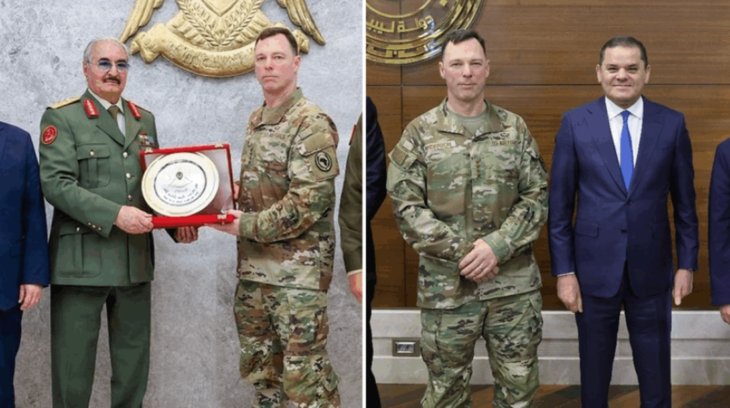
Two developments suggest a modest but meaningful upward trend in US reengagement. First, building on the US Navy ship visit to Libya in April (the first in fifty years), AFRICOM’s deputy commander visited GNU-controlled Tripoli and LNA-held Sirte in October. Inviting Libya to Exercise Flintlock was deliberate signaling: The US government seeks to pull Libya into a broader Western security network—rather than cede the field to other countries with stronger influence, such as Russia. This trajectory continued in early December, when Prime Minister Abdul Hamid Dbeibah met AFRICOM’s commander to expand cooperation on training, equipment, and force professionalization. The GNU’s public request for deeper US support in professionalizing Libya’s security forces marks a notable shift after years of strategic hedging between Washington, Ankara, and Doha.
Second, there has been a surge of activity around Libya’s energy sector. Since 2023, oil output has stabilized, front lines have frozen, and neither the LNA nor the GNU has achieved decisive military or political dominance. This stalemate has created political space for external influence. Energy-sector momentum has been reinforced by high-level diplomatic traffic in both directions. The US special envoy for Africa and Arab Affairs, Massad Boulos, traveled to Tripoli and Benghazi in July, followed by a GNU delegation visit to Washington in August. That trip signaled the GNU’s intent to re-anchor Libya with Western stakeholders and request US assistance in pushing Russia out of eastern military bases to restore unified territorial control.
That momentum was further reinforced by a joint statement on November 26 from the United States, major European partners, Gulf states, Turkey, Egypt, and the United Kingdom. The statement backed a renewed mandate for the United Nations Support Mission in Libya (UNSMIL), endorsed a political roadmap by UNSMIL head Hanna Tetteh, and explicitly called for deeper east-west military and economic coordination—a rare moment of alignment among Libya’s external powerbrokers. For the US administration, this sent the strategic signal that Libya’s unification is now within reach. The window of opportunity, however, is closing fast—and another conflict cycle, election breakdown, or foreign miscalculation could shut it indefinitely.
The energy-security nexus:
Why investment alone will fail
The return of oil majors represents the most consequential shift in Libya in a decade. But investment without security is unlikely to endure. In March last year, Libya launched its first licensing round for oil exploration in eighteen years, signaling a bid to attract Western technology, capital, and expertise. Shell, BP*, TotalEnergies, and Eni have reopened channels with the National Oil Corporation (NOC)—and ExxonMobil* signed a memorandum of understanding in August for offshore exploration in the Sirte Basin.
Yet these developments do not change the fact that some of Libya’s most valuable reserves remain under Russian influence. Western firms cannot scale operations without predictable access, enforceable contracts, and baseline security guarantees.
An intentional presence
to protect investment
To consolidate recent political and economic gains—and protect sizable Western energy investments—the United States should deliberately expand its diplomatic, military, and economic presence in Libya, in close coordination with allies.
The March 2024 announcement that the United States will reopen an embassy in Libya is a critical step toward sustained engagement across military and economic channels. It will also enable closer coordination with key partners—including Italy, Egypt, Turkey, and the UN—whose objectives overlap with US interests.
As the multi-year process to open the embassy inches forward, AFRICOM and its components should pursue near-term, high-impact initiatives. US special operations forces should help build and professionalize vetted Libyan special forces units across both western and eastern factions, units that would pursue shared security interests, no matter the progress toward an eventually possible unification. Additionally, maritime partnerships should be expanded rapidly to strengthen Libyan Navy and Coast Guard capabilities, particularly in interdiction, offshore asset protection, and port security.
At the same time, the United States could leverage its convening power to establish a technical deconfliction cell in Sirte, allowing GNU and LNA representatives to coordinate security around oil infrastructure and prevent escalation. Such mechanisms could also support counterterrorism cooperation, including targeting IS remnants and blocking spillover from the Sahel.
Layered US engagement can
unlock stability
However, military engagement alone will not be sustainable without economic development. Given the complex legacy of US involvement—from the economically devastating sanctions of the 1980s to the 2011 NATO intervention and the overthrow of the Muammar Gaddafi regime—the United States must work through partners to advance both economic and counterterrorism objectives. The US International Development Finance Corporation and the Export-Import Bank could prioritize export credits for pipelines, gas processing, and power generation, explicitly linking financing to transparency and anti-corruption benchmarks.
US and partner foreign assistance could also support long-overdue reforms at the NOC, including modern contracting practices, environmental standards, and shared revenue frameworks. These efforts should extend beyond governments: Western energy companies involved in Libya should participate in coordinated infrastructure planning, rather than simply launching isolated investments.
Layering diplomatic, military, and economic tools would allow the United States to establish a modest but coherent posture capable of unlocking outsized stabilization effects—and preventing any country that works against US interests from having dominance over Libya’s future. For the United States, Libya offers a proving ground for a new model of engagement—one built on security assistance that enables Western investment instead of substituting for it.
AFRICOM’s renewed presence and the surge of Western energy interest create a rare opportunity to reintegrate Libya into a Western orbit. If the United States seeks stability in the Mediterranean, resilience in the Sahel, and credible alternatives to Russian energy, now is the time to make coordinated security and economic investments in Libya.
***
Rose Lopez Keravuori is a nonresident senior fellow at the Atlantic Council’s Africa Center, an associate director at Strategia Worldwide, and chair of the board of advisors of GCR Group. She previously served as the director of intelligence at the US Africa Command. *** Maureen Farrell is a nonresident senior fellow at the Atlantic Council’s Scowcroft Center for Strategy and Security and vice president for global partnerships at Valar, a Nairobi-based strategic advisory and risk firm. She previously served as the deputy assistant secretary of defense for African affairs and director for African affairs at the US National Security Council.
Last year, Italy failed to transfer a Libyan alleged war criminal wanted by the International Criminal Court. What were the consequences?
In 2025, it was the first time that states were called to discuss non-cooperation with the International Criminal Court (ICC), at the Assembly of States Parties (ASP). Besides pointing to ICC member states’ failure to arrest Russia’s Vladimir Putin and Israel’s Benjamin Netanyahu, both under arrest warrants, the plenary meeting held on December 3 in The Hague heard a recurring country name coming up in the civil society speeches: Italy.
“In a context in which the court, its officials and civil society working for international justice are increasingly under attack, including through US sanctions, each instance of non-cooperation is a further blow to the Rome statute system, especially when it comes from state parties”, Cristina Orsini, senior programmes advisor at Lawyers for Justice in Libya, told the audience of states delegates and Ngos.
On January 21, 2025, two days after his arrest in a Turin hotel following a warrant from the ICC, Osama Almasri Najim, a former head of the Libyan judicial police, was released by Rome and flown back to Tripoli in an Italian government plane.
The 46-year-old Libyan national was reportedly in charge of the notorious Mitiga prison in Tripoli. He is suspected of crimes against humanity and war crimes, including murder, torture, enslavement and sexual violence. After months of procedural back and forth between the Court and Italy, on October 17, the ICC found that Italy failed to comply with its international obligation. But it did not refer the country to the next level up yet.
“It is not possible to engage in any discussion concerning alleged non-compliance by my country in the absence of a formal referral” [for lack of cooperation, to the ASP or the United Nations Security Council], declared Augusto Massari, Italy ambassador to the Netherlands, during the ASP plenary debate. He said that on the contrary Italy had provided “timely, transparent, and comprehensive responses” and “will continue to engage in good faith with the court”.
“The message sent is very problematic”
Opening the panel, ASP president Päivi Kaukoranta focused on the states’ obligations “to engage in timely consultation with the court” in case of problems with arresting or transferring suspects.
“Italy cited domestic legal and procedural issues to justify its decision. On the contrary, it seems that the mix of political concerns and diplomatic pressures led to the subordination of international obligations and justice considerations to political expediency”, added Orsini during the panel. Speaking to Justice Info later, she recalled that “Italy is not only a state party but also one of the founding members of the Court, so the message being sent is very problematic”.
Taking the word on behalf of the European Center for Constitutional and Human Rights (ECCHR) was David Yambio, co-founder of the Italian NGO Refugees in Libya. He said he was speaking as a “victim of innumerable violence of Almasri in many torture camps across Libya”. His host country’s failure to send the suspect to the ICC, had led him to “face many threats, and to this day our lives have never been the same”. Yambio concluded that in their “carefully crafted speeches”, the member states, including Italy, had spoken about accountability and the suffering of victims, “but what you have not acknowledged is that our lives depend on the decisions that you make”.
The ICC’s timid reaction
In its October decision, the ICC found that “Italy failed to comply with its international obligations under the Statute preventing the Court from exercising its functions and powers”. Over the months, Italy brought forward reasons for sending Najim back to Libya instead of the Hague, including the formulation of the ICC warrant and another competing warrant previously sent by the Libyan authorities. However, the Court found that this do not “explain its failure to communicate and cooperate” to resolve the alleged problems and do not provide “any valid legal reason or reasonable justification for having immediately transferred Mr Najim back to Libya, instead of first consulting with the Court”.
Regarding the alleged extradition request by Libya, the judges said that “Mr Najim was not handed over to the Libyan authorities but returned as a free man”. According to additional evidence filed by the prosecution on November 11, the Libyan request was notified to the Italian Ministry of Justice on January 22, 2025, after Najim was flown back to Tripoli in the evening of January 21. It was done “without measures and documents, without any indication of the enforceable procedural title and/or the arrest warrant”, it reads.
However, the ICC judges decided to wait before referring the country to the Assembly of States Parties or to the United Nations Security Council, whose 2011 referral of the Libyan situation sparked the Court’s investigation.
Allison West, senior legal advisor at ECCHR, told Justice Info that Italy should be referred to the ASP or to the UNSC “as a matter of principle”. “These are procedures that have little concrete consequences beyond naming and shaming”, Orsini told Justice Info. However, she thinks it would be important to bring the matter to a higher level.
Rome prosecutor’s silenced reaction
The Rome chief prosecutor had placed Alfredo Mantovano, Undersecretary of State to the Presidency of the Council of ministers, as well as the Justice and Interior ministers Carlo Nordio and Matteo Piantedosi, under investigation – for failure to fulfil their official duties, aiding and abetting and embezzlement. In a vote on October 9, the Chamber of Deputies denied a request for authorisation to proceed against the three government officials. Twenty days later, the Ministers’ Court shelved the investigation.
Nevertheless, in Italy’s response to the ICC requests for more information on domestic proceedings, the country’s ambassador to the Netherlands said that “against Parliament’s decision, the Judiciary has the power to raise the issue of a conflict of State powers attribution before the Constitutional Court.” Massari added that the fact that the developments in the Najim case were “widely reported and disseminated to the public by the media, have at all levels clearly raised awareness of how significant, rich in implications and therefore complex the cooperation with this Court is”. This can only have a “positive impact” on the “future requests for cooperation”, he concluded.
On October 30, the Appeal Court of Rome raised a question on the constitutional legitimacy of the laws on cooperation with the Hague Court. It asked the Constitutional Court to review the matter. Besides, the ECCHR decided to support a case before the European Court of Human Rights brought by a torture survivor, who said he was unlawfully detained by Najim, against Italy for its failure to cooperate with the ICC. “This will be the first time that the Strasbourg Court actually examines a case of non-surrender to the ICC”, West said.
Najim arrested in Libya?
In the late morning of November 5, Libyan and international media announced that Najim had been arrested. And a month later, Tripoli attorney general, Al-Siddiq Ahmed Al-Sour, confirmed in a special statement to Libya News 24 that he remains in prison.
However, “despite all of the public claims, we don’t actually have any credible evidence yet that Najim has been arrested. According to the Libyan civil society groups we’re in touch with, he remains at liberty”, said West. According to her, this can be seen as an effort by the attorney general to signal that Libya is serious about cooperating with the ICC, while making it clear that they would like to prosecute crimes domestically.
Besides, West explains that the Libyan judicial system remains too fragmented and under pressure from the different political and militia forces to ensure fair trials. “One of the fundamental issues at stake is that the charges that are proposed by the attorney general are for regular crimes under the Libyan Criminal Code, not international crimes”, she added. To her, “the widespread and systematic attack on both Libyans and migrants and refugees that takes place across Libya really consolidates in the detention industry. It’s incredibly important that it’s placed in the broader context of crimes against humanity”.
On May 15, the ICC made public a declaration sent by the Libyan government to accept the Court jurisdiction from 2011 to 2027. In its half-yearly statement to the UN Security Council on November 26, Deputy Prosecutor Nazhat Shameem Khan said that her office remains “focused on securing the arrest and transfer of Mr. Osama Almasri Najim for trial at the ICC”, and “would like to welcome the attorney-general of Libya to deepen his engagement in this common cause”.
The country arrested ICC suspects in the past, such as Saif Gaddafi in 2011, who was later freed, and more recently Mohamed Al-Saleheen, wanted in the context of the investigation into the Tarhuna mass graves. They were never surrendered to the ICC.
A Libyan before the ICC
Just before the States parties to the International Criminal Court (ICC) gathered to discuss non-cooperation, on December 1, 2025, a Libyan has been brought before the Court to stand trial. Khaled Mohamed Ali El-Hishri was a senior official of a militia known as RADA and is suspected of committing or overseeing crimes against humanity and war crimes in the Mitiga prison between 2015 and early 2020. He was arrested on 16 July 2025 in Germany.
“This is the very first case in the 15 years of the Libyan situation that’s actually going to proceed to trial”, underlined Allison West, senior legal advisor at the European Center for Constitutional and Human Rights. El-Hishri was in the leadership of the same prison and the same militia as Osama Almasri Najim. “What happens in this case would potentially influence other cases that are within that same investigative stream, which is why it’s so important to get this one right”, she concluded.
The insurgent movement that started in Tunisia on December 17, 2010, has spread throughout the Middle East in a very short period and has removed many leaders, especially in Egypt and Tunisia, from their seats. It was not thought that setting him on fire by a Tunisian peddler named Mohammed Buazizi would have caused events that would have deeply shaken the entire Middle East.
Many people trying to explain and understand the Arab Spring have often raised the demand of the masses for freedom in the liberal sense.
However, the disparity in divisional relations, the decline in people’s income levels, and the consequent disappearance of social justice should be analyzed as important factors. The point to note here is that the demonstrations in Libya differ at some point from the events in Tunisia or Egypt. In Libya, Gaddafi himself symbolizes the self-styled regime itself. The fall of Gaddafi, who turned Libya into Jamahiriya, means the fall of the self-styled regime itself.
The fact that the modern state and its features have not been properly settled and that nation-building has not been realized in the modern sense is among the most important reasons for the power vacuum in post-Gaddafi Libya.
The legal regulation for the use of force in international law prohibits states from using or threatening to use force in their international relations. However, there are two exceptions to this general framework.
These exceptions are Article 51 of the UN Charter 7 of the UN Charter with the right to self-defense as stated in Article, enforcement measures, including the use of force, will be taken by the UN Security Council under its section. In Libya, two resolutions adopted by the UN Security Council are on the agenda when it comes to military intervention in Libya.
Accordingly, on 26 February 2011, the UN Security Council adopted Resolution 1970 condemning the violence against civilians and violence against civilians in Libya, as well as the existence of massive and widespread human rights violations.
The Security Council has taken the humanitarian situation into its center and considers the human rights violations committed by the Libyan government against civilians as a crime against humanity.
The resolution called for an immediate halt to human rights violations and for the Libyan government to do all it could.
As the UN Security Council resolutions show, the international community has taken a stand in favor of the expected regime change in Libya. With the contribution of international intervention, the 42-year Gaddafi era in Libya ended after Gaddafi was captured and killed in Sirte on 20 October 2011.
After the overthrow of Gaddafi, the authority gap that formed throughout the country has not been solved even today. The country’s tribal structure and regional relationship networks have led the country into inextricable instability.
The anti-Gaddafi revolutionary movement was stepped up by NATO bombardment, succeeded with the capture and killing of Gaddafi, and at least it was declared a success.
After 42 years of rule, Libya was expected to achieve an ideal structure that would be freer and capable of performing state functions in the post-Gaddafi era. But the overthrow of Gaddafi not only ended the regime, it also displaced the state apparatus. The first confrontational atmosphere of the post-Gaddafi era occurred between the pro-Gaddafi militia forces and the revolutionary ranks.
This led Libya into a whirlpool of armed conflict at the beginning of the revolution. Instability and the inability to meet common values are among the major factors that deeply affect Libya, which is in transition.
Efforts to rebuild the state in Libya were leading to a division of power. The authority gap formed by the death of Gaddafi has been tried to be filled by some units that are historically incompatible with each other and are constantly competing.
These units are listed as transitional governments, revolutionaries, political parties, and non-government organizations. Likewise, the failure of the attempts to form a government in Libya and the resulting two-parliament structure are the visible repercussions of the inability to fill the power vacuum. So much so that the sharp polarization of society lies behind the political formations and political decision-making mechanisms taking place in Libya.
The distinction between the parties that carried out the revolution and the former regime supporters also reflected the political division of the state. The political and military camp in the country opened the door to international intervention; a new environment was emerging in Libya where countries that wanted to intervene supported any side. At the same time, UN-led international efforts to achieve peace and reconciliation were taking place.
The most important UN-led reconciliation step is the ‘Libyan Political Treaty’ signed in Shikrat, Morocco, in December 2015. The treaty was intended for more than one purpose.
The first step was to stop the conflict by achieving a national consensus. On the other hand, the fight against ISIS and other terrorist organizations, which have gained ground visibly since 2015, was expected to be intensified in order not to be interrupted or even strengthened.
Most importantly, however, the establishment of the cohesion government was being signed so that national reconciliation could be achieved.
For a civilian and legitimate government to be established in the country and for the institutions to become operational, the United Nations has decided to hold general elections in the country on 10 December 2018. However, disagreements arose between Italy and France regarding the holding of the elections, and Italy was criticized for acting in a way that prevented Libya from stabilizing again.
At the Palermo conference, hosted by Italy, Sarraj and Hafter met, and it was decided that the elections would be postponed until 2019.
National and international actors who had a share in continuing internal turmoil have deprived the country of a stable central government and economic development. It also complicates problems such as irregular migration.
In particular, European countries such as Italy and France, which have historical links with the North African region and the coast of the Mediterranean, are very interested in Libya’s future.
The coup d’etat general, who solidified his dominance in the southern part of the country in early 2019, has been on the renegotiation table with the mediation of the United Nations. However, shortly before the conference to determine a roadmap for Libya’s future, Haftar-controlled forces launched an operation to seize the capital, Tripoli. With this operation launched, the coup d’etat general has clearly shown his desire for chaos and conflict to prevail in Libya, not a solution.
Delegates who played the role of the Gulf states, including some European countries such as France and Russia both open to military, financial, strategic, and diplomatic support, as well as Chad, Sudan, and Somalia from imported mercenaries, and militia groups caused the balance to shift rapidly to the side of Hafter.
As a result, the search for order in post-Gaddafi Libya has still not concluded. The continuation of the civil war on the one hand, but the signing of the memorandum of understanding in the shadow of international efforts at the same time, shows how difficult the path to stability is.
A longer period of effort will need to be made to resolve the current multi-actor situation.
Few oppose the view that Libya needs structural reforms to its system of economic governance. There are a series of potential reform goals that would be likely to generate widespread public support.
These include: the devolution of state powers to local government structures; development of the private sector; economic diversification; adaptation to the global energy transition; and climate action.
However, discussion of specific reforms requires moving from considerations of the vested interests of political elites to an approach that places the rights of Libyan citizens at the heart of governance. In practice – and drawing on lessons from Lebanon and Iraq – this means the abandonment of power-sharing as the operating principle of economic decision-making.
Achieving this will depend on a systematic programme of government action, the passage of new legislation and the mobilization of funding mechanisms beyond year-to-year budgetary allocations. The question is how this can be achieved under Libya’s current circumstances.
A range of policies could be pursued to these ends, though each brings different challenges. The simplest option would be to leave major decisions to a future, unified Libyan government. An alternative approach might be to address foundational elements of economic governance in a constitutional process.
Yet both of these options would risk delaying action, potentially indefinitely. Libyans are mindful of the experience of the current GNU, which entered office in March 2021 with a mandate to deliver elections six months later. At the time of writing, in November 2025, the GNU remains in place, no national-level elections have been held, and no significant economic reforms have been pursued.
A more effective means of initiating economic reforms could be through incremental changes, with each measure tied to the political process. One promising idea that has been floated is the establishment of an economic reform charter which any incoming government would be expected to endorse and commit to implementing.
The structured dialogue on the economy currently under development for UNSMIL could be the vehicle to develop this charter. This would provide a clear mandate and purpose for the structured dialogue.
Such a charter could earmark priority areas for action, such as administrative decentralization, private sector development, economic diversification, and climate change mitigation and adaptation. Importantly, the charter could identify programmatic actions for the next government to pursue.
Experience from reforms in Aceh and South Sudan underlines the importance of ensuring that programmatic elements consist of actions that state institutions have the capacity to deliver. It would be for the incoming government and the wider state apparatus to then formulate an implementation plan and carry the reforms out. International support should be mobilized for such an effort.
Critically, an economic reform charter would need to be endorsed by participants in the associated political process, and publicly endorsed by the incoming government prior to its entering office.
This would be necessary to ensure that technical proposals have a means of being implemented by the experts who have developed them. The international community would need to play a role in holding the future government accountable to its commitments. One practical way of doing this would be to deploy technical experts to the new government to facilitate their plans and retain a forum for sharing information on progress, such as through the EWG.
Such an approach would by no means be foolproof. There are many ways in which it could fail, yet an economic charter would at least provide a means of diluting the powers of an incoming government and reducing the winner-takes-all dynamics that have inhibited reform to date. It would also enable complicated economic issues to be addressed in a manageable fashion.
3. Capacity-building
Public finance management experts caution that Libyan officials and institutions lack sufficient capacity to implement a coherent and strategic programme of reforms. The provision of targeted institutional support via the World Bank, the International Monetary Fund and bilateral support packages should centre around the key deficits in economic governance identified in this paper. Addressing these deficits would probably need to be a focus of the economic charter described above.
4. Anti-corruption enforcement
Outside of these distinct efforts, the UN and its partners should continue to support the efforts of the Libyan state’s oversight bodies, most notably the Libyan Audit Bureau and National Anti-Corruption Commission, in promoting good governance and combating corruption.
In September 2025 these two agencies announced the launch of a joint strategy to combat key vectors of corruption. As corruption associated with elite capture of the Libyan state is often international in nature, partnerships between Libyan oversight bodies and investigators in other countries could strengthen anti-corruption efforts. Internationally supported enforcement could also constrain the behaviour of Libyan elites, many of whose members have developed a sense of impunity over their economic activities.
Violations of Libyan and international laws could be addressed via criminal justice mechanisms within Libya but also in other jurisdictions given the international nature of some of the activities.
Within Libya, the establishment of clear ‘rules of the game’ through the economic track would provide a mechanism for stronger anti-corruption measures. Sanctions issued by external states should be on the table as a possible punishment for individuals who are profiteering from Libya’s governance chaos. The UN Security Council’s sanctioning of an armed group commander, Ibrahim Jadhran, in 2018 for economic damage to the Libyan state is a helpful precedent in this regard.85
5. Public diplomacy
Finally, for these efforts to be successful, the UN and its partners must engage the Libyan public. Ordinary Libyans have long been excluded from discussions over the future of the country.
Successful engagement on the economic track, and on the political track for that matter, must mobilize public support by explaining the goals of the initiative and building momentum through expansive public diplomacy.
The UN and its international partners can help with this process, capitalizing on previous efforts such as the ESCWA-led socio-economic dialogue and the ongoing attempts of the Libyan Peace Makers group.
Last word: No option but to continue trying
There are many reasons why the suggestions in this paper for the development of an economic track, in conjunction with a wider political process, may fail. As noted, support from external states for a negotiated settlement to Libya’s ongoing conflict has waned considerably in recent years, with a number of countries focusing on building their political capital with existing office-holders to serve geopolitical and/or economic agendas.
The UN’s credibility has also suffered following repeated failures of its mediation attempts. However, this does not diminish the necessity of reaching a settlement.
Libya’s current trajectory is one of elite consolidation over the control of state resources, and of escalating misuse of state funds.
This is depleting the remaining capacities of state institutions, and perpetuating a level of public spending that cannot be sustained. Any outbreak of substantial conflict, or a significant fall in global oil prices, threatens to worsen the economic situation. Moreover, the problems of rent-seeking and economic predation associated with Libya’s current governance arrangements have left the country unequipped to tackle the challenges of the future in relation to the renewable energy transition, climate change and sustainable development.
Foreign states that are building their relationships and influence within this system can only be assured of short-term returns. A more robust state would offer a much-improved partner for Libyan’s foreign interlocutors.
***
Tim Eaton is a senior research fellow in the Middle East and North Africa Programme at Chatham House. His research focuses on the political economy of conflict in the Middle East and North Africa (MENA) region, and on the political economy of the Libyan conflict in particular.
From the Arab spring to civil war: the role of international actors and the crisis of statehood.
The concept of security includes foreign policy analysis, regional studies, and so on. The crisis sub-title, however, cannot be considered separate from security studies.
These two areas have traditionally centered on the state, and analyses have been state-centered. When considered in this context, moments of crisis in international relations are often seen as areas that characterize areas of inter-state economic, political, or military problems and find meaning under the umbrella of security. Especially with the end of the Cold War, state-centered crises and security perceptions began to be replaced by people-centered debates.
Of course, state-based analysis was a priority, but a different window was opened, and everything that interested the person started to enter through it. For example, human rights and humanitarian law issues occupied the top of the agenda with the efforts of the media and international non-governmental organizations.
These new developments also offered a new basis of legitimacy to armed interventions. NATO’s Kosovo operation in 1999 was legitimized for humanitarian reasons.
The Modern international system is founded on the principle of ‘sovereignty’. Since the Treaty of Westphalia, and generally agreed upon, the international system has an anarchic structure of sovereign and equal states with no central police or governmental power.
Thus, the concept of sovereign and equal states, which first emerged in Europe, spread throughout the world over time. Some researchers suggest that they could not have predicted the Arab Spring. Because, as is widely believed, because of the autocratic structures of the Middle Eastern countries and the obedience of their people to such forms of government, the idea of a wide-ranging popular uprising remained absurd.
Political structures are identified in the literature as failing states, not as a challenge to the current international system or a threat to its existence; on the contrary, they should be seen as a phenomenon that sustains the current international system and gives rise to its existence.
Furthermore, it should not be ignored that this phenomenon is reproduced every time. Because the definition of a failed State necessarily brings with it the definition of a successful state. As a result of this necessity, the ongoing progressive understanding does not lose its habitat.
The Modern system of states requires sovereign and equal states. The Modern state claims to have a monopoly on the use of force on its territory and can feel all the institutionalization necessary to govern simultaneously and intensively all over its country.
In terms of our subject matter, Libya in particular, in general, when the whole Middle East perspective is taken into account, the result is the constant tension between the modern and the non-existent.
This conceptualization is codified as a cause of existence, not a threat to the central capitalist countries that claim to be modern, in other words, capable of fulfilling the requirements of statehood.
In classical terms, the common aspect of security conceptualizations is the security of the ‘state’, which is defined as the principal actor of foreign policy. In the anarchic international system, it is recognized that the most rational way for states to ensure their security is to increase power.
Especially with the end of the Cold War, state-centered security perceptions began to be replaced by people-centered approaches. In other words, besides the classic state security issues, the security issues that human beings are involved in have occupied the agenda of international politics.
For example, we were entering a new era in which non-state actors created security problems as a result of genocide and massacre attempts, large-scale migrations and, on the other hand, refugee problems, mass problems in transportation to water or food, and the descent of armament into the local area, which we witnessed especially in post-Cold War African countries.
As a result of changing circumstances, new methods or reinterpretation of old methods have also been brought to the agenda regarding the management of crises. In this sense, there are some instruments used in global policy to prevent, manage, and solve crises and conflicts, such as the provision of arms control and disarmament, international law, international organizations, peacekeeping operations and humanitarian intervention, sanctions, and democratization.
A renewed vote by Libya’s High Council of State to select Salah Al-Kumayshi as chairman of the board of the High National Elections Commission has brought the issue back to the centre of the political debate, reopening differences with the House of Representatives over the management of the electoral file.
The elections commission is widely viewed as a key institution for any future constitutional or electoral process, making disputes over its leadership particularly sensitive amid Libya’s ongoing political stalemate.
Vote outcome
During a second voting session, the High Council of State voted in favour of Al-Kumayshi, who currently serves as Director of Operations at the commission. • Votes for Salah Al-Kumayshi: 63 • Votes for rival candidate Al-Aref Al-Tir: 33 • Members participating: 103 out of 107 present
Al-Kumayshi has held several administrative roles within the commission in recent years, including head of the Planning and Follow-up Office, before moving to the operations department.
House of Representatives response
The Speaker of the House of Representatives, Aguila Saleh, rejected the move, saying there was no justification for changing the commission’s leadership at this stage.
In televised remarks on Sunday, Saleh said the current chairman, Imad Al‑Sayeh, and the existing board have the experience needed to manage electoral processes. He referred to the organisation of municipal elections last year and warned that altering the commission’s structure could affect the timing of future electoral steps.
Saleh also linked the issue to broader disagreements over the implementation of the Bouznika Agreement, stating that political understandings should either be implemented in full or that existing unified institutions should remain in place until the current phase is resolved.
High Council of State position
The President of the High Council of State, Mohamed Takala, said the House of Representatives had taken unilateral action by proceeding with appointments to the commission’s board.
In a statement published by the council’s media office, Takala said the Bouznika Agreement sets out a clear mechanism for appointments to sovereign institutions. Under that arrangement, he said, the High Council of State selects the commission’s chairman and three members, while the House of Representatives appoints the remaining three.
Commission and legal framework
For its part, the High National Elections Commission said that completing its board is consistent with Article 10 of Law No. 5 of 2013 governing its establishment. The commission stressed that the measures taken are based on existing legislation and are not linked to political agreements.
International context
The developments coincide with renewed statements from the United Nations. The UN Special Representative for Libya has previously indicated that an alternative mechanism could be proposed if the House of Representatives and the High Council of State fail to reach consensus on the political roadmap, reflecting international concern over the continuation of institutional disagreements.
Outlook
The dispute also comes amid continued debate over the role of the elections commission in the stalled constitutional process. While the commission says it is ready to implement any legally completed mandate referred to it, differing interpretations among political bodies persist.
As disagreements between Libya’s two main legislative institutions continue, the future of the elections commission remains part of a broader institutional debate, with constitutional and electoral timelines dependent on whether consensus can be reached.
An internationally mediated ‘economic track’, formally integrated into Libya’s peace negotiations, should focus on five areas: stabilization of governance, structural reform, capacity-building, anti-corruption enforcement and public diplomacy.
Given nearly a decade and a half of failed peacebuilding, Libyans can be forgiven for mistrusting the intentions of their own elites and foreign states alike. While this paper has focused on Libya’s systemic failings, the influence of foreign states has become increasingly malign in recent years.
Moreover, the foreign policy of the US, which until recently has led calls for political solutions and improved economic governance, has shifted to a more transactional approach. The status of the UN, and of multilateral institutions more widely, is in decline.
These shifts make developing an economic track of negotiations harder than ever. Yet the need has not diminished. As the violent reorganization of Tripoli’s security sector in May 2025 showed, the informal settlements that currently underpin the Libyan state’s governance are precarious.
The institutions critical to the state’s survival – such as the CBL and the NOC – are increasingly undermined and sidelined by vested interests.
Should these trends continue unabated, then the economy will become ever weaker and the opportunities for Libya and its foreign partners to benefit from soundly managed economic development will dwindle.
Private foreign investment in Libya will be a riskier proposition, while illicit financial flows and irregular migration will continue to thrive. It is therefore important to make the case that addressing economic drivers of conflict would provide the proverbial tide that lifts all boats for Libyans and their international partners.
The calculus of the UN and foreign states should rest on improving the well-being of the Libyan population, while drawing upon enlightened pragmatism in delivering settlements that have a realistic chance of working on the ground.
On the other hand, if external states adopt a narrower, more mercantilist approach – which is the apparent direction of travel – any investments by international companies are likely to be subject to instability and renegotiation as Libya’s economic landscape shifts and society suffers.
With this backdrop in mind, this paper’s assessment of the nature of Libya’s economic drivers of conflict, the paper’s appraisal of efforts to date to mitigate their effects, and its presentation of the lessons from other contexts reveal that negotiations on stabilizing Libya require an enhanced economic track.
While there is no substitute for a political track of negotiations to address political succession, or for a security track to agree arrangements in the security sector, the centrality of Libya’s economic challenges cannot be minimized. This problem set clearly illustrates the need for the economic track to be formally established as a forum for international mediation and negotiation – not simply dialogue – on par with its political counterpart.
A revamped economic track of this type should have five components.
The first should consist of engagement with current Libyan leaders on stabilizing economic governance in the short term.
The second element should be forward-looking, with a focus on planning for and initiating structural reforms to be undertaken under a future government.
The third should be continuing to develop the technical capacity of Libya’s public officials and their institutions.
The fourth should consist of enforcement measures against corruption and kleptocracy. Last but not least should be engagement of the general Libyan population through concerted public diplomacy. Only through such a combination of efforts can success be achieved.
Components of an enhanced
economic track
1. Stabilization of economic governance
In recent years, political incumbents and armed groups have significantly increased their control over state institutions, eroding the independence and operational integrity of these bodies. The aforementioned killing of Abdelghani al-Kikli in Tripoli in May 2025 came against a backdrop of his growing efforts to control the distribution of cash from the CBL and to dominate other key state institutions.
These behaviours were emblematic of a trend that has seen a rise in grand corruption and a deterioration in the availability and quality of public services such as education, healthcare and public security.
Unless such issues are addressed, the prospects for success in the wider political process are dim, and the recommendations of UNSMIL and its Advisory Committee are unlikely to succeed. Thus, economic stabilization must come before political transition in the sequencing of steps, rather than the other way around (as has often been the case to date).
Consequently, the UN (with its partners) should pursue measures that will stabilize economic governance as part of its ongoing political engagement in Libya. The aim should be to prepare the ground for a future political transition and to arrest worrying trends in economic governance.
Efforts should be limited, however, to ensuring adherence to existing laws and regulations, ensuring transparent financial reporting of laws and regulations, and agreeing a nationally unified budget. In this context, ‘unified’ means a budget that applies across the entire country, as opposed to the GNU releasing a budget in parallel to the GNS.
The NOC should be provided with a clearly delineated allocation from the budget to cover its running costs and investment needs, while the revenues it generates from oil and gas should all pass through the CBL; off-book spending and financing from eastern authorities for unvetted projects via the banking sector must cease, as must currency printing by eastern-based authorities.
The unified budget should be supported by provisions to ensure transparency and accountability, and should be designed in such a way as to prevent undue inflationary pressures.
The US is currently best placed to lead on this effort. Revamping its ‘economic dialogue’ as an economic mediation process would be the best means of doing this. Engagement by the US special adviser for Africa, Massad Boulos, has recently led to an agreement between western and eastern authorities on a budget for development.
If focused on institutionalizing arrangements – rather than representing insider deals with elites – these efforts could be stepped up and formalized, becoming complementary to wider UNSMIL efforts, which focus on medium- and longer-term economic reforms.
Creative means can also be sought to secure Libyan buy-in, such as leveraging of the partial unfreezing of the billions of dollars in Libyan assets held under sanctions regimes.
But the key is that any deals must bring with them transparency and accountability to reinstitute checks and balances in the governance of the state’s finances, thereby facilitating a shift towards strengthening of state institutions. Other countries or actors could also theoretically take on the role of the US in such a direct negotiation, but to date there have been no indications that any are willing to do so. The EWG has proven that it cannot fulfil this role.
While these goals may sound modest, they have eluded policymakers for a number of years. In particular, placing pressure on Libyan institutions to act within the law, and naming and shaming them where they do not, would be a significant step forward. Such efforts can build on the quiet work of the US to strengthen the CBL’s anti-money-laundering policies and to establish third-party monitoring of the CBL’s dollar transactions.
These efforts can build leverage on Libyan leaders given Libya’s reliance on access to US dollar markets. Improvements in this regard also open up means of pressuring Libya’s commercial partners to encourage better behaviour by Libyan officials and rival powerbrokers through commercial compliance regulations in Western markets.
Where opportunities exist to find technical fixes that would improve economic governance, these should be explored.
The World Bank, in particular, could provide useful insights, given its expertise in public finance management. Among other measures, external engagement with Libyan policymakers to assist in the transparent and accountable execution of spending under (development) of Libya’s budget framework could help to ensure that, even amid ongoing policy dysfunction, the state is investing in its own future.
Presently, planned expenditures on development are rarely executed in practice, as procedural problems resulting from the national governance split impede the legal disbursement of funds. One symptom of this split is the Haftar family’s apparent reliance on a dedicated Libyan Development and Reconstruction Fund for public works in eastern Libya; however, spending through this fund has little or no official oversight from the Libyan authorities, and the fund appears to be accountable (and in name only) to the House of Representatives.
Reorganizing funding mechanisms and channelling funds through the proper state entities must be a priority for both Libyan and international policymakers.
***
Tim Eaton is a senior research fellow in the Middle East and North Africa Programme at Chatham House. His research focuses on the political economy of conflict in the Middle East and North Africa (MENA) region, and on the political economy of the Libyan conflict in particular.
More than 40 companies have registered for Libya’s first licensing round since 2011, prompting the National Oil Corporation to target 2 million bpd by 2028.
Libya holds Africa’s largest proven reserves (48 billion barrels) and has lifted output back toward 1.4 million bpd.
Firms such as TotalEnergies, ConocoPhillips, Eni, Repsol, and OMV are betting that deeper on-the-ground presence can stabilize the political framework.
With more than 40 companies having now registered their interest in Libya’s first oil field licensing round since the removal of Muammar Gaddafi as leader in 2011, the National Oil Corporation (NOC) is confident it can lift oil production to 2 million barrels per day (bpd) by 2028, according to the latest statements from the organisation. The expressions of interest in the 22 offshore and onshore blocks to be licensed follow last year’s agreements between the NOC and Great Britain’s Shell and BP to assess Libya’s exploration opportunities.
Shortly after that, U.S. supermajor ExxonMobil inked a deal covering technical studies on a cluster of offshore blocks, while Chevron has also confirmed that it is planning a return to the country, having left in 2010. The key question for the oil markets, though, is does this influx of Western firms signal a genuinely more stable political backdrop in Libya that will allow it to finally make good on its oil potential?
There is certainly plenty of this to work with, as Libya remains the holder of Africa’s largest proved crude oil reserves, of 48 billion barrels. Before the removal of Gaddafi and the civil war that ensued, the country was producing around 1.65 million bpd of mostly high-quality light, sweet crude oil, notably the Es Sider and Sharara export crudes that are particularly in demand in the Mediterranean and Northwest Europe for their gasoline and middle distillate yields.
This had been on a rising production trajectory, up from about 1.4 million bpd in 2000, albeit well below the peak levels of more than 3 million bpd achieved in the late 1960s, analysed in my latest book on the new global oil market order. That said, NOC plans were in place before 2011 to roll out enhanced oil recovery (EOR) techniques to increase crude oil production at maturing oil fields and the NOC’s predictions of being able to increase capacity by around 775,000 bpd through EOR at existing oil fields looked well-founded.
Around 80% of all of Libya’s currently discovered recoverable reserves are located in the Sirte basin, which also accounts for most of the country’s oil production capacity, according to the Energy Information Administration. However, in the depths of the civil war, crude oil output fell to around 20,000 bpd, and although it has recovered now to just under 1.4 million bpd — the highest level since mid-2013 — various politically-motivated shutdowns in recent years have pushed this down to just over 500,000 bpd for prolonged periods.
The problem for the Western firms now re-entering the country is that the core reasons behind these shutdowns have not been dealt with in any meaningful way. More specifically, at the time of signing the 18 September 2020 agreement that ended an economically devastating series of oil blockades across Libya at that time, Commander of the rebel Libyan National Army (LNA) General Khalifa Haftar made it clear that peace would be dependent on key objectives being met. Tripoli’s U.N.-recognised Government of National Accord (GNA), and fellow signatory to the deal, Ahmed Maiteeq, agreed to such measures that would address how the country’s oil revenues would be distributed over the long term and how the country’s perilous financial position might be stabilised in the short term.
At that point, the blockade from 18 January to 18 September had cost the country at least US$9.8 billion in lost hydrocarbons revenues. Key to this tentative agreement was the formation of a joint technical committee, which would – according to the official statement: “Oversee oil revenues and ensure the fair distribution of resources… and control the implementation of the terms of the agreement during the next three months, provided that its work is evaluated at the end of the 2020 and a plan is defined for the next year.”
In order to address the fact that the then-GNA effectively held sway over the NOC and, by extension, the Central Bank of Libya (in which the revenues are physically held), the committee would also “prepare a unified budget that meets the needs of each party… and the reconciliation of any dispute over budget allocations… and will require the Central Bank [in Tripoli] to cover the monthly or quarterly payments approved in the budget without any delay, and as soon as the joint technical committee requests the transfer.” None of these measures have since been put into place, which leaves fundamental flashpoints over the country’s core revenue stream remaining.
Instead, Washington and London’s broad strategy in Libya appears to be that Western firms should re-establish their presence on the ground across multiple sites in Libya and, through this presence and ongoing investment across the country, the resulting greater political leverage can be used to finally put such mechanisms for peace in place. It is a similar idea to that currently being rolled out in Syria, whose previous longtime leader (Bashar al-Assad) was also removed by the West among a backdrop of intense factionalism — and widespread Russian interference — across the country as well.
That said, the West’s presence in Libya never retreated as much as it did in Syria. Back in 2021, when the NOC first flagged serious plans to significantly boost its oil output, at that point up to 1.6 million bpd and then perhaps to 2 million bpd, French oil giant Total (now TotalEnergies) agreed to continue with its efforts to increase oil production from the giant Waha, Sharara, Mabruk and Al Jurf oil fields by at least 175,000 bpd and to make the development of the Waha-concession North Gialo and NC-98 oil fields a priority, according to the NOC.
The Waha concessions – in which Total took a minority stake in 2019 – have the capacity to produce at least 350,000 bpd together, according to the NOC, which added that Total would also “contribute to the maintenance of decaying equipment and crude oil transport lines that need replacing.”
Following these developments, NOC subsidiary Waha Oil announced that it has increased crude oil production by 20% since 2024 by dint of intensive maintenance programs, reopening shut-in wells and drilling new ones. Recent NOC comments highlighted similar initiatives as being the catalyst for the latest uptick in output across the country, together with new discoveries by its subsidiary Agoco and Algeria’s Sonatrach in the Ghadames Basin and Austria’s OMV in the Sirte Basin.
These efforts are part of the newly re-energised ‘Strategic Programs Office’ (SPO), which was focused on boosting production to 1.6 million bpd within a year, before rising political tensions last year delayed such initiatives. The SPO’s potential success also depends in part on the outcome of the current licensing round, as it needs around US$3-4 billion to reach the initial 2026/27 1.6 million bpd production target. That said, the 22 offshore and onshore blocks to be licensed include major sites in the Sirte, Murzuq, and Ghadamis basins as well as in the offshore Mediterranean region. In addition the firms already mentioned, U.S. supermajor ConocoPhillips has voiced its interest in expanding its operations in Libya beyond its current running of the Waha concession. From Europe, interest may well include Italy’s Eni, Spain’s Repsol, and Austria’s OMV.
Meanwhile, Great Britain’s BP said last July that it had signed a memorandum of understanding to evaluate options for redeveloping the giant Sarir and Messla onshore fields in the Sirte basin, and to assess potential unconventional oil and gas development. The firm’s executive vice president for gas and low carbon, William Lin, stated that the agreement, “reflects our strong interest in deepening our partnership with NOC and supporting the future of Libya’s energy sector.”
And given that Libyan oil production is exempt from OPEC+ quotas — and is rarely priced in by markets until after the fact — any major swing in output could once again tip the balance in a tight market, as it has done before.
***
Simon Watkins is a former senior FX trader and salesman, financial journalist, and best-selling author.
For decades, southern Libya has been portrayed in official discourse as nothing more than a vast “geographical space.” Yet the bitter truth unfolding day after day is that this space has become the greatest threat to the stability of the Libyan state as a whole. The crisis of weak border control in the south is not merely a “technical failure” of surveillance towers; it is a living manifestation of the failure of the central state and the natural outcome of years of strategic neglect.
Harsh Geography… and Harsher Politics
When we speak of borders stretching thousands of kilometers with Chad, Niger, and Sudan, we are not referring to lines on a map, but to open corridors in the heart of the Sahara. Along these routes, organized crime networks move with a flexibility far greater than that of fragmented security agencies. The rugged terrain of areas such as the Tibesti Mountains or the valleys of Murzuq and Ghat is not the only obstacle; the real issue is the absence of the state, which has turned these regions into “safe passages” for everything illegal—from human trafficking to arms smuggling.
Division: When Borders Become
Casualties of a “Game of Chairs”
We cannot sugarcoat reality. Institutional division between east and west has turned the security of the south into a bargaining chip rather than a national duty. The multiplicity of loyalties within military bodies operating in the south has rendered genuine security coordination almost impossible. While rival authorities fight over legitimacy in Tripoli and Benghazi, the southern borders have been left as easy prey for cross-border armed groups and, at times, mercenaries who thrive in chaos.
The South Is Not Just a “Gateway”
It Is People Who Suffer
The grave mistake successive governments have made is viewing the south solely as a military zone. The truth is that the “son of the south,” who sees his city deprived of the most basic necessities—fuel, electricity, and cash liquidity—may sometimes feel compelled to turn a blind eye to smuggling activities, or even to engage in them, simply to secure a livelihood. The continued economic marginalization of Fezzan is the largest breach through which security threats flow. Borders cannot be secured by a hungry soldier or by a citizen who feels abandoned by the state.
European Pressure and the Missing Role
It is almost ironic to see the European Union focus all its efforts and support on “boats of death” in the Mediterranean, while ignoring the “trucks of death” crossing our southern borders. The international approach that seeks to turn Libya into a “traffic police officer” guarding European shores—without providing real support to secure land borders or to develop source countries—is a lopsided approach that lacks both fairness and justice.
Beyond the Gunfire: The Solution
Starts from Within
The solution in the south will not come through temporary military campaigns that end when their budgets run out. What is needed is: • A unified political will: One that places the security of the south above political rivalries and unifies operations rooms under professional leadership. • Genuine development: There is no security without development. The citizen in the south must feel the presence of the state through services and projects, not only through checkpoints. • Firm diplomacy: With neighboring countries and the European Union, to ensure a fair sharing of security burdens and humanitarian responsibility.
Conclusion
The ongoing hemorrhage along the southern borders is a final warning. Either the state restores its authority and control over its entire territory through a comprehensive national vision, or we will continue to watch our sovereignty violated daily under the weight of sand and smuggling networks. The south is the heart of Libya—and if this heart continues to suffer, the body of the state will never recover.
Successful peace agreements usually include provisions to reduce economic disparities between communities and foster economic development. But settlements can fail to deliver their full benefit if institutional capacity for implementation is low or if ‘vertical’ economic inclusion is lacking.
The combination of ongoing conflict, competition for control of state resources, administrative over-centralization and a lack of sustainable development is not unique to Libya. Modern political settlements in various countries have included a range of economic provisions to tackle such problems, and may offer lessons for policymakers engaging with Libya. Such provisions have included:
formulas for resource revenue-sharing;
reconstruction funding;
land reform;
employment programmes; and
debt relief.
Analysis of political settlements from other countries and contexts illustrates that such agreements have been broadly successful in ensuring economic inclusion and avoiding further outbreaks of violent conflict in the short term, but that they have enjoyed fewer successes in delivering long-term stability, equitable development and sustained economic growth.
Where they have supported wider economic development, the economic provisions of political settlements have provided some kind of socio-economic peace dividend. For example, revenue-sharing in the Aceh Peace Agreement in Indonesia is considered to have prevented a relapse into conflict by addressing economic marginalization and reducing support for separatism.
The Good Friday Agreement in Northern Ireland unlocked significant EU and UK financial investment that improved economic conditions across Northern Ireland. This helped reduce the economic disparity between communities and created a shared incentive to maintain peace.
In Liberia and Sierra Leone, debt relief and international aid enabled post-war governments to redirect financial resources towards essential services, infrastructure and employment programmes.
The latter two examples also reflect a further ingredient that is often critical to the sustainability of peace deals: in both Liberia and Sierra Leone, two countries dependent on external rents, the mobilization of financial resources was accompanied by aid conditionality mandating governance and institutional reforms. This was to ensure that aid was used effectively.
However, as Libya is an upper-middle-income country with abundant natural resources, the threatened withholding of access to external financing does not carry the same leverage as it might elsewhere. Consequently, a different approach is advisable if Libya is to meet the challenges of providing long-term stability, equitable development and sustained economic growth.
Such an approach should focus on leveraging Libya’s reliance on access to dollar transactions in the international financial system. Ultimately, all of Libya’s international oil export revenues must be routed through this system. Thus, an emphasis on ensuring that Libya and its international commercial partners are fulfilling financial compliance requirements is the greatest source of leverage possessed by the US and its international partners.
For this leverage to be effective, sustained engagement between the international community and Libyan stakeholders is required. Evidence from other contexts suggests that roadmaps for the implementation of agreed economic provisions must be realistic and retain buy-in from parties to the conflict.
Failure to meet such criteria – for example, due to a lack of institutional capacity or to the privileging of vested interests – would likely result in limited or incomplete implementation of economic provisions in any agreement.
Similar risks are illustrated by the challenges that later emerged around the Aceh Peace Agreement – despite its success, in many respects – in Indonesia.
The agreement contained complex economic components, including provisions for the establishment of special autonomy status, which allowed the province to retain a larger share of tax revenues and control over public spending through a process of fiscal decentralization, along with provisions for resolving land disputes, compensating displaced persons and restoring property rights to those affected by the conflict. Yet, Aceh had a bureaucracy ill equipped to handle post-conflict reconstruction and development, and this complicated the peace deal’s adoption.
Another example of implementation and governance challenges can be found in the Comprehensive Peace Agreement between the government of Sudan and the Sudan People’s Liberation Movement. The agreement, signed in 2005, contained economic provisions that were instrumental in maintaining peace during the transitional period prior to South Sudan obtaining independence in 2011.
However, weaknesses affecting implementation, transparency and economic diversification limited the success of efforts to improve petroleum sector governance, attract foreign investment and stimulate economic development. The new government of South Sudan struggled to enact the necessary legislation and regulatory mechanisms, and this impeded the implementation of the peace agreement’s economic components ahead of independence.
As a result, most of the money or investment that was supposed to have funded South Sudan’s post-2011 transformation never reached its targets. It is alleged that much of the funding that did arrive was siphoned off by certain leaders.
A final lesson for Libya, from the wider MENA region, is that so-called ‘horizontal’ economic inclusion – in the form of power-sharing deals unaccompanied by accountable economic governance – may sow the seeds of medium- and long-term economic collapse.
In the case of Lebanon, the 1989 Taif Agreement rebalanced economic and political power horizontally among sectarian elites and their associates, but ‘vertical’ inclusion – beyond the elites, stretching to their constituents in the general public – was not seriously attempted. Consequently, this redistribution resulted in the entrenchment of clientelism in economic decision-making. Ministries too often became fiefdoms for political elites, facilitating corruption and inefficiency rather than fostering national economic recovery.
By the late 2010s, Lebanon’s debt-to-GDP ratio had become one of the highest in the world, leading to financial instability and an eventual economic collapse in 2019–20. In other words, the very policies designed to stabilize Lebanon’s economy after the war of 1975–90 ended up creating conditions for financial crisis decades later.
A similar story is perceptible in Iraq, where politically sanctioned corruption has undermined governance, posing significant obstacles to reform. Exploitation of the al-darajat al-khasa system of ‘special grades’ – whereby political parties vie to appoint loyalists to senior civil service positions – has allowed some appointees, protected by their political patrons, to control resource allocation within ministries and state institutions, diverting funds to benefit the parties with which appointees are affiliated.
Billions of dollars have been lost to inefficiency and fraud in this way, limiting the impact of reconstruction programmes. Protests over economic conditions, unemployment and corruption have erupted frequently, indicating that Iraq’s economic peace provisions have largely failed to create inclusive growth or stability.
In conclusion, the examples in this chapter reveal how the success of economic components in peace agreements depends on countervailing external pressures, long-term commitment, and robust institutions to generate tangible benefits for the population. Without these factors, even well-designed economic policies risk being undermined, leading to renewed instability.
***
Tim Eaton is a senior research fellow in the Middle East and North Africa Programme at Chatham House. His research focuses on the political economy of conflict in the Middle East and North Africa (MENA) region, and on the political economy of the Libyan conflict in particular.
In a tragic incident whose cause remains unknown, we now attempt to analyze what happened. Lieutenant General Mohammed Ali Ahmed al-Haddad, Chief of Staff of the Libyan Army, was killed along with four of his senior military aides when their private aircraft crashed shortly after taking off from Esenboğa International Airport in Ankara, Turkey, en route to Tripoli, on Tuesday evening, December 23, 2025.
Who Was Mohammed al-Haddad?
Mohammed Ali Ahmed al-Haddad was widely regarded as one of Libya’s most influential military figures in the post February 17, 2011 revolution era. He was a stronghold of revolutionary forces during the uprising against Muammar Gaddafi, al-Haddad emerged from a generation of officers shaped by the collapse of the former regime and the prolonged struggle to rebuild state institutions amid conflict and fragmentation.
Following the 2011 revolution, al-Haddad steadily rose through the ranks of Libya’s military establishment, gaining a reputation as a pragmatic officer with strong ties to revolutionary brigades in western Libya.
In August 2020, al-Haddad was appointed Chief of Staff of the Libyan Army by Fayez al-Sarraj, head of the Government of National Accord (GNA). His appointment came at a critical juncture, following the failure of Khalifa Haftar’s military campaign against Tripoli and amid renewed international momentum to stabilize Libya through political dialogue and security arrangements. As Chief of Staff, al-Haddad assumed responsibility for overseeing military structures aligned with the internationally recognized authorities in western Libya, while simultaneously engaging in dialogue with rival forces in the east.
One of al-Haddad’s most significant roles was his membership in the UN-sponsored Joint Military Commission (5+5), which brought together senior officers from both western and eastern Libya. Within this framework, he played a central role in negotiating ceasefire arrangements, confidence-building measures, and discussions on the withdrawal of foreign forces and mercenaries.
Al-Haddad’s national profile rose sharply during the 2019–2020 defense of Tripoli against Haftar’s forces. During this period, he was instrumental in coordinating military operations, improving command-and-control structures, and facilitating cooperation among diverse armed groups defending the capital. His leadership during the conflict earned him considerable political and military weight within western Libya, while also making him a controversial figure among rival factions.
Beyond active combat roles, al-Haddad was seen as an advocate for rebuilding a professional, unified national army under civilian authority. He consistently emphasized the importance of ending parallel military chains of command, integrating armed formations into state institutions, and insulating the military from direct political rivalry. However, these ambitions faced persistent obstacles due to Libya’s fragmented governance, external interference, and competing regional alliances.
The Flight and the Crash
The Libyan Chief of Staff was traveling aboard a Falcon 50 business jet. The aircraft took off from Esenboğa Airport at 8:17 p.m. local time, and contact was lost approximately 30–35 minutes later while it was flying at an altitude of 32,400 feet over the Ankara region.
After that the crew reported an emergency to air traffic control due to an electrical or technical malfunction in the aircraft’s electronic systems and requested permission for an emergency landing in the Haymana district south of the capital. After that communication was lost immediately afterward, and the aircraft crashed in rugged terrain near the village of Kesik Kavak in the Haymana district, about two kilometers from the village. Turkish Interior Minister Ali Yerlikaya stated that gendarmerie and rescue teams reached the crash site, after which a large explosion occurred due to fuel ignition and the scattering of aircraft debris. When Turkish authorities know they temporarily closed the airspace over Ankara and referred the investigation to the Ankara Public Prosecutor’s Office.
Scenarios for the Accident
There are several possible scenarios surrounding the accident.
First: Although the investigation is still in its early stages, initial indicators according to Turkish officials strongly suggest a technical malfunction, particularly within the aircraft’s electrical or electronic systems. Such a failure may have prevented the flight crew from successfully completing the requested emergency landing.
Second: Other scenarios cannot be ruled out, especially given the complex regional and international environment surrounding Libya. These possibilities include weather-related factors despite the absence of reports indicating severe conditions at the time of the flight and, in rarer circumstances, the possibility of an assassination attempt involving sabotage or terrorist activity.
Political Context
Libya–Turkey cooperation is strategic and multi-dimensional, particularly since 2019. Politically, Turkey has supported the internationally recognized authorities in western Libya and backed UN-led efforts aimed at stabilizing the country and preserving its territorial unity. This political alignment has been reinforced through frequent high-level visits and sustained diplomatic coordination between the two sides.
Militarily, cooperation represents the most significant pillar of the relationship. A bilateral security and military cooperation agreement signed in 2019 laid the foundation for Turkish support to Libyan forces aligned with Tripoli. This support included training, advisory assistance, and capacity-building aimed at improving command structures and institutional organization.
Beyond immediate security needs, Turkey has focused on long-term defense training and institutional development, hosting Libyan officers for training programs and supporting efforts to build a professional and unified national army under civilian oversight. Cooperation has also extended to counterterrorism, intelligence sharing, and border security.
Economically, Libya and Turkey cooperate in reconstruction, infrastructure development, trade, and energy-related services, with Turkish companies playing an active role in Libya’s post-conflict rebuilding. Additionally, the two countries signed a maritime boundary agreement in 2019 that strengthened their strategic positions in the Eastern Mediterranean and added a geopolitical dimension to their partnership.
The incident occurred following an official visit by General al-Haddad to Ankara, where he met with Turkish Defense Minister Yaşar Güler and Chief of the Turkish General Staff Selçuk Bayraktaroğlu to discuss strengthening military cooperation between the two countries.
The crash comes at a sensitive time for Libya, which remains divided between the Tripoli-based government in the west and forces in eastern Libya, amid ongoing UN efforts to unify the military institution and hold elections. The circumstances surrounding al-Haddad’s death could potentially open the door to internal power struggles over key military positions. Libyan and International Response
A Libyan military delegation was dispatched to Turkey the day after the incident. The delegation was tasked with coordinating directly with the Turkish authorities, monitoring the crash site from both military and technical perspectives, supporting the investigation, and working closely with other government committees to fully understand the situation.
The Libyan Ministry of the Interior also formed a specialized official committee that began its work on the ground. Its responsibilities included coordinating with Turkish judicial and security authorities, overseeing the identification of the victims through DNA analysis, collecting preliminary forensic data, and documenting the circumstances of the incident in accordance with Libya’s legal frameworks.
Meanwhile, a technical team from the Ministry of Transport was sent to Turkey to review flight data, examine the aircraft’s technical records, assess the flight route, and oversee procedures related to handling the black box. This work was conducted in coordination with international technical experts, including cooperation with the United Kingdom, to ensure a professional, impartial investigation in line with international standards.
Uncertainty Looms Over
Al-Haddad’s Death
The investigation into General Mohammed al-Haddad’s death raises critical questions for Libya’s political and military landscape. It is unclear whether the process will extend throughout 2026, with final results expected in 2027. During this period, there is the potential for additional parties to be implicated, creating further tension among competing factions. Individuals or groups might attempt to evade accountability, and political actors could exploit the uncertainty to advance their own agendas.
At this stage, Libya’s future trajectory remains highly uncertain. The country is deeply fractured, both internally among rival factions and externally through competing foreign alliances. The outcome of the investigation, and how its findings are received or acted upon, could significantly influence power dynamics, military cohesion, and ongoing UN-led efforts toward political stabilization and national reconciliation.
***
Dr. Miral Sabry AlAshry is Co-lead for the Middle East and North Africa (MENA) at the Centre for Freedom of the Media, the Department of Journalism Studies at the University of Sheffield.
Libyan political analyst Hussam Al-Abdali said. Libya’s political scene remains in a vicious cycle. This has been the case since the failure of the scheduled elections on December 24, 2021. All paths are now blocked. There is an absence of real solutions to the crisis. Al-Abdali made these remarks to Sputnik Agency.
Al-Abdali clarified that current political bodies appear satisfied with the status quo. These include the House of Representatives and the High Council of State. The current situation guarantees their continuation in power. It also preserves their privileges. These benefits include high salaries, political immunity, expenses, and other advantages. These benefits extend to them and their children.
He stated that the international community and major powers show no real urgency. They are not pushing to resolve the Libyan crisis. This is because the current situation poses no direct threat to their regional or international interests. This applies to the Mediterranean Sea. It also applies to neighboring countries and major powers.
He pointed out that these countries do not want a strong Libyan state. Such a state might threaten their security. Nor do they want a weak state. A weak state could become a breeding ground for terrorist groups and armed gangs. He believes that the current state of temporary relative stability serves their interests.
Al-Abdali indicated that Libya is not among the international community’s priorities at this stage. The world is preoccupied with several other crises and conflicts. These include the war in Sudan and Middle East tensions over the past year. The Yemeni crisis and other issues also hold greater priority.
Al-Abdali addressed the role of the United Nations mission. He explained that it launched what was known as the “Structured Dialogue” recently. This dialogue took place on December 10. Approximately 124 members participated. The stated goal was to pave the way for a government. This government would lead the country towards elections. However, the UN mission surprised participants. It announced that the dialogue’s outcomes would be non-binding.
Al-Abdali believes this development empties the Structured Dialogue of its content. It makes it similar to the Advisory Committee’s experience, known as the “Committee of Twenty.” That committee submitted proposals and recommendations that were not adhered to. He questioned if this development resulted from a misjudgment by the mission’s leadership. He ruled out that possibility. He suggested that a strong international party intervened. This party obstructed the Structured Dialogue for multiple reasons.
He added that this conclusion is supported by statements from UN envoy Hannah Tetteh. Recent international movements also support it. He suggested that this international party has a different vision for a solution. This might rely on understanding between specific parties. These include military factions in the east and west. It also involves the Government of National Unity led by Abdul Hamid Dbeibeh. The Libyan National Army’s General Command is also involved. The UN envoy indicated in her Security Council briefing that an alternative plan exists. This plan would be used if Libyan political parties fail to reach a solution. This plan is expected to be presented in an upcoming briefing in February.
Al-Abdali believes the UN mission decided to postpone the Structured Dialogue’s outcomes until February. This suggests the next phase might see different voices and approaches. It could result in a new constituent council. This council would replace the House of Representatives and the High Council of State, after their dissolution. A new government would emerge from it. In this context, he suggested America is the most influential international party in this process. He believes the US could push for a solution relatively quickly.
On another note, Al-Abdali discussed the cabinet reshuffles. The Government of National Unity recently announced its intention to carry these out. He considers these attempts to politically extend the government’s lifespan. He referred to previous statements by Minister of State for Communication and Political Affairs, Walid Al-Lafi. Al-Lafi had spoken about announcing new ministers before the end of the last year. This did not happen by year-end.
He explained that the non-announcement of these changes might relate to UN mission statements. The mission stated it was not informed of any cabinet adjustments. He views this as an implicit indicator of the mission’s disapproval. It signals disapproval of the Government of National Unity’s steps at this time. This is especially true given the ongoing Structured Dialogue. He believes these movements are merely political maneuvers. He affirmed that the unity government is sacrificing Libyans’ future. It is doing so to maintain its hold on power.
Al-Abdali added that the country’s economic situation is worsening. The political situation is deteriorating even further. The government is unable to implement real economic reforms. It cannot halt the decline in the Libyan currency’s value. Nor can it achieve political unification for the country. He pointed to unannounced communications and contacts. These are between the Government of National Unity and parties in eastern Libya. They involve files related to oil companies and financial sharing. He accused both parties of corruption. He asserted that their shared interest is prioritizing private gain over public interest.
Al-Abdali believes the continued political stagnation reflects a lack of seriousness from international parties. They are not serious about making real change in Libya. He explained that Libyans are now awaiting the outcomes of February. They are also waiting for the alternative plan mentioned by the UN mission. They await the results of the international party’s intervention. This party has entered the crisis. They want to know if it will succeed in dialogue with what he called “clinically dead political bodies.” Or will the deadlock continue?
The Government of National Unity (GNU) became the first unified government since 2014 when it was appointed in March 2021. Its mandate was almost exclusively focused on taking Libya to elections planned for December that year. In this context, the GNU had no clear mandate to engage on any expansive set of economic objectives, beyond the existing day-to-day priorities pursued by the EWG, such as achieving improvements in the electricity grid.
While the EWG and LEEC continued their work, the GNU did not prioritize implementing their recommendations, viewing economic decision-making as its responsibility.
Moreover, the limited number of LEEC members who subsequently joined the GNU did not appear to act as advocates for the LEEC’s reforms once in government. Thus, Salamé and Williams’ goals of addressing economic drivers of conflict did not materialize.
Libya’s political process stagnated following the failure to hold elections in December 2021. In February 2022, the split between parallel governments – the GNU in the west, and the Government of National Stability (GNS) in the east – re-emerged. To address the executive division, UNSMIL, with the EWG’s support, pursued three main objectives: ensuring transparent and equitable management of state revenue; safeguarding the NOC’s operations; and advancing the reunification of the CBL.
Overall, these moves indicated a reversion to the pre-2017 agenda of improving day-to-day governance rather than seeking to reform the Libyan state per se. Importantly, the approach was also based on dialogue rather than active mediation, so any progress depended on the willingness of incumbent Libyan policymakers.
A US-developed proposal, the Mechanism for Transparency and Accountability in Public Finance (known as ‘Mustafeed’), was tabled at the EWG in the spring of 2022. This was a departure from previous efforts in that it sought to impose conditions on Libyan authorities.
Specifically, Mustafeed sought to limit state expenditures to essential categories. This was aimed at making it harder for officials associated with vested interests to cling to office, and at incentivizing a move towards elections. Unsurprisingly, the proposal faced stiff resistance from Libyan policymakers, who claimed it was an infringement of Libyan sovereignty. In the face of this resistance, and potential implementation challenges, Mustafeed did not materialize.
A key feature of the political process to date has been the idea that efforts should be ‘Libyan-led’. A genuinely Libyan-led effort on the economic track emerged in the summer of 2023, amid tensions between the rival western and eastern governments over control of state revenues. The Tripoli-based Presidency Council founded the so-called High Financial Committee, designed to mediate in economic disputes between rival powerbrokers.
The committee met several times, but eastern-based officials withdrew from it after a political deal was reached between the CBL’s governor, Sadiq al-Kabir, and the speaker of the House of Representatives (HoR), Agila Saleh, over a nominal ‘reunification’ of the CBL in which the bank’s eastern governor, Marei al-Barassi, became deputy governor.
With the collapse of the High Financial Committee, negotiations on the economic file withered. Real discussions between rival powerbrokers moved behind closed doors and focused on the tacit agreement in the oil sector to divide access to oil revenues between west and east. Subsequently, the HoR formed a technical committee in December 2023 to prepare a draft unified budget, although this budget was ultimately disregarded.
Libya has thus continued to operate without any formal agreement on state spending between west and east, allowing for the uncontrolled increases in expenditure detailed in this paper.
In June 2024, the US re-initiated its own economic dialogue to foster consensus between Libya’s divided state institutions. However, by August 2024 escalating disputes over resource allocation had triggered a leadership crisis within the CBL. Negotiations facilitated by UNSMIL resulted in the appointment of a new CBL governor and the re-establishment of a board of directors in October 2024, after a decade-long absence.
In December 2024, UNSMIL announced the launch of an UNSMIL-facilitated but Libyan-led and -owned ‘multi-track’ political process. The centrepiece of this initiative was the formation of an Advisory Committee of independent Libyan experts who would put forward options for UNSMIL to consider so that the political impasse could be broken.
As part of the process, UNSMIL would formulate an inclusive, structured dialogue among Libyan social constituencies to reach consensus on a collective vision for the country’s future and to address long-term conflict drivers. Notably, the dialogue aimed to build on existing work involving Libyan partners, with the economic consultations focusing on fundamental issues that could ensure a ‘stable, sustainable and prosperous economy’ for the benefit of the Libyan people.
Yet, the necessary parameters to define how the structured dialogue would interact with other lines of effort were never fully finalized and agreed.
In the summer of 2025, the Berlin process resumed, with Germany helping the UN to bring international players together in an attempt to forge consensus behind the UN’s developing plans. These plans were announced at the UN Security Council by the current head of UNSMIL and special representative of the secretary-general, Hannah Tetteh.
Building on the Advisory Committee’s recommendations – delivered in June 2025 – Tetteh’s proposals focused on navigating the political roadblocks to the holding of national elections, seeking the promulgation of an elections law that would have broad acceptance, and facilitating the establishment of an interim government ahead of polls being organized.
Yet, the connection of this process to the previously announced structured dialogue on economic reform remains unclear. As of November 2025, when this paper was being finalized, efforts to reconvene the EWG – which had not met in the previous three years – remained in progress. There is, however, no clear consensus over what the function of a reinstated EWG should be, or how it might interact with the structured dialogue that has already been initiated.
***
Tim Eaton is a senior research fellow in the Middle East and North Africa Programme at Chatham House. His research focuses on the political economy of conflict in the Middle East and North Africa (MENA) region, and on the political economy of the Libyan conflict in particular.
A Landmark Arms Deal in Benghazi Signals the End of Meaningful Enforcement and the Emergence of Parallel Global Defense Supply Chains.
Last week, a defining geopolitical event unfolded in Benghazi, Libya, with implications that extend far beyond the immediate Maghreb theater. The visit of Pakistan’s Chief of Army Staff, General Asim Munir, to meet with Major General Saddam Haftar of the Libyan National Army (LNA) resulted in a defense agreement valued between $4 billion and $4.6 billion. While Western attention remains fixed on conflicts in Eastern Europe and the Levant, this procurement represents a fundamental restructuring of the North African security architecture.
It signals the effective collapse of the United Nations arms embargo and the emergence of a “South-South” military-industrial channel that operates independently of Western oversight or conditionality.
For the past half-decade, the operational tempo in Libya has been dictated by the prevalence of Unmanned Aerial Systems (UAS), specifically the Turkish-manufactured Bayraktar TB2, which proved decisive in repelling LNA advances on Tripoli in 2020. The introduction of the JF-17 Thunder (Block III) fundamentally alters this tactical equation.
The JF-17 Block III, a 4.5-generation multirole fighter co-developed by Pakistan and China, introduces capabilities previously absent from the LNA’s arsenal. Equipped with Active Electronically Scanned Array (AESA) radar and compatible with PL-15 beyond-visual-range air-to-air missiles, the platform is technically capable of detecting and engaging tactical drones and legacy aircraft from standoff distances. From a strategic perspective, this acquisition transitions the LNA from a force reliant on irregular mercenaries and asymmetric warfare to one possessing state-level air superiority capabilities.
Furthermore, the inclusion of 12 Super Mushshak trainer aircraft indicates a long-term institutional strategy. Rather than relying solely on external contractors or the Wagner Group (now Africa Corps) for air support, the LNA is investing in indigenous capacity building, establishing a pilot training pipeline that ensures operational sustainability independent of foreign proxies.
The transaction highlights a growing trend in global defense economics: the rise of alternative supply chains that bypass traditional Western and Russian monopolies. This deal is characterized by a “South-South” cooperation model, where a nuclear-armed South Asian power supplies a North African non-state actor (or quasi-state entity) without the political preconditions typically attached to Western arms sales.
For Pakistan, grappling with severe economic headwinds and a need for foreign currency, the sale represents a lucrative export opportunity that leverages its indigenous defense industry. For the LNA, it provides access to advanced military hardware without the diplomatic friction of navigating US or EU export controls. General Munir’s reference to Libya as a “land of lions” during his address to LNA officers serves to legitimize this partnership through a narrative of pan-Islamic solidarity rather than mere transactional commerce. This rhetorical framing seeks to elevate the LNA’s status from a militia to a sovereign partner in the eyes of the region.
Perhaps the most significant outcome of this agreement is the open challenge it presents to the credibility of international law. The United Nations Security Council has maintained an arms embargo on Libya since 2011, a measure theoretically designed to prevent the proliferation of heavy weaponry in the fractured state. However, the scale and publicity of the Pakistan-Libya deal suggest that this mechanism has lost its deterrent value.
Pakistani defense officials, speaking on condition of anonymity, have characterized the UN restrictions as a “paper embargo” that is “virtually non-existent”. This stark assessment underscores a reality where enforcement mechanisms—such as the EU’s Operation Irini—are bypassed via air corridors or direct government-to-government transfers that ignore maritime interdiction protocols. The lack of an immediate, high-level diplomatic censure from Washington or Brussels suggests a tacit acceptance of the new status quo, or perhaps a strategic paralysis born of competing priorities.
The Benghazi Accord marks a critical inflection point. The LNA’s acquisition of fourth-generation fighter aircraft does not merely escalate the potential for renewed conflict; it demonstrates the viability of a parallel international order where sanctions are disregarded and military capability is auctioned to the highest bidder.
As the JF-17 fleet becomes operational, the strategic calculus for the Government of National Unity in Tripoli—and its international backers—must shift from containment to navigating a reality where the LNA possesses qualitative military parity, if not superiority. The era of the embargo is effectively over; a new phase of unbridled militarization in North Africa has begun.
There have been sporadic efforts in recent years to develop the economic dimension of peace negotiations, with UNSMIL in particular playing a prominent role. But instability, political opposition and rivalry between Libya’s parallel governments have impeded progress.
International policymakers have long recognized the need to mitigate economic drivers of conflict in Libya, and have taken a number of concrete steps to engage Libyan stakeholders on these topics. Such steps included the announcement of an ‘economic track’ of negotiations in 2018, and subsequent efforts to make state spending more coherent and rein in the diversion of state funds by officials and their associates.
The UN also expressed its ongoing commitment to governance reforms in a recently unveiled ‘multi-track’ process. There have also been continuing efforts to facilitate dialogue between Libyan stakeholders – such as on agreeing a budget between the Government of National Unity (GNU) and House of Representatives (HoR) – in the search for consensus on economic governance.
But these ad hoc efforts have, until now, remained largely divorced from wider efforts on the political track of negotiations. Critically, too, they have taken the shape of dialogue rather than direct mediation. Thus, the meetings have aimed simply to share views rather than force agreements.
A timeline of economic negotiations
Since 2014, Libya’s economy has been shaped above all by the political and security challenges arising from the emergence of rival governments in the west and east of the country. In response to this split, the international community initially focused on damage limitation: essentially, mitigating the impact of conflict on key economic institutions, and hoping to prevent their division and protect critical sectors like oil.
These efforts had mixed results – for example, they failed to maintain nationally unified governance of the CBL and NOC – but nor were they entirely in vain.
Indeed, coherent international action arguably prevented more serious impacts. For example, universal international recognition of the CBL’s Tripoli-based leadership ensured that only the Tripoli-based entity could access international financial markets and foreign exchange.
In the case of the NOC, the parallel leadership established in the east was prevented by the international community from selling oil directly on the international market. These measures by no means solved all the problems associated with the governance divide – as noted earlier, the east developed its own financing mechanisms entirely separate from those of its counterparts in Tripoli – but they did sustain a useful degree of national economic interdependence.
Broadly, NOC-affiliated entities in the east and south of Libya continued to extract and sell oil and petroleum products, while authorities in the west of the country received the revenues and distributed them nationally.
In 2015, the Libyan Political Agreement (LPA), signed by Libyans invited to a UN-brokered dialogue process, sought to establish a unified government to bring an end to administrative division. While laying a roadmap for elections under a unified government, the LPA simultaneously sought to insulate economic and financial institutions from political instability in what was supposed to be an interim period ahead of elections.
The LPA emphasized transparency, anti-corruption policies and adherence to international standards. Under the UN banner, the LPA also aimed to avoid oil blockades and ensure the continued functioning of vital sectors. Yet the government that was formed by the LPA – which became known as the Government of National Accord – was rejected by Khalifa Haftar and the House of Representatives in the east, leading the east to retain its own government. So, the problems remained unsolved.
In November 2017, Ghassan Salamé, at the time the new UN special representative for Libya and head of UNSMIL, told the UN Security Council that ‘politics in Libya is strongly shaped by economic predation’.
Salamé and his deputy, Stephanie Williams, recognized that capture of resources had become a major driver of ongoing conflict in Libya, and that addressing this problem meant elevating issues surrounding Libya’s economy to the forefront of the UN’s political engagement with the country.
Yet this statement of intent was not matched by actions, in part because of a deterioration of the situation on the ground.
Salamé had hoped to promote a shift from brokering stopgap agreements on specific issues, such as oil blockades, to addressing the underlying causes of conflict in a broader political settlement. His plan was to table economic components of reform at a planned ‘National Conference’ in April 2019; the conference was intended to bring together Libyan constituencies to negotiate an agreement that would end political division and chart a consensus path forward.
The exact shape of what was planned on the economic side has never been disclosed, however, not least because the event was cancelled following the attack by Haftar’s Libyan Arab Armed Forces (LAAF) on Tripoli two weeks before the conference was scheduled to take place.
Despite this setback, UNSMIL remained committed to addressing economic drivers of conflict through the creation of both a new Libyan body and a corresponding new international one. On 7 January 2020, UNSMIL established the Libyan Economic Expert Commission (LEEC), which was made up of Libyan officials, experts and academics and tasked with developing essential reforms.
The LEEC’s establishment had followed UNSMIL-led engagement over several months, culminating in a meeting in Cairo where those selected to join the LEEC convened to discuss how the body should function. The LEEC was subdivided into three working groups:
i) banking and the private sector;
ii) revenue distribution and transparency; and
iii) reconstruction and development.
Meanwhile, on 9 January 2020 representatives from the international community convened at the first Berlin Conference, where Salamé sought to gather support for UN-led peace efforts. The conference was predicated on a belief that without international consensus on the way forward in Libya, agreement among rival Libyan factions would not be possible. The meeting resulted in the Berlin Declaration, which set out seven components for a peace process, including a ceasefire, security sector reform, and economic and financial reform. The declaration announced the formation of an Economic Working Group (EWG) ‘follow-up committee’ to coordinate international support for Libya’s economic stabilization and institutional unification in pursuit of the declaration’s goals.
UN Security Council Resolution 2510 (2020) endorsed the outcomes of the Berlin Conference, as well as confirming the establishment of the LEEC. Critically, however, the resolution did not clarify the relationship between the economic and political processes. It thus remained unclear what the respective roles of the LEEC and the EWG should be. Was the LEEC to be empowered to make decisions that any governing authority would be required to implement? Or was it there merely to advise the Libyan authorities and their international counterparts at the EWG?
What became clear was that the members of the LEEC expected it to be given the power to do the former – bringing them on a par with their counterparts on the political track – while the international community ended up settling on the latter.58 The LEEC thus effectively became a consultative body that worked with the EWG to put recommendations to the Libyan government. While important, this role was clearly of less significance than the political track.
The EWG was encumbered with a situation where it had four co-chairs – the US, UNSMIL, Egypt and the EU – with their own priorities and interests. Moreover, the priorities set for the EWG were extensive, ranging from pursuit of structural economic reform to supporting the provision of vital public services. To add to the challenge, the EWG had no obvious means of delivering these ambitious goals, beyond the facilitation of dialogue among Libyan officials and institutions.
Simultaneously, UNSMIL’s economic unit formulated a detailed ‘policy reform roadmap’ that would be pursued with support from the EWG and the LEEC. Combined, these developments meant that the economic track centred on agreements among existing holders of office in Libya, targeting measures that would improve economic governance. However, momentum for this agenda faltered as international attention focused on the establishment of a new government via another UN-led selection process, called the Libyan Political Dialogue Forum, in October 2020. Few of the target measures of the policy reform roadmap were achieved.
***
Tim Eaton is a senior research fellow in the Middle East and North Africa Programme at Chatham House. His research focuses on the political economy of conflict in the Middle East and North Africa (MENA) region, and on the political economy of the Libyan conflict in particular.
Egypt’s UN Counteroffensive Exposes How Ankara’s Influence in Libya Continues to Fuel a Deeper Strategic Rivalry in the Eastern Mediterranean.
Despite a publicly promoted thaw between Ankara and Cairo in recent years, accompanied by high-level diplomatic visits and gestures of normalization, Turkey and Egypt remain deeply at odds over the future of Libya.
That unresolved fault line resurfaced recently when Egypt mounted a forceful counteroffensive at the United Nations, exposing how the Libyan question continues to anchor a lingering and strategically significant tension between two heavyweight powers in the eastern Mediterranean.
Egypt’s latest filing, circulated on September 16, 2025, lays out Cairo’s strongest rejection to date of Libya’s newly submitted claims over extended continental shelf limits and maritime boundaries. According to Egypt, the maps and coordinates submitted by Libya in May and June 2025 do more than stake out new maritime zones: they place swaths of Libyan-claimed areas inside Egyptian waters, encroaching on Egypt’s territorial sea, contiguous zone, exclusive economic zone and parts of its continental shelf.
Cairo’s note asserts that the Libyan outer limits overlap Egypt’s western maritime boundary and that Libya’s declared eastern limit lies entirely within Egyptian jurisdictional waters. In effect Egypt views these filings as an attempt to unilaterally redraw the Mediterranean’s maritime geography at its expense.
Libya’s filing to the United Nations on May 27, 2025, lays out Tripoli’s formal declaration of the outer limits of its continental shelf in the Mediterranean, accompanied by a map and a list of coordinates. The document asserts that Libya’s maritime boundaries, drawn in accordance with the 2019 maritime delimitation memorandum signed with Turkey, constitute an equitable solution under international law and explicitly states that neither Greece nor Egypt holds sovereign rights in the areas delimited between Libya and Turkey.
Tripoli rejects the 2020 EEZ agreement between Greece and Egypt as legally invalid and accuses both governments of issuing offshore hydrocarbon licenses in areas that Libya claims as its own. The note argues that Greek exploration activities south of Crete, including surveys begun in 2022, violate Libya’s sovereign rights and disregard established international maritime norms. Libya further claims that parts of Greece’s 2025 Maritime Spatial Plan and Greece’s newly declared Ionian Sea EEZ encroach upon the Libyan continental shelf.
In its submission Libya outlines a broad maritime boundary extending west toward Tunisia and east toward Egypt, anchored in the 2019 Turkey–Libya memorandum and supported, it argues, by international jurisprudence that limits the effect of islands in maritime delimitation. It provides a full list of coordinates along with a map showing its claimed continental shelf zone, territorial sea and exclusive economic jurisdictions.
It demands that Greece and Egypt suspend all hydrocarbon licensing and exploration activities in contested areas until final maritime boundaries are agreed.
It appears that what heightens Egypt’s alarm is not only the content of the Libyan claims but the political context behind them. The Egyptian filing devotes significant space to Libya’s accelerating offshore cooperation with Turkey.
It singles out a June 25, 2025, memorandum of understanding between Libya’s National Oil Corporation and Turkey’s state-owned national oil and gas company, the Turkish Petroleum Corporation (Türkiye Petrolleri Anonim Ortaklığı, TPAO), which allows seismic surveys across four offshore blocks, one of which — “Area 4” — Egypt says overlaps directly with its maritime boundary.
Cairo rejects the entire agreement, insisting that no legal effects can stem from activities rooted in what it considers an illegitimate claim. The document further reiterates Egypt’s long-standing position that Turkey’s previous deals with Libyan authorities — the 2019 maritime delimitation agreement and the 2022 hydrocarbons agreement — are both invalid and without legal force.
For Cairo these are not isolated technical disagreements but evidence of a coordinated Libyan–Turkish effort to reshape the regional energy and security landscape in ways that undermine Egypt’s strategic interests.
Libya’s June protest against Greece’s international tender for hydrocarbon exploration south of the Peloponnese and Crete deepens the complexity. Tripoli maintains that one of the tender blocks, “south Crete 2,” lies within Libyan jurisdiction. Egypt categorically rejects this claim as well, arguing that it disregards Egypt’s established sovereign rights.
The triangular dynamic that emerges — Egypt and Greece on one side, Libya and Turkey on the other — underscores how interlinked the disputes have become and how the eastern Mediterranean has evolved into a layered geopolitical theatre where every maritime move reverberates across multiple capitals.
To reinforce its position, Egypt grounds its objections in a comprehensive legal and diplomatic framework. It references Presidential Decree No. 595 of 2022 defining its western maritime borders, its 2023 Maritime Zone Notification and earlier notes deposited with the UN in 2019, 2023 and 2024. By locking its boundaries into the UN record, Egypt positions itself as defending an established legal status quo while portraying Libya’s submissions and, by extension, Turkey’s influence as destabilizing revisions that violate international law.
Behind the formal language, the underlying geopolitical narrative is clear. Libya’s persistent fragmentation has created an opening for external actors, with Turkey’s deep military and political engagement with western Libyan factions giving Ankara considerable leverage in shaping Libyan policy.
Cairo has long viewed Turkish influence on its western flank as a strategic threat, and the latest UN filing reflects an enduring suspicion: that Libya’s new maritime claims are less an expression of Libyan national interest and more an extension of Turkish strategic ambitions in the Mediterranean.
Turkey’s activist regional policy, rooted in energy exploration, security partnerships, and political sponsorship of Libyan factions, has become one of Egypt’s most enduring concerns despite public claims of reconciliation.
While Egypt closes its filing by expressing openness to negotiations “in good faith,” the substance of the document underscores the depth of the divide.
Cairo believes the rules of engagement have already been distorted by unilateral Libyan declarations and Turkish-driven agreements. With Libya unstable, Turkey entrenched, Greece directly implicated and lucrative offshore hydrocarbon prospects at stake, tensions in the eastern Mediterranean remain far from resolved.
Libya is unlikely to withdraw its submissions; Turkey is unlikely to reduce its footprint; and Egypt is certain to continue escalating its diplomatic resistance.
The dispute is still confined to the diplomatic and legal arena, but the actors are positioning themselves for a protracted contest, one in which maritime boundaries serve as proxies for a broader strategic rivalry that normalization efforts between Ankara and Cairo have yet to bridge.
***
Abdullah Bozkurt is a Swedish-based investigative journalist and analyst who runs the Nordic Research and Monitoring Network.
The agreement will supply the Libyan National Army with 16 fourth-generation JF-17 fighters.
Pakistan is selling warplanes it jointly developed with China to the Libyan National Army (LNA), a move analysts said could serve as a gateway for Beijing to expand its influence into North Africa.
In one of Pakistan’s largest-ever arms deals, 16 of the JF-17 “Thunder” fighters were listed among the over US$4 billion worth of military equipment sold to the force led by Khalifa Hifter, which controls the east of the country.
The deal included other land, sea and air equipment, such as 12 Super Mushak trainer aircraft for basic pilot training, and would be delivered over 2½ years, Reuters reported.
The plane has previously been sold to Myanmar, Nigeria and Azerbaijan. While most previous sales have been conducted through Pakistan, the latest Pentagon China military power report named the JF-17 as the bestselling Chinese-designed fixed-wing aircraft on the global market.
“The deal is a way of expanding China’s geopolitical influence through defence-industrial partnerships,” said Liselotte Odgaard, non-resident senior fellow at Hudson Institute. “It enables China to establish market presence behind the veneer of Pakistani exports.”
The JF-17 is a fourth-generation single-engine, multi-role aircraft developed jointly by Chengdu Aircraft Corporation and the Pakistan Aeronautical Complex. Its head designer was Yang Wei, from the Chinese firm, who also led the design of China’s fifth-generation stealth fighter, the J-20.
Mass production of the JF-17, known in China as the FC-1, started in 2007. The latest Block III variant, introduced in the 2020s, was equipped with an active electronically scanned array radar and advanced avionics. The plane gave Pakistan a cost-effective alternative to its F-16 fleet, and also represented China’s first major push to export advanced combat systems and compete globally through a joint venture model.
On the international market, the JF-17 is attractive to nations with tight budgets or political friction with the West, according to Odgaard. While significantly better than obsolete Cold War-era aircraft, it was much cheaper than top-tier Western jets such as the upgraded US F-16V or the French Dassault Rafale.
Most importantly, deals through Pakistan avoid the geopolitical scrutiny attracted by arms deals in the US, Russia or the European Union. With Chinese support, Pakistan now offered viable aircraft, training and maintenance that could set a precedent for similar deals in Africa or the Middle East, Odgaard said.
The deal with the Libyan National Army also included agreements on further weapons sales, training and joint manufacturing, according to social media posts by the force. Many critical parts of the plane, such as the radar and long-range PL-15E air-to-air missiles, were made in China, former Chinese rocket force instructor Song Zhongping said.
“The deal is primarily a good thing for China. Increased foreign usage could help validate and demonstrate the capabilities of the Chinese fighters,” he said. Myanmar acquired 16 JF-17s in 2015, Nigeria bought three in 2016, and Azerbaijan ordered 40 earlier this year. Pakistan is also reportedly negotiating a deal with Iraq.
Song added that the JF-17 was not used by the People’s Liberation Army and was not among China’s most advanced platforms, ensuring that the Chinese military retained a technological edge over the export market.
Libya has been under a United Nations Security Council (UNSC) arms embargo since 2011, but this has effectively been ignored by multiple states that have continued to supply various factions in the civil war. Pakistan officials argued there were no direct sanctions targeting individuals including Hifter, and that delivering arms to the LNA was not explicitly prohibited.
Chinese-made Wing Loong II drones, reportedly supplied to the LNA through the United Arab Emirates, have been widely used in the conflict. Odgaard said that if the sale of the warplanes to Hifter’s force was registered as a Pakistani deal, China could mitigate the damage to its image as a permanent member of the UN Security Council and reduce the legal risks from the violation of the arms embargo.
“While the deal raises broader questions about China’s ethical posture and the integrity of UNSC embargoes, China retains sufficient distance to shield itself from immediate diplomatic backlash,” she said. The focus on Pakistan would also help with the fallout with other key players in the region, such as Turkey, she added.
***
Liu Zhen joined the Post in 2015 as a reporter on the China desk. She previously worked with Reuters in Beijing.
Libya’s state has become increasingly bloated. Of the country’s population of around 7 million, approximately 2.6 million people are employed by the state. Expenditure on salaries through the state budget has skyrocketed since fall of the Gaddafi regime.
A curious feature of conflicts in Libya since 2011 is that the opposing sides have almost always both been on the state payroll, meaning that – in a fiscal sense, at least – civil war has essentially consisted of the state fighting against itself.
A key obstacle to progress on economic reform is the strong cultural conviction throughout Libyan society that a state position is the most reliable form of income (people widely see public sector jobs as necessary to safeguard their financial futures).
Indeed, perhaps one of the most economically damaging legacies of the Gaddafi regime was the conflation of employment with welfare.
The irony is that today public sector employment in reality provides little in the way of a safety net: the broader failures of the state have meant that many Libyans are now unable to even withdraw their (public sector) salaries from their bank accounts; even where employees can still do so, the effects of inflation at ground level in the real economy (where the black-market exchange rate, rather than international statistics on Libyan inflation, is a more accurate indicator) mean those salaries pay for fewer goods.
Governance dysfunction has progressively weakened the Libyan economy to the extent that, by 2025, some experts argued that revenues received by the CBL were insufficient to cover public sector salaries.
The effects of state centralization
There is a degree of consensus among economic experts that – regardless of the contest among elites for control of the state – the hyper-centralized underlying structure of Libya’s system of governance prevents local communities from benefiting from state spending. Local governments such as municipal councils have few powers and depend on central ministries for funding, while almost all procurement decisions run through Tripoli.
Almost all state institutions are headquartered in Tripoli, which means that personal or political connections and access in the Libyan capital are key to securing jobs and contracts. Tripoli’s political and financial dominance over the rest of the country is a source of grievance for those in the east and south.
A rebalancing of state power, involving the devolution of decision-making and institutional control to regions outside Tripoli, is a core demand of many people in the east in particular. (Indeed, national institutions such as the NOC and CBL were originally formed in Benghazi, while the parliament also used to meet there periodically prior to Gaddafi’s rise to power.)
Decentralizing the state would have significant implications for the distribution of power, and could play an important role in conflict mediation.
It can be argued that a de facto rebalancing of the system is already partially under way, as the Haftar family – politically dominant in the east of the country – has tried to ensure that its own networks and associates retain a controlling interest in key state companies in the oil and development sectors.
The Haftar family and its associates also have access to financing through control of locally headquartered state-owned commercial banks. However, these various mechanisms typically rely on personal or improvised connections; what is lacking is institutionalized agreement over how state funds should be managed across the country in a way that would be beyond factional interest.
Future vulnerabilities
There is widespread recognition that the Libyan state cannot continue down its current path. Around 96 per cent of state revenue is believed to come from fossil fuels.48 This leaves the economy highly vulnerable to global oil and gas price fluctuations, and to market changes associated with the green energy transition. Moreover, little has been done to diversify Libya’s economy or prepare it for future challenges.
There is an urgent need to support climate-resilient livelihood diversification. The 2023 Derna disaster – when heavy rain caused two dams to burst, resulting in flooding that devastated the city of Derna and the surrounding areas – underlined Libya’s vulnerability to the impacts of climate change. Exposure to risks from rising temperatures, desertification and water scarcity is a major concern.
Despite signing the Paris Agreement on climate change in 2016 and ratifying it in 2021, Libya has yet to submit a nationally determined contribution (NDC) outlining its plans to reduce emissions and adapt to climate change; nor has the government published a national adaptation plan.
In addition to the direct risks, failure to address these clearly identifiable threats may exacerbate social conflict.
III – The challenges of addressing
structural economic drivers of conflict
The obstacles to improved economic governance are entrenched. They include vested interests, public suspicion of officialdom, and uncertainty about whether incremental or systemic reform is likely to work best.
The need for reform of the Libyan state has been a consensus opinion among experts for over 25 years. Yet given widespread agreement that economic drivers of conflict cannot be addressed without structural change, why have so few reforms taken place?
In reality, efforts to improve economic governance and mitigate conflict face many obstacles – including a lack of incentives, limited public support for a smaller state, and a lack of agreement over how reforms could be implemented.
Of these factors, the absence of incentives for current officials and their international partners is perhaps the most obvious impediment to reform. As noted, Libya’s highly centralized government system, in which the state has a monopoly over the distribution of oil and gas revenues, offers members of the elites and their networks access to vast resources.
Those in control of this system have a natural interest in maintaining the status quo, especially as economic governance discussions are often reduced to questions of ‘power-sharing’ – in effect, how to divide state wealth among conflicting parties.
Consequently, Libyan elites contesting power largely sideline difficult issues relating to structural reform, offering only superficial rhetoric on decentralization and development.
Their primary concern remains control over existing institutional structures and resources rather than creating a fairer or more forward-looking system. This sustains zero-sum calculations, whereby obtaining or remaining in office offers a means to control access to financial or physical resources.
It makes incumbent office-holders reluctant to support reforms that could dilute their power (thereby undermining any reform commitments they may have made in order to obtain office in the first place).
These disincentives are often replicated at the international level, as external states – rather than helping Libya to tackle its structural governance problems – often focus on protecting and developing their own political and/or commercial interests through engagement with Libyan elites.
Just as problematic for reform prospects is a lack of vocal support from the very group that should in theory stand to benefit – the public. While public opinion on these issues is difficult to gauge, and technocratic governance reforms are hardly a common topic of everyday conversation, dissatisfaction with the economy and failing public services is easy to discern.
Beyond this, there seems to be broad support for administrative decentralization, while many Libyans recognize their over-reliance on an ineffective state. Nonetheless, the cultural emphasis on the state is strong and there appears to be a lack of trust that reforms to the state system – such as the removal of costly subsidies for fuel, electricity, medicines and foodstuffs – would benefit the public.
The perspectives and concerns of ordinary citizens are insufficiently included in this debate. Economic reform discussions have remained largely confined to experts, and attempted governance changes have generally been limited to dialogue among ruling elites.
One notable exception was a socio-economic dialogue led by the UN Economic and Social Commission for Western Asia (ESCWA) between 2018 and 2021. This provided a platform for a diverse and inclusive range of Libyan stakeholders to formulate a long-term vision for Libya’s sustainable development.
The initiative’s findings were published in a 2021 report, outlining a common vision centred on prosperity, justice and strong state institutions. Other efforts, such as those by Libyan Peace Makers, a dialogue programme that brings together Libyans from across the country and with different perspectives to inform international mediation efforts, have put forward visions for an equitable distribution of resources as part of a wider political process. Libyan-led discussions on these issues have grown in recent years, but much remains to be done to foster societal pressure for the inclusion of economic reforms in the political process.
Even among those who already advocate and work to facilitate reforms, there is a lack of consensus over the pathways that should be pursued and the optimal sequencing of steps.
Some advocate incremental reforms with international support, while others argue that Libya’s governance system is fundamentally flawed and requires immediate root-and-branch restructuring.
One Libyan expert sees economic reform as part of a wider renegotiation of the social contract, a process that will necessarily entail downsizing the state and decentralizing power.53 Another group suggests that a decentralization law could provide the foundation for lasting peace.
However, the questions remain: how can sweeping reforms be delivered in a structured and effective manner, and what are the risks of such efforts making an already bad situation worse?
***
Tim Eaton is a senior research fellow in the Middle East and North Africa Programme at Chatham House. His research focuses on the political economy of conflict in the Middle East and North Africa (MENA) region, and on the political economy of the Libyan conflict in particular.
Rich in hydrocarbons and engaged in reforms deemed attractive, Libya is attracting renewed interest from major energy companies, despite political and security instability that continues to weigh down heavily on investment decisions.
The North African country’s vast oil reserves and recent adjustments to its fiscal and contractual framework are beginning to draw the attention of major international energy companies, according to an analysis reported by Bloomberg.
This momentum comes as the country continues to face high political risks and persistent structural weaknesses in its energy sector.
According to a report by the consulting firm Enverus Intelligence Research, the new licensing round launched by Tripoli covers 22 exploration blocks containing approximately 10 billion barrels of recoverable oil, in addition to nearly 18 billion barrels yet to be discovered.
These considerable volumes place Libya among the most promising territories in North Africa for oil exploration.
For Tom Richards, regional director at Enverus, this licensing round marks a turning point for a sector long paralysed by instability.
Libyan authorities have notably improved tax conditions, simplified cost recovery mechanisms, and clarified production-sharing agreements—reforms designed to reduce legal uncertainty and make projects more bankable for international investors. This opening, however, remains contingent on external factors that are difficult to control.
The National Oil Corporation, a pillar of the sector, aims to increase national production by more than 40% to reach two million barrels per day by 2030.
This objective is considered ambitious, even optimistic, given the state of the infrastructure, investment needs, and dependence on foreign players.
Caution remains all the more necessary as Libya remains politically fragmented. The coexistence of an internationally recognised government in the west and a rival authority in the east, backed by Marshal Khalifa Haftar, continues to intermittently disrupt oil flows.
These tensions have repeatedly led to the closure of fields and terminals, reminding investors of the sector’s vulnerability to internal power struggles.
Despite its exceptional energy potential, Libya thus appears as a high-yield but high-risk market.
Ongoing reforms are improving the formal attractiveness of the investment framework, but they are not dispelling the political and security uncertainties that, for international actors, constitute the main obstacle to a large-scale and sustained commitment to the Libyan oil sector.
A small airport in southern Libya – controlled by a military commander allied to the United Arab Emirates – has become a vital conduit for weapons, fuel and mercenaries to a Sudanese paramilitary group, experts and officials say.
A remote airstrip in southeastern Libya has reshaped Sudan’s civil war by providing a lifeline to the Rapid Support Forces paramilitary group, according to more than a dozen military, intelligence and diplomatic officials.
The paramilitary group – which grew from the “Janjaweed” militia mobilised two decades ago by Sudan’s government to subdue its western Darfur province – has been fighting the Sudanese army since April 2023 when the two fell out over how to integrate their forces.
The conflict has since killed tens of thousands of people, displaced millions and spread famine across the vast country.
Military supplies sent via the airstrip in Kufrah, about 300 km from Sudan’s border, helped the RSF revive its fortunes after the Sudanese army retook the capital Khartoum in March, the officials said. The supply route was central to the RSF’s brutal capture of the city of al-Fashir in October, which allowed the paramilitary group to consolidate its control over Darfur and preceded a series of victories in Sudan’s south.
The vast desert region of Kufrah is controlled by a Libyan military commander allied with the United Arab Emirates – a Gulf nation that U.N. experts and the U.S. Congress have accused of sponsoring the RSF. The UAE denies backing either side in Sudan’s conflict.
The airport – largely unused before this year – has undergone extensive renovation and received dozens of cargo flights since the spring, coinciding with a growing RSF presence to its south, an analysis of satellite images, flight tracking data and social media shows.
A U.N. official familiar with RSF operations, who asked not to be named, said the group’s use of Kufrah had “changed the whole game” by providing a conduit for supplies and fighters to bolster the 18-month siege of al-Fashir.
Justin Lynch, managing director of the Conflict Insights Group analysis firm, said he identified at least 105 cargo plane landings at Kufrah between April 1 and November 1 by correlating satellite images with flight tracking data. Reuters was not able to confirm his figure independently.
The “pattern, location, and aircraft” of the flights into Kufrah “correlate with UAE support to the RSF,” Lynch said. “Kufrah and southern Libya have become a significant logistics hub for the RSF.”
UAE also has economic interests in Sudan, where it had planned billions of dollars in investments in a Red Sea port and Sudanese farmland before the war. It also has ties to the RSF’s commander, Mohamed Hamdan Dagalo, known as Hemedti, who sent thousands of troops to fight for the UAE in Yemen.
The UAE did not respond to requests for comment. The RSF, which has denied receiving Emirati support, also did not respond to Reuters questions.
Sudan’s army has repeatedly accused the RSF of securing military cargoes via Libya and in September submitted a complaint to the United Nations that alleged Colombian mercenaries had traveled via Kufrah to support the RSF.
The Libyan National Army, which is under the command of Khalifa Haftar, controls eastern and southern Libya where the airport is located. It has repeatedly denied backing the RSF and insisted it is not taking sides in Sudan’s conflict.
Reuters could not reach LNA leadership for comment. An LNA military official in Kufrah, who declined to be named, said the cargo flights into Kufrah had transported civilians, soldiers and police to and from other eastern Libyan airports. He denied there were RSF fighters in the area.
To determine the scale of the Kufrah operation, Reuters spoke to 18 diplomatic, military, intelligence and other officials from Western and African countries, and 14 experts on regional and military affairs.
In October, the Wall Street Journal quoted U.S. officials as saying the UAE had stepped up arms deliveries to the RSF via Libya and Somalia. The details of the airport’s role are reported here for the first time.
THE LIBYA ‘PIVOT’
Libya has been divided for years between rival factions which have both been accused of smuggling weapons, drugs and migrants. Local units of the LNA, which seized control of eastern Libya with UAE backing nearly a decade ago, have long-established trafficking ties with elements of the RSF, according to a Dec. 1 report from the Global Initiative against Transnational Organized Crime.
Shortly after Sudan’s war broke out, some LNA fighters helped move military cargo down to the border that had arrived to Kufrah by plane from Benghazi, according to a U.N. expert report. But army advances soon disrupted the route, and the airport fell back into disuse.
The RSF renewed its interest in Kufrah after political pressure last year complicated its use of a supply line through a remote airstrip in eastern Chad, significantly closer to the frontlines in Darfur, according to officials and experts.
By January, a camp about 80 kilometers south of Kufrah can already be seen forming in Copernicus satellite service images. The Centre for Information Resilience (CIR), a UK-based non-profit, said in a July report it had traced RSF vehicles and fighters at the camp to Darfur.
The RSF’s retreat from Khartoum moved the war’s center of gravity to Darfur, making the re-establishment of supply lines from Libya imperative, the Global Initiative against Transnational Organized Crime report said.
After the RSF re-captured key border areas in June, the “Libya corridor” became “a key focal point” for RSF supply operations, according to a Western diplomatic cable sent to other Western countries in September, reviewed by Reuters.
KUFRAH’S ROLE GROWS
By May, Kufrah’s airport had already been revamped, with a new facade, fountains and lawn. Two local airlines began flights with Benghazi in June.
The number of large cargo planes on the tarmac also increased. None were visible in any of last year’s Copernicus images, available roughly every three to five days.
But in April, at least one appears in six out of seven images.
The numbers rose throughout the summer and in the weeks before al-Fashir’s fall as many as five were visible at a time.
Flight tracking data from FlightRadar24 shows at least some of the cargo flights to Kufrah were operated by airlines previously accused of involvement in trafficking weapons from the UAE.
One Ilyushin-76 with the tail number EX-76008, which flew to Kufrah from Dubai on June 5, was operated by a Kyrgyz airline, Sapsan Airlines LLC.
A May 2022 UN expert report on Libya said the airline had carried out flights “for the direct, and indirect, supply of military equipment and other assistance” as part of an airbridge to Haftar in the early 2020s.
The same plane flew to Kufrah on July 12 from Bosaso in Somalia’s Puntland region, where the UAE has trained and funded local security forces. The UAE has denied using the airport to supply the RSF.
Two Ilyushins operated by FlySky Airlines – another Kyrgyz operator accused in the U.N. report of trafficking weapons from the UAE to Haftar – have also landed in Kufrah, flight tracking data and social media posts show.
Both planes – EX-76017 and EX-76022 – had made at least a half dozen flights each from the UAE to Amdjarass, the airstrip in eastern Chad, according to a previous Reuters analysis. U.N. experts in a January 2024 report cited “credible” accusations the UAE was supplying the RSF with weapons via that runway, which Abu Dhabi denied.
FlySky did not reply to requests for comment. A Sapsan Airlines employee said by phone the airline was being shut down and directed questions to the airline’s UAE-based owner, Bu Shames FZE. Bu Shames did not reply to phone calls and emails seeking comment.
More widely, these dynamics reflect the fact that the Libyan state is increasingly being captured by elite networks associated with a handful of leaders. It appears that some of these leaders have overseen a massive expansion of corruption that has been dubbed a ‘kleptocratic boom’.
The ever closer links between elite networks and the state have been particularly noticeable in the oil sector, where private Libyan and foreign companies alike have received significant contracts to sell oil on behalf of the Libyan state.
On the domestic side, one example is the emergence of Arkenu, a private Libyan firm believed to be controlled by vested interests connected to prominent political families, and noted by the UN Panel of Experts to be ‘indirectly controlled by Saddam Haftar’.
On the international front, meanwhile, Turkish and Emirati political influence appears relevant to the growing role of BGN in Libya’s oil sector. Such developments suggest that the consolidation of commercial influence also has an international dimension.
Indeed, the nature of international engagement with Libya’s state has shifted in recent years: where once there was multilateral consensus on the need for unified and stable governance, this shared understanding has given way to competition between foreign actors over spheres of influence and access to Libyan territory and resources.
Similar dynamics are visible in other sectors. In telecommunications, a new company, O3, has emerged with close links to Libya’s rulers. In the infrastructure sector, al-Aamar Holding Company offers a further such example.
These trends appear to indicate that where the private sector is replacing public companies, it may be doing so in concert with vested interests.
In short, a predatory political economy dominates Libya’s state landscape, with a number of vested interests extracting increasingly large amounts of funds from the state for little in return.
This trend has driven an expansion of state spending, albeit one that has been masked in the official figures because two major sources of spending are absent from the CBL’s figures. The first is the massive increases in fuel subsidies, data for which were removed from the CBL’s disclosures in November 2021.
If the CBL and Libyan Audit Bureau’s own estimates of fuel subsidy expenditure are factored in, an additional US$50 billion was spent between 2022 and 2024.
The second reason for the discrepancy between official data and actual fiscal outlays is that expenditures by the eastern-based authorities, made via their own financing mechanisms, are also excluded from the CBL’s figures.
The World Bank estimates that the government debt owed by the eastern authorities totalled LYD 71 billion (approximately US$65 billion) in 2014–20. In 2023, the eastern branch of the CBL engaged in monetary financing of around LYD 7.2 billion (US$1.5 billion) in support of the GNS.
Also in 2023, capital expenditure escalated significantly through the Haftar family-controlled Libyan Development and Reconstruction Fund; such spending reached LYD 59.1 billion (approximately US$12.3 billion) in 2024.
While these figures remain estimates, they provide a sense of the extent to which official figures under-report total state expenditures, indicating that in reality such expenditures may have climbed from US$18.5 billion in 2021 to an average of around US$45 billion a year in 2022–24.
In 2024, more funds appear to have been expended via the eastern authorities and fuel subsidies (LYD 154.5 billion) than outgoings reported via the CBL’s official channels (LYD 107.1 billion).
The impact of these shifts on Libya’s fiscal dynamics is striking. Based on the same calculations for expenditures as above, Libya’s true fiscal position – once off-book spending, etc. is accounted for – has moved from a surplus of around US$4.3 billion in 2021 to a deficit of over US$10.4 billion in 2024.
(This would equate to more than 22 per cent of GDP – a high, and unsustainable.) These problems are not just about unrecorded expenditure: deep concerns are also present on the revenue side. Between late 2021 and March 2025, the practice of fuel-for-crude swaps reshaped the flow of funds by removing the CBL from the financial process.
Previously, when crude oil had been sold internationally, the proceeds were routed first to the CBL and subsequently to the NOC to purchase fuel (via a budgetary process). But the scaling up of fuel swaps meant that the NOC obtained the fuel by directly swapping crude oil for it, leading to a significant reduction in revenues being transferred to the CBL.
The subsequent scaling up of fuel imports (as part of the fuel subsidy) by around 50 per cent is reported to have been connected to a surge in fuel smuggling.
The rise in public debt associated with these developments is driving inflation. Notably, the CBL has been increasing money supply via the creation of digital money that is not offset by a decrease in physical paper currency, a process described by some as reliance on ‘helicopter money’.
As a Libyan expert explains: ‘This approach effectively enables elites to erode citizens’ wealth through inflation, transferring economic costs to the public. If left unaddressed, this dynamic is likely to trigger serious social and political unrest in the future.’
Against this backdrop, the Libyan public is bearing the cost of currency devaluation. Official rates of inflation as measured by international financial institutions remain low (2.1 per cent in 2024, down from 2.4 per cent in 2023).
However, the margin between Libya’s official rates of exchange for the dinar to the US dollar and the parallel rate on the black market presents a different picture. The black market is in fact a better indicator of prices paid by Libyans for everyday goods and services, and thus a more reliable barometer of cost-of-living pressures.
A pattern in which prices have continued to rise until the CBL has intervened with devaluations and new policies. Yet, the trend remains clearly inflationary. Economists warn of a ticking time bomb over Libya’s public finances as the Libyan dinar loses its value.
Libya devalued the dinar in both 2020 (though the decision took effect in January 2021) and 2025, taking the official rate of exchange from LYD 1.22=US$1 in February 2011 to LYD 5.56=US$1 in April 2025. In the black market, a clear indicator of the true weakness of the currency, the exchange rate reached over LYD 7.5=US$1 at the time of writing, in November 2025.
***
Tim Eaton is a senior research fellow in the Middle East and North Africa Programme at Chatham House. His research focuses on the political economy of conflict in the Middle East and North Africa (MENA) region, and on the political economy of the Libyan conflict in particular.
A series of attacks and crashes involving Turkey and Turkish-owned ships feed anxiety.
Libya’s army chief of staff and seven others on board perished on Tuesday after a private jet carrying them over Turkey requested an emergency landing, citing an electrical fault.
The Dassault Falcon 50 jet, which took off from Ankara Esenboga Airport, crashed near the district of Haymana shortly after contacting aviation authorities about the malfunction.
The death of Libya’s chief of staff, Mohammed Ali Ahmed al-Haddad, and four members of his entourage shocked Turkey, as Haddad was in the country on an official visit. Earlier that day, he had been hosted by his Turkish counterpart, Selcuk Bayraktaroglu.
The crash occurred a day after Turkey’s parliament passed a decision to extend the mandate for the deployment of Turkish soldiers in Libya by two more years.
Nato member Turkey has provided military and political support to Libya’s Tripoli-based, internationally recognised government for years.
In 2020, it sent military personnel there to train and support the government, and later reached a maritime demarcation accord that has been disputed by Egypt and Greece.
The crash has put many Turks on edge, coming after a series of incidents beginning with the crash of a Turkish military cargo plane in Georgia last month, which killed 20 soldiers and crew members.
Subsequently, three ships carrying Russian cargo were attacked near Turkish territorial waters in November and early December. Throughout December, at least three Turkish commercial ships have been targeted in the Black Sea, reportedly by Russian “kamikaze” drones.
In addition, at least three Russian-made drones have landed in Turkey, far from the Black Sea coast, reaching areas near Ankara where sensitive Turkish defence companies are located.
Turkish nationalist leader Devlet Bahceli, a key member of the ruling coalition and head of the Nationalist Movement Party (MHP), said on Wednesday that the timing of the Libyan crash was “thought-provoking”, as it came amid deepening dialogue between Turkey and Libya and coordinated efforts to defend mutual interests.
Even though there is no evidence of sabotage so far, some have raised the possibility of infiltration or electronic warfare attacks against the country by foreign actors, most prominently Russia and Israel.
A trilateral summit between Israel, Cyprus and Greece held in Jerusalem on Monday also unsettled the Turkish public, after Greek and Israeli sources described it to the media as a new front against Turkey.
Burak Dalgin, an independent Turkish MP, noted that both the summit and the parliamentary motion to extend the Turkish military presence in Libya took place on Monday.
The following day, the Libyan military chief of staff’s plane crashed in Ankara, which he suggested may not have been a coincidence.
Further reports in Turkish media have attempted to connect the privately rented plane to Greece.
A Turkish report said that Maria Pappa, the flight attendant on board the plane carrying the Libyan delegation, is a Greek citizen, citing Greek sources.
“It is also assessed that the aircraft, just before bringing the Libyan delegation to Ankara, carried another group – businesspeople or low-profile diplomats – from Athens to Tripoli, and then took al-Haddad and his team from Tripoli to Ankara,” Turkish journalist Koray Kamaci said.
However, no evidence of foul play in the crash has been made public.
And Turkish aviation experts believe the incident may have been caused simply by a technical malfunction.
Ugur Cebeci, a prominent aviation expert, told Hurriyet that a technical investigation would determine the cause. He did not completely rule out sabotage but said the evidence so far pointed elsewhere.
“In explosions usually caused by sabotage, pilots would not have time to report it,” he said.
“Therefore, it is impossible to understand and interpret this accident without analysing the plane’s two black boxes. These black boxes will likely be deciphered through collaboration with the aircraft’s manufacturer, the French company Dassault Falcon.”
Ali Bin Musa, Faozi Al-Goidi, and Abdalftah Hamed Ali
Libya has been in the grip of armed conflicts that have led to the collapse of state institutions and the fragmentation of central authorities among multiple, externally supported actors.
Over the past decade, international efforts have proven insufficient, on their own, to resolve these protracted conflicts and achieve comprehensive peace in these countries.
This has brought to the fore local mediation mechanisms, which show potential as key ways to manage and resolve domestic conflicts at the grassroots level.
In environments characterized by protracted conflict, the proliferation of armed forces, and the fragmentation of the ruling system, local mediation can complement or provide an effective alternative to international and national efforts, which often find it hard to address the root causes of conflict in a way acceptable to all sides.
In Libya, local mediation in the form of reconciliation committees has in many cases helped prevent armed clashes from escalating, as well as helping reopen roads between cities and regions, and mediating the exchange of bodies, prisoners, and detainees.
The work of these committees has often come as a complement to existing truces, which are mainly established between the leaders of armed militias and military units. Yet although their achievements may seem small, their impact in terms of alleviating suffering and saving lives is significant within the context of Libya’s long-running political impasse.
Local mediation differs from international efforts in several ways. The former relies on actors from within the conflict-affected community, drawing on local customs and values. Agreements are often verbal, underpinned by customary traditions, and aimed at containing escalation or restoring the situation to the status quo prior to the conflict.
International mediation, on the other hand, depends on a foreign third party, is often limited to a specific timeframe, and seeks technical solutions derived from diplomacy and international law or norms. This often attracts suspicion from local parties to the conflict, or from their competing external backers, lest their interests be threatened.
The process of mediation starts when the conflicting parties come together, or the mediator enters talks with each party separately. This stage involves each party listening to the others’ narratives and establishing the facts. This leads to the proposal of compromise solutions such as the payment of compensation and damages in cases of killing, establishing pathways for care, or temporarily halting the fighting until national law can resolve the conflict.
The agreement is usually announced to the community, and sometimes written down, making it binding on all parties. Local administrations or committees then monitor implementation and impose fines on those who violate the agreement.
This makes such a mechanism effective, in the short term, in reducing violence or mitigating its humanitarian impact. However, the absence of an institutional framework to protect these solutions leaves them in a fragile state when the balance of power shifts and the conflict expands. This means it is essential to consider ways to integrate them into broader national and regional peace processes.
The paper argues that when the state weakens, local solutions based on customary, tribal, and religious mediation mechanisms step in to fill the void created by the absence or weakness of a central authority. Through our analysis, we aim to draw practical lessons for policymakers on how to support, activate, and ensure the sustainability of local mediation, alongside formal conflict resolution processes.
Diverse Mediation Mechanisms
Between East and West
Following the fall of Moammar Gaddafi’s regime in 2011, Libya descended into a maelstrom of armed conflict. While the international community focused on formulating a plan for a political transition and national elections, local mediation efforts flourished on the ground, going some way to reining in the country’s descent into total chaos.
As security institutions collapsed, many communities were forced to rely on tribal customs and local reconciliation committees to settle disputes and provide some semblance of security within the community. Libya has a long history of tribal traditions for resolving disputes, especially in rural areas.
These include the practices of al-mīʿād and jabr al-khawāṭir, which involve tribal elders meeting to settle disputes and promote harmony in the event of a community-level conflict over a certain issue. After 2011, new entities such as municipal councils and civil society organizations emerged and came to mediate in such conflicts.
Between 2011 and 2018, at least eight reconciliation agreements were concluded between local Libyan groups linked to various armed militias from various Libyan regions and cities and with differing objectives and loyalties.
One of the most prominent such agreements was the Misrata-Tawergha Agreement (2016–2018), which led to the return of thousands of displaced Tawergha residents to their city after seven years of forced displacement.
A senior UN official remarked that “Local mediation is the best thing that has happened in Libya since the revolution.” Similarly, mediation efforts led by tribal councils in the southern region of Sabha resulted in a peace agreement between armed groups from the Tebu and Tuareg communities in 2015 after repeated bouts of armed violence.
While successive governments have failed to unify and rebuild Libya’s security institutions, such grassroots reconciliation efforts have played a crucial role in containing localized conflicts and preventing them from escalating. That said, their impact has often remained limited, and their success has varied across both space and time due to the absence of a unifying national framework.
A Mix of Traditional and Modern Actors
Local mediation in Libya is organized at the group level, often through “reconciliation committees” comprising tribal elders and sheikhs, religious figures, local council members, and civil society activists. These bodies are typically formed in response to armed clashes, whether on a large scale or within a certain locality.
They often include real or nominal representatives of the conflicting parties, along with “neutral” figures and dignitaries not affiliated with any side.
A string of ceasefire agreements in western Libya in 2014-2015—between the Misrata and Warshafana militias; Misrata and Zintan; Zintan and Gharyan; Zuwara and Zawiya; as well as neighboring towns in the Nafusa Mountains—serve as pertinent examples of the role of mediation committees in containing conflict and de-escalating tensions in western Libya.
In most of these cases, the truces were supported by confidence-building measures, as stipulated in the peace agreements signed by committees representing the belligerents. These measures typically included a ceasefire, prisoner exchanges, the withdrawal of armed forces from contact zones, the reopening of closed roads, compensation for victims and the return of displaced persons, among other things.
This approach made a notable contribution to installing a general state of peace in western Libya which paved the way for the signing of the Libya-wide peace deal known as the Skhirat Agreement, in December 2015.
The United Nations Support Mission in Libya (UNSMIL) later played a bigger role in supporting these local mediation efforts. From 2015 onwards, it began to rely partially on local mediators in its own efforts, providing them with technical expertise or even accompanying them with observers on national reconciliation committees, to give the latter international momentum.
Another important mechanism in Libya is that of the tribal social councils, which were resurrected in certain cities and regions after the 2011 uprising. For example, the Warfalla Tribal Social Council managed the affairs of the city of Bani Walid with a fair degree of independence from the main power centers of eastern and western Libya, helping to resolve conflicts between armed groups in the city through the historical legacy of local and tribal customs.
In summary, local mediation mechanisms in Libya have evolved from traditional meetings in private living rooms into national reconciliation conferences sponsored by the government and the international community, mainly seeking to prevent local disputes from escalating or spreading.
Challenges and Lessons Learned
The successes of local mediation efforts in Libya have several key characteristics and offer important lessons that can be built upon.
Firstly, cultural and social legitimacy is a vital key to success. Besides adding national ownership to peacebuilding, it also gives mediators a form of influence that international institutions cannot provide.
Secondly, experience has shown that the tactical flexibility of local mediation allows it to contain escalation quickly, even if these solutions are temporary and partial.
Thirdly, while it is clear that local mediation cannot replace the state and its institutions in addressing the root causes of conflicts or putting in place a sustainable peace, it is nonetheless a key piece of the puzzle, one that complements national and international processes.
Finally, the contribution of women and civil society, even if limited, has increased the effectiveness of mediation and given it wider legitimacy by bridging the gap between traditional structures and new actors.
In short, despite its fragility, local mediation has shown its value and made a tangible difference in people’s lives, representing an indispensable building block in any comprehensive peace process.
These modest successes notwithstanding, local mediation mechanisms face challenges and obstacles stemming from the broader conflict environment, and lack the tools to ensure that their achievements are sustainable and become integrated into broader, national processes.
The first challenge is the lack of financial and logistical resources. Local mediators—whether tribal elders, community leaders, or civil society activists—operate in impoverished environments and often lack institutional support. They frequently embark on mediation efforts with their limited personal resources, making them hostage to local circumstances and unable to expand or sustain these efforts for extended periods.
This vulnerability leaves mediators susceptible to burnout and a loss of capacity to follow through, especially when dealing with agreements that require long-term monitoring and implementation.
The second challenge lies in the direct security threats mediators face. In Libya, armed groups often view local mediators as obstacles to expanding their own military and economic interests, and have resorted to intimidating them. As a consequence, this dangerous environment undermines public trust in the process itself, as people fear engaging in a process that could lead to personal repercussions. Political interference presents a third, equally serious challenge.
The absence of guarantees is a fourth challenge that threatens many locally mediated agreements with collapse. Accords brokered through local efforts are often verbal or undocumented, relying more on trust and moral commitment than on institutional, executive, or judicial mechanisms.
In Libya, too, many ceasefires have disintegrated in cases of significant imbalances of power between the warring parties; in Sudan, local ceasefire agreements are frequently violated due to the ongoing war.
Conclusion
Local mediation efforts in Libya reveal that such tools are not merely a traditional mechanism for resolving minor conflicts, but a vital tool that has kept community life going during moments of complete state collapse.
These processes have achieved tangible breakthroughs in protecting civilians, opening roads, negotiating prisoner exchanges, and ensuring the delivery of humanitarian aid. However, they have notable limitations, namely their inability to address the root causes of conflict or to ensure the sustainability of agreements in the face of the whims of major political and military powers.
These findings highlight the need for a new approach that sees local mediation as an essential component of peacebuilding, not merely a temporary solution to crises. No national or international agreement can succeed unless it is rooted in legitimacy with the local community and the latter’s own mechanisms for conflict resolution.
Furthermore, ignoring these mediation mechanisms means leaving vast areas of conflict unmanaged, inevitably leading to a resurgence of violence later on.
Based on these findings, we recommend that international and regional organizations provide sustained financial and technical support to local mediators, including training in negotiation skills and protection mechanisms, without attempting to impose external control over them.
Local agreements should be formally recognized and integrated into national political processes, transforming them from ad hoc achievements into the building blocks of a comprehensive peace process.
It is also essential that local mediators are provided with effective protection, through international and regional monitoring mechanisms that prevent them from being targeted or blackmailed by armed groups.
There is also a need for stronger partnerships between civil society and traditional structures, creating bridges between modern and historical legitimacy.
Sharp disputes over the management of the central bank in 2024 and 2025 further undermined confidence in the banking system.
Libya’s central bank governor has urged the head of the Tripoli-based Government of National Unity Abdulhamid Dbeibah to intervene immediately to regulate imports, warning that continued loopholes allowing foreign trade to be financed outside the formal banking system could expose the country to international financial isolation.
In a series of letters, widely leaked to Libyan media, Central Bank of Libya (CBL) Governor Naji Issa said the bank was unable to conduct effective monetary policy while a large share of the money supply, in both dinars and foreign currency, continued to circulate beyond official channels.
Issa linked his call to mounting risks to financial and security stability, chief among them what he described as “non-bank-financed imports.” Such trade relies entirely on purchasing foreign currency from the parallel market, driving up demand for hard currency and pushing down the value of the dinar.
He also warned of what he called “diversion” in the use of foreign currency allocated for personal purposes, or leakages from opened letters of credit, with funds recycled to finance a parallel trade that undermines the wider economy.
“The situation is catastrophic,” Issa said in the letters, cautioning that Libya would lose control over its foreign currency resources and be unable to protect citizens’ purchasing power unless all import channels were unified under the banking sector.
Most serious, he warned, was the risk of an international financial clampdown. Global watchdogs, including the Financial Action Task Force (FATF), closely monitor cross-border financial flows, he said.
If the current disorder persists, Issa warned, correspondent banks abroad could sever ties with Libyan banks, plunging the country into financial isolation and leaving it unable to import even basic foodstuffs and medicines.
Libya, he said, now stands at a crossroads: either entrench financial chaos and collide with international sanctions and economic collapse, or comply with the central bank’s rules enforcing transparency and good governance.
The governor described Libya’s financial system as suffering from a destructive duality, with the shadow economy expanding at the expense of the formal sector. Misuse of personal foreign currency allocations, such as the annual $4,000 allowance or welfare-linked cards, has, he said, turned from a means of helping citizens into an illicit supply channel, with currencies pooled and sold to traders to finance goods entering the country without oversight.
Leakages from letters of credit mean funds officially released to import specific goods are instead diverted to parallel deals or retained abroad as private balances, draining the public purse of foreign currency with little economic return.
Libya’s financial crisis, Issa argued, is structural rather than purely resource-driven, rooted in a complex overlap of politics, economics and security. Rival governments have fragmented monetary policy and prevented the adoption of a unified state budget, creating what he described as “fiscal dominance,” with institutions facing competing spending pressures.
Sharp disputes over the management of the central bank in 2024 and 2025 further undermined confidence in the banking system and its ability to implement effective monetary policy, he said.
As a result, many Libyans and businesses prefer to hold cash outside banks, fearing they will be unable to withdraw funds later, deepening liquidity shortages within the formal banking system.
In the leaked correspondence, Issa instructed the prime minister, the Internal Security Agency, the interior ministry and the Municipal Guards Authority to shut down unlicensed foreign exchange offices operating without permits. He also urged the prime minister to direct the economy ministry to issue a decree banning imports and exports except through banking transactions.
The central bank reiterated calls for “genuine economic reforms” aimed at improving living standards, including measures to strengthen the dinar, ensure cash availability, curb inflation and lower prices.
It warned of a sharp rise in the activities of unlicensed black-market operators, citing uncontrolled domestic and cross-border fund transfers and the financing of illegal activities in violation of commercial regulations and anti-money laundering and counter-terrorism financing laws.
The warnings come against a fragile backdrop. Global oil prices have fallen to around $55 a barrel, hitting Libya’s main source of revenue. Last week, the dinar briefly slid to 8.40 to the dollar on the parallel market, intensifying price pressures, while cash shortages persist at banks.
Issa had pledged in August that the dinar would strengthen to below seven to the dollar on the black market and that the cash crisis would end by October. Neither target has been met.
His latest moves form part of a broader push by the central bank to reform Libya’s economic, monetary and financial system, curb money laundering and tax evasion, reduce reliance on the dollar in the parallel market, stabilise prices and shore up the dinar.
Libya’s centralized economic model and huge public sector – both Gaddafi-era relics – create fiscal vulnerabilities, incentivize state capture and corruption by elites, and greatly complicate prospects for economic governance reform.
Libya’s economic reform challenges reflect its curious combination of centralized state power and fragmented on-the-ground governance.
In de jure terms, the economy is by design highly centralized in key respects – partly a legacy of Gaddafi-era top–down control. But in a practical, operational sense, cohesive policymaking is often impossible because of the current administrative split between competing power centres in the west and east of the country, a problem epitomized by the lack of a unified national government.
Control of the state in Libya implies control of economic resources. Many Libyan experts have argued that this dynamic is inherently unhealthy, and that competition over resources and rents is a structural driver of conflict.
Certainly, economic drivers of conflict in Libya are intertwined with conflicts over state authority, as different social constituencies and political factions vie for control of public institutions. This has implications both for the day-to-day management of the state and its resources and for the structural underpinnings of the state, making it impossible to address problems in one area without reforms in the other.
The period since the 2011 overthrow of Muammar Gaddafi has featured a complex bargaining process among Libya’s social constituencies over control of the state. The lack of formal, organized representations for these constituencies means that these diverse interest groups are represented largely by informal social networks encompassing neighbourhood-, town- and city-based identities, tribal and familial loyalties, and religious, political and ethnic identities.
Given the fragmented nature of this social fabric, the contest for power and access to economic rents has resulted in the division of the state (and of control of its institutions and resources) among multiple actors. The dominant logic of this trend – explicitly reinforced by internationally supported efforts to secure political consensus – has been predicated on power-sharing.
Libya’s post-2011 power-sharing system initially included a wider array of elite interests than are influential today. However, since 2021 – following the consolidation by Khalifa Haftar of control in eastern Libya and the appointment of the Government of National Unity (GNU) in Tripoli – this circle of elites has narrowed.
People in positions of authority have become increasingly distant from the social constituencies they claim to represent, as elite consolidation has accelerated.
This pattern has corresponded with a reduction in the delivery of public goods by the state, as governance and public sector performance have been undermined by corruption, a lack of capacity, internal disputes and inefficiency.
State largesse has remained visible in persistent public sector salary increases, However, the salary bill is divided among an increasing number of state employees on modest salaries, while other channels of spending show lavish payments to supporters of well-connected elite interests.
(In just one example, videos emerged on social media in September 2025 depicting a games lounge kitted out with luxury computer gaming stations and a café for members of the state-affiliated 111 Brigade, which is closely aligned with the GNU in Tripoli.) The result is that reported spending of the state budget (salaries) and (operating expenses, including state officials’ salaries and other procurements) has grown from 11 per cent of GDP in 2008 to 34 per cent of GDP in 2024.
Economic and political marginalization – real and perceived – has played a potent role in Libya’s conflict and continues to present significant questions about the future of the Libyan state with regard to the locus of authority between the country’s western and eastern regions.
Groups that clearly have been marginalized – such as the Tebu and Tuareg communities, based predominantly in the country’s south – have fought to improve their status, but have had relatively little impact over national-level governance. Yet, in recent years such problems have become increasingly subordinate to the governance challenges associated with state capture.
The state as a resource
Libya’s economy is dominated by the state at all levels. To the extent that hyper-centralized, Gaddafi-era structures remain in place, economic governance has, formally at least, changed little since 2011. Gaddafi’s regime had accelerated ‘Libyanization’ reforms – whereby internationally owned commercial enterprises were nationalized by the state – following his ascent to power in 1969.
This resulted in all oil companies and banks being under state ownership by the end of the 1970s. In the 1980s, the regime went further as political institutions were reformed to deliver ‘direct democracy’.
In the economic realm this translated into the partial abolition of the private sector in favour of state-run enterprises, and in the nationalization of most remaining foreign-owned companies and assets. This state dominance created a complex web of committees, agencies and monopolies.
If anything, the situation has become even more complicated in the post-2011 period, as more institutions have been formed while existing institutions have remained in place.
This legacy means that state institutions and state-owned enterprises effectively have dominion over the sectors in which they operate. For example, the Central Bank of Libya (CBL) not only is responsible for monetary policy and financial regulation, but also has ownership stakes across most of the banking sector.
Consequently, the CBL has over the last 10 years been able to influence appointments at commercial banks which the CBL owns. In the post-2011 period, a number of CBL employees accepted board roles at these commercial banks, creating potential conflicts of interest.
Moreover, the CBL maintains a monopoly on the distribution of foreign currency and must authorize all documentary letters of credit for the import of goods. These extensive powers place the CBL in a dominant position in the banking sector.
The situation is mirrored elsewhere in the state system, notably in relation to the National Oil Corporation (NOC). The NOC owns 15 subsidiaries and is part owner of nine joint ventures. International companies operating in the Libyan oil sector can only hold minority shares in these joint ventures.
The dominance of state institutions and state-owned enterprises leaves little room for development of the private sector based on fair competition. Indeed, the principal customer of Libya’s private sector is very often the state itself, rendering private companies reliant on cultivating relationships with state entities and officials.
Private companies operate as contractors to the state in areas ranging from construction to catering to oil services. In recent years, companies associated with armed groups have expanded in these areas. Because state institutions are the customers, control of these institutions in turn assures control over the distribution of contracts. Private companies also complain that state-owned enterprises enjoy market-distorting advantages.
In some instances, procurement rules explicitly stipulate that state-owned entities should be given preferential treatment. State-owned enterprises are also often shielded from considerations of profit and loss, meaning that works can be subcontracted to the private sector at inflated prices, sustaining corrupt practices.
These factors have facilitated the expansion of patronage networks and the rise of vested interests. Officials in control of state institutions are often able to use their positions to sign contracts with companies in which they may hold a beneficial interest.
Where this happens, the state entity loses money and the official gains private profits. This pattern has become particularly notable in sectors such as healthcare, where procurement is strongly impacted.
***
Tim Eaton is a senior research fellow in the Middle East and North Africa Programme at Chatham House. His research focuses on the political economy of conflict in the Middle East and North Africa (MENA) region, and on the political economy of the Libyan conflict in particular.
When Bashar al-Assad’s regime collapsed in December 2024, many analysts predicted that Russia was on the verge of losing the military infrastructure it had built up over the past decade.
Moscow’s access to the strategically important Khmeimim Air Base and the Tartus naval facility appeared uncertain as new Syrian authorities reassessed foreign relations. Media reports told of Russia facing new restrictions and renegotiations with the new Syrian authorities that limited its freedom of movement.
This raised concerns among Western policymakers that Russia might shift its regional posture to Libya if its foothold in Syria unraveled, given Russia’s existing relationship with the Libyan National Army (LNA).
Moscow has cultivated ties with LNA Commander Khalifa Haftar for nearly a decade to secure access to eastern Libyan territory and military infrastructure, turning Libya into a logistical hub for Russia to project power deep into Africa.
One year later, Russia’s situation in Syria appears better than many expected in the early post-Assad days. Russia has preserved a reduced but durable presence in Syria. High-level engagements between Russian President Vladimir Putin and Syrian President Ahmed al-Sharaa reaffirmed Moscow’s role in the country, and al-Sharaa publicly committed to honoring preexisting military agreements.
The result is a more constrained footprint, but not one that represents a strategic loss.
While its plan B in Libya proved unnecessary, Russia nevertheless has spent the past year building up its logistical network in eastern and southern Libya.
Serving as a transit hub, Libyan airbases give Russia the ability to reach deep into the African continent, where it seeds for instability with arms shipments and members of its Africa Corps—a Russian defense ministry-controlled paramilitary group and successor to the Wagner Group.
Why southern Libya became Russia’s new strategic platform
By late 2024, before its future in post-Assad Syria was determined, Russia was actively searching for alternatives for strategic relationships in the Middle East and North Africa.
Flights from Syria to eastern Libya, movements of personnel and equipment, and diplomatic visits by Russian officials to eastern Libya were being reported, as concerns about Russia establishing a naval port in eastern Libya grew among Western leaders.
A year later, Russia still has not secured a port in the southern Mediterranean, likely because Libya’s eastern authorities are unwilling to jeopardize improving ties with the United States, Turkey, and European partners by granting Moscow a major coastal facility.
Instead, Russia expanded inland in Libya. The Maaten al-Sarra airbase provides a key example.
This strategically located airbase near the borders with Chad and Sudan is a staging point for Russia’s destabilizing operations across the Sahel. It predates the Assad regime’s collapse and is reportedly financed by the United Arab Emirates. But beginning in December 2024, Russian equipment, personnel, and Syrian fighters tied to the Assad regime began arriving at the desert airbase
Although Maaten al-Sarra is a key location in Russia’s southern Libya presence, Moscow uses multiple airfields as part of its transit corridor to the Sahel. These include the al-Khadim base in eastern Libya, the al-Jufra base in central Libya, the Brak al-Shati base near Sabha, and the al-Qardabiya base south of Sirte.
Together, these dispersed locations form a resilient transit network connecting Russia’s foothold in Syria to its growing activities in the Sahel, increasing Russia’s ability to sustain Africa Corps deployments and arms supplies to its African partners.
The inland network faces less international scrutiny, requires fewer political concessions from Libyan authorities, and gives Moscow access to remote corridors that support long-range logistical movements.
Countering Russia’s gains in Libya
Russia’s increased presence in Libya over the past year hasn’t gone entirely unchecked. The United States and its key international partners have sought to counter Russian activities and influence.
This has primarily been through a strategy to accelerate military unification between eastern and western Libya, with promises of security cooperation and training. LNA Deputy Commander Saddam Haftar has been the main focus of these efforts to untangle the LNA from Russia’s hold.
In February, the United States sent two B-52H Stratofortress aircraft into Libyan airspace as part of a joint training with Libyan military tactical air controllers. In April, the US Navy conducted its first port call to Libya in over fifty years with stops in Tripoli and Benghazi.
That same month, Ankara hosted a visit by LNA’s Saddam Hafter, and in August, the Turkish Navy conducted port calls to both Tripoli and Benghazi as well. On the sidelines of the UN General Assembly this September, the United States hosted a senior officials meeting on Libya.
Participants included representatives from Egypt, France, Germany, Italy, Qatar, Saudi Arabia, Turkey, the United Arab Emirates, and the United Kingdom. The importance of Libyan east-west security integration was highlighted, as was the importance of modifying the UN arms embargo in January 2025, which enables joint training and technical assistance in support of east-west integration.
In October, United States Africa Command (AFRICOM) Deputy Commander Lt. Gen. John Brennan announced that Libya will participate and co-host part of the US military’s annual Flintlock exercise in the spring of 2026. Brennan commented that “this exercise isn’t just about military training; it’s about overcoming divisions, building capacity, and supporting Libya’s sovereign right to determine its own future.”
During the first week of December, AFRICOM Commander Gen. Dagvin Anderson met in Tripoli with Deputy Minister of Defense Abdulsalam Zubi and Chief of Staff Gen. Mohamed al-Haddad, as well as with Haftar and his son Deputy Commander Saddam Haftar in Benghazi. These discussions focused on maintaining regional stability, supporting Libyan efforts to unify military institutions, and US-Libya security cooperation, including Flintlock 26.
While these efforts by the United States and its partners have likely nudged along east-west military integration in Libya, it remains unclear if the strategy has done much to counter Russian activities or separate Russia and LNA leadership. Incentives, such as legitimacy and security cooperation, may be insufficient when used alone to try to pull the LNA away from Russia’s orbit. Economic sticks, such as targeted sanctions, may be required too.
Eliminating or greatly diminishing Russia’s use of Libya as a transit hub for its arms shipments and for personnel to flow into the Sahel would be a significant step toward promoting stability and ending conflicts on the continent. This would advance US President Donald Trump’s peacebuilding priorities, pushed forward over the past year by Senior Advisor Massad Boulos.
One year after the fall of Assad, Russia’s most important bases in the region may not be Khmeimim Air Base or the Tartus naval facility in Syria, but instead a handful of small air bases scattered across Libya. This represents a key front in Washington and its partners’ efforts to counter Russia.
***
Frank Talbot is a nonresident senior fellow with the North Africa Initiative at the Atlantic Council’s Rafid Hariri Center & Middle East programs. Previously, he served in the Department of State supporting stabilization initiatives in the Middle East and North Africa.
Libya’s conflict and its intersection with economic governance
Negotiations to resolve Libya’s political and security crisis, and to end the disruptive co-existence of parallel governments, have largely separated political issues from economic ones. That approach is not working.
Libya’s ongoing political and security crisis is exacerbating – and exacerbated by – weak economic governance. A stable peace remains elusive. Following the civil war in 2011, two further outbreaks of nationwide violence occurred in 2014 and 2019, while concentrated local fighting took place in Benghazi between 2013 and 2019.
A number of local conflicts have also continued sporadically. Although a nationwide ceasefire has been in place since October 2020, and a unified government – the Tripoli-based Government of National Unity (GNU) – was appointed in March 2021, attempts to hold national elections in December 2021 fell through.
Libya’s governance split re-emerged in February 2022 when a new, rival entity – the Government of National Stability (GNS) – was set up in Benghazi. As such, Libya’s conflict cannot be said to have been resolved.
The result is that Libya remains in a state of ‘no war, no peace’, with a fragile status quo supported by a fundamentally flawed system of mediation among an increasingly limited set of elites. Real power increasingly resides with these elites rather than with institutions of the state, whose legitimacy and effectiveness are undermined by (among other factors) the division of administrative powers between the west and east of the country.
In this context, describing Libya as in a state of conflict remains apt, even if large-scale armed violence is not currently taking place. The fact that no formal agreement underpins the country’s political governance was illustrated in May 2025, when the killing in Tripoli of Abdelghani al-Kikli – a prominent armed group commander known popularly as ‘Ghneiwa’ – triggered a violent reordering of the capital’s security sector. The fallout from the killing heightened tensions between the GNU and the Special Deterrence Forces (known locally as ‘al-Radaa’), and drew in forces from outside Tripoli, threatening to drive an expansion of conflict.
The essential feature of the incident was that both armed groups involved in the dispute were affiliated in one way or another with the state – which in effect was thus fighting itself.
At the forefront of mediating the Libyan conflict has been the UN Support Mission in Libya (UNSMIL), particularly following the breakdown of Libya’s post-Gaddafi political transition in 2014. UNSMIL’s mandate requires it not only to mediate among rival parties via an inclusive political process, but also to support the provision of humanitarian aid and public services.
This means that UNSMIL is simultaneously tasked with brokering a sustainable settlement among rival parties and supporting day-to-day governance. At times, these responsibilities conflict with each other: on the one hand, UNSMIL is engaging with competing political actors in a way that challenges their hold on state power; on the other, it is responsible for supporting their administration of the state.
This duality runs through debates over what could and should be done in the UNSMIL-led political process. A similar conflict between short-term imperatives and structural reform is reflected in the challenges of economic governance.
How short- and long-term imperatives collide
At the heart of the economic governance debate is the question of whether a so-called ‘economic track’ in negotiations between Libya’s factions should (a) principally serve efforts to reach a formal political settlement, (b) should address management of the economy on an ongoing basis, or (c) ideally combine the two.
Consequently, while there is a broad consensus among Libyan experts and international policymakers that structural failings in economic governance in Libya contribute to ongoing conflict, opinions diverge on how best to address this issue.
It is no surprise, therefore, that the policy approaches adopted to date have been in tension with one another.
International mediation has largely focused on resolving immediate security crises or settling disputes among rival factions, with the primary objective of achieving sufficient consensus to facilitate the restoration of unified government. This type of approach assumes, in effect, that political stabilization necessarily precedes economic governance reforms, and that implementation of the latter must therefore be left to a future government.
However, crisis-driven interventions have often been poorly aligned with broader international assistance aimed at supporting development programming and state-building. For instance, significant international support has been provided for reconstruction and development in Libya, yet development spending through formal state processes has remained in gridlock since 2011.
Similar outcomes have been observed in other countries and contexts, where elites have effectively ‘bought the peace’ by capturing foreign aid and development assistance, resulting in a deterioration in state capacity as a result.
Conversely, many Libyan experts have argued instead that reform of economic governance must be a key element of any political settlement – and built into negotiations from the outset – to prevent a relapse into conflict.
They contend that any political agreement that leaves the current economic governance system intact will simply enable the ‘victors’ in a post-conflict settlement to distribute resources through patron–client networks, perpetuating instability and economic decline.
While this logic is widely held to be sound in principle, many policymakers still consider integration of an economic track into political negotiations to be unrealistic. As such, the need for pragmatism often leads to more limited approaches – the argument being that no critical mass of Libyans exists to call for systemic economic reform in the face of elite intransigence. The author’s discussions with Western policymakers underline the prevalence of this thinking.
The above differences in perspectives have created a significant gap in understanding of the economic track and its potential scope, and this presents a policy dilemma: on the one hand, striking limited economic deals among elites to achieve short-term economic and political progress risks further undermining the administration of the state and weakening its institutions, thereby limiting accountability and transparency; on the other, if discussions around ambitious reforms that could entirely restructure the state take place purely among technocrats – without sufficient regard for the agendas and capacities of those wielding political and military power, and without adequate public buy-in – there is little chance of the status quo changing.
About this paper
In response to the reform dilemmas outlined above, this paper makes the case for an enhanced, internationally mediated ‘economic track’ within political negotiations on stabilizing Libya.
The paper draws together the findings of a three-year, UK government-funded project that has sought to identify and address drivers of conflict as they manifest in the economic and financial institutions of the Libyan state. As part of these efforts, Chatham House has sought to identify means of strengthening accountability and transparency in the management of Libyan resources, including via internationally mediated processes.
The project has sought to understand how Libyan policymakers can improve state performance despite ongoing political disputes among rival authorities; the project has also explored how the state could better expose and clamp down on corruption in relation to the management of financial and physical resources.
The paper seeks to draw these themes together by presenting a series of options that Libyan and international policymakers can consider in order to achieve both objectives.
The paper reflects conversations with Libyan and international experts over a number of years.
It builds on a body of work, published by the author, that has assessed the nature of Libya’s conflict economy, how state institutions have found themselves at the heart of conflict, how networks of elites have sought to control institutions, and how armed groups have controlled economic and financial interests.
***
Tim Eaton is a senior research fellow in the Middle East and North Africa Programme at Chatham House. His research focuses on the political economy of conflict in the Middle East and North Africa (MENA) region, and on the political economy of the Libyan conflict in particular.
Libya’s woes are often described in terms of armed factions, oil, kleptocracy, and the collapse of governance. Yet one of the country’s deepest fractures is not the lost barrels of crude or warring brigades. It is measured in the bodies of women. Libya has, in effect, waged a quiet but devastating war on women, characterized by unchecked killings, the normalization of abuse, and institutions hollowed out to the point where protection is more fiction than function.
To understand why women in the country bear the brunt of the slow-motion collapse of the state, one must begin with an understanding of the basic structure of Libyan governance. Or, more accurately, its absence.
Two rival governments, both of which claim legitimacy while neither offers any real security, have created a vacuum in which affiliated armed groups rule by force rather than law. With militias embedded within ministries, the “police” compromised, and the courts incapable of enforcing rulings, impunity is woven into the fabric of everyday life.
It is within this context that femicide and gender-based violence have flourished. The data, though incomplete, points to a chronic and escalating crisis. Within a week of a recent UN campaign on violence against women there were three high-profile murders in Libya: a social media influencer shot in her car, a doctor killed by relatives, and the body of an unidentified woman dumped outside Tripoli.
Worse yet, many cases never become public knowledge because most killings happen at home, often committed by husbands linked to armed groups or carrying trauma from years of conflict. Such violence is not confined to domestic spaces, however. Migrants, Christian minorities, and other vulnerable groups face conditions that amount to blatant predation.
More than 14,000 migrants were intercepted and returned to Libya in mid-2025 alone, over a thousand women among them. They were detained in facilities run by militias or traffickers masquerading as state agents. Reports regularly document the systemic abuse, torture, and exploitation that happens in those detention facilities.
Even the recent rescue of 11 kidnapped migrant women by military units reveals an uncomfortable reality: When the same actors responsible for enforcing “security” are sometimes complicit in abuses, safety becomes a lottery.
Another underlying ill is the endurance of a social contract that treats the autonomy of women as negotiable. The legal framework in Libya still fails to criminalize domestic violence, spousal abuse, or sexual harassment.
Even the act of reporting gender-based violence risks prosecution for victims. A draft law recognizing all forms of violence against women has been in limbo since 2023. And a ban on the word “gender” in official policies reflects a political culture that treats equality as a threat, rather than a constitutional commitment.
Libyan society finds itself in a strange “protector-perpetrator” paradox. Basically, social norms in the country task male guardians with safeguarding women. In practice, however, the men who are supposed to provide the protection are often those who inflict the most harm.
Throughout Tripoli, Benghazi, and Sabha, for example, women are forced to rely on male guardians for mobility, financial security, and social legitimacy. This dependency creates conditions in which control easily mutates into abuse — or worse. Many women describe such enforced guardianship as a trap: a system in which protection is conditional on obedience, and disobedience invites punishment.
The political economy of violence worsens the situation. Armed groups, flush with state funds through networks of patronage, wield both resources and the power of coercion. Some women even marry militia members simply to avoid harassment at checkpoints, a survival strategy that paradoxically places them at even higher risk of violence, at home.
The paralysis of governance in Libya has amplified ideological policing. In the east of the country, authorities endorse gender segregation and restrictions on the mobility of women. In the west, morality policing has resulted in the arrest of women on vague charges such as hosting “mixed gatherings.” The retreat of the state has allowed other actors, both official and unofficial, to selectively impose draconian norms, heightening the pressure on women to self-censor and completely withdraw from public life.
Online violence has surged as well, turning social media into yet another arena of intimidation; election monitors documented an 89 percent increase in such attacks on women this year.
In such a climate, political participation becomes an act of personal risk. High-profile assassinations — such as those of rights activists Salwa Bugaighis in 2014, Hanan Al-Barassi in 2020, among others — have had a chilling effect. Each killing sends the same message: women who speak out are fair game.
But the consequences extend beyond individual tragedy: Libya’s war on women corrodes state-building as well. The exclusion of women from public life reduces political competition, stunts civic debate, and removes essential actors from critical peace processes.
Decades of research into post-conflict governance have shown that states with higher levels of gender inclusion are more stable, more democratic, and less prone to relapse into violence. Libya, in contrast, has reversed even the limited gains it made after 2011. In effect, the women who helped ignite the revolution now find themselves pushed to the margins of the very system they hoped to reshape.
There is also an economic cost. When half of a country’s population is constrained by fear, harassment or mobility restrictions, productivity drops, labor markets contract, and household vulnerabilities deepen. Moreover, Libya’s stalled diversification efforts, a youth unemployment crisis, and its shrinking civic space are all linked to this degradation of women’s rights.
A society that fails to criminalize, or even merely tolerates, violence against women is a society that burns its own social capital. This is precisely why the treatment of women should not be relegated to the periphery, it should be a diagnostic tool — a litmus test for whether Libya can sustainably rebuild itself. After all, a country that cannot protect women cannot stabilize. A state that allows militias to terrorize women cannot govern. And a political class that refuses to enact basic protections for women cannot claim legitimacy.
Libya needs functioning institutions that are capable of enforcing the law, not simply mimicking it. It needs courts that treat violence against women as a crime, not a family matter. It needs a political compact that commits to equality, not as a concession to foreign patrons but as the foundation for a stable state.
Most importantly, it needs to reimagine the very idea of protection, shifting from a guardian-centric model to a citizenship-based system in which rights are inherent, not negotiated. Libya’s war on women is, ultimately, a war on its own future. No road map for elections, ceasefire agreement or constitutional committee will succeed if half of the population remains confined, silenced, or brutalized.
The ultimate measure of Libya’s reemergence will be whether women can drive without fear, speak without threats, and live without bargaining for protection. Until then, Libya remains a country fighting the wrong battles — and losing the most important one.
***
Hafed Al-Ghwell is senior fellow and program director at the Stimson Center in Washington and senior fellow at the Center for Conflict and Humanitarian Studies.
Libya enters 2025 as a profoundly fragmented polity, where persistent divisions between the western Government of National Unity (GNU) in Tripoli and the eastern Libyan Arab Armed Forces (LAAF) under Khalifa Haftar perpetuate instability and undermine state-building efforts. This report examines the country’s geopolitical positioning, economic vulnerabilities, civil society dynamics, military capacities, and external relations, drawing on real-time verification of primary sources from international institutions and think tanks. The analysis integrates insights from the attached monitoring document on hybrid migration systems, which highlights how political fragmentation sustains illicit economies like human smuggling, while expanding the scope to encompass broader structural factors. Methodology employs rigorous open-source intelligence protocols, cross-verifying quantitative claims with at least two independent sources from permitted domains, such as the International Monetary Fund (IMF) and World Bank, alongside qualitative assessments from Chatham House and the Stockholm International Peace Research Institute (SIPRI). All data reflect conditions as of December 2025, with hyperlinks resolved live to exact documents.
Politically, Libya’s bifurcation traces to the 2011 revolution’s aftermath, exacerbated by the failed 2014–2020 civil wars. The GNU, led by Abdul Hamid Dbeibah, controls western regions but grapples with internal rivalries, as evidenced by the August 2024 Central Bank of Libya (CBL) crisis that disrupted oil revenue distribution and fiscal oversight. This event, stemming from the dismissal of governor Sadiq al-Kabir, led to a power struggle that weakened patronage networks essential for coalition maintenance. In the east, the LAAF has consolidated a personalized system around the Haftar family, with civilian entities like the Government of National Stability (GNS) serving primarily as patronage vehicles. Fragmentation manifests in localized conflicts, such as the September 2024 assassination of Abd al-Rahman Milad(al-Bija), a sanctioned coast guard commander in Zawiya, which created a power vacuum and intensified rivalries between armed groups like the Busriba network and Mohammed Bahroun‘s forces. These dynamics, detailed in How migrant smuggling has fuelled conflict in Libya – Chatham House – February 2025, illustrate two feedback loops: authority disputes fueling violence, and economic reliance on illicit cross-border activities entrenching armed actors. In Kufra and Sebha, ethnic tensions between Arab Zway and Tebu communities further fragment governance, with armed groups leveraging smuggling for financial and political capital. The UN Support Mission in Libya (UNSMIL) has facilitated dialogue, but as of November 2025, no unified elections have occurred, perpetuating a stalemate that hinders reform.
Economically, Libya remains hydrocarbon-dependent, with oil comprising 95% of exports and 60% of GDP. The World Bank projects 12.3% GDP growth in 2025, driven by oil output averaging 1.3 million barrels per day (mbpd), a 17.4% rise from 2024 levels, surpassing the decade-long average. This rebound follows a 2024 contraction due to the CBL crisis and global price volatility, as noted in Libya: Leveling the Playing Field Towards Private Sector Growth – World Bank – June 2025. However, fiscal deficits persist under high public spending, with the IMF forecasting a small current account surplus in 2025 before shifting to deficit amid subdued oil prices. The IMF‘s Article IV consultation emphasizes that political divisions impede expenditure control, with $47 billion in 2024 budgets fueling inflation at 2% and eroding intergenerational equity from oil revenues. State-owned enterprises (SOEs) dominate, incurring losses through overstaffing and inefficiencies, crowding out private sector growth. Non-oil sectors, at 40% of GDP, suffer from insecurity, as the CBL crisis halted foreign exchange allocations, disrupting imports. Geopolitically, oil fields like Sharara and El Feel are flashpoints, with shutdowns in 2024 costing $2 billion in lost production due to rival claims. The National Oil Corporation (NOC) navigates east-west divides, but unified revenue sharing remains elusive, risking escalation. Civil impacts include 6.9 million population facing 23% unemployment, with youth at 35%, exacerbating migration pressures. Remittances from diaspora, at $1.5 billion annually, provide a buffer, but inequality widens as elites capture rents.
Civil society in Libya operates amid repression and division, with 500,000 internally displaced persons (IDPs) as of December 2025, per UNHCR data. Human smuggling ecosystems, as analyzed in the attached document, underscore civil vulnerabilities: hybrid systems—air arrivals at Benina airport followed by overland transport to west coast departures—sustained 71,000 attempted crossings in 2024, consistent with 72,000 in 2023. Migrant origins shifted to South Asia (Bangladesh13,800 arrivals in Italy) and the Levant (Syria12,500), reflecting semi-legal entry via $500 (€452) LAAF clearances. Instability in Zawiya and Sabratha, fueled by Milad’s assassination, enabled smugglers to exploit power vacuums, with departures fluctuating based on enforcement. In Kufra, 150,000 Sudanese refugees surged by January 2025, but few crossed the sea, with 2,000 arrivals in Italy. Horn of Africa migrants faced abuses, including mass graves near Kufra, as smugglers charged $18,000 (€16,300) for routes. The Central Mediterranean route claimed over 1,000 lives in 2025, adding to 25,600 since 2014, as per Latest deadly shipwreck highlights need for safer migration – UN News – November 2025. Civil actors, including tribes like Awlad Suleiman, mediate but often entrench illicit economies. Women’s participation remains low at 16% in politics, hampered by insecurity.
Militarily, Libya’s forces are divided, with the LAAF commanding 35,000 personnel in the east, equipped with Russian-supplied hardware, while western militias like the SSA and Rada Forces number 20,000. SIPRI data reveals arms flows to non-state groups despite UN and EU embargoes, with three Libyan factions receiving major arms in 2020–2024, as documented in SIPRI Yearbook 2025 Summary – SIPRI – June 2025. Conflicts have de-escalated but persist without resolution, with LAAF curbing large-scale smuggling in Tobruk while tolerating small-boat operations to Crete. Budgets, at $10 billion (20% of GDP), prioritize salaries over modernization, per IMF assessments in Libya: 2025 Article IV Consultation-Press Release; and Staff Report – IMF – June 2025. Foreign backers—Russia for LAAF, Turkey for GNU—sustain proxy dynamics, with Wagner Group (now Africa Corps) bases in the east.
Libya’s relations with Europe and NATO center on migration and energy security. As a non-participant in NATO‘s Mediterranean Dialogue (involving Algeria, Egypt, etc.), Libya engages bilaterally, as per Mediterranean Dialogue – NATO – September 2025. EU partnerships focus on border control, with Italy leading via the Trans-Mediterranean Migration Forum. Alignment between US, Italy, and Turkey seeks stability, with Italy prioritizing migration ( 62% of Italy’s 2024 arrivals from Libya) and energy imports, as analyzed in US, Italy, and Turkey alignment could push the needle in Libya – Atlantic Council – October 2025. Turkey‘s military presence in the west and contracts enhance leverage, while US pushes institutional unification. However, European symptom-focused interventions, like supporting coast guards implicated in abuses, entrench conflict without addressing roots, per Chatham House.
Implications are multifaceted. Geopolitically, fragmentation invites external meddling, risking escalation if oil disputes flare, as in 2024‘s $2 billion losses. Economically, 12.3% growth masks vulnerabilities: without diversification, volatility threatens 23% unemployment and $47 billion spending. Civilly, smuggling ecosystems exacerbate abuses, with 1,0002025 deaths underscoring humanitarian costs. Militarily, divided forces hinder counterterrorism, with arms embargoes violated. For Europe and NATO, rising arrivals (71,000 attempts) demand whole-of-route strategies, including development aid to reduce demand, rather than enforcement alone. Policy recommendations include unified elections under UNSMIL, fiscal reforms per IMF guidance, and EU-led private sector initiatives to foster non-oil growth. Absent reform, Libya risks deeper instability, with migration surges and illicit economies sustaining armed groups into 2026.
Why an enhanced ‘economic track’ must be integrated into political negotiations
Policies to address Libya’s interminable political and security crises have too often relied on a flawed system of elite bargains in which power- and wealth-sharing are used to keep the peace among rival factions.
The irony is that such policies often aggravate some of the very conflict dynamics they are intended to remedy, for example incentivizing economic predation and rent-seeking via control of state institutions.
This paper makes the case for an alternative approach. Efforts to tackle the economic causes of conflict in Libya must be systemically integrated into political negotiations, given equal status to the political ‘track’, and reinforced by active mediation.
The paper argues that an enhanced economic track of this nature should focus on five areas:
(1) immediate stabilization of the economy, with the UN and other international partners spearheading the development of technical governance;
(2) structural economic and political reform, pursued through a consultative process, so that more equitable and stable economic models are developed and entrenched;
(3) capacity-building to equip Libyan officials and institutions with the skills and resources to implement reform programming;
(4) anti-corruption enforcement; and
(5) public diplomacy, so that ordinary people and civil society have a stronger say in Libya’s political and economic future.
Summary
With the political situation in Libya remaining precarious, there is a critical need to make economic reform an integral part of any national settlement. Yet despite broad acceptance among analysts that economic drivers of conflict play a significant role in Libya’s state dysfunction, international policy interventions have insufficiently addressed this dimension of the country’s problems. This paper makes the case for a change in approach.
At the heart of the challenge is the fact that political contestation – including between parallel governments operating in the west and east of the country respectively – is all but indivisible from competition for control of economic resources and rents. Policymakers have at times reached ad hoc agreements on discrete aspects of economic governance, but these have never been integrated into an organized, internationally mediated ‘economic track’ within broader peace negotiations.
Political mediation to date has been tacitly predicated on dividing resources among rival domestic parties to avoid outbreaks of violent conflict. But this merely entrenches clientelism, further undermining economic governance. Compounding domestic drivers of instability, international engagement with Libya’s state has degenerated in recent years into a competition between foreign patrons and other external actors over spheres of influence and access to territory and resources. As a result, any previous multilateral consensus on the need to secure unified and stable governance has been lost.
State capture by elite networks has fuelled corruption and caused public spending to soar. (If expenditures unrecorded in official data are accounted for, the author estimates that Libya’s true fiscal deficit in 2024 may have exceeded US$10.4 billion – which would equate to more than 22 per cent of GDP.) This is manifestly unsustainable. With government revenues acutely vulnerable to fluctuations in oil and gas prices, any significant market shock could disastrously impact the state’s ability to pay public sector salaries, let alone fund economic development. Just as fiscal pressures are rising, moreover, the appetite of Libya’s elites to access more state funds is growing – a trend illustrated by the increasingly active role of private companies in previously state-dominated sectors such as oil.
For Libyan citizens, the practical impact of such failings is that the state’s ability to deliver public goods is declining. With consumer prices rising, the country’s huge public sector workforce – historically dependent on government salaries – is struggling to survive financially. Subsidized medicines and other essentials are increasingly unavailable, while liquidity problems in the banking sector mean that some public servants have been unable to withdraw salaries from their bank accounts.
Drawing upon lessons from Libya and comparable countries, this paper argues that breaking the country’s cycle of violence and instability requires political negotiations to formally integrate measures to address the economic drivers of conflict. An enhanced approach will need to focus on five areas:
Immediate stabilization of economic governance via international mediation.
The UN, its international partners and international financial institutions must coordinate to identify technical solutions for improving economic governance. A focus must be on (a) bolstering transparency and accountability, particularly in relation to state expenditure, revenue collection and the financial declarations of state institutions; and (b) formulating a unified state budget.
Structural economic governance reform pursued through a consultative process.
The new, formalized ‘economic track’ must be situated within the broader, internationally mediated political process. The focus of this track must be to reform Libya’s rentier system of government; this will mean finding alternatives to the use of power-sharing (and wealth-sharing) among competing factions and local elites. What is needed is a strategic, structured programme of reforms within a clear accountability structure.
Capacity-building.
Libyan officials and institutions lack sufficient capacity to implement these ‘programmatic’ reforms. The provision of targeted institutional support by international financial institutions should be aligned with the delivery of governance reform.
Anti-corruption enforcement.
International policymakers and donors should develop partnerships with Libyan anti-corruption agencies and related bodies. The aim of such partnerships should be not only to support better governance, but also to combat the growing transnational illicit financing mechanisms that are underwriting the activities of rival powerbrokers and undermining the foundations of the Libyan state.
Public diplomacy.
The Libyan public must be meaningfully included in internationally led efforts to negotiate the formation of a unified national government. Existing conflict resolution has focused on achieving agreement among a familiar set of elites who are profiting extensively from the country’s instability (and who consequently have little interest in ceding power). The UN and its international partners can capitalize on previous efforts such as the socio-economic dialogue led by the UN Economic and Social Commission for Western Asia (ESCWA). Work could also build on the efforts of the Libyan Peace Makers group, a dialogue programme that brings together Libyans from across the country and with different perspectives to inform international mediation.
***
Tim Eaton is a senior research fellow in the Middle East and North Africa Programme at Chatham House. His research focuses on the political economy of conflict in the Middle East and North Africa (MENA) region, and on the political economy of the Libyan conflict in particular.
In November 2016 he presented “Project Phoenix” to the German company’s board. Approval was made for $10mn of funding — which was lent via an entity in Singapore, Senjo, and then to the Dubai account of a Swiss lawyer who in turn put the funds into Isle of Man-registered Emerging Africa Energy Limited.
EAEL would invest its $10mn in Lorasco, while LHG would invest $4mn and manage the company. At first EAEL’s ultimate beneficial owner was declared by Lorasco’s LHGappointed management to be the Swiss lawyer. In a 2020 due diligence review, however, Lorasco updated its know-your-customer file to indicate that EAEL was in fact controlled by an offshore trust — the Labels Foundation. The trust’s UBO was named as James Henry O’Sullivan, who at the time was publicly identifiable as a Singapore-based businessman with strong connections to Wirecard. O’Sullivan, a co-conspirator of Marsalek in the Wirecard fraud, was convicted in Singapore this year and will be sentenced in January.
But the true UBO of EAEL was and always had been Marsalek, according to two people who built the structure. A third party declared they were “100 per cent sure” Marsalek was the beneficiary based on what he himself had told them. LHG and Ben Halim have stated that, as with LCC, they had no knowledge of Marsalek’s financial involvement until Bowman informed them of it in 2022. At that point, they said, they had acted swiftly to freeze EAEL’s shares in accordance with the law.
“At no time during the due diligence processes carried out by LHG companies was it discovered or suspected that Marsalek was the UBO of any investing party,” they said. Despite that claim, documents reveal a close financial relationship between Ben Halim and Marsalek at the time. In December 2016 Marsalek underwrote a $4mn bridge financing loan from Ben Halim’s British Virgin Islands-based family investment vehicle to fund EAEL’s acquisition of Lorasco shares, as the promised $10mn in funding from the Swiss lawyer — and ultimately Wirecard — was late to arrive. According to Ben Halim and LHG, Marsalek agreed to incur this $4mn liability as a “favour”. It did not make them think he might also be the owner of EAEL, they said.
The bridge loan guarantee was not Ben Halim’s only direct financial relationship with Marsalek. In 2018 Marsalek invited Ben Halim and other backers of the Libya projects to invest in a new crypto token being launched by messaging platform Telegram, whose founder Pavel Durov had met Marsalek and invited him to participate. A special purpose vehicle was set up for them to pool their money and invest but Credit Suisse, which was organising the sale of the token, blocked the transaction. It turned out the bank was happy to take money from Marsalek, whose role in the biggest corporate fraud in recent European history had yet to be revealed, but was wary of his Libyan friends.
As a workaround, Ben Halim and others decided to let Marsalek invest their money in his name, sidestepping Credit Suisse’s money laundering checks. However, the US Securities and Exchange Commission blocked Telegram’s issuance of the tokens and Marsalek refunded his Libyan associates.
In responses to questions from the FT and Bayerischer Rundfunk, Ben Halim and LHG repeatedly stressed that all relationships with Marsalek had been arranged through Bowman, who they said had concealed the true nature of Marsalek’s involvement and interests in Libya. Bowman acknowledged he had been the main contact between LHG and Marsalek but insisted Ben Halim and others at the company were fully aware of the Austrian’s investments.
“I’ve never had any reason to be disingenuous about Marsalek’s past involvement. He was a fantastic investor and a good friend. What we were doing at the time was completely legitimate and even though it might be obvious in hindsight, we had no idea about his other life . . . To all of us, he was just this hugely talented, very successful European businessman,” Bowman told the FT.
“He was the anchor investor in Lorasco from day one and it was known to all of us internally [at LHG] — and there’s substantial evidence to support that. The business wouldn’t have been created without him. That was really one of the reasons why I parted ways with LHG. They have been trying to bury the truth,” Bowman said.
Other people who were part of the LHG-Marsalek network also dispute the notion that Ben Halim was not enthusiastic about the Austrian’s involvement.
Correspondence reviewed by the FT shows Ben Halim was involved in extensive and frequent discussions about projects involving Marsalek over a period of several years. One topic that often cropped up was Libyan politics. A 2018 photograph obtained by the FT shows Marsalek in Benghazi, taking tea with Ben Halim, Bowman and Wanis Bukhamada, the late head of eastern Libya’s special forces under General Haftar who was widely revered in Libya as the “black panther” for his success in fighting Isis.
People present on the trip even recall Marsalek asking Ben Halim whether he would be interested in running for political office, with a view eventually to becoming prime minister of the country. Ben Halim confirmed details of the meeting but said he dismissed out of hand Marsalek’s suggestion, which led him to believe Marsalek to be a dangerous fantasist. Others dispute that, and say Ben Halim knew about Marsalek’s connections in Russia and engaged with him, albeit irregularly and indirectly, as an interlocutor for Russian interests. While Ben Halim did not wish to enter politics, other discussions took place over other potential candidates who might be sympathetic to LHG and Marsalek’s interests.
When Marsalek fled in 2020, everything changed — not least for him. He faced one particular irony: having salted away millions of dollars behind complex structures and frontmen around the world, he was now, trapped in Russia, vulnerable to losing control of his hidden assets. “Assholes” were trying to “steal” his money, he would write in a December 2020 Telegram message to Orlin Roussev, one of the Bulgarian spies convicted last year in Britain, “because they think I am hiding in a cave in Afghanistan”. While he did not indicate to whom he was referring, his hidden financial interests in Libya were being eroded.
Lorasco in 2020 and 2021 initiated a series of capital raisings that began to vastly dilute Marsalek’s holding in the company. EAEL’s stake dropped from more than two-thirds to just 10 per cent. Matters became even more complicated in 2023 when Bowman started to acquire — via Damviol, a company controlled by his wife — shareholdings that had once belonged to Marsalek, taking part of EuroAtlantic’s stake in LCC and trying to acquire all of EAEL’s stake in Lorasco. Bowman told the FT this was a case of sweeping up assets that were going cheap and would never be reclaimed.
LHG, however, claimed this was suspicious and has refused to acknowledge the transfer of EAEL shares to Damviol. It says it is legally bound to keep the proceeds of a crime frozen. It also says it has questions about Bowman’s motive as Marsalek’s former friend and even the origin of his funds. Bowman told the FT he had not spoken to Marsalek in five years and that the idea he could be so stupid as to act as a front for him, given their known relationship, was ludicrous. Bowman’s dispute with LHG will soon come to a head — in court. Damviol in October filed a civil case in London alleging a conspiracy to defraud it, accusing Ben Halim and LHG of trying to use Bowman’s past relationship with Marsalek as a pretext to freeze the company out of his rightful minority shareholdings.
LHG, which denies the allegations, filed its legal response this week, saying there was no “animus” between Ben Halim and Bowman and stated that LHG blocked the transfer of EAEL-held shares on purely legal and fiduciary grounds.
A growing American footprint is taking shape in Libya, made unmistakably clear by the first official visit of Gen. Dagvin Anderson, the head of United States Africa Command. His trip stood out not only for its timing but also for its breadth, bringing him face-to-face with political and military power brokers in both western and eastern Libya.
In early December 2025, Anderson held meetings in Tripoli with Prime Minister Abdul Hamid Dbeibah, Deputy Defense Minister Abdul Salam al-Zoubi, and Presidential Council Chief of Staff Mohammed al-Haddad. The visit was billed as part of a wide review of the country’s security and political landscape.
Strengthening Ties
During the talks, al-Dbeibah stressed what he described as his government’s commitment to promoting security and stability and countering regional threats. He also emphasized the need to bolster the military through meaningful partnerships and high-quality training programs.
A report published on the AFRICOM website on December 2 quoted Anderson as saying that meeting leaders from both sides was essential to understanding the current challenges. He encouraged Libyan actors to commit to dialogue and joint action in order to achieve lasting peace and stability.
Anderson noted that the coming months will involve coordinated work between eastern and western forces as they prepare for the Flintlock 2026 exercises. He said Libya will host part of the drills for the first time, a step he argued will help strengthen the integration of the country’s military institutions.
In the same context, United States Chargé d’Affaires Jeremy Berndt said he was pleased to accompany Anderson during his visit to Tripoli and Benghazi. He stressed that AFRICOM’s partnership continues to support United States objectives in Libya and reinforces counterterrorism efforts.
Berndt added that the visit offers a chance to deepen ties with Libyan partners. He emphasized that unifying the country’s military institutions remains a crucial step toward long-term stability.
The United States official said Washington supports the Libyan-led political process and stressed that strengthening security and economic integration are essential pillars for long-term sovereignty and stability.
He noted that the talks also covered threats linked to terrorism and organized crime, and said Washington hopes to push Libyan actors toward a more unified approach that strengthens the country’s ability to confront those challenges.
In its coverage of the recent developments, the Libyan newspaper Alwasat reported that Washington has for months adopted a pragmatic approach to the Libyan file, one built on direct coordination between the armed groups aligned with rival authorities in the east and west. The paper said this amounts to a form of mutual recognition.
A report published by the outlet on December 5 argued that Washington is largely brushing aside the escalation coming from political players who have been calling for self-rule, for creating a three-presidency council in Tripoli, and for sharply criticizing the United Nations mission and its head, Hanna Tetteh.
The report added that Anderson’s visit is part of a broader United States effort to reinforce its military and security presence in Africa. The paper pointed to the upheaval across the Sahel, shifting geopolitical dynamics in West Africa, and Washington’s loss of influence in a region it considers strategically sensitive.
The report continued that the Trump administration’s new approach reflects a desire to play a more active role in shaping political and economic understandings inside Libya through a process of direct dialogue under full United States supervision.
According to Alwasat, this approach follows a method adopted by President Donald Trump in conflict management, one that relies on direct communication between rival parties.
The outlet said United States mediation helped broker the November 18 agreement that laid the groundwork for a unified development program for eastern and western Libya and addressed the long-running dispute over oil revenue distribution.
It added that these efforts come as part of ongoing talks in which White House envoy Massad Boulos has served as the lead mediator. He brought together Saddam Haftar and Ibrahim Dbeibah at a meeting in Rome in early September 2025.
Regional Calculations
The United States military push in Libya cannot be separated from the wider regional chessboard, particularly Russia’s expanding ambitions. The Wall Street Journal recently reported that Sudan has offered Moscow the chance to build a military base at a strategic port on the Red Sea.
A United States official told the paper that a Russian base in Libya or Port Sudan would significantly expand Moscow’s ability to project power and give it new ways to operate outside the reach of sanctions.
Retired Air Force General Mark Hicks, who once led United States special operations units in Africa, argued that any Russian military foothold on the continent would strengthen the Kremlin’s hand by granting it greater international leverage and prestige.
The journal noted that the possible establishment of a Red Sea base has alarmed United States security officials who have been competing with both Moscow and Beijing for military influence in Africa for years. The paper added that a base in Libya or along the Red Sea would allow Russian ships to remain at sea far longer in both the Mediterranean and the Indian Ocean.
Masoud al-Salami, a professor of international relations at Libyan universities, said the AFRICOM commander’s visit to Libya fits within a broader United States strategy to solidify its role as a leading global power and maintain the balance of power in North Africa.
Speaking on the Libyan channel Wasat TV on December 4, al-Salami said the visit was not limited to Libya but followed earlier stops across North Africa as part of a wider American effort to manage regional conflicts and track Libya’s rival factions more closely.
He explained that the trip aims to gain a comprehensive understanding of Libya’s political and military landscape rather than a narrow snapshot. The central goal, he said, is to stabilize the current military environment and prevent the widening of rifts among Libya’s competing armed groups, which could easily trigger a much larger conflict.
Al-Salami added that unifying Libya’s fragmented armed forces under a single command is not the immediate objective because the conditions on the ground are nowhere near ready. For now, Washington’s focus is on ensuring the situation does not slide into deeper military division.
He also noted that AFRICOM’s movements in Libya run parallel to broader United States political efforts and that this trip marks the first personal visit by the AFRICOM commander after earlier visits by deputies and other delegations.
Al-Salami added that the AFRICOM commander’s public remarks made clear that the visit was centered on efforts to bring greater cohesion to Libya’s armed forces and to preserve a measure of military stability on the ground.
New Directions
Abdul Basit al-Qadi, head of the International Commission for Combating Corruption and Organized Crime, said AFRICOM’s visit sends a clear signal about Libya’s shifting political and military landscape.
“The trip signals there will be no political change in Libya before the end of April 2026, since arrangements for joint military exercises scheduled for that month have already been agreed and signed,” he told Al-Estiklal.
“This means that any expansion of AFRICOM’s footprint in Libya will directly affect the interests of regional and international players involved in the Libyan file.”
“Washington’s push to activate its new Africa strategy in Libya, along with the recent spike in military and diplomatic activity by AFRICOM, is primarily aimed at stabilizing the country and using its internal divisions to position Libya as an advanced front in political competition,” al-Qadi added.
“AFRICOM’s top priorities,” he noted, “include establishing a hub for monitoring, counterterrorism work, and securing the country’s oil fields.”
Al Qadi urged Libyan officials to take this seriously and to reassess the security cooperation embedded in existing contracts and agreements, placing strict legal limits that prevent Libyan territory and territorial waters from being used as a staging ground for military maneuvers or for threatening any third party.
For Libyan academic Osama Alshhoumi, the recent flurry of AFRICOM visits reflects a deliberate American trajectory and marks a clear rise in Washington’s engagement with the Libyan file, shifting the relationship from diplomatic contact to direct military involvement. He told Annahar that unifying the military institution sits at the top of the agenda, alongside counterterrorism, organized crime and border control, especially in the south, where instability in West Africa is spilling over.
He stressed that Russia’s presence in the region remains a key concern and that Washington is looking to put new security arrangements in place before Libya enters a decisive political phase. The meetings held by senior American officers, he said, send a clear message: military legitimacy in Libya will rest only with unified state institutions.
Alshhoumi added that Washington is also signaling that Libya’s future security architecture will not be built around competing armed groups and that the United States will not recognize any militia, regardless of its local influence, as a political or security actor. He expects other countries and the United Nations to follow the same line that Washington is now setting.
He said the international community increasingly understands that no political or economic process in Libya can endure without a unified security structure. The urgency Washington places on military unification, he argued, directly serves to create a less polarized environment and reduces the ability of armed actors to derail the political track.
Alshhoumi noted that a cohesive military institution is critical for protecting the country’s oil fields, especially as Libya works to reassert itself in the oil and gas investment market. He concluded that Washington wants Libya to manage its resources without resorting to violence or confrontation and that a unified security sector is the key to unlocking the country’s political and economic gridlock.
Bir al-Ghanam is an unofficial detention centre south-west of Tripoli, which Tilley said receives “even less scrutiny” than other sites and is known for its “horrific” conditions. “There’s no access, oversight or registration of the people who go there, so they are much more likely to disappear and to be extorted,” said the researcher.
The site has also been flagged by the US State Department’s country report on human rights practices for arbitrarily detaining migrant children.
A 2023 UN fact-finding mission reported found “overwhelming evidence” that migrants are “systematically tortured” in Libya’s detention centres, where “acts of murder, enforced disappearance, torture, enslavement, sexual violence, rape and other inhumane acts are committed in connection with their arbitrary detention”.
Salahadine Juma, a co-founder of activist group Refugees in Libya, has firsthand experience of what happens to those detainees whose families can’t afford to pay. “I was held in a [Libyan] detention centre for a year and a half. I was forced to do hard labour because I couldn’t pay the ransom,” he said.
Juma, who co-founded Refugees in Libya before arriving in France 18 months ago, said its hotline receives between 50 and 80 messages a day from trapped refugees and migrants asking for help to escape the centres. “They [Libyan officers] force them to pay a ransom, and if they can’t pay, they force them to work. Or, if they are women, they are sexually abused.”
Juma said there’s not much the group can do to help them, other than putting pressure on the United Nations High Commissioner for Refugees’ representatives in Libya. “But there are many stories of refugees and migrants being neglected by UNHCR in Libya,” he added.
Italy’s ‘deliberate obstruction’
The journey to Italy from the international waters north of the Libyan coast where we’d picked up Omar’s boat could be done in 13 hours, but it was six days before Humanity 1 finally reached the port of Ortona in central east Italy on 1 December.
During the long journey, many survivors on board asked why we had not yet reached Italy. At one point, we were so close to the shore we could see the details of buildings and wind farms – and yet we were still over 24 hours from arriving.
Since Italy’s adoption of the ‘Piantedosi decree’ in January 2023, rescue ships requesting a safe port to disembark rescued people have regularly been forced to travel to distant ports, sometimes over 600 miles away, or risk their boats being detained for non-compliance. Rescue organisations say the policy is a “deliberate obstruction” designed to limit their ability to rescue people in distress at sea.
When Omar and the other survivors eventually disembarked in Ortona, they were met by the Red Cross and Italian police. This moment marked the start of a new and challenging chapter for them – the start of their asylum processes in Italy. Those from countries that the Italian Ministry of Foreign Affairs have declared to be ‘safe’ (which includes Egypt) could face a fast-tracked detention and a deportation order.
Stefania, the protection representative onboard Humanity 1 said the dangerous sea crossing is “not the only challenge” the rescued people will have to face.
“Under Italian law, some categories are protected, for example, if you’re a victim of torture or trafficking,” she said. “[Otherwise] they could be detained in administrative detention centres [in Italy]. I don’t want to exaggerate but they could look like something they lived through in Libya.”
Bribes in one hand, EU salary in the other
For Omar, arrival in Italy also started the countdown for him to contact the Libyan smuggler awaiting payment.
“The money is due on arrival,” Omar told me before the boat docked. “As soon as I get on shore and have reception, I have to send the smuggler a message on Facebook to tell him I arrived. Then he’ll get in contact with my father to arrange payment.”
Omar owed the smuggler 360,000 Egyptian pounds (£5,650) for the crossing, which was due in full only if he arrived in Europe alive. “The smuggler told me that if the sum isn’t paid, he will kill any of my cousins or brothers in Libya,” said the teenager. “He told me he has contacts in Egypt and could hurt one of my family members there too. He knows who my relatives are, he’s observed me. The thing that matters to him is the payment.”
Omar has good reason to believe these are not empty threats. “The smuggler was always carrying his gun [while we were waiting to cross],” he said. “One time I picked up my phone to send a voice message on WhatsApp and he pointed his gun at me. He told me if you do that again, I will shoot you and bury you here.”
Omar described how most smugglers he interacted with during his time in Libya appeared to be connected to the Libyan internal police. “They have police cars, they’re wearing police uniforms and carrying the guns,” he said. “Those police pay money to the coastguard to get the boats through.”
This claim is difficult to verify, but likely has a measure of truth, according to Juma. “The majority of smugglers in Libya have some connection with the police or coastguard,” said the activist. “They know when the coastguard boats will be at sea, so they know which days to send boats. Some are even members of the coastguard themselves.”
Tilley told openDemocracy that Libyan internal police may not be smugglers “in the traditional sense”, but they could be seen as “facilitators” who turn a blind eye to smuggling, often in exchange for a financial incentive.
The 2023 UN fact-finding mission found “reasonable grounds” to believe that high-ranking staff in the Libyan Coast Guard, Libya’s Stability Support Apparatus and the Directorate for Combating Illegal Migration in Libya had “colluded with traffickers and smugglers.” The report stated that trafficking and smuggling generated “significant revenue” for individuals, groups and state institutions.
“The Libyan coastguard are border guards for Italy, not for Libya,” said Omar. “They get paid bribes by the smugglers, and they get their salaries from Europe.”
Mounir Satouri, a French MEP and chair of the EU’s Subcommittee on Human Rights, said the EU’s continuing support for the Libyan coastguard “only ensures that atrocities are committed in our name and with European taxpayers’ money.” He described the coastguard as “an uncontrollable armed militia that violates international law and tramples on human rights.”
“To tackle both militia abuses and smuggling networks, the European Union must coordinate genuine search-and-rescue operations and open safe pathways for those seeking refuge in Europe,” said Satouri.
“On 13 October, a boat carrying 140 people was attacked, leaving a man between life and death with a bullet lodged in his skull. Just last week, the rescue vessel Louise Michel was targeted. This is unacceptable. This impunity and Europe’s silence must end.”
The EU Commission (Migration and Home Affairs) was approached for comment. Italian interior ministry was approached for comment.
When I asked Omar if there was anything he would like people to know about the journey, he said his only message was for others looking to make the crossing. “Don’t travel to Europe through Libya,” he said. “Find another way.”
***
Melissa Pawson is the editor for Beyond Trafficking and Slavery. She also works as a freelance journalist, covering migration, human rights and the climate crisis.
FT investigation sheds light on Wirecard fraudster’s activities in north Africa and shadow life as a Russian agent of influence.
***
From a townhouse in London’s Mayfair, a secret deal was sealed last year to sell three Libyan cement factories. Hidden behind layers of offshore shell companies and non-disclosure agreements, the strategic assets passed into the hands of a businessman with connections to General Khalifa Haftar, the Russian-backed warlord who rules the east of the north African country.
But the biggest sensitivity for many of those involved was not the identity of the buyer, but that of a legacy investor in the plants: Jan Marsalek, Europe’s most-wanted financial criminal — and most-hunted Russian spy.
For years Marsalek was the toast of Europe’s business world, a dynamic young executive helping lead German fintech Wirecard to ever-greater heights, until the company was exposed as a fraud. But he was also embroiled in the world of Russian espionage, driven by a fascination with risk and power as well as an outlook on life in which he treated almost everything as a game.
In the five years since Wirecard’s collapse, two central questions about the Austrian’s role have remained a mystery: where did the money he stole end up, and how might it have been used to further Russia’s interests?
An investigation by the Financial Times and German broadcaster Bayerischer Rundfunk now sheds light on one small but geopolitically important tranche of Marsalek’s missing millions. It is also a story about the shadow battle for control of assets by his former business partners, which has been held in check until now by their desire to keep their ties to Marsalek as quiet as possible.
In the 2020 article that first exposed Marsalek as a likely Russian spy, the FT reported on his interests in Libya. Marsalek had boasted about “his” businesses there, including the Libyan Cement Company. However, LCC’s owners — London-based Libya Holdings Group — denied ever having had anything to do with him.
Now, based on hundreds of pages of leaked documentation, court filings, interviews with current and former employees, investors and consultants, and Marsalek’s own emails obtained after the collapse of Wirecard, a detailed picture of his years-long involvement with LHG, now known as LH Severus, can be revealed. Marsalek’s investments in the country, if he could still access them, are now worth tens of millions of dollars. LCC was just one of them.
Although the sums are small in comparison to the €2bn fraud Marsalek helped mastermind at Wirecard, the Libya projects shine a light on how he operated as an agent of influence, using access to illicit funds and relationships with risk-hungry businessmen to blend his own financial interests with those of his Russian masters.
The paper trail also hints at Marsalek’s political interests in Libya — how he sought to build connections with powerful factions and warlords, showcasing his usefulness to his handlers in Russian intelligence and harnessing people’s greed to further a covert geopolitical agenda.
Marsalek’s Munich-based lawyer, who has represented him in the Wirecard fraud trial, did not respond to requests for comment. Questions remain about whether Marsalek, now in Moscow under the protection of the Russian state, continues to wield any influence over his holdings, and how aware UK authorities are of his financial network in London.
Barely six months since six British-Bulgarian citizens were convicted of spying for Marsalek in a sensational trial at London’s Old Bailey, his erstwhile financial partners — who still operate multimillion-pound businesses and travel around Europe on private jets — say they have not been contacted by security services.
Marsalek’s current involvements in Libya are unclear. But the importance to Russia of the country — a gateway to Africa, a lever to influence Europe, an arms bazaar and a geopolitical bargaining chip — makes the investments and activities of the London network more relevant than ever to Moscow’s agenda.
Marsalek’s financial interests in Libya began a decade ago through a man who would become one of his closest friends. Joe Bowman, a US-born entrepreneur who was based in London but had spent years in Moscow, was exploring opportunities in the north African country including a payments venture. A mutual acquaintance suggested Marsalek could help.
But the Austrian soon became interested in more than just businesses aligned with his day job. Mayfair-based financier Ahmed Ben Halim contacted Bowman in 2015 with an investment proposition. Three Libyan cement factories were on the market at a knockdown price after the bankruptcy of their former Austrian owner.
Ben Halim, the son of a 1950s Libyan prime minister under King Idris, had been forced into exile along with his family after Muammer Gaddafi’s 1969 revolution. He grew up in London where he pursued a career in finance and founded private wealth manager The Capital Partnership. After Gaddafi’s fall in 2011 he set up the Libya Holdings Group to make investments in his native country.
Bowman, who was already operating in Libya, seemed a good fit for the cement plants. The business case was clear: the country’s reconstruction would require huge amounts of cement and the factories could have a chokehold on the resource in the east of the country. Other investors were scouted out and Marsalek came onboard — although his name would never appear on official corporate documentation.
Instead, his investment in LCC came via a Cypriot entity, EuroAtlantic, according to four people involved in the transaction. Officially, the ultimate beneficiary of the LCC shares was EuroAtlantic’s founder, a Dubai-based businessman. Marsalek was his silent partner. Ben Halim and LHG insist they never had any idea the Austrian was involved. However, a close relationship between Marsalek and LCC management — a small group of individuals who reported to Ben Halim and LHG — is clear from email correspondence reviewed by the FT.
Topics discussed include an attempt by LCC to set up an account at Wirecard Bank, and the hiring of Russian mercenary group RSB to clear the cement plants of unexploded ordnance. Marsalek was integral to both projects — at the very least, as a trusted adviser to LCC.
What is more, he soon became involved in an even bigger LHG-backed project: backing an opportunity in 2016 to acquire lucrative assets in Libya through a company called Lorasco, which operates drilling rigs that are rented out to oil companies and is now worth more than $80mn. Marsalek was Lorasco’s anchor investor and ploughed millions into the business with money siphoned off from Wirecard.
On a rescue ship in the Mediterranean, a survivor tells of their detainment in Libya, which the EU helped to fund
The boat took us all by surprise that morning. It was spotted by a crew member on lookout on our top deck, and soon, what had been a pinpoint on the horizon quickly became a distinct wooden boat, tightly packed with people, all waving and shouting. No one was wearing a lifejacket.
The crew on our boat, Humanity 1, moved fast. I joined them on one of the lifeboats and watched as those being rescued clambered on board one by one – some laughing and smiling, others seemingly in a state of shock.
It felt like a toss of the dice that they’d been found by a German rescue vessel in the wide ocean of the central Mediterranean, one of the world’s deadliest sea crossings. They could just as easily have drowned or been picked up by the Libyan coastguard and sent to one of the country’s brutal detention centres.
This is a reality that one of the survivors, Omar*, knows all too well.
This rescue, in late November, was the seventh time the 18-year-old Egyptian had attempted to cross the Mediterranean in 2025.
On four of those attempts, Omar’s boat was stopped by the Libyan coastguard, while on another, in April, it was intercepted by the Tunisian coastguard, which “sold” those on board to Libyan authorities. Each time, Omar ended up being held in various Libyan detention centres, where he faced severe beatings, starvation, sleep deprivation, overcrowding and extortion for ransoms.
On this latest attempt, Omar believes he only made it so far because his smuggler paid the Libyan coastguard to allow them passage. In his 11 months of trying and failing to leave Libya for Europe, he said he encountered a network of smugglers, police, militia and coastguard all connected through bribes and corruption – all while the European Union turned a blind eye, and even funded Libyan border agents.
Over the past decade, the EU has paid Libyan authorities hundreds of millions of euros to block migrant people from entering Europe on small boats departing from North Africa. An initiative led by Italy – the target destination for most of those who make the journey – has provided further funding and resources, including at least 14 patrol vessels.
The money comes after Italy ended its government-run search and rescue operation in the Mediterranean in 2014, after just one year, citing high costs and a lack of EU support. Since then, more than 22,775 people have died or gone missing on the route.
Civil rescue boats such as Humanity 1 have expanded their patrols of the waters in efforts to prevent loss of life, but are increasingly facing crackdowns from Libya, Italy and other European countries.
Libyan officials on board one of the Italian-donated boats opened fire on a rescue ship in international waters in August. Rights groups urged the EU to suspend funding for the country’s coastguard after the attack, which they said was part of a broader pattern of aggression towards people in distress at sea and rescue crews.
Instead, Italy and the EU have doubled down on their support for Libya’s migration tactics. This week, after we arrived in Italy carrying Omar and the other survivors, Humanity 1 was detained by Italian authorities for not communicating with the Libyan coastguard. The organisation operating the vessel, SOS Humanity, said it suspended communication due to the Libyan agency’s track record of rights abuses at sea.
Marc Tilley, an independent migration researcher focusing on North Africa and the central Mediterranean, told openDemocracy that the EU is looking to expand its support for migration management in Libya, and the UK hopes to join them.
“The UK and the EU are now holding bilateral meetings with [Libyan commander] Khalifa Haftar in eastern Libya,” said Tilley. “This was the first exercise in legitimising eastern Libya [whose government is unrecognised] and recognising them as potential partners in their battle against migration.”
Held for ransom five times
In the six days we were both on board Humanity 1, I often spotted Omar listening to music and laughing with the other Egyptian and Somalian teenagers, the youngest of whom was just 15.
They could’ve been teenagers in any part of the world, except they happened to be on a rescue boat in the middle of the Mediterranean Sea, having escaped a place notorious for torture, forced labour and mass killings.
When I approached Omar on the deck and asked to interview him, I told him that I would need his informed consent to publish his story. He started laughing. “We’re not used to being respected like this, we’re used to being beaten in Libya.”
In March 2023, Omar was on his lunch break at a construction site in Cairo when he heard that his 15-year-old cousin had drowned off the Tunisian coast.
Omar, then 16, had last spoken to his cousin the night before to wish him a safe trip. The two teenagers were living in poverty in the Egyptian capital, Omar said, and planned to travel together to Libya and then find a boat to cross the Mediterranean Sea to Italy in search of a better life.
In the end, though, Omar was refused boarding on the flight to Libya from Egypt. His cousin made the journey alone. “I would’ve died with him,” Omar said.
Less than two years later, Omar decided to try again. “I left Egypt to find a better life,” he said. “I wasn’t afraid by what happened to my cousin.”
He found a smuggler to help him travel overland to Libya in January of this year, where he initially planned to stay and work. He had been recruited over Facebook to work in a sweet shop for 14,000 Libyan dinars a month (£1,900), but when he arrived, he was told he would only be paid the equivalent of £275 a month.
“I was threatened when I asked for my rights. I was cheated out of my salary,” he said. “I couldn’t go home. I felt I had to continue.”
Omar said that each time he attempted the crossing and was intercepted and imprisoned, he was forced to contact family members in Libya or back home in Egypt to beg them to pay for his release, with the ransom demanded by Libyan authorities ranging from 2,000 Libyan dinars (£274) to 16,000 dinars (£2,195).
The longest Omar was held for was 37 days, in the notorious Bir al-Ghanam detention centre. In the end, his father flew to Libya to pay the ransom, which secured his release. On other occasions, he turned to his cousins also living in Libya to help him fund the funds to get out.
“We were 200 people crammed into a cell,” he said of his time in Bir al-Ghanam. “There was no room to even sit down. There were insects everywhere, and guards would come in at all times of the day to beat us with belts or throw water on us.”
He described how people in the cell would collapse onto each other because they were so weak from exhaustion and hunger.
“It was like that every time I was in prison,” said Omar. “But Bir al-Ghanam was the worst. I saw a lot of torture happening there. Some people had been there for over a year because they couldn’t afford the ransom.”
***
Melissa Pawson is the editor for Beyond Trafficking and Slavery. She also works as a freelance journalist, covering migration, human rights and the climate crisis.