Greece’s fragmented foreign policy in eastern Libya contrasts with Turkey’s methodical approach of the region.
Before the end of June, Greek Foreign Minister George Gerapetritis will travel to North Africa again. This time, he will make two stops – one in Tripoli and one in Benghazi, to meet with both Libya’s United Nations-recognized government in the west of the country, under Abdul Hamid Dbeibah, as well as with the eastern-based House of Representatives, under Aqila Saleh and the Libyan National Army (LNA) of Field Marshal Khalifa Haftar, who has appointed his son, Saddam, as the leader of the armed forces.
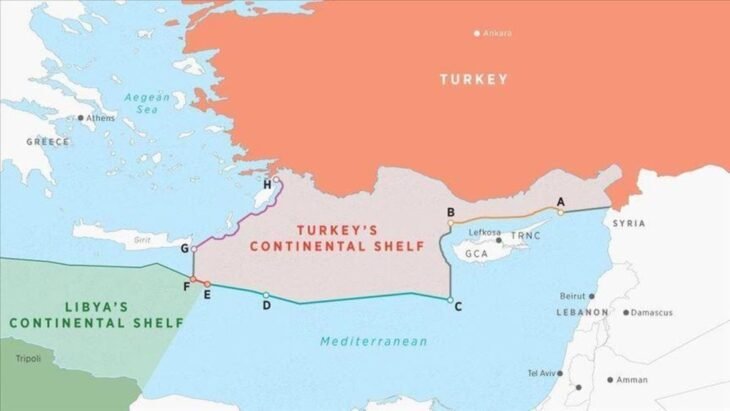
Until recently, the difference between the East and the West Libya, at least as far as Greece was concerned, was that the eastern part of the country was firmly anti-Turkish. This offered Athens extra reasons to reject the 2019 Turkish-Libyan maritime agreement as the deal had not been ratified by the national assembly initially based in Tobruk and now in Benghazi.
Haftar now appears open to discussing it, as Turkey has taken several steps to approach Benghazi, in a methodical manner. The Turkish charm offensive was facilitated by Greece’s failure to follow a foreign policy that would provide results, from the very next day of Haftar’s visit to Athens in January 2020 onwards, despite some initial activity.
The first two years were marked by highly symbolic steps. Greece, as of July 2021, was one of only three countries to have a consulate in Benghazi (along with Egypt and Italy). Benghazi started making a series of requests, most of which Greece failed to satisfy. Haftar’s side had requested some old-style ammunition (artillery and bullets), which Athens was hesitant to provide.
There had been some further discussions on economic cooperation, most notably covering some of Eastern Libya’s needs for consumer goods, through ships that would travel from Greece to the port of Benghazi. In fact, Greece financed, through the UN’s World Food Program, the rehabilitation of part of the port of Benghazi (a container warehouse and a corridor connecting two piers), as an entry point for humanitarian aid to the Sahel and sub-Saharan Africa.
There were attempts to revive contacts with eastern Libya on a commercial level, initially with a proposal for a coastal ferry connection, or an airline to Crete or Athens, but these efforts have also failed.
The failure in the Greek government’s efforts over the past five years to revive trade or other economic relations is largely due to the Greek business community, which is extremely skeptical of taking risks in a country that is divided into two. In addition, there are unpaid debts that Libya owes to Greek businesses since the fall of Muammar Gaddafi and the early years of the civil war.
Especially after February 2023 and the gradual normalization of Greek-Turkish relations, which made it look like investments in hydrocarbon exploration by American giants in the southwest of Crete would continue, Athens somewhat relaxed contacts with Libya.
It is also a given that Greece’s failure to assist Benghazi when Storm Daniel swept through eastern Libya in 2023 destroying the city of Derna and leaving thousands of dead, also played a very important role. Greece at the time attempted to organize a small aid mission, which ended in the death of three Greek soldiers and Angela-Moira Mandalios and Philip-Antonios Mandalios, two local young Greeks, on September 17, 2023. On its side, Turkey sent tankers with about 400 personnel, set up mobile hospitals and supported Haftar’s faction intensively.
Then, in November 2024, Turkey reopened its consulate in Benghazi, with a much larger presence than before. Many Turkish construction companies are active in the country, while last April saw the first visit of Haftar’s son, Saddam, to Istanbul. The Turks have also expressed their willingness to train soldiers from the militias of Eastern Libya, which Greece has also been extremely hesitant to do.
Lieutenant General Saddam Haftar, is also seen by the West as the official representative of the armed forces of Eastern Libya, which is why last Monday, June 2, he was in Toulon, following an invitation from his French counterpart, General Pierre Schill, Chief of Staff of the French Army, to a symposium of his Mediterranean counterparts. In his speech, Haftar did not mention Greece’s role but had many positive things to say about Turkey.
Since the beginning of last month, Tripoli has asked the UN Security Council not to renew resolution 2733, which provided for the surveillance of the movement of ships to Libya, to comply with the arms embargo. To this end, the European Union had launched a naval mission in the Mediterranean Sea, dubbed Irini, aimed at enforcing the arms embargo. Turkish ships had repeatedly bypassed or even refused to be inspected by warships of EU member states.
In mid-May, the French proposed to Dbeiba that the mission receive a technical rollover of six to nine months, something the Italians also agreed with. Turkey is the only country to have deployed land, sea and air weapons systems in Libya, while it has been training Tripoli’s forces since 2019. For Ankara, this is about acquiring significant experience in intelligence gathering missions, as well as promoting the value of its weapons.
Fourteen years since the revolution, Libya’s institutional framework has undergone near-total dissolution, as evidenced by the state’s effective surrender of responsibility for core sovereign functions to nonstate actors.
Clashes in Tripoli last month, triggered by the assassination of a militia commander in circumstances under the guise of negotiations, resulted in nine documented civilian fatalities and 47 injuries, all with absolute impunity for the perpetrators, reflecting a systemic pattern in which violence has been monetized by the ruling elites. This incident was not an anomaly but the inevitable byproduct of a rentier political economy dominated by kleptocratic networks and external sponsors.
Despite generating $50 million daily from the export of 1.2 million barrels of oil, Tripoli remains fractured, split into militia fiefdoms in which any nominal state authority depends entirely on 120-plus armed groups. These factions control informal and illicit economies, including human trafficking corridors that funnel thousands of migrants each year to Europe, municipal extortion rackets and parallel “customs” operations at ports such as Misrata.
Hydrocarbon revenues subsidize militia salaries and systems of patronage instead of funding public services, creating a self-perpetuating war economy in which institutional collapse is not a failure but a design feature to enable elite capture.
The Tripoli-based government’s fumbled “purge” last month constituted a predatory realignment, not a much-needed change or institutional reform. When state-aligned forces eliminated a rival militia commander during a purported negotiation, they seized control of Abu Salim, a district that controls vital central bank access points that are responsible for processing an estimated $1.8 billion a month in hydrocarbon revenues.
The maneuver exposed the Government of National Unity’s existential paradox: it exterminates competing factions while relying entirely on aligned militias such as the 444th Combat Brigade, which receives $15 million to $20 million a month from state coffers for “security services.”
The inevitable urban warfare last month demonstrated the ways in which violence services the competition between elites for dwindling resources. Libya’s $6 billion quarterly oil revenues remain captive to this cycle of predation, with the militias systematically diverting more than a third of the proceeds through fuel-smuggling syndicates that move more than 100,000 barrels a day. Meanwhile parallel “customs” operations at the Port of Tripoli impose a 25 percent “tariff” surcharge.
Taking control of Abu Salim alone secured illicit revenues worth $300 million a month, confirming militia consolidation as a resource grab mechanism through which state collapse enables elite enrichment.
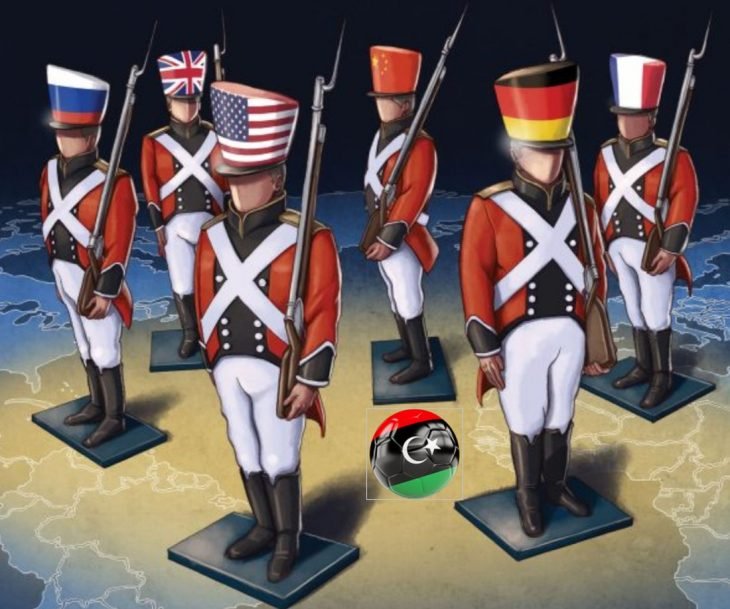
Meanwhile, foreign engagement in Libya operates as a transactional marketplace in which external powers exchange military capital for access to resources, with zero regard for Libyan sovereignty or stability.
Turkiye’s 5,000-troop garrison and drone bases near Tripoli oversee hydrocarbon-rich maritime zones, while Russian mercenary forces at Al-Qardabiyah Airbase guard Libyan National Army commander Khalifa Haftar’s eastern oil terminals and are repaid with crude oil allocations worth about 80,000 barrels a day.
Such engagement fuels fragmentation, a strategy that Washington has also co-opted as part of its rather puzzling policy on Libya. On the one hand, the US expresses explicit support for the Tripoli-based parallel authority. On the other, it simultaneously makes diplomatic overtures to the eastern-based rival government — which is actively mobilizing troops toward Sirte, positioning it to seize $50 million per day in oil revenues — and holding joint military exercises that lend it legitimacy.
With more than 12 foreign military bases now established, the disintegration of Libya is not collateral damage but the intended outcome of resource access opportunism masquerading as diplomacy.
Beneath this warlord calculus, there simmers the prospect of societal collapse as a result of deliberately engineered scarcity; 200 percent inflation eviscerates household purchasing power, while 18-hour-a-day electricity blackouts cripple critical sectors and industry, despite the billions of dollars of hydrocarbon revenue flowing in each year.
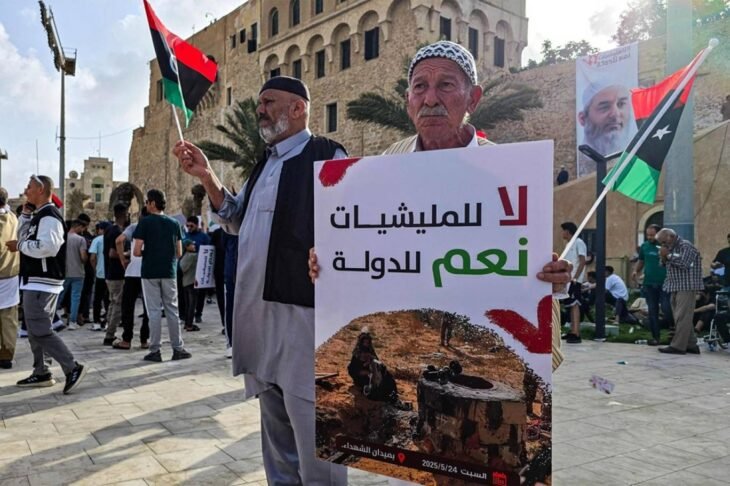
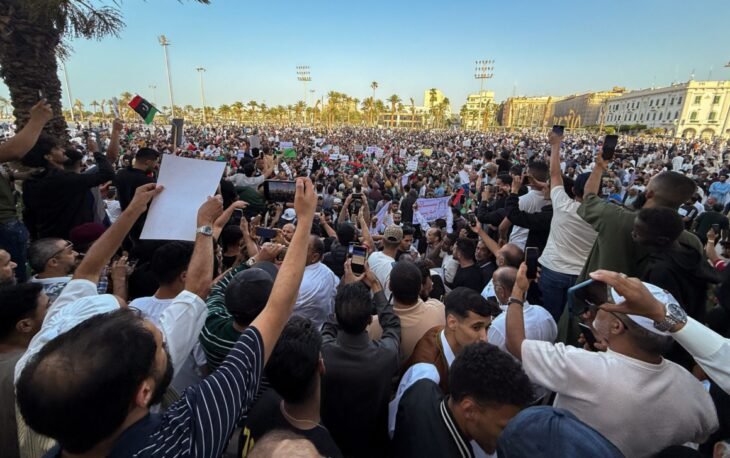
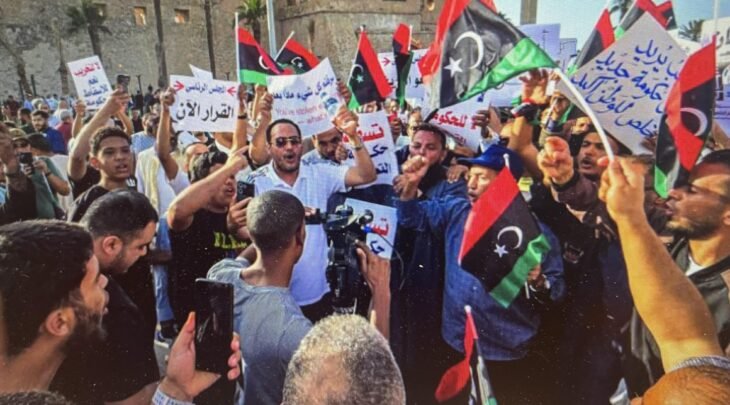
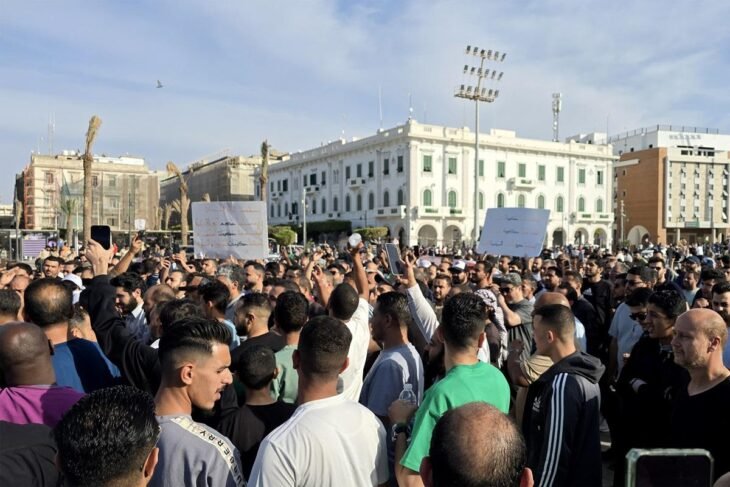
This systematic deprivation fuels mass dissent, as evidenced by the 4,000 citizens who chanted “neither east nor west” during protests last month, serving as a direct indictment of all ruling factions after 1,400 days of undelivered election promises.
Meanwhile, youth unemployment stands at a staggering 40 percent, reflecting generational abandonment, compounded by resource-hoarding by elites — such as the millions in embezzled dam maintenance funds, a direct result of which was the Derna dam collapses in September 2023 that resulted in at least 5,000 preventable deaths, a figure exceeding the number of front-line combat deaths.
As a consequence, public fury is on the rise, as evidenced by the nightly burning of tires and occupation of ministry buildings, protests that are often met with live militia fire.
Beyond Libya’s own borders, the disintegration of the country actively metastasizes into regional instability, with militia-controlled coastal networks dispatching thousands of migrants each year across the Mediterranean.
This human commodity market intersects with the implosion of Sudan, where 9 million displaced persons have fled conflict zones, alongside the funneling of small arms into and out of Libya through porous southern borders.
The concern, therefore, is that a renewed Tripoli-Benghazi civil war could trigger immediate and very grave consequences that would dwarf even the descent into conflict of neighboring Sudan. It would not only be a matter of the potentially unprecedented scale of human suffering it might cause, but the domino effect on the global economy of disruption to oil exports in a country that contains about 41 percent of Africa’s total proven reserves, while also accelerating refugee flows.
Appointments of UN envoys and ceasefire agreements remain largely performative when global powers are actively fueling conflict. The collapse of the Government of National Unity and the ascendance of Haftar prove that Libya’s “leaders” prioritize personal enrichment over the establishment of a credible and sustainable social contract.
With international diplomatic missions now fleeing Tripoli for Tunis and militias stockpiling weaponry, the question now is not whether the violence will escalate but when the spillover will force a reevaluation of the international complacency and a recalibration of approaches.
In the meantime, an accountability vacuums persist. Without the prosecution of those accused of embezzlement or war crimes, the demilitarization of cities and an end to foreign arms flows, Libya’s frozen conflict will thaw into a regional conflagration.
A forensic auditing process must commence before the next dam breaks because, every 3.6 seconds, another barrel of oil adds more funds to this engineered chaos, while the spark of regional ignition draws ever closer.
***
Hafed Al-Ghwell is a senior fellow and executive director of the North Africa Initiative at the Foreign Policy Institute of the Johns Hopkins University School of Advanced International Studies in Washington, DC.
Haftar authorities severed phone and internet services at the western Sirte checkpoint, leaving the Gaza convoy’s participants stranded in the desert.
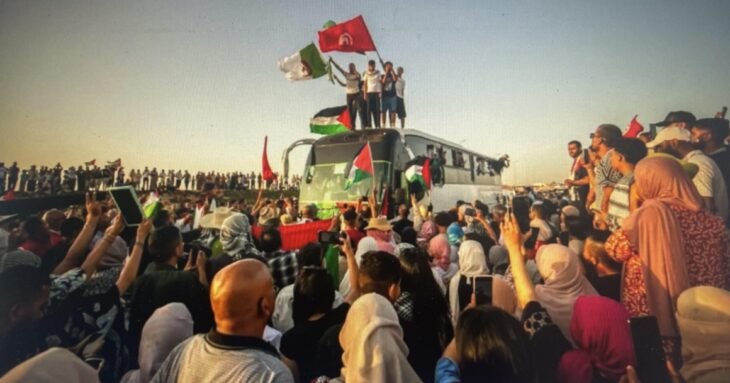
Libyan security and military forces loyal to Khalifa Haftar’s eastern administration stopped a Gaza-bound convoy, known as the Somoud convoy, late on Thursday at the east entrance of Sirte, some 450 kilometres from Tripoli, demanding additional security clearance and cutting off internet services across the area where participants have since camped.
The convoy, consisting of 150 vehicles and approximately 1,700 activists, arrived at the Haftar-controlled checkpoint around 8 p.m. Local security officials told the convoy’s organisers, the Joint Action Coordination for Palestine, that they must await formal approval from authorities in Benghazi before proceeding.
Faced with the unexpected blockade, organisers decided to halt and camp by the roadside overnight. Checkpoint officials requested lists of participants’ names and passports, which were promptly provided; however, they have yet to issue a response. Seventeen hours later, the convoy remains stranded in a remote desert area.
In a public appeal, organisers called on Libyans for logistical support, including tents, water, and portable toilets, warning of the harsh conditions facing those who were forced to camp out. Meanwhile, authorities aligned with Haftar severed phone and internet services at the western Sirte checkpoint, forcing participants to move in shifts westward in search of connectivity to share updates and images.
“Some officials say we will be allowed to pass after a few hours; others claim that Egypt is refusing, and that passage is impossible. We have no clear information”, said Wael Naouar, a lead organiser. Initially, Libya’s eastern government welcomed the convoy in a statement early 12 June, praising the “brave initiative.” However, it requested the respect of “Egyptian regulations” governing visits to the volatile border region near Gaza.
On 11 June, Egypt’s Foreign Ministry reiterated that any visits to the area must be conducted through official channels, with prior approvals secured through Egyptian embassies or the ministry itself. Naouar said the group submitted an official entry request on 19 May and had met with Egypt’s ambassador in Tunis, accompanied by a Tunisian official close to the Egyptian government, prior to their departure.
While the convoy set out before receiving a final answer, organisers stressed that Egyptian authorities were informed of their plans. Since Wednesday, Egyptian authorities have detained and deported more than 200 activists upon their arrival at Cairo airport or from hotels in downtown Cairo, according to multiple participants who spoke to The New Arab.
Haftar, a warlord whose family wields significant political power in eastern Libya, is backed by Egypt, the United Arab Emirates, and Russia. Cairo views Haftar as a crucial barrier against Islamist groups, particularly the Muslim Brotherhood, which it opposes domestically. President Abdel Fattah al-Sisi has regularly voiced support for Haftar’s campaign to “combat terrorism” and stabilise Libya.
A divided Libya challenges convoy’s
progress
The convoy’s organisers have carefully avoided political messaging about the Libyan authorities governing regions they traverse, urging participants to do the same. Libya remains deeply fractured following the 2011 NATO-backed uprising that toppled longtime ruler Muammar Gaddafi.
The country is divided between a UN-recognised government in Tripoli, led by Prime Minister Abdulhamid Dbeibah, and a rival administration in the east controlled by Haftar’s faction. Organisers had anticipated delays crossing from western to eastern Libya due to heightened security and political tensions, but now worry that the internal conflict is seeping into the convoy’s camp.
“We have started noticing provocations from some Libyan individuals insisting on staying in the camp and causing disturbances,” said Ghassan Benkhelifa, an activist travelling with the convoy. “One repeatedly tried to board a bus despite opposition from the organising committee. We have complained to security personnel at the camp, but the behaviour continues. There are also frequent patrols by officers in uniform and civilian clothes.”
As of now, the convoy’s organisers continue to negotiate with Benghazi authorities. Meanwhile, in Egypt, authorities has tightened security at the Libya border, especially at al-Salloum, according to TNA’s correspondent in Cairo. Egyptian state-aligned media have persistently called for banning the convoy, and dismiss it as a “PR stunt designed to embarrass Egypt”, often associating it with the outlawed Muslim Brotherhood.
Composed mainly of activists from across the Maghreb, the convoy is part of a broader grassroots effort to challenge Israel’s blockade and deliver humanitarian aid to Gaza. It departed from Tunisia on 9 June and was planned to follow a route through western Libya, Sirte, Benghazi, and the Sallum border crossing. The goal was to reach the Rafah crossing by Sunday. “We are determined to move forward. We will not turn back or give up. Our goal is to reach Rafah, not to be stopped in Libya, Egypt, or anywhere else,” Naouar said.
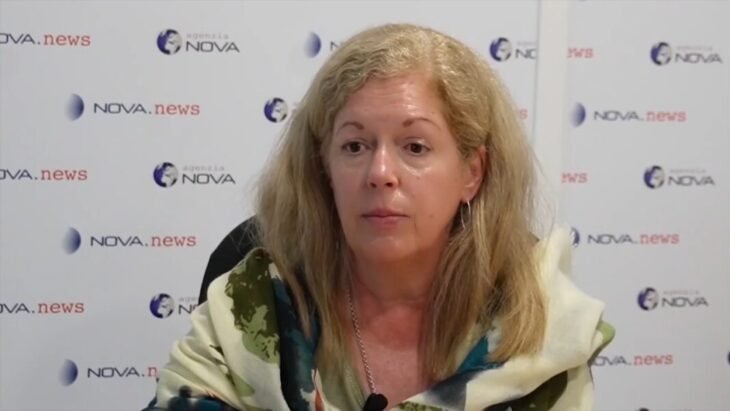
Libya cannot be reduced to a mere migration dossier: a broad and courageous vision is needed, capable of addressing the deep roots of the crisis that has been affecting the North African country for over a decade. This is the vision of Stephanie Turco Williams, former special representative of the Secretary General of the United Nations in Libya, a US citizen with a central role in diplomatic attempts at peace and now author of the book “Libya Since Qaddafi: Chaos and the Search for Peace”.
The work, which offers a detailed reconstruction of the post-2011 Libyan events, has a charitable purpose: all proceeds will be donated to charity. In an exclusive interview with “Agenzia Nova”, Williams illustrates the content and motivations behind her volume, conceived as a detailed and in-depth account of the political, military and diplomatic events in Libya from 2012 to the latest developments. “I decided to write this book,” explains Williams, “because I felt that there was a lack of a detailed and impartial reconstruction of the post-Gaddafi Libyan events, seen from the inside and in all their complexity. It is a story that does not spare criticism of any of the actors involved.”
The US diplomat criticizes Italy for having focused too much on the migration issue. “Italy certainly has its own lens through which it looks at Libya,” says Williams, explaining that Rome’s policy on the North African country has historically been influenced by the migration issue. “We may disagree on how to handle this issue with the Libyans, but I think it certainly influences the policies adopted.
The French, on the other hand, tend to look at Libya through the lens of anti-terrorism,” she adds, highlighting how each European country observes the Libyan situation through its own specific interests. Williams, however, reiterates the need for greater overall European political and strategic commitment, positively noting the recent relaunch of the Berlin Process, a diplomatic initiative launched by Germany and supported by the United Nations in 2020 to promote a political solution to the Libyan crisis.
The Berlin Process involves the main international actors interested in the Libyan dossier – including the United States, Russia, Turkey, Egypt, France, Italy, the United Arab Emirates, and the African Union – and has served to obtain common commitments on the ceasefire, respect for the arms embargo, and support for an inclusive electoral process under the auspices of the UN.
A next meeting is scheduled in Germany on June 20. “From what I can see, there is now more emphasis on collaboration than rivalry between the two countries in the Libyan dossier,” Williams comments. This renewed European and international engagement, according to Williams, is “crucial” to overcome the current crisis of legitimacy in Libya, where “there is not a single Libyan institution that enjoys real popular legitimacy. They all lack it. This is a problem that needs to be addressed.”
According to Williams, one of the main critical issues encountered in the recent past concerns the marginalization of the Libyan dossier in international agendas, especially in 2019. “The problem was that, in almost all capitals, Libya ceased to be a political priority. Decisions on the Libyan dossier were often subordinated to bilateral political considerations with key players in the region, such as the United Arab Emirates or Egypt,” says the former UN envoy.
“Libya became a secondary element within broader strategic relationships.” For Williams, it is now crucial that Libya returns to being a political priority in the main international capitals: “Today there is a real opportunity to put Libya back at the center of the agenda. A serious, coordinated and lasting commitment is needed.”
The former special representative underlines the strategic role of Russia and Turkey, which now operate “in a sort of condominium” on Libyan territory, a situation that despite having guaranteed relative calm, remains precarious and dangerous. “The Libyans themselves invite foreign powers into their country,”
he states, “but in doing so they put their own sovereignty at risk.” A situation that now more than ever requires European leadership capable of proposing authentically inclusive solutions, which look not only to immediate interests but to a lasting and sustainable pacification of Libya.
In the interview with “Agenzia Nova”, Williams also comments on the recent military parade organized in Benghazi by the forces of General Khalifa Haftar, during which numerous heavy weapons and new means of war were exhibited, and the growing militarization of Fezzan, a southern region under the control of Haftar.
“Obviously, from what we saw in the parade, weapons continue to arrive, equipment continues to arrive,” explains the former UN special representative in Libya. A situation that highlights the ongoing violation of the arms embargo imposed by the United Nations, the observance of which, Williams states bitterly, “is a joke”. In his opinion, the presence of “tens of thousands” of mercenaries on Libyan soil and the continuous influx of weapons from abroad demonstrate the total lack of respect for Libyan sovereignty.
One of the most controversial and delicate passages of the Libyan crisis, analyzed in the book and in the exclusive interview given to “Agenzia Nova”, is the ambiguous role played by the United States during the military offensive launched by General Khalifa Haftar in April 2019 against Tripoli. Williams recalls that moment with bitterness: “During the first Trump administration there was a profound disconnect and lack of communication between the White House, the Pentagon and the State Department.
This led, among other things, to the famous green light for Haftar’s attack on Tripoli, while the State Department and the Defense Department were completely unaware. They were not even aware that Trump had called Haftar. There was a four-day delay between that phone call and the release of an official statement, something that never happens in Washington. This general disorganization and confusion between the agencies, combined with Trump’s penchant for a transactional approach to foreign policy, raises legitimate concerns about the direction that American policy in Libya could take”.
Williams does not limit herself to that 2019 episode. The book also clearly shows a second “green light” given by the US in the “secret” oil agreement signed in July 2022 in Abu Dhabi between the Haftar and Dabaiba families, an agreement that caused an internal political and institutional earthquake: “The replacement of Mustafa Sanalla at the helm of the National Oil Corporation (NOC), decided in Abu Dhabi between Haftar and Dabaiba, had a devastating effect on the autonomy and integrity of the NOC, which for years had been protected and considered sacrosanct by the international community.
Once again, as in April 2019, the agreement had the tacit green light from the White House, creating an extremely worrying scenario for the transparency and economic stability of the country”. It is precisely this episode, Williams adds, that pushed her to leave her role at the United Nations in July 2022.
Williams’ analysis is also critical of Libyan leaders themselves. The case of Prime Minister Abdulhamid Dabaiba is emblematic: “During the Libyan Political Dialogue Forum (LDPF) that we organized under the auspices of the UN, Dabaiba made a public and solemn commitment not to run for president. He even signed an official declaration to that effect. A few months later, however, he blatantly violated that promise. This choice was perceived by many Libyans as a political betrayal that weakened the peace process and compromised the path to elections.”
The failed elections of December 24, 2021 represent one of the most critical and painful moments in Libya’s recent history. “We had set clear deadlines in the Lpdf, especially on the constitutional framework. When it became clear that a constitutional agreement would not be reached by February 2021, the international community should have intervened immediately.
Not doing so was a huge strategic mistake,” says Williams. “I believe it is extremely difficult to go to the polls without a clear constitutional framework that addresses, among other things, the thorny issue of the eligibility criteria for presidential candidates, a still unresolved issue. We know very well that this problem revolves around a single figure in Libya (General Haftar, ed.) and touches on sensitive issues such as dual citizenship and the possibility for military officers in service to run for office.
This is a negotiation that must be managed entirely by the Libyans. I discuss this in depth in my book: bypassing this discussion, as was then done, and allowing Parliament to approve electoral laws in an opaque and non-consensual manner, has opened the way to a plethora of presidential candidacies, with the result of fueling further divisions and tensions”, says the former UN special representative.
Another serious mistake, according to Williams, “was the betrayal of the prerogatives established by the Forum for the new government. It was supposed to be a streamlined executive, with the aim of decentralizing and guaranteeing funds to municipalities to facilitate the organization of the electoral process. It was not supposed to turn into a bloated monster of power-sharing, a classic muhasasa system. And instead that is exactly what happened”. A drift, according to Williams, that compromised not only the credibility of the transition, but also the minimum conditions to arrive at a truly inclusive and transparent vote.
The former UN envoy also clarifies the details of the scandal related to the alleged bribes during the Lpdf meetings: “In Tunis, we received vague accusations of corruption aimed at influencing the vote on the new Libyan leaders. However, we had no investigative mandate. We immediately contacted the Libyan Prosecutor and the UN Panel of Experts, asking them to investigate. They told us that there was no concrete evidence. Weeks later, leaks came out that smeared the entire process. If there was indeed evidence, it should have been made public immediately out of respect for transparency”.
In its third section, Williams’ book addresses the crucial issues that continue to block Libyan reconciliation: the absence of a concrete policy of disarmament, demobilization and reintegration of militias, the pervasiveness of rentier economic structures that fuel local conflicts, and above all the widespread impunity for human rights violations, which remains a major cause of the perpetuation of violence.
Another central issue addressed in the interview was that of disinformation, a phenomenon that the former mediator defines as “devastating” for Libyan society, deeply divided even online, with veritable foreign electronic armies, including Russians and Turks, engaged in creating opposing and polarizing narratives. Williams recalls the murder of parliamentarian Saham Sergeiwa, who disappeared in Benghazi after a smear campaign on social media: “The conflict in Libya has been fought online as much as on the ground.”
Williams emphasizes that Libya is “a Facebook nation,” where “there are more Facebook accounts than citizens.” This is the main channel of communication and, at the same time, propaganda. “Stanford University published a very in-depth report at the end of 2020, which I recommend everyone read,” says the former UN representative.
“It analyzes not only the situation in Libya, but also in Syria and Sudan, and directly links disinformation to Prigozhin’s networks, but also to sources in the Gulf countries, Egypt and elsewhere in the region.” This study, Williams continues, prompted Meta to remove numerous fake pages and profiles.
During the interview, Williams expressed a clear condemnation of the hypotheses, circulating in recent days in the international press, about a possible agreement for the temporary transfer of part of the population of Gaza to Libya. “I cannot imagine the Libyan people accepting such an agreement. Any Libyan who even took part in that type of discussion would, in my opinion, be automatically disqualified from any position of responsibility in the country”.
For Williams, it would be a “cynical and purely transactional” initiative. An equally severe judgment is reserved for the idea of using Libya as a platform for the rejection of migrants. “Libya is not a safe country for any migrant”, Williams reiterated. “We have also addressed this issue here in Rome, with the Italian government. The United Nations has always opposed the repatriation of migrants to Libya and to those detention centers that are, quite simply, hells on earth”.
In closing, the former UN Special Representative launches an appeal to Libyan leaders. Williams says she is “very encouraged” by the current work of the UN mission in Libya (UNSMIL), now led by the new Special Representative of the Secretary General, Hanna Tetteh, and recognizes “the importance of the results” obtained by the new Libyan Advisory Committee to overcome the political stalemate. In her opinion, the United Nations “remains the most impartial mediator in Libya, and the one most widely accepted by the majority of the population”.
For this reason, she emphasizes, it would be “very wise for Libyan actors to support this new UN mediation process”. But the final reflection goes beyond politics. “Libyan leaders must stop thinking about themselves, and start thinking about their children and grandchildren. What kind of Libya will they leave to future generations? What will their legacy be? It is their country, and they are ultimately responsible for its fate”.
Libya’s Tripoli-based government has been riven by militia fighting, while Saddam Haftar courts senior US intelligence officials
US envoy Massad Boulos is set to make his first official visit to Libya next week amid rising tensions in the capital city of Tripoli and neighbouring Sudan, a US official and an Arab source told Middle East Eye.
Boulos, who is Trump’s senior advisor to Africa, was supposed to travel to Libya earlier this year, the sources said, but Egyptian officials complained, saying they wanted him to visit Cairo first.
Boulos met Egyptian President Abdel Fattah el-Sisi and the head of the Egyptian General Intelligence Service, Hassan Rashad, in May. Egypt is one of the main external powers in Libya.
Ties between Egypt and the US have become strained over Washington’s reassessment of military aid to Cairo and Trump’s call earlier this year for a forced displacement of Palestinians from Gaza, MEE previously reported.
In Libya, Boulos is expected to visit Tripoli first, home to the United Nations-recognised government, and then travel to Benghazi in eastern Libya, which is controlled by a parallel government backed by General Khalifa Haftar and his sons.
Boulos’s office did not respond to MEE’s request for comment. The envoy’s visit comes as Libya’s powerful militias and politicians jostle for power.
In May, Tripoli was convulsed by fighting between rival militias that killed at least eight people. The clashes started after the 444 Brigade loyal to Prime Minister Abdulhamid Dbeibah killed the leader of a rival group. The 444 Brigade then launched attacks on a Salafist militia called the Rada Deterrence Force, which controls Tripoli’s main airport.
Dbeibah was appointed president in 2021 as a consensus candidate with a mandate to usher Libya into elections. The vote never took place. There have been regular protests against Dbeibah.
Boulos has been in discussions with Dbeibah’s top advisor about unlocking billions of dollars in sanctioned frozen wealth funds, MEE was the first to reveal. The two sides discussed putting some funds into investments with US companies in Libya.
NBC later reported that in exchange for releasing the funds, the Trump administration pressed the government to accept up to 1 million Palestinians from the Gaza Strip, which has been under Israeli assault since 7 October 2023, after the Hamas-led attacks on southern Israel.
Saddam Haftar comes to the fore
The instability in Tripoli has allowed Khalifa Haftar’s family to lobby for support.
Khalifa Haftar is 81 years old. His son Saddam is being cultivated as a likely successor, US and Arab officials tell MEE. Saddam’s stock is rising with the new Trump administration, especially in national security circles, the US official and Arab source told MEE.
Saddam made a high-profile visit to Washington in April, where he met Boulos at the State Department. More importantly, he held a meeting with several senior US intelligence officials in Washington, the sources told MEE. That meeting has not been previously reported.
Saddam has also been making overtures to countries traditionally closer to the government in Tripoli. He has visited Qatar and Turkey for support. This week, he visited Italy.
Libya has been divided since the Nato-led removal of longtime ruler Muammar Gaddafi in 2011. The civil war became a proxy conflict with Russia, the UAE, Egypt, and France backing Haftar and Turkey supporting the government in Tripoli.
In 2019, Trump gave his tacit approval for the elder Haftar’s bid to take over Tripoli. The attack failed when Turkey intervened. The battle lines in Libya have become more convoluted in recent years.
Sudan spillover
A case in point is the competing interests among external powers in Sudan. Although Egypt and the UAE both support Haftar’s government, they are backing opposing sides in the Sudanese civil war. Egypt has thrown its support behind Sudan’s army along with Iran and Turkey, while the UAE is backing the paramilitary Rapid Support Forces (RSF). Haftar has facilitated the shipment of arms to the RSF.
Boulos has been trying to mediate a ceasefire between Rwanda and the Democratic Republic of the Congo. Egyptian officials want Boulos to make progress on preventing a spillover of the Libyan and Sudanese conflicts, an Egyptian official told MEE.
However, following their May meeting, the Egyptians assessed that his influence would be limited, the source said. Politico reported in May that Trump has curbed Boulos’s influence. The US and Arab sources told MEE that expectations for Boulos’s trip were low on all sides.
The RSF said on Wednesday it seized a strategic zone on the border with Egypt and Libya. The announcements came a day after forces loyal to Haftar launched a cross-border attack alongside the RSF, the first allegation of direct Libyan involvement in the Sudanese war. The attack is likely to strain ties between Haftar and Egypt.
Armed clashes among forces of the U.N.-backed government in Tripoli benefit the Tobruk-based eastern administration dominated by Field Marshal Khalifa Haftar and his Libyan National Army.
Russia and Türkiye are taking advantage of a divided and unstable Libya to improve their geostrategic positions in Africa and the Mediterranean.
Russia is cementing its ties to Haftar with major weapons deliveries and deployments, whereas Türkiye is making inroads to Tobruk through the use of soft power.
Türkiye’s ties to all major Libyan factions position Ankara to potentially broker unity in the country, after years of failed efforts by U.N. mediators.
***
In mid-May, Libya’s continuing division into two rival administrations – a U.N.-backed Tripoli-based Government of National Unity (GNU) and a Tobruk-based, Haftar-dominated House of Representatives (HOR) government – manifested as violent clashes that caught civilians in the crossfire. Violence in Tripoli broke out when allies of GNU Prime Minister Abdul Hamid Dbeibah put down a revolt by one of the armed militias his administration relied on – the Stabilization Support Apparatus (SSA).
U.N. officials reported that the Tripoli combat killed eight civilians, and another 58 bodies were later found in a hospital under the SSA’s control. The head of the SSA was killed in the battle. Hanan Salah, Libya researcher and associate director in the Middle East and North Africa division at Human Rights Watch, told Deutsche Welle: “The sheer recklessness of the warfare that Human Rights Watch documented in the middle of civilian neighborhoods shows the blatant disregard these armed groups have for the life and livelihoods of civilians.” The fighting ended with an undisclosed agreement between the militias and Dbeibah’s administration, but it was followed by popular protests and the resignation of several ministers who supported protesters’ calls for Dbeibah to step down.
The SSA revolt was sparked by Dbeibah’s effort to consolidate his control over all western militia forces, which he judges necessary to match the degree of control Haftar exercises in eastern Libya. Haftar long ago consolidated control over the various militias within his territorial sphere of influence, ruling with an iron fist. The elected HOR (parliament), which nominally runs the eastern administration, is loyal to Haftar, as is the appointed Prime Minister Ossama Hammad.
With backing from Russia, as well as Egypt and the United Arab Emirates (UAE), Haftar’s forces nearly captured Tripoli in 2019 before Turkish military shipments and advice helped the western forces repel the attack. Since then, U.N. officials have been visiting the country continuously, in what has thus far been a fruitless effort to persuade both administrations to dissolve, form a unified national government, and ultimately yield to leaders chosen in new national elections.
Western powers, including France, Italy, and the United States, have supported U.N. conflict resolution and unification efforts, but Russia and, to a lesser extent, Türkiye have taken advantage of Libya’s divisions to promote their separate geostrategic interests. Moscow has largely ignored U.N. stabilization efforts and instead expanded its military relationship with Haftar, viewing his territory as an ideal platform to compensate for its diminished influence in and access to post-Assad Syria.
Russia’s arms deliveries to the LNA and access to the bases it controls provide Russia with strategic depth in Africa and the ability to project power into the Sahel. There, Russia seeks to capitalize on Western setbacks, including the forced French withdrawals from Mali, Burkina Faso, Niger, Chad and Senegal, and the U.S. departure from Niger. The Kremlin not only wants to displace Western influence in Africa, but also to control key resources, including Libyan oil, Sudan’s deposits of gold, and uranium mining in Niger.
Moscow also sees Haftar as an avenue to build a permanent naval presence in the Mediterranean – a long-standing Kremlin ambition that requires year-round port access and the ability to deploy naval assets. Naval basing, as well as other deployments, will help Russia control or influence transit routes from Libya, positioning Russia to pressure Europe over vital energy and infrastructure routes.
Eastern Libyan leaders in Tobruk have cited the coastal city as a potential location for a new Russian naval base. In February, satellite imagery showed Russia’s development of the Maaten Al Sarra airbase in southern Libya, where it had shipped S-300 and S-400 air defense systems. Nearly 1,000 Russian military personnel have also relocated to Libya from Syria since Assad’s collapse.
The added forces complement the former Wagner mercenaries—officially incorporated into Russia’s military as the Africa Corps following Wagner founder Yevgeny Prighozin’s death in 2023—already embedded within the LNA. For his part, Haftar views the Russian military deployments – which provide the LNA access to Russia’s logistical networks and its military installations in the country – as leverage against Tripoli.
As a sign of the expanding strategic relationship, Haftar and his son and heir apparent, Saddam, visited Moscow in early May to attend ceremonies marking victory in World War II. On May 12, the Kremlin press service announced simply that, “The president (Vladimir Putin) met with the commander in chief of the Libyan National Army, Khalifa Haftar.” Haftar’s delegation also met with Russian Defense Minister Andrei Belousov, who is said to have praised his “critical efforts” in curbing terrorism and “preventing further instability.”
At the same time, Haftar’s unbridled ambition to control all of Libya has led him to begin building ties to Türkiye, Moscow’s rival for geostrategic positioning in the eastern Mediterranean. Ankara has long been bereft of influence in eastern Libya – viewed exclusively as the military guarantor of the GNU in Tripoli, which it still arms and advises, and an ally of the GNU-linked Islamist militias that are anathema to Haftar’s anti-Islamist forces. However, more recently, Haftar has been willing to respond to Ankara’s overtures, in the process enhancing his leverage over Moscow.
Haftar and his allies appear to appreciate Türkiye’s use of “soft power” to build influence in the east – a clear contrast to Moscow’s military-centric approach. After Storm Daniel and the collapse of Derna’s dams in September 2023—described as “Libya’s 9/11”—Türkiye provided swift humanitarian assistance and opened channels of communication with authorities in the East. In April, Ankara hosted a visit by Saddam Haftar for meetings with the Turkish defense minister and other military officials in Ankara, where they discussed supplying equipment and providing training to LNA forces. By engaging both sides of the Libya divide at the highest levels, Türkiye appears to be positioned to engineer the political solution to Libya’s divisions that has thus far eluded U.N. negotiators.
Türkiye’s expanding engagement with eastern Libyan leaders has begun to pay dividends for Ankara’s geostrategy. The nominal governing authority of the east, the House of Representatives, is reportedly preparing to ratify a controversial maritime agreement with Türkiye. This development could significantly alter the strategic balance of power in the Eastern Mediterranean in Ankara’s favor. A 2019 memorandum of understanding (MoU) between Türkiye and the GNU delineated maritime boundaries and granted Türkiye access to a vast economic zone in the Mediterranean. However, the deal was challenged by Greece, Cyprus, Egypt and the eastern administration in Tobruk, which does not recognize the GNU’s authority to sign pacts with outside powers on behalf of all Libyans.
Speaker Aguila Saleh of the HOR previously denounced the agreement as null and void and a violation of Libyan sovereignty. Recent reports suggest the HOR has formed a committee to review and potentially ratify the agreement. Approval of the accord would align all major Libyan factions – in both the west and the east – with Türkiye’s maritime claims, in the process countering Greece’s bilateral maritime deal with Egypt. In the view of many analysts, the potential ratification of the maritime agreement by Libya’s eastern parliament might prove pivotal in ongoing disputes over Mediterranean energy resources and regional influence.
The Türkiye-Libya maritime agreement, if ratified by the HOR, would not necessarily put Moscow and Ankara at odds. The two powers have established in Libya what analysts characterize as a “managed rivalry” or “adversarial collaboration,” as previously seen in other theaters where their interests simultaneously collide and overlap, such as Syria and the South Caucasus.
On the other hand, the expanding Turkish and Russian influence in Libya has caused experts to question whether Washington has ceded influence in North Africa to other powers, Russia in particular. Perhaps in part to reassure its allies in Europe and in the Middle East, in March, the U.S. Air Force conducted a “training visit” in Libya, including by B-52 bombers. The visit represented an effort by U.S. generals to present Libyan leaders, particularly Haftar, with a strategic alternative to hosting an ever-increasing number of Russian troops stationed in LNA-controlled bases in Libya.
Turkey is seeking to expand its footprint in the region and the situation in Libya could represent a window of opportunity for Ankara. However, other actors such as Egypt and Russia, may try to limit the Neo-Ottoman expansion of Ankara.
Turkish posture in Libya has grown significantly in recent years. The main changes came with Ahmet Davutoglu, who stressed the importance of Turkey, extending its influence in the “near abroad”. He defined Libya as the heart of Ankara’s geopolitical strategies and the future of Turkish influence in the region. In 2011, Ankara participated in the NATO’s operation in supporting of the Libyan opposition and gradually increased its aid for the revolutionary and Islamist groups in Tripolitania.
In the beginning, Turkey used a mixture of socio – religious ties to exert influence. Between 2011 and 2014, the AKP (Justice and Development Party) created a network among the Libyan Muslim Brotherhood members, together with Qatar. By 2014, the situation escalated to a second civil war, characterized by the presence of two rival governments: One based in Tripoli (Western Libya, backed by Turkey) And one in Tobruk (Eastern Libya supported by Khalifa Haftar’s Libyan National Army (LNA)
After 2019, the Turkish government decided to strengthen its presence, following the LNA offensive. The intervention of Ankara was motivated by the US withdrawal from Libya in 2019, as well as the possibility of targeting Russian and United Arab Emirates ambitions. Moscow is considered the main competitor of Turkey in the country and the UAE has demonstrated its hostility to the Muslim Brotherhood, which prompted Erdogan to distance himself from Abu Dhabi.
In 2019, Turkey signed a Memorandum of Understanding with the GNA in order to organise the next steps, with a focus on security and military cooperation. Since then, Ankara’s strategy has changed from indirect to direct intervention, backing the GNA, through deployment of weapons systems and Syrian mercenaries. Among the military support, Erdogan transferred military personnel and Bayraktar TB2 UAVs. The intervention shifted the war in favour of the GNA.
Furthermore, Turkey has strengthened its presence with the Naval base in Misrata and the Air base in Vatiyya. Subsequently, the Maritime Deal of November 2019, signed by the GNA and Turkey, aimed to expand Turkey’s claims from 41,000 to 148,000 square kilometres in the Mediterranean and to allow the exploitation of resources. Protests came from Cyprus, Egypt and Greece, as it has been seen as a Turkish move to consolidate its presence in Libya. On the other side, actors such as Russia, Egypt and UAE gave their support to Khalifa Haftar’s troops and offensive. Cairo tried to break the ceasefire in 2020 but failed. In addition, these countries viewed the intentions of Ankara to stay as a concern for their interests, especially for what this could have implied for the Libyan unification.
In 2020, Egypt signed a maritime agreement with Greece with an exclusive economic zone between the two countries, mirroring of 2019 deal. The tensions between Ankara and Cairo arise from the coup d’etat in 2013, when Turkey sided with Islamists aligned with the Muslim Brotherhood in Egypt and cut diplomatic ties with Cairo. However, the recently restored relationship between the two countries reflects their willingness to collaborate in shaping Libya’s future.
On 5 February 2021, the new Libyan interim government, formed by the Libya Political Dialogue Forum (LPDF), appointed Abd al-Hamid Dbeibah as interim Prime Minister. Under Dbeibah, Turkey and the GNU have signed in 2022 a Memorandum of Understanding on oil and gas, building on the 2019 MoU. However, the Turkish approach also included an adaptation to the Libyan political context. Ankara established relations not only with the western but also with the eastern Libyan factions, including the Haftar family. This underlines the shift from direct confrontation to cautious diplomacy, as Turkey’s objective is to remain involved for the long term.
Turkey and Egypt from clashing to
rapprochement on Libya’s dossier
Following the meeting of September 2024, which constituted a turning point in Egyptian-Turkish relations, the two countries announced the establishment of a bilateral Strategic Cooperation Council. The aim is to coordinate mutual regional objectives in order to prevent potential conflicts.
The results of the rapprochement have been reflected in Libya’s political dynamics. Cairo and Ankara expressed their willingness to collaborate and work together to stabilise the troubled political environment in Libya and push the two governments – the Bengazi government led by Haftar and the GNU – to resolve their disputes. These efforts could also boost hydrocarbon production in Libya and represent a chance for both countries to consolidate their influence in the region.
However, during his visit in Cairo in early September 2024, Erdogan reiterated Turkish intentions to institutionalise relations with Tripoli, an aspect that risks destabilising the newly restored relations with Egypt.,The MoU signed in August between the Turkish government and Dbeibah confirmed the consolidation of Turkish military presence in Libya. This agreement gives the Turkish armed forces access to Libyan territory, airspace, and territorial waters.
The following day, Egypt invited Osama Hamad, head of the eastern government. Tripoli authorities interpreted this as a provocation and expelled two Egyptian diplomats. Nevertheless, Turkey maintained its strategy of cautious diplomacy. In the eastern part of Libya, Ankara made numerous investments, including the Turkish steel company Tosyali, which announced plans to build the largest iron and steel production plant in the world in Benghazi. In November, the Turkish military attaché to Libya traveled to Benghazi to meet with Lieutenant General Khairi al-Tamimi, the secretary of the general command of the self-proclaimed Libyan National Army.
Why does the current situation
benefit Turkey?
The current situation in Tripoli, which emerged on May 12 after the killing of Al-Kikli, (known as “Gheniwa”), head of the Stability Support Authority (SSA), has thrown the country into renewed chaos. Clashes erupted between militias aligned with the GNU.
This situation could strengthen Dbeibah – backed by Turkey and the GNU – following several attempts to replace him. In addition, factions that are under the Defence Ministry, particularly the 444 Brigade under Mahmoud Hamza, the 111 Brigade and the Joint Force from Misrata, could gain more power and consolidate their positions. The 444 Brigade is known for its close ties to Turkey. Furthermore, Ankara favours a less fragmented security landscape in Tripoli and the removal of Gheniwa could foster a more unified and secure environment.
Future perspectives
Following the fall of the Assad regime in Syria – which represented a window of opportunity for Turkey to expand its regional footprint – Ankara may attempt to do the same in Libya, albeit with a different approach. Turkey’s ability to operate on multiple fronts, and to capitalise on regional instability, could push it to further consolidate its presence in Libya. However, the presence of other key players, such as Russia and Egypt, must not be overlooked.
Their manoeuvres in the region will be critical. On one hand, they stress the importance of restoring governmental cohesion in Libya; on the other, they will not refrain from pursuing their own interests. Russia is present in Libya with military bases and maintains strong ties to the eastern government, having repeatedly supported Haftar. Although the war in Ukraine has somewhat loosened Moscow’s regional grip, its presence remains significant.
The same goes for Egypt, which despite re-establishing communication with Ankara, seeks to retain its influence over Libyan affairs. It cannot be ruled out that these actors – particularly Turkey and Russia – could exploit the current context to pressure Europe on migration issues. This tool has often been used, as demonstrated in Syria, to shift the balance of power. In the event of a deterioration of the situation – though less likely but still plausible – a new confrontation could arise, this time with different and potentially more serious consequences.
On May 12, Tripoli experienced widespread clashes between rival militias as Libya became the arena for the type of blood-letting and public disorder that recalled the horrors of civil conflicts and war that have devastated the country for more than a decade.
Both parts of the divided country, led by rival authorities in Tobruk and Tripoli, are overrun by militias. The administration in the east, headed by the House of Representatives in Tobruk, is supported by the Libyan Arab Armed Forces, commanded by Khalifa Haftar. His army controls political and financial institutions.
Haftar’s forces also control Libya’s oil-producing areas in the east that produce 1.2 million barrels a day. Oil revenues, which are deposited in the Central Bank of Libya, account for 97 percent of the government revenues required to pay for official expenses, salaries, and imports.
The latest turbulence has occurred in the west of the country, which is administered by the Government of National Unity headed by acting Prime Minister Abdul Hamid Dbeibah. Tripoli is home to three powerful militias: the Stability Support Authority; the Special Deterrence Force, also known as Radaa; and the 444 Brigade.
In early May, Dbeibah called for the dismantling of these militias. On May 12, after heavy fighting, the head of the Stability Support Authority, Abdulghani Kikli, was killed. He was the most powerful militia chief in Tripoli, controlling internal security and managing cash transfers from the central bank. Following his death, militias affiliated with Dbeibah, in particular the 444 Brigade, took over the assets of the Stability Support Authority, consolidating Dbeibah’s hold on power.
Beginning on May 16, however, popular protests started to take place in Tripoli demanding Dbeibah’s resignation. The demonstrators held him responsible for the power enjoyed by the militias, and for their own dire security and living conditions. After the protests were quelled by the security forces, Dbeibah took credit for “ending the rule of militia and building a state of law.”
The latest violence in Tripoli has highlighted the fragility of a binary political order in Libya that has enfeebled state institutions, weaned predatory political leaders, and encouraged lawlessness and violence in the broken polity.
It has also placed Libya at the center of regional human-trafficking networks. The International Organization for Migration estimates that in January and February this year more than 700,000 migrants from 44 countries were waiting in Libya to make perilous sea journeys to Europe.
The rival leaders in Tripoli and Tobruk enjoy the support of one of two major external powers: Turkiye backs Tripoli, while Russia backs Tobruk. Turkiye has provided the Government of National Unity with armored vehicles, air defense systems, armed drones, and artillery.
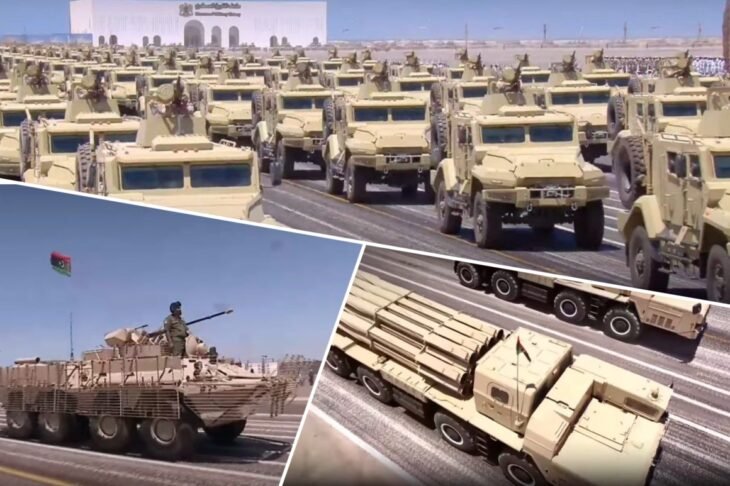
Meanwhile, during a military parade in Benghazi on May 26, Haftar flaunted Russian-supplied weaponry that included air defense systems, helicopters, tanks, military trucks, rocket systems, and infantry fighting vehicles. The parade served to showcase his military prowess, and supported the Libyan Arab Armed Forces’ claim to be the legitimate national army.
While Libya’s leaders enrich themselves and feud with each other, their backers, Turkiye and Russia, are reaping strategic and economic benefits. Russia already has airbases at Al-Khadim and Al-Shatti, and is said to be looking to establish a Mediterranean naval base, possibly at Tobruk itself.
Turkiye’s agreement with the Tripoli-based government in 2021 strengthened its claims to the energy resources of the Eastern Mediterranean. Since then, the country has obtained lucrative infrastructure contracts from the Tobruk government as well.
Russia views Libya as a strategic bridge to the Mediterranean and Africa. In the aftermath of the regime change in Syria, Moscow has targeted Libya as its principal geopolitical center for political, economic, and military outreach in Africa. Its interests on the continent, particularly in the Sahel, are being promoted by the Africa Corps, the successor to the Wagner Group, and are well-served from bases in Libya, particularl Maettan Al-Sarra close to the borders with Chad and Sudan.
So far, Turkiye and Russia have been pursuing a policy of “managed rivalry,” as they have done previously in relation to Syria and the South Caucasus.
A recent analysis in an Arabic newspaper contrasted the current lawlessness and violence in western Libya with the unity, discipline, and security provided by Haftar in the east through the elimination of extremists and militias. The author suggested that before seeking free elections and a democratic government, Tripoli needs to establish law and order through a takeover by Haftar’s forces and unite the country.
Possibly concerned by the corrosive effect of the national divide, Russia and Turkiye just might agree to unify Libya under Haftar. In September last year, there were reports that he was moving his troops to Ghadames, a strategically located oasis with an airport near the border with Tunisia and Algeria. This movement of his armed forces was seen as a precursor to the siege of Tripoli.
However, recent history tells us that although in times of disorder and violence military rule might seem alluring, once in power such rule rarely makes way for free and fair elections; instead, it remains entrenched for decades and grows increasingly autocratic, intolerant, and harsh.
Libya, sadly, is likely to be the latest example of this historical truth.
The Kremlin found itself in new foreign policy constraints due to further manifestations of nepotism among its Libyan ally.
Since mid-May, Tripoli, the capital of western Libya, has become a battleground for various factions supporting the UN-recognized Government of National Unity (GNU) led by Abdel Hamid Dbeibah.
Paradoxically, the crisis was triggered by the prime minister’s attempt to consolidate power, a move urged by international actors. However, Dbeibah’s steps toward centralization were clumsy and lacked the finesse of backroom deal-making—essentially achieved through the killing of Abdel Ghani al-Kikli, who led the militarized «Stability Support Apparatus» in Tripoli.
Following al-Kikli’s death—whether accidental or the result of a deliberate ambush—forces loyal to the GNU’s Ministry of Defense, primarily Mahmoud Hamza’s 444th Brigade, began seizing the Apparatus’s facilities in Tripoli’s districts. This led to armed clashes, public protests, and a new wave of political turbulence in a region where the official security apparatus of the internationally recognized government essentially consists of formations resembling private military companies, which periodically clash with one another.
Against this backdrop, another Libyan power center, represented by Khalifa Haftar and his family, began moving units of the Libyan National Army (LNA) closer to western territory—from Benghazi to Sirte. Given Haftar’s past tactics of exploiting divisions among western Libyan forces through pressure, renewed attempts by the LNA to avenge its 2020 defeat are not unlikely.
However, external forces play a significant role in stabilizing the situation—Turkey, which previously saved Tripoli from LNA capture, and Russia, which has unofficially established a presence at nearly all eastern Libyan military sites.
For Moscow, still struggling to maintain a semblance of influence in post-Assad Syria, new attempts by Haftar to seize full control of Libya could have severe consequences, potentially undermining the already faltering «African Corps» projects across the continent. Yet, even without a new military adventure by Haftar, Moscow’s medium-term presence in Libya lacks clear prospects.
Volatile Perspectives
Over the past decade, Russia’s stance on Libya’s internal power dynamics has shifted repeatedly: Moscow has at times openly aligned with Khalifa Haftar, only to later balance this tilt by intensifying contacts with Tripoli’s authorities.
This zigzag foreign policy trajectory was tied to battlefield successes and failures in Libya, where, after the LNA’s failed Wagner-backed offensive on Tripoli, the Kremlin hurriedly adjusted its actions to favor the internationally recognized authorities. Additionally, internal divisions within Russia’s elite—the Foreign Ministry advocated dialogue with Tripoli, while the Defense Ministry backed Haftar, and the Kremlin’s «towers» lacked consensus—created further policy fluctuations.
Among Russian military experts, it is believed that the infamous conflict between Yevgeny Prigozhin and then-Defense Minister Sergei Shoigu first escalated due to Libyan events.
Initially, Prigozhin’s «trolls,» followed by sociologists, political strategists, and mercenary fighters, bolstered the positions of regular Russian forces in eastern Libya. However, the «tail soon began wagging the dog,» demanding recognition of Wagner’s «hard» and «soft» power experience on the ground.
This conflict generated a wealth of information, but Wagner’s story in Libya ended in a lesser-known way. In September 2023, after Prigozhin’s elimination, Russian mercenaries at Libyan bases threatened to strike nearby Russian Defense Ministry facilities if the military did not urgently allow a Wagner-operated transport plane—carrying over 100 of Bashar Assad’s security personnel from a «Libyan assignment”—to land in Syria.
This was likely the final straw, after which Wagner mercenaries were fully withdrawn from Syria and Libya, replaced by the Defense Ministry’s fully controlled «African Corps.»
Following the fall of the Assad regime and the reduction of Russia’s presence in Syria (with the Tartus and Hmeimim bases effectively demilitarized), Libyan facilities have become a key stronghold for projecting Kremlin influence in Africa and the Middle East. The supply and rotation of the «African Corps» in West Africa (primarily Burkina Faso, Niger, and Mali) cannot logistically occur without relying on facilities in Haftar’s domain.
Haftar’s visit to Moscow in May 2025 was likely intended to officially mark a new phase in the Kremlin’s Libyan policy. Despite the LNA’s questionable legitimacy, Haftar observed the Victory Day parade alongside other countries’ presidents (though some, like Burkina Faso’s Ibrahim Traore, came to power through coups).
Prior to this, Haftar held talks with Shoigu, now Security Council Secretary, surrounded by military intelligence (GRU) leadership.
On May 10, Haftar was received by Vladimir Putin in the Kremlin and later—likely after receiving assurances from the president—by the current Defense Minister, Andrei Belousov.
Yet, Moscow’s position remains ambiguous: Russia’s embassy in Libya is located only in Tripoli, and the Foreign Ministry has consistently obstructed the opening of a consulate in Benghazi, despite the significant presence of Russian military personnel in eastern Libya.
The escalation in Tripoli amid eastern stability could push Moscow toward clearer support for Haftar. However, this is unlikely, as Moscow, despite its investments in Haftar, is well aware of the «ticking time bomb» in eastern Libya—one it cannot defuse even if it wished: 81-year-old Haftar faces health issues, and the transition of power to his sons could follow an unpredictable path.
Nepotism in Governance
Concerned about the impending power transition, Khalifa Haftar has long sought to delegate authority to his sons, primarily Saddam and Khaled.
Saddam Haftar is considered the primary contender to lead the LNA and the «eastern empire» as a whole.
From 2016 to 2024, he rose from cadet to head of the LNA’s ground forces. Initially, Saddam commanded the Tariq bin Ziyad Brigade, still regarded as one of the LNA’s most combat-ready units. However, international human rights groups have repeatedly accused the brigade of crimes against civilians.
As head of the ground forces, Saddam controls other capable units—battalions and brigades that are well-equipped and trained by local standards. The Tariq bin Ziyad Brigade primarily consists of Madkhali Salafists, which makes Haftar’s claims of fighting «takfirists» absurd and undermines the Russian Defense Ministry’s media campaign, built on supporting regimes purportedly combating «Islamists.»
Another of Haftar’s sons, Khaled, was appointed in 2024 to lead the LNA’s security units, centered around the 106th Brigade, which also relies on various Salafist groups. The distribution of military power between the two brothers (Haftar’s other children have lesser political ambitions for various reasons) allows the Haftar family to control eastern Libya but creates risks: it remains unclear how Saddam and Khaled will act in the event of their father’s death or incapacitation.
The situation is complicated by the stance of southern tribes, with whom Haftar has always managed to find common ground in tough times. For them, Saif al-Islam, Muammar Gaddafi’s reclusive son, would be preferable to Haftar’s sons.
While Libyans are weary of civil wars—a factor that could be significant during a power transition—the issue of resource distribution may outweigh the desire for swift stabilization.
The central issue, however, is consensus within the Haftar family. In Libya and among leading experts, there is a prevailing view that Haftar’s current display of family harmony is a facade, with serious competition between the brothers in reality.
Moreover, it is uncertain whether Saddam, in the event of his father’s withdrawal, could convince loyal brigades and battalions to remain faithful. The LNA’s ongoing purge, which in 2024 alone led to the dismissal of nearly 3,000 officers and generals, is unlikely to pass without consequences during a power transition.
Among the younger generation that has rapidly advanced in recent years, some may be dissatisfied and tied to the «old guard,» sidelined not only from power but also from income sources.
Experts are well aware of the shadow economy in eastern Libya, where oil smuggling intertwines with drug and human trafficking, with proceeds laundered through construction projects managed by two key funds: the National Development Agency, overseen by Saddam, and the Libyan Development and Reconstruction Fund, headed by another son, Belkasem.
The current security equation in eastern Libya relies on extensive international ties maintained by Saddam and Khaled—with allies like Russia, Egypt, Saudi Arabia, and the UAE, as well as adversaries like Turkey, the US, Israel, and others.
Turkey’s role in modern Libya is particularly paradoxical: a few years ago, Ankara was the Haftar family’s main opponent, contributing to the LNA’s military failure to control the entire country, but now Turkish construction companies are involved in numerous infrastructure projects in the east.
There are reasons to believe that Saddam and Khaled are seeking support from different players: the former from NATO countries, the latter primarily from Russia and Belarus. Rumors suggest that the secrecy surrounding construction at the Maaten as-Sarra airbase, conducted for the «African Corps,» is tied to Khaled’s efforts to demonstrate his ability to provide Russia with a key logistical hub for transferring goods and personnel to Burkina Faso, Mali, Niger, and Sudan, even in a region tightly controlled by Saddam. If this power dynamic is accurate, the prospects of the «African Corps”—a project meant to replace Wagner’s remnants in the region under GRU control—may be in jeopardy and heavily dependent on whether the Haftar family can reach any consensus. Even if a consensus is achieved, the external actors it relies on will matter greatly.
Moscow would prefer that the competition between Haftar’s sons is a tactical game of «good cop, bad cop,» aimed at securing concessions from all sides and demonstrating the Haftar family’s indispensability, if not for the entire country, then at least for its eastern half.
However, the Kremlin likely dismissed expert warnings that Assad’s victory in the Syrian civil war was an illusion and his regime’s collapse was almost inevitable. The consequences of that miscalculation are well known.
***
Platon Nikiforov – Political analyst specializing in the Middle East.
_____________________
Libya’ Military Politics: The Missed Path Toward National Strategy (4)
June 7, 2025
6 min read
Milad Elharathi
The National Road Map
In the main time, there is need to draft a national road map to transform these concepts to tangible practical plans that can be implemented according to the available budget. Accordingly, all concerned ministers put down their proposals concerning these resources.
Each proposal has objectives for the program and its component, and a definition of the strategy to achieve these objectives, with a timetable and explanation of the obstacles that each program may face and how to overcome them.
It is important to devise a system for accountability to give warning indications monitoring the stages of implementation and development priorities that will offer benefits to all citizens.
The Major Development Priorities
Good governance: and improving responses and accountability as well as the services that are provided by the government or the institutions, besides the local governments bodies.
– Participation and social integration, which leads to the individuals and societies’ ability to participate in the decisions that affect their lives.
– Health: improving the quality of health care and access to the services that aim at promoting the health of those who are physically, mentally and socially marginalized.
– Education: quality of education that improves the ability of formal and informal educational institutions to provide educational opportunities that contribute in alleviating
poverty, and giving priority to provide job opportunities, alleviate poverty, decrease cost of living, and combating corruption.
– The Judiciary’s Independence: Independence of the Libyan Judiciary system means that the Judicial Power should be isolated from any other powers of the government. That means that courts should not be subjugated to any influence of any institution, body or council in the state or any persons or parties.
There are several means to realize that, including selection of the judges and their appointment for life so as to enable them to concentrate on establishing justice and to judge in all cases according to the rules of the law, and according to what their conscience dictates, even if their judgments were not popularly accepted, or did not serve interests of certain groups or persons.
However, national development priorities differ from Libya to another state, but Libya should be confined, as a whole, to abolishing unemployment, providing job opportunities, alleviating poverty, reducing living costs, combating corruption, availability of food, combating crime and violence, combating narcotics, treating political instability, providing daily services such as drinking water, electricity in terms of securitization approaches, health care for all family members, endorsing equal rights between men and women, speech freedom in press, radio and television, and in seminars and conferences.
Furthermore, establishing security and acceleration of economic development is one of the priorities in rebuilding Libya after the revolution, and building a safe and stable society where the people own the country’s wealth.
As a result, it is necessary to aim all classes of the society with fixed programs by providing real job opportunities that maximize the role of human resources in upgrading productivity and good quality to be able to export the surplus of products.
It is vital to convince members of the society by the Media and seminars that development is done for their own interests and that will be asserted by asking every individual to play a role in that development, and to equally benefit of its results.
No doubt, putting citizens’ basic needs at the top of the national development priorities, broader popular participation in decision-making process, exposing economic, social and cultural policies to more studies through open public debates will lead to the best use of human resources, and make access to data and information, provide transparency in economic transactions, limelight all aspects of flaws and inefficiency in governmental departments and economic institutions and combat of corruption.
All these should be done in a framework of democracy. Development process is not only affected by democracy but it also affects it. Democracy avails the framework that constitutes an intensive development.
Economic growth, which includes a high degree of industrialization and value added, contributes in transformation to democracy much more than selling or exporting raw material.
Returns of raw oil sales do not per se lead to that transformation in the required speed and depth. Oil returns are accumulated by the state, and consequently increase the state’s power and bureaucracy as happens in some oil producing and exporting states. Politically oriented, Libya, in the first election, after half a century to elect the members of the General National Conference (GNC), the results of the Libyan election was in contrast to the expectations of most analysts who betted on the Islamists’ victory as happened in both Egypt and Libya, as the general trend of the Arab Spring was in favor of the Islamists.
In contrast, the Libyan results came to rectify the political comps and correct the course of the whole Arab revolts, and proved that the Islamists were not the only ones in the ground.
These elections returned confidence of followers of the democratic civil state, stressing that not Libyans are in favor of the Islamic rule. They are looking forward to a prosperous future for the modern Libya state: the state of institutions, a democratic constitution, a rule of the law, justice, rationality and living in peace with themselves and the world, as a state of stability, construction and development.
Conclusion
To conclude, Libya’s agony is not caused so much by the civil war, as it is by the internal problems left unresolved by Muammar Kaddafi. The war simply revealed a series of weaknesses and vulnerabilities, which had remained more or less dormant for decades.
And it’s almost impossible to solve these problems anytime soon, especially since the House of representatives does not have too many human and financial resources, so we can expect a weak, divided and on the edge-of-survival Libyan state for many years to come.
In short, Libya will be the most predisposed to internal divisions and instability. At the same time it’s also the only North African state to have failed to do away with the ethnic and tribal barriers and to create a national identity.
The main barrier to achieving this goal has been and still is geography and wealth along with the tribal segmentations in the country.
***
Milad Elharathi – Visiting Fellow, at Clare College, University of Cambridge UK
Eastern Libya’s parliament endorsement of a 2019 maritime deal would challenge Greece’s deal with Egypt.
Greece is expected to ask Egypt to intervene to dissuade the government in eastern Libya backed by General Khalifa Haftar from ratifying a maritime agreement with Turkey, Middle East Eye can reveal.
Greek Foreign Minister George Gerapetritis is expected to raise the issue with his Egyptian counterpart Badr Abdelatty on Wednesday, two regional officials with knowledge of the matter told Middle East Eye.
Libya’s internationally recognised government in Tripoli signed a contentious maritime demarcation agreement with Turkey in 2019 that ignored Greece’s claims to exclusive economic zones, including via major Greek islands like Crete and Rhodes.
Greece countered that maritime agreement the next year by signing its own deal with Egypt. Haftar-controlled eastern Libya has opposed Turkey’s ambitions for years and is backed by Cairo along with the UAE.
Any move by eastern Libya to endorse Turkey’s position would represent a sea change for the eastern Mediterranean, where regional actors hope to develop potentially lucrative natural gas deposits.
It would be a major boost for Ankara’s bid to assert itself as the dominant maritime power in the region as it would put all of Libya’s factions in line with Turkey’s claims.
If the deal is pursued it could reawaken maritime tensions in the region which saw Greece and Turkey edge close to conflict in the summer of 2020.
Greece and Cyprus are already alarmed. But any recognition of Turkey’s maritime claims could also irk Israel. Greece, Cyprus and Israel want to develop gas fields in the eastern Mediterranean and build a subsea electrical inter-connector, but those projects have stalled.
If Haftar-controlled eastern Libya ratifies the maritime deal, it could provide cover to Syria’s new government to strike its own accord with Ankara that includes Northern Cyprus, a breakaway region whose independence is recognised only by Turkey, one of the regional officials told MEE.
Saddam Haftar opens dialogue
with Turkey
Eastern Libya would also find itself in direct confrontation with the Egypt-Greece maritime agreement.
Cairo did not recognise all of Greece’s claims to exclusive economic zones via its islands in that 2020 agreement, but a wide swath of it contradicts the Turkey-Tripoli deal.
The Tobruk-based Libyan House of Representatives in June established a committee to review the deal Tripoli endorsed.
Just a few years ago, it would have been unthinkable for Haftar-controlled eastern Libya to consider signing a maritime deal with Turkey. The shift represents just how fast the region is reordering itself.
In 2019, Haftar launched a months-long offensive to take Tripoli with the backing the UAE, Egypt and Russia. Turkey successfully intervened to defend its ally, sending mercenaries, soldiers and drones.
But Khalifa Haftar is now courting Turkish support. In April, his son and potential successor, Saddam, paid a landmark visit to Ankara.
A Turkish source familiar with Libya’s relations with Ankara told MEE that Haftar and his sons are currently aiming to deepen their relationship with the Turkish government, and would likely keep this issue in limbo rather than approving or declining the maritime deal right now.
Libya’s eastern and western governments are jockeying for influence and access to the country’s oil riches – the largest in Africa. The government in Tripoli is led by Prime Minister Abdul Hamid Dbeibeh. Eastern Libya is led by Haftar, and its parliament in Tobruk is headed by Aguila Saleh.
Bilgehan Ozturk, a non-resident research associate at the Global Institute for Strategic Research (GISR), said that the move by the government in eastern Libya wasn’t likely to produce any concrete results.
Ozturk told MEE that Aguila Saleh was seeking relevance as Dbeibeh and Haftar renewed their international engagements.
“The likelihood that Saleh’s manoeuvre will have international consequences is very slim,” he said. “These are manoeuvres aimed at the internal power struggle.”
Greece was able to lean on Egypt in 2020 to counter Turkey because ties between Ankara and Cairo were strained. Libya was just one flashpoint in the relationship.
Egyptian President Abdel-Fattah el-Sisi came to power after leading a 2013 military coup, that overthrew Egypt’s democratically elected Islamist president, Mohamed Morsi. He was an ally of Turkish President Recep Tayyip Erdogan.
As late as 2019, Erdogan refused to recognise Sisi’s legitimacy. However, in recent years Ankara and Cairo have patched up ties.
Any effort by Egypt to lobby eastern Libya against the Turkey deal could inflame tensions in the recently thawed relationship.
A fragmented Libya faces internal violence, funded by foreign powers interested in controlling Libya’s future oil production.
Commander of the Stability Support Authority (SSA), Abdel Ghani al-Kikli, also known as “Gheniwa” was assassinated during a meeting at the base of the 444th Combat Brigade. Sparking massive clashes between government and paramilitary forces across the capital. Photo: X
On May 12, 2025, Abdul Ghani al-Kikli, known to everyone in Libya as Ghnewa al-Kikli, was killed during a meeting inside a militia facility run by the 444th Combat Brigade in Tripoli. Ghnewa, as he was called, led the Stability Support Apparatus (SSA), which had ruled parts of Tripoli, and indeed sections of northern Libya, with an iron fist.
The leader of the 444th Brigade, Major General Mahmoud Hamza, celebrated his troops for “overthrowing the Ghnewa Empire”. Hamza, although rooted in his militia, is the director of military intelligence of one of the several governments that claim to be the official government of Libya. The death of Ghnewa opened a new round of violence across Tripoli, as the SSA fighters took to the streets in distress at the death of their leader.
As the SSA dissolved in despair, the 444th Brigade went into its vacated posts and properties to claim them. At this point, as if Libya needed more trouble, the RADA Special Deterrence Forces, led by the Islamist leader Abdul Raouf Kara, attacked the 444th Brigade. Kara’s al-Radaa or RADA forces are rooted in the Madkhali salafi tradition that is favored by sections of Libya’s Muslim Brotherhood, and while the name of their force appears governmental, it is just another glorified militia outfit that spends its time going after non-Islamic political forces in Libya.
The clash between the 444th Brigade and the SSA, and then with the RADA Special Deterrence Forces, provoked another round of handwringing about tribalism and Islam in Libya. That was how the Western press and think tanks reported what had happened in Tripoli. But this is utterly misleading. Major General Hamza responded to criticism that his 444th Brigade operates as a militia for parochial purposes on his Facebook page: “For years, we have always been keen on the security and protection of citizens, preventing bloodshed and stopping the armed conflict.
We were not advocates of war, and keen on the sanctity of the blood of innocent people and the protection of lives, property and honors. Our intervention in the past years to stop armed conflicts is evidence of the sincerity of our intentions.” He hastened to meet with the Prime Minister of Libya’s Government of National Unity, Abdul Rahman al-Dbeibeh and told him that the 444th Brigade had secured the major intersections in Tripoli, such as at Salahaldeen and Ain Zara. All seemed back to normal.
What NATO created
When the North Atlantic Treaty Organization (NATO) exceeded the mandate of United Nations Security Council resolution 1973 in 2011, it did not provide a no-fly zone or prevent bloodshed in Libya, but it destroyed the institutions of the Libyan state and provided air cover to various militia groups. These militia groups, funded by a range of actors (Egypt, United Arab Emirates, Saudi Arabia, Qatar, Turkey, the United States), worked together against the remnants of the Libyan state, but had nothing to unite them. The moment that they brutally killed Muammar al-Qaddafi and claimed Tripoli, they turned on each other.
A hasty parliamentary election called for 2012 brought some of these factions into stark conflict: the Muslim Brotherhood coalesced by and large around the Justice and Construction Party (led by a former hotel manager, Mohamed Sowan) and the National Front for the Salvation of Libya (led by a long-time exile, Mohamed el-Magariaf), the salafi Homeland Party (led by the cleric Ali al-Sallabi and the al-Qaeda fighter Abdelhakim Belhadj), and then the neoliberals of the National Forces Alliance (led by the US-backed Mahmoud Jibril).
The pro-Qaddafi forces had been banned. No political leader emerged in parliament with a majority, while Islamist and other militias began to tear apart the country as the state’s monopoly over armed force vanished. Prime Minister after Prime Minister followed each other, but none had real power. The entire situation created by NATO in 2011 exploded into what is now known as the Second Civil War, which went on from 2014 to 2020.
Three centers of power emerged. The Government of National Unity and the Government of National Salvation operate in Tripoli, while the Government of National Stability is in Tobruk and Bayda. Guns blared with ex-CIA asset General Khalifa Haftar trying on several occasions to seize Tripoli from the east and provide a military solution to the political disorder. But no one was able to prevail. Libya became chaotic, the oil wells clogged up, theft was rampant, and government institutions deteriorated.
None of the major political forces could make a claim to being Libyan, with the result that no-one could rise above their parochial origins (leaders of this or that militia from this or that town) or of their limited power base (head of this group or that group with gunmen able to defend this or that neighborhood or town). In the absence of any national force (a military or a political project), Libya spent the past decade bathed in violence and despair.
Ghnewa was a perfect example of the kind of man who dominated Libya. He was born in Benghazi, but his family comes from Kikla, a town in the western Nefusa Mountains, about 150 kilometres southwest of Tripoli (where his body was returned to be buried on May 14). Ghnewa owned and worked in a bakery in Tripoli’s Abu Salim working-class district in 2011 when Gaddafi was overthrown. He had already become part of the local muscle in the tough neighborhood, and shaped that experience into building a militia that increasingly took over parts of the economy and life of Tripoli.
It was the SSA that ran many of the prisons in which migrants had been detained, tortured, and then sold into enslavement (recently the International Criminal Court framed a warrant for the arrest of Osama Elmasry Njeem, the head of one of these prisons; rather than hand him over, the Italian government, which had Njeem in custody, sent him back to Libya).
While it is tempting to imagine that his death is part of an attempt to clean up the militia groups, it is in fact part of a broader internal struggle between the militias that characterized the Second Libyan Civil War. Social media shows the movement of militia groups from Warsehfana and Zawiya in western Libya toward Tripoli, perhaps in support of Kara’s RADA group. There is no immediate optimism about the situation in the aftermath of Ghnewa’s death. The baker lived by the gun and died by the gun. His life since the NATO war has been characterized by violence and corruption – dangerous ingredients that characterize Libya today.
Dangerous tremors
A few days after the death of Ghnewa, Libya’s mufti, Sheikh Sadiq al-Ghariani went on Tanasuh Television to call for “people to take to the streets in their tens of thousands to call for elections and an end to the transitional phases”. Al-Gharani, a salafi preacher, had emerged in the chaos of the NATO war to claim this important seat and from there began to offer fatwas against Qaddafi and later against anyone who went against his view of the world.
He remains very powerful, with close links to some of the Islamist forces in the country. Meanwhile, General Khalifa Haftar took advantage of the anniversary of what is called the al-Karama (Dignity) uprising of 2014 to offer his view that the military is the most important institution in Libya and should be saluted for its bravery and commitment to the nation. Between al-Ghariani and Haftar lie the two sources of power within the country, those who wield the Quran and the Gun, for political purposes. Even they are fragmented, though.
But the real source of power lies elsewhere. Since 2011, the United Nations has forty-four times passed resolutions calling for stability in Libya and for no outside interference. The ceasefire of 2020, rooted in the Berlin II process, created several platforms for stability and sovereignty, including the Security Working Group, the Economic Working Group, and the 5+5 Joint Military Commission.
These groups have become vehicles for the intervention of foreign powers, from the United States to Turkey, that are interested in Libya’s future oil production. They simply will not allow Libya to breathe because that will mean that it might make decisions for the oil that do not please the outside forces. In each of these groups and the many others that have been set up since 2012, Libyan representation has been minimal, largely because Libya is itself fragmented and disoriented.
The guns are again firing in Libya. Money pours in from outside with the hope that one day Libyan oil will allow money to move in the opposite direction. In the shifting sands of Libya’s interior, hope is minimal. The desire is for no more conflict, but that is unlikely. There are so many men with guns across the country. And they have so many bullets.
***
Vijay Prashad is an Indian historian, editor, and journalist. He is a writing fellow and chief correspondent at Globetrotter. He is an editor of Left Word Books and the director of Tricontinental: Institute for Social Research. He has written more than 20 books, including The Darker Nations and The Poorer Nations. His latest books are On Cuba: Reflections on 70 Years of Revolution and Struggle (with Noam Chomsky), Struggle Makes Us Human: Learning from Movements for Socialism, and (also with Noam Chomsky) The Withdrawal: Iraq, Libya, Afghanistan, and the Fragility of US Power.
Recent violence in western Libya brought back the specter of renewed civil war. But observers say the fighting and ensuing protests may also offer a renewed chance to break the country’s political gridlock.
It may be comparatively calm this week but Libya’s western capital Tripoli remains in turmoil.
Earlier in May, violence broke out between armed groups and pro-government forces after Prime Minister Abdul Hamid Dbeibah issued a decree ordering the dismantling of armed militias, including the influential Stabilization Support Apparatus, or SSA, militia. The head of the SSA was killed.
According to the UN, the resulting violence killed eight civilians in Tripoli. Later another 58 bodies were found in a hospital under the SSA’s control,
“The latest fighting in Tripoli that resulted in civilian casualties is a strong indication of the fragility of the situation,” Hanan Salah, Libya researcher and associate director in the Middle East and North Africa division at Human Rights Watch, told DW. “The sheer recklessness of the warfare that Human Rights Watch documented in the middle of civilian neighborhoods shows the blatant disregard these armed groups have for the life and livelihoods of civilians,” she said.
Country split in half
Since 2014, Libya has been split into two, with opposing governments located in the east and west of the country. A United Nations-backed administration known as the Government of National Unity is based in Tripoli in the west and headed by Dbeibah. Its rival, known as the House of Representatives, is based in the east, in Tobruk and headed by Prime Minister Ossama Hammad. He is supported by former warlord-turned-politician Khalifa Haftar.
In the east, Haftar has managed to consolidate control over various armed militias under his command, ruling with an iron fist. In the west, Dbeibah has tolerated different militias competing. Observers say the recent fighting in Tripoli indicates that Dbeibah is now trying to do the same as Haftar and consolidate control over militias in the west too.
In mid-May, the fighting ended after a few days with an undisclosed agreement between the militias and Dbeibah’s administration. It was followed by popular protests. People demanded national elections as well as a return to the drafting of a constitution: Both were halted when a peace process under UN leadership failed in December 2021.Thousands also called for a Dbeibah’s resignation.
Dbeibah did not address those calls. In a televised speech he said, “we will welcome all those who choose to stand with the state… and we will sideline those who resort to blackmail and corruption. Our goal is a Libya free of militias and corruption.”
Observers agree that Dbeibah’s key objective is likely to consolidate power and influence.
Unsolved problems
“In recent years the conflict [in Libya] has been frozen as the spoils have been divided among the various actors,” Tim Eaton, a senior research fellow with the Middle East and North Africa programme at London-based think tank Chatham House, said.
Over time, “these groups had been competing against one another to grab ever greater parts of the Libyan state,” he told DW.
In a recent piece for the think tank’s website, Eaton wrote that the contest had been exacerbated this May over “a dispute over control of a state institution, the Libyan Post, Telecommunications and Information Technology Company, which operates valuable monopolies in the telecommunications sector.”
In his view, the current situation is very perilous. “There clearly is a threat of a slide into another bout of civil war,” he told DW.
But, Eaton and other experts say, there’s also some hope.
“There is a real shot for the UN to capitalize on this moment to make some political progress,” Eaton told DW. “This set of actions also seems to present an opportunity to reinvigorate the political track. When there were other outbreaks of significant conflict in Tripoli in 2014 and 2020, political change did follow,” he pointed out.
In 2014, fighting in Tripoli ended with the country splitting in half. In 2020, a UN-led political process to appoint a new government was started.
“So there is clearly an opportunity for such an occurrence to happen again,” Eaton suggested.
New UN roadmap
This month’s crisis could well “represent a significant opportunity to begin changing the course of events by moving toward holding parliamentary and presidential elections,” agrees Mohamed Dayri, a former foreign minister for the Tobruk-based government in the east. “The first step in this direction is the formation of a unified government that ends the institutional division currently plaguing our country,” he told DW.
Meanwhile, the United Nations Support Mission in Libya, or UNSMIL, first launched in 2011 to help facilitate a political process that would lead to democratic elections in Libya, has published a new report that outlines four options which could serve as a roadmaptowards ending the country’s difficult transitional phase.
The options include conducting presidential and legislative elections simultaneously or conducting parliamentary elections first, followed by the adoption of a permanent constitution. They also include adopting a permanent constitution before elections, or alternatively establishing a political dialogue committee to finalize electoral laws and define executive authority and a permanent constitution.
“Libya’s parties have to come to a consensus,” HRW’s Salah points out. “The human rights crisis and political divisions in Libya will not be solved overnight,” she told DW. “Conducting free and fair elections is elusive today but at the end of the day, what option do the competing Libyan parties really have?”
Field Marshal Khalifa Haftar’s meeting on May 10 at the Kremlin with Russian President Vladimir Putin drew attention once more to the Libyan strongman’s ever-growing ties to Moscow.
Visiting Russia to attend the celebration of the 80th anniversary of the country’s victory over Nazi Germany, the commander of the Libyan National Army (LNA) also met with several top Russian military figures, including Defense Minister Andrey Belousov.
For a while, Haftar’s Russia connection has been a matter of great concern to the US and Europe, which led to a renewed focus on Libya and paving to way for an unprecedented flurry of US contacts with officials from western and eastern parts of the country.
In early May, the minister of defense of the Tripoli government, Abdulsalam Al-Zoubi, was received in the Pentagon. He was the first Libyan defense official to hold talks in Washington in years. Saddam Haftar, the son and presumably pre-ordained successor to Haftar, was also welcomed for a meeting with several senior US officials at the State Department, in late April.
During the same period, Haftar’s other son, Belqassim, was the guest of honor at a business forum in Washington. As part of a well calibrated effort to treat Tripoli and Benghazi as equals in the ongoing diplomatic-military dance, the USS Mount Whitney (LCC-20), a US 6th Fleet vessel docked last April in both ports of Tripoli and Benghazi.
In February, two US Africa Command (Africom) generals visited Libya where they met with leaders in Tripoli and Benghazi, including Khalifa and Saddam Haftar, as well as GNU Prime Minister Abdulahamid Dbeibah.
The State Department summed up Washington’s objectives as continuing “to engage officials from western and eastern Libya and to support Libyan efforts to unify their military institutions as Libyans secure their autonomy.”
Behind the US outreach, as explained by US Army Lieutenant General John W Brennan, Deputy Commander of Africom, there was before anything else a US desire “to defeat malign actors who threaten North Africa and US security interests.”
Fears of “malign actors” unmistakably
meant Russia
US re-engagement has in fact mirrored NATO’s realization, as expressed by the alliance’s May 2024 independent expert report about its southern neighborhood strategy, that “Libya deserves particular attention” in North Africa.
Part of that strategy was to court Haftar in the hope of weaning him away from relying on the Russians. Haftar’s ties to Moscow and his frequent meetings in Benghazi with Russian Deputy Defense Minister Yunus-Bek Yevkurov were a source of utmost concern.
The US even sent two B-52 Stratofortress bombers to “conduct Libyan military tactical air controllers” near Sirte. In August 2024, AFRICOM Commander, General Michael Langley, met Haftar in Benghazi. There is however a lot of skepticism about Washington’s ability to win over Haftar, considering his deeply-vested interests with Moscow.
Nevertheless the US seemed willing to takes its chances with the LNA commander as concerns about Russian encroachment mushroomed since Moscow started redeploying troops and materiel from Syria to Libya, in December 2024, hence making the North African country its de facto launch-pad for the rest of the continent.
With nearly 2,000 to 2,500 Russian “Africa Corps” troops reportedly present in several military bases in Libya, NATO saw a growing threat to the security of Europe especially that Russia’s military deployment was coupled with anti-Western disinformation campaigns, which could only make worse NATO’s image problem.
The Atlantic alliance was often blamed for the legacy of chaos and strife in Libya and the Sahel since it backed the uprising which toppled long-time ruler Muammar Gadhafi in 2011 but subsequently bailed out without a proper exit-strategy.
Now, Western strategists see a Russian threat in the Mediterranean including a naval presence in Libya and possible attempts to weaponize migration flows across the sea from Europe.
Moscow is also suspected of using Libya as a launchpad for activities south of the Sahara. During the last three years, the West’s position in the Sahel region has deteriorated while Russia moved in. France was pushed out of Mali, Niger, Burkina Faso, Senegal and Chad, while the US had to depart its anti-terrorism base in Niger.
The competition between international and regional powers comes with a cost to Libya which finds itself caught in the middle while its vantage point is rarely considered. The struggle for influence is dragging Libyans into fights that are not their own and is making the murky Libyan political landscape even murkier.
The Russian military bases (but also other bases that host foreign troops such as Turkey’s) do not project a sense of Libya’s sovereignty nor guarantee its peace. Outside military presence can only add to the fragmentation of Libya’s domestic scene by entrenching the already deep domestic divides around foreign actors.
Recent episodes have also shown that competition for influence between foreign powers can fuel factional strife within Libya.
The latest reports about the US intent to deport illegal migrants with a criminal record to Libya threw the country’s social media into a frenzy as people wondered if Washington was taking advantage of the muddled political scene and exploiting its vulnerabilities of to carry out a questionable agenda that could only further destabilize Libya.
On May 23, US Secretary of State Marco Rubio linked the leaked news reports of Washington’s attempted deportation of criminal elements to Libya and other parts of Africa to Libya’s upheaval saying they have emboldened rebel forces in Libya, igniting the worst street fighting in three years in the Libyan capital. That particular episode has created many doubts over the US strategy in Libya as Washington seemed to be prioritizing a set of expedient objectives despite their predictably adverse effects on the North African country.
The uproar which erupted in the first week of May over the shocking video of kidnapped MP Ibrahim el-Dirsi (held with chains around his neck) was seen by many in Libya as an attempt by Haftar’s rivals to quash Washington’s overtures to the LNA commander.
Amid the turmoil which engulfed Tripoli at the end of May over the future of the Dbeibah government, Russia and Turkey tried to paint their encroachment in Libya “in order to prevent a new escalation that threatens to turn into a resumption of hostilities”.
Moscow and Ankara were clearly putting the best face on their more self-serving agendas. Most Libyans suspect foreign actors of being after the country’s oil, gas and vast underground riches. They believe Libya’s stability is at best a secondary goal for regional and international powers seeking to curtail the footprint of their rivals. But nobody consulted them before inviting foreign armies and their mercenary subordinates and none of the local sponsors is seriously discussing their removal.
It is true that the United Nations and some people of good-will have spared no effort to help Libyans steer the ship of state to safe harbor despite the stormy seas. But the complex web of intertwined interests between domestic and foreign stakeholders has so far caused an insurmountable headwind blocking any real progress.
Furthermore, the role played by foreign powers has been too often a measure of Libyan protagonists’ dependence on outside forces to ensure their own political survival and promote their selfish agendas in an environment awash in corruption and human rights abuses.
Not much headway towards a political process that would ensure the reunification of the country’s institutions is possible until vying Libyan actors themselves are convinced of the need to put Libya’s interests first. That might mean waiting for another generation of wiser and less greedy elites.
As a first step, the Security Council should consider reforming other elements of the LIA sanctions regime that curb its growth. Exemptions for the reinvestment of assets beyond those held in cash, provided that managers put the money in stable, low-volatility vehicles and the assets remain frozen, make sense.
Just as keeping LIA assets in billions of dollars of cash holdings was a sub-par solution, so, too, is maintaining holdings purchased before 2011 that no longer offer decent financial returns. As with the Council’s decision to allow the LIA’s frozen cash reserves to be invested, removing restrictions on other types of investment would require notification by member states to the Libya sanctions committee.
For its part, the LIA could propose reinvesting the holdings that are no longer performing well in conservative, low-risk vehicles. The Council, after all, is more likely to approve safer bets.
In this respect, the LIA could follow the example of the Guyana Natural Resource Fund, that country’s sovereign wealth fund, which invests its resources exclusively in the Federal Reserve Bank of New York – one of the twelve regional banks of the U.S. Federal Reserve System and historically known as a highly secure, reliable locus of investment.
Investing in the U.S. Federal Reserve has allowed the Guyanese fund to earn a stable interest rate of around 5 per cent per year, albeit without the potential rewards of a high-risk approach.
The LIA could explore other options that are considered safe in today’s financial environment and propose a reinvestment strategy to the Council. Demonstrating initiative and leadership in pursuing prudent financial plans would likely improve the Council’s perception of the LIA and make members more likely to greenlight the fund’s requests.
Another option for reinvesting the fund’s holdings in better-performing financial vehicles is through a pilot project that allows the LIA to co-manage assets with a responsible third party.
Such a vehicle could give the LIA more experience in responsible asset management while maintaining safeguards; build Council members’ trust and confidence in the LIA, if it proves to be a responsible steward of the pilot; and use interest payments to finance development projects that are desperately needed as poverty climbs in Libya and leaders fail to reinvest substantial oil profits in the country.
The obvious vehicle for such a pilot is a World Bank or UN multi-partner trust fund, a well-tested and effective channel. The private sector also has experience managing such funds, although its tendency to put profit over public interest probably rules out that option. Going through the UN or the World Bank has benefits given their neutrality, independence and experience in handling complex fiduciary responsibilities. These funds are typically guided by a steering committee that defines the fund’s overall strategy, which is unique to each case, and oversees investment and disbursement.
There are many examples of such funds, but two recent ones are worth highlighting as relevant to the Libyan case. A UN-managed fund designed for Venezuela, which never got off the ground due to political reasons, would have managed frozen assets derived from oil revenues and disbursed them to fund humanitarian aid and social and economic development projects.
Another UN fund for Uzbekistan is currently managing around $131 million in assets embezzled by the daughter of the country’s former president, Islam Karimov, and later seized by the Swiss authorities.119 The fund’s aim is to return the stolen assets to the Uzbek people through projects aligned with the UN development framework for Uzbekistan.
Developing a multi-partner trust fund for the LIA would probably require the investment authority to submit a proposal to the sanctions committee or the Security Council to ask the Secretary-General to establish such a fund. The risks for the UN involved in managing a fund for frozen assets, legal and otherwise, are not small.
The benefits of such a pilot, however, may make procedural hurdles and risks worthwhile. The LIA should also strive to take bold steps to build confidence in its abilities. Reinvigorating its efforts to comply with the Santiago Principles on sovereign wealth fund best practices, and producing credible and comprehensive financial statements, would increase Council members’ trust.
The LIA could make its annual reports and investment performance public, as other sovereign wealth funds do. Submitting regular, credible exemption requests to the Council, as well as licence requests to member states, would be another important step, even though the process is cumbersome. Better reporting is especially important in light of the Council’s disappointment with the quality of the LIA proposal submitted in 2024.
Over the long term, the Security Council should determine realistic avenues for ending the sanctions regime. Over the long term, the Security Council should determine realistic avenues for ending the sanctions regime, given that elections, reunification and political stability are anything but imminent. For good reason, officials are hesitant to lift sanctions while Libya is in disarray, and they do not want to be responsible for making a decision that opens the door to graft. Yet even if the Council adopts reforms that lessen sanctions’ effects on the LIA’s growth, the restrictions will keep imposing major costs on the fund.
At a minimum, the Security Council should take note of the contradictions of keeping in place a sanctions regime that no longer aligns with its original purpose, even as Libya’s problems continue. Member states should consider other forms of diplomatic pressure to encourage Libyan authorities to adopt best practices when it comes to managing the sovereign wealth fund.
If nothing is done to change the status quo, the implications of the Council leaving sanctions in place are likely to go beyond Libya. On a broader scale, if Security Council sanctions are quasi-permanent, and hang on far past the circumstances they were intended to address, the Council risks damaging the credibility of this important tool – and, indeed, of the Council itself.
Unfortunately, the Libya sanctions regime is not the only one that jars with its original purpose. The UN Security Council’s sanctions on the Afghan Taliban, established under UN Security Council Resolution 1988, offer another example. That regime sets out delisting conditions that have become moot, in effect, since the previous government in Kabul collapsed in August 2021. Other examples abound. The Council should learn the lessons from the Libya case and take steps to ensure that all its sanctions are fit for purpose.
VI. Conclusion
The UN should not miss the chance to make further reforms to the Libya sanctions regime. Even if there is no immediate resolution of the country’s political divisions, there are ways to ensure that increasing the fund’s size and protecting it from misuse are not mutually exclusive goals.
Carefully gauged steps to free the fund from restrictions that are lowering its potential value, shield it where possible from corruption and help it grow are feasible. Libyan authorities must do their part by shoring up the LIA’s credibility and transparency, such as by enhancing compliance with best practices for sovereign wealth funds and producing credible and comprehensive financial statements.
Over the long term, plans for winding down the sanctions regime will help enhance the credibility of Security Council sanctions and the Council more broadly. Building upon its moves in January 2025, the UN should do what it can to overhaul outdated sanctions as well as to ensure a brighter future for Libya.
The eastern-based House of Representatives and its Tripoli-based counterpart, the High Council of State, are both widely discredited, having consistently perpetuated Libya’s crisis to keep themselves in office. The same goes for the Presidency Council, a toothless, three-member executive body formed under U.N. auspices along with Dabeiba’s government. When the fighting erupted in Tripoli, representatives of these three institutions predictably sought to harness the backlash, hoping to convert the wave of public discontent into a push to form a new government.
But their attempts likely did more to sap the public’s hope for genuine change and expose the risk of popular mobilization being hijacked for parochial ends. Equally predictable was the internal squabbling within all three institutions, which thwarted their attempts to propose a common plan to replace Dabeiba.
Such transparently cynical scheming helped the Dabeibas dismiss demands for the government’s resignation. Their efforts to shape narratives in the public sphere quickly bounced back, with Dabeiba portraying the conflict as a campaign to restore state authority and dismantle rogue militias. Evidence of Ghnewa’s crimes saturated Libyan social media, and the Dabeiba camp showed hints that it could discredit its opponents with damning imagery.
Less overtly, the Dabeibas are also leveraging the identity politics underpinning the conflict. As fighting erupted, a narrative gained traction on social media: that Dabeiba was seeking to monopolize power with the backing of Misratan forces. This framing has echoed through the organized political activism demanding his resignation, much of it emerging from Tripoli’s Suq al-Juma neighborhood, the city of Zawiya and the Warshafana region — areas where his armed opponents are concentrated. In truth, Dabeiba has long been unpopular in Misrata, including among its armed groups, only a handful of which have backed his government militarily in Tripoli.
Yet by mobilizing against what they portray as a Misratan power grab, the government’s adversaries are inadvertently shoring up Dabeiba’s faltering support in his hometown. Privately, the Dabeibas have been messaging communal and armed actors in Misrata that the crisis is not merely about retaining office but about safeguarding the city’s political relevance in Tripoli.
Their calculus hinges on the belief that a decisive alignment from Misrata’s factions could fracture the already brittle opposition coalition — particularly in Zawiya, where rivalries among armed groups have historically undermined unity.
While this political battle over popular opinion and communal fears is unfolding, the truce in Tripoli remains extremely precarious. Both sides have strong incentives to escalate. For the SDF, the ceasefire simply freezes a battlefield disadvantage. Not only did it lose control of strategic positions, it has also been politically sidelined by Dabeiba’s government. Its only viable route to reclaim leverage is to rally support and apply pressure, whether through new alliances or renewed force.
Moreover, allowing the security situation in Tripoli to recover its normalcy risks strengthening Dabeiba’s claim that he is restoring order. If, as seems likely, political efforts to unseat Dabeiba falter or drag on too long, the SDF may conclude that escalation is the only way to regain influence in the evolving power balance.
For the Dabeibas, the same logic applies. The renewed talk of forming a new government, especially among eastern institutions and western Libyan rivals, raises the stakes. The longer this momentum builds, the more tempting it becomes to preempt it militarily — particularly by targeting groups trying to establish an alternative seat of power in Tripoli. The Dabeibas and their inner circle may therefore see renewed confrontation as the only way to assert primacy.
This backdrop of rising tension is compounded by a near-total collapse of trust among Tripoli’s factions. For years, militia leaders maintained a fragile arrangement underpinned by a mutual interest in managing spoils and preventing Haftar’s advance into western Libya. Disputes were often defused at the last minute, through personal relationships, negotiated understandings and implicit red lines.
But that informal modus vivendi has now crumbled. Only recently, Ghnewa had appeared smiling alongside those who conspired against him at an iftar dinner hosted by Ibrahim Dabeiba. His killing shattered the basic assumption that alliances offered protection, and sent the message that anyone could be next.
In that climate, the foundations for negotiation over ceasefires or institutional arrangements have significantly eroded. The current truce is not the product of mutual understanding but of hedging. Perhaps the most significant reason why it is still holding is the forceful messaging of a Turkish envoy who, in direct talks with key stakeholders, stressed the imperative to avoid renewed escalation.
This matters, coming from a country whose military presence weighs heavily in western Libya’s favor. But it may not be sufficient. With trust eroded and rivalries deepened, Tripoli is in a state of suspended conflict, primed for renewed violence.
The scene of these maneuvers is part of a broader political theater. Both camps loudly warn that empowering their rivals would hand Tripoli to Khalifa Haftar. Dabeiba’s critics claim his destabilizing moves in Tripoli embolden the eastern commander.
The Dabeibas insist that a change in government would allow Haftar’s allies to reassert control through state institutions. But these warnings ring hollow. Both sides have shown they are willing to cut deals with Haftar and his inner circle when it serves their interests. The specter of Haftar does not function as a principled red line but has become a tool.
Over the past years, power struggles in Tripoli have routinely opened space for the Haftar family to expand their influence, even without a military presence in the capital. By leveraging control over oil production and their grip on the eastern Libya-based parliament, the Haftars have extracted political and financial concessions from rivals in the west.
There is little to suggest that this round will break the pattern. The divisions and short-term calculations among Tripoli’s factions continue to serve eastern interests by default, regardless of intent.
Yet another scenario has become at least conceivable with these events: the possibility of Dabeiba emerging with greater centralized control in Tripoli. Surviving this crisis may open a narrow path toward greater authority, but it will come at a cost. Ghnewa’s death has unraveled an empire of institutional influence, giving Dabeiba space to maneuver and reconsolidate patronage networks.
Many of Ghnewa’s former affiliates now seek protection from groups aligned with Dabeiba — or face the prospect of being replaced by loyalists to the prime minister. Yet the armed groups Dabeiba depends on to consolidate control are not simply loyal followers; they are exploiting his moment of vulnerability to push for the appointment of their own affiliates, constraining his ability to build a truly loyal apparatus. Efforts to fill the power vacuum left by Ghnewa are in turn shaped as much by opportunism and coercion as by strategy.
The result is a landscape of conditional alignment, where armed groups back Dabeiba not out of fealty but calculation and, increasingly, caution. They are taking note not only of the risks of open defiance, but also of the precariousness of cooperation. Brigade 444, a core pillar of Dabeiba’s operation against Ghnewa and the SDF, emerged from this brief bout of warfare politically bruised and publicly blamed.
In his address defending government actions, Dabeiba singled it out for igniting the clashes, casting it as an undisciplined actor rather than a partner. That message has resonated beyond Tripoli: The more conflict-averse factions in Misrata, too, are increasingly wary — not just of being drawn into confrontations with other western Libyan groups, but of absorbing public backlash on behalf of a prime minister who struggles to unify his own hometown behind him.
All in all, and against most expectations, the fallout may leave Dabeiba more dominant in the short term, but with even fewer trusted partners and growing unease among the militias he must still depend on. The effect would not be one of consolidation, but of reluctant drift, his position reinforced by a lack of alternatives, rather than a coherent coalition. The moral of Ghnewa’s story is now etched into the ethos of Tripoli: At this juncture, today’s ally can just as easily become tomorrow’s adversary or scapegoat.
At a deeper level, however, the patterns underpinning Dabeiba’s tenuous hold on power reflect the broader stagnation of Libya’s political landscape. The transition remains stalled — not because Libyans lack a desire for reform, but because the incentives sustaining the current order remain deeply entrenched.
The absence of a shared sense of urgency among international actors only reinforces this paralysis: Without coordinated external pressure, there is little chance of a credible push to form a new government, let alone to sideline the House of Representatives and High Council of State, whose mutual veto power continues to block meaningful progress.
And even if a new government does emerge, it will inherit the same broken foundations: a fragmented security architecture, revenues monopolized by Haftar and a governance model that privileges militia leverage over institutional legitimacy. Until those structural dynamics are disrupted, moments of crisis will continue to serve as catalyst points for mutation, not transformation.
*** Emadeddin BadiEmadeddin Badi is a consultant and senior fellow with the Atlantic Council and the Global Initiative Against Transnational Organized Crime
Wolfram LacherWolfram Lacher is a senior associate at the German Institute for International and Security Affairs and the author of “Libya’s Fragmentation”
The prevailing impression, now, is that the final say when it comes to war or peace is in the hands of the Russians and the Turks.
Statements by Russian Foreign Minister Sergey Lavrov sought to convey the impression that that his country’s efforts in coordination with Turkey have made possible the precarious calm tensions prevailing in Libya and that Moscow will not allow the North African country to plunge into war again.
A cautious calm remains uninterrupted in Libya after clashes in the capital, Tripoli, in recent days. The violence has raised new concerns that the conflict could expand, leading eventually to the involvement of the Libyan National Army (LNA) forces led by Field Marshal Khalifa Haftar.
These concerns increased with the massive military parade organised by the LNA in Benghazi to mark the anniversary of the launch of Operation Karama (Dignity), and the statements made by Haftar during the parade, in which he threatened to attack Tripoli again.
Lavrov’s statements appeared to be a reassurance to Libyans, whose fears were fuelled by Haftar’s hint at a repeat of the Tripoli war, the repercussions of which Libyans have yet to overcome. Their fears were further exacerbated by the presence of Russian Deputy Defence Minister Yunus-Bek Yevkurov in Benghazi to mark the anniversary of Operation Dignity, the 2014 military campaign that Haftar launched to seize control of the city from Islamists.
The prevailing impression, now, is that the final say when it comes to war or peace is in the hands of the Russians and the Turks, a fact confirmed by Lavrov’s statements on Tuesday during his meeting with his Turkish counterpart Hakan Fidan.
Haftar’s forces had earlier advanced toward Sirte, coinciding with the outbreak of clashes in the capital, Tripoli. These clashes aimed to dismantle the Rada Special Deterrence Forces and eliminate their commander Abdul Raouf Kara, in a repeat of what happened with the Stability Support Apparatus, when its commander, Abdul Ghani al-Kikli, known as Ghneiwa, was killed.
Leaks indicate that Haftar and his sons, especially Saddam, have succeeded in recent years in establishing ties with militias in Tripoli. Activists on social media circulated a video of Vice President of the Presidential Council, Musa al-Koni, speaking about Saddam’s strong influence in Tripoli, which he said has become equal to or greater than that of Prime Minister Abdulhamid Dbeibah.
Sources had reported in recent days that a Turkish intervention halted the attack that Dbeibah was seeking to carry out to dismantle the Rada Deterrence Forces. They believed that had it not been for the Turkish intervention, Dbeibah’s forces would have achieved their goal, despite the mobilisation of forces from various regions in western Libya to support Rada.
In 2019, Haftar launched an attack on the capital, Tripoli, that lasted for nearly three years. This fighting ended with him losing all his positions south of the capital and withdrawing his forces to the east, following a Turkish intervention and the use of Turkish drones, which tipped the balance of power in favour of the Tripoli forces, despite the Russian Wagner Group’s support for Haftar’s forces.
During his meeting with Fidan on Tuesday, Lavrov revealed that Russia and Turkey agreed to use their influence on the Libyan parties to prevent the resumption of hostilities in the country. “We agreed to use our influence on the Libyan parties to prevent a new escalation that threatens to resume hostilities,” Lavrov said, according to Russia’s Sputnik news agency.
Haftar said on Monday that his forces will play a decisive role in shaping the country’s future, stating they will have “the final word at the critical moment.” He described the restoration of the Libyan state and the pursuit of security and stability as his primary goals. “We are aligned with the will of the Libyan people and at their service,” he said.
Haftar also claimed that his forces had “fought and defeated terrorism,” adding that the international community should support his army without “discrimination or delay,” as it had, in his view, done the fighting on its behalf. Haftar’s statements coincided with protests demanding the departure of Dbeibah, a move the UN mission to Libya (UNSMIL) does not currently support.
From May 12 to 15, Tripoli had been rocked by violent clashes between armed groups and pro-government forces after the Government of National Unity decided to disband “all militias” controlling the city. Fierce fighting erupted, resulting in the deaths of at least eight people, according to the United Nations, until a truce was reached.
Although relative calm has since returned to the city, the situation remains highly volatile, with demonstrations rejecting Dbeibah’s continuation in office and rival demonstrations in his support.
Prime Minister Abdelhamid Dabeiba has set off a series of events destabilizing western Libya, but the structural forces behind the country’s wider stalemate remain strong.
On May 13, Libya’s prime minister, Abdelhamid Dabeiba, and his closest allies were triumphant. The night before, Abdelghani “Ghnewa” al-Kikli, the city’s most powerful militia leader and, until recently, a key pillar of Dabeiba’s rule, was shot dead at a meeting with government officials. Within hours, Ghnewa’s forces collapsed, his lieutenants fled Tripoli and units aligned with Dabeiba seized his territory.
For a fleeting moment, it looked like Dabeiba had eliminated a key rival and taken a major step toward consolidating control in Tripoli. The next day, Dabeiba’s hold on power was at its weakest since taking office in 2021. Heavy fighting had engulfed the capital overnight, and Dabeiba was widely held responsible.
Libya’s capital has seen endless twists and turns since the demise of the Gadhafi regime in 2011. But this dramatic reversal was extraordinary even for Tripoli. In its wake, a fragile ceasefire took hold that could easily break down again. Dabeiba’s authority has been shaken to the core.
He long sought to present himself as the guarantor of stability and security in the capital. Indeed, clashes became increasingly rare after he warded off initial challenges to his rule. Now, the image he cultivated lies in tatters, and he is the focus of popular anger. Could the unintended consequences of Dabeiba’s power grab finally undo Libya’s political stalemate?
Until he was shot in the back of the head at the Tekbali military base on May 12, Ghnewa was among the biggest beneficiaries of Dabeiba’s rule. Dabeiba had been appointed as head of a unity government under a U.N.-led process in March 2021, ostensibly to oversee an interim period until elections that were scheduled for December of that year.
When those elections were canceled, Dabeiba’s western Libyan opponents allied with the warlord Khalifa Haftar, based in the eastern part of the country, to form a new government. But Dabeiba prevailed in Tripoli, confining the rival administration’s sway to Haftar’s territory. He did so by exploiting fears of Haftar taking power and by buying the loyalties of western Libyan armed groups. Key to this was Ghnewa, a former baker who had formed a militia in 2011 and gradually turned it into a major force. Ghnewa’s territory just south of Tripoli’s city center was a mere stone’s throw from the seat of the prime minister.
In exchange for their support for Dabeiba, Ghnewa and a handful of other militia leaders received more than lavish funding. They gained unprecedented sway over state institutions by appointing figureheads to oversee the plunder of funds in ministries and state-owned companies. Alongside Dabeiba’s nephew Ibrahim Dabeiba — widely seen as the real power-broker behind the prime minister — they also built direct ties with Haftar’s sons and routinely brokered arrangements over key positions and institutions.
Relations among the key players in Tripoli were not devoid of tensions. But most shared an interest in the survival of a government that enabled them to accumulate power and wealth. This required keeping the peace in the capital, allowing the prime minister to claim that he had delivered Tripoli from the recurrent clashes it had seen for years. Meanwhile, the city’s militias tried to build a reputation as professional security forces, with some succeeding more than others.
For several years, the Dabeibas juggled competing demands from Haftar and western Libyan militia leaders, allowing Ghnewa’s associates to take over security institutions such as the domestic intelligence service. As Ghnewa’s power grew, managing him became increasingly difficult for the Dabeibas and their allied commanders. In August 2024, Ibrahim Dabeiba relied on a force led by a Ghnewa lieutenant to oust the long-serving central bank governor.
But that force subsequently monopolized control of the central bank and protected the new governor, bringing him under Ghnewa’s influence, much to the Dabeibas’ dismay. Ghnewa also made outsized demands to place his proteges in key ministerial positions, threatening to throw his support behind the formation of a new government. Meanwhile, he aggressively expanded his share of spoils from fraud in sectors ranging from imports of medicine to oil and telecommunications.
As Ghnewa’s relations with the Dabeibas soured, he mended ties with another major force in Tripoli: the Special Deterrence Force (SDF), headed by Salafi-leaning commander Abderrauf Kara. The SDF and its affiliates controlled the capital’s airport and vast swathes of eastern Tripoli, and exerted considerable influence within state institutions. Kara had played a key role in helping Dabeiba retain power at critical junctures, but he grew increasingly alienated over time, frustrated by what he perceived as meager returns for his support.
The Dabeibas had begun favoring leaders of other factions. Ghnewa was among them, as were Abdesselam Zubi of Brigade 111 and Mahmoud Hamza of Brigade 444 — the latter a former Kara lieutenant turned bitter rival. And these groups had begun to curb SDF influence, most drastically at the central bank, where the SDF had for years maintained a strong presence.
The turning point came when Ghnewa compelled the SDF’s withdrawal from the central bank to assist the Dabeibas in ousting the governor. Ironically, that episode’s aftermath brought Kara and Ghnewa into an uneasy alliance, forged by their respective roles in derailing the Dabeibas’ bid to assert control over the central bank. By late 2024, the two had found a common purpose: to guard themselves against threats from the Dabeibas and their closest allies.
In April, the joint force from Dabeiba’s native Misrata began sending convoys of armed vehicles toward Tripoli. Its objective remained unclear, and rumors suggested it had prepared an attack on the SDF. Yet many dismissed the idea that Dabeiba would initiate hostilities and thereby shatter the capital’s tranquility he so cherished.
But in early May, tensions between Ghnewa and the Dabeibas escalated when Ghnewa’s men abducted two top executives at Libya’s state telecommunications holding, a cash cow that Dabeiba had used as a slush fund. In the following days, convoys began converging on Tripoli from Misrata, Zawiya and Zintan, foreshadowing an imminent escalation.
On the evening of May 12, the news that Ghnewa had been shot dead spread like wildfire across Tripoli, along with pictures of his blood-stained body. It quickly emerged that he had been killed at the headquarters of Brigade 444, during a meeting to which Hamza had invited him. Hamza has since suggested that his killing happened after Ghnewa’s men raised their weapons at their hosts.
But the speed with which Brigades 444 and 111 took control of Ghnewa’s stronghold in the Abu Salim district right after the killing clearly indicates a well-planned operation. Dabeiba himself lauded the campaign for its success in speedily routing Ghnewa’s forces with minimal immediate harm to civilian lives or property.
The ease with which they had eliminated a major rival must have surprised the operations’ architects themselves. The next day, they sought to build on the momentum to move against the SDF. To that end, Dabeiba issued a series of decrees dissolving units affiliated with both Ghnewa and the SDF. Among those targeted was the Judicial Security Apparatus, a powerful SDF affiliate led by Osama Njeem, who faces an arrest warrant from the International Criminal Court.
Other units were integrated into the Interior Ministry headed by Emad Trabelsi — a close Dabeiba ally from the town of Zintan. The Ghnewa associate heading the domestic intelligence service was replaced by an appointee from Zintan and a deputy from Misrata. For Kara’s SDF and other armed groups in greater Tripoli, the message was clear: Dabeiba was centralizing control and empowering Misratan and Zintani actors at their expense.
Even as Dabeiba and his allies touted their victory against what they now described as rogue militias, a different picture took shape. Clips of looting in Ghnewa’s former stronghold of Abu Salim spread on social media. Many of the worst excesses were the work of the General Security Apparatus, a Zintani-led force commanded by the interior minister’s brother. The same force later looted Tripoli’s port and even attempted to break into the vaults of the central bank. Its acts galvanized public outrage and shattered Dabeiba’s narrative.
This combination of overreach and misconduct directly strengthened the position of the SDF. Kara seized the opportunity to widen his coalition, reaching out to factions in several Tripoli districts as well as the neighboring city of Zawiya. Although most stopped short of open military engagement, many began hedging, positioning themselves to join the fray should momentum shift away from the government.
Instead of consolidating control, Dabeiba’s moves ignited urban warfare. Tensions came to a head on the evening of May 13, during the attempted handover of positions previously held by the Judicial Security Apparatus to Mahmoud Hamza’s Brigade 444. The transfer was a highly sensitive matter, as both forces had heavily clashed before, and Hamza’s long-standing animosity toward Kara was no secret. Fighters affiliated with the Judicial Security Apparatus backtracked on the agreement to surrender their positions, triggering localized clashes that quickly escalated across Tripoli.
The SDF began targeting Brigade 444, which was left to fend off its advances with little support from Dabeiba’s other key allies — Brigade 111 and the Misrata joint force. Within hours, Tripoli plunged into chaos: Street battles erupted in densely populated and affluent neighborhoods, improvised drone-borne explosives struck military camps, and the SDF and 444 rampaged throughout the capital. Forces from Zawiya entered Tripoli from the west, drawing Dabeiba-aligned forces into a defense on multiple fronts.
For a brief moment, the fighting looked like it could escalate into a protracted urban war. But by noon the following day, a fragile ceasefire had been brokered, halting the clashes as suddenly as they had erupted. The shifts on the battlefield revealed a mixed picture. The SDF had defended its exposed bases in southern Tripoli but had been compelled to retreat from key positions in the city center, including the port. However, not all of the SDF’s lost territory was now held by forces loyal to Dabeiba. Neutral forces from Misrata had deployed to separate the opposing coalitions in some of the most critical locations, including around the central bank.
Far more consequential than the shifts in territorial control during the fighting was the latter’s political fallout. The sudden throwback to the capital’s worst days shocked Tripoli’s residents. Public dismay focused on Dabeiba and on Brigade 444, which had previously cultivated a reputation for disciplined security provision, but now bore the brunt of the blame for the clashes’ excesses.
On Friday, two days after the ceasefire was reached, protests erupted on Martyrs’ Square. They reflected a volatile blend: genuine civic frustration with state failure and militia impunity, mixed with the calculated presence of provocateurs aligned with Dabeiba’s political rivals. For much of the day, the demonstrations remained peaceful and focused. But by dusk, the mood shifted. Provocateurs directed protesters toward the seat of the prime minister and attempted to storm it. They were dispersed with live ammunition. Meanwhile, ministers associated with the SDF and other anti-Dabeiba armed groups resigned, their announcements timed to trigger a domino effect that failed to materialize.
The crackdown on protesters was a turning point. On the one hand, it provoked another wave of public anger against Dabeiba. On the other, it allowed Dabeiba to portray the unrest as coordinated subversion. Clearly, however, the line between grassroots mobilization and factional manipulation had been crossed. With these events, the conflict shifted into a new phase — a battle of narratives.
For a moment after the protests, there appeared to be an opening, a chance to challenge Dabeiba’s power with both political initiative and popular credibility. But the moment slipped. The protests lost momentum, and the rival camp’s chronic weaknesses resurfaced. Divided by geography, ambition and deep mistrust, the opposition lacked the unity and the legitimacy to present a compelling alternative.
Dabeiba’s greatest strength lies not in the alliance backing him, but in the incoherence of those seeking to replace him.
***
Emadeddin BadiEmadeddin Badi is a consultant and senior fellow with the Atlantic Council and the Global Initiative Against Transnational Organized Crime
Wolfram LacherWolfram Lacher is a senior associate at the German Institute for International and Security Affairs and the author of “Libya’s Fragmentation”
The past fortnight has shattered perceptions of stability in Libya, unveiling deep fractures within its political, security and economic state and non-state apparatuses.
The May 12 assassination of Abdul Ghani al-Kikli, prominent leader of the Stability Support Apparatus (SSA), triggered large-scale urban confrontations between rival armed factions, but this came as no surprise. The escalation occurred against the backdrop of powerful semi-state armed factions, duplicated executive and legislative institutions alive long past their mandate, an absent judiciary, a nationwide economic crisis, and pervasive corruption.
Coalitions formed on the basis of affiliations to the Government of National Unity (GNU) on one side, and Special Deterrence Force (SDF) on the other, drew in militants from Tripoli and beyond, bringing to light grievances and mistrust accumulated over years of fluid, ever-changing, short-term security arrangements and international neglect.
Indeed, the notion that the dual status quo could endure since the 2020 Ceasefire Agreement between the military factions of the then-Tripoli-based Government of National Accord (GNA) and the Benghazi-based Libyan Arab Armed Forces of Khalifa Haftar, with its multiplied leaders unchecked, can no longer hold in public discourse.
Countrywide divisions are also resurfacing as Tripoli grapples with its own, with chaos in Libya’s capital creating an ideal battleground for those seeking to achieve nationwide domination through military means.
Beyond the ballot box
Currently envisaged solutions to Libya’s crisis feel like a band-aid on a gunshot wound. Crisis appears to be brewing as tensions deepen and fears mount of further violent escalation in urban areas. The United Nations andthe Presidency Council launched a truce committee to negotiate a local ceasefire and interim security arrangements in Tripoli, whose influence over peace enforcement in practice is, however, limited at best. At the same time, the House of Representatives, whose members were last elected in 2014 and have long overstayed their mandate, seized the opportunity of undermining the also-entrenched GNU and launched its own process forforming yet another executive.
The international push for elections in 2021 was seen as the most promising avenue towards stability. However, as the ballot box was never opened, the profound depth of Libya’s legitimacy crisis across all existing executive and legislative institutions perdures today. Indeed, no single individual or institution in Libya would be able to meaningfully bring the country to elections without due process and international backing.
What’s more, any attempt at the implementation of new political arrangements amid the current escalation risks resulting in more violence, including towards civilians. Peace enforcement, therefore, rises to the front as the utmost imperative for the international community in the short term, while paving the way for a complete political overhaulin the medium term.
While it’s clear that an international agreement is needed to support Libyans in reversing current negative trends and overall escalation, no single external actor can be a viable mediator without multilateral backing. While in other contexts, the United Nations could consider deploying an international peacekeeping mission, permanent members’ interests at the Security Council amid changing Mediterranean geopolitics would likely lead to a deadlock and the use of veto power(s) for such an initiative.
A way out of the current institutional blockage—Libyan and multilateral—must therefore rely on other pathways to multilateral cooperation.
With the United Nations gridlocked and unilateral interventions only deepening Libya’s divides, the question of who, if anyone, could credibly enforce peace looms large. Egypt, despite its strategic clout and dual membership in the African Union and League of Arab States, is too closely aligned with eastern factions to lead.
Turkey is disqualified on similar grounds, its deep entrenchment in Tripoli rendering it a partisan actor, despite recent meetings suggesting a possible rapprochement with Eastern factions. While symbolically inclusive,the Union for the Mediterranean lacks both Libya’s full participation and any enforcement teeth.
The European Union, though equipped with resources, remains hamstrung by internal divisions and a migration-centric agenda. Meanwhile, the Security Working Group—gathering key Western and regional actors—has political weight but no mandate. As Libya’s instability never stays within its borders, its African and European neighbors remain most exposed to renewed spillovers, while none of the major external backers, from Russia to Turkey, ultimately benefit from continued escalation.
Breaking the stalemate
This begs the question: What might peace enforcement look like in Libya’s current politico-security landscape? The question is complex, given the internationalized nature of interest-based politics hampering Libya’s stability.
Given these limitations, few paths can be deemed viable for the weeks ahead. For the proponents of traditional multilateral approaches to peacebuilding, the most viable path forward may lie in a time-bound African Union-led initiative, co-endorsed by the League of Arab States, and supported by a coordinated diplomatic and operational role for the European Union and Egypt.
The Security Working Group could serve as the core forum where such a framework is negotiated and designed, leveraging its existing membership and political clout. A hybrid mechanism of this kind, though likely to require extensive negotiations in its inception, could prove successful in beginning to reverse escalation and lay the groundwork for a more durable political—and peace—process.
For the proponents of rapid bilateral solutions, another path could be relying on a smaller coalition of involved States to intervene with the goal of keeping peace. A riskier but faster-to-deploy setup could for instance involve the likes of Turkey, Egypt, Algeria and a southern European State—one that is agreeable to the United States—in an interim entente of influence over Libyan stakeholders (and spoilers), each deterring them from further escalation until a new political process takes form.
While constraints faced may hamper its effectiveness, the United Nations and its support mission must remain central in any process, as the holders of Libya’s peace negotiations and guarantors of international legitimacy. Indeed, while both paths proposed may help break the current stalemate (albeit with different risk levels), they must be designed as a bridge, not an alternative, to a reinvigorated UN-led political track.
Given the financial strain the UN system has faced in recent months, the proposed interim models could offer a much-needed breathing space to reassess, alongside key partners, the trajectory and structure of the process ahead.
Ultimately, Libyans must define the terms of their political future, which will require more than elections alone. With all major political institutions mired in crisis, a renewed approach could involve sequencing parliamentary elections first, under a model in which executive authority is shaped by parliamentary legitimacy. A technocratic, legitimacy-grounded constitution-writing process could then follow.
Crucially, a new oversight phasemust be introduced—one that is multilateral, time-bound, and rooted in local ownership—to shield the process from spoilers, prevent backroom power grabs, and guarantee that implementation matches intent. Only then can a political transition begin to gain the resilience Libya so urgently needs.
***
Karim Mezran is a Resident Senior Fellow and director of the North Africa Initiative at the Atlantic Council.
Roberta Maggi is an Associate Fellow at the Center for Applied Research in Partnership with the Orient (CARPO).
A significant number of Russian heavy weapons have appeared for the first time in the arsenal of the Libyan National Army (LNA), which controls a portion of the country divided by years of civil war.
The new military hardware was showcased during a parade in Benghazi led by Field Marshal General Khalifa Haftar, marking the anniversary of Operation Dignity. The event featured a range of modern Russian equipment not previously observed in use by Haftar’s forces.
Among the most notable items were 300 mm BM-30 Smerch multiple launch rocket systems and Tor short-range air defense systems, both seen for the first time in Libya.
A large number of new Russian armored vehicles also took part in the parade, including modernized BMP-2M Berezhok infantry fighting vehicles and BTR-82A armored personnel carriers. Around 100 Spartak armored vehicles were also on display.
In addition to the new systems, the parade included equipment already in LNA service, such as T-72M and T-55 tanks fitted with large anti-drone cages, and Pantsir-S1E air defense systems previously spotted in the region.
It remains unclear over what period this volume of Russian hardware was delivered or under what conditions. However, previous reporting by Militarnyi indicated that since December 2024, Russian Il-76 military transport aircraft have been flying regularly along an “air bridge” between the two countries.
Two Russian Ministry of Emergency Situations aircraft, carrying unspecified cargo, have made frequent alternating flights through Turkish airspace and landed at Al Khadim Air Base, located east of Benghazi.
Those flights may also have been related to activities by the Wagner Group rather than weapons deliveries. According to AllEyesOnWagner, the Al Khadim base serves as a key Russian transit hub for moving equipment and exporting gold from mines controlled by mercenaries in the Central African Republic.
Khalifa Haftar also receives substantial backing from the United Arab Emirates. It was through Emirati channels that the LNA received Russian Pantsir-S1E systems configured for export on MAN chassis.
For the LNA, military expansion represents a consolidation of power in the country fractured by conflict. Haftar’s forces remain opposed to the UN-recognized Government of National Unity (GNU), based in Tripoli. The two rival administrations control large parts of Libya and do not recognize each other’s authority, maintaining an uneasy ceasefire.
Russia continues to support Haftar through arms transfers and the deployment of private military contractors, while Turkey backs the GNU with troops and bases established in western Libya.
_____________________
Libya: Civilians Caught in Militia Clashes
May 26, 2025
7 min read
Civilians Killed, Homes Destroyed,
Protesters Attacked
Rival armed groups and quasi-state forces in Libya failed to protect civilians during clashes in Tripoli last week, leading to civilian deaths and damage to homes, Human Rights Watch said today. Judicial authorities should urgently investigate allegations of abuses and violations.
Heavy fighting broke out between armed groups in the Libyan capital on May 12 following the killing of Abdelghani “Ghneiwa” al-Kikli, commander of the Tripoli-based armed group Stability Support Apparatus (SSA) in circumstances that remain unclear. After two days of clashes, a truce came into force on May 14. Armed groups have since used live ammunition to quell widespread anti-government protests.
“Civilians caught in the Tripoli fighting are once again bearing the brunt of reckless, unaccountable armed groups who show utter disregard for the lives of people when they fire heavy weapons in residential areas,” said Hanan Salah, associate Middle East and North Africa director at Human Rights Watch. “All armed groups are required to protect civilians from harm during clashes and the authorities need to ensure their right to peaceful protest.”
While this round of fighting was triggered by turf wars and escalating tensions around control of resources, the clashes occurred within a wider political divide in the country as two rival authorities vie for control of Libya: the Tripoli-based Government Of National Unity (GNU), affiliated armed groups, and quasi-state forces control western Libya, and their rivals, the Libyan Arab Armed Forces (LAAF) and affiliated security apparatuses and militias, control eastern and southern Libya.
Al-Kikli was reportedly killed alongside several companions at a Tripoli meeting with other prominent commanders from western Libya. The meeting took place at Tekbali base, headquarters of the powerful GNU-aligned 444 Combat Brigade. The circumstances of al-Kikli’s death are currently unclear, but an autopsy report circulating on social media suggests he was shot at point blank range at the back of the head.
Following the killing, fighting broke out between rival armed groups. The 444 Combat Brigade, headed by Mahmoud Hamza who is also the GNU head of military intelligence, clashed with SSA positions. Another major armed group, the Deterrence Anti-Organized Crime and Terrorism Apparatus, also known as al-Radaa and led by Abderrauf Kara, joined in the fighting after the 444 Brigade attacked areas under its control.
A 21-year old bride-to-be was reportedly killed in the clashes on May 14 when a shell fell on her house in the Ain Zara area. Emergency services that day retrieved the bodies of two brothers, Salem and Nagib al-Tajouri, after a shell apparently fired indiscriminately landed on their home and killed them. Souad al-Soueih, a civilian resident of Souq al-Jomaa, was also killed after a shell hit her home according to media reports quoting the local municipality. In another incident reported by local media, shelling on May 12 in Suleiman Khater Street injured several passersby.
As of May 20, the GNU Health Ministry had not released casualty figures from the fighting. The eastern-based House of Representatives said that six civilians were killed, but did not provide a source.
Tripoli residents shared videos and photos of damage to civilian objects, including burning houses and cars. The GNU Interior Ministry said it processed at least 69 claims of damage to civilian property, as of May 18. Offices and vehicles belonging to the Central Bank of Libya were also damaged by the fighting.
The Tripoli Ambulance and Emergency Department called on armed factions to provide safe passage for civilians who wished to flee the fighting and for emergency workers.
International law obligates warring factions to take all feasible precautions to minimize harm to civilians and civilian objects. Deliberate attacks on civilians and civilian objects are prohibited. Parties should facilitate rapid and unimpeded passage of humanitarian relief, respect medical personnel vehicles, and facilitate the safe movement of civilians in particular to enable them to escape a zone of fighting.
Armed groups in Tripoli also reportedly used live ammunition to disperse demonstrators who came out to protest the GNU in the Abu Salim neighborhood and in Martyr Square on May 14 and the days that followed. On May 16, the GNU interior ministry announced the death of a police officer “due to random gunfire while performing his security duties” in al-Ghazala Square, but did not provide details.
Reports circulated on social media of the release or escape of prisoners from detention facilities previously run by the SSA, but these reports are unconfirmed. Authorities should ensure detainees are accounted for and that prompt judicial reviews are conducted to establish their status and the need for their continued detention, Human Rights Watch said.
In a May 12 statement, GNU Prime Minister Abdelhamdi Dabeiba sought to portray the Abu Salim operation as a security achievement, lauding the interior and defense ministries for “their significant accomplishments in establishing security and imposing state authority in the capital,” and saying that the objective was to “eliminate irregular groups.” In a televised speech on May 17, he justified the attacks on the SSA by GNU-aligned armed groups, saying “Ghneiwa was in a densely populated area, controlled six banks in the country, and anyone who disobeyed him would be sent to prison or the cemetery…. What happened in the Abu Salim area that night was a successful operation carried out quickly and without any damage, despite the area being densely populated.” He did not address the reports of civilian casualties and damage to civilian objects.
On May 13, Prime Minister Dabeiba issued a flurry of security decrees in the midst of the clashes, ordering the dissolution or restructuring of security establishments ostensibly to bring them under state control. These included dissolving the Judicial Police Department of Operations and Judicial Security, headed by Osama Elmasry Njeem who is wanted by the International Criminal Court for serious crimes, as well as the Directorate to Counter Illegal Migration, transferring the latter’s assets to a new General Administration for Combating Illegal Immigration under the GNU Interior Ministry. He also appointed Mustafa al-Wahishi to head the notoriously abusive Tripoli Internal Security Agency.
Widespread backlash to the decrees among targeted armed factions led Mohamed al-Menfi, head of the Presidential Council, to freeze the decisions that are “of a military or security nature” on May 13. Several Ministers resigned in protest over the GNU’s handling of clashes, including the deputy prime minister and the ministers of economy and trade, local government, and housing and construction.
Authorities should disclose the status of fighters and militia members detained during or in the aftermath of the clashes and ensure they are detained according to law, treated humanely, and not subject to revenge crimes. Judicial authorities should secure documents and other evidence found in prisons or bases used by the SSA and other armed groups in Abu Salim neighborhood to ensure that critical evidence for future accountability is preserved.
“Judicial authorities should urgently investigate reports of abuses,” Salah said. “Commanders could be held criminally responsible for crimes committed by subordinates unless they act resolutely to stop them and punish those responsible.”
Thousands of Libyans rallied on Friday in mass demonstrations in the capital Tripoli, as well as in Misrata, Sabratha and other areas in western Libya.
Protests and internal and external pressures are tightening the noose around Libya’s Government of National Unity, pulling the rug out from under Prime Minister Abdulhamid Dbeibah, who is struggling to remain in office indefinitely.
Thousands of Libyans rallied on Friday in mass demonstrations in the capital Tripoli, as well as in Misrata, Sabratha and other areas in western Libya, demanding the departure of the Government of National Unity, all political bodies, and the dismantling of armed militias.
In Martyrs’ Square in central Tripoli, massive crowds raised images of those in power and held banners calling for the overthrowing of the Government of National Unity in Tripoli, the parallel government in the east, the House of Representatives, the High Council of State and the Presidential Council.
Protesters chanted: “Leave!” “The keys to the state are in the people’s hands!” and “No East, No West, Libya is national unity.” They also called for an end to corruption and the dominance of militias and armed groups.
Through their chants and signs, protesters expressed their rejection of the legitimacy of the current political entities and their refusal to accept the ongoing political system. They demanded an end to the transitional phases and the holding of elections to allow the people to determine their fate and choose a legitimate authority.
The Chairman of the Presidential Council, Mohamed Menfi, called on all Libyans to continue their peaceful demonstrations in various cities, in order to build a modern state that reflects everyone’s hopes, as he put it.
Menfi added in a post on his X account that he was proud of the civilised national scene presented by the demonstrators in Tripoli by reasserting the right to peaceful expression.
He also praised the role of the security institutions in protecting this right, securing the people, and respecting their opinions by all means to achieve positive change.
Unlike the protest that took place on may 16, the security forces succeeded this time in securing the protests and preventing them from veering into violence by protesters or suppression by security forces.
Protesters, on Friday, have not ruled out resorting to civil disobedience if official disregard continues. They called on all Libyan cities to join the protests, urging national unity and rejecting all forms of foreign interference in an effort to save Libya from chaos and disintegration.
Libyan sources have earlier said that Dbeibah has succeeded in infiltrating the protests and their organisers by shifting their goal from overthrowing his government to overthrowing all political bodies.
This currently seems illogical, will not be approved by the international community and will be seen as a call to perpetuate chaos and push the country into a political vacuum.
These sources, who spoke on condition of anonymity to The Arab Weekly, noted that Dbeibah’s infiltration remains limited compared to the scale of the protests and the number of participants.
Political activist and presidential candidate Suliman Albayoudi considered that the massive popular demonstrations that took place in Martyrs’ Square in the capital, Tripoli, represented a radical shift in the Libyan political landscape.
He emphasised that the international community is now dealing with the post-Dbeibah government phase and is seriously considering ways to form a new executive authority.
He added that the crowds that took to the streets on Friday numbered nearly 100,000, confirming that the pace of popular mobilisation is increasing and that there is local and international support for the people’s right to demonstrate and express their demands, which include ending the political deadlock and moving towards a new phase.
Observers believe that the Dbeibah government is facing a massive wave of popular anger and that the tensions are not limited to the capital, Tripoli, but rather extend to all regions of the country, including Misrata.
This suggests that protests will likely escalate in the coming days and that civil disobedience will be considered to force the international community to end the current political deadlock.
Libya has accumulated around $1 billion in arrears to its fuel suppliers after ending a controversial oil barter program three months ago.
Summary by Bloomberg AI
The state-owned National Oil Corp.’s unpaid dues are likely to triple by the end of the year if not cleared, risking the availability of products like gasoline in a country beset by political unrest. Summary by Bloomberg AI
The NOC has urged the government to allocate funds to pay for fuel imports, warning that failure to do so will disrupt critical services like power stations and transportation.
Libya has piled up about $1 billion of arrears to its fuel suppliers after the country ended a controversial oil barter program about three months ago, according to people familiar with the matter
Dues owed by state-owned National Oil Corp. are likely to triple by the end of the year if it doesn’t start clearing them, said two people with knowledge of the situation, asking not to be identified because the information is private. The company’s inability to pay risks the availability of products such as gasoline in a country beset by political unrest.
Despite sitting on Africa’s largest oil reserves, Libya is heavily dependent on imports of refined fuels due to a shortage of refining capacity. A swap system had enabled it to pay for the purchases with crude in an arrangement that allowed the NOC to avoid immediate cash payments. But Libya’s audit bureau earlier this year called for the termination of the system, citing inefficiencies.
Libya’s oil ministry didn’t immediately respond to a request for comment.
The nation heavily subsides fuel, with both gasoline and diesel costing $0.027 a liter — among the cheapest in the world, according to the Global Petrol Prices online tracker. That’s less expensive than a bottle of water in the country. A UN panel said in December that some of the cheap imported fuel is smuggled abroad to be sold at higher prices.
The NOC has been unable to pay for fuel imports with its earnings from crude sales because that revenue needs to be deposited directly in the country’s central bank, the people familiar with the situation said. The country is ruled by two separate governments, with both sides vying for control over the oil sector and the central bank.
The situation is emblematic of the deep fragmentation in Libya since the 2011 overthrow of longtime ruler Moammar Qaddafi. Severe fuel shortages resulted in miles-long lines at filling stations last year and the suspension of the head of the state fuel-distribution company as discontent rose across the country.
The NOC has urged the government to allocate the necessary funds to pay for fuel imports, warning that any failure to do so will result in disruptions to critical services such as power stations and transportation, according to a Jan. 19 letter signed by the chairman of the NOC that was seen by Bloomberg.
In the correspondence, the company called for the implementation of a new payment mechanism to ensure the timely release of fuel budgets, through letters of credit from the central bank.
The Russia-Haftar vision began to take form over 2024. Over the first three months of the year, 1,800 Russian soldiers were deployed to Libya as well as special forces teams. Some of these then moved onwards in service of Russia’s new relationship with Niger’s military junta. Russia’s presence swelled as thousands of soldiers, trainers and other support staff reportedly began arriving.
Although some of these were again deployed elsewhere in Africa, this was a significant escalation, as Wagner’s presence had previously been an estimated 2,000 operatives. New training camps have been set up across Libya along the new front line in places like Waddan, further south at Brak al-Shati[25], and amid Benghazi’s hub of military bases. All of which suggests that the LAAF is getting the training Haftar requested. There were also renewed joint-exercises around the Sirte frontlines in mid-March. Dubbed “Dignity Shield 2024”, these showed off the vast array of Russian equipment such as Pantsir surface-to-air missile systems, Mi-35 attack helicopters, and T72 tanks[26] received in violation of the UN arms embargo.
By late spring 2024, Russia had begun to reap the rewards. Brak al-Shati airbase was being expanded, and Libya’s role as a hub enlarged. In early April, Russian naval vessels the LSS Aleksandr Otrakovsky and Ivan Gren were tracked going from the Syrian port of Tartus to Tobruk, where Russian equipment ranging from towed artillery, to rocket launchers and armoured personnel carriers was then offloaded. In July a cargo ship, Ursa Major, was seen taking the same route, and the My Rose (carrying Russian military trucks) was tracked in August.
But the new Haftar-Russian relationship is not just a military one. Despite Wagner’s transformation into an official Russian presence, there is no sign that smuggling has abated. Between April 14 and May 12 2024, Benghazi received 300 million litres of diesel, six times more than Tripoli—even though the capital serves roughly a third of Libya’s entire population. This demonstrates how Libya is financially vital to Russia, as well as logistically vital to the Africa Corps regional mission.
Alongside this, the Russian connection is building up the LAAF as a diplomatic centre for the Kremlin’s Africa cluster. In the wake of Russia’s new relationship with Niger, Haftar immediately reached out to increase security cooperation with the junta, particularly on migration issues. This was followed up by a regional tour from Saddam Haftar in summer 2024, including visits to Ouagadougou in July and then Niamey in September, suggesting that Libya may even formally join the Sahelian diplomatic expression of the entente roscolonial: the Alliance of Sahelian States.
These visits also led to a flourishing of cross-border cooperation between Saddam, Chad’s president Mahamat Déby, and Niger’s junta. This involves working with Niamey trying to stop the free movement of Touareg separatists who are causing Russia such grief in Mali, and closer cooperation in cross-border smuggling of everything from people to cocaine. Similarly, cooperation between the LAAF and Chad on managing fuel and gold smuggling in their cross-border regions is deepening. This highlights how Saddam is passing on his lessons, helping Russia give both Niamey and N’Djamena[27] their own version of its “domestication” process in Libya itself.
Formalising the formalisation
Moscow has also been building bridges throughout western Libya since re-opening the embassy in Tripoli at the start of 2024. Its ambassador, Aydar Aganin, an Arabic speaker who formerly headed up Russia Today’s Arabic language service, has been active building formal Russian connections across the country’s west. His deployment is the Libyan expression of the diplomatic component of Putin’s post-2022 Africa strategy: to appoint senior ambassadors with regional experience and links to the intelligence services across the Maghreb states.
As Saddam Haftar moved troops westward in August, western Libyan military leaders feared that key Tripoli-based groups would choose to deal with rather than fight the LAAF this time around. With Turkey now working more closely with the UAE and Russia—not just on Libyan energy with the Haftars, but on Sahelian security with other members of the entente roscolonial—they also questioned whether Turkey would support them once more. But Russia’s new relationships have cracked some of its older ones.
As Saddam sought to take the Ghadames basin on Libya’s southwestern border with Algeria, the last set of oil fields outside Haftar’s control, Algiers pushed back hard. Russia had tried to lay the diplomatic groundwork in Algiers, only to have its request to turn a blind-eye to Haftar’s move rejected. But Algeria also communicated it would intervene if Haftar moved on western Libya. This is indicative of a worsening relationship between Moscow and its oldest regional ally, which has also voiced concern over Russian weapons deliveries to Mali.
Domestication in the roscolonial
As Libya demonstrates, this late stage of the Russian relationship looks rather colonial. As in Assad’s Syria until last December, it comprises a brutally oppressive militarised regime that needs to be propped up by Moscow and other partners like the UAE. This helps compensate for the regime’s lack of domestic legitimacy and is fully geared towards extracting wealth from the country. Syria was a rare example of how this all ends. Eventually the parasitic dictator hollows out his country to such a degree it is no longer able to support him, leading to implosion.
Despite not having legal authority, Haftar has enough de-facto power to allow Moscow to develop a meaningful proxy and seize Libyan assets. And Russia’s influence is not limited to Libya’s east. Its vision resonates with Libya’s elite, helping Moscow stand out from an international crowd that has become increasingly disaffected and distracted. The country is thus now waving many red flags of “Syrianisation”: the catastrophe in Derna, the carve-up of the oil industry, and the transformation of Libyan state and security systems into what are effectively smuggling mafias.
The process that Russia has followed in Libya looks to be turning into a production line. Chad’s Déby and Niger’s Tchiani, for example, are both developing close relations with Moscow. They are also both supported by the LAAF, and new smuggling and criminal synergies have emerged between all these parties. Indeed, across the coup belt and in Sudan, Russia has tried—not successfully so far—to fill European security vacuums to serve its own interests. But it needs its Libyan linchpin to support these operations.
To remove it, Europeans will have to dust off a tool that may seem quaint in this age of Western-enabled ethnic cleansing in Gaza and European migration deals with warlords in Libya: working to enforce international norms. Russia was able to embed in Libya to such an extent because the international community seemingly gave up on norms around the country—such as defending the arms embargo, fighting illicit oil sales, and empowering a political process. This created another vacuum that Russia is filling and pushing to expand. But the story of Russia in Libya holds other lessons, too.
***
Tarek Megerisi is a senior policy fellow with the Middle East and North Africa programme at the European Council on Foreign Relations. His work mainly addresses how European policy making towards the Maghreb and Mediterranean regions can become more strategic, harmonious, and incisive—with a long-term focus on Libya.
Many Security Council members maintain that the LIA’s assets should stay frozen until a unified government emerges in Tripoli. Several recognise that this stance is a deviation from the original aim of the sanctions, but they believe it would be irresponsible to lift the restrictions in the absence of an elected government. A Western official said the east-vs.-west feuding must stop for full sanctions relief to happen.
The minimum requirement for sanctions relief is a Libyan government that brings the east and west together. [Our government] has zero appetite to do anything to ease or temporarily unfreeze the assets without a government.
Some member states are more flexible with this requirement than others, noting that the desire to see a unified government is “not a hardline position” and could be overlooked “if [the] LIA got its house in order”. Member states have raised the possibility of sanctions relaxation serving as an incentive for Libyan politicians to inch toward elections. As a Western diplomat said, “This is the one carrot we have to dangle”.
But diplomats admitted that expecting relief from the LIA sanctions to sway Libyan politicians is overly optimistic. Despite vigorous efforts by the UN, the U.S. and other powers to break Libya’s political deadlock, little progress has been made.
Part of the reason, according to diplomats, is that Libyan political elites are motivated by personal gain, and LIA sanctions relief offers them little in the way of profit because of the intense international scrutiny these assets get. Even if they could exploit an unrestricted wealth fund, the windfall would pale in comparison to the billions of dollars they are allegedly already reaping each year, largely unchecked, from Libya’s state funds and oil exports.
V. Building on Reform
The Security Council took a major step forward when it decided to allow the LIA to invest its frozen cash reserves, while keeping safeguards in place. This move should help the fund grow once again. But the Council can do more. Libya’s sovereign wealth fund is a symbol of hope for the future and an insurance policy against the inevitable moment when the country can no longer depend upon its oil reserves to sustain the state. The Libyan people deserve to see the fund expand to its full potential.
A. The Case for and against Sanctions
While sanctions have insulated the LIA’s holdings from the dysfunction and graft common to many Libyan state institutions, they have also limited its growth. The fact that the LIA has been unable to reinvest the cash it holds severely limits the fund’s potential.
A change is on the way, in part because the LIA is now allowed by the Security Council to reinvest its frozen cash reserves held at the Euroclear bank and with investment fund managers. Nonetheless, sanctions still prohibit the LIA from selling its holdings if they are incurring losses and from taking advantage of opportunities to buy new assets if doing so is financially beneficial.
The opportunity costs of this restriction are enormous. The Panel of Experts points out that the LIA’s frozen assets have grown by 11.93 per cent since imposition of the freeze, in contrast to the LIA’s claim that its assets have fallen in value.
Yet had the LIA reinvested its frozen cash in an index fund mirroring the S&P 500, a stock market index that tracks the performance of the 500 largest publicly traded companies in the U.S., it could have seen those cash reserves grow by almost 400 per cent over the same period. If it had invested in U.S. government bonds, a safer bet, it could have seen 16 per cent growth. The opportunity costs of holding cash for so long could amount to tens of billions of dollars.
The hefty management fees paid to professionals who are barred by sanctions from actively managing the LIA’s portfolios have also depleted the fund, though in its 2025 report the Panel of Experts found that excessive charges violate the sanctions regime. To be sure, had the Council lifted LIA sanctions when it delisted the National Oil Corporation and Central Bank, the LIA could have been subject to the same political meddling and corruption those institutions experienced.
Before the asset freeze, the LIA made questionable investments in real estate, equities and other assets that could have seen returns below those of an index fund or a low-risk vehicle like a government bond.
With the country suffering recurrent bouts of turmoil and an unresolved division between its two competing authorities, the reluctance of Security Council members to hand over the keys of the fund to Libyan leaders is all the more understandable. In any event, hardly anyone inside or outside Libya is calling for the full-scale lifting of sanctions on the LIA in the absence of a unified, elected government.
Mismanagement and corruption risks are a weak justification for international sanctions.
Still, mismanagement and corruption risks are a weak justification for international sanctions, which stand out as some of the most restrictive measures in the UN Security Council’s arsenal. The Council is mandated to use sanctions in the case of threats to international peace and security, but it would be a stretch to assert that corruption at the LIA falls into this category.
Other sovereign wealth funds have been embroiled in major scandals; indeed, according to an expert, as far as sovereign wealth funds go the LIA is nowhere near the bottom of the list in terms of probity and transparency. The other justification for continued sanctions, that Libya lacks a unified, elected government, is also weak given that such a government, if established, would not necessarily guarantee the LIA’s transparency.
In any event, this prospect remains distant. Libya’s political crisis looks poised to continue, perhaps for years. If it does, the country’s deadlock would mean that the LIA will also be under sanctions indefinitely. The longer sanctions continue, however, the harder it will be for the Council to justify restrictions designed to stop a long-dead former dictator from committing atrocities. The current measures come with conditions for lifting that seem impossible for Libya to meet. Instead, the Security Council should take additional actions to remove constraints on the fund’s growth while maintaining safeguards.
With the reforms it made to LIA sanctions in January 2025, the Council showed that it can move past politics, competing priorities and technical complexity to make its sanctions regimes better fit for purpose and more in line with its institutional mandate. It should stay on this track and find more solutions that stop any further erosion of the fund.
Faced with a wave of protests and violent armed clashes that have bloodied the Libyan capital, several ministers in the national unity government chaired by Abdelhamid Debeibeh have formalized their withdrawal from the executive branch.
This collective defection illustrates the deepening of a major political crisis shaking Libyan institutions. The government of current Prime Minister Debeibeh is expected to collapse under popular pressure, while Parliament is expected to appoint a prime minister in the coming days.
This government repudiation comes amid heightened popular tensions. Protesters converged on Martyrs’ Square, the symbolic epicenter of Tripoli, vehemently demanding the dismissal of the Debeibeh government.
The protesters, some of whom reached the Prime Minister’s headquarters on Sikka Road, blame the head of government for the violence that has engulfed the capital.
Fadel Lamen, a candidate in the December 2021 presidential elections, is on the official list of eleven candidates for Prime Minister. A journalist and recognized expert on Middle Eastern and North African affairs, he played a central role in Libya’s post-revolutionary transition, focusing on political reform, economic development, and social stability.
Fadel Lamen is number 7 on the list of eleven candidates for the post of Prime Minister approved by the Libyan parliament ten days ago.
Born in 1960 in Benghazi, Fadel Lamen lived there until the age of 10. His father is from the Zuaid tribe (in the city of Al-Khoms, western Libya), while his mother is descended from a notable family – the granddaughter of Fadhil Bou Omar, one of the most prominent Libyan resistance fighters, originally from Oujla (Fezzan region, southern Libya). He spent his childhood in Tripoli where he studied, before moving to the United States to obtain a master’s degree in media and political science.
Fadel Lamen served as the Director General of the Libyan National Council for Economic and Social Development (NCESD), a government think tank founded in 2008 to support the country’s reform efforts. In this role, he led several initiatives aimed at rebuilding the Libyan economy and strengthening the social fabric, with a particular focus on empowering youth and women.
A key player in the Libyan political dialogue, Lamen served as an independent member and coordinator of the UN-led Libyan Political Dialogue. He contributed to the drafting and signing of the Libyan Political Agreement (LPA) in 2015, a crucial agreement that ended the 2014 civil war and was endorsed by a UN Security Council resolution. He also chaired the National Commission for Dialogue in Libya, working toward reconciliation and unity among Libya’s various factions.
Outside of his political engagement, Fadel Lamen has extensive experience in journalism. He has published extensively in Arabic and English on regional politics, culture, and US foreign policy. His analyses have been featured in leading research centers such as the Carnegie Endowment for International Peace and the Rafik Hariri Center. He regularly appears in the media as a commentator on Libyan affairs and broader Middle Eastern issues.
In his interview with Mondafrique, Fadel Lamen calls for “responsible international support”
***
Mondafrique: You participated in several national dialogues after each internal war. What were you trying to accomplish through these dialogues?
I wasn’t looking for positions, but for solutions. That’s why I’ve always insisted: dialogue must not be a mere diplomatic formality; it must lead to genuine reconciliation that includes all Libyans, without exception.
My fundamental objective was to go beyond the logic of “quotas” to move towards a true “national partnership” and establish the foundations of a state that respects its institutions and believes that Libya belongs to all and is built with all.
I have often repeated that “one government for one state with capable institutions” is the path to salvation. Accountability, discipline, and control must be fundamental elements of any agreement, otherwise dialogue will only reproduce the crisis instead of resolving it.
Mondafrique: In your opinion, did these dialogues fail due to a lack of Libyan will or due to foreign interference?
The failure of some dialogue rounds cannot be attributed to a single cause. There is clearly local responsibility: many parties did not come with a resolution mentality, but rather with a view to preserving their gains. Sometimes, the objective was simply to leave the room with a tactical gain, without aiming for a lasting agreement.
That said, I do not deny that foreign interference has had a negative effect. Some powers have fueled divisions instead of encouraging unity, imposing conditions that are contrary to the national interest.
This is why I have always called for what I call “responsible international support,” a role of support, not of guardianship.
And I have made this clear after certain episodes of political violence, such as the attempted assassination of Minister of State Adel Jumaa: “Violence cannot be a means to resolve political differences. Dialogue is the only way. Continuing the impasse will only lead to further violent reactions.”
Mondafrique: Was there a dialogue where you sensed a real possibility of stability? And what happened to that opportunity?
The moment I felt Libya was closest to real stability was during the Skhirat Agreement in 2015, in which I participated as an independent member within the UN mission.
There was a clear international consensus, a palpable domestic weariness with division, and a genuine hope of building a national unity government to save the country from collapse.
Unfortunately, obstacles quickly emerged: some parties rejected the agreement because they did not feel sufficiently consulted or benefited, while others took advantage of the fragility of the institutions to recycle their power under a new guise.
The opportunity was lost not because the agreement was bad, but because political will was lacking and the spirit of domination took precedence over that of partnership. Fear and mistrust also played their part.
Since then, I have called for genuine reconciliation, a prerequisite to any power-sharing, based on justice, disarmament, and a strengthening of the role of the judiciary. These are not luxuries, but the fundamental conditions for stability.
As I said: “Without judicial and control institutions with real powers, the plunder will move from pockets to flesh… and not even bones will remain.”
Mondafrique. How do you assess the current situation in Libya, more than ten years after the revolution? Are we closer or further away from a state project?
We are not far from rebuilding the state, but we face both operational and existential dangers. In recent years, and particularly the last three, collapse has become evident in key state institutions, such as the National Oil Company, the Central Bank, and the Libyan Sovereign Wealth Fund. The judiciary, for its part, has lost all protection, and the executive branch has remained divided for more than a decade.
Libya now faces an existential threat that threatens its unity and risks causing its breakup and economic and social collapse. A Libya transformed from a fragile state to a ruined one will have consequences for its neighbors, Europe, and Africa.
This is a historic moment. The country needs strong national leadership capable of uniting, reconciling, and reforming, without exclusion or marginalization. Libya is for all, by all. A common future, a single destiny.
Mondafrique. What do you consider the top priority at this stage: unifying the country? Building institutions? Or improving the economy?
All of this is connected. None of these issues can be solved in isolation. But if we must start with one, unity is key.
Institutions cannot be built in a climate of deep social division, nor can an economy be redressed in an atmosphere of hatred and misunderstanding.
The reconciliation I advocate is not limited to media conferences or press releases. It must involve recognizing the other, repairing wrongs, integrating veterans into state structures in accordance with the law, and putting an end to the rhetoric of treason.
Ending parallel institutions and competing governments will help build unified, efficient and transparent institutions. We need an independent judiciary, strong oversight bodies and competent local government.
As for the economy, it is the key to the return of hope. But development cannot come without stability. I once said: the absence of a state has transformed the theft of money into the pillaging of bodies. Salvation will only come from just governance, within a unified state.
Mondafrique: Does the Libyan citizen still believe in change? And what would you say to this young generation who has known only chaos?
Yes, hope remains—even if it is tenuous. Libyan citizens are not naive. They understand the mechanics of the political game. What they expect today are not words, but actions: a sincere government, fair justice, and a law that applies to all.
My message to young people is clear: don’t be victims of this phase; be builders of what comes next. You have inherited disorder, but also an opportunity: to redefine the meaning of homeland. Don’t let anyone decide your future for you. Take your place in the public debate, in the media, in projects. Libya doesn’t need a savior, but a generation that understands that unity is the only guarantor of peace and stability.
As I said on February 17: “The day is near when we will celebrate not only the end of the conflict, but the beginning of a new era… when every Libyan will reap the fruits of their labor, and when we will all feel safe and confident about the future of our children.”
Mondafrique: Why did you decide to run for prime minister at this precise moment? And what’s different about your proposal?
My decision to run for the presidency was not born out of a simple personal desire, but rather the fruit of a long political journey, participation in dialogues, and a vision I have developed over the years based on a deep understanding of the Libyan crisis. Libya is now at a critical moment: it can no longer afford to wait or tolerate more provisional governments without oversight or legitimacy.
What I am proposing is different: it is not a catalogue of electoral promises, but a concrete plan based on several clear pillars:
• A single governmental authority, with real and not symbolic legitimacy.
• A restructuring of the Libyan economy with diversification towards sustainable growth.
• A system of decentralized local governance, with expanded responsibilities.
• The return to complete national sovereignty, with diplomacy based on mutual respect, common interests, and strategic partnerships.
• Development of public services, particularly in education and health, adapted to the 21st century.
• Promoting investment, economic competition, and youth entrepreneurship with state support but without state domination.
• And finally, the strengthening of national capacities: security forces, justice, control institutions.
Mondafrique: Who are your potential partners in this national project?
My project is deeply national and open to all forces that believe in the state, in action, and in Libyan sovereignty. My partners are those who accept the arbitration of institutions, reject violence, and place Libya’s interests above personal, regional, or ideological interests.
Mondafrique: How do you see Libya’s place in the regional context? What role can it play in regional stability?
Our geographical position, our resources, and our population give us the ability to be a bridge of cooperation, not a battleground. Libya is for everyone and by everyone. Our strength, stability, security, and sovereignty lie in our unity.
Mondafrique. Finally, what do you want to leave in the memory of Libyans? What message do you have for your people as you prepare to enter a crucial phase?
Don’t give in. Don’t let the culture of chaos become our destiny. The future is not given, it is built.
As I said on February 17, 2025, “Very soon, we will all take to the streets as Libyans, and we will celebrate – sincerely – as a united nation, a strong and rooted national state. May God protect our country and our people.”
________________________
Libya’ Military Politics: The Missed Path Toward National Strategy (3)
May 21, 2025
8 min read
Milad Elharathi
The Hybrid Security Department
Not all the armed Islamist groups operating in Libya are affiliated with the state in some way, which has led to the establishment of a mixture arrangement between formal and informal forces.
Over time, most of the armed groups are subordinated themselves to the chief of staff and Ministry of Defense. Others joined the Ministry of Interior’s Supreme Security Commitiee (SSC), which roughly approximated the functions of the police. The SSC was always stronger in Tripoli than in other areas.
Because entire armed groups joined the SSC and Shield forces, the new structures essentially preserved the cohesion and parochial outlook of the armed groups, even though under the cover of the state . Effectively represented by the government and flush with funds, the armed groups were even more emboldened to pursue agendas that were increasingly political and self-serving.
At best the Libya Shield and SSC structures were ways for the Libyan government to purchase firepower when needed to quell crises. But the new structures took on a life of their own, confusing efforts to build up the regular army. In many parts of the country, it is the armed Islamist groups, not the army, that control defense ministries, barracks, bases, and ammunition terminuses. In the past four years, the Libya Armor has become a shadow army that has rapidly over shadowed the power of the regular forces.
Ironically, the monthly government salary for Islamist armed group member exceeds that of a regular policeman and army recruit, giving the members of the Islamist armed groups or would-be recruits little incentive to join the government’s formal forces
The Splitting State
Furthermore, the splitting up of the state, the lack of a capable central power and the persistence of large numbers of heavily armed militias with often conflicting interests led to a general state of insecurity. Moreover, Libya has become an access strip for arms and drug traffickers, who can move in virtually any geographical direction and in any neighboring country they desire. Ironically, the Islamist threat is quite low due to the militias and tribes.
But this does not stop the Islamists to use the isolated territories (particularly those in the south and south / west) as launching pads for attacks in neighboring countries, such as the one on the natural gas processing plant at In Amenas in Algeria, which is very close to the border with Libya and where, among others, two Romanians died more than a year ago.
For this reason Algeria, Mali, Egypt as well as Chad have increased the number of patrols and monitoring operations at their borders with Libya. The movement of Qaddafi-era officers reveals this clearly.
Haftar (Libya’s former chief-of-staff Gen. Khalifa Hftar ) and many of his core supporters are from Benghazi or other eastern towns, which explains why the Special Forces and Air Force have declared for him, while Farnana claims to represent the (Nafusa-Zintan) militia-based “Western Regional Military Council.”
Together they organized the series of “extraordinary conferences of the Libyan army” that resulted in the formation of the Assembly of Free Libyan Officers in April 2013, and most recently announced the establishment of a Supreme Military Council to rival the general staff headquartered in Tripoli.
The emerging military politics clearly revolve in part around formal posts such as that of the chief of staff, who acts as one of several interfaces between various armed groups on the ground, the ministry of defense, and the General National Congress.
The same dynamic also applies to the third camp that has formed since 2011, centering institutionally on the ministry of defense, but also comprising various militias. Qaddafi abolished the ministry in 1991, but since its resurrection in 2011 it has largely been controlled by (Zintanis) and their affiliate militias, while the post of deputy minister has been held by (Sadeq Mabrouk and Khaled al-Sharif), both former leading members of the militant Libyan Islamic Fighting Group (LIFG, founded in 1995).
In short, as in 2011, the Libyan armed forces may again be splitting and fragmenting, and their ability to decide the balance of political power is far from certain. However, the weaknesses and disunity of the country’s civilian governing bodies suggests that resolution of divisive debates about the distribution of power and wealth will be driven by military politics, much as in the transition from the monarchic era to the republic in 1969.
These remain very much in flux, and have been greatly complicated by the addition of powerful revolutionary militias to the mix.
The concept of Rebuilding and
Transformation (Libya)
In the times of transformation and transition of any giving society priorities should be established. State building process takes longer time and further collective understanding and agreement because of the political currents and their role. The aim of this reporting essay is to lay down the ground for how new Libya can build its destination.
Rebuilding Libya after a revolution should be done according to a national development plan that includes all spheres which were either ignored by the old regime or have deteriorated as a result of exceptional circumstances in which the country live as a result of productive activities’ halt when most of the people are engaged in the revolution which represents for them a great event and a great hope, especially as they were accompanied by demonstrations and sit-ins due to factional demands, and due to difference between workers and company owners which lead to closing some factories and governmental facilities.
In addition, reality and limited potentials impose themselves forcibly, and the post-revolutionary government (PRG) has to draft a list of priorities that needs to start with, not only to meet necessary daily requirements for all the people but also for the production wheel to start anew in the right direction, and to realize a speedy return to satisfy the biggest number of the people, especially the needy and those of limited income.
Nevertheless, to start projects to rebuild the state on new revolutionary bases and with determined priorities needs huge of funds; even if there have been already feasible studies which in turn cost a lot of money and time.
However, with some deterioration in productive sites that generate incomes such as tourism, exports and services, thinking to allocate necessary funds as soon as possible starts. The only available financial source of Libya is energy income. Loans from international donors, if it’s a soft ones with grace periods and less costly than domestic loans are encouraged.
However, bearing in mind that some of the international loans have difficult conditionality concerning expenditure rationalization, and basic commodities; subsidies.
The Missed Path Toward
a National Strategy
A matter of great importance and sensitivity is that the Revolution erupted in protest to certain rejected practices in international politics: such as the necessity to have independent national decisions, and in home politics: the necessity to provide means of living and basic needs for a people who is aspiring for improving their economic and social levels in the light of its sacrifices to achieve the Revolution’s objectives.
To draft a plan for development priorities needs understanding of available resources to help realize desired results. Local resources can be either local or international. Availability of resources may be an important factor in the necessity to put down priorities, and that needs field research and studies.
Moreover, national development strategy usually includes: security matters, good governance and economic development, as well as regional and international cooperation. Most important is to work for political reconciliation with the society’s spectra.
Paradoxically, it is crucial that the government is committed by a national strategy for development, and that one of its objectives is to empower the citizens and institutions to provide better services, to create job opportunities and sustainable development, to allow NGOs of the civil society to participate and to protect citizens’ rights.
The development priorities’ list is important as it:
– Explains to the people the government’s efforts to legitimize them and to secure stability to help implement its plans.
– Improving incomes, public services, providing more job opportunities, and strengthening capabilities for good governance.
– Government’s control of the development’s agenda in all fields.
– Preparing a list of priorities and implementing it will spread a feeling of satisfaction for the Libyan citizens and the international community that there are serious efforts that are exerted to realize development, and not be satisfied with slogans only.
The list includes good governance, providing security and peace, developing the private sector, developing human resources, developing infrastructures and agricultural and rural development.
– Developing human resources includes (developing skills, education for all, high education, women’s affairs and capacity building in health affairs).
– Development of infrastructures includes: generating local resources, industries, energy programs and urban development.
– Development of the private sector includes: trade facilities, small and medium enterprises, using Egyptian and Tunisia labor force and not exported ones.
– Good governance includes: economic and financial reform, transparency and accountability, rule based on efficiency and efficacy, local good governance, justice for all, respect of human rights.
***
Milad Elharathi – Visiting Fellow, at Clare College, University of Cambridge UK
Escalation in violence could make foreign nationals ‘targets of opportunity’
Aspiring Libyan prime minister Fadel Lamen said Malta should ‘revisit’ its dealings with ‘unsavoury people’ like recently assassinated militia chief Abdel Ghani al-Kikli, to whom it granted a Schengen visa.
A contender for the leadership of Libya has warned against further evacuations of Maltese citizens from his country amid rising instability, insisting such a step could send a “message of desperation”.
Libyan writer and political analyst Fadel Lamen, who claims to be in the running to take over from embattled prime minister Abdulhamid Dbeibah, said Malta should instead try to prevent the country from “descending to escalating violence”.
Acknowledging that “everyone is at risk at some point,” however, the aspiring prime minister said that while Libyans usually would not attack foreigners, an escalation in violence could make foreign nationals “targets of opportunity” for terrorist sleeper cells.
“Evacuations of foreigners can send a message of desperation to the Libyan people and a green light to troublemakers and terrorists. A message of abandonment is very tricky,” he said.
Lamen was speaking to Times of Malta from Istanbul while on route to Libya on Friday, a day after Home Affairs Minister Byron Camilleri announced that 38 Maltese nationals had been evacuated from Libya amid fierce fighting in the nation’s capital Tripoli.
Fighting erupted in Tripoli last week following the assassination of Libyan militia chief Abdel Ghani al-Kikli, who hit the headlines locally in March after it emerged he had travelled to Italy using a Schengen visa issued by Malta.
While early reports indicated the conflict could see the prime minister consolidate his power in Western Libya, Dbeibah’s position remains unclear amid ongoing fighting and popular protests demanding stability and long-delayed general elections.
Local media reported late on Friday that six ministers and deputy ministers from Dbeibah’s cabinet had resigned, according to AFP. Only two confirmed their departure, however.
Libyan protesters gather in Tripoli’s Martyrs Square to call for the resignation of the national unity government. AFP
And on Saturday, the Maltese government quashed rumours that the Libyan PM had fled the country to Malta. Later that day, Dbeibah called on armed groups to align themselves with “state institutions”, AFP reported.
Characterising the embattled prime minister’s style of governance as akin to the “mafia”, Lamen said the Libyan leader had “outstayed his welcome”, pointing to popular discontent at the “corruption he has caused and the devastation of the Libyan country”.
“Over the last year or so, Dbeibah has lost most of his allies and is trying to cling onto power,” he said, adding the “writing on the wall is he is on his way out”.
“The Libyan government has reached a point of total collapse,” he said, while urging the incumbent prime minister to cooperate with the Libyan parliament and United Nations on a “dignified exit” from the post.
Describing al-Kikli – once described as an “infamous warlord” by the Associated Press – as a “trusted friend” of Dbeibah, Lamen stressed the “root of the problem is the alliance of Mr Dbeibah that kept him in power”.
Commenting on the government granting a Schengen visa to al-Kikli, he called it a “sad fact that countries found themselves dealing with unsavoury people… and this is something that Malta should revisit”.
Acknowledging that while action was needed to tackle human trafficking and illegal immigration, he said: “I think we should do better in terms of dealing with militias or armed groups in Libya.
“At the same time, I shouldn’t blame because the lack of a Libyan state and Libyan institutions causes foreign countries to deal with whoever has power on the ground… it’s not an excuse but it’s the reality”.
‘I believe in democracy’
Lamen thinks he can be a force for positive change in the country and is positioning himself as a candidate to take over as prime minister, explaining he is one of 11 people to have submitted their candidacy to the country’s attorney general for consideration.
Despite popular calls for elections, Lamen explained that a new prime minister would be chosen by the country’s parliament instead of by popular vote, a procedure he said was in line with Libya’s constitution and recognised by the UN.
Describing himself as a “consensus candidate” and claiming to wield the most support, the analyst and former journalist said: “I’m not a gambler; we have a good plan and a good track record… I can make a difference.
“I’m a known quantity; I’m not somebody who entered the scene in 2011… I’ve been involved in politics – and opposed Gaddafi – for a long time.”
Insisting he wants to govern Libya differently to previous leaders, Lamen said he had counselled deposed dictator Muammar Gaddafi against violence in 2011 at the outset of the Libyan civil war, and said he is committed to putting an end to corruption.
“I will guarantee that I will work through all the processes that we need to work on to make sure that it [corruption] ends. It may not end in the first or second day, but I believe in human rights,” he said.
“I believe in democracy, and I am completely dedicated to implementing that… We’re going to get an election.”
Should Lamen be appointed prime minister, he said he intends to step up cooperation with Malta, a “partner” in the region.
Asked about Malta’s secretive migration centre in Libya, he said he would “review” the facility to ensure it “complies with Libyan and international law”.
‘I’m going to unify the country’
While Lamen is seeking the leadership of the Tripoli-based GNU, if he succeeds in landing the top job, he does not intend to stop there and has big plans for the country.
“I’m going to unify the country. I’m not going to be the leader for [just] the east or the west,” he said, referencing the Tobruk-based Government of National Stability (GNS) in the east of the country controlled by Libyan National Army commander Khalifa Haftar.
With relations between the GNU and GNS traditionally strained, however, how likely does he think such an outcome is?
“I say we can unify the country, and I mean it knowing what I know about the regional and international community that is supporting it.”
Does he rule out a military campaign against the east of the country in pursuit of his goals?
“No military campaigns. I think we had enough of military campaigns in Libya… There are many good ways of trying to find ways and solutions where consensus can be reached,” he said.
Asked if he would be willing to work with Haftar, who has attracted criticism from international organisations for alleged human rights abuses and crackdowns on opposition figures, he said he was “open to working with all stakeholders in Libya”.
Responding to yesterday’s armed clashes in Tripoli between various militias, which resulted in the surrender of many members of the notorious Stability Support Authority (SSA) militia and the killing of its leader, Abdel Ghani al-Kikli, known as “Gheniwa”, as well as subsequent decisions by the Government of National Unity (GNU) today, including appointing a new head of the infamous Tripoli-based Internal Security Agency (ISA) and dissolving the Directorate for Combatting Illegal Migration (DCIM), Mahmoud Shalaby, Egypt and Libya Researcher at Amnesty International, said:
“For years, the SSA and the ISA terrorized people in Tripoli through enforced disappearances, torture, and other crimes under international law. SSA members subjected hundreds of migrants and refugees to torture, forced labour and rape after intercepting them at sea and returning them to detention centres under SSA’s command.
“Now, the GNU must prioritize the rights of victims and break the cycle of impunity. It must ensure that all members of these militias, including their leaders, who are suspected of committing crimes under international law and other serious human rights violations are held to account.
The GNU must immediately open thorough, independent, impartial, and transparent investigations into the crimes committed by these groups over the past years. But accountability must not turn into revenge: militia members who are arrested or surrender must be treated humanely while in detention and be protected from the risk of torture or other ill-treatment.
The GNU must prioritize the rights of victims and break the cycle of impunity. It must ensure that all members of these militias, including their leaders, who are suspected of committing crimes under international law and other serious human rights violations are held to account.
“The GNU’s appointment of a new head of the ISA today must bring to an end the ISA’s vicious campaign of repression against people who peacefully exercise their human rights. The GNU must also ensure that the former head of the ISA, Lotfi al-Harari, is held accountable for all crimes under international law allegedly committed under his command. In particular, while he was deputy head of the Abu Salim Central Security Force, another militia, he is suspected of having been involved in crimes under international law and other serious human rights violations since 2011, including arbitrary detention, torture and enforced disappearances.
“The GNU’s decision to dissolve the DCIM and integrate its members into the Ministry of Interior must include rigorous and thorough individual vetting to ensure that alleged perpetrators of well-documented crimes against migrants and refugees, including sexual violence, extortion, forced labour, and inhuman detention conditions across DCIM centres, are held accountable.”
Amnesty International is also calling on the GNU to ensure the immediate release of all individuals who are detained without charge or a legal basis in official or unofficial places of detention controlled by the SSA and all other militias, including the ISA. All those held arbitrarily must have access to effective remedies.
Background
On 12 May 2025, armed clashes erupted in Tripoli between rival militias amid reports of the killing of one of the most powerful militia leaders in Tripoli Abdel Ghani al-Kikli, known as “Gheniwa”. Emergency Medicine and Support Center, a governmental health institution, stated that six dead bodies were collected from the streets of the Abu Salim neighbourhood in Tripoli after the clashes, without clarifying whether they were civilians or fighters.
On 13 May 2025, the GNU issued several decisions, including establishing a governmental committee tasked with inspecting detention facilities and ensuring respect for the humane treatment of detainees. The committee is also tasked with reviewing the legality of arrests and detentions in order to guarantee that decisions on release or continued detention by judicial authorities are implemented The GNU’s decisions included the dissolution of DCIM, as well as the appointment of another head for the ISA.
The SSA, created by the GNU in 2021, was commanded by, Abdel Ghani al-Kikli, known as “Gheniwa”, who was appointed despite the well-documented history of crimes under international law and other serious human rights violations allegedly committed by militias under his command since the 2011 uprising. Amnesty International has documented crimes including enforced disappearances and deaths in custody by SSA militia members under “Gheniwa’s” command, as well as interceptions of refugees and migrants at sea that have been marred by reports of violence, leading to loss of life at sea.
For years, Amnesty International has documented crimes under international law and other serious human rights violations across DCIM detention centres, in which migrants and refugees have been subjected to indefinite arbitrary detention and reported extortion and forced labour, cruel and inhuman detention conditions, sometimes amounting to torture, severe beatings with various objects, and sexual violence.
On May 12, 2025, Abdulghani al-Kikli, widely known as “Ghnewa”, the head of the Stability Support Apparatus (SSA), an entity affiliated with Libya’s Presidential Council, was killed in Tripoli. His death triggered armed clashes that resulted in six additional fatalities before the situation was declared “calm.”
According to Al Wasat, witnesses reported intense gunfire at the Tikbali military camp, located in southern Tripoli near the Abu Salim district—Ghnewa’s traditional stronghold—where streets were reportedly deserted during the fighting. Other sources based in Tripoli indicated that al-Kikli was killed in a targeted ambush, suggesting a deliberate effort to remove him from the country’s complex military landscape.
In the aftermath of the clashes, the Ministry of Defense under the Government of National Unity (GNU) announced that it had assumed “full” control over the Abu Salim area. By the morning of May 13, the ministry confirmed it had also secured all SSA headquarters and had issued directives to implement a broader plan aimed at restoring security and stability.
GNU Prime Minister Abdulhamid Dbeibah addressed the developments in a statement on X, extending congratulations to the Ministries of Interior and Defense, along with the army and police. He characterized the events as “a decisive step toward ending irregular groups,” asserting that the outcome “confirms that the legitimate institutions are capable of protecting the nation and preserving the dignity of its citizens.” He added that the operation reinforces the principle that “there is no place in Libya except for state institutions and no authority except that of the law.”
A push for power consolidation
Al-Kikli’s killing is reportedly part of a broader effort by these brigades to eliminate influential militia leaders and consolidate control over Tripoli under forces fully loyal to the GNU prime minister. According to Libyan sources, Hamza and Zoubi had been planning this campaign for some time. The original strategy was allegedly set to begin in April, targeting another major Tripoli militia—Abdulrauf Kara’s Special Deterrence Forces (SDF, or Radaa), which controls Mitiga Airport. However, the operation was delayed. The SDF was also the group responsible for kidnapping Hamza in 2023, an event that triggered one of the most severe outbreaks of violence in Tripoli since the October 2020 ceasefire.
Al-Kikli was targeted after escalating tensions by attacking the Libyan Post Telecommunications and Information Technology Company (LPTIC)—considered the most important state-owned enterprise in Libya after the National Oil Corporation (NOC). He and his men were accused of kidnapping and shooting the newly appointed chairman of the board, Salaheddin Elnajih, an appointee of Prime Minister Abdulhamid Dbeibah.
In early April, following Elnajih’s appointment, Prime Minister Dbeibah underscored “the importance of full and orderly disclosure of all revenues and profits of the company” and called for “adherence to financial transparency in order to strengthen the trust of the State and citizens in the performance of public institutions.” Elnajih, in turn, denounced what he described as a “systematic campaign targeting the company,” and affirmed his “full commitment to respecting the Prime Minister’s directives on disclosure and transparency.”
Both of the groups involved are nominally aligned with the GNU. The 444th Combat Brigade is commanded by Major General Mahmoud Hamza, appointed Director of Military Intelligence by Dbeibah in 2023. The 111th Reinforced Brigade, formerly known as the 301 Brigade, is led by Abdussalam al-Zoubi of Misrata. These two brigades were subsequently tasked with securing control over the contested area.
Al-Kikli in the crosshairs: Long
brewing tensions
After the kidnapping, military authorities reportedly demanded the handover of those responsible. Al-Kikli’s refusal to comply elevated him to the top of the target list—not only for Zoubi and Dbeibah but also for several Misratan factions with increasing stakes in consolidating state authority.
Al-Kikli had shown little interest in pursuing a negotiated settlement. This led to the ambush: he was reportedly called in under the pretense of holding talks—something that had occurred numerous times in the past—but was instead killed.
Commenting on this operation, General Hamza stated: “Three hours were enough to complete a precise operation […] against the most brutal criminal forces in the country since 2011.”
This development must also be viewed within the context of persistent intra-Misratan rivalries, with Abdussalam al-Zoubi particularly focused on safeguarding his own position. Acting preemptively, General Hamza and Zoubi eliminated “Ghnewa”, seized all SSA bases, and consolidated their military presence.
Escalations and endurance: Looming
questions on what’s to come
In the aftermath, questions remain over how the Special Deterrence Forces (SDF) and remnants of the SSA will respond.
There had been speculation about a possible negotiated deal. With Dbeibah, Hamza, and Zoubi currently holding the advantage, they may seek to pressure the SDF into accepting the terms of a potential surrender, possibly offering immunity or concessions in exchange for relinquishing control over Mitiga Airport.
However, according to images and reports emerging from Tripoli, the 444th Brigade launched an attack on Kara’s SDF on the evening of May 13, provoking a violent response from the Madkhalite-aligned militia.
This marks a significant development, highlighting a key distinction between the SDF and other Tripoli-based armed groups. The SDF is not a typical militia: it is a radical Islamist Madkhalite formation that follows the teachings of Saudi theologian Rabee al-Madkhali. Although Madkhalism is generally considered a politically quietist and ultraconservative branch of Salafism, the SDF has carved out a distinct identity, opposing both General Khalifa Haftar and Islamist groups such as the Muslim Brotherhood.
This ideological foundation has contributed to the SDF’s greater resilience and internal cohesion compared to more transactional or criminally driven militias. By contrast, the SSA under al-Kikli functioned primarily as a criminal network. With his killing, the group is likely to be replaced by a younger, still locally embedded but likely more radical figure. But in the short term, the SDF has been effectively sidelined.
Meanwhile, social media footage indicated the arrival of armed groups from other parts of western Libya—such as Zawiya and Warshefana—seemingly mobilizing in support of Kara’s faction. This type of fragmentation and shifting alliance-building is emblematic of intra-militia conflict dynamics in Libya since 2014.
After several hours of intense fighting, international agencies reported that a temporary truce had been reached. Whether it will hold remains uncertain.
The fate of Ghnewa’s fighters
Against this backdrop, another dimension warrants attention:While Tripoli’s militias may become politically irrelevant following the elimination of their leaders, they have historically played key roles in local territorial control. Though widely labeled as “criminal organizations,” these groups often functioned as de facto police forces, maintaining a tenuous form of order by deterring rival factions. In contrast, the forces led by General Hamza and Abdussalam al-Zoubi are highly militarized and not particularly suited for routine policing or neighborhood-level governance.
A fragile calm has settled over Tripoli after a sudden surge of violence this week left parts of the city in ruins, claimed civilian lives, and heightened concerns about the stability of Libya’s already fragile political and security situation.
Clashes broke out earlier in the week across several districts of the Libyan capital, reportedly triggered by the killing of a prominent militia leader.
The fighting, which involved heavy weaponry in densely populated areas, forced hundreds of families to flee and placed severe strain on local hospitals.
UN Secretary-General António Guterres urged all parties to take urgent steps to consolidate the ceasefire announced on Wednesday.
“The rapid nature of the escalation, which drew armed groups from outside the city and subjected heavily populated neighbourhoods to heavy artillery fire, was alarming,” his spokesperson said in a statement on Thursday.
“The Secretary-General reminds all parties of their obligation to protect civilians and calls on them to engage in serious dialogue in good faith to address the root causes of the conflict.”
Alarms raised
The UN Support Mission in Libya (UNSMIL) issued successive warnings throughout the week, calling the situation “deeply alarming” and urging an “immediate, unconditional ceasefire.”
“Attacking and damaging civilian infrastructure, physically harming civilians, and jeopardizing the lives and safety of the population may constitute crimes under international law,” the mission said on Wednesday, praising mediation efforts by elders and civil society leaders.
Years of fragmentation
Nearly 15 years after the fall of Muammar Gaddafi and the emergence of rival administrations in 2014, the country remains divided, with the internationally recognised Government of National Unity (GNU) based in Tripoli in the northwest and the Government of National Stability (GNS) in Benghazi in the east.
Competition over Libya’s vast oil wealth further complicates the situation. Though the country produces more than a million barrels a day, the living conditions of ordinary Libyans have seen little improvement.
Accountability for atrocities
In New York on Thursday the Prosecutor of the International Criminal Court (ICC) announced that its investigation into alleged war crimes in Libya has entered a new phase, following increased cooperation by authorities there.
Briefing the UN Security Council from The Hague, ICC Prosecutor Karim Khan described “an unprecedented six months of dynamism,” citing the January arrest of Osama Elmasry Najim, a commander in the now-dissolved Special Deterrence Force (RADA), and his controversial return to Libya.
Mr. Khan briefed Ambassadors via videolink after the United States imposed punitive sanctions on the court including senior personnel, which threaten the prosecutor and others with arrest if they travel to the US. The US made the order in response to the ICC issuing arrest warrants for the Israeli Prime Minister and former defence minister, last November.
Mr. Najim was arrested by Italian authorities based on an ICC warrant on charges of war crimes and crimes against humanity linked to abuses at Metiga Prison.
However, his return was a matter of deep concern, said Mr. Khan.
New ‘rule of law’ promises accountability
“There was real dismay and disappointment among victims that Mr. Njeem was returned to the scene of the alleged crimes,” Mr. Khan said.
Despite that setback, he said that the arrest warrant had sent “shockwaves” through Libyan militias and alleged perpetrators in Libya, signalling a growing awareness that “the rule of law has entered the territory of Libya.”
He confirmed that more arrest warrants are being pursued, and that the ICC has responded to a request for assistance from the National Crime Agency of the United Kingdom as part of its own investigation into Mr. Njeem.
“There is a black box of suffering in Libya,” he told ambassadors. “We will manage to break it open.”
Libya grants ICC jurisdiction
In another major development, Libya formally submitted a declaration to the ICC under Article 12(3) of the Rome Statute, granting the court jurisdiction over crimes committed on Libyan soil from 2011 to 2027.
Mr. Khan described this as a “new chapter” in accountability efforts and confirmed that the investigation phase is expected to conclude by early 2026.
About the ICC
The International Criminal Court (ICC) is an independent judicial body established under the Rome Statute, adopted in 1998 and in force since 2002.
Although not part of the United Nations, the ICC works closely with it under a cooperative framework. The situation in Libya was first referred to the ICC by the UN Security Council in 2011 through resolution 1970.
The Libyan deputy’s nightmare began on May 16, 2024, when, after attending a military parade of the General Command forces in Benghazi, he was kidnapped in the city center. Since then, he has been imprisoned in inhumane conditions.
Since Libya lost its sovereignty and stability, the country has become an open arena for human rights violations and the suppression of dissenting voices—even within elected institutions. One of the most telling cases exposing the depth of institutional and security collapse is the disappearance of Libyan Member of Parliament Ibrahim Al-Darsi, which has become a new symbol of the erosion of parliamentary immunity and freedom of expression.
On May 16, 2024, after participating in a military parade for the General Command forces in Benghazi, MP Ibrahim Al-Darsi was abducted in the city center. Security authorities in Benghazi claimed at the time that the incident was “criminal” and that the MP had been kidnapped for robbery, in an attempt to offer a narrative distancing political motives, despite clear indicators to the contrary.
A year after his disappearance, leaked videos began circulating on social media, showing a man widely believed to be the missing MP sitting on the ground, chained with iron shackles, nearly naked, in a degrading and inhumane condition. The French magazine “Afrique Asie” later published images from the video, quoting sources saying the footage was recorded inside a secret detention center in Benghazi operated by the Tariq Bin Ziyad militia, which reports directly to Saddam Haftar. This militia has previously been accused of extrajudicial killings and enforced disappearances of political opponents.
Even more shocking were additional leaked clips, in which MP Ibrahim Al-Darsi appeared pleading with Saddam Haftar to show mercy, spare his life, and release him for the sake of his children—scenes that underscore the moral collapse in the treatment of an elected official for merely expressing his opinion.
According to political and media sources, the real reason behind Al-Darsi’s abduction hadnothing to do with robbery. Instead, it stemmed from his outspoken criticism of the so-called
“Benghazi Reconstruction Project.” He accused influential figures close to the Haftar family, notably Belqasem Haftar, of exploiting millions of Libyan dinars allocated for reconstruction to complete private projects, which are then rebranded under the reconstruction initiative. He asserted that this was not genuine rebuilding, but rather systematic looting cloaked in superficial legitimacy.
Al-Darsi’s accusations came at a sensitive time, amid growing reports of massive deals and public funds being funneled into private companies linked to the Haftar family without oversight or accountability. These remarks placed him directly in the crosshairs of political and security powers, and he disappeared just days later—followed by near-total silence from the House of Representatives, which was supposed to protect its members.
The House of Representatives, led by Aguila Saleh, issued no official statement clarifying the circumstances of the incident, nor has it demanded an independent investigation. The public prosecution remained silent, prompting activists and civil society figures to accuse them of blatant complicity.
The United Nations Support Mission in Libya (UNSMIL) expressed “deep concern” over the circulating footage, confirming that it clearly showed signs of torture and abuse. The mission called for an immediate, impartial, and independent investigation, emphasizing that enforced disappearances, torture, and extrajudicial killings constitute grave crimes potentially prosecutable by the International Criminal Court.
The mission also stated that it had requested its digital forensic experts to examine the video’s authenticity and reminded that detention centers across Libya, both in the east and west, are known for systemic violations against detainees.
Hanane Saleh, Deputy Director for the Middle East and North Africa Division at Human Rights Watch, described the leaked footage and photos of MP Ibrahim Al-Darsi as “shocking,” calling for a transparent investigation while noting that the organization could not independently verify the materials at that stage.
Meanwhile, the International Criminal Court (ICC) spokesperson, Fadi El Abdallah, said that the ICC could not comment on the leaked videos due to the confidentiality of ongoing investigations and the need to protect witnesses and sources. He also confirmed that ICC Prosecutor Karim Khan would brief the United Nations Security Council on May 15, 2025, and called on all parties to submit any information relevant to the ongoing investigations in Libya.
The case of MP Ibrahim Al-Darsi clearly illustrates the current state of Libya: a silent parliament, accused security forces, unchecked militias, and corruption exploiting public projects to empower de facto powers. Amid local silence, hopes for justice now rest on the international community, human rights organizations, and the courage of those still willing to speak out against injustice—despite the risk.
A number of Libyan government officials object to sanctions as a matter of principle. They take issue with the punitive nature of the sanctions, which they say constitute “a significant departure” from their original function of protecting Libya’s assets from Qadhafi’s abuses.
They do not think Libya should be penalised through the same measures used against Qadhafi, and they question the Security Council’s authority to oversee Libyan finances. “Who are they to establish what benchmarks are required for management [of LIA’s assets]?”, one asked.
The internationally recognised government in Tripoli, however, has refrained from pressing for an outright end to sanctions on the LIA. It has long called for the Security Council to reform the restrictions on the LIA, citing the same issues that the fund has highlighted, but gone no further.
Officials point to two main reasons for this stance:
The first is pragmatic: the Security Council is unlikely to wholly lift the sanctions as long as Libya is a divided nation without an elected government, so lobbying for this goal would be a waste of effort.
The second is that the government in Tripoli also values the protection that sanctions give to Libya’s assets in a period of prolonged turmoil. According to public officials, sanctions shield LIA assets from potential misappropriation.
In the words of the permanent representative of Libya to the UN, “I admit that the funds could have been wasted if they were totally unfrozen because of the instability”.
[Lyban Officials] are worried about foreign countries and companies extracting compensation from frozen LIA funds for claims brought against the Libyan state. Even so, Libyan officials highlight the need for reform.
While acknowledging the benefits of sanctions, they are worried about foreign countries and companies extracting compensation from frozen LIA funds for claims brought against the Libyan state.
Various cases already exist. In one, an NGO associated with a Belgian prince that completed a project in Libya during the Qadhafi era sought €50 million in compensation from frozen LIA funds held in Belgium.
In another, a Kuwaiti construction company secured a court-ordered freeze on over $360 million of the LIA’s assets in France (this decision was later overturned on appeal).
Libyan officials are concerned that such cases will become more common or create precedents for awarding frozen LIA funds to foreign companies.
Besides LIA staff themselves, other Libyan officials have occasionally made ad hoc pleas for sanctions relief from the Security Council.
In 2023, the Tripoli government inquired with foreign embassies whether they would agree to unfreeze some of the LIA’s funds for development projects such as solar energy farms and reconstruction in Derna, which had been hit by a severe flood. The LIA chairman, however, did not endorse these requests. Embassies were hesitant to take the conversation further.
They might have been willing to unfreeze funds to tackle the flood’s effects, ideally with the World Bank overseeing disbursements. But Western diplomats in Tripoli wanted the two Libyan governments to agree on how the funds would be used, and no such deal came about.
Authorities in eastern Libya, meanwhile, toe the official line that LIA assets should not be left in the hands of the Tripoli-based managers, but rather should be transferred to judicial receivership.
They occasionally express support for a parallel LIA leadership aligned with the eastern authorities and make allegations that the Tripoli government is involved in corruption at the fund.
They are rarely vocal on the LIA issue, however. They ignored the proposal to use unfrozen funds for Derna’s reconstruction.76
C. The Libyan Public
Dozens of Libyans from civil society groups, the business class and political circles told Crisis Group that they did not support the wholesale lifting of sanctions on the LIA.
They saw the restrictions as a “safety net” sheltering the country from the chaos of political instability and conflict, as well as from endemic corruption. “Lifting the sanctions while the country is divided would be catastrophic”, a businessman said.
Few have confidence in the capacity of the LIA’s management to manage the assets fairly and competently. As another businessman said, “What is the insurance that this money will be invested competently? The risks of mismanagement are very high”.
Many Libyans believe that the sanctions constrain elites from stealing or mismanaging LIA’s assets.
IV. Security Council Positions on
Sanctions Relief
Until the Security Council decided to allow the LIA to invest some of its frozen cash reserves following presentation of the fund’s investment plan, its members were wary of agreeing to any reform because of Libya’s political and economic turmoil as well as their doubts about the LIA’s competence.
Members say lifting the sanctions fully would require a legitimate, elected government and proof by the LIA that it can responsibly manage Libyan wealth.
A. Council Members Agree on Reforms
Security Council members had started to coalesce around the idea that the asset freeze required updating in 2024. A diplomat expressed the emerging consensus, noting that “the sanctions regime is out of sync with the current reality”. Several agreed with the LIA that the sanctions had contributed to material losses.
They arrived at this view after hearing similar ones from others. In part, they were influenced by the LIA’s own reinvigorated advocacy for sanctions reform when it submitted its investment plan.
In its review of the LIA’s proposals, the Panel of Experts also recommended that the Security Council approve reforms to allow the LIA to reinvest frozen cash reserves, with safeguards in place.
In December 2024, China called for developing “a reasonable plan” for the frozen assets and expressed openness to adjusting the asset freeze measures.86 Other Western Council members expressed similar views in private.
Council members still had concerns about the LIA’s competence, which were reinforced rather than mitigated by the LIA’s investment plan. Council members described it as “jumbled” and said it “does nothing to inspire confidence”, a view bolstered by the Panel of Expert’s blistering assessment of the plan’s numerous inaccuracies and inconsistencies.
The Panel report offers an extensive analysis of the transparency, accuracy and comprehensiveness of the plan, which it found to be lacking; catalogues the plan’s errors; and details risks of misuse and misappropriation should all the LIA’s requests be fulfilled.
Informed by the Panel’s conclusions, member states nevertheless came to the conclusion that the sanctions could be reformed – so long as robust safeguards were maintained.
On 16 January 2025, the Security Council decided in a resolution, approved by fourteen members with one abstaining, to reform the LIA sanctions. (Russia abstained for reasons having to do with the arms embargo that were unrelated to the LIA.)
The Security Council welcomed the Panel of Experts’ recommendations on actions to reinvest the LIA’s frozen assets. It decided to allow the fund’s frozen cash reserves to be invested, in line with the LIA’s requests, but with modifications and conditions.
The Council, however, did not grant other requests from the LIA’s investment plan, such as permission to transfer $2.4 billion in cash from Euroclear to the Bank ABC or to countenance active management of the equities and securities in the LIA’s portfolio.93
B. Credibility of the Libyan Investment
Authority
While Council members agreed on reforms, they maintain that a full-scale lifting of LIA sanctions would be irresponsible. A central reason is concern about the LIA’s ability to manage Libyan state funds.
Diplomats see any move to give the LIA authority or management responsibility over the frozen assets as “problematic” because it could open the door to corruption.95 A Western official said his government would not consider unfreezing assets “unless it could be guaranteed that the funds will not be siphoned off”.
They are also concerned that the LIA would make irresponsible investments if given a free hand. Foreign investors, such as multinational corporations and investment firms eager to tap into the LIA’s capital – in addition to states lobbying on their behalf – do not, as a Western official said, “have a history of responsible use of the money”.
Past lawsuits have highlighted the LIA’s poor investment choices, especially in its dealings with more sophisticated financial businesses. Without sanctions, Council members said, unscrupulous actors might jump at the opportunity to get their hands on tens of billions of dollars. As one expert put it, “the vultures will descend”.
The influence of Libya’s political elite and armed groups over the LIA’s operations also worries Security Council members. Armed groups connected to different leaders repeatedly used force in and around the LIA’s headquarters from 2016 until at least 2023.
The groups tried to influence hiring decisions and instal into or force from office various people vying for control. Incidents of intimidation by armed groups peaked in 2018, when a militia abducted a fund employee for several hours and forced senior fund managers to move out of Tripoli for security reasons.
Council members fear that unlocking the LIA’s assets would allow these same armed groups to influence the LIA’s decision-making and compromise the fund’s independence.
Another major concern for Council members is the LIA’s technical and managerial capacity. As an official told Crisis Group, “part of it is a genuine lack of technical ability, but also part of it is … the inability of management to lead the organisation”.
The official said the LIA has so far been unwilling to adopt international standards such as the Santiago Principles for good governance of sovereign wealth funds (although the LIA has taken steps toward honouring these principles), a view that the Panel of Experts shares.
Security Council members say the LIA lacks transparency, asking why it has been unable to produce a consolidated financial statement in accordance with international standards, despite repeated requests from the Council for such a document.
For its part, the LIA confirmed to Crisis Group in 2023 that it was working to complete its financial statements with the help of Deloitte, an advisory firm. To date, however, these statements are unfinished. Council members also say the LIA’s formal requests, such as for sanction licences, often do not meet their standards.
Fresh gunbattles broke out in Tripoli between the powerful Radaa force and the 444 Brigade, just a day after Libyan authorities declared the violence over.
Fresh gunbattles have erupted in the Libyan capital between two powerful armed groups, a security official said Wednesday – just a day after authorities declared the fighting over. Clashes flared between the Radaa force and the 444 Brigade in key areas of Tripoli, including the port, the source said. There were no immediate reports of casualties.
The official described the fighting as “urban warfare”, with intermittent clashes in residential areas involving light and medium weapons. In other areas, heavy weapons were being used to target rival positions. Libya has struggled to recover from years of unrest since the NATO-backed 2011 uprising that toppled and killed longtime leader Moamer Kadhafi.
The country remains split between a UN-recognised government in Tripoli, led by Prime Minister Abdulhamid Dbeibah, and a rival administration in the east, controlled by the Haftar family. On Monday night, heavy arms fire and explosions rocked several Tripoli districts, killing at least six people, according to authorities. Reports said Abdelghani al-Kikli, leader of the Support and Stability Apparatus which controls the southern district of Abu Salim, had also been killed at a facility controlled by the 444 Brigade.
Fighting now extended in southern and western Tripoli as Radaa and “groups supporting it came as reinforcements against the 444 Brigade”, the interior ministry source said. Another source told AFP groups were moving into the capital from neighbouring Zawiya in support of Radaa.
The 444 Brigade controls parts of southern Tripoli and is aligned with Dbeibah, whereas Radaa controls parts in the capital’s east and holds several key state facilities. On Tuesday, the Tripoli-based government said the fighting had been brought under control, and Dbeibah announced a string of executive orders including dissolving Radaa.
Dbeibah also said authorities were seizing or dissolving some bodies previously run by Tripoli armed groups other than the 444 Brigade. The United Nations mission in Libya said it was “deeply alarmed by escalating violence in densely populated neighbourhoods of Tripoli for the second night in a row”.
In a statement, it called for “an immediate, unconditional ceasefire in all areas, allowing safe corridors for the evacuation of civilians trapped in intense conflict zones”.
Killing of Libya militia leader sparks violent clashes in Tripoli
The killing of militia leader Abdelghani al-Kikli in Tripoli has triggered fierce clashes between rival armed groups. The killing of Abdelghani al-Kikli on Monday, head of Libya’s Support and Stability Apparatus and one of Tripoli’s most powerful militia leaders, has triggered intense fighting across the capital, leaving at least six people dead and plunging the city into a new wave of armed chaos by Tuesday morning.
Al-Kikli, also known as ‘Ghneiwa’, was shot dead late on Monday during a meeting at the Tekbali military camp in southeast Tripoli, according to security and medical sources cited by The New Arab‘s Arabic language edition, Al-Araby Al-Jadeed. The meeting was reportedly convened to de-escalate mounting tensions among armed factions, but turned violent when guards from rival groups exchanged fire outside the gathering.
Al-Kikli and several of his escorts were killed in the shootout. Members of the 444th and 111th Brigades, both affiliated with the Ministry of Defence, were also reportedly present. Videos circulating on social media from inside Tekbali camp appear to show al-Kikli’s body alongside armed men believed to be part of his entourage.
Escalating tensions
By Tuesday morning, fighting had engulfed several areas in southern Tripoli, particularly Abu Salim and the adjacent Mashrou al-Hadhba district, where the Support and Stability Apparatus was headquartered. In the wake of the violence, Libya’s defence ministry declared operations in Abu Salim complete, with Prime Minister Abdul Hamid Dbeibah claiming the offensive demonstrated the state’s ability to “protect the homeland and preserve the dignity of citizens”.
The interior ministry issued multiple statements urging residents to remain indoors, while the health ministry declared a state of emergency across Tripoli’s hospitals. The clashes forced authorities to suspend flights at Mitiga International Airport, transferring aircraft to Misrata. Schools were also shut down across the capital, and streets in many districts remained deserted.
Ibrahim al-Khalifi, the mayor of Tripoli, confirmed that gunfire had largely subsided by early Tuesday but said movement in many neighbourhoods remained halted. Al-Kikli was a key player in Libya’s post-2011 armed landscape. A civilian before the 2011 uprising, he founded a militia in the Abu Salim district after Muammar Gaddafi’s fall.
His forces later played a central role in the 2015 Libya Dawn operation and were incorporated into official state structures in 2016 under the interior ministry. Under the Government of National Accord, al-Kikli’s influence grew, culminating in the formation of the Support and Stability Apparatus under the Presidency Council.
His power extended well beyond Tripoli into Gharyan to the west and Zliten to the east, and he was widely seen as one of the city’s four major militia commanders alongside the Special Deterrence Force, the 444th Brigade, and the 111th Brigade. His group played a leading role in the 2019–2020 “Volcano of Rage” operation that repelled warlord Khalifa Haftar’s attempt to capture Tripoli.
Libya remains divided between two rival governments, the UN-recognised administration based in Tripoli and a competing authority led by Haftar in Benghazi. The two sides have fought multiple times, most notably during Haftar’s 2019–2020 assault on the capital. Efforts to unify the country and hold national elections have repeatedly failed since Libya split politically in 2014, following the NATO-backed overthrow of Gaddafi in 2011. Attempts to consolidate authority through a single military or civilian structure have so far collapsed under competing factions and shifting allegiances.
Tensions had been mounting in the capital for days, reportedly due to a struggle over control of administrative buildings and influence over key state appointments. Videos shared by activists on Monday night showed convoys from Misrata’s Joint Force and Zintan-based units loyal to Interior Minister Imad Trabelsi moving toward Tripoli. These groups are aligned with the Government of National Unity (GNU) and appear to have taken part in raids targeting al-Kikli’s bases.
UN’s Support Mission in Libya (UNSMIL), expressed alarm over the situation, calling for “an immediate de-escalation and an end to provocative actions”. The US embassy in Libya echoed the call for restraint and shared the UN’s statement. Both urged armed groups to protect civilians and settle disputes through dialogue. The clashes come just days after the UN mission began consultations on electoral law proposals aimed at breaking Libya’s political deadlock.
Suddenly and unexpectedly, at this time, Mohamed Menfi, Head of the Presidential Council, announced the launch of the decrees for the National Rescue Plan, calling on members of the Presidential Council not to object to the powers that require the Council’s consensus.
The rescue plan is based on 12 presidential decrees, beginning with Presidential Decree No. 1, which suspends the effects of the law establishing the Supreme Constitutional Court, which was issued by the House of Representatives two years ago based on a ruling by the Constitutional Chamber declaring it unconstitutional.
The Presidential Council’s action coincides with the action of the United Nations Mission in Libya (UNSMIL), supported by the US administration. UNSMIL is awaiting the receipt of the Legal Committee’s final proposals by the end of this month, to begin implementing a political initiative in which the fate of these proposals will be determined by representatives of the political and military parties and other participants from other groups and components.
The conflict between the project led by UNSMIL and the Presidential Council’s project is clear, as there is no harmony between the two projects. UNSMIL will invite the conflicting parties, along with other parties, to a political dialogue that will take into account the Legal Committee’s proposals and select the agreed-upon options for proceeding to the elections. Meanwhile, the Presidential Council’s decrees undermine the powers of the conflicting parties and take a different path, one in which the House of Representatives and the High Council of State have no role. Consequently, a clash between the two projects is undoubtedly imminent.
The Presidential Council’s next steps will be more daring. It may issue a decree suspending the House of Representatives and the High Council of State, a step that would intensify the conflict. Rejection and disdain for these decrees began immediately after their publication, with the Speaker of the House of Representatives declaring them invalid and illegitimate.
Meanwhile, the Prime Minister’s statement hinted at the worst possible consequences: the entrenchment of division. The Presidential Council’s steps may place the country on the brink of total partition. The legal basis for the Presidential Council’s actions will be controversial, and no one will be able to decide on it, because the basis of the crisis and conflict is political, not legal.
Furthermore, the House of Representatives; the legislative body, has not set the right example in respecting laws and agreements, as it has violated the Constitutional Declaration, political agreements, and even the House’s Rules of Procedure.
Representatives no longer have any real authority to enforce the national interest through the House’s laws and decisions. Therefore, there is no point in rejecting or supporting them based on legal interpretation. I believe that the Presidential Council is betting on popular support for this move, especially if it is close to activating the stalled draft constitution and putting the draft constitution to a referendum.
The epic of the upcoming
political process
UN envoy Hannah Tetteh has announced during her first briefing to the UN Security Council that the legal committee tasked by the United Nations with developing legal proposals and options to resolve the political crisis will complete its work before the end of this month. The mission will evaluate these options as the basis for the political process.
Tetteh did not reveal any details about this political process, its stages, or its stakeholders. This is likely to be presented first to the permanent members of the Security Council, and await their comments and demands to ensure their support when it begins implementation.
Despite this secrecy, after carefully listening to the briefing and the statements of the Council members, one can anticipate the steps the mission will take in the coming weeks and months.
The beginning will be to develop an urgent approach to halt the acceleration toward economic collapse by pushing the conflicting parties to agree on a unified budget and implementing a package of economic and financial reforms proposed by the Central Bank Governor to halt the decline in the value of the local currency against international currencies, provide liquidity to commercial banks, and halt withdrawals from the bank’s international currency reserves to cover the deficit in government spending.
The critical level of the crisis, the state of popular discontent, and the consensus in the Security Council on the need to unify the budget as a fundamental step to curb rampant spending.
In parallel, UNSMIL will begin inviting the parties to the conflict to send names of representatives to participate in a political dialogue that will examine the Legal Committee’s proposals and select the appropriate ones to set arrangements and deadlines for the elections. Membership in the dialogue committee will not be limited to the parties to the conflict alone, but will include figures representing entities and regions not actively represented in the current government.
Taking into account the capabilities and experience of the political party controlling the House of Representatives’ decisions, including obstruction, obfuscation, and procrastination, and thwarting all political solutions that do not meet its expectations, and its ability to completely control all authorities—especially since it possesses the Bouznika laws, which some parties have accepted and others have rejected—what is expected is a new version of the Tunis-Geneva dialogue, with minor differences.
Based on past experience, we should fear that everyone will agree to form a new executive authority under the same pretexts as before: unifying divided institutions, supervising the holding of elections, and managing state affairs. Then the elections are aborted, and the eternal Speaker of Parliament returns to his favorite game: obstructing the government’s work, denying it a budget, then withdrawing confidence from it and forming a parallel government. This leaves the country in the same vicious circle, and the transitional phase continues with a resurgence of previous conflicts.
The frenzy of fake elites
Once again, in less than a month, statements by Musa Al-Koni, a member of the Presidential Council representing the south, have sparked controversy among activists and followers on social media. The previous time, he proposed an initiative to resolve the Libyan crisis, proposing a return to a system of regions and governorates, based on the principle of reducing the struggle for power and wealth by dismantling the central government and easing pressure on the capital.
This time, he spoke more daringly and explicitly, stating that Libya is an occupied country with no sovereignty over its territory. This undeclared occupation, according to his statements, is due to the Russian and Turkish forces controlling Libyan military bases. He stated that he was returning from a visit to an African country, and his plane was prevented from crossing the airspace of the Brak military base in southern Libya, on instructions from the command of the Russian forces stationed at the base.
There is, of course, nothing new in Al-Koni’s statement. Russian forces have been present in Libya since 2017 at the invitation of Khalifa Haftar and with the approval of the House of Representatives, under the banner of the Wagner Group, providing military and security services. This banner was later removed and they were officially transformed into forces affiliated with the Russian Ministry of Defense. They subsequently expanded, doubling their numbers and upgrading their armament, and now control military bases in the east, center, and south.
Turkish forces are also present in at least two bases in western Libya, based on a security and military memorandum of understanding concluded between the former Government of National Accord and the Turkish government to assist in repelling Haftar’s gangs and mercenaries from the capital in 2019.
Why the controversy, then, when these facts are clear and well-known? Not a single international report, not even a statement by a former UN official in Libya, not to mention the periodic reports of Security Council experts, fails to mention the Russian and Turkish military presence, along with special forces from other countries. However, these forces are far smaller in size and effectiveness than those of Russia and Turkey.
The main reason, in my opinion, is that these statements were made by a Libyan political figure who plays a role in the current executive authority. Therefore, there is no room to doubt their authenticity or downplay their importance. Also, because they reveal the Presidential Council’s inability, as the Supreme Commander of the Armed Forces, to take action, and are content with issuing statements and declarations that will neither liberate the country nor restore sovereignty.
It is, of course, strange that an official would maintain his position and not resign after knowing that he is not exercising the duties and responsibilities of the position, meaning that his presence is a mere figurehead with no contribution whatsoever. Moreover, they cannot be considered an acquittal because they were not accompanied by a resignation.
However, these were statements that revealed the enormity of our calamity. I do not mean here the occupation, as Al-Koni described it, nor his failure to resign, while he realizes that he and his two colleagues in the council are merely decorative pieces to beautify the scene, for positions have their own temptations and advantages that only the most determined men would disdain.
Rather, I mean the responses I read from figures who claim in all their conversations that they are brimming with patriotism and even dying for love for the homeland, and do not care about money, prestige, and positions. These are funny claims that we will attribute to the many jokes in our country these years.
These figures, swollen with patriotism, did not get angry in support of their homeland and their alleged patriotism against the foreign forces violating Libya’s sovereignty, or at the very least, call for an investigation and verification of Al-Koni’s claims, and then adopt a position commensurate with their claimed patriotism. Rather, they sharpened their tongues and pens and attacked him ferociously as if he had uttered blasphemy.
They found no argument to respond with other than wavy, repetitive talk about the chaos and terrorism in the south in recent years, as if the control of foreign forces over our military bases was less serious than terrorist groups, or as if those who claimed to have expelled these groups and liberated the south had the right to open the country wide to foreign forces and mortgage its sovereignty to foreign powers.
This is our reality, revealed by events, positions and statements. Our greatest disaster lies in the false elites that promote everyone who possesses the means of power, out of greed for money or position. They justify and defend his crimes and betrayal, and are seized by an incomprehensible frenzy against everyone who opposes them, defending the homeland against the agents.
Now that Libya has become an outright kleptocracy—with billions missing from the public treasury and national politics frozen—the Trump administration may need to throw a sanctions “grenade” into the mix.
ibya is at its lowest point since 2020, when a ceasefire ended the civil war between the UN-recognised government in the west and eastern forces led by Khalifa Haftar. Since then, a series of UN and internationally-backed efforts failed to produce national elections or a unity government, enabling Haftar and Prime Minister Abdul Hamid Dbeibeh to remain in power with no intention of leaving. Both have pledged to cede power to a new transitional government. However, neither appears intent on yielding their status quo privileges. Those include using state assets to enhance their families’ wealth and to distribute it to their allies.
Essentially, Libya has become a kleptocracy. It should be a wealthy country. If properly managed, oil wealth could provide for its own population and help develop the region. Instead, two principal and related economic policy failures produce massive inefficiencies: the state employs most of the working population, and fuel subsidies make up over 20% of GDP. Those subsidies induced cross-border smuggling for what now seems petty change compared to the amount stolen from the state today.
A recent series of reports details how billions of dollars are missing from public funds. The annual UN Panel of Experts report created under UN Security Council Resolution 1973 details a scheme in which some Libyan oil exports were “bartered” in exchange for diesel needed to generate electricity. The panel and a subsequent exposé by the Financial Times describe how this non-transparent scheme led to billions in missing revenue from the Central Bank. The national electric company is also being investigated for supporting this scheme.
Libya’s Audit Bureau also reported that oil revenues from the National Oil Corporation fell well short of deposits made to the Central Bank. After the report came under attack, the embassies of France, Germany, Italy, the UK and the US emphasised their support for the Audit Bureau and concern for maintaining its independence. In another sign of corruption, the chairman of Libya’s Asset Recovery and Management Office was arrested in January. It doesn’t take much imagination to ask why someone exploring a major source of funds was detained despite the UN’s condemnation.
During the first half of March, Libya’s Central Bank injected $2.3bn in foreign currency to provide liquidity for the economy. Then, on 7 April, the bank devalued the dinar by 13%, partly to prevent a black market for foreign currency from developing even before Trump’s tariffs kick in.
Frozen Politics
If the economic picture is bleak, politics is similarly frozen. Dbeibeh received 39 out of 73 votes in the 2021 Libya Political Dialogue Forum, yet he remains prime minister for four years and counting. He was supposed to leave the temporary position in 2022.
For their part, the so-called legislative bodies, the House of Representatives based in the east and the High State Council in the west, have been just as ineffective. They have engaged in countless formal and informal talks with the Presidency Council, but none have produced anything of note. The political leaders have too much vested interest in remaining in power and don’t want to get crosswise with the Dbeibeh or Haftar families.
Foreign Meddling
Beyond internal efforts within Libya, external countries have influenced developments on the ground. Despite holding conferences and initiating dialogues, such as the Berlin process initiated by former Chancellor Angela Merkel, Western actors have been stymied by regional spoilers and a lack of will to prioritise Libya.
During the 2019-2020 civil war, Russian (or Wagner) forces embedded themselves with Haftar in his offensive against Tripoli. Turkish forces heeded the call from the Tripoli government to assist with their defence. The ensuing stalemate left the Turks and Russians in place.
While Turkiye trains western Libya forces and has business ties throughout the country, Russian forces—formerly Wagner Group, now the Africa Corps—have increased their presence across Libya. They use Libya for access to airbases, which allows them to transport troops and materiel to expand into Africa. They also maintain a presence in oil facilities to hold Libya’s main source of income hostage. And when the Assad regime was overthrown, the first place Russia looked to redeploy its forces and ships was the deepwater ports in eastern Libya.
Unwinding Russia’s influence on Haftar is wishful thinking. Russia is clearly the stronger party, but Haftar benefits from its presence against potential external threats or internal challenges. Haftar lets Russia exploit Libyan territory, knowing the Kremlin will ignore the manner in which he rules. As Haftar’s son, Saddam—recently appointed as chief of staff of the Libyan Arab Armed Forces—consolidates more power, he too will rely on a partnership with Russia for the same reasons.
Despite these challenges, the Biden administration sought to make inroads with Haftar, sending the US Libya envoy to meet him at least seven times in Benghazi as well as an assistant secretary of state and the commanding general of US Africa Command. Instead of isolating him until he delivered something concrete to form a unity government, the administration engaged Saddam and Khalifa with no preconditions.
The Biden administration also initiated military exercises in an attempt to unite the eastern and western militaries, but they are fundamentally imbalanced since the majority of military strength in the west comes from the armed groups, not the formal military.
So far, the new administration has followed the Biden approach of trying to lure the Haftars away from Russia. Both Saddam Haftar and his brother Belgassim, who runs the Eastern-based Libya Development and Reconstruction Fund, visited Washington the week of 27 April.
The fund signed several MOUs with American companies, but the Foreign Corrupt Practices Act will likely impede any deals in favour of Turkish and other regionally based companies if the Fund cannot demonstrate a degree of transparency it has lacked to date. If Trump fails to see the benefits to American companies, he will most likely defer the Libyan conflict to Europe. To cite Vice President Vance from the Yemen leaks, “I just hate bailing out Europe again.”
Alternatively, Trump can throw a grenade into the Libya morass, as he has done to shake up other seemingly intractable conflicts. The administration could threaten all the key Libyan leaders who disrupt the peace and stability of Libya and implement existing sanctions regarding Russia’s defence relationships in the East.
Both sides must take concrete steps toward forming a technocratic government, or else they will be sanctioned. Part of the deal should include strict monitoring of the government budget and its key financial institutions, the National Oil Corporation, the Central Bank and all of their subsidiaries. No US administration has been willing to sanction Haftar. Threats would force him to choose between participating in genuine negotiations or showing his true colours as an unreconcilable Russian pawn.
If the Libyan leaders agree to participate in a genuine UN-led negotiation, the US should use its influence to force spoilers to stay out of the process—something previous administrations have failed to do. If the Libyans can’t agree on such a technocrat government after two months, the Trump administration can throw the problem back to Europe.
Put simply, there is an urgency to addressing Libya’s chaos and dysfunction. Every month wasted will yield deeper corruption, more difficult negotiations, and continued Russian exploitation. Europe will not be able to prevent this scenario on its own while dealing with the very survival of NATO. They would be wise to engage with Trump on Libya before it is too late.
***
Ben Fishman is the Steven D. Levy Senior Fellow in the Linda and Tony Rubin Program on Arab Politics at The Washington Institute, where he focuses on North Africa.