Nikolaj Nielsen

Italy’s incoming far-right government will most likely attempt to usher in reforms to deny people their right to asylum. Read More
Nikolaj Nielsen

Italy’s incoming far-right government will most likely attempt to usher in reforms to deny people their right to asylum. Read More
Gloria Shkurti Özdemir

Introduction
Unmanned aerial vehicles (UAVs/drones) have become an indispensable asset in military operations since the beginning of the century. Read More
Making tolerance-focused education a priority can help students prepare for an increasingly diverse world.
Knox Thames

Instability, conflict and human rights abuses are daily occurrences worldwide, often driven by hostility based on religion, belief or ethnicity. As policymakers look for ways to get upstream of potential human rights abuses, tolerance education can play a crucial role in preparing students to live in peace in our increasingly diverse world. Read More
Niall O’Connor

Our first article in a two part series on the work of the Irish Defence Forces in dealing with arms smuggling in Libya. Read More

Salma El Wardany

More than a decade after the US, European and Arab governments helped Libyans to overthrow their tyrannical ruler Moammar Al Qaddafi, the country remains beset by periodic crises and bloodshed. Read More
Sansom Milton and Abdulrauf Elgeroshi


Armed clashes in Tripoli on 28 August sparked fears that Libya was set to slide back into a war reminiscent of the battle for Tripoli in 2019. In no small part due to mediation efforts by Qatar, the country was able to step away from this reality in recent weeks. Read More

Italian journalist Sara Creta has appealed to the European Court of Human Rights (ECHR) to learn how Italian and EU public funds are used by the Libyan forces that intercept migrants. Italy’s highest administrative court had rejected her request, according to InfoMigrants Website. Read More
Federica Saini Fasanotti

In a nutshell
Abdullah Alkabir

The past few days have witnessed several political moves and events, some of which do aim to propel the political process towards elections, but others are mere attempts to mediate between the parties. Read More

John P. Ruehl

Libya’s competing domestic actors are being exploited by foreign powers seeking to downplay their role in the fragile country. Read More
Paul Dyer

It has been a long, hot summer in Libya. Demand for air conditioning has strained the country’s electrical grid, leading to rolling blackouts that have underscored the unity government’s inability to improve the daily lives of its people.
With frustration mounting over the ongoing failure of political elites to organize elections, the blackouts prompted well-organized—if occasionally violent—protests in cities across the country in July. Young Libyans took to the streets to demand improved government services, economic opportunities, and the realization of elections promised by Libya’s power-sharing agreement of February 2021.
The protests coincided with increasing contestation between political elites, especially after elections planned for December 2021 were canceled. Since then, the speaker of the House of Representatives (HoR), Aguila Saleh, has called for Libya’s interim prime minister, Abdul Hamid Dbeibah, to step down, and went as far as having the parliament appoint Fathi Bashagha—a Saleh ally—to replace him in February.
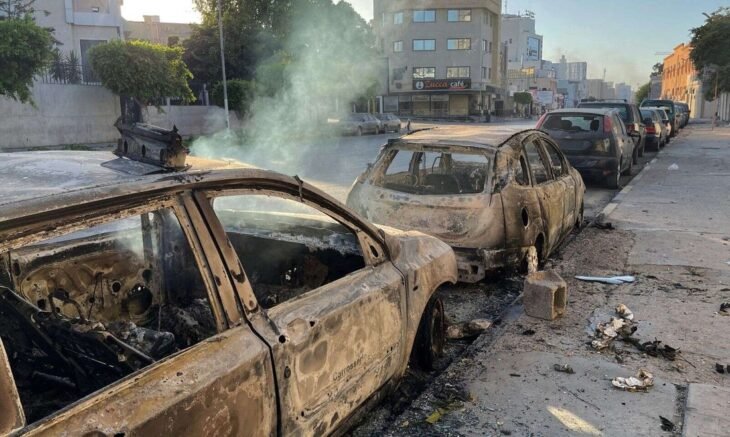
For his part, Dbeibah refused to resign absent an election. This has returned Libya to a volatile situation in which there are two competing claimants to legitimate leadership of the country. In July and August, militias tied to both officials have since engaged in multiple gun battles on the streets of the capital.
Both the protests and the armed skirmishes have unsettled the political elite that has governed Libya since the power-sharing agreement was put in place. Many Libya-watchers have raised concerns about a potential return to civil war. However, neither protests nor sporadic violence are likely to significantly change the political situation in Libya.
Rather, the structure of the power-sharing agreement—and the complex set of skewed incentives imposed by its design—will ensure that political elites push to maintain the status quo, including through efforts to maintain a delicate balance between the interests of both sides of the conflict and to delay (or indefinitely suspend) elections.
Libya’s Tenuous Power-Sharing Agreement under Pressure
The United Nations-sponsored power-sharing agreement was enabled by an international community eager to bring the civil war to a rapid end after a decade of political and economic instability.
In this regard, the agreement has been a success despite the continued existence of numerous militias and private armies. To ensure its initial acceptance, however, negotiators structured the agreement around a distribution of ministerial portfolios and government positions to representatives of disparate interest groups. This left Dbeibah, as interim prime minister, with a fractious cabinet unable to effect coherent policy solutions.
Moreover, the arrangement created unchecked opportunities for corruption and malfeasance as power players took advantage of access to government resources to enrich themselves and their cronies.
Since the agreement came into effect, Libya’s complicated network of competing interests, political groups, militias, and tribal associations has coalesced around three nodes of power represented by Dbeibah, Saleh, and Khalifa Haftar, the commander of the country’s largest private army.
Competition between these three nodes has led to a suspension of oil exports and continued contestation over control of sovereign institutions like the central bank. No substantive steps have been taken to form a united Libyan military or police forces, disarm militias, or end the presence of foreign military actors providing support for different sides of the conflict.
The unity government has lacked the power to improve government services or even to secure a monopoly over the use of force. While political discord has increased since the cancellation of planned elections in December 2021, the power-sharing agreement remains in place, along with the dysfunctional governmental structure.
The recent protests have had an impact on the struggle between the Dbeibah and Saleh camps. As some protesters directed their frustration at Saleh and the parliament, even burning parliamentary offices, the House speaker and his hand-picked prime minister, Bashagha, engaged militias in Tripoli in several failed attempts to secure access to ministerial offices and to push out officials from Dbeibah’s cabinet.
Dbeibah’s response to protests has been strikingly different, but it too has introduced an element of instability into Libya’s politics—he reached out to secure an apparent alliance with long-time rival (and former ally to Saleh) Khalifa Haftar.
To foster this alliance, Dbeibah replaced the head of the National Oil Company with a Haftar supporter. While politicizing the leadership of an institution essential to the Libyan economy’s stability, this move creates an opportunity for the country to begin exporting oil from terminals closed by Haftar’s forces.
In turn, this will ensure the government has access to resources needed to expand services and create jobs. It also will enhance Dbeibah’s standing with external parties desperate for a resumption of Libyan oil exports.
Prospects for Free and Fair Elections
When considering prospects for Libya going forward, concerns about a return to civil war are likely overblown. On departing her post at the end of July, United Nations Advisor on Libya Stephanie Williams warned that the unwillingness of Libya’s political elite to put the country’s interests over their own threatened to undermine the country’s stability.
This is certainly true, and although competition among Libya’s political elite for control over the state and its resources has intensified, both sides would ultimately lose out if the country relapsed into widescale violence.
Rather, Libyans are likely to face a period of mild, sporadic clashes as elites test out the will of competitors and international actors. The governmental structure put in place under the power-sharing agreement is likely to hold, as it serves the interests of the broader political elite.
In this context, near-term prospects for elections are not favorable. While the power-sharing agreement was secured with an understanding that national elections would be held within a year, no agreed-upon terms were included. This has allowed politicians like Dbeibah and others to support elections in public while quibbling over details in order to delay their realization.
In reality, those in power today are reticent to return voters to the polls because it risks disrupting a grip on power that was attained through elite politics rather than popular mandate.
Given the incentives to delay, elections are likely to only commence if their results can be guaranteed, or if the political calculus should change dramatically in the favor of either Dbeibah or Saleh’s camps.
In the current energy security environment, the international community would likely back the outcome of such an election, even if it was not free and fair.
While that will frustrate the youth who have taken to the streets—and the revolutionaries of 2011—who deserve the opportunity to realize their democratic ambitions, most Libyans are desperately seeking stability after a decade of conflict and would accept with relief any conclusion of the gamesmanship and chaos that has gripped the country since the revolution.
***
Paul Dyer is a nonresident fellow at the Middle East Council on Global Affairs. He also serves as the managing associate at Maxwell Stamp, Inc in Washington,D.C. Dyer brings more than 20 years of research and policy analysis experience in the Middle East and North Africa (MENA) region with a focus on youth development, employment policy, small and medium enterprise development, the provision of financial services to the poor, and broader issues of economic inclusion. His recent work has focused on conflict resolution, post-conflict recovery, and the region’s policy response to the COVID-19 pandemic.
______________

Marc Espanol

The eastern-based House of Representatives has launched an offensive on the judiciary that threatens to politicize one of the sectors of the country that had been able to remain to some extent outside the national rifts and that could turn the conflict very legal in nature. Read More
Khalid Mahmoud
![]()
Libya’s parliament-appointed prime minister, Fathi Bashagha, has admitted the government’s failure to conduct its daily business from the capital Tripoli nearly eight months after its formation.
Bashagha said in a speech in Benghazi, after concluding his tour abroad, that the cabinet will exercise its duties from Sirte and Benghazi, adding that the government rejects sedition.
He asserted that the government works for all Libyans, accusing some parties of wanting to create chaos and division.
Bashagha stressed that the government would serve all Libyans to achieve national reconciliation, despite many difficulties.
The government tried to stay in Tripoli to carry out its duties but wanted to avoid bloodshed and sedition, and decided to return peacefully despite people’s suffering in the capital and the Libyan West in general, explained Bashagha.
According to local media, Bashagha is scheduled to visit Cairo after meeting in Qobba with Speaker Aguila Saleh.
Meanwhile, the Interior Ministry of the Dbeibeh government announced that its Undersecretary for Public Affairs, Mahmoud Saeed, received a Libyan prisoner from the Ukrainian-Polish border, according to the prisoner exchange agreement signed with the Ukrainian government.
The ministry explained that a government committee recently deported and evacuated all the Libyan community in Ukraine, after a series of negotiations with the Ukrainian authorities last March.
All members of the Libyan community were deported and returned safely.
In addition, the United Nations Support Mission in Libya (UNSMIL) renewed its commitment to achieving peace in Libya through an inclusive Libyan-led and owned process.
Noting in a brief statement on the International Day of Peace, UNSMIL asserted it continues to work with all Libyan actors to advance the peace process and the elections the Libyan people demanded.
In New York, the head of the Presidential Council, Mohammed Menfi, participated in the consultative meeting held by German Chancellor Olaf Scholz with African leaders, including President of Senegal, Macky Sall, in his capacity as President of the African Union (AU), and Chairperson of the African Commission, Moussa Faki.
Menfi praised Germany’s role in supporting the political track in Libya through the Berlin conferences and the cooperation between Germany and Africa to support Libya’s stability.
He also touched on the challenges of food security in Africa, especially in light of the current international crisis, and the importance of cooperation to overcome this crisis.
Menfi explained that after reaching stability, Libya could play a significant role in oil, energy, and environment, providing economic and investment opportunities, stopping illegal migration, and settling sustainable development in Africa.
____________
Hendia Alashepy

Much of Libya’s coastal eastern city lies in ruins and fear remains, even though extremist groups have been eliminated. Read More
Giorgio Cafiero

Türkiye, not Switzerland, has been the most effective diplomatic bridge between Russia and Ukraine since February 24.
The United Nations General Assembly (UNGA) high-level General Debate kicked off last Monday in New York. “A watershed moment: transformative solutions to interlocking challenges” is the 77th session’s theme.
Representatives of the UN member-states are busy discussing many transregional dilemmas from the global energy crisis to climate change and the COVID-19 pandemic. One of the most important issues on the table is the war in Ukraine which erupted on February 24.
Türkiye’s diplomacy vis-à-vis the Russian-Ukrainian conflict has demonstrated Ankara’s special position in global affairs.
Türkiye plays a unique role in international efforts to resolve this seven-month-old conflict as a NATO member which staunchly supports Ukraine’s territorial dignity and has armed Kyiv with Bayraktar TB2 drones, while also maintaining complicated albeit respectful and cooperative relations with Moscow.
Türkiye’s balance diplomacy
Striking this delicate balance has been a challenge. Yet, Türkiye has proven capable of doing so.
On one hand, Ankara has not been afraid to challenge Russia’s foreign policy agenda in a host of conflict zones from the Levant to the Maghreb, highlighted by Türkiye’s downing of a Russian fighter jet that violated Turkish airspace in November 2015.
On the other, Ankara has managed to compartmentalize different issues in Turkish-Russian relations and always finds ways to cooperate and openly communicate with the Kremlin.
“This complex relationship [between Ankara and Moscow] evolved into brinkmanship with unwritten rules that govern the Turkish-Russian relations,” said foreign policy and security analyst Ömer Özkizilcik in an interview with Anadolu Agency.
“Over these years, Türkiye and Russia have learned how to deal with each other and how to reach agreements despite open hostilities. Now, Türkiye is transferring this knowledge and experience into a mediator role between Ukraine and Russia.”
Türkiye’s mediation differs from Switzerland’s for several reasons
To be sure, Türkiye is not the only power to carefully balance between the East and the West amid a period of increased bifurcation. One country which is strongly associated with neutrality, diplomacy, and mediation is Switzerland.
With military neutrality embedded in their constitution, no people have a tradition of neutrality in global affairs as firmly rooted in their national ethos as the Swiss. But there are major differences between Türkiye, a NATO member, and Switzerland, a European country that stays out of military alliances.
“The Swiss mediation is classical old-school mediation in which a neutral party brings together two opposing sides and provides them with a neutral environment to negotiate and find a political solution. This kind of mediation can only be useful if there is an interest on both sides for an agreement or ceasefire,” according to Ozkizilcik.
“The Turkish mediator role is much different and something new in international politics. It is a result of almost a decade-long period of confrontation and cooperation with Moscow.”
Since February 24, Türkiye — not Switzerland — has been the most effective diplomatic bridge between Russia and Ukraine. There are at least two main reasons why this has been the case.
First, Ankara, unlike Bern, has some significant leverage over Moscow. Türkiye has real influence over the Black Sea, Syria, the South Caucasus, and Libya, which directly impacts Russia’s geopolitical and security interests and requires Moscow to take Ankara’s interests into consideration.
Second, Türkiye has not joined Switzerland in implementing Western sanctions on Russia. Turkish President Recep Tayyip Erdogan’s government has not supported efforts aimed at destroying the Russian economy.
Both factors have resulted in Moscow viewing Ankara as a credible, capable, and trustworthy mediator despite Türkiye’s NATO membership and military support for Ukraine over the past seven months.
“The mediating party should be really neutral in terms of treatment of both parties in conflict. Türkiye, although a NATO member, treated both [Russia and Ukraine] in an equal, firm, and fair manner,”
Dr. Murat Aslan, a researcher at the SETA Foundation and a faculty member at Hasan Kalyoncu University, told Anadolu Agency.
Ankara continues to pursue its peacebuilding efforts
Building on Türkiye and the UN’s success in helping Russia and Ukraine negotiate the grain shipment deal over the summer, Ankara seeks to play a critical role in helping Moscow and Kyiv to reach a permanent peace deal eventually.
Based on an understanding that continued warfare in Ukraine will threaten Türkiye’s economic and security interests, Ankara is boldly pursuing its efforts to help bring peace and stability to the country through its balanced relationships with Moscow and Kyiv.
As world leaders meet in New York to discuss Ukraine among other pressing global challenges, the role of Türkiye as a mediator in a rapidly changing international environment remains extremely important.
***
Giorgio Cafiero is the CEO and founder of Gulf State Analytics and a geopolitical risk consultancy based in Washington, DC.
______________


MEI hosted Mr. Martin for a discussion of his conclusions and experience in Libya. Read More
Zeinab Salih

At least 400 Chadian workers rounded up in east Libyan town of Ajdabiya after security forces in Chad arrest four Libyan poachers. Read More
Mustafa Fetouri

The Speaker of Libya’s House of Representatives, Aguila Saleh, visited Qatar on 10 September where he spoke with officials before meeting Emir Tamim Bin Hamad Al-Thani. Read More
Hatem Lukhai
The future of Libya is one of economic renewal and diversification. With political stability comes the promise of investment and intra-African trade. Read More
Mustafa Fetouri

The Egyptian delegation, headed by Foreign Minister, Sameh Shoukry, withdrew from the 158 meeting of the League of Arab States’ (LAS) ministerial meeting on 6 September, a rare Egyptian diplomatic step. The LAS meeting was chaired by Libya’s Foreign Minister, Najla Al-Mangoush, as her country assumed the position from Lebanon. Read More
Umar A Farooq

The relatives of three military cadets killed in a 2020 drone strike in Tripoli, Libya, have filed a lawsuit in a US court against Libyan eastern commander Khalifa Haftar, blaming him for the attack that left 26 cadets dead and more than a dozen others wounded. Read More
Andrei Popoviciu

Two US-based advocacy groups accuse Paris of complicity in a counter-terror operation with Cairo that killed civilians in the Western Desert between 2016 and 2018. Read More

Leaders in Libya must take immediate steps to resolve their political impasse, which is spilling over into increasing violence, UN political affairs chief Rosemary DiCarlo told the Security Council on Tuesday. Read More
Hamza Mekouar

Ten years after the US ambassador to Libya was killed in the eastern city of Benghazi, the country remains in turmoil and Washington is vying for influence with other foreign powers. Read More
Alamin Shtiwi Abolmagir

In a new piece of historical thought leadership political analyst and naval strategist Harry Halem reminds readers of the role which the Senussi dynasty played in shaping the Libyan state we know today. Read More
Dr. Hamza Karcic

Over the course of the past two decades, Türkiye has become a geostrategic player in its own right with both the resources and the will to shape events beyond its borders. Read More
Abdullah Alkabir

Despite tragedies and destruction left behind by wars, there is a positive side to them, which does not appear clearly to anyone who is not looking thoroughly with a scrutinizing eye to monitor their repercussions and changes. Read More
Malak Altaeb

Libya’s neglected agricultural sector has been shrinking through the years, making it more vulnerable to the numerous challenges it faces. The impact of climate change has been felt through droughts, higher temperatures, and more frequent dust and sand storms, directly impacting the sector. Read More
Jalel Harchaoui and Bernardo Mariani


Perceptions of Non-Western Approaches to Peacemaking
Interviewees see the competing interests between foreign powers engaged in Libya as a challenge because they exacerbate existing tensions. There is also a highly polarised range of perceptions about these foreign actors.
Every foreign state involved in Libya may appear as the most constructive peacemaker in the eyes of some interviewees—and as a deleterious interferer according to others. This divergence is a testament to the deeply fractured character of Libya’s political landscape.
One senior politician, formerly with the eastern-based government, sees the UAE and Russia as having potential to be at the “forefront of actions aimed at re-establishing peace and stability in Libya”. However, he also points out that any future Russian peace-building role in Libya “hinges on the withdrawal of the Wagner army from the country”, something that, in his opinion, the Russian leadership should seriously consider.
LNA military commanders praise the role of the UAE, which is perceived as a benevolent country that “has reached out to and tried to help the Libyan people”, and with a governance system — “a strong state, with a solid authority, a true vertical of power” (ibid) — that is very compatible with Libya’s need to restore law and order.
The Emirati economy, which has been able to diversify away from the traditional oil sector, is also seen as a model for Libya to aspire to. Finally, one interviewee argues that given that the UAE is a largely tribal society, “Abu Dhabi can and should mediate between Libya’s tribes.
They can also act as mediators between rival cities and rival armed groups. The Emirati can talk to the various actors”. Views of Turkey’s role in Libya among LNA supporters are unsurprisingly negative. They see Ankara’s “Islamist type governance model” as having a “destabilizing influence in many parts of the Middle East and North Africa region”.
According to this view, letting Turkey influence Libya’s diplomatic, political, or military affairs would be tantamount to allowing the Muslim Brotherhood to take control of Libya’s institutions and the governance system. Under such a scenario, argues one interviewee, “me along with everybody else in the military are going to be in danger.
Just look at what Erdogan did to his own armed forces after the failed coup of July 2016: he went ahead and threw a lot of military officers in jail”. Similar, if not worse, are LNA supporters’ perception of Qatar, which is seen as a destabilising actor that is “actively against the emergence of a strong military in Libya” and has instead supported terrorist organisations in cities like Benghazi.
Although such criticism is hyperbolic, Doha has supported some hard-line groups in Libya between 2011 and 2016, including the armed group Benghazi Defense Brigade, which was formed by Libyan Islamist Ismail al-Sallabi in May 2016 thanks to Qatari money.
Supporters of the Tripoli government often hold diametrically opposing points of view. Among them, there is, for example, deep mistrust of the UAE, which is perceived as wanting to impose an authoritarian type of governance that concentrates power in the hands of one leader or small elite, without any truly democratic institutions.
According to one interviewee, through its malign influence, the UAE is poised to “destroy Libya’s existing capabilities and assets, particularly oil ports and other hydrocarbon assets, as well as Libya’s maritime transport”. He accuses the UAE of having committed serious crimes in Libya, “such as the July 2019 airstrike on the Tajura migrant centre or the January 2020 airstrike on the Hadhba military academy”, referring to the militaryacademy attack of January 2020, documented by the BBC.
Like the UAE, Russia’s intervention in Libya finds many critics among GNU supporters. In their view, Russia’s aim in Libya is not to promote peace or help with state building, but rather to control Libya’s gas and oil production to exert pressure on Europe. On the contrary, they consider Turkey and Qatar forces of peace that “do not seek to promote a governance model based on militarism”.
Turkey is seen as having intervened in Libya mainly to secure its own economic interests, but they believe that a strategic relationship and cooperation with Turkey will help with reconstruction across all sectors of the economy, including energy, transport and infrastructure. Among LNA supporters, views of China tend to be positive. According to one interviewee, Libyans “can and should cultivate diplomatic economic ties with China”.
In this view, letting in more Chinese workers, who are renowned for their work ethic and cheap labour, would be a win-win for Chinese corporations investing in Libya and also for the Libyan people who would benefit from the quick delivery of well-executed projects, especially in the fields of engineering and construction.
China’s economic role in Algeria, including the deep-water port project in Cherchell, is given as an example of such a partnership. As a major world power, “that has had almost nothing to do with the Libyan conflict since 2011”, China is also perceived as a potential “compelling mediator”, in contrast, for example, to Russia, which is seen, even among some LNA members, as taking sides in the conflict and as unable to act as an honest broker or peacemaker.
However, China’s image is often not positive in the eyes of Libyans supporting Tripoli. They are sceptical about the viability of any Chinese peacemaking role in Libya, due to what they perceive as a lack of effective peacemaking by China elsewhere, a lack of popular support in Libya, and opposition by Western countries, which “would be furious if China played any significant diplomatic role in Libya”.
One former Libyan minister is wary of the risks of “debt trap diplomacy” when dealing with China and adds that “a diplomatically assertive Beijing would put Libya in the crosshairs of global rivalries, which frankly we could do without at this stage.
We Libyans must bear in mind that if China enters our country’s affairs through the door of reconstruction, it will inevitably enter all other fields, including politics, geostrategy and ideology”. Even the Libyan interviewees with the most pronounced political bias regarding foreign meddlers expressed a potential willingness to allow those nations, with which they bitterly disagree, to play a greater economic role in Libya.
A former minister, who condemned the role played by the UAE during the 2019-2020 war, noted that “the possible ascendancy of the UAE as a neutral mediator in Libyan politics and Libyan affairs necessitates a profound change in the Emirati government’s strategy and way of thinking towards Libya”.
Stated differently, if such economic cooperation enables Libyans to rebuild their country and, while doing so, acquire new skills by interacting with foreign partners, many Libyans would be prepared to turn the page on the bellicose behaviour that foreign interferers demonstrated during the past decade.
By raising the economic stakes through construction efforts across all Libyan provinces, this dynamic would incentivise various factions to adopt a less rigid, warlike attitude. It is noteworthy that, at present, some major players in the Libyan conflict—such as the UAE—fulfil only a minor role in Libya’s ongoing economic reconstruction efforts.
In July 2022, Abu Dhabi was instrumental in precipitating a change in the leadership of the National Oil Corporation, a key economic institution responsible for almost all of Libya’s income. But it still remains to be seen whether the UAE will inject capital or send some of its talent in Libya. Separately, questions persist as to whether or not Egypt will contribute to Libya’s reconstruction.
One senior Western diplomat underscored the great potential of Egyptian companies when it comes to participating in the recovery, noting that Libya’s eastern neighbour “has superb workers at a variety of different levels and sectors who were working in Libya before, including Egyptian Copts, who used to work safely in Libya before”. Cairo is deeply interested in increasing the number of Egyptian workers residing in Libya.
Conclusions
Foreign interference in Libya by Western and non-Western countries alike over the past decade has exacerbated the divisions and antagonisms within the country.
Senior Libyan figures interviewed for this paper have emphasised that, despite regional and great-power competition, there is still room for all foreign states engaged in Libya to play a positive role in the country’s reconstruction and help create opportunities for economic growth.
The concrete ability of foreign powers to mobilise non-military assets and expertise to assist Libya in rebuilding itself, as well as to help it manage its economy efficiently, is perceived as a natural platform through which novel forms of dialogue and new channels of communications should be cultivated.
Libyan interviewees believe that such a new economy-centred approach could also be leveraged for political and mediation purposes. This is a meaningful finding because it points to potential avenues for reconciliation.
Indeed, responses from the elites interviewed for this report highlight reconstruction as an area upon which foreign states that have been responsible for exacerbating Libya’s crisis during the past decade might decide to concentrate their efforts.
By doing so, they would acquire a more positive image in the eyes of Libyans. However, there is a great deal of uncertainty about Libya’s short-term future. At the time of writing, Libyans were not waging war against each other, but neither were they agreeing to an election or any other unification effort. Nor were they truly reconciling.
Fault-lines have been shifting amid higher tensions, which points to more volatility ahead compared to the recent calm. In addition to the Libyans’ own unwillingness to end their crisis in a durable manner, the activism of some external players may further reduce the probability of Libya’s rival factions achieving de-escalation.
The year 2021 offered an approximate preview of what a less violent Libya could resemble: the GNU avoided war and attached great importance to economic revival and infrastructure reconstruction. But the dynamics on display during 2021 could not be sustained.
There is a risk of relapsing into war, involving physical destruction, armed violence and a deterioration of Libya’s already-fractured institutional landscape, including in the economic realm. In such a scenario, the “economic reconstruction” incentive will lose its potency among foreign meddlers while economic sabotage, political fait accompli and military coercion may become once again their primary tools of influence.
Another possible path for 2022 is one wherein Libya could manage to avoid further polarisation as well as a relapse into war. In that case, foreign states whose behaviour in Libya has thus far been either exceedingly aloof or too bellicose, may still embrace a more constructive, peacemaking role, which would further their economic interests while creating new dialogue opportunities vis-à-vis a wide array of Libyan interlocutors.
For Libya to avoid conflict relapse, two necessary conditions must be fulfilled:
(a) no foreign state involved in Libya should encourage or seek frontal clashes;
(b) no meaningful Libyan group should do so, either.
Three types of phenomena may endanger the fragile equilibrium above. The current status quo may be deemed unsatisfactory in the view of Ankara or Moscow. Such an assessment would push one of the two Eurasian powers to deliberately upset the balance of power in Libya using force or economic sabotage.
Moreover, the broader geopolitical context, such as the war in Ukraine, may also jeopardise the current restraint between Russia and NATO members, such as Turkey, Britain, or Italy, on the Libyan file.
Finally, other players, whether Libyan or foreign, may choose to disrupt the precarious equilibrium that has prevailed since June 2020. In all cases, international diplomats must not take the calm that characterised 2021 for granted.
They should help maintain a balance on both a political and an economic level between the main sides, Libyan and foreign alike. Although rapid reconstruction cannot substitute for the solid promotion of transitional political and security frameworks, economic considerations are of paramount importance when it comes to consolidating Libyan peace in 2022 and beyond.
***
Jalel Harchaoui is a researcher specialising in Libya, and an Associate Fellow with the Royal United Services Institute, London. His work concentrates on the North African country’s security landscape and political economy as well as the role of foreign states.
Bernardo Mariani is a freelance conflict prevention and peacebuilding consultant based in Austria, with specialist knowledge of China. Since 2005, he has managed and implemented research and policy dialogue projects on the implications of China’s growing role in global security affairs.
_____________

Islam Alatrash & Faisal Edroos


A semblance of normality returns to Tripoli a week after supporters of a rival administration clashed with the UN-recognised government. Read More
Khalid al-Karimi

Recent deadly clashes have alarmed regional and international powers, as civilians fear displacement and a shortage of medicine and food. Read More
Jalel Harchaoui and Bernardo Mariani


Future Prospects for the Russo-Turkish Entente
Russia and Turkey’s commitment to maintaining an informal entente with one another has been significant to Libya’s fate since 2020. Broadly speaking, Russia — unlike Europe —has shown a patient willingness to accept and, to some extent, accommodate Turkey’s aspirations to become a full-blown regional power. Read More
Tarek Megerisi

Libya is trapped in a degenerative cycle of war. Yet Europeans could use the current stalemate in the country to restart an electoral process that would end the cycle. Read More
Ferhat Polat

Failure to hold polls significantly damaged international efforts to end political crisis in Libya. Read More