1.1 The most prominent conflicts on the Libyan scene
The signing of the Skhirat Agreement under UN supervision in December 20151 came as an end to the conflict that erupted between the Tripoli government and the Tobruk government, as that agreement resulted in a “government of national accord” that would run the transitional phase for eighteen months.
With recognition of the elected House of Representatives that was approved by most of the powers It was approved on April 6, 2016. However, internal divisions and conflicts quickly re-affected the unity of the Libyan ranks, especially after it became clear the direction of the Government of National Accord supporting the empowerment of extremists.
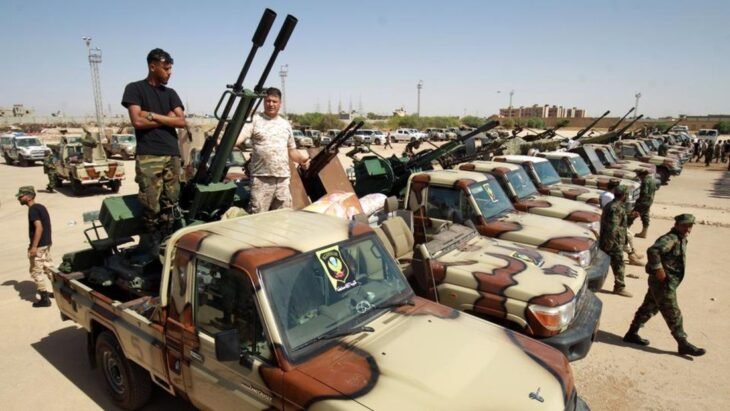
This prompted Field Marshal Khalifa Haftar in December 2017 to announce that the signed Libyan Political Agreement in Skhirat, Morocco, it expired after the end of the period of time specified for it, and with it the mandate of the “Government of National Accord”, and then began to move militarily to hunt down extremist groups loyal to this government, a conflict that expanded and took on regional and international dimensions.
1.2 The three main axes on the Libyan arena
The study identifies three main axes or groups on the Libyan arena:
a. The Western Libya Group, centered in Tripoli and represented by the Government of National Accord, which is recognized by the United Nations and supported by countries such as Italy.
b. The Eastern Libya Group, represented by the Libyan National Army led by Field Marshal Khalifa Haftar, which controls most of the eastern regions of Libya and is supported by countries such as France and Russia.
c. Semi-neutral sides, represented by countries such as Algeria, Tunisia, Germany, and the United States, which do not take sides with either the East or the West and aim to ensure that Libya does not slip into total chaos or be controlled by certain groups at the expense of others.
The study argues that the Libyan arena has witnessed many conflicts and alliances, which have contributed to the deterioration of the political and security situation in the country. The study identifies three main axes or groups on the Libyan arena:
The Western Libya Group, centered in Tripoli and represented by the Government of National Accord, which is linked to a network of strong alliances and is supported directly by some regional countries and at the international level.
The Eastern Libya Group, represented by the Libyan National Army led by Field Marshal Khalifa Haftar, which raises the slogan of combating terrorism and extends its influence on some areas of the south and the West through understandings and tribal consensus sometimes and armed confrontations at other times.
The semi-neutral sides, represented by countries such as Algeria, Tunisia, Germany, and the United States, position themselves in a way that ensures that Libya does not slip into a state of total chaos or submit to the control of certain political and societal forces and components, therefore, they maintain balanced relations with all parties to the Libyan file, whether the current warring inside Libya or foreign countries with conflicting interests.
1.3 Developments of the Libyan political crisis
According to the study, the Libyan arena has witnessed many conflicts and alliances, which have contributed to the deterioration of the political and security situation in the country. The actual control over the Libyan land was distributed among multiple centers of power, which meant that it was difficult to launch any voting process characterized by impartiality and integrity without being affected by the power of militias, tribal forces, and armed groups.
The differences and factors of internal rivalry and disparities alone would not have succeeded in disrupting Libya’s political stability unless these factors found an incubating external environment, whether at the regional or global levels.
It is argued that against the backdrop of these political events, all efforts of the initiatives launched to strengthen the political track in Libya had faltered, whether those based on popular participation and ballot boxes, such as the General National Congress, or through negotiations and agreements between political and social forces, similar to what happened in the Skhirat Agreement.
The study suggests that the division that reaches the point of conflict in the accounts and estimates of the countries involved in the Libyan file, especially from the perspective of interests and threats, played an important role in disrupting the political track by instructing internal forces to disrupt understandings and work to run the transitional phase in a manner that serves the interests and estimations of those external parties.
1.4 The Libyan political crisis after the Gaddafi era
The Libyan revolution in 2011 marked the end of Gaddafi’s rule and with all its economic, political and security repercussions on the Libyan state, and the segments of Libyan society emerged victorious. The prevailing belief was that the end of Gaddafi’s rule meant the beginning of a new era characterized by stability, security, and economic abundance. However, the Libyan revolution produced armed factions and militias and the presence of pro-Gaddafi parties contributed to the continuation of the Libyan political crisis.
Since 2012, Libya has witnessed a deep political deterioration that contributed to the decline of all political, economic and security sectors of the state, until the coming of the National Accord Conference, which contributed to the convergence of political views in the state and contributed to providing a kind of stability. But that stability quickly faded with the development of conflicts and disputes. The internal and major divisions that appeared on the Libyan arena, in addition to international interventions, constituted a catalyst for the continuation of the political division that Libya is witnessing to this day.
1.4.1 The political crisis, its roots, and paths
The study argues that the main root of the Libyan political crisis is the National Congress Elections Law No. 4 of 2012 which created a state of chaos that absolves the political forces collectively from responsibility. This law hinders the possibility of understanding with a large number of individual members and financial and administrative corruption is the most prominent reason for the emergence of internal conflicts in Libya.
Additionally, the emergence of major powers led by Haftar and the weakness of Libyan state and civil society institutions are also main reasons for the political divisions in Libya. Furthermore, the feeling of the counter-revolutionary current that they can break the political and security balance in favor of the revolution’s current and the emergence of major powers led by Haftar form armed groups opposing the Libyan government and aiming to reach power are also major reasons for the political divisions in Libya.
1.4.2 The security crisis and the weakness of political will
The Libyan arena had been facing many security crises, which hindered the establishment of political unity among all parties involved in the conflict. The struggle for control of power and the proliferation of armed forces and militias led to a widening divide between the parties. At the political level, there was a clear rift between the various axes of power in the Libyan security sector, and many fighters were unwilling to give up their weapons and were ready to use them against the government.
Additionally, the absence of an effective judicial system contributed to fueling the conflict. Economic factors such as poverty and unemployment among the youth also played a role in their decision to join armed groups. These issues created a suitable environment for them to pursue their aspirations and provided a source of income.
1.4.3 The distribution of armed groups in Libya and their impact on national unity
The Libyan security sector is characterized by the presence of multiple armed groups, which are divided into three main regions:
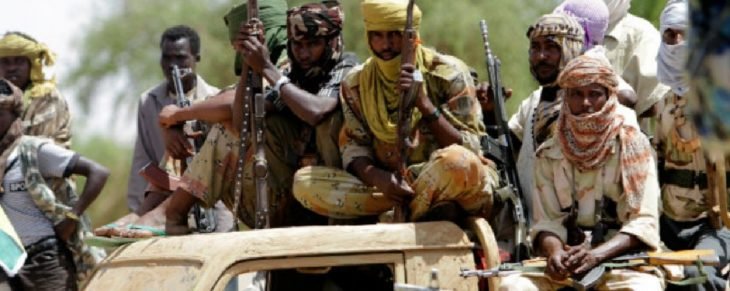
The south, west, and east. In the south, the battalions are primarily divided into Arab and Tabu sections, with the Arab section led by the Awlad Suleiman and Awlad Bousif tribes, and the Tabu section led by the Martyrs of Umm al-Aranib and Qatrun Martyrs.
In the west, the formations are predominantly urban in nature, such as in Misurata where there are approximately 25,000 fighters and 230 battalions known as the Central Libya Shield Force.
In the east, battalions are primarily composed of revolutionaries on the fronts and those close to the Islamist movement, such as the February 17 Brigade, Free Libya Martyrs Brigade, and Rafallah al-Sahati Brigade.
Additionally, there are also the Ansar al-Sharia Brigades deployed in Benghazi and Sirte, and the First Infantry Brigade battalion. Many of these armed groups are based on tribal loyalty and do not follow the military hierarchy system, and they are also characterized by the lack of an effective judicial system and the spread of poverty and unemployment in most corners of the country.
1.4.4 Most important initiatives and efforts to resolve the political crisis
The Libyan crisis has seen many important initiatives and efforts aimed at reaching a peaceful settlement. One of the most notable of these is the Palermo conference, held in Italy in 2018, which emphasized the importance of respecting the results of elections and rejected a military solution in Libya.
The Berlin conference, held in 2020, also focused on finding a political settlement and included a wide range of parties and issues in its approach. However, the meetings of the Security and Military Committee, formed as a result of the conference, were disrupted due to ongoing fighting.
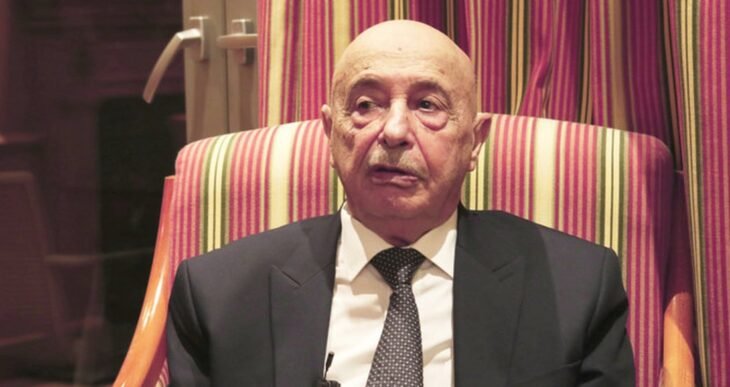
Another important initiative was the Cairo Declaration, which was issued after a meeting between Field Marshal Khalifa Haftar and Chancellor Aqila Saleh, calling for a halt to the fighting and outlining a roadmap for a comprehensive political solution for all Libyan forces and components. Some countries, including Russia and France, have also tried to revive the Berlin track as a basis for resumed negotiations.
***
Mohammad Salih Alzawahreh – M.A of conflict resolution – University of Jordan
_______________
Source: Journal of Political Science and Law – Issue # 35 – March 2023 – The Democratic Arabic Center.
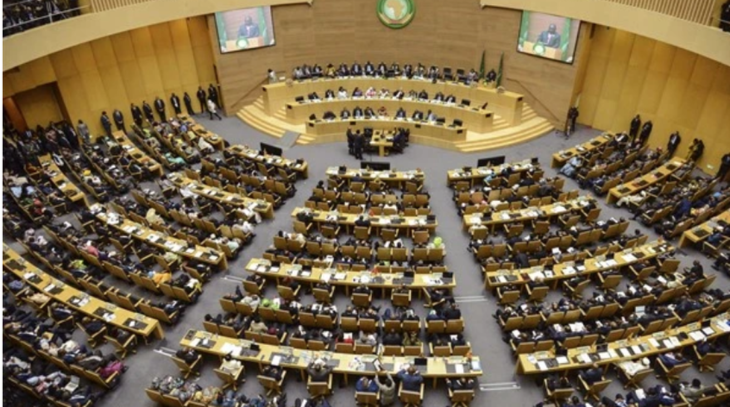
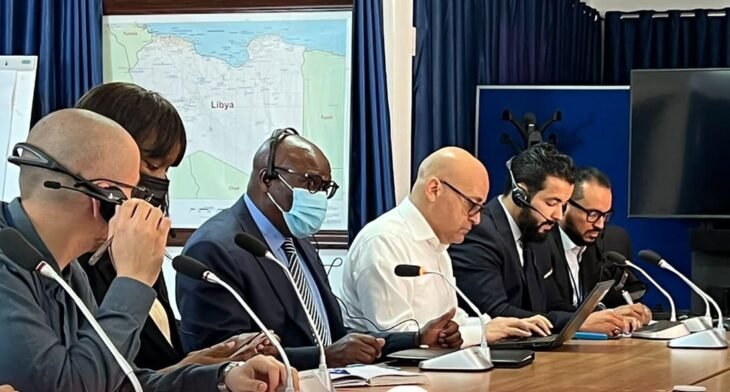
In the opening months of 2023, the political situation in Libya seems to be undergoing significant changes. To break out of the current impasse, Libyan actors and the international community are engaging in various initiatives to revive political processes once again, even as substantial challenges persist. The newly appointed Head of the United Nations Support Mission in Libya (UNSMIL), Abdoulaye Bathily, has overseen the recent negotiations of the Libyan Joint Military Council for the withdrawal of foreign troops. Moreover, the African Union has announced plans to host a reconciliation conference. But while Libya clearly remains a focus of intense international attention, questions remain about how successful these endeavors will prove.
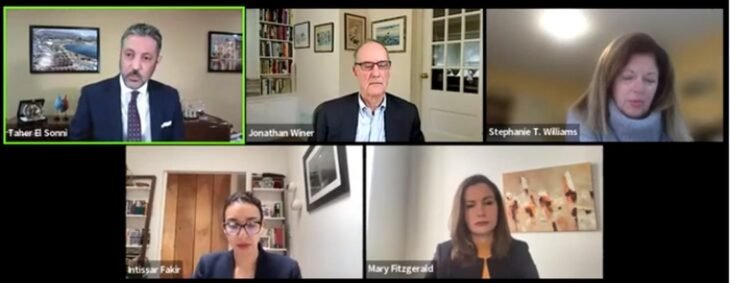
To discuss the latest developments in Libya’s trajectory, MEI is pleased to host a virtual panel discussion. Please join our experts, with years of experience in Libyan affairs, policy, and diplomacy, for what promises to be a fascinating event.
Speakers
Mary Fitzgerald – Non-Resident Scholar, Middle East Institute
Taher el-Sonni – Libyan Ambassador to the United Nations
Jonathan M. Winer, moderator – Non-Resident Scholar, Middle East Institute
Detailed Speaker Biographies
Mary Fitzgerald Mary Fitzgerald is a non-resident scholar at the Middle East Institute. She is a researcher and consultant specialising in the Euro-Mediterranean region with a particular focus on Libya. She has worked on Libya for more than a decade and has conducted research on Libya for the International Crisis Group, the United States Institute of Peace, the European Council on Foreign Relations, and the European Institute of the Mediterranean, among others. Her areas of focus include Libya’s political transition and its energy sector. She has also consulted for a number of international organizations working in Libya, including in the areas of peace building and civil society.
Taher el-Sonni Taher el-Sonni has been Libya’s Ambassador to the U.N. since January 2020. Prior to that, he spent four years as a senior political advisor to the Libyan Government of National Accord and Chief of Staff to the President. He has also worked for the United Nations Development Programme and is the proud founder of Libya’s National Youth Movement.
Stephanie T. Williams Stephanie Turco Williams is a non-resident senior fellow at the Brookings Center for Middle Eastern Policy. She was a special advisor on Libya to the United Nations Secretary-General from 2021 to 2022. Prior to that, Stephanie was both Acting Special Representative of the Secretary-General for Libya and Head of the U.N. Support Mission in Libya (UNSMIL). During her tenure as the ASRSG, Stephanie led the U.N. mediation that resulted in a nation-wide Libyan ceasefire agreement in 2020 and a political agreement reached in 2021 that produced Libya’s first unity government in seven years. As well as working with the UN, Stephanie has also worked in the U.S. Embassy in Libya. Her current research includes examining international mediation efforts in an era of global disorder and conflict resolution in failed states.
Jonathan M. Winer, moderator
Jonathan M. Winer has been the United States Special Envoy for Libya, the deputy assistant secretary of state for international law enforcement, and counsel to United States Senator John Kerry. He has written and lectured widely on U.S. Middle East policy, counter-terrorism, international money laundering, illicit networks, corruption, and U.S.-Russia issues. In 2016, Winer received the highest award granted by the Secretary of State, for “extraordinary service to the U.S. government” in avoiding the massacre of over 3,000 members of an Iranian dissident group in Iraq, and for leading U.S. policy in Libya “from a major foreign policy embarrassment to a fragile but democratic, internationally recognized government.” In 1999, he received the Department’s second highest award, for having “created the capacity of the Department and the U.S. government to deal with international crime and criminal justice as important foreign policy functions.” The award stated that “the scope and significance of his achievements are virtually unprecedented for any single official.”
This study explores the international intervention in Libya between 2011 and 2021, and examines the relationship between power interests and Libyan internal conflicts. The research adopts an analytical descriptive approach and concludes that the ongoing conflict in Libya is a result of the deteriorating political, economic, and security conditions in the country. The study highlights the importance of resolving internal disputes through more international efforts, rather than fueling them.
The 2011 Libyan revolution is identified as a key factor in the continuity of the crisis and the difficulty in finding a solution that satisfies all parties involved. The study concludes that the power interests of external actors have played a significant role in supporting the growing power of Haftar, exacerbating the already complex situation in Libya.
INTRODUCTION
Since the dawn of human existence, the impact of conflicts on humans had been a persistent issue that had arisen as a result of conflicts in general, but the impact is amplified if conflicts are accompanied by any form of violence. Libya was impacted by the Arab Spring events, and the revolution began in 2011 because of the Libyan youth’s unemployment, poverty, and lack of liberties.
Libyan revolutionaries succeeded in assassinating Colonel Muammar Gaddafi and toppling his regime, but their revolution was not completed with the establishment of the desired state, so it entered new political turning points, symbolized by the emergence of security chaos and internal conflict, which were fueled by external forces seeking to put an end to the revolution.
Since the collapse of previous President Muammar Gaddafi’s government, Libya had faced instability, political disagreement, and a severe economic crisis, as well as the formation of a wide rift in the state’s internal political system.
The Libyan Interim Government was established to the east, and what had exacerbated the crisis is the presence of dozens of militias and armed forces loyal to the conflict parties and competing with each other, and for years the country had been exhausted by clashes that once subsided only to return under different reasons and names, affecting the economy and public services, as well as the health sector, and causing the displacement of tens of thousands of people.
The international intervention in Libya had a number of consequences, the most notable of which was the collapse of the state’s military and security structure, which allowed for the rekindling of old tribal and regional conflicts, the majority of which revolve around political, economic, and military influence, as well as negative effects on the public scene.
This had become marked by an atmosphere of insecurity, the spread of violence and tension, and the recurrence of various crises. For a variety of reasons, Libya had become a proxy war zone for competing regional and international parties, the most important of which was those forces’ aim to govern Libya through various ways, taking advantage of internal incompatibility among the locally active groups.
It had an opportunity to fuel the internal Libyan strife in the east and west of the country. Libya is currently regarded as a fertile setting for international intervention, despite domestic divides and conflicts, particularly given the availability of oil, which is one of Libya’s most valuable natural resources. Internal confrontations are being prolonged. From an academic level, the research aims to fill the academic gap regarding international intervention in Libya between power interests and the Libyan internal conflicts in the period between (2011-2021).
The research seeks to achieve the following objectives:
a. Studying the economic, political and security reality of Libya after the revolution.
b. A statement of the most important motives and causes of internal conflicts in Libya.
c. Identifying the most prominent international interests and interventions in Libya.
d. Determining the future effects of international interventions in Libya and their impact on the continuation of the conflict.
The importance of the research stems from the following:
a. Studying the subject of international interventions in Libya in light of the interests of the powers and the emergence of internal conflicts. This topic is one of the important topics that deserve to be researched due to the valuable information it provides that studies the reality of the crisis in Libya and the extent of international interventions and their interests in Libya.
b. The importance of the research emerges by researching the causes of internal conflicts in Libya and the most important factors attracting international interventions and their declared and undeclared interests, and by addressing the most prominent implications for its political, economic and security future.
c. The research is based on providing scientific and theoretical material that can benefit scholars as a scientific reference in this global issue.
The research problem lies in the seriousness of the security and political situation in Libya between (2011 – 2021) considering the presence of international intervention with strategic interests in Libya. In addition to what internal conflicts constitute a fertile environment for the presence of international intervention, which works to aggravate and develop these conflicts.
This requires the development of many solutions and strategies to confront and end international interference in Libya, and from here arises the problem of this research into the extent of international intervention in Libya and what are its most prominent interests in light of the emergence of internal conflicts in the Libyan state?
The research seeks to answer the following questions:
a. What were the implications of the Libyan revolution on the economy, policy, and security in the country?
b. What were the motives of the diverse disputants that resulted in internal conflicts in Libya?
c. Who were the main international players on the Libyan arena, and what were their interests?
The research was based on the following hypotheses:
a. There is a negative relationship between the emergence of the Libyan revolution and the emergence and continuation of internal conflicts in Libya.
b. There is a negative relationship between international interventions in Libya and the emergence of many political, security and economic problems for the state.
c. There is a positive relationship between concerted efforts to achieve security and stability in Libya on one hand, and ending the internal conflict, confronting international interference, and thwarting its interests on the other hand.
For answering the questions of this thesis and aiming to reach the desired objectives, the analytical descriptive approach is relied on by collecting information. As it is a systematic method, the researcher studies the subject in its natural form, supported in this by collecting the amount of data and information that he deems appropriate.
The researcher then clarifies the relationship between the research variables in the form of questions or hypotheses and uses the statistical analysis tools that fit the nature of the research data, followed by the development of the results, and then the researcher ends by formulating solutions, which he sees from his point of view as appropriate.
***
Mohammad Salih Alzawahreh – M.A of conflict resolution – University of Jordan
_______________
Source: Journal of Political Science and Law – Issue # 35 – March 2023 – The Democratic Arabic Center
Summary: the Libyan people have been abandoned to political and military elites that control the country with Mafia-style fiefdoms; their success in entrenching themselves in the state apparatus and in UN-sponsored peace talks means that unless bold initiatives are undertaken, the country’s future remains bleak.
***
Three years on from the end of its latest violent civil war, Libya’s political elites have once again led the country down a path of executive bifurcation, fuelling instability and violence. Last summer, young Libyans took to the streets cross-country in a show of raw popular frustration, in a country with two governments yet no one to govern it.
As Libya stumbles into another year without the prospect of elections in sight, the need for people-centred solutions to the population’s suffering should be at the forefront of everyone’s concerns.
Yet, Libya’s political and security elites (and their foreign backers) continue benefitting from the country’s ongoing deep divides – entrenching themselves, their money and their political aspirations into all internal and external processes aimed to put an end to the status quo and bring the country towards any semblance of transition.
Reminiscent of global cases of mafia ethos and rule over communities, a prevalent sense that those who shall not be named and their criminal ways are now a political reality that must be dealt with silently underpins all discussions surrounding Libya’s future.
This article aims to present an overview of the key trends and dynamics to watch and offer some recommendations towards restoring a social contract that benefits the Libyan population, as opposed to its wealthy and-or armed elites.
Since the revolution, what’s left of the Libyan state has been taken over by a panoply of armed groups benefitting from a traditionally Weberian sovereignty over their fiefdoms. Most key armed groups commanders have since taken up positions within the state apparatus, progressively deriving political legitimacy from their institutional affiliations and securing roles for their rank and file.
With institutional affiliations and state salaries came an increase in their individual influence – making them difficult for weak state structures to oversee, control and hold accountable. It is now estimated that almost one in five Libyans are drawing a salary from the state, including in their capacity as members of an armed group.
Yet, the state’s been often unable to pay salaries for months at a time, drawing people away from the golden standard of state employment towards the star-glazed life of the militiaman. This vicious cycle of rushing towards the gold is very emblematic of armed groups’ elite commanders, more focused on mobilising financial resources than fighting, and mobilising politically to ensure their continued relevance in the political sphere.
Yet, it’s perhaps their newfound political legitimacy that could be the armed groups’ downfall as organised crime networks. Their increased dependence on the deep state for the fulfilment of their political aspirations is likely to entail a progressive decline in social legitimacy – the Libyan population being fully disenchanted with its entire political class.
As armed group representatives are increasingly built into both the political and military tracks of the UN-led peace process, the country’s future looks increasingly like that of a mafia-run state, a sanctuary for criminal interests to flourish unchecked.
The international community would need to step in assertively to have any hope of preventing this scenario and realising the true democratic aspirations of the Libyan population.
Yet, this would require a paradigm change, possibly the adoption of a policing-like behaviour rather than the current acceptance of armed groups’ inclusion in international political negotiations.
Not least would be the active weaponization of many of these actors’ craving for both political and social legitimacy, as well as the power of communities and social structures as forms of informal oversight and de facto law enforcement.
Sadly, this paradigm shift is not one which can be expected in the short term.
While the appointment of UN Envoy Abdoulaye Bathily came at a moment of opportunity for Libya, the roadmap presented at the UN Security Council in February 2023 centred around the creation of a support body for the holding of elections fails to embody the stronger hand that would have been needed for the situation to truly change in Libya.
Rather, his mandate is likely to remain burdened by legacies of conflicts that were undealt with, paying little attention to justice, restitution, and the broader Libyan public, which is growing impoverished, fatigued, and apathetic, and has come to distrust the UN mission.
Given the Libyan conflict’s spoilers’ track record with foreign (self-interested) sponsors, even-handedly considering all actors as potential spoilers and isolating them from the design of any UN-led process is the only way out of the current protracted vacuum. But, as this is unlikely under the new roadmap, it is important to focus efforts on understanding what parts of the new roadmap can be leveraged and insulated as much as possible from such spoilers.
Should political legitimacy fail to protect criminal networks’ coveted positions of power and territory, financial security is a key net upon which to fall – which is why they’ve made sure to leverage the shadow economy to their advantage.
In a country where the social contract still fundamentally comes down to economic interest, we’re looking at a corruption-prone government capable of spending billions of Libyan dinars with no clear process, checks or balances according to which funds are disbursed.
The country has the potential to be an economic hub for the whole of North Africa and a bridge to Europe, notably during a global energy crisis. Yet, the governance of the disbursement of state funds has been largely untouched, with over forty billion Libyan dinars in cash moving around the country unchecked.
In the East, an Egyptian style of military involvement in the economy, notably through the Military Investment and Public Works Committee, creates dangerous precedents for the worsening of an already precarious economic governance system.
What’s more, in the medium to long term, any prospects for infrastructure investments by the National Oil Corporation are now being eyed by criminal networks seeking access to those funds – and, perhaps, their generous share of the country’s oil wealth as a cherry on top of their existing revenue generation mechanisms.
Disarmament, Demobilisation and Reintegration (DDR), a key narrative trope of the UN and security assistance industry, has no prospects of success against the militias’ “core” management structure, who yield such unimaginable wealth and power that even key private sector positions wouldn’t be attractive enough to trigger a willing change in their path.
This bleak picture is but the tip of the iceberg of the ways in which organised crime of this scale affects prospects for development in Libya. The international community can no longer shy away from ignoring the reality of their modus operandi. Ethical questions should be the front and centre of this discussion: what does it mean to have normalised having a thirteen-year-old boy manning a checkpoint, so drawn to weapons and money?
Is substance abuse truly surprising when considering the long-term psychological effects of war and death, forced recruitments into security forces from a young age, and no perspectives for one’s future in any other field? Yet, no end is in sight.
Self-interest is still the driving force behind the maintenance of the status quo, with key spoilers blocking any political solution that would see them losing power, influence, wealth, privilege.
There are some avenues for hope, still.
For starters, while militias’ management structure will be hard to dismantle with carrots (as opposed to sticks), many of their rank and file could be convinced to reconvert if provided the right avenues for professional development.
Investments to develop Libya’s higher education and private sector could be a good way to start; noting once again Libya’s potential as a hub for innovation (especially in the energy sector).
Second, a real UN-led focus on justice, reconciliation and accountability should be front and centre. Through the right processes and institutional structures, much could be achieved by way of oversight and checks and balances (not least when it comes to following the money, tracking government spending, and preventing corruption and financial mismanagement).
Finally, bolstering the country’s justice sector will be a needed component of prosecution for human rights violations and abuses of the use of force committed by Libya’s armed groups (in their institutional or non- capacity) for their own or external powers’ benefit.
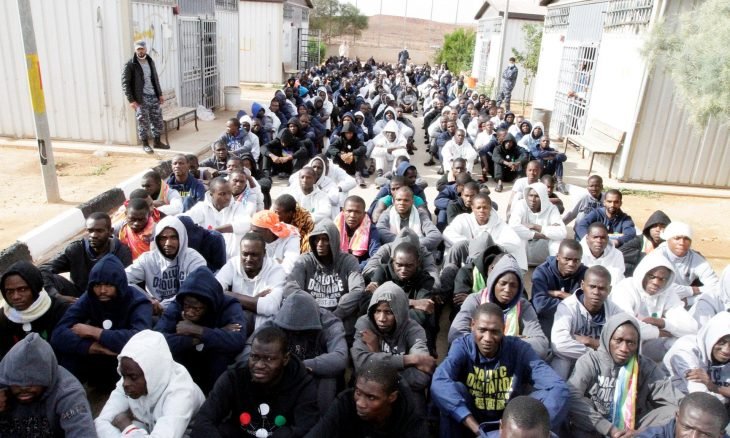
Notably important for Europe is the question of Libya’s migrants, detained and tortured in the most inhumane of conditions. While recent events such as Italian PM Giorgia Meloni’s visit are a welcome show of renewed interest and investments, this must not come at the expense of the need to avoid the banalisation of migrants’ situation and prosecute those behind such violations.
All in all, the Libyan public’s disenchantment with the UN process, political elites and self-interested militia commanders could be the opportunity the country needs for the public to draft a new social contract that reflects their values and quest for justice and accountability.
***
Roberta Magg – North Africa project officer at the Middle East and North Africa Division, Geneva Centre for Security Sector Governance (DCAF).
Andrea Cellino – DCAF’s Head of the North Africa Desk.
Karim Mezran – Director of the North Africa Initiative and resident senior fellow with the Rafik Hariri Center and Middle East Programs at the Atlantic Council for today’s newsletter.
Libyan commander’s representative liaised with Russia’s embassy in Saudi Arabia ahead of landmark 2017 summit in the Mediterranean, documents show
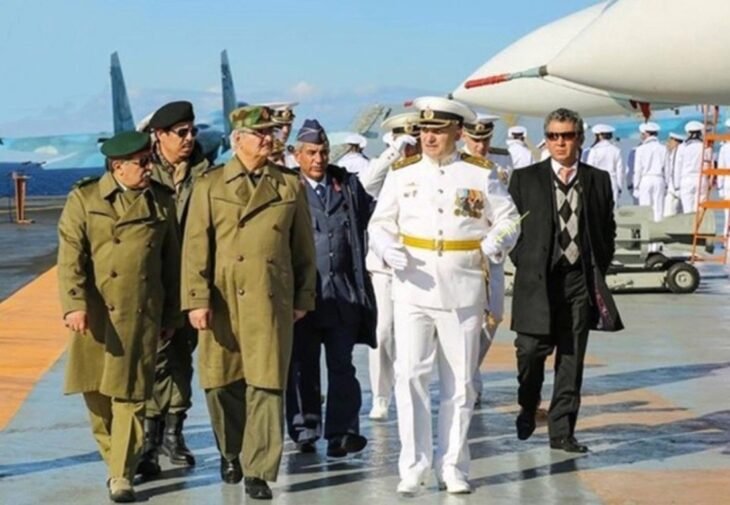
Russia’s military attache in Saudi Arabia was the point man for talks between Khalifa Haftar and Moscow in the lead up to the Libyan commander’s 2017 visit to a Russian aircraft carrier, according to documents obtained by Middle East Eye.
The cache of diplomatic cables between the Russian embassy in Saudi Arabia and a representative of Haftar show how Russia’s Riyadh mission served as the regional liaison between the eastern Libyan commander, his emissaries and Moscow for high-level meetings, requests for arms sales and intelligence collection.
MEE obtained the documents from a Libyan source close to Haftar’s circle and will publish further details later.
The cables detail how a visit for Haftar to a Russian aircraft carrier in January 2017 was facilitated to discuss “issues of cooperation in the field of fighting terrorist groups in Libya and supplying the Libyan Arab Armed Forces with medical supplies”.
Following the meeting, about 70 wounded soldiers from Haftar’s Libyan Arab Armed Forces, a coalescence of militias also known as the Libyan National Army (LNA), were flown to Russia via Egypt for medical treatment.
The Russian embassy in Saudi Arabia did not respond to requests for comment.
The correspondence and trip to the Admiral Kuznetsov, Russia’s only aircraft carrier, came at a time when Russia was stepping up support for Haftar. Then, like now, Libya was divided by competing governments in the east and west, and Haftar had designs to become the oil-rich North African country’s leader – ambitions that resulted in a failed attempt to conquer Libya’s west in 2019-2020.
Russia was already violating a UN arms embargo at the time by funnelling weapons to Haftar, and Moscow was also printing billions of dollars worth of Libyan banknotes for the Haftar-aligned government in Libya’s east. In 2016, Haftar visited Moscow twice, as his forces fought a gruelling battle for control of Benghazi.
MEE previously reported that after the aircraft carrier visit, during which Haftar spoke to Russian Defence Minister Sergei Shoigu on a secure phone line, Russia agreed to boost its military support for the commander in coordination with Algeria.
On 4 January 2017, Haftar wrote personally to Shogui, accepting an invitation passed to him by Russia via its embassy in Saudi Arabia to come aboard the Admiral Kuznetsov.
“Accept from us our deep gratitude and courageous support of the Libyan people in their struggle against terrorism, in order for security and peace to prevail in Libya and the entire Mediterranean,” Haftar wrote.
The Russian coordinating with Haftar at the time was Colonel Vladimir Kirichenko, military attache at Russia’s embassy in Saudi Arabia.
Three days after Haftar’s letter to Shogui, Kirichenko wrote to Libya’s then-ambassador to Saudi Arabia, Abdul-Basit al-Badri, warning him to keep plans for the aircraft carrier meeting secret and “within the framework of bilateral Libyan-Russian relations only”.
Badri was seen as a close ally of Haftar and travelled often to Moscow to meet senior Russian officials. Russia reportedly pushed for him to be named Libyan defence minister in 2015. Since 2021, he has served as ambassador to Jordan.
Badri told MEE that he severed ties with Haftar in 2017 and that he has had “no contact” with the Russians for years.
The Russian embassy said Haftar should arrive at the aircraft carrier by boat and provided a maritime satellite phone number for him to call. They also requested the contact person coordinating the trip on the Libyan side speak English or Russian.
Kirichenko wrote to Badri one day before the meeting was meant to take place, delaying it for two days to 11 January because of bad weather. He also requested the Libyans submit a list of topics to discuss.
Longstanding interest
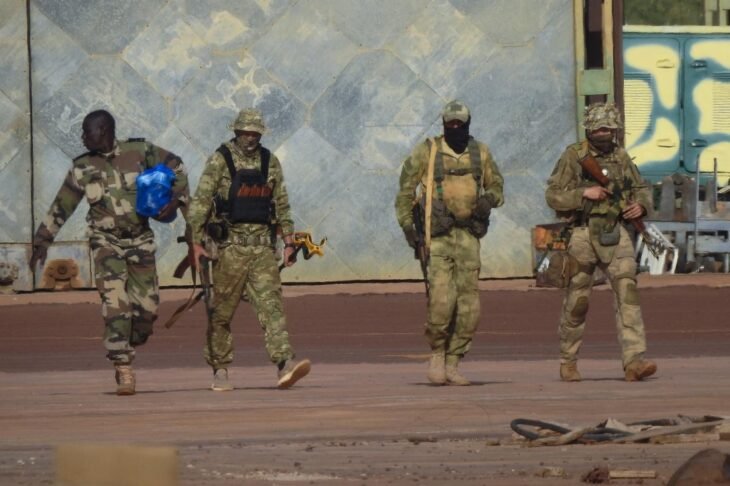
In recent years, Russian interest in Libya has been viewed mostly through the activities of the Wagner Group, a shadowy private paramilitary that has gained notoriety in conflicts such as Ukraine and Syria and is led by Yevgeny Prigozhin, a close associate of Vladimir Putin.
Wagner fighters, deployed with Moscow’s consent in 2019, are believed to have been funded by the UAE, at least initially.
However, as the cables show, Russia’s military had significant interest in Libya long before Wagner reached its shores.
“We all imagine Wagner was obsessed with Libya from the beginning, but it was the Russian state – Putin – who was obsessed. When the Russian state first saw Libya as strategically important, Wagner barely existed,” Jalel Harchaoui, a Libya expert at the Royal United Services Institute for Defence and Security Studies, told MEE.
Before Muammar Gaddafi was toppled by a Nato-backed uprising in 2011, Putin’s government inked $4bn worth of construction and arms deals with Libya – an investment that Russia has since sought to claw back through engagement with various rival Libyan parties, including Gadhafi’s son, Saif al-Islam, and even the Tripoli-based government Haftar went to war with.
Yet Haftar, who remains in effective control of eastern Libya and has enjoyed significant backing from the UAE and Egypt as well as diplomatic cover from France, emerged as Russia’s premier partner in the country.
Though Saudi Arabia has hosted Haftar and the liaisons between the commander and Russia were conducted on its soil, the Saudi government is not mentioned in the cables. Riyadh has, however, supported the commander by providing funds for his assault on Tripoli, reportedly including paying Wagner fighters and lobbying for him in Washington.
Russia is believed to have supplied Haftar with weapons, advisors and money.
Later, during Haftar’s 2019-2020 war on Tripoli, which killed at least 2,500 and displaced another 150,000 people, Wagner fighters provided training, aided artillery units, provided security to high-ranking members of the LNA, repaired and serviced equipment, and operated Pantsir anti-aircraft systems. As the conflict progressed, they took an increasingly offensive role, laying landmines and booby traps and taking up sniper positions.
“For Libya to make sense from a business perspective for Wagner, you need to get to 2018, when the UAE ups funding for Haftar to attack Tripoli,” Harchaoui said. “Then you have a market and if you are Prigozhin, there are all kinds of reasons to believe you will get the cash you need.”
Today, some of the estimated 1,000 Wagner fighters deployed in Libya remain in the country’s east and centre, though the group has expanded its operations elsewhere in Africa and played a leading role in the Russian invasion of Ukraine.
Its mercenaries have been sent to Mali, Sudan and the Central African Republic (CAR), where they control lucrative gold and diamond mines. MEE has previously reported on massacres carried out by Wagner fighters around gold mines in the CAR.
Samuel Ramani, a fellow at the Royal United Service Institute and author of a new book on Russia in Africa, says Libya is a linchpin for Russia’s ambitions in the continent.
“Libya is the Kremlin’s connection to the Sahel. Russia has always viewed Libya and Mali as an integrated theatre,” he said.
“Libya has grown in importance to the Kremlin as it looks to project power in West Africa, following the Ukraine war.”
***
SeanMathews is a journalist for Middle East Eye writing about business, security and politics. His coverage spans from across the Middle East, North Africa and the Balkans.
Criminal political and military elites with mafia-style fiefdoms now rule Libya. They have entrenched themselves in the state apparatus and even in the UN-sponsored peace talks. Only bold initiatives by the international community can change the status quo.
Three years on after the end of its latest civil war, Libya’s political elites have once again led the country down a path of executive bifurcation. This is fuelling instability and violence. Last summer, young Libyans took to the streets cross-country in a show of raw popular frustration. In a country with two governments no one really governs it.
Libya has stumbled into another year with no prospect of elections in sight. Libya’s political and security elites, and their foreign backers continue to benefit from the country’s deep divides. They have entrenched themselves in their positions of power. They are using their financial and political resources to prevent any change to the status quo and any process of democratic transition. They are functioning as per a mafia ethos that has been seen in many places in the world where criminal syndicates rule their communities.
Armed Groups and their Fiefdoms
In Libya, “those who shall not be named’ now rule the land and their criminal ways are now a political reality. Any discussion of Libya’s future must recognize these mafia powers and deal with them.
Since the revolution that led to the fall of Colonel Muammar Gaddafi, armed groups have taken over what’s left of the Libyan state. They exercise traditionally Weberian sovereignty over their fiefdoms. Most key armed groups commanders have since taken up positions within the state apparatus, progressively deriving political legitimacy from their institutional affiliations and securing roles for their rank and file. With institutional affiliations and state salaries came an increase in warlords’ individual influence, making it difficult for weak state structures to oversee, control and hold them accountable.
As per some estimates, almost one in five Libyans is now drawing a salary from the state, including in their capacity as members of an armed group. However, the state has often been unable to pay salaries for months at a time. This has drawn people away from the golden standard of state employment towards the star-glazed life of the militiaman. This vicious cycle of rushing towards gold is very emblematic of armed groups’ elite commanders who are more focused on mobilizing financial resources than on fighting.
As armed groups increasingly infiltrate the political and military tracks of the UN-led peace process, it seems that, in the future, Libya will be a mafia-run state.
What lies ahead?
There is a chance that political legitimacy could cause the downfall of armed groups as organized criminal networks. As they increasingly draw legitimacy and resources from the state, their social legitimacy could decline. The Libyan population is increasingly disenchanted with the entire political class.
The time has come for the international community to step in and find a framework for the expression of Libyan people’s democratic yearnings. This might involve more of a policing approach instead of accepting the inclusion of armed groups in peace negotiations. Libya needs a new paradigm, not more sticking plaster to paper over the cracks.
Sadly, we cannot expect this paradigm shift in the short term. The appointment of UN Envoy Abdoulaye Bathily is a moment of opportunity for Libya. Yet the roadmap presented at the UN Security Council in February 2023 centered around creating a body to hold elections and failed to address deeper issues. Bathily is burdened by legacies of conflicts that were undealt with.
The UN process paid little heed to justice, restitution and the broader Libyan public. Now the public is growing impoverished, fatigued and apathetic, and has come to distrust the UN mission.
For now, criminal networks are protecting their positions of power. They are also leveraging the shadow economy to enrich themselves. In Libya, the social contract still fundamentally comes down to economic interest. So, a corruption-prone government spends billions of Libyan dinars with no clear process, checks or balances.
Libya has the potential to be an economic hub for the whole of North Africa and a bridge to Europe, notably during a global energy crisis. Yet, there is little governance of the disbursement of state funds with over 40 billion Libyan dinars in cash moving around the country unchecked. In the east, an Egyptian style of military involvement in the economy, notably through the Military Investment and Public Works Committee, creates dangerous precedents for the worsening of an already precarious economic governance system.
More dangerously, in the medium to long term, criminal networks are eyeing funds of the National Oil Corporation, which should be used for infrastructure development instead. The UN’s narrative of “Disarmament, Demobilisation and Reintegration” (DDR) has degenerated into a trope used only by the security assistance industry. It has no prospects of success against the militias’ “core” management structure that yields such wealth and power that even key private sector positions wouldn’t be attractive enough to trigger a willing change in their path.
This bleak picture is but the tip of the iceberg. Organized crime of this scale now scuppers prospects for development in Libya. Ethical questions should be at the front and center of this discussion about the international community’s modus operandi: What does it mean to have normalized having an armed 13-year-old boy manning a checkpoint? Why are Libya’s young boys so drawn to weapons and money?
Substance abuse is now rampant in the country. Given the long-term psychological effects of war and death, forced recruitments into security forces from a young age, and no perspectives for one’s future in any other field, is that surprising?
As of now, no end is in sight. Self-interest of criminal militia leaders is still the driving force for the maintenance of the status quo. They are key spoilers who block any political solution that would make them lose power, privilege, influence and wealth.
There are still some avenues for hope, still. The top management of criminal militias do not have incentives to change. However, their rank and file could be tempted to change tack if they had other opportunities. Investments in education and developing a private sector would be a good starting point. If Libya could emerge as an energy hub, then militia foot soldiers might move to lower risk careers.
A UN-led focus on justice, reconciliation and accountability would help as well. So, would better oversight as well as checks and balances on government spending. Cracking down on corruption and financial mismanagement would give the Libyan government more money to invest on education and infrastructure. Finally, the public’s disenchantment with the UN process, political elites and self-interested militia commanders could be a great opportunity for the country. The Libyan people could come together to draft a new social contract inspired by their values that fulfills their quest for justice and accountability.[Arab Digest first published this piece.]
***
[Arab Digest thanks
Roberta Maggi, the North Africa project officer at the Middle East and North Africa Division of the Geneva Centre for Security Sector Governance (DCAF),
Andrea Cellino DCAF’s Head of the North Africa Desk and
Karim Mezran director of the North Africa Initiative and resident senior fellow with the Rafik Hariri Center and Middle East Programs at the Atlantic Councile.]
Analysis: The regional body is in the process of organising a reconciliation conference to help restore stability to Libya, but can the strategy succeed where previous initiatives have failed?
***
The 17th of February marked the 12th anniversary of the Libyan revolution, which ousted the country’s decades-long dictator Muammar Gaddafi.
Despite some positive signs initially, the post-revolutionary transition has become an unceasing deadlock due to multiple political crises, foreign intervention, and a stagnant status quo.
During the process, international powers, regional countries, and neighbouring states have tried to find a solution to organise free and fair elections in Libya to complete its long-awaited democratic transition.
As part of these efforts, international conferences, meetings, and initiatives have been organised on several occasions, but with no tangible developments.
“Since the war on Tripoli by Haftar’s forces in 2019, the African Union got more involved and started to make an active contribution to the mediation process”
Throughout the process, the demands of the country’s elites, the interests of foreign countries, and key ideological divisions have been laid bare.
Since last year, the African Union (AU) has been trying to organise a national reconciliation conference for Libya’s conflict.
Last month, on 19 February, it was announced by the AU Commission’s chief, Moussa Faki, that the union is set to have the meeting by June, which will be chaired by the Republic of Congo’s President Denis Sassou Nguesso.
A few days later, the UN’s Libya Envoy, Abdoulaye Bathily, also announced that he had decided to launch an initiative aimed at organising presidential and legislative elections in Libya in 2023.
The proposal includes bringing all relevant stakeholders in Libya together – from politicians to NGOs and tribal leaders.
The AU’s plan for a reconciliation conference could complement the UN envoy’s initiative if it becomes a reality. Furthermore, it would be the largest African-proposed strategy to solve Libya’s crisis.
But considering the failure of most previous such proposals, could it work?
Jalel Harchaoui, a Libya specialist and associate research fellow at the Royal United Institute for Defence and Security Studies (RUSI), told The New Arab that throughout the post-2011 era, the AU has consistently disappointed in Libya.
“In fact, it has never done or said anything of substance on that particular file. Given how extraordinarily vague this latest June 2023 ‘reconciliation’ conference plan seems, one should assume this year will be no departure from the AU’s tradition of irrelevance on Libya,” he added.
On the other hand, according to Abdulkader Assad, a prominent Libyan journalist, the African Union has been modestly involved in solution-making processes, especially back in 2014 when Libya divided into east and west camps.
“However, since the war on Tripoli by Haftar’s forces in 2019, the African Union got more involved and started to make an active contribution to the mediation process, especially with the advent of the GNU and the Menfi-led Presidential Council, which paid special attention to African countries and got them to be part of the reconciliation process, such as Chad, Niger, and Sudan, which share borders with Libya,” Assad told TNA.
According to him, “an African Union solution wouldn’t be the one that rallies all parties together” but would have “some effect on stability and security in the south, especially in the 5+5 Joint Military Commission’s military track”.
“Internationally, the five nations that matter the most inside Libya are Turkey, the UAE, the US, Russia, and Egypt. Only the latter is part of the AU”
Expressing more pessimism regarding the AU’s plan, Harchaoui said that Libya is not at war but is in dire need of elections. He also argued that the concept of reconciliation begs the question; between whom?
“Reconciliation among the small club of current rulers? Or should the circle of to-be-reconciled parties be broader? How broad? How many parties, factions, and communities should be invited?” he asked.
“Furthermore, it is unclear why Bathily mentioned the AU’s national reconciliation conference as part of his address before the UN Security Council. Which one is the priority: the elections or the reconciliation?” Harchaoui said.
“A proper, full-blown national reconciliation process requires lots of time. If the UN says it now has a streamlined, robust roadmap to make elections happen by the year’s end, where exactly does the reconciliation process fit? Is there enough time to implement it?”
According to Assad, the AU’s efforts are more directed at national reconciliation and military stability, meaning that the efforts aim to produce some law and order in the south as an essential step for the west and east to reconcile later.
“Because the southern region is still suffering from persistent problems related to the border crossings of foreign mercenaries and illegal immigrants,” Assad said.
The past few weeks have witnessed a rift between the UN envoy and the pro-Haftar House of Representatives (HoR) in the east, and there is another question mark about how the latter would react.
The HoR has also already started working with the Libyan High Council of State to complete constitutional amendments to organise elections in the country.
Commenting on the issue, Harchaoui told TNA that the HoR so far has ignored the AU’s proposed reconciliation conference.
“This indifference makes sense because, based on how things are shaping up, the AU’s event seems geared to serve as an innocuous and irrelevant distraction more than anything else,” he said.
“Internationally, the five nations that matter the most inside Libya are Turkey, the UAE, the US, Russia, and Egypt. Only the latter is part of the AU. Therefore, the Egyptian-backed HoR is unlikely to feel threatened by the AU’s initiative.”
Assad, on the other hand, argued that the HoR and its speaker, Aguila Saleh, would go along with the AU’s initiative as long as it was not aimed at political change.
“They would back the African Union’s national reconciliation and foreign mercenaries’ exit plans but would hinder any of its intervention in efforts to hold elections or end the stalemate,” Assad added.
He also claimed that, if it becomes a reality, the AU plan’s prominent actors could be the Congolese President Denis Sassou Nguesso and Mohamed Bazoum, Niger’s President, who has his origins in southern Libya.
“Bazoum and Nguesso recently mediated for the release of Gaddafi’s henchman, Abdullah Mansour. Besides that, Chad, Algeria, and Egypt are key actors who can emerge from the African Union”.
***
Ufuk Necat Tasci is a political analyst, journalist, and PhD Candidate in International Relations at Istanbul Medeniyet University. His research focuses on Libya, proxy wars, surrogate warfare, and new forms of conflict.
A new initiative is to be launched in Libya to enable elections this year, according to Reuters. The initiative was announced at the end of February by the United Nations Libya envoy, Abdoulaye Bathily.
Bathily’s goal is to break a year-long stalemate in the country that will risk the comeback of old conflicts by establishing a high-level steering committee.
During his presentation to the U.N. Bathily said the committee will bring together different groups from across the country including representatives of political institutions, other political and tribal leaders, civil society groups, security officials, and more.
Bathily said that Libya is in desperate need of the formation of this committee and elections, “Libya’s political class is going through a major legitimacy crisis.
One could say that most institutions lost their legitimacy years ago.” Libya has been attempting to hold an election for years, but conflict over the rules has prevented it from happening.
The House of Representatives has attempted to create an amendment to address electoral issues along with the High State Council. However, according to Bathily, the amendment was controversial in the country and did not address the main issues with the elections – including issues like candidate eligibility and an election timeline.
Conflict in Libya is not new, and the modern conflict has been happening since 2011 when NATO supported an uprising to remove the de facto leader, Muammar Gaddafi. Unstable, Libya broke into two factions – the east and the west – in 2014.
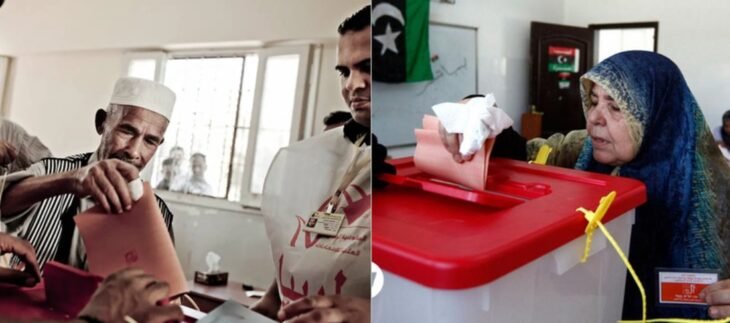
The last time major violence between the two factions occurred was in 2020, and it ended in a ceasefire, according to Reuters. An election was to be held in December of 2021 but never ended up happening due to disputes over the rules of the election.
While the Libyan envoy presented his ideas to the U.N., it is important for the U.N. to only provide support for the specific request and not overstep its bounds. The events of 2011 demonstrate that when organizations such as the U.N. or NATO become overly involved, their intervention can often exacerbate rather than alleviate existing problems.
While external guidance may prove beneficial, it is paramount that those with an intimate understanding of the country in question assume leadership roles. Empowering local actors to take charge of the situation can yield more effective and sustainable solutions.
After over a decade of conflict and division and over a two-year period of peace, Libya has the opportunity for an election to install a stable government.
Since the ousting of Muammar Gaddafi in 2011, Libya has yet to be unified under a functioning national government. Infighting elites and small armed groups continue to govern their own territories. The resulting state fragility creates conditions where illicit activities—notably the trafficking and abuse of vulnerable migrants—can thrive. Unfortunately, efforts to address irregular migration could be making matters worse.
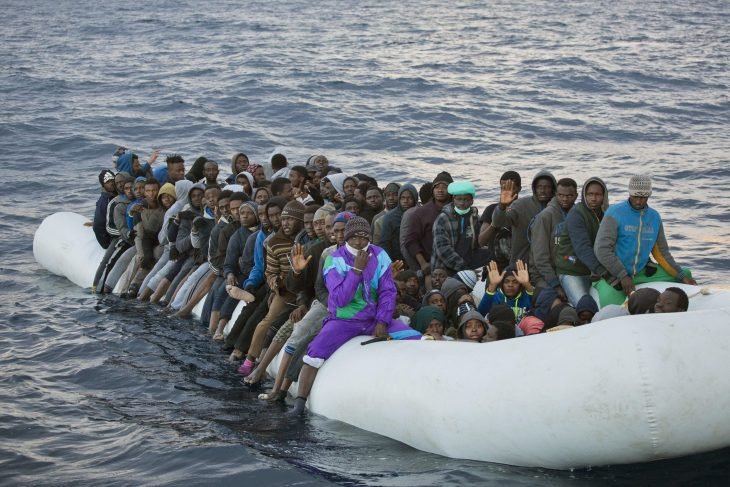
Libya is a major hub for migrants en route to the European Union from across the African continent and beyond. Opportunities for legal migration to Europe for most Africans remain extremely limited, driving migrants in search of economic opportunities and physical safety to seek out irregular routes.
Afraid of getting caught and with limited legal pathways to move, desperate people often take desperate measures, putting them at high risk of abuse by traffickers, smugglers, local militias, and even corrupt government officials.
The European Union and its member states have invested heavily in Libya’s migration management capacity, primarily in hopes of curbing the number of irregular migrants reaching their shores. However, the limitation of regular pathways and the securitization of responses to irregular migration has inadvertently created financial opportunities for illicit actors (e.g., non-state armed groups, traffickers, and smugglers), and contributed to instability and state fragility.
Effectively addressing the irregular migration challenge in a way that reinforces—rather than undermines—human rights is a critical component of any effort to prevent conflict and promote stability. Such a rights-respecting approach is also of fundamental importance to the legitimacy crisis at the heart of Libya’s fragility.
The United States recently selected Libya as a priority country for its Strategy to Prevent Conflict and Promote Stability, also known as the Global Fragility Strategy (GFS) in a nod to the 2019 Global Fragility Act that mandated it.
Though irregular migrants arriving in Europe directly affect the United States’ European friends and allies, Libya’s ungoverned spaces and the illicit activities that exist in them (including the presence of international non-state armed actors, such as Russia’s Wagner Group including the bad actors who facilitate the irregular movement of people) are of U.S. national security interest. Migration management and state fragility are intricately related in Libya.
Effectively addressing the irregular migration challenge in a way that reinforces—rather than undermines—human rights is a critical component of any effort to prevent conflict and promote stability.
Challenges in the Existing Migration System
As of October 2022, the United Nation’s migration agency, IOM, identified over 683,000 migrants in Libya from over 42 countries, equivalent to almost 10 percent of Libya’s population. Though it is hard to know exactly how many people are in Libya without regular status, according to the UN refugee agency (UNHCR), historically, “most refugees and migrants arrive irregularly in Libya through Sudan (for those from East Africa), Niger (for those from West and Central Africa), or, to a lesser extent, Algeria (for those from West Africa).
” Though many come from Sub-Saharan African countries, some people come from as far away as Pakistan and Bangladesh. Not all of them will attempt to cross to Europe in a given year (IOM reported over 125,000 attempted the trip in 2022), leaving many of them underemployed, informally employed, or trapped in exploitative labor conditions within Libya.
Remote Visualization
But the European Union’s main concern is the presence of such a large number of people who could attempt to cross the Mediterranean. This has led the European Union and EU member states to place an overwhelming focus on stopping people from embarking on the journey or from entering Europe if they do.
Responses have been targeted at professionalizing Libyan security forces and deploying migration management technologies, including the technology-enabled hardening of Libya’s borders and coastline and the empowerment of Libya’s security forces to stop people from leaving.
An unintended consequence of this securitization of migration management is that it can put money in the hands of militias, traffickers, and corrupt government officials and thus reinforce state fragility in Libya.
In addition to the human rights abuses that can result from this, the broken status quo benefits those with vested interest in maintaining it, meaning that already endemic state corruption could entrench over time, further undermining good governance and democratic principles in the long run. And, perhaps more importantly to European policymakers, the current system (or lack thereof) does not address root causes or results of migration.
Those interested in the stabilization of Libya should learn from the shortcomings of past efforts. Doing so will require more than just focusing on stopping flows via the securitization of migration.
EUTF-Specific Challenges
Through the EU Emergency Trust Fund for Africa (EUTF)—established in 2015 with a stated mission of decreasing irregular migration to Europe by addressing its root causes—the European Union delivers funding, technology (e.g., biometric identification systems), and training (e.g., cybersecurity, coastal surveillance, and maritime detection) to detect, identify, and intercept people attempting to reach Europe from Libya.
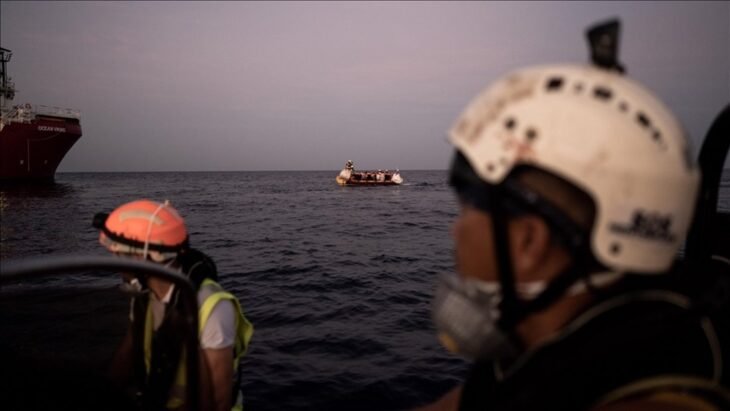
The EUTF has enhanced the capacity of search and rescue missions, which have undoubtedly saved lives that might otherwise have been lost at sea. Since 2014, IOM has recorded over 25,000 migrant deaths and disappearances at sea, 17,000 of which took place along the Central Mediterranean route for which Libya is the most popular launching point. In 2016, just 8 percent of interceptions along the central Mediterranean route were made by the Tunisian and Libyan coast guards; by 2018, this had risen to 49 percent.
In building this capacity, destination countries (in this case in Europe) are outsourcing migration management to transit and origin countries, primarily through training and technology. In the case of Libya, this means that those who might have been intercepted in European territorial waters are now being intercepted in Libyan waters.
However, this outsourcing comes at a cost. Evidence suggests that the funding and technology provided to the Libyan government by the European Union has contributed to enhanced capabilities to intercept, detain, and repatriate migrants; it has also contributed to their marginalization and exploitation. Intercepted migrants often end up in dangerous situations and face serious human rights abuses at the hands of the Libyan state actors, including the EU-trained Libyan Coast Guard and personnel in detention centers supported by the European Union, EU member states (e.g., Italy), and the United Nations.
An AP investigation in 2019 found that networks of coast guard members frequently colluded with militiamen and traffickers to exploit migrants, often using diverted EU money. Other investigations have found that thousands of migrants end up in detention centers with problematic approaches to the protection of human rights that the European Union has supported with equipment and training. Libyan-run detention centers have been described as “unfit for human habitation.
” A 2018 joint report by the UN Support Mission in Libya and the UN Office of the High Commissioner for Human Rights found that “unlawful killings, torture and other ill-treatment, arbitrary detention and unlawful deprivation of liberty, rape and other forms of sexual and gender-based violence, slavery and forced labour, extortion and exploitation by both State and non-State actors” were commonplace in these detention centers.
Though exact figures can be difficult to verify (UNICEF reported in October 2021 that the Al Mabani detention center alone has 5,000 people or four times its official capacity, while a separate May 2022 report by UNHCR reported that there were 2,772 total people held in all detention centers), it is clear that migrant detention centers in Libya are problematic.
Intercepted migrants often end up in dangerous situations and face serious human rights abuses at the hands of the Libyan state actors.
There is also evidence to suggest that the prioritization of managing migration flows to Europe over other concerns—like addressing the root causes of migration—is part of a larger trend in European assistance to Africa.
The Migration Policy Institute found in May 2021 that the EUTF “only modestly altered foundational economic and social factors driving migration” in its first seven years of existence while, at the same time, about a third (1.5 billion euros) of EUTF funding went toward efforts to address irregular migration already underway.
This commitment was reinforced in November 2022, when the EU Commission’s new EU Action Plan on the Central Mediterranean pledged to continue strengthening the capacity of the Libyan government’s migration management institutions.
Though the EUTF commits in writing to achieve its goals “in full respect of fundamental rights and international obligations,” some have noted a subpar track record of enforcing such commitments. In fact, the European Ombudsman recently found that the European Commission failed to properly assess the human rights impacts of the EUTF, including the risk in Libya of the “misuse of data and possible privacy infringements of third country populations in a vulnerable position.”
It also highlighted specific incidents of abuse that were facilitated by the provision of European migrant detection equipment, such as a June 2021 incident in which the Libyan coast guard shot at a boat carrying 50 migrants, including children, and then prevented an attempt to rescue passengers who fell out of the vessel, resulting in four deaths.
In another reported incident, Libyan authorities opened fire on a group of migrants at a disembarkation point when they attempted to flee, resulting in three deaths. The complaint to the Ombudsman listed several other instances of abuse by the Libyan Coast Guard based on migrant interviews, who reported beatings, rape, extortion, and torture. As a result of this evidence, the Ombudsman recommended that all future EUTF projects require a prior human rights impact assessment.
Opportunities for the GFA to learn from EUTF challenges
The United States has prioritized Libya in its Global Fragility Strategy and should learn from the EUTF experience. The 2019 Global Fragility Act (GFA) is designed to give U.S. policymakers the tools needed to “reduce violent conflict, alleviate migration pressures, and prevent violent extremism” by investing in 10-year strategies tailored to specific contexts.
These strategies are due to be released in the first half of 2023. The GFS translates those goals into action by setting up mechanisms for interagency coordination and identifying five priority locations to focus its efforts, one of which is Libya.
The launch of the 10-year GFS strategy and recent EUTF criticisms are an opportunity to assess the impact that migration management has on fragility and develop more cohesive strategies to address it. These efforts should be coordinated across partner governments working on similar issues, including in Libya. The U.S. GFS implementation team should work with its EU colleagues and other stakeholders to do the following:
incorporate lessons from Libya’s migration management experiences into the design and implementation of the GFS, particularly focusing on the shortcomings presented in the European Ombudsman report and uncovered in the 2020 mid-term evaluation of the EUTF;
align, or at least deconflict, inherently shorter-term migration management efforts (e.g., EUTF funding of technology) with longer-term GFS efforts to, among other things, alleviate migration pressures;
ensure all GFS projects carry out a human rights due diligence assessment prior to implementation, and conduct regular assessments throughout the course of the program;
prioritize transparency, oversight, and accountability in all GFS-related programming in Libya, also prioritizing support to civil society actors—including those working on migrant rights—who are critical to achieving these goals;
ensure that all assistance provided under the GFS, EUTF, and any other effort to manage migration and promote stability in Libya takes into account protection of migrant rights in policy and in practice;
assess the potential for manipulation of migration management technologies and put in place human rights protection related training and safeguards around their utilization; and
deny migration management technologies to known human rights abusers, especially foreign security forces, which the U.S. government is already prohibited from doing under the Leahy law.
It is in everyone’s interest—from migrants to European and U.S. policymakers interested in future stability, democracy, and the protection of human rights in Libya—to ensure that efforts to address migration are coordinated and mutually reinforcing.
The protection of migrant rights should be a top priority in order to avoid siloed programming that seeks to achieve narrow migration management goals but risks exacerbating state fragility in the process.
Lauren Burke is a program manager and research associate for the Human Rights Initiative at the Center for Strategic and International Studies (CSIS) in Washington, D.C. Erol Yayboke is a senior fellow with the CSIS International Security Program and director of the CSIS Project on Fragility and Mobility.
***
Lauren Burke is the program manager and research associate for the Human Rights Initiative at the Center for Strategic and International Studies (CSIS). Prior to joining CSIS, she spent four years as the senior program coordinator for the German Marshall Fund (GMF) Cities program, where she played a critical role in managing the Young Transatlantic Innovation Leaders Initiative (YTILI) and launching the Cities Fortifying Democracy project.
Erol Yayboke is a director of the Project on Fragility and Mobility and senior fellow with the International Security Program at the Center for Strategic and International Studies (CSIS). His specific research interests include migration and forced displacement, violent conflict and global fragility, conflict-aware stabilization, violent extremism, climate change, civil-military cooperation, and disruptive technologies.
Closing the curtain on maneuvers of Aqila Saleh, Speaker of House of Representatives (HoR) and Khaled Al-Mishri, Head of the High Council of State (HCS), the UN Special Envoy to Libya, Abdoulaye Bathily has announced his intention to form a high-level committee as the legal basis for the upcoming elections.
That is together with a road map with specific and binding dates for steps of the electoral process. The deadline made by Bathily to both HoR and HCS ended with his briefing to the UN Security Council, after failing to reach any consensus, as expected given their stark differences over candidacy conditions for presidential elections, besides their desire to continue in the political scene to the maximum extent possible.
Even the constitutional amendment presented by Aqila Saleh on behalf of HoR, which HCS has yet to vote on, has neither convinced Bathily nor countries supporting the elections. Bathily pointed out in his briefing that the constitutional amendment is controversial among political circles because it does not address candidacy criteria for the presidential elections and does not set a timetable to conduct elections.
These are sufficient reasons to transcend the two houses, and not to waste more time on waiting that will lead to nowhere.
The committee, Bathily intends to form will bring together 30 to 40 figures from stakeholders, institutions, tribal leaders, women and youth.
It will bring together a wide political and social spectrum, and the number is likely to pass the 40 figures, to involve the maximum number possible of those with vested interest in the elections, such as political parties. However, Bathily did not disclose any details about the mechanisms and standards that he will adopt in the selection process, which in any case, will be subject to controversy and criticism, as not everyone can be satisfied.
Bathily Initiative was widely welcomed by most UN Security Council members, except as expected, a Russian reservation. Internally, it was welcomed by political parties, but criticized by HoR’s presidency and its affiliated government.
HCS did not comment and its president called for a session on Thursday in an attempt to approve the 3rd constitutional amendment.
Among the popular circles, the initiative was met with relief because it transcends the two houses, however with cautious optimism, as whether the plan could lead to a solution, ending the state of the political impasse.
The path to implementing the initiative and formation of the high committee for elections will not be paved with flowers, as the international consensus is still missing, even with the agreement that the way to the solution is through elections.
The French representative spoke of the formation of a unified government before going to elections, while the USA and Britain welcomed the initiative, and both want to go directly to elections.
Russia knows that its presence in Libya is the main target of this American-British move, and therefore, its representative warned against rushing things, promising to study Bathily’s initiative seriously.
While Egypt is still committed to the constitutional path that it sponsored and content with HoR and HCS leading the political process, however, its influence will be weak in the face of the international and local desire to conduct elections.
As all international and regional parties have local proxies, whom are keen to continue in the political scene.
The progress in implementing the initiative to achieve its goals, requires continued support of international actors to the UN envoy, and the situation may require using serious threats of applying international sanctions against obstructers.
HoR and HCS will not be completely excluded from the political process, but their representation in the new committee will not enable them its control.
The constitutional amendment will be among the foundations upon which the constitutional bases will be built, that is based on consensus among members of the committee, and finalizing election law and conditions for candidacy for the presidential elections, with preparedness to only conduct legislative elections, if dispute over presidential elections persisted.
Nevertheless, the mere presentation of the initiative itself, wrote the first chapter of their end, and with their disappearance, the country will embrace a new political stage.
***
Abdullah Alkabir, a Libyan political writer and commentator
The new UN envoy to Libya had hoped to usher in long-delayed elections, but his initiative is facing pushback from the eastern-based parliament and a lukewarm reception by its rivals in Tripoli.
Senegalese diplomat Abdoulaye Bathily told the UN Security Council last month he planned to create a panel tasked with delivering presidential and legislative elections in conflict-torn Libya later this year.
But his blunt criticism of the North African country’s two houses of parliament for failing to agree on a legal basis for elections has sparked a backlash that threatens to derail Bathily’s plans.
The pushback was “predictable”, said Khaled al-Montasser, a professor of international relations at the University of Tripoli, as elections would see members of both chambers potentially lose their seats and privileges.
Despite the rivalry between them, both view the UN initiative as “interference in their sovereign decision-making power and an attempt to impose international will on Libyans,” Montasser told AFP.
Libya has seen more than a decade of stop-start conflict since the 2011 revolt that toppled strongman Moamer Kadhafi, with a myriad rival militias, foreign powers and multiple governments vying for influence.
The country remains split between a supposedly interim government in the western capital, Tripoli, and another in the east nominally backed by military chief Khalifa Haftar.
While most observers believe Libyans overwhelmingly support elections, bitter wrangling over the legal basis for holding them has been a key sticking point since the last major battle between Haftar and western Libyan forces in 2020.
Last month, the eastern-based House of Representatives passed an amendment to the country’s Constitutional Declaration — an interim constitution — which it said would provide a legal basis for elections.
Bathily, who was appointed as head of the UN’s Libya mission UNSMIL in October, said the amendment was “controversial” among Libyans and lacked clarity of key issues such as who may stand in presidential polls.
He also noted it had not been endorsed by the High Council of State, the Tripoli-based upper house of parliament.
The House in turn accused Bathily of “double standards” and “lacking impartiality”
‘Not enough’
Libyan analyst Abdallah al-Rayes said the UN envoy’s initiative aimed to put pressure on rival Libyan factions by giving them a “last chance” before “a vote takes place without them”.
“The international community wants to embarrass the two chambers, who are masters in the art of wasting time and political horse-trading,” he said.
The Tripoli-based transitional government of Kadhafi-era tycoon Abdelhamid Dbeibah has signalled its willingness to cooperate with Bathily’s plan, asking the United Nations to provide logistical support to that end.
The US embassy last week called on “key Libyan leaders to approach the plan in a constructive spirit”, saying in an online post the UN proposal would “build on progress made between” the two chambers “on the legal basis for elections”.
Britain also said it supported the plan.
“Libyans deserve certainty and faith in their institutions,” its mission at the United Nations in New York tweeted shortly after Bathily had spoken at the Security Council.
“Conditions for elections must be agreed by all and the results respected.”
But Monstasser said US and British backing was “not enough”, stressing the importance of buy-in from their arch-rival Russia, which has a presence in southern Libya via the Kremlin-linked Wagner paramilitary group.
“Moscow is a powerful actor in Libya and exerts influence on Haftar,” he said.
Western Libyan efforts to prevent Haftar, a US citizen, from standing in presidential polls have been a key factor in the stalemate over the legal basis for polls.
Haftar’s rivals want rules that ban the candidacy of dual citizens and military figures.
Dbeibah summed up the fears of many in western Libya in a recent speech.
“A return to a military regime is unacceptable,” he said.
The following is the March 7, 2023, Congressional Research Service In Focus report, Libya and U.S. Policy.
Twelve years after a 2011 uprising that toppled longtime authoritarian leader Muammar al Qadhafi, Libya has yet to make a transition to stable governing arrangements. Elections and diplomacy have produced a series of interim governments, but militias, local leaders, and subnational coalitions backed by competing foreign patrons have remained the most powerful arbiters of public affairs.
The postponement of planned elections in 2021, Libyans’ continuing lack of consensus over constitutional and legal arrangements, the potential fragility of a United Nations (U.N.)-backed ceasefire, and the reemergence of institutional rivalry are prolonging Libya’s instability and pose challenges for U.S. decisionmakers.
Successive U.S. Administrations have sought to prevent Libya from serving as a permissive environment for transnational terrorist groups and have taken different approaches to conflict and competition among Libyans. The Biden Administration supports the holding of new elections in Libya and has used U.S. influence to bolster U.N.-led mediation efforts to that end. Congress has appropriated funds to enable U.S. diplomacy and aid programs, and some Members have called for more assertive U.S. engagement.
War, Ceasefire, and a Deferred Election
Conflict reerupted in Libya in April 2019, when a coalition of armed groups led by Qadhafi-era military defector Khalifa Haftar known as the Libyan National Army (LNA, alt. “Libyan Arab Armed Forces,” LAAF), attempted to seize the capital, Tripoli, from the internationally recognized Government of National Accord (GNA).
Russia, the United Arab Emirates (UAE), Egypt, and leaders of Libya’s House of Representatives (HOR, an interim parliament last elected in 2014) backed the LNA. With Turkish military support, the GNA and anti-LNA western Libyan militias forced the LNA to withdraw. Libya has remained divided since, with foreign forces still present, and opposing coalitions separated by a line of control west of Sirte (Figure 1). During 2020, multilateral diplomatic initiatives helped achieve a ceasefire, and the U.N. has deployed civilian monitors at Libyans’ request.
In 2021, members of a U.N.-appointed Libyan Political Dialogue Forum (LPDF) and the HOR approved an interim executive authority and Government of National Unity (GNU) to replace the GNA, with a mandate to serve until elections or through June 2022. In 2021, the U.N.
Support Mission in Libya (UNSMIL) facilitated discussions among LPDF members, the HOR, and the High Council of State (HCS, an advisory representative body) in an attempt to establish a constitutional and legal basis for parliamentary and presidential elections planned for December 24, 2021. However, disputes over candidacy criteria and constitutional and legal issues persisted, leading to an indefinite postponement of the elections.
U.N. and U.S. officials have sought to preserve momentum toward elections, amid contending Libyan proposals and initiatives. Figure 1. Libya: Areas of Influence and Timeline
2014 Elections for constitutional drafting body and parliament. Disputed results fuel conflict. U.S. diplomats depart.
2015 International mediation yields agreement to form Government of National Accord (GNA).
2016 House of Representatives (HOR) withholds GNA endorsement. Islamic State forces defeated in Sirte with U.S. military support.
2018 Libyan National Army (LNA) controls eastern Libya.
2019 LNA offensive against Tripoli; Turkey intervenes.
2020 U.N. supports ceasefire negotiations, selects Libyan Political Dialogue Forum (LPDF) members. LPDF agrees to roadmap, plans December 2021 elections.
2021 LPDF selects Interim Executive Authority members. HOR approves interim Government of National Unity (GNU). U.N.
Security Council endorses ceasefire monitoring and election date, but election postponed.
2022 HOR selects replacement interim government. GNU leaders object and, after militia clashes, retain control of the capital.
2023 U.N. plans High Level Steering Panel to organize elections.
Competing Governments Reemerge
In the wake of the election postponement, consultation and political competition among Libyans intensified. Haftar, the LNA, and competing western Libyan militias remain powerful security actors with diverse political aims and influence. HOR Speaker Aqilah Saleh, who had stepped back from his role in 2021 to seek election as president, moved to dismiss GNU Prime Minister Abdul Hamid Dabaiba and the GNU cabinet.
Dabaiba, who also had presented himself as a presidential candidate despite a previous pledge not to do so, has asserted a continuing mandate and refused to yield to anything but a nationally elected government. In February 2022, the HOR endorsed former GNA Interior Minister Fathi Bashaga as Prime Minister-designate, and, in March 2022, endorsed Bashaga’s proposed cabinet.
Bashaga made multiple attempts to enter and assert authority in Tripoli, but met resistance from Dabaiba and local militias, resulting in some armed confrontations and the defeat of Bashaga allies. Bashaga and his would-be government continue to operate in eastern Libya but have no effective national authority.
Libya’s fiscal and economic dependence on the oil and gas sector make Libyan National Oil Corporation (NOC), the Central Bank, and budgetary and fiscal processes objects of intense competition, as rivals seek access to oil export revenues to pay salaries, provide subsidies, and otherwise generate political and security support. In July 2022, Dabaiba replaced longtime NOC Chairman Mustafa Sanalla with Farhat Bengdara.
Allies of Haftar and the LNA subsequently suspended their protest blockade of national oil facilities, which had severely reduced oil exports. In September 2022, Abdoulaye Bathily of Senegal became the Special Representative of the U.N. Secretary-General for Libya. Bathily has consulted with Libyan and foreign parties since to build consensus on a constitutional basis for planned elections.
In February 2023, Bathily announced he would establish a High Level Steering Panel to organize and hold legislative and presidential elections in 2023 on an agreed constitutional basis, saying “most institutions lost their legitimacy years ago.” HOR Speaker Saleh and LNA leaders reportedly insist on terms that would allow Haftar to stand as a candidate, which Haftar’s opponents reject.
Military officers of the Joint Military Commission (“5+5”) that negotiated the 2020 ceasefire met under U.N. auspices in Sirte in October 2022 and established a subcommittee on disarmament, demobilization, and reintegration.
U.S. Policy and Selected Issues
During and prior to armed clashes in 2019 and 2020, rival executive authorities based in western and eastern Libya competed for power and recognition. International mediators intended the formation of the GNU and the holding of new elections to provide a basis for the reunification of Libyan institutions and an end to serial interim arrangements.
U.S. officials have supported U.N. leadership of these initiatives, emphasized the importance of maintaining the ceasefire and the neutrality of institutions such as the NOC, and sought to avoid accusations of illegitimate interference by not insisting on specific outcomes.
U.S. officials encourage dialogue among Libyans and have stated that elections are required to resolve disputes over legitimacy. U.S. officials continue to balance Libya-related concerns with other U.S. goals in relation to Russia, Egypt, Turkey, France, Italy, and the UAE.
U.S. Special Envoy for Libya Ambassador Richard Norland has led U.S. diplomatic engagement since 2019. U.S. officials operate from a Libya External Office at the U.S. Embassy in Tunisia. The executive branch continues to assess requirements to reestablish a lasting U.S. diplomatic presence in Libya. Congress may consult with the Administration on related security needs and costs.
Terrorism and Foreign Military Forces
U.N. and U.S. reporting describe transnational terrorist threats in Libya as reduced and contained. Successive U.S. Administrations have sought to foster the departure from Libya of foreign military forces and mercenaries. The U.S. military has monitored and reported on the activities of Russian mercenaries and military equipment in Libya.
Press accounts suggest that some Russian mercenaries may have left Libya to support operations in Ukraine, although Libya reportedly remains a logistical hub for their operations in sub-Saharan Africa. Forces in eastern Libya shot down a U.S. unmanned aerial vehicle there in August 2022; U.S. investigation continues. Turkish military advisers train and assist western Libyan forces in accord with a 2019 TurkeyGNA security agreement. The LNA and its opponents reportedly have used fighters from Syria, Chad, and Sudan.
Sanctions and U.N. Bodies
The U.N. Security Council has authorized financial and travel sanctions on entities threatening peace in Libya, undermining the political transition, or supporting others who do so. U.S. executive orders provide for comparable U.S. sanctions. The Security Council has extended UNSMIL’s mandate through October 2023.
Humanitarian Needs and Migration
The U.N. estimates more than 800,000 people in Libya (out of 7 million) require some form of humanitarian aid. U.N. agencies have identified nearly 680,000 foreign migrants, more than 134,000 internally displaced persons, and more than 44,700 refugees in Libya. Migrants remain especially vulnerable to extortion and other abuses. The State Department reported in 2022 that “endemic corruption and militias’ influence over government ministries contributed to the GNU’s inability to effectively address human trafficking.”
Issues in the 118th Congress
Congress has conditionally appropriated funding for transition support, stabilization, security assistance, and humanitarian programs for Libya since 2011. The Biden Administration sought $44.5 million in FY2023 funding for Libya aid programs, and in 2022 named Libya as a priority country for the purposes of the Global Fragility Act (Title V of Division J, P.L. 116-94).
The 117th Congress did not include House-passed Libya-related provisions in the James M. Inhofe National Defense Authorization Act for Fiscal Year 2023 (P.L. 117-263) that would have authorized future U.S. assistance, enacted U.S. sanctions in statute, and established new reporting requirements.
***
Christopher M. Blanchard, Specialist in Middle Eastern Affairs.
According to Siddiq Kabir, he is the last pillar holding the country together. His adversaries claim he is perpetuating a national crisis.
***
With backing from Egypt, the United Arab Emirates and France, Haftar’s forces slowly subdued their enemies in Benghazi, in grinding street fighting that lasted almost four years. Meanwhile, Haftar consolidated his authority in the east. In September 2016, he took over eastern Libya’s oil ports from rival militia leader Ibrahim al-Jadhran. Haftar allowed oil exports to resume despite the fact that the revenues were going to the central bank in Tripoli — a policy that won him praise from the NOC and Western governments, and helped strengthen his profile as a statesman. But, in meetings with Western ambassadors, Haftar railed against Kabir, accusing him of funding “terrorists.”
As Haftar’s forces expanded both in number and territorially, his need for funds grew, and his tolerance for the flow of revenues to Tripoli dwindled. In June 2018, Jadhran furnished the pretext for Haftar to challenge that arrangement. Jadhran seized the eastern oil ports in a lightning attack with dozens of four-wheel-drives, only to be driven out again by Haftar’s forces a week later. It was the third such attack on the oil ports in the space of 18 months, by varying coalitions of armed groups opposed to Haftar.
Once he was back in control, Haftar’s forces announced that the eastern oil facilities would henceforth be operated by the east-based parallel NOC, and demanded that Kabir be replaced. Yet, one week later, pressure from a U.S. administration worried about rising oil prices prompted Haftar to reverse his position and allow the Tripoli NOC to resume exports. To justify the U-turn, Haftar could point to a face-saver: a letter to the U.N. Security Council from the Tripoli-based prime minister, Faiez Serraj, demanding a financial review of both the Tripoli and the east-based central banks. Serraj had his own reasons to challenge Kabir, since the latter met Serraj’s requests for spending with stubborn austerity.
Haftar continued to advance, seizing control of southern Libya in early 2019, and his eventual ascension to overall power increasingly appeared inevitable. But his debt-based financial model was reaching its limits, as east-based banks neared bankruptcy. To facilitate his takeover, Haftar’s foreign backers sought to alleviate the financial pressures on him. French diplomats I met in February 2019 argued that the Tripoli government should quickly inject money into the southern regions Haftar had just captured and that any power-sharing agreement with Haftar had to include change at the central bank.
Ghassan Salamé, who, as the U.N. envoy from 2017 to 2020, met Haftar frequently, told me that Haftar raised the need for Kabir to leave in virtually every meeting. In the ill-fated negotiations over a power-sharing agreement that took place in early 2019, Haftar even proposed a replacement for Kabir: Farhat Bengdara, the last central bank governor before the 2011 uprising.
When Haftar launched a surprise offensive on Tripoli two months later, neutralizing Kabir was part of the plan. The French president’s adviser for Libya, Paul Soler, invited Kabir to a meeting at the Élysée Palace for the day of the attack, April 4, 2019 — thereby ensuring that Kabir would be out of the country. (Soler did not respond to requests for comment.) According to Kabir, Soler and a senior Emirati official who joined the meeting had no specific questions related to the central bank. Instead, they told him that arrangements had been made with militia leaders in Tripoli and that Haftar’s takeover would be complete within hours. They then asked him to meet again the next morning. Overnight, however, armed groups in the Tripoli area captured over 100 of Haftar’s soldiers, foiling their attempt to reach the city center. “When I met them the next day, the picture had changed. They were surprised, they had imagined — based on what Haftar’s people had told them — that his forces would enter smoothly.” Kabir returned to Tripoli the same day.
With Haftar’s forces settling in for a long fight over the capital, Kabir became a key target for foreign states seeking to negotiate a settlement favorable to Haftar. In the early months of the war, the Donald Trump administration tacitly supported Haftar’s offensive. According to Western diplomats at the time, the U.S. National Security Council under John Bolton was adamant that Kabir had to go. Haftar’s backers — France, the UAE and Egypt — shared that goal. “The Tripoli government has to make concessions to Haftar: dismantling militias and changing the board of the central bank,” French diplomats told me in October 2019.
Meanwhile, Haftar’s forces on Tripoli’s southern outskirts — now backed by mercenary fighters from Russia’s Wagner Group — continued to make incremental progress towards the central bank in the city center. While the physical prize remained out of reach, Haftar began lobbying foreign capitals on an alternative plan: depriving the central bank of oil revenues. In December 2019, Haftar’s son Belgasem and Farhat Bengdara, the former central bank governor, traveled to Washington to propose that an escrow account under international supervision be set up for oil revenue. But the Treasury Department opposed the idea, and the U.S. position on Kabir had softened after Bolton left the White House in September. Belgasem Haftar and Bengdara were unable to get face time with any senior officials.
To press his demand, in January 2020, Haftar shut down most of Libya’s oil production. Turkey had just begun intervening in earnest to support the Tripoli government against Haftar, who argued that oil revenues were paying for the Turkish intervention. But British diplomats who went to see him that month found him “obsessed with Kabir,” according to one member of the delegation.
In Tripoli, Kabir reacted to the oil shutdown by suspending payments of salaries and, in March, sales of foreign currency. This escalated tensions that had been brewing for years between Kabir and Prime Minister Serraj. While Haftar’s forces continued their shelling of Tripoli, the spat between Kabir and Serraj spilled out into the open. In April, Serraj spent the bulk of a 40-minute televised speech attacking not Haftar but Kabir: “I have tried to avoid a war of words with the Central Bank of Libya, but things have really crossed all lines.” Decrying Kabir’s unilateralism, Serraj called for the board of the central bank to meet — a frontal challenge to the exclusive authority Kabir had exercised over the bank for six years.
In late May, the Turkish intervention finally turned the tide. First the Wagner fighters and then Haftar’s forces hurriedly retreated from western Libya, drawing a new frontline through the center of the country that left them in control of most oilfields and export terminals.
But the slow detente that followed the war turned out to be a greater danger to Kabir than Haftar’s power grab had ever been. Tarik Yousef, a board member who had stayed loyal to Kabir, tried unsuccessfully to mediate between Kabir and Serraj, telling me that July that the two were still not on talking terms. Meanwhile, to get the oil flowing again, U.S. and U.N. diplomats sought to broker an agreement for revenues to remain embargoed in the NOC’s account at Libya Foreign Bank, a central bank subsidiary — but without any onward transfers to the central bank itself. They found allies in Serraj and NOC Chairman Sanalla.
When Serraj came out in support of the idea in August 2020, neither he nor the U.S. ambassador, nor U.N. envoy Stephanie Williams, had discussed the matter with Kabir. In September, oil production resumed, with revenue flowing into the NOC account, prompting a struggle between Kabir and Serraj over control of Libyan Foreign Bank. Kabir was increasingly isolated. “Kabir’s time horizon for everything he’s doing now is days and weeks,” a close collaborator of Kabir who asked to remain anonymous told me at the time.
Furious at being sidelined, Kabir leaked a “top secret” letter to Sanalla in which he accused NOC of having concealed billions of dollars in oil revenue “for years” instead of transferring them to the central bank. Sanalla hit back at what he called Kabir’s “failed policies” with an acerbic video address: “Where has all the money gone? One person controls everything. Who are you, brother? This chaos can’t go on. Until the central bank is reformed, you won’t see any money at all,” he barked into the camera.
Williams, too, vented her frustration with Kabir. “We’ve been pushing on a central bank board meeting for two years. Siddiq Kabir needs to go,” she told me that September.
The noose around Kabir was tightening.
The French Revolution, its detractor Jacques Mallet du Pan famously observed, devoured its own children. In what has become a recurrent pattern, once revolutionary upheaval has mobilized wide swaths of society, it tends to annihilate its agents in the struggles that follow.
The Libyan revolution has been no exception. Most members of the 2011 National Transitional Council (NTC), the revolutionary leadership, have long sunk into irrelevance or abandoned crisis-ridden Libya for a more comfortable life abroad. Exiles who returned to Libya in 2011 after spending decades overseas enthusiastically embraced the democratic transition, then left disillusioned as conflicts and corruption engulfed the country.
Many commanders in the revolutionary war against Gadhafi were killed or sidelined in the struggles that followed, prompting the rise of a younger generation of militia leaders. Former regime officials, after being exiled, imprisoned and ostracized by the revolutionaries in the years after 2011, have returned to the fore. The appointment of Abdelhamid Dabeiba as prime minister of a unity government in March 2021 has been the most conspicuous example. In the Gadhafi era’s final years, Dabeiba had grown rich at the head of a state-owned company. In eastern Libya, Haftar — who participated in the 1969 coup that brought Gadhafi to power but later joined the exiled opposition — has built a regime that eerily resembles Gadhafi’s: iron-fisted repression and blatant self-enrichment by Haftar’s sons, all draped in a grotesque personality cult.
Kabir is the sole top-level survivor from 2011. When the February 2011 revolution erupted, Kabir was in London, heading the local subsidiary of Bank ABC, whose majority owner is Libya’s central bank. He went to Benghazi and, with the support of influential figures from Tripoli, became one of six members representing the capital on the NTC. In September, after Tripoli had fallen but while the war was still ongoing, the NTC appointed Kabir as central bank governor. “If Siddiq Kabir leaves, the era of the February revolution will be over,” Abderrezaq al-Aradi, a prominent businessman and former member of the Muslim Brotherhood, told me.
Aradi’s assessment is not disinterested. He has known Kabir since childhood, having grown up in the same neighborhood near the Belkheir mosque in Tripoli’s Italian-built city center — only a few hundred meters from the central bank. In 2011, Aradi — like Kabir — was an NTC member for Tripoli, and he backed Kabir’s appointment as governor.
By the time Kabir joined the revolution, he had already proven his political acumen by surviving the vagaries of Gadhafi’s rule. In 1988, Gadhafi’s finance minister, Mohamed al-Bukhari, another childhood friend from the Belkheir neighborhood, introduced Kabir to an influential regime official, Saleh Ibrahim. (In 2021, the British High Court found Ibrahim jointly responsible for the fatal 1984 shooting of a policewoman outside the Libyan Embassy in London.) At the time, Kabir was in his mid-30s and had no experience in banking. But Ibrahim’s intercession with Gadhafi’s right-hand man, Abdesselam Jalloud, won Kabir an appointment as chairman of al-Umma Bank, one of Libya’s largest state-owned banks — “without the central bank governor so much as being informed about it,” Kabir told me.
Under Gadhafi, bank executives had to ensure they retained the goodwill of powerful figures, particularly high-ranking security officials and members of the Gadhafi family. Favoritism translated into an endemic problem of unpaid debts. In 1998, a scandal over hundreds of millions of dinars (at a time when the official rate of exchange was 2 to 3 dollars per dinar) embezzled by regime cronies erupted in eastern Libya. Gadhafi ordered the wholesale prosecution of several dozen executives at the country’s banks — among them Kabir and his deputy at al-Umma. Kabir spent 90 days in pretrial custody.
Among the accusations leveled against Kabir specifically was that al-Umma had accorded a large number of real estate loans on the basis of personal guarantees from the head of military intelligence, al-Khweili al-Hmeidi. Kabir’s lawyer in the case, Mohamed al-Alagi, told me that the accusation was hypocritical, since Kabir had no choice: “this was the way it worked.” Alagi demanded that al-Hmeidi be heard as a witness, prompting the judge to take fright and eventually clear Kabir.
In the broader case against Kabir and dozens of other executives, the court also initially cleared the accused. Kabir left for Tunis and began working at the local Bank ABC subsidiary. But then the case was brought before another court, and Kabir was sentenced in absentia to three years in prison. “I didn’t return to Libya for about a year while I appealed,” Kabir said. During that time, Kabir worked with a well-connected Libyan businessman named Mohamed Aqil, a long-standing friend whose businesses, as Kabir admitted to me, enjoyed the protection of Gadhafi’s intelligence chief, Abdallah Senussi. Eventually, the appeal court cleared Kabir of all charges, and he resumed his career at Bank ABC, promoted by Farhat Bengdara, the bank’s chairman who later became central bank governor.
After 2011, revolutionary hardliners turned that background against Kabir, castigating him as a Gadhafi regime crony — a potent smear in the first years after the ancien regime’s demise. But as power struggles divided the former revolutionaries, the line of attack changed. “When I arrived, people complained about Kabir being pro-Gadhafi. Later, they started saying he was a Muslim Brother. So which is it?” asked Deborah Jones, the U.S. ambassador from 2013 to 2015. Kabir himself portrays himself as the victim of defamation campaigns by “those who want to seize what’s inside the central bank,” as he told me.
The allegations that Kabir and everyone around him were held in place by Libya’s Muslim Brotherhood would mount for years. They were pushed by the Egyptian and Emirati governments, who saw their own countries’ Brotherhood wings as the primary threat to regime stability and led a regional propaganda campaign to demonize the group. During Haftar’s Tripoli offensive, French and U.S. diplomats made the charge their own.
The evidence fueling such suspicions was often flawed. There was the recurrent claim that one Tripoli NTC member who had backed Kabir’s appointment as governor, Abderrezak al-Mokhtar, was a Muslim Brother — when in fact he was not. While one senior central bank official, Fathi Aqub, is indeed a member of the group, his colleague Mustafa Manea merely has a brother who is, but on that basis Manea has been branded a member himself.
Kabir’s enemies also made much of the fact that, in 2011, he had been one of three directors of a company registered in the U.K., the other two being a prominent cleric close to the Brotherhood, Ali Sallabi, and Ibrahim Dabeiba, a relative of the later Prime Minister Abdelhamid Dabeiba. But according to Abderrezak al-Aradi, Kabir’s childhood friend and a former Muslim Brother, he himself had set up the company to manage shipments of humanitarian supplies to rebel-held areas and had asked Kabir and Dabeiba because he needed two U.K. residents for registration. Kabir confirmed this account, insisting that he knew neither Sallabi nor Dabeiba at the time.
Rather than relying on any particular faction, Kabir has survived by constantly adapting his political network. The 2014 split allowed him much leeway in navigating Libya’s shifting landscape. It is the legislature that appoints the central bank governor, but western factions have contested the east-based Parliament’s legitimacy, preventing it from toppling Kabir.
The political agreement signed under U.N. auspices in late 2015 requires the east-based Parliament to agree with its Tripoli-based rival, the High State Council, on replacements for Kabir and other top officials. The east-based Parliament’s unilateral appointment of a replacement to Kabir fell flat in December 2017. Several unsuccessful attempts by both bodies to hammer out a deal followed over the years. The latest failed at the end of 2022, due to reluctance among members of the High State Council.
Kabir is widely alleged to have cultivated allies in both the High State Council and the east-based House of Representatives, transcending all political divides. The former chairman of the High State Council, Abderrahman al-Sweihli, told me in a 2021 interview that Kabir had assembled “lobbies” in both bodies. Sweihli said that the recurrent threats by parliamentarians to replace Kabir amounted to a form of extortion aimed at securing access to funds.
A former close collaborator of Kabir’s told me that members of the east-based Parliament recurrently came to see the governor to solicit favors. (When I met Kabir in 2018, a parliamentarian from eastern Libya was just leaving his office.) In 2017, Libya’s audit bureau accused the head of the Parliament’s finance committee of being Kabir’s “personal companion in all meetings” and of having interceded with the bureau on behalf of companies engaging in letters of credit fraud. According to minutes of a 2017 meeting between Kabir and parliamentarians, the governor gave the head of the economics committee a say in the allocation of letters of credit in the east.
Kabir’s pragmatism in dealing with Libya’s political divisions has allowed him to hold on to his position even when everyone appeared to have turned against him.
By December 2020, Kabir was under pressure from all sides. Prime Minister Serraj, NOC chief Sanalla and the U.N. all agreed to bypass him, depriving the central bank of oil revenue. In this precarious situation, Kabir held a board meeting with Ali Hebri and the other east-based members — the first since 2014. “Serraj and Sanalla were putting Kabir in a corner.
By reaching out to Hebri, Kabir called their bluff,” a close collaborator of Kabir told me at the time. The board agreed on devaluating the dinar and extending credit lines as well as access to foreign currency to several east-based banks. Over the following year-and-half, Kabir drew Hebri into a protracted process ostensibly leading to the central bank’s reunification. The process eventually failed but, as it ran its course, it deflected much of the international pressure Kabir had faced.
In parallel to the rapprochement with Hebri, Kabir discreetly weighed into the U.N.-led negotiations over the formation of a unity government to replace both Serraj and the eastern parallel authorities. He conducted backchannel talks with parliamentarians and, according to one person present in the meetings, held out his cooperation as the trump card for any prospective prime minister they would support.
The U.N.-led talks in February 2021 designated Abdelhamid Dabeiba as prime minister, amid allegations that Dabeiba’s relatives had bribed several negotiators. To the surprise even of optimistic foreign observers, the east-based Parliament endorsed Dabeiba’s government, which thereby became the first unified Libyan administration since 2014. Sanalla resumed the NOC’s transfers of oil revenue to the central bank, which funded Dabeiba’s public investment projects and generous raises of civil servants’ salaries. Dabeiba reached out to Kabir almost immediately after his designation. Instead of his enemy Serraj, Kabir now had an ally at the prime minister’s office.
For several months, Kabir put his close alliance with Dabeiba on open display. He appeared with Dabeiba at a youth forum, where the prime minister announced extravagant grants to help young couples marry. Dabeiba suddenly became immensely popular. When, in October 2021, I pointed this out to the head of the High State Council, Khaled al-Meshri, he countered: “The only thing Dabeiba has succeeded in is unlocking access to the central bank. Kabir always refused requests from previous governments. As soon as Dabeiba arrived, he began disbursing funds.”
But soon, Dabeiba’s star faded, and Kabir took his distance. Fathi Bashagha, the Misratan power broker who had repeatedly told me that Kabir had to leave, gained Haftar’s backing to form a new government in early 2022. In a tense standoff that lasted for months, Bashagha and Dabeiba both courted armed groups in and around the capital. By August, Dabeiba had warded off the Bashagha government’s final attempt to take office in Tripoli. There, Dabeiba has since cemented his hold, but the Bashagha government remains active in the east and is reportedly reverting to raising funds through the Benghazi-based central bank. The rivalry has returned Libya to its chronic state of division and upended the protracted process of central bank reunification.
Kabir, meanwhile, resorted to his erstwhile austerity policies, largely reducing government spending to payments of salaries and subsidies. At least initially, he maintained ambiguity towards Dabeiba and Bashagha, as well as the goodwill of the U.S. and U.N., which were alarmed over reports that Dabeiba was handing out checks to militias to keep himself in office. Under U.S. pressure, Kabir also began publishing far more detailed data on government spending. Throughout the spring, armed groups in the capital puzzled over Kabir’s position in the struggle between Dabeiba and Bashagha. “Whomever Kabir supports will be prime minister,” one militia leader told me in May. But Kabir was inscrutable. “It is a waiting game for him,” a close collaborator of Kabir said.
As Bashagha lost his tug-of-war with Dabeiba, Kabir again moved closer to the winner, though without loosening the purse strings. His caution may go a long way to explaining Kabir’s political longevity. “He is an expert at reading the landscape, at riding the wave to stay in power,” Hammuda Siala, a parliamentarian who had taken his distance from politics since Dabeiba’s rise, told me. U.S. officials, conscious that their recognition helped keep Kabir in place, have been consistently frustrated by his resistance to their reform proposals. “He was polite, listened to our advice, but was extremely cautious — apparently worried that if he made big changes of any kind, he would be at risk of being pushed out,” Jonathan Winer, the U.S. Special Envoy from 2014 to 2016, said.
Kabir’s detractors often describe him as all-powerful and overbearing. “He controlled everything, interfered in everything: the government budget, who gets letters of credit,” one of Serraj’s former ministers told me. (Indeed, Kabir’s power was evident in the sheer number of people interviewed for this article — bankers, parliamentarians, government officials — who asked to remain anonymous.)
Behind the appearance of omnipotence, however, a more complex picture emerges, one that highlights Kabir’s readiness to strike arrangements with political adversaries when needed, as well as his cautious, temporizing modus operandi. Among Kabir’s traits, it is his fundamentally ambiguous, sphinxlike character that perhaps best captures his politics.
Even senior foreign diplomats who regularly met Kabir concede that he remained a mystery to them. He is neither the ultimate barrier against the pillage of the Libyan state, as he himself maintains, nor the biggest culprit behind its crisis, as his enemies say. Yet even many of his critics, acknowledging his austerity, grudgingly accept his claim to have helped save Libya from bankruptcy and reliance on foreign loans.
Kabir’s ambiguity mirrors many of the contradictions of post-Gadhafi Libya — contradictions he has contributed to shaping: the state’s financing of the competing factions vying for its control; the constantly shifting alliances; the collusion between ostensible political adversaries in perpetuating the country’s crisis. The only event certain to conclude his tenure is a settlement ending Libya’s conflicts.
***
Wolfram Lacher is a senior associate at the German Institute for International and Security Affairs and the author of “Libya’s Fragmentation”
Twelve years after the Libyan uprising, we are at a crucial point on Libya’s road to democracy. Now more than ever, it is important that civil society is at the heart of the approaching electoral process and future governance.
Democracy is more than the registration of voters, a list of candidates, and a ballot box. Democracy is what happens around those elements: the ability of citizens to associate freely, including to form political parties; the ability to question candidates and hold them to account, and to freely express views without fear of reprisal or sanction; and the ability of all citizens of legal age to take part, regardless of gender, location, and political affiliation. Democratization is more than anything a political process whose success relies on the buy-in of society.
A process that does not guarantee fundamental rights and the rule of law will only remain a superficial procedure that provides photo opportunities and opportunistic congratulatory statements.
In Libya, this facade of democracy is used to signal Libya’s readiness for elections. In reality, the international community’s current formula for Libya is failing, not only because it prioritizes expediency over meaningful transformation, but also because it focuses on reconciling Libya’s corrupt and illegitimate political elite rather than empowering its citizens.
This empty electoral vision will not foster a transition to a stable and peaceful Libyan state.
Libyan civil society urgently needs the space to operate safely and freely in Libya. Instead, Libya’s political elite consistently and systematically continues to shrink the space for civil discourse, and to target activists legislatively, physically, and institutionally. Libyan activists, journalists, and public figures have been abducted, tortured, and disappeared, and face brutal security apparatuses reintroduced from the Gaddhafi regime.
To give Libyan civil society a meaningful role in Libya’s transition to democracy, the international community must hold Libya’s political elite accountable for its crackdown on civil society. It must make the participation of the elite in any new process conditional on its commitment to repeal restrictions on civil society and allow the space for citizens to operate freely. Fundamentally, it must ensure that the framework of any new process is designed in consultation with Libya’s civil society and invites citizens’ contributions.
Failure to do so will not only birth another empty political process but will further enshrine a culture of impunity for human rights violations and violence—bringing more harm to the Libyan people.
***
Karim Mezran is director of the North Africa Initiative and resident senior fellow with the Rafik Hariri Center and Middle East programs at the Atlantic Council, focusing on the processes of change in North Africa.
Elham Saudi is cofounder and director of Lawyers for Justice in Libya, a leading organization working toward a Libya that embodies the values and principles of human rights and the rule of law, and a society committed to justice.
According to Siddiq Kabir, he is the last pillar holding the country together. His adversaries claim he is perpetuating a national crisis.
***
The cityscape of Tripoli has come to chronicle the large and small conflicts that have plagued the Libyan capital since the fall of the country’s longtime ruler Moammar Gadhafi in 2011. Ruins scattered across the city radiate a feeling of decay — reminders that no government since that year has been able to reverse Libya’s descent into crisis.
If you join the trickle of foreign visitors braving the unpredictable security situation, you won’t arrive at the city’s international airport, which burned down in the 2014 civil war and was then partially restored, only to be fought over again in 2018 and 2019. Instead, you’ll land at Mitiga, seven miles east of Tripoli’s city center, on the Mediterranean coast. There, ruined hangars tell of the rockets and drone strikes that hit the airport during the 2019-20 war, when the forces of the warlord Khalifa Haftar besieged the capital for over a year before being forced to withdraw.
Driving toward downtown Tripoli, you’ll spot damaged buildings bombed by NATO as command-and-control centers in 2011. You’ll pass the foreign ministry, a trapezoid-shaped block from the Italian colonial era, whose large windows are burnt out from a 2018 suicide attack by the local Islamic State affiliate. In the city center, Gadhafi’s former headquarters is a wasteland whose destroyed walls and watchtowers were only recently cleared away. Over the years, militia battles have left bullet holes everywhere from luxury hotels to decrepit apartment blocks. On a main thoroughfare, the scorched carcass of the Aman Bank high-rise reminds passersby of the height of the country’s cash shortage in 2017. The militia guarding the bank lost control of the angry crowd queuing for cash and opened fire, killing a young man. The next day, relatives of the victim returned and fired rocket-propelled grenades into the building, setting it ablaze. I was in Tripoli at the time; the tower continued to smolder for days.
Yet, in the heart of the city, the country’s most coveted piece of real estate stands unscathed: the Central Bank of Libya, a heavyset, red-brown Italian-era building with an arcaded entrance and two turquoise domes. Built in the 1920s as the Savings Bank of Tripolitania by a future fascist star architect, it sits right next to the Red Castle, the fortress that had been the seat of Tripoli’s rulers from the 16th century until the Italian conquest in the early 1900s.
There is little visible security. The dozen or so militiamen guarding the central bank’s perimeter let you pass unchecked when told that you have an appointment. Nothing would suggest that this building holds the ultimate prize for Libya’s warring factions: Africa’s largest foreign exchange reserves and the sputtering heart of Libya’s oil-fueled economy.
Receiving visitors in his elegant office, the governor has an unimposing presence that contrasts with the vast power attributed to him by the many Libyans who describe him as the country’s de facto ruler. Bald, bespectacled and slender, Siddiq Kabir looks more like a mid-ranking bureaucrat with a conservative Italian dressing style. If asked about policies for which his enemies are attacking him, he will invariably respond by calmly explaining how the central bank is following the law to the letter, spiking his conversation with English phrases to flaunt his American education.
Kabir, who is in his early 70s and has been in office since 2011, has survived a decade of turbulence and civil wars — against all odds. As governor, he has seen two civil wars break out and end, and outlived six prime ministers. He has withstood numerous attempts to dislodge him, whether by U.S. diplomats or the violent onslaughts unleashed by successive Libyan factions. Of the latter, Haftar’s forces came closest — but they ultimately failed to seize the bank. To this day, Kabir holds the keys to Libya’s treasury.
Acore paradox of post-Gadhafi Libya is that, while state authority has almost entirely collapsed, the bureaucracy lives on. Throughout the past decade, the state has continued to add employees to its payroll, even as civil war split the country between rival governments and militia leaders shut down oil production for prolonged periods of time.
This bloated public sector is a legacy of the Gadhafi era, during which Libya became a quintessential petrostate. Yet, since Gadhafi’s fall, the number of state employees has almost doubled, to 2.4 million, in an overall population of 7 million. The education ministry alone employs more than 650,000 people, almost 10% of the population. But public schools and universities are in crisis, and parents who can afford it increasingly send their children to private institutions. The health ministry employs another 210,000 people, though state hospitals are decaying. Doctors often refer their patients to the private clinics at which they moonlight. State employees generally spend only a few hours per day at their workplace, many showing up just once a week, or not at all. Meanwhile, manual tasks are the preserve of migrant workers from Egypt, sub-Saharan Africa and South Asia, who lack the most basic rights.
When I first met Kabir, in 2018, he belittled politicians for their hiring sprees. “The government is weak,” he said. “They keep adding people to the payroll, then come to us asking that we cover these salaries.”
It is the central bank, from its seat on the Tripoli seafront, that ultimately makes the salary payments — or withholds them, sometimes for several months. Since 2014, this decision has been Kabir’s alone.
That year, war erupted between rival militia coalitions both in Tripoli and in the main eastern city of Benghazi. The fragile post-Gadhafi transitional government collapsed, and state institutions split in two — among them the central bank. Kabir’s deputy, Ali Hebri, moved to eastern Libya along with three other board members. The newly constituted east-based Parliament, which enjoyed international recognition, then appointed Hebri as governor, and he began establishing a parallel central bank in the east. Kabir, who had stayed in Malta as the war erupted, returned to Tripoli, retaining the loyalty of two other board members and — crucially — control of the bank’s SWIFT codes, which help banks identify one another.
Western governments quickly decided they would not recognize the new appointments made by the eastern authorities to the central bank and the National Oil Corporation (NOC). Like Kabir, the NOC chairman in Tripoli, Mustafa Sanalla, had been in place since before the split. In international eyes, Kabir and Sanalla remained the legitimate heads of the two institutions. It was this international recognition that allowed Kabir to prevail over Hebri. “Kabir has been held in place by the Federal Reserve, the Treasury Department, and the IMF,” Martin Kobler, the U.N. special envoy to Libya from 2015 to 2017, told me in 2018.
Since the split, Kabir has exercised exclusive control over the central bank in Tripoli – “a one-man show,” his predecessor as governor, Farhat Bengdara, told me this June, shortly before he was appointed as Sanalla’s successor at the NOC. With some notable interruptions, oil revenues have continued to accrue to the central bank in Tripoli. The split made the regular budgeting process impossible, turning Kabir into the central player in all future negotiations over government spending.
Hebri’s eastern body, lacking access to hard currency, resorted to creating money out of thin air: Hebri had billions of dinars printed in Russia. (He told me he was forced to take that step because Kabir curbed cash transfers to the east after the split.) Hebri also credited eastern banks with fictitious deposits at his central bank in exchange for the payment of salaries to employees of the parallel eastern authorities — effectively saddling these banks with billions of dinars in public debt.
Perhaps the most perplexing feature of this situation was that the central bank in Tripoli continued paying out salaries to state employees across Libya — including to militiamen on both sides of the civil war. Virtually all the Libyan armed groups that had formed since the 2011 revolution operated officially as units of the defense or interior ministries. In the first year after the split, Kabir continued to work with the payrolls that predated the civil war, in what he says was an effort to preserve the central bank’s neutrality in the conflict. This meant he was effectively financing both sides in the war. “It used to drive [then-U.S. Secretary of State] John Kerry crazy,” Deborah Jones, the U.S. ambassador at the time, told me. “He would ask about Kabir, ‘Why doesn’t he just cut it off?’”
State funds even reached certain jihadist groups during the war. In 2015, central bank checks surfaced that the defense ministry in Tripoli had made out to a coalition of armed groups that included Ansar al-Sharia, which the U.N. and U.S. had blacklisted as an al Qaeda affiliate in 2014. Kabir confirmed the checks’ authenticity to me, blaming their clearance on negligence by one of his subordinates while he himself was traveling.
Overall, however, the salary payments have ensured that average Libyans have retained a minimal level of income despite the dire economic repercussions of the conflict. And they have benefited citizens across the country. In 2018, the Tripoli government took hundreds of thousands of employees of the eastern parallel authorities onto its payrolls, where they have remained since. Since 2021, the government has transferred large lump sum payments to Haftar, who does not recognize the Tripoli government and has tried to unseat it. While these funds are ostensibly for salaries, the Tripoli authorities have no means of verifying the final beneficiaries of the money.
Kabir and his close collaborators argue that, by continuing to pay out salaries across Libya, the central bank has been the last pillar standing to hold the country together, solely responsible for keeping its economy going. They also claim that, by requiring ministries to match employees to a national ID system introduced in 2015, they have helped reduce widespread salary fraud. (Previously, civil servants would often get on the payrolls of several ministries at the same time. While such practices have become less common, they persist.)
Yet Kabir’s depiction of a technocratic, politically neutral central bank contrasts starkly with the accusation hurled at him by his numerous enemies and echoed by many Western diplomats in recent years: that he has exacerbated Libya’s economic woes, exploiting them to buy loyalties and keep himself in office.
The 2014-15 civil war pushed Libya’s economy into a deep crisis. In the east, a militia leader named Ibrahim al-Jadhran kept oil ports under his control shut, demanding large sums of money in exchange for allowing exports to proceed. In the west, armed groups allied with Haftar closed the valves of pipelines linking southern oilfields to export terminals on the coast. By January 2016, the NOC estimated the treasury’s losses from these closures at $68 billion.
Kabir reacted to the loss of Libya’s only source of export revenue by drastically slashing government spending and the sale of hard currency from early 2015 onward. The Libyan dinar is not freely convertible; its rate to the dollar is fixed by the central bank, which authorizes the sale of foreign currency to importers through letters of credit that are issued by banks.
By 2016, Kabir had cut sales of hard currency to one third of their 2014 level. Unable to get foreign currency through letters of credit, importers resorted to the black market — depriving the banking system of their funds and sparking endemic cash shortages at banks. The result was a widening gap between the official and the black market exchange rates, which before the war had been on a par with one another. By late 2016, the black market rate of the dollar was four times the official rate; a year later, it had sextupled from the original rate.
Businesses that could obtain letters of credit were highly privileged — and the central bank made the ultimate decision on who did. Access to foreign currency at the official rate opened up huge opportunities for fraud by exploiting the price differential with the black market. Companies would open letters of credit for a given commodity, then import containers filled with water bottles or simply nothing. After bribing customs to certify that the transaction had been completed as planned, they could sell the hard currency they had bought at the official rate on the black market, reaping profits of up to 600 percent.
Spectacular fortunes were made in those years, from 2015 to 2018, even as the growing cost of imports impoverished vast swaths of Libyan society. Among the businessmen who rose from obscurity to sudden prominence was a foodstuffs importer named Mohamed Taher Issa, a resident of Misrata, which since 2011 has hosted some of western Libya’s most powerful armed groups. Dubbed the “letters of credit king” on Libyan social media, Issa is widely alleged to have benefited from privileged access to hard currency thanks to the warm relations he built with Kabir. Several people close to both men confirmed this relationship to me. A former close collaborator of Kabir, speaking on condition of anonymity, claimed that, at the height of the dollar’s black market rate, Issa would come to the central bank several times per week. Issa himself confirmed to me that he frequently went to the bank and considered Kabir a “friend.” But when I repeatedly raised the issue with Kabir, he twice responded by asking “Mohamed who?” and denied any privileged relationship.
A leaked 2018 report by Libya’s audit bureau concluded that the central bank had deliberately caused a crisis in imports by obstructing the work of a cross-government committee formed to oversee letters of credit. As price hikes in basic commodities raised the political pressure to find rapid solutions, the bank then allocated letters of credit on its own. Kabir also held meetings with several prominent businessmen, Issa among them, to draft decrees authorizing emergency imports. The same businessmen then attempted to benefit from these measures before the audit bureau suspended them, according to the report and several people with knowledge of the meetings.
Some of the businesses profiting from letters of credit were front companies for armed groups. A U.N. investigative panel documented letters of credit worth more than $20 million obtained by one Tripoli militia leader, Haitham al-Tajuri, in 2015 alone, by threatening central bank employees. “They were extremely bad times,” a senior bank executive in Tripoli told me. “Armed groups were threatening and kidnapping bank directors.” Among the victims of abductions were several central bank officials or their relatives, including the brother of Kabir’s head of office. Kabir claims he himself never submitted to threats. “In spring 2017, Haitham [al-Tajuri] and Ghnewa [al-Kikli, another Tripoli militia leader] came to my house,” he told me in 2018. “But we always rejected attempts to intimidate us.”
During the same period, a handful of armed groups — including those of Haitham al-Tajuri and Ghnewa al-Kikli — gradually carved up Tripoli among themselves, dislodging smaller factions in a series of clashes. The victorious militias protected the Government of National Accord, the internationally recognized government formed through U.N. mediation, which took office in Tripoli in March 2016. Protection came at a price: The militias gained sway over state institutions, including by appointing allies to crucial positions. By controlling bank branches, they also exerted growing influence over the allocation of letters of credit.
Factions that felt disadvantaged by the distribution of spoils in Tripoli blamed Kabir and looked for ways to alter the balance of power. Fathi Bashagha, a key Misratan protagonist who would go on to become interior minister, angrily complained to me in April 2018: “Libya’s biggest problem today isn’t [Prime Minister Faiez] Serraj or Haftar — it’s Kabir! He’s buying militia leaders and parliamentarians with letters of credit, turning them into millionaires overnight. He needs to go!”
One evening that month, I joined a group of Misratan militia leaders chatting over dinner, sweet tea and a water pipe. My host became agitated about the Tripoli militias taking everything for themselves. “We’re going to Tripoli to get our share! If necessary, we’ll throw the government into the sea!” A member of Misrata’s municipal council countered: “Let’s be honest — this is about getting your slice of the letters-of-credit cake!” Nobody protested.
The group I had met was plotting an offensive on Tripoli with the Kaniyat, a militia from Tarhuna that later became notorious for the mass graves it left behind in the town. When the Kaniyat finally attacked Tripoli in August of the same year, it allied with a different set of Misratan militia leaders, while those I had spent the evening with mobilized to position themselves between the warring sides.
The month-long fighting became known as the letters-of-credit war. The Tripoli militias repelled the assault but, as part of the settlement that ended the conflict, the U.N. negotiated the introduction of a tax on purchases of foreign currency. That measure significantly narrowed the gap between the official and black market exchange rates, allowing the central bank to liberalize the allocation of letters of credit.
Kabir remained in place. But soon, a bigger threat to him loomed from the east.
Ever since Khalifa Haftar first assembled a coalition of militias to launch an assault on rival armed groups in Benghazi in May 2014, he has never made a secret of his ambitions. The mustachioed, septuagenarian general styled his forces as the “Libyan National Army” and vowed to eradicate all “terrorists” from Libya — a term that encompassed anyone who opposed him. Haftar’s campaign quickly gained much support in eastern Libya, where an assassination spree targeting military officers had spread fear and anger.
***
Wolfram Lacher is a senior associate at the German Institute for International and Security Affairs and the author of “Libya’s Fragmentation”
Italy is tapping its deep and historic African ties to replace Russian energy sources. But Libya’s internal conflicts could threaten an $8 billion natural gas exploration agreement.
In a nutshell
Russia’s war in Ukraine has accelerated Italy’s shift to African energy producers
The strategy is paying off in Algeria, which now supplies 34 percent of Italy’s gas
Libya’s political rivalries will create challenges for a new gas exploration deal
***
At the end of 2022, shortly after her party won the parliamentary elections, Italian Prime Minister Giorgia Meloni spoke of a new “Mattei plan’’ for Africa, a long-term strategy of close and respectful cooperation between Europe and Africa. Enrico Mattei was the founding chairman of Eni, Italy’s multinational energy company, from 1953 until his death in a plane crash in 1962. He was a pioneer in oil management who set the foundation for Eni’s policy of generous royalties and revenue sharing for host African states.
In Mr. Mattei’s vision, oil was to be not only an energy resource but also a political glue. He is remembered with fondness on the continent. In Algiers, a garden was dedicated to him in 2021, memorializing those democratic principles for which he had fought so hard during fascism as a Christian partisan and which he later applied to business. This recipe would prove to be successful over time and allowed the Italian oil giant to keep working, for example, even during the darkest moments of Libya’s long civil wars.
The impetus of Russia’s war
Russia’s war against Ukraine has accelerated Italy’s shift to African suppliers. The risk of being without Russian natural gas has awakened Italian politicians to the hard realities of the nation’s dependence on energy imports. Rome’s search for partners to reduce its energy deficit brings its leaders to Algeria and Libya, among other states.
Ms. Meloni’s first trip to Africa as prime minister, with Eni CEO Claudio Descalzi by her side, was to Algeria. There she met with President Abdelmadjid Tebboune. A few days later, she flew to Libya. Italian Foreign Minister Antonio Tajani also got involved in the push this year, with visits to Egypt, Tunisia and Libya. Ms. Meloni and Mr. Tajani went to Tripoli, the seat of the internationally recognized Government of National Unity (GNU) led by Prime Minister Abdul Hamid Dbeibeh. His administration’s legitimacy is, however, challenged by the Government of National Stability (GNS) in Sirte led by Fathi Bashagha.
The 40-year agreement with Libya will boost production, starting in 2026, up to 800 million cubic feet of gas per day.
Before Moscow’s war, Russia’s Gazprom supplied 47 percent of Italy’s gas pipeline flow. Today this figure has dropped to around 16 percent. The strategy is paying off. Today, Algeria’s Sonatrach supplies about 34 percent of Italy’s gas needs through the Transmed pipeline (also known as the Enrico Mattei pipeline) that crosses Tunisia and arrives in Sicily at Mazara del Vallo. The Algerian import figure had been as low as 11 percent in recent years.
It is a different matter for Libya, whose gas supplies to Italy go through the GreenStream pipeline from Mellitah to Gela, built 20 years ago and owned 50/50 by Eni and the Libyan National Oil Company (NOC). Those flows have dropped from 3.2 billion cubic meters (bcm) in 2021 to 2.6 bcm in 2022. On January 28, 2023, Prime Minister Meloni and Mr. Descalzi met with her Libyan counterpart, Mr. Dbeibah, and the new NOC CEO Farhat Bengdara.
The $8 billion agreement
These were fruitful meetings. During Ms. Meloni’s visit to Libya, Eni and NOC signed an $8 billion agreement for the offshore development of natural gas. The 40-year agreement with Libya will boost production, starting in 2026, up to 800 million cubic feet of gas per day, NOC chairman Farhat Bengdara said.
Under the arrangement, Eni recoups its investment by retaining 38 percent of the extracted volumes for 15 years, after which Eni’s share will drop to 30 percent for the remaining 25 years. About a third of the gas retained by Eni could then flow into the GreenStream subsea pipeline. The agreement will include the construction of a carbon dioxide capture and storage plant.
The project deepens Eni’s Libyan involvement. Italy already supplies 80 percent of the nation’s domestic natural gas needs (9.3 bcm of gas in 2022).
Internal obstacles
The rosy premise of Italy’s ambitions of becoming a hub for African energy has complications. First of all, an important figure was not present at the signing of this agreement: Libyan Minister of Oil and Gas Mohamed Oun, Libya’s representative to OPEC from April 2015 to June 2019. Mr. Oun declared the deal invalid because there was no prior approval from his ministry. This is the same minister, however, who took it upon himself to renew a memorandum of understanding in October 2022 with Turkey for hydrocarbon exploration in areas of the Eastern Mediterranean claimed by Greece and Egypt.
External obstacles
Each of the main players has backstage supporters who have been fighting since 2011. The ongoing civil strife has weakened power centers and kept the country deeply disjointed and vulnerable to outside forces. Russia’s presence on Libyan territory through its Wagner mercenaries could make onshore oil operations more difficult, given the opposition to the Eni-NOC arrangement.
Despite Prime Minister Meloni’s triumphalist tones, the challenges for Eni are clear and manifold.
Turkey is very likely to view this agreement positively. The Italian government, by signing the deal with the GNU, shows its support for Mr. Dbeibeh as prime minister. The controversy that arose over the renewal of the 2019 memorandum of understanding between Ankara and Tripoli was based on the fact that Mr. Dbeibeh’s term had expired on December 24, 2021. Moreover, the interim government in Tripoli was obliged by the Libyan Political Dialogue Forum not to sign any new agreements. The Italian move, therefore, while it may improve energy security, also has the potential to stir international conflict.
Scenarios
Everything goes smoothly
The possibility of minor problems ahead seems unlikely for now, given Libya’s deep instability and a massive number of weapons. Militias have used critical infrastructure – oil, electricity and water – as bargaining chips, threatening to close or disrupt supplies. Such blackmail would not be surprising in the Eni-NOC deal.
Greater costs and difficulties ahead
The more likely scenario is trouble ahead. Despite Prime Minister Meloni’s triumphalist tones, the challenges for Eni are clear and manifold. The country is deeply divided, with rival governments in strong conflict – one of which has not recognized the agreement. Institutions are only a facade to hide the rapacity and mediocrity of the Libyan political class. With these factors firmly in mind, the agreement may become costly and painful, if it is implemented at all.
Speaking exclusively to Libya Herald, The Undersecretary of the Ministry of Economy and Trade for Commercial Affairs, Suhail Boushiha, said that the total number of foreign companies that entered Libya and requested work permits reached 182 companies. Those entering the Libyan market for the first time were 44 companies, while 58 companies applied for renewal of their work permits.
The companies span several specializations, including 35 companies in oil and gas, 37 companies in contracting, including 16 companies specialized in electricity and 7 companies in the fields of communications and information technology.
The Undersecretary indicated that these companies are from several countries, led by Turkey, then Egypt, Germany, America, Italy, Tunisia, Britain, and France.
Security and stability encouraging foreign companies to return Boushiha told Libya Herald that the return of foreign companies from these countries comes as a result of the state of security and stability throughout the country and the promises made by the Abd Alhamid Aldabaiba Tripoli-based government, knowing that these companies operate in all the country – east, west and south – without distinction between one city and another. He said there is cooperation between all state institutions in all regions to enable these companies to resume their work and existing projects.
Procedure for registering or restating projects With regards to procedures for entering Libya or restarting projects, Boushiha said the Companies Office in the Ministry of Economy is the legally authorized authority to register foreign companies wishing to work inside Libya according to the procedures and controls regulating that. This must be within certain conditions, including that it has a contractual relationship with a Libyan party or a partnership with a Libyan company, or it has existing projects inside Libya that it wishes to complete and resume work on – after it has agreed with the Libyan state.
Law No. 9 of 2010 offers exemptions With regard to granting exemptions to encourage the return of foreign companies, the Undersecretary said the Foreign Companies Registration Office only plays the role of legalizing the presence of foreign companies inside Libya in order to guarantee them their rights and the rights of the Libyan state.
As for the exemptions, there is a special law to encourage foreign capital, which is Law No. 9 of 2010. The Privatization and Investment Board (PIB) is the entity in charge of investment law exemptions and privileges granted to foreign companies wishing to invest their money in partnership with a Libyan partner under Law No. 9. He said there are several experiences of foreign companies in this regard.
Returning companies to complete stalled projects With regards to foreign companies returning to complete their stalled projects, Boushiha said the most prominent problem had been the state of instability that prevailed, but that at the present time there is a good atmosphere of calm that encourages the return of foreign companies to return again to work inside Libya, either to implement and invest in new businesses or to resume previous projects that were suspended during the past years.
Boushiha added that the Libyan state, in accordance with the laws related to the work of foreign companies and foreign partners in various activities, grants legal and financial pledges and guarantees to work in Libya, including bank letters of guarantee and legal clauses related to commercial arbitration.
The Libyan state also obtains good guarantees from these companies in order to complete their work inside Libya.
Libya’s debts to foreign companies Regarding Libya’s outstanding debts to foreign companies, and whether previously existing obligations on Libya were paid in favour of these companies, Boushiha said these debts were due to the state of force majeure that the country went through which is governed by certain legal rules that guarantee the rights of both parties.
Nevertheless, he stressed, Libya is willing to solve this problem in a way that guarantees the completion of projects on the one hand and achieves the interests of all parties on the other hand, and this is what has actually happened with several companies that returned to work again in Libya in several sectors.
Twelve years after its revolution, political tensions in Libya remain high, and its leaders face a “major legitimacy crisis” amid widespread public frustration, the UN’s senior official in the country told the Security Council on Monday, announcing plans to create a new mechanism in support of crucial elections.
“The political process remains protracted and falls short of the aspirations of Libyans, who seek to elect their leaders and reinvigorate their political institutions,” said Abdoulaye Bathily, Special Representative for Libya and head of the UN’s political mission in the country, known as UNSMIL.
“In short, Libyans are impatient,” he stressed, noting that they are widely questioning the will and desire of political actors to hold inclusive and transparent elections in 2023, as planned.
Critical elections
Outlining his extensive engagement with Libyan actors over recent months – from civil society representatives to tribal leaders to senior national authorities – the Special Representative said he has also met with General Khalifa Haftar, head of the so-called Libyan National Army, a rival administration to the UN-recognized Government of National Accord.
Libya has grappled with multiple crises since the 2011 overthrow of Muammar Gaddafi, who had led the oil-rich nation since 1969, and the UN has been working to support a peaceful resolution ever since.
In December 2021, legal disputes and other challenges forced Libya to postpone, and later cancel, critical presidential and parliamentary elections, sparking disappointment both within and beyond the country’s borders.
Special Representative Bathily, appointed in September 2022, had aimed to help Libyan parties and international partners to agree on a constitutional basis for those elections by the end of February.
‘Crisis of legitimacy’
Meanwhile, Mr. Bathily said Libya’s political class continues to face a major crisis of legitimacy, and most State institutions lost their authority in the eyes of ordinary Libyans “years ago”.
Citing the lack of progress on elections as a critical barrier to forward progress, he announced his decision to launch a new initiative aimed at enabling the organization and holding of presidential and legislative elections in 2023.
The proposed “high-level steering panel” will bring together all relevant Libyan stakeholders to facilitate the adoption of a legal framework, as well as a time-bound road map, for the holding of elections this calendar year.
It will also provide a platform to advance consensus around related matters, such as election security, and the adoption of a code of conduct for all candidates.
‘Fragile’ calm
Turning to Libya’s reconciliation process, the Special Representative praised strong support from the African Union and called for the holding of an inclusive conference to that end.
“Reconciliation is a long-term process that should be inclusive, victim-centred, rights-based and grounded on transitional justice principles,” he said.
Reporting that Libya’s ceasefire continues to hold – with no violations recorded since his last briefing, in December – he nevertheless cautioned that Libya’s security situation remains fragile, and recent strides must be protected.
Among those, he said the “5+5” Libyan Joint Military Commission, which has been working on the military track of intra-Libyan negotiations for several years, recently endorsed terms of reference for its Disarmament, Demobilization and Reintegration Joint Technical Sub-Committee – a key component of the country’s ceasefire agreement.
Mercenaries and foreign fighters
Another important event was a recent meeting between Libya’s neighbours – including Sudan and Niger – in which participants agreed to establish a coordination and information sharing committee, aimed at facilitating the withdrawal of mercenaries and foreign fighters from the country.
Speaking last week at a meeting of the African Union’s High-level Committee on Libya, in Addis Ababa, Secretary-General António Guterres pointed out that external interference has fuelled Libya’s descent into conflict.
He welcomed the creation of a coordination committee as “an important step towards greater stability and peace in Libya and the wider region,” while emphasizing that there is “no alternative to elections” on the political track.
As the world’s attention remains fixed on the war in Ukraine, the United Nations is pushing for new elections in Libya, another country on Europe’s doorstep where Russia is seeking greater influence.
More than a decade after the uprising that toppled longtime dictator, the North African country remains mired in political chaos with two rival camps, each backed by foreign powers, vying for control.
The UN’s Libya envoy, Abdoulaye Bathily, told the Security Council on Monday that he would be forming a high-level steering panel of “relevant Libyan stakeholders” that would produce a roadmap for presidential and legislative elections by the end of 2023. Bathily’s plan is the second international push for national Libyan elections in as many years.
Polls scheduled for December 2021 collapsed amid disagreements over the constitutional basis of the elections and who was eligible to run. Candidates included Gen. Khalifa Hifter, a former CIA asset-turned-warlord in Libya’s east, and Seif al-Islam Gaddafi, the Russia-backed son of the ousted dictator.
As the elections stalled, Libya found itself with two prime ministers — Abdul Hamid Dbeibah, who was installed as head of the UN-supported interim government, and Fathi Bashagha, who was appointed by the eastern-based parliament that is backed by Hifter.
The proposed elections in 2023 aim to unify Libya under a single executive authority. Many Libya-watchers and foreign officials say Bathily’s plan is a good start but short on details. Questions remain over how members of the steering panel will be selected and whether they can achieve political consensus in just 10 months.
The United States says it’s “100% committed” to helping Bathily succeed.
Libya may not be a foreign policy priority, but the Biden administration recognizes that further instability in Africa’s most oil-rich country could undermine global counterterrorism efforts, send new migration flows into Europe and expand Russia’s sphere of influence in Africa and the Mediterranean.
Last week in Washington, the administration hosted Bathily and senior officials from Egypt, France, Germany, Italy, Qatar, Turkey, the United Arab Emirates, and the United Kingdom for a discussion on Libya’s stalled elections.
US officials have also been visiting the North African country with more frequency, and the administration is weighing reopening the US Embassy in Tripoli, which closed two years after the deadly 2012 attack on the US mission in Benghazi.
A senior US official told Al-Monitor that the administration is “looking internally and as appropriate consulting with the Congress about steps in that direction.” The official also hinted at “more regular and more senior travel” to Libya as security conditions allow.
CIA director William Burns made a surprise visit to Libya in late January, with Russian private military company Wagner reportedly high on the agenda.
Wagner fighters supported Hifter’s self-styled Libyan National Army in its failed 14-month offensive to capture Tripoli. Its mercenaries remain in Libya, despite a 2020 ceasefire calling for removal of foreign fighters from the country. US officials, including Burns and Secretary of State Antony Blinken, have asked Cairo to pressure Hifter to end his dealings with Wagner, the Associated Press reports.
Speaking on condition of anonymity, the senior US official said the administration has discussed the presence of foreign fighters with “a wide range of Libyan actors.”
“We’re not going to sit on our hands and wait when there’s a really serious security risk,” the official said. “The ongoing presence of Wagner fighters in Libya is tremendously destabilizing to Libya and to the broader region.”
Libya’s current political turmoil is seen as part of the problem. A more accountable, representative government would have the “moral weight to speak clearly about the relationship it wants with foreign actors, including Russia,” the official said.
Ben Fishman, a former National Security Council director for North Africa and now a senior fellow at the Washington Institute for Near East Policy, said the main role the United States can play in any Libyan election is getting outside actors on board.
Egypt, which supports the east-based parliament, is “very wary of any elections, despite what they may say publicly,” said Fishman. “They are comfortable with the status quo.”
Also comfortable with the status quo are the Libyan political elite who stand to lose power in a possible election.
As a European envoy to Libya told Al-Monitor, “It’s more or less clear that some people would like to remain in the position that they are right now, and that is the reason why we are in this stalemate.”
*** Elizabeth Hagedorn is Al-Monitor’s State Department correspondent. She previously reported on the region as a freelance journalist in Turkey and Iraq for publications including Middle East Eye, The National and The Guardian.
The war in Ukraine has brought Yevgeny Prigozhin and his Wagner Group to the forefront, with the United States now focusing on countering their presence beyond Ukraine, particularly in Africa.
One theatre Washington is now prioritizing as part of this burgeoning effort is Libya, where Russia’s influence is mainly projected through Wagner mercenaries. There, Wagner has acted as the Kremlin’s surreptitious foreign policy tool for over three years, significantly expanding its footprint in the country after supporting General Khalifa Haftar in his failed attack to capture Tripoli and oust Libya’s United Nations-recognized government in 2019. Quelling Wagner’s influence in Libya will be challenging, as the US must address Libyan realities and unite Europe and regional powers to support its foreign policy endeavor.
The Wagner Group’s activities in Libya have been multi-faceted, including military operations, military hardware maintenance, political advisory services, and social media disinformation and influence operations. After Haftar’s failed attack in 2019, Wagner’s profile grew substantially, with the group shifting to fulfill Russian strategic goals.
Since the October 2020 ceasefire, Wagner mercenaries have entrenched in the south and east of Libya, taking over military airbases and encamping near oil fields and natural resource infrastructure. This development dovetailed with blockades imposed by Haftar and his rag-tag army on oil exports. The latest blockade—unilaterally imposed through the first half of 2022 by Haftar—served Russian geopolitical interests and harmed US interests by stifling oil supplies to Europe and exacerbating global inflation.
Directly challenging Russia’s influence in Libya is difficult for the United States. Wagner’s positioning advances Russia’s goals while safeguarding the group’s presence. A military offensive to remove Wagner, already an unlikely prospect, is less appealing, as vital oil infrastructure could become collateral damage. Moreover, Russia’s proximity to oil facilities allows them to project the narrative that the group can independently threaten European oil supplies.
While this scenario is unlikely, the perceived threat has contributed to a passive European tolerance of Wagner’s presence in Eastern and Southern Libya. Privately, this inaction is rationalized by EU countries as pragmatism, since the Russian presence, along with Turkey’s footprint in Western Libya, are seen as preserving Libya’s peace.
Neglected in the thought process is the fact that Wagner in Libya is not just an unfunded and static holding force, but a central node of influence that has logistically enabled the amplification of Russian influence in Burkina Faso, the Central African Republic, Chad, Mali, and Sudan—all while buttressing Haftar’s Libyan National Army’s (LNA) nominal hold over Libya’s south and east.
Yet, Wagner’s combat readiness and utility to the LNA, and the threat it represents to Libya and the broader region will decline if funding and ability to mobilize resources diminish. Maintaining Wagner’s presence as a holding force may become increasingly challenging for a sanctioned, cash-strapped Kremlin over time. However, to date, this financial impediment is not a problem for Russia.
This is due to limited oversight on the process of the LNA’s salary allocation. It is widely believed that the Wagner mercenaries’ presence in Libya has been funded through monthly lump-sum transfers of oil revenues to Haftar by the Central Bank of Libya (CBL). This needs to change if Wagner’s hold in Libya is to be challenged.
To address this, the United States must also confront the skeletons in Libya’s state coffers. Since 2016, Haftar has leveraged his control over an Eastern breakaway branch of the CBL to import well over 10 billion counterfeit dinars printed in Russia.
The same CBL branch accumulated more than $23 billion in debt through a pyramid scheme of bond sales. The parallel Russian currency and amassed debt partly went to fund Haftar’s rag-tag army, but also served as leverage over Haftar by his foreign sponsors. Letters of credit were issued to cover Haftar’s military imports and fake currency was swapped for dollars on the black market to cover Haftar’s foreign expenses.
In this context, Haftar’s dependence on Russian banknotes and his yet-unquantified Russian bill is leverage that Moscow holds over him and Libya’s future. The likelihood Haftar’s independent funding mechanisms will once again be utilized still exists, particularly if monthly CBL payments to the LNA are scrutinized. This makes negotiating the LNA’s decoupling from Russia not just a military question, but a political and economic one for Washington.
Nevertheless, the US’s foreign policy focus on countering Wagner has been heeded by Libyan stakeholders, who seek to publicly distance themselves from Russia to obtain greater international support. Dbeibah and his Tripoli-based government were first to unambiguously position the GNU as strongly anti-Russia, despite Moscow’s attempts to diversify its contacts in Western Libya.
Fathi Bashagha, a rival prime minister based in Eastern Libya, has also sought to distance himself from Moscow—despite the latter’s initial endorsement of his parallel government established in early 2022. Sources tell me that even Haftar is now considering taking steps to distance himself from the group, particularly following the US Treasury designation of the Wagner Group as a Transnational Organized Criminal Organization in January 2023.
To capitalize on this burgeoning momentum, the US must overhaul its Libyan policy. So far, Washington’s increased engagement is reactive and borne out of geopolitical necessity. The US wants to reassert its position along NATO’s southern flank as Russia’s presence in Libya and the Sahel has become a threat.
The urgency is compounded by threat perceptions that interpret Russia’s Libyan presence as geared towards enhancing operational deployment in inland Africa, as well as a securing a warm-water port in the Mediterranean. When viewed in conjunction with the threat of Russian-induced oil markets disruption, there is sizeable bipartisan American agreement on the importance of mitigating the Russian threat in Libya. Central Intelligence Agency Director William Burns’ visit to Libya in January, which reportedly included meetings with Dbeibah and Haftar, was meant to scope these stakeholders’ willingness to distance themselves from Wagner.
However, the US must realize that efforts to counter Wagner cannot be dissociated from resolving Libya’s political impasse. Currently, the US is trying to restart economic talks on Libya, all while enhancing multilateral efforts between European stakeholders, as well as Ankara, Abu Dhabi, Cairo, and Doha.
A P3+2+4 meeting on Libya, which has instituted this dialogue format between these capitals, was held in Washington on February 22. However, forging international consensus between these stakeholders will require more forceful US follow-up and transatlantic consensus on change in Libya.
The US involvement in the economic track, coupled with scrutiny on CBL-disbursed funds, could indeed culminate in depriving Wagner’s contingent in Libya of their funding. This would not just challenge the Wagner Group’s military footprint in Africa—it could also support the withdrawal of foreign forces and mercenaries ahead of planned Libyan elections. Building on this, Washington needs to go the extra mile by focusing on insulating Libya from foreign interference to support the multilateral enforcement of a United Nations (UN) roadmap that stabilizes the country.
American efforts to resolve the political deadlock in Libya will face many challenges. Isolated, Russia is likely to obstruct UN peace efforts by using its veto power within the Security Council. Even if a sanitized UN Security Council resolution passes, alternative mechanisms should be considered in order to better anchor the UN’s nascent peacemaking efforts under UN Special Representative to Libya, Abdoulaye Bathily.
This is only possible if the US develops its Libya policy more substantively and positions itself as an arbiter that leverages coercion and incentives to influence allies and partners in the region into following its lead (under the UN’s aegis). Absent such an effort, Russia will simply weather the current storm, and Libya will be left open to the same multipolarity and transactional opportunism that curtailed its transition, which Moscow, among many, has thrived on.
***
Emadeddin Badi is a senior non-resident fellow at the Atlantic Council’s Middle East Program.
A new push to convince chaos-stricken Libya’s rival factions to hold presidential and legislative elections this year was announced by the top United Nations diplomat in the country on Monday, but any optimism was dampened by a lack of details and continued disputes.
Abdoulaye Bathily, U.N. Secretary-General Antonio Guterres’ special representative for Libya, told the U.N. Security Council in New York that the latest initiative aims for elections within 10 months.
To date, he said, “the political process remains protracted and falls short of the aspirations of Libyans who seek to elect their leaders and reinvigorate their political institutions.”
“In short, Libyans are impatient,” he continued. “They question the will and desire of political actors to hold inclusive and transparent elections in 2023.”
Ravaged by civil war since 2011, oil-rich Libya is divided between rival governments. One is based in the capital Tripoli and is led by Prime Minister Abdul Hamid Dbeibah. The other is headed by Prime Minister Fathi Bashagha and is based in Sirte with a parliament in the eastern city of Tobruk.
A U.N.-brokered process installed an interim government — with Dbeibah at its head — in early 2021 to guide the country to elections later that year. The elections weren’t held following disagreements over several key issues, including the eligibility for presidential candidacy.
Bathily said Monday he was launching an initiative “aimed at enabling the organization and holding of presidential and legislative elections in 2023,” and plans to establish a high-level steering panel.
“The proposed mechanism will bring together all relevant Libyan stakeholders, including representatives of political institutions, major political figures, tribal leaders, civil society organizations, security actors, women, and youth representatives,” he said, without elaborating further.
Bathily and many international actors hope that elections could unify the divided nation. Those divisions have fueled violence between armed groups and driven untold numbers of unsafe journeys by boat from Libya across the Mediterranean. Many of the journeys end in drownings.
After the televised meeting, Security Council members held a closed discussion.
“We asked questions and now we are looking for the answers. So far everything is very vague,” Russia’s deputy U.N. ambassador Dmitry Polansky said afterward. “We need to see the details, because the efforts to bring together various Libyan parties were taken before. They failed. So we want to understand what’s really different this time.”
Libya’s U.N. ambassador Taher El-Sonni, one of the few diplomats at the meetings whose government does not control all of the internationally recognized national territory, echoed the call for more.
“Everbody is waiting to see the details of the mechanism,” he said. “Everybody is agreeing on going towards elections … we’re hoping that this political momentum will take place.”
***
Associated Press writer Jack Jeffrey in Cairo contributed to this report.
The war in Ukraine has brought Yevgeny Prigozhin and his Wagner Group to the forefront, with the United States now focusing on countering their presence beyond Ukraine, particularly in Africa.
One theatre Washington is now prioritizing as part of this burgeoning effort is Libya, where Russia’s influence is mainly projected through Wagner mercenaries. There, Wagner has acted as the Kremlin’s surreptitious foreign policy tool for over three years, significantly expanding its footprint in the country after supporting General Khalifa Haftar in his failed attack to capture Tripoli and oust Libya’s United Nations-recognized government in 2019. Quelling Wagner’s influence in Libya will be challenging, as the US must address Libyan realities and unite Europe and regional powers to support its foreign policy endeavor.
The Wagner Group’s activities in Libya have been multi-faceted, including military operations, military hardware maintenance, political advisory services, and social media disinformation and influence operations. After Haftar’s failed attack in 2019, Wagner’s profile grew substantially, with the group shifting to fulfill Russian strategic goals.
Since the October 2020 ceasefire, Wagner mercenaries have entrenched in the south and east of Libya, taking over military airbases and encamping near oil fields and natural resource infrastructure. This development dovetailed with blockades imposed by Haftar and his rag-tag army on oil exports. The latest blockade—unilaterally imposed through the first half of 2022 by Haftar—served Russian geopolitical interests and harmed US interests by stifling oil supplies to Europe and exacerbating global inflation.
Directly challenging Russia’s influence in Libya is difficult for the United States. Wagner’s positioning advances Russia’s goals while safeguarding the group’s presence. A military offensive to remove Wagner, already an unlikely prospect, is less appealing, as vital oil infrastructure could become collateral damage. Moreover, Russia’s proximity to oil facilities allows them to project the narrative that the group can independently threaten European oil supplies. While this scenario is unlikely, the perceived threat has contributed to a passive European tolerance of Wagner’s presence in Eastern and Southern Libya. Privately, this inaction is rationalized by EU countries as pragmatism, since the Russian presence, along with Turkey’s footprint in Western Libya, are seen as preserving Libya’s peace.
Neglected in the thought process is the fact that Wagner in Libya is not just an unfunded and static holding force, but a central node of influence that has logistically enabled the amplification of Russian influence in Burkina Faso, the Central African Republic, Chad, Mali, and Sudan—all while buttressing Haftar’s Libyan National Army’s (LNA) nominal hold over Libya’s south and east.
Yet, Wagner’s combat readiness and utility to the LNA, and the threat it represents to Libya and the broader region will decline if funding and ability to mobilize resources diminish. Maintaining Wagner’s presence as a holding force may become increasingly challenging for a sanctioned, cash-strapped Kremlin over time. However, to date, this financial impediment is not a problem for Russia. This is due to limited oversight on the process of the LNA’s salary allocation. It is widely believed that the Wagner mercenaries’ presence in Libya has been funded through monthly lump-sum transfers of oil revenues to Haftar by the Central Bank of Libya (CBL). This needs to change if Wagner’s hold in Libya is to be challenged.
To address this, the United States must also confront the skeletons in Libya’s state coffers. Since 2016, Haftar has leveraged his control over an Eastern breakaway branch of the CBL to import well over 10 billion counterfeit dinars printed in Russia. The same CBL branch accumulated more than $23 billion in debt through a pyramid scheme of bond sales. The parallel Russian currency and amassed debt partly went to fund Haftar’s rag-tag army, but also served as leverage over Haftar by his foreign sponsors. Letters of credit were issued to cover Haftar’s military imports and fake currency was swapped for dollars on the black market to cover Haftar’s foreign expenses.
In this context, Haftar’s dependence on Russian banknotes and his yet-unquantified Russian bill is leverage that Moscow holds over him and Libya’s future. The likelihood Haftar’s independent funding mechanisms will once again be utilized still exists, particularly if monthly CBL payments to the LNA are scrutinized. This makes negotiating the LNA’s decoupling from Russia not just a military question, but a political and economic one for Washington.
Nevertheless, the US’s foreign policy focus on countering Wagner has been heeded by Libyan stakeholders, who seek to publicly distance themselves from Russia to obtain greater international support. Dbeibah and his Tripoli-based government were first to unambiguously position the GNU as strongly anti-Russia, despite Moscow’s attempts to diversify its contacts in Western Libya.
Fathi Bashagha, a rival prime minister based in Eastern Libya, has also sought to distance himself from Moscow—despite the latter’s initial endorsement of his parallel government established in early 2022. Sources tell me that even Haftar is now considering taking steps to distance himself from the group, particularly following the US Treasury designation of the Wagner Group as a Transnational Organized Criminal Organization in January 2023.
To capitalize on this burgeoning momentum, the US must overhaul its Libyan policy. So far, Washington’s increased engagement is reactive and borne out of geopolitical necessity. The US wants to reassert its position along NATO’s southern flank as Russia’s presence in Libya and the Sahel has become a threat. The urgency is compounded by threat perceptions that interpret Russia’s Libyan presence as geared towards enhancing operational deployment in inland Africa, as well as a securing a warm-water port in the Mediterranean. When viewed in conjunction with the threat of Russian-induced oil markets disruption, there is sizeable bipartisan American agreement on the importance of mitigating the Russian threat in Libya. Central Intelligence Agency Director William Burns’ visit to Libya in January, which reportedly included meetings with Dbeibah and Haftar, was meant to scope these stakeholders’ willingness to distance themselves from Wagner.
However, the US must realize that efforts to counter Wagner cannot be dissociated from resolving Libya’s political impasse. Currently, the US is trying to restart economic talks on Libya, all while enhancing multilateral efforts between European stakeholders, as well as Ankara, Abu Dhabi, Cairo, and Doha. A P3+2+4 meeting on Libya, which has instituted this dialogue format between these capitals, was held in Washington on February 22. However, forging international consensus between these stakeholders will require more forceful US follow-up and transatlantic consensus on change in Libya. The US involvement in the economic track, coupled with scrutiny on CBL-disbursed funds, could indeed culminate in depriving Wagner’s contingent in Libya of their funding. This would not just challenge the Wagner Group’s military footprint in Africa—it could also support the withdrawal of foreign forces and mercenaries ahead of planned Libyan elections. Building on this, Washington needs to go the extra mile by focusing on insulating Libya from foreign interference to support the multilateral enforcement of a United Nations (UN) roadmap that stabilizes the country.
American efforts to resolve the political deadlock in Libya will face many challenges. Isolated, Russia is likely to obstruct UN peace efforts by using its veto power within the Security Council. Even if a sanitized UN Security Council resolution passes, alternative mechanisms should be considered in order to better anchor the UN’s nascent peacemaking efforts under UN Special Representative to Libya, Abdoulaye Bathily. This is only possible if the US develops its Libya policy more substantively and positions itself as an arbiter that leverages coercion and incentives to influence allies and partners in the region into following its lead (under the UN’s aegis). Absent such an effort, Russia will simply weather the current storm, and Libya will be left open to the same multipolarity and transactional opportunism that curtailed its transition, which Moscow, among many, has thrived on.
***
Emadeddin Badi is a senior non-resident fellow at the Atlantic Council’s Middle East Program.
A new push to convince chaos-stricken Libya’s rival factions to hold presidential and legislative elections this year was announced by the top United Nations diplomat in the country on Monday, but any optimism was dampened by a lack of details and continued disputes.
Abdoulaye Bathily, U.N. Secretary-General Antonio Guterres’ special representative for Libya, told the U.N. Security Council in New York that the latest initiative aims for elections within 10 months.
To date, he said, “the political process remains protracted and falls short of the aspirations of Libyans who seek to elect their leaders and reinvigorate their political institutions.”
“In short, Libyans are impatient,” he continued. “They question the will and desire of political actors to hold inclusive and transparent elections in 2023.”
Ravaged by civil war since 2011, oil-rich Libya is divided between rival governments. One is based in the capital Tripoli and is led by Prime Minister Abdul Hamid Dbeibah. The other is headed by Prime Minister Fathi Bashagha and is based in Sirte with a parliament in the eastern city of Tobruk.
A U.N.-brokered process installed an interim government — with Dbeibah at its head — in early 2021 to guide the country to elections later that year. The elections weren’t held following disagreements over several key issues, including the eligibility for presidential candidacy.
Bathily said Monday he was launching an initiative “aimed at enabling the organization and holding of presidential and legislative elections in 2023,” and plans to establish a high-level steering panel.
“The proposed mechanism will bring together all relevant Libyan stakeholders, including representatives of political institutions, major political figures, tribal leaders, civil society organizations, security actors, women, and youth representatives,” he said, without elaborating further.
Bathily and many international actors hope that elections could unify the divided nation. Those divisions have fueled violence between armed groups and driven untold numbers of unsafe journeys by boat from Libya across the Mediterranean. Many of the journeys end in drownings.
After the televised meeting, Security Council members held a closed discussion.
“We asked questions and now we are looking for the answers. So far everything is very vague,” Russia’s deputy U.N. ambassador Dmitry Polansky said afterward. “We need to see the details, because the efforts to bring together various Libyan parties were taken before. They failed. So we want to understand what’s really different this time.”
Libya’s U.N. ambassador Taher El-Sonni, one of the few diplomats at the meetings whose government does not control all of the internationally recognized national territory, echoed the call for more.
“Everbody is waiting to see the details of the mechanism,” he said. “Everybody is agreeing on going towards elections … we’re hoping that this political momentum will take place.”
***
Associated Press writer Jack Jeffrey in Cairo contributed to this report.
The European Commission earlier this month handed over search and rescue boats to the Libyan Coast Guard, promising four additional vessels to help prevent migrants and asylum seekers from fleeing to Europe.
But according to the Human Rights Watch (HRW), doing so is a further reflection of the EU giving up its “primary responsibility of search and rescue in the Mediterranean,” as criticism mounts on the bloc for its increasing indifference in the plight of hundreds trying to cross into Europe fleeing violence and poverty.
Thousands of migrants and asylum seekers have died while attempting to reach Europe from North Africa, mostly Libya.
According to Hanan Salah, associate director of the Middle East and North Africa Division at HRW, an estimated total of more than 24,600 people intercepted in the Mediterranean were forced back to Libya in 2022, while “a staggering 25,313 at least have died in the Mediterranean since 2014.”
Bram Frouws, director of the Mixed Migration Centre (MMC), told Anadolu that the European asylum system and the whole approach to migration is in “poor shape.”
He argued that there is a lack of solidarity between countries and no proper agreements about the relocation of asylum seekers across the European continent.
In his opinion, we are witnessing “double standards” in the way European countries are dealing with the reception of Ukrainian refugees versus asylum seekers and migrants from any other countries around the world.
“We see European Union and European countries sort of constantly crossing a line of morality and humanity,” he said.
Far-right influence
Since facing a refugee crisis in 2015, the EU is still grappling with how to reform its asylum system at a time when migrant entries are once again on the rise, said Frouws.
Reaching an agreement between the EU’s 27 member countries has become more difficult with the growing influence of the far right in the politics of some of its member states.
For instance, Sweden, the current holder of the EU presidency, is reliant on the far-right Sweden Democrats, who now have a strong influence on the new right-wing coalition government.
Frouws pointed out that this coalition was stepping up the restrictive approach introduced under the previous Swedish government after large numbers of asylum seekers came to Sweden in 2015 and 2016.
Critics say the Swedish EU presidency is likely to concentrate on boosting the number of irregular migrants sent back to their countries of origin.
Frouws warned that the political setup in Sweden, their approach towards reducing migration and reducing the number of asylum seekers coming to Sweden or the EU in general would slow down any progress in terms of the bloc’s asylum system.
“I really don’t think we should have high hopes of progress during the Swedish presidency,” he said.
EU disagreement
Under the current EU law on asylum claims, known as the Dublin Regulation, irregular migrants and asylum seekers are the responsibility of the EU country where they first enter.
In 2016, the European Commission presented a proposal for a revision of the regulation as part of a package of proposals on the Common European Asylum System, but the proposed reform has since been stalled.
“I think it’s quite clear that the system doesn’t work at the moment. It’s an unfair system. It’s unfair towards the countries that are positioned on Europe’s external borders.
“But at the same time, there seems to be little incentive with those countries that are conveniently located much further away from Europe’s external borders to reform this system,” said Frouws.
In his opinion, this is very much the reason why these discussions on the reform of the Dublin arrangements have been “stuck” for such a long time.
He further argued that the EU needed an asylum system that promotes more equal responsibility across Europe.
There seems to have been a split within the EU as Italy, Spain, Greece and Malta back the proposed reform that would see asylum seekers relocated across the bloc, but other countries such as Hungary, Poland, and the Netherlands are opposing it.
Frouws said a pan-European compromise was unlikely anytime soon when it comes to the disagreements among member states over the terms of the reform.
Developing a coalition of willing leaders who show the courage to make some progress on this issue of relocation and setting a good example in hope that the other European countries will follow is the way forward, he added.
Türkiye, EU cooperation ‘crucial’
Anitta Hipper, the European Commission’s spokesperson on home affairs, told Anadolu that the EU’s response to the war in Ukraine shows what is possible “when the EU is united.”
“If we can achieve these results in times of crisis, we can also equip ourselves to manage migration in normal times; to provide legal pathways and protection for people in need, prevent irregular migration and to return people without the right to stay in the EU to their countries of origin,” she added.
However, the cooperation between EU member states and non-EU countries is also “crucial” on the issue of migration, Frouws said, stressing that it was the only way to make migration work.
Working with both destination states and countries of origin on the issue of returns “remains so much part of the gridlock … I think that’s sort of blocking progress towards a better way of dealing with migration,” he added.
Currently, if a country does not cooperate with the return of failed asylum seekers, the EU threatens to cut foreign aid by a certain percentage, “which is not really serious. It’s not a good way of working together, and it won’t have much impact,” said Frouws.
The cooperation between Türkiye and the EU has always been “crucial,” but even more so now after the earthquakes in Türkiye and Syria, he added.
“Türkiye has been generously hosting a very large number of Syrian refugees” and “I think to a large extent has proven a trustworthy partner to the European Union,” Frouws continued, adding it is very much so Europe’s turn now “to show solidarity.”
He insisted that the bloc should support Ankara after the recent massive earthquakes in terms of hosting refugees in the same way it supported Ukraine.
“What we saw after the war in Ukraine started is that almost all European member states said this war is happening to our neighbor. Ukraine is very much part of Europe,” meaning that the refugees will be hosted in Europe. But “Türkiye is as much a next-door neighbor as Ukraine is,” said Frouws.
He also stressed that Europe must bear this in mind if it wants to continue to be able to count on Türkiye.
Currently, he said, there is a lot of anxiety in Europe that the events from 2015 and 2016, when a large number of people from the Middle east, particularly Syria, crossed through Türkiye into the EU, could repeat itself.
“So, I’m sure this relation between Türkiye and the EU is very much on top of the political agendas at the moment,” said Frouws.
Action plans
In November and December 2022, the European Commission published two action plans, on the Central Mediterranean and the Western Balkans.
According to the EU, the action plans are operational measures to address the immediate and ongoing challenges along the Central Mediterranean and Western Balkan migration routes.
Hipper said the non-alignment of a visa-free regime with the EU’s visa policy contributes to an increasing number of people that arrive directly by air to Western Balkan countries and move onward to the EU.
“The action plans set out a series of measures to reinforce the EU’s support to member states facing increased migratory pressure along the two routes.
“Close cooperation with countries of origin and transit is essential to address these shared migratory challenges,” said Hipper.
Frouws pointed out that the action plans do not signal any change and overall were a “pretty disappointing outcome.”
Hipper argued that the action plans complement the ongoing work targeting other key migratory routes to Europe and may act as a model to develop similar plans addressing the specificities of other migratory routes.
“Agreement on the New Pact on Migration and Asylum is of course as urgent as ever,” she said.
For his part, Frouws warned that under the current law, there were many risks for refugees, even when they have set foot inside Europe, around a lack of access to housing and protection, as well as discrimination and vulnerability to human trafficking.
According to him, refugees face these risks because the laws are either insufficient or not adequately implemented.
Despite a lot of good agreements and excellent objectives out there, not all states stick to them, and “it’s the same with the whole body of international human rights law,” said Frouws.
“So instead of changing laws or creating new laws, quite often, what would be sufficient is actually sticking to the laws and adhering to the laws that we already have,” he added.
In the latest EU summit held on Feb. 10, heads of EU states discussed migration as a key agenda, and here it was evident that the European Commission is now crossing the line towards directly financing infrastructure to protect European Europe’s external borders, and this is really “worrying.”
“I think this is the first step towards actually directly financing the construction of walls and fences at Europe’s external borders.
“And I think that’s really not the way to go for Europe. It’s not what Europe should signal to the rest of the world,” said Frouws, adding that even a million asylum claims, or 160,000 people arriving irregularly on Europe’s borders, should be manageable.
“This is a very rich continent” with more than 500 million people, with some of the richest countries of the world, he said.
Europe, he said, should stop panicking around these numbers and actually show a little bit of confidence, certainty and courage “because Europe can handle this, I would say,” said Frouws.
The Speaker of the House of Representatives, Aqila Saleh, has fulfilled his promise, and threw at the High Council of State (HCS), a constitutional amendment labelling it No. 13, with a broad and accurate details of the conditions for running for parliamentary elections, for both House of Representatives (HoR) and the Senate, as well as their tasks, and number of members in each house.Read More
Abdul Hamid Dbeibeh, the head of Libya’s interim Government of National Unity (GNU), and his foreign minister, Najla Mangoush, are facing public accusations of complicity in the extradition of a Libyan national to the United States for his alleged involvement in the Lockerbie affair, nearly 33 years later, in the latest scandal of its kind in the government’s scandal-ridden life, despite having been in power for only two years.Read More
In recent months, the administration of U.S. President Joe Biden has adopted a series of measures to respond to the record number of migrants and asylum-seekers at the U.S. southern border last year. Read More
The UN Envoy to Libya, Abdoulaye Bathily and France’s Minister for Europe and Foreign Affairs, Catherine Colonna, discussed political and security developments in Libya to stressed the importance of supporting a Libyan-Libyan process to facilitate inclusive, transparent elections in 2023.Read More
Arrangements for the Italian Prime Minister’s visit to Libya were preceded by Italian Foreign Minister, Antonio Tajani’s tour of Turkey and Egypt, where he conducted consultations focusing on the Libyan crisis, and Italian government’s desire to join international efforts to achieve political change through elections. Read More
The son of Libya’s last monarchical ruler has a plan to revitalize and stabilize his oil-rich nation. In 2011, Libyans overthrew 42 years of rule by socialist dictator Muammar Ghazzafi. Millions of Libya embraced the flag and national anthem of Libya’s former monarchy.Read More
The case of Kufra raises difficult questions for policymakers over what interventions to support in places that have come to thrive on illicit cross-border trade.Read More
This week is the 12th anniversary of the outbreak of the first Libyan civil war but there will be no fanfare or grand speeches commemorating what was the beginning of the end for Muammar Qaddafi’s regime.Read More
There is little end in sight for Libya’s lengthy transition period, which began in 2011 with the uprising against forty-one years of Muammar Gaddafi rule. Read More